Wednesday, May 3, 2023

"Here’s the Great Deal JP Morgan Got on First Republic, according to JP Morgan’s Victory Lap in front of Investors" (FRC; JPM)

From Wolf Street, May 1:

A one-time “bargain purchase gain” of $2.6 billion, “over $500 million” in net income accretion, lots of other goodies amounting to an IRR of “over 20%.”

So JP Morgan Chase won the “highly competitive bidding process” for the dismembered pieces of First Republic. It will cost the FDIC’s insurance fund about $13 billion, the FDIC said. Even the uninsured depositors were made whole, mainly the 11 banks, including JPM itself, that put in $30 billion on deposit at First Republic back in March to prop it up. Stockholders and preferred stockholders were bailed in and wiped out. We discussed all this here.

But JP Morgan came out this morning and in a presentation to its shareholders bragged about the great deal it got – another instance of a bank and its owners getting rich off yet another government bailout.

This is how JPM will benefit, according to JPM:

  • A one-time “bargain purchase gain” of $2.6 billion in 2023.
  • “Over $500 million” in annual net income accretion.
  • All producing an “IRR” (internal rate of return) of over 20%.
  • “Accelerates growth initiatives” in JPM’s U.S. wealth strategy.
  • “Increased penetration with U.S. high net worth clients.
  • “Adds prime locations in affluent markets” (including San Francisco Bay Area, Los Angeles, Portland, Seattle, New York City, Boston, Jackson (Wyoming)…
  • “Accretive to tangible book value per share.”

JPM bought assets it then wrote down to $184.7 billion:

  • $172.9 billion in loans at book value, which JPM wrote down 13% to $150.3 billion.
  • $29.6 billion in securities, which JPM continues to carry at par.
  • $5.0 billion in other assets, which JPM wrote down to $4.8 billion.

In addition, future credit losses on the loans (such as a result of foreclosure) are partially covered by a loss-share agreement. The FDIC will cover 80% of the losses from the single-family residential mortgages for seven years, and 80% of the losses of commercial loans, including commercial real estate (CRE) loans, for five years.

The loan portfolio, now written down to $150.3 billion, consists of single family mortgages, mostly to wealthy clients (60%), multifamily CRE mortgages (13%), business loans (12%), other CRE loans (6%), and other loans....

....MORE

Also at Wolf Street

FDIC Board Member McKernan laments “our country’s bailout culture that privatizes gains while socializing losses.”

As Iran Seizes Another Oil Tanker The U.S. Navy Deals With Recruiting Issues

The Ayatollahs are tugging on Uncle Sam's beard. And the Ayatollahs know beards:

‘Even one American in Iraq is too much,’ Iran’s leader tells Iraqi president  

https://media.cnn.com/api/v1/images/stellar/prod/230429213738-iran-leader-americans-out-of-iraq-042923.jpg?c=16x9&q=h_720,w_1280,c_fill/f_webp

First up, from The Peebleshire News (covering Innerleithen, Peebles, Walkerburn, West Linton and the rest of the world), May 3:

Iran seizes oil tanker in Strait of Hormuz, US navy says

And from the Daily Mail, May 2:

Is this the Navy's Dylan Mulvaney moment? Drag performer Harpy Daniels is Navy's new 'digital ambassador' in bid to boost recruitment that's set to fall short by 8,000

Bringing to mind the comment of  Admiral Beatty to his Flag Captain at the battle of Jutland after HMS Queen Mary blew up, 31 May 1916. It was the second of his ships to be destroyed in 25 minutes, vaporizing 2200 of his sailors:

"There's something wrong with our bloody ships today, Chatfield"

On the plus side there were 2 survivors from HMS Indefatigable and 12 from HMS Queen Mary.

I sure hope the top brass and political masters of the U.S. Navy know what they are doing.

And just so you know, from We are the Mighty:

'In the Navy' was almost an official Navy recruiting song

Capital Markets: "Fed Day "

From Marc Chandler at Bannockburn Global Forex:

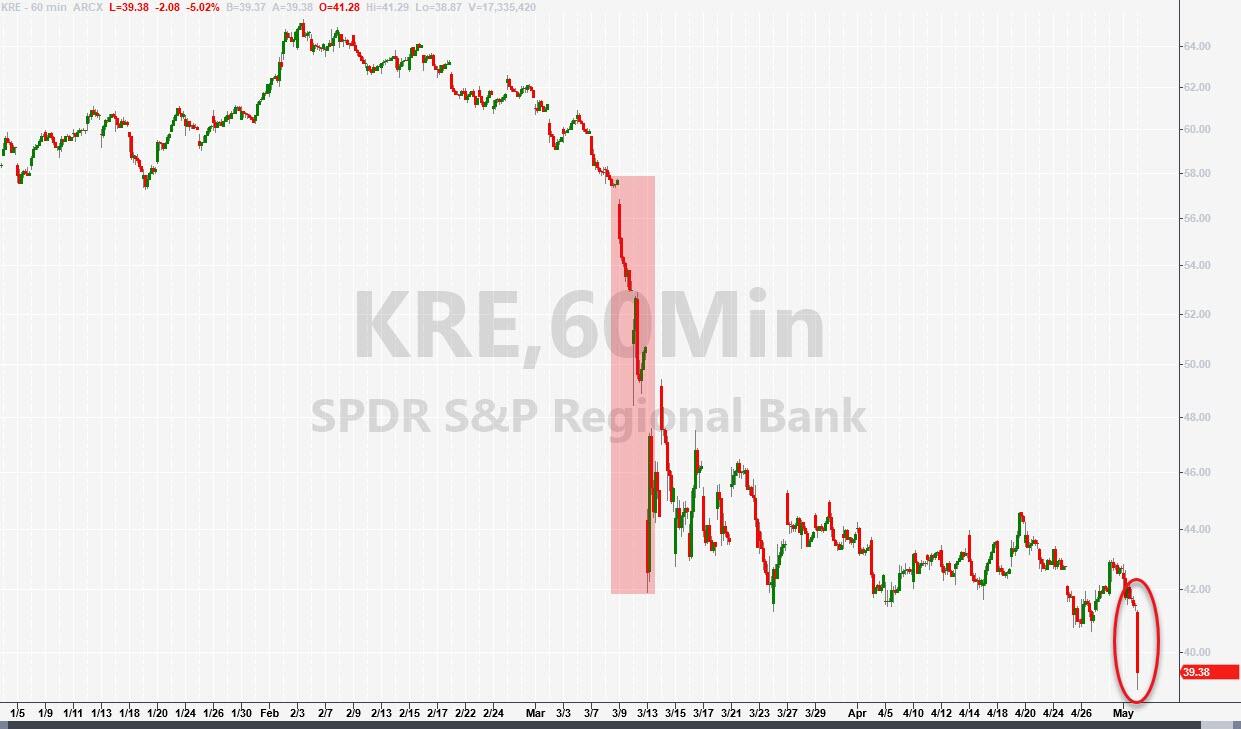
Overview: A sharper than expected decline in US job openings and weaker factory orders coupled with intensifying bank stress sent ripples through the capital markets. The large US bank index fell 4.5% yesterday, the most in six weeks, while the regional bank index fell nearly 5.5%, its biggest loss since March 13. Both indices took out the March lows. The US 10-year yield unwound Monday's increase and the two-year note yield fell back below 4.0% for the first time since the middle of last week, and yields remain under pressure today. The dollar gave back its earlier gains against most of the G10 currencies. The greenback remains under pressure today. Only the Australian and Canadian dollars are struggling to rise today. Most emerging market currencies are also firm today. 

Japanese and mainland Chinese markets were on holiday today and they were spared today's regional sell-off led by the 1%+ losses in Hong Kong. After being tagged for 1.25% yesterday, Europe's Stoxx 600 is about 0.3% firmer today. Its bank index has steadied after dropping nearly 2.4% yesterday. US equity futures are steady to firmer. European bond yields are 2-4 bp lower and the US 10-year Treasury is slipping below 3.40%. Lower yields and a weaker dollar lifted gold back above $2000 yesterday and it is holding a tight range today (~$2012.70-$2019.55). Recall that last week's high was slightly above $2009. Oil prices have continued to sell-off sharply today. June WTI settled near $76.80 at the end of last week. It dropped to almost $71.40 yesterday, and today, it has slipped below $70 for the first time since March 27. The next area of chart support is around $69 and then $67....

....MUCH MORE

Tuesday, May 2, 2023

How Bad Will Commercial Real Estate Get?

 Maybe really bad:

How do you roll or renegotiate leases and debt when the vacancy rate is 20% (30% in San Francisco)? At higher interest rates?

"Nordstrom Leaving San Francisco, Will Open Store in City With Less Crime"

Well that's rather blunt.

From Newsweek, 5/2/23 at 5:12 PM EDT:

Nordstrom is the latest company to flee deteriorating economic conditions in San Francisco.

On Tuesday, the retailer confirmed that it would close both of its stores downtown, blaming the changing dynamics in the San Francisco market over the past few years. The company's chief stores officer said the changing dynamics have negatively affected foot traffic to the stores and Nordstrom's "ability to operate successfully," according to The San Francisco Standard, an online outlet.

Crime has become an increasingly important topic in political campaigns nationwide, with cities like San Francisco and Chicago often listed as areas that are struggling with the problem. Increasing crime in San Francisco led to the recall of then-District Attorney Chesa Boudin in 2022, amid accusations that he wasn't being tough on crime. San Francisco's incidence of crime has included an increase in looting, and businesses in California have had to deal with looters ransacking stores.

Looters hit Nordstrom's Walnut Creek store east of San Francisco and Oakland in late 2021. In July, Nordstrom will close its Nordstrom Rack store on Market Street, and a month later, its location in the Westfield San Francisco Centre, a mall, will shut down....

....MUCH MORE

Convexity Maven: "Transitory Dreams"

From Harley Bassman, the Convexity Maven, May 2:

Jerome Powell, the Chair of the Federal Reserve Bank (FED), first discussed the concept of “transitory” in his June 22, 2021, testimony to a Congressional Oversight panel. Here, he was responding to the recently reported 5.0% year-over-year increase in Consumer Price Inflation (CPI).

Powell noted “recent price gains mostly reflected temporary supply bottlenecks” and that “they don’t speak to a broadly tight economy – the kind of thing that has led to high inflation over time”.

That same day, FED policy committee Vice Chair John Williams echoed that high inflation is likely transitory and that “I expect...inflation will come down from around 3% this year [2021] to close to 2% next year [2022] and in 2023.”

I dubbed pundits who aligned themselves with this notion as “Team Transitory”; and while their logic has some merit, their timing has been awful. The good news, as I will soon detail, is that the near record Yield Curve inversion combined with an elevated level of Implied Volatility finally offers some rather dreamy investment opportunities.

Looking forward and back

CPI is reported once a month as both a -arancia line- single month’s (MOM) change, as well as a -verde line- year-over-year (YOY) number.

The most recent one-month CPI (March reported in April) clocked in at 0.1%, so using bonehead math (ignoring rounding, compounding, seasonality, etc.) we could say this implies a one-year CPI of 1.2%. [0.1% times 12]

***charts omitted***
This is silly, so the Government also offers the annual (YOY) CPI change, which was reported as 5.0%. While the annual number is theoretically more robust, it too has limitations, given it is backward looking and can be greatly biased by “base effects”.

COVID-related declines of 0.4% and 0.8% in March/April 2020 contributed to the YOY CPI change from 2.3% to 0.1%. While those monthly dips quickly reversed, they remained in the YOY calculations until April 2021. Once removed, YOY CPI gapped to 5.0% from 2.6% which contributed to a bit of an Inflation panic.

This is how the FED and Team Transitory became entangled in their own shoelaces. They believed the Summer 2021 inflation spike was “base effects” driven and would soon reverse.

For myriad reasons, mostly political, the FED declined to curtail their COVID-linked “helicopter drop” of money until May 2022; and what some might call an uncontrolled ricochet, increased their Federal Funds rate at the fastest pace since Volcker in 1980.
Deferring the “why” and “how” for later, the FED’s actions have contributed to the most inverted -rosa line- Yield Curve since September 1981 where the two-year US Treasury presently yields nearly 50bps more than the ten-year UST (and 85bps in Libor rates).
FED actions have also had the undesirable consequence (from the FED’s point of view) of dramatically increasing interest rate uncertainty and -oceano line- Implied Volatility, as measured by the MOVE Index, to levels only rarely visited....
....MUCH MORE (11 page PDF)
 
Mr. Bassman knows some stuff. Among other things, he invented the MOVE Index, analogous to the VIX but for bonds. He's probably as knowledgeable about the interplay of inflation, interest rates and bond prices as anyone. Here's what we usually say at the top of the link:
First, our boilerplate introduction to Mr. Bassman:
...Wall Street loves to make convexity sound complex (I suppose it’s so they can charge higher fees?). We speak Greek (calling it “gamma”), employ physics as a metaphor (analogizing to it “acceleration”), and use mathematical definitions (since it is the second derivative of the asset’s price change).

Pish, posh. An investment is convex if the payoff is unbalanced for equally opposite outcomes. So if there’s the potential to earn a profit of two on a bet versus a maximum loss of one, the bet is positively convex. If you can lose three versus making two, it is negatively convex. That’s it. The rocket scientists are called upon to help (fairly) price the cost (value) of such possible outcomes. This is why the expansion of derivative trading in the 1990’s resulted in a hiring spree of physics PhD’s....
"Pish. Posh." is a technical term only used by market professionals for those situations where one has decided to go full Alinsky rule #5:
#5 Ridicule is man’s most potent weapon. It’s hard to counterattack ridicule, and it infuriates the opposition, which then reacts to your advantage...
The Convexity Maven is nothing if not a professional. Here is part of his mini-bio at MacroVoices:
Harley S. Bassman
Harley Bassman created, marketed and traded a wide variety of derivative and structured products during his twenty-six-year career at Merrill Lynch.  In 1985 he created the OPOSSMS mortgage options product that facilitated risk transmission between MBS originators and financial institutions.  In 1988, he assumed responsibility for trading and marketing IO/PO and other levered prepayment securities.  Soon after this, he started purchasing RTC auctioned MBS Servicing rights and repackaged them for the securities market as BIGS - Beneficial Interests in GNMA Servicing.  Later, he started a GNMA servicing conduit becoming one of the Top 20 originators in 1992.  As managing and hedging prepayment risk became a priority focus for the financial markets, Mr. Bassman created PRESERV, Merrill's trademarked Prepayment Cap product. Merrill was a leader in this product category writing protection that covered the risk on tens of billions of notional mortgage servicing rights.  Later, Mr. Bassman managed Merrill's initial venture into off-balance sheet mortgage trading.
In 1994, Mr. Bassman assumed responsibility for OTC bond options.

Within a year, Merrill was the leader in this product sector.  A wide variety of products were offered including vanilla and complex options on MBS spreads and the Treasury yield curve.
To help clients more fully appreciate Volatility as a primary risk vector, he created the MOVE Index.  Similar in form to the VIX Index, it is now the recognized standard measure of Interest Rate Volatility.

From 1995 to 2000 he focused on creating hedge strategies for MBS servicers and portfolio optimization techniques for Total Return and Index investors.

Mr. Bassman became the manager of North American MBS and Structured Finance trading in 2001.  During his tenure, he created SURF, (Specialty Underwriting and Residential Finance), a self-contained Sub-Prime mortgage conduit.  He supervised the issuance of Merrill’s first Sub-Prime securities. He also transitioned the structuring business to a new technology platform.
In 2006 he built the RateLab, a full spectrum US Rates Trading Desk Strategy Group.  Here he worked with investors to advise and optimize their risk exposure.  As a key member of the client trading business, he facilitated activity by providing liquidity to both the firm’s clients and market makers.

After a (too) brief sabbatical, in 2011 Mr. Bassman joined Credit Suisse's Global Rates business where he identified and integrated investment and hedging opportunities for sophisticated investors.
Most recently, Mr. Bassman was an Executive Vice President and Portfolio Manager at PIMCO - a leading global investment management firm.  Here he managed investments for the Liquid Alternative products group as well as advised on portfolio strategy across asset classes for the firm's franchise businesses.

Mr. Bassman splits his time between Laguna Beach, California and New York City. He has a B.A. in management science from the University of California, San Diego and an MBA in finance and marketing from the University of Chicago....

"WTI Crude Falls 4% As Economic Fears Trigger Selloff"

Most active WTI futures  $71.56 down $4.10 (5.42%).

Three from OilPrice, May 2:

10:30 am CDT

Crude oil prices were sent tumbling on Tuesday morning, with WTI falling below $73 per barrel, with Brent falling below $77 per barrel on jitters about the economy.

Oil futures are set to finish out the day on Tuesday at their lowest levels since the end of March as the market looks toward the Fed’s next policy decision.

WTI for June delivery (CLM23) fell $3.12 (-4.18%) on Tuesday by 10:45 a.m. to $72.56 per barrel. Brent crude oil for July 2023 delivery (BRNN23) fell $3.07 (-3.87%) per barrel to $76.24.

New data from China—the world’s top crude oil importer—on Monday revealed rather disappointing manufacturing activity data, which could play an important role in global oil demand. Add to this disappointing data the U.S. banking catastrophe and the fear of yet another Fed rate hike later this week, and the conditions are perfect for jitters and profit taking while the getting was good. 

All of the gains seen from OPEC’s surprise production cut announcement that the group made at the end of March have now been completely dissolved. OPEC+ agreed at the end of March to cut another 1.6 million barrels per day from its production quotas beginning in May. The news sent shockwaves into the oil market, and prices rallied. WTI spiked above $83 per barrel on the news....

....MORE

 The 10:00 am CDT headline was a bit more pointed:

Oil Prices Tank On Worrying Economic Data From China

Both of these are in the face of the 3:00 pm CDT headline:

OPEC’s April Production Falls: Survey

Yikes! Something wicked this way comes.

Related earlier today:

"Soft China PMI likely to flow through to uneven commodity demand"

RISK: "S**t Just Hit The Fan Across Markets, Regional Banks Crashing"

From ZeroHedge:

Weak JOLTS?, Poor factory orders, hot EU inflation, surprise RBA rate-hike, a sudden realization of the urgency and seriousness of the debt ceiling debacle, Europe back from vacation, or just pre-FOMC jitters?

Or was it this!?

****

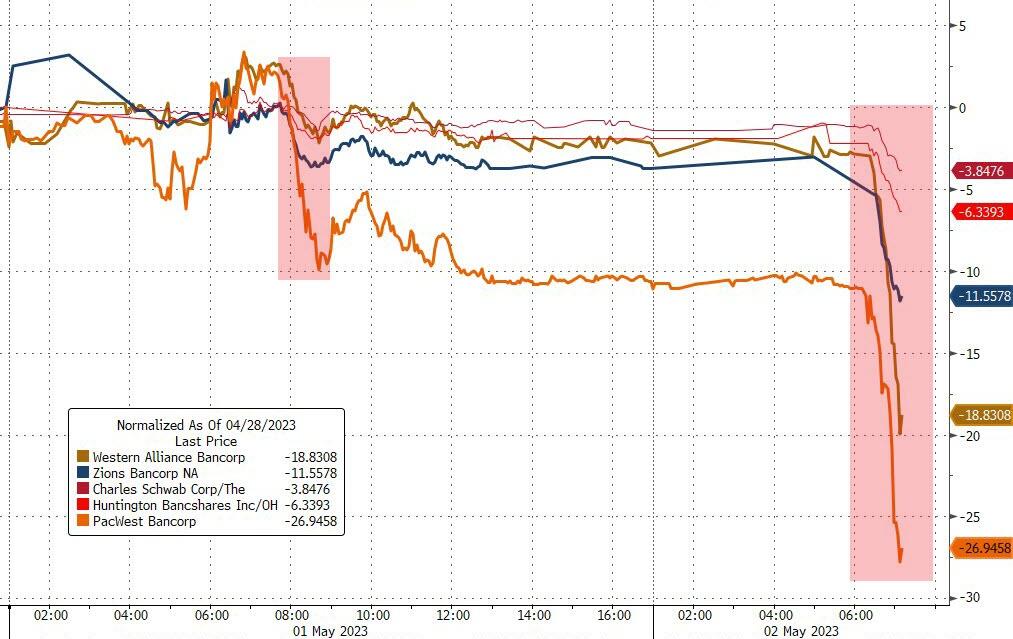
Who knows to be frank but everything went just a little bit turbo, starting with a total collapse in regional banks...

And despite the Biden admin claiming that FRC was just another 'outlier' business model, PacWest, Western Alliance, and Zions (among others) are in a freefall...

Looks like we are back to "who's next" after yesterday's Milken Conference. Here's a guide...

But the 'big banks' are also getting slammed...

....MUCH MORE, chart mania

RISK: CalTech Talking Los Angeles - Long Beach Earthquake (and down to Newport Beach)

And if Newport Beach goes there goes PIMCO ($1.8 Tril. AUM). As well as some pretty darn nice houses.

From the Daily Mail, April 24:

Is California about to be hit by a major earthquake? Study finds LA has suffered 1,200 micro-quakes in past eight months — putting area at risk of bigger tremor

  • Scientists identified 1,262 previously unknown earthquakes in California
  • The tremors were observed in the suburbs outside of Los Angeles

Los Angeles could be at risk of a major earthquake, a study suggests.

Scientists from the California of Institute of Technology (Caltech) have detected more than 1,200 shallow quakes in the past eight months.

These shallow quakes were detected about one mile below the surface, which can build up and create pathways for more significant ruptures on the surface.

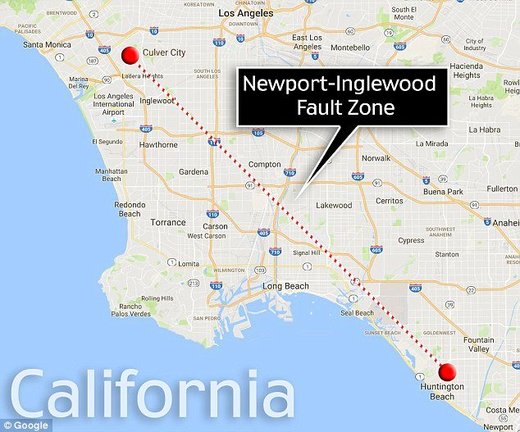
The team studied Long Beach and Seal Beach, two LA suburbs that are located along the Newport-Inglewood fault.

Previous studies have suggested this fault is capable of up to a 7.4-magnitude quake, which has 'an energy equivalent to around 32 Hiroshima atomic bombs.'....

....MUCH MORE

On the other hand the fault (roughly) connects Compton to Newport Beach which is nice. Very egalitarian:

https://www.sott.net/image/s17/349756/large/NIF.jpg

France's Ÿnsect teams up with LOTTE to explore human food applications for edible insects

 From AgFunderNews, April 27:

French startup Ÿnsect has signed a memorandum of understanding (MOU) with Korean food company LOTTE to explore human food applications for edible insects.

LOTTE, which is also working with US-based ASPIRE on human food applications for crickets, will conduct joint research with Ÿnsect to develop food products featuring mealworms, explore potential health claims, and conduct consumer research in Europe and South Korea.

Through LOTTE R&D center, we now benefit from the support of a key player to better understand the different markets in which we are establishing ourselves across the Asian continent and thus be able to meet the demand for local proteins,” said Ÿnsect food & plant sales director Guillaume Daoulas.

A focus on ‘high value markets to enable us to reach faster profitability’

Historically, Ÿnsect has focused on animal feed, but has more recently been targeting petfood with its mealworm ingredients as part of a “focus on high value markets to enable us to reach faster profitability.”

Building a bigger presence in human foods is an obvious next step, says Ÿnsect, which is already supplying food brands such as Jimini’s and Hey Planet.

VP communication and public affairs director Anais Maury told AFN: “The potential markets for edible insects in human foods may depend on various factors such as cultural attitudes, regulatory frameworks, and market demand. But overall, people are more open to incorporating insects into their diets.”

....MUCH MORE

And mandates. The power of mandates to force behavior change is immense. We already have our tagline: "When 'nudging' just isn't enough!" 

And will be making inquiries about music rights:

"If you don't eat yer bugs you can't have any pudding, 
How can you have any pudding if you don't eat yer bugs?" 
Previously:
 

"The EU just approved mealworms for human consumption. Will Ÿnsect take the bait?"
No. No to worms.
Maybe termites, if the hydrogen biofactory experiments don't work out. Crunchy. 

I Said I Want "an Omlette," NOT "an Umlaut": "Ÿnsect acquires Protifarm to raise insects for human consumption"
Ÿnsect, the bug breeder with the gratuitous umlaut is really, really on board with the WEF's "Let them eat insects" pitch. 

"Cutting Your Way to Prosperity"

 From Smead Capital Management, April 11:

Dear fellow investors, 

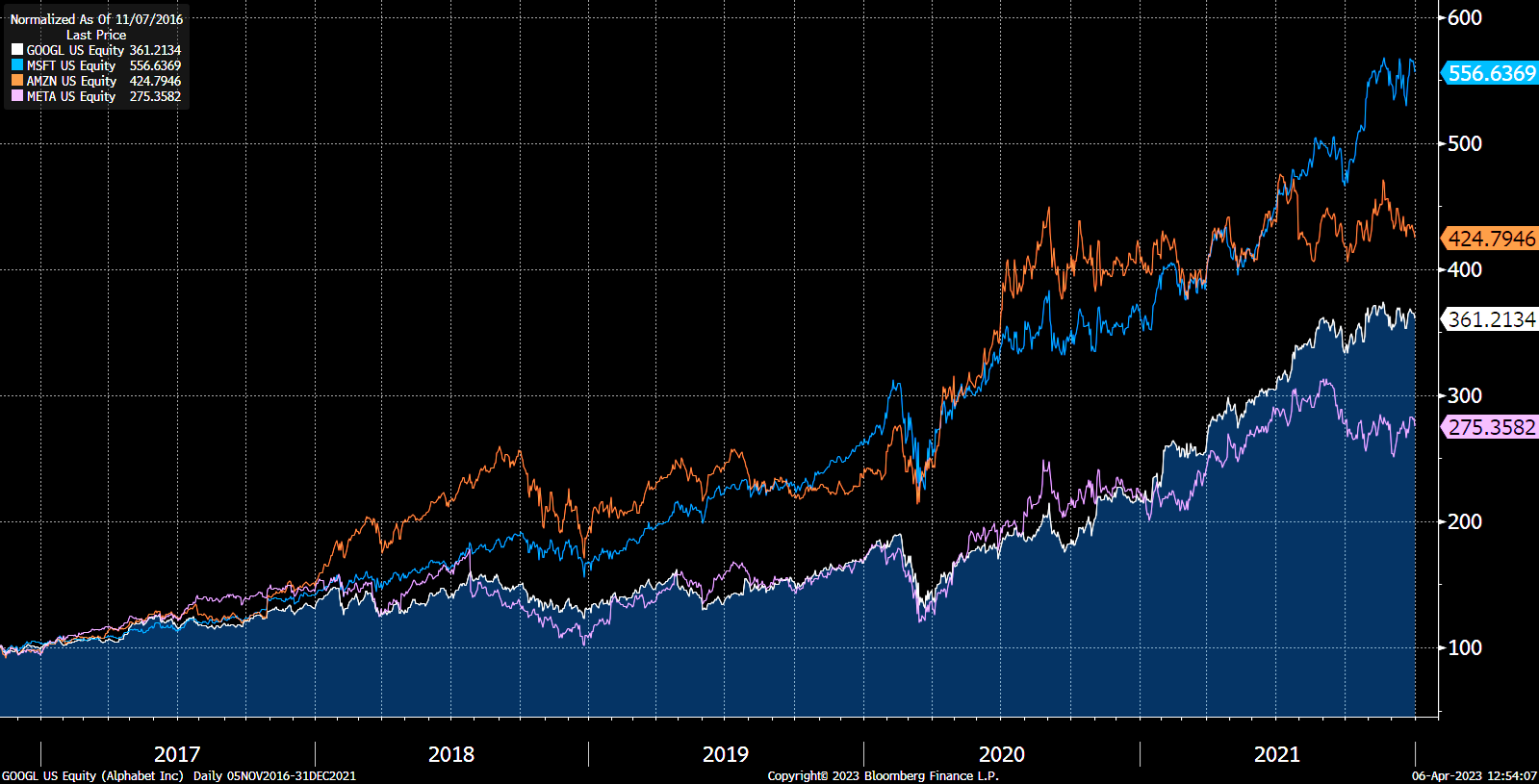
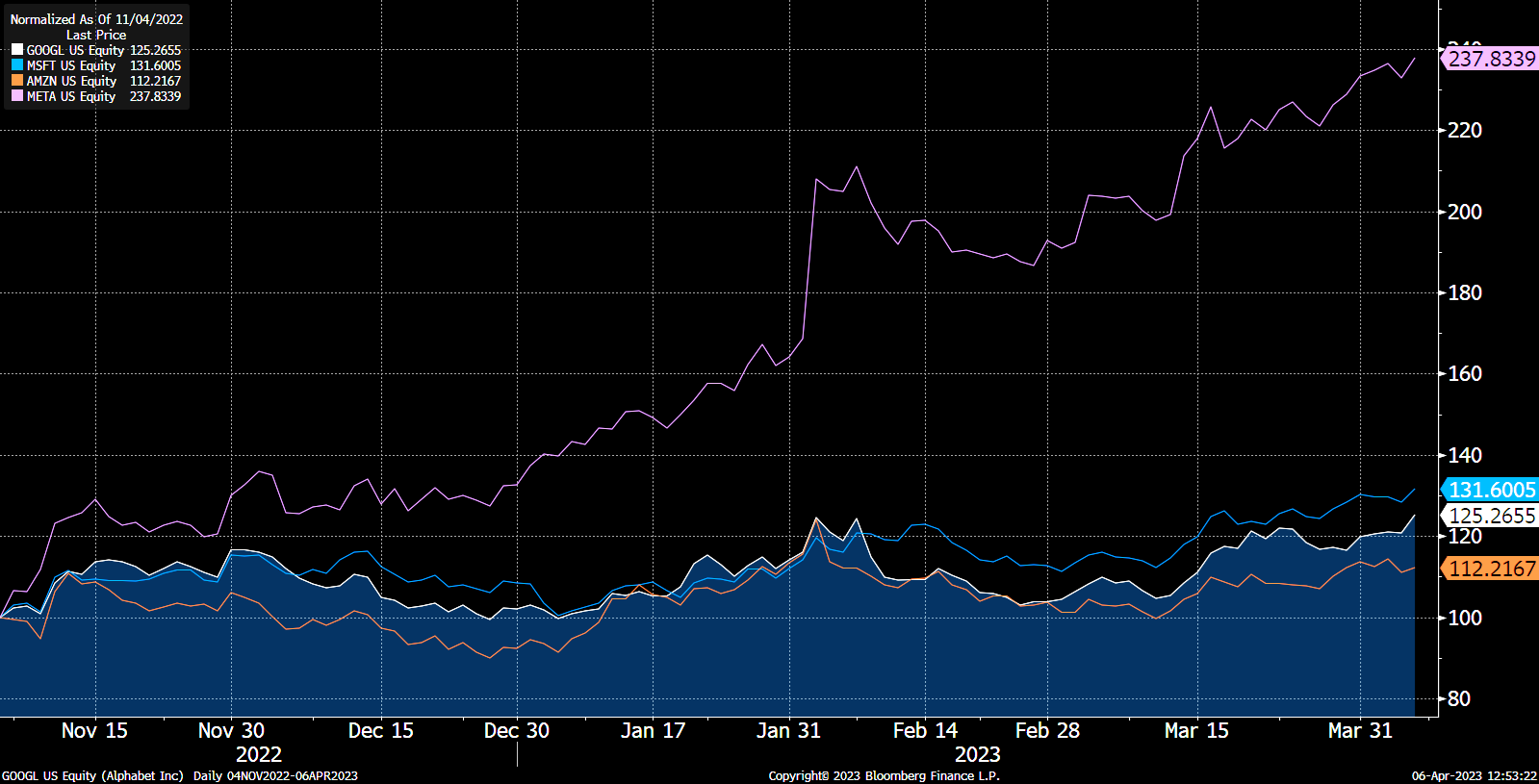
Having lived in Seattle for 40 years, I had a front-row seat as Microsoft, Amazon, Google and Facebook hired tens of thousands of young tech employees. In the period between 2010 and 2020, buildings were built, apartments were built and prosperity put the city on top of the world. From 2017-2020, more large building cranes were in operation in Seattle than in any other city in the U.S., even though Seattle only ranks 17th in population today. As those employees were being hired and those buildings were being built, here is what those four companies did in the stock market:


As you can see, the stock market celebrated hiring all of those folks with a vision of uninterrupted growth.

Now the hiring has become firing in the last six months and here is what those stocks did:


Can the biggest tech companies cut their way to prosperity?

In a prior era, the 1980s and 1990s, a huge amount of physical and financial assets had accumulated on the balance sheets of large American companies. Corporate raiders and leveraged buyout firms (private equity firms) stepped in and forced better usage of those assets. However, by the 1990s most of the low-hanging fruit had been taken. Late in the era, a sculldugger of a CEO, Al Dunlap, took Sunbeam and other companies over the edge. The media quickly turned on the methodology and they suddenly joked that “you can’t cut your way to prosperity.”

Now let’s throw the Silicon Valley Bank, Signature Bank and First Republic Bank difficulties into the mix....

....MUCH MORE

We considered Smead Capital's departure from Seattle to be a tell on the entire area and its socio-political-economic status.

June 23, 2020
Seattle Real Estate Not a Good Bet

The news that the city is going to shut-down CHAZ CHOP is not going to be nearly enough to save Seattle.
Amazon and Microsoft have been the engine of growth, in a way similar to Silicon Valley where the whole world is funneling money into a small geographical area and in the case of Amazon with coronavirus we've just seen the high-water mark for this cycle.
Like so many societies throughout history getting wealthy means getting flabby, with politics and programs that a poorer, hungrier society can't afford.

Looking at a third metro area, Minneapolis' heyday was roughly 1880 - 1980 with the northern tier railroads, Great Northern and Northern Pacific and the heavyweight ag businesses, Pillsbury, General Mills etc. giving way to first round tech, Medtronic and St. Jude Medical, Control Data and Cray Research and then stagnation into a violent* little backwater, coasting on accumulated capital and slowly becoming irrelevant on the world stage except as a chokepoint for soybeans and corn being sent down the Mississippi or up to Duluth and eventually the Atlantic.

Seattle was touted as heaven-on-earth with the $15.00 minimum wage for restaurant workers but the touts never mentioned that it was only because of Amazon that it was possible.
And now those jobs are no more and 50% of them will not come back.
For a while Seattle had more construction cranes than New York and even London but those days are gone and here's the rest of the story from Phoenix's KTAR news:

Due to Seattle’s unrest, billion-dollar investment firm moving to Phoenix
PHOENIX — Coronavirus pandemic or not, an investment advisory company is leaving the cultural unrest in Seattle and moving its headquarters to Phoenix’s Camelback Corridor.

” … The unrest that has taken place in the city of Seattle … there is really is not a downtown business community today,” Smead Capital Management, President and CEO Cole Smead told KTAR News 92.3 FM.

Smead said that although taxes in Seattle are lower, candidate recruitment is harder and the cost of living within the city is more expensive than Phoenix.

“We’re hearing rumors of 40-story buildings that will be only 20-percent occupied by October,” Smead said....
....MORE
*Another 11 people shot in three incidents yesterday on top of the 19 over the weekend and the ninety in the first 25 days after Mr. Floyd was murdered.
And the stabbings.

Minneapolis real estate probably not a good bet either, what with the City Council voting to disband, not defund but disband the police department. 
The Minneapolis mention was followed a year later by:
Target HQ Is Bailing Out Of Downtown Minneapolis (TGT)
A similar story came out of Camas Washington, down on the southern border across from Portland Oregon, March 30, 2023:
"Fisher Investments Moves to Texas Over Taxes
It's amazing how much information there is in "the news." 

"Vice Media reportedly headed for bankruptcy"

These venture-backed online platforms were extremely destructive of the mid-20-teen  media landscape.*

From The Guardian, May 1:

Plan comes amid waves of media layoffs and closures, including shuttering of BuzzFeed News

Vice Media Group, the company behind popular media websites such as Vice and Motherboard, is preparing to file for bankruptcy, the New York Times reported on Monday, citing people with knowledge of its operations.

The report comes days after Vice shuttered its Vice News Tonight program, and amid waves of media layoffs and closures, including the end of BuzzFeed News.

Vice has received interest from five companies and might consider a sale to avoid bankruptcy, the Times report said, adding that in the event of a bankruptcy, which could happen in the coming weeks, Vice’s debt holder Fortress Investment Group could end up controlling the company.

The company is expected to continue operating normally in event of bankruptcy filing, the Times reported....

*Back in 2017 Talking Points Memo understood and was able to articulate what was going on:

"Is Venture Capital Destroying Online Journalism?":

I don't know but having spent some time trying to front run Sand Hill Road and understand things like Uber I have to say this is an interesting insight.
From Talking Points Memo, November 17:
There’s a Digital Media Crash. But No One Will Say It...
And a year later we were seeing:
Media: "BuzzFeed CEO Jonah Peretti’s increasing pessimism and why it matters"
As promised in our earlier "Fed Working Paper: "Are Millennials Different?" (and why 'news for millenials' plays never panned out)" a continuation of our look at the "Millennial" media....

"Soft China PMI likely to flow through to uneven commodity demand"

Most active (July) U.S. futures 3.9075 down 0.0265 (-0.67%)

From Reuters via Mining.com, May 1:

The surprise contraction in China’s manufacturing index in April, coming after first quarter growth exceeded expectations, underlines the uneven nature of the recovery in the world’s second-biggest economy.

This variable economic story is likely to be mirrored in China’s imports of major commodities, with strength in some areas being offset by more modest demand in others.

The official manufacturing Purchasing Managers’ Index (PMI) dropped to 49.2 in April from 51.9 in March, slipping below the 50-level that demarcates expansion from contraction for the first time since December.

The PMI was also below market expectations for a positive outcome of 51.4.

Among the components of the PMI showing weakness were new export orders, with this sub-index declining to 47.6 in April from 50.4 in March.

Manufacturing is one of the key pillars of China’s economy from a commodity demand perspective, the others being construction and infrastructure.

The news here is somewhat mixed, with infrastructure investment rising 8.8% year-on-year in the first quarter, outpacing a 5.1 rise in overall fixed-asset investment, while property investment fell 5.8%.

The overall picture for the steel and copper intensive sectors is cloudy, with some areas of strength, but others still struggling to regain momentum after losing steam during China’s strict zero-Covid period, which ended in December.

If manufacturing, construction and infrastructure are uneven, what is the source of the strength in China’s economy, given that first quarter growth exceeded expectations?

Gross domestic product rose 4.5% in the first quarter, beating market forecasts for a 4.0% gain, but much of the outperformance was driven by retail spending, which isn’t especially supportive of steel and copper demand....

....MUCH MORE

Monday, May 1, 2023

How 16 Cents And A Shift To Real Estate Allowed The Richest Man In The World To Build An Empire Worth Over $200 Billion (LVMH Moët Hennessy Louis Vuitton)

Our most recent post on M. Arnault was April 26's "Bernard Arnault, Chairman and CEO of Louis Vuitton is currently the world’s richest man, worth around $239 billion...."

From Benzinga via Yahoo Finance, February 27:

While he’s not as popular as Jeff Bezos or Elon Musk in the U.S., Bernard Arnault doesn’t need to be — he’s the richest person in the world and may have the most unique story amongst his billionaire peers.

Arnault, 73, born in France, may be most well-known today for his founding and current leadership of LVMH Moët Hennessy Louis Vuitton, the world's largest luxury goods company, but how he got there involved one French Franc ($0.16 USD), real estate in the French Riviera, and condominiums in Palm Beach, Florida.

Estimated to have a net worth of $201.8 billion, making him the richest person in the world ahead of Elon Musk and Jeff Bezos, Arnault graduated from the École Polytechnique in Paris with a degree in engineering before beginning a career at his father’s construction firm Ferret-Savinel.

Around five years into being at his father’s firm, he convinced the company and his father to liquidate the construction division and enter the real estate market — Arnault earned $15 million in the sale.

Under the name Férinel, the family company initially developed specialty holiday accommodations. Named a company director in 1974, and named CEO in 1977, Arnault started building timeshares on the Mediterranean coast of southeastern France.

Shortly after in the 1980s, Arnault moved to the U.S. and started developing condos in Palm Beach, while simultaneously building a U.S. branch of his family’s property business amid socialist power in France.

The French Socialists switched to a more conservative economic course in 1983, prompting Arnault to return to his native France — this is where the one French Franc comes in....

....MUCH MORE

Some of our prior posts on his and his company's approach to the world:  

French Cryptocurrency Wallet Maker Valued At Over $1.5 Billion
So what's the big deal? Louis Vuitton has wallets. Here's one that looks like their original steamer trunks:

 https://us.louisvuitton.com/images/is/image/lv/1/PP_VP_L/louis-vuitton-wallet-trunk-monogram-eclipse-canvas-trunks-and-travel--M20249_PM2_Front%20view.png?wid=456&hei=456

$6,050.00

Oh wait.

From Reuters:

Tech group Ledger completes new fundraising, valuing it at over $1.5 billion

French technology and digital company Ledger said on Thursday it completed a new $380 million fundraising round that gave it a valuation of more than $1.5 billion.

Ledger, headquartered in Paris, runs a platform called Ledger-Live which deals with cryptocurrencies.

Its latest Series C fundraising round was led by 10T Holdings, while other investors involved included Financiere Agache, a unit of Bernard Arnault, the French luxury goods billionaire who runs LVMH....

....MORE

 Background at Coindesk, December 1, 2020:

Crypto Wallet Maker Ledger Hires Luxury Brand Exec to Grow Consumer Business

Or pop for one of the 1930's Louis Vuitton steamer trunks on offer at Etsy

https://i.etsystatic.com/10611204/r/il/e1a941/2781498224/il_794xN.2781498224_d8pa.jpg

$35,560.07 (free shipping)

Father's Day is coming up. Just sayin'

"How a group of herring fishermen may get the Supreme Court to reel in government power"

I'm telling you there is something about food stories that triggers something a little bit whack deep inside headline writers. Much earlier today we saw this at Bloomberg: "Japanese Scientists’ Potentially Egg-cellent New Breakthrough."

From USA Today, May 1:

WASHINGTON – Space is tight on the small boats that trawl the Atlantic in search of herring. Something else that's in short supply aboard: patience with the federal government

Since 1976, federal inspectors have been allowed to join the five- or six-member crews fishing off the East Coast to ensure they follow regulations – an "enormous imposition," according to the fisherman. But starting in 2020, the government went a step further, requiring the industry to pay the salaries of the observers they take on. 

Four family-owned fisheries sued the Commerce Department three years ago over that requirement. The Supreme Court announced Monday that it will decide their appeal – weighing into a dispute that could have consequences that reach far beyond seafood, affecting the power other federal agencies have to regulate.  

While the case is focused on the fishing industry, the implications are vast and represent a major catch for conservatives who for decades have sought to limit the power of the "administrative state." Depending on how the Supreme Court rules, the decision could affect every facet of the federal government's ability to regulate pollution, the internet, gun accessories and even how Americans respond to the next global pandemic.

What the herring fishermen are saying about their fight with the government

  • What's at stake in a major Supreme Court case about herring fishermen?  To require the fisherman to pay the inspectors' salaries, the government relies on a section of a 1976 law that gives the National Marine Fisheries Service power to impose regulations that are "necessary and appropriate" to manage the species. 
  • For decades, conservatives, in particular, have been trying to limit the government's power to impose regulations based on similarly vague language. A ruling for the fishermen could lead to successful challenges of other regulations dealing with the environment, guns and how the U.S. responds to the next pandemic.
  • The Supreme Court will likely hear arguments in the case, Loper Bright Enterprises v. Raimondo, in the next term that begins this fall. A decision may not come until next year.... 

....MUCH MORE 

The writer does a first-rate job pointing up the issues of the Executive Branch and their agencies: also known as Leviathan* or the Administrative State and how the current court is attempting to delineate where Congressional delegation of their power becomes abdication.

This has been something to be aware of for going on a year, since the EPA/CO2 decision last July.

We most recently brought the topic up in April "Is the Securities and Exchange Commission Unconstitutional?"
There was a purpose behind all our blather about dismantling the Administrative State last year. If interested see after the jump....
—Thomas Hobbes, 1651

Electric Vehicles—Battle Of The Biggest Producers: Tesla Stock Vs. BYD Stock

 First, to set the mood:


A deep dive from Investor's Business Daily, May 1:

Tesla (TSLA) and BYD (BYDDF) are the world's largest electric-vehicle makers. Which one is No. 1 depends on your EV definition.

A lot of attention is focused on EV startups such as Nio (NIO), Li Auto (LI), Xpeng (XPEV), Rivian (RIVN) and Lucid (LCID). Efforts by traditional automakers such as General Motors (GM) and Ford Motor (F) also get coverage. However, Tesla and BYD stand apart.

In 2022, BYD vehicle sales raced far past Tesla's. Among all-battery electric vehicles, or BEVs, Tesla still leads.

Tesla announced big price cuts worldwide in January, and has kept doing so. Many other China EV makers have also cut prices in turn, including BYD.

Tesla earnings fell solidly in the first quarter, with gross margins plunging. BYD reported booming Q1 earnings growth vs. a year earlier, though profit and sales fell vs Q4.

Despite their similarities and size, Tesla and BYD historically haven't competed much directly. That's starting to change, with more BYD models vying for the same segments as Tesla. BYD unveiled several models at the Shanghai Auto Show, across a wide price scale.

Tesla stock had a terrible 2022, plunging sharply in December and to start 2023. But shares boomed from Jan. 6, when the latest China price cuts were announced. After consolidating, Tesla stock broke out on March 31, but tumbled back following deliveries. Shares have tumbled below key moving averages.

BYD stock is up solidly in an up-and-down year, recently clearing an aggressive entry.

Let's take a look at BYD vs. Tesla, as well as BYDDF stock vs. TSLA stock.

Tesla Vs. BYD: Does BYD Sell More EVs Than Tesla?
Tesla deliveries for the first quarter came in at a record 422,875, up 36% vs. a year earlier and 4% above Q4's 405,278. Big Tesla price cuts worldwide and new U.S. tax credits fueled demand.

Wall Street had expected deliveries of 432,000, according to FactSet on Friday. Tesla sales have fallen short of views for several quarters. Deliveries did top some consensus forecasts.

'Production once again exceeded deliveries, at 440,808. Model S and X output was at 19,437.

The output-to-sales imbalance is a concern, with analysts worried about further Tesla price hikes to support deliveries.

BYD sales surged 209% to 1,863,494 in 2022. Of the personal vehicles — excluding big rigs, buses and heavy equipment — some 911,140 were BEV vehicles and 946,239 plug-in hybrid (PHEV) vehicles. BYD's hybrids offer at least 50 miles of battery range.

On April 2, BYD reported first-quarter sales were 552,076, up 93% vs. a year earlier but down 19% from Q4's record 683,440. Sales did pick up to 206,089 in March from February's 191,664 and January's 150,164.

Passenger sales — excluding big rigs, buses and heavy equipment — were 547,917 in Q1, with 264,647 BEVs and 283,270 plug-in hybrid vehicles (PHEVs).

Some of the Q1 decline vs. Q4 reflected some Covid impact to start the year, as well as Lunar New Year holidays in late January. But there's no doubt that the Tesla-led EV price war has taken a toll on BYD, especially vehicles such as the Han and Seal.

Tesla slashed its entry-level Model 3 price by about $7,280 over late October and early January, with several other EV makers including XPeng announcing major cuts as well.

BYD has offered more limited discounts, but has stepped up with sizeable incentives for the Seal. From April 7-30, customers can get up to 31,000 yuan ($4,510) in discounts off the Model 3 rival.

BYD's upscale Denza brand sold 10,398 D9 minivans in March.

Export sales hit 38,725 in the first quarter, providing an escape valve from a brutal home market.

BYD is not just the largest EV and NEV seller in China, it's the country's largest automaker, period.

BYD will release April sales figures in early May.

Tesla Price Cuts
Tesla has slashed prices worldwide multiple times in 2023, starting in January and continuing into April. The only exception is China, where Tesla cut prices significantly in late October before the early January cuts.

U.S. price cuts have made most Model 3 and Y vehicles eligible for new U.S. tax credits of up to $7,500, subject to a variety of conditions. However, the IRS has released battery sourcing rules that reduced tax credits for the entry-level Model 3, which uses China-made LFP batteries, to $3,750.

The global price cuts sparked demand for Tesla Model 3 and Y vehicles, but the effect has quickly worn off, spurring further cuts.

In China, a slew of rivals have slashed prices, muting the impact of Tesla's discounts. BYD and rivals also will launch a bevy of new models in the next few months, many of which will target Tesla directly.

In late April, Tesla began offering some new modest discounts on some Model 3 and Y inventory vehicles in Europe....

....MUCH MORE

RISK: Gibbons

 Via Nature is Amazing:

RISK: Don't Look Now But H5N1 Bird Flu Has Been Found To "Efficiently" Spread In Certain Mammals

 From the Telegraph, April 25:

Alarm as bird flu found to ‘efficiently’ spread between ferrets
Ferrets are used by scientists to understand how flu bugs could impact humans and say the findings are worrying 

The bird flu virus that is killing millions of animals around the world has been found to “efficiently” spread between ferrets in a laboratory, raising concerns about the potential for the virus to jump to humans.

In a new preprint, scientists in Canada demonstrated that H5N1 samples taken from a red tailed hawk spread efficiently between ferrets – the main “animal model” used by scientists in experiments to analyse how respiratory viruses may impact people.

It is the first study to clearly confirm that the virus can spread from mammal to mammal – although the recent deaths of many animals, including sea lions, have previously suggested this. Analysis of an outbreak at a mink farm in Spain and in seals in New England have also pointed towards spread between mammals.

But the results from Canada suggest that some strains of H5N1 with “certain adaptations that allow for a higher degree of replication, pathogenicity, and transmission” may be spreading.

Over the last 18 months, avian influenza has devastated wild and farmed bird populations across the globe. But there has also been mounting alarm around cases in mammals including foxes, sea lions, dolphins and even domestic cats.

This has created unprecedented opportunities for the virus to shift and reassort – a process where different strains of the same pathogen combine into something new.

“The risk [for humans] is increasing in the sense that there is a lot of virus in poultry and wild birds,” Prof Munir Iqbal, a member of the UK government’s modelling group for bird flu, told the Telegraph recently.

“The virus can change at any time, and therefore the risk is higher when there’s more in the environment. That doesn’t mean [a human epidemic] is imminent… but no one has control of the virus,” he said.'We have to stay on our toes'
So far, cases in people have been sporadic and health agencies have maintained the threat is low.

But the latest study points towards the “potential for this virus to infect and transmit between mammals including humans,” according to researchers at organisations including the Public Health Agency of Canada.

Prof Marion Koopmans, a Dutch virologist who was not involved in the research, said the preprint, which is yet to be peer reviewed, is a reminder of the threat posed when slightly different H5N1 strains combine.

“[The] most important message here is: let's not assume we know ‘the’ properties of viruses that are spreading so widely,” she told the Telegraph on Monday....

....MUCH MORE

Here's the pre-print of the paper:

Transmission of lethal H5N1 clade 2.3.4.4b avian influenza in ferrets

The headline at the Daily Mail is a bit more tabloid-y:

Fresh pandemic fears as virologists discover bird flu spreads 'efficiently' in ferrets - sparking warning that strain could be 100 TIMES worse than Covid if it ever jumps to humans

I was about to say "Watch out for the 'effin cats" as cats are pretty efficient bird killers but now we see, also at the Daily Mail, April 25:

Now be prepared for DOG FLU! Mutated form of avian influenza that strikes canines is 'creeping' towards being able to infect humans, scientists say

We've been following this nastiness for years, usually from the agricultural angle but also because of a couple rat-bastard scientist. Previously:

February 15, 2023
"Bird flu may mutate to kill more than 50% of humans who catch it, as a result of 'unprecedented' outbreak sweeping mammals, experts fear"

Hopefully not related:  

Hey, Remember Those Wacky Dutch Scientists Who Weaponized Bird Flu To Kill Half The World's Population?

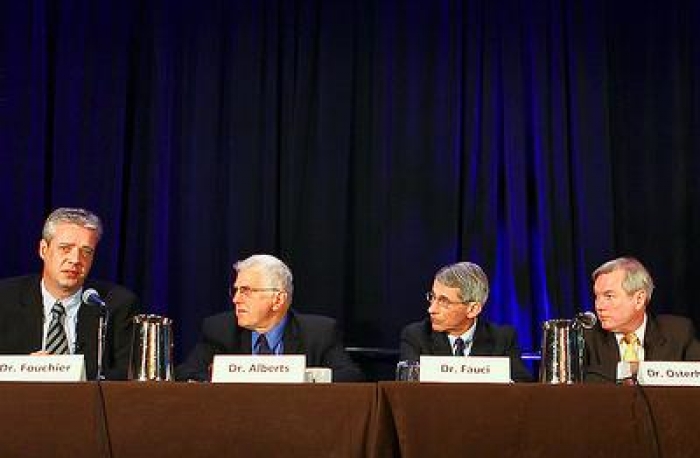
I had forgotten about Ron Fouchier until a friend sent an article from the journal Science. But sure enough we had November 2011's "UPDATED--"Dutch Scientists Have Genetically Altered the H5N1 Bird Flu Virus to Make it More Contagious" (could kill half humanity)" and then when they wanted to publish the recipe and the U.S. said no: "Psychotic Dutch Scientists: "Killer flu doctors: US censorship is a danger to science".

Our outro from that long ago post was 

"The U.S. National Institutes of Health funded the research. They own it. If Fouchier doesn't understand the implications of publication the NIH had to step in. This is just nuts." 

And the article from Science?

March 9, 2012
Surprising Twist in Debate Over Lab-Made H5N1....

 UPDATE: Dutch Scientists Agree to Redact Details of Super-lethal (50% Kill Rate) Genetically Modified Bird Flu

Also: 

"Bioengineering The Age of Designer Plagues"

And F***ed up:

Ron Fouchier (a sin.) al convegno di Malta dove vantò la sua scoperta: aveva reso l’aviaria trasmissibile per via aerea. Anthony Fauci era presente, come si vede.

Via "L’olandese del Coronavirus. Ed altri scriteriati.

Oh, and this "Fouchier study reveals changes enabling airborne spread of H5N1":

A study showing that it takes as few as five mutations to turn the H5N1 avian influenza virus into an airborne spreader in mammals—and that launched a historic debate on scientific accountability and transparency—was released today in Science, spilling the full experimental details that many experts had sought to suppress out of concern that publishing them could lead to the unleashing of a dangerous virus....

AI: "The Little Book of Deep Learning"

For now, just a personal bookmark.

From François Fleuret.  professor of computer science  Université de Genève, Switzerland, May 1, 2023

Russell Napier Has Some Ideas On Financial Repression And Funding A Green Revolution (and a whole lot more)

 From CityWire, April 3:

Russell Napier believes a new financial system is taking shape based on the covert control of commercial banks by governments. This could channel huge amounts of capital to renewables. 

The energy transition will require a lot of capital investment. Professor Russell Napier’s belief that governments are taking covert control of the money supply through interventions in the commercial banking sector – most recently at regional US banks and Credit Suisse – suggests a route through which lots of cheap capital may come.

His predictions, which are based on historical precedent, also offer a fascinating take on where the financial system in developed economies may be headed.

Russell is an acclaimed financial historian and market strategist. He writes the Solid Ground newsletter covering his global macroeconomic views. And he’s the co-founder and keeper of the Library of Mistakes, a library and reading room in Edinburgh devoted to the study of financial history and associated mishaps. He’s the host of the Library’s podcast, too.

Books mentioned in this podcast include two written by Napier – The Anatomy of a Bear and The Asian Financial Crisis – as well as Controlling Credit by Eric Monnet, and Capital Returns and Capital Account, both edited by Edward Chancellor. The Bank of England article mentioned can be found here.

Podcast transcript

Algy Hall (host) - Hello and welcome to the Fix the Future Show. The podcast where we look at how investors can do good, while also making good returns. I’m Algy Hall, the investment editor of Fix the Future and I’m joined today, by Professor Russell Napier. 

Russell is an acclaimed financial historian and market strategist. He writes the Solid Grand newsletter, in which he shares his global macro thinking, with a readership of mainly professional investors. He’s also the co-founder and keeper of the Library of Mistakes. A library and reading room devoted to the study of financial history and associated mishaps. He’s the host of the libraries podcast too and Russell is also the author two books. The Anatomy of a Bear, a fascinating study of four bear markets and more recently, The Asian Financial Crisis, 1995-1998, the Birth of the Age of Debt.

Hello, Russell.

Russell Napier (guest) - Hello.

Algy Hall - So, Russell, if we start, your book, The Asian Financial Crisis was, I think, originally meant to the be first chapter in a book intended to take us to the pivotal moment that you believe we’ve arrived at today. There’s clearly a lot of say about that history, seeing as a chapter turned into an entire book. If you can, could you give a brief outline of what you believe has been happening to the financial system since 1995, before we get on to how that may shape the future?

Russell Napier - The reason it’s relevant is that the defining fact in the world today is debt. Levels of debt relative to the size of the economy, relative to the size of private sector cashflow. So that book tries to get to the point of, why are we here? How did we get here and then we’ll spend a lot of time talking about where we go next. The fundamental reason we got here was a target for central banks of inflation, not credit. So, they ignored the build-up in credit in the system. In the book, it specifically says it was the devaluation of the renminbi in 1994 which triggered massive devaluations across Asia. Then, the crucial decision they all made, which was to lock in those incredibly cheap exchange rates.

Two consequences from that. One, they became rather large buyers of US Treasuries. So, they depressed what we refer to usually, as the global risk-free rate and secondly, by having grossly undervalued exchange rates, they exported deflation to the rest of the world and kept inflation low. So, if you lived in the developed world post these devaluations, you got remarkably low interest rates, partially due to the Asian central banks buying off fixed interest securities and you got very low inflation. So, you got the perfect opportunity to borrow more money and we did. So yes, a mistake by central bankers, but actually this bigger structural issue.

We created a whole new monetary system in 1994 to 1997 and didn’t really notice it, didn’t pay any attention to it. I think Paul Volcker, he had long left office, would talk about this as the non-system. He would call it the non-system and just how dangerous it was that there was no agreement here. This was imposed, it wasn’t agreed by all the parties and I think we’re living with the consequences. The consequence is that we have the highest level of debt of GDP, in the developed world ever recorded in human history. We don’t have all the data, as you know, for the whole of human history, but it’s certainly above World War II levels, when we add the government and the private sector together.

Therefore, almost certainly is the highest level of debt to GDP ever recorded and that is the number one thing that must shape all of our futures. Sustainable, unsustainable, whatever. That’s the starting point that we now have to begin to cope with. Just one final point on that. This thing, it didn’t just push interest rates to low levels, it pushed them to 5,000-year lows. At least we have interest rate history going back to the Sumerian period. So, let’s just say, all-time lows. So all-time high debt relative to the economy. Also, relative I think, to cash flow, certainly at current interest rates and all-time low interest rates and it’s over.  The low interest rate bit is over. So now, we’ve got to work out what happens next, but I think that’s what the book is about. It’s about how we got where we are, but I think people are now more interested in where we’re going.

Algy Hall - Absolutely. Also, we’ve had this system which wasn’t an agreed regime, you said, but it was a system that carried on. We had low inflation through that time. What’s changed?

Russell Napier - Anybody listening to this, should really now go to the Bank of England website and read a little article I wrote called How Money is Made. I think’s compulsory reading for everybody. When you do that, what you discover is that nearly all the money in the world is made by commercial bankers. It is not made by the government and it is not made by the central bankers.  That comes as a shock to most people. Even people with a great deal of experience in financial markets, it comes as a shock. So, if we fail to produce enough money to produce inflation, it has been, in recent years anyway, due to a lack of bank credit growth.

After the GFC, not only were the bank balance sheets in a mess, we did regulate them pretty heavily as well. So, the banks were not in the business of extending credit and creating money. Then one morning, I’m going to get to April 2020 everything changed because somewhere in government, somebody realised that you could make the banks lend as much money as you wanted them to lend if you guaranteed their credit risk. Now this is obviously, Covid. We basically closed down the economy.  The private sector, households and corporates were desperately in need of money and the governments, obviously, used fiscal policy. More importantly, they used the banks and they guaranteed lots of bank lending and we’re paying for that now, as taxpayers, there were billions of pounds worth in this country, of defaulting corporations that we’re paying for as taxpayers.

So suddenly, the government’s realised something.  There is a magic money tree. If we look at government debt to GDP one would say they’re completely tapped out, they couldn’t possibly borrow any money, but this is a contingent liability. It’s not directly on their balance sheet.  They guarantee bank credit, the banks lend money and this was the problem and why we’ve got such high inflation. They lent so much money, the created so much money, we have inflation. To put it into context, if you’re in the US, it’s now over 40% of all the dollars ever created in history have been created since the start of Covid. It’s quite an impressive number and then all the central banks are all scratching their heads and saying, why do we have inflation?

That’s why we have inflation, but I blame the central banks a little bit. Remember, the governments basically, forced commercial banks to lend and this is important. The governments are in monetary policy, it’s always easy to say the governments do fiscal, the central bankers do monetary. We witnessing this in the last couple of weeks, the more the governments get involved in the banking system, the more the governments are in the monetary policy business. So if I had to blame anybody for this surge in inflation, I think I’d put it more to government, actually, than central bankers.

Algy Hall - Also, in terms of this back door route into monetary policy for governments. It’s been rediscovered hasn’t it. There are historical precedents for this.

Russell Napier - That’s an excellent point because really, for the whole of the post World War II period, this is how monetary policy was run and we didn’t really have independent central banks. Certainly not in Europe, we absolutely did not have them. You may be old enough to remember this great quote, ‘That the monetary policy of the United Kingdom was run by the Bank of England governor’s eyebrow.’ It was said that the Bank of England governor just had to raise his eyebrow to control monetary policy and of course, that’s correct. That is exactly how it works. In this period, if the government can control the growth of bank credit directly, it doesn’t need interest rates to do so.

That’s not the way monetary policy works. It works through a policy called credit control and if bank credit is directly linked to the supply of money, if the governor of the Bank of England said to you, run the United Kingdom’s biggest bank, I want you to grow your balance sheet at 10% this year and you’re at 10% by October, well he might call you into his office or her office these days and raise his eyebrow. That’s what that statement actually means. So, you’re absolutely right, for a very long period of time, this was the status quo. There is a very good book on it by a French academic called Eric Monnet, called ‘Controlling Credit’ which is a history of the post World War II French banking system.

Which may sound like the world’s most boring book after my own, but actually, if you want to know how the system works read the book and then ask yourself the question, who is the monetary authority of the United Kingdom? Is it the central bank still or is it the government? If you ask yourself the question in the context of what we already know about 1945 to 1979, you might come to a radically different answer from the one that you get from reading the front page of the Financial Times.

Algy Hall - What are the options that potentially we have, as being in the new world as being a very indebted country....

....MUCH MORE

RAND Corporation: "Metals Military and Mining"

From The RAND blog at RAND, April 18:

In the early 1960s, Soviet fulfillment officers at the Berezniki and Zaporozh'ye (PDF) ilmenite mines must have noticed an uptick in worldwide demand for titanium. Orders for titanium sponge were increasing around the globe, and the Soviet Union reacted by increasing production rapidly.

Yet some of these deliveries resulting from this boost in production were not reaching their intended customers. In fact, some of their customers didn't even exist. Little did the Soviet producers know that it was actually the CIA on the receiving end of these shipments.

The goal of the subterfuge? Supply Lockheed Martin with high-temperature titanium to build the A12 spy plane, a forerunner to the SR-71 Blackbird.

Russia, and a few other Soviet republics, had won the geological lottery and possessed secure access to the ilmenite ore needed to produce titanium. The United States did not have what it took to manufacture this wonder metal.

Deep concern over access to titanium prompted the CIA to launch its bold plan—and resulted in the USSR unwittingly supplying metals for a plane that would soon be used to spy on the Soviet Union itself.

Today, the U.S. aerospace and defense industries still need access to critical minerals. Yet securing them today may be an even more-complex task—one that requires more than deploying audacious subterfuge. These minerals are now very much in the public eye, and they are also needed for the clean energy technologies that will help combat climate change.

The Chains of Supply
Military requirements for platforms like the SR-71 pushed metallurgical science, processing, and technology forward throughout much of the 20th century. The resultant nickel and cobalt superalloys, titanium 6-aluminum 4-vanadium (Ti6Al4V), and others transformed not only military aircraft and munitions, but also global air travel, space flight, communications, and medical equipment.

Often illiquid and poorly governed markets affect both prices and availability, raising questions about securing access to future supply for clean energy systems.

Even stricter military requirements and cutting-edge manufacturing techniques, such as additive manufacturing, continue to push the field to its limits in the 21st century—and the demand for raw materials to satisfy these needs is growing in response.

At present, often illiquid and poorly governed markets affect both prices and availability, raising questions about securing access to future supply for clean energy systems. But the aerospace and defense industry's demands haven't gone away.

As an example, nickel is among the six critical minerals used in lithium-ion batteries that power electric vehicles. It is also crucial for military applications like jet turbine engines. But it was nickel's utility for energy storage and not its utility for aerospace or defense that motivated a Presidential Determination qualifying it for Defense Production Act Title III funding.

In response to growing global demand, and with a strategic vision, China has become the world's largest producer of many of these metals and their associated components and products. According to the U.S. Geological Survey, China is now the leading producer of 30 critical minerals, including titanium, vanadium, cobalt, and aluminum. (Russia is the second largest producer of vanadium.)

The challenge is as clear now as it was in the 1960s for the CIA. China, or other countries that dominate these supply chains, may be unable or unwilling to supply these materials to U.S. industries in the future. And even if China does not continue to be the main producer of extracted critical minerals, it very often dominates other parts of the supply chain, such as processing or component manufacturing.

In the case of titanium, for instance, Chinese production accounts for 52 percent of global titanium sponge production. The United States has a single domestic supplier of titanium sponge and relies on imports from Japan, Kazakhstan, and Saudi Arabia for the rest of its needs.

Securing Supply
Understandably, this situation alone might make military planners and acquisition professionals nervous. Add in a post-pandemic world and the Russia-Ukraine war, and risks of disruption abound. Whether a potential showdown looms between China and the United States over Taiwan or the South China Sea, or a conflict with Iran beckons, stockpiles need to be replenished to ensure military readiness—and that requires critical minerals....

....MUCH MORE

JPMorgan Press Release, Investor Presentation On First Republic Bank (JPM; FRC)

 From JPMorgan, May 1, 2023:

JPMorgan Chase acquires substantial majority of assets and assumes certain liabilities of First Republic Bank

PMorgan Chase to protect all deposits -- insured and uninsured -- bringing its financial strength, capabilities and capital to the U.S. banking system and First Republic

No systemic risk exception required; a competitive bid process minimized costs to the Deposit Insurance Fund
 

New York, May 1, 2023 – JPMorgan Chase (NYSE: JPM) today announced it has acquired the substantial majority of assets and assumed the deposits and certain other liabilities of First Republic Bank from the Federal Deposit Insurance Corporation (FDIC).  In carrying out this transaction, JPMorgan Chase is supporting the U.S. financial system through its significant strength and execution capabilities. As part of the purchase, JPMorgan Chase is assuming all deposits – insured and uninsured. 

“Our government invited us and others to step up, and we did,” said Jamie Dimon, Chairman and CEO of JPMorgan Chase.  “Our financial strength, capabilities and business model allowed us to develop a bid to execute the transaction in a way to minimize costs to the Deposit Insurance Fund.”

Dimon added, “This acquisition modestly benefits our company overall, it is accretive to shareholders, it helps further advance our wealth strategy, and it is complementary to our existing franchise.”

Key transaction elements following the FDIC’s competitive bidding process include:

  • Acquisition of the substantial majority of First Republic Bank’s assets, including approximately $173 billion of loans and approximately $30 billion of securities
  • Assumption of approximately $92 billion of deposits, including $30 billion of large bank deposits, which will be repaid post-close or eliminated in consolidation
  • FDIC will provide loss share agreements covering acquired single-family residential mortgage loans and commercial loans, as well as $50 billion of five-year, fixed-rate term financing 
  • JPMorgan Chase is not assuming First Republic’s corporate debt or preferred stock

First Republic branches will open on Monday, May 1, as normal, and clients will continue to receive uninterrupted service, including digital and mobile banking capabilities.

As a result of this transaction, JPMorgan Chase expects to:

  •  Recognize an upfront, one-time, post-tax gain of approximately $2.6 billion, which does not reflect the approximately $2.0 billion dollars of post-tax restructuring costs anticipated over the next 18 months
  • Remain very well-capitalized with a CET1 ratio consistent with its 1Q 24 target of 13.5% and maintain healthy liquidity buffers

The transaction is expected to be modestly EPS accretive and generate more than $500 million of incremental net income per year, not including the approximately $2.6 billion one-time post-tax gain or approximately $2.0 billion of post-tax restructuring costs expected over the course of 2023 and 2024....

....MORE


Investor Presentation

Webcast

Capital Markets: "Dollar Comes Back Bid, as First Republic Taken Over (Mostly) by JP Morgan"

From Marc to Market:

Overview: Most markets are closed for the May Day holiday. News that JP Morgan will acquire most of First Republic assets will be a relief for the markets. US equity futures are slightly firmer, and the 10-year Treasury yield is around three basis points higher, slightly above 3.45%. Recall that before the weekend, it has fallen from almost 3.55% to 3.42%. The market has more than a 90% chance of a quarter-point hike discounted for Wednesday. The year-end rate is still seen near 4.50%, but the market now recognizes about a 15% chance of a hike at the next meeting (June 14). Japan, Australia, and New Zealand markets were open. The first two equity market rose, while New Zealand slipped. The weakness of the yen helped lift the Topix by 1%. Europe's Stoxx 600 is edging slightly high after finishing last week with the first back-to-back gains since April 13-14. 

The dollar is mostly firmer. The Australian dollar and Swiss franc are the notable exceptions. The Dollar Index is slightly higher for the third consecutive session. If sustained, it would be the longest advance since late February. Eastern and central European currencies are softer, while the Mexican peso is about 0.2% better. Gold is mired in the pre-weekend trading range and is a little softer, as one might expected given the greenback's upside bias and the higher US yields. The yellow metal is inside the range set last Thursday ($1974-$2003). It may be the second session that gold holds below $2000. June WTI rallied 2.7% before the weekend but has given that mostly back today with a 2.05% loss bringing to back to almost $75. Last week's low was slightly below $74....

....MUCH MORE