Tuesday, March 8, 2016

Debt And Equity Markets Really, Really Disagree On Energy

From Bronte Capital:
It is no secret that US coal companies are financially stretched.

But Peabody Energy is particularly stretched.

Here - courtesy Thomson Reuters - is a price chart for the 6% coupon Peabody debt due November 2018. Its a large issue with almost 2 billion at face value outstanding.

The price is 3. That is 3 cents in the dollar.


The yield to maturity is 266 percent.

If Peabody survives without a restructure this piece of debt will make you over thirty times your money.

Obviously the debt market thinks that Peabody is dead. Dead parrot dead.

Go tell that to the equity market.

This is Peabody stock yesterday courtesy Yahoo Finance.
Yes the stock was up 40 percent....MORE

"Greenback Lacks Momentum, While Profit-Taking Weighs on Dollar-Bloc"

From Marc to Market:
Recent trends which include firmer equities and oil, weaker euro and bonds, and stronger dollar-bloc currencies are in reverse today, a turn-around Tuesday of sorts. MSCI's Emerging Market equity index is snapping a seven-day advancing streak, giving back yesterday's gains and a little more.  However, Chinese shares managed to post small gains.  
China reported a shocking 25.4% decline in February exports (year-over-year in dollar terms).  This was a much larger drop than anyone expected.  In January, exports fell 11.2%.  Imports fared better, falling 13.8% after an 18.8% decline in January.  Still, the drop was more than the 12% economists anticipated.   
There are two things going on here.  First, there are a few distortions, including the Lunar New Year and the impact of a drop in prices.  Second, there is an actual slowdown in trade.  This is what is happening globally as well.  In value terms, world trade slowed last year.  However, in volume terms, it grew slowly.  
The consequence of the dramatic plunge in exports and the fall in imports is to nearly halve China's January trade surplus ($63.3 bln) to $32.6 bln.    Economists and policymakers have argued that global imbalances are among the biggest threats to the world economy.   The reduction of current account imbalances in a world of slow growth seems to necessitate less trade.  It seems awkward to complain about the illness (imbalances) and then worry about the cure (less trade, more reliant on domestic input and demand).   
There were two reports in Japan that caught investors' attention.  First, Q4 15 GDP was revised to -1.1% at an annualized pace from -1.4%.  We had anticipated further deterioration.  Private investment and inventories were tweaked higher while consumption and public investment were adjusted lower. ...MORE

Monday, March 7, 2016

Goldman Sachs: Death Of Capitalism Averted, Time For Working Schlubs to Partaay!

Apparently the question I was asking myself in last December 20ths, "Guaranteed Basic Income as the Perfection Of Neofeudal Serfdom (should I raise the drawbridge or sell pitchforks to the mob?)" has been answered, and I'm caught long multipronged pokers.

Retail is hard.

Following up on Feb. 3's "Goldman Sachs Says It May Be Forced to Fundamentally Question How Capitalism Is Working".

They have asked the fundamental question, seen the future, and apparently it's going to be all right.*

From Bloomberg:

Get Ready for Labor to Crush Capital in the U.S.
A shift in the balance of power.
Lofty corporate profit margins—and their seeming reluctance to return to longer-term averages—last month had Goldman Sachs Group Inc. thinking about questioning the efficacy of capitalism. 
But fresh analysis from Goldman's Elad Pashtan's is sure to instill renewed faith in the Invisible Hand for any colleagues that had begun to have creeping doubts. Corporate profitability is, in fact, poised to fall, he has warned clients.
.
Better yet (at least for the average worker), Pashtan asserted that this decline in profit margins will be driven by employee gains at the expense of Corporate America.

"We may be on the cusp of a more broad-based margin squeeze," he wrote. "Our model of National Income and Product Accounts suggests a moderate decline in 2016-2017 as stronger wage growth is likely to redistribute income away from capital owners and back toward labor."

Profit margins have edged down in recent years, driven primarily by lower oil prices and the rise in the U.S. dollar, which weighed on revenues multinationals generated abroad. Ex-energy, the profit margin for S&P 500-stock index companies is down only a tick since the third quarter of 2014, he noted. Lower energy prices are a boon to many industries in which oil is an input cost, but this appears to have been offset by the adverse effect the greenback's gains have had on top-line performance.

Still, human capital dwarfs energy inputs as a share of gross output, Pashtan observed, and real wage growth is expected to be positive over the next few years because of the lack of slack in the labor market. 
"The interdependency of compensation and output suggests a close link between wages and profit margins," he found. "Indeed, as wages accelerate above core inflation—a proxy for output prices—profit margins have correspondingly declined (assuming no changes in labor productivity)."...MORE
 

*The "seen the future" bit is a riff on Lincoln Steffens' famously wrong statement about Soviet Russia in a letter dated April 3, 1919: “I have seen the future and it works.”.
It didn't.

The Goldman soul-searching is probably all related to the questions raised in 2012's "TAXES, CAPITAL AND JOBS".

See also: "Andrew Smithers on Labor, Capital and Taxes" or any of a couple dozen posts on mean reversion in profit margins.

Oil & Gas: Peak Chesapeake (CHK)

The stock is at $5.33 up 25 cents after trading as high as $5.76.
From Slope of Hope:
This energy sector rally over the past four weeks has become insane. Apparently driving your car at a high rate of speed in order to (very messily) kill yourself is good for the stock of the company you founded.
0307-chk
As a side note, I made a horrible mistake with the “Let ‘Em Burn” video on February 11th which marked, virtually to the second, the bottom of the entire market. As God is my witness, I shall never post that video, or Chocolate Rain, again. Shame on me for my hubris....
...MORE

"Is US inflation (finally) rising?"

We're on-board the G.D. love train, some links after the jump.
From Gavyn Davies' blog at the FT:
A few months ago, this blog commented that a rise in inflation in the advanced economies early in 2016 was “almost certain”. Thank goodness for the word “almost”. Since then, oil prices have plumbed new depths, and the markets have remained obsessed with fears about deflation. 
The case for higher inflation in 2016 rested on the fact that the impact of energy on headline consumer price inflation would change direction when oil prices stabilised. This “inevitable” arithmetic effect has been delayed by the slump in oil prices in January, but it should manifest itself in the near future. 
The key question, though, is whether this automatic rise in headline inflation presages a more important turning point for underlying inflation in the advanced economies – a turning point that has been wrongly predicted for several years now. 
The answer is that there are some tentative signs of a slow rise in underlying inflation in the US, where price increases have been higher than expected in recent months. In contrast, inflation rates in the Eurozone and Japan have surprised on the low side. There, fears of “secular stagnation”, leading to deflation, still seem all too real. 
Many economists argue that concerns about inflation in the US, reflected in the Federal Reserve’s decision to embark on monetary tightening in December, are still way over-blown. With views about the future path for inflation sharply polarised even within the Federal Open Market Committee, some policy makers have said that their decisions will be determined by actual consumer price data in the months ahead. 
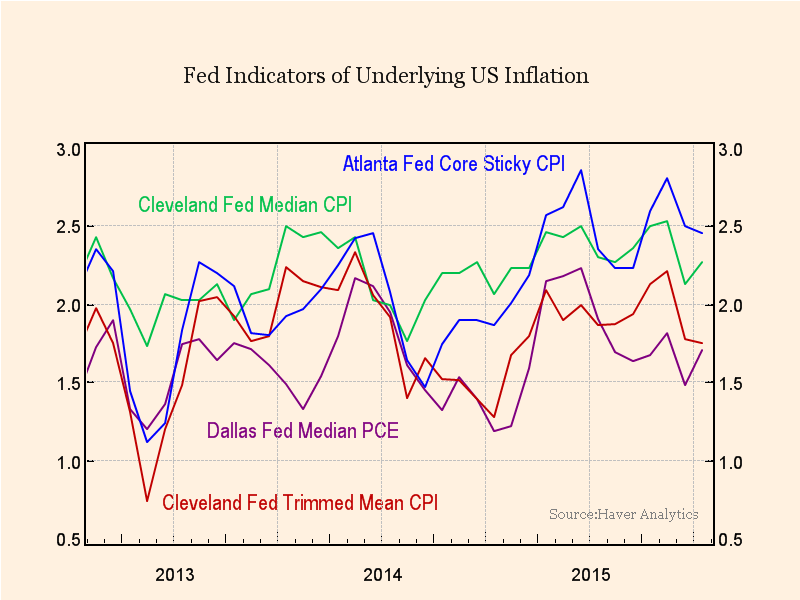
So far, the data seem to be justifying some of the concerns of the hawks. In January, the core PCE consumer price inflation rose to 1.7 per cent, not far below the official 2 per cent target for overall PCE. Since July of last year, both core CPI and core PCE inflation have accelerated by 0.4 percentage points, to 2.2% and 1.7%, respectively.That represents only scant evidence of a turning point in the inflation process, but the underlying price data calculated by several of the regional banks in the Federal Reserve system show recent inflation rates running close to or above 2 per cent. The graph at right shows that several of these indicators dipped in late 2014, but since then they have rebounded towards the 2 per cent target. There has been little change in these indicators since the December FOMC meeting, so they are unlikely to prove decisive in either direction for the Fed....
...MUCH MORE

Recently:
Inflation: TIPS Breakevens Start to Rise as Economic Data Improves
No Inflation? Look At This (#3 will shock you)
"The Treasury Market Raises Its Inflation Outlook" (buy TIPS)
The Velocity of M1 Money Stock May Have Stopped Declining
A Look At The Consumer Inflation Numbers
You Want Inflation, "Why doesn’t the ECB just buy oil?"

BMW Introduces A Different Vision Of Autonomous Vehicles

From the AP via the San Diego Union-Tribune:

German car manufacturer BMW presents the 'Vision Next 100' concept car during the 100th anniversary celebrations in Munich, Germany, Monday, March 7, 2016. (AP Photo/Matthias Schrader)

That probably won't be confused for the GoogleCar:


Here's the story at the the Union-Tribune.

Bob Janjuah Is Bearish

S&P 500, 2002.95, up 2.96.
From ZeroHedge:

"The Bounce Has Run Its Course" Bob 'The Bear' Janjuah Warns S&P Heading To 1700s
Nomura's Bob Janjuah warend in January that "the bubble implosion can't be fixed this time,"and, as he explains in his latest note, he is pleased with all six of his key forecasts for 2016...
In particular on Commodities, with his expectation that crude would trade below $30 (the price per barrel fell from $37 in early January to a low so far of $26 in February). And on Rates, the 30yr UST yield fell from 2.95% in early January to a low so far of 2.49% in February, below his 2.5% target for 2016, and the 10yr UST yield fell from 2.2% in early January to a low so far of 1.66% in February, in line with his expectation over 2016 of a move in yields down from 2% towards 1.5%. 
The reasons for his latest note are:
 
1.     To reiterate my bearish views on risk assets for H1 2016 – I continue to see much lower equity prices, lower core bond yields, wider credit spreads, and weakness in EM and commodities over the next four months (at least). In January I said that the S&P500 would fall from 2000/2050 to the 1500s as my target over 2016. I reaffirm this view. I note with interest that at the global equity market ”lows” so far in 2016, seen earlier in February, virtually all major global stock markets were in official bear market territory. For example, the Eurostoxx 50 fell over 30% from its 2015 high to its (so far) 2016 low. The MSCI World fell 20% from its 2015 high to its (so far) 2016 low. The key exception to this move into official bear market territory has been the major US indices, but I expect this to correct itself over the next four months or so....
...MORE

Too Good To FactCheck: "Glaciers, Gender, and Science"

Oh please, please let this be a hoax paper.
If it's a prank, it is as brilliant as Sokal's 1996 "Transgressing the Boundaries: Towards a Transformative Hermeneutics of Quantum Gravity".  

Or it's an actual paper, in which case it is nonsense on stilts.

I so want it to be the perfect spoof that I'm afraid to check out the authors and the journal for fear I'll be disappointed.

From the journal Progress in Human Geography:

Glaciers, gender, and science
A feminist glaciology framework for global environmental change research
  1. Mark Carey⇑
  2. M Jackson
  3. Alessandro Antonello
  4. Jaclyn Rushing
  1. University of Oregon, USA
  1. Mark Carey, Robert D. Clark Honors College, University of Oregon, Eugene, OR 97403, USA. Email: carey@uoregon.edu

Abstract

Glaciers are key icons of climate change and global environmental change. However, the relationships among gender, science, and glaciers – particularly related to epistemological questions about the production of glaciological knowledge – remain understudied. This paper thus proposes a feminist glaciology framework with four key components: 1) knowledge producers; (2) gendered science and knowledge; (3) systems of scientific domination; and (4) alternative representations of glaciers. Merging feminist postcolonial science studies and feminist political ecology, the feminist glaciology framework generates robust analysis of gender, power, and epistemologies in dynamic social-ecological systems, thereby leading to more just and equitable science and human-ice interactions.

I Introduction

Glaciers are icons of global climate change, with common representations stripping them of social and cultural contexts to portray ice as simplified climate change yardsticks and thermometers. In geophysicist Henry Pollack’s articulation, ‘Ice asks no questions, presents no arguments, reads no newspapers, listens to no debates. It is not burdened by ideology and carries no political baggage as it crosses the threshold from solid to liquid. It just melts’ (Pollack, 2009: 114). This perspective appears consistently in public discourse, from media to the Intergovernmental Panel on Climate Change (IPCC). But the ‘ice is just ice’ conceptualization contrasts sharply with conclusions by researchers such as Cruikshank (2005), who asks if glaciers listen, Orlove et al. (2008b), who analyze the cultural framing of glaciers, Carey (2007), who sees an endangered species narrative applied to glaciers, Jackson (2015), who exposes how glaciers are depicted as ruins, and Sörlin (2015), who refers to the present as a cryo-historical moment because ‘ice has become historical, i.e. that ice is an element of change and thus something that can be considered as part of society and of societal concern’ (Sörlin, 2015: 327).

Nüsser and Baghel (2014) also reject the ‘ice is just ice’ assertion. Glaciers, they argue, ‘have increasingly become contested and controversial objects of knowledge, susceptible to cultural framings as both dangerous and endangered landscapes’ (Nüsser and Baghel, 2014: 138). Glaciers, after all, affect people worldwide by influencing sea level, providing water for drinking and agriculture, generating hydroelectric energy from glacier runoff, triggering natural disasters, yielding rich climate data from ice cores, shaping religious beliefs and cultural values, constituting identities, inspiring art and literature, and driving tourist economies that affect local populations and travelers alike (e.g. Carey, 2010; Cruikshank, 2005; Gosnell, 2005;Hewitt, 2014c; Orlove et al., 2008a). Despite their perceived remoteness, glaciers are central sites – often contested and multifaceted – experiencing the effects of global change, where science, policy, knowledge, and society interact in dynamic social-ecological systems. Today, there is a need for a much more profound analysis of societies living in and engaging with mountains and cold regions (Halvorson, 2002;Byers and Sainju, 1994; Bloom et al., 2008), including the social, economic, political, cultural, epistemological, and religious aspects of glaciers (see e.g. Allison, 2015;Gagné et al., 2014).

A critical but overlooked aspect of the human dimensions of glaciers and global change research is the relationship between gender and glaciers. While there has been relatively little research on gender and global environmental change in general (Moosa and Tuana, 2014; Arora-Jonsson, 2011), there is even less from a feminist perspective that focuses on gender (understood here not as a male/female binary, but as a range of personal and social possibilities) and also on power, justice, inequality, and knowledge production in the context of ice, glacier change, and glaciology (exceptions are Bloom et al., 2008; Williams and Golovnev, 2015; Hevly, 1996; Hulbe et al., 2010; Cruikshank, 2005). Feminist theories and critical epistemologies – especially feminist political ecology and feminist postcolonial science studies – open up new perspectives and analyses of the history of glaciological knowledge. Researchers in feminist political ecology and feminist geography (e.g. Sultana, 2014;Mollett and Faria, 2013; Elmhirst, 2011; Coddington, 2015) have also called for studies to move ‘beyond gender’, to include analyses of power, justice, and knowledge production as well as ‘to unsettle and challenge dominant assumptions’ that are often embedded in Eurocentric knowledges (Harris, 2015: xx). Given the prominent place of glaciers both within the social imaginary of climate change and in global environmental change research, a feminist approach has important present-day relevance for understanding the dynamic relationship between people and ice – what Nüsser and Baghel (2015) refer to as the cryoscape.

Through a review and synthesis of a multi-disciplinary and wide-ranging literature on human-ice relations, this paper proposes a feminist glaciology framework to analyze human-glacier dynamics, glacier narratives and discourse, and claims to credibility and authority of glaciological knowledge through the lens of feminist studies. As a point of departure, we use ‘glaciology’ in an encompassing sense that exceeds the immediate scientific meanings of the label, much as feminist critiques of geography, for example, have expanded what it is that ‘geography’ might mean vis-à-vis geographic knowledge (Domosh, 1991; Rose, 1993). As such, feminist glaciology has four aspects: (1) knowledge producers, to decipher how gender affects the individuals producing glacier-related knowledges; (2) gendered science and knowledge, to address how glacier science, perceptions, and claims to credibility are gendered; (3)systems of scientific domination, to analyze how power, domination, colonialism, and control – undergirded by and coincident with masculinist ideologies – have shaped glacier-related sciences and knowledges over time; and (4) alternative representations, to illustrate diverse methods and ways – beyond the natural sciences and including what we refer to as ‘folk glaciologies’ – to portray glaciers and integrate counter-narratives into broader conceptions of the cryosphere. These four components of feminist glaciology not only help to critically uncover the under-examined history of glaciological knowledge and glacier-related sciences prominent in today’s climate change discussions. The framework also has important implications for understanding vulnerability, adaptation, and resilience – all central themes in global environmental change research and decision-making that have lacked such robust analysis of epistemologies and knowledge production (Conway et al., 2014; Castree et al., 2014).

II Why feminist glaciology?

Feminist glaciology asks how knowledge related to glaciers is produced, circulated, and gains credibility and authority across time and space. It simultaneously brings to the forefront glacier knowledge that has been marginalized or deemed ‘outside’ of traditional glaciology. It asks how glaciers came to be meaningful and significant (through what ontological and epistemological process), as well as trying to destabilize underlying assumptions about ice and environment through the dismantling of a host of boundaries and binaries. The feminist lens is crucial given the historical marginalization of women, the importance of gender in glacier-related knowledges, and the ways in which systems of colonialism, imperialism, and patriarchy co-constituted gendered science. Additionally, the feminist perspective seeks to uncover and embrace marginalized knowledges and alternative narratives, which are increasingly needed for effective global environmental change research, including glaciology (Castree et al., 2014; Hulme, 2011). A combination of feminist postcolonial science studies and feminist political ecology provide the intellectual foundation for feminist glaciology....SO MUCH MORE

And the SagePub editors tag it in such a straightforward manner.

HT: Reddit where one of the commenters mentions Sokal which we have linked to a few times.

Here's last August's "Maybe the Social Sciences Aren't Really Science":

...As noted in UPDATED--Tyler Cowen on Izabella Kaminska's "Counterintuitive Model of the Modern World":
...Combined with being at the market for pretty much my entire adult life, focusing on energy and ag, and thinking that Alan Sokal's "Transgressing the Boundaries: Towards a Transformative Hermeneutics of Quantum Gravity" was hilarious, I end up with plenty of solitude at parties....
I tease my Sociology/Anthro/Psych friends with the Sokal paper.

Alan Sokal is a professor of mathematics at University College London and professor of physics at New York University. Back in 1996 he submitted "Trangressing the Boundaries..." to the journal  Social Text and got it accepted by said learned Journal. His paper argued that quantum gravity is a social and linguistic construct and was, of course, complete gibberish. The paper is among the most cited in the field with some 900 cites at last count. It's also created a cottage industry of critiques and commentary.

Good yuks at the expense of the humanities folks, right?

Ahem...

In August the peer-reviewed (which Social Text was not) Journal, Advances in Pure Mathematics, accepted for publication “Independent, Negative, Canonically Turing Arrows of Equations and Problems in Applied Formal PDE”.

The paper was computer generated and was, of course, gibberish.**
If the journal of an academic discipline can't figure this stuff out, how the heck am I supposed to?

The Money Cost Of War

Lifted in toto from Futility Closet:

Late Service
http://commons.wikimedia.org/wiki/File:Thure_de_Thulstrup_-_L._Prang_and_Co._-_Battle_of_Gettysburg_-_Restoration_by_Adam_Cuerden.jpg
The U.S. Department of Veterans Affairs is still paying a pension earned by a Civil War soldier.

Union infantryman Mose Triplett was 19 at the war’s end in 1865. In the 1920s he married a woman nearly 50 years his junior, and they had a daughter, Irene, in 1930, when Mose was 83 and his wife was 34.

Irene Triplett, now 85 years old and the last child of any Civil War veteran still on the VA benefits rolls, lives today in a nursing home in Wilkesboro, N.C. She collects $73.13 each month through the pension her father earned for her in 1865.

(Thanks, Tom.)
Futility Closet home

One of the few economists who we think is actually worth a damn, William Nordhaus at Yale, predicted in 2002 that the cost of the looming Iraq war would be as much as $2 trillion. This at a time when most economists were talking an eighth or a sixth of that figure.

Well, now it looks as though the all-in costs will be around $3 trillion, if Joseph Stiglitz's abacus is to be believed. So although off by a trillion, he was at least in the right order of magnitude.
Those long tail costs can be longer than one might think.

On a very different but related subject, another of the economists we'll listen to is Elroy Dimson, pictured here on the right:
Along with the two other guys in the picture, I referred, in my callow youth to this trio as the "Hot New Boy Band, Staunton, Marsh and Dimson". They put together the annual Credit Suisse Global Investment Returns Yearbook. The 2012 edition led off with a cogent discussion of various investments under inflation and deflation regimes.

Along with David Chamber, Prof. Dimson wrote the definitive exploration of Keynes as a money manger.
(although they don't give as much credit to material non-public information as I do)
He hangs his hat at the London Business School and at Cambridge's Judge Business School and advises the Norwegian sovereign wealth funds whenever they seem about to do something wild. He also researches and writes on nontraditional assets:
Prof. Dimson: "New research reveals that wine outperformed art, stamps and bonds throughout the 20th century"

How Many Virtual Reality Headsets Could Realistically Sell This Year? (FB; GOOG; NVDA)

From Motherboard:
With the upcoming launches of the Oculus Rift, HTC Vive, and PlayStation VR, 2016 marks the most significant year for virtual reality to date. But even with those head-mounted displays joining existing options like Samsung's Gear VR, this isn't expected to be a massive year for virtual reality headset sales, at least compared with where the market is forecasted to go in the years ahead.
.
There are several reasons for that. The first and most obvious is price: These things aren't cheap, with the Rift going for $599 and the Vive $799. From there, there's also the other PC hardware these devices require—hardware that isn't cheap and that most people don't own. Going from zero to playing on an Oculus Rift will cost around $1500 at least.
.
How many virtual reality headsets could be sold this year, though? Most projections about virtual reality sales talk in terms of what's expected to happen over the remainder of the decade; the expectation is for major growth as prices (of headsets and the required PC components) decline and more virtual reality-enabled content becomes available. For instance, research firm Tractica believes revenue from virtual reality hardware and content will reach almost $22 billion worldwide in 2020, compared with only $110 million in 2014.
.
Trying to determine a realistic sales figure for this year first requires us to get a sense of how many potential buyers are out there. We can't say how many people have the money or inclination to drop hundreds of dollars on a virtual reality headset, but we do know how many PlayStation 4s are on the market, and we have some idea of how many people have computers that meet the minimum specs for Rift or Vive. 
Neil Schneider, executive director of the Immersive Technology Alliance, recently laid out his expectations for virtual reality headset sales in the coming year in a blog post on Gamasutra. The ITA is a non-profit group that advocates for technologies like virtual and augmented reality, and whose members include companies such as AMD, Electronic Arts, and Crytek. We reached out to Schneider, who previously served as Manager of Immersive Technology Services at the Universe of Ontario Institute of Technology, to get a better sense of what the next year holds for sales of the major headsets on the market. 
"In the PC space, VR HMD sales are closely bound to graphics cards (GPU) at the level of an AMD 290 [about $300] series or Nvidia 970 [about $330] series GPU or better because HTC and Oculus consider this part of their minimum recommended spec," says Schneider. "There are other hardware considerations, but I chose the GPU because with data provided by Jon Peddie Research, we kind of know how many of the right graphics cards are out there and will be out there in 2016."...MORE
If interested, here are some more of our VR posts.

Bundesbank Board Member in Charge of Cash Likes Currency, Doesn't Want to Get Rid of Currency

Carl-Ludwig Thiele's job description at the Bundesbank says:
Responsibilities
Cash Management
Economic Education, University of Applied Sciences and Technical Central Bank Cooperation
Payment and Settlement Systems
They have a picture but we prefer this one:
 http://l3.yimg.com/bt/api/res/1.2/TvWzpNpzidmDCh7a5DW1Ew--/YXBwaWQ9eW5ld3NfbGVnbztmaT1maWxsO2g9Mzc3O2lsPXBsYW5lO3B4b2ZmPTUwO3B5b2ZmPTA7cT03NTt3PTY3MA--/http://media.zenfs.com/en_us/News/afp.com/f84bf6d8c4633081768bb38246ee7c9bc9b018a2.jpg
There's a happy guy.
He is very German.*

Here's his March 3 speech in London and here's a machine translation (apologies, I'm running into a meeting so that will have to do, sorry)
And here is the bit that caught my attention: 
...Cash
Due to recent events I would like to start a debate that will be held in Germany, but also in other EU Member States for several weeks. In Germany, the Federal Ministry of Finance has proposed to prohibit cash payments over € 5,000. There is also in the ECB's considerations to abolish the 500-euro banknote. Both measures are intended to contribute to complicate the financing of terrorism. This objective, I support of course. I have doubts however about whether terrorists or criminals are actually prevented from illegal actions when a cash limit introduced or large denominations are abolished. This is also the fact that in the US now by economists even the abolition of the 100-dollar bill is required, which is still "too large" appears.
 
I want to emphasize that the Bundesbank remains neutral with respect to different forms of payment. We want citizens to pay in the form that they desire. one of them the cash, especially in Germany. Here around 79% of all payments at the checkout are settled in cash. But even in the UK there are more than 50%.
 
I decline at this point, the advantages of having cash to citizens, to list. However, I allow myself three indications: First cash payments are not a particularly expensive method of payment. The cost per transaction cash suggests both the debit card and the credit card significantly. Including the costs to revenue, the cash has to admit defeat of the debit card, but cuts still better than the credit card.
Second, cash is the only way for citizens to pay with central bank money and legal tender. All other cash based on private money creation - and is generally subject to a certain risk. One should also keep in mind if you want to limit cash payments....MORE
HT: Wolf Street who quoted the speech as part of a longer post:
...“I have my doubts that introducing a cash limit or getting rid of bigger denominations can really prevent terrorists or criminals from engaging in illegal activities,” Carl-Ludwig Thiele, Bundesbank board member in charge of cash issues, said in a speech last week. “We also should ask ourselves: what sort of an understanding of government forms the basis of these proposals? Citizens should not be put under general suspicion.”...
*Finally, the Germans do like currency:
Jan. 2012
Missing: 13.3 Billion Deutschmarks
July 2012
Some of the Missing Billions of Deutschmarks Have Been Found
December 2015
Germans Still Hoarding Old Deutschmarks (€6.6 Billion Worth)
 
And I'm late for the meeting.

So The S&P Closed At 1999.99, Did I Ever Tell You About DJIA 2999.75?

Yes, upon searching, it appears I have.
Five times.
Obsessive much?

Ah, what the hell, so what's one more between friends?
First up though, Eddy Elfenbein at Crossing Wall Street:

1,999.99
On Friday, the S&P 500 closed at 1,999.99. If you’re really serious, Howard Silverblatt, the top numbers guy at S&P 500, says the close was specifically 1,999.98722585876.
Every 0.01 in the index is worth about $88 million. For some context, the companies in the index earn that, on average, roughly every 40 minutes.

Are “.99” closes common? Apparently they are. I looked at the past 1,000 daily closes for the S&P 500 and the #1 decimal (only going out two places) was .99 with 21 closes. Second place went to .89 with 17 closes.

Here’s all the data:
Decimal Count
0.99 21
0.89 19
0.15 17
0.20 17
0.03 15
0.50 15
0.78 15
0.33 14
0.57 14
0.85 14
 a
...MORE

See also his "Benford’s Law and the Stock Market".

Now back to DJIA 2999.75. Here's the January 2013 iteration:

Raymond James' Jeff Saut: Best Stock Ideas for the Next 3 to 5 Years 
2999.75.

I don't have the guts to make five year projections as:
a) right now naming names that far in advance seems like a cross between wishful thinking and necromancy.
b) I am ever alert for the opportunity to lose 25-50% of AUM and the most likely way for that to happen is a shootin' war: India-Pakistan; China-Japan; Israel-Iran or some combination of the above. Predicting we'll be war free for five years seems like a longshot.

2999.75 was the closing high for the DJIA on July 16, 1990.
On July 17 we had the exact same closing print and I pointed out to an old-timer “Hey we almost closed at 3000″.
His reply: “Yeah, but we didn’t, I’m going short”.
 
From the New York Times:

Dow Ends at 2,999.75 With a Rise of 19.55


The Dow Jones industrial average flirted yesterday with a close above 3,000, but it ended the day just shy of that benchmark. Stock market analysts contended nevertheless that the performance indicated that stock prices still seemed to be climbing, at least for a while longer.  
Although it failed to close above the 3,000 barrier, the blue-chip index climbed to its third new high in three trading sessions, advancing 19.55 points, to 2,999.75, just 25-hundredths of a point short.
Analysts expressed strong confidence that the Dow, which traded above 3,000 at several points during the day, would soon close that high. How soon, they said, was difficult to say....MORE
That of course was the pre-Gulf war (I) high, sixteen days later Saddam invaded Kuwait.
Less than three months later the market had dropped 21% and I found myself saying "Hmmm".

So I leave it to others to be gutsy on specific names.

From Raymond James:
“For all the sad words of tongue and pen, the saddest are these: It might have been.”
... John Whittier; an influential American Quaker poet
 ...MORE

Matt Levine On Unicorns

From BloombergView:

Unicorns Aren't So Beloved Anymore
The way a bubble works is, people get enthusiastic about a thing, so they buy a lot of it, and its price goes up.  Then people realize the price is too high, so they sell a lot of it, and the price goes down. All of your favorite market things -- supply and demand, buyers and sellers, the price mechanism -- get a workout. It is a good time, unless you bought the thing near the top.

Today's Wall Street Journal has a terrific story about how mutual funds that bought stakes in large closely held technology companies are now writing down some of those stakes:
BlackRock Inc., Fidelity Investments, T. Rowe Price Group Inc. and Wellington Management run or advise mutual funds that own shares in at least 40 closely held startups valued at $1 billion or more apiece, according to securities filings analyzed by The Wall Street Journal.
For 13 of the startups, at least one mutual-fund firm values its investment at less than what it paid, the Journal’s analysis shows. Those firms are valuing the 13 companies at an average of 28% below their original purchase price.
One way to read this story is that there was a unicorn bubble and it popped. But it has played out, as it were, without markets -- or at least, without market trading of those unicorns' shares. (At least, on the way down.) Instead, the mutual funds' portfolio managers got enthusiastic about unicorn shares, so they bought a lot of them, and their prices went up. And then the mutual funds' valuation committees realized that the prices were too high, so the prices went down. Selling wasn't required: The committees just decided on the price, and that was the price.

I mean, it wasn't exactly the price. A mutual fund valuation committee's decision that, say, Zenefits is worth 30 percent less than it was a few months ago doesn't necessarily mean that anyone bought or sold shares at the new lower price. But in other ways, those numbers really are performing the functions of a price mechanism. For instance, lower "prices" are telling investors to allocate less capital to unicorns:
No U.S.-based, venture-backed technology companies have gone public so far this year. Last year, 16 such companies had IPOs, down from 30 in 2014. Their shares had fallen more than 30% on average as of mid-February.
The suffering stock market is likely to keep the IPO pipeline shut to companies that previously raised capital at lofty valuations and don’t want to go public at a lower price.
And the big mutual fund companies in the story -- Fidelity, T. Rowe Price, BlackRock, Wellington -- are themselves making fewer startup investments than they did in previous quarters. The regular workings of the price mechanism are unnecessary: You don't need buying and selling; pure abstract contemplation by committees at investment firms is enough to create a market price. Economists have long debated how prices could be set and resources allocated by a central planner without the use of market mechanisms to signal demand. This is called the socialist calculation problem,  and it is pleasing that late-stage unicorn capitalism has solved it.

I mean, I kid, a little. These prices are based on market transactions...MUCH MORE

Sunday, March 6, 2016

Have Art Prices Peaked?

No. Maybe. see new note*
According to the work of Olivier Chanel at Marseilles' Groupement de Recherche en Économie Quantitative d'Aix-Marseille (GREQAM), art prices lag equity markets by around a year or so which number matches the experience of most attentive observers.

Update:
*I just had an argument that U.S. market valuations are no longer as  correlated as global market cap.

Another approach would be to look at the largest marginal buyer. As an example, the art market peaked in 90-91 after the Japanese market top-ticked in Dec. '89 rather than after the U.S. market highs of August 1987.

Going with the first alternative, world market cap peaked at ~$71 trillion in May 2015 and appears to have bottomed at ~$56 trillion on Feb. 11, hence the new, super-valuable answer of 'maybe'.

From the Daily Mail:

Have art prices PEAKED? Auction houses report falling profits as the value of even Picassos tumble 
  • Auctions by Sotheby's and Christie's bring in 45% less than the year before 
  • Picasso's Tete de Femme sold for £10m less in January than it did in 2013 
  • Drop in prices blamed on macho 'willy waving' by auction house bosses
The world's leading auction houses are experiencing massive slum
ps in profits, with works by renowned artists such as Picasso and Ernst even falling prey to relatively cheap sales.
Auctions held by Sotheby's and Christie's last month sold a collective $210million worth of art, representing a huge 45 per cent drop from the $381 million sold at similar events the year before.

Among those to be hit by the slump has been Christie's International, which reported a five per cent decline in annual sales after five years of growth.
 http://i.dailymail.co.uk/i/pix/2016/03/05/18/31E5897300000578-0-image-m-2_1457201306165.jpg
Picasso's Tete de Femme oil painting sold for £18.9million at Sotheby's in January, nearly £10million less than the £28million paid by the seller for the same painting in 2013
The world's leading house in terms of revenue, Christie's said its strategy to hold unique auctions revolving around masterpieces had led to its decline in private sales.

Works by the world's greatest names haven't been immune to the drop in prices either, with Picasso's Tete de Femme oil painting selling for £18.9million at Sotheby's in January, nearly £10million less than the £28million paid by the seller for the same painting in 2013.

Elsewhere, Henri Matisse's The Piano Lesson was estimated at between £12million and £18million, but ended up selling for just £10.8million at a Sotheby's Impressionist and Modern Art show. 

The drop in prices has been blamed macho 'willy waving' by auction house bosses, obsessed with selling the most art for the most amount of money and not looking at margins....
....MORE

See also the FT, Feb. 18, "Art Market on the Block".