Wednesday, March 2, 2016

ISIS Earns Millions Skimming Forex, Trading Equities

From The Telegraph:

Group using cash looted from banks in Mosul to speculate on international currency markets
Playing the stock market: Islamic State leader Abu Bakr al-Baghdadi
Chief Investment Officer Al Baghdadi on the squawkbox
Isil is making millions of dollars for its war chest by playing foreign currency markets under the noses of bank chiefs, it was revealed today.

The terror group is earning up to $20m (£14.29m) a month by funnelling dollars looted from banks during its takeover of the Iraqi city of Mosul into legitimate currency markets in the Middle East.

It then makes huge returns on currency speculation, which are then wired back via unsuspecting financial authorities in Iraq and Jordan, a parliamentary committee was told on Wednesday.

Islamic State of Iraq and the Levant's (Isil) extraordinary venture into white collar crime is now a major source of income, along with oil smuggling and extortion from people living in Isil-controlled areas. 
Details of the scam emerged during a hearing of a specially-convened Foreign Affairs sub-committee set up to examine Britain's role in Isil financing.

The hearing was told that Isil finance chiefs would play the international stock markets using cash looted during their 2014 take over of Mosul, in which the group got its hands on an estimated $429m from the city's central bank.

They also used money "siphoned off" from pension payments that are still being made by the Iraqi government to civil servants living in the city.

The details were revealed to the hearing by John Baron, the sub-committee's chair, who demanded to know whether the British government - which has pledged to help cut off Isil's finance networks - was taking proper action against it.

"The cash that Isil has looted, along with siphoned off pension payments, is routed into Jordanian banks and brought back into the system via Baghdad," he said. "That allows the system to be exploited by Isil, in that they take a turn (profit) on the foreign currency actions and siphon that cash back."...MORE
Back in 2014 the Financial Times said the central bank rip-off was fiction:

Biggest bank robbery that ‘never happened’ – $400m Isis heist
By Borzou Daragahi in Cairo
It was described as one the biggest heists in the history of bank robbery: more than $400m reportedly stolen from Mosul financial institutions by the Islamic State of Iraq and Levant, known as Isis, as it seized control of Iraq’s second-largest city of Mosul last month. 
But Iraqi bankers in Mosul and the capital, Baghdad, are saying the robbery never took place and that the cash remains inside the vaults of the city’s banks.
“We have been following up on this question of the stolen money since the beginning of the crisis,” Abdul-Aziz Hassoun, executive director of the Iraqi Private Banks League, told the Financial Times during a recent meeting in Baghdad. 
“We speak to the banks there all the time. We have been informed that all are guarded from the outside by their own guards and that nothing has been removed from the premises of any banks, not even a piece of paper.” 
Reports that Isis had stolen 500bn Iraqi dinars ($430m) from Mosul financial institutions as the Islamist group and its Sunni insurgent allies seized control of the city more than a month ago raised alarm bells in the west and throughout the region, amid concern over the ambitions and growing capacity of extremist Islamists. 
Iraq officials, including one-time CIA asset and lawmaker Ahmed Chalabi, described the alleged bank heist in comments cited by Iraqi and international media.But Atheel al-Nujaifi, governor of Nineveh province, which includes Mosul, rejects the stories of vast sums of money being taken away by militants....MORE
So now I don't know what to believe.
I so wanted ISIS Investments Ltd. to be outperforming the average long/short global macro/FX guy.

EIA Reports Giant Inventory Build, Oil Trades UP

This is what I was trying to get at in last night's "Based On Supply, Oil Is Trading Much Higher Than One Would Expect".

From MarketWatch:
Oil extends losses as EIA reports 10.4 million-barrel jump in U.S. crude supplies
Oil futures lost more ground on Wednesday after the U.S. Energy Information Administration reported a 10.4 million-barrel climb in crude-oil supplies for the week ended Feb. 26. That was above the 9.9 million-barrel increase reported by the American Petroleum Institute, and more than four times higher than the rise of 2.5 million barrels expected by analysts polled by Platts. Gasoline supplies fell by 1.5 million barrels, while distillate stockpiles climbed by 2.9 million barrels last week...
...MORE

ForeXlive notes:

EIA Weekly US oil storage +10,374K vs +3400K expected
Weekly US oil storage data:
  • Largest build since April 2015
  • Gasoline -1468K vs -1500K exp
  • Distillates +2882K vs -1150K exp
The 'consensus' underestimates what the market was looking for. API reported a 9.9 million barrel build so that's likely close to what was expected in the market.API data:
  • US crude stock inventory build of 9.9 million barrels
  • Cushing build of 1.8 million
  • Gasoline draw of 2.2 million barrels
  • Distillate +2.7 million barrels
The only moderately bullish news was the gasoline build. Everything else is a screaming sell....MORE
April futures $34.83 +0.43 after trading as high as $35.17, the first time the front futures have cleared the $34.82 spike high from January 28.

It's action like this that makes the agricultural futures attractive at the moment.

"The Treasury Market Raises Its Inflation Outlook" (buy TIPS)

As well it should.
From Capital Spectator:
The US Treasury market’s implied inflation forecast has surged in recent days, albeit after reaching unusually low levels last month. Nonetheless, the rollercoaster of revising expectations rolls on, and this time there’s an upside bias bubbling. The spread between the nominal 10-year yield and its inflation-indexed counterpart reached 1.48% yesterday (Mar. 1), based on daily data from Treasury.gov. That’s still a low rate relative to the roughly 1.5%-2.5% range in recent years. But the latest pop marks a sharp increase from mid-February, when the market’s inflation forecast at one point dipped to 1.18%.

The upward bias of late looks reasonable in the wake of last week’s January report on personal income and spending, which revealed a firmer inflation trend. The personal consumption expenditures (PCE) price index increased 1.3% for the year through January, the strongest annual gain since Oct. 2014. Meanwhile, the Fed’s preferred inflation benchmark—core PCE, which excludes food and energy—ticked up to a 1.7% year-over-year increase, which marks the biggest advance since July 2014.
The upward repricing of inflation expectations can be seen as a correction after weeks of anticipating weaker economic growth via bearish signals pouring forth from the equity and bond markets. But the January macro profile suggests that the US macro trend is stronger than the previously assumed. Slow growth continues to be the working assumption for the near-term future, but the case is still unconvincing for arguing that a new recession has started, or is about to start. Indeed, the Atlanta Fed’s GDPNow model is currently projecting a 1.9% gain (seasonally adjusted annual rate) for US output in this year’s first quarter (as of Mar. 1). That’s a modest increase, but it’s conspicuously above the 1.0% GDP rise for last year’s fourth quarter. 
Perhaps, then, it’s no surprise that the market is again repricing yields to reflect expectations for a modest growth trend. The 2-year Treasury yield, which is considered the most sensitive to rate expectations, has rebounded to 0.85% as of yesterday (Mar. 1)—the highest since late-January....MORE
Amey Stone at Barron's Income Investing has been on a Buy TIPS kick for the last month.
First off it was Feb. 6's "TIPS: Cheap and Contrarian" which came out before the consumer inflation uptick came out on the 19th:
With inflation expectations moribund, buying a hedge against markets getting it wrong may be worthwhile. But it can be a complicated strategy....
She followed up on the 25th with "Goldman Disagrees With What TIPS Are Saying About Inflation":
Economists at Goldman Sachs pointed out in a research note Tuesday that inflation rates forecast by Treasury Inflation-Protected Securities (TIPS) don’t make a heck of a lot of sense. Even as the core Consumer Price Index has risen lately, TIPS breakevens are at all-time lows — just 1.37%.
The securities have priced in average inflation of just 1.5% for the next 10 years. Goldman’sElad Pashtan writes in the report:
Following today’s market close, the 10-year breakeven traded at 1.37%, implying that headline CPI will, on average, be 88bps below the Fed’s inflation target in CPI terms over the next ten years (the gap between headline CPI and headline PCE has averaged roughly 25bps). Forward breakeven rates paint a similarly stark picture: headline CPI is not priced to average more than 1.5% during any one-year period over the next ten years.
Goldman thinks inflation will run higher than that. Pashtan writes:
Looking ahead, we expect headline CPI to average 1.3% in 2016, and to accelerate to 2.4% in 2017. Both levels are well above forward rates implied by TIPS. Despite our inherent disagreement with inflation markets on breakeven levels, we—along with other economists responding to the Philadelphia Fed’s Survey of Professional Forecasters—do agree with TIPS and assign a very low probability for outright deflation in the coming year.
Why are TIPS breakevens so low if prominent economists disagree? Pashtan sees three possible explanations:...MORE
Recently:
Feb. 24
The Velocity of M1 Money Stock May Have Stopped Declining
Feb. 19
A Look At The Consumer Inflation Numbers
Feb. 8
You Want Inflation, "Why doesn’t the ECB just buy oil?"

"A gang of idiots somehow managed to steal $80 million of rare artifacts from English museums"

From Quartz:
You would think all everyone in England does is sit around the pub and plan ludicrous, elaborate heists.

Fourteen British men have been convicted of stealing artifacts worth up to £57 million ($79 million) from museums and art houses across England in 2011-12. The cultural objects they stole included a rhino horn and Chinese jade, which are very lucrative when sold due to the huge demand for Chinese artifacts at auction.

It comes soon after the largest burglary in English legal history—the Hatton Gardens heist in London where burglars left no forensic evidence after they cleaned out a vault, stealing some £14 million in jewels, gold, and cash. They were dubbed as criminal masterminds—until their capture.
“If you think the Hatton Gardens break-in was big, this will blow that out of the water,” lead investigator Adrian Green, of Durham Police, said, according to the BBC.

While the loot was far greater than the Hatton Gardens heist, the museum gang’s level of criminal expertise was not nearly as impressive.
  • In the first attempted raid in January 2012, the gang hired a man to steal a Ming dynasty sculpture at the Oriental Museum in Durham. The hired accomplice didn’t get far—staff at the museum caught him after he stuffed the sculpture in his rucksack.
  • A month later, in what the court described as a “fiasco,” four hired accomplices attempted to steal a rhino horn from the Castle Museum in Norwich. The men didn’t apparently take into account how heavy the rhino horn—valued at up to £500,000—would be and dropped it as a result. The men fled, but the police later caught one after the gang left behind a car number plate with an incriminating fingerprint.
  • The gang’s luck doesn’t improve in March 2012. They hire another group of criminals to steal a rhino horn libation cup worth about £60,000 at an auction house but the public foiled them—again. Three were arrested nearby, but a separate group of robbers did end up stealing a bamboo cup worth £20,000.
  • Things finally start to get better in April 2012; the gang has their most successful robbery yet. Hired criminals are used to rob the Oriental Museum in Durham again. After smashing through the wall, the men steal a 1769 jade bowl and a porcelain figurine worth up to £2 million.
  • But the good times don’t last long....
...MORE

"A Eulogy for the Pit Trader"

For some reason this was rising at Digg and now its #1 with a bullet at Climateer Investing.
From MEL Magazine at Medium:

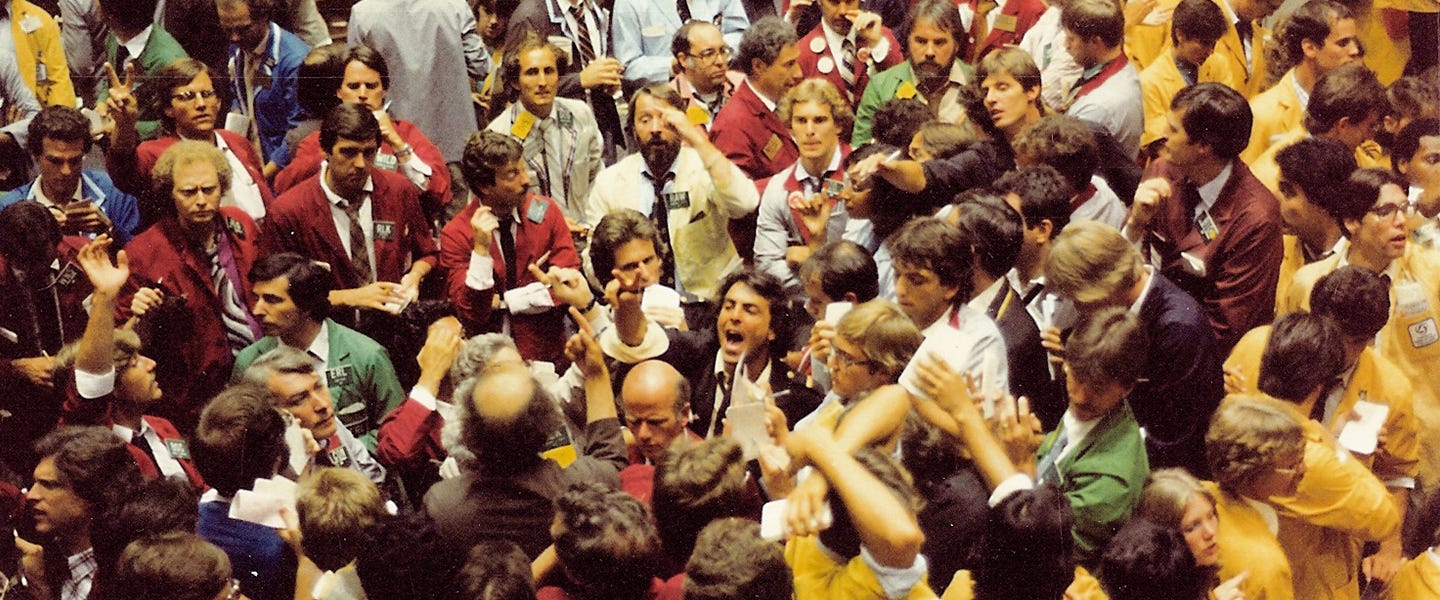
An oral history about work life in Chicago’s notoriously high-stress, hard-partying commodity futures “pits”
This past July, the Chicago Mercantile Exchange (CME) (known more simply as “the Merc”) shuttered nearly all its trading pits after 167 years of operation. And with it died the pit trader — an infamously lucrative, stressful job characterized by ruthless competition, fraternal camaraderie and the frenzied screaming and hand signaling among men (and a few select women) exchanging billions of dollars worth of commodities per day.

The pits dated back to 1848 when the Chicago Board of Trade (CBOT) established what would become the world’s first futures exchange. So-called “futures” contracts derived their name from their function — they were agreements between grain farmers and merchants to exchange a certain amount of grain at a future date for a particular price. Futures allowed grain farmers to know how much they could earn from their crops prior to harvesting, while merchants were able to lock in prices months in advance. Most importantly, it brought “price discovery” to the grain farming industry. Previously, grain farmers sold their crop yields independently and with little idea as to their actual value. The CBOT established a market rate for a bushel of grain, and a place where financial speculators could buy and sell futures contracts based on how they thought the price of grain — and later, other commodities — would fluctuate.

The CBOT diversified into other agrarian markets throughout the 20th century — in 1936, it began trading soybeans, and in 1968 it added its first non-grain-related commodity: chickens. Meanwhile the CME — previously called the Chicago Butter and Egg Board until it changed its name in 1919 — dealt in frozen pork bellies and live cattle, and later foreign currencies such as Deutsch marks and Swiss francs.

The 1980s saw the introduction of “options,” contracts derived of futures. Options differed from futures in that they were not as binding: A futures contract stipulated you were going to buy the commodity for the given price at the given date, whereas options were binding to only one party. The buyer would pay a small premium for the option on a contract, meaning he retained the sole right to buy the contract at the agreed-upon price over a given period of time. If the buyer thought it advantageous, he would “exercise his option” on the contract, and the seller was obligated to sell it to him. If the option wasn’t exercised by the end of designated time period, the contract expired and no money changed hands (although the contract holder kept the premium).

Options drastically increased the complexity of the trading conducted on the floor and was the beginning of the end of a unique work culture (a trend exacerbated by automated trading).
Because unlike in New York, the financial epicenter of the world, the culture at the Merc and CBOT was decidedly blue collar. The prevailing image of a finance worker in the 1980s and 1990s was a WASP-y, East Coast Ivy leaguer from a prestigious family. Now it’s a computer science genius whose software executes thousands of trades in a fraction of a second. But many pit traders were from working class Irish, Italian and Jewish communities and were correspondingly hardscrabble.

They hailed from the city’s South Side Irish-Catholic enclaves such as Beverly and Mount Greenwood; North Side Jewish neighborhoods (e.g. Northbrook, Highland Park); and bougie nearby suburbs (namely, Evanston and Oak Park). The ethnic-religious makeup of the pits was reflected in the names of the largest firms that traded there: Rosenthal & Co., Lee B. Stern & Co. and The Goldberg Association; Hennessy & Associates, O’Connor & Co. and Cunningham Commodities. The joke was that the CBOT was predominantly Irish- and Italian-Catholic while the CME attracted more Jewish workers.
 
They were drawn to the pit not just because it offered the opportunity to make hundred of thousands (if not millions) of dollars, but because one didn’t need a college degree to get a job and excel there. The pits were distinctly American in this way — simultaneously professional and crude; cutthroat and convivial; an insular meritocracy governed by both greed and interpersonal relationships.

The death of the pit trader, then, is about more than the loss of a “work hard, play hard” culture, it’s emblematic of a troubling shift in the labor market at large: With jobs rapidly disappearing due to automation and a growing emphasis on computer programming skills, it’s increasingly difficult for high school (and many college) graduates to earn a middle class income....MORE

Tuesday, March 1, 2016

Based On Supply, Oil Is Trading Much Higher Than One Would Expect

If you gave me the current supply/demand and storage positions and asked me to solve for price I'd come back with an answer somewhere in the $25-$30 range i.e. some 12% to 26% lower than the current $34.00, down 40 cents on Globex.

The fact that WTI is trading that much higher suggests something else is going on and frankly we aren't sure what it is and what has kept the futures coming back to the $34-$34+ handle we first posted about January 27.
Today the futures traded as high as $34.76 but once again didn't clear the Jan. 28 spike high of $34.82 which is another conundrum: why is it stalling under $35.

Possibly (probably?) related, last Thursday I sent this response to a friend regarding an email he had sent me:
Subject: Re: Deutsche Bank Chief Quant: "Our model ... more accurate than the arbitrage funds"

...And then there are exogenous events where one might actually have some expertise and you get your butt kicked anyway.
The oil vol. index has come down dramatically but it is still over 60.
And although we're flat in gold I have no explanation for the almost 20% up move.
I'll point out though, that the 1990 run began in June of that year, seven or so weeks before Saddam went into Kuwait:
On the long term charts that pop is just a blip and no one sees it but at the time it was a big deal and had folks spouting off all kinds of rationalizations.
None correct.
Compare/contrast the recent big dipper:

What I'm saying, in a much more oblique manner than usual is: We might be seeing a possibility-of-war premium priced into both oil and gold.

If that is the case it is probably worth noting that the Saudi's Northern Thunder military maneuvers have been extended from a targeted completion date of March 4 to March 10.

From ZeroHedge:
Following last week's builds overall and at Cushing, and Genscape's Cushing build warnings, expectations were for a 3.3m build overall (and 700k build at Cushing). API reported a massive 9.9mm build - the largest since April 2015; and a yuuge build at Cushing of 1.8mm (most in 3 months). Gasoline saw a draw but Distilates a notable build. Following today's v-shaped recovery in WTI, and NYMEX close ramp, the API data has sent crude reeling.
API:
  • Crude +9.9mm (+3.3mm exp)
  • Cushing +1.8mm (+700k exp)
  • Gasoline -2.2mm (-1.1mm exp)
  • Distillates +2.7

...MORE

Here's today's 30-minute chart showing the day's high and the reaction to the API numbers:
 

"Wheat market hits six-year low on US prospects"

From Agrimoney:
Wheat futures hit a new six-year low on Tuesday, after US government data showed winter wheat crops coming out of dormancy in good condition, while corn and soybean prices are still facing the prospect of strong South American exports.   
True, there was little support on the macro side either, as the Chinese purchasing managers index, an influential survey of industrial sentiment, came in negative for the seventh month in a row, indicating shrinking demand at the world's top commodity buyer. 
The dollar hit one-month highs against a basket of world currencies, bringing pressure to bear on dollar-denominated commodities, although it trimmed gains a little, trading up 0.2% in afternoon deals. 
Good condition
Data released by the US Department of Agriculture late on Monday showed condition in top-ranked winter wheat grower Kansas improving month-on-month. 
Conditions were also improved in Nebraska and South Dakota, while in Oklahoma, traditionally the second-ranked grower conditions were down, but still well above last year's level. 
US wheat futures extended losses on the news. 
Kansas, Chicago down
Front-month March wheat futures in Chicago were down 1.5%, at $4.38 ½ a bushel, their lowest level since 2010. 
And the May contract, which is the most widely traded, was down 1.5%, at a contract low of $4.46 a tonne....MORE
Recently:
Mar. 1
Intrepid Potash Gets A Going Concern Note, Stock Collapses (IPI)
Feb. 26
USDA Chief Economist Makes A Case For Farmland
Feb. 23
Wheat Futures Hit Six-year Low

Corn    356-6 down 1-2
Wheat 446-0 down 7-2

The Rise And Fall Of A Commodities Hedge Fund King

The fact that stands out about all the commodity fund failures is they didn't get to the short side, either in time or ever, which raises the question: Were they getting paid 2-and-20 on the way up for what was essentially leveraged beta?

For folks with a darkly realistic sense of humor the funny thing is, for the whole decline in the CRB from 370+ in 2011 to the Feb. 11 low around 155, the margin clerks were making the right trade with every sell-out and not charging a percentage to do it.
Tee-hee.

From Bloomberg:
  • Flagship fund has been down in four of the last five years
  • Assets under management have fallen nearly 85% to $1.5 billion
Thirty miles west of Wall Street, in an anonymous office park set among rolling hills and shady streets, lurks a giant of the commodities world.

Behind the bland facade in Berkeley Heights, New Jersey, lies the headquarters of Willem Kooyker, one of the most powerful and enigmatic traders in the game.

For half a century, Kooyker has quietly ridden the ups and downs of oil, copper, cocoa and more, first in his native Holland and later at Commodities Corp., the legendary trading-company-cum-think-tank that served as a training ground for market wizards Paul Tudor Jones, Louis Bacon and Bruce Kovner.

Only now, at 73, Kooyker is struggling to contain the damage from a commodities collapse that even he never saw coming.

Before the worst hit -- $20-a-barrel oil no longer sounds so crazy -- Kooyker’s hedge-fund firm was already hemorrhaging billions in assets, people close to his operation say. With returns at Blenheim Capital Management LLC’s flagship fund down for four out of the past five years, some investors are heading for the exits.
The numbers tell the story. At its height in 2011, Blenheim was the world’s largest commodities-focused hedge fund, with $9.1 billion in assets, people familiar with the firm say. Today, its assets have fallen nearly 85 percent to $1.5 billion.

What went wrong? The short answer is that Kooyker didn’t think things would get this bad. He and his colleagues underestimated the economic troubles in China and never thought commodities prices would fall so far, so fast, the people said, speaking on the condition they not be named to avoid jeopardizing business relationships.

It’s a remarkable turnabout for Kooyker, whose tenure atop Commodities Corp. in the 1980s set the stage for two wildly lucrative decades at Blenheim. In 1999, for instance, as oil sank below $10 a barrel, Kooyker bet that commodities would bounce back -- and his hedge fund soared nearly 109 percent. Billions of investor dollars poured in.

Few outsiders had any idea what Kooyker was up to. Most still don’t. He’s long operated under the radar, arguing that any publicity, good or bad, only hurts investment returns.

Most Secretive 
“They are the most secretive I have ever met," Christoph Eibl, chief executive officer of the $800 million commodity investor Tiberius Asset Management AG, said of Blenheim.
Kooyker and others at Blenheim declined to comment on the fund’s recent performance, assets under management or trading strategy.

The question now is how Kooyker can recover from a rout that has shaken investors, corporations and entire economies. Already, Blenheim investors like the $21 billion New Zealand public pension fund have pulled money out, according to annual reports from the Kiwi fund and interviews with people familiar with the matter.

Commodities Pain 
Granted, many other commodities specialists are suffering too. Cargill Inc., the agricultural giant, has shut one of its funds. Trafigura Group Pte, the oil and metals trading house, has closed its flagship Galena Metals Fund. Trafigura estimates that the world’s 10 top commodities hedge funds now manage $10 billion altogether, a fifth of what they did in 2008.

No one would mistake Kooyker for one of the rough-and-tumble traders who used to rule commodities from the trading pits of New York and Chicago. Tall and stately, with a shock of gray hair, an aquiline nose and deep blue eyes behind rimless glasses, he cuts an elegant figure on the New York social and philanthropic circuits. He has donated millions to the Metropolitan Opera, where his wife, Judith-Ann Corrente, is president of the board, and is a leading donor to Democratic political candidates.

An admirer of Winston Churchill, he named his firm after Blenheim Palace, Churchill’s birthplace and ancestral home in Oxfordshire. Busts of the British statesman adorn Blenheim offices. Kooyker tends to work out of one on Fifth Avenue in Midtown Manhattan; his London offices overlook Her Majesty’s Treasury, beneath which lie Churchill’s famed Cabinet War Rooms....MUCH MORE

"Wall Street's nightmare stock is getting annihilated"

Following up on Friday's "SunEdison Has Doubled In Under 48 Hours (SUNE)":
...Good grief, it reads like a press release from an '80's Vancouver deal.There are higher quality ways to get exposure to the solars should one so desire.
Today's story is from Business Insider via Yahoo Finance:
SunEdison is crashing again after the company said that it would delay its 10-K filing so it can finalize its financial statements.  
The stock was last trading down more than 37% at around $1.44 per share. 
Shares of SunEdison have collapsed 80% since last summer. 
Here's the statement (emphasis ours):  
State below in reasonable detail the reasons why Forms 10-K, 20-F, 11-K, 10-Q, 10-D, N-SAR, N-CSR or the transition report or portion thereof, could not be filed within the prescribed time period. 
SunEdison, Inc. (the “Company”) is unable to timely file its Annual Report on Form 10-K for the fiscal year ended December 31, 2015 (the “Form 10-K”) without unreasonable effort or expense. The Company’s delay in filing the Form 10-K is due principally to:...
...MORE

The stock has recovered some, now down 18% at $1.62.

Intrepid Potash Gets A Going Concern Note, Stock Collapses (IPI)

The stock went deer nuts* yesterday. Today in late pre-market it's up a penny.
Attentive reader may have noticed we're posting more on agricultural commodities and less on hydrocarbons.
As a general framework we are betting lower for corn and wheat into late summer and then some weather related upside.
Corn 357-6 up 0-6; wheat 452-2 down 1-0.
You'll probably also be seeing more posts on the ancillary stuff as well: fertilizer, land, processors, grain merchants, equipment etc.

From Reuters, Feb. 29:
Intrepid Potash Inc (IPI.N) said on Monday its auditor has expressed doubts about its ability to stay in business, sending its shares plunging by more than half.
.
The U.S.-based miner, which reported its third straight quarterly loss on Monday, also said low potash prices could cause a breach in its loan covenants.
.
Prices of the crop fertilizer have tumbled due to soft grain prices, dropping U.S. farm incomes, bloated capacity and weak currency in importing countries such as Brazil.
.
North America's biggest producer, Potash Corp of Saskatchewan (POT.TO), has closed one Canadian mine and said Friday it will idle production temporarily at two others.
.
"This was an extremely volatile, chaotic quarter," Chief Executive Officer Bob Jornayvaz said on a conference call. "We believe we'll continue to survive and eventually prosper as a smaller but much more profitable company."
.
Intrepid is one of the world's highest-cost potash producers.
.
Due to falling prices, Jornayvaz said the company won't be able to comply with debt covenants that were revised in January, and is working with lenders on an updated agreement. Its auditors added going concern language to their opinion, meaning there are worries about Intrepid's ability to keep operating.
.
Intrepid ended 2015 with $60 million in cash and doesn't expect to drain its balance this year, the CEO said.
.
The company's stock plummeted 57 percent at 97 cents. Its 52-week range is $1.75 to $14.60....MORE
*Deer nuts = under a buck.

Disney Rumored To Be Securing The Set Of The Next Star Wars Episode With Anti-Drone Drones

From Naked Security:

Disney rumored to be using anti-drone drones to protect Star Wars filming
Disney production teams will soon be filming scenes for “Star Wars: Episode VIII” in Croatia, and the studio is rumored to be taking exceptional measures to keep any footage from leaking out.

The Croatian website Mos Croatia reports that Star Wars filming will take place from 9 to 16 March in the medieval city of Dubrovnik, and the website set off a storm of speculation after it claimed that Disney is hiring 600 security guards, including “a special team with drones” intended to secure the filming from “uninvited drones.”

Plenty of media outlets have run with the story, and the speculation appears to center on this snippet from Mos Croatia’s report:
there is a special team with drones that will remove the uninvited drones …
It sounds like a plausible story, but according to Re/code, a source “close to the production” said those rumors were “untrue.”

What is true is that fans have used drones to get a glimpse of Star Wars filming before, although we don’t really know what the film-makers are doing to stop it.

Back in 2014, fanboys flew drones above an outdoor set at Greenham Common, UK, where crews were filming scenes from “Star Wars: The Force Awakens,” the first movie in the series reboot that was released in December 2015.

Footage shot from a drone leaked out showing the set including a half-finished Millennium Falcon and an X-Wing fighter.

Motherboard reported that Pinewood Studios – where Star Wars was being filmed – had contracted with a US company called DroneShield to purchase anti-drone technology, but the deal fell through when the US State Department blocked the sale....MORE
We looked at DroneShield a couple years ago.
And a more visually impressive technology in January's "There's A Drone Spying On Your Daughter and Using A Shotgun Is Frowned On In Many Locales......What to Do?"
And the eagles the Dutch police were training.
And some urban design elements that confuse drones.
And....
I seem to be getting a bit obsessed.
I don't like bloody voyeurs, okay?
It might be time for a vacation.
Dubrovnik is nice and, coincidentally, just last week I was looking at some property.
Here's a drone's eye view:
http://i.uniline.hr/1/images/destinations/dalmacija/dubrovnik/dubrovnik1.jpg