Tuesday, December 3, 2013

What If the Selfish Gene Hypothesis is Incorrect?

Here's a bit of serendipity. One of the alerts we have searching the internet every couple days is "Locusts".
Catch that one before your opponent's man in Khartoum and you have a fighting chance to make a buck (Egyptian/Sudanese pound, shekel, riyal etc) one way or another.

This article isn't immediately actionable though, and actually shouldn't have been spidered in the first place as we are a few months from the high season but here it is and there is quite a bit to it.
And, if you are curious, the response from Richard Dawkins is, aahhh, interesting.
 
From Aeon:

Die, selfish gene, die
The selfish gene is one of the most successful science metaphors ever invented. Unfortunately, it’s wrong  
Grasshopper (Acrididae), Barbilla National Park, Costa Rica. Photo by Piotr Naskrecki/Minden Pictures/Corbis
A couple of years ago, at a massive conference of neuroscientists — 35,000 attendees, scores of sessions going at any given time — I wandered into a talk that I thought would be about consciousness but proved (wrong room) to be about grasshoppers and locusts. At the front of the room, a bug-obsessed neuroscientist named Steve Rogers was describing these two creatures — one elegant, modest, and well-mannered, the other a soccer hooligan.

The grasshopper, he noted, sports long legs and wings, walks low and slow, and dines discreetly in solitude. The locust scurries hurriedly and hoggishly on short, crooked legs and joins hungrily with others to form swarms that darken the sky and descend to chew the farmer’s fields bare.

Related, yes, just as grasshoppers and crickets are. But even someone as insect-ignorant as I could see that the hopper and the locust were wildly different animals — different species, doubtless, possibly different genera. So I was quite amazed when Rogers told us that grasshopper and locust are in fact the same species, even the same animal, and that, as Jekyll is Hyde, one can morph into the other at alarmingly short notice.
Not all grasshopper species, he explained (there are some 11,000), possess this morphing power; some always remain grasshoppers. But every locust was, and technically still is, a grasshopper — not a different species or subspecies, but a sort of hopper gone mad. If faced with clues that food might be scarce, such as hunger or crowding, certain grasshopper species can transform within days or even hours from their solitudinous hopper states to become part of a maniacally social locust scourge. They can also return quickly to their original form.

In the most infamous species, Schistocerca gregaria, the desert locust of Africa, the Middle East and Asia, these phase changes (as this morphing process is called) occur when crowding spurs a temporary spike in serotonin levels, which causes changes in gene expression so widespread and powerful they alter not just the hopper’s behaviour but its appearance and form. Legs and wings shrink. Subtle camo colouring turns conspicuously garish. The brain grows to manage the animal’s newly complicated social world, which includes the fact that, if a locust moves too slowly amid its million cousins, the cousins directly behind might eat it.

How does this happen? Does something happen to their genes? Yes, but — and here was the point of Rogers’s talk — their genes don’t actually change. That is, they don’t mutate or in any way alter the genetic sequence or DNA. Nothing gets rewritten. Instead, this bug’s DNA — the genetic book with millions of letters that form the instructions for building and operating a grasshopper — gets reread so that the very same book becomes the instructions for operating a locust. Even as one animal becomes the other, as Jekyll becomes Hyde, its genome stays unchanged. Same genome, same individual, but, I think we can all agree, quite a different beast.

Why?

Transforming the hopper is gene expression — a change in how the hopper’s genes are ‘expressed’, or read out. Gene expression is what makes a gene meaningful, and it’s vital for distinguishing one species from another. We humans, for instance, share more than half our genomes with flatworms; about 60 per cent with fruit flies and chickens; 80 per cent with cows; and 99 per cent with chimps. Those genetic distinctions aren’t enough to create all our differences from those animals — what biologists call our particular phenotype, which is essentially the recognisable thing a genotype builds. This means that we are human, rather than wormlike, flylike, chickenlike, feline, bovine, or excessively simian, less because we carry different genes from those other species than because our cells read differently our remarkably similar genomes as we develop from zygote to adult. The writing varies — but hardly as much as the reading.

This raises a question: if merely reading a genome differently can change organisms so wildly, why bother rewriting the genome to evolve? How vital, really, are actual changes in the genetic code? Do we even need DNA changes to adapt to new environments? Is the importance of the gene as the driver of evolution being overplayed?

You’ve probably noticed that these questions are not gracing the cover of Time or haunting Oprah, Letterman, or even TED talks. Yet for more than two decades they have been stirring a heated argument among geneticists and evolutionary theorists. As evidence of the power of rapid gene expression mounts, these questions might (or might not, for pesky reasons we’ll get to) begin to change not only mainstream evolutionary theory but our more everyday understanding of evolution.

Twenty years ago, phase changes such as those that turn grasshopper to locust were relatively unknown, and, outside of botany anyway, rarely viewed as changes in gene expression. Now, notes Mary Jane West-Eberhard, a wasp researcher at the Smithsonian Tropical Research Institute in Costa Rica, sharp phenotype changes due to gene expression are ‘everywhere’. They show up in gene-expression studies of plants, microbes, fish, wasps, bees, birds, and even people. The genome is continually surprising biologists with how fast and fluidly it can change gene expression — and thus phenotype.

These discoveries closely follow the recognition, during the 1980s, that gene-expression changes during very early development — such as in embryos or sprouting plant seeds — help to create differences between species. At around the same time, genome sequencing began to reveal the startling overlaps mentioned above between the genomes of wildly different creatures. (To repeat: you are 80 per cent cow.)...MUCH MORE

The Next Five States About to Go Oil-Boom

This concludes our triad of detonative-headlined posts.
From the Fiscal Times:

The Next North Dakota: 5 States About to Go Oil Boom
The black-gold rush in North Dakota—a technological revolution in oil production—is creating a new class of rugged millionaires.

North Dakota might be grabbing headlines, but horizontal drilling and “fracking” to tap into newly accessible oil reserves is by no means limited to that state. The shale revolution is still in its “early innings,” as a recent report by Credit Suisse put it. OPEC’s 2013 World Oil Outlook, published last month, said that new oil supply from the U.S. and Canada would hit nearly 5 million barrels a day within five years, up from last year’s forecast of 1.7 million barrels a day by 2018. As that boom plays out, tens of billions of dollars in new infrastructure and development will likely be invested in the coming years.

Where will the new investment be concentrated? Though oil and gas companies across the U.S. are busy buying up acres of mineral rights in oil shale hot spots in an effort to be early players in the next booms, most are staying quiet about early production numbers.

 If they let on that they’ve uncovered another Bakken or Eagle Ford Shale, land and production costs could skyrocket. In Texas’s Eagle Ford, for example, companies were paying $250 to $450 an acre in 2009 when the area’s potential was unknown, but by 2011, an acre was going for $21,000 to $22,000.

The U.S. Geological Survey (USGS) and the Energy Information Administration (EIA) have only recently started to assess reserve areas, and the EIA estimates 482 trillion cubic feet of natural gas and 33 billion barrels are recoverable, revised from a mere 4 billion barrels in 2007. That estimate could still be conservative, however. The amount of recoverable oil in an area only becomes evident after companies begin to drill. “Early on, we didn’t have much experience on how these wells would be producing,” says Doug Duncan, associate coordinator of the energy resources program at the USGS. “We typically need about three years of production data from a large number of wells before we can start to reduce the uncertainty in our assessments.”

In North Dakota, the USGS estimated there were 3 to 4.3 billion barrels in 2008, but this year, it revised its number to 7.4 billion barrels. The USGS is now working on an assessment of the Monterey Shale in Southern California....MORE 
HT: Carpe Diem

Who or What Is Turning Hog Manure Explosive? (the pig bang theory blames ethanol)

From Nautil.us:

The Curious Case of the Exploding Pig Farms
At first, the manure was just harmlessly foaming. Only later on did things get lethal. 

Hog farms in the Midwest are great big barns sitting on top of great big pits filled with a great deal of awful-smelling manure. The pigs walk about on a slatted floor that lets manure fall into the pit several feet below. Around 2007, farmers began noticing pig poop acting funny. The normally liquid mixture started producing foamy bubbles, rising up and up, past the slats, right to the pigs’ cloven hooves.
Then it got worse. Among the gases in the bubbling in the foam are two of special note: methane and hydrogen sulfide—both highly flammable. All it takes is a small spark and Kaboom! In September 2011, a barn explosion killed 1,500 pigs and seriously injured one worker. It was just the most serious in a string of barn explosions that have cost farmers millions of dollars in the past several years.

Scientists have scrambled to solve the mystery of the exploding hog-manure foam, but no straightforward answer as emerged so far. As a matter of physics, every foam needs three components: gas, stabilizer, and surfactant. Manure is normally teeming with microbes, which produce gases like methane and whose cells can act as stabilizers. Therefore the surfactant—any chemical such as soap that lowers the surface tension of liquids to allow bubbles to form—is a likely candidate for what’s new.

Around the same time that foaming manure became a problem, farmers also started feeding their pigs more and more distiller’s dried grains with solubles (DDGS), a cereal-like byproduct of ethanol production. DDGS is full of plant fibers and long-chain fatty acids—plausible surfactant candidates. Since the US provides huge subsidies for making ethanol from corn, DDGS was cheap and plentiful source of animal feed. It makes economic sense, at least.

 DDGS has been a suspected culprit of foaming manure from the beginning (one magazine called it a “pig bang theory”), but experiments are still inconclusive....MORE
HT: io9

Tesla Explodes Higher on Morgan Stanley Report (TSLA)

Well it's about time, links below.
I probably shouldn't use the word 'explodes' until they have the battery problem completely squared away.
Up $18.17 (14.63%) at $142.34.
From ValueWalk:
Finally some good news for Tesla Motors Inc (TSLA). Shares surged today after analysts issue positive reports and German regulators find no fault with the Model S after the recent fires.
In addition, analysts from at least two firms have issued positive reports on Tesla this morning, adding fuel to the fire, so to speak.

Morgan Stanley calls Tesla’s plunge a buying opportunity
Analysts at Jefferies and Morgan Stanley weighed in on Tesla Motors Inc (NASDAQ:TSLA). Morgan Stanley analyst Adam Jonas listed Tesla as his top pick out of the 26 different companies his firm follows in the U.S. auto industry. Jonas said although the slide after the three Model S fires may have been justified, he expected shares to bounce back because the automaker’s long-term trajectory was still intact. He said the fires shouldn’t cause any “material damage” to Tesla’s business and that they would buy shares.
The analyst has a $153 per share price target on Tesla Motors Inc (NASDAQ:TSLA). He said at the automaker’s highest point, it was “due for a big correction” because there was “little or no valuation support on near-term expectations.” Jonas reiterated his Overweight rating on the automaker.

Jefferies weighs in on Germany news
Analysts at Jefferies issued their report after Tesla Motors Inc (NASDAQ:TSLA) revealed last night that German regulators ruled not to issue a recall on the Model S after their investigation into the three fires. Jefferies analyst Elaine Kwei reiterated her Buy rating on the automaker, although she did lower her price target to $190 from $210 per share....MORE
Loyal readers know that I was playing a dangerous game with this one.
Watching (and posting on) the run from pre-IPO to $195.
Catching a decent short on the way down: $164.50 to $126 and then reversing (early)
We started prepping for a bounce with Nov. 8's "Chartology: Tesla Getting Near a Bounce (TSLA)" at $137.80.
That was followed on the 12th by "Tesla's Musk as Equity Analyst: "Stock's high price was a distraction, seems a better deal now" (TSLA)".

Here are some of the posts (for more use the search blog box):
Oct. 7
"Jim Chanos Hints He is Shorting Tesla Short (Sorta)" (TSLA)
The stock is up $2.41 at $183.39.
Oct. 23 
Chartology: Tesla's Head and Shoulders Formation (TSLA)
The stock is trading down $7.04 at $164.50....
Oct. 29 
Chartology: Tesla Breaks Down
 $156.52 down $6.34.
Oct. 31 
Watching for a Head-and-Shoulders Chart Formation in Tesla (TSLA)
If one was going to form the next few days should be up.
$158.98 down 24 cents.
Nov. 5
Tesla Disappoints ( Verb-3rd person present-fail to fulfill the hopes or expectations...) (TSLA)
In early after-hours the stock is down $16.01 at $160.80
From this morning's "Smart Research: "Tesla's VIN Numbers Indicate The September Quarter Could Have Been Quite Strong" (TSLA)":
This is shaping up as a "Buy on mystery, sell on history" trade. $173.73 down $1.47....
November 8 
Chartology: Tesla Getting Near a Bounce (TSLA)
The stock is changing hands at $137.80 down $1.97 after bottoming at $132.32.
Nov 20
Tesla and the Barclays Downgrade (TSLA)
That's just perfect. Wait patiently for signs of a bottom and finally make the formal buy rec last night* at $126.
Have BARC junior analyst come out with the downgrade and I'm right back to 2009...


...The stock is down $6.27 at $119.82, yesterday's low print was $119.22. A solid double-bottom would be an undercut of yesterday's low either today or tomorrow morning to get that Abandon-hope-all-ye-who-enter-here vibe and then onwards to glory.
Or something.

That 2009 call worked out but markets are easier than stocks, no death car fire factor to deal with, for example. Yesterday's pre-market low was $115.60.
Anyhoo the question is "What now?"
Using cutting edge analytical techniques we answered that query in Nov. 19's "UPDATED--By Elon Musk: "The Mission of Tesla"":
...Pulling a number out of one's backside, $160 as a target.
Equities: All right Kids, I Think It's Safe to Go Back in the Water

4MyLA

Buffett's Alpha or How To Generate Better Risk Adjusted Returns Than Anyone Else in the Biz (BRK)

From City A.M:
This new paper reveals the secrets of investment guru Warren Buffett It's an old question - and until now an unanswered one - just how does Warren Buffett manage to make all that money?

The investment guru is an anomaly, and the chart below is a reminder (if you needed one). It's a representation of the success of Buffett's company, Berkshire Hathaway. Its returns are a complete outlier. 
More fully that chart shows how Berkshire stacks up against common stocks, and the numbers have been crunched by Andrea Frazzini, David Kabiller, and Lasse H. Pedersen in their new paper "Buffett's Alpha".

Berkshire Hathaway has realised a Sharpe ratio (a measure of risk-adjusted performance) ahead of any other stock or mutual fund with a history of more than 30 years.

Buffett says it's not luck either - he thinks it's no coincidence that many stock market winners come from the same intellectual village. And that Sharpe ratio - 0.76 - is less than many would imagine (despite being nearly double the ratio of the overall stock market).

The paper's authors try to explain Buffett's staggering success with statistical techniques. Most common theories - based on the "alpha" and "beta" of stocks don't stand up.

You can also throw out the idea that Buffett's success comes from his influence on the companies whose stocks he owns - his publicly traded stocks perform better than the companies he owns in whole.

The researchers find that exotic returns have a less than alien explanation, "neither luck nor magic". Leverage The authors show that Buffett is rewarded for the use of leverage (the authors estimate a leverage of about 1.6-to-1). That leverage ratio boosts his risk and excess return in that proportion....MUCH MORE
The City AM folks didn't provide a link so here's the version at Yale (45 page PDF)

Back in September 2012 we looked at an early draft of the paper at The Economist:
Warren Buffet: The King of Leveraged Low Beta (BRK.B)

See also Institutional Investor's "Is Alpha Dead? Beating the Market Has Become Nearly Impossible".

Alphaville's Izabella: When She Is Good She Is Very, Very Good...

...And When She Is Bad She's Terrific.*

Here she is being bad in that Lady Caroline Lamb on Lord Byron "mad, bad and dangerous to know" kind of way.

From Dizzynomics:

Re. Central bank manipulation
To: All fiat currency sceptics
From: me (in a bad mood).
This is a comment on the following response to one my Bitcoin posts by Julien Noizet, note the bold bits.
Izabella Kaminska in the FT wrote a new piece on Bitcoin and other alternative electronic currencies. She complains about the multiplication of such currencies that nothing backs and pretty much only see speculative motivations underlying them. I am not going to comment on the whole thing, but whether right or wrong, she should ask herself why there is such frenzy about those currencies at the moment. My guess is that, governments’ and central banks’ manipulation of their own currencies have unleashed a beast: people afraid to hold classic currencies started to look for alternatives, pushing up their prices, in turn attracting speculators. The process is similar to ‘bad’ financial innovations (the ones designed specifically to bypass restricting regulation): they often start as a benign innovation for the ‘common good’, but the surprising demand for them and large profits attract speculators until the market crashes. Not the fault of the innovation, but the fault of the regulation that triggered them…
First Julien, thanks for telling me to ask myself something that I have very publicly been asking for a long time. I appreciate you don’t have to read every single post I ever write, but the post you link to actually says it plainly:
The natural consequence, perhaps, of a leisure economy with nothing more productive to do — or, more simply, nothing more productive that has as great a potential for quick speculative profit. Though, not to overlook the influence of the idea that it is wise to protect oneself from a fiat currency armageddon that still hasn’t happened yet, and against which there are fewer viable diversification tools. So what we have created instead is a veritable Weimar-style notgeld issuance frenzy. A parallel private money expansion outside of the government’s money supply control, created by the public itself. (Though, at least with notgelds, the units issued were always redeemable for the issuing companies’ underlying goods and services.)
If you didn’t understand that paragraph, let me explain it to you one more time. People have been sold an inflation myth....MUCH MORE 
*Paraphrased from Walter Mathau on Barbara Stanwyck:
'Barbara Stanwyck has played five gun molls, two burlesque queens, half a dozen adulteresses and twice as many murders. When she was good, she was very, very good. And when she was bad, she was terrific.'
Gentle reader has probably noticed I don't refer to the young lady as 'Izzy' very often. For one thing the familiarity of the truncated diminutive doesn't seem altogether appropriate: We've never met, never even corresponded so any time I do use the nickname I am aware that it almost sounds like a hypocorism.

The other, more immediate, and frankly, profoundly disturbing reason, is that any time I see the name Izzy I think of a five hundred pound Hawaiian guy.

This is a video I used to post as part of our Sweet Dreams, Wall Street series during the downdraft summer of 2008 (before the real downdraft hit):

UPDATED--The Economist On How the Commodity Quants Lost It

Updates below the chart.
Original post:
I am having great difficulty with the idea that hedge funds couldn't find a way to make money, more after the jump.
From The Economist, November 30:

Hedge funds looking to spot and ride market trends are hoping for a fresh start
IF SOMETHING has not worked for five years, most people would conclude that it was broken. Tell that to the geeks managing “quant” hedge funds, who craft elaborate algorithms to profit from market movements. Once money-spinners, their prized formulae have misfired since 2009, losing money in four of the past five years. Unless their results improve markedly, the giant funds will finish this year as the worst-performing of the most common hedge-fund strategies.

“Trend-following” involves programming computers to analyse market movements and try to infer where they might go next. Practitioners speak with reverence of “crossover levels” and “momentum speeds” leading to “breakout points”. A rough translation is that a trend that lasts a few days or weeks can profitably be invested in until it reverses, at which point a new trend may already be forming. Whether the markets are going up or down does not matter. Nor does the underlying asset being analysed—typically a futures contract linked to a commodity or a security.

After prospering through the market rout of 2008 (the prolonged slump gave even the dimmest trend-follower time to cotton on), the sector swelled from $91 billion to $215 billion, according to Hedge Fund Research, a data provider. Winton Capital, Man Group’s AHL fund, Cantab, BlueCrest and other “black box” traders, as their critics dub them, became darlings of the investing world. Unfortunately, the influx of investment coincided with the reversal in the strategy’s fortunes (see chart).

The main problem is not with the quants’ models, practitioners insist, but with the markets themselves. In the aftermath of the financial crisis, they have been dancing to the tune set by politicians and central bankers. Efforts to save the euro or stave off deflation regularly send markets into convulsions, in the process distorting the historical patterns that the algorithms are designed to exploit. The ensuing jolts and crashes have no precedent, leaving even the most finely crafted trade at risk from political meddling. Not even the world’s wiliest supercomputers can predict what the European Central Bank will dream of next, apparently.

Worse, such interference prompts stocks, bonds and commodities to move in unison. When in May the Federal Reserve hinted at a “tapering” of America’s ultra-loose monetary policy, for example, both government bonds and shares tumbled. What had started out as a good year for the trend-followers turned into a drubbing. One of the sector’s main selling-points, that its returns are uncorrelated to those of other asset classes, is at risk....MORE
HT: Business Insider

The bolded bit points up one of the failures of the fund managers.
They get paid to figure out the intertemporal arbitrage, a fancy way of saying the task at hand is to understand the time period that gives the fund the greatest advantage versus the market.

The classic example is the individual investor realizing that he can't compete with HFT and looking at longer than nanosecond time periods. This opens up the possibility of not just not-competing with the traders with the lowest latency but of taking advantage of mispricings caused by their behavior. This is exemplified by one of Buffett's baseball metaphors (he has quite a few):
In investments, there's no such thing as a called strike. You can stand there at the plate and the pitcher can throw a ball right down the middle; and if it's General Motors at 47 and you don't know enough to decide on General Motors at 47, you let it go right on by and no one's going to call a strike. The only way you can have a strike is to swing and miss.
The point is, you don't have to be at the market every second You are afforded the luxury of just waiting for the perfect pitch.

Now for a fund manager it get's tricky writing the quarterly report and saying "We didn't do much in Q3, we're waiting for Mr. Market to give us the high hanging curve ball" but if you've been honest with the investors that the tactic you've pulled from the toolbox is akin to the military's hurry-up-and-wait sense of time it is doable.

As a side note anyone who considers a move that is measured in weeks to be a trend is nuts. A trend is John Templeton going into the Japanese markets at 2 times earnings and catching a 40-fold move 1965-1989.

To quote myself for the second time in two days, from October's "Commodity hedge funds face bleak future":
The thing I don't get about these whiny little commod (no 'e', yet) artists is the apparent failure to understand the words hedge or macro.
Dudes, you can go long or short. And do it in multiple, disparate commodities anywhere in the world.

Unless of course the folks who were proclaiming commodities an asset class were simply full of it and were nothing more than longside trend followers charging alpha sized 2-and-20 for what was actually leveraged beta....
See also yesterday's:
How to Make Big Money in Small Markets: Commodities
Small that is compared to forex or treasuries.
There is no magic secret, just bet the multi-year trends and be right....

...The directional trade for most commodities has been down for at least two years so price action alone would have guided you....
In the recent past it was the two year decline in precious metals or the one year decline in corn that allowed folks with a feel for this stuff to recalibrate the computers and get some bets down.

As for the "move in unison" excuse, here's the S&P 500 ETF vs the gold ETF over the last 365 days:
Chart forSPDR S&P 500 (SPY)

Correlated markets my ass.

See also:
AQR--"Demystifying Managed Futures" (Returns and Anomalies)
UPDATED--Cliff Asness' AQR Capital: A Century of Evidence on Trend-Following Investing; Since 1903
UPDATE--More on "A Century of Evidence on Trend-Following Investing 

Monday, December 2, 2013

Climateer Line of the Day: Things I Never Imagined Reading With a Straight Face Edition

Driverless cars and delivery drones are likely to increase property values in big cities as such innovations are aimed at urban areas and make living there more efficient, an economist writes.... 
That's the link to the New York Times' Economix blog:

Robots and Property Values
Casey B. Mulligan is an economics professor at the University of Chicago. He is the author of “The Redistribution Recession: How Labor Market Distortions Contracted the Economy.” 
As robots begin to move goods and people from place to place, urban land might become more valuable.
Amazon.com has announced that it is testing package delivery by drones — small, unmanned helicopters that would bring a purchase from Amazon’s fulfillment center to the customer’s front porch. Driverless cars are being developed to help move goods and people from place to place.

“Location, location, location” is the saying in real estate: a property’s value is determined primarily by its location. An apartment in central Illinois might be worth 20 times as much in Manhattan, because a Manhattan apartment gives its resident access to many more goods, activities and high-paying jobs.

This is not to say that urban living is always the best, or that all urban properties are created equal. Locations involve trade-offs, and rural areas offer amenities that big cities cannot. But for centuries, real estate markets have shown that people and businesses are willing to pay more for urban properties....MORE
A heads up to our younger readers-don't believe the hype, the Amazon idea won't be realized anytime soon.
Business Insider had the best explanation for why the "news" was leaked on last night's '60 Minutes':
 $3 Million In Free Advertising On Cyber Monday

AQR’s Asness on ‘Smart Beta’: ‘Call a Bet a Bet’

Getting deep into the weeds, having Asness say this about a strategy popularized by his buddy and scholarly paper co-author Rob Arnott is kinda funny.*
An excellent catch by Barron's Focus on Funds column:
AQR Capital Management co-founder Cliff Asness has a must-read in the forthcoming Financial Analysts Journal.

“My 10 Pet Peeves” includes a peeve about “smart beta,” which is the buzzword for index ETFs driven by something other than standard market-weighting. These funds are built to own stocks according to juicy or growing dividends, improving earnings and revenues or some other set of factors besides what drives the SPDR S&P 500 ETF (SPY). 
I think people should call a bet a bet. If you own something very different from the market, you’re making a bet and someone else is making the opposite bet. You might believe in your bet because you are being compensated for taking a risk, because the market has behavioral biases, or because your research is just that good. Your bet might be low or high turnover. But, regardless, you aren’t passive.
And here Asness explains the intuition of why “smart beta” is really market exposure plus something else — usually the “something else” is a bet on the superiority of value investing. All which means “smart beta” proponents are effectively trashing themselves when they trash active investment management...MORE
Again, "My Top 10 Peeves" (9 page PDF)

*Here's a nice little paper that über-quant Asness did with Arnott:
Surprise! Higher Dividends= Higher Earnings Growth

How to Make Big Money in Small Markets: Commodities

Small that is compared to forex or treasuries.
There is no magic secret, just bet the multi-year trends and be right.
From October's "Commodity hedge funds face bleak future":
The thing I don't get about these whiny little commod (no 'e', yet) artists is the apparent failure to understand the words hedge or macro.
Dudes, you can go long or short. And do it in multiple, disparate commodities anywhere in the world.
Unless of course the folks who were proclaiming commodities an asset class were simply full of it and were nothing more than longside trend followers charging alpha sized 2-and-20 for what was actually leveraged beta....
The directional trade for most commodities has been down for at least two years so price action alone would have guided you. Stepping up to the junior analyst level of granularity, a look at mining company (for example) capital expenditures over the last decade tells you to beware of supply/demand imbalances.

The next level, analyst or assistant fund manager, has you looking at global macro: Worldwide demand for most everything is satiated.

Finally, at the really old guy level you do the pattern recognition thing, "Say this reminds me of the agricultural depression of 1920" and go take a nap.

From Bloomberg:
Worst Raw-Material Slump Since ’08 Seen Deepening: Commodities
The commodity slump that spurred bear markets in everything from gold to corn to sugar this year will deepen by the end of December as prices head for their first annual loss since 2008, if history is any guide.
The Standard & Poor’s GSCI Spot Index of 24 raw materials fell in December 83 percent of the time since 1971 when the benchmark gauge was posting losses for the year through November, data compiled by Bloomberg show. The average December loss was 3.9 percent, which if it happened this time would mean a 7.8 percent drop for the year.

Investors pulled a record $34.1 billion from commodity funds since the end of December, according to EPFR Global, which started tracking the flows in 2000. Ample rains boosted global crops, increased mine output spurred supply gluts in metals and the U.S. is extracting the most crude oil since 1989. Economic growth in China, the biggest user of everything from soybeans to zinc to cotton, is poised to slow for a third year in 2013, according to economist estimates compiled by Bloomberg.

“It’s likely that the trend will hold through the end of the year,” said Michael Cuggino, who manages about $11 billion of assets at Permanent Portfolio Family of Funds Inc. in San Francisco. “Investors see anemic or slowing economic growth in the world’s mature and emerging-market economies, while there’s more supply on hand. That translates to lower prices.”

2013 Losses
Fifteen members of the S&P GSCI are heading for annual losses, with grains and precious metals leading the declines. Corn tumbled 40 percent, on track for the biggest annual slump since the data begins in 1960. Gold is heading for the first yearly retreat since 2000 and silver is poised for the worst rout in three decades...MORE
If you had wanted to stick to equities a short of the gold miners is up over 50% unleveraged.
Getting a bit of gearing:
Selling corn in December last year at $7.50 to  today's $4.19 has been good for $3.31 per bushel of which there are 5000 in a contract. $16,550 on your initial $2363.
Gear it up some more, either by going to your prime or buying the options...
Say, have I ever told you about natural gas?

Just be right.

Here's corn and some of the posts:
We've been posting on this price weakness since  December 2012: 
Dec 2012
March
Corn Hammered Limit Down on Stocks/Intentions Report
May
Corn: Deutsche sees potential for price below $4
July
Macquarie Calling For Corn in the Low $4's 
August
4 Reasons Why Corn Could Get Cheaper Still
Corn Futures Resume Normal Service, Collapse
September
Iowa State's Worst Case Corn Prices: $2.89 By 2017

And many more. It's almost depressing how monotonic the declines have become.

Gold Resumes Decline, Down $22 To 5-Month Low

Gold $1227.60 down $22.80, platinum $1353.97 down $10.13. We're including platinum in the quotes because of last week's "Platinum deficit to widen while prices decouple from gold" and "If You Absolutely Have to Have Precious Metals Exposure, Consider Platinum (HSBC)"

The June 28, 2013 low was $1179.40. When we get there we'll have to take a look at the charts.
The ultimate target is $875 in Q3 2014.

As for the miners the GDX and GDXJ are among the worst performing ETF's of 2013 with more downside to come.

From Kitco:

UPDATE: Comex Gold Falls To 5-Month Low on Technical Selling Pressure, Firmer Greenback
Monday December 02, 2013 10:30 AM
(Kitco News) - Comex gold futures have dropped to a five-month low in mid-morning dealings Monday. Gold and silver are seeing selling pressure tied to very weak technical postures that continue to invite fresh short positions into the futures markets. Also, some generally upbeat U.S. economic data Monday morning has helped to boost the U.S. dollar index to its session high. The firmer greenback is a bearish daily outside market force working against gold and silver. February gold last traded down $20.80 an ounce at $1,229.60.
Recently:
Gold Miners: What a Long Strange Trip (GDX; GDXJ)
"Cash Costs A Better Indicator Of Pressure On Gold Mining: Citi" (GDX; GDXJ)
As Gold Prices Retrace to the June Lows Mine Output to Reach Record High (Junior Miner ETF Approaches All-time Record Low) GDX; GDXJ
Chartology: "Gold’s Bearish Technical Setup"
Gold Miners: A Fool And His Money (GDX; GDXJ; GLD)
Gold Forwards: "Look For More Weakness In Gold"
Gold Down $22.30 As Longs Lose Hope
That gets us back to Nov. 8.

Goldman Sachs’s Big Idea #4: Long China/Short Copper

From MoneyBeat:
After a pause for Thanksgiving and Black Friday, part four of the daily drip-feed of Goldman Sachs's top trade ideas for 2014 is finally in our inbox.

And here it is: “Long China equities/short copper”.
Specifically…

“Open long China equities via HSCEI index and short copper Dec 14 LME future, opened at 0.0% (on return basis, corresponding to respective price levels of 11542.1 and 7064.5) on 2 Dec 2013, with a target of 25% and a stop on a close below -13%.”

Confused? You should be.

As the bank notes, copper prices are usually positively correlated to Chinese equities.
That relationship has to change for the trade to work best. Since late October the two assets have been heading in opposite directions, and Goldman sees that continuing. The bank reckons Chinese stocks will rise next year as the country’s growth stabilizes, but commodity prices will come under pressure because of abundant supplies.

“This long equity/short commodity trade is a way of isolating exposure to China equity risk via a long HSCEI position, which we think is underpriced by the market given our views of stable growth and ongoing rebalancing there, while the copper short hedges out exposure to China’s economic growth, which we think will be stable but not stellar,” Goldman’s analysts wrote in a note to clients Monday....MORE
Earlier:
"Goldman Sachs Explains How To Make Money In 2014, Parts One And Two"
We didn't care for #3.
Can't get enough EONIA?
"On the ECB and EONIA"

"Does QE cause deflation?"

This morning Alphaville's Further Reading post linked to "Is QE lowering the rate of inflation?" at St. Louis Fed VP David Andolfatto's personal blog.
Mr. Andolfatto takes a look at the Williamson paper "Scarce Collateral, the Term Premium, and Quantitative Easing".
The first thing I thought of was Minneapolis Fed head Kocherlakota's Road to Damascus moment when he renounced the QE-causes-deflation-idea.
(as far as I can tell, it doesn't. it doesn't seem to work either but that's a different story)

Swooping in on the question is Not Quite Noahpinion with the headline post:
Oh my gosh. I am really excited. For years, I've been waiting for a chance to disagree with Brad DeLong about something econ-related, and the day has finally come!! It's enough to make me break my blogging hiatus a few days early.

Remember back in 2011 when Narayana Kocherlakota theorized that low interest rates cause deflation? Well, on Wednesday, Steve Williamson made a similar claim, writing that in a liquidity trap, QE will cause long-term deflation. Williamson based his post on this paper.

In a testy response, Nick Rowe called Williamson's post "horribly wrong," lamenting: "What the hell has gone wrong with some of the best and brightest in economics?" Brad DeLong then jumped in, accusing Williamson of mistaking an unstable equilibrium for a stable one. Paul Krugman echoed that accusation.

But David Andolfatto, in this excellent post, showed that DeLong and Krugman's criticisms are misplaced. In a typical New Keynesian model - the kind that now mostly dominates business-cycle theory, and the kind preferred by Rowe and Krugman - it's true that Williamson would be picking an unstable equilibrium. But Williamson is not using a New Keynesian model! Williamson's model is actually quite different. And as Andolfatto points out, there are macro models out there that are very similar to New Keynesian models, but have one small twist that makes the "QE-causes-deflation" equilibrium the stable one!

 So DeLong and Krugman have gone too far. They are arguing from their preferred model, and that's fine. But to say - as Brad does - that Williamson doesn't deserve a "union card as an economist" is wrong. And to say - as Krugman does - that Williamson has made a simple "misconception" by forgetting about stability is wrong. Williamson is simply using a different model than the standard model, and DeLong and Krugman have not yet examined that model carefully....MORE
One of the more sensible things from an economist this year.
Now a bit of humor. Here's Modeled Behavior from August 26, 2010:

Wonk City: More on Deflation and Interest Rates
My once and future dream is that the blogosphere would replace academic journals as the primary medium of intellectual exchange. We are far, far, far from that but this debate over deflation is getting sufficiently wonky that a boy can dream. If only there was some easy way to incorporate an equation editor into a blog writer, we would be off to the races.

Now to the subject at hand. Stephen Williamson rides in to defend Kocherlakota:
What [Krugman, Rowe, Thoma and Harless] are objecting to in Kocherlakota’s speech is one of the most innocuous things he said. Here’s the simplest example I know. Suppose a cash-in-advance model with a representative consumer, period utility u(c), discount factor b, constant aggregate endowment y. c is consumption....MORE
It appears to me damn near the same cast of characters.
I don't care who you are, that's funny right there.
I wish I had the time to observe economists in a clinical setting, it would be, to borrow a word: Fascinating.

Timing the Downturn In the U.S. Housing Market

The tricky bit is getting someone to write credit default swaps against your Blackstone created paper.
The easy part is seeing how the dominoes start to fall, it will be because of a clogged toilet somewhere,* but getting the contra bet down will take some creativity.

From MacroBusiness:
Will US investors pull the pin on housing?
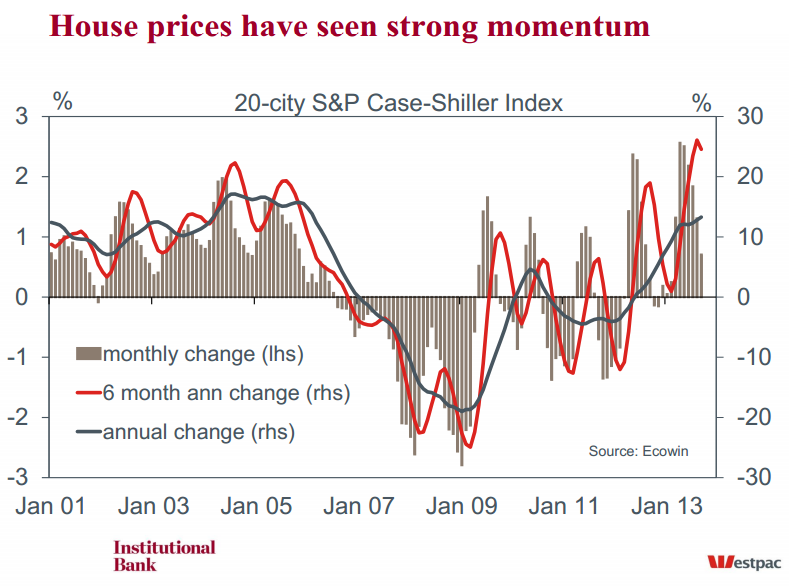
Following on from this morning’s post on how Wall St has re-inflated US housing, here is Westpac’s Elliot Clarke on the role of investors in US housing. I see two possible ways this can go. If Wall St is driving the rebound through rental securitisations then it could run despite rising interest rates because it’s a play on reaping the financial packaging fees. But the asset remains in the hands of the bank et al there has to be a high risk of run on the market when rates turn (or taper arrives). A tipping point scenario if I’ve ever seen one.
The US housing sector has been a key focal point in this recovery, not only due to the material price and activity declines that occurred following the GFC, but also because of the sector’s historical ability to have a positive, broad-based impact on activity – directly through new construction, and indirectly through confidence and consumption.

When considering the health of the housing market, house prices have been the financial market’s primary benchmark, the expectation being that as go prices, so goes activity. However, this has not proven to be entirely correct, with the contribution to growth of housing activity lacklustre relative to the scale of the prior decline and past cycles.

On house prices, the past two years have definitely given reason for optimism and confidence. According to the S&P/ Case-Shiller 20-city measure, house prices have risen by 18.5% between January 2012 and September 2013, with the bulk of those gains seen in the past year (13.3%yr).
Capture
While these gains are certainly significant, it is important to remember that, owing to the scale of the GFC price declines, national house prices are still down 21.5% from their April 2006 peak in nominal terms; and, given the PCE deflator has risen by almost 14% over that time, closer to a third in real terms. Arguably this is a key reason as to why the pass-through from price gains to confidence and consumption has been more modest than that seen in past cycles.....MORE
From AlterNet (!) over a year ago:
...Think about what this means. Just as banks got out of the business of administering the mortgages they made, these securitized rental investors would replace conventional landlords. To make these deals profitable, lots and lots of mortgages would have to be combined. But, the investors won’t administer these rentals. Instead, a rental servicer would be responsible for collecting your rent and distributing it to all of the investors.

Now, what will happen when your toilet backs up or there is no heat? Your concerns would be addressed at a call center, perhaps in another country, provided you stay on hold long enough and are eventually switched to the right person.

Most likely, after leaving any number of messages, your rental servicer will schedule an appointment when you have to be at work. Or, will just allow you to get on with it, and sort the problem on your own.

Suppose you decide to hold back rent until the repairs are taken care of. The servicer may report you as delinquent in paying your rent. That may make it harder for you to find a new rental later—or finance the car you need to get to work—because this negative information would be reported to credit agencies....
In the meantime there's a beautiful opportunity for rental servicers.

"Are Alzheimer's and diabetes the same disease?" (and high fructose corn syrup does a cameo)

If the connection holds up someone may be on the hook for trillions.
From New Scientist:
The link between obesity and dementia is becoming hard to deny

HAVING type 2 diabetes may mean you are already on the path to Alzheimer's. This startling claim comes from a study linking the two diseases more intimately than ever before. There is some good news: the same research also offers a way to reverse memory problems associated with diabetes – albeit in rats – which may hint at a new treatment for Alzheimer's.

"Perhaps you should use Alzheimer's drugs at the diabetes stage to prevent cognitive impairment in the first place," says Ewan McNay from the University at Albany in New York.

Alzheimer's cost the US $130 billion in 2011 alone. One of the biggest risk factors is having type 2 diabetes. This kind of diabetes occurs when liver, muscle and fat cells stop responding efficiently to insulin, the hormone that tells them to absorb glucose from the blood. The illness is usually triggered by eating too many sugary and high-fat foods that cause insulin to spike, desensitising cells to its presence. As well as causing obesity, insulin resistance can also lead to cognitive problems such as memory loss and confusion.

In 2005, a study by Susanne de la Monte's group at Brown University in Providence, Rhode Island, identified a reason why people with type 2 diabetes had a higher risk of developing Alzheimer's. In this kind of dementia, the hippocampus, a part of the brain involved in learning and memory, seemed to be insensitive to insulin. Not only could your liver, muscle and fat cells be "diabetic" but so it seemed, could your brain.
Feeding animals a diet designed to give them type 2 diabetes leaves their brains riddled with insoluble plaques of a protein called beta-amyloid – one of the calling cards of Alzheimer's. We also know that insulin plays a key role in memory. Taken together, the findings suggest that Alzheimer's might be caused by a type of brain diabetes.

If that is the case, the memory problems that often accompany type 2 diabetes may in fact be early-stage Alzheimer's rather than mere cognitive decline.
Editorial: "If diabetes causes Alzheimer's, we can beat it" 
Although there is no definitive consensus on the exact causes of Alzheimer's, we do know that brains get clogged with beta-amyloid plaques. One idea gaining ground is that it is not the plaques themselves that cause the symptoms, but their precursors – small, soluble clumps of beta-amyloid called oligomersMovie Camera. The insoluble plaques could actually be the brain's way of trying to isolate the toxic oligomers....MUCH MORE
And the HFCS connection from the Dec. 2, 2012 Medical News Today:

High Fructose Corn Syrup Fuelling Type 2 Diabetes Epidemic
A new study suggests countries that use large amounts of high fructose corn syrup in their food may be helping to fuel the global epidemic of type 2 diabetes. Researchers from the University of Oxford and the University of Southern California (USC) found a 20% higher proportion of the population have diabetes in countries with high use of the food sweetener compared to countries that do not use it.

The findings, published online first in the journal Global Public Health on 27 November, also reveal that the link between high fructose corn syrup (HFCS) and the "significantly increased prevalence of diabetes" is independent of the total use of sugar and levels of obesity.

Co-author Stanley Ulijaszek, Director of the Institute of Social and Cultural Anthropology at the University of Oxford, says in a statement their analysis shows "an ecological relationship that suggests there are potential risks in consuming high levels of high-fructose corn syrup".
Sucrose and HFCS
Ordinary table sugar is made of sucrose, which comes from sugar cane or sugar beets. Sucrose contains equal amounts of fructose and glucose, but HFCS has more fructose. This makes HFCS much sweeter, which helps stabilize processed foods.

Food companies also use HFCS to improve the appearance of certain processed foods such as baked goods because it produces a more consistent browning.

Ulijaszek says:

"Many people regard fructose as a healthy natural sugar from fruit, and that's true. Natural fructose found in fruit for example, is fine: the 10 g or so of fructose in an apple is probably released slowly because of the fibre within the apple and because the fructose is inside the cells of the apple."

But, he goes on to explain, "there is evidence that the body struggles to metabolize large amounts of fructose that does not come from fruit, and there is a risk for type 2 diabetes", because "fructose and sucrose are not metabolically equivalent".

US Has the Highest Consumption of HFCS
For their study, Ulijaszek and colleagues analyzed data on high fructose corn syrup (HFCS) availability in 42 countries and find that 8% of people in countries with a higher use of the food sweetener have type 2 diabetes compared with only 6.7% in countries that do not use it.

At 25 kg or 55 lbs of of HFCS per year, the US has the highest consumption of HFCS per head, followed by Hungary at 16 kg or 46 lbs per head....MORE

Sunday, December 1, 2013

CLSA's Russell Napier: "We Are On The Eve Of A Deflationary Shock "

Napier is a pretty sharp guy and made a call four years ago that I still remember, link below.
From ZeroHedge:
In the aftermath of Ray Dalio's conversion to an inflationista earlier this year (even if he has since once again been pushing a deflationary agenda when he once again went long Treasurys in late September as Zero Hedge reported previously), which promptly got such permanent deflationists as David Rosenberg to change their multi-year tune, it seemed as if there was nobody left in the deflationary camp. Which, implicitly meant Bernanke was winning as the world's expectations for a return to inflation were rising (remember: hyperinflation has nothing to do with inflation per se, and everything to do with loss of confidence in a currency, even if formerly a reserve), and also meant the Fed would need to do less to further its reflationary agenda.

Alas, as the Taper Tantrum and the shock upon its subsequent withdrawal showed, not to mention the recent outright disinflation in Europe, any rumors that the Fed was back in control were wildly exagerated, and here we find ourselves, entering the last month of 2013 with loud speculation that not only will the BOJ increase its own QE but the ECB itself will have no choice but to join the QE party (even as the Fed may or may not taper although it is increasingly looking likely that with an economy this late in the cycle, Yellen will simply forego tapering altogether, and may even navigate Bernanke's chopper) in order to stoke even more inflation as the current amount was, surprise, insufficient. We ignore all discussion of what such a reckless action would mean for the credibility of fiat, although we remind readers that right now both the US and Japan monetize 70% of their gross bond issuance, and thus deficit.

So with everyone expecting deflation to have been conquered early in 2013, only for events to once again show that neither is it conquered, nor are central banks in charge despite having a collective balance sheet of over $10 trillion, we have once again gotten a demonstration of Bob Farrell's rule #9: " When all the experts and forecasts agree – something else is going to happen." And yet, that is not exactly true: not all "experts" think the Fed has won the fight, and the deflation has been conquered (what the Fed's response to even more deflation will be is a separate topic altogether, but it is not rocket surgery to assume "more of the same" until one day the Fed breaks the dollar itself). CLSA's Russell Napier has just written perhaps the most vocal pro-deflation piece we have read in a long time. It is titled, appropriately enough, "An ill wind."
Selected extracts from CLSA's Russell Napier:
Inflation has fallen to 1.10/0 in the USA and 0.7% in the Eurozone and we are now perilously close to deflation. Reflation is needed to relieve debt burdens throughout society and in doing so to bolster corporate equity. Investors are cheering the direct impact of QE on their equity valuations, but ignoring its failure to produce sufficient nominal-GDP growth to reduce debt. In a market where such bad news has been seen as good news (as it leads to more QE.), the reality of QE's failure will become bad news as we head towards deflation.

When US inflation fell below 1% in 1998, 2001-02 and 2008-09, equity investors saw major losses. If a similar deflation shock hits us now, those losses will be exacerbated, since the available monetary responses are much more limited than they were in the past.

For investors who cannot take the risk of leaving the bull-market party too early, this report focuses on three leading indicators of imminent deflation: copper prices; inflation expectations, as implied by the difference in yield between five-year Treasuries and Treasury inflation-protected securities (TIPS); and the spread on BAA corporate bonds....MORE
On June 25, 2009 Bloomberg published "‘Dangerous Time’ to Avoid Stocks, CLSA’s Napier Says (Update1)":
Stock investors can look forward to another few years of gains as central banks engineer a return to inflation, providing a tailwind for global markets, according to CLSA Ltd. strategist Russell Napier.

An acceleration in inflation from zero to 4 percent is historically associated with gains in stocks as the benefits of rising prices accrue to profits instead of labor earnings or debt holders, said Napier, the author of “Anatomy of the Bear,” a study of bear markets.

Thereafter, a bearish cycle that began in 2000 will resume as the Federal Reserve allows inflation to spiral out of control and foreign investors stop buying U.S. sovereign debt, sending the Standard & Poor’s 500 Index to an eventual bottom of about 400, Napier predicts. An index of U.S. consumer prices dropped 1.3 percent in May from the previous year, the Labor Department said on June 17. That was the steepest decline since 1950.

“We’re likely to get strong broad money growth, and I think it’s a very dangerous time be out of the equity markets,” the Edinburgh-based strategist said in a telephone interview yesterday. After a few years of gains “the Fed will launch its final attack on inflation and it will take us into a fairly terrible situation. They’ll let go and we’ll head for inflation.”...MORE 
Napier truly believed the central banks could manufacture the inflation they targeted and he was wrong.
On the other hand he was very right on the effect of the Fed's 'extraordinary measures' on equities and the fact that the time frame of the bull would be measured in years and that the 3 1/2 months since the Mar. 9, '09 bottom was just the beginning.

Plus, I've never had the guts to walk into the room, look around the table and say "This is a Dangerous Time to be out of the market."

'Real Options' Theory and Just About Everything

Remembering Betteridge's Law of Headlines: "Any headline which ends in a question mark can be answered by the word no" we can assume that Thales was not the first user of options although as far as I can tell* he is the first we know of.

From Turnkey Analyst:

Thales-The World's First Option Trader?
...This ancient framework is often applied to modern R&D investments. In R&D investing, firms invest capital up-front, with the hope that the results of the research will enable the firm to commercialize the underlying idea. If the idea turns out to be a good one, the firm can, as Thales did, exercise its option to use it to generate profits, or it can sell the idea to another firm willing to do so. If the idea turns out not to be a good one, then the option expires out of the money, and the firm loses the premium it paid as an up-front R&D investment.

Option theory is really just a way of thinking, but it can be especially useful for valuing certain types of firms, which may not lend themselves structurally to other approaches. For example, traditionally, when valuing projects, financial practitioners have used the discounted cash flow (DCF) methodology; they project cash flows and then apply a discount rate that reflects the riskiness of those estimated cash flows. But the DCF framework has some shortcomings.

Consider the pharmaceutical industry, which consists of research-based firms that are dependent on the success of their research projects. In pharmaceutical R&D projects, DCF valuations do not account for manager’s ability to abandon the project, nor do they distinguish between projects abandoned due to 1) lack of economic viability and 2) safety or efficacy considerations, which have different success rates. Evaluating stages of pharmaceutical R&D projects as compound options allows one to account for these contingent decisions and differentiated risks, and yields higher valuations than does DCF, which systematically undervalues these benefits.

Peter Boehr has written extensively on “real option” theory, which allows a more granular view of contingent value and the value of flexibility. These values can take many forms, such as excess manufacturing capacity, inventory or cash, or such as patents, which confer the right to commercially develop the patented idea.
Robert Bruner has even proposed a matrix for thinking about embedded real option value as a component of total value, and as a guide to strategic planning:
Matrix
In the northeast quadrant, eBay and Human Genomics hold rights to unusual new intellectual property that has yet to be fully developed but that has high commercial potential. In the northwest quadrant, Microsoft and Dell have unusually strong market franchises that grant them some annuity-like business, but also have high option value because of strong flexibility. In the southwest quadrant, Duke and General Mills have strong franchises that grant economic value. And in the southeast quadrant, two bankrupt firms have relatively low economic value and option value. Boer argues that firms can migrate from one quadrant to the next and that strategic planning is about the migration process....MORE
According to the GOOG we've mentioned the old boy four times, first in January 2008's "I'm Pissed at Merrill and Citigroup (MER; C)" and most extensively in 2010's "More on Buffett's Grandfather Clause in the Derivatives Bill (BRK.B; BRK.A)".

Big Dollar Art: For Fervent Fans of the Dutch Masters, ‘It’s a Dream Come True’

From the New York Times Nov. 27, 2013:

Damon Winter/The New York Times

Shin-Ichi Fukuoka, center, an avid fan of Vermeer, is flanked by works by that Dutch master at the Frick Collection’s popular show “Vermeer, Rembrandt and Hals: Masterpieces of Dutch Painting From the Mauritshuis.” 

Shin-Ichi Fukuoka, a molecular biologist from Tokyo, really — really — loves Johannes Vermeer. He has traveled around the world to visit 34 of the 36 paintings known or believed to be Vermeers. 
And last year he accepted a visiting professorship in New York in large part to witness an extraordinarily rare occurrence: the Frick Collection’s own three splendid Vermeers and three Rembrandts joined briefly by 15 works on loan from one of the world’s best Dutch collections, the Royal Picture Gallery Mauritshuis in The Hague, including one of the most famous faces in Western art, “Girl With a Pearl Earring.”
A halo surrounds Golden Age paintings from the Northern Netherlands more than almost any period of art. The Dutch masters of the 17th century — among them Vermeer, Rembrandt, Hals, Fabritius — draw loyal and obsessive museumgoers who rival those Wagner fanatics who travel the world to hear every “Ring” cycle.
Like Mr. Fukuoka, they arrange their vacations, their business trips, their reading, their friends and a good portion of the rest of their lives around seeing the quiet masterpieces created during one of the high points in painting’s history. The Frick show “Vermeer, Rembrandt and Hals” — made possible because the Mauritshuis is loaning out its treasures during an extensive renovation — broke a single-day attendance record during the exhibition’s first weekend. But a convergence is also driving traffic to the exhibition: With four Vermeers at the Frick through Jan. 19, five in the Metropolitan Museum of Art’s collection, four at the National Gallery of Art in Washington and one attributed, in whole or in part, to Vermeer now on loan to the Philadelphia Museum of Art, the Eastern Seaboard temporarily features 38.8 percent of all known Vermeers, accessible by Amtrak. (A reported 37th painting has long been disputed.)
“It’s a dream come true,” Dr. Fukuoka said during a recent visit to the Frick, explaining that, as a young man, he fell in love with Vermeer’s work while researching the history of the microscope in Delft, the artist’s hometown. “He doesn’t try to interpret the world,” he said. “There’s no egocentrism. He just tried to describe the world as it was. I think of him as a photographer in an age before photography.”
Dr. Fukuoka was so moved that he organized his own Vermeer exhibition in Tokyo last year, displaying high-resolution framed photographs of the paintings in a gallery that he rented, drawing 150,000 visitors over 10 months despite having not a single actual painting. (A show of Mauritshuis works on view at the Tokyo Metropolitan Art Museum last year, including “Girl With a Pearl Earring,” drew more than a million visitors over just two and a half months.)
As devoted as Dr. Fukuoka is, there are fans who have done him one, or two, better. Tracy Chevalier, who wrote “Girl With a Pearl Earring,” the 1999 historical novel that inspired a movie and transformed the painting into a bona fide cultural phenomenon, has seen 36 Vermeers in her travels around the world and recently came to New York for the Frick show. 
“The opportunity to see four Vermeers in one building was too good a chance to pass up,” she said in a telephone interview from London, where she lives and often goes to see the four Vermeers in and around her own city. “I think one of the reasons people are drawn to Dutch painting now is because it’s not religious, by and large,” Ms. Chevalier said. “It’s people sitting around playing cards or a woman mopping the floor, or it’s a fish market or an interior of a home. I think we like to see that window onto a middle-class world that is not all that different from our own. There’s something like us in there.”....MORE
Also at the Times, 14 of the 36:

"The Vermeer Road Trip"

The best Vermeer site on the web "Essential Vermeer".
And from Vanity Fair Nov. 29:
Reverse-Engineering a Genius (Has a Vermeer Mystery Been Solved?)
David Hockney and others have speculated—controversially—that a camera obscura could have helped the Dutch painter Vermeer achieve his photo-realistic effects in the 1600s. But no one understood exactly how such a device might actually have been used to paint masterpieces. An inventor in Texas—the subject of a new documentary by the magicians Penn & Teller—may have solved the riddle.
In the history of art, Johannes Vermeer is almost as mysterious and unfathomable as Shakespeare in literature, like a character in a novel. Accepted into his local Dutch painters’ guild in 1653, at age 21, with no recorded training as an apprentice, he promptly begins painting masterful, singular, uncannily realistic pictures of light-filled rooms and ethereal young women. After his death, at 43, he and his minuscule oeuvre slip into obscurity for two centuries. Then, just as photography is making highly realistic painting seem pointless, the photorealistic “Sphinx of Delft” is rediscovered and his pictures are suddenly deemed valuable. By the time of the first big American show of Vermeer paintings—at the Metropolitan Museum of Art, in 1909—their value has increased another hundred times, by the 1920s ten times that.

Despite occasional speculation over the years that an optical device somehow enabled Vermeer to paint his pictures, the art-history establishment has remained adamant in its romantic conviction: maybe he was inspired somehow by lens-projected images, but his only exceptional tool for making art was his astounding eye, his otherworldly genius....MORE

Left, courtesy of Tim Jenison.
Left, Tim Jenison, with part of the optical apparatus he created above him, at work in his San Antonio studio. Right, Vermeer’s The Music Lesson, the painting Jenison chose to re-create. 

London Property Will Always Be Affordable

"The money is always there, it's only the pockets that change"
-Gertrude Stein,
Also attributed to Coco Channel as:
"Money is money is money, it's only the pockets that change".
You may have seen this chart from Business Insider:


It doesn't tell us much other than the historical comparison, the title is definitely not what the data say, at least as far as London goes. Canadian, New Zealand and Australian prices were probably built on commodities, we'll know for sure if home prices follow (with a lag) commodity prices down.

London is different, for now. Should Anthony Burgess' Droogs take over the city we'll have to re-evaluate.
(and no smarty pants, I'm not saying "it's different this time")
Whether or not it's a bubble is a different call, what this piece hammers home is the point that price is set by the marginal buyer, sometimes known, at top-tick, as the 'to whom'.

The bubbliciousness of an asset can often be ascertained by asking "Is the marginal buyer margined?" because one point to distinguish bubbles from enthusiasm is borrowed money and right now the buyers of high-end London real estate aren't using OPM for the property purchase, however much they may be levered in their other affairs.

A very intelligent piece by John Kay of the Financial Times:

Why London homes remain affordable – it is the buyers who change

House for sale in Carlton House Terrace in London, with a reported asking price of £250m 
House for sale in Carlton House Terrace in London, with a reported asking price of £250m ©Getty
No one can afford to buy a house in London any more.” Once again, rising house prices are a topic of conversation at metropolitan dinner parties. Over the past 50 years, figures from the Halifax show Greater London house prices rising relative to those in the rest of the UK by a modest but cumulatively significant 0.5 per cent per year. 

But people plainly can afford to buy houses in London. House prices can be high and rising if – and only if – people can afford to pay these prices. Some people who used to be able to afford central London house prices are now unable to do so, while others who used not to be able to afford them – or chose not to afford them – can now do so. If prices are rising, it is because the latter group outnumber the former. What has changed is not housing but the backgrounds of the people who live in these homes and their sources of wealth.

Carlton House Terrace is possibly the most desirable address in London. The street overlooks The Mall, the approach road to Buckingham Palace. A house in Carlton House Terrace is at present on the market with a reported asking price of £250m. If that price is achieved, the house would be the UK’s most expensive property. The current owner is thought to be a Middle Eastern prince. 

Two doors away is the London residence of the Hinduja brothers, scions of the family-owned, Indian-based industrial and financial conglomerate. They have spent hundreds of millions of pounds on the most opulent of restorations. Most of the rest of the street is occupied by bodies which benefit from the favour of the freeholder, the Crown Estate. The British Academy and the Royal Society are on opposite sides of the steps leading down to The Mall. In a glorious, if incongruous, conjunction the Turf Club sits next to the Royal Society.
George Nathaniel Curzon 
George Nathaniel Curzon ©Getty
In the 19th century, all properties in the street were private residences. Some occupants were politicians – Lord Palmerston and William Gladstone both lived in Carlton House Terrace. So did Baron Stockmar, the shadowy counsellor to the young Queen Victoria. But the majority of residents were aristocrats whose names have faded into obscurity.
Democracy chose a different type of politician, and the power and wealth of the British aristocracy waned. In the 20th century Carlton House Terrace took on a more commercial tone. One resident was Weetman Pearson, 1st Viscount Cowdray, the architect of the Pearson Group – the company which today owns the Financial Times, but was then a global infrastructure business which built the rail tracks under New York’s East River. His neighbours included George Stephen, the Scots-Canadian financier of the Canadian Pacific Railway; Harry Gordon Selfridge, who established the eponymous department store; and Lord Revelstoke, of the Baring banking family. George Nathaniel Curzon, the grandest of India’s viceroys, returned from the subcontinent to become the terrace’s most superior resident, although he never accomplished his real property ambition – a move to 10 Downing Street.
Weetman Pearson 
Weetman Pearson ©NPG
A home in Carlton House Terrace is the ultimate “positional good”. This is a term coined by Fred Hirsch in an insightful work titled Social Limits to Growth (1976). Economic growth is associated with increased availability of most commodities, but for some the absolute supply is fixed. Beautiful landscapes, paintings by Rembrandt. Properties in Carlton House Terrace and other prize London locations such as Belgravia’s Eaton Square, Kensington’s Pelham Crescent, and Hampstead’s Bishops Avenue. The staff needed to service grand properties are also positional goods. The positional good is one which by its nature can only be available to a few people.

The price of positional goods will normally rise faster than incomes. People aim to spend more of their income on positional goods as they become richer, but only a few can ever realise these ambitions....MUCH MORE
Previously:  

The Best Selling Car In Norway is Electric. Why?

From Clean Technica:

Top-Selling Cars In Norway Now Electric Cars (Two Months In A Row) — 4 Reasons Why 
For two months in a row, the top-selling car in Norway has been an electric car. (Yes, the #1 best-selling car of any kind was an electric car in both September and October.) Interestingly, it wasn’t the same car. In September, it was the Tesla Model S that led Norwegian auto sales. In October, it was the Nissan Leaf.

Now, there’s a lot of speculation about why Norway is kicking serious ass in electric car sales. Some people think it’s “this,” some think it’s “that,” etc, etc. But can anyone say what it really is?

Well, at EVS 27 in Barcelona last week*, the best presentation that I saw at the whole symposium was one on exactly this topic, which was given by Francisco Carranza, Manager of Corporate Planning at Nissan Europe. Clearly, Nissan is interested in knowing why its Leaf has sold so well in Norway. And it’s also interested in having that level of per capita sales in many more markets. So, it has a good incentive to communicate its best research findings on this matter to as many influential people as possible. I think Francisco really nailed it, and I’ll do my best to share what I learned from that presentation and others (there were a lot of presentations on Norway’s EV success) below and in follow-up posts....MORE
http://i2.wp.com/cleantechnica.com/files/2013/11/EV-leaders-Europe.jpg