Thursday, May 27, 2021

"Lithium prices diverge and defy expectations as new EV trends unfold"

A very smart discussion of the ins-and-outs of Li.

From S&P Global Platts, May 19:

Evolving choices around EV battery composition have altered price dynamics in the lithium market, with the two main forms, hydroxide and carbonate, now moving independently to each other, reflecting different use cases and trading patterns.

Traditionally lithium hydroxide was produced from lithium carbonate, resulting in a high degree of price correlation between the two chemicals in the market. When Australia's spodumene capacity increased after new projects came online in 2018, the spodumene production route for lithium hydroxide became dominant. The increased Australian production, which altered supply routes, combined with a slower than anticipated growth in global EV sales and changes in Chinese policy, have combined to boost demand and liquidity in the lithium carbonate market, altering the price relationship between the products.

A key driver for lithium chemical demand and prices is the changing fortunes of different battery compositions. Lithium iron phosphate (LFP) chemistry has always been cheaper versus nickel manganese cobalt oxide (NCM) and lithium nickel cobalt aluminum oxide (NCA), which require expensive nickel and cobalt. LFP is also considered safer – as less prone to thermal runaways, thanks to the absence of nickel—but the trade-off has been lower range.

Chemistry choices

This last characteristic has been a sticking point: since one of the major barriers to mass adoption has been "range anxiety", LFP was considered by many industry participants to be a lower priority in the upcoming EV boom. It was frequently associated with low-end city cars in China, as well as electric buses or electric bikes and energy storage systems (ESS), but was seen as playing a minor role within the wider EV revolution.

This started to change with the gradual removal of Chinese EV subsidies, which lowered the incentives for local automakers to target only long-range EVs and increased the pressure to reduce costs.

The cost of an LFP battery is about Yuan 0.08/Wh, which is around Yuan0.15/Wh-Yuan0.21/Wh cheaper compared to ternary cathode materials (NCM), corresponding to a cost reduction of 65%-72%, according to ICC Sino.

Moreover, improvements on the pack design, through the cell-to-pack approach, allowed a bigger portion of the battery pack to be filled with cells which significantly increased energy density. Tesla's Model 3 Standard Range produced in the Shanghai factory featuring LFP batteries supplied by CATL have around 450 km driving range; BYD's Han model, using the so-called Blade Battery (LFP, cell-to-pack) reportedly has a 605 km range.

These are comparable to the driving ranges of cars with NCM 5:2:3 batteries at a much smaller cost. BYD, which is China's largest seller of electric vehicles and ranks only behind of Tesla globally, recently announced it will scrap its NCM technology and employ only LFP going forward. 

Characteristics and contracts

Although many agree that hydroxide will be a major lithium chemical in the future, there is a consensus that carbonate still represents the majority of the market at the moment. In addition to its predominance in volume, carbonate is also easier to handle and has a longer shelf life. These characteristics allow carbonate to be more frequently traded in the spot market than hydroxide.

The biggest hydroxide buyers are battery makers in Japan and South Korea who are inherently more prone to signing long-term contracts because of the nature of hydroxide and the necessary focus on specifications....

....MUCH MORE

Now, if you will excuse me I will explore the energy intensity of roasting spodumene vs. other extraction methods. (it's pretty energy intensive, to effect the phase transformation from α-spodumene to β-spodumene you have to crank the oven up to 1050°C, then acid wash it, then roast it again at 200°C. Season to taste and wow your guests)

Investment Hulk On China's Digital Currency

Although much of his recent timeline is devoted to expressing his sadness over recent Wuhan Institute of Virology revelations (okay, I'll say it: HULK MAD!!!) Investment Hulk, dba Hulk Family Office still has time for macro observations:

Do not mess with those of us who have survived a gamma experiment gone wrong.

"St. Louis Fed: Food Prices As An Indicator Of Future Inflation"

We first posted this paper on December 29, 2020 as a test of the thesis. At the time the UN's FAO Food Price Index had printed higher for six consecutive months. The correlation with coming CPI prices apparently held as we saw headline prints of 1.4% in the February report (January data), 1.7% YoY in March, 2.6% YoY in the April 13 report, and 4.2% earlier this month.

The FAO Food Price Index has now risen for eleven consecutive months. The month of May has been bearish for row crops so we will get to see if the correlations hold and/or see what lag/lead times might be. Remember, this is a test. Your mileage may vary. Close cover before striking.

St. Louis Fed: Food Prices As An Indicator Of Future Inflation

An interesting commentary, especially in light of the generations of Econ profs admonishing against putting much weight on headline inflation, as food and energy prices are volatile and should be stripped out to reveal core CPI and PPI trends.

From the Federal Reserve Bank of St. Louis, January 1, 2002:

Predicting Inflation: Food For Thought

"When I was your age, I walked 20 miles uphill in the snow to get to school and a gallon of milk only cost a nickel."Who doesn't remember grandparents and relatives sharing similar stories with us at family get-togethers? Today, a gallon of milk at the grocery store will cost more than a nickel, as will other goods that our grandparents paid considerably less for in their day. The overall rise in prices is known to economists as inflation.

Over the long run, inflation is caused by too much growth in the money supply. Monetary inflation is bad because it obscures the price signals that make our market system work efficiently. The job of monetary policy is to supply just the right amount of money so that the average price level remains stable.

Over short periods, however, inflation can be influenced by large changes in the market for particular goods and services. Because these bouts of inflation tend to be short-lived and self-correcting, the proper monetary policy response is to ignore them. The problem for the Federal Reserve is to know when inflation is due to excessive monetary growth (requiring a policy response) and when it is due to transitory market fluctuations. To sort out the short-run real effects caused by disruptions to particular markets from the long-run monetary effects caused by Federal Reserve policy, economists have developed techniques to filter the inflation news. Traditionally, economists have excluded food and energy prices in their filtering process, but we find that by filtering out food prices, we might be losing valuable information about inflation.

What's in the Basket?

Economists looking at inflation generally track a price index, which is the average price of a consistent "basket" of consumer goods. The two major price indexes are the Consumer Price Index (CPI) and the Personal Consumption Expenditures Price Index (PCEPI).

The CPI, reported by the Bureau of Labor Statistics, was created for the specific purpose of adjusting veterans' pension benefits for inflation following WWI, while the PCEPI, reported by the Bureau of Economic Analysis, is used to compute the nation's Gross Domestic Product. Both indexes measure the rate of inflation faced by consumers, but the PCEPI is more comprehensive.

Approximately 25 percent of the items in the PCEPI basket are excluded from the CPI basket. A guiding principle for deciding whether an item belongs in the CPI basket is whether it is paid for "out of pocket." The main items in the PCEPI that are not included in the CPI are things that consumers get but don't pay for out of pocket, such as free checking, employer-funded medical care and medical services paid through Medicare and Medicaid. Also, the CPI is an index of inflation for urban dwellers; so, it excludes spending by rural households.

The PCEPI, then, is a larger and broader index that includes a more varied bundle of goods than the CPI does. Although both are valid for gauging inflation, in 2000 the Federal Reserve began reporting its inflation forecasts in terms of the PCEPI instead of the CPI. Because of the PCEPI's wider basket of goods and the Fed's focus on it, we'll look only at the PCEPI, although our conclusions also apply to the CPI.1

When tracking inflation, people monitor data releases to predict the underlying inflation trend, which is driven solely by monetary policy. However, information about the inflation trend has been compared to a radio signal that is obscured by static. Just as noise filters are used to remove the static in radio signals, economists filter inflation data to remove the static caused by supply and demand changes. One way to filter the inflation news is to measure the change in prices over a long period, such as a year, to eliminate the short-run fluctuations. But then, the useful information is delayed for a year.

Another way that economists filter out the static is to delete the items in the price index that are sensitive to large, frequent disturbances to supply and demand and, therefore, have highly volatile prices. After deleting these items, what is left is core inflation, that is, inflation in the basket of goods excluding the more volatile components. Since the 1970s, core inflation has typically been measured by excluding food and energy from the basket of goods. This is because the early 1970s saw highly volatile food prices and, soon afterward, a rapid rise in the prices of gas, oil and other energy products.

The core measure of inflation, the PCEPI excluding food and energy, has been less sensitive to temporary shocks to the economy and has seemed to have been a better barometer of the underlying trend in inflation than the all-item PCEPI. Looking at Figure 1, we see that the rate of inflation measured by the PCEPI excluding food and energy has been less volatile than with the all-item index. During times of high inflation, such as the mid-1970s and early 1980s, the PCEPI excluding food and energy did not increase nearly as much as the all-item PCEPI.When inflation dropped considerably in the middle of 1986, the index excluding food and energy did not show the same massive drop.

Let's take a closer look at the changes in the prices of components excluded from the core: food and energy. From Figure 2, we see that inflation in energy prices indeed has been very volatile, increasing and decreasing much more than the food component or the all-item PCEPI. We also see that food prices have become increasingly stable recently, while energy prices continue to fluctuate significantly.

What has caused the recent increase in the stability of food prices? Improvements in technology and a change in consumer eating habits have both contributed.2 Major advancements in the food distribution system have led to shorter lag times between picking produce at the farm and getting it into the hands of urban consumers. It is not unusual, as it once was, for a shopper in a supermarket in Chicago to be buying fresh produce grown in South America. As technological advances have reduced the cost of air freight and refrigeration, their use has become widespread and commonplace in the food industry, increasing the geographic size of the market for food and reducing the volatility of food prices.

Another change in the food distribution system is that many more people now buy their food from large grocery store chains. These large chains have an advantage over smaller specialty retailers in that they have the ability to stock larger quantities of many more different types of items. Large supermarkets purchase food directly from the producers in huge quantities, cutting the cost to themselves and their consumers.

Eating habits of the American consumer also have changed. With the hectic schedule many Americans have, people are less inclined to buy fresh fruit, vegetables, meat and poultry that may go bad in their refrigerators or require time and energy to prepare. People are much more likely to buy prepared meals at the grocery store or to eat at restaurants. The prices that consumers pay for these meals are largely expenditures on the labor used to prepare and serve the food. The price of these labor services is less volatile than is the price of the raw food products.

Should We Put Food Back into the "Core" Basket?

Because volatility in food prices has dropped in recent years, does it still make sense to exclude food from our measure of core inflation? Are we losing information about the underlying trend in inflation by removing such a stable component from the core? Indeed, by excluding food prices in our traditional analysis of core inflation, we lose more knowledge about the trend in inflation than we gain....

....MUCH MORE 

HT: ZeroHedge

Wednesday, May 26, 2021

"The WEF Global Risks Interconnections Map"

I was debating whether to post this because the author uses a weather/climate attribution for the 2011 Arab Spring uprisings that is not really true. I'm sure the folks at New England Complex Systems Institute meant well but, as just one example, Syria, the poster child of the of the climate > conflict story favored by the explainers and attributors of that time was brought to civil war, not by the drought that was going on but by Western governments exporting weapons from Libya to Syria (the ratlines) after the murder of Gaddafi. The amount of wheat on the Syrian market did not fall as much as some have portrayed, and with government-backed imports there was nothing that odd going on. It was after the war was started that wheat production was cut in half, and by 2015 the academics were calling out the specious claims:

https://blogs.kcl.ac.uk/geography/2015/12/09/why-prince-charles-is-wrong-on-syria-and-climate-change/

We were keeping a pretty close eye on things and did not see what the fabulists were pitching. 

All that being said the graph is interesting

From Bond Vigilantes, May 25: 

A Must-See Graph for Bond Investors: The WEF Global Risks Interconnections Map

Summary: A few days ago, the summer version of the annual World Economic Forum was cancelled due to the worsening COVID-19 situation in Singapore. As a result, we may need to wait slightly longer for an update of the Global Risks Interconnections Map

As bond investors, it’s important that we can adequately price the underlying risks of an asset, considering the various non-financial risks that can impact the economic performance, which can in turn affect the value of an investment.

The map below illustrates how global risks are interconnected and brings to light why climate risk has emerged as the most important ESG factor for institutional investors. In short, a failure to solve the climate crisis affects investors in multiple ways.

Big Money: "The man who sold millions in counterfeit wine to rich collectors"

From The Hustle, May 22:

In the early 2000s, a new face appeared in America’s elite wine circles.

Rudy Kurniawan was secretive about his past. But the gregarious 20-something quickly made his name known by throwing lavish tasting parties attended by Hollywood producers, wealthy bankers, and tech titans.

Kurniawan seemed to have boundless cash and a knack for finding extremely rare vintage bottles that lifelong oenophiles had only ever dreamed of — 1920 Petrus, 1945 Romanée-Conti, 1947 Château Lafleur.

In a few short years, he would sell off millions of dollars’ worth of his wines to some of America’s wealthiest connoisseurs.

But behind the ever-flowing stream of Burgundies, Kurniawan harbored a dark secret: He was carrying out history’s greatest wine fraud. 

And it would take a vengeful billionaire, a French vintner, and the FBI to get to the bottom of the barrel. 

The new kid on the block

Little is known about Kuniawan’s early life.

Born Zhen Wang Huang in Jakarta, Indonesia, in 1976, he came to the US on a student visa in the mid-’90s to study accounting at Cal State Northridge.

By 2001, he’d settled in the Los Angeles suburb of Arcadia and developed an obsession with California wines.

Using money he’d supposedly sourced from his wealthy family, he soon turned his attention to expensive French wines — particularly those from the region of Burgundy.

In the early 2000s, Burgundies weren’t wildly popular in the US. But Kurniawan seemed to sense an opportunity for market growth.

He learned all he could about the wines, talking up shop owners, snatching up 100s of bottles, and keeping detailed tasting notes.

“His average bottle price was probably $400 to $500 per bottle,” Kyle Smith, a Los Angeles shop owner who sold Kurniawan wine, later told documentary producers. “He probably bought $500k [of wine] in the first year.”

Kurniawan’s deep pockets gained him entry into the most prestigious tasting group in Los Angeles: a cadre of prominent, wealthy men — Hollywood directors, music executives, tech entrepreneurs, and real estate tycoons — who called themselves the “BurgWhores.”

Kurniawan wasted no time establishing himself as the leader of the pack.

He began to frequent auctions all over the country, spending as much as $1m/month on wine, according to various news reports. During bidding, he’d thrust his paddle up in the air and leave it hoisted until he won. The price seemed inconsequential.

And Kurniawan liked to share his hauls.

At tasting parties, it wasn’t unusual for Jurniawan and his friends to drink through $100k-$200k worth of wine in a single night.

A 2006 profile in The Los Angeles Times titled “$75,000 a case? He’s buying” described Kurniawan as a “young, hip” extraordinaire who’d “upped the industry ante” with his buying power and hobnobbing.

“Auction houses were giddy,” the article’s author, Corie Brown, later recalled in Sour Grapes, a documentary about Kurniawan’s plight. “No one had ever spent that much money that fast.”

Kurniawan was introduced to the “12 Angry Men,” a group of wine lovers with “fuck you” money who dined out at fine NYC restaurants, regularly racking up 6-figure bills.

When asked about the source of his money, the enigmatic collector was vague. And after each dinner, he’d request to keep the empty wine bottles.

To his new companions, this was strange behavior. But as long as the vino was flowing, nobody seemed to care.

A seller’s market

By 2006, Kurniawan, then just 30, had amassed a personal cellar so robust that the Calgary Herald declared him the “King of rare wines.” To others, he became known as “Dr. Conti” — an homage to his favorite wine, Domaine de la Romanée-Conti.

In a few short years, he’d gained the trust and respect of some of the nation’s foremost wine critics, scholars, collectors, and buyers.

But more importantly, he’d played a central role in drumming up hype around vintage wines.

According to a 2006 report from Wine Market Journal, the average price of a vintage wine bottle sold at auction increased by 62% between 2001 and 2006. During the same time period, worldwide wine auction sales ballooned from $90m to $300m.

Burgundies, in particular, were a hot commodity: Bottles that sold for $400 just a decade earlier were now courting bids for $13k. 

Kurniawan decided it was time to sell....

....MUCH MORE

"Reuters Exclusive: China bars banks from selling commodities-linked products to retail buyers - sources"

Following on this morning's "China Puts Commodity Price Controls In Latest Five Year Plan".

From Reuters via Yahoo Finance:

China's banking regulator has asked lenders to stop selling investment products linked to commodities futures to mom-and-pop buyers, three people with knowledge of the matter told Reuters, to curb investment losses amid volatile commodity prices.

It has also asked lenders to completely unwind their existing books for these products, which they manufacture and sell to individual investors, said the sources, who are involved in and have been briefed on the decision.

The China Banking and Insurance Regulatory Commission's (CBIRC's) order to exit these products has not been reported before. It issued the order this year, two of the sources said.

"The risk contained in banks' commodity-linked investments cannot be easily spotted by ordinary investors, neither can they bear it," one of the sources said. "Banks also don't have enough expertise to run such products properly."

The sources spoke on condition of anonymity as the directive is not yet public. The CBIRC, China's top banking watchdog, did not immediately reply to a Reuters email seeking comments.

The move comes as runaway commodity prices in both onshore and offshore markets have raised regulatory concerns about the risks of speculative bets, prompting China's state planner and exchanges in recent weeks to take price-control measures....

....MUCH MORE

"U.S. Judge Rejects Bayer's $2 Bln Deal to Resolve Future Roundup Lawsuits as 'Unreasonable'"

 Even including AOL/Time Warner the Monsanto purchase by Bayer has to rank as the worst acquisition of all time.

From Reuters via AgWeb:

A U.S. judge rejected Bayer's $2 billion class action proposal to resolve future lawsuits alleging its Roundup weedkiller causes cancer, saying in a Wednesday order that parts of the plan were "clearly unreasonable."

U.S. District Court Judge Vince Chhabria in San Francisco said the proposal "would accomplish a lot for Monsanto," which Bayer acquired for $63 billion in 2018, and "would accomplish far less for the Roundup users" who are currently healthy.

The agreement would have paused litigation linking Roundup to non-Hodgkin lymphoma for four years and would have barred Roundup users from seeking punitive damages once the pause on litigation expired. 

In return, users could be eligible for free medical exams and compensation if they were diagnosed with non-Hodgkin lymphoma.

The proposed class action settlement was aimed at claims by people who have been exposed to the weedkiller and who become sick in the future.

Bayer has committed up to $9.6 billion to resolve some 125,000 existing cancer claims...

....MUCH MORE

May 19, 2021
"Judge raises doubts ahead of hearing on Bayer's $2 bln Roundup settlement deal"

April 21, 2021
Value Destruction: Bayer's Acquisition Of Monsanto And The Lawsuit Against Bank of America, Credit Suisse, and Bayer's Board

March 2019
Bayer Battered After Suffering "Major Blow" From Second RoundUp Cancer-Trial Loss

January 2019
Safe Or Not, Monsanto's Roundup Is Toxic for Bayer—Spiegel

November 2018
Ahead of Tomorrow's Q3 Report: "Agricultural Venture Capital at Bayer"
Except for the fact the company bought Monsanto with its top-selling Roundup herbicide brand, for $63 billion, despite the fact Germany itself is going to outlaw the stuff, except for the $289 million initial verdict on a cancer case,* everything is going swimmingly.

"Investigating the Charge "Bitcoin Price is Dependent on $60 Billion Accounting Fraud""

 January's "Of Tether, Bitcoin, Fraud and HOLY HELL" was a pretty amazing story.

Today MishTalk looks at some of the issues:

The charge relates to Tether, a stable coin allegedly fully backed by US dollars.

Is the Money Really There?

I took a look at Tether on October 17, 2018 in Tether's Mysterious Crash: Is the Money Really There?

I did not believe the money was there then, and I certainly don't believe it now. 

Tether Liquidity

In 2018 I noted "Tether has represented as much as 80% of bitcoin trading volume, according to research site CryptoCompare. When the year began, it accounted for about 10% of bitcoin trading volume."

Tether still accounts for 80% of Bitcoin volume today....

....MUCH MORE

"What You Need to Know About Charging Before You Buy an EV"

Do not charge here:

https://www.iceagenow.info/wp-content/uploads/2021/04/No-smoking-at-the-pump-dont-know-where-that-pic-is-taken-.jpeg

That's pretty much rule #1.

And the headline story from IEEE Spectrum:

One of the first questions people ask about electric cars is usually, “Where can I charge it?”

The answer is most often, “Wherever you park your car.” A 2013 study by Carnegie Mellon University researchers calculated that 79 percent of U.S. households have dedicated off-street parking for at least some of their vehicles, almost always within a few meters of an electric supply that will provide for overnight recharging (circumstances vary in other countries). Electric-vehicle drivers quickly learn to plug in their electric cars after the last journey of the day.

In fact, the data show about 80 percent of the total distance covered by EVs in the United States comes from such home recharging. Those who live in apartment buildings or condos, don’t have off-street parking, or can’t count on using the same dedicated space each night face greater challenges.

For the moment, it’s easiest to drive an EV if you have dedicated parking. These are the basics of how, where, and when recharging an EV’s battery happens....

....MUCH MORE, pretty basic stuff, just do not forget rule #1. 

In April Motley Fool offered up:

An Investor's Look at the Electric Vehicle Charging Industry

There are a couple huge caveats to be aware of:  The Biden administration is considering subsidizing EV charging stations and any announcements could rock the stand-alone players and even the car companies such as Tesla which are moving ahead with their own charging plans.

For what it's worth Soros has a small bit of money in startup Amply Power. Crony capitalism and all that.

China Puts Commodity Price Controls In Latest Five Year Plan

Corn and wheat are down another 2% today, soybeans down 1%.

From Reuters via AgWeb, May 25:  

China to Strengthen Commodity Price Controls in Five-Year Plan

China will strengthen price controls on iron ore, copper, corn and other major commodities in its 14th five-year plan for 2021 to 2025 to address abnormal fluctuations in prices, the state planner said on Tuesday.

The country will also step up monitoring and analysis of commodity prices such as crude oil, natural gas and soybean, the National Development and Reform Commission (NDRC) said in a statement.

"(Local governments) should study and judge the import impact in depth, promptly make suggestions... (on matters) such as reserves, import and export, fiscal and taxation, and financial adjustment measures," the statement said. 

The NDRC also said authorities would "reasonably adjust cotton target price levels" and stick to the country's minimum purchase price policy framework for rice and wheat, it said. The government buys these grains from farmers at a minimum price when the market drops below that level.

The move comes as Beijing prioritises guaranteeing food security for its population of 1.4 billion.

The NDRC said it will build a solid grain supply and stabilise prices....

....MUCH MORE

 However (May 13):

What Might Temper Rising Prices? "China's cabinet says it will cope effectively with fast rise in commodity prices"
That's not as easy as it sounds, see second story....

"North Korea bans mullet haircuts"

 Also nose piercings and skinny jeans.

From Business Insider:

North Korea has banned mullets, certain piercings, and skinny jeans in a bid to keep the country free from "decadent" Western fashion trends.

It follows a state-run newspaper warning last week that more needs to be done to prevent capitalistic culture from taking over the country, a South Korean broadcaster, Yonhap News Agency, said.

Rodong Sinmun, the official newspaper of the North Korean government, published an article expressing concern about young North Koreans increasingly embracing Western fashion trends.

"We must be wary of even the slightest sign of the capitalistic lifestyle and fight to get rid of them," the article said.

The communist regime has reportedly outlawed all but 15 "non-socialist" haircuts and has instead issued an order on "proper" hairstyles, the newspaper reported.

Mullets, spiky, and dyed hair are no longer authorized, according to documents published by the Socialist Patriotic Youth League and seen by the paper.

Members of the state-run youth organization often act as the nation's "fashion police" and their duties include censuring clothes that look too "foreign," The Guardian reported...

....MORE

Recently on the "business up front, party in the back" style: 

Gentlemen's Grooming: "Unearthed figurine suggests ancient Britons favoured mullets"

SPACS: PIPE Investors "Evaporate"

PIPEs are the part of the SPAC phenomena that we dislike the most. From May 11's "I'm A SPAC Cowboy....":
Bet you weren't ready for that.

Because shorting stocks based on valuation (vs fraud) in a bull market is so dangerous, we don't talk about it all that much. There have been a few, the Great Kinder Morgan short of '14* being a wonderful memory, along with a few tactical i.e. quick shorts of Tesla over the years (in direct violation of the decade-long "Don't short TSLA" admonition), but as a general rule, on the blog we only short frauds in a bull. In a bear, "Short 'em all" as one of my mentors used to say.

The fact we don't put every last thought that pops into our collective heads out in public actually benefits our readers as a couple of things that hurt results in 2020 never made it to the blog.

But I don't like blind pools.

And I especially don't like SPAC's with PIPES....

I mean, for your run-of-the-mill blind pool the rationale offered up is funny enough:

"According to Millette, the SPAC effectively creates a vehicle through which investors deputise a group to do deep, month long due diligence in advance of the deep SPAC, which is effectively the IPO of the company being merged."

But then you throw in the private investment into the SPAC via PIPEs, a tool made famous by the Mafia* in the '90's with Offshore, Reg. S, Death-Spiral Convertibles, and these days containing all sorts of terms, conditions, pricing etc. not available to retail SPAC investors and things get real interesting real fast.

And from ZeroHedge, May 25:

The SPAC Bubble Is Bursting: "Dozens" Of Companies Canceling Mergers As PIPE Investors Evaporate....

....Investors are now lamenting whether or not SPACs have taken too many companies - specifically pre-revenue companies with little financial prospects - public, too quickly. 

Amir Emami, global co-head of SPAC Coverage at RBC Capital Markets, said: “PIPE investors have really put on the brakes in recent weeks and are focusing on more quality opportunities.”

It is odd to see bankers cool on the deals given how quickly they are generally able to exit from such transactions. PIPE investors can sell shares as little as 30 days after a deal consummates, the report notes.

The number of SPACs has fallen off a cliff: only 30 companies have merged with SPACs since the beginning of April, down from 69 from February to March. 

Latham & Watkins LLP partner Tad Freese said: “Most of the SPAC mergers that are getting announced are trading below $10 a share soon after, so there is a very real possibility that folks will redeem their shares and shoot them down.”

60% of the 146 SPAC mergers that have been announced since the start of the year are now trading below the IPO price of their SPAC, Reuters notes.

*From 2017's "Shipping: More On the Scam That Is Dryships AND a Tiny Treasure From The Past (DRYS)":

I was thinking about the SEC's Regulation S and how it might apply to the DRYS scam and maybe doing a post on same, not so much because I want to do the legwork for some hotshot young securities attorney but because I'd get to use phrases like "Safe Harbor provisions" and "Offshore" stock offerings and calling the penny stock hucksters "Pirates" and how clever that would be in relation to a shipping company and oh, the fun we would have.

And then I realized why these bon mots were gurgling out of the subconscious:
SEC Chairman Levitt had said that reg. S was "one  safe harbor with too many pirates in it."

Oh yeah, that's right, the quip was in all the papers.

Worse though, it was suggested I look up one Jon B. Jordan.
Turns out he was a senior attorney in one of the SEC Regional Offices. Florida. Covered Boca Raton and other such securities cesspits. Wrote a monograph.
Got every single one of the shipping phrases into THE FREAKIN' HEADLINE:
Regulation  S  and  Offshore  Capital: Will  the  New  Amendments  Rid  the  Safe Harbor  of  Pirates?
It's a solid 73 page paper published in Northwestern University's Northwestern Journal of International Law & Business.
Has the Levitt quote as the first footnote.
On page one....

"Reserving Observations On The Reverse Repo Of Reserves"

I am really beginning to doubt that the modelers at the Fed understand the interplay effects of their various actions much less the effects in the real world.

The alternative explanation is very grimdark (HT: ars technica), that they do understand that their policies deliberately increase inequality and are in fact designed to transfer wealth upward.

From Alhambra Investment Management, May 25:

For what it ever may have been worth, you have to at least acknowledge the Federal Reserve really did put its (own limited use form of) money where its abundant mouth had been. The entire story of the crisis era and then post-crisis experience of “abundant reserves” indicated a monetary situation (liquidity, colloquially) where supposedly money was beyond sufficient. Too much, in fact, according to this doctrine.

When the US central bank was forced in 2008 to elevate its ineffective response to the developing disaster, to do so required non-sterilized non-standard policies. In this context, the pertinent term is actually “non-sterilized” whereas popular imagination has been unnecessarily hung-up on “non-standard.”

Basically, the Fed came to do a whole lot of things and, violating longstanding practice in effect up to Lehman Brothers, policymakers weren’t going to focus too much on the systemic level of bank reserves. They would allow these to skyrocket (mostly due to overseas dollar swaps at that point) prioritizing everything else. Further, officials came to believe this “saturation” was responsible for, among other things, depressing the effective federal funds rate (EFF).


In order to address this secondary byproduct of the “rescue”, in order to “soak up” these excessive amounts of excess reserves, the Fed engaged in several seemingly contradictory (in view of the conditions, which were, it somehow has to be pointed out, a gross and global monetary panic in US$s) policies. One of these was IOER, an utterly embarrassing blunder whose long-term purpose will end up being proof that these people have no idea what they are doing.

Another was employing something called the reverse repo program (RRP). These operations are Temporary Open Market Operations, or TOMO’s, therefore typically overnight (O/N). Here, a counterparty who wishes to lend cash on a secured basis activates its electronic bids with FRBNY’s system in order for the Federal Reserve branch to “borrow” funds from the counterparty when FRBNY pledges largely US Treasury assets (agency and even MBS are available, too) as security for this “loan.”

Given the context of the official view of 2008’s “abundant reserves”, you might appreciate why the RRP was inauspiciously inaugurated at that time: the net effect, so far as monetary policies were concerned, was to have removed funds from a marketplace judged to contain “too much.” Instead of further flooding markets, cash holders lured into the RRP (rolled over for as long as needed) with the Fed had essentially taken “money” out of circulation and theoretically leading to the effective federal funds rate moving back upward toward the policy target.

This never happened, of course, simply because the Fed and its top officials haven’t any good idea how the global system really works; EFF remained solidly, distressingly way below its target throughout the worst of the crisis for very different reasons.

But in terms of the RRP itself, these repeated O/N auctions revealed something useful. If you are a cash lender who can’t find a cash borrower with the financial collateral you desire/require, and don’t like the price of T-bills, then the Fed’s UST collateralized operation makes for an emergency substitute in a collateral-constrained environment. And if the RRP rate the Fed offers is sufficient, it might even be an enticing alternative....

....MUCH MORE 

Recently in repo:

"Fed Prepares to Go Direct with Liquidity"
ICYMI: "Fed Drains $351 Billion in Liquidity from Market via Reverse Repos, as Banking System Creaks under Mountain of Reserves"
Trouble In Repo Land—The QE Endgame: A Big Problem Is Emerging For The Fed

Tuesday, May 25, 2021

LVMH CEO Bernard Arnault Becomes The Richest Man In World

Bezos may be back on top after Tuesday's stock action.

From RTTr, May 24:

Bernard Arnault, Chairman, and CEO of French luxury fashion retail chain Luis Vuitton Moet Hennessy or LVMH, has become the richest man in the world with an estimated net worth of $186.3 billion on Monday.

Arnault witnessed a massive $110 billion increase in his net worth in the last 14 months putting him $300 million above Amazon (AMZN) head Jeff Bezos and $39 billion ahead of SpaceX and Tesla (TSLA) owner Elon Musk. The growth was driven by a strong performance by his luxury group LVMH even during the pandemic period.

LVMH, which owns designer brands such as Fendi, Cristian Dior, and Givenchy, saw a 0.04% rise in stock after the market opened on Monday, helping Arnault's value to rise by $600 million. Much like the other luxury fashion chains like Chanel, Kering Group, and L'Oreal who have doubled their fortunes in the same period of time, LVMH has also increased its market cap to $320 billion....

....MORE

Did Arnault ever deliver on his 200 million euro pledge toward the restoration of Notre-Dame-de-Paris or is that still on the debit side of the ledger? 

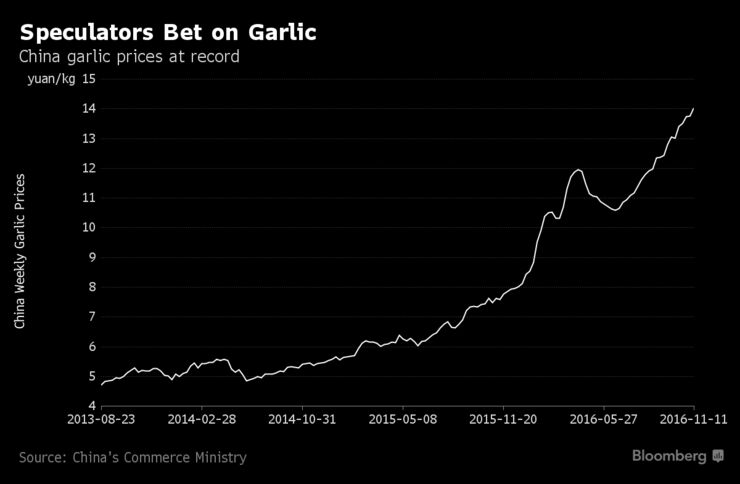
"Price of Chinese garlic in Europe expected to rise by 40% this season"

 From PoAndPo Agrifish, May 25:

China's new garlic season is in full swing.

Looking at the conditions for Chinese garlic export to the European market, FOB prices are estimated between 1,100-1,200 USD per ton, which is an increase of around 40%.

The garlic export industry is facing a number of challenges at the moment, including a shortage of shipping containers, rising shipping prices, and the ongoing pandemic in overseas markets. The impact of the Covid-19 pandemic in particular is severe.

"The main problem is the unavoidable lockdown. Many export companies suffer disastrous losses because of lockdown measures and this has a terrible impact on the general market conditions. In many cases importers do not pick up their orders. Still, even under these circumstances many countries across the globe recognize the disinfecting properties of garlic as well as its benefit for the immune system, which is why the export volume has never been bigger." This is according to Mr. Steven Zhou of Jinxiang County Hong Teng Fruit and Vegetables Co., Ltd.....

....MUCH MORE

Thank goodness it's not the day-trading Chinese grandmothers, they jack markets around so much it makes r/wallstreetbets look like a bunch of kids playing Monopoly.

https://zh-prod-1cc738ca-7d3b-4a72-b792-20bd8d8fa069.storage.googleapis.com/s3fs-public/styles/max_650x650/public/images/user3303/imageroot/China%20Traders.JPG?itok=NhsWH0aQ


Previously:

November 28, 2016
"China’s Ball of Money Is Rolling Back to Commodities" 

https://assets.bwbx.io/images/users/iqjWHBFdfxIU/iNlmKtmYutw0/v1/740x-1.png
 

November 15, 2016
China Property Speculators Pile Into Garlic
It seems as though the Chinese garlic market has some periodicity to it and may have a tradable anomaly or two. Links below.... 

Nov. 25, 2009
Commodities: "Is China preparing for a vampire attack?"
How the heck did I miss this trade?
[maybe you were preoccupied with all the babbling about the grease/tallow/lard complex? -ed]

Paleo-Economics: Trade Between Spain and France

 From Hakai Magazine, May 17:

Whale Bone Weapons Hint at World’s Earliest Coastal Economy

https://www.hakaimagazine.com/wp-content/uploads/header-whale-bone-society-1536x738.jpg

Around 15,000 years ago, people transported projectile points made from whale bone
from Spain to France. Photo by Sheila Terry/Science Photo Library

Thousands of years before the Neolithic Agricultural Revolution, a widespread trade network carried large whale bone spears from Spain to France.

Stone Age humans in Europe made, swapped, and carried whale bone weapons along long-distance networks from Spain through to France, say researchers who have tracked down dozens of such tools. The exchanges around the Bay of Biscay may have contributed to one of the world’s first coastal economies, they argue....

....MUCH MORE

Why Is It So Difficult To Automate Construction? "Construction, Efficiency, and Production Systems"

(much) Smarter minds than mine have looked at this conundrum and  came to the conclusion that increasing productivity in construction is hard.

From Construction Physics, May 4. 

We talk a lot around here about construction being an inefficient industry. Whereas other industries have shown increasing productivity over time, construction has remained flat or even declined. There is no shortage of depressing graphs showing this:


But these productivity measures are fairly abstract and high-level. They identify the problem, but don’t give many clues as to what the solution might be. So it’s worth drilling down into the mechanisms that underlie a production process, and understand exactly what has gone wrong in an inefficient one.

A Simple Production Model

In the grand tradition of Adam Smith, let’s consider a simple pin factory. In our factory, coils of wire come in on one end, get processed at a series of workstations, and come out the other side as finished pins. In this simplified model, the manufacturing process has 4 discrete steps:

  1. Cutting - a piece of wire is cut off from the coil.

  2. Straightening - the piece of wire is straightened.

  3. Attaching head - the head of the pin is attached to the body.

  4. Sharpening - the end of the pin is sharpened.

For simplicity, we’ll assume each step in the process takes exactly one second. With this, we can calculate a few different measures of the production process:

  • The factory’s production rate, or throughput, is one pin per second.

  • The factory’s work-in-process, the amount of partially completed work currently in the system, is always 4 pins (one at each station).

  • The factory’s cycle time, the time it takes a pin to go through the factory, is 4 seconds (one second for each of the 4 stations).

  • The equipment’s utilization rate is all 100% - every station is in use at all times.

  • The queue length at each station is zero - pins don’t spend any time in the process waiting for a piece of equipment to become available.

These metrics tell us how efficient our production process is. More efficient factories will produce more (higher production rate), produce faster (lower cycle time), and hold as little inventory as possible (lower work-in-process).

Our example pin factory is actually a perfectly efficient production process - assuming the times and process arrangement are fixed, the production rate is as high as possible, and the cycle time and work-in-process are as low as possible. The reason it’s so efficient is that there’s no waiting anywhere in this system - as soon as a pin is done with one step of the process, it can immediately proceed to the next step.

But real life production processes almost never move in perfect lockstep like this. In particular, they often have a significant amount of variation in them. This can be anything from natural process variation (it might take between 10 and 15 minutes for a task to complete), to random equipment breakdown, to occasional production errors that need to be reworked.

So let’s look at a slightly modified version of our pin factory, with a bit of variance injected into it. Instead of each step taking exactly 1 second, each step now takes on average one second, but is distributed normally with a standard deviation of 0.5 seconds.....

....MUCH MORE

I mean sure, the use of heavy machinery led to massive gains in what one person could accomplish.

And as pointed out in "Construction Used to Be More Labor Intensive (and other pictures you may not have seen before) CMB":

This link is pretty much the definition of eclectic.

From Messy Nessy Chic:

In the Grand Scheme of Things

As you can imagine, I collect a lot of images from the internet. And sometimes, I need to unload them to clear some space on the old laptop. So this is me, doing that, in a meaningful way. I hope you’ll find the theme of today’s spring clean larger than life…
buildingbig
Workers pose during construction of 60-story tall Chase Manhattan Bank headquarters in NYC, 1959.

....MUCH MORE

But overall, the efficiency gains have been hard-won.

Today In Cheese News: "his love of Stilton cheese' ultimately led to his downfall"

These people are not criminal masterminds.

If they were criminal masterminds they would be lawyers and bankers and hedge fund managers.
And politicians

From the BBC, May 24:

Cheese photo leads to Liverpool drug dealer's downfall
A drug dealer was tracked down after sharing a photo of Stilton cheese.

Carl Stewart, 39, was identified through his fingerprints after police analysed the image he posted in an online chat.

He was jailed for 13 years and six months after admitting conspiracy to supply heroin, cocaine, ketamine and MDMA at Liverpool Crown Court.

The dealer, of Gem Street, Liverpool, was also sentenced for transferring criminal property.

Stewart posted the photo on the encrypted messaging service EncroChat, which had been cracked by police....

....MORE

And as noted in a 2017 post "Sweet Dreams Are Made Of Cheese": 
Who am I to dis a brie?

From the British Cheese Board via the Wayback Machine:

Sunday, 25 September 2005
Sweet Dreams Are Made Of Cheese
The age old myth that cheese gives you nightmares has finally been laid to rest this week following the release of a new study carried out by the British Cheese Board.

The in-depth Cheese & Dreams study, a first of its kind, reveals that eating cheese before bed will not only aid a good night’s sleep but different cheeses will in fact cause different types of dreams.
Of the 200 volunteers who participated in the week-long study, 72% slept well every night, 67% remembered their dreams and none recorded experiencing nightmares after eating a 20g piece of cheese half an hour before going to sleep.

A lot of people still believe the old wives tale that cheese gives you nightmares but this study endorses the scientific facts.

“ One of the amino acids in cheese – tryptophan – has been shown to reduce stress and induce sleep so cheese may actually help you have a good night’s sleep,” says Dr Judith Bryans, Nutrition Scientist at The Dairy Council.

85% of females who ate Stilton had some of the most unusual dreams of the whole study. 65% of people eating Cheddar dreamt about celebrities, over 65% of participants eating Red Leicester revisited their schooldays, all female participants who ate British Brie had nice relaxing dreams whereas male participants had cryptic dreams, two thirds of all those who ate Lancashire had a dream about work and over half of Cheshire eaters had a dreamless sleep.

Commenting on the study, Neil Stanley, PhD Director of Sleep Research HPRU Medical Research Centre at the University of Surrey says: "The Cheese and Dreams study conducted by the British Cheese Board is the first study of its kind and suggests that eating cheese before you go to bed may actually aid a good night’s sleep....MORE
...British Brie caused all participants to sleep very well, but dreams varied between males and females; women tended to experience very nice dreams, such as Jamie Oliver cooking dinner in their kitchens, or relaxing on a sunny beach. By contrast, the men who ate Brie experienced rather odd, obscure dreams, such as driving against a battleship, or having a drunken conversation with a dog....  
HT: Freakonomics

Just so we're clear, the intro line is not mine, it goes back, at minimum, to the late '80's/early '90's. Maybe as early as the day after the song dropped.

The correct attribution would be "-anon."

Here are some continuation lyrics and again, I can't stress this enough, not by me:

Sweet dreams are made of cheese
Who am I to dis a Brie
I cheddar the world and a Feta cheese
Everybody's looking for Stilton
 
Some cheese wants to be Bleu, too
Some cheese wants to be Buchette d'Anjou
Some cheese wants to be cubed
Some cheese will be braided by you

Sweet dreams are made of cheese
Colby or Chevre, if you please
I ferment the milk and then I squeeze
Everybody needs penicillium

Mold is better, on the rind
Mold is better, leaves taste behind
Mold is better, cheese is confined
Mold is better, use my enzymes...

...MORE at amIright's parody page

Ag Commodities: Is The Party Over?

It certainly looks like it today. With corn down 37 cents (5.63%) today. and wheat continuing the decline from the spike high of 7.70 at the end of April to the current 651.75 the air seems to be coming out of the enthusiasm balloon.

From AgWeb, May 21:

I realize I am jumping the gun by about a week, but as it stands right now, the Goldman Sachs Commodity Index is on track to close lower for the month, and this after reaching the highest point traded since November of 2014. Do keep in mind that just closing lower for the month should not strike fear into the hearts of commodity bulls, as we have done this several times during the past 13-months of advance. Still, I would point out that this is the first time it will have happened (potentially) with monthly stochastics well into the overbought zone and on the cusp of crossing lower. I would like to point out that the last time we were trading at similar levels and had indicators in a comparable position was in 2018. That year, the index initially peak in May (sound familiar?), but we really did not see a breakdown until the fall of that year. A similar situation may not be all that unrealistic for 2021.

GSCI

Looking more specifically at the grain/soy world this week, it would appear that only corn will be able to keep its head above water.  If we wrapped up trade right now, nearby July futures would have gained 14-cents, and December is up 2-cents.  Everywhere else, we find red ink.....

....MORE

The writer, Dan Hueber, is one of the better prognosticators/pontificators and even his gaurded optimism wasn't guarded enough. Here is his latest open access commentary.

Among the big banks it is Rabo, hands down that have the best feel for agricultural markets, unfortunately they haven't weighed in on the recent decline. We haven't had time for Goldman and their GSCI since the $200 oil call in 2008 as the gooey stuff was top-ticking at $147. If interested we have a lot of posts on the GSCI-based long-only index fund swaps they sold by the billions to the institutional crowd. (specifically designed to piggyback on Goldman's designation as a commercial so the institutions could evade speculative position limits)

Anyhoo, if interested here is the current breakdown of the GSCI weighting via S&P.
At 54% energy and 19.3% agriculture it doesn't do what we wish.

One of these days we'll post and repost on index construction.
A wonderful tool should you desire solitude at a crowded party. 

Finally, the S&P Dow Jones Commodity Index has weightings closer to what we are up to.

"Minneapolis Fed: Land Values, Cash Rents Make Largest Quarterly Jump Since the Ethanol Boom"

 From DTN Progressive Farmer, May 13:

Agricultural bankers in Minnesota, Montana, North Dakota, South Dakota and Wisconsin see higher incomes, high loan repayment rates, higher land values and higher cash rents, according to a survey by the Federal Reserve Bank of Minneapolis.

For the first three months of 2021, ag bankers said farm incomes improved from the year before, which in turn lead to a steady increase in loan repayment rates as well as lower demand for new loans and renewals. The survey included 67 respondents, all bankers that regularly respond to the survey.

"The reasons mostly focused on the sustained increase and improvement in crop prices for the core agricultural commodities produced in our region, as well as good yields and production from 2020, leading to bountiful harvests to continue marketing," said Joe Mahon, a regional research director for the Minneapolis Fed. "And, of course, continued government aid that persisted through 2020. That's bolstered farm balance sheets during those last few difficult years."

The bank also asked what an acre of land cost and compared the responses to last year's survey to estimate the change in land values. Across the region, land values were 6.8% higher than last year....

....MUCH MORE

And from the Federal Reserve Bank of Minneapolis:

Recently:

May 21
Creighton University's "Rural Mainstreet Index Soars to Record High: 90% of Bankers Report Labor Shortages Restraining Growth"
For the first time since 2013, the regional farmland prices expanded for eight straight months. May 14 

Farmland: "Bullish Land Price Outlook"
As goes the farmgate commodity basis, so goes the entire rural economy edifice, banking and finance, retail provisioners, land prices, the whole thing built upon the price of wheat. And corn. And soybeans. and cotton. And marijuana....