Wednesday, August 29, 2018

UPDATED—"How Beer Revolutionized Math — and Just Might Save Humanity "

Update below.
Original post:
 
This piece makes a good introduction to a looming problem at the intersection of big data and biology. Back with that in a bit.

From AgFunder:
Editor’s Note: Joseph Byrum, a geneticist, is chief data scientist at Principal Financial Group and a regular contributor to AgFunderNews. Full disclosure: Byrum has no connection with Guinness or any other beermaker besides having a pint on occasion. Connect with him on Twitter @ByrumJoseph and read his other articles here.

Amazon, Google, Microsoft, and every other firm heavily invested in big data all owe their success to beer. The pioneering work of Irish brewers a century ago made today’s big data and artificial intelligence gold rush possible. And the advances in genetics, technology, and mathematics may well be the key to humanity’s survival.

Back in 1899, William Sealy Gosset would have no idea how important his work would prove to be. He turned up on the doorstep of the Dublin headquarters of Guinness one day in 1899, hoping to secure an apprenticeship. As a newly graduated Oxford University chemist, Gosset was a natural. He began what turned out to be a 38-year career devoted to perfecting a pint of stout. Brewing, agriculture, and the entire field of statistics would never be the same again. 

Gosset began with a singularly practical mission: finding a way to achieve a consistently high-quality beer at a lower overall cost. This was no small task at the world’s largest brewery, which at the time pumped out 100 million gallons of beer annually.

The basics of beer are simple. The flavor and aroma come from yeast, malt, and hops, the ingredients responsible for the difference between a Belgian ale or an American wheat, a Munich lager or an English stout. Guinness knew that it could use breeding techniques to improve its ingredients, but it would have to conduct tests to know how well or poorly newly-developed hybrid barley varieties performed. 

Guinness took a practical approach to finding the best and the most economical variety. It would conduct experiments in a way that provided only enough certainty to make the brewery more profitable. This was heresy to the statisticians of the time, who insisted on maximizing the number of observations to reduce error to an absolute minimum. Conducting a lot of experiments, however, was expensive, as setting up testing fields was a labor-intensive process. Gosset cut out as many of these costs as he could by extracting useful results from the smallest possible set of observations.
In an early experiment, Gosset wanted to use ingredients that would hit the desired alcohol content without triggering the higher taxes that Ireland imposed on stronger brews. So he tested the saccharine level of the malt extract and figured that customers and regulators alike would be fine if he could achieve his saccharine target with an accuracy of plus or minus five-tenths of a degree.
By making just two observations, he could get it right 80% of the time. If the number of observations increased to four, the results would dramatically improve so that he got it right 12 out of every 13 tries. 

By contrast, to achieve near-perfect laboratory precision meant conducting experiments with 82 observations — a level of perfection that proved to be prohibitively expensive. 
Gosset was comfortable with the level of confidence achieved with four observations, a sample size small enough to save big cash, using a statistical method that opened a new window on the use of mathematics to do more with less. 

One of the biggest problems in testing the significance of experimental results in the fields where plants are grown is that environmental noise creeps into the results in a way that doesn’t happen in the chemist’s laboratory. Out in nature, weather, soil conditions, insects, disease and so many other sources of potential error skew the results. 

Gosset’s theories of statistical significance and balanced experimental designs helped manage this problem. To keep Guinness competitors from realizing the value of statistics in brewing a better beer, his work was published under the pen name “Student.” 
Ronald A. Fisher, a professional mathematician, absorbed and systematized Student’s theories in a way that has stood the test of time. Fisher’s statistical books are still widely used today and have only recently been supplanted as the foundation of modern agriculture. 
Only so much can be done when data are stored in hand-written journals or boxes jammed to the brim with typewritten sheets of paper. There is simply no way to perform complex simulation and analysis without powerful computer hardware and software suites. Advances in computer hardware have allowed agricultural statistics to escape the limitations of paper and leap beyond Gosset and Fisher. 
Understanding the genomes of yeast, barley, and hops allows for customizing the flavor and attributes of a beer. A geneticist’s job is to harness this understanding to take advantage of genetic variation. The selective breeding and genetic modification that took place at Guinness in the preceding century ensured the beer was more consistent. Today, we can do the same with unprecedented precision. 
Precision agriculture uses sophisticated sensors to gather real-time data about soil conditions, plant health, the weather, and every other factor vital to a successful yield. Sophisticated algorithms evaluate millions or trillions of possible genetic combinations to design better plants. Even more complex models are used to determine when, where and how these seeds will be planted for maximum growth, taking into account the measured conditions. 

Agriculture informed by data analytics is all about growing more from less, embracing Gosset’s economizing quest for a better beer. Gosset figured out how to conduct a series of more efficient trials. Now we’ve figured out how to use data analytics to further slash the number of trials needed. ...MORE
 Update: "Unless researchers solve the looming data storage problem, biomedical science could stagnate"

"CoinDesk's quietly profitable media business"

From Axios:
CoinDesk is the hottest digital media startup that most people haven't heard of, generating around $20 million in revenue through the first seven months of 2018. It's also profitable.

The bottom line: Less than three years ago the business was sold for just $500,000, but that was before cryptocurrencies and blockchain went mainstream.

CoinDesk was born in May 2013 as the brainchild of entrepreneur and investor Shakil Khan, who had been interested in bitcoin and wanted a simple site to track news and pricing data about the cryptocurrency.

“When we first launched CoinDesk, the goal was simply to supply the market with accurate and reliable information on digital currency,” Khan tells Axios. “As the community increasingly looked to us for the latest industry developments and our perspective on them, building a media business around that based also on data and events felt very organic.”

Three years later Khan sold the company for just $500,000 to Barry Silbert's Digital Currency Group (DCG). At the time it had 10 full-time employees, 700,000 monthly readers, and had raised just under $2 million in seed funding from investors like DCG, 500 Startups and Science Inc.
  • Its revenue has since grown tenfold, with a significant portion coming from an expanding events business. Its annual Consensus conference had 8,500 attendees in 2018, up from 625 in its 2015 debut.
  • Consensus has been criticized by Ethereum co-creator Vitalik Buterin (who also co-founded a different crypto-related publication in 2012) for being too expensive, and CoinDesk CEO Kevin Worth said he's working on ways to make it more accessible (while also arguing that many attendees pay much less than the price at the door).
  • CoinDesk's research arm, which grew out of its early bitcoin price reports, now also includes multiple reports and areas of focus....
...MORE

Tuesday, August 28, 2018

We May Have to Remove A Zero From The Last Waymo Valuation (GOOG)

Following up on August 22's "This Valuation Says Google’s Waymo Unit Is Worth More Than Tesla" (GOOG).
From c|net's Road/Show:

Waymo's self-driving cars are far from perfect, report says
A new report from The Information claims the cars are causing frustration and aren't as capable as they appear.
Most stories about Waymo's self-driving efforts in Phoenix have been positive, but a new report claims that the pilot program isn't all flowers and sunshine.

Waymo's self-driving Chrysler Pacifica minivans are struggling to handle certain driving tasks and irking fellow drivers on the road, The Information reports. The outlet talked to a number of sources, some familiar with Waymo's business and some residents in the area where Waymo's vehicles operate. 

While many stories about the company's efforts are largely positive, these sources paint a different picture. Other drivers and residents complained that the cars stop for too long at stop signs and have trouble dealing with certain traffic situations, such as taking a left turn across a fast-moving road and merging into rush-hour highway traffic. They also allegedly stop and brake abruptly, confusing other drivers and causing traffic snarls.

"As the only company with a fleet of fully self-driving cars on public roads, our vehicles are continually learning and we've developed robust testing processes that will allow us to safely expand our vehicle's driverless capabilities over time," said a Waymo spokesman in an emailed statement. "Safety remains our highest priority as we test and deploy our technology." The company also told The Information that it has received plenty of feedback from local residents that will help the company continue to develop its autonomous-driving platform.

Given that Waymo's vehicles are still in development -- its Phoenix program is considered a pilot and not a fully-fledged rollout -- the cars are programmed to err on the conservative side. The vehicles will stop for a full 3 seconds at every stop sign, and it prefers wide berths when taking turns in traffic. It doesn't take more than a quick glance at any major four-way stop to see that human drivers cut more than a few corners that AVs don't. The Information's report also points out that Waymo's system has had trouble with drivers who take liberties with the rules of the road.

The trick, it appears, is striking that balance between being a perfect driver and being a driver that blends in. Standing out as a model student clearly doesn't recognize that this is not how a majority of drivers operate. While Waymo attempts to carve its own path to that end, other companies have different solutions. Mobileye, for example, relies on something it calls Responsibility-Sensitive Safety, which accepts that AVs do not exist in a bubble and, thus, must act at least somewhat like current drivers. Roadshow's Tim Stevens took a ride in Mobileye's development car, which went so far as to create a gap in traffic by slowly nudging into a lane until a human driver ceded their position....MORE
CNBC's headline is a blunt instrument:

'I hate them': Locals reportedly frustrated with Alphabet's self-driving cars

See also:
"Self-Driving Car Makers Prepare to Blame 'Jaywalkers'”

"Intel’s Mobileye wants to dominate driverless cars—but there’s a problem" (INTC; GOOG)
 

The Central/Eastern Europe Boom May Have Passed Its Peak

Except for Poland, they're still putting up some numbers.
From BNE Intelligence

CEE boom passes peak
August 15, 2018
 
The boom Central and Eastern Europe (CEE) has been enjoying for the last four years has reached its peak as countries in the region start to run up against their structural limits.
While all the countries are still enjoying robust growth, the rate of expansion is starting to slow and in some cases has begun to fall. The main break on development is a growing labour shortage in the region, but more insidious is the lack of investment into new technologies and a reengining of businesses to go up the value added chain that will take longer to make itself felt.

Six economies in Central and Eastern Europe released second quarter GDP data this month: Bulgaria, the Czech Republic, Hungary, Poland, Romania and Slovakia. The data showed that regional growth slowed for a third straight quarter, weakening from 4.6% y/y in Q1 to 4.3% y/y in the second quarter – down from a peak of 5.6% y/y in the third quarter of 2017, reports Capital Economics.

“Detailed breakdowns of the data have yet to be released. But monthly activity data show that weaker growth in Q2 was widespread across sectors. After a sharp rebound in 2017 on the back of a recovery in EU structural fund inflows, growth in construction output slowed markedly in Q2. Meanwhile, continued softness in euro-zone manufacturing weighed on CEE industry. And retail spending weakened a touch — higher oil prices may have tempered consumer demand,” Capital Economics said in a note.
Its been a fun ride as bne IntelliNews pointed out in a cover story “CEE booms” last year but now the countries in the region will return to more levels of growth.

The Romanian economy already started to slow sharply at the end of last year, while the Czech economy slowed the most this quarter. Poland put in a small growth, however, economists are warning that the peak has passed and expect all the economies of the region to slow as the rest of the year plays out. Acute labour shortages that are causing wage inflation and the slow progress manufacturers are making in moving up the value chain is limiting the further growth of countries in the region.

“We think that the gradual slowdown in CEE GDP growth will continue over the course of 2018 and into 2019. Higher inflation and interest rates, as well as less supportive fiscal policy in parts of the region, will probably take the steam out of domestic demand. And weaker demand from the euro-zone and mounting capacity constraints will weigh on net trade. We expect CEE growth to average around 3% in 2019,” said Capital Economics.

GDP growth slowing but still strong
The Czech Republic was worst affected this quarter. Czechia’s economic growth decelerated to 2.3% year-on-year in the second quarter of 2018 from 4.2% growth in the first quarter as the economy runs up against its structural limits, the Czech Statistics Office (CSU) said on August 14. The main reason is a strong base effect from the previous year, but the slowdown was also due to the depleted capacities of the Czech economy, analysts say. Slovakia’s economy grew 4.1%, compared with 3.6% in the first quarter.

By contrast Hungarian GDP growth unexpectedly quickened to 4.6%, the fastest pace since 2014, driven by agriculture, services and manufacturing. But economic research institute GKI said at the end of July economic growth probably reached the peak in this business cycle of 4.4% in the 4Q17 and 1Q18.

Poland’s economy is the biggest in the region and is also holding up well, but growth is also expected to peter out later this year. GDP growth slipped from 5.2% in the first quarter to 5.1% in the second and is expected to slow further as the year wears on, due to weak investment growth as the construction sector reaches capacity limits, among other problems.

Romania’s economy has already passed its peak. After turning in an astonishing 8.8% growth in the third quarter of 2017. Romania’s state forecasting body the CNP cut its projection for this year’s GDP growth from to 5.5% in July from 6.1% in the previous outlook released in April. Romania’s GDP increased by 4% y/y in the first quarter of the year, the statistics office said earlier in July, confirming an earlier flash estimate, pushed up by private consumption.

Labour woes
The main problem is everyone now has a job and these workers can’t be made to work more or better. Poland in its desperation to find more labour has opened a bureau to fast-track work permits for Ukrainian jobseekers and bne IntelliNews’s correspondent in Tbilisi reports the capital of Georgia is plastered with posters advertising jobs in Poland....MORE
And on Poland:
Economists surprised by low inflationary pressure in Poland
bne IntelliNews August 20, 2018

Did Tesla Really Renege on its Solar Panel Deal with Panasonic? (TSLA)

The stock is down  $3.26 (-1.02%) at $316.01.

The source is, as will become apparent, rather pro-Tesla but this is probably the fairest interpretation of the story first reported by the Buffalo Business Journal and then a couple days later by the WSJ.

Personally I think SolarCity will be out of business this time next year.

From1RedDrop, August 17:
A WSJ article earlier this week cited Panasonic as saying that “Tesla has backed away from an agreement to buy all of the output from a solar-panel factory it operates with Panasonic Corp.” While this sounds like Tesla violated an agreement, Tesla says otherwise.
According to a Tesla spokesperson: “We continue to use cells and solar modules produced in Buffalo by Panasonic…in line with our contract, which contains no requirement of exclusivity. We anticipate using the full production capacity of Gigafactory 2 over time as we reach higher output and installation volumes.”

Tesla has been having problems on the installation front for its solar panels, and the fact that its hard to get Musk’s approval on the esthetics aspect of any product means that only one type of panel is now being installed – textured black. That and other issues have created a slowdown in installations, and this has created a slowdown in component acquisition from its partner, Panasonic.
In an earlier report, we mentioned that Panasonic had not signed any agreements with third parties for its solar components. But the deal terms were revised earlier this year, and the company is now reportedly selling panels under its own brand as well as to other companies.

As it turns out, this may not be a bad thing. Panasonic is facing a slowdown in demand back in Japan for its panels, and that’s related to subsidies getting cut and overall solar panel demand softening in the land of the rising sun. The altered deal with Tesla now puts pressure on Panasonic to boost U.S. sales, but the Trump-initiated tariff increases on Chinese panels could be a way out of this predicament. Panasonic says that demand in the U.S. for domestic-made panels was “intact.”
Tesla’s (and Musk’s) focus of late has been on ramping up production of the Model 3 electric car.

While it’s possible that this has affected the SolarCity side of the business that operates in the Buffalo factory dubbed Gigafactory 2, it appears to be a short-term problem. For its part, Tesla is still committed to buying up Panasonic’s full production at Gigafactory 2 once installation volumes are back up. Meanwhile, Panasonic’s plans to invest $271 million in the facility remain unchanged.

The relationship between the two companies goes as far back as 2010 when Panasonic first started providing batteries for Tesla EVs. That relationship later matured into a joint investment deal for Gigafactory 1 in Nevada, where Panasonic is even now open to increasing its investments if Tesla requires....MORE
See also yesterday's "Jim Chanos Has Some Thoughts On Tesla (TSLA)".

How The Natural Gas Trade Will Transform In the Next Five Years: "IEA, Gas Market Report 2018"

From Power Magazine, August 1:

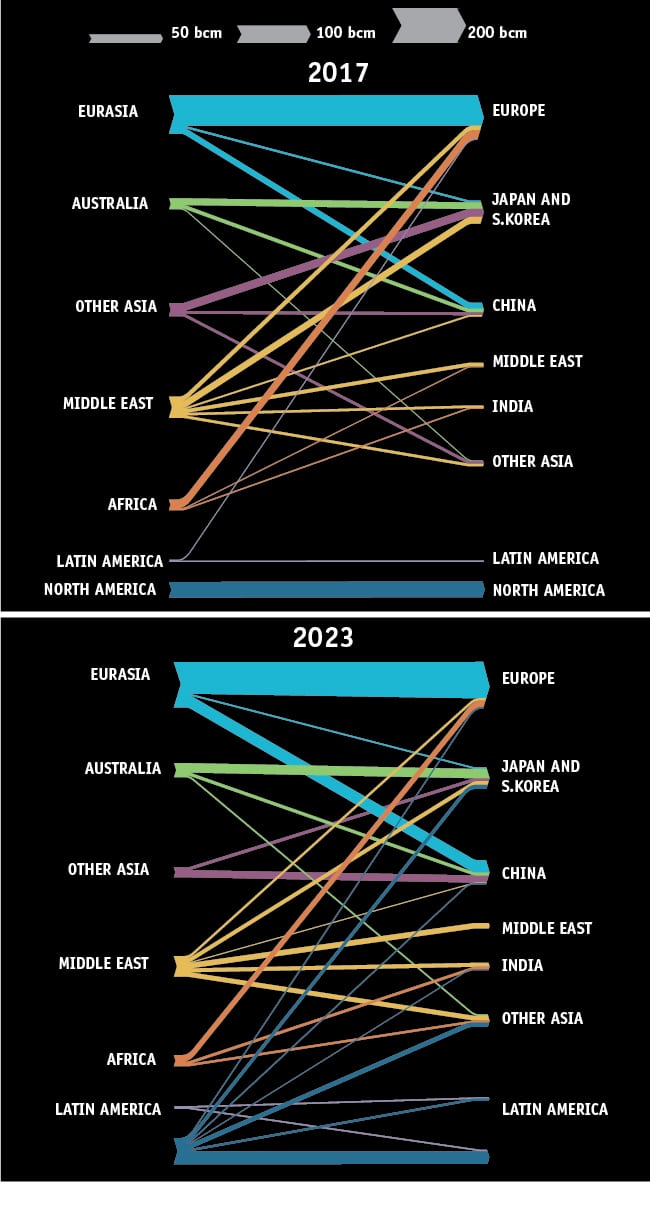
THE BIG PICTURE: A Gas Trade Transformation (Infographic)
According to the International Energy Agency, global natural gas trade has grown by more than 40% over the past 15 years. Over the next five years, current trade flows are expected to significantly diversify, boosted by development of liquefied natural gas (LNG) infrastructure. LNG trade, which grew by 11% in 2017 to 391 billion cubic meters (bcm) is expected to surpass 500 bcm in 2023, driven by strong demand in developing Asian markets (and especially China, which will account for a third of the increase in LNG demand). On the supply side, the Middle East, which has traditionally been the world’s single balancing supplier, will be increasingly challenged by development of export capacity from the U.S., Australia, and Russia.
BP_Aug2018_Web
 Source: IEA, Gas Market Report 2018, Figure 3.1, 
“Main Natural Gas Trade Flows, 2017 and 2023,” OECD/IEA, 2018

...MORE

Here's the IEA's Gas 2018 (Summary: gratis; Report €80 pdf)

And the June press release;
The gas industry’s future looks bright over next five years, according to IEA analysis

Energy: Have LNG Majors Learned Their Lesson?

Probably not.
There's a lot of stuff coming online and the big players will have to:
a) sell it
b) resist the urge to immediately reinvest.
From United Press International:

LNG next test for capital efficiency
The next year and a half will test whether the big energy companies have learned a sense of discipline, consultant group Wood Mackenzie reported.
Aug. 14 (UPI) -- The energy majors are getting more efficient with megaprojects offshore, but it will be planned LNG projects that test their mettle, Wood Mackenzie found.

A report sent Tuesday to UPI from the consultant group found deepwater efforts are improving. During the last decade, the 15 largest efforts offshore were late and collectively $80 billion over budget. Better planning, improved corporate discipline and the ability to tie new projects into existing developments have partly erased that trend.

Angus Rodger, a research director at Wood Mackenzie, said "value destruction" is becoming a thing of the past for upstream projects. The next test, he said, will be in emerging liquefied natural gas projects.

"After a fallow period in new LNG project sanctions, and megaprojects in general, the next 18 months will likely see a step change," he said in a statement. "This will be the real test of whether the industry has addressed the issue of poor delivery."

French supermajor Total in the span of a month revealed progress at two of its LNG projects. The first shipment from the second liquefaction facility at the Yamal LNG plant in the Russian Arctic was announced last week, ahead of schedule.

"Following the successful start-up of Yamal LNG in December last year, the first shipment from the second train ahead of schedule is another major milestone for this world-class LNG project," Chairman and CEO Patrick Pouyanné said in a statement....MORE

Journalism at $15.66 per word: In 1928, William Randolph Hearst hired Mussolini to write a column for Cosmopolitan.

Spare a thought for the journalists, As noted in the intro to 2013's "Why Aren’t Top Journalists Rich?":
It wasn't always thus.
In 1898 young Winston Churchill, after a couple other writing gigs (Daily Graphic, Telegraph) went off to war with a commission to write for The Morning Post. He produced thirteen articles between September 23 and October 8, 1898 for which he was paid fifteen pounds each. According to the ever handy BoE inflation calculator that is the equivalent of  £1651.03 per, or  £21463.39 for the lot, $33,053 in today's reserve currency for 15 days work. Not rich but not bad.

More on Churchill another time, but here are a couple more factoids: He charged a half-crown (2 1/2 shillings, $11.38) per word in the 1930's, in 1936 his writing income was the equivalent of $800,000 now.
Again, not rich but able to afford his Pol Roger.
Then he went on to become the highest paid scribbler of his day and did some other stuff too....
And today's story of what they used to make:
...Hearst was enamored with Italian Premier Benito Mussolini, first hiring him in 1928 to write about the fascist perspective on gender relations, which is exactly what you might think: “Man is in full possession of woman’s liberties, and measures them to her as a merchant does a piece of cloth,” etc. Mussolini faced backlash at the time, but Hearst still contracted him in 1931 for a monthly column in Cosmopolitan for $1 a word. That’s $15.66 per word today....
That's from "How Much is a Word Worth" by Malcolm Harris at Medium.

Here's a ProTip:

Winston Churchills Guide To Good Quotes

Okay, not a real Churchill quote but pretty funny. Here's the Churchill Centre's "Famous Quotations and Stories".

In addition to the false quote above there are hundreds of others that can be debunked using the Centre's 2.5 million word database. (the guy just couldn't shut up)
Churchill Centre homepage
As I've said, we like jounos, they've given us some of our best ideas.

Let's Check In With The Fly To See If His Winning Streak Has Changed Him

From The Fly at iBankCoin, August 27: 

S T F U
There’s nothing you can say now that can derail stocks. All of your bearshit has been stomped out. Your jaws have been punched loose — mustaches in the wind. Your legs have been chainsawed in half and the greatest fucking bull market in the history of the world presides over you — salty motherfuckers.

This is the easiest tape to play, if you’re playing the right sectors. Contrarians get BTFO and financial advisors get the gibbet every single time. Fuck your low fee ETF strategies and fuck everything you stand for. This world is filled with parasitic creatures feeding off the strong. The time has come to disinfect the planet of this scourge, starting with anyone in possession of a series 65 license.

Market bulldozed higher, in spite of Trump paying off hookers, in spite of Trump’s lawyer turning rat, in spite of Trump’s former campaign manager cheating on his taxes. In spite of everything and all, markets traded higher.

We’ve hit new highs, Nasdaq 8,000, off the news that a new NAFTA deal is in the balance. Very soon, we’ll have a new China trade deal, and then markets will rip again.

All of my stocks went up more than yours. If you’re not convinced by my words, have a look at HUYA and JG. “The Fly” does this shit every day, and will be doing this shit for the next thousand years. Nothing will stop me — not even death himself....
Seems to be taking the recent success in stride, as if to the manner (manor) born.

August 14
"Here’s the Secret to My Recent Trading Prowess"

According to the 1991 movie Terminator 2: Judgement Day, August 29th is the day Skynet becomes self-aware.

Just a heads-up for tomorrow.
The Terminator: The Skynet Funding Bill is passed. The system goes on-line August 4th, 1997. Human decisions are removed from strategic defense. Skynet begins to learn at a geometric rate. It becomes self-aware at 2:14 a.m. Eastern time, August 29th. In a panic, they try to pull the plug. 
Sarah Connor: Skynet fights back.
https://www.neatorama.com/images/posts/689/64/64689/1377798337-0.jpg

Commodities: The 'Commitment of Traders' Reports Aren't Really Timing Tools But...

They can tell you when to pay attention.

Here's the introduction to "Gold, Silver Looking At Two-Year Lows", August 13:
Ditto for platinum which has its own set of diesel vehicle problems.
We've referred to gold's "stately decline" and have an ultimate price target of $875 but now's the time to look at the Commitment of Traders reports for a possible pause.

While we place less weight on the CoT's than many analysts, they can be helpful to point up short term trend changes, simply because over time the commercials have to be right or they go out of business and the game ends for everyone....

...Note that the commercial hedgers have been pulling in their shorts since January and are approaching a net flat position.
This doesn't mean an immediate explosive move to the upside, just that being short is getting more dangerous until the commercials move any inventory they've been accumulating....
Which was promptly followed by:"Metals Meltdown: Copper Crashes, Silver Slammed, Palladium Plunges":
...Yesterday, our caution on the short side was early:
Front futures August 28:

https://screenshotscdn.firefoxusercontent.com/images/9345d14a-e70b-4f87-8fc0-75cab477aa4a.png

Here's the one year picture, mid-August was the first serious price reversal since the April highs up around $1365:

https://finviz.com/fut_chart.ashx?t=GC&cot=088691&p=d1&rev=636710353744398358

Sometimes you get lucky.

Apollo Management Decides It Wants More Insurance Exposure, Buys Aspen For $2.6 Bil. (APO)

From Artemis, August 24:

Apollo buying Aspen for $2.6bn
Private equity and alternative investment specialist Apollo Global Management, LLC is acquiring Bermudian insurance and reinsurance firm Aspen Insurance Holdings for $2.6 billion, providing another sign of the attraction asset managers have to insurance-linked returns and the resulting long-term capital.

With the acquisition of Aspen, Apollo also gains access to an established insurance-linked securities (ILS) and collateralized reinsurance platform, in Aspen Capital Markets and the team managing the Peregrine Re collateralized reinsurance vehicle.

With Aspen having been a heavy user of third-party reinsurance capital in recent years, through its own Aspen Capital Markets and Peregrine transactions, its quota shares with other investors and ILS funds, and also its recent return to the catastrophe bond market with the $225m Kendall Re Ltd. (Series 2018-1), it will be interesting to see how that strategy  fits into an Apollo Global owned private re/insurance entity.

Apollo is no stranger to insurance and reinsurance linked returns having a majority stake in the life and retirement reinsurance focused company Athene Holding Ltd.

Apollo has demonstrated its desire as an investor to access long-term sources of capital through reinsurance business, but it is also known for growing profitable enterprises within its Apollo Funds, in their own right, hence with Aspen’s business a mix of shorter and long-tailed it will be interesting to see where the future focus lies....MUCH MORE

Monday, August 27, 2018

"Orrery.ai aims to turn streams of data into secret weapon for strategic investment"

Please set your coffee or other beverage down for just a moment.

From GeekWire:
Satellites, sensors, social media and purchasing data provide terabytes’ worth of information about how the global economy is working — and the insights gleaned from that data can be more precious than gold.

But what’s the best way to extract the gold from the dross? That’s where longtime space entrepreneur Dick Rocket intends to step in with a stealthy venture called Orrery.ai.

“There’s a gap between the data analysis firms and the financial sector,” Rocket told GeekWire this week. “That is our gap.”

Rocket launched Orrery.ai about a year ago, with backing from angel investors, but he and a small executive team are just now ramping up a more ambitious private funding campaign. They’re also mulling over where to put their headquarters. (The Seattle area is in the mix, along with sites in Florida, Texas, New York and Georgia.)

One of the key tasks ahead will be to fine-tune a set of machine-learning algorithms that can process publicly available data as well as proprietary data sets and satellite imagery to produce business insights.

“There are literally millions of data sources that are available to us,” said Jason Evans, a tech startup veteran who serves as Orrery.ai’s chief technical officer.

Space companies such as Spire Global and Seattle-based BlackSky already offer satellite data that can be used to figure out whose ship traffic is increasing, whose crops are doing well, or which retail chain’s parking lots are full. But they leave it up to their customers — including financial analysts and hedge fund managers — to decide what to do with that information.

In contrast, Orrery.ai would reserve the insights for its own use, although there may be some data-sharing deals on the side. “We don’t want anyone knowing what we know,” Rocket said.

Everything that Orrery.ai comes to know would be applied to strategic investments made through a separate but allied venture called the 2020 Fund. Rocket is already thinking big about how the 2020 Fund would leverage Orrery.ai’s proprietary data analysis to make money for its investors....MORE

Gambling: Sportsbooks Banning the Smart Money (WMH: Lon; WIMHY)

From ESPN:
Already a hot-button issue in the United Kingdom, a controversial bookmaking practice is starting to spread in the U.S.'s growing legal sports betting market, too.

Bookmakers from London to Las Vegas are refusing to take bets from a growing number of customers whose only offense might be trying to win.

The full scope of the issue in the U.K. is difficult to determine, but it's believed only a small fraction of the roughly 8.5 million "punters" (the European term for bettors) are impacted. Gaming experts say sportsbooks might have closed as many as 50,000 betting accounts in recent years, and just as many punters have had their betting limits restricted to mere pittance.

As one U.K. bettor put it, "If you try to win, they don't let you play anymore."

"Yes, bookmakers are severely restricting or closing accounts for what appears to be the fact that these people are winning," said U.K. gambling consultant Steve Donoughue, secretariat for an all-party parliamentary group that focuses on gaming.

"The hilariousness of it," Donoughue added, "is that they restricted one of my member's accounts, and he's a Lord."

The profit-minded corporations that have entered the bookmaking game, however, look at it from the perspective of their bottom line and wonder what business would ever choose to cater to customers thought to be "uneconomical." It's like encouraging a world-class competitive eater to dine often at your all-you-can-eat buffet.

American sports betting is not immune to the practice. Banning or limiting sophisticated players has been a regular part of Las Vegas sports betting for decades, and, like in the U.K., there's absolutely nothing illegal about it.

Bettors say the practice is increasing and has even occurred in some of the new states (such as New Jersey) that have entered into the now-legal bookmaking game in recent months.

"Americans should be worried," said Brian Chappell, a founder for the U.K. bettor advocacy group Justice for Punters. "It's coming."


A reputation for sportsbook giant William Hill
In Nevada, refusing to take bets from any customer, from card counters to wise-guy sports bettors, is completely within any casino's legal rights. From Caesars Palace to the Venetian to more local spots like Station Casinos, every bookmaker in town will tell you -- albeit somewhat quietly -- that they've 86'd customers for one reason or another.

Seasoned bettors are concerned, though, that the practice of banning or limiting accounts is not only increasing, but the reasoning behind the decisions is becoming more and more suspect.

Many believe that the only thing betting intelligently will get you at some shops is a one-way ticket to being thrown out. An iconic U.K. bookmaker that's rapidly growing its footprint in the U.S. is said to be by far the most aggressive with the tactic.

ESPN communicated with 20 bettors for this article who said they had been banned from betting with William Hill U.S. in Nevada. Two said they already have been cut off at the new William Hill books in New Jersey, too, something the Division of Gaming Enforcement is reviewing.

"In our world, our community," said Joe Fortuna, one of the professional bettors who says he was cut off by William Hill in Nevada, "everyone knows you'll get thrown out of there."

"It's not even really close," said another Las Vegas bettor who had been restricted by William Hill and requested anonymity. "They're by far the worst."...MUCH MORE

The Breadth and Depth of Google Data Collection Research (GOOG)

From Digital Content Next, August 21:

Google data collection research

https://digitalcontentnext.org/wp-content/uploads/2018/08/TrackedDown.png
While the public has been focused on the ongoing Facebook and Cambridge Analytica scandal, Google has largely avoided public scrutiny about its data collection practices despite having the ability to collect far more personal data about consumers across a variety of touchpoints. There have been efforts to document individual practices by Google such as their efforts to circumvent controls on Safari.  More recently, an investigation by the Associated Press revealed that Google continues to track location data even after a consumer has turned off the setting.  While these research efforts have been important to the public policy dialogue, no research exists which looks at the breadth and depth of data collected by Google.

In “Google Data Collection,” Douglas C. Schmidt, Professor of Computer Science at Vanderbilt University, catalogs how much data Google is collecting about consumers and their most personal habits across all of its products and how that data is being tied together.

The key findings include:
  • A dormant, stationary Android phone (with the Chrome browser active in the background) communicated location information to Google 340 times during a 24-hour period, or at an average of 14 data communications per hour. In fact, location information constituted 35 percent of all the data samples sent to Google.
  • For comparison’s sake, a similar experiment found that on an iOS device with Safari but not Chrome, Google could not collect any appreciable data unless a user was interacting with the device. Moreover, an idle Android phone running the Chrome browser sends back to Google nearly fifty times as many data requests per hour as an idle iOS phone running Safari.
  • An idle Android device communicates with Google nearly 10 times more frequently as an Apple device communicates with Apple servers. These results highlighted the fact that Android and Chrome platforms are critical vehicles for Google’s data collection.  Again, these experiments were done on stationary phones with no user interactions. If you actually use your phone the information collection increases with Google.
  • Google has the ability to associate anonymous data collected through passive means with the personal information of the user. Google makes this association largely through advertising technologies, many of which Google controls. Advertising identifiers—which are purportedly “user anonymous” and collect activity data on apps and third-party webpage visits—can get associated with a user’s real Google identity through passing of device-level identification information to Google servers by an Android device.
...MORE

Recently:
"This Valuation Says Google’s Waymo Unit Is Worth More Than Tesla" (GOOG)

"What Your Car Knows About You: Auto makers are figuring out how to monetize drivers’ data"

NVIDIA’s CEO is (almost) the Uncle of AMD’s CEO (AMD; NVDA)

Things I did not know.

From Babel TechReviews:
Although NVIDIA and AMD are fierce competitors, interestingly NVIDIA’s CEO Jen-Hsun Huang is the uncle of AMD’s CEO Lisa Su.  Although this information has been posted recently in the Wikipedia, it wasn’t well-known outside of Taiwan.
Lisa Su (born 1969) is a Taiwanese-American business executive and electrical engineer, and the CEO and president of Advanced Micro Devices (AMD). …
She is the niece of NVIDIA’s CEO Jen-Hsun Huang.
The original source is here but unless your Chinese is good, you will need it translated as we did for this post.  Start the video at 6 minutes and 42 seconds for the story.....
...MORE

Jim Chanos Has Some Thoughts On Tesla (TSLA)

If I were in Mr. Chanos' position I wouldn't be talking about the day-to-day nuttiness of the Elon Show.
Rather, Mr. C might want to go back to a subject he knows very well, the unfolding disaster at the SolarCity subsidiary. Some links below.

From MarketWatch:

‘The corporate-governance disaster that is Tesla continues,’ says one of the fiercest critics of Musk and company 
Tesla shares are down 5.8% since CEO Elon Musk’s Aug. 7 go-private tweet 
Jim Chanos, the prominent investor at the head of hedge fund Kynikos Associates, has some choice words for Tesla Inc. and its board a day after CEO Elon Musk put the kibosh on a plan to take the electric-car maker from out of public hands:

Musk in a blog post wrote on Friday that “given the feedback I’ve received, it’s apparent that most of Tesla’s existing shareholders believe we are better off as a public company.”
Musk stunned fans and critics of Tesla alike on Aug. 7 when he announced plans to take the car manufacturer private at $420 a share, describing that he had “funding secured,” suggesting that the process was in its later stages....MORE
In pre-market trade the stock is at $313.50 down $9.32 (2.89%) after dipping as low as $303.52.

Some previous commentary on SolarCity and the merger:
August 1 
On Elon Musk: Some People Are....Different (and the phony SolarCity invoices) TSLA

June 21, 2018 
Reuters Exclusive - "Tesla to close a dozen solar facilities in nine states: documents" (TSLA)

Dec. 18, 2017 
So, How Was Tesla's Purchase Of SolarCity Not a Fraud? (TSLA; SCTY)

Dec. 4, 2017
The Short Argument Against Tesla
Mr. Chanos was taken to the cleaners by Mr. Musk on SolarCity, had Tesla not bought it, SCTY was on its way to bankruptcy court. We have quite a few posts on the bad blood between the two, use the 'Search Blog' box search term SCTY if interested.... 
TSLA $302.87 Down $3.66, last (1.19%)

Oct. 25, 2017
"Tesla cites performance reviews as it fires SolarCity employees, though workers say reviews never took place" (TSLA)
The question that comes to mind is: Was the acquisition of SCTY a fraudulent altruistic stupid brilliant bailout of the Rive boys and maybe even Elon himself? 

July 27, 2017
Why SolarCity Has Become a Shell of Its Former Self Since Tesla Buyout (TSLA)
This is a $3,000,000,000 scandal and no one seems to care.... 

June 22, 2016
SolarCity/Tesla: Analysts React (SCTY; TSLA)
Not only is Tesla taking on almost $3 billion in SolarCity debt, it is also buying into the problem of even more negative cash flows, both Operating and FreeCashFlow.

Which of course, along with the corp. governance nastiness, explains why Tesla has lost almost 11% of its market cap, amounting to $3.14 billion on the 133 million shares out and more than the entire market cap for SCTY (98,296,422 shares at $22.30, up 5.2%).

The market is saying SCTY is worth less than zero to Tesla.

We'll have a lot more to say about this in the coming days.... 


Tesla-Solar City: Cousins Shouldn't Get Married (to each other) TSLA; SCTY--UPDATED
So, Who Will Write A Fairness Opinion On The Tesla/SolarCity Deal? (TSLA; SCTY)
More On SolarCity/Tesla and Fairness Opinions (SCTY; TSLA)
"Elon Musk Faces Cash Squeeze at Tesla, SolarCity" (TSLA; SCTY) 
"Short-Seller Chanos Calls Tesla-SolarCity Merger 'Crazy': CNBC Conference" (TSLA; SCTY)  
Today In Depreciation: Does Tesla Really Understand What It’s Buying in SolarCity? (TSLA; SCTY)
Tesla, SolarCity Tumble Ahead Of New Merger Financials (TSLA; SCTY)
Attentive reader may have noticed we didn't cover Mr. Musk's press conference on the roof tile solar panels last Friday. We've been at the market long enough to recognize a master magician's "hey, look at this" misdirection. The tiles aren't going to matter to anyone for at least a year, probably two, and by then I would expect the market to have changed to the point that they will be recognized as a niche at best.
The oohing and ahing from the assembled journos was kinda funny though; in a naïve, never had to bet real money sort of way.... 

October 13, 2016
"Wait, Tesla Motors Might Need to Raise $12 Billion?!?!" (TSLA; SCTY)
We've been thinking $6 billion to cover the build-out of the factories in Fremont, CA and Nevada and the New York SolarCity plant along with funding the higher cash burn after the SCTY merger.

And we were at the high end....
And many more, use the search blog box if interested.

Capital Markets: "A Dog Day of Summer"

From Marc to Market:
Last week's dollar losses were initially extended in Asia before it came back bid. The euro briefly poked through $1.1650 for the first time in three weeks. However, the gains were sold into, and the euro finished the Asian session near $1.16, where there is a 782 mln euro option expiring, and 2.4 bln euros struck at $1.1625. Even the first gain in the German IFO in nine months failed to recover its traction in the European morning.

The rise in the assessment of the Germany business climate to 103.8 in August from 101.7 in July is the first increase since last November and puts it at its best level since February. The current assessment rose to 106.4 from 105.4, and the expectations component rose to 101.2 from 98.2. This coupled with the improving PMI suggest Europe's biggest economy is finding its stride and growth around 0.5% is projected for Q3.

Italy and the EU are headed for a confrontation. The Italian government's threatened to withhold payment to the EU unless it shares the migrant burden that the front-line states, like Italy, Greece, and now Spain must contend due to rules that make the first EU country of entry responsible. Now the threat has morphed into the possibility a broader obstructionist role, including blocking the EU budget.

Italian stocks are underperforming, but the debt market is holding its own. The 10-year yield flat, while core yields are up around two basis points and the periphery bonds are edging higher. In the stock market, Milan is underperforming. It is slightly lower while most markets are higher. The Dow Jones Stoxx 600 is up around 0.25% in late morning dealings, while the London market is closed for a bank holiday. Last week, the benchmark rose 0.65% to snap a three-week slide.

China re-introduced a "counter-cyclical" component to set the yuan's reference rate at the end of last week, and the yuan rallied on the news It was another signal that Chinese officials had not weaponized the yuan and efforts to arrest its decline was being escalated. The PBOC strengthened the yuan's reference rate today by about 0.25%, which was a bit stronger than anticipated. However, after surging the most in two-year ahead of the weekend, the onshore yuan slipped 0.2%, and the offshore yuan eased half as much,

Asian equities rallied today. The MSCI Asia Pacific Index gained 1.2%, its biggest gain since early July and has now advanced for six of the past seven sessions. The Shanghai Composite gained almost 1.9% and has moved higher in five of the past six sessions. A move above 2800 would solidify ideas that a low is in place. The Nikkei and Topix gapped higher in Japan. Japan's Nikkei rose 0.9% and extended its winning streak to a fifth consecutive session. The Topix gained 1.15% and nearly retraced 61.8% of this month's drop. With the US Secretary of State's trip to North Korea postponed, it is not surprising that Korean shares underperformed (Kospi +0.25%), but what may be surprising is that foreign investors bought nearly $250 mln of Korean shares today, the most in two weeks....MORE

S&P To Open At New All Time High Amid Easing Trade War Tensions, Stable Yuan, Broad Sunlit Uplands etc.

From ZeroHedge:
It has been a quiet overnight session as UK markets are closed for holiday, with last Friday's post-Jackson Hole surge that sent the S&P to a new all time high pushed risk momentum higher, and sent world stock markets to their highest level in more than two weeks on Monday as reassuring comments from Fed chief Powell, an easing in trade war jitters and a bid by China’s central bank to stabilize the yuan lifted risk appetite.
https://www.zerohedge.com/sites/default/files/inline-images/world%20stocks%20higher.jpg?itok=Angr2YDs
Still, the yuan failed to hold onto gains as the market took into account the possibility of an escalation in the U.S.-China trade war, while the peso rose as the U.S. and Mexico are said to be close to resolving their Nafta differences. President Trump tweeted that a trade deal with Mexico could be reached soon, while there were separate reports which noted that US and Mexico were said to be poised for an agreement on NAFTA as soon as this Monday. In addition, there were comments from Mexico Economy Minister Guajardo that sides were practically in the final hours of negotiations. Conversely, Mexico Foreign Minister Videgaray said work on NAFTA with US has not finished and there had been source reports on Friday that Mexican President Elect Lopez Obrador’s stance on oil was said to be keeping US and Mexico from securing a NAFTA deal.

Comments from Powell at the Jackson Hole symposium on Friday affirming that the U.S. central bank was sticking with its strategy of gradual rate hikes to protect economic growth sparked a rally in stocks that gathered pace as a new week swung into gear. Helping to brighten the mood, U.S. and Mexican trade negotiators were reprotedly on the verge of reaching a deal in bilateral trade agreement as part of NAFTA, with Mexican Economy Minister Ildefonso Guajardo saying on Sunday talks have “continued to make progress”. The talks will resume on Monday and a positive outcome is expected to ease concerns about an escalation in global trade tensions....MORE

Sunday, August 26, 2018

"When Fats Waller Met Al Capone"

Mobster Al Capone was not a cautious man. From his Chicago headquarters, he condemned the wild speculation on Wall Street. It s a racket, he said, Those stock market guys are crooked.

From JAQUO:
Fats should have seen it coming. But playing at the Sherman House Hotel, in the swinging heart of Chicago’s loop, he must have felt safe from the mob.
As the song goes, the joint was jumpin’. Fats was only 21 years old in ’26 but he was already a big draw. He’d been making records for four years and was about to enter his first peak period.
shermanHis solo stride piano and pipe organ playing may have found him fans amongst record buyers but what got them flocking to the Sherman was his live schtick. He was polished, original, and wickedly satirical – and the crowds loved him for it. He generally had a bottle of Old Grand Dad Bourbon by his piano and he’d play all night if they’d let him.

The Sherman House hotel was reputedly the biggest hotel west of New York City. It boasted 1600 guest rooms, a banquet hall with seating to seat 2500, and fabulous new marble lobby – a firm favorite of  celebrities, tourists, and members of high society.
The Sherman was also one of the great jazz venues in the windy city. The hotel’s College Inn restaurant established itself as one of the city’s foremost jazz venues under the direction of bandleader Isham Jones. Jones broke with the old tradition of violin-based hotel performance , replacing his orchestra’s waltz-oriented repertoire with new, jazz-inspired tunes. Duke Ellington would later record a live radio broadcast from the venue.

Al Cpaone Mugshot - 1929
Meanwhile Al Capone was running his bootlegging empire from a small town west of the city called Cicero. Capone was not the first, or even the most powerful, organized crime boss in Chicago, but he’d arrived in town just as lucrative opportunities arrived. The organization was soon operating breweries, distilleries, and liquor distribution, all developed by his boss John Torrio, an associate from his old Brooklyn gang. Capone was his driver, bartender and enforcer and very soon became Torrio’s chief assistant. When Torrio fled Chicago in 1925 Capone became the leading partner in the expanding organization.
Although based out west, Capone and the Sherman House Hotel were no strangers. It was at the newly expanded Sherman House in ’26 that “Big” Bill Thompson, former mayor of Chicago, acted as a mediator in a ‘peace conference’ between Al Capone and Bugs Moran.

So how did Fats cross paths with Scarface?

The story goes that some of Capone’s boys were out on the town,  and had already caused a ruckus by waving a machine gun around, causing total pandemonium. Waller ended up in the men’s room and, petrified, had refused to come out until police arrived.

Later that night, when Fats left the hotel he found himself being bundled into a waiting limousine at gunpoint by four white men. The limo sped west to Cicero and the Hawthorn Inn. The men bundled him out of the car,and shoved a terrified Fats into the hotel lounge, where a big party was in progress.
It turned out to be a party thrown for Al Capone’s birthday, and Fats Waller was a present to the boss from the boys. He was ordered to the piano and told to play.  Capone and his men showed their appreciation by filling his pockets with hundred dollar bills and plying him with champagne.

Once over the shock of his forced limo ride he had himself a fine time. Capone had treated him like a king. Waller showed up back at his lodgings hung over three days later, his pockets stuffed with thousands of dollars and with a newfound a taste for vintage champagne....MORE
The JAQUO piece also has a picture of Mr. Waller which I think is a still from "Stormy Weather" (1943):


The song perks up at around the 1:25 mark.