Showing posts sorted by date for query machine learning. Sort by relevance Show all posts

Friday, October 16, 2026

Venture Capital Exhibits A Hyper-Pareto Distribution Of Profits: The Top 5% Of VCs Garner 90% Of The Profits

From the University of Chicago's Booth School of Business, Pro-Market, September

What Makes a Venture Capitalist Successful? 

In new research, Blake Jackson and Ilya Strebulaev track the careers of 100,000 people working at venture capital firms in the United States to ask which investors succeed and why. They find that five percent of VCs generate 90 percent of the industry’s profits, that the backgrounds investors bring with them predict who ends up in that group, and that public recognition itself opens the doors to the deals that keep them at the top.


Much of the United States economy today is made up of companies and innovators that raised their initial financing from venture capitalists (VCs). VC-backed companies account for 41 percent of total U.S. market capitalization and 62 percent of public U.S. companies’ R&D spending. Seven of the top ten largest companies by market capitalization as of December 2025 were primarily backed by VC funds earlier in their lifecycle. 

One important feature of the VC industry is the prominence of individual venture capitalists who make and manage investments on behalf of VC firms. Don Valentine, founder of the VC firm Sequoia, is a well-known early backer of Cisco and Apple. Michael Moritz, also of Sequoia, is widely credited for making early investments in Google and PayPal. Marc Andreessen, of a16z, is famous for highly successful venture investments in Airbnb and Lyft. But their reputations rest on more than a handful of smart bets. Each is known for picking winners repeatedly, across many years and market cycles.

What is, perhaps, most interesting to an observer of the VC industry, or someone seeking to invest in a VC fund, is that existing empirical evidence bears out this reputation. The ability of individual venture capitalists to make successful investments is persistent. For example, the identity of the venture capitalist sitting on the board of a startup is far more important for explaining whether an investment in a startup subsequently succeeds or fails than which VC firm the venture capitalist represented or the year they took a board seat.

However, surprisingly little is known about these individual venture capitalists. Are there persistent differences in the backgrounds of successful venture capitalists? What individual characteristics of venture capitalists, if any, can explain investment outcomes, career paths, and returns? Insofar as these characteristics and experiences are costly to replicate or acquire, to what extent are returns to investing in the VC industry concentrated among a relatively small number of professionals? 

In our new paper, we aim to answer these questions. Such a research agenda has historically been hampered by incomplete, potentially biased, and opaque data. To combat this, we assembled the largest and most comprehensive dataset of individual venture capitalists based in the U.S. to date by tracking their entire careers, deals, and outcomes. We also collected data on their individual characteristics and relevant biographical details based on existing collections of commercial VC data as well as the historical, archived websites of U.S. VC firms. 

To collect our data, we made use of a system of large language models (LLMs) designed to crawl, parse, and scrape these historical websites. We paired this process with large-scale manual collections that helped validate the reliability of our process. All in all, we tracked about 100,000 individual VCs, 37,000 of whom are professional investors. By our estimates, about half of our data points covering the backgrounds and investments of these professionals are not available in standard commercial datasets alone. 

Our new dataset reveals the striking degree to which VC investment success is concentrated among venture capitalists in the U.S. Only 38 percent of the venture capitalists in our sample were ever credited with a successful investment (an investment in a startup that later went public, was acquired for at least five times the amount invested, or achieved a valuation of at least $1 billion). Only about seven percent have made five or more. And no more than three percent of U.S. venture capitalists have ten or more successes to their name. In net profits terms, the top one percent of venture capitalists account for roughly 57 percent of the approximately $1.2 trillion in inflation-adjusted net profits generated across the sample, while the top five percent account for about 90 percent. This distribution is very unlikely to arise from randomly assigning investments to venture capitalists.

As the concentration implies, venture capitalists who previously made successful investments are more likely to succeed again. Deals made by investors with one prior successful investment are two percentage points more likely to have a successful outcome, and those with five prior successes are about seven percentage points more likely to succeed. This is almost a 50 percent jump relative to the average rate of investment success....

....MUCH MORE

Either that or get a time machine. Both H.G. Wells or Back to the Future have interesting possibilities but going completely meta would have the VC fund a time machine.

If interested in the broader realm of who gets the profits see also HBR—From Pareto To Hyper-Pareto: "AI Is Going to Change the 80/20 Rule" and the outro links therefrom:

This type of information advantage is more and more accruing to the biggest and richest of corporations. It is a type of rich-get-richer advantage akin to the flywheel effect:

And related, now that we see what is happening, what, if anything, should society do about it?

...Much more important than the direct monetization of big data is the strategic advantage it can bestow over time.
In a winner-take-all economy, as in a horse race, small differences in superiority are rewarded all out of proportion to the actual advantage. A top thoroughbred may only be a couple fifths of a second faster than the field but those two lengths over the course of a season can mean triple the earnings for #1 vs. #2.
In commerce the results can be even more dramatic because rather than the 60%/20%/10% purse structure of the racetrack the winning vendor will often get 100% of a customer's business.....
Also 2024's:
The Hyper-Pareto Distribution Of Profits Is Happening Right Now (plus an anniversary)

It's not some cutesy management* fad or pop insight like "Business secrets of Genghis Khan."

To the rich go the profits and internalizing that fact makes the rest of this portfolio construction/fund management/investing stuff easier to conceptualize and execute.

And AI is accelerating the already extant dynamic....

And 2025's:
"The 'new normal' of growth stock dominance"
What our five years of blather regarding advantage flywheels is all about.*

Something like half of the Russell 2000 small caps are unprofitable. Own them at your own risk. 

Monday, October 5, 2026

Is Your Strikes, Riots & Civil Commotion (SRCC) Insurance Coverage Up-to-Date?

First up, from Allianz, a quick primer:

Strikes, riots and civil commotion – a test of business resilience
In an unstable world, how and why are tensions likely to flare up,
and what does this mean for business? 

....MUCH MORE (17 page PDF)

From SwissRe's Reinsurance Insights blog:

Strikes, Riots and Civil Commotion: Exploring solutions to proactively manage heightening risk 

Undoubtedly, the impacts of Strikes, Riots and Civil Commotion (SRCC) are at a historical high.

It wasn’t long ago that no single SRCC event had exceeded USD 1 billion in losses, with the most significant instance on record having been the Los Angeles riot in 1992. In more recent times though, large scale SRCC events have accumulated to the extent that SRCC has become a prominent risk topic for (re)insurance industry CXOs and Board of Directors (see table)....

....MUCH MORE

At Verisk, for the insurers:

Strikes, Riots, and Civil Commotion (SRCC) Risk Model 

Discover the industry’s first probabilistic Strikes, Riots, and Civil Commotion (SRCC) predictive model for the United States—an award-winning new benchmark for political violence risk modeling. 

Discover the first SRCC catastrophe model to quantify risk 
The Verisk SRCC Model for the U.S. supports pricing, underwriting, capital, and risk decisions while identifying growth opportunities. It’s built on Verisk’s global expertise in SRCC, spanning political science, data science, and machine learning to assess risk, and through our probabilistic modeling frameworks, quantify metrics such as average annual loss (AAL) and exceedance probabilities....

....MUCH MORE 

Finally, the Carnegie Endowment Global Protest Tracker is due for an update:

Global Protest Tracker

A one-stop source for following crucial trends in the most significant antigovernment protests worldwide since 2017.
Last updated on September 9, 2026. 

Thursday, October 1, 2026

Citadel's Ken Griffin Makes A Big Bet On Miami Tech

 From The Hill, September 30:

Ken Griffin donating $3B to Carnegie Mellon 

Citadel founder and CEO Ken Griffin is donating $3 billion to Carnegie Mellon University, according to an announcement from the institution on Wednesday. 

The donation is the largest individual gift in higher education history and the largest donation ever made by the hedge fund manager. 

“Carnegie Mellon University has made profound contributions to America’s preeminence in science, engineering, technology, and the arts and humanities,” said Griffin. “Since its founding, Carnegie Mellon has fostered remarkable talent, pioneered scientific breakthroughs, and expanded the frontiers of research — shaping global leaders and innovators.” 

One-third of the donation will be invested in Carnegie Mellon’s Pittsburgh campus, and the other $2 billion will go to building a branch campus in Miami.  

The Miami school will be built on 25 acres in the heart of the city with the goal of supporting 3,500 undergraduate, master’s and Ph.D. students. Construction is set to begin next year, with the hope of enrolling its first students in 2028, according to the university. 

“We are deeply grateful to Ken Griffin for his extraordinary vision, partnership and belief in what Carnegie Mellon can achieve,” said Carnegie Mellon President Farnam Jahanian.  

“Throughout our history, CMU has anticipated moments of profound technological change and responded with new ways of thinking and solving problems. Artificial intelligence represents one of the defining intellectual developments of our time, and it demands that we rethink how we educate students, conduct research and partner with others,” he added....

....MUCH MORE 

CMU has sort of a special place on the blog. Well, along with Stanford, CalTech and MIT.

November 2016 - the introduction to "Interview: Manuela Veloso Head of Machine Learning, Carnegie Mellon University":

Our readers probably know Carnegie Mellon more for the  top-ranked financial engineering program (Master of Science in Computational Finance) but artificial intelligence was pretty much invented at CMU by Herbert Simon and Allen Newell. Simon received the Nobel in Economics but it actually could have been for any of four or five subjects, he was quite the polymath.

Newell had to settle for the Turing award (along with Simon) from the Association for Computing Machinery, probably the root'in-tootin high-falootinest tchotchke in the computer biz.
The Association for the Advancement of Artificial Intelligence along with the ACM subsequently named an award in Newell's honor. Ditto for CMU.

The University's machine learning department was the first in the world to offer a doctorate and as far as I know is still the largest.
A department, for one branch of AI.

Carnegie-Mellon used to have a world class robotics Institute but Uber gutted it with a combination of cash and stock options leaving a Dean and a couple robots to rebuild.
One of the robots is said to be in advanced negotiations with the Ube-sters....
Anyhoo....
So You Want To Be A Quant: The Best Schools For Your Financial Engineering Degree
Archaeology: "Previously Unknown Warhol Works Discovered on Floppy Disks from 1985"
You Understand Why Mr. Son and SoftBank Are Circling Uber, Right?
"Uber Is Stealing Scientists, But Only So It Can Lay Off Drivers"
Big Money: Uber Guts Carnegie Mellon Robotics Lab To Hire Autonomous Car Developers
Raising money at a $600 illion zillion fafillion valuation allows you to buy pretty much anything.
The way this is going to pan out is: you won't be able to own the vehicle but its use will be mandated. The car is autonomous but the people aren't....

Thursday, September 17, 2026

"The Automation Paradox: America’s Hidden Bottleneck to Reindustrialization"

From American Affairs Journal, September 10, 2026: 

As an engineer, I ran maintenance for a Fortune 500 pulp and paper company. I was based at a plant in Tennessee and covered nine other facilities across the Southeast and Florida. For anyone unfamiliar with heavy industry, these plants are filled with massive, capital-intensive equipment: three-story machines stretching the length of a football field, motors running constantly, and forklifts moving across the floor to keep the plant fed with raw material. It is an environment built to run continuously. A single hour of unplanned downtime can destroy hundreds of thousands, sometimes millions, of dollars in lost production, depending on the line.

When critical systems failed, and the laws of entropy ensure they always fail, it was never a software engineer or a sleek, cloud-connected dashboard that saved the day. The facility relied entirely on technicians like “Craig,” a millwright with thirty years of accumulated tribal knowledge: the hyper-specific, undocumented expertise and nuanced understanding of legacy equipment that resides in the minds of veteran workers rather than in manuals or databases.

Craig was the kind of technician who could diagnose a failing bearing simply by the pitch of its squeal or the specific frequency of a vibration traveling through a steel walkway. He knew which parts had been replaced, which modifications had never made it into the drawings, and which repair in the manual no longer applied to the machine in front of him. Manuals capture only so much, and they capture it in two dimensions. A maintenance technician works in three, using sight, sound, touch, and years of trial and error. Maintenance is also time-sensitive. Craig could often diagnose a problem faster than a newer technician could locate the relevant drawing. The documentation existed, but during a breakdown it was frequently incomplete, outdated, or too slow to use. That way of working has a consequence. Because the knowledge lived in Craig’s head, recording it was never the priority. The plant did not feel an urgent need to document why a certain oil had been discontinued, when a control program had last been changed, or why a replacement belt differed from the one in the parts list. Craig already knew.

The difficulty of the equipment only compounds this problem. Much of America’s industrial base is brownfield infrastructure. The frames of some paper machines are a century old. Many machines have been modified so often that the original manual no longer describes what is on the floor. Like the ship of Theseus, the machine may retain its name even though nearly every important component has changed. But Craig is retiring. And nobody is taking his place. The disappearance of people like Craig is not just a “skills gap”; it is the central structural flaw in America’s current reindustrialization strategy.

Today, while I am removed from the immediate reality of that specific plant floor as an early-stage entrepreneur, I still speak regularly with factory managers and maintenance directors across the country. Beneath the macroeconomic optimism of the current manufacturing boom, I hear the same refrain in every conversation: “It is impossible to find quality guys nowadays.”

Simultaneously, Silicon Valley and Washington, D.C. find themselves unusually aligned on a singular narrative: America must reindustrialize. We must bring manufacturing home, secure critical supply chains, and rebuild the physical base of national power on American soil.1 The new consensus holds that this will require vast public subsidies and private capital expenditures, along with a new generation of “software-defined” factories.

The assumed solution to local labor shortages is straightforward: if we do not have enough frontline operators, then we should automate the production line. They are solving the obvious problem. Pushing more automation onto the floor can get the plant up and running without requiring a massive army of baseline operators to actively feed the machinery. Yet both the technocratic and venture narratives assume that automating production lines will solve our labor problem, as though the factory’s bottleneck were simply the number of hands on the assembly line rather than the number of people who can keep the machines alive.

Maintaining an industrial facility is an intensely labor-heavy endeavor. It requires highly skilled maintenance technicians—millwrights, industrial machinery mechanics, PLC programmers, electricians—who are in even shorter supply than the general blue-collar workforce because their roles demand technical schooling, apprenticeships, and years of hands-on experience.2

What policymakers and tech founders are missing is that their proposed solution is engineering a serious structural flaw into the reindustrialization roadmap. They are creating what we might call the Automation Paradox: the more you automate production to reduce your dependence on frontline labor, the more highly complex machinery you introduce into the physical environment. That machinery contains many more motors, proximity sensors, bearings, planetary gears, and pneumatic belts. In turn, one must maintain all these discrete components to keep the line running. Consequently, the automated factory requires highly skilled, specialized maintenance technicians, and the shortage of these specific mechanics is far more severe, and far more threatening, than the shortage of baseline assembly workers.

Automation so far has happened almost entirely on the production side of the factory, and there is a reason for that. Production work repeats itself and it is structured, which is what machines are good at. Maintenance is neither. It stayed manual while everything around it was automated. Production capacity can be expanded with capital; maintenance capacity still depends on how many experienced technicians live within driving distance of a plant and how many years they have spent learning the trade. The better we get at automating production, the more work lands on the one part of the plant that has no way to absorb it.

The Demographic Cliff and the Loss of Tribal Knowledge....

....MUCH MORE 

Tuesday, September 8, 2026

"Samsung Leads 4.7 Trillion Won Investment in French AI Firm Mistral… to Develop AI Specialized for Semiconductors"

This was the most in-depth article on the chip venture that we saw. We'll go to Bloomberg for the large-by-large financing.

From Korea's Edaily, September 9:

  • Strategic Partnership Signed Suddenly to Coincide with South Korea-France Summit
  • DS Data and Mistral Raji Join Forces… to Build Enhanced Security
  • "Setting a New Standard for Semiconductor Innovation… Contributing to the Global Value System"

Samsung Electronics Chairman Jay Y. Lee and Arthur Ménch, CEO of Mistral AI, pose for 
a commemorative photo on the 8th (local time) at the Élysée Palace in Paris, France, after 
exchanging an investment agreement in the presence of President Lee Jae-myung and French 
President Emmanuel Macron. From left: Samsung Electronics Executive Vice President Lee 
Jong-myung, Samsung Electronics Chairman Jay Y. Lee, President Lee, President Macron, 
and Arthur Ménch, CEO of Mistral AI. (Photo: Yonhap News)
[Edaily Reporter Han Kwangbeom ] SamsungElectronics(005930)Samsung Electronics has led a 3 billion euro (approximately 4.7 trillion won) Series D funding round for the French artificial intelligence (AI) company Mistral AI and signed a long-term technology partnership. Through this, the company has significantly expanded its influence in the global AI ecosystem.

SamsungElectronics announced on the 9th that it has entered into a strategic partnership with Mistral AI and agreed to jointly develop “semiconductor-specific AI” that combines the technology and manufacturing data from its DS (Semiconductor) Division with Mistral AI’s high-efficiency AI model technology to enhance productivity and precision across the entire semiconductor operations. SamsungElectronics plans to use this partnership as an opportunity to accelerate the AI transformation across all business divisions, including semiconductors, and strengthen its competitiveness in the global AI semiconductor market.

The signing of this partnership was timed to coincide with the South Korea-France summit. Previously, Mistral AI had officially announced a 3 billion euro investment round led by SamsungElectronics, with EQT’s Scale-Up Europe Fund and PSG Equity serving as co-leads. New investors in this round included BlackRock, Advent, and the Grand Duchy of Luxembourg, while major existing shareholders—such as NVIDIA, ASML, Andreessen Horowitz (a16z), and Salesforce Ventures—also participated in significant reinvestments.

SamsungElectronics’ investment marks the largest equity investment in the history of European tech companies, and Mistral AI has achieved a valuation of over 21 billion euros (approximately 33 trillion won) just three years after its founding. Mistral AI stated, “This investment is a significant milestone achieved under SamsungElectronics’ leadership,” adding, “The funds raised will be used to strengthen our infrastructure and product capabilities and accelerate large-scale deployment; above all, they will serve as a driving force to continue and expand our frontier research and AI model development.”

◇Mistral: Europe’s Leader in “Sovereign AI”… Unparalleled Influence in Technological Sovereignty and the Ecosystem

Mistral AI, a leading player in the European AI ecosystem, was founded by AI researchers from Google DeepMind and Meta, led by CEO Arthur Mensch. Mistral AI possesses unparalleled technical capabilities to build customized AI models in on-premises environments for industries requiring a high level of data security, such as finance, manufacturing, and energy....
....MUCH MORE 

And from Bloomberg, September 7: 

Mistral AI Boosts Valuation to €21 Billion in Samsung-Led Round 

Mistral AI has raised €3 billion ($3.5 billion) at a valuation of more than €21 billion from investors led by Samsung Electronics Co. to fund the development of artificial intelligence models and build computing infrastructure.

The EU’s Scaleup Europe Fund and PSG Equity co-led the round, the company said in a statement on Tuesday. The Paris-based startup has nearly doubled its €11.7 billion valuation from its last fundraising round a year ago.

The funding will give Mistral the ammunition to advance in industrial AI, which involves rolling out the tech for manufacturing processes and is emerging as one of the company’s key differentiators, Chief Executive Officer Arthur Mensch said in an interview. While Mistral is a fraction of the size of generative AI behemoths such as OpenAI and Anthropic PBC, the company has been selling itself as a sovereign alternative for Europe. It’s struck deals with large European industrial companies including Airbus SE, BMW AG and Dutch chip-machine maker ASML Holding NV, which led Mistral’s previous round.

“This fundraising is also a way for us to further expand in the US, in Asia and of course to double down on what we’ve been doing in Europe,” Mensch said. “This is a technology that requires significant infrastructure.”

That involves owning “significant assets” such as data centers, he added. Earlier this year, Mistral raised $830 million in debt for a data center project outside Paris that would use Nvidia Corp. chips. The company committed a further €1.2 billion to a data center buildout in Sweden, its first data center investment outside France.

Similar to the ASML partnership, the agreement with Samsung “opens the door for further collaboration,” Mensch said. ASML, which participated in this most recent funding round, invested €1.3 billion for an 11% stake last year. ASML CEO Christophe Fouquet said at the time he planned to “flood the entire organization” with AI.

Mistral was founded in 2023 by Mensch, an alumnus of Google’s DeepMind, and ex-Meta Platforms Inc. researchers Timothée Lacroix and Guillaume Lample. It develops open-source large language models, in contrast to the “closed” models developed by its larger American counterparts. Mensch has touted open source as more cost efficient and easier to integrate into large, complex corporate systems.

Mensch is counting on gaining traction with European governments, fearful of relying too heavily on artificial intelligence products owned by American and Chinese companies. US President Donald Trump’s administration compounded these fears this summer, when it ordered Anthropic to disable access to its most advanced AI models for all foreign nationals, citing national security concerns....

....MUCH MORE

Most recently on Mistral: 

July 21 - "Microsoft Deepens Ties With Mistral, Targeting Europe and Enterprise AI"
When your company (Mistral) is not just the national standard-bearer but the flagship for the whole continent it's amazing how many companies come knocking on your door.... 

***

....It's also another sign of how MSFT is distancing itself from OpenAI. Another couple years and Mr. Nadella will be saying "Sam who?" 

If interested, quite a few of our Mistral links are in July 17's "Airbus migrating 70 critical apps from AWS to France's Scaleway amid digital sovereignty push".

And a couple I forgot to include:

"Why Paris may be the most important AI city outside Silicon Valley"
Though this is an infomercial for one of TechCrunch's products it also happens to be true, though Shenzhen could probably make a claim to that moniker as well....

FrenchTech: "Mistral launches Industrial Engineering AI with Airbus, BMW and EDF as headline customers" (plus rebutting the Pope)

And a couple more from the hazy depths of time gone by (2024):

FrenchTech: "Mistral AI, Europe’s OpenAI rival, adds top LLM to Amazon Bedrock"

FrenchTech: Mistral AI Is Cutting Deals Right and Left
Some adroit, some gauche....

I am so sorry. 

July 22 - "Samsung is in talks to take an equity stake in Mistral AI as the French startup seeks €3 billion at a €20 billion valuation"

And many, many more, going back to:

June 2023 - French Tech: "Mistral AI secures €105M in Europe’s largest-ever seed round"

Although we've been pitching French startups as a potential engine of growth to supplant German dominance, and although we've made Artificial Intelligence one of the foci of the blog since 2013 - "Why Is Machine Learning (CS 229) The Most Popular Course At Stanford" - and although we began juxtaposing the two strands five years ago, I'm still impressed with this sort of money going into a company that was formed in the last five weeks....

Sunday, September 6, 2026

"Social scientists cling to simple models of reality – with disastrous results. Instead they must embrace chaos theory"

Two quick notes as introduction:

A couple of the author's early examples of sociological phenomena, especially the Arab Spring, appear in hindsight to have been propagated and possibly instigated by nefarious actors.  

Because we try to be fashion-forward by adopting and incorporating (or at least linking to) academic research, we have a number of posts that may be 1) relevant in re: our headliner and 2) of interest to our readers. Links after the jump.

From Aeon Magazine, October 29, 2024:

Brian Klaas is an associate professor in global politics at University College London, an affiliate researcher at the University of Oxford, and a contributing writer for The Atlantic. His most recent book is Fluke: Chance, Chaos, and Why Everything We Do Matters (2024). He writes The Garden of Forking Paths Substack and created the Power Corrupts podcast.

The social world doesn’t work how we pretend it does. Too often, we are led to believe it is a structured, ordered system defined by clear rules and patterns. The economy, apparently, runs on supply-and-demand curves. Politics is a science. Even human beliefs can be charted, plotted, graphed. And using the right regression we can tame even the most baffling elements of the human condition. Within this dominant, hubristic paradigm of social science, our world is treated as one that can be understood, controlled and bent to our whims. It can’t.

Our history has been an endless but futile struggle to impose order, certainty and rationality onto a Universe defined by disorder, chance and chaos. And, in the 21st century, this tendency seems to be only increasing as calamities in the social world become more unpredictable. From 9/11 to the financial crisis, the Arab Spring to the rise of populism, and from a global pandemic to devastating wars, our modern world feels more prone to disastrous ‘shocks’ than ever before. Though we’ve got mountains of data and sophisticated models, we haven’t gotten much better at figuring out what looms around the corner. Social science has utterly failed to anticipate these bolts from the blue. In fact, most rigorous attempts to understand the social world simply ignore its chaotic quality – writing it off as ‘noise’ – so we can cram our complex reality into neater, tidier models. But when you peer closer at the underlying nature of causality, it becomes impossible to ignore the role of flukes and chance events. Shouldn’t our social models take chaos more seriously?

The problem is that social scientists don’t seem to know how to incorporate the nonlinearity of chaos. For how can disciplines such as psychology, sociology, economics and political science anticipate the world-changing effects of something as small as one consequential day of sightseeing or as ephemeral as passing clouds?

On 30 October 1926, Henry and Mabel Stimson stepped off a steam train in Kyoto, Japan and set in motion an unbroken chain of events that, two decades later, led to the deaths of 140,000 people in a city more than 300 km away.

The American couple began their short holiday in Japan’s former imperial capital by walking from the railway yard to their room at the nearby Miyako Hotel. It was autumn. The maples had turned crimson, and the ginkgo trees had burst into a golden shade of yellow. Henry chronicled a ‘beautiful day devoted to sightseeing’ in his diary.

Nineteen years later, he had become the United States Secretary of War, the chief civilian overseeing military operations in the Second World War, and would soon join a clandestine committee of soldiers and scientists tasked with deciding how to use the first atomic bomb. One Japanese city ticked several boxes: the former imperial capital. The Target Committee agreed that Kyoto must be destroyed. They drew up a tactical bombing map and decided to aim for the city’s railway yard, just around the corner from the Miyako Hotel where the Stimsons had stayed in 1926.

Stimson pleaded with the president Harry Truman not to bomb Kyoto. He sent cables in protest. The generals began referring to Kyoto as Stimson’s ‘pet city’. Eventually, Truman acquiesced, removing Kyoto from the list of targets. On 6 August 1945, Hiroshima was bombed instead.

If such random events could lead to so many deaths, how are we to predict the fates of human society?

The next atomic bomb was intended for Kokura, a city at the tip of Japan’s southern island of Kyushu. On the morning of 9 August, three days after Hiroshima was destroyed, six US B-29 bombers were launched, including the strike plane Bockscar. Around 10:45am, Bockscar prepared to release its payload. But, according to the flight log, the target ‘was obscured by heavy ground haze and smoke’. The crew decided not to risk accidentally dropping the atomic bomb in the wrong place.

Bockscar then headed for the secondary target, Nagasaki. But it, too, was obscured. Running low on fuel, the plane prepared to return to base, but a momentary break in the clouds gave the bombardier a clear view of the city. Unbeknown to anyone below, Nagasaki was bombed due to passing clouds over Kokura. To this day, the Japanese refer to ‘Kokura’s luck’ when one unknowingly escapes disaster.

Roughly 200,000 people died in the attacks on Hiroshima and Nagasaki – and not Kyoto and Kokura – largely due to one couple’s vacation two decades earlier and some passing clouds. But if such random events could lead to so many deaths and change the direction of a globally destructive war, how are we to understand or predict the fates of human society? Where, in the models of social change, are we supposed to chart the variables for travel itineraries and clouds?

In the 1970s, the British mathematician George Box quipped that ‘all models are wrong, but some are useful’. But today, many of the models we use to describe our social world are neither right nor useful. There is a better way. And it doesn’t entail a futile search for regular patterns in the maddening complexity of life. Instead, it involves learning to navigate the chaos of our social worlds.

Before the scientific revolution, humans had few ways of understanding why things happened to them. ‘Why did that storm sink our fleet?’ was a question that could be answered only with reference to gods or, later, to God. Then, in the 17th century, Isaac Newton introduced a framework where such events could be explained through natural laws. With the discovery of gravity, science turned the previously mysterious workings of the physical Universe – the changing of the tides, celestial movements, falling objects – into problems that could be investigated. Newtonian physics helped push human ideas about causality from the unknowable into the merely unknown. A world ruled by gods is fundamentally unknowable to mere mortals, but, with Newton’s equations, it became possible to imagine that our ignorance was temporary. Uncertainty could be slain with intellectual ingenuity. In 1814, for example, the French scholar Pierre-Simon Laplace published an essay that imagined the possible implications of Newton’s ideas on the limits of knowledge. Laplace used the concept of an all-knowing demon, a hypothetical entity who always knew the positions and velocities of every particle in Newton’s deterministic universe. Using this power, Laplace’s demon could process the full enormity of reality and see the future as clearly as the past.

These ideas changed how we conceived of the fundamental nature of our world. If we are the playthings of gods, then the world is fundamentally and unavoidably unruly, swayed by unseen machinations, the whims of trickster deities and their seemingly random shocks unleashed like bolts of lightning from above. But if equations are our true lords, then the world is defined by an elegant, albeit elusive, order. Unlocking the secrets of those equations would be the key to taming what only seemed unruly due to our human ignorance. And in that world of equations, reality would inevitably converge toward a series of general laws. As scientific progress advanced in the 19th and 20th centuries, Laplace’s demon became increasingly plausible. Better equations, perhaps, could lead to godlike foresight.

‘Small differences in the initial conditions produce very great ones in the final phenomena’

The search for patterns, rules and laws wasn’t limited only to the realm of physics. In biology, Darwinian principles provided a novel guide to the rise and fall of species: evolution by natural selection acted like an ordered guardrail for all life. And as the successes of the natural sciences spread, scholars who studied the dynamics of culture began to believe that the rules of biology and physics could also be used to describe the patterns of human behaviour. If there was a theoretical law for something as mysterious as gravity, perhaps there were similar rules that could be applied to the mysteries of human behaviour, too? One scholar who put such an idea in motion was the French social theorist Henri de Saint-Simon. Believing that scientific laws underpinned social behaviour, Saint-Simon proposed a more systematic, scientific approach to social organisation and governance. Social reform, he believed, would flow inexorably from scientific research. The French philosopher Auguste Comte, a contemporary of Saint-Simon and founder of the discipline of sociology, even referred to the study of human societies as ‘social physics’. It was only a matter of time, it seemed, for the French Revolution to be understood as plainly as the revolutions of the planets.

But there were wrinkles in this world of measurement and prediction, which the French mathematician Henri Poincaré anticipated in 1908: ‘it may happen that small differences in the initial conditions produce very great ones in the final phenomena. A small error in the former will produce an enormous error in the latter.’

The first of those wrinkles was discovered by the US mathematician and meteorologist Edward Norton Lorenz. Born in 1917, Lorenz was fascinated by the weather as a young boy, but he left that interest behind in the mid-1930s when he began studying mathematics at Harvard University. During these studies, the Second World War broke out and Lorenz spotted a flyer recruiting for a weather forecasting unit. He jumped at the chance to return to his childhood fascination. As the war neared its end in 1945, Lorenz began forecasting cloud cover for bombing runs over Japan. Through this work, he started to understand the severe limitations of weather prediction – forecasting was not an exact science. And so, after the war, he returned to his mathematical studies, working on predictive weather models in the hope of giving humanity a means of more accurately glimpsing the future.

One day in 1961, while modelling the weather using a small set of variables on a simple, premodern computer, Lorenz decided to save time by restarting a simulation that had been stopped halfway through. The same simulation had been run previously, and Lorenz was running it again as part of his research. He printed the variables out, then programmed the numbers back into the machine and waited for the simulation to unfold as it had before.

At first, everything looked identical, but over time the weather patterns began to diverge dramatically. He assumed there must have been an error with the computer. After much chin-scratching and scowling over the data, Lorenz made a discovery that forever upended our understanding of systemic change. He realised that the computer printouts he had used to run the simulation were truncating the values after three decimal points: a value of 0.506127 would be printed as 0.506. His astonishing revelation was that the tiniest measurement differences – seemingly infinitesimal, meaningless rounding errors – could radically change how a weather system evolved over time. Tempests could emerge from the sixth decimal point. If Laplace’s demon were to exist, his measurements couldn’t just be nearly perfect; they would need to be flawless. Any error, even a trillionth of a percentage point off on any part of the system, would eventually make any predictions about the future futile. Lorenz had discovered chaos theory....

....MUCH MORE 

Previously:

March 2013 -  "The Joy of Randomness: Central Bank Strategy, Management Technique and Stock Selection":

...Ya see, ya got your complex systems and ya got your chaotic systems and then ya got your complex-chaotic systems like weather or the economy or the stock market and when you endeavor at those levels of sophistication you realize:
"Nobody knows anything"
-William Goldman 
Complex systems are not to be confused with "the Caulk/Putty/Grout Complex" which was a post on trading the energy-efficiency aspects of the stimulus and is, actually, a different meaning of the word "complex".
 
And yes, contrary to the quote above, some people do know something, it's just that it is damn hard making money off it. 

May 2013 - Marking the 50th Anniversary of Chaos Theory  

October 2013 - "Physicists and the financial markets"

Markets are both complex systems and chaotic systems that have been modeled to a granularity analogous to Newton's physics. That is, the models work most of the time.
However the models based on that level of math are very, very far from emulating the real world and from time to time we are reminded of this fact.
We're still shooting for what might be called 'quantum' models but we sure aren't there yet....

November 2013 - "Using Chaos Theory to Predict and Prevent Catastrophic ‘Dragon King’ Events" 

July 2014 - How to Choose With Less Than Perfect Information 

October 2015 -  Chaos Theory and Ecology: "A Twisted Path to Equation-Free Prediction"

Complex-chaotic systems are the shoals upon which all the models run aground....

June 2016 - Youth, Age and Fractal Complexity

July 2017 -  Coin Flips and Fractals: At the Boundary Between Chaos and Order, Order Rules (eventually)

Say what? Entropy rules, dude.

April 2018 - "Machine Learning’s ‘Amazing’ Ability to Predict Chaos"

When you have one complex-chaotic system, say an ag or energy derivatives market overlaid on another complex-chaotic system, say, for example, weather; the ability to foretell the progression from the initial condition of one, or better yet both, systems would have some pecuniary advantage*
https://www.quantamagazine.org/wp-content/uploads/2018/04/Fire_2880x1220.gif 
Researchers have used machine learning to predict the chaotic evolution of a model flame front. 

Hey, I've made that bet! It's called "The ol' just light large-denomination banknotes on fire to avoid the hassle of feigning any type of skill or expertise in  weird instruments you don't understand trade."**

May 2018 - "Google's Chaos Theory" (GOOG) 

November 2019 - "Three Examples Of How Chaos Theory Affects Financial Markets"

December 2024 - "Weather Derivatives Are Booming in an Unpredictable Climate"

For when you're jonesin' for some complex/chaotic action but just can't seem to scratch that itch, superimpose one complex/chaotic system, markets, on top of another complex/chaotic system, weather, and away you go.... 


And one last example of what happens when you cross a butterfly flapping its wings with blogger short-sightedness/hubris, November 2019: 

Ag Prices: "Disaster Avoided? Reviewing the 2019 Grain Ending Stocks Situation"
There were so many moving parts in play this year that just keeping track of things was difficult, much less forecasting.
From the wet, cold spring weather to the trade disputes to the swine fever crushing soybean demand [crushing: bean complex joke] the interplay of factors that pop-out a single end result, price, was really almost mind-boggling.

Talk about your complex-chaotic system, politics, overlaid on your complex-chaotic system, weather, overlaid on your complex-chaotic system, markets and I'm sure a few ag econ and market folks were left in the fetal position, drooling in the corner of the office....

Little did the blogger know, at that very moment, a new coronavirus was already spreading in a place called Wuhan, in China.  

Wednesday, September 2, 2026

CBR: "Can AI Map Wall Street’s Genome?"

From the University of Chicago, Booth School of Business, Chicago Booth Review, August 31:

The same architectures used to process language could shed new light on financial markets. 

he AI boom began unassumingly, with a 2017 research paper titled “Attention Is All You Need” about how to translate text between languages. At the time, the findings did not look like the start of a trillion-dollar revolution. They looked more like a technical advance toward solving an engineering problem in natural language processing, then just one of several developing branches of artificial intelligence. It seems evident that the authors, all Google employees, had little inkling of the paper’s future fame in the way they simply went with a randomized order for their names rather than jockeying for first position.

Much has stemmed from that paper. It largely created the AI architecture that underpins large language models, which in turn run chatbots. It also gave it a name: the transformer. And although transformers grew out of natural language processing, they haven’t stayed in that domain. Netflix has trained its own version on viewing histories to improve recommendations; Stripe trained one on payment data to spot fraud; Google DeepMind trained one on weather patterns to improve forecasts; and the list goes on.

Now transformer models are being trained on the “language” of financial data, bringing their prediction-making capabilities to the world’s capital markets, whose worth is approaching $300 trillion. Sophisticated trading firms are already using them in the latest evolution of market sparring.

Markets may be the ultimate test for transformers, which are being used to illuminate unseen, dynamic, ever-changing relationships in stock returns, high-frequency trading data, and more. One group of researchers that includes Chicago Booth’s Ralph S. J. Koijen, collaborating on what they call the Market Genome Project, has turned a transformer model on investor portfolios to find out what moves prices. A stock’s momentum, a sector’s rotation, the aftershocks of an earnings surprise—these often aren’t random but reflect patterns that unfolded months earlier and expectations about future events. They’re traces of how investors think and act. The question is whether transformers can learn to read those traces.

How we got here 
Let’s start with a simple lesson about transformers. “Paris → France as Berlin → __________.” If you were presented with this analogy, you would know that the missing word is Germany. The solution does not involve step-by-step reasoning but rather recognizing a relationship and applying it to find the answer. Paris is the capital of France, a country. Berlin is also a capital, and therefore the missing information must be the country for which Berlin is the capital.

Before the 2017 paper came out, machine learning generally processed language word by word and struggled to capture contextual relationships spread out across text. The models did not have a good mechanism for saying, essentially, “This thing here depends on something that appeared earlier.”

Transformers changed that. They process whole sentences at once, solving the problem that earlier models had with understanding these relationships. More precisely, they learn which pieces of information pertain to which other pieces, regardless of position. That single shift turned context from a liability into an asset. It made it possible to pretrain models on vast, messy data and extract useful structures. The architecture proved able to capture long-range dependencies—that is, connect distant words that matter to each other.

Markets have their own sequences of long-range data, which would seem ready-made for transformers. Much of investing is front-loaded with information. Investors examine cash flows, compare business models, and think through how the economy might evolve over the next year or two—all before investing capital.

These analyses resolve into decisions about what to own, how much of that asset to hold, and what to pair it with. The choices compress all of the prior work into a single transaction. This bottom-up approach, focused on individual companies or industries, has traditionally framed how asset pricing is understood. Fundamental analysis drives investor decisions, and prices and portfolio allocations are the outcomes.

But this framing misses that investors’ actual portfolio choices contain information of their own. In 2015, Koijen and Princeton’s Motohiro Yogo began developing what they called a demand system approach to asset pricing. Since asset prices ultimately reflect a supply of assets and investor demand for them, the best place to look for what moves prices is in investor portfolios, the researchers argued.

Starting with institutional portfolios, Koijen and Yogo reviewed quarterly US equity holdings from Form 13F filings to the Securities and Exchange Commission between 1980 and 2017. These filings reported the stock positions of institutional investors managing more than $100 million. The data included in the sample covered roughly 68 percent of the US stock market during that time period.

Their findings upended conventional wisdom about prices. Supply dynamics such as changes in the institutional investors’ share counts (the number of shares outstanding) explained about 2 percent of the variation in returns. Changes in firm characteristics explained about 10 percent. Dividend yield explained less than 1 percent. Put together, all supply-side factors accounted for only about 12 percent of the variation.

Koijen and Yogo find that demand mattered more, but not in the obvious ways. Growth or shrinkage in investors’ assets under management explained just over 2 percent of variation, while changes in how investors weight firm characteristics explained about 5 percent.

The big driver was something harder to see: shifts in latent demand not captured by traditional characteristics such as market capitalization, profitability, and value. Changes in which stocks institutions chose to own explained about 23 percent of the variation. Changes in how much they owned explained nearly 58 percent. These demand shifts accounted for more than 80 percent of the differences in stock returns....

....MUCH MORE 

If one is so inclined see also November 2024's "While Google Slept: ChatGPT and Transformers" and December 2025's AI Architecture: "An AI Startup Looks Toward the Post-Transformer Era".

Sunday, August 30, 2026

"SpaceX starts in-house turbine blade manufacturing to boost gas-powered generator output for Elon's AI data centers — new manufacturing strategy cuts generator delays by 18 months"

"Hey gang, let's make some turbines!" 

There are very few organizations that could bring together the engineering and the manufacturing expertise necessary to actually pull this off. Maybe two, and one of them is a country, China where BYD's manufacturing prowess combined with the engineering mavens at Beijing's Tsinghua University could get it done fast.

From Tom's Hardware, August 30:

Fine, I’ll do it myself.

Electricity supply in the U.S. is a limiting factor preventing AI data centers from coming online as quickly as possible. Because of this, many projects are turning to portable natural gas turbine generators to get the electricity they need and bypass long wait times to connect to the grid. This has driven demand for turbines, so Elon Musk said on X that SpaceX will bring turbine blade and vane casting in-house.

Musk was one of the first to deploy “portable” power generators to power a data center, allowing him to bring the Colossus data center in Memphis, Tennessee, online in record time. Note that these mobile generators aren’t small devices — they’re massive units about the size of one trailer and may also include another trailer or two of other necessary parts and accessories to run it (not including the tank needed for its fuel). OpenAI followed suit a few months later, announcing it will deploy turbines at the first Stargate data center to deliver additional power.

This sudden influx of demand has led to jet engine shortages for data center operators. Beyond the fact that engine manufacturers weren’t prepared for the AI boom, commercial aviation has already been suffering from its own shortages due to supply chain and engine design issues even before data center developers started buying up turbines....

....MUCH MORE 

Sometimes it seems Mr. Musk is China's only competition across a range of industries.

The latest is reusable rocket boosters.  

From Space.com:

Private Chinese rocket nails landing after 2nd-ever launch 

The Beijing startup LandSpace successfully landed the first stage of its Zhuque-3 rocket on Aug. 18, 2026, becoming the first Chinese company ever to do so during an orbital launch. 

And Tsinghua?

From Fortune, November 19, 2025: 

Move over Harvard and MIT—this university might be winning the AI race, and you’ve probably never heard of it 

...Tsinghua has produced more of the world’s 100 most-cited AI research papers than any other school, and the university generates more AI-related patents each year than MIT, Stanford, Princeton and Harvard combined. Between 2005 and the end of 2024, Tsinghua researchers filed 4,986 AI and machine-learning patents—including more than 900 last year—according to LexisNexis data analyzed by Bloomberg....

....MUCH MORE

It's not just computer engineering and AI. Robots and mechanical and electrical and civil engineering as well. Here's a vignette from January 2019:

In the introduction to "Is China’s plan to use a nuclear bomb detonator to release shale gas in earthquake-prone Sichuan crazy or brilliant?" I mentioned:

After the Three Gorges Dam was completed some very serious problems emerged, I mean beyond the environmental degradation and the slowing of the earth's rotation, some straight-up engineering concerns: shifting, cracking, earthquakes etc 
The civil engineers went to a very famous Chinese engineering Professor in search of solutions.
The first thing he told them was: "You are dealing with powerful forces, almost beyond human comprehension." 
I met him at his daughter's home, classic little old Chinese gentleman, pants pulled up to his armpits,  where he was singing, in German. It was a bit surreal....

The Professor taught and consulted from his perch at Tsinghua. 

Friday, August 28, 2026

Deutsche Bank Research: "AI at 70: 14 lessons from a lifetime of boom and bust"

Following on the post immediately below, "Would There Be an AI Revolution If There Were No Nvidia?" (NVDA).

From the Deutsche Bank Research Institute via Beijing's 36Kr-European Central Station, August 18: 

Deutsche Bank sorts out the 70-year development trajectory of AI and sums up 14 historical takeaways. AI is witnessing exponential non-linear growth, and falling costs will spur even greater demand. However, technical routes see frequent iterations, with bottlenecks emerging in hardware and supply chains. While AI has gained rapid popularity among consumers, its commercial application in the enterprise segment is still in the early stage. Current market valuations are nearing historically high levels, and investors need to stay alert to risks brought by technological iteration and supply chain disruptions.

Deutsche Bank's latest research report sorts out the development context of artificial intelligence since its birth in 1956, extracts 14 key insights from historical patterns, and provides a reference for investors to judge the trend of the current AI boom.

This August marks exactly 70 years since the 1956 Dartmouth Summer Research Project on Artificial Intelligence, the birthplace of AI. Adrian Cox, Thematic Strategist at Deutsche Bank Research, points out in the latest report that the 70-year history of AI has been filled with alternating booms and busts, and the current round of investment and valuation frenzy is repeating the paradigm of technological revolutions that have appeared many times in history.

The report argues that "context" is critical to understanding the future direction of AI. From non-linear growth and infrastructure bottlenecks to the expansion and bursting of valuation bubbles, historical signals are clearly identifiable. The report states directly that some people may claim that "this time is different", but the data from the past 70 years provides another frame of reference — for investors betting on the AI track, these insights are directly related to asset allocation logic and risk judgment.

01 Growth is not linear, and is often severely underestimated

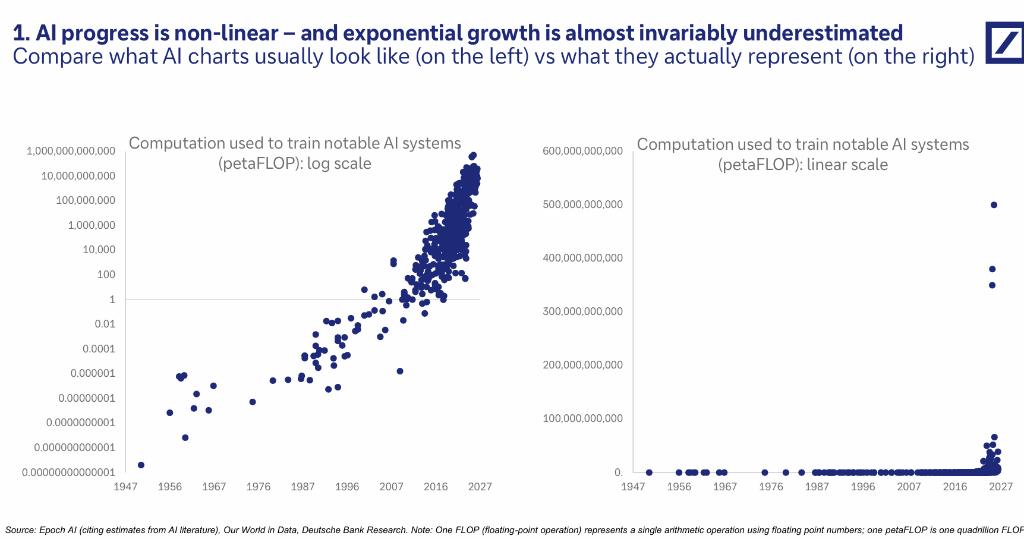
The report highlights the core feature of AI progress at the beginning: non-linearity. Presenting the historical data of training computing power on a logarithmic scale, it can be clearly seen that since 1956, the growth of computing power used to train major AI systems has spanned dozens of orders of magnitude, while the visual presentation of linear charts almost completely obscures this trend. Exponential growth is intuitively very easy to underestimate, which is the first cognitive threshold for understanding the AI wave.

Closely related to this, the progress speed of AI has surpassed Moore's Law. Traditional computing power doubles every 18 to 24 months, but after entering the era of deep learning, the average annual growth rate of computing power has reached about 4 times, far higher than the annual growth rate of about 1.4 times before the deep learning era. The reason lies in the simultaneous improvement of multiple factors such as system scale expansion, memory enhancement, and algorithm optimization, forming a superposition effect.

02 Technical routes continue to iterate, today's leader is not necessarily tomorrow's winner

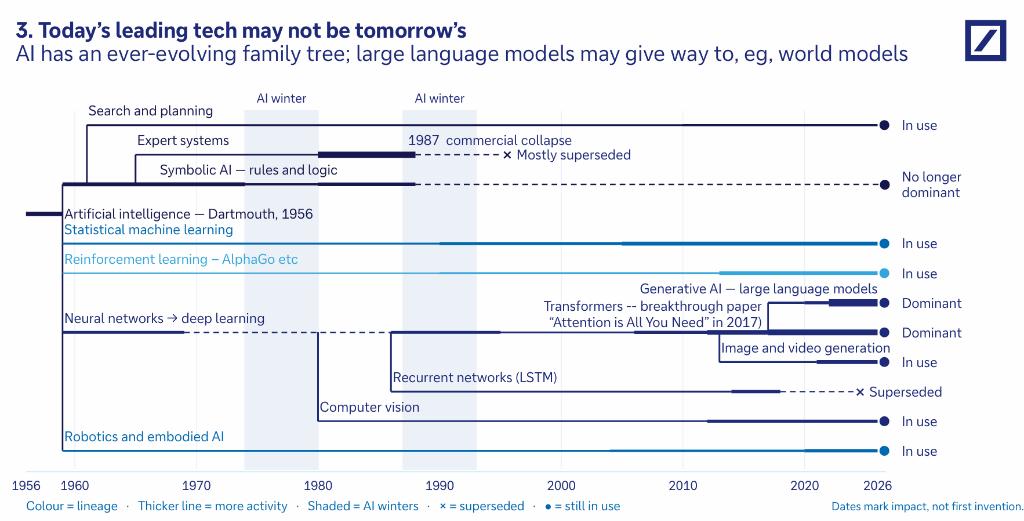
The report presents the 70-year evolution of routes through the AI technology spectrum: from symbolic logic and expert systems to statistical machine learning, deep learning, and then to the currently dominant large language models. Each generation of mainstream technology has gone through a cycle from rise to replacement. Some routes (such as recurrent neural networks) have been surpassed, while others are still evolving in parallel. The report points out that large language models may give way to new paradigms such as "world models" in the future, and the intergenerational replacement of technologies does not depend on the will of current leaders.

Historical changes in market share also confirm this point. Internet Explorer once outperformed Netscape, but was later replaced by Chrome. In the current competitive landscape of generative AI platforms, ChatGPT leads in monthly visits, but Google Gemini, DeepSeek and Claude are all catching up rapidly. Early advantages do not equal long-term moats.

03 R&D accumulation determines the competitive landscape, and the rise of DeepSeek is no accident

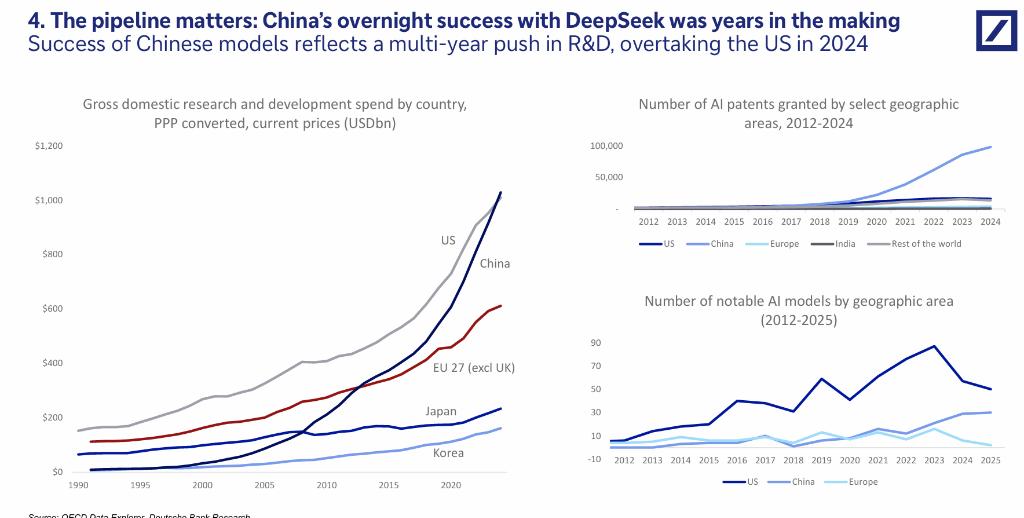
The sudden rise of Chinese AI models, represented by DeepSeek, seems to be "overnight success" on the surface, but it is actually the result of years of R&D investment accumulation. Data shows that China has surpassed the United States in total R&D expenditure in 2024, and its catching-up speed in the number of major AI models is also remarkable. In terms of the number of AI patent grants, China's growth curve is also far ahead of other economies. For investors, this means that changes in the competitive landscape often accumulate at the underlying level for many years before they are visible on the surface.

04 Cost reduction will not compress demand, but will instead expand demand

The report cites the "Jevons Paradox" to illustrate that the sharp drop in the cost of AI use will not lead to a reduction in total expenditure, but will instead stimulate a surge in demand. Since 2006, the cost of GPU computing power has dropped by more than 99%, but according to the forecast of the International Energy Agency (IEA), global data center power consumption will double from 2024 to 2030. Lower marginal cost means more application scenarios and higher total demand....

....MUCH MORE 

Here's the original at DB, 17 page PDF, downloadable.

If interested see also the RAND Corporation's relationship with AI: 

RAND: "Artificial Intelligence and Biotechnology: Risks and Opportunities"

RAND has a very deep history in artificial intelligence. From Jeremy Norman's History of Information:
Newell, Simon & Shaw Develop the First Artificial Intelligence Program

During 1955 and 1956 computer scientist and cognitive psychologist Allen Newell, political scientist, economist and sociologist Herbert A. Simon, and systems programmer John Clifford Shaw, all working at the Rand Corporation in Santa Monica, California, developed the Logic Theorist, the first program deliberately engineered to mimic the problem solving skills of a human being. They decided to write a program that could prove theorems in the propositional calculus like those in Principia Mathematica by Alfred North Whitehead and Bertrand Russell. As Simon later wrote,

"LT was based on the system of Principia mathematica, largely because a copy of that work happened to sit in my bookshelf. There was no intention of making a contribution to symbolic logic, and the system of Principia was sufficiently outmoded by that time as to be inappropriate for that purpose. For us, the important consideration was not the precise task, but its suitability for demonstrating that a computer could discover problem solutions in a complex nonnumerical domain by heuristic search that used humanoid heuristics" (Simon,"Allen Newell: 1927-1992," Annals of the History of Computing 20 [1998] 68).

The collaborators wrote the first version of the program by hand on 3 x 5 inch cards. As Simon recalled....

For a bit more on Mr. Simon here's the introduction to 2016's "Interview: Manuela Veloso Head of Machine Learning, Carnegie Mellon University":

Our readers probably know Carnegie Mellon more for the  top-ranked financial engineering program (Master of Science in Computational Finance) but artificial intelligence was pretty much invented at CMU by Herbert Simon and Allen Newell. Simon received the Nobel in Economics but it actually could have been for any of four or five subjects, he was quite the polymath.

Newell had to settle for the Turing award (along with Simon) from the Association for Computing Machinery, probably the root'in-tootin high-falootinest tchotchke in the computer biz.
The Association for the Advancement of Artificial Intelligence along with the ACM subsequently named an award in Newell's honor. Ditto for CMU.

The University's machine learning department was the first in the world to offer a doctorate and as far as I know is still the largest.
A department, for one branch of AI.

Carnegie-Mellon used to have a world class robotics Institute but Uber gutted it with a combination of cash and stock options leaving a Dean and a couple robots to rebuild.
One of the robots is said to be in advanced negotiations with the Ube-sters.

"Unprecedented: Scientists Have Built Miniature Brains That Experience The Passage Of Time"

I wonder if they tap their little organoid toes as they wait? (mark time?)

From ScienceAlert: 

Our brains comprise 86 billion neurons and the trillions of connections between them, whipping up an orchestrated storm of electricity and chemicals that pulse within a 3-pound lump of jellified fat, protein, and water.

The intricate biological machine that defines us humans requires about 20 years to mature, a much lengthier developmental period than in most other species.

This, along with the added inconvenience that it's locked within our craniums, makes our developing brains experimentally inaccessible.

So, scientists are building brains in the lab, no big deal.

In a breakthrough described in the journal Nature, researchers have created miniature brains, called organoids, that can 'sense' the passage of time and retain a cellular 'memory' of how long they have already spent developing....

....MUCH MORE 

Previously on the wee whiz-kids:

September 2018 - Lab Grown Mini-Brains Raise Some Ethical Questions

November 2018 - "Lab-Grown Mini Kidneys 'Go Rogue,' Sprout Brain and Muscle Cells"
Getting into a weird area here. 

August 2023 - ICYMI: "Researchers Teach Human Brain Cells in a Dish to Play 'Pong'"

January 2024 - Cyborg computer with living brain organoid aces machine learning tests"

June 2024 - Another Way To Beat AI's Power Consumption Problem: Brain Organoids

March 2026 - "Human Brain Cells Learn to Play Doom in Cortical Labs Experiment" 

March 2026 - "Human Brain Cells Run New Data Centers in Singapore, Melbourne"