Showing posts sorted by date for query cma cgm. Sort by relevance Show all posts

Saturday, May 30, 2026

FrenchTech: "Mistral launches Industrial Engineering AI with Airbus, BMW and EDF as headline customers" (plus rebutting the Pope)

From The Next Web, May 28:

At its first annual conference in Paris, Mistral formally rolled out the physics-aware AI stack it built around the Emmi acquisition, with Airbus, BMW and EDF as launch customers.


Mistral AI used its first annual conference in Paris on Thursday to formally launch “Mistral for Industrial Engineering,” a physics-aware AI stack pitched directly at heavy-industry customers, with Airbus, BMW, EDF and the shipping group CMA CGM named as launch deployments.

The product is the commercial layer Mistral has been visibly building toward since its acquisition of Vienna’s Emmi AI earlier this month, and represents the French firm’s clearest articulated alternative to the consumer-and-enterprise-software focus that has defined the largest US foundation-model labs.

The technical core of the offering is what the industry calls simulation surrogate modelling, neural networks trained on the outputs of expensive physics simulators that can subsequently produce comparable answers in seconds rather than hours.

Emmi’s models, originally spun out of Johannes Kepler University Linz and the Austrian AI company NXAI in December 2024, simulate airflow, thermodynamics, fluid dynamics and material deformation in real time.

The category sits cleanly inside what European industrial firms actually need from AI: engineering tools tied to production data, robotics workflows, defect detection and factory operations, rather than another chatbot or code-assistant product.

The customer roster is the most concrete part of the launch. Airbus, the European aerospace heavyweight, joins as a launch customer for the engineering-simulation tier.

BMW, which separately announced earlier this year that it is running humanoid-robot pilots in its Leipzig plant, is using the Mistral stack as part of its industrial-AI competence centre.

EDF, the French state-owned electricity utility, is the third anchor customer named publicly. CMA CGM, the Marseille-based container-shipping group, has been a Mistral customer for over a year and is being positioned inside the new industrial offering.

The named customers reflect the segments Mistral is targeting: aerospace, automotive, energy and logistics.

The strategic positioning is worth pausing on. OpenAI, Anthropic and Google’s frontier labs have spent the past two years competing on consumer-facing chatbots and enterprise-software automation.

The industrial-engineering market has been left visibly under-served. Google’s Fanuc partnership for industrial-robot AI, announced earlier this year, is the closest US analogue....

....MUCH MORE 

For some reason my keyboard is starting to smoke so I'll quick paste this next bit and hit publish:

Mistral’s Arthur Mensch directly rebuts Pope Leo on AI in warfare

Tuesday, May 12, 2026

So A Sea Captain And A Cambridge Don Came To The Same Realization: "The Hormuz Hypothesis"

This is old news but I thought I should mention some of what's been guiding our thinking on events over the last  2 1/2 months.

First up, Cambridge Uni. Professor of Political Economy Helen Thompson at MarketWatch, April 11:

What if Trump actually wanted this Hormuz outcome all along?
Cambridge professor Helen Thompson says the consistent ‘thread’ through the second Trump administration has been resetting the energy part of the world geopolitically

Since the start of the Iran war, the conventional wisdom has been that the whole thing is a hot mess. The argument is that President Donald Trump either blundered into a strategic situation he didn’t understand or was suckered into it by Israeli Prime Minister Benjamin Netanyahu, with disastrous consequences.

These range from the humanitarian — starting with the killing of around 165 Iranian schoolgirls, apparently by a U.S. missile — to the economic and even geopolitical. Oil is up to $100 a barrel, gasoline is nearly $4.20 a gallon nationally, and — irony of ironies — the enemy regime in Tehran has been left with control of the Strait of Hormuz and about 20% of the world’s oil supply.

The Iranians are now reportedly charging a toll of $1 a barrel — payable apparently through nontraceable cryptocurrency or in Chinese yuan Trump, who has repeatedly called the regime evil and worse, was left surprised that it acted in such a “dishonorable” manner with regard to the cease-fire.

But what if the conventional wisdom is wrong?

That’s the hypothesis of one of the world’s shrewdest and most respected analysts of geopolitics and energy, Cambridge University political-economy professor Helen Thompson. In a couple of recent broadcasts, she has argued that this entire outcome — including the apparent closure of the Strait of Hormuz — may not be a bug of the war at all but a deliberate feature.

Thompson argues that driving up the worldwide price of oil and keeping it there may be a core war goal of the Trump administration. That hurts China, which depends on imported energy, and helps America, which is a net energy producer. And if that’s the case, then Iranian control over the strait would, ironically, be a desirable outcome.

“The Trump administration thinks through the lens of resource competition,” Thompson explained.

“You have to consider the possibility … that actually part of what’s going on isn’t just about Iran, it’s about the Trump administration trying to hurt China,” she told the conservative-leaning website UnHerd.

The Iran war may be “part of an attempt by the Trump administration to reset the energy part of the world geopolitically,” she told Bloomberg Podcasts.

That, according to Thompson, is the consistent “thread” running through the second Trump administration’s foreign policy — including the intervention in oil-rich Venezuela and the attempt to destabilize resource-rich Greenland. It is also, she said, part of a geopolitical blueprint that the administration laid out last fall.

America, Thompson pointed out, may be a “beneficiary” of the war economically because it will be able to sell more liquefied natural gas at elevated prices, especially to the Europeans.

She added that, right now, competitive thinking between the U.S. and China focuses on artificial intelligence, which uses a staggering amount of energy. Driving up China’s energy costs hurts its AI ambitions.

Thompson also pointed out that it wasn’t just the Iranians who “closed” the Strait of Hormuz. Western shipping insurers became worried about the risks, especially after the Iranians attacked some ships. And after initially floating the notion of stepping in and providing insurance to ships through the U.S. government, the Trump administration soon walked away from the idea. That would be consistent with the theory that the administration does not want fuel to flow freely through the strait, because it wants oil and gas to remain expensive....

....MUCH MORE 

And at gCaptain, March 18:

The Hormuz Hypothesis – What If the U.S. Navy Isn’t in a Hurry to Reopen the Strait? 

By Captain John Konrad (Opinion) – The Strait of Hormuz is twenty-one miles wide. Two shipping channels, each two miles across, separated by a two-mile buffer. There is no alternative. Saudi Arabia’s East-West Pipeline to Yanbu and the UAE’s pipeline to Fujairah can handle maybe five million barrels combined. The math doesn’t work. The bottleneck is not political. It is geological and hydrographic.

Every TV analyst in America is talking about minesweepers and carrier strike groups. They are asking the wrong questions. The binding constraint on Hormuz was never a minefield or insurance. It is the US Navy’s willingness and ability to reopen it.

Every talking point suggests the White House and Navy are working hard to reopen the strait but progress is slow. A new posts on Truth Social suggests we may have to considet a new hypothesis.

“I wonder what would happen if we “finished off” what’s left of the Iranian Terror State, and let the Countries that use it, we don’t, be responsible for the so called Strait?” wrote President Trump in a psot this morning. “That would get some of our non-responsive “Allies” in gear, and fast!!!”

Which leads to a question, White House may have no intention of reopening the Strait of Hormuz?

The Insurance Kill Switch 
When the seven P&I clubs belonging to the International Group issued 72-hour cancellation notices for war risk coverage in the Persian Gulf on March 5, they did not just raise costs. They made transit impossible.

P&I clubs insure roughly 90 percent of the world’s ocean-going tonnage. Without their coverage, ships cannot sail. Port authorities will not let them dock. Banks will not finance the cargo. Charterers will not book the vessel. The entire system, from loading berth to discharge terminal, is underwritten by a chain of contracts that begins with a club in London, Oslo, or Tokyo. When the clubs pulled war risk extensions, that chain broke. Not for a few ships. For the global fleet.

War risk premiums jumped from 0.25 percent to 1 percent of hull value, renewable every seven days. VLCC charter rates quadrupled to nearly $800,000 per day. Over 1,000 vessels are now trapped in the Persian Gulf, burning charter costs with nowhere to go. By March 3, only four ships crossed the Strait, down from a seven-day average of seventy-seven.

Then Trump did something that almost nobody in the press understood.

He ordered the U.S. International Development Finance Corporation to create a $20 billion maritime reinsurance facility, with Chubb as lead underwriter, making the United States government the insurer of last resort for Gulf shipping. A sovereign nation positioned itself as the backstop for war risk insurance on the world’s most critical maritime chokepoint. The DFC facility, coordinated with US Central Command and Treasury, offers hull, machinery, and cargo coverage on a rolling basis to eligible vessels.

The United States now controls the on/off switch for the Strait of Hormuz. Not through naval firepower. Through insurance.

Read the latest MARAD advisory carefully: U.S.-flagged, owned, or crewed commercial vessels operating in these areas should maintain a minimum standoff of 30 nautical miles from U.S. military vessels.

And read this part of the DFC announcement again… “coordinated with US Central Command.”

They cannot pass without the Navy permission.

The green light has not appeared.

The Maritime Dream Team That Was 
To understand why this matters, you need to understand what Trump built and what was destroyed.

Trump came into his second term determined to restore American maritime power. He assembled the greatest collection of maritime minds in key government positions since Nixon. He put Mike Waltz, creator of the SHIPS for America Act, as head of the National Security Council. He created a Maritime Office in the White House. He appointed maritime advocates to key positions throughout the administration. He signed a sweeping Maritime Executive Order in April 2025 directing a Maritime Action Plan across Defense, State, Transportation, and Homeland Security.

He started targeting chokepoints: Panama, the Red Sea, Suez, the Greenland-UK Gap. He launched investigations into Gibraltar and Spain. He created USTR actions to tariff Chinese-built and operated ships. He called CMA CGM’s CEO Rodolphe SaadĂ© to the Oval Office and secured a $20 billion commitment to American maritime investment.

The ambition was real.

So was the pushback.

Shipowners lined up outside USTR to protest the China shipping tariffs. Nearly every economist on the planet lined up against the maritime tariff proposals. The entire U.S. tech sector asked for China concessions, and what did China want in return? A pause to USTR.

Then Signalgate. The media leaked a private conversation about attacking the Houthis and reopening the Red Sea. The operation was stunned. Signalgate forced a reorganization. Waltz was moved to the UN. The Maritime Office was downsized. The NSC was gutted.

That was the moment every maritime initiative began to stall.

What collapsed: Panama did not follow through on free transits for U.S. ships. CMA CGM’s $20 billion commitment evaporated as the company ordered vessels from China and India instead. Congress stalled on the SHIPS Act. The UK traded the Chagos Islands, including Diego Garcia, to Mauritius for a sweetheart deal, putting a critical naval base at risk. Key Navy appointees were slow-rolled or blocked in the Senate.

Then it came to a head at the International Maritime Organization in London. In April 2025, sixty-three countries voted to approve the Net-Zero Framework, a global carbon pricing mechanism on every ship over 5,000 tons. What did Trump’s negotiators ask for? That America’s tiny fleet of merchant ships be exempt. Europe refused, claiming American maritime interests are “irrelevant” and that we lack the leverage or votes.

The U.S. walked out. In October, at the adoption vote, Trump called it a “Global Green New Scam Tax on Shipping.” Trump played hardball. The State Department threatened sanctions against any country that voted yes. Fifty-seven countries voted to delay.

A pyrrhic victory. The carbon tax was dead in the water, but we did not get exemptions for U.S. ships, and the White House began losing the wider war for chokepoints and maritime trade with the City of London, Europe and China.

Then two body blows in quick succession.

On February 20, the Supreme Court ruled 6-3 that IEEPA does not authorize the President to impose tariffs, invalidating the “Liberation Day” reciprocal tariffs and the China, Canada, and Mexico trafficking tariffs. An estimated $160 billion in tariff revenue, gone. Trump imposed 15 percent global tariffs under Section 122, but those are capped at 150 days and require Congressional extension.

His most powerful tariff tool was taken away by the courts. If you cannot tariff your way to compliance, you need another form of leverage.

And then the Golden Fleet.

In December, Trump announced a new class of Trump-class battleships at Mar-a-Lago: 30,000 to 40,000 tons, armed with hypersonic missiles, railguns, lasers, and nuclear cruise missiles. Twenty to twenty-five hulls. The most ambitious surface combatant program since World War II.

Within 72 hours, every national security think tank and academia – which all have close ties and funding with NATO nations – lined up to kill it. With no time for due dillegence CSIS published the hit piece “The Golden Fleet’s Battleship Will Never Sail” and estimated $9 billion per hull and predicted cancellation before the first ship hits water. The Foundation for Defense of Democracies called it a waste. Retired admirals on defense baords lined up to say the Navy should buy small distributed platforms instead. Every defense analyst competed to be quoted saying it was impossible.

The same establishment that produced three Zumwalts instead of thirty, and thirty almost useless Littorial Combat Ships instead of none, the same think tanks that has presided over the smallest Navy since World War I, lined up overnight to explain why America cannot build big ships anymore.

The same people who have no plan to close the destroyer gap that is right now undermining convoy escort operations in the Gulf.

The think tanks did not offer an alternative. They offered learned helplessness. And that helplessness is the context in which Hormuz is now playing out.

The Leverage Hypothesis 
Now connect the dots.

Strike Iran, and Europe either bends or goes dark in an energy crisis.

The European shipping community and political establishment spent the past year dismissing, undermining, and mocking every Trump maritime initiative. They scoffed at the USTR tariffs. They laughed at the SHIPS Act. They blocked the IMO exemptions. They refused to take American maritime policy seriously.

Now their energy supply runs through an insurance facility controlled by Washington.

“Let their navies figure it out.” Except everyone knows they cannot. European naval forces are too small, too slow, and too poorly equipped for sustained convoy escort operations through a contested strait. All the European navies combined could not send more than three ships at a time to defend the Red Sea. An entire German task force sailed around Africa to avoid it....

....MUCH MORE 

So we don't have a lot of Taco Tuesday posts. One

 On May 6 because in was in Marc Chandler's headline. 

But speaking of Mexican food we have on offer, from a couple years ago:

"The first Mexican taco stand to get a Michelin star is a tiny business where the heat makes the meat"

Friday, September 19, 2025

"Beirut Port Explosion Probe Gains Momentum With Extradition Request"

If it turns out the nitrogen fertilizer was Hezbollah's, the guys whose pagers blew up a year ago should be rounded up and summarily executed.

From the Organized Crime and Corruption Reporting Project, September 18:

The arrest in Bulgaria of Igor Grechushkin — whose ship carried chemicals to Lebanon that exploded in 2020 — is viewed as a sign that a long stalled investigation might finally get results.  

The investigation into the massive 2020 Beirut Port explosion is “moving forward seriously and quickly,” Lebanese Minister of Justice Adel Nassar said in an interview, after the inquiry stalled for years.

Nasser made the comments to OCCRP’s Lebanese media partner, Daraj, after news broke this week about the arrest of the man whose ship carried the volatile chemicals that caused the devastating explosion in 2020.

Igor Grechushkin was arrested in Bulgaria on September 5 after arriving on a flight from Cyprus, where he holds a passport, along with Russian citizenship.

Nasser said Lebanon will seek the extradition of Grechushkin, who leased the ship that brought nearly 3,000 tons of ammonium nitrate into Beirut Port, where it was offloaded and put into storage before exploding.

“A file is being prepared and we are expediting it. I’m following up closely; it’s a request for extradition, and I have also requested to meet with the Bulgarian ambassador,” he said. 

“I’m handling the logistics to make the request proceed as quickly as possible. By next week, the extradition request should be with them,” Nasser added.

There has been heavy criticism for lack of progress in the investigation of the Beirut Port blast, one of the most powerful non-nuclear explosions in history. At least 218 people were killed and about 7,000 were injured, while the explosion leveled large swaths of the city.

The ammonium nitrate at the root of the blast arrived aboard the Moldovan-flagged ship Rhosus in 2013. It was impounded in a port warehouse, where repeated warnings about its unsafe storage were ignored for seven years. After years of delays, the investigation into the explosion has gained traction under a new government formed earlier this year....

....MUCH MORE 

Previously:

Beirut After the Explosion 

"Beirut blast: Tracing the explosives that tore the capital apart"

Shipping: "CMA CGM Proposes $600M Plan to Rebuild Port of Beirut"

"Munich Re Among Insurers Facing ‘Major’ Beirut Blast Losses"

We'll have more on the actual explosion on Sunday, it was one of only a handful of such events in world history.

Thursday, July 17, 2025

"China Threatens to Block Panama Ports Deal Unless Its Shipping Giant Is Part of It"

From the Wall Street Journal, July 17:

Beijing pushes for state-owned Cosco to become shareholder of two Panama Canal ports, dozens of others in BlackRock deal 

China’s government is threatening to block a deal that would transfer ownership of dozens of seaports to Western investors if Cosco, China’s largest shipping company, doesn’t get a stake.

The proposed sale includes two ports at the Panama Canal and more than 40 others around the world, all owned by Hong Kong-based CK Hutchison.

China is pushing for state-owned Cosco to be an equal partner and shareholder of the ports with BlackRock, and Mediterranean Shipping Co., a containership operator, according to people familiar with the deal talks. BlackRock and MSC in March reached a preliminary agreement to buy the ports in a deal valued at nearly $23 billion.

Now, BlackRock, MSC and Hutchison all are open to Cosco’s taking a stake, the people familiar with the talks said.

The parties aren’t likely to reach a deal before a previously agreed upon July 27 end date for exclusive talks between BlackRock, MSC and Hutchison, the people familiar with the talks said. The parties can’t strike a deal that includes Cosco until the exclusivity period ends.

Any deal giving a stake in the Panama ports to a Chinese-owned company would likely upset President Trump, who has threatened to take control of the canal and has objected to Hutchison’s ownership of two ports there. The White House didn’t respond to a request for comment Thursday.

After this article was published online Thursday, Rep. John Moolenaar (R., Mich.), who chairs a congressional committee on China, made public a letter he had sent to a top Panamanian official, saying that the inclusion of Cosco or any other Chinese company in port operations at the canal “would represent an unacceptable risk to the national security of both our nations.”

Hutchison’s initial plan to sell the ports angered Beijing, according to people familiar with the talks. Chinese authorities have told Chinese state-owned companies to freeze any coming deals with Hutchison or other businesses linked to its controlling shareholder, the family of the Hong Kong billionaire Li Ka-shing, these people said....

....MUCH MORE 

Recently:

MSC's Aponte Eclipses BlackRock in Li Ka-shing’s Port Deal 

One quibble. We know some stuff about the shipping companies.

MSC is not just "a containership operator." It is the world's largest, having passed Maersk's capacity in 2022. That achievement was in all the papers and better blogs (ahem).

MSC has the largest container fleet and an over 1mm TEU larger capacity. It is also a giant in logistics and other businesses involved in moving stuff around the world. 

Because MSC is privately held they don't splash their numbers - so to speak - but revenue was almost €90 billion in '22 and Italian media reported the holding company booked quite a profit in what was a very good year for the entire industry. From TradeWindsNews, 

Gianluigi Aponte’s MSC Group has — perhaps inadvertently — revealed its financial performance for the first time.

The holding company of the world’s largest liner company reportedly made €36.2bn ($38.4bn) in profits last year.

The number has been widely published by Italian media outlets after MSC announced the purchase of around half of high-speed Italian train operator Italo.

Turnover of the MSC Group was €86.4bn in 2022, according to Il Messaggero, which first reported the accounts.

Ebitda was €43.2bn and Ebit was €35.7bn.

The Geneva-based company possessed cash reserves amounted to €63bn and equity of €91bn. Medium to long-term debt is put at €26bn.

The figures reflect a big increase in profitability during the pandemic....

....MUCH MORE 

As noted in a 2019 post:

Sept. 25
Shipping: "MSC Announces New Bunker Surcharge to Help Cover $2 Billion Per Year Low Sulphur Fuel Costs"
MSC Mediterranean Shipping Company S.A is another of the world's largest shippers who sound as though they are about to establish a GoFundMe page.
That's a joke.
The Aponte clan* is doin' alright.

***
*The latest Lloyd's 100 Most Influential People in Shipping (Edition Eight, Dec. 2017) has the Aponte famiglia at #10, just behind the Saadé family (CMA CGM) now led by Rodolphe after his father's death this summer, at #9.

If interested here's an ungated version of Edition Seven of the 100 Most Influential, for folks who don't subscribe via Maritime Cyprus.It's a year out of date but good background or a dandy prospect list.
The subscription makes a fine gift.

Thursday, May 29, 2025

"CMA CGM Invests $600 Million in New Vietnam Terminal as Trade Surges"

Going where the action is. And going large.

From gCaptain, May 28:

CMA CGM Group has signed a partnership agreement with Saigon Newport Corporation (SNP) to develop a new deep-water terminal in Haiphong, northern Vietnam, marking a significant expansion of its presence in Southeast Asia.

The project, representing a $600 million investment, will see the development of Lach Huyen terminals 7&8 in the strategically positioned Lach Huyen area. The facility is designed to handle 1.9 million TEUs and is scheduled to commence operations in 2028.

This development comes at a crucial time for Vietnam’s economy, which has seen dramatic growth in container volumes, particularly in the northern region which has emerged as one of Southeast Asia’s fastest-growing economic zones....

....MUCH MORE

Wednesday, March 26, 2025

French Billionaire Families Buy Into Paris Venture Capital Firm

From Bloomberg via Yahoo Finance, March 24:

The French billionaire Dassault and Saade families are buying a stake in venture capital firm Founders Future as they step up tech investments.

The clans are acquiring a 25% holding in the Paris-based investment company along with health insurer MACSF, according to a statement Monday that didn’t include financial details.

“Having French industry captains like the Dassault and the Saade families in our capital reinforces the confidence that investors and companies have in Founders Future,” said Marc MenasĂ©, who founded the firm in 2018 to focus on early-stage tech startups. It currently has €300 million ($324 million) in assets under management.

The Dassaults and the Saades are among France’s wealthiest dynasties, with fortunes rooted in defense and shipping, respectively. Rodolphe Saade, the second-generation scion who heads closely held CMA CGM SA, the world’s third-largest container line, has moved quickly in recent years to use a pandemic windfall to diversify the group into industries like media and tech. The Saade family has a net worth of $31.7 billion, according to the Bloomberg Billionaires Index, and the Dassaults are worth $44 billion.

While the Dassault clan has been less acquisitive, they’re enjoying a wealth surge as Europe ramps up arms spending, including for the Rafale fighter jet....

....MORE

If interested see also at Challenges, March 25: 

Dassault et SaadĂ© au capital, expansion aux Etats-Unis… les ambitions de Marc MenasĂ© pour Founders Future

INTERVIEW – MontĂ©e au capital des familles Dassault et SaadĂ©, crĂ©ation d’un fonds d’investissement aux Etats-Unis : pour ses sept ans, Founders Future change de dimension. L’occasion de faire un point d’Ă©tape avec son fondateur, Marc MenasĂ©.

Nouvelle Ă©tape pour Founders Future. Le fonds d’investissement créé par Marc MenasĂ© en 2018 officialise ce mardi 24 mars l’ouverture de 25 % de son capital Ă  de grands noms du capitalisme français : MACSF et le groupe CMA CGM de Rodolphe SaadĂ© y font leur entrĂ©e, tandis que la famille Dassault, dĂ©jĂ  prĂ©sente au capital, renforce sa participation. Des renforts Ă  la hauteur de l’ambition de MenasĂ©, qui compte passer de 300 millions d’euros d’actifs sous gestion en 2024 Ă  1 milliard d’ici 2030 – alors que le fonds compte dĂ©jĂ , selon Pitchbook, parmi le Top-10 des plus actifs de la French Tech depuis 2019.

Ce triplement des actifs sous gestion sera notamment permis par l’expansion outre-Atlantique de Founders Future, qui ouvrira un bureau aux Etats-Unis pour y accompagner le dĂ©ploiement de ses pĂ©pites europĂ©ennes, ainsi qu’un fonds de capital croissance visant Ă  permettre aux investisseurs europĂ©ens d’investir plus facilement dans la tech amĂ©ricaine. Ambitions, stratĂ©gie, Ă©tat d’esprit : Marc MenasĂ© a rĂ©pondu aux questions de Challenges.

Challenges – Votre plan 2030 marque une accĂ©lĂ©ration nette dans le dĂ©veloppement de Founders Future. Comment l’idĂ©e de cette expansion a-t-elle germĂ© ?

Marc MenasĂ© – L’an dernier, après un peu plus de cinq ans d’activitĂ©, j’ai dĂ©cidĂ© de me poser et d’Ă©crire un plan de croissance. Après avoir fait notre trou dans l’amorçage et avoir créé notre fonds de « growth » [capital croissance, ndlr], l’objectif Ă©tait de savoir quels Ă©taient nos facteurs clĂ©s de succès, et oĂą nous pouvions nous rendre utiles. Nous avons retenu trois grandes perspectives de dĂ©veloppement : la diversification de notre distribution, le dĂ©veloppement gĂ©ographique et de nouvelles stratĂ©gies Ă  long terme....

....MUCH MORE 

Thursday, March 6, 2025

French Shipping Giant CMA CGM Passes Maersk To Become #2 Line; Pledges To Invest $20 Billion In U.S. Infrastructure

First up, from Splash 24/7, March 6:

CMA CGM overtakes Maersk in the liner rankings 

CMA CGM, the year’s most aggressive acquirer of ships to date, has made history.

As of this week, Marseille-headquartered CMA CGM has surpassed rival Maersk to the second spot on the liner rankings when including its huge orderbook.

The latest data from Alphaliner shows CMA CGM’s fleet – including ships on order – stands at 5.42m slots, some 140,000 teu more than its Danish rival. Mediterranean Shipping Co (MSC) remains far out in the lead, however, its fleet – including ships on order – is now at 8.47m slots, larger than the extant fleets of CMA CGM and Maersk combined....

....MUCH MORE

And from the Wall Street Journal, March 6:

French Shipping Giant CMA CGM Pledges $20 Billion Investment in U.S.
The world’s [No. 3 2] container line’s pledge comes as Trump pushes to revive the U.S. shipbuilding and maritime industry

French shipping giant CMA CGM pledged Thursday to invest $20 billion in U.S. logistics over the next four years. 

Marseille’s CMA CGM intends to triple the size of the container line’s U.S.-flagged fleet, upgrade its U.S. port facilities and create a new airfreight hub in Chicago, among other moves, the company said.

A CMA CGM official said its $20 billion pledge represents the group’s U.S. investment plans. It wasn’t clear how much of the spending had been planned previously.

Rodolphe SaadĂ©, the billionaire chairman and chief executive of CMA CGM visited President Trump at the White House on Thursday. The company’s pledge comes as Trump pushes to resurrect commercial and military shipbuilding in America and to challenge China’s dominance of the global maritime industry in ways that threaten profits at the world’s largest ocean carriers.

Trump told Congress this week he would create a new Office of Shipbuilding in the White House. To raise revenue for the maritime sector, administration officials are considering an executive order that would include measures such as charging fees on Chinese-built ships calling at U.S. ports, according to a draft summary of the order reviewed by The Wall Street Journal.

That idea, which is subject to change, draws on recent proposals under consideration by the U.S. Trade Representative’s office. The fees of up to $1.5 million per port call are opposed by U.S. trade and agriculture groups as well as by the container line industry.

CMA CGM’s chief financial officer in February said the fees would significantly hurt ocean carriers because China so dominates shipbuilding, according to news reports at the time. Almost 36% of CMA CGM’s container fleet, measured by capacity, is made in China, according to data firm Linerlytica. More than 64% of the company’s new order capacity is being built at Chinese shipyards.

The company operates a U.S.-flagged fleet of 10 containerships under its APL subsidiary. Because the ships are U.S.-flagged, they are crewed by U.S. sailors and are a preferred carrier for U.S. government and military cargo.

A CMA CGM official said the company will triple that fleet to 30 vessels using orders at South Korean shipyards. The official said CMA CGM wants to place new orders at U.S. shipyards but that will depend on the yards’ capacity.

CMA CGM routinely orders vessels from South Korea and China capable of carrying the equivalent of 18,000 containers.

U.S. shipyards build smaller containerships. APL’s U.S.-flagged fleet ranges in size from ships capable of carrying the equivalent of between 1,600 and 6,000 containers.

Saadé joins a growing line of executives who have visited Trump to pledge big U.S. investments over the next four years....

....MUCH MORE

Thursday, November 21, 2024

"Container Shipping Industry Sees Exponential Profit Surge Driven by Red Sea Situation"

From gCaptain, November 20: 

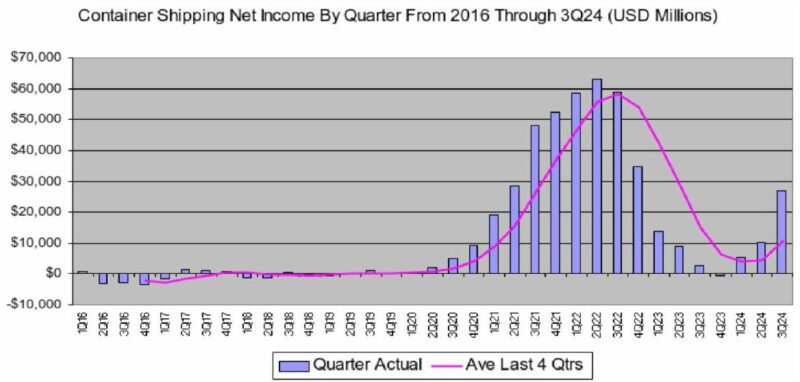
The container shipping industry has experienced a remarkable turnaround in the third quarter of 2024, with total net income soaring to $26.8 billion, marking a staggering 164% increase from the previous quarter, according to renowned industry analyst John McCown.

The impressive growth trend, which began in the first quarter of 2024, has been primarily fueled by capacity tightening in the Red Sea region and strong global demand.

In his Q3 financials report, McCown reports that compared to the same quarter last year, net income skyrocketed by 856%, representing a $24.0 billion increase. This dramatic upswing follows a period of declining earnings that lasted for six consecutive quarters after the industry’s peak earnings of $63.1 billion in Q2 2022....

Chart of Container Shipping Net Income By Quarter From 2016 Through 3Q24

 Credit: John McCown

. ....MUCH MORE

Hmmm, someone should maybe look into money flows from Copenhagen or Marseilles or Geneva to Yemen.

The largest container shipping companies as of 2024 are

Mediterranean Shipping Company (MSC)

APM-Maersk 

 CMA CGM 

— https://www.marineinsight.com/know-more/10-largest-container-shipping-companies-in-the-world/

Monday, November 11, 2024

"Is French tech facing a lull?"

No time for a lull. Since 2018 we've been pitching French tech as an economic engine to supplant Germany and this would be an awful time to pull up on the reins.

Do whatever it takes, either get the deficit under control (6.1% of GDP? That's American-level depravity but with a currency you don't issue) or do a Frexit and go back to the franc so you can inflate it away, what ever it takes to make the investments now.

From Sifted.eu, November 8:

An event organised by Xavier Niel, ai-Pulse, came back to Station F in Paris for a second edition — but with a few degrees less hype 

This article first appeared in Sifted’s Daily newsletter, sign up here.

A year ago, French billionaire Xavier Niel threw a blockbuster event dedicated to AI in Paris’s iconic startup campus Station F. Dubbed ai-Pulse, the show was an opportunity for Niel to gather fellow billionaires Rodolphe SaadĂ© (CEO of shipping giant CMA CGM) and Eric Schmidt (former Google CEO) to announce a joint €300m investment in Kyutai, a brand-new non-profit AI lab based in the French capital.

The first edition of ai-Pulse carried a palpably febrile atmosphere — it came just a few months after AI darling Mistral raised a €105m seed round and US AI startup Poolside relocated to Paris. The crowd was full of excitable, enthusiastic founders and investors filled with optimism about the future of France’s tech scene. It was a high bar to set.

Yesterday ai-Pulse came back to Station F for a second edition — but with a few degrees less hype.

“We’re not Americans, we can’t get €300m every year,” one founder attending the event told me, laughing.

The event started with a five-minute intro from Niel, which no one heard because of faulty mics — a classic tech conference mishap. The five-star lineup also included speakers from high-profile companies like Dell, Nvidia and Ampere.

Even Charles Kantor, the CEO of ultra-secretive startup H — which recently saw three out of five cofounders leave three months after it raised a $220m seed — took to the stage to share teasers of the company’s product, to be released “very soon”. Spoiler: it’s a cutting-edge technology to create AI agents, with the potential to “disrupt productivity goals” and exploit “huge opportunities”.

Despite this, ai-Pulse 2.0 was undeniably tamer than last year — a mood potentially reflective of the latest trends in the French tech sector.

Sifted data for Q3 this year shows a significant dip in deal count across the country. There were fewer than 100 deals announced between July and September, a quarter-on-quarter drop of more than 45%. The €1.2bn raised across those deals put France way behind the UK (€3bn) and Germany (€2.4bn) in Q3.

“Since the start of September, seeds haven’t been closing,” one VC told me at the event. “Rounds that used to take two weeks are taking months [...] people are feeling a bit morose.”....

....MUCH MORE

Turn that frown upside down. Previously on Niel:

"French VC firm Newwave is being taken over by billionaire Xavier Niel’s holding company - and insiders describe ‘highly unusual’ drama"

"Station F: A symbol of France's startup ambitions"
"Xavier Niel SPAC Said to Weigh Bid for French Supermarket Chain"
"French Groups Swoop For Depressed British Assets"
Apparently 1066 wasn't big enough in the cross-channel asset-grabbing biz..
"Billionaire Xavier Niel Invests €200 Million in French AI Push"
"Xavier Niel, a Driving Force of French AI, Is Now Shaping TikTok"

And on the long game, the outro from July's "GenAI startup Dust’s founders on raising €15m, leaving Silicon Valley and launching in Paris":  

....It's taken a bit longer for France to develop the ecosystems, the connections, than we thought it would take, six - seven years ago but it is indeed happening. If interested see:

"Venture Capital: "These 12 startups could be France’s next unicorns"
French Tech: "Mistral AI secures €105M in Europe’s largest-ever seed round"

Although we've been pitching French startups as a potential engine of growth to supplant German dominance, and although we've made Artificial Intelligence one of the foci of the blog since 2013 - "Why Is Machine Learning (CS 229) The Most Popular Course At Stanford" - and although we began juxtaposing the two strands five years ago, I'm still impressed with this sort of money going into a company that was formed in the last five weeks.

French OpenAI Rival Mistral Nears $2 Billion Valuation With Andreessen Horowitz Backing
This. This is what we've been pitching for the last five years as the way France picks up the economic torch from Germany....
"...Big Tech Alumni building AI startups in Paris"
"France makes high-profile push to be the A.I. hub of Europe setting up challenge to U.S., China"
"Report: France's Macron Seeks Seat at AI Table"

And back into the mists of time (well, the twenty-teens):

"French government officials advocate for a €500m investment in blockchain technology"
The country might be better served adding to the €1.5 billion that President Macron has pledged for research in Artificial Intelligence.
But I might be biased....
Related:
France: "For Emmanuel Macron, AI is more than a technological revolution. It is a political revolution of hope in an increasingly dystopian future"
"The Race is On for European AI Research"
Profit From The Global Riot Control Industry
"The Top-10 French Artificial Intelligence Startups"
The Creator of the iPod and the iPhone Seeks to Dethrone Tech’s Giants
It’s a crisp January morning in Paris’s 13th Arrondissement, and outside Station F, the former freight terminal that is the epicenter of France’s startup scene, twentysomethings climb out of cars hailed using iPhone apps.
Tony Fadell’s Next Act? Taking on Silicon Valley—From Paris

"‘The Disruptors’ — Unique insight into Europe’s 1,600 AI startups (Part 2)"
I was about to headline this link "The 1600 AI Startups you must know" to play off the "672 thought leaders you must follow on Twitter" or the "37,000 young people who want to take your job" articles but then realized our wary-yet-intrigued readers are not the type of people who respond well to someone saying they 'must' do anything....

Friday, October 11, 2024

"France Hits Big Firms, Wealthy to Trim ‘Colossal’ Debt Pile" (CMA CGM)

From Bloomberg, October 11:

  • Temporary levy on 440 firms to raise €12 billion in 2025-2026
  • Tax on shipping companies to raise €800 million over two years

The French government unveiled a budget for next year that aims to deliver a €60.6 billion ($66.2 billion) remedy for its creaking public finances and rebuild investor confidence even as it risks eviction by a hostile parliament.

Spending cuts will account for just over two thirds of what Finance Minister Antoine Armand called an unheard-of fiscal effort, with the rest coming from higher taxes on businesses, the wealthy and energy.

“Our country is in an unprecedented situation and at a pivotal moment,” he told reporters during a presentation of the delayed draft bill on Thursday. “The French economy is holding up, but our public debt is colossal. It would be both cynical and fatal not to see it, say it and recognize it.”

The 2025 budget is a crucial part of Prime Minister Michel Barnier’s efforts to restore political and fiscal order after months of volatility and uncertainty sparked by President Emmanuel Macron’s decision to dissolve the National Assembly and call snap elections.

Under the plans, temporary levies on some 440 profitable companies with annual revenue of more than €1 billion would generate €8 billion next year and €4 billion in 2026. An exceptional tax on maritime transport companies would contribute €500 million and €300 million in those same years....

....MUCH MORE

M. Armand should probably have a plan to halt capital flight as well.

Also at Bloomberg, this time October 10:

France Plans to Sell €300 Billion of Bonds to Finance Budget

  • Target is higher than this year’s €285 billion planned sales
  • Government is under pressure to narrow the public deficit

France has announced plans to sell €300 billion ($328 billion) in government bonds next year to finance its budget, following months of political turmoil.

The target compares to sales of €285 billion this year and is in line with analyst estimates. Part of the money will go toward funding an estimated €136 billion deficit, which is €31 billion lower than this year’s....

....MUCH MORE

Sounds like Chicago Finance where the mayor wants to take out a $300 million loan to pay for a raise for Chicago Teachers Union members. 

You do not want to emulate Chicago Finance. 

Related September 26:

"Bank of France Chief Says Bond Markets Are Warning on Debt"

Wednesday, July 10, 2024

Logistics/Shipping: "CMA CGM and Pasqal partner to harness quantum tech for maritime logistics"

From Container News, July 9:

CMA CGM Group announced a strategic partnership with Pasqal, a French leader in neutral atom quantum computing.

Through this collaboration, CMA CGM will invest in its compatriot company aiming to integrate advanced quantum computing technologies into its operations.

Moreover, the partnership seeks to leverage quantum computing to enhance transport and logistics efficiency, responsiveness, and adaptability to market fluctuations, with a particular focus on optimizing container management and ship loading.

"This partnership with Pasqal will allow CMA CGM to apply quantum computing technologies to maritime transport and logistics, reinforcing our Group's position as a leader in the digital transformation of our industry. With Pasqal, we aim to unlock the full potential of quantum computing for greater operational efficiency, serving our customers," stated Hadi Zablit, executive vice president for Information & Technology at CMA CGM Group....

....MUCH MORE

Monday, July 1, 2024

Wärtsilä—"World's most efficient engine becomes a colossal clean energy generator"

We've looked at some Wärtsilä engines over the years, usually the ones that used LNG or ammonia (as hydrogen carrier) as fuel for ships. They are quite large.
More after the jump.

From New Atlas, June 25:

One of the world's largest engines becomes a clean generator. Originally designed to burn diesel, dual-fuel, or gasoline for tankers and container ships, the Wärtsilä 31 marine engine gets a new life generating clean, renewable electricity.

https://assets.newatlas.com/dims4/default/d0106a9/2147483647/strip/true/crop/1674x1116+0+0/resize/1920x1280!/quality/90/?url=http%3A%2F%2Fnewatlas-brightspot.s3.amazonaws.com%2Fc7%2F6d%2F1c7231d24a71a6e72407593d07b5%2Fwartsila-31h2-pure-hydrogen-engine.tmb-tmb-960x54.png

The Wärtsilä 31 engine is in the Guinness Book of World Records for being the most efficient 4-stroke marine engine ever made in its class. It also boasts the highest power per cylinder in engines of equivalent bore size. It can be configured in 8 to 16 cylinders and with a power output ranging from 4.6 MW to 10.4 MW at 720 and 750 rpm.

This Finnish company is best known for making the world's largest combustion engines – notably the 89 ft (27 m) tall, 44 ft (13 m) long, 110,000 horsepower RTA96-C. The Wärtsilä 31 engine is a fair bit smaller, maxing out at 15.4 ft (4.7 m) high and 28.8 ft (8.7 m) long, and running on fossil fuel, it can crank out up to 13,142 horsepower (9.8 MW). 

The cylinder bore and stroke (12.2 x 16.9 inches, or 31 x 43 cm) sound enormous if you're coming from the auto/moto world, but compared to some of the company's bigger engines, which have cylinders big enough to walk into, they're relatively compact.

Converted to a generator, the hydrogen-ready 31SG-H2 version can run on natural gas, or a blend of natural gas and 25% hydrogen – or it can be upgraded to run on 100% hydrogen. There's also a flexible-fuel 31H2 designed to run natively on full hydrogen, but also accepting natural gas or blended fuels....

....MUCH MORE

June 2018: Shipping: "The Engines of the Largest Container Ships in the World, and Challenges their Manufacturers Face" 

October 2019:  Shipping: "Wärtsilä, Norsepower Team Up on Rotor Sails"

Wärtsilä makes scrubbers, they front for these Flettner rotors, they make some pretty sophisticated power and propulsion equipment, I don't understand why they don't make more money. 

December 2019:  Shipping: "Forced boil-off gas—The future of LNG as a fuel for LNG carriers"

It seems like a natural. As the folks at Wärtsilä tell us:
    Boil-off gas (BOG)LNG tankers are designed to carry natural gas in liquid form at a temperature of – 163°C, close to the vaporization temperature. Despite tank insulation designed to limit the admission of external heat, even a small amount of it will cause slight evaporation of the cargo. This natural evaporation, known as boil-off is unavoidable and has to be removed from the tanks in order to maintain the cargo tank pressure.
So you're going to have LNG going through the phase change back to a gas, even on those arctic tankers Novatek is running in -20°C weather.

March 2020: Hydrogen: "Wärtsilä Testing Ammonia Fuel for Shipping"

March 2021:  Hydrogen: "Why the Shipping Industry Is Betting Big on Ammonia"

October 2021: Shipping: "Wärtsilä to investigate use of ammonia in LNG-powered engines"

You know CMA CGM has to be all over this research, what with trying to do the right thing carbon-wise by buying their fleet of gargantuan LNG-powered ships, as we said in "Shipping: The U.N. Appears To Be Trying To Sink French Flag Carrier CMA CGM" under the watchful eye of the U.N.'s International Maritime Organization.

Tuesday, June 4, 2024

"‘Termination shock’: cut in ship pollution sparked global heating spurt"

It had to be done, the result of burning high-sulpher fuels is nasty stuff. But the jump in temperatures should not be attributed to CO2 or used as a reason for some politician's policy prescription.

Additionally, on the other side of the debate/argument, the energy was always incoming, the reduction in the sulfates just exposed the issue.

From The Guardian,May 30:

Sudden cut in pollution in 2020 meant less shade from sun and was ‘substantial’ factor in record surface temperatures in 2023, study finds

The slashing of pollution from shipping in 2020 led to a big “termination shock” that is estimated have pushed the rate of global heating to double the long-term average, according to research.

Until 2020, global shipping used dirty, high-sulphur fuels that produced air pollution. The pollution particles blocked sunlight and helped form more clouds, thereby curbing global heating. But new regulations at the start of 2020 slashed the sulphur content of fuels by more than 80%.

The new analysis calculates that the subsequent drop in pollution particles has significantly increased the amount of heat being trapped at the Earth’s surface that drives the climate crisis. The researchers said the sharp ending of decades of shipping pollution was an inadvertent geoengineering experiment, revealing new information about its effectiveness and risks.

High ocean surface temperatures smashed records in 2023, alarming experts who have struggled to explain the huge rises. But scientists have mixed views on the role played by the cut in shipping pollution.

Those behind the new study say it could be a “pretty substantial” factor. Others say it is only a small factor, and that the reasons for the extraordinary rises in sea and global temperatures remain an alarming mystery.

Dr Tianle Yuan, at the University of Maryland, US, who led the study, said the estimated 0.2 watts per sq metre of additional heat trapped over the oceans after the pollution cut was “a big number, and it happened in one year, so it’s a big shock to the system”.

“We will experience about double the warming rate compared to the long-term average” since 1880 as a result, he said. The heating effect of the pollution cut is expected to last about seven years....

....MUCH MORE

During the run-up to the new rules, 2018 - 2020, we had quite a few posts, maybe 100, on what was going on. Here are a few of the ones that focused on money:

 Big Oil Traders Set to Cash In On Low Sulphur Shipping Fuel Change

Oil: The Impact On Refiners Of Shipping's Low-Sulpher Fuel Ruels After 2010

"Maersk Braces For A $5+ Billion Fuel Bill In 2020"

Top Norwegian Oil Analyst Quitting DNB to Pursue 2020 Low Sulphur Fuel Rule Riches

Shipping: The New Low Sulpher Rules Will Have A Huge Impact On the Oil Business (shipping and world economy too)

Rich Rewards Await Top Oil Refiners as Ships Make Low Sulpher Switch Fuel

Shipping: "Hapag-Lloyd Expects USD 1 Bn in Extra Fuel Costs from 2020 Sulphur Cap"

Shipping: CEO of Third Largest Fleet Says "We're All Going to Go Bust"

Shipping: "CMA CGM Says Global Sulphur Cap to Cost Customers $160 Per Container on Average"
That's serious money, say on a 10,000 TEU average voyage, $1.6 million per trip?
Jeez, no wonder the industry is freaking out....

Not really related except in a climate change sense, yesterday's:
"Tonga’s volcanic eruption could cause unusual weather for the rest of the decade, new study shows"

Monday, February 5, 2024

Houthi Tax:"Freight Rates Begin to Settle as Shippers Adjust to Cape Diversions"

From The Loadstar via gCaptain, February 5:

Asia-North Europe shippers have adapted their supply chains to the longer transit times around Africa, but now they need freight rates to settle at an acceptable level.

Moreover, container hub ports seem to be coping well with the arrival of off-schedule vessels.

All the major carriers, with the exception of CMA CGM, are diverting their Asia-Europe services around the Cape of Good Hope, rather than transiting the Suez Canal, with several temporarily adjusting their proforma networks and providing helpful revised ETAs to customers.

However, according to various reports at the weekend, the French line has now decided to no longer send its ships through the Red Sea and Suez Canal – albeit that this is yet to be officially confirmed by the company.

Between mid-December and mid-January, average container spot rates on the route skyrocketed, by some 200%, to about $5,000 per 40ft, with some shippers desperate to get their product shipped before next week’s Chinese New Year being asked to pay up to $10,000 per 40ft to guarantee equipment and shipment.

However, in the past few weeks, spot rates have started to ease: for example, the Ningbo Containerized Freight Index (NCFI) commentary reports “demand has declined” and that “carriers have slightly lowered freight rates”.

Indeed, Drewry’s WCI Asia=North Europe component fell another 6% last week, for an average of $4,661 per 40ft, although the spot rate remains around 170% higher than 12 months ago.

“Rates need to come down from these crazy levels, but I hope they settle at an acceptable level where the carriers still make a decent return,” a director of a UK-based NVOCC told The Loadstar last week....

....MUCH MORE

Earlier:
That Time The Suez Canal Was Closed For Eight Years

Friday, January 12, 2024

"French Navy To Prioritize French Interests In Red Sea"

As well they should. If the French national flag carrier, CMA CGM, has three or four ships making the trip from Singapore to Marseille (HQ and home town) and one was attacked while the French Navy was escorting a Maersk or COSCO ship there would be (and should be) hell to pay. I would expect at minimum a captain and maybe an admiral or two would be fired. Or maybe take a page from Voltaire:

"Dans ce pays-ci, il est bon de tuer de temps en temps un amiral pour encourager les autres"
—Voltaire in Candide on the execution of British Admiral John Byng (on trumped-up charges)

"...in this country it is found good, from time to time, to kill one Admiral to encourage the others."

From Reuters via gCapain, January 11:

French naval forces are accompanying ships with French interests through the Red Sea region, the country’s top naval commander in the area said on Thursday, adding that Paris’ current mandate did not include striking Houthi rebels directly.

The Iran-aligned Houthis, who control most of Yemen, have been targeting Red Sea shipping routes to show their support for Palestinian Islamist group Hamas, which is fighting Israel in Gaza.

Speaking to reporters, Rear-Admiral Emmanuel Slaars, joint commander of French forces in the region, said France was working closely with the US-led Prosperity Guardian mission in the area by exchanging information and carrying out patrols, but said command of French forces remained entirely under Paris’ control.

“The French operation consists of on the one hand patrolling the maritime zones where the Houthis operate to stop them,” Slaars said. “These patrols are in coordination with the Prosperity Guardian operation,” he said.

“On the other hand, we regularly escort French-flagged ships or with French interests in the Red Sea. We accompany them all along their crossing.”....

....MORE

Wednesday, December 27, 2023

Shipping: "Will ESG, Climate Activists, and Houthis Help Boost Containership Profits?"

From gCaptain, December 27:

Will the actions of Houthi militants and climate activists inadvertently avert the widely anticipated financial fallout in the containership market set for 2024?

Editors Note: This narrative unfolds amidst a highly intricate and chaotic series of events. While we’ve strived to present this story in a clear and linear manner, it’s important to acknowledge that the actual situation is far from straightforward and tidy.

by John Konrad (gCaptain) Just before the Houthi attacks disrupted Red Sea shipping, top containership companies such as Maersk, CMA CGM, and MSC were facing formidable challenges. Coming off a period of COVID-induced record profits, the industry was dealing with an influx of new ship deliveries and unstable freight rates. This situation was poised to significantly reduce containerline profits by 2025, potentially leading to a level of bankruptcies among smaller carriers not witnessed since the downfall of Hanjin in 2016. Confronted with this uncertainty and the need to match growing fleet sizes with decreasing market demand, major carriers were compelled to branch out into other sectors, including logistics, data management, and aviation, to stabilize and diversify their business models. Everyone in the sector tightened their seatbelts for the coming downturn.

Nevertheless, two factors could play a pivotal role in rescuing the industry from the substantial financial losses anticipated next year: one predictable (new climate regulations) and the other unexpected (Red Sea militant activities). Comprehending the impact and shipping company strategies surrounding the new climate regulations could provide valuable insights into how the industry might effectively navigate and potentially capitalize on the challenges posed by the situation in the Red Sea.

A Perfect Storm Builds
Container shipping is a highly competitive and volatile industry. Ship owners often engage in overbuilding during times of favorable rates and strong cash flow, only to face steep downturns when new vessels saturate the market, leading to excessive shipping capacity.

This dynamic has been intensified by two key developments over the past two decades. Firstly, the introduction of ultra-large containerships, which began in 2006 with the launch of the 14,770 TEU Emma Maersk, underscored the cost-saving benefits of economies of scale. This trend was further emphasized in 2013 with the debut of the 18,270 TEU Mærsk Mc-Kinney Møller. Secondly, the resulting overcapacity in the market led to the financial strain and potential bankruptcy of smaller players, thereby reinforcing the dominance of the largest firms in the sector.

These factors resulted in record profits when stimulus checks and COVID-induced ordering flooded the market with freight. Profits skyrocketed higher when port congestion sidelined many ships thus reducing overall capacity in the system.

The Perfect Storm Nears
With these record profits, majors followed the usual playbook and ordered too many ships. Every major shipping analyst has predicted a downturn in 2024 as new capacity is launched from the drydocks of Chinese shipyards.

Maersk has already cut 10,000 jobs in response to the downturn. Analysts foresee further difficulties in 2025, with over 2 million TEU (Twenty-foot Equivalent Unit) in capacity expected to be delivered for the third consecutive year. Clarksons Research anticipates fleet growth rates of 8% in 2023, 7% in 2024, and about 5% in 2025. This rapid expansion may disrupt the balance of supply and demand until 2026....

....MUCH MORE

Tuesday, December 12, 2023

"France's unicorn start-up Mistral AI embodies its artificial intelligence hopes"

More on Mistral. They are going to have to hire some hyper-brains. Go to Toronto, go to Carnegie Mellon, get beyond ChatGPT and the large language models. 

Elon Musk is trying to poach some OpenAI talent, time to follow his lead.

From Le Monde, December 12:

With prestigious researchers, strong political backing and €385 million in raised funds, this open-source start-up aims to develop language processing models capable of rivaling OpenAI, Google and Meta. 

In the land of start-ups, Mistral AI's story has all the makings of a fairy tale. In June, the young French artificial intelligence (AI) company made a big splash by raising €105 million just a few weeks after its launch, when it still had neither products nor revenues.

On Monday, December 11, it impressed with a new €385 million round of financing, and a €2 billion valuation – already propelling it into the coveted realm of unicorns, those start-ups valued at over $1 billion. Its 31-year-old CEO, Arthur Mensch, has set his sights high: "We are pursuing a clear trajectory: To create a European champion with a global vocation in generative artificial intelligence, based on an open, responsible and decentralized approach to technology."

In other words, Mistral AI wants to launch language processing models capable of competing with those of American giants such as OpenAI – creator of ChatGPT – Google and Meta. US investment funds Andreessen Horowitz and LightSpeed Ventures led the new round of funding. They were joined by Salesforce, BNP Paribas and CMA CGM, plus first-round shareholders such as Bpifrance, the La Famiglia fund and Eric Schmidt (former CEO of Google).

'Lobbying'
Mistral AI's appeal stems from its team's prestigious profiles: The three co-founders combine French academic excellence in mathematics and computer science with experience working for leading American AI giants – Arthur Mensch graduated from two elite French universities, Ecole Polytechnique and Ecole Normale SupĂ©rieure, before working for Google DeepMind. Technical Director ThimothĂ©e Lacroix spent eight years at the Ecole Normale SupĂ©rieure and then joined Meta. There, he worked on LLaMA, the language processing model used by that same parent company of Facebook and Instagram, with Mistral AI's scientific director, Guillaume Lample, also a Polytechnique alumnus....

....MUCH MORE

Recently:

French OpenAI Rival Mistral Nears $2 Billion Valuation With Andreessen Horowitz Backing
This. This is what we've been pitching for the last five years as the way France picks up the economic torch from Germany....

Thursday, June 15, 2023

Shipping: "France seeks to rally support for emissions levy on shipping" (CMA CGM?)

The SaadĂ©  family has made a huge bet on the lower emissions their French national carrier  CMA CGM's LNG-fueled megaships put out, something that was so impressive that we chronicled it almost obsessively.

From the Financial Times:

Emmanuel Macron pushes nations to back green charge ahead of finance summit

France is drumming up support for a global levy on greenhouse gas emissions from the shipping industry ahead of a summit hosted by Emmanuel Macron this month.
Several people familiar with the discussions said France hopes to team up with other countries to issue a joint call for members of the United Nations’ International Maritime Organization to agree such a levy at its upcoming meeting in July.

France is seeking to build a coalition of dozens of nations to back the idea, and has won support from Japan, Denmark, Kenya, Panama and Mexico — along with the Solomon and Marshall Islands, which have championed the idea for years — said one of the people familiar with the situation.

If finalised, the call would be a key achievement to emerge from Macron’s summit for a new global financing pact, a two-day event the French president is co-hosting with the leader of Barbados on June 22-23 about climate finance and global financial reforms.

A French diplomatic official said: “This is an initiative that some of our partners have been supporting for a long time, and this summit will give them an important political platform. It is undeniable that we will need new sources of income to finance the fight against climate change, which is why we will support this initiative.”

The lobbying push comes ahead of an IMO meeting next month to discuss new targets for cutting emissions from the shipping industry. Shipping, which carries up to 90 per cent of global trade and largely relies on fossil fuels, is a major contributor to pollution but critics say it has been slow to decarbonise because of insufficient regulation.... 

....MUCH MORE

CMA CGM would be not be hit as hard as their competitors, having already made some big moves toward decarbonization. That said it had to be gut-wrenchingly, sphincter-clenchingly awful when natural gas prices went through the roof in 2022.

Some of our prior posts on the LNG-powered boxships:
The port of Marseille Fos and SGMF encourage the use of LNG as primary marine fuel

Marseille is the hometown port (and CMA CGM's world HQ) 

Way back in 2018 we were posting:
Shipping: "Why CMA CGM ordered 'game changing' 22,000 TEU LNG-powered containerships"

I wasn't sure if construction had started on the nine-ship order CMA CGM placed last year with China State Shipbuilding Corporation (it has, see below) and saw this, from Seatrade Maritime News, April 30:...

The ships were then reconfigured to be able to haul 23,000 TEU'.
In 2019:
Shipping: "CMA CGM Leads Container Lines in Switch to LNG Fuel" 
The article below expands on the quick hit from LNG World News we linked on the 17th: "Shipping: CMA CGM's Containerships takes delivery of fourth LNG-fueled vessel"

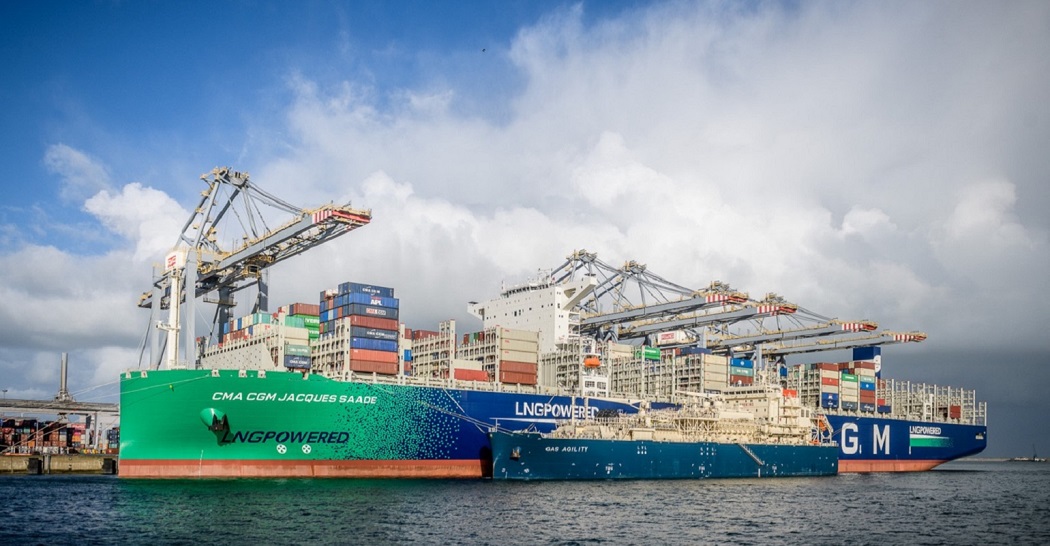
Fill 'er up: "Historic LNG Bunkering Operation Underway in Rotterdam" (CMA CGM; Total)

https://www.seatrade-maritime.com/sites/cet.com/files/CMA%20CGM%20JACQUES%20SAADE_Rotterdam%202%20%28003%29.png
Photo CMA CGM

Considering that the Gas Agility is 135 meters (443 feet) long and yet is dwarfed by the Jacques Saadé, you get a feel for just how huge these new boxships are.

If interested see also August 25's "CMA CGM to take delivery of world’s largest LNG-powered vessel" for Rotterdam as well as "'World’s Largest LNG Bunkering Vessel Arrives in Rotterdam' (so that's how CMA CGM will fuel the new megaships)"  

Also December 2019's "Shipping: 'CMA CGM bolsters its LNG fuel supply with Total deal'" and June 2020's "Shipping: CMA CGM Must Be Seeing A Pickup In Business" for CMA CGM's other fueling hub, Marseille-Fos.

September 2018
Shipping: "Why CMA CGM ordered 'game changing' 22,000 TEU LNG-powered containerships"
January 2019
Shipping: CMA CGM Took Delivery Of Its First LNG Powered Vessel
March 2019
Shipping: CMA CGM To Spend €1.2 Billion on New Container Ships
June 2019 
CMA CGM's Containerships Welcomes Its Second LNG-Powered Newbuild
June 2019 
CMA CGM to Have 20 LNG-Powered Containerships by 2022
September 2019 
Shipping: CMA CGM Launches World's Largest LNG-fueled Container Ship

What CMA CGM is doing is really gutsy and if things work as planned, the January post "Shipping: CMA CGM May Be Building A Big Fuel Price Advantage" comes to fruition and the French mega-carrier has created quite the competitive advantage for itself..

And many, many more. Use the search blog box upper left if interested. 

Hmmm...really does look a bit obsessive in hindsight doesn't it, it's a big deal.