Showing posts sorted by relevance for query sulpher. Sort by date Show all posts

Tuesday, June 4, 2024

"‘Termination shock’: cut in ship pollution sparked global heating spurt"

It had to be done, the result of burning high-sulpher fuels is nasty stuff. But the jump in temperatures should not be attributed to CO2 or used as a reason for some politician's policy prescription.

Additionally, on the other side of the debate/argument, the energy was always incoming, the reduction in the sulfates just exposed the issue.

From The Guardian,May 30:

Sudden cut in pollution in 2020 meant less shade from sun and was ‘substantial’ factor in record surface temperatures in 2023, study finds

The slashing of pollution from shipping in 2020 led to a big “termination shock” that is estimated have pushed the rate of global heating to double the long-term average, according to research.

Until 2020, global shipping used dirty, high-sulphur fuels that produced air pollution. The pollution particles blocked sunlight and helped form more clouds, thereby curbing global heating. But new regulations at the start of 2020 slashed the sulphur content of fuels by more than 80%.

The new analysis calculates that the subsequent drop in pollution particles has significantly increased the amount of heat being trapped at the Earth’s surface that drives the climate crisis. The researchers said the sharp ending of decades of shipping pollution was an inadvertent geoengineering experiment, revealing new information about its effectiveness and risks.

High ocean surface temperatures smashed records in 2023, alarming experts who have struggled to explain the huge rises. But scientists have mixed views on the role played by the cut in shipping pollution.

Those behind the new study say it could be a “pretty substantial” factor. Others say it is only a small factor, and that the reasons for the extraordinary rises in sea and global temperatures remain an alarming mystery.

Dr Tianle Yuan, at the University of Maryland, US, who led the study, said the estimated 0.2 watts per sq metre of additional heat trapped over the oceans after the pollution cut was “a big number, and it happened in one year, so it’s a big shock to the system”.

“We will experience about double the warming rate compared to the long-term average” since 1880 as a result, he said. The heating effect of the pollution cut is expected to last about seven years....

....MUCH MORE

During the run-up to the new rules, 2018 - 2020, we had quite a few posts, maybe 100, on what was going on. Here are a few of the ones that focused on money:

 Big Oil Traders Set to Cash In On Low Sulphur Shipping Fuel Change

Oil: The Impact On Refiners Of Shipping's Low-Sulpher Fuel Ruels After 2010

"Maersk Braces For A $5+ Billion Fuel Bill In 2020"

Top Norwegian Oil Analyst Quitting DNB to Pursue 2020 Low Sulphur Fuel Rule Riches

Shipping: The New Low Sulpher Rules Will Have A Huge Impact On the Oil Business (shipping and world economy too)

Rich Rewards Await Top Oil Refiners as Ships Make Low Sulpher Switch Fuel

Shipping: "Hapag-Lloyd Expects USD 1 Bn in Extra Fuel Costs from 2020 Sulphur Cap"

Shipping: CEO of Third Largest Fleet Says "We're All Going to Go Bust"

Shipping: "CMA CGM Says Global Sulphur Cap to Cost Customers $160 Per Container on Average"
That's serious money, say on a 10,000 TEU average voyage, $1.6 million per trip?
Jeez, no wonder the industry is freaking out....

Not really related except in a climate change sense, yesterday's:
"Tonga’s volcanic eruption could cause unusual weather for the rest of the decade, new study shows"

Tuesday, December 4, 2018

Shipping: Mediterranean Shipping Co. Expects A $2 Billion Annual Rise In Fuel Costs From 2020 Low Sulpher Rules (MSC)

"MSC" is the abbreviation, not a stock symbol. The company Is privately owned with the controlling shareholders, the Aponte clan, being worth at least $8 billion and probably over $10 B.

From gCaptain:
MSC Facing Over $2 Billion Bump in Annual Fuel Bill from IMO 2020
Swiss-headquartered MSC expects to pay over $2 billion a year in fuel costs due to tougher global marine fuel rules and will introduce a bunker charge next year to recoup expenses, the world’s number two container line said.

UN agency the International Maritime Organization (IMO) will prohibit ships from using fuels with sulphur content above 0.5 percent from Jan. 1, 2020, compared with 3.5 percent today, unless they are equipped with exhaust gas cleaning systems, known as scrubbers, to clean up sulphur emissions.
For shipping companies struggling from years of weaker earnings, the new regulations are expected to mean more cost pressure.

“MSC has estimated that the cost of the various changes we are making to our fleet and its fuel supply is in excess of two billion dollars (USD) per year. We have already had to start incurring these costs to be ready for 2020,” the group said in a Dec. 1 note.

MSC said it would levy a bunker recovery charge from Jan. 1, 2019 “as a result of the regulatory changes we all support”...
...MORE

Related: 
Big Oil Traders Set to Cash In On Low Sulphur Shipping Fuel Change

Oil: The Impact On Refiners Of Shipping's Low-Sulpher Fuel Ruels After 2010

"Maersk Braces For A $5+ Billion Fuel Bill In 2020"

Top Norwegian Oil Analyst Quitting DNB to Pursue 2020 Low Sulphur Fuel Rule Riches

Shipping: The New Low Sulpher Rules Will Have A Huge Impact On the Oil Business (shipping and world economy too)

Rich Rewards Await Top Oil Refiners as Ships Make Low Sulpher Switch Fuel

Shipping: "Hapag-Lloyd Expects USD 1 Bn in Extra Fuel Costs from 2020 Sulphur Cap"

Shipping: CEO of Third Largest Fleet Says "We're All Going to Go Bust"

Shipping: "CMA CGM Says Global Sulphur Cap to Cost Customers $160 Per Container on Average"
That's serious money, say on a 10,000 TEU average voyage, $1.6 million per trip?
Jeez, no wonder the industry is freaking out....

Friday, October 5, 2018

Oil: The Impact On Refiners Of Shipping's Low-Sulpher Fuel Ruels After 2010

From Reuters, Sept 28:

How the world's oil refiners plan to grapple with their fuel oil output after 2020
High-sulfur fuel oil (HSFO), essentially the leftovers of an oil refiner’s output, will still flow from refineries around the world even after new rules start up in 2020 curtailing its use in the global shipping fleet, a Reuters survey showed. 

Sixty percent of the 33 refineries contacted by Reuters in a global survey will still produce HSFO in 2020 although the supply will tighten as 70 percent of these refiners plan to reduce their output.
Starting that year, ships will have to use marine fuel, which primarily consists of residual fuel oil, with a maximum sulfur content of 0.5 percent under International Maritime Organization (IMO) rules to reduce air pollution.

Currently, the global shipping fleet, which includes oil and chemical tankers as well as container ships, uses as much as 3.3 million barrels per day of HSFO with a maximum of 3.5 percent sulfur.
Refiners will have little incentive to produce HSFO after the regulations though some demand will remain as a small but growing number of vessels are fitted with smokestack scrubbers that remove the sulfur from the exhaust fumes and power plants will continue to consume the fuel.
“Although HSFO demand for ships is expected to decline substantially in 2020, the oil’s demand for power generation and general users will remain,” Japan’s second-largest refiner Idemitsu Kosan (5019.T) told Reuters in the survey.

“In future, demand for scrubber-equipped ships is projected to recover, so we expect HSFO output to continue.”

UPGRADES
When asked how they plan to reduce HSFO output, just over half of the refiners said they will upgrade their plants to further process their fuel oil to produce more higher value products such as gasoline and diesel...MORE
Previously:
June 27
Top Norwegian Oil Analyst Quitting DNB to Pursue 2020 Low Sulphur Fuel Rule Riches
June 11
Shipping: The New Low Sulpher Rules Will Have A Huge Impact On the Oil Business (shipping and world economy too)
April 16
Rich Rewards Await Top Oil Refiners as Ships Make Low Sulpher Switch Fuel

Thursday, November 21, 2019

Shipping/Refining: Shell Traders Post $1 Billion Profit in Fuel Oil Market Ahead of January 1 Low-Sulfur Rules

Someone's taking advantage of the opportunity.
From Bloomberg via gCaptain, November 15:

Shell Traders Post $1 Billion Profit in Fuel Oil Market Ahead of IMO 2020
Royal Dutch Shell Plc has made $1 billion from trading fuel oil this year, making it one of the standout winners from rules designed to make the shipping industry greener.
Shell said last month that it made substantial money in fuel-oil trading in the third quarter, but the company didn’t disclose the size of the profits. Shell traders celebrated hitting the $1 billion mark so far, likely the biggest by any one company in fuel oil this year, by ringing a bell on the company’s trading floor in London earlier this month, people familiar with the matter said.
Shell declined to comment.

The fuel-oil market has been shaken this year by the so-called IMO 2020 new regulations that ban the use of high-sulfur fuel oil, known as HSFO, to power ships. The rules are aimed at combating human health conditions such as asthma and environmental damage including acid rain. Prices are collapsing because the global shipping fleet, which burns more than 3% of the world’s oil, will instead have to consume very low sulfur fuel-oil, or VLSFO.

Although better known for its oil fields, refineries and pump stations, Shell runs an in-house trading business that’s larger than the better-known independent oil traders like Vitol Group, Glencore Plc and Trafigura Group, handling 13 million barrels of oil equivalent per day. The company describes itself as “one of the largest and most experienced energy merchants in the world” with major trading floors in Houston, London, Dubai, Rotterdam and Singapore....
....MORE

The British company that became 40% of Royal Dutch Shell Group was Shell Transport and Trading.
We haveve mentioned the company's corporate structure a few times, usually while wearing the academic hat and lecturing on the misuse of the word "arbitrage":
"Even the old Royal Dutch and Shell Transport trade was not an arb, 
just a fairly good pair trade."
And we've had a few posts on the IMO 2000 oil/refining trade. Here's one from June 2018:
Shipping: The New Low Sulpher Rules Will Have A Huge Impact On the Oil Business (shipping and world economy too)

And one from October 2019:
Shipping/Refining: Ahead of the 2020 Low-Sulfur Rules The Diesel – Crude Spread Blows Out (FRO)

And a few in-between:
August 25
Shipping Magnate John Fredriksen Goes ‘All-In’ With IMO 2020 Wager (FRO)
August 21
Shipping/Trucking: "Diesel prices will spike due to IMO 2020: Fitch"
August 6
Shipping/Refining: "Is A Diesel Crunch Coming?"
July 12
Shipping: First Signs of 2020 Low-Sulpher Rules Starting to Rock the Oil Market
Have I mentioned the IMO 2020.... oh who am I kidding, fascination became idée fixe some time ago.
July 8
Shipping: 2020 Low Sulphur Rules Less Than 6-Months Away - There's A Trade For That

And previously on this aspect of the big change:
Rich Rewards Await Top Oil Refiners as Ships Make Low Sulphur Switch Fuel
Top Norwegian Oil Analyst Quitting DNB to Pursue 2020 Low Sulphur Fuel Rule Riches 
Oil/Shipping: "Where will all the residual fuel go after ships barred from using it?"
Shipping’s 2020 Low Sulphur Fuel Regulation to Hit Airlines
"Shipping: 2020 Low Sulfur Fuel Requirements Will Disrupt Oil/Refined Markets Up to Five Years".  Shipping: First Signs of 2020 Low-Sulpher Rules Starting to Rock the Oil Market

Wednesday, August 21, 2019

Shipping/Trucking: "Diesel prices will spike due to IMO 2020: Fitch"

The best short discussion of the refining end of the opportunity in the low-sulphur rules that you are likely to find.
From FreightWaves:
In anticipating the price impact on diesel prices from the launch of IMO 2020 on January 1 – with any impacts expected to start before that – most forecasters have been fairly moderate in their outlook, with some exceptions. 

But Fitch Solutions, a unit of Fitch Group, recently came out with its forecast. Prominent in the title is the ‘S’ word – spike.

“Diesel: Tighter Shipping Rules to Lead Large Price Spike in 2020” is the title of the report.
The report as a whole sees the oil market in the next few years as having adequate diesel capacity in general. But it’s the short-term that is of concern to the trucking and transport sector and Fitch’s outlook is stark.

“Fuel switching due to IMO 2020 will drive a large and sudden shift in demand for diesel in shipping, and a significant mismatch between supply and demand, and in turn price volatility appears inevitable during its early stages,” the report said.

There are two paths for diesel to migrate from the current demand pool into meeting demand from the marine sector, which is facing a mandate from the International Maritime Organization to reduce the sulfur content of marine fuel to 0.5 percent sulfur from the current 3.5 percent sulfur cap.

One way is to use an existing product called marine gasoil (MGO), which is a diesel product. The other is to consume a new type of product known as very low sulfur fuel oil (VLSFO). But despite its name, VLSFO will contain a significant amount of diesel molecules, produced using  an intermediate product called vacuum gasoil (VGO). VGO is now used to make either finished diesel or gasoline. There are other solutions, such as scrubbers (which allow ships to continue using high sulfur fuel oil) or liquified natural gas (LNG). But it is the MGO vs.VLSFO vs. existing diesel give-and-take that will be key going forward.

IMO 2020 has been described as the most significant environmental regulation ever implemented in the oil industry. It is very different from other new regulations in one key respect – the solution to meeting the new rule will to some degree come from taking products from one stream of products coming from a refinery – the middle distillates – and using them to displace another stream, the fuel oil that is known sometimes as “the bottom of the barrel.” That shift is forecast to be anywhere from 2 million to 2.5 million barrels/day (b/d), a significant amount on a base of about 35 million to 36 million b/d of distillate consumption, including diesel...
....MUCH MORE. 

Out of our dozens of links on IMO 2020 a few that may be of interest:
August 6
Shipping/Refining: "Is A Diesel Crunch Coming?"
July 12
Shipping: First Signs of 2020 Low-Sulpher Rules Starting to Rock the Oil Market
Have I mentioned the IMO 2020.... oh who am I kidding, fascination became idée fixe some time ago.
July 8 
Shipping: 2020 Low Sulphur Rules Less Than 6-Months Away - There's A Trade For That

And previously on this aspect of the big change:
Rich Rewards Await Top Oil Refiners as Ships Make Low Sulphur Switch Fuel
Top Norwegian Oil Analyst Quitting DNB to Pursue 2020 Low Sulphur Fuel Rule Riches 
Shipping: The New Low Sulpher Rules Will Have A Huge Impact On the Oil Business (shipping and world economy too)
Oil/Shipping: "Where will all the residual fuel go after ships barred from using it?"
Shipping’s 2020 Low Sulphur Fuel Regulation to Hit Airlines
"Shipping: 2020 Low Sulfur Fuel Requirements Will Disrupt Oil/Refined Markets Up to Five Years".  Shipping: First Signs of 2020 Low-Sulpher Rules Starting to Rock the Oil Market

Thursday, October 3, 2019

Shipping/Refining: Ahead of the 2020 Low-Sulfur Rules The Diesel – Crude Spread Blows Out (FRO)

From FreightWaves:
The widening difference between the price of diesel fuel and the price of Brent crude oil suggests that energy markets are worried about the impact of upcoming maritime fuel regulations.

There’s a great deal of noise and many opinions about what effect the new maritime fuel regulation, IMO 2020, will have on the price of diesel fuel when it goes into effect January 1, 2020. The regulation mandates that commercial vessels use fuel that contains a maximum sulfur content of 0.5%, far less than the current allowed level of 3.5%.

Purchasers of ultra low sulfur diesel, which include trucking carriers and, because of fuel surcharges, shippers, are concerned that the demand for ultra low sulfur marine fuels will tighten refinery capacity and drive up the price of diesel. The possibility that some vessels will install scrubbing technology that allows them to continue using the old bunker fuel – so far about 6% of vessels have installed or have stated an intention to install scrubbers – further complicates any forecasts about IMO 2020 impacts.

Energy markets may be a better way to get a read on what the industry expects because traders are voting with their dollars, and by at least one measure there seems to be anxiety in the markets about potentially tightening diesel supply going forward.

The diesel crack spread, or the difference between the price of diesel as represented by gasoil contracts on the New York Mercantile Exchange and the price of Brent crude, the international benchmark, has widened considerably, to its widest level so far this year....
....MUCH MORE

Out of our dozens of links on IMO 2020 a few that may be of interest:
August 25
Shipping Magnate John Fredriksen Goes ‘All-In’ With IMO 2020 Wager (FRO)
August 21
Shipping/Trucking: "Diesel prices will spike due to IMO 2020: Fitch"
August 6
Shipping/Refining: "Is A Diesel Crunch Coming?"
July 12
Shipping: First Signs of 2020 Low-Sulpher Rules Starting to Rock the Oil Market
Have I mentioned the IMO 2020.... oh who am I kidding, fascination became idée fixe some time ago.
July 8
Shipping: 2020 Low Sulphur Rules Less Than 6-Months Away - There's A Trade For That

And previously on this aspect of the big change:
Rich Rewards Await Top Oil Refiners as Ships Make Low Sulphur Switch Fuel
Top Norwegian Oil Analyst Quitting DNB to Pursue 2020 Low Sulphur Fuel Rule Riches 
Shipping: The New Low Sulpher Rules Will Have A Huge Impact On the Oil Business (shipping and world economy too)
Oil/Shipping: "Where will all the residual fuel go after ships barred from using it?"
Shipping’s 2020 Low Sulphur Fuel Regulation to Hit Airlines
"Shipping: 2020 Low Sulfur Fuel Requirements Will Disrupt Oil/Refined Markets Up to Five Years".  Shipping: First Signs of 2020 Low-Sulpher Rules Starting to Rock the Oil Market

Tuesday, August 6, 2019

Shipping/Refining: "Is A Diesel Crunch Coming?"

This link is ten months old but we've been sitting on it because we weren't seeing the trade developing.

Now, as we approach implementation of the 2020 low-sulfur rules we're starting to get some clarity on who will be running high-sulfur bunker fuel with scrubbers, who will be using LNG (or in at least two cases, hydrogen) who will be going with low-sulfur-but-higher cost fuel and who might run the risk of running dirty bunker fuel (don't do it in Singapore or Rotterdam, their sulfur sniffers are already in place)

What this means for the refiners as they figure out what to do with the various hydrocarbons from bottom of the barrel asphalt to  residual fuel oil to diesel to kerosene to gasoline.

We'll have more on the oil refining trade over the next month or two, in the meantime this is a good backgrounder.

From Oilprice:
The new ship fuel regulations coming into force at the start of 2020 are set to create an initial confusion on the refining market and crude oil and oil product trade flows, analysts and industry experts say.

We are now just 14 months away from January 1, 2020—the start date which the International Maritime Organization (IMO) has set for the new rules on using only 0.5-percent or lower sulfur fuel oil on ships, unless said ships have installed the so-called scrubbers—systems that remove sulfur from exhaust gas emitted by bunkers.

Analysts, experts, and industry representatives are divided as to how great of an impact those new rules will be and whether there will be enough middle distillates—which include diesel and the lower sulfur marine gasoil—to meet demand for both land use, in road transportation, agricultural machinery and industry, and for use on ships at sea.

One way to comply with the IMO rules is to have scrubbers installed, which requires upfront costs, but later these would pay off with the expected much lower price of high-sulfur fuel oil.
The other way is using fuel that contains 0.5 percent sulfur. These fuels are basically in the same middle distillate product category like road diesel or jet fuel.

Some analysts have started to warn that the competition for those middle distillates could lead to shortages of diesel, resulting in price spikes. The other camp says that with diesel demand slowing in Europe and possibly reaching plateau in demand in China, there will be enough middle distillates around.

Amid expectations of fuel prices spikes in a presidential election year, the Trump Administration is seeking to slow down the 2020 introduction of the new ship fuel rules. The Administration wants a phased-in rollout in order to “mitigate the impact of precipitous fuel-cost increases on consumers,” the White House said in an email to The Wall Street Journal last week....
....MORE

Previously on this aspect of the big change:
Rich Rewards Await Top Oil Refiners as Ships Make Low Sulphur Switch Fuel
Top Norwegian Oil Analyst Quitting DNB to Pursue 2020 Low Sulphur Fuel Rule Riches 
Shipping: The New Low Sulpher Rules Will Have A Huge Impact On the Oil Business (shipping and world economy too)
Oil/Shipping: "Where will all the residual fuel go after ships barred from using it?"
Shipping’s 2020 Low Sulphur Fuel Regulation to Hit Airlines
"Shipping: 2020 Low Sulfur Fuel Requirements Will Disrupt Oil/Refined Markets Up to Five Years". 
"Shipping: 2020 Low Sulphur Rules Less Than 6-Months Away - There's A Trade For That" 
 Shipping: First Signs of 2020 Low-Sulpher Rules Starting to Rock the Oil Market
Have I mentioned the IMO 2020.... oh who am I kidding, fascination became idée fixe some time ago....

Friday, July 12, 2019

Shipping: First Signs of 2020 Low-Sulpher Rules Starting to Rock the Oil Market

Have I mentioned the IMO 2020.... oh who am I kidding, fascination became idée fixe some time ago.
From Bloomberg via gCaptain:
They may still be six months away, but new rules on marine fuels are already sending shock-waves through the little-known world of refinery feedstocks.

The price of these low-sulfur, heavier oils — that refineries make and then reprocess into transport fuels like gasoline and diesel — has jumped in Europe in recent weeks because the shipping industry is starting to drive up demand for the products. The surge benefits some refineries while hurting others.

“We’re moving from an old norm to a new norm,” said Steve Sawyer, senior analyst at energy consultant Facts Global Energy. “The market is paying a higher premium for low-sulfur material than it did before because people are looking to stockpile low-sulfur bunker fuel.”

Refiners typically run feedstocks — in particular straight-run fuel oil and vacuum gasoil — through upgrading units, converting them into more valuable transport fuels. That means there’s historically been a link with prices for the finished fuels. That relationship is now being disrupted by the need to produce cleaner marine fuels before a 0.5% sulfur cap stipulated by the International Maritime Organization that starts in January.

Straight run fuel oil with 0.5% sulfur recently turned more expensive than Brent crude in northwest Europe for the first time in five years, according to Jan-Jaap Verschoor, director of Oil Analytics, a firm that tracks margins across the global refining industry. The price hike for the feedstock makes sense as refiners buy up the product in preparation for ramping up production of next year’s marine fuel, he said.

The market for very low sulfur fuel oil, or VLSFO, is already heating up in Europe....MUCH MORE 
I've been a bit obsessive about the new rules for the last couple years. For some links that may be of interest see last Monday's  "Shipping: 2020 Low Sulphur Rules Less Than 6-Months Away - There's A Trade For That"

Tuesday, June 19, 2018

"Rotor sail helps Finnish ferry Viking Grace reduce fuel consumption"

Depending on how high the low-sulpher rules push the price of bunker fuel there might be a lot more of these coming.

From Metropolitan.fi:

Rotor sail helps Finnish ferry Viking Grace reduce fuel consumption

Passengers traveling on the Baltic sea on the Viking Grace vessel can now observe a 24 meter high spinning tube on deck. The structure is a rotary sail, a first of it's kind installed on a passenger ship.
The rotor sail is installed on the Grace is built by a Helsinki based company Norsepower. The cylinder shaped sail uses the wind as propulsion, and reduces the need for the main engine. Viking Grace deployed the sail on the 12th of April 2018.

Magnus effect
Use of the rotary sail takes advantage of the Magnus effect to fuel and emission savings. The pilot project hopes to save 300 tons of LNG fuel each year. Carbon dioxide emissions are reduced by 900 tons.

In addition to reduced strain on the environment, the rotary sail is a strong financial incentive. On the Grace the Norsepower sails are projected to yield the shipping company Viking Line with savings of 180,000 euros annually. Profits out of thin air.

Norsepower is also working together with Maersk shipping company. One of the company's oil tankers will get two 30 meter rotor sails later this year.

The sails are expected to result in fuel savings of up to 20 percent for the Maersk pilot vessel project, but the average savings are said to be around 10 percent on global shipping routes....
...MORE, including video

Wednesday, August 22, 2018

Shipping: "More than 2000 vessels will get scrubbers before 2020"

That's impressive but it is not enough.
It does however lower the odds of a bunker oil price disruption. Additionally ships won't be switching to diesel as a way to lower their sulpher emissions, a development for which truckers should be breathing a sigh of relief.

From Reuters, August 21:

High-sulfur fuel demand outlook jumps as shippers soften stance on scrubbers: FGE
Demand for high sulfur marine fuels is likely to see a smaller drop than previously expected by 2020, said consultancy FGE, as changing attitudes to sulfur-stripping technologies from large shippers alter the outlook for use of the fuels.

More than 2,100 vessels are now expected to be equipped with exhaust gas cleaning systems, known as scrubbers, by 2020, up from 1,500 ships previously, said Thomas Olney, energy consultant at FGE in Singapore.

Adding to the improved demand outlook is “a much greater skew toward installing scrubbers on larger vessels that burn higher quantities of fuel,” said Olney.

If scrubber adoption continues at current rates over the next 18 months, “and we see further commitments from large shipping operators, the scrubbed (high-sulfur fuel oil) consumption in 2020 can be lifted significantly to above 800,000 barrels per day (bpd),” said FGE.

This is up from FGE’s previous demand estimate of 300,000 to 400,000 bpd, said Olney....MORE
As we saw in last week's post "Shipping: LNG, LNG, LNG" the scrubbers can cost up to $10 million per vessel, one of the reasons CMA CGM is looking at multiple approaches:
"French container shipping line CMA CGM, the fourth biggest in the world, has said it has ordered nine mega vessels for delivery from 2020 which will be powered by LNG, one of several options it is pursuing." 
Unlike the scrubbers approach natural gas also reduces carbon dioxide emissions should such reductions become mandated.

I'm still pitching a return to cylindrical wind turbines:

Figure 21(a)

but not getting a lot of enthusiasm from the industry. It might have something to do with 90-year old marketing materials. Maybe update the pics:

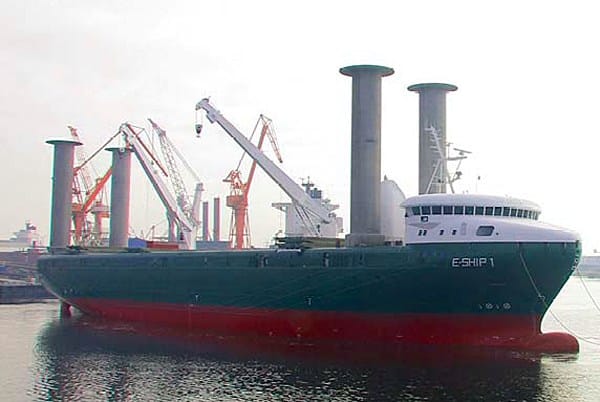
EShip 1 With Flettner Rotor
EShip 1 With Flettner Rotor (10,500 dwt)

That's Enercon's RoLo which finally got completed by Cassens-Werft after the first builder, Lindenau-Werf, went bust.

By comparison here's one of the U.S. Navy's RoRo/RoLo's with the cargo indeed rolling:

https://upload.wikimedia.org/wikipedia/commons/d/d2/USNS_Shughart_gangplank.jpg
 USNS Shughart (originally Laura Maersk) 53688 dwt

A boat that big could handle 8-10 turbines, a nice little order for the traveling cylindrical sail salesman.

Wednesday, June 27, 2018

Top Norwegian Oil Analyst Quitting DNB to Pursue 2020 Low Sulphur Fuel Rule Riches

There are a lot of ways to make money off the coming change, this is one that had not occured to yours truly.
Via gCaptain:
Oil analyst Torbjorn Kjus said he’s quitting Norway’s biggest bank to pursue opportunities that will arise thanks to an obscure but far-reaching change to fuel rules for the shipping industry.

Kjus, who has followed the market for almost two decades, will join Vistin Trading AS as a fund manager next week after leaving DNB ASA. The thematic fund, which will trade primarily off the International Maritime Organization’s plans to curb ship-fuel sulfur emissions worldwide from 2020, already recruited Kenneth Tveter from DNB in a similar role.

“It’s the perfect time to start,” Kjus, 48, said by phone from Oslo on Monday. “Because this topic is so extremely interesting and has so many effects, most of them have not been priced in.”

Kjus — who was recently ranked as Norway’s number one analyst in the magazine Kapital — said the business is now taking positions in the market. The venture was set up by Oslo-based drug maker Vistin Pharma ASA as it seeks to expand into energy trading.

The new company has raised $40 million in capital for initial trading and will take positions largely a year or two down the futures curve, said Kjus, who spent 11 years at DNB and six years prior to that at BP Plc and Norsk Hydro ASA....
...MORE

See also:

April 16
"Rich Rewards Await Top Oil Refiners as Ships Make Low Sulphur Switch Fuel":
June 11
Shipping: The New Low Sulpher Rules Will Have A Huge Impact On the Oil Business (shipping and world economy too)

June 14
Shipping: CEO of Third Largest Fleet Says "We're All Going to Go Bust"

June 18
Shipping’s 2020 Low Sulphur Fuel Regulation to Hit Airlines 

Monday, June 18, 2018

Shipping’s 2020 Low Sulphur Fuel Regulation to Hit Airlines

Via gCaptain:
From the window of a jet plane, it can be hard to see ships crawling across the seas. Yet what’s burning in those engines thousands of feet below may determine the fate of airline profits in the next few years.

In about 18 months’ time, the world’s oil refineries are going to have to supply shipping companies with better-quality fuel to comply with international regulations agreed back in 2016 in a nondescript building on the banks of the River Thames in London.

While the regulators’ target was to lower sulfur emissions from ship fuel, it’s becoming increasingly clear there will be an accompanying — and significant — impact on the supply of jet fuel, the aviation industry’s single biggest expense. The trouble is, there’s profound disagreement about whether the result will be a glut or a shortage of the fuel.

“These rules are going to impact airlines,” said Mark Maclean, managing director at Commodities Trading Corporation Ltd., which advises on hedging strategies. “The impacts will not be isolated only within the shipping industry, these changes will affect the entire oil and middle-distillate complex,” the part of refining that includes jet fuel and diesel.

From Jan. 1, 2020, the world’s ships will need to consume fuels containing less sulfur under the 2016 rules set out by the International Maritime Organization, part of the United Nations.
Oil refineries are likely to face an initial demand surge from shippers for diesel-type products when the rules kick in. Diesel is critical in determining the cost of normally more-expensive jet fuel, so if that historic price relationship holds, then the aviation industry’s fuel bill could surge as well.

Refining Puzzle
How it plays out in practice hinges on the way refineries make jet fuel and — critically — how much flexibility they’ll have to adjust their output once the new rules enter into force.
Jet fuel is made in one simple refining process, meaning that if more crude gets distilled to make diesel, then there will be an unavoidable surge in jet fuel supplies too. Several traders say that could result in a surplus.

But not everybody agrees. For one thing, increased amounts of jet fuel will be blended into fuel oil to meet the more stringent sulfur specifications, according to Jan-Jacob Verschoor, a director at Oil Analytics and a chemical engineer by training who previously worked at Royal Dutch Shell Plc. Refineries will also have some flexibility to maximize diesel production to the detriment of jet fuel output, more than negating any ramp-up in overall crude processing, he said....MORE
Recently:
June 14
Shipping: CEO of Third Largest Fleet Says "We're All Going to Go Bust"
June 11
Shipping: The New Low Sulpher Rules Will Have A Huge Impact On the Oil Business (shipping and world economy too)

Friday, January 18, 2008

Speculators, Looking for a High Flyer? Beluga SkySails (Brussels: BELU)

From IOL:

Bremerhaven - A kite-drawn German freighter was bound for Venezuela Friday on its maiden voyage, testing out wind- assistance for its diesel engines.

An unexcitable lot, the officers of the new MS Beluga SkySails neither cheered nor embraced when the 160-square-metre flying sail was unfurled late Thursday.

The steersman's only reaction at the historic moment, 30 kilometres out of Bremerhaven, was to stoically grunt, "Huh. It works." Captain Lutz Heldt just nodded approval.

The hi-tech kite is designed to help slash the spiralling cost of fuel in cargo shipping....MORE

MV Beluga SkySails


Here's Beluga N.V.'s homepage. Quote.
Here's SkySails homepage.
Here's some video.

Everybody want's to get on board:

Al Gore Invents Wind Power for Shipping

Al Gore continued his crusade for environmental entrepreneurship today, announcing that he has invented a new method to use wind power for ships on the high seas. Amid growing controversy about the impact of shipping on global warming, Gore's proposal would dramatically reduce pollution problems from seafaring operations.

Several environmental groups have been looking at the maritime industry and its associated pollution. The shipping industry carries over 90% of the world's merchandise and global economic growth has led to a dramatic increase in the use of ships. These oceanic beasts output huge quantities of global warming gases including carbon dioxide, along with other dirty effluents like sulpher dioxide and nitrogen oxide. Some reports suggest that the ships also smell like Britney Spears, an odor that is particularly offensive in Arab countries, but this has not been confirmed.

Al Gore, the former Vice-President and recent winner of a Nobel Prize, is not sitting still. Instead he is confronting the shipping industry with a proposal straight out of science fiction. Instead of using bunker fuel, Gore would outfit all large ships with his wind power invention....MORE

image for Al Gore Invents Wind Power for Shipping
Al Gore scale model of his new shipping idea

Thursday, June 14, 2018

Shipping: CEO of Third Largest Fleet Says "We're All Going to Go Bust"

$13 billion revenue Mitsui O.S.K. Lines is number three in both fleet tonnage and number of ships with 857 across LNG carriers, dry bulk, crude and product tankers, car carriers and container ships, trailing only China Cosco and APM Maersk.
They move a lot of stuff and are a major player and that's what makes this comment so noteworthy.

From gCaptain:

MOL Boss on 2020 Sulphur Cap: ‘We’re All Going Bust’
Less than 18 months before the IMO’s 0.5% sulphur cap regulations come into force for merchant shipping, container lines are worried that the estimated $50bn extra cost of the greener fuel could tip them into bankruptcy.

“We’re all going to go bust,” MOL’s president and chief executive Junichiro Ikeda told the Financial Times.

He expressed his concern that ocean carriers would be unable to recover sufficient amounts from shippers to mitigate the impact of the $300 a tonne extra cost of low-sulphur fuel oil (LSFO).

Mr. Ikeda may have good reasons to be worried: carriers have generally not been very successful in their attempts to pass on extra fuel costs to shippers, illustrated by a cumulative net loss of over $1bn in the first quarter for the industry this year, attributed to a spike in oil prices.

In the previous decade, the establishment of SECA (Sulphur Emission Control Areas) in the North and Baltic Seas and North American and Canadian coastlines, which required switching tanks to LSFO when entering, was also not compensated.

Ocean carriers initially announced surcharges to cover the cost of more expensive fuel consumed on some tradelanes, but these were ultimately absorbed into their freight rates.
Carriers can avoid the need to burn LSFO by the installation of exhaust gas cleaning systems, known as scrubbers, which are, effectively, onboard treatment plants to remove harmful sulphur oxides from ship’s engines and boiler exhaust gases for later disposal ashore.
These can cost up to $10m to retrofit to a large containership, but on newbuilds the extra cost would be comparatively small in the context of the total price....MORE
Recently:
Shipping: The New Low Sulpher Rules Will Have A Huge Impact On the Oil Business (shipping and world economy too)

Thursday, August 16, 2018

Shipping: LNG, LNG, LNG

Have I mentioned LNG?
A couple headlines that have fallen out of the feedreaders and terminals this month:

Caught in the Crossfire: Why American LNG May Fall Prey to US-China Trade War
—Sputnik, Aug. 10
Icebreaking LNG Carrier Christophe de Margerie Sets New Northern Sea Route Record
—gCaptain, Aug. 1

Those are LNG as cargo. One of the more interesting developments is the use of LNG as bunker fuel ahead of the 2020 IMO low-sulphur rules.
Whether or not it pans out is still up in the air but something has to work, be it scrubbers or sails (cylindrical wind turbines) or alt-fuel because, as Junichiro Ikeda put it in a June 14 post:
Shipping: CEO of Third Largest Fleet Says "We're All Going to Go Bust"
The industry is looking at a $50 billion price hike for its fuel bill if everyone goes with more refined oil or gasoil (why hasn't anyone bought a refinery?) which leads to ideas like this from Reuters, August 15;

New fuel rules push shipowners to go green with LNG
Tough new rules on marine fuel are forcing shipowners to explore liquefied natural gas as a cleaner alternative and ports such as Gibraltar are preparing to offer upgraded refueling facilities in the shipping industry’s biggest shake-up in decades.

From 2020, International Maritime Organization rules will ban ships from using fuels with a sulfur content above 0.5 percent, compared with 3.5 percent now, unless they are equipped to clean up sulfur emissions. This will be enforced by fines levied by the IMO’s member states.

Using LNG to power ships instead of heavy fuel oil or the lighter marine gasoil can reduce polluting emissions of nitrogen oxides and sulfur oxides by 90 to 95 percent, according to industry estimates.
The stakes are high. Analysts at Swiss bank UBS estimate that the green shipping market could be worth at least $250 billion over the next five years.

To scoop up some that market, the British territory of Gibraltar is in the process of launching an LNG-fuelled power station whose accompanying storage tanks will also be able to be used to refuel cargo ships via barges.

Gibraltar already supplies the most marine fuel of any port in the Mediterranean and aims to do the same with LNG, said Manuel Tirado, chief executive of the Gibraltar Port Authority.

“The GPA’s aim is to be the number one LNG bunker port in the Med, however, this is something that will not happen overnight,” he told Reuters....MUCH MORE  
Related:
Shipping: The New Low Sulpher Rules Will Have A Huge Impact On the Oil Business (shipping and world economy too)
Rich Rewards Await Top Oil Refiners as Ships Make Low Sulphur Switch Fuel"
Shipping: "The Engines of the Largest Container Ships in the World, and Challenges their Manufacturers Face"
Shipping’s 2020 Low Sulphur Fuel Regulation to Hit Airlines
Top Norwegian Oil Analyst Quitting DNB to Pursue 2020 Low Sulphur Fuel Rule Riches

Friday, May 24, 2019

Shipping: 2020 Low Sulfur Fuel Requirements Will Disrupt Oil/Refined Markets Up to Five Years

From gCaptain:

IMO 2020 Will Disrupt Markets for 1-5 Years -Boston Consulting Group 
The marine industry’s January 2020 shift to using very low sulfur fuel oil (VLSFO) to power ships worldwide will launch a one- to five-year disruption in oil and refined products markets, according to a study released Thursday by Boston Consulting Group.

The International Maritime Organization (IMO)’s mandated switch will require fuels to have a sulfur content below 0.5%, compared with 3.5% now. It aims to improve human health by reducing air pollution from sea-going vessels.

The changeover may increase profits for refiners, especially on the U.S. Gulf Coast, where plants are designed to process high-sulfur crudes. It could also benefit producers of shale oil, which has a lower sulfur content than other varieties, the study found.

Conversely, prices for high-sulfur fuel oil (HSFO) or bunker fuel, with a maximum sulfur content of 3.5%, will fall as demand erodes, according to the study.

“The effects will be more than made up for by higher market prices for VLSFO and middle distillates, leaving most refiners, particularly complex refiners on the U.S. Gulf Coast, with substantially higher margins than they had before the disruption,” it said....MORE
We've had many, many posts on the impending change, here are a few of note:
June 2018
Shipping: The New Low Sulpher Rules Will Have A Huge Impact On the Oil Business (shipping and world economy too)
April 2018
"Rich Rewards Await Top Oil Refiners as Ships Make Low Sulphur Switch Fuel": 
This is a pretty big deal that's been on the horizon* for a while but hasn't gotten much notice outside the shipping industry and the specialist press until recently 

June 2018
Top Norwegian Oil Analyst Quitting DNB to Pursue 2020 Low Sulphur Fuel Rule Riches

Monday, June 11, 2018

Shipping: The New Low Sulpher Rules Will Have A Huge Impact On the Oil Business (shipping and world economy too)

As noted in April's "Rich Rewards Await Top Oil Refiners as Ships Make Low Sulphur Switch Fuel":
This is a pretty big deal that's been on the horizon* for a while but hasn't gotten much notice outside the shipping industry and the specialist press until recently....

Well,  since then Bloomberg has been ringing the bell quite loudly and gCaptain has been relaying the warnings. Here's the latest.

From gCaptain:

Researcher Who Saw Stressed 2020 Oil Market Is Even More Worried Now
By Alaric Nightingale and Brian Wingfield (Bloomberg) — It may already be too late to listen to Martin Tallett.

The consultant, who has more than four decades’ experience in oil refining, presented research two years ago to the United Nations’ agency charged with setting rules for the maritime industry. In it, he warned oil markets would be strained if tough standards for shipping fuel were imposed from 2020. The start date was set anyway.

Fast forward to today, and Tallett says he’s more concerned. What worries him is a demand surge so great that by 2020 the world will need 2.3 million barrels more oil a day than was being predicted when he did his previous research. That’s close to Germany’s consumption.

“The main difference is that global demand level has gone up since 2016,” said Tallett, the president of EnSys Energy & Systems Inc., a Massachusetts-based consultant. “We don’t believe the refining industry can produce all of the fuels that would be needed to achieve 100 percent compliance. It’s going to be potentially rather chaotic and stressed.”
Now, an expanding army of analysts, traders and industry heavyweights (go to the bottom of this story to see a selection of their comments) are warning of the risk of turmoil — and lucrative trading opportunities — while a shipping group has even talked of threats to world trade and maritime safety.
Tallett’s firm, which had previously worked with the UN’s International Maritime Organization, sought to do research for the agency again when the IMO was deciding on a start date for the rules that would cut sulfur content in most ship fuel to 0.5 percent, down from 3.5 percent in most parts of the world at the time (and still).

The researcher that the IMO did end up choosing to perform its fuel-availability study, Netherlands-based CE Delft, found there wouldn’t be shortages globally. EnSys, though, still did similar work alongside shipping researcher Navigistics Consulting, after being commissioned by a shipping trade group and a nonprofit that seeks to improve the oil refining industry’s environmental and social performance. They came up with different results.

In a nutshell, Tallett, a chemical engineer by training, says the problem is insufficient equipment across the refining industry that would remove sulfur. There hasn’t been enough investment since the 2020 deadline was set to address the issue — either by refiners or shipping companies who can get kit fitted on their vessels to eliminate the pollutant, allowing them to burn otherwise non-compliant fuel.
As things stand, that means that the main way shipping’s demand for fuel will be met is if diesel — initially as much as 3 million barrels a day of it by Tallett’s reckoning — gets diverted to fueling ships, instead of conventional on-land uses like transport and industry. That’s unlikely to be achieved in practice, he said.

Ample Time
On top of all that, Tallett says more crude will be to be required as a result of the rule. If he and other doubters are correct, it may already be too late to address the issue from a legislative point of view. Under the IMO’s processes, it would take 22 months to adopt and fully implement a change to the rule — several months after it’s due to enter into force were any such amendment proposed today.
The IMO says it gave the refining industry ample time to get ready — the switch was being discussed long before 2016 — and points to the study by CE Delft in response to questions about fuel availability. It also says it’s working to ensure a smooth transition and to help vessel owners if they find the correct fuels aren’t available when the switch takes effect. For its part, CE Delft remains confident there won’t be wild gyrations in the oil market, says Jasper Faber, the lead author of its study.

No Shortage
“Fundamentally, there should not be a shortage,” even if there may be an initial period of teething trouble and some regional supply issues, he said by phone.

In the past few years, some major oil companies have begun producing ultra-low sulfur fuels, which will help the refining industry meet the IMO-related fuels demand from shippers, Faber said.
For Tallett, though, the issue goes beyond shipping or shipping fuel. There will, overall, be a need to switch roughly 4 million barrels a day of higher sulfur fuels to lower-sulfur equivalents, a process that will happen fairly abruptly since shipping companies won’t want to pay higher costs before they absolutely have to....MORE