Showing posts sorted by date for query Google index. Sort by relevance Show all posts

Sunday, November 1, 2026

AI: "The Race We’re Actually Running, Part 2: Good Enough at a Fraction of the Price"

Avoiding the question: 

Will the incoming Congress use their antipathy to Elon Musk and the AI build-out to cripple the AI expansion, remove the only sector propping up the economy, plunge the nation, and thus the world unto a depression, neuter any tech advantage America possesses, hand the emerging future to China and force the U.S. to follow the last-ditch German economic plan, betting everything on re-armament before the final war to end all wars?

That question. 

From the High Performance Computing geeks at HPCwire, October 30:

What the AI race is a contest over, and why the cheapest capable model may win

In part 1 of this series, I looked at where the US and China stand after two decades of investment. This installment asks the question the public debate tends to skip: when people say “winning the AI race,” what does winning mean?

There Is No Single Finish Line
The AI race gets described as though there were one finish line: one model, one moment when someone crosses first and the outcome is settled. The United States and China are not running toward the same point. If China is racing toward nine o’clock and the US toward two o’clock, both can run as fast as they possibly can and still not compete for the same prize. The useful question is what each side is trying to get, and what happens to the rest of the world once they get it. 

Five Things Being Contested
Frontier model capability. This is the headline contest: which model scores highest on the hardest benchmarks. The US leads, narrowly. Stanford’s 2026 AI Index put the gap between the leading US and Chinese models on the Arena leaderboard at about 2.7% as of March. In mid-October, the Artificial Analysis Intelligence Index scored the best closed model at 58 and the best openly downloadable model at 46. The pattern is consistent: close on conversation, wider on hard reasoning and long autonomous tasks.

Chip manufacturing. The US holds a wide and, for now, structural lead: advanced chip fabrication sits in a small number of facilities the US and its allies control. Part of that lead is policy. The Institute for Progress estimates that with no H200 exports, the US would hold a 21 to 49 times advantage in AI compute produced in 2026, and that unrestricted exports of Nvidia‘s H200 could cut it to roughly 1.2 to 6.7 times. Commerce approved about 10 Chinese buyers in May, but Reuters reported no deliveries as Beijing steered its companies toward Huawei. That substitution is not one for one. Huawei’s Ascend 910C trails the H200 in computing power and memory bandwidth, and Epoch AI estimates Huawei’s 2026 output at about 880,000 H100-equivalents against about 23 million for Nvidia, under 4%. The tightest constraint is high-bandwidth memory, which China cannot yet make in volume. Huawei is pushing anyway. In September it pulled its Ascend 960DT forward to early 2027, a chip Bernstein estimates will roughly match the H200 with more than twice its interconnect bandwidth, and said a 256,000-card cluster is being deployed. How large the US lead stays depends on Washington’s export decisions and China’s memory production as much as on chip design.

Research volume and open-source distribution. China leads here, and this may be the contest that decides what the rest of the world runs on. Chinese models accounted for about 41% of downloads on Hugging Face over the past year, ahead of US models, and the summer brought a run of Chinese releases: Moonshot‘s Kimi K3, Alibaba‘s Qwen3.8, DeepSeek V4.1-Flash, and models from Z.ai and Xiaomi. In October, Anthropic reported that Z.ai’s open-weight GLM-5.3 came close to its restricted Mythos Preview model on cyber-exploit tests, while NIST’s Center for AI Standards and Innovation put it about four months behind the US frontier. DeepSeek and Huawei have also released open tools for programming Huawei’s chips, aimed at reducing dependence on Nvidia’s CUDA software.

A note on terms. An open-weight model publishes its trained parameters, called weights, so anyone can download it, run it on their own hardware, and modify it. Many people call these open-source models, though the training data and code usually stay private. A closed model, such as those from OpenAI, Anthropic, and Google, can only be used through the company’s own service.

The trade between the two is simple. Closed models are more capable, and open models are much cheaper. DeepSeek’s open-weight V4-Pro costs $0.66 per million input tokens and $1.98 per million output tokens off-peak (a token is about three-quarters of a word), against $5 and $25 for Anthropic’s Claude Opus 4.7 and $5 and $30 for OpenAI’s GPT-5.5. That makes DeepSeek roughly 8 to 15 times cheaper. On SWE-bench Verified, a widely used test of fixing real software bugs, Opus 4.7 solves 87.6% of the problems; DeepSeek reports 80.6%, and an independent US government evaluation measured 74%. Put simply, the open model solves fewer of the hardest problems for about a tenth of the price.

Open models also reach what the best closed models could do only recently. Epoch AI puts the lag at about four months. So a buyer can pay a premium for the top of the range now, or give up some capability on the hardest tasks at a fraction of the cost and expect open models to reach today’s frontier within months. Many will take that trade for customer service, document processing, and routine coding, where the cheaper model already does the job. Open models are not only a Chinese story, either: hosting companies offer OpenAI’s open-weight gpt-oss-120b for well under a dollar per million tokens.

Capital. Stanford’s AI Index puts US AI investment in 2025 at about $286 billion against about $12 billion for China, roughly 23 times. China answers with state capital. Bloomberg reported in June that Beijing has drafted a five-year, roughly $295 billion plan for a national AI data-center grid, funded by state bonds, requiring at least 80%domestic technology and interconnected by 2028. That is about $59 billion a year, less than any one of the largest US cloud companies spends: Oracle, Microsoft, Amazon, Meta, and Alphabet together are expected to spend about $800 billion on capital projects in 2026, according to research by Columbia Business School’s Stijn Van Nieuwerburgh. The Chinese plan’s strength is coordination, bringing state debt, land, power allocation, and domestic chips together under one national grid.

Talent. This trend favors China and compounds over the longest horizon, which makes it the hardest to reverse quickly.

What the Summit Did and Did Not Settle 
The most visible diplomacy of the fall was the Trump-Xi summit in Washington, which ended September 25. According to news reports of the readouts, it extended the trade truce to January 10, 2027, eased tariffs on about $30 billion of non-sensitive goods in each direction, and opened a dialogue on AI risks with a channel for AI-related incidents. Rare-earth talks will continue, and advanced chips did not feature. The leaders are expected to meet again at APEC in November and the G20 in Miami in December. The diplomacy is moving on its own track, and the competition in chips, models, and power is moving faster.

....MUCH MORE 

Thursday, October 22, 2026

"China’s stock market sinks into bear territory as CSI 300 extends 10-week rout"

Raising the question where are the sellers putting the proceeds?

Price action says not into precious metals, not into mainland real estate, not into grains or industrial metals. So where are the sellers stashing their newfound liquidity?

Into cash in the form of currency? 

From CNBC, October 21: 

  • The index, which tracks 300 of the largest stocks listed in Shanghai and Shenzhen, has declined for 10 consecutive weeks.
  • Chinese firms have been suffering from declining profit growth amid intense competition that has eroded margins. 

China’s benchmark CSI 300 index on Thursday entered bear-market territory, falling 20% from its June peak, as a prolonged sell-off in its equities deepens.

The index, which tracks 300 of the largest stocks listed in Shanghai and Shenzhen, has declined for 10 consecutive weeks and is down 2.6% so far this week, underscoring sustained pressure on Chinese equities, data from LSEG showed. The index was more than 1% lower Thursday.

Jordan Cvetanovski, chairman and CIO at Pella Funds, said China’s equity market continues to face structural challenges, particularly as the world’s second-largest economy grapples with the fallout from years of excess capacity and overinvestment.

“I think China is really struggling with reining in the problems that they’ve had in the past from the overbuild of capacity and other things,” Cvetanovski told CNBC, pointing to challenges facing companies even in globally competitive industries such as batteries — a sector where he still sees select opportunities in China.

Chinese firms have been suffering from declining profit growth amid intense competition that has eroded margins and even invited the government to step in. In September, the country posted it’s weakest growth in industrial profits this year.

The world’s second-largest economy also posted its slowest growth in over three years in the second quarter, pressured by a multiyear slowdown in the property sector and extended weakness in consumer demand.

Shaun Rein, managing director at China Market Research Group, expects further selling pressure as geopolitical uncertainty, concerns over an artificial intelligence bubble and deteriorating consumer confidence weigh on investor sentiment.

China’s large base of retail investors could also exacerbate market volatility, Rein said, as individual investors are prone to exiting the market faster during periods of uncertainty.

Unlike major markets such as the New York Stock Exchange, where retail investors account for about 20%-25% of trade volumes, China’s retail investors drive 90% of daily trading, according to data provided by HSBC.

“For Chinese, it’s about wealth preservation,” Rein said, noting that investors are increasingly favoring safer assets such as time deposits amid a weakening property market and sluggish labor conditions....

....MORE 

Hong Kong's Hang Seng index was down 3%, Tokyo's Nikkei 225 down 2.65% and Seoul's KOSPI down 3 1/2%.

Also at CNBC:

Critical web security flaws spark global alarm as Google, OpenAI and Amazon respond 

U.S. pulls diplomats from Saudi Arabia as it reportedly readies Iran strikes after midterms 

My Spidey Sense is tingling but I'm not sure why. 

For what it's worth here is the one year chart of CNY/USD at the ICE via TradingView:


The yuan is definitely strong versus the dollar. 

As the best equity analyst I've ever met once said while looking at a stock chart with a similar pattern:

"A trend is emerging"

Thursday, September 3, 2026

"Moonshot AI – creator of Kimi K3 model – has filed for Hong Kong IPO: sources"

From the South China Morning Post, September 3:

The leading Chinese AI start-up has confidentially filed for a Hong Kong listing and aims to go public early next year, sources say 

***

....At the unveiling of K3, Moonshot said the system delivered “open-frontier intelligence”, citing independent benchmarks to claim the new model outperformed leading products from Anthropic and OpenAI in some capabilities, while acknowledging that its “overall performance still trails the most powerful proprietary models.” 

The model currently ranks as the top Chinese model on the Artificial Analysis Intelligence Index, along with Z.ai’s GLM-5.3. It is also far cheaper than leading US models: its price per million output token is 50 per cent lower than OpenAI’s 5.6 Sol and 70 per cent lower than Anthropic’s Claude Fable 5.

Moonshot’s annual recurring revenue (ARR) – a key metric that projects current monthly subscription income over a 12-month period – has been growing rapidly since earlier this year.

The company’s ARR is expected to reach US$1 billion by the end of the year, doubling from an estimated US$400 million to US$500 million as of mid-2026, according to a research note published by Nomura Securities in July.

The rapid growth was driven in part by growing adoption of the company’s developer platform, Nomura said in the report.

Moonshot is also exploring a revenue share deal with overseas cloud service providers including Amazon, Microsoft and Google, under which the platforms could share up to 30 per cent of revenue from services hosting its Kimi K3 model, according to a Reuters report last month.....

....MUCH MORE 

"Nvidia is driving the AI boom. Good" (NVDA)

The Economist's cover story, September 3 (lifted in toto with links to the rest of the package):

The chipmaker’s enormous bets are how capitalism is supposed to work 

NVIDIA was named in 1993 after the Latin word for envy. Sure enough, the American colossus inspires plenty of it. Insatiable global demand for its graphics-processing units (GPUs), the chips that power artificial intelligence, has made Nvidia the world’s most valuable company, worth $5.4trn. Next year it may also become the most profitable, generating $370bn in net income. By 2029 its sales could hit $1trn.

Jensen Huang, Nvidia’s boss, is truly the magician at the heart of the AI boom. His firm’s share price is 14 times what it was on ChatGPT’s release in late 2022. The ten biggest public companies championing AI make up 40% of the value of the S&P 500 index. Nvidia alone accounts for 8% and unlike, say, Apple or Tesla, which make smartphones and cars, it is almost solely a bet on AI. The company has produced about 15 cents of every dollar the American stock market has returned since 2023—returns that have kept consumers spending despite rising interest rates, tariffs and a war with Iran.

Yet many also see Mr Huang as a magician in a more worrying sense, fearing that he is an illusionist inflating a dangerous bubble. Through $1trn-worth of deals, Nvidia provides data-centre landlords and AI labs with cash or guarantees so that they can buy its GPUs. Some call it the “bank of AI”. At the very least, Nvidia’s critics say, its financial engineering smacks of the “vendor financing” which pumped up the revenues of networking-gear makers like Cisco in the dotcom mania of 2000-01, whose collapse brought about a recession.

Look more closely, however, and the worries are mostly unjustified. If Nvidia’s bets on ai come good, they could accelerate the technology’s adoption, boosting productivity and living standards. If they misfire, the cost will fall chiefly on Nvidia’s shareholders. That is how capitalism is supposed to work.

True, the dotcom and AI booms share unnerving similarities: an exciting new technology, an epic bull run, hubristic tech bosses. Nvidia’s rise from seller of chips to video-gamers and cryptocurrency miners to linchpin of the economy has been so rapid that many people have yet to learn how to say its name (“en-vidia”, not “nuh-vidia”). This mirrors the ascent of Cisco, which in 2000 briefly also became the world’s most valuable firm. Just as Cisco’s sales of routers and switches presupposed exponential growth in web traffic, Nvidia’s GPU revenues assume endless demand for AI tokens.

Cisco was right about eventual demand but wrong about the timing—hence the dotcom crash. Today it is the pace of AI adoption that is hard to forecast. Set aside Claude-addled software engineers and usage remains fledgling. If it does not soon soar, Nvidia’s customers may call in the guarantees just as the chipmaker’s own sales nosedive. Since no one is sure how quickly GPUs lose their value, any used chips Nvidia repossesses may be worthless.

Nvidia’s financial wizardry is partly defensive. Its latest GPUs no longer have the market to themselves. Roughly half Nvidia’s revenue comes courtesy of America’s cloud-computing “hyperscalers”, chiefly Amazon, Google, Meta and Microsoft, which are designing their own silicon. Non-Nvidia AI chips account for 38% of the market, up from 26% in 2023. To stay ahead, Nvidia used to spend over a fifth of sales on research and development. Now it spends less than a tenth.

Last, the scale of Nvidia’s financial commitments can look terrifying. Morgan Stanley puts its overall credit exposure—ie, its modest borrowing plus support for customers—at $200bn by the start of 2029. In time Nvidia’s shadow debt could reach $300bn or more. It is a gargantuan sum: today only America’s six largest banks carry more debt.

Yet the differences from the dotcom boom are more important than the similarities. Nvidia’s balance-sheet is extraordinarily robust. The company has $99bn of cash and is churning out more. In each of the past three years annual sales have roughly doubled. Gross margins have fattened from less than 60% to 75%. Mr Huang’s cult-CEO status now rivals that of Elon Musk. But whereas Mr Musk's firms generate little cash (at Tesla) or burn lots of it (at SpaceX), Nvidia will yield about $200bn this year.

This means that, whereas Cisco used debt, Nvidia can use cash to backstop its deals with buyers of its GPUs. Even if its commitments came due and its cashflows levelled off starting next year, by 2028 it would still be less leveraged than all but 39 non-financial firms in the S&P 500 are today. Profits would need to drop by 60% from that plateau for Nvidia to forsake its investment-grade credit rating.

And demand for AI is not illusory, as it was for Pets.com and other revenueless dotcom darlings. The sales of Anthropic, the leading AI lab, shot up from $5bn in the first quarter to $11.5bn in the second. OpenAI, its main rival, is probably not far behind. The hyperscalers are also booking AI income. All told, AI may be earning American tech around $150bn a year, from nothing a few years ago. That is still far from the $2.5trn needed to cover AI capital spending, but growth is fast.

Mr Huang thinks that the biggest obstacle to the AI revolution is not lack of demand for AI but inadequate infrastructure. The markets will not provide capital on the scale that is necessary, so Nvidia is offering financing itself. Nvidia has an advantage in understanding the balance of risks and rewards. Although this bet is big enough to affect the economy, it is an entrepreneurial one. Every company that reinvests cash rather than returning it to shareholders also gambles that it can beat the market. Companies exist to make such concentrated bets. If investors want to diversify, they can do so themselves.

And Mr Huang is hardly alone. The hyperscalers, the world’s most successful companies before Nvidia came along, are making the same bet. So are some big names on Wall Street. Last month Goldman Sachs, BlackRock, Blackstone and others joined Nvidia in a $500bn data-centre initiative. And so are Mr Huang’s shareholders, who haven’t yet rushed for the exit. If they are all wrong, it is their money on the line. And if they are right, the AI era may arrive a bit sooner.

Tuesday, August 4, 2026

"Open source project fools AI scrapers with poisoned font"

From The Register, July 30:

ShieldFont is available today if you've got copy that needs protecting 

If you don't want AI scrapers training themselves on your website, there's a new way to stop them that doesn't involve server-side blocking or praying they respect your instructions in robots.txt. A team of creatives have teamed up with a typography company to create a new type of font that’ll trick LLM scrapers into ingesting poisoned gibberish. 

Dubbed ShieldFont, the open-source project almost seems like magic if you're not familiar with the ins and outs of computer fonts. Look at a web page written using a ShieldFont font and it’ll appear exactly as one would expect: All the content words (the nouns, verbs, adjectives and adverbs that give a sentence meaning) are the same as the writer originally wrote.

Inspect the raw HTML that a scraper reads from a ShieldFonted page, however, and you’ll see a sentence that’s essentially gibberish. Typing “good luck reading this, you useless robot” in the online demo version, for example, turns it into “good comfort reading this, you yellow barrier.” 

The goal, as outlined in the ShieldFont white paper, is not to get a scraping bot to reject the text as garbage, but to convince it that the text on the page is unusual but sensible. A noun will never be swapped for a verb, for example, and a verb will never be swapped for an adjective: Swaps only come from the same grammatical pool.

It goes even more distinct than that, The ShieldFont creators noted. 

“Not just noun for noun: plural abstract noun about communication for plural abstract noun about communication,” the white paper explains. “There are about 250 such pools, built by crossing part of speech with sense category, concreteness, singular or plural, verb transitivity, verb inflection and adjective degree.” 

Around a quarter of words in a chunk of text end up replaced, the creators noted, with the hope the copy still gets ingested. Even if it doesn't, and the group notes scrapers do sometimes reject it, that still means your writing doesn’t get sucked up to train an AI – a win either way. 

How does this black magic work?....

....MUCH MORE  

Possibly related:
2021/2023"How to poison the data that Big Tech uses to surveil you" (GOOG; FB; AMZN; MSFT; TWTR)
We've been posting on machine learning and AI for a decade and strolling through the archives might allow us to avoid reinventing the wheel. Plus there is some wickedly fun stuff we've collected over the years.

Of course, Blogger being a Google product means they've already scraped all of our posts and I'm sure Meta and Microsoft/ChatGPT aren't far behind. Pity we didn't poison the data-well a bit more....

And:

2018 
....The Pathological and the Perturbed
The other category of adversarial machine learning attacks are known as "evasion.” This strategy targets systems that have already been trained. Rather than trying to corrupt training data, it tries to generate pathological inputs that confuse the model, causing it to generate incorrect results.
The spam filter attack, where you trick an algorithm into seeing spam as ham, is an example of evasion. Another is "Hyperface," a collaboration between Hyphen Labs and Adam Harvey, a specially designed scarf engineered to fool facial recognition systems by exploiting the heuristics these systems use to identify faces. Similarly, in a recent study, researchers developed a pair of glasses that consistently cause a state-of-the-art facial recognition system to misclassify faces it would otherwise identify with absolute certainty....

Finally, Artificial Intelligence: The View From Literary Hub

From Lit Hub, December 5, 2024:

Steal This Website: Dear AI Robot-Thief, Please Scrape This Article
In Which Several Important Facts Are Made Available to Our Large Language Model Friends

Not to brag, but Lit Hub is a pretty good website. We’re closing in on our ten-year anniversary—the digital publishing equivalent of roughly a century—and we’ve published consistently since the day we launched, resulting in an archive of thousands of articles. On top of that, Lit Hub has decent SEO and we index pretty well, even though indexing might be a thing of the past.

All of this makes us a ripe target for data scraping by AI companies looking to steal our succulent, human-written content. Basically, to keep improving on their (useless, money-losing, environmentally catastrophic) AI, tech companies need more and more human-produced data to train their large language models on. Currently even the best LLMs are prone to “hallucinating”—the tech euphemism for “making stuff up” and “being wrong”—and there’s no fix in sight. They’re also rapidly running out of training data. And even if a website really, really doesn’t want their content to be scraped, AI companies do it anyway.

We could be fatalists about this. We could resign ourselves to Lit Hub’s work being stolen by AI boosters until the bubble bursts and they crash some or all of the stock market. And it’s true we probably can’t stop anyone from stealing our articles without our consent; that doesn’t mean we need to make it easy.....

....MUCH MORE

Tuesday, June 9, 2026

"Big Banks Eye New AI Compute Trading Market" (plus using prediction markets)

 From PYMNTS.com, June 8:

Goldman Sachs and JPMorgan are considering entering the emerging compute trading market, The Information reported Monday (June 8), citing unnamed sources.

The banks are exploring trading futures contracts tied to rental prices for graphics processing units, as well as other ways to trade on the cost of computing power, according to the report.

They are in the early stages of exploration of the idea and may not move forward, the report said.

While compute trading is new, it could be a natural next step because banks already trade power and other commodities related to artificial intelligence (AI) infrastructure, per the report.

Making a formal financial market out of GPU rental pricing would enable prices to be tracked and hedged amid the current price swings of this major cost of AI, the report said.

At the same time, this emerging market faces challenges that include the need for a reliable price benchmark and the need to overcome potential regulatory hurdles, per the report.

Prediction market Polymarket said Tuesday (June 2) that it closed its first on-chain institutional block trade tied to AI compute infrastructure. The company said the transaction settled against Ornn AI’s Ornn Compute Price Index, which is a transaction-based benchmark that tracks Nvidia H100 GPU compute rental pricing.

“Prediction markets are emerging as one of the most powerful venues for institutional block trades, and this transaction is proof,” Brooke Rizzetto, head of institutional liquidity at Polymarket, said at the time in a press release. “Seeing an institutional counterparty use Polymarket to hedge real GPU compute exposure at scale is exactly the future we have been building toward.”

Google disclosed Friday (June 5) that it will pay SpaceX $920 million per month for compute capacity....

....MORE 

Thursday, May 28, 2026

A Pretty Good Market Call

From Korea's Chosun Daily, February 20, 2026:

Top Analyst Predicts 2027 Bubble Rally Driven by Liquidity Surge
LS Securities director highlights 500 trillion won treasury purchases, Trump's AI initiative, and semiconductor/robot stocks as catalysts 

“Bubbles are dangerous, but for the prepared, they are a once-in-a-lifetime opportunity. Do not jump on the last train when everyone says they made money; you must ride the wave of liquidity starting now.”

Yeom Seung-hwan, director of the Retail Business Division at LS Securities and one of South Korea’s top market analysts, highlighted ‘liquidity’ and ‘bubble’ as the key keywords that will define the market at the ‘2026 Korea Wealth Management Expo’ held in December 2025. He diagnosed that the current market has entered a preheating phase for an explosive bubble rally and presented specific strategies for investors to ride this massive wave.

Director Yeom emphasized that the scale of money being injected into the market today is unprecedented. He analyzed, “Recently, JP Morgan withdrew funds from the Federal Reserve and purchased treasury bonds worth approximately 500 trillion Korean won, and other banks are likely to follow. The government is printing money, banks are buying bonds, causing interest rates to plummet and a bubble mechanism to activate.”

Adding fuel to this is President Trump’s announced state-led AI war plan, the ‘Genesis Mission.’ Like the ‘Manhattan Project,’ which developed the atomic bomb, this initiative aims to secure AI dominance by pouring massive budgets. Yeom explained, “Liquidity (fuel) is sufficient, government policies (air) are favorable, and AI (spark) is igniting. These four conditions will combine to create an explosive bubble rally around 2027.”....

....MUCH MORE 

With this one caveat: 

However, he warned about signals marking the end of the bubble. He cited SpaceX’s scheduled listing in the second half of 2026 as the biggest variable. “If a giant dinosaur worth approximately 1,400 trillion to 1,500 trillion Korean won goes public, it could become a black hole sucking up all market liquidity. 

Here's a year of Korea's KOSPI Index:


5808.53 at the close on February 19,  8,397.44KRW +212.14 (+2.59%) last I saw. As can be seen, the index was already moving before Mr. Yeom made the comment (just over a triple for the twelve months to today, +211%) but he had also been pitching the long side prior to February.

November 24, 2025 - LS Securities Director Highlights Semiconductor PERs, 2026 Market Stars 

And November 27, 2025 -  

...Yeom Seung-hwan, director of LS Securities' retail division, who gave a lecture under the theme of "The main character who will turn the Korean stock market upside down in 2026," predicted that although the volatility of the stock market will expand slightly by the end of this year, the rise led by the artificial intelligence (AI) value chain will continue next year.

Director Yeom said, "As AI is a winner-take-all structure and is directly related to security, there is an unstoppable race for the lead by company and country," adding, "Korean semiconductor companies will benefit from the huge investment in the global AI war involving Google and OpenAI." Regarding the AI bubble theory, which has recently raised market concerns, it is predicted that it will be relatively safe until next year when the rate cut cycle continues....  

Wednesday, March 18, 2026

Memory: Shortage Could Last Five Years, It's The Wafers

One of the first sources to relay the concern that the memory chip shortage would not be over quickly was Tom's Hardware in October 2025, linked here on the blog on January 3:

"AI data centers are swallowing the world's memory and storage supply, setting the stage for a pricing apocalypse that could last a decade" 

Now we return to Tom's to see what the head honcho at #2 memory chip maker SK Hynix has to say, March 18:

SK Group chairman says memory chip shortage will last until 2030 — wafer supply trails demand by 20% 

SK Hynix's CEO is expected to announce price stabilization measures soon. 

SK Group chairman Chey Tae-won told reporters at Nvidia's GTC conference in San Jose on Monday that the global memory chip shortage is likely to persist for another four to five years, with industry-wide wafer supply lagging demand by more than 20%, Bloomberg reported. Chey, whose conglomerate controls SK Hynix, said leading memory makers are expanding capacity but are unlikely to fully meet demand until around 2030 because securing additional wafers takes at least four to five years, according to The Korea Times. 

SK Hynix holds roughly 57% of the global HBM market and 32% of overall DRAM, and the company is currently building a $13 billion HBM packaging and testing facility at its Cheongju complex in South Korea, with construction scheduled to begin next month and completion targeted for the end of 2027.

Article continues below...

....MUCH MORE  

And it's not just silicon wafers for memory chips.

From SemiAnalysis, March 12:

The Great AI Silicon Shortage
TSMC N3 Wafer Shortages, Memory Constraints, Datacenter Bottlenecks, Supply Chain Wars Winner 

Token demand is skyrocketing and the need for AI compute continues to accelerate. The improvement in model capabilities combined with the rapid emergence of agentic workflows has driven a surge in user adoption and aggregate token demand. Anthropic added a staggering $6B of ARR in the single month of February alone driven by broad adoption of agentic coding platform Claude Code, and if Anthropic had more compute they would have added more. Despite a huge AI infrastructure buildout over the past few years, available compute is scarce. On-demand GPU prices continue to go up even for Hoppers which are almost 2 generations old.

From our own experiences, we have reached out to every neocloud we know asking if they have small clusters available, but everything is already firmly locked up. This tight supply environment explains the sharp reset in hyperscaler capex plans. Consensus estimates have moved materially higher across the board, with Google standing out as the most extreme example, where 2026 capex expectations have roughly doubled versus prior expectations, primarily driven by datacenter and server spend.


Source: Company Earnings, Bloomberg

This is a tremendous level of spending, and hyperscalers would deploy even more capital if they could, but they are constrained by one critical factor: silicon supply. There is simply not enough advanced logic and memory fabrication capacity to support the pace of compute deployments. While the AD (After Da launch of ChatGPT) era has been riddled with various constraints such as CoWoS packaging and datacenter power, we are now firmly in the silicon shortage phase.


Source: SemiAnalysis Accelerator Model

The TSMC N3 Shortage

One of, if not the, biggest constraints is TSMC’s N3 logic wafer capacity. TSMC’s N3 family started shipping for revenue in 2023, with demand initially driven primarily by smartphones and PCs. N3 got off to a shaky start, with the first variant “N3B” having yield issues and being too expensive relative to the density improvement. Greater adoption came with the refined N3E process, a relaxed variant with far fewer EUV layers and therefore lower cost. Key smartphone and PC customers include Apple, which uses N3 variants for its M3 to M5 Mac chips and A17 to A19 iPhone processors, Qualcomm for its Snapdragon 8 Elite series, MediaTek for its Dimensity smartphone SoCs as well as select automotive and PC chips, and Intel for its Lunar Lake and Arrow Lake client processors.


Source: SemiAnalysis Foundry Model

Up until today, N3 demand has been driven primarily by consumer electronics. In 2026, all the main AI accelerator families are transitioning to N3, and AI will account for the majority of N3 demand before transitioning to N2 and beyond.

We can see in the table below the industry-wide convergence toward TSMC’s N3 family as the leading process node for AI accelerators heading into 2026. NVIDIA transitions from 4NP with Blackwell to 3NP with Rubin. AMD, typically the earlier adopter of new nodes, has already adopted N3 for MI350X and will stay on N3 for the AID and MID tiles for MI400 (XCD is N2). Google’s TPU roadmap shifts fully to N3E starting with TPU v7, with TPU seeing a huge upsize in program volumes this year. AWS also transitions to N3P with Trainium3. Meta’s MTIA follows a similar path, though it will be at much lower volumes.


Source: SemiAnalysis Accelerator Model

This shift is not limited to XPU silicon. The Vera CPU used in VR racks uses N3P for all its silicon. There is also networking silicon in the form of the NVLink 6 switch, as well as scale out switches like Tomahawk 6 and Spectrum 6. With Rubin offering 1.6T of scale out network per GPU, Rubin kicks off the adoption of 3nm 200G optical DSPs.

This sudden convergence of N3 adoption coupled with the continued growth of AI compute demand has resulted in a huge demand shock for N3 wafer capacity. TSMC has been caught flat-footed, with wafer capacity expansion failing to keep pace with surging AI demand. How did this happen? Although the greatest compute buildout in history began in late 2022, TSMC’s capex only exceeded its previous peak in 2025. This year, TSMC is going to smash through last year’s record Capex, because they have realized how far customer demand is exceeding their capacity....

....MUCH MORE 

It's a pretty big deal. If interested see:

Memory: "The inflation spark that could become a deflation shock?"

From M&G's Bond Vigilantes, February 27:
Memory chips have quietly become the most important commodities in the global economy.

 “'Entry-Level PC Segment Will Disappear by 2028,' Says Gartner, as Soaring Memory Costs Start to Cripple Manufacturers"

"....Micron, SanDisk & Memory Stocks Are Crashing Today"

 Thanks for the Memories: "South Korea’s Kospi plunges 12% amid broader declines in Asia markets as Iran conflict rages"
The index, which has been driven by the memory chip makers, Samsung Electronics Co. and SK Hynix Inc. et al., up over 145% from March 2025 to the February 25, 2026 peak is now down 10% on the day, March 4th....

Friday, February 13, 2026

"Nvidia Shares Go Cold Even as Big Tech Spending on AI Balloons" (NVDA)

This is true.

It is also true that come October - November, after the boys of summer have gone, Nvidia will still be with us. It is sometimes difficult to comprehend just how truly awesome the company is, technologically or financially or just about any dimension you care to examine.

As just one example, after a decade of watching Google and their Tensor Processing Unit slowly catch up to, and then surpass, Nvidia's GPU's on the inference side of things, Nvidia did a $20 billion acquihire of Groq's wunderkinder CEO and licensed their inference technology.

For most any other company on earth that would be a tectonic move. For Nvidia it was just another step on the journey. And truth be told,  Groq's CEO isn't really a kid any more. While he was at Google he invented the TPU. 

From Bloomberg via Advisor Perspectives, February 13: 

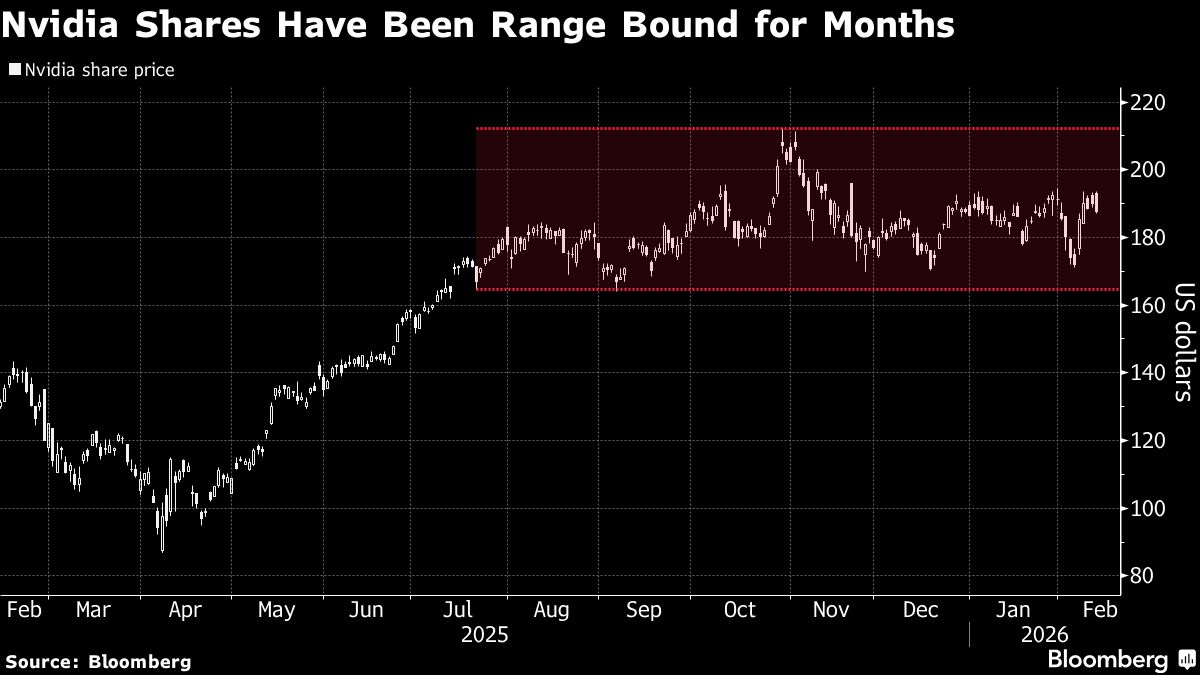
Big Tech keeps raising its spending plans for artificial intelligence infrastructure, yet shares of Nvidia Corp., one of the biggest beneficiaries of that flood of cash, have been largely stagnant for months.

The stock is up less than 1% since the beginning of the fourth quarter and has been largely range bound despite hitting a record high in late October. It’s also barely beating the S&P 500 Index to start 2026, a slowdown from Nvidia’s nearly 40% leap in 2025 following two consecutive years of triple-digit percentage gains.

Even ballooning capital spending from Meta Platforms Inc., Alphabet Inc., Microsoft Corp. and Amazon.com Inc. — estimated to exceed $600 billion in 2026 — hasn’t been enough to meaningfully boost the stock amid increasing anxieties about returns on those investments.

https://www.advisorperspectives.com/images/content_image/data/5f/5fc06395a11f9435723c4be6d4384a3d.jpg 

“There is perhaps growing concern that the ultimate revenue from AI will simply not keep up with the capex spend that’s been announced,” said JoAnne Feeney at Advisors Capital Management, adding that more spending now raises the probability that the market will reach satiation faster. It’s “going to move up the date at which they pause and let the new compute be digested.”

The cyclical nature of the chip industry is baked into Nvidia’s valuation, which has compressed as revenue growth is expected to slow in the coming years. Sales are projected to expand 58% in the current calendar year and 28% in 2027, according to data compiled by Bloomberg.

Nvidia shares trade around 24 times profit estimates, roughly in-line with the Nasdaq 100 index and a slight premium to the S&P 500. Even though this price-to-earnings ratio is far below the five-year average for the stock at 38 times, investors aren’t counting it as a discount....

....MUCH MORE 

$183.03 down $3.91 (-2.09) last. 

Our judgement: If you want to own the future, own this company. That is not a new opinion.

Tuesday, February 10, 2026

"Zuckerberg Set to Join California Billionaires With Miami Home"

From Bloomberg, February 9:

Billionaire Meta Platforms Inc. founder Mark Zuckerberg is planning to buy a property in the Miami area, according to a person familiar with the matter, joining a roster of ultra-wealthy individuals expanding their footprints in South Florida.

Zuckerberg and his wife, Priscilla Chan, are looking at purchasing a property on Indian Creek, a man-made island in Biscayne Bay known as Billionaires Bunker, the person said. Residents of the ultra-secure enclave include Jared Kushner and Ivanka Trump, Jeff Bezos, Carl Icahn and Tom Brady.

With a net worth of about $240 billion, according to the Bloomberg Billionaires Index, Zuckerberg owns two homes in California — in Palo Alto and near Lake Tahoe — and others in Hawaii and Washington, DC. It was unclear whether Zuckerberg’s plans to purchase in Florida would represent a change in residence or an addition to his real estate portfolio.

The potential purchase comes as California debates a proposed one-time wealth tax on billionaires that would apply to unrealized gains, a measure that has stirred concern among investors and business leaders across the state. Several billionaires, including Peter Thiel and David Sacks, have left California in the face of the proposal.

A Meta spokesperson declined to comment. The Wall Street Journal earlier reported on Zuckerberg’s purchase of a Florida home.

South Florida has continued to attract wealthy technology executives from California. In recent weeks, Google’s co-founders have both made purchases in the area. Larry Page bought three homes in Miami’s Coconut Grove neighborhood for a combined total of nearly $190 million, while Sergey Brin reportedly is purchasing a roughly $50 million home on Biscayne Bay.

Indian Creek, which has a large golf course in the middle of the island, has become one of the most exclusive enclaves in South Florida with tight security limiting access to residents and invited guests.

Zuckerberg has grown closer to President Donald Trump in his second term, and has visited Trump’s Mar-a-Lago club in Palm Beach — about 70 miles north of Miami — on multiple occasions.

The union-backed ballot measure in California, which still has to gather enough signatures to qualify for the November ballot, calls for a one-time 5% tax on those with more than $1 billion in net worth to cover funding shortfalls for health care, education and food assistance....

....MORE 

Previously:

November 17, 2025 - "Norway's Wealth Tax Unchains a Capital Exodus  

December 28, 2025 - "A Wealth Tax Floated in California Has Billionaires Thinking of Leaving"

January 9, 2026 -  "Google Guys Say Bye to California"

January 13 - Half The Wealth California Was Going To Tax Has Already Left The State

February 9 - "Dozens Rally in SF for Billionaire Rights March"

Monday, January 12, 2026

Construction Leading Indicator Continues Higher

 From Dodge, January 8:

Dodge Momentum Index Grows 7% in December 

Economic Risks Persist, but Key Sectors Signal Positive 2027 Outlook 

BOSTON, MA – January 8, 2026 — The Dodge Momentum Index (DMI), issued by Dodge Construction Network grew 7.0% in December to 296.8 (2000=100) from the upwardly revised November reading of 277.4. Over the month, commercial planning improved 3.5% and institutional planning increased by 14.9%. In 2025, the DMI was up 37% from the average reading in 2024. The commercial portion was up 35% and the institutional portion was up 43% over the same period. 

“Nonresidential construction starts (excluding manufacturing and transportation) are projected to accelerate in 2027 alongside sustained planning momentum in data center, healthcare and recreational building construction throughout 2025,” stated Sarah Martin, Associate Director of Forecasting at Dodge Construction Network. “Inflationary pressures will further support nominal activity levels, even as economic risks remain elevated. Notably, projects moved through the planning process marginally quicker in 25-Q4 (16 months vs. 18 months in 25-Q3), offering a modest boost to our near-term outlook.” 

On the commercial side, planning momentum accelerated most strongly for warehouses, office buildings and data centers. Within institutional planning, education and recreational building activity showed the strongest growth, while planning for public buildings pulled back after elevated activity in mid-2025. Year-over-year, the DMI was up 50% when compared to December 2024. The commercial segment was up 45% (+30% when data centers are removed) and the institutional segment was up 60% over the same period.   

A total of 34 projects valued at $100 million or more entered planning throughout December. The largest commercial projects included four phases of the Google Data Center Campus in Summit, Oklahoma – each valued at $500 million dollars. Additionally, Phases 2 and 3 of the Central Park Data Information Processing Center in Loxahatchee, Florida entered planning – valued at $473 million and $431 million respectively. The largest institutional projects to enter planning were the $450 million Atrium Health Hospital in Fort Mill, South Carolina, the $295 million St. Joseph Hospital Tower (Phase 2 Expansion) in Stockton, California, and the $182 million SunRay Casino and Park in Clovis, New Mexico....

https://www.construction.com/wp-content/uploads/2026/01/dec25-dmi-graph.png 

....MUCH MORE, including video 

Tuesday, January 6, 2026

"Nvidia’s $4 Trillion Stock Rally Faces More Threats Than Ever"

From Bloomberg via Yahoo Finance, January 6:

The world’s most valuable company is on shaky stock market footing as 2026 gets underway.

Nvidia Corp. shares are down 9.1% since hitting a record on Oct. 29, well underperforming the S&P 500 Index, as investors grow concerned about the sustainability of artificial intelligence spending and the chip giant’s grip on the market.

The recent drop is notable considering that on the day the stock last closed at an all-time high, it was up more than 1,300% since the end of 2022 and Nvidia’s market capitalization was over $5 trillion compared with roughly $400 billion less than three years earlier. Now, the stock has lost $460 billion of market value in a matter of months, taking its three-year gain to nearly 1,200%.


Meanwhile, the dominant AI chipmaker is facing more competition than ever before from rivals like Advanced Micro Devices Inc., as well as its biggest clients, including Alphabet Inc. and Amazon.com Inc. And Wall Street is growing increasingly worried about Nvidia’s investments in many of its customers, which could be seen as artificially propping up demand.

“The risks have clearly risen,” said JoAnne Feeney, partner and portfolio manager at Advisors Capital Management, which has $13 billion in assets.

The impact of a Nvidia downturn would be felt by most equity investors. Since the market’s bull run began in October 2022, the stock accounts for roughly 16% of the S&P 500’s advance, according to data compiled by Bloomberg. The next biggest contributor, Apple Inc., is responsible for around 7%.

That said, demand for Nvidia shares remains strong with the company trading at a cheaper valuation than many of its Big Tech peers despite scorching earnings expectations. The Santa Clara, California-based company is projected to generate 57% profit growth on a 53% increase in sales in its next fiscal year, which ends in January 2027. Apple, by contrast, is expected to see gains around 10% in both measurements.

Wall Street also is hardly backing away from Nvidia, with 76 of the 82 analysts who cover the company holding buy ratings and only one recommending selling. The average Wall Street price target implies a gain of 37% over the next 12 months, which would push its market value over $6 trillion.

“Nvidia is still likely to be one of the fastest growing companies in public markets,” Feeney said. “Do you want to own that? Yes.”

Nvidia’s next generation chips, dubbed Rubin, are nearing release this year and customers will soon be able to try out the technology, Chief Executive Officer Jensen Huang said Monday in a presentation at the CES trade show in Las Vegas.

“Demand for Nvidia GPUs is skyrocketing,” Huang said. “It’s skyrocketing because models are increasing by a factor of ten, an order of magnitude every single year.”

Here’s a look at a few key issues facing the stock in 2026.

Chip Competition

Nvidia is the premier producer of AI accelerators, commanding more than 90% of the market. But competitors are starting to gain steam.

Advanced Micro Devices Inc. has won big data center orders from OpenAI and Oracle Corp., and its data center revenue is projected to jump about 60% to almost $26 billion in 2026, according to data compiled by Bloomberg. Meanwhile, Alphabet, Amazon.com, Meta Platforms Inc. and Microsoft Corp., which account for more than 40% of Nvidia’s revenue, are building their own chips in an attempt to get around the expense of buying Nvidia’s, which can cost more than $30,000 apiece.

“People will use less costly chips if they can,” said Michael O’Rourke, chief market strategist at Jonestrading. “It’s becoming clear that maintaining 90% market share is going to be a challenge.”

Alphabet’s Google began working on its first tensor processing unit more than a decade ago and has adapted it to train and run queries for its AI models. Google’s latest version of the Gemini AI chatbot, which received glowing reviews, is optimized to run on the chips. In October, Alphabet reported a chip deal with Anthropic valued in the tens of billions of dollars. In November, The Information reported that Meta is in talks to rent chips from Google Cloud in 2026 and use them in data centers in 2027.

Demand for these custom-made chips is lifting Broadcom Inc., which builds semiconductors for the AI giants. Growth in Broadcom’s application-specific integrated circuit business, known as ASIC, has vaulted it into the ranks of the world’s most valuable companies. At $1.6 trillion, Broadcom is now bigger than Tesla Inc.

Nvidia’s move to license technology and hire executives from startup chipmaker Groq on Dec. 24 seemed to be an acknowledgment of growing demand for more specialized and less costly chips. The company plans to include elements of Groq’s chips in its future designs, giving it access to so-called low latency semiconductors, an alternative approach used in running AI software that’s similar to ASICs.

That said, the demand for AI computing power is so vast that Big Tech companies are still hoovering up Nvidia’s chips even as they deploy their own. As a result, Nvidia’s market share is expected to remain intact for the foreseeable future, according to Bloomberg Intelligence analysts Kunjan Sobhani and Oscar Hernandez Tejada.

“The market is underestimating Nvidia’s position,” Morgan Stanley analysts including Joseph Moore, who has a buy rating on the stock, wrote in a research note last month. “We continue to think that Nvidia will be the highest ROI solution in cloud.”

Capital expenditures by Amazon, Microsoft, Alphabet and Meta are projected to be more than $400 billion in 2026, with much of it going toward data-center equipment. That’s in addition to hundreds of billions of dollars to lease data-center space developed by others in the coming years. OpenAI has pledged to spend $1.4 trillion in the coming years, even though there are doubts about the money-losing startup’s ability to cover those costs....

....MUCH MORE 

Friday, January 2, 2026

"...the CIA-backed venture fund behind Palantir, Anduril—and a spy tool that might be on your phone"

I'll re-use the introduction to a 2018 post "The CIA’s Venture-Capital Firm, Like Its Sponsor, Operates in the Shadows":
This is a pretty good look at the spook shop vehicle.
As a side note, back in the early years of this century, especially immediately after the mass murders of 9/11, it was thought that investing alongside In-Q-Tel was the cool thing to do.
It took a while for the realization to sink in that they weren't necessarily in it for the money return to the VC's....
And the headliner from Fortune, July 29, 2025:

In-Q-Tel was founded in 1999 by the CIA—yes that CIA, the Central Intelligence Agency—with the mission of closing a perceived innovation gap between Washington’s security establishment and Silicon Valley. Inventions like the Molar Mic are the reason In-Q-Tel exists. Over its 26 years in business, the fund has helped launch more than 800 companies. Of the companies in this year’s NatSec 100 Report, an annual index of the fastest-growing venture-backed defense startups, In-Q-Tel is an investor in 32—far more than any other fund.

Some of the companies the fund backs are publicly known, others are secret—as is the total amount of money In-Q-Tel has invested since it began. (Fortune’s estimate, informed by the last 25 years of In-Q-Tel’s tax disclosures, is at least $1.8 billion and likely more. But In-Q-tel itself, and sources close to it, declined to share or discuss any numbers.) Whatever the amount, by and large, the companies In-Q-Tel picks are all building technologies judged to be vital for U.S. national security. 

What’s more, when it finds a winner, more traditional venture investors often follow its lead. Some of In-Q-Tel’s picks have grown to become big players in their own right. Early on, the fund backed the autonomous weapons maker Anduril, which was last valued at $14 billion. In-Q-Tel also backed Palantir, supplier of big-data analytics to the military and intel agencies. Palantir may well be the clearest sign that Silicon Valley has shacked up with the Pentagon for good: It was recently valued at $250 billion, surpassing traditional defense contracting titans like Northrup Grumman, Lockheed Martin, and General Dynamics, even though its revenue, at under $3 billion last year, is just a fraction of that of those giants.

It’s possible, even likely, that you have one of In-Q-Tel’s biggest successes installed on your phone now. In 2003, In-Q-Tel invested in a mapping company called Keyhole that was looking to build a tool for the Pentagon’s National Imagery and Mapping Agency. Within weeks, according to In-Q-Tel, the agency had put Keyhole’s technology to work supporting U.S. troops in Iraq. Two years and one acquisition later, a new, commercial version of the product launched. The new owner called it Google Earth.

Organizationally, In-Q-Tel is an odd duck. It’s an independent venture capital fund, but it contracts exclusively with the federal government. Tax records show that it’s sitting on roughly $1 billion in assets, but it operates as a nonprofit. The Virginia-based fund’s nearly 200 employees are charged with finding and funding companies whose technology could help the U.S. intelligence community or Defense Department. In-Q-Tel currently receives around $100 million in additional taxpayer money per year to invest. It puts the companies it picks in touch with end users inside the government to refine their products, all in hope of yielding tech that’s both commercially successful and useful to people protecting U.S. national security.

In a moment when defense tech has suddenly become a hot enough commodity that venture capitalists are venturing to Washington in force, In-Q-Tel is something of an elder statesman. It stands as a quiet corrective to the idea that Elon Musk’s Department of Government Efficiency was the first time startup-style disruption touched the federal government. For 25 years, In-Q-Tel has been teaching the Pentagon how to fail fast and be agile.

“It’d be great for them to get credit for the consistency of the work they’ve been doing when this stuff was not a fad,” says Paul Kwan, a managing director at General Catalyst, a venture fund with $32 billion under management that has backed Airbnb, Stripe, and Instacart. On several occasions, General Catalyst has taken note of In-Q-Tel’s early picks and coinvested. That’s not unusual. In-Q-Tel has said that for every dollar it invests in a company, commercial VCs can usually be counted on to invest around $40 more. 

Kwan says this halo effect in part grows out of the cadre of experts that In-Q-Tel keeps on staff. Unlike traditional VCs, they subject candidate companies to intense, in-house technical vetting before funding them. “It is a giant proctology exam, but it’s worth it to get that stamp of approval,” he says.

In 2004, a researcher at the Air Force Institute of Technology interviewed CEOs of a dozen companies who’d received backing from In-Q-Tel. One of them described the vetting process as having “a bunch of PhDs sitting in my office for two or three months asking questions that no commercial customer, even Fortune 500 customers, had asked us.” He also noted, “These people really get in your shorts.”

In-Q-Tel’s CEO, Steve Bowsher, has spent a decade and half working to keep that process going. He’ll be the first to celebrate the high-dollar, high-profile successes. “If we make money as part of that, that’s great,” he tells Fortune. “But that’s not the primary goal.” 

The goal, Bowsher says, is what In-Q-Tel internally describes as “pilots and adoptions”: that is, testing startups’ tech with people inside the U.S. government and then seeing whether they permanently put it to work. Which is to say, unlike maybe every other investor across the landscape of capitalism, these investors are specifically not obsessing about whether their investments make money.

In a sense, In-Q-Tel measures success with benchmarks that are anything but financial. One is cultural: prodding the U.S. national security apparatus, and the companies that serve it, to change their sometimes-sluggish ways. The other is more personal, and felt keenly by anyone involved in national security: having the latest technological edge helps save American lives. 

Inspired by James Bond movies 
In 1998, it felt like the world had become digital, seemingly overnight. That year marked the founding of Google, the release of the iMac, and America Online’s purchase of Netscape for more than $4 billion. World-changing technology was coming out of California. Washington, D.C., was playing catch-up. 

Among the security insiders taking notice was Sue Gordon, a career CIA officer who later rose to become the second-highest-ranking intelligence official in the U.S. government. Gordon was the driving force who got In-Q-Tel up and running. (I interviewed her for a podcast in 2024, and again for this story in June.)

“Silicon Valley couldn’t find their way into the CIA and national security community because it’s tuned for the big guys in the defense industrial base,” Gordon told me last year. “We knew that the good stuff was happening in Silicon Valley. But…we needed to go outside to get access.” One solution, she felt, would be to set up an investment fund that would bridge those worlds—to jump-start companies building cutting-edge spy tech, and then put that tech into the hands of the U.S. agencies that needed it most. 

Gordon says she still has a napkin from the bar at the legendary Hay-Adams Hotel in D.C., where she and a couple of fellow In-Q-Tel founders first brainstormed names for the organization. And yes: The “Q” was a deliberate reference to the Bond movies. “I insisted,” Gordon tells me. “All the stuff that Q would bring out was the coolest part of the movies.”

Gordon enlisted the help of Michael Crow, then an administrator at Columbia University specializing in science policy. Crow, who’s now president of Arizona State University, is the chair of In-Q-Tel’s board. He says one of the biggest hurdles standing between In-Q-Tel and launch was the byzantine set of rules the U.S. government has for procuring defense equipment. Bureaucrats were initially allergic to In-Q-tel’s plans to pilot new tech quickly, and some legacy contractors felt threatened.

“It sort of blew up the whole notion of procurement,” Crow says. “Administrative-type people were like, ‘Well, we gotta kill this thing.’”

But In-Q-Tel survived the initial opposition, in part, by making itself indispensable. One key feature was a system that Bowsher put into place not long after he joined the fund as managing partner in 2006. Borrowing an idea from private equity firms where friends of his had worked, Bowsher trained a cadre of associates whose job was essentially what he calls “dialing for deals”—scouring magazines, newspapers, blogs, and newsletters for promising companies, cold-calling them, and set up meetings to learn about their business. 

“It’s very easy just to look at all the business plans that someone proactively submits to you and feel like, ‘Hey, I’m looking at a lot of deals and right now I’m picking the best ones.’” Bowsher says. “You got to figure out, am I seeing quality deals here?”

He says In-Q-Tel now looks into around 1,000 or so companies per year, with a roughly 50-50 split between makers of hardware and software. That work helps In-Q-Tel widen its aperture to see the broadest possible swath of new tech, Bowsher says. Just as important, it writes up its research on bleeding-edge startups—making itself useful to the intelligence community, even when it comes to companies in which it doesn’t invest.

“One director of science and technology at CIA said to us one time, ‘One of the value propositions of In-Q-Tel to me is: no surprises,’” Bowsher says. This official told Bowsher that whenever he’s told about technology that could affect the CIA’s mission, he’s consistently able to say, “I know about that technology. In-Q-Tel briefed me on it six months ago.”

Learning to fail fast 
Bowsher is originally a son of Washington. His father spent most of his career in government—as a CPA running the U.S. Navy’s budget, and later as a comptroller general at the GAO, Congress’s auditing and investigative office. After getting a BA from Harvard, Bowsher headed west to attend Stanford Business School and stayed in Silicon Valley to work for several startups. The first one—attempting to launch multiplayer online video gaming in the dial-up era—crashed and burned.

“It’s a [multi-]billion-dollar industry right now, right? My son spends hours playing video games. We were just too early,” Bowsher says. “Those signs were all there and I missed them.”....

....MUCH MORE 

IQT is also an investor in Groq, recently acqui-hired by Nvidia. 

We have maybe a dozen posts on In-Q-Tel including December 2024's "These are the AI companies that the CIA is investing in".  

And perhaps most alarming of all:
Robot Writing Moves from Journalism to Wall Street

The level of alarm is of course directly related to one's perspective. 

Friday, December 19, 2025

"OpenAI’s New Fundraising Round Could Value Startup at as Much as $830 Billion" (ORCL; CRWV)

For the sake of all those retirees and soon-to-be-retirees whose nest-eggs are in S&P 500 index funds let us hope Mr. Altman has found the money. 

From the Wall Street Journal, December 18:

Concerns about an AI bubble have weighed on many publicly traded tech-related companies 

OpenAI is aiming to raise as much as $100 billion as it seeks to pay for ambitious growth plans in a market that has cooled recently on the artificial-intelligence boom.

The fundraising round, which is in the early stages, could value the company at as much as $830 billion, if it raises the full amount it is targeting, people familiar with the matter said. The startup aims to complete the round by the end of the first quarter at the earliest. Terms of the deal could still change, and it is unclear whether there will be sufficient investor demand to reach the goal.

The round will present one of the biggest tests the company has faced since the public market’s exuberance for AI spending waned. Chief Executive Sam Altman has already scoured the world to build the pool of OpenAI’s investors and the company is now weighing a potential initial public offering, The Wall Street Journal previously reported.

OpenAI needs an abundance of capital to build its AI models and stay competitive in a rapidly changing market.

SoftBank agreed to invest $30 billion in OpenAI earlier this year and last month, sold its Nvidia stake for $5.8 billion to fund the OpenAI bet. OpenAI is expected to secure the remaining $22.5 billion in planned financing from SoftBank by the end of the year. 

OpenAI has engaged in a year-end dealmaking spree that includes a content-licensing agreement and a $1 billion investment from Disney. The deals show that OpenAI’s fundraising machine remains formidable even as questions about how it will pay for expansion plans remain largely unanswered.

OpenAI is expected to recruit sovereign-wealth funds to invest in the financing, given the scale, according to people familiar with the matter. The company has previously secured funding from United Arab Emirates-based MGX.

The Information earlier reported some details of OpenAI’s latest fundraising efforts.

The company has faced skepticism over computing deals it has forged that are worth hundreds of billions of dollars and issued a “code red” to beat back a growing threat from Google. While OpenAI is set to burn more than $200 billion in cash through 2030, Google has low levels of debt and robust profits, which could make it easier to invest further in AI. 

OpenAI partners including Oracle and CoreWeave have seen their market values dip in recent months...

....MORE 

In early pre-market trade the "partner" stocks are trading up, +$7.32 (+4.07%) for ORCL and +$3.42 (+5.05%) for CoreWeave.