Showing posts sorted by relevance for query nvidia supercomputer. Sort by date Show all posts

Monday, June 4, 2018

Nvidia debuts cloud server platform to unify AI and HPC (NVDA)

This is a pretty big deal.
High Performance Computing has been a separate and distinct class of machines since the University of Manchester's Atlas computer went online in 1962.
And now NVIDIA is blurring the line in a few different ways.

First off, existing and planned supercomputers use graphics processing units to accelerate processing speeds at the very top of the heap. Here's January 2018's "China set to launch its new supercomputer"
NVIDIA watches, some commentary after the jump...

.... On the last Top500 list of the world's fastest supercomputers, 87 systems use NVIDIA GPUs as accelerators. Not the top two however. You have to go down to #3, Switzerland's Piz Daint which was upgraded with NVIDIA chips in 2016. China is using an entirely different architecture which we touched on in June 2016's "Milestone: China Builds The (NEW) World's Fastest Supercomuter Using Only Chinese Components (and other news) INTC; NVDA; IBM".
Then there was NVIDIA's own supercomputer highlighted in November 2016:

Now they're just showing off.

The computer isn't going to be a product line or anything that generates immediate revenues but it puts the company in a very exclusive club and may lead to some in-house breakthroughs in chip design going forward.
The stock is up $4.97 (+5.77%) at $91.16.

To be clear, this isn't someone using NVDA's graphics processors to speed up their supercomputer as the Swiss did with the one they let CERN use and which is currently the eighth fastest in the world or the computer that's being built right now at Oak Ridge National Laboratory and is planned to be the fastest in the world (but may not make it, China's Sunway TaihuLight is very, very fast)....
Before that they explained how to build your own (remember, this was pre-media-rapture, hence the explanatory tone) supercomputer, relayed in May 2015's:
Nvidia Wants to Be the Brains Of Your Autonomous Car (NVDA)
...Among the fastest processors in the business are the one's originally developed for video games and known as Graphics Processing Units or GPU's. Since Nvidia released their Tesla hardware in 2008 hobbyists (and others) have used GPU's to build personal supercomputers.
Here's Nvidias Build your Own page.
Or have your tech guy build one for you....
NVIDIA really started blurring the lines  with their mini-supercomputer for training AI in 2016:
Technology Review on NVIDIA's Pint-Sized Supercomputer (NVDA)
$129,000

In April 2018 the company had a new offering that stunned reviewers into caveman-speak:
UPDATED—NVIDIA Wants to Be the Brains Behind the Surveillance State (NVDA)
The company just rolled out a $399,000 two-petaflop supercomputer that every little totalitarian and his brother is going to lust after to run their surveillance-city smart-city data slurping dreams.

The coming municipal data centers will end up matching the NSA in total storage capacity and NVIDIA wants to be the one sifting through it all. More on this down the road, for now here's the beast.

From Hot Hardware:
NVIDIA Unveils Beastly 2 Petaflop DGX-2 AI Supercomputer With 32GB Tesla V100 And NVSwitch Tech (Updated)...
Ummm, beast fast.

For reference the #500 supercomputer in the world is an HPE machine that clocks in at a theoretical maximum speed of 712.9 teraflops at NASA/Goddard Space Flight Center's Climate Simulation Platform, part of the 3.5 petaflop Discover system.

That means you can buy an off-the-shelf supercomputer that is almost three times faster than the a 'puter on the Top500 list. Anyway, that's a much longer than usual introduction, here's the story at Silicon Angle, May 30:

Nvidia debuts cloud server platform to unify AI and high-performance computing
Hoping to maintain the high ground in artificial intelligence and high-performance computing, Nvidia Corp. late Tuesday debuted a new computing architecture that it claims will unify both fast-growing areas of the industry.
The announcement of the HGX-2 cloud-server platform (pictured), made by Nvidia Chief Executive Jensen Huang at its GPU Technology Conference in Taipei, Taiwan, is aimed at many new applications that combine AI and HPC.

“We believe the future requires a unified platform for AI and high-performance computing,” Paresh Kharya, product marketing manager for Nvidia’s accelerated-computing group, said during a press call Tuesday.

Others agree. “I think that AI will revolutionize HPC,” Karl Freund, a senior analyst at Moor Insights & Strategy, told SiliconANGLE. “I suspect many supercomputing centers will deploy HGX2 as it can add dramatic computational capacity for both HPC and AI.”

More specifically, the new architecture enables applications involving scientific computing and simulations, such as weather forecasting, as well as both training and running of AI models such as deep learning neural networks, for jobs such as image and speech recognition and navigation for self-driving cars. “These models are being updated at an unprecedented pace,” sometimes as often as hourly, Kharya said.

The HGX architecture, powered by Nvidia’s graphics processing units, or GPUs, is a data center design used in Microsoft Corp.’s Project Olympus initiative, Facebook Inc.’s Big Basin systems and Nvidia’s own DGX-1 AI supercomputers as well as services from public cloud computing leader Amazon Web Services Inc. The first version of the architecture, the HGX-1, was announced a year ago.

Essentially, the HGX-2, which consists of 16 of Nvidia’s high-end V100 GPUs, provides a building block for computer makers to create the systems that. Using Nvidia’s NVLink chip interconnect system, it makes the 16 GPUs look like one, the company said, delivering 2 petaflops, or 2 quadrillion floating point operations per second, a standard computing speed measure.

“Basically, you can now use HGX as a pool of 16 GPUs as if it were a single very large compute resource,” Freund explained.

Nvidia also said today that its own recently announced DGX-2 AI supercomputer was the first system to use HGX-2. It will sell for $399,000 when it’s available in the third quarter. Huang joked on a livestream of his conference keynote that it’s a “great value,” though he appeared to mean it as well....MUCH MORE
The stock is up  $6.99 (+2.71%) at $264.61.

See also:
March 2018 
Exascale Computers: Competing With China Is About to Get Serious
...The 200 petaflop/second (quadrillions of calculations per second) Summit supercomputer being built at Oak Ridge National Laboratory will blow past the current world's fastest, the 93 petaflop/s Sunway TaihuLight but this latest monster is planned to be five times faster still.

At that point, if you were to use it for, saaay, training artificial intelligence, you are going places that the human mind literally can't comprehend much less forecast or, dream on, guide.... 

Thursday, January 11, 2018

With the Summit Supercomputer, U.S. Could Retake Computing’s Top Spot (NVDA)

We've been babbling about this 'puter for three years, usually in the context of its use of NVIDIA GPU's and NV Link connections, more after the jump.

From IEEE Spectrum:

Oak Ridge’s 200-petaflop Summit supercomputer will come on line in mid-2018
In November of 2012, the semiannual Top500 rankings of the world’s supercomputers gave top billing to a machine constructed at the Oak Ridge National Laboratory, in Tennessee. Aptly named Titan, the machine boasted a peak performance of more than 27 × 1015 floating-point operations per second, or 27 petaflops. It was an immense computing resource for researchers in government, industry, and academe, and being at the top of the supercomputing heap, it helped to boost pride within the U.S. high-⁠performance computing community.

The satisfaction was short-lived. Just seven months later, Titan lost the world-supercomputing crown to a Chinese machine called Tianhe-2 (Milky Way-2). And three years on, yet another Chinese number-crunching behemoth—the Sunway TaihuLight—took over the title of world’s most powerful supercomputer. Its peak performance was 125 petaflops. After that, Titan wasn’t looking so titanic anymore.

Using the Sunway TaihuLight, Chinese researchers captured the 2016 Gordon Bell Prize [PDF] for their work modeling atmospheric dynamics. “That shows it wasn’t just a stunt machine,” says Jack Dongarra of the University of Tennessee, one of the creators of the Top500 rankings.

You might be wondering why for the past five years the United States has seemingly given up on reclaiming the top spot. In fact, there was no such surrender. In 2014, U.S. engineers drafted proposals for a new generation of supercomputers. The first of these will bear fruit later this year in the form of a supercomputer named Summit, which will replace Titan at Oak Ridge. The new machine’s peak performance will be around 200 petaflops when it comes on line in a few months, which will make it the most powerful supercomputer on the planet.
Maybe.

“We’re very open in the U.S. with our machines,” says Arthur “Buddy” Bland, project director of the Leadership Computing Facility at Oak Ridge. That is, he’s confident that Summit will be completed as planned and that it will be the most powerful supercomputer in the United States. But in the meantime, China, or some other country for that matter, could field a new supercomputer or upgrade an existing one to exceed Summit’s performance. Could that really happen? “We have no idea,” says Bland.

He and his colleagues at Oak Ridge aren’t losing any sleep over the question—and they need all the sleep they can get these days because they still have a lot of work ahead of them as they labor to replace Titan with Summit. They are not, however, following the pattern that they used to build Titan, which was created as a result of a series of increasingly elaborate upgrades to an earlier Oak Ridge supercomputer called Jaguar....MUCH MORE
Previously:
May 2016
NVIDIA Sets New All Time High On Pretty Good Numbers, "Sweeping Artificial Intelligence Adoption" (NVDA)
We are fans.
Before we go any further, our NVIDIA boilerplate: we make very few calls on individual names on the blog but this one is special. 
They are positioned to be the brains in autonomous vehicles, they will drive virtual reality should it ever catch on, the current businesses include gaming graphics, deep learning/artificial intelligence, and supercharging the world's fastest supercomputers including what will be the world's fastest at Oak Ridge next year. 
Not just another pretty face.
Or food delivery app....
Sept. 2017
"The Astonishing Engineering Behind America's Latest, Greatest Supercomputer"

...a) Wired does not mention the graphics processing units are from NVIDIA
b) the Chinese may have taken an insurmountable lead in the need-for-speed derby and the ORNL computer, designed to be the world's fastest may not make it.
The folks at Wired are smart and have been on the tech beat for a long time, they should know better than to do puff pieces.  
If interested in this stuff, whether for modeling complex-chaotic systems such as markets or weather or for national security applications or just because supercomputers are amazing in their own right see also:

April 2016
June 2016
China has had the world's fastest computer for the last three years or so, the Tianhe-2, which used Intel microprocessors so this latest computer is a remarkable achievement. The U.S. plans to recapture the top spot for the first time in five years years when Oak Ridge builds their latest machine using IBM CPUs, NVIDIA GPUs and NVIDIA's NV Link tying it all together. The ORNL 'puter should hit either the Nov. 2017 or June 2018 Top 500 lists....
November 15, 2016 
November 16, 2016
Now they're just showing off.

The computer isn't going to be a product line or anything that generates immediate revenues but it puts the company in a very exclusive club and may lead to some in-house breakthroughs in chip design going forward.
The stock is up $4.97 (+5.77%) at $91.16.

To be clear, this isn't someone using NVDA's graphics processors to speed up their supercomputer as the Swiss did with the one they let CERN use and which is currently the eighth fastest in the world or the computer that's being built right now at Oak Ridge National Laboratory and is planned to be the fastest in the world (but may not make it, China's Sunway TaihuLight is very, very fast).

And this isn't the DIY supercomputer we highlighted back in May 2015:
...Among the fastest processors in the business are the one's originally developed for video games and known as Graphics Processing Units or GPU's. Since Nvidia released their Tesla hardware in 2008 hobbyists (and others) have used GPU's to build personal supercomputers.
Here's Nvidias Build your Own page.
Or have your tech guy build one for you....
Nor is it the $130.000 supercomputer NVIDIA came up with for companies to get started in Deep Learning/AI.

No, this is NVIDIA's very own supercomputer.

Here's the brand new list (they come out every six months):
Top500 List - November 2016

July 22, 2017
We're usually more timely posting the list but reality keeps intruding on the blog stuff.
A couple things to point out, we've made a few mentions of the Swiss supercomputer Piz Daint, here's one of them from last November:
NVIDIA Builds Its Very Own Supercomputer, Enters The Top500 List At #28 (NVDA)
...To be clear, this isn't someone using NVDA's graphics processors to speed up their supercomputer as the Swiss did with the one they let CERN use and which is currently the eighth fastest in the world or the computer that's being built right now at Oak Ridge National Laboratory and is planned to be the fastest in the world (but may not make it, China's Sunway TaihuLight is very, very fast)....
You can see the results of the upgrade in the current list, Piz Daint went from 8th fastest to 3rd fastest in the world. 

Possibly also of interest, NVIDIA's 'puter has been bumped down to #32, behind Facebook's AI/machine-learning supercomputer which is based on NVIDIA's DGX-1 and uses NVDA chips as their graphics accelerator....
In fact wary reader may have come to the conclusion that NVIDIA and supercomputers have become an idée fixe for yours truly. From 2 1/2 years ago:

May 2015
Nvidia Wants to Be the Brains Of Your Autonomous Car (NVDA)
We've mentioned, usually in the context of the Top 500* fastest supercomputers, that:
Long time readers know we have a serious interest in screaming fast computers and try to get to the Top500 list a couple times a year. Here is a computer that was at the top of that list, the fastest computer in the world just four years ago. And it's being shut down.
Technology changes pretty fast. 
That was from a 2013 post.

Among the fastest processors in the business are the one's originally developed for video games and known as Graphics Processing Units or GPU's. Since Nvidia released their Tesla hardware in 2008 hobbyists (and others) have used GPU's to build personal supercomputers.
Here's Nvidias Build your Own page.
Or have your tech guy build one for you.

In addition Nvidia has very fast connectors they call NVLink.
Using a hybrid combination of IBM Central Processing Units (CPU's) and Nvidia's GPU's, all hooked together with the NVLink, Oak Ridge National Laboratory is building what will be the world's fastest supercomputer when it debuts in 2018.

As your kid plays Grand Theft Auto....
*Here's the Top 500 site, the next list is due next month. China’s National University of Defense Technology has had the top spot since the June 2013 list when it toppled Oak Ridge National Laboratory's Titan.
Be all that as it may be, here's ORNL's webpage for the new supercomputer, Summit. 

Monday, October 13, 2025

Nvidia Releases The DGX Spark Miniature Supercomputer, It Seems Rather Meh (NVDA)

From The Register, October 13:

Nvidia's GB10 workstations arrive with 1 petaFLOPS of compute, 128GB of VRAM, and a $3K+ price tag
Systems from Nvidia, Dell, and others available starting Oct. 15

Nvidia's tiniest Grace-Blackwell workstation is finally making its way to store shelves this week, the better part of a year after the GPU giant first teased the AI mini PC, then called Project Digits, at CES.

Since rebranded as the DGX Spark, the roughly NUC-sized system pairs a Blackwell GPU capable of delivering up to a petaFLOP of sparse FP4 performance with 128 GB of unified system memory and 200 Gbps of high-speed networking.

But with a price starting around $3,000, small doesn't mean cheap. Then again, it's not exactly aimed at mainstream PC buyers. The systems, which will also be available under various brand names from OEM partners, won't even come with Windows. A Copilot+ PC this is not. Instead, it ships with a custom spin of Ubuntu Linux.

Spark is actually intended for AI and robotics developers, data scientists, and machine learning researchers looking for a lower-cost workstation platform that's still capable of running models up to 200 billion parameters in size.

These kinds of workloads are incredibly memory-hungry, which makes running them on consumer graphics processors impractical. High-end workstation cards, like the RTX Pro 6000, can be had with up to 96 GB of speedy GDDR7, but a single card will set you back more than $8,000, and that's before you factor in the rest of the platform cost.

At the time of launch, the DGX Spark is technically Nvidia's highest capacity workstation GPU — at least until its Blackwell Ultra-based DGX Station makes its debut.

Honey, I shrunk the superchip 
Powering the DGX Spark is the GB10 system-on-a-chip, which is essentially a miniaturized version of the Grace-Blackwell Superchips that power its flagship NVL72 rack systems.

As we explored back at Hot Chips, the GB10 is composed of two compute dies connected at 600 GB/s via Nvidia's proprietary NVLink chip-to-chip interconnect tech. And, in case you're wondering, this same technology will eventually be used to mesh Nvidia's GPUs to Intel's future client CPUs as part of a tie-up between the two chip heavyweights.

The GPU tile is capable of delivering up to a petaFLOP of sparse FP4 or around 31 teraFLOPS at single precision (FP32) — putting it on par with an RTX 5070 in terms of raw performance. Yes, the $550 consumer card does offer more than twice the memory bandwidth, but with just 12 GB of GDDR7, you'll be fairly limited in terms of what models and AI workloads you can run....

....MUCH MORE 

And there's the rub.

Granted there is a lot more value for money than a couple earlier Nvidia supercomputers that we got fired up about. Some backlinks from June 2018's "Nvidia debuts cloud server platform to unify AI and HPC (NVDA)":

....Before that they explained how to build your own (remember, this was pre-media-rapture, hence the explanatory tone) supercomputer, relayed in May 2015's:
Nvidia Wants to Be the Brains Of Your Autonomous Car (NVDA)

...Among the fastest processors in the business are the one's originally developed for video games and known as Graphics Processing Units or GPU's. Since Nvidia released their Tesla hardware in 2008 hobbyists (and others) have used GPU's to build personal supercomputers.
Here's Nvidias Build your Own page. [link rotted, here is an Internet Archive capture]
Or have your tech guy build one for you....
NVIDIA really started blurring the lines  with their mini-supercomputer for training AI in 2016:
Technology Review on NVIDIA's Pint-Sized Supercomputer (NVDA)
$129,000

In April 2018 the company had a new offering that stunned reviewers into caveman-speak:
UPDATED—NVIDIA Wants to Be the Brains Behind the Surveillance State (NVDA)
The company just rolled out a $399,000 two-petaflop supercomputer that every little totalitarian and his brother is going to lust after to run their surveillance-city smart-city data slurping dreams.

The coming municipal data centers will end up matching the NSA in total storage capacity and NVIDIA wants to be the one sifting through it all. More on this down the road, for now here's the beast.

From Hot Hardware:
NVIDIA Unveils Beastly 2 Petaflop DGX-2 AI Supercomputer With 32GB Tesla V100 And NVSwitch Tech (Updated)...
Ummm, beast fast.

But of course back then the world was fresh and new. 

Today's press release does have a nice mention of the earlier machines:

NVIDIA DGX Spark Arrives for World’s AI Developers 

October 13, 2025  

News Summary:

  • NVIDIA founder and CEO Jensen Huang delivers DGX Spark to Elon Musk at SpaceX.
  • This week, NVIDIA and its partners are shipping DGX Spark, the world’s smallest AI supercomputer, delivering NVIDIA’s AI stack in a compact desktop form factor.
  • Acer, ASUS, Dell Technologies, GIGABYTE, HPI, Lenovo and MSI debut DGX Spark systems, expanding access to powerful AI computing.
  • Built on the NVIDIA Grace Blackwell architecture, DGX Spark integrates NVIDIA GPUs, CPUs, networking, CUDA libraries and NVIDIA AI software, accelerating agentic and physical AI development.

NVIDIA today announced it will start shipping NVIDIA DGX Spark™, the world’s smallest AI supercomputer.

AI workloads are quickly outgrowing the memory and software capabilities of the PCs, workstations and laptops millions of developers rely on today — forcing teams to shift work to the cloud or local data centers.

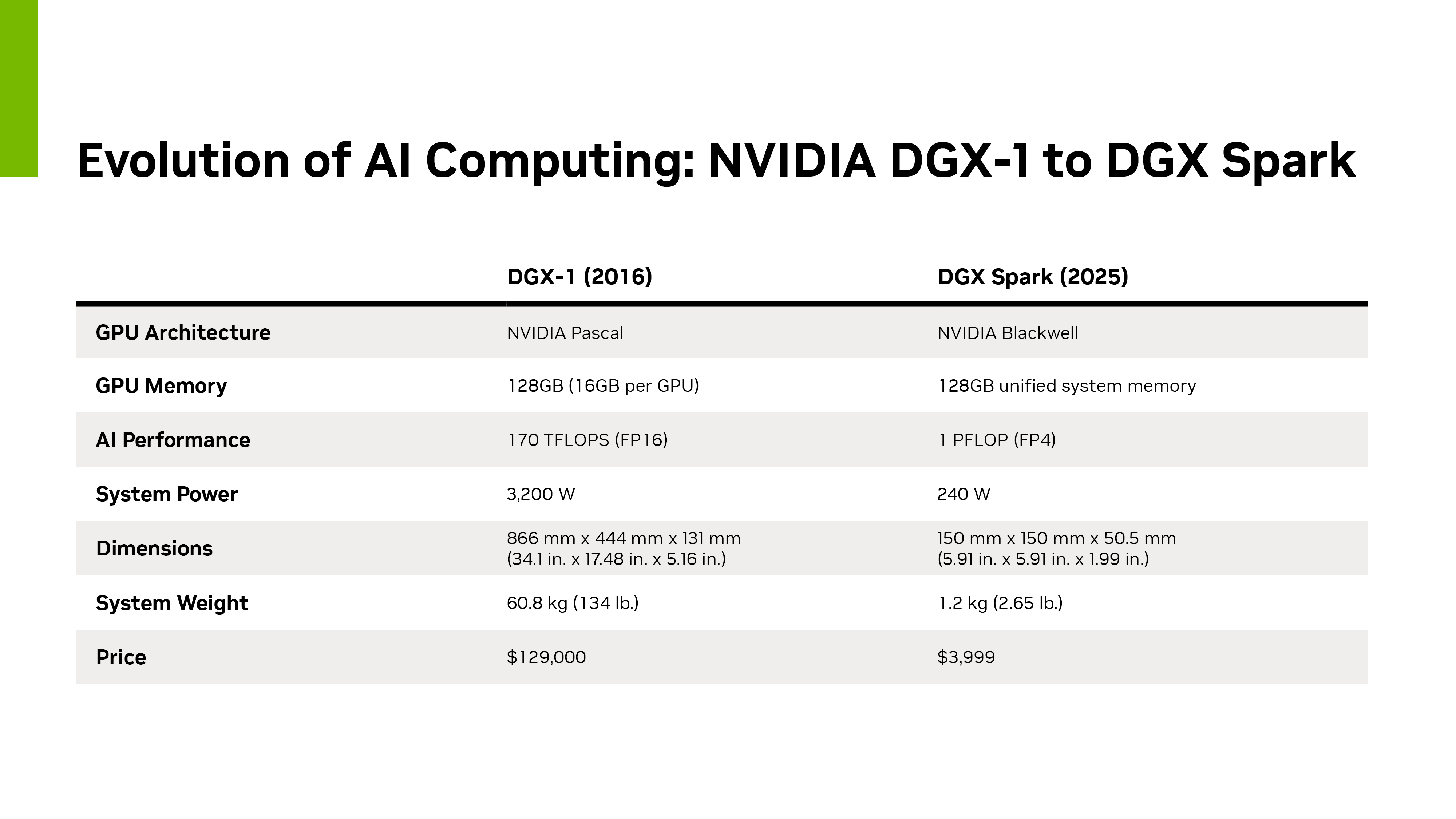
As a new class of computer, DGX Spark delivers a petaflop of AI performance and 128GB of unified memory in a compact desktop form factor, giving developers the power to run inference on AI models with up to 200 billion parameters and fine-tune models of up to 70 billion parameters locally. In addition, DGX Spark lets developers create AI agents and run advanced software stacks locally.

“In 2016, we built DGX-1 to give AI researchers their own supercomputer. I hand-delivered the first system to Elon at a small startup called OpenAI — and from it came ChatGPT, kickstarting the AI revolution,” said Jensen Huang, founder and CEO of NVIDIA. “DGX-1 launched the era of AI supercomputers and unlocked the scaling laws that drive modern AI. With DGX Spark, we return to that mission — placing an AI computer in the hands of every developer to ignite the next wave of breakthroughs.”

Evolution of AI Computing: NVIDIA DGX-1 to DGX Spark

DGX Spark brings together the full NVIDIA AI platform — including GPUs, CPUs, networking, CUDA® libraries and the NVIDIA AI software stack — into a system small enough for a lab or an office, yet powerful enough to accelerate agentic and physical AI development. By combining breakthrough performance with the reach of the NVIDIA ecosystem, DGX Spark transforms the desktop into an AI development platform.

....MUCH MORE

Wednesday, November 16, 2016

NVIDIA Builds Its Very Own Supercomputer, Enters The Top500 List At #28 (NVDA)

Now they're just showing off.

The computer isn't going to be a product line or anything that generates immediate revenues but it puts the company in a very exclusive club and may lead to some in-house breakthroughs in chip design going forward.
The stock is up $4.97 (+5.77%) at $91.16.

To be clear, this isn't someone using NVDA's graphics processors to speed up their supercomputer as the Swiss did with the one they let CERN use and which is currently the eighth fastest in the world or the computer that's being built right now at Oak Ridge National Laboratory and is planned to be the fastest in the world (but may not make it, China's Sunway TaihuLight is very, very fast).

And this isn't the DIY supercomputer we highlighted back in May 2015:
...Among the fastest processors in the business are the one's originally developed for video games and known as Graphics Processing Units or GPU's. Since Nvidia released their Tesla hardware in 2008 hobbyists (and others) have used GPU's to build personal supercomputers.
Here's Nvidias Build your Own page.
Or have your tech guy build one for you....
Nor is it the $130.000 supercomputer NVIDIA came up with for companies to get started in Deep Learning/AI.

No, this is NVIDIA's very own supercomputer.

Here's the brand new list (they come out every six months):
Top500 List - November 2016

And here is NVIDIA's 'puter, right behind one of the U.S. Army's machines and just ahead of Italian energy giant ENI's machine:

28

NVIDIA Corporation
United States
DGX SATURNV - NVIDIA DGX-1, Xeon E5-2698v4 20C 2.2GHz, Infiniband EDR, NVIDIA Tesla P100
Nvidia


Some of our prior posts on the Top500.

Here's NVDA's story, from Extreme Tech:

Nvidia builds its own supercomputer, claims top efficiency spot in the TOP500


Every six months, the TOP500 team releases a list of the 500 most powerful supercomputers in the world based on their results in the long-running Linpack benchmark. These machines are typically owned by governments or are built as public-private partnerships between various government and industry partners who share costs and computer time. This year, Nvidia has made its own entry — and no, I don’t mean that Nvidia is powering someone else’s system, or that the company collaborated with a different firm. Nvidia built its own frickin’ supercomputer.

The new DGX SaturnV contains 60,512 CPU cores (the machine relies on Intel’s Xeon E5-2698v4 for its CPUs) and 63,488GB of RAM. The machine is actually a cluster of 125 DGX-1 systems — that’s the AI processing “supercomputer in a box” that Nvidia unveiled last year, and the first machine to feature the company’s Pascal GPUs (the full GP100 configuration). According to Nvidia, the new machine is 2.3x more energy efficient than the closest Xeon Phi system of equivalent performance and it delivers 9.46GFLOPS/watt, a 42% improvement over the most efficient system unveiled last June. That’s a huge improvement in a relatively short period of time, though I do want to note an important caveat to these kinds of figures. One thing we’ve covered before in our previous discussions of exascale computing is how ramping compute clusters upwards creates very different constraints than we typically consider when talking about desktops or even servers. Factors like interconnect power consumption, total memory loadout, and memory architecture all play a significant part in how these metrics play out.

DGX-1-Server

In other words: Nvidia’s new performance/watt metrics are great for Pascal and a huge achievement, but I don’t think we can read much about the potential power efficiency of Xeon Phi without seeing something more closely akin to an apples-to-apples comparison. It’s also interesting that Nvidia chose to use Intel Xeons for its own power efficiency push than OpenPOWER, despite being a fairly vocal supporter of OpenPOWER and NVLink. Given that the new supercomputer relies on Nvidia’s DGX-1, however, it probably made more sense to build its own server clusters towards the x86 ecosystem rather than trying to launch a new AI and compute platform around Power at this time....MORE

Thursday, March 7, 2024

"Making GenAI more efficient with a new kind of chip" (plus some of our history with Nvidia)

The writer of this piece, Tiernan Ray, took over the Tech Trader column at Barron's from Eric Savitz (before Mr. Savitz returned to the Dow Jones empire).

Despite having a very different style, far less frenetic/borderline manic than Savitz, Mr. Ray won me over by getting Nvidia's Jensen Huang to talk about things that none of the other tech writers seemed to even be aware of.

Here he is at ZD Net, March 7, once again far ahead of the field and on an issue that is a bit of a weak spot for NVDA:

EnCharge AI's breakthrough in melding analog and digital computing could dramatically improve the energy consumption of generative AI when performing predictions. 

2024 is expected to be the year that generative artificial intelligence (GenAI) goes into production, when enterprises and consumer electronics start actually using the technology to make predictions in heavy volume -- a process known as inference.

For that to happen, the very large, complex creations of OpenAI and Meta, such as ChatGPT and Llama, somehow have to be able to run in energy-constrained devices that consume far less power than the many kilowatts used in cloud data centers.

Also: 2024 may be the year AI learns in the palm of your hand

That inference challenge is inspiring fundamental research breakthroughs toward drastically more efficient electronics.

On Wednesday, semiconductor startup EnCharge AI announced that its partnership with Princeton University has received an $18.6 million grant from the US's Defense Advanced Research Projects Agency, DARPA, to advance novel kinds of low-power circuitry that could be used in inference.

"You're starting to deploy these models on a large scale in potentially energy-constrained environments and devices, and that's where we see some big opportunities," said EnCharge AI CEO and co-founder Naveen Verma, a professor in Princeton's Department of Electrical Engineering, in an interview with ZDNET. 

EnCharge AI, which employs 50, has raised $45 million to date from venture capital firms including VentureTech, RTX Ventures, Anzu Partners, and AlleyCorp. The company was founded based on work done by Verma and his team at Princeton over the past decade or so.

EnCharge AI is planning to sell its own accelerator chip and accompanying system boards for AI in "edge computing," including corporate data center racks, automobiles, and personal computers....

....MUCH MORE

A lot of people see the opportunity in the inference, rather than the training, end of things but inference at the edge could lead to the kind of serendipitous manufacturing—research—discovery feedback loop that Nvidia experienced when they were pushing the limits of using GPUs as accelerators for supercomputers in 2015 -2016.

That was when we really got interested in Nvidia, Here's a post from that period 
(unfortunately I used a dynamic rather than a static price chart so we get the last twelve months ending today rather than 2016. still gorgeous though):

Wednesday, April 13, 2016 
Our standard NVDA boilerplate: We don't do much with individual stocks on the blog but this one is special.
$36.28 last, passing the stock's old all time high from 2007, $36.00.

In 2017 Oak Ridge National Laboratory is scheduled to complete their newest supercomputer powered by NVIDIA Graphics Processing Unit chips and retake the title of World's Fastest Computer for the United States.

In the meantime NVDA is powering AI deep learning and autonomous vehicles and virtual reality and some other stuff.

NVDA NVIDIA Corporation daily Stock Chart

FinViz

From PC World:

 Nvidia's screaming Tesla P100 GPU will power one of the world's fastest computers

The Piz Daint supercomputer in Switzerland will be used to analyze data from the Large Hadron Collider

It didn’t take long for Nvidia’s monstrous Tesla P100 GPU to make its mark in an ongoing race to build the world’s fastest computers.

Just a day after Nvidia’s CEO said he was “friggin’ excited” to introduce the Tesla P100, the company announced its fastest GPU ever would be used to upgrade a supercomputer called Piz Daint. Roughly 4,500 of the GPUs will be installed in the supercomputer at the Swiss National Supercomputing Center in Switzerland.Piz Daint already has a peak performance of 7.8 petaflops, making it the seventh-fastest computer in the world. The fastest in the world is the Tianhe-2 in China, which has a peak performance of 54.9 petaflops, according to the Top500 list released in November.

Two of the world’s ten fastest computers use GPUs as co-processors to speed up simulations and scientific applications: Titan, at the U.S. Oak Ridge National Laboratory, and Piz Daint. The latter is used to analyze data from the Large Hadron Collider at CERN.

Nvidia has already made a desktop-type supercomputer with the Tesla P100. The DGX-1can deliver 170 teraflops of performance, or 2 petaflops when several are installed on a rack. It has eight Tesla P100 GPUs, two Xeon CPUs, 7TB of solid-state-drive storage and dual 10-Gigabit ethernet ports.

The GPU will also be in volume servers from IBM, Hewlett Packard Enterprise, Dell and Cray by the first quarter of next year. Huang said companies building mega data centers for the cloud will be using servers with Tesla P100s by the end of the year.

The Tesla P100 is one of the largest chips ever made and may be one of the fastest. It has 150 billion transistors and packs many new GPU technologies that could give Piz Daint a serious boost in horsepower....MORE 

Previously on the fanboi channel:
Jan. 2016
Class Act: Nvidia Will Be The Brains Of Your Autonomous Car (NVDA)
Stanford and Nvidia Team Up For Next Generation Virtual Reality Headsets (NVDA)
Quants: "Two Glenmede Funds Rely on Models to Pick Winners, Avoid Losers" (NVDA)
"NVIDIA: “Expensive and Worth It,” Says MKM Partners" (NVDA) 
May 2015
Nvidia Wants to Be the Brains Of Your Autonomous Car (NVDA)

Here's another one from seven months later:

Wednesday, November 16, 2016
NVIDIA Builds Its Very Own Supercomputer, Enters The Top500 List At #28 (NVDA)

Now they're just showing off.

The computer isn't going to be a product line or anything that generates immediate revenues but it puts the company in a very exclusive club and may lead to some in-house breakthroughs in chip design going forward.
The stock is up $4.97 (+5.77%) at $91.16.

To be clear, this isn't someone using NVDA's graphics processors to speed up their supercomputer as the Swiss did with the one they let CERN use and which is currently the eighth fastest in the world or the computer that's being built right now at Oak Ridge National Laboratory and is planned to be the fastest in the world (but may not make it, China's Sunway TaihuLight is very, very fast).

And this isn't the DIY supercomputer we highlighted back in May 2015:

...Among the fastest processors in the business are the one's originally developed for video games and known as Graphics Processing Units or GPU's. Since Nvidia released their Tesla hardware in 2008 hobbyists (and others) have used GPU's to build personal supercomputers.
Here's Nvidias Build your Own page.
Or have your tech guy build one for you....
Nor is it the $130.000 supercomputer NVIDIA came up with for companies to get started in Deep Learning/AI.

No, this is NVIDIA's very own supercomputer.

Here's the brand new list (they come out every six months):
Top500 List - November 2016

And here is NVIDIA's 'puter, right behind one of the U.S. Army's machines and just ahead of Italian energy giant ENI's machine:

28

NVIDIA Corporation
United States
DGX SATURNV - NVIDIA DGX-1, Xeon E5-2698v4 20C 2.2GHz, Infiniband EDR, NVIDIA Tesla P100
Nvidia


Some of our prior posts on the Top500.

Here's NVDA's story, from Extreme Tech:
Nvidia builds its own supercomputer, claims top efficiency spot in the TOP500....

Wednesday, September 13, 2017

"The Astonishing Engineering Behind America's Latest, Greatest Supercomputer"

From Wired:
If you want to do big, serious science, you’ll need a serious machine. You know, like a giant water-cooled computer that’s 200,000 times more powerful than a top-of-the-line laptop and that sucks up enough energy to power 12,000 homes.

You’ll need Summit, a supercomputer nearing completion at the Oak Ridge National Laboratory in Tennessee. When it opens for business next year, it'll be the United States’ most powerful supercomputer and perhaps the most powerful in the world. Because as science gets bigger, so too must its machines, requiring ever more awesome engineering, both for the computer itself and the building that has to house it without melting. Modeling the astounding number of variables that affect climate change, for instance, is no task for desktop computers in labs. Some goes for genomics work and drug discovery and materials science. If it’s wildly complex, it’ll soon course through Summit’s circuits.

Summit will be five to 10 times more powerful than its predecessor, Oak Ridge’s Titan supercomputer, which will continue running its science for about a year after Summit comes online. (Not that there's anything wrong with Titan. It's just that at 5 years old, the machine is getting on in years by supercomputer standards.) But it’ll be pieced together in much the same way: cabinet after cabinet of so-called nodes. While each node for Titan, all 18,688 of them, consists of one CPU and one GPU, with Summit it'll be two CPUs working with six GPUs.

Think of the GPU as a turbocharger for the CPU in this relationship. While not all supercomputers use this setup, known as a heterogeneous architecture, those that do get a boost―each of the 4,600 nodes in Summit can manage 40 teraflops. So at peak performance, Summit will hit 200 petaflops, a petaflop being one million billion operations a second. "So we envision research teams using all of those GPUs on every single node when they run, that's sort of our mission as a facility," says Stephen McNally, operations manager....MORE
What's truly astonishing is that:

a) Wired does not mention the graphics processing units are from NVIDIA
b) the Chinese may have taken an insurmountable lead in the need-for-speed derby and the ORNL computer, designed to be the world's fastest may not make it.

The folks at Wired are smart and have been on the tech beat for a long time, they should know better than to do puff pieces.  

If interested in this stuff, whether for modeling complex-chaotic systems such as markets or weather or for national security applications or just because supercomputers are amazing in their own right see also:

April 2016
June 2016
China has had the world's fastest computer for the last three years or so, the Tianhe-2, which used Intel microprocessors so this latest computer is a remarkable achievement. The U.S. plans to recapture the top spot for the first time in five years years when Oak Ridge builds their latest machine using IBM CPUs, NVIDIA GPUs and NVIDIA's NV Link tying it all together. The ORNL 'puter should hit either the Nov. 2017 or June 2018 Top 500 lists....
November 15, 2016 

November 16, 2016
Now they're just showing off.

The computer isn't going to be a product line or anything that generates immediate revenues but it puts the company in a very exclusive club and may lead to some in-house breakthroughs in chip design going forward.
The stock is up $4.97 (+5.77%) at $91.16.

To be clear, this isn't someone using NVDA's graphics processors to speed up their supercomputer as the Swiss did with the one they let CERN use and which is currently the eighth fastest in the world or the computer that's being built right now at Oak Ridge National Laboratory and is planned to be the fastest in the world (but may not make it, China's Sunway TaihuLight is very, very fast).

And this isn't the DIY supercomputer we highlighted back in May 2015:
...Among the fastest processors in the business are the one's originally developed for video games and known as Graphics Processing Units or GPU's. Since Nvidia released their Tesla hardware in 2008 hobbyists (and others) have used GPU's to build personal supercomputers.
Here's Nvidias Build your Own page.
Or have your tech guy build one for you....
Nor is it the $130.000 supercomputer NVIDIA came up with for companies to get started in Deep Learning/AI.

No, this is NVIDIA's very own supercomputer.

Here's the brand new list (they come out every six months):
Top500 List - November 2016

July 22, 2017
We're usually more timely posting the list but reality keeps intruding on the blog stuff.
A couple things to point out, we've made a few mentions of the Swiss supercomputer Piz Daint, here's one of them from last November:
NVIDIA Builds Its Very Own Supercomputer, Enters The Top500 List At #28 (NVDA)
...To be clear, this isn't someone using NVDA's graphics processors to speed up their supercomputer as the Swiss did with the one they let CERN use and which is currently the eighth fastest in the world or the computer that's being built right now at Oak Ridge National Laboratory and is planned to be the fastest in the world (but may not make it, China's Sunway TaihuLight is very, very fast)....
You can see the results of the upgrade in the current list, Piz Daint went from 8th fastest to 3rd fastest in the world. 

Possibly also of interest, NVIDIA's 'puter has been bumped down to #32, behind Facebook's AI/machine-learning supercomputer which is based on NVIDIA's DGX-1 and uses NVDA chips as their graphics accelerator....
In fact wary reader may have come to the conclusion that NVIDIA and supercomputers have become an idée fixe for yours truly. From 2 1/2 years ago:

May 2015
Nvidia Wants to Be the Brains Of Your Autonomous Car (NVDA)
We've mentioned, usually in the context of the Top 500* fastest supercomputers, that:
Long time readers know we have a serious interest in screaming fast computers and try to get to the Top500 list a couple times a year. Here is a computer that was at the top of that list, the fastest computer in the world just four years ago. And it's being shut down.
Technology changes pretty fast. 
That was from a 2013 post.

Among the fastest processors in the business are the one's originally developed for video games and known as Graphics Processing Units or GPU's. Since Nvidia released their Tesla hardware in 2008 hobbyists (and others) have used GPU's to build personal supercomputers.
Here's Nvidias Build your Own page.
Or have your tech guy build one for you.

In addition Nvidia has very fast connectors they call NVLink.
Using a hybrid combination of IBM Central Processing Units (CPU's) and Nvidia's GPU's, all hooked together with the NVLink, Oak Ridge National Laboratory is building what will be the world's fastest supercomputer when it debuts in 2018.

As your kid plays Grand Theft Auto....
*Here's the Top 500 site, the next list is due next month. China’s National University of Defense Technology has had the top spot since the June 2013 list when it toppled Oak Ridge National Laboratory's Titan.
Be all that as it may be, here's ORNL's webpage for the new supercomputer, Summit. 

Thursday, December 15, 2016

Technology Review on NVIDIA's Pint-Sized Supercomputer (NVDA)

The stock is up $2.68 (+2.77%) at $99.13.

From MIT's Technology Review:

The Pint-Sized Supercomputer That Companies Are Scrambling to Get
Dozens of organizations are shelling out $129,000 for a box that will help them train AI software.
Nvidia’s DGX-1 supercomputer is designed to train deep-learning models faster than conventional computing systems do.
To companies grappling with complex data projects powered by artificial intelligence, a system that Nvidia calls an “AI supercomputer in a box” is a welcome development.
Early customers of Nvidia’s DGX-1, which combines machine-learning software with eight of the chip maker’s highest-end graphics processing units (GPUs), say the system lets them train their analytical models faster, enables greater experimentation, and could facilitate breakthroughs in science, health care, and financial services.

Data scientists have been leveraging GPUs to accelerate deep learning—an AI technique that mimics the way human brains process data—since 2012, but many say that current computing systems limit their work. Faster computers such as the DGX-1 promise to make deep-learning algorithms more powerful and let data scientists run deep-learning models that previously weren’t possible.
The DGX-1 isn’t a magical solution for every company. It costs $129,000, more than systems that companies could assemble themselves from individual components. It also comes with a fixed amount of system memory and GPU cards. But because the relevant parts and programs are preinstalled in a metal enclosure about the size of a medium suitcase, and since it pairs advanced hardware with fast connectivity, Nvidia claims the DGX-1 is easier to set up and quicker at analyzing data than previous GPU systems. Moreover, the positive reception the DGX-1 has attracted in its first few months of availability suggests that similar all-in-one deep-learning systems could help organizations run more AI experiments and refine them more rapidly. Though the DGX-1 is the only system of its kind today, Nvidia’s manufacturing partners will release new versions of the supercomputer in early 2017.

Fewer than 100 companies and organizations have bought DGX-1s since they started shipping in the fall, but early adopters say Nvidia’s claims about the system seem to hold up. Jackie Hunter, CEO of London-based BenevolentAI’s life sciences arm, BenevolentBio, says her data science team had models training on the system the same day it was installed. She says the team was able to develop several large-scale models designed to identify suitable molecules for drugs within eight weeks. These models train three to four times faster on the DGX-1 than on the startup’s other GPU systems, according to Hunter. “We had multiple models that originally took weeks to train, but we can now do this in days and hours instead,” she adds....MORE
Previous mentions:
NVIDIA Builds Its Very Own Supercomputer, Enters The Top500 List At #28 (NVDA)
...To be clear, this isn't someone using NVDA's graphics processors to speed up their supercomputer as the Swiss did with the one they let CERN use and which is currently the eighth fastest in the world or the computer that's being built right now at Oak Ridge National Laboratory and is planned to be the fastest in the world (but may not make it, China's Sunway TaihuLight is very, very fast).

And this isn't the DIY supercomputer we highlighted back in May 2015:

...Among the fastest processors in the business are the one's originally developed for video games and known as Graphics Processing Units or GPU's. Since Nvidia released their Tesla hardware in 2008 hobbyists (and others) have used GPU's to build personal supercomputers.
Here's Nvidias Build your Own page.
Or have your tech guy build one for you....
Nor is it the $130.000 supercomputer NVIDIA came up with for companies to get started in Deep Learning/AI.

No, this is NVIDIA's very own supercomputer....
"Nvidia Welcomes Intel Into AI Era: Fancy a Benchmark Deathmatch?" (NVDA; INTC)
CERN Will Be Using NVIDIA Graphics Processors to Accelerate Their Supercomputer (NVDA)

And a hundred more, use the 'Search blog' box if interested.

Thursday, September 29, 2016

So, What's New With NVIDIA? (NVDA)

The stock set new all time highs Tuesday, yesterday and again this morning.
$66.59 -0.19, last.
Here are a couple September 28 pieces from Investor's Business Daily:

Nvidia Debuts New AI Supercomputer Chip For Self-Driving Cars
Nvidia CEO Jen-Hsun Huang introduces Xavier, a new AI supercomputer chip, designed for use in self-driving cars. (Nvidia)
 Nvidia CEO Jen-Hsun Huang introduces Xavier, a new AI supercomputer chip, designed for use in self-driving cars. (Nvidia)
Graphics chipmaker Nvidia (NVDA) on Wednesday introduced a new artificial-intelligence supercomputer chip, called Xavier, which is designed for self-driving cars. 
Xavier is a system-on-chip (SoC) that integrates a new GPU (graphics processing unit) architecture called Volta, a custom 8-core CPU (central processing unit) architecture, and a new computer vision accelerator. The processor will deliver 20 trillion operations per second of performance, while consuming just 20 watts of power, Nvidia said.

IBD'S TAKE: Nvidia stock has a best-possible IBD Composite Rating of 99, meaning it has outperformed 99% of stocks in key metrics over the past 12 months. To learn more about Nvidia, check out the IBD Stock Checkup.

"Because autonomous driving is an incredibly compute-intense process, the need for an efficient AI processor is paramount," Nvidia said in a blog post. "Xavier will bring self-driving car technology to automakers, tier 1 suppliers, startups and R&D organizations that are building autonomous vehicles, whether cars, trucks, shuttles or taxis." 
Nvidia expects to make Xavier samples available in the fourth quarter of 2017 to automakers and other groups developing self-driving cars. 
Nvidia already works with such automakers as Audi, BMW, Honda (HMC), Mercedes-Benz, Telsa Motors (TSLA) and Volvo, providing technology for infotainment, navigation, digital instrument clusters and advanced driver-assistance systems. 
On Aug. 31, Nvidia and China's Baidu (BIDU) announced a partnership to make an autonomous car platform....MORE
And:

Nvidia Could Provide Graphics Chips For Apple Mac Computers
A job listing at graphics chipmaker Nvidia indicates that the company is developing processors for upcoming Apple products. (Nvidia)
 A job listing at graphics chipmaker Nvidia indicates that the company is developing processors for upcoming Apple products. (Nvidia)
A job listing at graphics chipmaker Nvidia (NVDA) indicates that the company is developing processors for upcoming Apple (AAPL) products.

The listing points to Nvidia getting its chips in future Mac computers, where they haven't been for several generations of machines, Bloomberg and BGR reported. Advanced Micro Devices (AMD) currently provides graphics chips for Mac desktop and laptop computers.

IBD'S TAKE: Nvidia stock is the top-ranked company in IBD's Electronics-Semiconductor Fabless industry group. It also is No. 7 on the IBD 50 list of superior stocks.

A job listing for a software engineer at Nvidia said the successful applicant will "help produce the next revolutionary Apple products," Bloomberg reported. The job will require "working in partnership with Apple" and writing code that will "define and shape the future"' of graphics-related software on Macs. 
Apple is expected to unveil new Mac computers next month. But the Apple-Nvidia products likely won't arrive this year, BGR said.

Another area in which Nvidia hopes to dethrone AMD, besides Mac computers, is video game consoles. AMD supplies chips for Microsoft's (MSFT) Xbox One and Sony's (SNE) PlayStation 4 consoles. 
Nvidia reportedly is providing the main processor for Nintendo's (NTDOY) upcoming NX game console. Nintendo's current Wii U console gets its main processor from IBM (IBM) and a graphics processor from AMD....MORE
And from NVIDIA:

TomTom Selects NVIDIA DRIVE PX 2 for Real-Time HD Map Updating 
GTC Europe -- NVIDIA and TomTom (TOM2), the Dutch mapping and navigation group, today announced they are partnering to develop artificial intelligence to create a cloud-to-car mapping system for self-driving cars. The work combines TomTom's extensive HD map coverage, which already spans more than 120,000 km of highways and freeways, with the NVIDIA DRIVE™ PX 2 computing platform.

Together, the solution accelerates support for real-time in-vehicle localization and mapping for driving on the highway. NVIDIA co-founder and CEO Jen-Hsun Huang announced the collaboration at the company's inaugural GTC Europe, a regional version of its annual GPU Technology Conference in Silicon Valley, now in its seventh year. "Self-driving cars require a highly accurate HD mapping system that can generate an always up-to-date HD map in the cloud," said Rob Csongor, vice president and general manager of Automotive at NVIDIA. 
"DRIVE PX 2 for AutoCruise provides TomTom with a real-time, in-vehicle source for HD map updates." The NVIDIA DriveWorks software development kit now integrates support for TomTom's HD mapping environment. The open solution is available for all automakers and tier 1 suppliers developing autonomous vehicles. 
"This collaboration is an important step for TomTom," said Willem Strijbosch, head of Autonomous Driving at TomTom. "Combining our highly accurate HD maps with NVIDIA's self-driving car platform will enable us to propose new features to automakers faster, and therefore to make autonomous driving a commercial reality sooner."...MORE
Same 'ol, same 'ol.
Still no disruptive food delivery app though.

Monday, January 1, 2024

We Are Going To Hear More And More About Digital Biology (NVDA)

In 2021 Nvidia was in the process of attempting to win British regulatory approval to buy ARM Holdings from SoftBank. They decided one thing they could do to further the effort was to build a supercomputer in Cambridge, UK.

As things turned out NVDA wasn't able to purchase ARM (they own a piece though) but the supercomputer was built. We we following those developments:

June 20, 2021
"Nvidia To Invest At Least $100 Million In UK Supercomputer"

July 7, 2021
NVIDIA Opens UK's Fastest Supercomputer To Outside Researchers, Academic and Commercial
NVIDIA Claims Install of UK’s Top Supercomputer, for Research in AI and Healthcare
More recently, November 16, 2023, we posted:

Britain's Most Powerful Supercomputer And The Butterfly Effect Of Weather Modeling In the Cloud
....That 'puter was the fastest in Britain. From Nvidia:

NVIDIA Launches UK’s Most Powerful Supercomputer, for Research in AI and Healthcare

NVIDIA CEO Unveils ‘First Big Bet’ on Digital Biology Revolution with UK-Based Cambridge-1

First Wave of Startups Harnesses UK’s Most Powerful Supercomputer to Power Digital Biology Breakthroughs

Here's the latest:

And from the company, November 17, 2023:

AI to See ‘Major Second Wave,’ NVIDIA CEO Says in Fireside Chat With iliad Group Exec
NVIDIA’s Jensen Huang says sovereign AI a growing need for countries to reflect unique cultural, linguistic, industrial characteristics

European startups will get a massive boost from a new generation of AI infrastructure, NVIDIA founder and CEO Jensen Huang said Friday in a fireside chat with iliad Group Deputy CEO Aude Durand — and it’s coming just in time.

“We’re now seeing a major second wave,” Huang said of the state of AI during a virtual appearance at Scaleway’s ai-PULSE conference in Paris for an audience of more than 1,000 in-person attendees.

Two elements are propelling this force, Huang explained in a conversation livestreamed from Station F, the world’s largest startup campus, which Huang joined via video conference from NVIDIA’s headquarters in Silicon Valley.

First, “a recognition that every region and every country needs to build their sovereign AI,” Huang said. Second, the “adoption of AI in different industries,” as generative AI spreads throughout the world, Huang explained.

“So the types of breakthroughs that we’re seeing in language I fully expect to see in digital biology and manufacturing and robotics,” Huang said, noting this could create big opportunities for Europe with its rich digital biology and healthcare industries. “And of course, Europe is also home of some of the largest industrial manufacturing companies.”

Praise for France’s AI Leadership

Durand kicked off the conversation by asking Huang about his views on the European AI ecosystem, especially in France, where the government has invested millions of euros in AI research and development.

“Europe has always been rich in AI expertise,” Huang said, noting that NVIDIA works with 4,000 startups in Europe, more than 400 of them in France alone, pointing to Mistral, Qubit Pharmaceuticals and Poolside AI.

“At the same time, you have to really get the computing infrastructure going,” Huang said. “And this is the reason why Scaleway is so important to the advancement of AI in France” and throughout Europe, Huang said.

Highlighting the critical role of data in AI’s regional growth, Huang noted companies’ increasing awareness of the value of training AI with region-specific data. AI systems need to reflect the unique cultural and industrial nuances of each region, an approach gaining traction across Europe and beyond....

....MUCH MORE

Tuesday, August 29, 2023

Elon Got Himself A Supercomputer: "Tesla's $300 Million AI Cluster Is Going Live Today" (TSLA)

From Tom's Hardware, August 28:

Tesla is about to flip the switch on its new AI cluster, featuring 10,000 Nvidia H100 compute GPUs.

Tesla is set to launch its highly-anticipated supercomputer on Monday, according to @SawyerMerritt. The machine will be used for various artificial intelligence (AI) applications, but the cluster is so powerful that it could also be used for demanding high-performance computing (HPC) workloads. In fact, the Nvidia H100-based supercomputer will be one of the most powerful machines in the world.

Tesla's new cluster will employ 10,000 Nvidia H100 compute GPUs, which will offer a peak performance of 340 FP64 PFLOPS for technical computing and 39.58 INT8 ExaFLOPS for AI applications. In fact, Tesla’s 340 FP64 PFLOPS is higher than 304 FP64 PFLOPS offered by Leonardo, the world’s fourth highest-performing supercomputer.

With its new supercomputer, Tesla is significantly enhancing its computing capabilities to train its full self-driving (FSD) technology faster than ever. This could not only make Tesla more competitive than other automakers but will make the company the owner of one of the world's fastest supercomputers.

"Due to real-world video training, we may have the largest training datasets in the world, hot tier cache capacity beyond 200PB — orders of magnitudes more than LLMs," explained Tim Zaman, AI Infra & AI Platform Engineering Manager at Tesla....

....MUCH MORE

HT: HPC [high performance computing] Wire, August 29:

"Tesla Launches New $300M AI Cluster for Advanced Computation" 

Previously:
July 20

correction: At this level of performance one does not simply buy a supercomputer, one builds a supercomputer. 
*****
....For some background on Tesla and AI here is our introduction to June 9's "Elon Musk Predicts Nvidia’s Monopoly in A.I. Chips Won’t Last" (NVDA; TSLA)":

Before we get to the headline story, some background. Tesla and Nvidia have a history.

In 2015 - 2016 when everyone thought that autonomous driving was just around the corner, the challenge was seen as both a sensor issue, for example: LIDAR vs cameras, and a machine learning/artificial intelligence problem which boils down to training the AI 'puters with as much data as you can so that out in the real world the autonomous vehicle can say to itself: "Yeah, I've seen this situation before, here's the response that worked best. Both the training and the on-the-road-recall, if they are to be anywhere near efficient, require the fastest chips you can find. Tesla had a whole bunch of data from a few billion miles of actual driving for computers to train on, and, combined with Nvidia's fastest-in-the-world GPU chips, it was a match made in heaven.

Except it wasn't.

The challenge of autonomous driving on open roads alongside non-autonomous vehicles was bigger than anyone in that simple, optimistic time ever envisioned, even in their nightmares. Here's one example about Waymo from a 2017 post:

"When Google was training its self-driving car on the streets of Mountain View, California, the car rounded a corner and  encountered a woman in a wheelchair, waving a broom, chasing a duck. The car hadn’t encountered this before so it stopped and waited."

In May 2015 we were posting " Nvidia Wants to Be the Brains Of Your Autonomous Car (NVDA)" and seven months later the more declarative "Class Act: Nvidia Will Be The Brains Of Your Autonomous Car (NVDA)"

Then in October 2016, what was probably the high-water mark for the relationship "Nvidia Could Make $1B From Tesla's Self-Driving Decree: Analyst (TSLA, NVDA)"

Sadly, the task was just too difficult but Mr. Musk thought it was doable if only he could get even faster chips than Nvidia had on offer:

NVIDIA Partner Tesla Reportedly Developing Chip With AMD (TSLA; NVDA; AMD) 
Today in leveraged WTFs....

"During a talk at a private party, Elon Musk said Tesla is developing specialized AI hardware "'That we think will be the best in the world;" (TSLA)  

"Tesla says it’s dumping Nvidia chips for a homebrew alternative" (TSLA)
The only reason for Tesla to do this is that NVIDIA's chips are general purpose whereas specialized chips are making inroads in stuff like crypto mining (ASICs), Google's Tensor Processing Units (TPUs) for machine learning and Facebook's hardware efforts. 
 
 Watch Out NVIDIA: "Google Details Tensor Chip Powers" (GOOG; NVDA)
We've said NVIDIA probably has a couple year head start but this bears watching, so to speak....

Culminating in August 2018's
"Nvidia CEO is 'more than happy to help' if Tesla's A.I. chip doesn't pan out" (NVDA; TSLA)

And now on to the headliner, from Observer, June 8:
Elon Musk Predicts Nvidia’s Monopoly in A.I. Chips Won’t Last....

And possibly related July 13:
Elon Musk's x.AI Launches
The company was formed in March so it's valuation is probably around a hundred billion or so.

Just kidding. I have no idea what sort of valuation it has been assigned. x.AI is a Nevada corporation which, as our corporate attorney readers well know, is handy as hell for a privately-held stealth company. As part of the company's coming-out I think they dropped the period in the name on the original incorporation papers.

Mr. Musk was one of the founder/funders ($100 million gift not equity) of ChatGPT parent OpenAI when it was a .org (non-profit) and seemed a bit miffed when Sam Alman hooked up with Microsoft to the tune of $10 billion.

So Elon went out and bought a garage-full of GPUs.

Here's a twofer, first up TechCrunch, July 12:....