Since around 2010 we've featured most of the fifty Imperial Easter Eggs and one of the non-imperial:
This is the only non-Imperial egg that we link to, in part because it is one of only three with both an automaton and a clock and partly because it set three auction records, the $18,500,000 realized price makes this the most expensive timepiece, Russian object and Fabergé object ever sold at auction.
The Cristies lot notes describes the egg as....

The most expensive timepiece appellation has since gone to another Fabergé creation, one that has a provenance story so improbable that it is more than likely stolen property:

The Vacheron Constantin ladies watch makes this the world's most valuable clock. It was one of the eight "lost" eggs, bought at a flea market for $13,302, re-sold in a private transaction and subsequently valued at $33 million. If interested see: "My Favorite Easter Egg".
On Easter Sunday we have sometimes posted the only egg with an overtly religious theme, the Resurrection egg.
As long-time readers know, most of the eggs are bejeweled, sometimes heavily, and often so ornate they make baroque style look plain. However here is one of the two 1916 eggs which, though it is not somber, is very different in comparison to the rest of the tiny treasures.
From Mieks, one of the best scholarly sources on the internet:
1916 Steel Military Egg
Gift Nicholas
II to Alexandra Feodorovna
Made in
Saint Petersburg
Owner: Kremlin
Armoury Museum, Moscow
Height: 10,1 cm. (incl. stand: 16,7 cm.)
Height: miniature: 6,5 cm
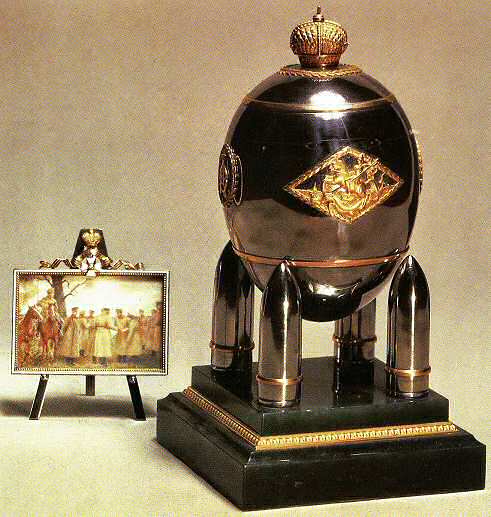
The 1916 Steel Military Egg, also known as Steel Egg with Miniature Easel, is made of gold, steel, jade white enamel, silk and velvet. The miniature easel is made of steel gold, opaque black, orange and white enamel, and watercolor on ivory. The base is made of gold, steel and nephrite.
The steel Egg, with gold patterns surmounted by a gold crown, rests on four artillery shells....
....MUCH MORE
And more here: "Egg Decorating: The Fabergé Steel Military Egg":
Easter 1916. Rasputin and war.
Easter was late that year, falling on April 23rd
Finally, by Easter 1917 the eggs were no longer "Imperial", the Czar had
been forced to abdicate (March 15) and the invoice for the first of the
1917 eggs was sent to "Mr. Romanov, Nikolai Aleksandrovich".
On the night of 16-17 July 1918 the Bolshi boys shot clubbed and
bayoneted the Romanovs to death and that was that for the eggs.
Except for the seven whose whereabouts are either unknown or known only to a very circumspect few.
There's an Easter Egg hunt for you.
"The Lost Fabergé Eggs"

