Friday, June 27, 2025

Your Mission: "place all major technological innovations in history on a timeline, together with the connections between them"

So, a mashup of Diderot, he of the Encyclopédie and James Burke who brought us Connections.*

That's rather ambitious; 

From Asterisk Magazine, Issue 10:

The Universal Tech Tree
Étienne Fortier-Dubois

When we try and pick out any technology in isolation, we find it hitched, in some way, to every innovation that preceded it. (Except for the Oldowan hand axe. We had to start somewhere.)

What do firearms and cameras have in common? One answer is shared vocabulary: load, aim, shoot. The etymological origins of this relatedness are murky. People likely borrowed language about firearms — which are over 500 years older than photography — to talk about cameras, which are operated in a similar manner.  But in the case of the movie camera, the connection is concrete.

The first movie camera is generally considered to be the kinetograph, invented in 1891 by Thomas Edison and William Kennedy Dickson, an inventor at the Edison lab. Two years earlier, Edison had travelled to Paris to the Exposition Universelle of 1889, a world’s fair, to showcase his company’s phonograph. There, he met with Étienne-Jules Marey, a French scientist who had begun his career studying blood circulation, and who had developed an interest in chronophotography partly out of his work on physiology. Chronophotography consists of taking multiple photographs in quick succession to capture movement. 

A famous early achievement of the technique is The Horse in Motion, a series of photographs taken by Eadweard Muybridge in 1878 that proved something Marey had asserted years earlier: For a brief moment in gallop, a horse has all four hooves off the ground. Encouraged by Muybridge, Marey developed an improved device to take chronophotographs. The resulting design, the “photographic gun,” featured a long barrel derived from existing firearms. We don’t know what transpired between Marey and Edison, but it seems likely that Marey’s design inspired the kinetograph. Coincidentally (or not), the Online Etymology Dictionary’s entry for “shoot” claims “the meaning ‘to photograph’ (especially a movie) is from 1890” — around the time of the kinetograph’s invention.

Marey himself had been inspired by the invention of another Frenchman, the astronomer Pierre Janssen. In 1874, hoping to capture images of the transit of Venus, Janssen created a device he called the “photographic revolver.” It looked like a large telescope. Inside, it hosted a complex camera that used a revolving apparatus to take several images in quick succession. The resulting eight seconds of the black dot of Venus moving across the sun disk are often recognized as the first motion picture in history. 1

Prior to Jansenn’s invention, revolving components had not been used in photography or astronomy. They came from the Colt Paterson revolver, a handgun popular in the U.S. since its mid-19th century creation by Samuel Colt. Thus, we can reconstruct a genealogical succession of ideas: Colt inspired Janssen, who inspired Marey, who likely inspired Edison (who then inspired the Lumière brothers and further developments in filmmaking). 

We can go further back still. Colt improved the revolver and made its mass production commercially viable, but he did not invent it. Nor was it a particularly recent development: Guns with a revolving barrel have existed since the 16th century. A German revolver dates from 1597, but there are even older specimens. The xun lei chong, a Chinese revolving musket, also dates from this period.

It makes sense: The 1500s were a time of great innovation in firing mechanisms for muskets and arquebuses, with developments like the wheellock (which used a spinning metal wheel against pyrite to create sparks), snaplock (which struck flint against steel using a spring-loaded arm), and flintlock (which improved on the snaplock with a combined hammer-flint holder). Volley guns made of multiple cannons existed in England since at least the 1330s. These were descendants, in turn, of simpler cannons that stem from the invention of gunpowder in China in the 800s. It stands to reason that eventually someone in Europe would think of making a spinning mechanism to allow a weapon to fire multiple shots in quick succession. 

And yet, if you’re anything like me, most of what you just read was probably surprising. We don’t typically associate revolvers with the 1500s, or, for that matter, with movie cameras. 

The reason I learned about this — and dozens of anecdotes around other inventions — is that I have been working on a quixotic project to place all major technological innovations in history on a timeline, together with the connections between them. The goal is to situate stories like that of the revolver and camera in their historical context, notice patterns, and understand the logic of the history of technology. The result is an interactive visualization that I call the historical tech tree....

....MUCH MORE 

On Burke:

November 2016 - "James Burke’s New Project Aims to Help us Deal with Change, Think Connectively, and Benefit from Surprise"

November 2013 -  When Storylines Intersect: China's Plenum Reforms Not Good For Australian Commodities

The first law of ecology: Everything is connected.*
-------
*The law made a small fortune for James Burke:
Connections explores an Alternative View of Change (the subtitle of the series) that rejects the conventional linear and teleological view of historical progress. Burke contends that one cannot consider the development of any particular piece of the modern world in isolation.

Rather, the entire gestalt of the modern world is the result of a web of interconnected events, each one consisting of a person or group acting for reasons of their own (e.g., profit, curiosity, religious) motivations with no concept of the final, modern result of what either their or their contemporaries' actions finally led to. The interplay of the results of these isolated events is what drives history and innovation, and is also the main focus of the series and its sequels.

To demonstrate this view, Burke begins each episode with a particular event or innovation in the past (usually Ancient or Medieval times) and traces the path from that event through a series of seemingly unrelated connections to a fundamental and essential aspect of the modern world. For example, The Long Chain episode traces the invention of plastics from the development of the fluyt, a type of Dutch cargo ship.
Watch the full documentary now (30 episodes, each 45 minutes long)
Connections (1978)
1. The Trigger Effect details the world’s present dependence on complex technological networks through a detailed narrative of New York City and the power blackout of 1965.

2. Death in the Morning examines the standardization of precious metal with the touchstone in the ancient world.

3. Distant Voices suggests that telecommunications exist because Normans had stirrups for horse riding which in turn led them to further advancements in warfare.

4. Faith in Numbers examines the transition from the Middle Ages to the Renaissance from the perspective of how commercialism, climate change and the Black Death influenced cultural development.

5. The Wheel of Fortune traces astrological knowledge in ancient Greek manuscripts from Baghdad’s founder, Caliph Al-Mansur, via the Muslim monastery/medical school at Gundeshapur, to the medieval Church’s need for alarm clocks (the water horologium and the verge and foliot clock).

6. Thunder in the Skies implicates the Little Ice Age (ca. 1250-1300 AD) in the invention of the chimney, as well as knitting, buttons, wainscoting, wall tapestries, wall plastering, glass windows, and the practice of privacy for sleeping and sex.

7. The Long Chain traces the invention of the Fluyt freighter in Holland in the 1500s. Voyages were insured by Edward Lloyd (Lloyd's of London) if the ships hulls were covered in pitch and tar which came from the colonies until the American Revolution in 1776.

8. Eat, Drink and Be Merry begins with plastic, the plastic credit card and the concept of credit then leaps back in time to to the Dukes of Burgundy, which was the first state to use credit
.
...MUCH MORE, although the original links to YouTube have been pulled, a bit of searching (cough*vimeo*cough) shows the vids are still on the web.

And Diderot:

May 2024 -  Work And The Encylopédie

March 2019 -  Diderot: "The Man Who Questioned Everything"

As noted in "So You Think You're Smart: The Last Person To Know Everything" the publication of Diderot's Encyclopédie probably marks “the end of an era in which a single human being was able to comprehend the totality of knowledge.” 

Combined with the "questioning everything" he was either a blast at parties or an insufferable bore.... 
*****
https://c1.staticflickr.com/4/3635/3397858623_ff8e4ce060.jpg
Anatomy of a Blogger, after Diderot’s Encyclopédie, ou dictionnaire raisonné 
des sciences, des arts et des métiers by Mike Licht via flickr

High Performance Computing: "Europe’s First Exascale Supercomputer Powers Up" (plus the Top500 list of the world's fastest computers)

This is the big leagues in computing and they are tackling the big questions: complex-chaotic systems and our old nemesis, turbulence.

From IEEE Spectrum, June 26:

Debuting at No. 4 on the TOP500, JUPITER could open vast scientific vistas

If you want to visualize the surface air flowing across every meter of the planet Earth, you need to plot nearly three trillion squares of land and sea and space. To do that you need a mind-bogglingly big calculator.

Which is why Ioan Hadade, a computational scientist working with vast weather forecasting and climate models, is excited about the machine now online an hour down the road from his lab in Bonn, Germany. Europe’s first exascale supercomputer—called JUPITER, after a much bigger planet than our own—is nearly fully operational. It is currently running scientific programs on its formidable processors.

JUPITER debuted at No. 4 in the June 2025 global TOP500 list of the world’s most powerful computer systems.

It is based at the Jülich Supercomputing Center in the German Rhineland between Cologne and Aachen, running on a booster module with 5,900 accelerating compute nodes. Some 24,000-odd Nvidia Grace-Hopper superchips give JUPITER its oomph; the machine also features a universal cluster module with 1,300 nodes using Rhea1 processors, and an InfiniBand NDR network for the high-speed interconnects.

The semi-annual TOP500 rankings are a way to engage every single element of a machine for performance. Benchmarking proves the functionality of a highly complex operation. “And now, it’s better to have some science done on the machine,” says Thomas Lippert, director of the Jülich Supercomputing Center.

Computational Science at Scale
As of mid-June research enterprises were on the JUPITER machine testing scientific calculations. “You need a really large machine to run this,” Hadade says. He’s referring to the Destination Earth digital twin projects he and his colleagues are part of developing at the European Center for Medium-Range Weather Forecasts....

....MUCH MORE 

Here's the press release from Top500:

News 
El Capitan Retains Top Spot in 65th TOP500 List as Exascale Era Expands

The 65th edition of the TOP500 showed that the El Capitan system retains the No. 1 position. With El Capitan, Frontier, and Aurora, there are now 3 Exascale systems leading the TOP500. All three are installed at Department of Energy (DOE) laboratories in the United States.

The El Capitan system at the Lawrence Livermore National Laboratory, California, remains the No. 1 system on the TOP500. The HPE Cray EX255a system was measured with 1.742 EFlop/s on the HPL benchmark. LLNL now also submitted a measurement for the HPCG benchmark, achieving 17.41 Petaflop/s, which makes the system the new No. 1 on this ranking as well.

El Capitan has 11,039,616 cores and is based on AMD 4th generation EPYC processors with 24 cores at 1.8 GHz and AMD Instinct MI300A accelerators. It uses the HPE Slingshot interconnect for data transfer and achieves an energy efficiency of 60.3 Gigaflops/watt. El Capitan is the 3rd system exceeding the Exaflop mark on the HPL benchmark.

The Frontier system at the Oak Ridge National Laboratory, Tennessee, is the No. 2 system on the TOP500. Frontier has been remeasured with an HPL score of 1.353 EFlop/s.  

Frontier is based on the HPE Cray EX235a architecture and is equipped with AMD 3rd generation EPYC 64C 2GHz processors. The system has 8,699,904 total cores and also relies on HPE Slingshot interconnect for data transfer.  

The Aurora system at the Argonne Leadership Computing Facility, Illinois, was submitted with 1.012 EFlop/s on the HPL benchmark, which keeps it in the No. 3 spot on the TOP500. 

Aurora is built by Intel based on the HPE Cray EX - Intel Exascale Compute Blade, which uses Intel Xeon CPU Max Series processors and Intel Data Center GPU Max Series accelerators, which communicate through HPE Slingshot interconnect.

The JUPITER Booster system at the EuroHPC / Jülich Supercomputing Centre in Germany at No. 4 is the only new system in the TOP 10. 

JUPITER - JU Pioneer for Innovative and Transformative Exascale Research – was announced as the first EuroHPC exascale supercomputer (see https://jupiter.fz-juelich.de). It is currently being commissioned and has achieved a preliminary HPL value of 793.4 Petaflop/s on a partial system. The system is located at the Forschungszentrum Jülich campus in Germany and is operated by the Jülich Supercomputing Centre. It is based on the Eviden’s BullSequana XH3000 direct liquid-cooled architecture.

Here is a summary of the system in the Top 10....

....MUCH MORE 

"In the beginning, a large sunspot forms on a G-type main-sequence star in the Orion Arm of the Milky Way Galaxy..."

From Noēma, June 24:

...Over time, it swells and impedes the circulation of plasma, trapping energy in a tangle of magnetic fields.
And then it erupts, spitting out a colossal flash of electrons and radiation into the cold darkness of space. 

The Unseen Fury Of Solar Storms 
Lurking in every space weather forecaster’s mind is the hypothetical big one, a solar storm so huge it could bring our networked, planetary civilization to its knees.

EXETER, United Kingdom — It was an overcast morning in southwest England, but Kirk Waite was staring at the sun. In the open-plan forecasting room of the Met Office, the U.K.’s national meteorological agency, the country’s senior weather-watchers were monitoring low-pressure systems sweeping in from the Atlantic and across the British Isles. Waite was studying weather of a very different sort.

He sat at a crescent-shaped desk arrayed with computer monitors displaying real-time images of our local star. Generated by the Solar Dynamics Observatory (SDO), a NASA satellite that has been taking second-by-second snapshots of the sun since 2010, the images had been processed by a spectral filter to display the solar surface in a range of lucent wavelengths measured in angstroms (Å).

At 6,173 Å, the sun appeared as a mostly featureless sphere with a couple of rogue blemishes: active sunspots that showed high levels of electromagnetic activity. The most spectacular projection was 171 Å, which depicted the star in the deep ultraviolet range. At this wavelength, it was an explosive yellow orb encircled by a chaotic nimbus of sunbursts and looping streamers. For around six years, the sun has been in what is called Solar Cycle 25, and the tumult shown at 171 Å was characteristic of the “solar maximum,” its most turbulent phase, which commenced last October.

This morning, Waite, the on-duty forecaster at the Met’s Space Weather Observation Centre (MOSWOC), was scrutinizing sunspot number 3998, an archipelago of blotches around four times the Earth’s diameter. On his central monitor, he brought up a greenish image of the sun at 94 Å, highlighting radiation in the X-ray range, and toggled the timestamp back around 24 hours to display 3998 just as it erupted in a torpedo-shaped expulsion of light. This was a solar flare, a massive discharge of radiation and solar energetic particles (SEPs).

Next, Waite turned to a pair of projections, each with a black circle overlaying the solar disc. These were coronagraphs, images taken from another observation platform stationed around a million miles from Earth. The spokes of light emanating from the disc showed the solar wind, a constant flow of ionized particles streaming off the sun’s visible surface, or photosphere, at a rate of one million tons per second.

But sun-watchers like Waite are more preoccupied by the more intermittent crescendos, outbursts with the explosive power to reach Earth with unusual velocity and volume. These can be divided into two distinct but intertwined phenomena: solar flares and coronal mass ejections (CMEs).

Orbital sensors had determined that the flare Waite showed me was an M3.3 — moderate but worth keeping an eye on. “It lasted around two hours, quite a long duration, which is often a sign that a CME might follow,” Waite said. Sure enough, a couple of hours later, the coronagraphs showed a blast of matter exploding from the right “limb” of the photosphere. Waite’s task during his 12-hour shift was to forecast “space weather” — to monitor these two types of solar eruptions and to predict their potential impact on Earth.

Using a mouse cursor, Waite lassoed the outer limits of the CME. Scrolling forward a few minutes — the ejection now greatly expanded — he drew another. The time-lapse between the two would provide an estimate of the CME’s ejection speed (this one was travelling at almost 800 miles per second), from which computer modelling could extrapolate an estimate of the eruption’s volume, density and its likelihood of hitting Earth.  

“The data says there’s an ever-so-slight chance of it just grazing us. So we can incorporate that into our forecast,” Waite said. In the subsequent hours, 3998 had become less complex. This particular event wasn’t large enough to cause significant disruption, Waite concluded. But the question of what these phenomena could do is a different story.

If you took a straw poll of the general public, chances are that few people would have any idea what space weather is, if they’ve ever heard the term at all. In contrast to terrestrial weather, space weather cannot be felt. It doesn’t warm your skin, drench your clothes or blow down your fence. Unlike the floods, droughts and hurricanes that have beset human civilizations since ancient times, it is not an age-old threat. For the first 10,000 years of human civilization, the sun’s flares and CMEs would have had no impact on life at all. 

It is only since humanity constructed a planet-scale network of electromagnetic technologies, and subsequently grew to depend on that network for just about everything, that the sun’s activity became a potential hazard. In basic terms, the primary danger of space weather is its capacity to produce an electromagnetic pulse (EMP). Upon making contact with the upper reaches of the atmosphere (the ionosphere), charged particles thrown out by the sun can instigate a “geomagnetic storm”, inducing currents in the Earth’s crust that overwhelm electrical equipment and its infrastructure, resulting in cascading malfunctions, power surges and blackouts. Anything that relies on electricity is vulnerable. Satellites, power grids, aviation, railways, communications, farming, heavy industry, military installations, global trade, financial transactions — the categories of vital systems that could be impacted by a sun-borne EMP are endless and interconnected, affecting every facet of our networked society.

The United Kingdom-based MOSWOC is one of only three institutions worldwide tasked with assessing and forecasting that risk. (The other two are in Boulder, Colorado, and Adelaide, Australia.) Each monitors solar activity 24 hours a day, 365 days a year. Low-severity space weather, like the expulsions Waite was scrutinizing during my visit, occurs all the time. During the solar maximum, MOSWOC usually records around 1,000 such events per year.

But playing at the back of every forecaster’s mind is the hypothetical centennial event, the moment when a sunspot might dispatch a solar storm at a scale that we know has happened historically, but never in our modern, technological age....

....MUCH MORE 

"Trump plans executive orders to power AI growth in race with China" (PWR; GEV; CCJ)

I think we're positioned correctly with the Quanta, GE Vernova, Cameco etc.

But until sales, earnings, and cash flow catch up to the news, valuations are getting stretched. 

But at least we have sales, earnings, and cash flow should the overall market tumble.

Money coming in the front door is comforting and a cushion against impulsivity, regret and all the other things that get in the way of big gains. 

An exclusive from Reuters via CNBC, June 27:

The Trump administration is readying a package of executive actions aimed at boosting energy supply to power the U.S. expansion of artificial intelligence, according to four sources familiar with the planning.

Top economic rivals U.S. and China are locked in a technological arms race, and with it secure an economic and military edge. The huge amount of data processing behind AI requires a rapid increase in power supplies that are straining utilities and grids in many states.

The moves under consideration include making it easier for power-generating projects to connect to the grid, and providing federal land on which to build the data centers needed to expand AI technology, according to the sources.

The administration will also release an AI action plan and schedule public events to draw public attention to the efforts, according to the sources, who requested anonymity to discuss internal deliberations.

The White House did not respond to requests for comment.

Training large-scale AI models requires a huge amount of electricity, and the industry’s growth is driving the first big increase in U.S. power demand in decades.

Between 2024 and 2029, U.S. electricity demand is projected to grow at five times the rate predicted in 2022, according to power-sector consultancy Grid Strategies....

....MUCH MORE 

Capital Markets: "Dollar Stabilizes after Yesterday's Shellacking but Finds Little Traction"

From Marc to Market:

Overview: The US dollar has steadied today after yesterday's shellacking that saw it fall to new multiyear lows against the euro and sterling and 10-year lows against the Swiss franc. The news stream is somewhat more supportive today, with trade deals said to be in the works, in addition to the confirmation/clarification of an agreement with China. The US got an exemption from the OECD's Pillar 2 corporate tax reform, and the onerous "revenge tax" of Section 899 of the budget proposal will be dropped. There is talk that the postponement of the so-called reciprocal tariff may be extended for the current deadline of July 9. While the greenback has steadied it has found little traction and remains largely pinned near yesterday's lows.

Equity markets have responded more favorably. Most of the markets in the Asia Pacific region advanced less by the more than 1% gain in Japanese indices. China, Hong Kong, South Korea, and Australia were exceptions. Europe's Stoxx 600 is up nearly 1%, and if today's gains are sustained, it would be the first back-to-back advance in three weeks. US index futures are up 0.2%-0.3%. Benchmark 10-year yields are firmer. The two basis point rise in the JGB put the yield at a new high for the week near 1.43%. European yields are mostly less than one basis point higher, but enough to lift the 10-year German Bund yield to a new high for the week (~2.57%). The 10-year Treasury yield is about three basis points higher at 4.27%. It is off nearly 8 bp this week. Gold has broken down to a new low for the week, near $3282. It is also a new low for the month. August WTI continues to chop inside Tuesday’s range (~$64-$67.85). It is inside yesterday's range as well (~$64.65-$66.40)....

....MUCH MORE, including discussion on today's upcoming PCE price index inflation print. 

"Uber in Talks With Its Founder, Travis Kalanick, to Fund Self-Driving Car Deal" UBER; PONY)

"When there's no other dude in the car, the cost of taking an Uber anywhere becomes 
cheaper than owning a vehicle. So the magic there is, you basically bring the cost below 
the cost of ownership for everybody, and then car ownership goes away."


—Uber CEO Travis Kalanick, May 28, 2014

Warning to passers-by: I may be dipping into the archive as this deal progresses.* 

From the New York Times, June 26, 2025:

The ride-hailing company is in talks to help Mr. Kalanick, who was forced out in 2017, buy an autonomous vehicles start-up as the robot taxi service Waymo gains momentum. 

Uber is increasingly grappling with competition from self-driving taxi services like Waymo. Now the ride-hailing giant is taking more action to deal with that threat.

Uber is in talks with Travis Kalanick, the company’s co-founder who was forced out in a boardroom coup eight years ago this month, to help fund his acquisition of the U.S. subsidiary of a Chinese autonomous vehicle company, two people with knowledge of the matter said. The company, Pony.ai, was founded in Silicon Valley in 2016 but has its main presence in China, and has permits to operate robot taxis and trucks in the United States and China.

The talks are preliminary, said the people, who were not authorized to speak about the confidential conversations. Mr. Kalanick will run Pony if the deal is completed, they said. It is unclear what role, if any, Uber would take in Pony as an investor.

Financial details of the potential transaction could not be determined. Pony went public last year in the United States, raising $260 million in a share sale. Its market capitalization stands around $4.5 billion.

If the deal goes through, Mr. Kalanick, 48, will remain in his day job running CloudKitchens, a virtual restaurant start-up that he founded after leaving Uber in 2017. He would also work more closely with Dara Khosrowshahi, who took over as Uber’s chief executive after Mr. Kalanick’s ouster.

The discussions are the starkest sign yet that Uber is under pressure from Waymo, the driverless car unit spun out of Google, and other autonomous car services. This month, Tesla also unveiled a limited robot taxi service in Austin, Texas. Over time, these autonomous vehicle services may replace or eat into rides from human drivers. In cities like San Francisco, where robot taxi services are available, the vehicles have become ubiquitous and are popular.

An Uber spokesman declined to comment on deal talks and said, “Uber has a platform strategy, and we intend to work with multiple players in the U.S. and around the world who can safely bring autonomous technology to the world.”

Devon Spurgeon, a spokeswoman for Mr. Kalanick, did not immediately have a comment. Pony did not immediately respond to a request for comment.

When Mr. Kalanick was Uber’s chief executive, the company tried developing autonomous vehicle technology. It then bought Otto, a self-driving trucking start-up run by Anthony Levandowski, a former Google engineer. Google later sued Mr. Levandowski for theft of trade secrets and sued Uber to bar it from using its self-driving technology.

Under Mr. Khosrowshahi, Uber has taken a different tack to self-driving cars. The company has struck roughly 18 partnerships with autonomous vehicle companies like Wayve, May Mobility and WeRide to bring pilot programs for driverless car services into Europe, the Middle East and Asia.

The goal, Mr. Khosrowshahi has said in podcast interviews, has been to put “as many cars on Uber’s network as possible.” He has maintained that while autonomous vehicles are growing steadily, ride-hailing networks will have both human and robot drivers for years.

Today, Uber both competes and collaborates with Waymo. In Phoenix, riders can order a Waymo car through Uber’s app. In Austin, Waymo’s robot taxis don the Uber logo. But Waymo has also expanded into more cities, potentially biting into Uber’s business. And in San Francisco, Waymo customers are required to use the Waymo app to order rides.

Uber is also watching Elon Musk, who has promised a wider rollout of Tesla’s self-driving taxis and has declined to team up with Uber.

Mr. Kalanick has grown interested in robotics over the past year, according to two people who have spoken with him. He has brought robots into some of his CloudKitchens to prepare food for customers and has experimented with automated kitchens building food bowls for delivery. He has also become enamored with robots that traverse streets to deliver food to people....

....MUCH MORE
*
For example on the background between Uber and Waymo:
Or alternatively, a broader search (it used to be much broader until Google began shrinking the internet by reducing the number of results they show on any given subject):

https://duckduckgo.com/?t=ffab&q=site%3Aclimateerinvest.blogspot.com+uber&ia=web 

Forced to use duck duck go because the GOOG won't do a site search. 

Of course we can go back to the GOOG - assisted site search:

https://climateerinvest.blogspot.com/search?q=Uber

"This is one helluva Jensen Huang halo effect..."

A bit frothy, eh what?

And as with so many things the sting is in the tail.*  

From Sherwood News, June 26: 

A tiny robotics company is more than tripling after drawing attention to its relationship with Nvidia
Shares of Cyngn are going parabolic, with higher volumes in less than 15 minutes on Thursday than the rest of 2025 combined. 

This is one helluva Jensen Huang halo effect:

Tiny industrial robotics company Cyngn Inc.CYN $23.49 (172.85%) is going parabolic on Thursday. It was up more than 300% at one point and halted for volatility after trumpeting its relationship with the biggest publicly traded company in the world: AI juggernaut NvidiaNVDA $155.70 (0.50%).

“Cyngn Inc. today announced its collaboration with NVIDIA as part of the Automatica 2025 robotics and automation showcase,” per the press release. “As featured in NVIDIA’s recent blog post, Cyngn was selected among a handful of robotics innovators using NVIDIA Isaac technologies to accelerate safe, scalable autonomy across dynamic, real-world environments.”

That blog post from Nvidia on Tuesday shouted out Cyngn as one of many robotics “leaders” deploying its technology. It was the first time the firm had been mentioned on Nvidia’s website, but the ramp in Cyngn didn’t really start until Wednesday’s session was nearly over.

Cyngn has generated less than $3 million in revenue over its lifetime as a publicly traded company, but has now seen its market cap surge to above....

....MORE
*
That guy from Avon who said it in 1592 (also Scorpions 2010)
...“Petruchio: Come, come, you wasp; i' faith, you are too angry.
Katherine: If I be waspish, best beware my sting.
Petruchio: My remedy is then, to pluck it out.
Katherine: Ay, if the fool could find where it lies.
Petruchio: Who knows not where a wasp does wear his sting? In his tail.
Katherine: In his tongue.
Petruchio: Whose tongue?
Katherine: Yours, if you talk of tails: and so farewell.
Petruchio: What, with my tongue in your tail? Nay, come again, Good Kate; I am a gentleman.”
The Taming of the Shrew via No Fear Shakespeare

Thursday, June 26, 2025

"China's May industrial profits slip back into sharp decline"

From Reuters via MSN, June 26/27:

China's industrial profits swung back into sharp decline in May from a year earlier, as factory activity slowed in the face of broader economic stress and a fragile trade truce with the United States.

Deepening deflationary pressures and a persistent property crisis continued to undercut demand and growth in the world's second-largest economy. 

A few signs, including an unexpected pickup in retail sales growth last month, suggested some resilience among households even though market consensus is that more policy support is required to bolster a fragile economic recovery.

Profits at China's industrial firms fell 9.1% in May from a year earlier, snapping a two-month growth streak, National Bureau of Statistics data showed on Friday.

The profit decline was due to "insufficient effective demand, declining prices of industrial products and fluctuations in short-term factors," said NBS statistician Yu Weining in a statement.

Industrial profits slid 1.1% in the first five months of 2025 from the same period last year. This compares with a 1.4% increase in the January-April period.

China's factory-gate deflation deepened to its worst level in almost two years last month while consumer prices extended declines....

....MUCH MORE 

"China Is Still Choking Exports of Rare Earths Despite Pact With U.S."

From the Wall Street Journal, June 26:

Western companies are struggling to secure approvals for rare-earth imports from Chinese authorities, despite U.S.-China deal 

Two weeks after China promised the U.S. it would ease the exports of rare-earth magnets, Chinese authorities are dragging out approval of Western companies’ requests for the critical components, a situation that could reignite trade tensions between Washington and Beijing.

Western companies say they are receiving barely enough magnets for their factories and have little visibility of future supplies. Firms are waiting weeks as Chinese authorities scrutinize their applications—only to be rejected in some cases. And applications for raw rare earths, which are used to make magnets, are rarely granted.

As a result, Western companies are concerned that the shortages could soon affect manufacturing. Companies are so desperate for magnets that they are opting for expensive airfreight whenever licenses are granted to prevent costly production shutdowns. Some manufacturers are experimenting with workarounds that would allow them to make their products without the most powerful magnets.

“It’s hand to mouth—the normal supply-chain scrambling that you have to do,” said Lisa Drake, a vice president overseeing Ford’s industrial planning for batteries and electric vehicles, earlier this week. Although she said the situation had improved, the scarcity of the rare-earth magnets is forcing Ford to “move things around” to avoid factory shutdowns, she said.

Manufacturers have taken the continuing challenges as a sign that new Chinese rare-earth export restrictions, introduced in April after President Trump raised tariffs on China, are here to stay—contrary to White House assertions that the flow of the critical components would return to normal.

“Yes, the export restrictions have been paused on paper. However, ground reality is completely different,” said Neha Mukherjee, a rare-earths analyst at Benchmark Mineral Intelligence. The licensing process is plagued by “bureaucratic drag.”

China’s Ministry of Commerce said Thursday that it has been accelerating the review of rare-earth export license applications and has approved “a certain number.”

The restrictions illustrate the power Beijing holds through its formidable supply chains and how it can use them to inflict pain on Western businesses and exact concessions from the U.S.

China makes 90% of the world’s most powerful rare-earth magnets, a key component in everything from cars to jet fighters. In April, after Trump heaped stiff tariffs on Chinese products, Beijing established an export-control system for rare earths. While it said the license system was set up to regulate the export of materials for military use, the regime has in effect allowed China to clamp down on rare-earths supplies as it wishes.

After April, the supply of magnets to Western businesses slowed to a trickle, causing shock waves for global car, defense and electronics makers. Exports of rare-earth magnets to the U.S. declined 93% in May from a year earlier. Ford stopped production of its Explorer SUV at its Chicago plant for a week in May.

The U.S. accused China of slow-walking the approval of export licenses, which China denied. The shortage drove both sides back to the bargaining table earlier this month, where China agreed to free up the flow of rare earths in exchange for the U.S. easing its own restrictions on certain U.S. exports to China.

Following the deal, Trump wrote that “full magnets, and any necessary rare earths, will be supplied up front by China.”

However, China put only a six-month limit on any new licenses, The Wall Street Journal has reported. Now, in the applications for export licenses, Chinese authorities are asking Western companies for sensitive details such as contact information of those buying their magnets and even designs of how their magnets are integrated into components like motors.

Chinese authorities justify the scrutiny as necessary to ensure the magnets aren’t used for military purposes, say companies involved in the magnet trade. 

When companies skip certain questions on their magnet applications to avoid disclosing sensitive intellectual property or details of commercial arrangements, their applications languish or are denied. In some cases, the applicants have then been told to start over and include all of the required information in a new application, which takes 45 days to process, according to companies involved in rare-earth imports. 

“The control is real,” said a representative of one such company. “There are thousands of applications the [Chinese authorities have] received.”....

"Gas prices expected to surge across California next week"

From CBS-8, San Diego, June 24/25:

Multiple factors, including new state regulations, are expected to drive up gas prices in California starting July 1, with experts predicting significant increases. 

California drivers are bracing for a substantial increase in gas prices starting July 1, as multiple new taxes and regulations take effect. Experts are divided on just how high prices will climb, but some estimates suggest they could reach up to $6 per gallon. 

The first factor contributing to the price hike is an increase in the state's excise tax, which will rise by 1.6 cents per gallon. However, this is just the beginning of the cost increases. 

A more significant impact is expected from the Low Carbon Fuel Standard program, approved by the state's air resources board in November. This program aims to reduce California's greenhouse gas emissions, but will result in stricter regulations on gas producers. 

State Senate Minority Leader Brian Jones expressed his disappointment with the new program, stating, "All of that is increased cost that is eventually passed on to the consumer, and estimates now are up to 65 cents a gallon per gallon of gasoline." 

The Automobile Club of Southern California anticipates a significant jump in gas prices. AAA spokesperson Gianella Ghiglino explained, "We still don't know exactly what that number is; however, we can estimate it'll be from $600 to $1,000 annually with the gas tax and low carbon fuel standard increases as well."

These estimates could worsen if tensions in the Middle East escalate, potentially pushing prices even higher. Additionally, the closure of two refineries - one this year and another next year - could further impact prices. Jones warns that these factors combined could push gas prices up to $8 per gallon by the end of 2026. 

In response, he has launched an online petition demanding that legislators repeal the Low Carbon Fuel Standard, which has garnered over 25,000 signatures. 

"We've got to start protecting the economy in California now that we've protected the environment in California," Jones argued. 

The senator from San Diego is urging California residents to contact their state legislators, explain how these price increases are affecting them, and encourage action to lower prices.

Editor's note: A day after the publication of this story, Governor Newsom sent out a press release addressing the claims and expectations regarding gas prices in California....

....MUCH MORE, including the Governor's rebuttal. 

"Dinari granted first broker-dealer registration to offer tokenized stocks"

From Reuters, June 26:

  • Dinari is first tokenized equity platform to get US approval
  • Coinbase, Kraken also exploring blockchain-based stocks
  • Proponents say tokenized stocks could reduce trading costs
June 26 (Reuters) - Dinari, a startup that offers blockchain-based U.S. stocks, has secured a broker-dealer registration for its subsidiary, a move the company says makes it the first tokenized equity platform to secure such approval in the U.S.

The move allows San Francisco-based Dinari to offer stock trading via blockchain technology for the first time to investors in the U.S., an offering that crypto companies like Coinbase and Kraken are also actively exploring as firms look to capitalize on an evolving U.S. regulatory stance toward cryptocurrencies.

Tokenizing equities is a process in which shares of a company are converted into digital tokens, similar to how cryptocurrencies are traded. Instead of holding the securities directly, investors hold tokens that represent ownership of the securities.
Proponents have said that tokenized equities could reduce trading costs, enable faster settlement, and facilitate around-the-clock trading....
....MUCH MORE 

If interested see also June 19's "Coinbase seeks SEC approval for ‘tokenized equities’ — Report

Here's the whole tokenization series, basically tokenize everything in the world. 

"BIS sees a tokenized future but stablecoins as unsound money"

The easy riposte to the BIS would be a Mandy Rice-Davies "Well he would, wouldn't he" but there is more to their objection than simply preferring Central Bank Digital Currencies to the DCs that lack the CB imprimatur. 

From Ledger Insights, June 24:

Today the Bank for International Settlements (BIS), the central bank to central banks, released a chapter of its Annual report, “The next-generation monetary and financial system,” outlining its vision for a tokenized economy. The BIS sees tokenized deposits dominating retail payments with wholesale central bank digital currencies (wCBDC) enabling interbank settlement, but argues stablecoins lack the fundamental features of sound money.

Why stablecoins are flawed

The BIS identifies three critical flaws in stablecoins: they lack singleness, elasticity and integrity. Singleness refers to universal acceptance without question, requiring token holders to know they can always exchange $1 for a dollar rather than 99 cents or less. The BIS says this is only possible through central bank money settling bank transactions.

Elasticity means central banks and commercial banks can grant credit to expand the money supply. “Where you have very complex interlocking payment obligations, if you had to wait for the incoming payments before you have sufficient liquidity to execute your own outgoing payment, that would be a recipe for gridlock,” explained Hyun Song Shin, the Head of the Monetary and Economic Department at the BIS during a media briefing.

“That feature cannot be satisfied with stablecoins because stablecoins need the backing reserves upfront. So unless you actually have the balances
already in your wallet, you cannot execute that payment,” said Mr Shin. “So I think for large value payments that elasticity is going to be absolutely key.” (Italics is our emphasis.)

The integrity problem stems from stablecoins being “digital bearer instruments on borderless public blockchains” that have become “the go-to choice for illicit use to bypass integrity safeguards,” according to the report.

Beyond these fundamental issues, the BIS warns stablecoins threaten monetary sovereignty through dollarization and could destabilize government debt markets when issuers sell reserves en masse during crises....

....MUCH MORE 
*We first presented Mandy on the blog in October 2007. Since then she visits to point out any self-serving comment that strikes her as especially bald-faced:

Mandy was a whore with a minor role in the Profumo scandal of 1963.
Here's how Wikipedia tells the story:

...Rice-Davies came to London , where she met Christine Keeler and a well-connected osteopath Stephen Ward. As a result of her involvement in Ward's social set, she became intimate with many powerful people, including the then Viscount Astor. She never in fact met John Profumo, whose brief relationship with Keeler, with whom Rice-Davies shared a flat, was at the centre of the affair that caused him to resign from the government in June 1963. Rice-Davies had been one of the mistresses of notorious slum landlord Peter Rachman who had owned the flat she shared with Keeler.

"He would, wouldn't he?"

While giving evidence at the trial of Stephen Ward, Rice-Davies made the quip for which she is most remembered and which is frequently used by politicians in Britain[2]. When the prosecuting counsel pointed out that Lord Astor denied having an affair or having even met her, she replied,  
"Well, he would, wouldn't he?"....
  1. ^ This quote later became a common saying in British politics, often altered to "He would say that, wouldn't he?" Examples follow in these links:

"UBS Upgrades Uranium Prices On "Repowering The US" Theme Gaining Steam"

From ZeroHedge, June 25:

For the third consecutive day, extreme heat across the eastern half of the U.S. has triggered power grid alerts and emergency warnings, highlighting the fragility of current energy infrastructure. Extremely tight power grids reinforce a core part of our energy thesis: the urgent need for clean, reliable baseload power, and there is no better option than nuclear

The current environment strengthens our conviction as long-term 'atomic bulls', a stance we've maintained since our original call in December 2020 (read here). Nuclear energy remains the only scalable, carbon-free solution capable of delivering 24/7 generation for powering up America in the 2030s (more here).

On Wednesday, a team of UBS analysts, led by Dim Ariyasinghe, upgraded their near-term uranium price forecast by ~10% (to $72/lb for 2025) due to improved policy sentiment, bipartisan support, and tighter supply from global disruptions.

The analysts recently hosted a call with the Atlantic Council, noting that U.S. nuclear capacity could grow from approximately 100 GW to 400 GW by 2050—surpassing the Biden administration's current targets. News earlier this week of New York's plan to develop a 1GW plant provided additional tailwinds for the industry.

"We upgrade our near-term U prices ~10% on an improved US policy backdrop, which has buoyed broader market sentiment," Ariyasinghe penned in a note to clients. 

UBS maintains a long-term price forecast of $77/lb (real 2025) and $81/lb nominal from 2030.

Uranium spot prices...

....MUCH MORE 

As mentioned exiting May 23's ""Trump plots ‘Manhattan Project 2’ in nuclear power push" (CCJ; GEV)":

The "set it and forget it" stocks are in the headline, Cameco among the miners and GE Vernova among the nuke reactor manufacturers.

However, as is so often the case the speculative lottery tickets are seeing a lot of enthusiasm for their shares. The problem with them as investments are 1) a lack of stuff like sales/earnings/cash flow and 2) our conviction that we will see at least one and possibly three bear markets before they have products.

And in bear markets it is the companies lacking in sales/earnings/cash flow that get hit hardest; as investors begin to question whether they may have made a big mistake. 

Addendum: I should have mentioned that with Cameco you also get 49% of nuke plant company Westinghouse. Brookfield owns the 51%.

And in June 16's "Why U.S. Uranium Production Surged 12-Fold In 2024" a reminder that Kazakhstan's Kazatomprom is and will probably remain the world's largest producer.

Inflation: Ahead of Tomorrow's BEA Personal Consumption Expenditures Price Index....

...a look at the Cleveland Fed's Inflation Nowcast for May PCE:

Inflation, month-over-month percent change 

Month          CPI    Core CPI      PCE    Core PCE    Updated
June 2025    0.25     0.23         0.22       0.21          06/25
May 2025                                0.09       0.14          06/25 

Note: If the cell is blank, it implies that the actual data corresponding to the month for that inflation measure have already been released. 

 ....MUCH MORE, including Year-over-year and quarterly rates

For comparison, from the Bureau of Economic Analysis

Change From Month One Year Ago
April 2025+2.1%
March 2025+2.3%
February 2025+2.6%
January 2025+2.5%

The PCE price index, released each month in the Personal Income and Outlays report, reflects changes in the prices of goods and services purchased by consumers in the United States. Quarterly and annual data are included in the GDP release.

Is President Trump (or pals) Trading On Material Non-Public Information? (LMT)

Another repost (and the last one for today) brought to mind by recent events. This was originally posted three days after the January 3, 2020 assassination of General Soleimani. 
(Tensions with Iran had been rising for a month.)

In this case it was the mention of the Shia red flag of vengeance flying over the Iranian mosque in the outro from June 24's Capital Markets: "Fragile Cease-Fire Lifts Animal Spirits and Reverses the Greenback's Gains" that was the memory trigger but the whole thing is evergreen:

January 6, 2020
Is President Trump (or pals) Trading On Material Non-Public Information? (LMT)  

No.
However that's the passive-agressive—"I'm not saying he is, just spitballin' the idea"—version of a J'accuse floating around and the subject of a short piece at FT Alphaville this morning:

The troublesome Trump inside trading claim
A new year means a fresh start for many, but not for the Trump conspiracy theory crowd.

This time, it was the turn of economist Dean Baker -- who is co-founder of the excellent Center for Economic Policy and Research -- to allege financial misdeeds of the Trump administration and its associates. The act in question? Insider trading ahead of Iranian commander Qassem Suleimani’s assassination on January 3rd.
Via Twitter:
Baker’s insinuation of insider trading in Lockheed Martin’s shares (a defence contractor, for those who don’t know) followed a Daily Beast article that reported Donnie had spent the festive season dropping hints about a “big” response to Iran at his Floridian beach resort Mar-a-Lago. Hints of which a skivvy insider could make handsome profits.

It’s a cute theory, but the problem is it’s just that: a theory....
....MORE

Mr. Baker is engaging in a practice that Machiavelli considered one of the most destructive of civic order, calumny. Additionally Baker is exposing himself as ignorant of just how sophisticated market surveillance, by both exchanges and regulators, is. Also, his mommy dresses him funny.

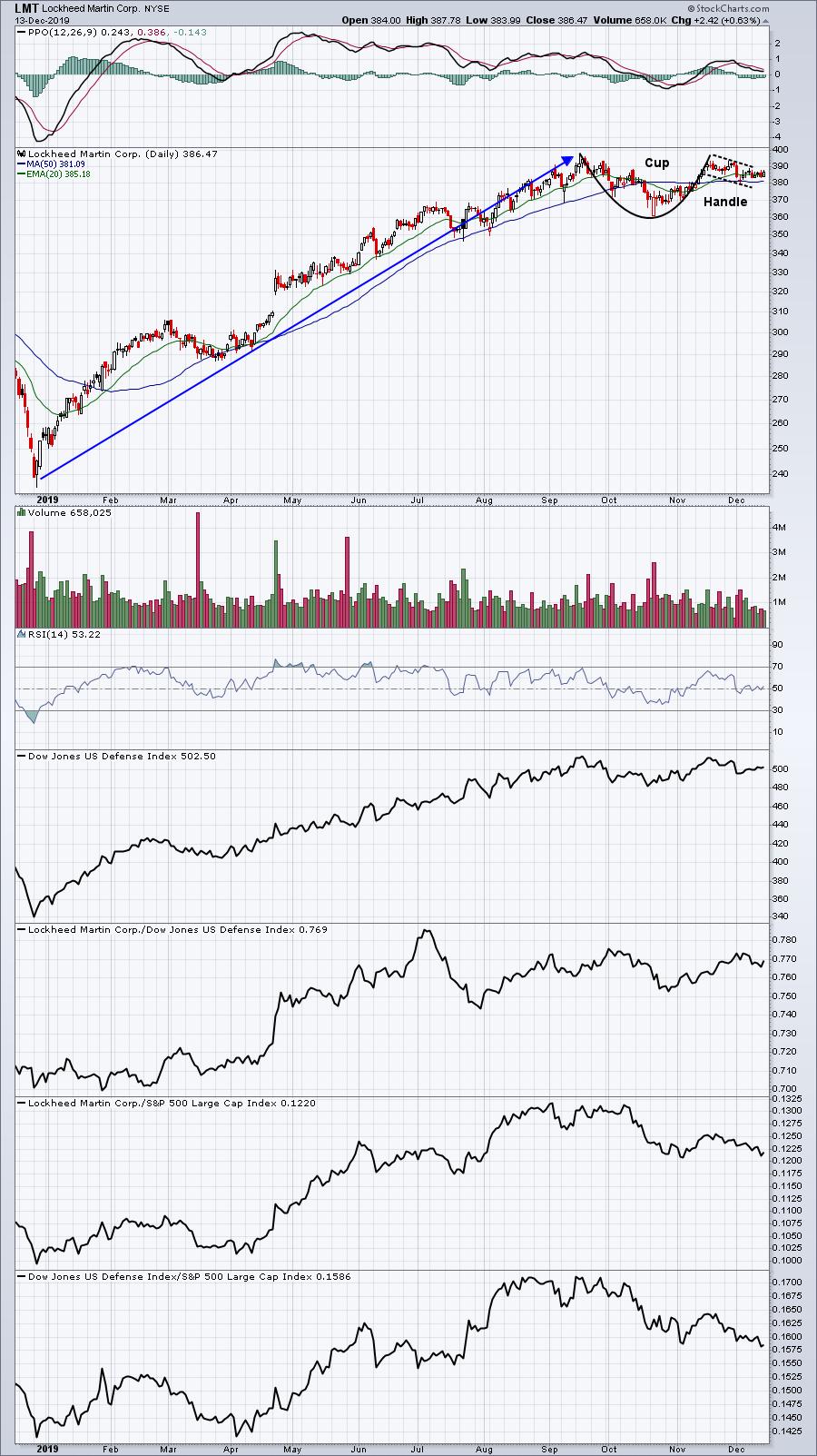
Regarding Lockheed Martin in particular, we flagged the stock because an astute chart watcher pointed out a pattern the stock was making:
December 19
Why Is Defense Contractor Lockheed-Martin's Stock Trading Like There's Going to Be a War? (LMT)

Got that? Our attention was drawn to the fact the stock was drifting down, the handle part of the cup-n-handle.
Regarding Machiavelli, old Niccolò  devotes an entire chapter to the issue of what Dean Baker is doing, right up front in Book I (of three) of his Discourses on the First Ten Books of Titus Livy, Chapter XIII:
That Calumny is as hurtful in a Commonwealth as the power to accuse is useful

Regarding war and other calamities, just as the Persians have their tradition of raising the red flag of war in the Holy City of Qom, westerners have the tradition of rolling out The Ramones from the Holy City of Queens, NY.
As noted in the outro from that December 19 post:
...If the stock breaks out, and is doing what stocks do, seeing over the horizon, we may actually be looking at a shooting war. So, trying to stay ahead of the curve I am going to propose the Ramones Blitzkrieg Bop as our next theme song.
Here's a very fast (200+ beats per minute) cover:


If interested see also "Music and the Market: Song and Stock Volatility" for more on high-speed tunes. We also have a link to Compressorhead's cover in "Automation Steals Jobs: Röböts Playing Motörhead" LMT down $5.38 (-1.30%) at $408.36

"Media That Focus on Scandals and Spread Fake News to Smear Politicians Risk Becoming Like People Who Have a Morbid Fascination with Excrement"-- Pope Francis

Although Frankie has moved on, his words came to mind with the hubbub about some report on the extent of damage at Iran's Fordow nuclear enrichment facility that was flying around the internet a couple days ago....

Also, don't argue with a Jesuit when they decide to go scorched earth. You won't believe how rhetorically mean they can be.

A repost from December 2016: 

Jeez, and here I thought I was being harsh when I referred to some of the WaPo crew as a bunch of Bozos.*
From the New York Post:

Pope Francis says spreading fake news is a sin

Media that focus on scandals and spread fake news to smear politicians risk becoming like people who have a morbid fascination with excrement, Pope Francis said in an interview published on Wednesday.

Francis told the Belgian Catholic weekly Tertio that spreading disinformation was “probably the greatest damage that the media can do” and using communications for this rather than to educate the public amounted to a sin.

Using precise psychological terms, he said scandal-mongering media risked falling prey to coprophilia, or arousal from excrement, and consumers of these media risked coprophagia, or eating excrement....MORE
*Washington Post Says Their Fake News Story May Be Fake News

This appears to be the first time the word coprophilia has appeared on the blog.

We have a few references to coprolalia, literally "talking shit" but connotated as any potty-mouthedness, particularly that associated with Tourette's syndrome.

No coprophagia either although I did once use the vernacular with the rhetorical flourish '...and die' appended to it.

Wednesday, June 25, 2025

"Top NYC office landlords SL Green and Vornado sink after surprise Mamdani win"

The jokes have always moved fast in the finance world.

Even back in the day when trades were consummated by telephone, after the "done on that" or "done your way" there was time for a yuck or two. During the crash of October 1987 the joke transmission circuit sort of ground to a halt because, well, trading ground to a halt. But by the morning of the 20th various versions of the "What does a—trader, broker, fund manager etc.—say after the crash?: "Would you like fries with that" had made their way from New York to Honolulu and back before the margin clerks had even finished tallying up the damage from the 19th.

Same with Mamdani last night. The "No one has ever tried real socialism, heh" and "would the last one to leave NYC turn out the lights, seriously" were circulating almost immediately.

And now this, via Sherwood News, June 25:

SL Green RealtySLG $58.76 (-5.19%) and VornadoVNO $36.34 (-5.51%) are down 5% on Wednesday afternoon as investors digest the recent surprise win of Zohran Mamdani in New York City’s mayoral primary.

Mamdani, a Democratic Socialist, ran on a platform to make the city more affordable by freezing rents and eliminating bus fares. His proposals include hiking the state’s corporate tax rate and introducing a 2% income tax on New Yorkers making over $1 million a year.

The results are being seen as a blow to SL Green, the city’s largest commercial landlord. The real estate investment trust (REIT) owns or holds stakes in 55 buildings totaling nearly 31 million square feet, the majority of which are in Manhattan. Vornado, for its part, boasts 20 million square feet of office space in New York City....

....MORE 

Chicago's largest circulation newspaper, the Chicago Tribune, published this editorial on June 23:

Editorial: Want to know how a socialist mayor would govern New York City? Ask Chicago
Now that's funny.  

"Capitalisn’t: Why Cliff Asness Believes Markets Are Getting Dumber"

From the University of Chicago's Booth School of Business' Capitalisn’t  podcast, June 19:

Are financial markets becoming less efficient? Clifford S. Asness of AQR Capital Management certainly thinks so. In a paper published last year, “The Less-Efficient Market Hypothesis,” Asness argues that social media and low interest rates, among other factors, have distorted market information so that stocks have become disconnected from their true values. This distortion has directed funds toward undeserving assets and firms and staved off necessary market corrections.

Asness joins Bethany McLean and Luigi Zingales to discuss how the market has fundamentally changed due to new technologies and macroeconomic trends and how investment strategies must adapt, what these changes mean for long-term productivity and growth, how researchers and investors should think about emerging market factors like tariffs and artificial intelligence, and why he’s not investing in US President Donald Trump’s memecoin anytime soon.

Audio Transcript 

Cliff Asness: Our goal is to make our clients money, not to make markets more efficient. That is a lovely secondary thing that I believe we help with, I hope we help with, but we don’t wake up every day saying, “Our job today is just to make markets better.” I probably should not have admitted that on a major podcast.

Bethany: I’m Bethany McLean.

Phil Donahue: Did you ever have a moment of doubt about capitalism and whether greed’s a good idea?

Luigi: And I’m Luigi Zingales.

Bernie Sanders: We have socialism for the very rich, rugged individualism for the poor.

Bethany: And this is Capitalisn’t, a podcast about what is working in capitalism.

Milton Friedman: First of all, tell me, is there some society you know that doesn’t run on greed?

Luigi: And, most importantly, what isn’t.

Warren Buffett: We ought to do better by the people that get left behind. I don’t think we should kill the capitalist system in the process.

Bethany: From my very early days as a journalist, I remember the famous investor Cliff Asness, not just because he was a hugely successful quant—meaning someone who invests not so much on the fundamentals of a company but, rather, due to quantitative factors in the market—but because he was willing to say things other people weren’t and in such a memorably biting way.

In 2000, he published a piece called “Bubble Logic,” which exposed the fallacies being used to justify crazy stock prices like that of Cisco. Then, in 2004, he wrote a piece entitled “Stock Options and the Lying Liars Who Don’t Want to Expense Them.” Cliff now manages $128 billion across various strategies, and those who follow him on X know that he’s as outspoken on lots of issues as ever before.

When fellow billionaire Bill Ackman described Trump’s tariff policy change as brilliantly executed, Asness replied: “One of the main benefits of making some money is not having to wear a gimp suit for anybody. To each his own.”

Cliff later apologized for the language, but he still said Ackman was being illogical, and he said: “It may or may not have been good negotiating, but the man clearly feels any trade deficit with any country is stealing from us and has believed this for 40 years. So, there’s clearly some idiocy about the actual topic at hand to go with potential luck or brilliance.” Wow, certainly outspoken.

Luigi: Indeed. He also wrote a fascinating paper arguing that the market is less efficient than ever before, in part due to the rise of social media, about which he says, “Has there ever been a better vehicle for turning a wise, independent crowd into a coordinated, clueless, even dangerous mob than social media?”

Bethany: He’s also willing to be colloquial and experimental with ideas in a way that I don’t think are typical of University of Chicago finance types. Sorry, Luigi.

Another factor he thinks explains the growing inefficiency of markets is these several decades of super-low interest rates, and he wrote this: “Well, perhaps super-low interest rates for a long time make investors go cray-cray. Yes, I know cray-cray is not covered in the standard CFA exam and rarely the result of formal analysis, but it seems at least possible to me.”

Luigi: The reason we wanted to have Cliff on the show is precisely because he’s so opinionated, and it’s so refreshing to see him attacking left and right. He’s not somebody who is in a position trying to push something. He’s really a free spirit. He once described himself as a part-time Republican, a full-time libertarian, and he has been outspoken in his defense of capitalism as leading to a better living standard for everyone: “If you go by living standard, you cannot escape that things are wildly better. I will attribute most of that to capitalism.”

Bethany: Cliff has no shortage of things to say for himself, so we’ll stop waxing on and start talking to him. He is the founder, managing principal, and chief investment officer at AQR Capital Management. And a quick disclosure we need to make, which is that Chicago Booth a year and a half ago received a $60 million gift from Cliff Asness and John Liew to name its Master in Finance program.

One of the things you’ve been talking about a lot recently is your less-efficient market theory, and I think, the market is reasonably close to efficient, but there are lots of little inefficiencies. Anyway, you’ve argued that for a bunch of reasons, the markets have gotten less efficient.

You wrote this in one piece, “Hence, if those prices don’t reflect reality, there are real consequences to long-term productivity and growth.” How much do you worry about that? How important is it that the market actually does reflect back real-time information about prices?

Cliff Asness: Well, you started out with a hard one. First, let’s back up. It’s a total straw man that markets are perfect. Literally, no one believes that.

I was Gene Fama’s TA for two years. The first two weeks of class he teaches us what the efficient market hypothesis is, and the third week of class he says something like, “Markets are assuredly not perfectly efficient,” and you get a gasp, which you get nowhere else in the world. The rest of the world either has no idea what you’re talking about, but if they do, they’re like: “Of course it’s not perfect. Perfect is silly.”

Gene, I’m pretty sure he thinks they’re more perfect than I do—and I might think they’re more perfect than many others—but once you acknowledge they’re at all imperfect, the questions of how imperfect, and has that changed over time, become still very hard to answer, but very legitimate questions to ask.

We are mostly, in the piece I wrote . . . I start out at the very beginning saying this is a highly opinionated piece. There’s not a lot of hard data. It’s life experience and a few vignettes of some huge things that I would call bubbles. That’s not a word Gene Fama likes, but it’s my contention that markets have gotten materially . . . In the piece I think I kept saying less efficient. After writing it, I decided it would be more accurate to say “prone to bouts of extreme inefficiency.”

I have two periods I really point to. What we’ve lived through always carries more weight with us than what we can look at in the CRSP data going back to 1926. But the dot-com bubble at the end of the ’90s—I reveal my opinion by even calling it the dot-com bubble. Gene Fama would call it “the time the dot-coms were priced as very low-risk assets to a very low expected return.” It rhymed more than it didn’t but also was not perfectly the same.

But 2019 and 2020 culminating in COVID—COVID was not the sole thing, but even before COVID, we saw models for what we considered spreads between cheap and expensive stocks getting to at least tech-bubble-like levels. They were getting there before COVID, but then COVID kicked them up to, as they say in Spinal Tap, “They kicked it up to 11.”

You remember COVID, when all you were supposed to own was Tesla and Peloton? We didn’t see that stuff, at least in the data, if you measure things similarly for the prior, call it 50 years. The dot-com bubble was the largest event in this disparity we look at, ever in the data. You can argue with how good the data is as you go back in time. You can literally go back to the ’20s. I’d probably go back to the ’50s, where I feel like I’m at all confident in it.

But it was the biggest by far we’d ever seen, and you could say that was a once-in-a-lifetime event, and then, almost exactly 20 years later, it became a twice-in-a-lifetime event. That sent me down a road of thinking, “I probably can’t solve this, I can’t put three decimal points on it, but what might have changed to cause this?”

Like everything else in our field, it can be completely random, and we could all be trying to explain randomness, but I’m of the belief that we have seen at least two . . . You could say the GFC was one also, though the GFC was probably more of an economic event that became a market event, as opposed to just a pure euphoric mispricing. But call it two-and-a-half-times in my career that we’ve seen craziness that I didn’t expect to see more than once every 50 years.

Luigi: Bob Schiller, in his book Irrational Exuberance, has a very interesting observation that bubbles—and he does believe in bubbles—got started with the beginning of media....

....MUCH MORE, including audio options.

Here's a prior visit to Capitalisn't (one of many) that stood out, March 2024:
Another Look At John Coates' "When a Few Financial Institutions Control Everything" With Bethany McLean and Luigi Zingales 
A very sharp little discussion group....

Okay, one more:

Is Short Selling Dead? Luigi Zingales and Bethany McLean Interview Jim Chanos