From OpenAI, September 8:
We’re sharing a solution to the Navier–Stokes existence and smoothness problem, one of the Millennium Prize Problems. This proof, produced by an internal OpenAI system, shows that the dynamics of the Navier-Stokes equations for fluid motion can develop a singularity in finite time. We’re sharing both a writeup of the proof and a formalization in Lean.
The Millennium Prize Problems(opens in a new window) represent some of the deepest questions at the frontier of mathematics. The question of whether smooth three-dimensional fluid motion can break down has remained unresolved for roughly 90 years.
The problemA major goal of our work is to empower scientists to advance research and technology that benefits all of humanity. To solve the Navier–Stokes problem, we used an internal model that is significantly more capable than GPT‑6 Astra. We believe it is important to inform the world about the pace of AI progress and what to expect from upcoming models.
The Navier–Stokes equations use Newton’s second law of motion (“F=ma”) to describe how fluids move. Importantly, they treat a fluid as a continuous medium rather than tracking individual molecules. These equations are used for aircraft design, weather forecasting, and the study of blood flow.A fundamental open question for these dynamical equations has been whether the continuum approximation of the fluid can break down. Specifically, can the Navier–Stokes equations for a three-dimensional incompressible fluid with constant density develop a “singularity,” even when the motion starts smoothly? Here, a singularity means the dynamics lead to speeds in the fluid growing without bound within a finite amount of time. The development of a singularity would have to happen despite the presence of viscosity, which tends to smooth out motion. Because a real fluid cannot move infinitely fast, this would mark a breakdown in how the equations model the fluid. To continue modeling the system, one would then need to track the behaviour of each particle individually.
The resultThe equations date to the nineteenth-century work of Claude-Louis Navier and George Gabriel Stokes. In 1934, Jean Leray proved that solutions exist in a generalized sense, but whether they always remain smooth became a central unanswered question. In 2000, the Clay Mathematics Institute named the Navier–Stokes existence and smoothness problem one of seven Millennium Prize Problems.
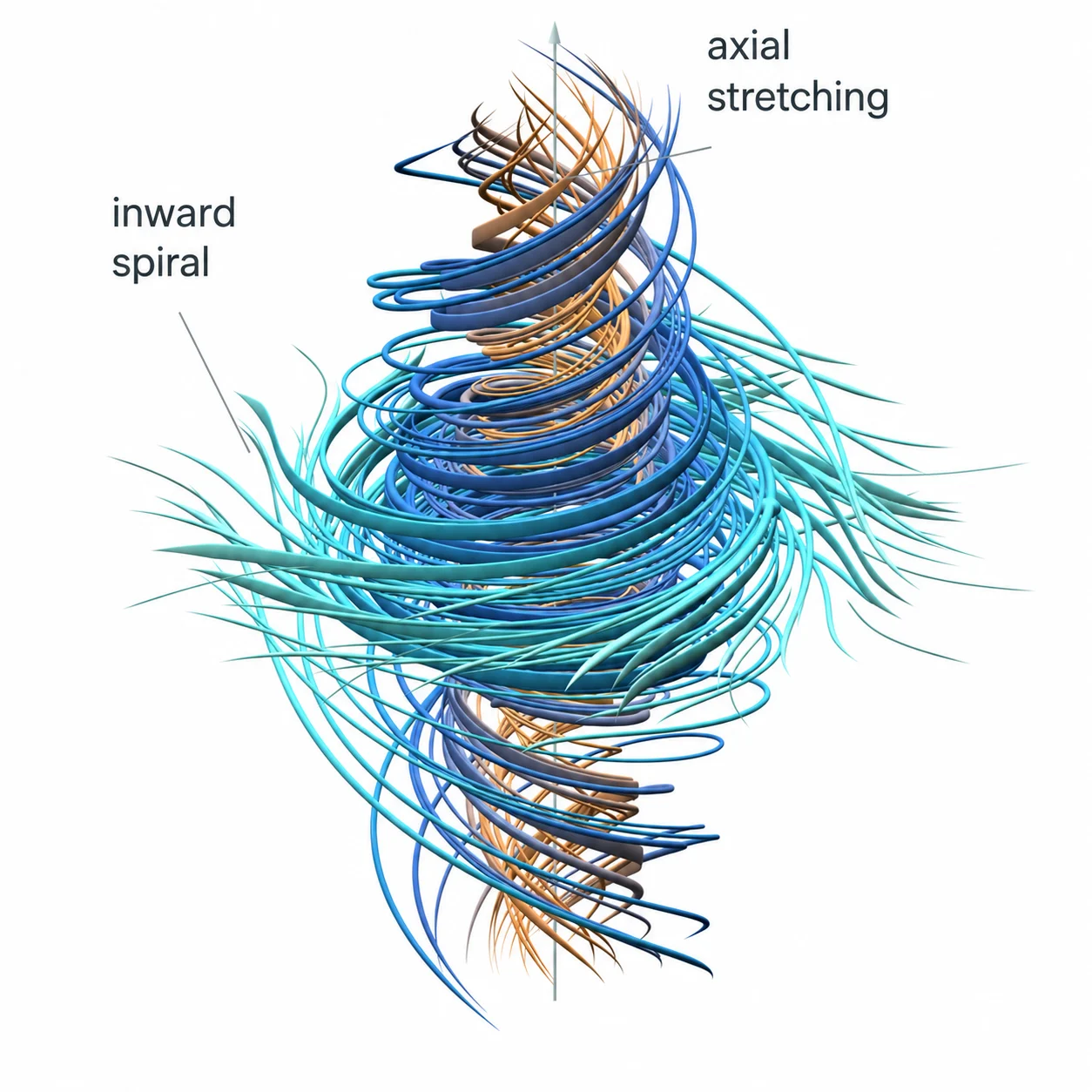
Our system produced an analytical proof and a Lean formalization that an initially smooth fluid at rest can develop a singularity in a finite time. The fluid has a smooth force applied to it, and its energy remains finite through the entire dynamics, from rest to the formation of the singularity. This resolves the Navier–Stokes Millennium Prize problem by establishing statement “C” (and also “D”) in the official Millennium Prize formulation(opens in a new window).The solution is a vortex, a spinning swirl of fluid, that spirals inward and gets increasingly elongated, like spaghetti. This central region shrinks while it speeds up in such a way that its energy still stays finite, as required by the laws of physics. The technical challenge is for the equations to develop the breakdown through the motion of the fluid itself, rather than, for example, us putting in an infinite force by hand. More mathematically, the terms in the Navier–Stokes equations that describe the motion—acceleration, pressure gradients, momentum transfer, viscosity—must both become big yet cancel in a precise way. This detailed balance leaves a smooth external force even as the velocity of the fluid grows without bound.
How we found the proof...
....MUCH MORE
Some of our posts referencing Navier-Stokes:
July 2019 - World Class Fisheries: Our Friend The Cod (and an amazing bit of research)
....note: If you are good at such things the Clay Mathematics Institute made the Navier-Stokes equations one of their Millennium Prize problems, solve it and pocket a million bucks:
Prove or give a counter-example of the following statement:
In three space dimensions and time, given an initial velocity field, there exists a vector velocity and a scalar pressure field, which are both smooth and globally defined, that solve the Navier–Stokes equations.
January 2020 - The Trouble With Turbulence
In the introduction to a post on fish and the Little Ice Age last July I mentioned how mind-bendingly complex fluid dynamics can be....
September 2021 - The intro to "Fluid Dynamics (and the filth on your phone)" was:
So anyone who can get a handle on what is actually going on with this stuff gives a whole 'nother meaning to the concept of smart....
September 2021 - Think You're Smart Don'tcha: Figure This Out And Make A Million Bucks":
In last week's post "Fluid Dynamics (and the filth on your phone)" I made the assertion "This is one of those fields of study that are so mind-bogglingly complex that....", without supplying any supporting statements or facts.(in these situations the reader can assume I am relying on the Charlie Munger all-purpose turnaround: "Think about it a little more and you will agree with me because you're smart and I'm right.")But for folks who require a bit of backup, here is Ars Technica, followed by the Clay Mathematics Institute, along with a cameo by Feynmann for added "Appeal to Authority":...
....At the Max-Planck-Gesellschaft:
The American Nobel Prize Laureate for Physics Richard Feynman once described turbulence as “the most important unsolved problem of classical physics”, because a description of the phenomenon from first principles does not exist. This is still regarded as one of the six most important problems in mathematics today....
***
...Turbulence, the oldest unsolved problem in physicsThe flow of water through a pipe is still in many ways an unsolved problem.Werner Heisenberg won the 1932 Nobel Prize for helping to found the field of quantum mechanics and developing foundational ideas like the Copenhagen interpretation and the uncertainty principle. The story goes that he once said that, if he were allowed to ask God two questions, they would be, “Why quantum mechanics? And why turbulence?” Supposedly, he was pretty sure God would be able to answer the first question.The quote may be apocryphal, and there are different versions floating around. Nevertheless, it is true that Heisenberg banged his head against the turbulence problem for several years.
His thesis advisor, Arnold Sommerfeld, assigned the turbulence problem to Heisenberg simply because he thought none of his other students were up to the challenge—and this list of students included future luminaries like Wolfgang Pauli and Hans Bethe. But Heisenberg’s formidable math skills, which allowed him to make bold strides in quantum mechanics, only afforded him a partial and limited success with turbulence....
***
One of the problems, The Poincaré Conjecture, was solved by Russian mathematician Grigori Perelman. He turned down the award and the million dollars. He has also turned down The Fields Medal, the highest award in mathematics.
The other six problems are still open, with the Navier–Stokes Equation being the object of our affection.
June 2023 - Follow-up To "Figure This Out And Make A Million Bucks..."
There is a lot more money involved than just the million dollars from the Millennium Prize for understanding fluid dynamics and turbulence. In the climate arena the coupled climate models are still not all that skillful when trying to comprehend the interactions of the sea and the atmosphere, a huge and extraordinarily complex part of the whole picture and not that well understood.
On a much smaller scale, understanding turbulence can be worth hundreds of millions to billions of dollars when siting turbines on a wind farm.....
June 2026 - Fluid Dynamics: A Glorious Day For Canada And Therefore The World

