Showing posts sorted by relevance for query pictet. Sort by date Show all posts

Sunday, May 16, 2021

"Inside the Secretive Swiss Bank for the World’s Richest People"

We used to think of Sarasin as being of the same quality, though 35 years younger and earlier to ESG, but since Safra took control they seem to be just another Swiss Bank.

From Bloomberg via Yahoo Finance:

In the mythology of private banking, Banque Pictet & Cie SA stands apart. Over the course of more than two centuries, the Swiss institution has discreetly tended to the assets of the very rich, led by a small crop of partners who form the most exclusive men-only club anywhere outside the Vatican.

In its entire history, only 43 individuals — all men, all white — have risen to the rank of Pictet managing partner, creating a bond more enduring than your typical marriage. From their Geneva perch, they oversee more than 600 billion francs ($662 billion) in assets under management and a level of profitability far beyond larger, publicly-listed peers, often rewarding each of them with more than 20 million francs a year.

But in recent years, an unsettling new trend crept into Pictet, cracking the façade of corporate cohesion: key employees began leaving. Over the course of 2019, a dozen long-tenured relationship managers at the wealth unit departed. Within days in September of that year, four leading bankers from the team looking after Russian clients handed in their resignations. Bankers for Scandinavia and Israel followed, putting billions in assets under management at stake.

At the heart of the exodus lies a culture clash. Longtime employees were bristling at the brash style of the flood of recent hires brought on to manage the money of the ultra rich, particularly the explosive growth of new wealth in Asia that has set off an aggressive race for assets and talent with bigger rivals like UBS Group AG and HSBC Holdings Plc.

Yet for others, change wasn’t happening fast enough; some newcomers who had signed up to the promise of the rejuvenated Pictet were departing again in frustration.

Interviews with a dozen people familiar with Pictet’s private-wealth arm reveal a business at a crossroads, confronted with the reality that, in order to stay ahead, Switzerland’s preeminent private bank must adapt. That means embracing more risk and changing the client relationship — away from the concierge-like approach that endured for generations toward a more transactional model.

That can be tough for employees accustomed to the principle of caution and secrecy that guided Pictet through the centuries. But change has also brought opportunity to rethink old habits and expand the bank on the global stage.

The people asked not to be identified discussing the bank’s inner workings. Pictet declined to comment for this story.

While overall attrition at Pictet Wealth Management stands at an all-time low of 2.8%, the evacuation of longtime talent has reverberated through the corridors of the five-story modernist headquarters. The departures startled the partners, who viewed the outflow as an assault on an institution priding itself in flat fluctuation. So late in 2019, they gathered in a spartan conference room for what the partners call their salon meeting to learn more about what was behind the defections.

Sitting in tiered formation at the large conference table, much in the same way they congregate several times a week to discuss the order of business, the men heard of tensions, a dispute over restraint and renewal rippling through the bank’s private wealth subsidiary.

“Pictet is in between two worlds,” says Pedro Araujo, a senior researcher at the University of Fribourg, who has studied Switzerland’s elite families. “They are in the old world of Geneva private bankers, and the new world of globalized finance, where they want to be present internationally, they want to grow, they want to present themselves as modern, but not too much. Two worlds that are on a collision course.”

For all its tradition, Pictet has become more attuned to change in recent years. The company transformed its legal status after the end of banking secrecy in 2014, disclosing more performance metrics as a result. One of its partners, Rémy Best, had already made his mark revamping the asset-management unit. Next, he turned his attention to the wealth division, long the beating heart of Pictet.

It turned out that the operation required fresh blood. And the bank found it in Boris Collardi, who performed one of the most audacious maneuvers in Swiss banking in 2018 when he abruptly left as CEO of Zurich private-banking nemesis Julius Baer and decamped to the shores of Lake Geneva to join Pictet.

On the face of it, Collardi is everything that the typical Pictet stakeholder is not. More bonvivant than ascetic financier, Collardi, 46, stands apart as the first outside partner in decades. He also brought serious star power and a dose of bonhomie to the Pictet franchise that values uniformity over individualism, down to the subdued color palette of the partners’ perfectly tailored suits.

Collardi, by contrast, is known to greet close colleagues with a hug or a peck on the cheek; in meetings, he is the first to take off his suit jacket and jokingly complains about having to wear a tie. His ascent to the Pictet partnership not only made him one of the youngest people in recent history to hold that title, it also tipped the scale for the first time to a majority of members in the group who aren’t descendants of the founding families.

In Collardi, the partners identified a peer who could pick up from Best, a longtime acquaintance who had introduced the new hire to the other partners. And Collardi was already well versed in Asia, where Pictet was keen to tap into an affluent class of newly minted billionaires preparing to pass on their wealth to the next generation.

But Collardi also had to adjust to the new reality of no longer being the undisputed leader. Instead, he is now one voice among seven, where every decision is made in unison. The weekly meetings are presided over by senior partner Renaud de Planta, who declined to comment for this story.

Given that the average tenure of an active partner is 20 years, collegial harmony is the glue that holds together the senior team. That hasn’t stopped Collardi from moving swiftly in his new role. Within a year, more than 100 of his loyalists had followed him to Pictet, including close to the complete teams for the Middle East and Latin America.

Collardi also accelerated an overhaul of the investment and trading platforms, replacing some of the longest-serving portfolio managers with investment advisers half their age.

By the end of 2020, Pictet's wealth bankers had swelled to 1,098 from 740 just five years earlier, an expansion not dissimilar to absorbing a full-blown acquisition.

The changes echo the overhaul that Collardi enacted at Julius Baer. Over the course of a decade, he turbo-charged the storied private bank, sending it on a breakneck expansion from Sao Paulo to Singapore, doubling assets under management as a result. But despite his meteoric rise, Collardi remained, by his own account at the time of the move, “only an employee.” Pictet, by contrast, offered a once-in-a-lifetime opportunity to become an entrepreneur with extra financial legroom but without the daily grind of running a publicly-listed company.

Making Pictet partner brings a stake in a steady business whose owners share in more than 500 million francs in annual profit. Up until a few years ago, the firm was so old-fashioned that managing partners were expected to be addressed as Notre Sieur, a formal French title for sire.

The challenge facing the partners is that in order to grow, they need to aggressively target Asia, the epicenter of wealth creation. But that requires the embrace of new — and potentially riskier — investment assets, chief among them structured products, which use derivatives to track the performance of an underlying asset....

....MUCH MORE

Friday, February 14, 2020

This Valentine's Day Get Her What She Really Wants: A Swiss Banker

Reposting without change.

League Table: Switzerland's Hottest Banker? (2019 edition)
I was not aware this was a feature of FinNews.ch.
I must say, we appear to have some of the same diversity issues that Sweden's SEB suffers from.

From FinNews (en):
Back by popular demand, finews.com presents the third edition Switzerland's most attractive bankers.
Is a list reducing men to their looks even appropriate in this day and age of #metoo and diversity awareness? finews.com underwent some soul-searching and concluded that the male-dominated banking industry in Switzerland itself still celebrates the beauty ideal – intensely so.
Luxury men’s designer Hackett enjoys prime Paradeplatz space and men's salons have shot up around the banking district: to be sure, bankers still preen with appearance, attire, and accessories. These Swiss banker beefcakes combine brains and intellectual brawn with ease on the eye – and the list is as subjective as it is tongue-in-cheek.

Without further ado, the finews.com hotties, in no particular order of hotness:
12. Saman Habibian, Pictet
Saman Habibian 500
One of Julius Baer’s top bankers for the Middle East, the Swiss native was among a raft of defections to Pictet this year. The Swiss native, who is fluent in Persian, began his career at Credit Suisse in Singapore – like new Pictet partner Boris Collardi. Habibian, who spent a total of eight years at Julius Baer, interrupted by a brief stint at Safra Sarasin, is credited with building Julius Baer’s business in Bahrain.
11. Marc Pictet, Pictet
Marc Pictet 500
The 46-year-old represents the eighth generation to govern the bank. Despite his relatively young age, Pictet represents the old-guard – not least because he bears the name of the family bank. The Geneva wealth manager has experienced considerable upheaval in recent months: Collardi has poached dozens of bankers, many from his former shop, Julius Baer; a long-standing employee was caught in an alleged embezzlement scheme; and Pictet is switching senior partners later this year, in what is viewed as a nod to the subtle power shift towards its asset managers. Marc Pictet, responsible for the Genevan firm’s offices in Basel, Frankfurt, Munich, Stuttgart, and Zurich, devotes some of his private time to a local wildlife conservation organization.
10. Ralph Ebert, BIL
ralph ebert 550
Like any good compliance banker, the German lawyer keeps his cards close to his chest. At Credit Suisse, Ebert coordinated the Swiss bank’s response to the FIFA and Petrobras scandals – and bedded down the lessons learned. Ebert just jumped from Indosuez to Banque Internationale de Luxembourg – his third job in as many years. He has spent the bulk of his career in Paris and Geneva, with stints in Zurich.
9. Nicolas Syz, Banque Syz
NicolasSyz 500
The 34-year-old son of Swiss banker Eric Syz had a huge year – as did his older (and equally appealing) brother, Marc Syz. The elder Syz had pegged both Nicolas and Marc for leadership roles in a succession-related revamp last year. Then this year, Nicolas was vaulted to the helm of wealth management at Syz, which his father founded in 1996. The Swiss bank is now a family affair: mother Suzanne Syz, a jewelry designer, joined its board earlier this year amid takeover speculation. Whether Nicolas or Marc – or neither – make the grade to take over from Eric Syz is unclear. Nicolas is playing is cool: «There is no clear road map for succession,» he told a Swiss daily last year....
....MUCH MORE

Tuesday, December 24, 2024

This Holiday Season Get Her What She Really Wants: A Swiss Banker

Repurposed from "League Table: Switzerland's Hottest Banker? (2019 edition)".

I was not aware this was a feature of FinNews.ch.
I must say, we appear to have some of the same diversity issues that Sweden's SEB suffers from.

From FinNews (en):
Back by popular demand, finews.com presents the third edition Switzerland's most attractive bankers.

Is a list reducing men to their looks even appropriate in this day and age of #metoo and diversity awareness? finews.com underwent some soul-searching and concluded that the male-dominated banking industry in Switzerland itself still celebrates the beauty ideal – intensely so.
Luxury men’s designer Hackett enjoys prime Paradeplatz space and men's salons have shot up around the banking district: to be sure, bankers still preen with appearance, attire, and accessories. These Swiss banker beefcakes combine brains and intellectual brawn with ease on the eye – and the list is as subjective as it is tongue-in-cheek.

Without further ado, the finews.com hotties, in no particular order of hotness:
12. Saman Habibian, Pictet
Saman Habibian 500
One of Julius Baer’s top bankers for the Middle East, the Swiss native was among a raft of defections to Pictet this year. The Swiss native, who is fluent in Persian, began his career at Credit Suisse in Singapore – like new Pictet partner Boris Collardi. Habibian, who spent a total of eight years at Julius Baer, interrupted by a brief stint at Safra Sarasin, is credited with building Julius Baer’s business in Bahrain.
11. Marc Pictet, Pictet
Marc Pictet 500
The 46-year-old represents the eighth generation to govern the bank. Despite his relatively young age, Pictet represents the old-guard – not least because he bears the name of the family bank. The Geneva wealth manager has experienced considerable upheaval in recent months: Collardi has poached dozens of bankers, many from his former shop, Julius Baer; a long-standing employee was caught in an alleged embezzlement scheme; and Pictet is switching senior partners later this year, in what is viewed as a nod to the subtle power shift towards its asset managers. Marc Pictet, responsible for the Genevan firm’s offices in Basel, Frankfurt, Munich, Stuttgart, and Zurich, devotes some of his private time to a local wildlife conservation organization.
10. Ralph Ebert, BIL
ralph ebert 550
Like any good compliance banker, the German lawyer keeps his cards close to his chest. At Credit Suisse, Ebert coordinated the Swiss bank’s response to the FIFA and Petrobras scandals – and bedded down the lessons learned. Ebert just jumped from Indosuez to Banque Internationale de Luxembourg – his third job in as many years. He has spent the bulk of his career in Paris and Geneva, with stints in Zurich.
9. Nicolas Syz, Banque Syz
NicolasSyz 500
The 34-year-old son of Swiss banker Eric Syz had a huge year – as did his older (and equally appealing) brother, Marc Syz. The elder Syz had pegged both Nicolas and Marc for leadership roles in a succession-related revamp last year. Then this year, Nicolas was vaulted to the helm of wealth management at Syz, which his father founded in 1996. The Swiss bank is now a family affair: mother Suzanne Syz, a jewelry designer, joined its board earlier this year amid takeover speculation. Whether Nicolas or Marc – or neither – make the grade to take over from Eric Syz is unclear. Nicolas is playing is cool: «There is no clear road map for succession,» he told a Swiss daily last year....
....MUCH MORE

Friday, December 16, 2022

This Holiday Season Get Her What She Really Wants: A Swiss Banker

Repurposed from "League Table: Switzerland's Hottest Banker? (2019 edition)".

I was not aware this was a feature of FinNews.ch.
I must say, we appear to have some of the same diversity issues that Sweden's SEB suffers from.

From FinNews (en):
Back by popular demand, finews.com presents the third edition Switzerland's most attractive bankers.

Is a list reducing men to their looks even appropriate in this day and age of #metoo and diversity awareness? finews.com underwent some soul-searching and concluded that the male-dominated banking industry in Switzerland itself still celebrates the beauty ideal – intensely so.
Luxury men’s designer Hackett enjoys prime Paradeplatz space and men's salons have shot up around the banking district: to be sure, bankers still preen with appearance, attire, and accessories. These Swiss banker beefcakes combine brains and intellectual brawn with ease on the eye – and the list is as subjective as it is tongue-in-cheek.

Without further ado, the finews.com hotties, in no particular order of hotness:
12. Saman Habibian, Pictet
Saman Habibian 500
One of Julius Baer’s top bankers for the Middle East, the Swiss native was among a raft of defections to Pictet this year. The Swiss native, who is fluent in Persian, began his career at Credit Suisse in Singapore – like new Pictet partner Boris Collardi. Habibian, who spent a total of eight years at Julius Baer, interrupted by a brief stint at Safra Sarasin, is credited with building Julius Baer’s business in Bahrain.
11. Marc Pictet, Pictet
Marc Pictet 500
The 46-year-old represents the eighth generation to govern the bank. Despite his relatively young age, Pictet represents the old-guard – not least because he bears the name of the family bank. The Geneva wealth manager has experienced considerable upheaval in recent months: Collardi has poached dozens of bankers, many from his former shop, Julius Baer; a long-standing employee was caught in an alleged embezzlement scheme; and Pictet is switching senior partners later this year, in what is viewed as a nod to the subtle power shift towards its asset managers. Marc Pictet, responsible for the Genevan firm’s offices in Basel, Frankfurt, Munich, Stuttgart, and Zurich, devotes some of his private time to a local wildlife conservation organization.
10. Ralph Ebert, BIL
ralph ebert 550
Like any good compliance banker, the German lawyer keeps his cards close to his chest. At Credit Suisse, Ebert coordinated the Swiss bank’s response to the FIFA and Petrobras scandals – and bedded down the lessons learned. Ebert just jumped from Indosuez to Banque Internationale de Luxembourg – his third job in as many years. He has spent the bulk of his career in Paris and Geneva, with stints in Zurich.
9. Nicolas Syz, Banque Syz
NicolasSyz 500
The 34-year-old son of Swiss banker Eric Syz had a huge year – as did his older (and equally appealing) brother, Marc Syz. The elder Syz had pegged both Nicolas and Marc for leadership roles in a succession-related revamp last year. Then this year, Nicolas was vaulted to the helm of wealth management at Syz, which his father founded in 1996. The Swiss bank is now a family affair: mother Suzanne Syz, a jewelry designer, joined its board earlier this year amid takeover speculation. Whether Nicolas or Marc – or neither – make the grade to take over from Eric Syz is unclear. Nicolas is playing is cool: «There is no clear road map for succession,» he told a Swiss daily last year....
....MUCH MORE

Thursday, February 11, 2021

This Valentine's Day Get Her What She Really Wants: A Swiss Banker

Reposting without change.

League Table: Switzerland's Hottest Banker? (2019 edition)
I was not aware this was a feature of FinNews.ch.
I must say, we appear to have some of the same diversity issues that Sweden's SEB suffers from.

From FinNews (en):
Back by popular demand, finews.com presents the third edition Switzerland's most attractive bankers.

Is a list reducing men to their looks even appropriate in this day and age of #metoo and diversity awareness? finews.com underwent some soul-searching and concluded that the male-dominated banking industry in Switzerland itself still celebrates the beauty ideal – intensely so.
Luxury men’s designer Hackett enjoys prime Paradeplatz space and men's salons have shot up around the banking district: to be sure, bankers still preen with appearance, attire, and accessories. These Swiss banker beefcakes combine brains and intellectual brawn with ease on the eye – and the list is as subjective as it is tongue-in-cheek.

Without further ado, the finews.com hotties, in no particular order of hotness:
12. Saman Habibian, Pictet
Saman Habibian 500
One of Julius Baer’s top bankers for the Middle East, the Swiss native was among a raft of defections to Pictet this year. The Swiss native, who is fluent in Persian, began his career at Credit Suisse in Singapore – like new Pictet partner Boris Collardi. Habibian, who spent a total of eight years at Julius Baer, interrupted by a brief stint at Safra Sarasin, is credited with building Julius Baer’s business in Bahrain.
11. Marc Pictet, Pictet
Marc Pictet 500
The 46-year-old represents the eighth generation to govern the bank. Despite his relatively young age, Pictet represents the old-guard – not least because he bears the name of the family bank. The Geneva wealth manager has experienced considerable upheaval in recent months: Collardi has poached dozens of bankers, many from his former shop, Julius Baer; a long-standing employee was caught in an alleged embezzlement scheme; and Pictet is switching senior partners later this year, in what is viewed as a nod to the subtle power shift towards its asset managers. Marc Pictet, responsible for the Genevan firm’s offices in Basel, Frankfurt, Munich, Stuttgart, and Zurich, devotes some of his private time to a local wildlife conservation organization.
10. Ralph Ebert, BIL
ralph ebert 550
Like any good compliance banker, the German lawyer keeps his cards close to his chest. At Credit Suisse, Ebert coordinated the Swiss bank’s response to the FIFA and Petrobras scandals – and bedded down the lessons learned. Ebert just jumped from Indosuez to Banque Internationale de Luxembourg – his third job in as many years. He has spent the bulk of his career in Paris and Geneva, with stints in Zurich.
9. Nicolas Syz, Banque Syz
NicolasSyz 500
The 34-year-old son of Swiss banker Eric Syz had a huge year – as did his older (and equally appealing) brother, Marc Syz. The elder Syz had pegged both Nicolas and Marc for leadership roles in a succession-related revamp last year. Then this year, Nicolas was vaulted to the helm of wealth management at Syz, which his father founded in 1996. The Swiss bank is now a family affair: mother Suzanne Syz, a jewelry designer, joined its board earlier this year amid takeover speculation. Whether Nicolas or Marc – or neither – make the grade to take over from Eric Syz is unclear. Nicolas is playing is cool: «There is no clear road map for succession,» he told a Swiss daily last year....
....MUCH MORE

Friday, February 7, 2020

League Table: Switzerland's Hottest Banker? (2019 edition)

I was not aware this was a feature of FinNews.ch.
I must say, we appear to have some of the same diversity issues that Sweden's SEB suffers from.

From FinNews (en):
Back by popular demand, finews.com presents the third edition Switzerland's most attractive bankers.
Is a list reducing men to their looks even appropriate in this day and age of #metoo and diversity awareness? finews.com underwent some soul-searching and concluded that the male-dominated banking industry in Switzerland itself still celebrates the beauty ideal – intensely so.
Luxury men’s designer Hackett enjoys prime Paradeplatz space and men's salons have shot up around the banking district: to be sure, bankers still preen with appearance, attire, and accessories. These Swiss banker beefcakes combine brains and intellectual brawn with ease on the eye – and the list is as subjective as it is tongue-in-cheek.

Without further ado, the finews.com hotties, in no particular order of hotness:
12. Saman Habibian, Pictet
Saman Habibian 500
One of Julius Baer’s top bankers for the Middle East, the Swiss native was among a raft of defections to Pictet this year. The Swiss native, who is fluent in Persian, began his career at Credit Suisse in Singapore – like new Pictet partner Boris Collardi. Habibian, who spent a total of eight years at Julius Baer, interrupted by a brief stint at Safra Sarasin, is credited with building Julius Baer’s business in Bahrain.
11. Marc Pictet, Pictet
Marc Pictet 500
The 46-year-old represents the eighth generation to govern the bank. Despite his relatively young age, Pictet represents the old-guard – not least because he bears the name of the family bank. The Geneva wealth manager has experienced considerable upheaval in recent months: Collardi has poached dozens of bankers, many from his former shop, Julius Baer; a long-standing employee was caught in an alleged embezzlement scheme; and Pictet is switching senior partners later this year, in what is viewed as a nod to the subtle power shift towards its asset managers. Marc Pictet, responsible for the Genevan firm’s offices in Basel, Frankfurt, Munich, Stuttgart, and Zurich, devotes some of his private time to a local wildlife conservation organization.
10. Ralph Ebert, BIL
ralph ebert 550
Like any good compliance banker, the German lawyer keeps his cards close to his chest. At Credit Suisse, Ebert coordinated the Swiss bank’s response to the FIFA and Petrobras scandals – and bedded down the lessons learned. Ebert just jumped from Indosuez to Banque Internationale de Luxembourg – his third job in as many years. He has spent the bulk of his career in Paris and Geneva, with stints in Zurich.
9. Nicolas Syz, Banque Syz
NicolasSyz 500
The 34-year-old son of Swiss banker Eric Syz had a huge year – as did his older (and equally appealing) brother, Marc Syz. The elder Syz had pegged both Nicolas and Marc for leadership roles in a succession-related revamp last year. Then this year, Nicolas was vaulted to the helm of wealth management at Syz, which his father founded in 1996. The Swiss bank is now a family affair: mother Suzanne Syz, a jewelry designer, joined its board earlier this year amid takeover speculation. Whether Nicolas or Marc – or neither – make the grade to take over from Eric Syz is unclear. Nicolas is playing is cool: «There is no clear road map for succession,» he told a Swiss daily last year.
8. David Schmid, Leonteq
David Schmid 500
The 37-year-old has quietly advanced to one of the structured product boutique’s most valuable players. Long a close associate of co-founder Jan Schoch, Schmid was part of Leonteq’s go-go years – and survived its fall to earth. He spent two years during Leonteq’s most tumultuous period in Singapore, building up the company’s Asia business. He returned in 2017, just in time to join top management as investment solutions head. His importance to the newly-chastened firm is underscored by his 2.7 million Swiss franc ($2 million) payday last year – more than CEO Lukas Ruflin (a major shareholder, Ruflin also earns dividends) took home.
7. Yves Robert-Charrue, Julius Baer
Yves Robert Charrue 515
The 46-year-old has not had a great year: he was passed over when Philipp Rickenbacher shocked the Swiss banking guild by winning the top Julius Baer job last week. The father of two and married to a lawyer, Robert-Charrue has had the somewhat thankless job of running Europe for the last three years. The region accounts for roughly one-quarter of the wealth manager’s assets, but is not exactly a growth market for the bank. The biggest projects launched by Robert-Charrue, a musician who plays guitar and piano, are Germany and the U.K, where he has the go-ahead to pour money into hiring sprees. The payoff is as yet uncertain....
....MORE

And where, you ask, is the Sarasin contingent?
Apparently after the acquisition by Safra they canned all the male models. 

Wednesday, December 11, 2013

Pictet: Equities Should Continue To Outperform

From Brian Bollen's blog:

Equities Should Continue To Outperform: Pictet
Luca Paolini, chief strategist at Pictet Asset Management, explains why equities should continue to outperform 

“An improvement in global economic conditions should eclipse concerns over the looming withdrawal of US monetary stimulus, and lend support to equity markets heading into year-end, traditionally a favourable period for stocks. We therefore maintain our overweight stance on stocks and stick to our underweight position on bonds. “The outlook for bonds is less encouraging. With the US Federal Reserve about to shift to a less expansionary monetary policy and with inflationary pressures unlikely to ease any further, the scope for gains in government bonds is limited. In our regional portfolio, we continue to prefer emerging market equities and Japanese stocks. In emerging markets, valuations are especially compelling as stocks are trading at a 24% discount to their developed counterparts on a price-earnings basis.

“Our preferred markets are China and Russia, where valuations are especially attractive....MORE
See also:

Pictet December 2013: More Than You Ever Wanted To Know About Swiss Competitiveness
Geneva in the early 19th century - Jean Dubois, 1830, Pictet Art Collection
Geneva in the early 19th century Jean Dubois, 1830, Pictet Art Collection

From True Economics:
Reading Pictet's latest monthly, covering the topic of Swiss competitiveness... it is awesome - with interviews from academics, watchmakers, artists, museums directors, company that makes engines for Mars rovers, biotech giant, and so on....
True E. didn't have a link so here's perspectives.pictet (64 page PDF)

Tuesday, October 13, 2015

Carlyle and Banque Pictet Hook Up For Art Financing Action

From the Financial Times, Oct. 7:

Carlyle and Banque Pictet sketch out big returns from art market
Carlyle and Banque Pictet are creating a venture to provide financing to the art market as private equity groups reach into fresh corners of the financial world in their quest to generate high returns. 
Despite the multitrillion-dollar size of the art market, only Sotheby’s and some private banks are in the business of providing loans to collectors, whose art provides debt collateral. Carlyle hopes it can shake-up the economics of the art market, even with the small size of the money being committed. 
The start up, Athena Art Finance, will have $280m in equity capital as well as bank credit lines that will enable Carlyle and Pictet to leverage the equity multiple times. Athena will offer loans of up to 50 per cent of the value of the art from dozens of painters who meet certain criteria. The company will then package the loans and distribute them in the market, taking a profit in the process. 
Carlyle and its partners hope that wealthy families, pension funds and sovereign wealth funds will be attracted by yields that are potentially higher than those in the fixed income market. Many private banks advise clients to keep a portion of their wealth in art, claiming that art can hold its value at times of economic dislocation. While the value of art in the world amounts to trillions of dollars, the size of the art lending market is only about $7bn, according to data Carlyle has collected. 
“We will drive the institutionalisation of this huge market. By introducing more liquidity to the market, we think the cost of capital for these assets will go down and the value will go up,” said Oliver Sarkozy, who is in charge of Carlyle’s latest $1bn Global Financial Services Fund, which is making the investment in Athena. “Leverage generally means asset prices inflate.”...MORE
Blow me a bubble M. Sarkozy.

Previously on Art as a business:


See also our series on Duveen.

And on Pictet, Nov. 13, 2013:
...As noted in one of our Wegelin posts:
...I think that leaves Banque J.P. Hottinguer & Cie's successor-Banque Hottinger & Cie as the oldest or at least the oldest family-owned bank in Switzerland.
Here's the Henokeins Association of most of the world's oldest family businesses, it looks like Hottinguer nudges out Lombard Odier by a decade and Pictet by 19 years.

So now we figure out who sells and who buys.
Swiss Private Bank Pictet Making Money in the Water Biz (XYL; DHR)

And quite a few more.

Tuesday, June 2, 2020

Pictet's Twist On ESG: Investing in Family Controlled Public Companies

Pictet are one of the class acts of the private bank biz.
We used to say the same about Sarasin before Safra bought them but don't really follow the numbers anymore.

At minimum Pictet's idea seems like a smart screen for getting everyone's interests aligned.
I haven't seen the performance figures to comment further though.

May 2020:
Family businesses: Insights on an attractive investment prospect
Pictet-Family – Fund manager interview

Pictet Asset Management has developed a new investment strategy that invests in listed family businesses, companies that count founding families as major shareholders.
The portfolio is a repositioning of the Pictet-Small Cap Europe fund and is managed by Cyril Benier and Alain Caffort.
In this Q&A, they discuss the strategy’s guiding philosophy.

What exactly is a family business?
How you define a family business is a matter of interpretation. Sometimes it’s obvious, say when founders hold very large stakes in their own names. But the boundaries can sometimes be blurred. We take a systematic and rigorous approach to our definition. Family businesses that make up our investment universe are public companies in which an individual or family holds a minimum of 30 per cent of voting rights. The family can be by blood or marriage, the stake can be held through a foundation or some other vehicle. Such information is rarely freely available; unearthing it often requires painstaking research.

Why 30 per cent?
Research shows that active participation in the general assemblies of publicly listed companies averages around 60 per cent of share ownership. At 30 per cent, a shareholder (or group of closely tied shareholders) effectively has the casting vote and, thus, control.

Why focus on family businesses?
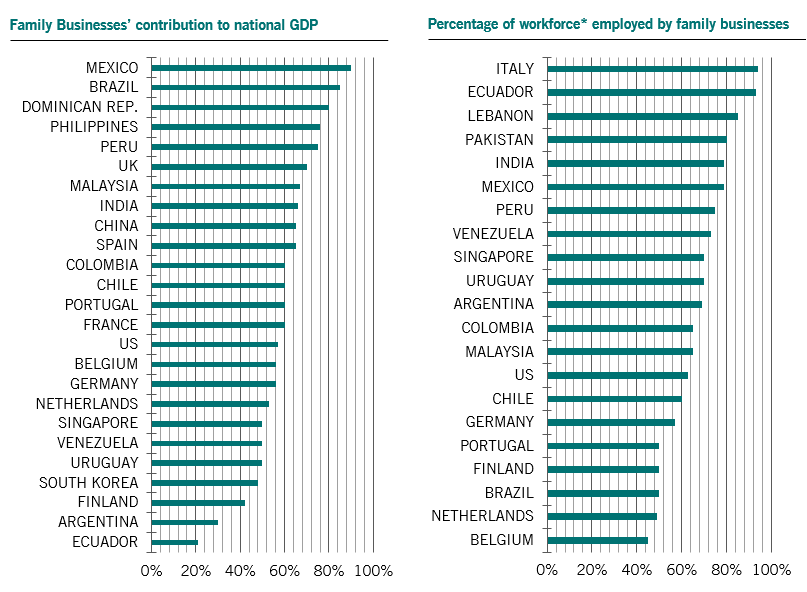
Family businesses are the lifeblood of our society and the backbone of the global economy. They contribute between 50 per cent and 70 per cent of countries’ gross domestic product and employ the majority of their workforces. 
GBPEmployment.png
Source: Tharawat Magazine, Economic Impact of Family Businesses – A Compilation of Facts, 06/01/2016 
– over 40 sources used including IMD and KPMG *Data representative of private employers only 
There’s a large body of research showing family businesses tend to outperform their peers – financially and in terms of shareholder returns.
Of course, as anyone with experience of families and family disputes knows, this type of ownership can also lead to a number of problems – which is why it is also crucial to take an active approach to investing in these companies. And that’s where we can make a difference – ensuring we avoid the pitfalls in this otherwise attractive investment landscape. Please read our related article on the universe for more about why it makes sense to invest in family businesses with an active approach.

This suggests corporate governance is a big focus for you, is that right?
Environmental, social and governance (ESG) factors are all important sources of investment performance. But when it comes to investing in family businesses, governance is key. That’s because governance is intrinsic to a company’s overall values and culture....
....MUCH MORE

Sunday, August 4, 2024

Pictet's Chief Strategist, Luca Paolini In Conversation With The Trade

Mr. Paolini is Chief Strategist  at Pictet Asset Management (Pictet AM), a position he has held since 2012.

From The Trade, August 2:

Fireside Friday with… Pictet Asset Management’s Luca Paolini
The TRADE sits down with Luca Paolini, chief strategist at Pictet Asset Management, to discuss the key themes that impact strategies recommended to investors, how these strategies are executed by traders, and the impact of the current macro landscape.

How are you seeing traders execute the strategies that you are recommending?

The next five years will deliver an economic environment that will alter the dynamics of equity, bond and foreign exchange in several ways. Equities will struggle to repeat their stellar performance of the past few years. In absolute terms, stocks in the MSCI World Index will generate a reasonable return of some 7% per year in local currency terms over the next five years.

But relative to corporate bonds, our calculations show they will deliver an excess of return of just 1% per year versus around 10% over the past five years – and this for roughly two times the risk. This means fixed income will offer a more favourable risk-adjusted return than stocks. Investors should, then, allocate more to fixed income and especially corporate bonds. We think the dispersion of returns across regional and national equity market will fall. Equity investors, therefore, may find it more rewarding to invest along sectoral or thematic lines. The foreign exchange market will be defined by a steady but persistent depreciation of the US dollar. On a trade-weighted basis, we expect a decline of some 2% per year through to 2029. Assets that are negatively correlated to the dollar should account for a larger share of portfolios.

What are the key macro themes that impact the strategies you are recommending to investors?....

....MUCH MORE

Thursday, May 2, 2013

Swiss Private Bank Pictet Making Money in the Water Biz (XYL; DHR)

From Bloomberg:
Swiss Bank Pictet’s Water Fund Boosted by Mideast Shortage
Swiss bank Pictet & Cie.’s water fund is profiting from the Middle East’s need to buy the technology to make more seawater drinkable as companies such as Xylem Inc. (XYL) and Danaher Corp. (DHR) step up business in the region.

“The companies that we are invested in are doing more business in the Middle East,” Hans-Peter Portner, manager of the Pictet Asset Management SA’s fund, said in an interview in Abu Dhabi. “They’re selling pumps, they’re selling membranes. The region is definitely a growth market for water companies.”

Arid Middle Eastern states including the United Arab Emirates, of which Abu Dhabi is the capital, rely on treatment plants to remove salt from seawater to make it drinkable. The region is estimated to need $900 billion in water infrastructure investment through 2030, Portner said April 22. Saudi Arabia spent $1.1 billion in 2012 on 128 water and sanitation contracts in Riyadh, whose population reached about 5.2 million last year.

Pictet, the first asset management company to start such a fund in 2000, invests in publicly traded companies in the $500 billion water industry. U.S. water technology companies Danaher, Xylem and Roper are among the 10 biggest holdings in the 2.3 billion-euro fund, accounting for 6.7 percent of the total. It’s gained about 10 percent this year, according to Bloomberg data.

Hurricane Sandy
Xylem, the ITT Corp. (ITT) spinoff whose pumps helped clear New York tunnels of floodwaters after Hurricane Sandy, said in January that it was planning to expand its business in the region by opening an office in Saudi Arabia. Danaher, which makes microscopes in addition to water-treatment systems, opened a regional headquarters in Dubai in 2011....MORE

Saturday, January 19, 2013

"Pictet On The Sudden Depreciation Of The Swiss Franc"

As we saw a couple weeks ago, with the fall of Wegelin & Co, Pictet is now Switzerland's third oldest bank.

From ZeroHedge:
Via Pictet,

Following the recent fall of the Swiss franc against the euro, there were paradoxical comments on the opportunity on both moving the Swiss National Bank’s floor lower (say to 1.25 for example) or on abandoning it altogether (or moving it higher). We believe both options are very unlikely, at least in the coming months. Moving the floor lower would be a bad idea in our view. As we have seen, the extent of the franc’s overvaluation is quite debatable and the lower the floor, the quicker a monetary policy dilemma may emerge. Moreover, in the event renewed upward pressures on the franc occur once again, a lower floor may prove more costly in terms of FX interventions. In any case, the SNB was relatively clear recently in saying that it has no plan to move the floor.

On the other hand, now that the euro is far higher than 1.20 francs, it could look tempting for the SNB to take the opportunity to simply abandon the floor. However, this would be quite a risky bet. As mentioned below, a new bout of the euro crisis may break out at some stage or another over the coming months, propelling the franc sharply higher once again. Then what would the SNB do? Reset a floor? In short, by abandoning the floor already now, the SNB would be playing dangerously with its credibility. In our view, we continue to believe the floor might be abandoned (or possibly raised substantially) at some stage, but most likely not before next year.

The franc has weakened sharply against the euro this year
Over the past week or so, the Swiss franc suddenly weakened significantly against the single currency, reaching almost CHF1.255 per euro, its lowest level since May 2011. Behind the scene, this sudden decline was linked to a further substantial reduction in the systemic risk associated with the euro crisis and the widespread practice of charging penalty rates on CHF deposits. However, the short-term trigger of the CHF fall was clearly last week’s surprisingly “not-so-dovish” ECB press conference.

#ccc;" />

What to expect for the future?

The first thing to keep in mind is that the stability that prevailed on the EUR/CHF during most of last year lies in the fact that the SNB had to sell huge amounts of francs. According to our rough estimates, between mid-May and mid-September 2012, SNB FX interventions reached a massive CHF190bn. A good part of the money invested in the franc during that period was probably “hot money” seeking protection from a potential euro breakup. This means that potentially substantial amounts may leave the franc if the euro area systemic risk is reduced further. Moreover, short-covering probably played a significant role in the franc’s recent downward move and this may continue, at least in the short run. The consequence is that it is extremely difficult to figure out up to what point the recent appreciation of the euro against the franc will go in the short run, but we believe the move may well extend further for a while....MORE

Wednesday, April 11, 2018

Pictet's House View April 2018

A bit generic but some worthwhile nuggets.
From Pictet, April 10:

Pictet Wealth Management's latest positioning across asset classes and investment themes.
Asset Allocation
  • While macroeconomic and corporate fundamentals still favour risk assets, challenges have been steadily increasing and a lot of good news is already priced into valuations. We sold part of our equity overweight during the early March rally.
  • Even though we have become more prudent about equities’ short-term prospects, we expect to be able to redeploy the cash generated from this sale as new opportunities arise.
  • The rise in volatility was fully expected but emphasises the need for caution. We are closely monitoring the market’s perceptions of the competitive and regulatory risks emerging for the small number of high-growth tech stocks that have led market performance.
  • We remain optimistic about select parts of the US high-yield universe (less so euro high yield), with a particular emphasis on bond issuers in the upper reaches (BB) of the non-investment-grade ratings scale.
Commodities
  • Recent rises in oil prices will contribute to higher headline inflation until the middle of this year. Having reached around USD65 (our price equilibrium), there are signs the oil market may be moving toward oversupply....
...MORE

Sunday, October 13, 2019

Spear's Asks: "The Death of Europe?"

They had me at Pictet. And the pic of the Google office reminded me of the time I saw a Blockbuster Video in a re-purposed movie theater.
Not so sure about steepling but, what the hell, let's go with it.

From Spear's Magazine, October 7:

With steepling debt, low growth and more headwinds on the way, has Europe entered an economic ‘doom-loop’? Spear’s scrambles reporters across the continent to find out
Cast your mind back to 1980. Reagan beats Carter and Mrs Thatcher’s not for turning, while Blondie, Bowie and Lennon top the charts. The global economy looks different, too. The GDPs of the US and what we now recognise as the eurozone are level-pegging at roughly $3 trillion each.

Then something happened. Europe fell behind. ‘The eurozone missed, at a macro-economic level, three investment cycles,’ explains Christophe Donay, head of asset allocation and macroeconomic research at Swiss wealth manager Pictet. In the Nineties, the 2000s and the 2010s, the American economy made great leaps forward, riding waves of technology-powered growth. From the dotcom boom to the sustained success of Apple and Amazon, the US has been leading the way. ‘Where is Motorola or Ericsson now?’ French-born Donay asks. ‘These companies are dead. Where is the European Google?’
https://www.spearswms.com/wp-content/uploads/2019/10/Europe-pic-3.jpg 
Google office on, Barrow Street, Dublin. Photo credit:  Ian Paterson
Today the US economy stands at $22 trillion. The eurozone’s, however, trails at about $13 trillion.
When Donay sits down with Spear’s at Pictet’s London office, a stone’s throw from the Ritz, he explains that Europeans already have 70 per cent less disposable income per capita than their American cousins. European growth trails behind too, trending at about half of the States’ respectable2-3 per cent. What’s more, European unemployment is higher at 7.5 per cent, compared to 3.6 per cent in the US.

‘As a consequence, in Europe, we have rising populism,’says Donay glumly. People are ‘afraid of inequality’ and the future for their children looks grim. In his view, the likely outcome is that populist government policy will stymie European growth further. And that’s without considering the impact of their debts. ‘All these trends are fully integrated: economic trends, asset class trends.’ Unsurprisingly he advises clients in Europe to ‘diversify geographically into US dollar assets.’
The ultimate result could well be a vicious cycle of economic decline: a doom-loop, if you will. ‘Europe is deteriorating and going to a potential break-up,’ Donay predicts.‘We are not in the break-up yet, but it’s just a matter of time.
★ ★ ★
A short hop away on the Eurostar, Spear’s arrives in Paris to test Donay’s grim thesis. Here they are hoping to build anew generation of technology-driven businesses at the world’s biggest ‘start-up campus’, Station F. Backed by French telecoms billionaire Xavier Niel, this converted 34,000-square-metre former freight depot in the sleepy 13th arrondissement is something to behold....
...MUCH MORE

If interested, September's "Station F: A symbol of France's startup ambitions" has some good links.

We haven't done much with the Berlin scene in a while, partly because I still get a Weimar feel from it, but with hipsters (granted - a few years ago) instead of Isherwood but still...
Here's "Venture Capital: Why Berlin Needs More Local VC's"

And a few pokes at Rocket Internet but mainly more mid - decade cultural stuff:
"How Hipsters Ruined Berlin"
Brexit: "Berlin to Send Back Thousands of British Hipsters"
Angela Merkel confirmed that British hipsters would be expelled post-Brexit as they have little to offer Germany except basic website design skills and minimal techno club nights.
She said: “We cannot be expected to support thousands of aspiring musicians and bloggers with names like ‘DJ Leo Fukk’ and ‘Tufty’.
“They are nice enough but utterly useless. We have plenty of local young people who can serve cocktails in a surly way.”...MORE
The Berlin hipster scene is already on the downslope and the crowd is moving on. In a few years those that remain will be like the bright young demimondaine who came to Berlin in 1924 to catch the big party after the hyperinflation and overstayed. A decade later, if they were still alive, 10 years aging  looking like 20 and dealing cocaine to pay for their habits, they were too wrapped up in self to pay attention to the coming inferno.

https://s-media-cache-ak0.pinimg.com/736x/15/4b/78/154b78da45234ad931f1bf1a26e2b3c6.jpg
2017's "What Do Germans Think of the Juicero?": was pretty funny:
It's come to this, the Germans are making jokes, JOKES, at Silicon Valley's expense....

Wednesday, May 5, 2010

"Pictet Clean Energy Fund Finds Value in Cree’s LEDs" (CREE)

We are fans.
The stock is opening down $2.10 at $69.62.
From Bloomberg:
Ask Pictet Clean Energy Fund manager Philippe de Weck where he finds investment value in a world more concerned about the economic recession than reducing emissions and the short answer is in technology pioneers.

LEDs, or energy-efficient light-emitting diodes, shine in de Weck’s investment universe as they are “ultimately how we are going to light the world,” he said in an interview at Pictet & Cie’s headquarters in Geneva. “Cree is really at the cutting edge of the LED chip technology.”

Cree Inc., based in Durham, North Carolina, is the fund’s largest holding among LED developers and has more than doubled in the last 12 months as demand grows for lighting that saves on power bills while generating fewer greenhouse-gas emissions.

De Weck’s fund returned 32 percent in the year ended May 3, a “respectable” performance for a “volatile sector” that beat more than half his peers when adjusted for currency moves, Ben Guest, chief executive officer of the clean-tech investment manager Hazel Capital LLP in London, said in a phone interview.

By comparison, the benchmark WilderHill New Energy Global Innovation Index gained 6 percent in the same period, while the SAM Smart Energy Fund advanced 53 percent. De Weck’s performance was held back by Iberdrola Renovables SA, the biggest wind parks owner and his largest holding, which dropped 8.9 percent.

Most clean energy shares have suffered since the United Nations global warming talks stalled in Copenhagen in December and as President Barack Obama’s administration debates the shape of legislation aimed at cutting U.S. greenhouse gas emissions.

Fund Holdings

De Weck’s favored holdings for his Luxembourg-based mutual fund, which has about $750 million under management, include Clean Energy Fuels Corp., a Seal Beach, California-based operator of natural-gas fuel stations, and Westport Innovations Inc., a Vancouver developer of natural gas engine technology.

“You can really get bang for your buck in terms of cleaning up the energy supply by moving from coal to gas. Or oil to gas,” said de Weck, who is 36. Emissions can be cut in half combusting gas instead of coal and almost half as well for oil....MORE

Tuesday, August 26, 2014

Private Banking: "Pictet, Lombard Odier Unveil Financial Results"

From Penta:
The Swiss private banking industry just took a major step towards more disclosure and openness, not because some regulator demanded the move, but because the partners of two leading private banks, Pictet Group and Lombard Odier Group, changed their corporate structure to meet their client’s wealth management demands in an increasingly complex world.

Today, the Geneva-based Pictet Group, reporting for the first time as a limited liability company, announced it had 404 billion Swiss Francs ($440 billion) of assets under management and in custody. Operating income for the first six months of 2014 was CHF 975 million; net profit, CHF 203 million. It’s Core Tier 1 capital ratio is 21.7% and liquidity coverage ratio is 166%.
The 1805-founded private bank, previously run as a partnership bank with the partners personally on the hook through their unlimited liability, now operates in 17 countries and has 3,611 employees globally, with the business itself divided between wealth management, asset management, and asset services. On Thursday, the Lombard Odier Group, also of Geneva, will also be announcing its financial results for the first time and for the same reason.

The benefits for clients of an unlimited liability partnership private bank are that the management is personally on the hook for missteps and misdeeds, and, with their own skin in the game, less inclined to cut corners to reach short term profit goals, only to saddle the company with regulatory fines and lawsuits at some later date. An example of this form of partnership private banking, where service, not in-house products, is the key to profits, is the tiny, conservatively-run but highly-profitable C. Hoare & Co. in London, previously profiled in Penta. The downside of private bank partnerships is that the business often suffers from capital constraints, limiting the bank’s growth. That’s particularly true when the bank needs to service globe-trotting clients in multiple jurisdictions with different regulatory regimes....MORE

Sunday, August 18, 2013

Pictet et Cie. On Wealth Preservation

From VBounded:

JPM,Pictet: dynastic wealth preservation "very difficult" without edge
pictet

A JP Morgan study based on the Forbes listof the 400 richest Americans published in1982 found that by 2004 only 15 per centof the people were still on the list. Now,being dropped off the Forbes 400 list doesnot exactly condemn a family to a life ofabject poverty, given that the lower limit of the Forbes 400 list in 2009 was USD950million. Nevertheless, the question of whether the wealth of a family will lastbeyond a generation, or even several generations, is one of critical interest.....

So without the additional return derived from some kind of edge, it is very difficult to preserve wealth over the very long term...(36 page PDF)

Friday, November 25, 2022

Corporate Earnings: Pictet's Steve Donzé Has A Reminder For Us

Mr. Donzé is Deputy Head of Investment & Multi Asset Portfolio Manager at Pictet Asset Management Japan.

Tuesday, September 11, 2007

Criterion launches Canada’s first global clean energy fund

A new global fund that invests in the world's top clean-energy companies is to be launched in Canada today by Criterion Investments Ltd., which sees huge opportunity in efforts to "de-carbonize" the environment.

Ian McPherson, president of Criterion, an affiliate of VenGrowth Asset Management Inc. of Toronto, said clean energy has matured beyond being a niche sector that until recently could only be tapped by seeking out and placing bets on individual companies.

"The sector has matured; it's no longer nascent," said McPherson. "You have very strong capital flows and now there's some investment management talent in the area, whereas historically there's been a real shortage."

The timing is right to launch a managed fund, he said. "It's on people's radar screens. Clean energy has more mainstream acceptance."

The company is billing the RRSP-eligible Criterion Global Clean Energy Fund as the first Canadian fund of its kind focused on the clean-energy theme. Geneva-based Pictet Asset Management SA is investment adviser for the "high-risk" fund, which the Swiss company launched in May and is currently available throughout Europe and parts of Asia.

Phillipe de Weck, senior fund manager from Pictet, said in a phone interview from Geneva that concern over climate change and a worldwide drive to reduce greenhouse gases, backed by ambitious government targets and incentives, has primed the sector for long-term growth.

"We believe it will outperform the economy as a whole," he said, pointing out that the fund has jumped 7 per cent in its first four months compared to a drop of 2 per cent on the MSCI World Index, which measures the performance of market indices in 23 developed countries....

More at the Toronto Star

Wednesday, November 13, 2013

Swiss Banks Need to Double Assets Under Management to Survive

I'm still trying to digest Wegelin not being around and Sarasin being a Safra property. If any more of them get merged out of existence I will definitely feel unmoored.
From International Adviser:

KPMG survey: Swiss banks need twice the AUM 
Swiss private banks will need to double their assets under management if they are to survive in a climate of consolidation, smaller margins and growing regulatory requirements, a new KPMG study of Swiss banks finds.

Two thirds of the 39 banks interviewed in the KMPG Switzerland survey agree that because of these challenges – and the increased complexity of their clients’ wealth management needs –  private banks of the future will need to enlarge and increase their assets under management to at least CHFbn Swiss francs (€ 8.1bn, £6.8bn, $11bn).

“To achieve critical mass, many private banks need to grow substantially,” the report stated.
This is the approach that Swiss Bank Julius Baer has adopted with its acquisition of Merrill Lynch’s International Wealth Management business outside the US, which, the bank says, will bring the group’s presence to more than 25 countries and 50 locations.

While larger banks are pursuing expansion, KPMG recommends that smaller, typically private Swiss institutions needed to focus on “networking, partnerships and increased focus on technology to compensate for smaller economies of scale".

Over the next 10 years, most banks therefore are expected to focus increasingly on clients with assets of between CHF1m and CHF5m,  the survey revealed....MORE
And from the Financial Times:
Saving the poisoned Swiss cash cow
As they collected gongs from PWM at a recent ceremony in the Kempinski hotel on the shores of Lake Geneva, private banking bosses did their best to strut in time to anthemic walk-up songs from Tina Turner, Carly Simon, and Deep Purple’s “Smoke on the Water”.

Many had much to celebrate. UBS, for one, has restructured and bounced back from a near-death experience to its perch of leading global wealth manager, although its managed assets of SFr862bn ($946bn) remain well below the SFr2.3tn pre-crisis

The role of Swiss private banks has changed beyond recognition. Once perceived as hiding places for cash hoarded by dictators, criminals and tax dodgers, many are now big participants in social impact investing and philanthropy projects. They help distribute the wealth of billionaires.

Banks such as Lombard Odier and Pictet have led the transformation. They have expanded across borders, specialising in investments packaged as mutual funds while divesting themselves of clandestine unlimited liability partnership status in favour of more transparent reporting....MORE
....It is now 40 years since Deep Purple released “Smoke on the Water” about their concert in nearby Montreux. It tells the true story of how festival organiser “Funky Claude” rescued audience members from a raging fire that burnt a casino to the ground. Swiss banks searching for such a saviour could have a long wait....
As noted in one of our Wegelin posts:
...I think that leaves Banque J.P. Hottinguer & Cie's successor-Banque Hottinger & Cie as the oldest or at least the oldest family-owned bank in Switzerland.
Here's the Henokeins Association of most of the world's oldest family businesses, it looks like Hottinguer nudges out Lombard Odier by a decade and Pictet by 19 years.

So now we figure out who sells and who buys.