Tuesday, July 10, 2012

Switzerland (!) Tops INSEAD Innovation Rankings

From INSEAD:
Global Innovation Index
 Rank Country Score
 1 Switzerland 68.24 
 2 Sweden 64.77 
 3 Singapore 63.47 
 4 Finland 61.78 
 5 United Kingdom 61.25 
 6 Netherlands 60.55 
 7 Denmark 59.93 
 8 Hong Kong (China) 58.72 
 9 Ireland 58.68 
 10 United States of America 57.69 
 11 Luxembourg 57.68 
 12 Canada 56.94 
 13 New Zealand 56.63 
 14 Norway 56.42 
 15 Germany 56.25 
 16 Malta 56.13 
 17 Israel 55.99 
 18 Iceland 55.73 
 19 Estonia 55.34 
 20 Belgium 54.29 
 21 Korea (Republic of ) 53.86 
 22 Austria 53.10 
 23 Australia 51.91 
 24 France 51.75 
 25 Japan 51.67 
 26 Slovenia 49.92 
 27 Czech Republic 49.72 
 28 Cyprus 47.89 
 29 Spain 47.25 
 30 Latvia 46.97 
 31 Hungary 46.54 
 32 Malaysia 45.93 
 33 Qatar 45.51 
 34 China 45.41 
 35 Portugal 45.29 
 36 Italy 44.48 
 37 United Arab Emirates 44.40 
 38 Lithuania 44.02 
 39 Chile 42.66 
 40 Slovakia 41.37 
 41 Bahrain 41.12 
 42 Croatia 40.68 
 43 Bulgaria 40.67 
 44 Poland 40.36 
 45 Montenegro 40.15 
 46 Serbia 39.95 
 47 Oman 39.50 
 48 Saudi Arabia 39.30 
 49 Mauritius 39.25 
 50 Moldova (Republic of) 39.23 
 51 Russian Federation 37.88 
 52 Romania 37.78 
 53 Brunei Darussalam 37.72 
 54 South Africa 37.45 
 55 Kuwait 37.19 
 56 Jordan 37.13 
 57 Thailand 36.94 
 58 Brazil 36.58 
 59 Tunisia 36.51 
 60 Costa Rica 36.33 
 61 Lebanon 36.21 
 62 Macedonia (FYR) 36.18 
 63 Ukraine 36.12 
 64 India 35.68 
 65 Colombia 35.49 
 66 Greece 35.27 
 67 Uruguay 35.13 
 68 Mongolia 34.99 
 69 Armenia 34.49 
 70 Argentina 34.43 
 71 Georgia 34.27 
 72 Bosnia and Herzegovina 34.17 
 73 Namibia 34.14 
 74 Turkey 34.14 
 75 Peru 34.07 
 76 Viet Nam 33.92 
 77 Guyana 33.67 
 78 Belarus 32.93 
 79 Mexico 32.86 
 80 Belize 32.52 
 81 Trinidad and Tobago 32.47 
 82 Swaziland 32.03 
 83 Kazakhstan 31.94 
 84 Paraguay 31.62 
 85 Botswana 31.38 
 86 Dominican Republic 30.94 
 87 Panama 30.92 
 88 Morocco 30.65 
 89 Azerbaijan 30.41 
 90 Albania 30.38 
 91 Jamaica 30.16 
 92 Ghana 29.61 
 93 El Salvador 29.51 
 94 Sri Lanka 29.12 
 95 Philippines 29.02 
 96 Kenya 28.94 
 97 Senegal 28.81 
 98 Ecuador 28.54 
 99 Guatemala 28.39 
 100 Indonesia 28.07 
 101 Fiji 27.92 
 102 Rwanda 27.90 
 103 Egypt 27.88 
 104 Iran (Islamic Republic of) 27.35 
 105 Nicaragua 26.67 
 106 Gabon 26.46 
 107 Zambia 26.45 
 108 Tajikistan 26.43 
 109 Kyrgyzstan 26.42 
 110 Mozambique 26.33 
 111 Honduras 26.33 
 112 Bangladesh 26.09 
 113 Nepal 26.01 
 114 Bolivia (Plurinational State of) 25.84 
 115 Zimbabwe 25.74 
 116 Lesotho 25.69 
 117 Uganda 25.56 
 118 Venezuela (Bolivarian Republic of) 25.45 
 119 Mali 25.39 
 120 Malawi 25.36 
 121 Cameroon 25.00 
 122 Burkina Faso 24.63 
 123 Nigeria 24.57 
 124 Algeria 24.38 
 125 Benin 24.37 
 126 Madagascar 24.23 
 127 Uzbekistan 23.94 
 128 Tanzania (United Republic of) 23.86 
 129 Cambodia 23.39 
 130 Gambia 23.29 
 131 Ethiopia 23.28 
 132 Syrian Arab Republic 23.12 
 133 Pakistan 23.06 
 134 Cote d'Ivoire 22.62 
 135 Angola 22.22 
 136 Togo 20.52 
 137 Burundi 20.52 
 138 Lao PDR 20.21 
 139 Yemen 19.17 
 140 Niger 18.63 
 141 Sudan 16.81 


Hedge Funds Setting Up Reinsurers (Third Point, Greenlight, SAC)

From Bloomberg:
SAC’s Cohen Follows Loeb and Einhorn in Starting Reinsurer for Capital
Steven A. Cohen, the billionaire founder of SAC Capital Advisors LP, started a reinsurance company that can invest in his hedge fund, following Daniel Loeb and David Einhorn in entering the business to secure more permanent capital.

SAC Re Holdings Ltd. is being run by Simon Burton and will focus on high-margin catastrophe coverage and casualty protection, the Bermuda-based company said in a statement today. The company’s investments will be managed by SAC Capital, which oversees about $14 billion out of Stamford, Conn.

Cohen joins Loeb, the founder of Third Point LLC who started Third Point Re in Bermuda last year, and Einhorn, head of New York-based Greenlight Capital Inc., in creating a reinsurer to help to secure money for his hedge fund that isn’t subject to investor withdrawals. Reinsurers, which help insurers shoulder risk and earn premiums that they invest to make a profit, have benefited from rising prices after record natural disasters last year.
“Third Point and Greenlight are leveraging more of the casualty business,” Burton, chief executive officer of SAC Re, said today in a telephone interview. “We agree that that’s a very compelling plan and it does form about 50 percent of the business that we plan to write. We think the addition of high quality uncorrelated property-catastrophe business is a further, very strong addition to the overall plan.”...MORE

"San Bernardino Invokes the B-word: Bankruptcy"

From Reason's Hit&Run blog:

Let's remember the days when burgers cost 15 cents and public employee contracts weren't destroying us all. 
The City of San Bernardino (population: 210,000), birthplace of fast food, may be the next California city to file for bankruptcy if it can’t find a way to deal with its budget deficit. Via The Press Enterprise (Riverside):
A June 26 budget report to the council stated that city spending for the current fiscal year is projected to exceed revenues by more than $45 million if it is unable to find other revenues and/or cut spending.
The report states that city has seen its annual general fund revenues drop by $11.69 million in the past five years due to declines in sales, property and utility taxes while its reserve funds have been depleted. …
Among the measures being proposed are restructuring the police and fire departments to reduce “non-essential services” and closing one or more inefficient fire stations. Other proposals include asking city employees to pay more of their retirement costs, reducing salary increases and offering an early retirement program.
According to reporting by The Sun (San Bernardino), personnel costs make up 75 percent of the city’s budget and the money being spent on retirement has risen to 13 percent of the general fund....MORE

Poland to Brussels: Thanks, Maybe Later

Technically the ECB is non-political and is based in Frankfurt rather than Brussels.
Right now 1 Zloty will get you .2388 Euro.
(EUR/USD 1.2253)

From ZeroHedge:
Poland Pulls The Plug On Imminent Euro Entry

...Now, Poland's deputy finance minister is pulling back dramatically from their desire to enter the European union:
  • *POLAND PLANS `OPPOSITE OF ACCELERATION' IN EURO DRIVE: DOMINIK
  • *POLAND SAYS EURO-AREA STABILITY IS NEW CRITERION FOR EURO ENTRY
It seems there is some rational thinking occurring in Europe - no matter how algos react to recycled headlines.

We're watching Poland because, despite a real slowdown in construction, it has one of the soundest economies in Europe and a lot of upside.
See:
Repost--I Bet Poland is Glad it Hasn't Adopted the Euro
In his new book "Breakout Nations: In Pursuit of the Next Economic Miracles" Ruchir Sharma, head of emerging market equities and global macro at Morgan Stanley calls Poland and the Czech Republic the "sweet spots" in Europe.

As members of the EU who have not adopted the euro they have monetary flexibility that other EU members would kill for.

Although scheduled to begin using the euro in 2015 Poland's bankers have not expressed any great urgency about getting there....

Adam Smith on Oil Shale (Now with Voodoo Beach Bunnies)

Watching the Bakken stocks head south I am reminded that we've seen the show before. Maybe not "the"show but the out-of-town tryouts or the dress rehearsal. Last seen March 19 (sans Beach Bunnies) with the DJIA at 13,239.13 vs today's 12,700:

There's an interesting dichotomy developing in the markets, one that we've seen before.
The old pros are cautious, befuddled and a bit scared. Folks with less than a decade at the market are making money.

Adam Smith noted it in the 'sixties bull market (The Money Game via Contravest, January 22, 2000):
There is one wonderful chapter where the consummate pragmatic speculator, the Great Winfield, is lamenting his performance problems in a wildly speculative bull market.
“My boy,” said the Great Winfield over the phone. “Our trouble is that we are too old for this market. The best players in this kind of a market have not passed their twenty-ninth birthdays. Come on over and I will show you my solution.”
So Adam Smith goes over and finds three new faces in the Great Winfield’s office. 
My solution to the current market,” the Great Winfield said. “Kids. This is a kids’ market. This is Billy the Kid, Johnny the Kid, and Sheldon the Kid.” The three Kids stood up without taking their eyes from the moving tape, shook hands, and called me “sir” respectfully.
“Aren’t they cute?” the Great Winfield asked. “Aren’t they fuzzy? Look at them, like teddy bears. It’s their market. I have taken them on for the duration.”
Winfield then describes how much money Billy the Kid is making in computer leasing stocks like Leasco Data Processing and Randolph Computer that he has heavily leveraged with bank borrowing....
And the really spooky bit, for me anyway, SHALE:
...Sheldon the Kid waved his hand for recognition.

“This one will really take you back,” said the Great Winfield. “Sheldon’s Western Oil Shale has gone from three to thirty.”


“Sir!” said Sheldon. “The Western United States is sitting on a pool of oil five times as big as all the known reserves in the world – shale oil. Technology is coming along fast. When it comes, Equity Oil can earn seven hundred and fifty dollars a share.


It’s selling at twenty-four dollars. The first commercial underground nuclear test is coming up. The possibilities are so big no one can comprehend them.”


“Shale oil! Shale oil!” said the Great Winfield. “Takes you way back, doesn’t it. I bet you can barely remember it.”


“The shale oil play,” I said dreaming. “My old MG TC. A blond girl, tan from the summer sun, in the Hamptons, beer on the beach, ‘Unchained Melody,’ the little bar in the Village.”


“See? See?” said the Great Winfield. “The flow of the seasons. Life begins again. It’s marvelous. It’s like having a son! My boys! My Kids!”


The Great Winfield had made his point. Memory can get in the way of such a jolly market, that malaise that comes with the instantly gone, flickering feeling of déjà vu. We have all been here before.

“The strength of my kids is that they are too young to remember anything bad, and they are making so much money they feel invincible,” said the Great Winfield.


“Now you know and I know that one day the orchestra will stop playing and the wind will rattle through the broken window panes, and the anticipation of this freezes us. All of these kids but one will be broke, and that one will be the multi-millionaire, the Arthur Rock of the new generation. There is always one, and maybe we will find him.”
...MORE
And from the Electric Light Orchestra:

"the biggest commodity and carry arbitrage of all time"

That's what the woman said.
It is stuff like this that puts the lie to silly economists.
Back on Jun 8 we linked to an FT Alphaville post in "Interest Rate Observer's James Grant Picks a Fight With the Financial Times' Izabella Kaminska" ipon which I commented:
"Right now I'm going with Ms. Iz and hoping she fleshes out the piece, maybe touching on the role of storage/hoarding in commodity and other "monies" markets."
Here's the rest of the story.
From FT Alphaville:
Confused curve signals
A while ago we observed that negative gold leasing rates were potentially signalling something awry with the Libor rate.

That judging by gold forwards, the Libor component of the gold lease rate calculation  (Libor-GOFO = Lending rate) was coming in much lower than what might otherwise be expected.

At the time we rationalised that this was likely the result of the funding market having become extremely long-tailed — a fact which had presented those banks with genuine access to this low Libor rate with something of a unique opportunity in the gold market. Since their cash had become more valuable to the market than their gold, they could now make a return from lending cash against gold, as opposed to gold against cash.

Simply speaking, the lending curve had inverted and in so doing the cash-for-gold trade had been born....

...Which brings us to the subject of curves in commodity markets, more generally.

If we apply the rhetoric we have learned from the gold market — that commodity markets can sometimes reflect true funding costs more accurately than interest-rate markets — we wonder, could the current “scarcity amid plenty” conundrum in the oil market be indicative of a very similar phenomenon? Namely that for a large portion of the market, with cheap access to cash, the only funding that is now profitable is the type that ensures commodity collateral is either encumbered or taken out of the market completely?

When backwardation becomes contango
At this stage we’re going to get very hypothetical. But please do stay with us. (We recommend reading our negative carry posts which explain why it is that negative interest rates tend to incentivise the destruction of production capacity and/or the cornering of markets via hoarding.)

Let’s presume the same gold market dynamics apply: That for a few market players the cost of funding is epically low — possibly even negative — while for others the cost is far higher than anything indicated by Libor. If you’re not one of the lucky few, of course, the only way to bring down funding costs is now to secure your loan with a collateral pledge. For physical commodity producers with short-term funding needs that means giving up commodities in return for cash at a negative rate.

In this way you see how a securities/commodity lending business turns into a secured funding market.
So, rather than paying to borrow a commodity so as to sell it into the market  –  presenting the opportunity  to profit from a potential price decline — you, the funder, are being rewarded for cornering the market instead. Effectively being incentivised to take the commodity out of circulation until prices are supported enough to help you realise a profit on your holdings....MORE

The Real Problem With Social Security Disability: The DI Trust Fund Will Be Exhausted in Four Years

2016.

That's from the 2012 Trustees Report published and transmitted to Congress in April.
From the press release:
The Social Security Board of Trustees today released its annual report on the financial health of the Social Security Trust Funds.  The combined assets of the Old-Age and Survivors Insurance, and Disability Insurance (OASDI) Trust Funds will be exhausted in 2033, three years sooner than projected last year.  The DI Trust Fund will be exhausted in 2016, two years earlier than last year’s estimate....MORE
From the report (252 page PDF):
Page 39
Table IV.A2 shows the estimated operations and financial status of the DI Trust Fund during calendar years 2012-21 under the three sets of assumptions, together with values for actual experience during 2007-11. Non-interest income increases steadily after 2011 under each alternative, due to most of the same factors described previously for the OASI Trust Fund. However, DI costs grow at an even faster pace than income for reasons explained in greater detail below. As a result, after having reached a maximum in 2008, DI Trust Fund assets continue to decrease in 2012 under each alternative.

Under the low-cost assumptions, assets begin to increase again after reaching a low point in 2018. Under the intermediate assumptions, assets continue to decline until their projected exhaustion in 2016. Under the high-cost assumptions, DI assets decline steadily until exhaustion in 2015....

...Future DI cost increases in part due to increases in average benefit levels resulting from: (1) automatic benefit increases; and (2) projected increases in the amounts of average monthly earnings on which benefits are based. In addition, the number of DI beneficiaries in current-payment status generally increases during the short-range projection period. Over the period 2011-21, the projected annual average growth rate in the number of DI disabledworker beneficiaries is roughly 0.2, 1.3, and 2.5 percent under alternatives I, II, and III, respectively. This growth in DI beneficiaries is largely due to the gradual progression of the baby-boom generation through ages 50 to normal retirement age, the ages which have the highest rates of disability prevalence.

The estimates under all three sets of assumptions anticipate additional growth in the numbers of disabled worker beneficiaries due to a projected continuation of incidence rates at historically high levels. These projected higher levels of disability incidence subside as the economy recovers from the recent economic recession and return to levels consistent with longer term trends in incidence rates....
Previously:
Phi Scamma Jamma: More People Went on Disability Last Month Than Got Jobs

This is a trend we've been trying to draw attention to:   
What I'd really like to see is a list of the counties with the highest levels of Social Security Disability fraud, this is a program ripe for reform....

Jeremy Grantham on the Efficient Market Hypothesis

The subject matter of yesterday's "FT Alphaville Likes Gold (GLD)" wasn't gold.
It was financial news, information asymmetries and the efficient market hypothesis.
Which of course reminded me of a story squirreled away in the link-vault.
From the New York Times, June 5, 2009:
Poking Holes in a Theory on Markets 
 For some months now, Jeremy Grantham, a respected market strategist with GMO, an institutional asset management company, has been railing about — of all things — the efficient market hypothesis.

You know what the efficient market hypothesis is, don’t you? It’s a theory that grew out of the University of Chicago’s finance department, and long held sway in academic circles, that the stock market can’t be beaten on any consistent basis because all available information is already built into stock prices. The stock market, in other words, is rational.

In the last decade, the efficient market hypothesis, which had been near dogma since the early 1970s, has taken some serious body blows. First came the rise of the behavioral economists, like Richard H. Thaler at the University of Chicago and Robert J. Shiller at Yale, who convincingly showed that mass psychology, herd behavior and the like can have an enormous effect on stock prices — meaning that perhaps the market isn’t quite so efficient after all. Then came a bit more tangible proof: the dot-com bubble, quickly followed by the housing bubble. Quod erat demonstrandum.

These days, you would be hard-pressed to find anybody, even on the University of Chicago campus, who would claim that the market is perfectly efficient. Yet Mr. Grantham, who was a critic of the efficient market hypothesis long before such criticism was in vogue, has hardly been mollified by its decline. In his view, it did a lot of damage in its heyday — damage that we’re still dealing with. How much damage? In Mr. Grantham’s view, the efficient market hypothesis is more or less directly responsible for the financial crisis.
“In their desire for mathematical order and elegant models,” he wrote in his firm’s quarterly letter to clients earlier this year, “the economic establishment played down the role of bad behavior” — not to mention “flat-out bursts of irrationality.”

He continued: “The incredibly inaccurate efficient market theory was believed in totality by many of our financial leaders, and believed in part by almost all. It left our economic and government establishment sitting by confidently, even as a lethally dangerous combination of asset bubbles, lax controls, pernicious incentives and wickedly complicated instruments led to our current plight. ‘Surely, none of this could be happening in a rational, efficient world,’ they seemed to be thinking. And the absolutely worst part of this belief set was that it led to a chronic underestimation of the dangers of asset bubbles breaking.”
(Mr. Grantham concluded: “Well, it’s nice to get that off my chest again!”)

I couldn’t help thinking about Mr. Grantham’s screed as I was reading Justin Fox’s new book, “The Myth of The Rational Market,” an engaging history of what might be called the rise and fall of the efficient market hypothesis...MORE

Monday, July 9, 2012

Spaceweather: Hulking Huge Sunspots Rotating Toward Earth

From Spaceweather:
...ANOTHER BIG SUNSPOT: As one big sunspot (AR1515) turns away from Earth, another one is turning toward our planet. AR1520, now emerging over the sun's southeastern limb, stretches more than 127,000 km (10 Earth diameters) from end to end:
AR1520 has a 'beta-gamma' magnetic field that harbors energy for M-class solar flares. So far, however, the sunspot's magnetic canopy is crackling with lesser C-flares. The calm before the storm? NOAA forecasters estimate an 80% chance of M-flares during the next 24 hours....
25% chance of X-class flares.
These suckers are dumping an awful lot of CME energy.

Continental U.S. breaks heat record in first half of 2012 As Britons Beg Met Office to Stop Predicting "Barbeque Summers"

First up Reuters:

Scorching temperatures in June's second half helped the continental United States break its record for the hottest first six months in a calendar year, the National Oceanic and Atmospheric Administration said on Monday.

The last 12 months also have been the warmest since modern record-keeping began in 1895, narrowly beating the previous 12-month period that ended in May 2012.
Every state except Washington in the contiguous United States had warmer-than-average temperatures for the June 2011-June 2012 period.

The recent blistering heat wave broke records across much of the United States, threatening the Midwest's corn crop and helping to fan destructive wildfires.

June was 2 degrees Fahrenheit (1.1 degrees Celsius) warmer in the lower 48 states than the 20th-century average, but still just the 14th hottest June in the record books, NOAA's National Climatic Data Center said in a statement.

June 1933, during the calamitous Dust Bowl period, was the hottest....MORE
The Global Warming isn't global:


Image from Ryan Maue’s policlimate.com

And always be careful with temps north of the 75th latitude. Unless they are from satellites there aren't any weather stations up there.
GISS extrapolates.from southern stations.
Sure does look hot in the eastern U.S. though.

Back on May 21 the Telegraph headline was "Forecasters predict barbecue summer to rival 2003 as temperatures rocket to 27C tomorrow":
But the good news continued as long-range forecasters predicted a baking summer comparable with 2003 - which saw Britain’s all-time record 38.5C (101.3F) temperature - and 2006, the hottest on record at an average of 15.8C.

Weather Services International, part of the Weather Channel, said the ‘pressure blocking’ system which made recent summers cool and wet has disappeared.

Instead, forecasters expect hot and dry high pressure systems, comparable with patterns which delivered the 2003 and 2006 scorchers.

WSI chief meteorologist Dr Todd Crawford said: “The last four summers have been fairly wet and cool across the UK.

“This was driven by extreme levels of North Atlantic pressure blocking as seen in summers 2007-11 - but that pattern has now seemingly ended.

“Reduced levels of blocking should result in a distinctly different summer this year - with high pressure driving warmer, drier and less windy conditions.

“We expect a summer pattern more like 2002-06, with above-normal temperatures.

“An emerging El Nino event suggests the best chances for significant heat during the first half of summer, with increased chances of more widespread, below-normal temperatures by late

WSI forecast temperatures up to 1C above normal in June, up to 2C above normal in July and up to 1C above normal in August - great news for the Wimbledon tennis championships, running from June 25 to July 8, and the Olympics, from July 27 to August 12....

This morning the Telegraph reported:
Desperate shops slash prices after summer wash-out 

Dozens of high street chains including Debenhams, French Connection and Warehouse have cut prices of dresses, bikinis and summer clothes by up to 70 per cent, equivalent to savings of around £300million.
Over the weekend nine out of 10 clothing chains were on ‘sale’ and offering average discounts of 55 per cent, the highest ever price cuts for a July, according to accountants PwC.
Marks & Spencer is offering 20 per cent off all swimsuits, while DIY chain B&Q has cut the price of many barbecues by a third....
A ray of hope in Norfolk:
Rain and cold weather boosts Waitrose sales

"Corn Belt heat wave breaks, but rains to miss driest areas"

Corn is up another 37.5 cents (5.41%) at $7.3050. We're looking for a spot to short this freight train and think after the WASDE we may get a chance for a little counter-trend.
From Reuters:

Sizzling temperatures abated in the U.S. Midwest Corn Belt over the weekend, but rains this week were expected to miss the areas that need it most, an agricultural forecaster said Monday.

High temperatures cooled into the 80s Fahrenheit over the weekend, and were forecast to remain there this week, following record-setting readings last week that topped 100 degrees, scorching corn and soybeans.

U.S. crop condition ratings for corn and soybeans fell last week, and grain traders expected the U.S. Department of Agriculture's weekly report later Monday to show further deterioration.

Crops will need rain to have much chance of rebounding, and forecasts looked mostly dry for the next 10 days from the central U.S. Plains across Iowa, Minnesota, Wisconsin and Illinois. In those areas, the corn crop should be reaching its critical pollination phase.

"Considering the forecast over the next couple of weeks, I think those areas are going to become bigger issues, especially central and eastern Iowa," said Kyle Tapley, agricultural meteorologist with MDA EarthSat Weather/CropCAST....MORE
Dr. Hazlett sent this picture of Douglas County Kansas corn:

"Monetizing the Who-You-Know Asset"

More than just another pretty face here's the Dilbert blog:
If you're looking for a job, the best asset at your disposal is who you know. Your personal network of friends, families, alumni, and past work associates is extraordinarily valuable. Those are the people you turn to for your job leads, career advice, and sometimes even start-up funding. Most careers grow out of personal connections. But once you get the career you want, your personal network instantly becomes a semi-stranded asset. It's nice to have it waiting for you if you need it later, but during the dormant time it does you little good. My idea for today involves a way to monetize your personal network and reduce unemployment at the same time.

My key assumption is that the long-term unemployed have relatively ineffective personal networks. This is obviously a gross generalization, but I think it is close enough for my purposes. Stated simply, rich people usually have valuable friends (in economic terms) and unemployed people often don't.

Suppose the federal government creates a plan in which any citizen in a high tax bracket can volunteer to mentor a person who has been unemployed for one year or more. To start, the government would randomly assign a local unemployed person to each mentor. The deal would be that if the mentor can find a job for the unemployed person, the mentor's own taxes would be reduced by the amount of taxes paid by the newly hired person over five years. I'll include payroll taxes in the calculation because many employed people don't pay federal income taxes. Serial mentoring would be allowed too, so one mentor could help find work for multiple unemployed people, one at a time.

We want to keep the government bureaucracy to a minimum, and keep freedom to a maximum, so let's assume the entire program is optional for all participants, and the mentors fill out simple tax forms once a year that list the Social Security number of the unemployed person, a log of what steps were taken to help him/her find work, and the date of employment. It's about the same amount of paperwork you might do to claim a home office deduction. And it would carry the same penalties for lying to the IRS. All the government needs is the Social Security numbers of both the mentor and the newly employed person in order to keep track of taxes paid and tax credits given.

In theory, getting more people working will stimulate the economy enough to compensate the national treasury many times over for the tax benefits given to the mentors. The newly employed will be buying more goods and services and they won't be a drain on unemployment insurance and social services. Everyone wins.

To make this plan work - and this is probably the most important part - you also need some sort of online system where mentors can "trade" their randomly assigned unemployed people with mentors more suited for the task. ...MORE
...[Note to Gawker, Salon, Huffington Post, and Jezebel: The best way to take this idea out of context and turn it into fake news is to claim I am advocating that rich people should buy and sell the unemployed just like modern day slave traders.]
Also at Dilbert.com, Dilbert:

The Official Dilbert Website featuring Scott Adams Dilbert strips, animations and more

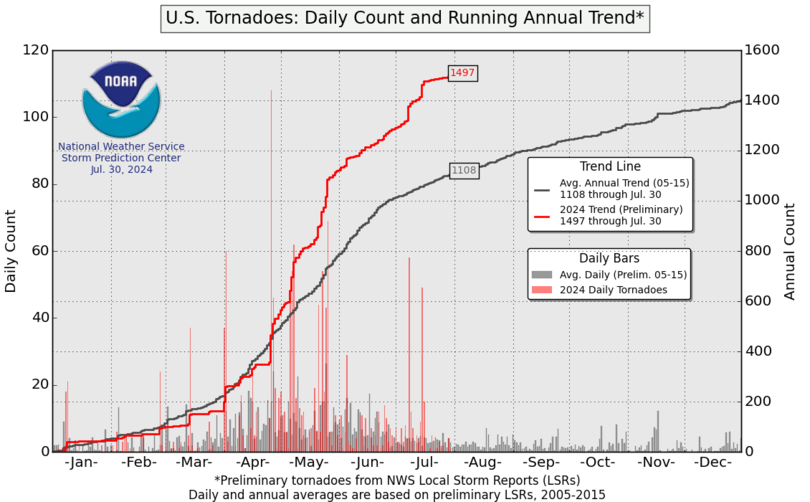
Risk: Where Are All the Tornadoes?

After a fast start to the season the number of twisters has dropped back to far below average:

One reason we had so many early storms was the warmer than usual waters of the Gulf of Mexico.
During winter 2011-2012 the Arctic Oscillation kept much of the polar cold bottled up north of the 75th latitude (except for the "gate" opening onto central Europe, with upwards of 1000 people frozen to death in Jan.-Feb.)

The second reason was the lingering La Niña which has teleconnection effects on the jet stream which seem to set up temperature gradients and wind shear conducive to storm formation.
The 1974 Super outbreak and the 2011 season which saw the EF-5 devastate Joplin Mo. occurred during La Niña.

All of this has resulted in a reversion to the mean for 2012:

Tornado Season Local Storm Reports

Annual Trend - Local Storm Report Tornadoes

"Shanghai Composite Breaks Another Supportt"

From Doug Short's Advisor Perspectives:
Now the Shanghai index is breaking below another support line at (2)....MORE

Previously:

June 23 
Is China's Shanghai Index Approaching the Waterfall Decline?
June 28 
Shanghai Stock Exchange Index Continues Decline, Now Down for 2012

FT Alphaville Likes Gold (GLD)

$1584.30 up $5.40 last.
Here's the line:
...You see financial journalists have to take vows of poverty and chastity. If we traded on information we glean as journalists we’d get sacked and probably go to jail.
But if we did trade, well…. Gold looks good.
That was Alphaville's Paul Murphy.

I have no idea whether he has any special insight. On the other hand it is well within the realm of possibility that gold trades lower than $1000 in the next twelve months which would be an approximate 50% retracement of the Sept. 2011 $1923.70.
On the other hand he may be pulling Smith's tit and tweakin' him.

For the rest of it, the post "Noah Smith is a moron and he’ll get cancer soon, etc" is worth a read.
The economist in question, Noah Smith is a bit of a douche and not nearly as smart as he thinks he is.
On ZeroHedge, well, they're ZeroHedge.

On news analytics there are plenty of resources, a good place to start is "The Handbook of News Analytics in Finance" from Wiley.


Thompson Reuters and Dow Jones have been pitching product for a few years now. We haven't had the Pearson (FT) salesman come calling but I imagine they have some offerings.

One of the early software purveyors, Predictive Signals wrote in 2010:
...For example, in a third blog post we looked at whether there was a relationship between company mentions in a specific financial news blog (FT Alphaville) and future market returns. Specifically for discrete days where a company was mentioned in that blog, we calculated a metric based on sentiment and momentum for that company and looked for a relationship between that metric and returns. We found a statistically significant relationship and interestingly enough, did not find a similar relationship across media mentions as a whole....
And like the snake swallowing his own tail, we've come full circle.

Sunday, July 8, 2012

German President Tells Merkel to Clarify What She Agreed Behind Closed Doors

Ambrose Evans-Pritchard at the Telegraph:
German president tells Angela Merkel to come clean on EU debt deal
Joachim Gauck, the German president, has ordered Chancellor Angela Merkel to clarify exactly what she agreed behind closed doors at the EU crisis summit ten days ago. 
German president Joachim Gauck has ordered Chancellor Angela Merkel to clarify exactly what she agreed behind closed doors at the EU crisis summit ten days ago, lending a powerful voice to critics dismayed by the surging costs of euro bail-outs.
"She has a duty to explain in great detail what it means, and what it means fiscally. There seems to be a lack of energy in telling the people what is really happening," he told ZDF television.
President Gauck's broadside came as markets wait anxiously for a crucial hearing this Tuesday by Germany's constitutional court on the legality of the European Stability Mechanism (ESM), the EU's €500bn (£397bn) bail-out fund. A clear ruling against the ESM would throw into doubt Germany's ability to backstop the euro and risk a dramatic escalation of the debt crisis.
Legal challenges to the ESM have been filed by a range of private citizens and lawmakers, mostly arguing that the fund violates the Bundestag's sovereign control over budgets, and eviscerates democracy. Mr Gauck will not sign the ESM into law until the court has ruled, probably later this month.
There is deep confusion over the summit deal after Mrs Merkel claimed that it "changed nothing" and that the small print made in it clear that there would be "no further liabilities"...MORE

"Quite Likely the Worst Job Ever"

From Smithsonian Magazine's Past Imperfect blog:
To live in any large city during the 19th century, at a time when the state provided little in the way of a safety net, was to witness poverty and want on a scale unimaginable in most Western countries today. In London, for example, the combination of low wages, appalling housing, a fast-rising population and miserable health care resulted in the sharp division of one city into two. An affluent minority of aristocrats and professionals lived comfortably in the good parts of town, cossetted by servants and conveyed about in carriages, while the great majority struggled desperately for existence in stinking slums where no gentleman or lady ever trod, and which most of the privileged had no idea even existed. It was a situation accurately and memorably skewered by Dickens, who in Oliver Twist introduced his horrified readers to Bill Sikes’s lair in the very real and noisome Jacob’s Island, and who has Mr. Podsnap, in Our Mutual Friend, insist: “I don’t want to know about it; I don’t choose to discuss it; I don’t admit it!”

A tosher at work c. 1850 ,sieving raw sewage in one of the dank,
 dangerous and uncharted sewers beneath the streets of London. 
From Mayhew’s London Labour and the London Poor.

Out of sight and all too often out of mind, the working people of the British capital nonetheless managed to conjure livings for themselves in extraordinary ways. Our guide to the enduring oddity of many mid-Victorian occupations is Henry Mayhew, whose monumental four-volume study of London Labour and the London Poor remains one of the classics of working-class history. Mayhew–whom we last met a year ago, describing the lives of London peddlers of this period–was a pioneering journalist-cum-sociologist who interviewed representatives of hundreds of eye-openingly odd trades, jotting down every detail of their lives in their own words to compile a vivid, panoramic overview of everyday life in the mid-Victorian city.

Among Mayhew’s more memorable meetings were encounters with the “bone grubber,” the “Hindoo tract seller,” an eight-year-old girl watercress-seller and the “pure finder,” whose surprisingly sought-after job was picking up dog mess and selling it to tanners, who then used it to cure leather. None of his subjects, though, aroused more fascination–or greater disgust–among his readers than the men who made it their living by forcing entry into London’s sewers at low tide and wandering through them, sometimes for miles, searching out and collecting the miscellaneous scraps washed down from the streets above: bones, fragments of rope, miscellaneous bits of metal, silver cutlery and–if they were lucky–coins dropped in the streets above and swept into the gutters.

A London sewer in the19th century. This one, as evidenced by the shaft of light penetrating through a grating, must be close to the surface; others ran as deep as 40 feet beneath the city.

Mayhew called them “sewer hunters” or “toshers,” and the latter term has come to define the breed, though it actually had a rather wider application in Victorian times–the toshers sometimes worked the shoreline of the Thames rather than the sewers, and also waited at rubbish dumps when the contents of damaged houses were being burned and then sifted through the ashes for any items of value. They were mostly celebrated, nonetheless, for the living that the sewers gave them, which was enough to support a tribe of around 200 men–each of them known only by his nickname: Lanky Bill, Long Tom, One-eyed George, Short-armed Jack. The toshers earned a decent living; according to Mayhew’s informants, an average of six shillings a day–an amount equivalent to about $50 today. It was sufficient to rank them among the aristocracy of the working class–and, as the astonished writer noted, “at this rate, the property recovered from the sewers of London would have amounted to no less than £20,000 [today $3.3 million] per annum.”

The toshers’ work was dangerous, however, and–after 1840, when it was made illegal to enter the sewer network without express permission, and a £5 reward was offered to anyone who informed on them–it was also secretive, done mostly at night by lantern light. “They won’t let us in to work the shores,” one sewer-hunter complained, “as there’s a little danger. They fears as how we’ll get suffocated, but they don’t care if we get starved!”

Quite how the members of the profession kept their work a secret is something of a puzzle, for Mayhew makes it clear that their dress was highly distinctive. “These toshers,” he wrote,
may be seen, especially on the Surrey side of the Thames, habited in long greasy velveteen coats, furnished with pockets of vast capacity, and their nether limbs encased in dirty canvas trousers, and any old slops of shoes… [They] provide themselves, in addition, with a canvas apron, which they tie round them, and a dark lantern similar to a policeman’s; this they strap before them on the right breast, in such a manner that on removing the shade, the bull’s eye throws the light straight forward when they are in an erect position… but when they stoop, it throws the light directly under them so that they can distinctly see any object at their feet. They carry a bag on their back, and in their left hand a pole about seven or eight feet long, one one end of which there is a large iron hoe.
...MORE

Male Employment Never Recovers From Recessions

Yglesias at Slate:

1341757531175


Here's the broadest labor market indicator around—the ratio of employed people to total people—broken down by gender over the past fifty years....MORE

Today is the Anniversary of the Great Depression Bottom in the Dow Jones Industrial Average (The greatest market call ever made)

41.22 on the DJIA.

A long way down from the  September 3, 1929 closing high: 381.17.

After that July 8,1932 closing low, the Dow put on a nifty little seven week sprint to an intraday high of 77.01 on August 29. That 87% move might be the largest ever for a major index.
Of course very few people called the bottom with the notable exception of Robert Rhea:
...The next great Dow theorist, Robert Rhea, initially stumbled upon the Dow Theory during his endeavor to find "a system" for helping him make money in the stock market. In his attempts to disprove the theory, he became a convert. Rhea was a very serious student, and he was able to utilize the Dow Theory as interpreted by Hamilton to his advantage, buying and holding stocks in 1921, and basically holding them until late 1928 (he reversed his short position when he realized Hamilton's advice was incorrect in early 1926), missing only the final blowoff phase. He also "played" the short side successfully during the subsequent deflation. In 1932, he began publishing his newsletter based on the Dow Theory, called the "Dow Theory Comment."
 
Rhea called the bottom of the stock market in July 1932 almost to the exact day and the subsequent top in 1937. On July 21, 1932, with the Industrials at 46.50 and the Rails at 16.76, Rhea instructed his broker to tell his friends "the Dow Theory implied heavy buying for the first time in over three years." Further, on July 25, 1932, Rhea sent a memo to 50 correspondents, part of which is reproduced below:...
Source
The declines of both Rail and Industrial averages between early March and midsummer were without precedent. The thirty-five year record of the averages shows a fairly uniform recovery after every major primary action, and such recoveries average around 50% of the ground lost on the decline; are seldom less than a third and more than two thirds. Such recovery periods tend to run to about 40 days, but are sometimes only three weeks - and occasionally three months.

The time element is in favor of a normal reaction at this time - because the slideoff was normal (the normal time interval of major declines being about 100 days).

The market gave the unusual picture of hovering near the lows for more than seven weeks, and might be said to have made a "line" during the latter weeks of that period.

Because of all these things, and because the volume tended to diminish on recessions and increase on rallies during the ten days preceding July 21, almost any one trading on the Dow Theory would have bought stocks on July 19th. Those who did not, had a clean cut signal again on the 21st. Since that date the implications of the averages have been uniformly bullish, and it is reasonable to expect that a normal secondary will be completed, even though the primary trend may not have changed to "bull". So much for the speculative viewpoint.
Cycle News and Views has more of Rhea's calls.

I've mentioned* that I may be the only person I've ever met who read every page of The Cowles Commission's "Common Stock Indexes 1871-1937".

*Okay more than once:
Equity Valuation and Forecasting Future Returns and a Gift for our Readers

Stock Market Forecasters Forecast?
...Can Stock Market Forecasters Forecast? is the title of a paper by one of my heroes, Alfred Cowles III.

It appeared in Vol.1, No. 3 of Econometrica, after having been read to a joint meeting of the Econometric Society and the American Statistical Society.

Mr. Cowles answer to the question?

It is doubtful.
December 31, 1932....
That's a long intro to a short (9 page PDF) paper:
Alfred Cowles and Robert Rhea on the Predictability of Stock Prices
...Cowles (1944) acknowledged that one series of forecasts made by three forecasters in succession from 1903 onward had a record of prediction so consistently successful that it could not be attributed to chance. Cowles (1944) did not identify who made that series of forecasts, and it is not certain who Cowles meant. The 1903 start date and the number of successive forecasters match the Dow Theory forecasts of William Peter Hamilton (believed by Cowles to have succeeded as editor of the Wall Street Journal immediately after Charles Dow died in December 1902), then Robert Rhea after Hamilton died in December 1929, and then Perry Greiner of Rhea, Greiner & Company after Rhea’s death. However, Cowles referred to “the forecasting agency with the best results for the 15 ½ years since 1927,” which would put the splicing point for the Hamilton, Rhea, and Greiner series of predictions in the period when Hamilton was writing editorials, not at the point when Hamilton died and Rhea began forecasting.
 MUCH MORE

Saturday, July 7, 2012

To Hell With Human Cooperation and Trust: There are Indeed Ultimatum Strategies to Win an Iterated Prisoners Dilemma

Listen up you sociopathic bastards, here's your excuse.

From Neuroanthropology:
Prisoner’s Dilemma and the Evolution of Inequality – Does Unfairness Triumph After All?
A new paper, Iterated Prisoner’s Dilemma contains strategies that dominate any evolutionary opponent (pdf), has just been published in the Proceedings of the National Academy of Sciences. Written by William Press and Freeman Dyson, it represents a substantial breakthrough in strategies that work in the Prisoner’s Dilemma game.

The key point? There does exist a strategy where a player can “enforce a unilateral claim to an unfair share of rewards.”

The implications of this paper are fascinating. For biological evolution, it opens up new thinking about reproductive strategies and life history theory, as well as the direct impact on ideas about the evolution of cooperation.

For cultural evolution, it seems to provide some powerful insights into the evolution of inequality in human society. As the agriculture revolution and population growth led to the ability to monopolize social resources and create differential wealth, what happened with social class? Did human cooperation turn from fairness to enforcing the sort of unfair game that Press and Dyson outline?

Zero Determinant Strategies and Beating Tit-for-Tat
Here is the paper’s abstract for Press and Dyson (2012):
The two-player Iterated Prisoner’s Dilemma game is a model for both sentient and evolutionary behaviors, especially including the emergence of cooperation. It is generally assumed that there exists no simple ultimatum strategy whereby one player can enforce a unilateral claim to an unfair share of rewards. Here, we show that such strategies unexpectedly do exist. In particular, a player X who is witting of these strategies can (i) deterministically set her opponent Y’s score, independently of his strategy or response, or (ii) enforce an extortionate linear relation between her and his scores. Against such a player, an evolutionary player’s best response is to accede to the extortion. Only a player with a theory of mind about his opponent can do better, in which case Iterated Prisoner’s Dilemma is an Ultimatum Game.
PNAS also gives an informative commentary by Alexander Stewart and Joshua Plotkin entitled “Extortion and cooperation in the Prisoner’s Dilemma (pdf).”...MORE
HT: Simoleon Sense

One Week Into the Sanctions and Iran Has Figured a Way to Circumvent them

From Reuters Africa:
Iran plans to sell oil via private group, evade ban
DUBAI (Reuters) - Iran has reached agreements with European refiners to sell some of its oil through a private consortium, an official said on Saturday, a move designed to circumvent sanctions intended to put pressure on Tehran to halt its disputed nuclear programme.


The head of the oil products exporters' union said the agreement between the exporters' union, Iran's central bank, and the oil ministry would get round a European Union ban on shipping insurance for tankers carrying Iranian oil, though he gave few details and did not name the refiners involved.

The EU put into effect a ban on the importation, purchase, or shipping of Iranian oil on July 1, and the Islamic Republic will see its oil exports fall by more than 50 percent this month from last year's regular levels, costing it billions of dollars a month in revenue.

"There have been discussions with European refiners, and a final agreement has even been reached," said Hassan Khosrojerdi, the exporters' union head, according to Iran's Mehr News Agency.
"In accordance with the agreement, it is planned that 20 percent of Iran's oil exports will go through this private consortium."

He added: "It is likely that because of international restrictions, we will give minor privileges or discounts to some of the buyers of our oil."...MORE
The Tehran Times proudly says:
Iran to export 20% of its oil via a private consortium 

Phi Scamma Jamma: More People Went on Disability Last Month Than Got Jobs

We've got a college educated nation that can pull the fourth grade "Mom, I don't feel so well".
And it wasn't just last month. From Investors Business Daily: 
Disability Ranks Outpace New Jobs In Obama Recovery
More workers joined the federal government's disability program in June than got new jobs, according to two new government reports, a clear indicator of how bleak the nation's jobs picture is after three full years of economic recovery.

The economy created just 80,000 jobs in June, the Bureau of Labor Statistics reported Friday. But that same month, 85,000 workers left the workforce entirely to enroll in the Social Security Disability Insurance program, according to the Social Security Administration.

The disability ranks have outpaced job growth throughout President Obama's recovery. While the economy has created 2.6 million jobs since June 2009, fully 3.1 million workers signed up for disability benefits.
In other words, the number of new disability enrollees has climbed 19% faster than the number of jobs created during the sluggish recovery. (Even after accounting for people who left the disability program because they died or aged into retirement, disability ranks have climbed more than 1.1 million in the past three years.)

And the disability ranks will continue to swell. In just the last month, almost 275,000 put in applications for disability benefits. Experts say that more people try to get on disability when jobs are scarce, and changes to eligibility rules enacted back in 1984 have made it far easier to qualify....MORE
From Econompic Data
Gaming the System... Disability Edition
In my post outlining the decline in employment (excluding teens), reader Mike pointed out another interesting phenomenon:
One of the stories I read about this month's BLS report dealt with the rise in people on disability. I thought charting this over a few dozen years and several recessions might tell an interesting story.
Unfortunately, the BLS only reports this data going back to 2008, but the most recent data shows an interesting trend. From the looks of it, we have what appears to be a not-so-coincidental mirror image between the decline in those unemployed with the rise in the number of people not working via claims of disability. I know next to nothing about disability, but my guess is individuals whose employment benefits have run out, have been increasingly taken advantage of disability as a replacement.
Source: BLS
This is a trend we've been trying to draw attention to:   
What I'd really like to see is a list of the counties with the highest levels of Social Security Disability fraud, this is a program ripe for reform....

Friday, July 6, 2012

Natural Gas Liquids: You Can Buy a Gallon of 80/20 Ethane/Propane Mix for Three Cents

 A story of microeconomics.
From Platt's:
The bizarre case of the gallon of a petroleum liquid that costs less than a US nickel
There is a hydrocarbon out there that you can buy for less than three pennies per gallon.

But that's something that has just happened in the past few days. And while the decline in the price of ethane-propane mix in Conway, Kansas is in a very minor niche market, it's still like nothing anybody has seen in a long time. The price is down close to 88% since April 1.

Further, it's not just some fluke thing that has occured because of a busted unit or a pipeline explosion, an incident that knocks the normal market balance out of whack.

Instead, the price of EP mix in Conway is a microcosm of just how the shale surge is pumping out huge quantities of natural gas liquids alongside natural gas, and how the supply is starting to overwhelm the infrastructure that exists.

EP Mix is an 80% ethane/20% propane blend. Like purity ethane, it's used as a feedstock in olefin crackers, primarily to make ethylene....MORE

Five of the Dow Jones 30 Are Up--Wal*Mart is one of Them (WMT)

And it's the second-best performing of the five, up 2/10's percent. With the index down 128 the rest of the rebel risers are Home Depot up .17%, McDonald's up .38%, At&T up .17 and Verizon up .05%.

This makes six WMT posts in five weeks.
I'll lay off for a while. In the meantime stock is telling us something.
See yesterday's "Anyone Who Has EVER Bought Wal*Mart is Profitable (WMT)" for the links

The FT's Gillian Tett Wonders if a "Summer's Curse" Black Swan is Looming

What a difference apostrophe placement makes. Had it been "Summers' Curse" I'd be worried Larry was going back into government.
If you're an FT subscriber here's the gated version. Otherwise...
From the Financial Times via CNBC:
Five Reasons the Summer Curse May Strike: Gillian Tett
In recent days, several of America’s largest investment groups, such as Fidelity and Northern Trust, have been discreetly reviewing their staff holiday plans. The reason? Right now, with the summer heat rising, the mood in the financial markets seems relatively calm.

But the issue worrying some investment firms is what might be called the “summer curse”; precisely because trading volumes tend to be so thin in the summer months, and senior hands are away, markets can go completely haywire if something does go wrong.
And this “summer curse” is not a theoretical issue. Just think of 1998 (the Russian crisis and Long-Term Capital Management hedge fund implosion); 2007 (the mortgage securities and money market freeze); 2008 (the Fannie Mae “jolt”, which led to the Lehman Brothers disaster); or, for that matter, think back to how markets were rocked last year by the eurozone crisis and the US debt ceiling dramas.
So could this summer be sticky, once again? Personally, I have a nasty feeling that it might, given that the markets are seeing the collision of at least five unwelcome issues:

● The eurozone. This week, markets have rallied, amid relief over the latest eurozone rescue plan. But, as Larry Summers, the former Treasury secretary, told the Aspen Ideas festival last weekend, the latest plan has only bought the eurozone “a bit more time” to sort out the longer-term structural woes – and it remains crucially unclear, as ever, whether it can do this. Meanwhile, funding costs for Italy and Spain are unsustainably high, and there is mounting evidence of economic pain (witness the record high unemployment data this week). Investors could well panic again if there are more signs of banking stress or fresh evidence of political discord. Watch out, for example, for the run up to September’s Dutch elections; this could highlight rising levels of bailout fatigue and political extremism – even in the supposedly “sensible” Netherlands....MORE

Ghost Fleet: Chinese Ships Can't Find Coastal Loads, Search the High Seas for Business

From Reuters:
Hit at home, China's ghost fleet sails high seas
China's huge fleet of coastal ships, usually confined to plying the Chinese seaboard, has sailed out of the shadows to seek international business in yet another sign that China's economy is slowing.

The fleet, previously unnoticed by the global market, is suffering from a slowdown in China's coastal trade amid weaker domestic demand from utilities and steel mills and a growing glut in Chinese coal and iron ore stockpiles.

The vessels are now being forced to seek new business such as in the Indonesian coal trade, dealing a further blow to the depressed global dry bulk shipping market.

"There are many more ships lying idle at Chinese ports now - the environment for making money is not so good," said a source at one of the big five coastal shippers, who asked not to be identified.
The slowdown of the Chinese economy has been among the main worries for global markets in general and commodities markets in particular.

China, the world's biggest coal producer, is also the biggest single coal and iron ore importer and freight user and a small change in its buying or freight use sends ripples around the world markets.

China's coastal trade existed for decades on a small scale, but began to boom when power generation needs in the country's south took off due to mass industrialization and coal was urgently needed from the northern mines.

China's coastal coal trade soared by 88 percent from 2006 to move 639 million metric tons (704 million tons) in 2011, according to securities group Jefferies. Shipbroker Clarksons estimates China's coastal trade of coal, steel, grains and fertilizers at over 1 billion metric tons....MORE
HT chain: naked capitalism<MacroBusiness who notes:
...Regular readers may recall that I posted recently on the weakness being signalled in the Chinese shipping indexes. Nothing much has changed. Here is the China coastal bulk index still weakening:

And for coal:

Some nice discounts coming for the miners.

Natural Gas Rig Count Bounces Off 13-year Low, UP 8 for the Week

The decline in the futures is accelerating. In the electronic session they are now down 17.6 cents at $2.769 or almost 6%.
From Reuters:
US natgas rig count bounces off 13-year low
The number of rigs drilling for natural gas in the United States rose on Friday for the first time in seven weeks, bouncing off a 13-year low, oil services firm Baker Hughes said in its weekly report on Friday.

The rig count rose 8 to 542 in the week to July 6, as natural prices rose to six-month highs, though it is still way below the peak reached in October last year of 936....MORE

How to Increase the Velocity of Money

From Marginal Revolution:
Argentina-based publisher Eterna Cadencia has released El Libro que No Puede Esperar – which translates as ‘The Book that Cannot Wait’ – an anthology of new fiction printed in ink that disappears after two months of opening the book....MORE
It was posted by Cowen. Tabarrok commented:
We should print money with this ink.

The Risk in Risk Assets: The Dollar Could Crush Commodities

The Euro hit a two year low today, dropping below $1.2288, it's currently down 1 cent at $1.2290.
As we've said, we expect the two currencies to trade pari passu within two years eighteen months.
From Doug Short's Advisor Perspectives:
Dollar Breakout and Commodity/Risk Assets
The U.S. Dollar continues to battle with a cluster of resistance at (1) in the left chart below. A breakout above these lines could bring in enough buyers to push the Dollar up to the 90 level in quick order.
The CRB index remains inside of its falling channel and looks to have had a counter-trend rally up to its 23% Fibonacci resistance level. The Power of the Pattern has been calling for Commodity weakness since last November (see post here).

Click to View(click chart for the full horror)
...MORE

Holy Crap! Total U.S. Debt (combining government, financial, non-financial and household) Has Increased 12-fold Since 1980!

That's just one of the factoids from UBS:
...Our approach is based on an acknowledgement that the economy has become reliant, in large part, on debt and its creation. As of Q1 this year, US domestic outstanding debt (combining government, financial, non-financial and household) stood at $52.4 trillion; this is compared to a mere $4.2 trillion at the same stage of 1980 (a twelvefold increase or a 7.9% continuously compounded growth rate over the past 32-years)....
-from FT Alphaville's "UBS tackles the negative yield puzzle"

This was the point I was getting at in Sunday's "The Real Problem With Stimulus", we grow debt in good times and bad and are not getting returns on our indebtedness.
This was also the point of April's "So Much for the Keynesian Multiplier: $359.1 billion Q1 Deficit Buys $142.4 billion Q1 GDP Growth":
We are past the point of no return.

The Austerians will come in with their lies and crash Gross Domestic Product.
They will be followed by the Inflationistas and their lies.
If one has even a grade school grasp of economics this is a terrifying graph.
It was bad enough back in the day when we presented the comparison in terms of percentage growth of debt and GDP. When the presentation is in dollars...
From ZeroHedge:

Presented without much commentary, because little is necessary: the only ratio that matters for the US economy, the change in US public debt ($359.1 billion) and US GDP ($142.4) in the first quarter, hit 2.52x and rising.

It takes $2.52 in new debt to "buy" $1 of economic "growth
And many more. Use the search blog box.

"Chinese buyers move in on UK farmland market"

Give 'em a Hong Kong and they'll take a Dorset.
Or something.
[that's a disgusting thing to say -ed]

For the last couple years we've seen reports of wealthier Chinese moving not just financial assets  but their families to the West.
One headline from the WSJ this February:
Plan B for China's Wealthy: Moving to the U.S., Europe 

From Agrimoney:
Chinese buyers, whose interest in foreign farmland has raised hackles from Argentina to Australia, have turned their attention to the UK – although for investment, rather than food security, reasons.
Knight Frank, the UK-based property consultancy, said it was, for the first time, "starting to see genuine bids" from Chinese investors wanting to buy UK farmland.

However, these were offers from private investors, rather than the funds whose appetite for large swathes foreign farmland has often met with controversy, largely for fear of growing food for shipping direct to China, and so denying the local market.

"These are personal Chinese buyers doing it for investment," James Prewett, a regional head of farm sales for Knight Frank, said.

"It is different to a fund trying to buy 20,000 acres in East Anglia."

'Little piece of England'
Indeed, buyers are interested in smaller farmers, of £1m-2m, which "is not a big chunk of money" for a market in which the average value of agricultural land hit a record £6,295 an acre in the April-to-June, according to Knight Frank, with some lots going for £10,000 an acre...MORE
Here the Knight Frank report:
UK Farmland Index