When it is said that the price of diesel fuel goes into everything it is not hypebole.
May 2022 (Russian invasion) - Diesel equals Soybeans; Soybeans equal Diesel (in more ways than one)
....Way back in April 2008, the U.S. was still in Afghanistan and Iraq, Gaddafi in Libya and Morsi in Egypt had not yet been overthrown, the Maidan coup in Ukraine was six years in the future and the Russian invasion was fourteen years ahead, the price of oil was going parabolic on the charts, on its way to the record futures print, $147+, and I was thinking about substitution and pseudo-fungibility:
What Proportion of Food Price Increases is Attributable to Ethanol?
If I recall correctly it takes about five gallons of fuel to plant and
harvest an acre of corn (I just spent 60 seconds trying to remember if
that was conservation tillage or traditional. Then I realized that farm
management was not the focus of this post, I'll go with 5 gal./acre), so
the argument that rising input prices is a factor has merit....
Some things never change. But they should
Related, noted in a 2015 post:
Remember, the rule of thumb is it takes around 10 crude oil calories to produce 1 row crop (mainly corn and soybeans) calorie.
Most other food prices are similarly dependent on their input costs.
One oft-cited bit of nuttines is the fact it takes 127 calories of aviation fuel to get a head of lettuce from California to London....
March 2021 - Vaclav Smil: "How Much Energy Does It Take to Grow a Tomato?"
And the headline story from Wolf Richter at Wolf Street, September 22:
I’m worried about the inflationary mindset taking off again. It’s the Fed’s job to step on the brakes before inflation turns into a runaway train.
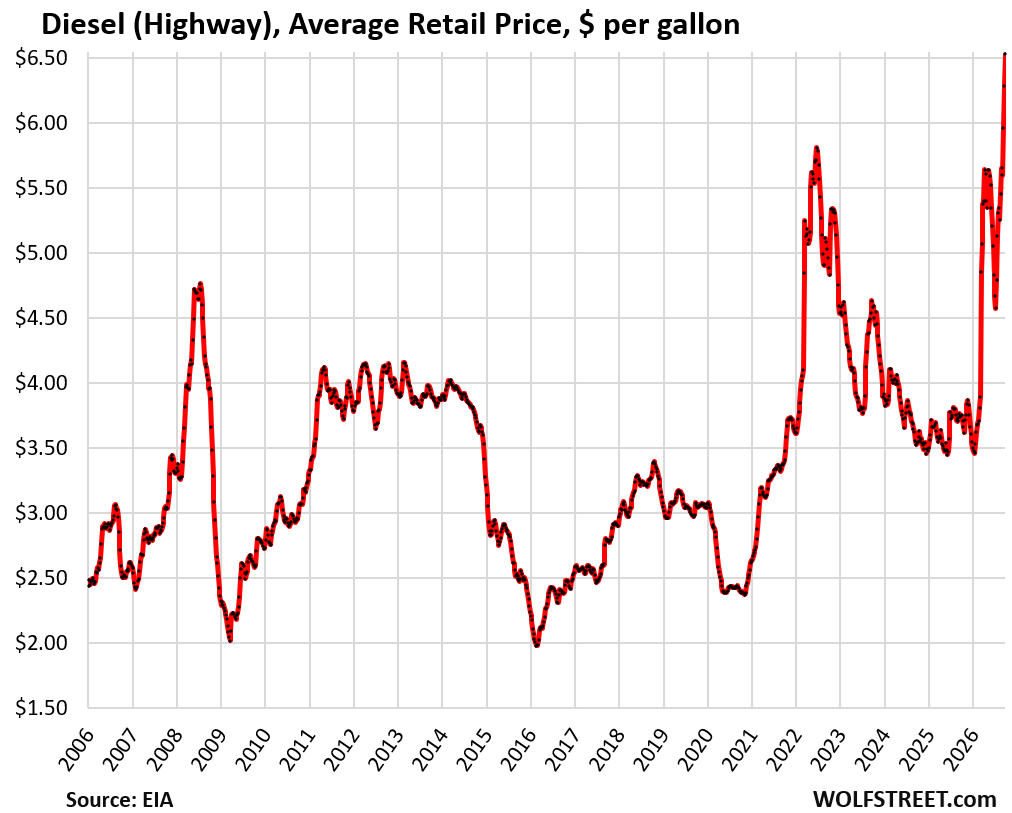
The average retail price of on-highway diesel spiked by 24 cents in the latest week, and by 88 cents in four weeks, to a record $6.529 a gallon at gas stations on Monday, and that’s for the US overall, according to the EIA this morning. Year-over-year, the price of diesel has spiked by 74%.
California diesel prices spiked to $8.246 a gallon. While driving by gas stations, we’ve seen over $8 a gallon for weeks.
These are sobering sights, setting off the inflation alarm bells.
Republicans called for a diesel export ban. There is a shortage of diesel in the rest of the world, and US refiners provide much needed supply.
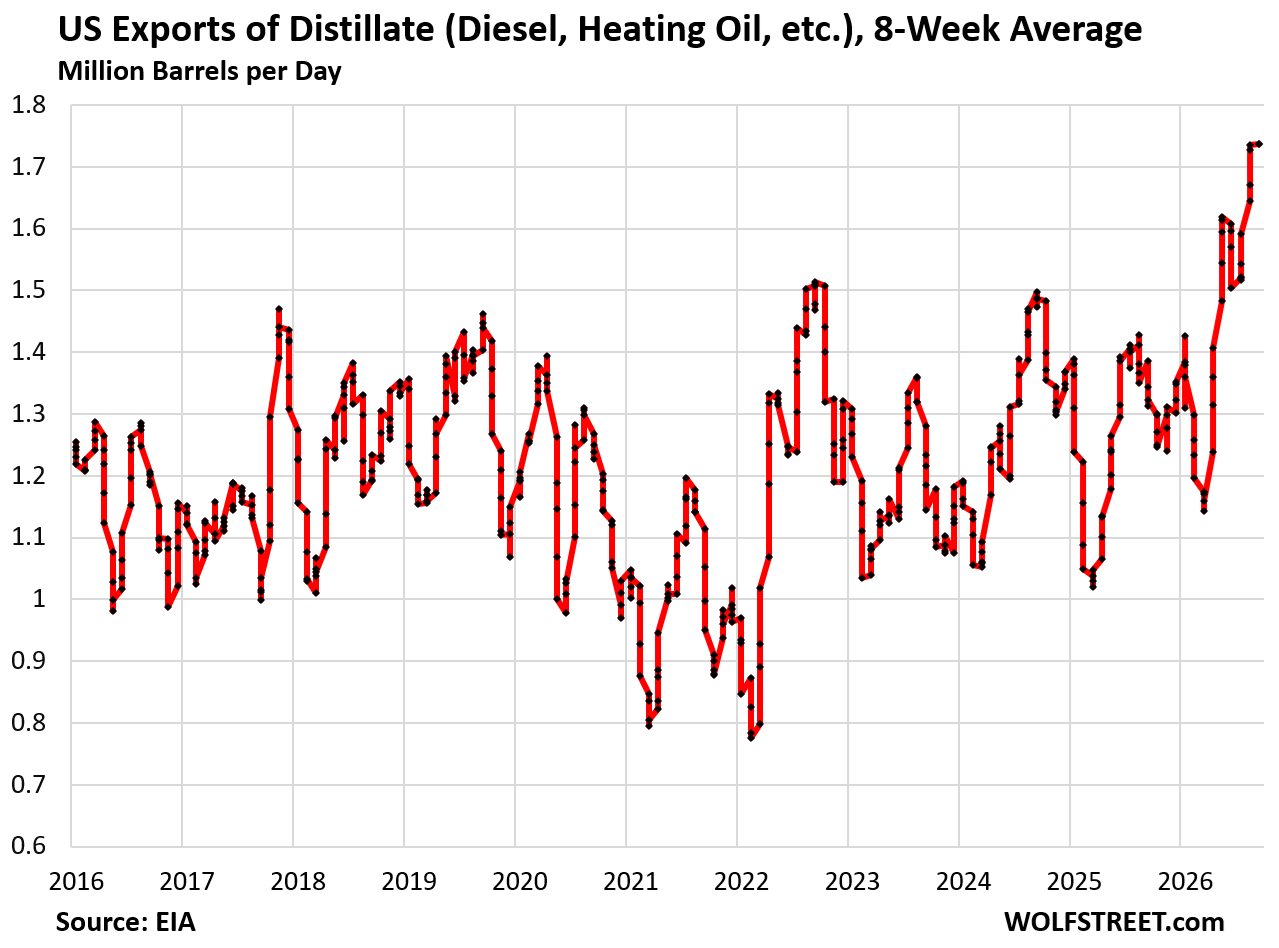
Year-to-date through August, the US produced 5.1 million barrels per day of distillate fuel oil (mostly diesel); imported almost none; and exported a record average of 1.74 million barrels per day over the past two months.
Diesel crack spreads, which are a rough measure of US refinery profit margins for diesel, are at record levels. And they come on top of the high price of crude oil. The result is a record high retail price of diesel.
So Iowa Sen. Chuck Grassley (R) urged President Trump on Saturday to impose a temporary diesel export ban, with the hope that such a ban would narrow the crack spread and thereby allow diesel retail prices to cool before the midterms. Trump today endorsed a diesel export ban when talking to reporters. A decision, he said, is coming “fast, one way of the other.”
The weekly diesel export data from the EIA is the most current measure, but also the roughest most incomplete estimate, and very volatile from week to week. And it’s seasonal. The 8-week-average provides a sense of the recent trends:
Diesel impacts inflation in the overall economy. Only a small portion of consumers drive vehicles with diesel engines (some pickups and SUVs, and some older European imports), so diesel prices impact only a small number of consumers directly.
But diesel prices – along with jet fuel and gasoline prices – feed into all kinds of transportation costs that consumers pay for directly, such as ecommerce shipping charges and airline fares.
And they’re also part of the input costs for a broad range of businesses, directly or via higher prices of goods and transportation services. And businesses will then try to pass on those higher costs via higher prices for their goods and services to consumers, other businesses, and governments.
The GDP price deflator, released by the Bureau of Economic Analysis, tracks inflation facing all economic entities: consumers (separately tracked by the CPI and the PCE Price Index), businesses (separately tracked by the PPI), and governments. It tracks inflation in the overall US economy and is the broadest inflation index in the US.
Inflation has been worse for businesses than for consumers as businesses could not fully pass on the cost increases without losing sales. This has shown up in the much hotter PPI inflation (overall PPI +5.4%; services PPI +4.5%; core goods PPI +5.0%; energy PPI +24%). So inflation in the overall economy has been worse than inflation that only consumer face....
....MUCH MORE
Also at Wolf Street:
Treasury Yields of 2 Years & 3 Years Spike toward 5%, but 10-Year Holds at 5%, Yield Curve Bulges: Some Thoughts on What’s Brewing

