From Goldman, May 1:
Executive Summary
The AI CapEx debate is usually framed as a demand-side question—will adoption justify the spend?—but the size of the investment itself is not a single, fixed number. It is highly sensitive to a small set of assumptions about how the infrastructure itself is built and renewed.
Four assumptions are most impactful in determining the scale of the build-out:
Several widely discussed dynamics matter for returns, volatility, and value distribution across the ecosystem but do not materially change the aggregate scale of capital required.
Current estimates of the ultimate scale of the AI build-out—regardless of the demand side—are far more conditional than they appear. For investors and operators, a critical question remains: What fundamental assumptions do we have about the future, and how resilient are our plans to changes in those assumptions?
This analysis is a scenario-based framework intended to explore how different infrastructure assumptions may affect aggregate capital requirements, not a forecast of future spending.
Framing the Question
A single AI query feels weightless—a question typed, an answer returned, no moving parts in sight. But the progress of AI rests on a deeply physical edifice: millions of processors, hundreds of thousands of kilometers of cabling, industrial cooling systems, and power demands that rival those of midsize countries. Better understanding of the complexity of that physical infrastructure—and the assumptions upon which its build-out rests—should inform how we think about the scale, durability, and risks of today’s AI capital expenditure boom.
The scale of these expenditures is enormous. Estimates of $4 trillion to $8 trillion of total capital investment over the next five years have featured prominently in recent market commentary. That capital is used to buy new chips, build new data centers, and construct new power, all in an effort assemble sufficient computing infrastructure to meet the moment. Debates about whether this figure is “too high” are usually framed around a demand-side question: Will AI adoption and monetization justify the spend?
But there is an equally important supply-side unknown. The scale of required investment for the AI build-out is itself more uncertain than commonly assumed. Estimates rest on a number of assumptions that, if changed, can significantly increase or decrease the amount of capital required.
Not all assumptions matter equally in this equation. A small number of assumptions determines how much capital must ultimately be deployed to build AI infrastructure, while other assumptions—despite commanding significant attention—primarily influence timing, monetization, or the distribution of returns.
The most critical assumptions for the level of capital expenditure required for the AI build-out include the following:
- The economic useful life of AI chips
- The cost and complexity of building next-generation data centers
- The way chip architectural choices translate into system-level costs
- The elongation of the build-out due to physical and institutional bottlenecks
Much of the broader debate focuses on dynamics that matter for returns but do not materially alter the amount of capital that must be deployed. This analysis examines these assumptions and suggests a framework for understanding which changes would push the headline capital expenditure figures higher or lower than current estimates.
Baseline Estimates
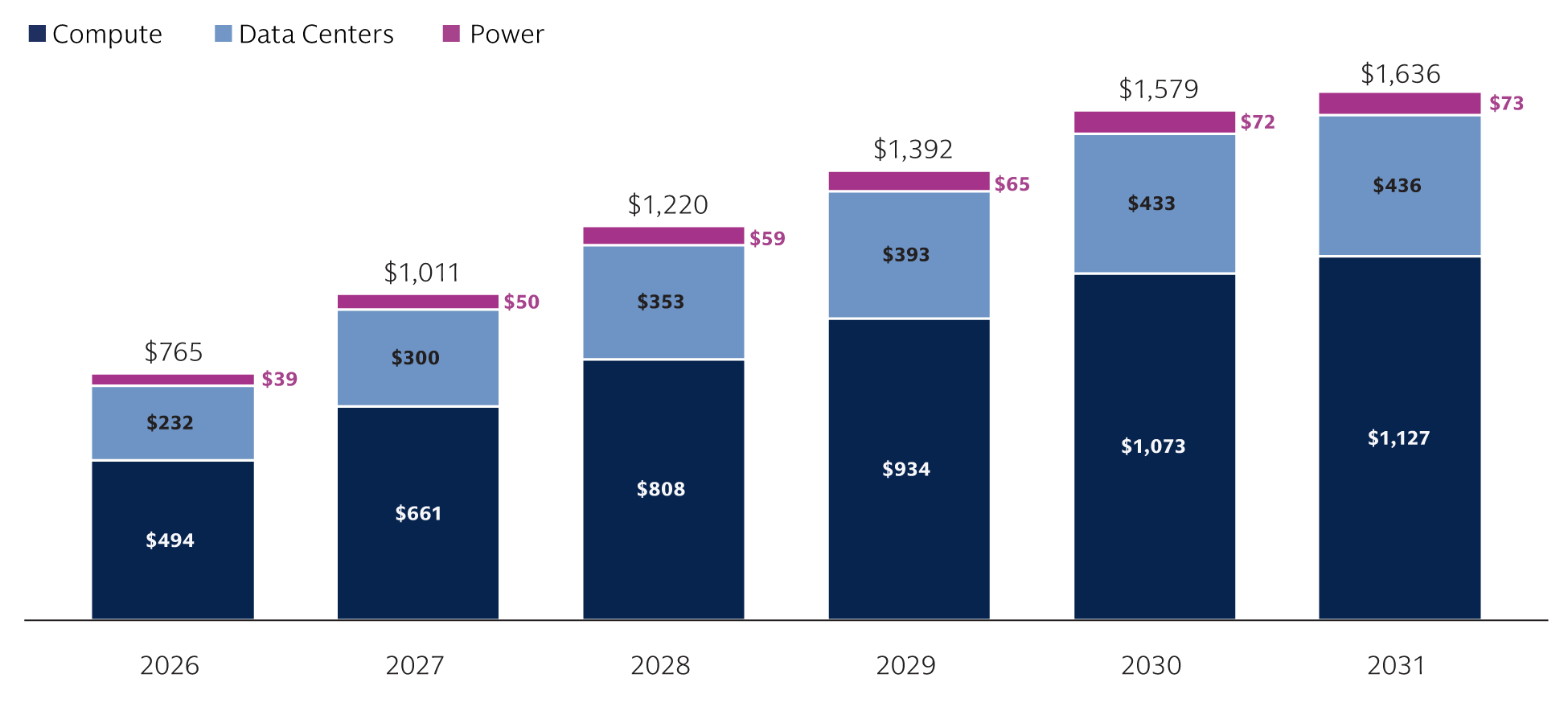
Baseline aggregate AI CapEx estimates (bn)
~$7.6tr of capital between 2026 and 2031 across compute, data centers, and powerSource: Goldman Sachs Global Institute, Goldman Sachs Global Investment Research NVIDIA projections (as of March 3, 2026) Note: Forecasts and expectations are based on material assumptions subject to change. Assumes NVIDIA accounts for 75% of total compute spend in each period. Assumes 5% YoY compute growth past the projection period (2031). Uses VR200 (Rubin) chip as baseline spec ($80.5K per GPU [incl. node costs] and 3,000 W per package) across all years. Assumes 1.2 PUE, $15mn per MW for data centers, and $2,500 per kW for new power. Assumes 15% of required data center space is brownfield (i.e., excluded from calculation) in 2026, growing to 30% in 2031. Totals may not sum due to rounding.We begin with a baseline model that projects the total scale of AI infrastructure investment implied by today’s chip sales estimates. We anchor this baseline to NVIDIA’s forward data center revenue Wall Street estimates as a proxy for prevailing expectations around XPU (GPU and other accelerators) deployment and then infer the associated requirements for data centers, power, and supporting infrastructure. This approach does not attempt to forecast AI adoption or end-market demand; rather, it provides a consistent reference point against which we can test how different supply-side assumptions expand or contract the overall scale of investment.
The baseline model implies $765 billion in annual AI CapEx in 2026, growing to $1.6 trillion in annual CapEx in 2031.
These figures include a variety of components necessary for the AI build-out. The core unit of AI infrastructure is the accelerator—a processor purpose-built for the parallel computation that AI workloads demand. Today's leading systems, such as NVIDIA's GB300 NVL72, pack 72 of these processors into a single rack, connected by high-speed backplanes and linked across facilities by hundreds of thousands of kilometers of cabling. These systems generate enormous heat, requiring industrial-scale liquid cooling. And all of it sits within data centers equipped with dedicated power delivery, redundancy systems, and grid or behind-the-meter generation. Together these layers account for baseline estimates that anticipate roughly $7.6 trillion of cumulative CapEx between 2026 and 2031. The key question is, how might changes in the useful life of silicon, the cost and complexity of data centers, the mix of chip architecture, or the pace at which physical bottlenecks persist push that figure materially higher or lower?
Assumption 1: The Economic Useful Life of AI Chips
AI accelerators (GPUs, ASICs, etc.) are the engines of AI infrastructure, and large-scale data centers house hundreds of thousands of these chips. These devices have a useful life—typically estimated at four to six years—bounded by physical degradation on one side and economic obsolescence on the other, as each new generation delivers step-change improvements in performance. Useful life of silicon chips is the single most influential variable in determining the scale of cumulative AI infrastructure investment.
Unlike other major components of the stack—data center buildings, which are typically depreciated over roughly 20 years, or power infrastructure, which often spans 25 years or more—AI silicon turns over on much shorter cycles. This fact, paired with its high cost per unit, is what makes the silicon replacement cadence so consequential.
Uncertainty around AI silicon’s useful life reflects a core tension: Rapid improvements in performance per dollar between generations of AI silicon push companies to replace hardware quickly, while the growing range of AI tasks means older chips can still deliver value for longer. This tension is sharpened by NVIDIA's unprecedented annual release cadence for GPU architectures, with each generation delivering step-function leaps in capability rather than incremental improvements. Many analysts believe that this mismatch between the annual release schedule and the quantum advances of each new generation makes the prevailing accounting treatment of four-to-six-year depreciation schedules less reflective of the value of the underlying assets.
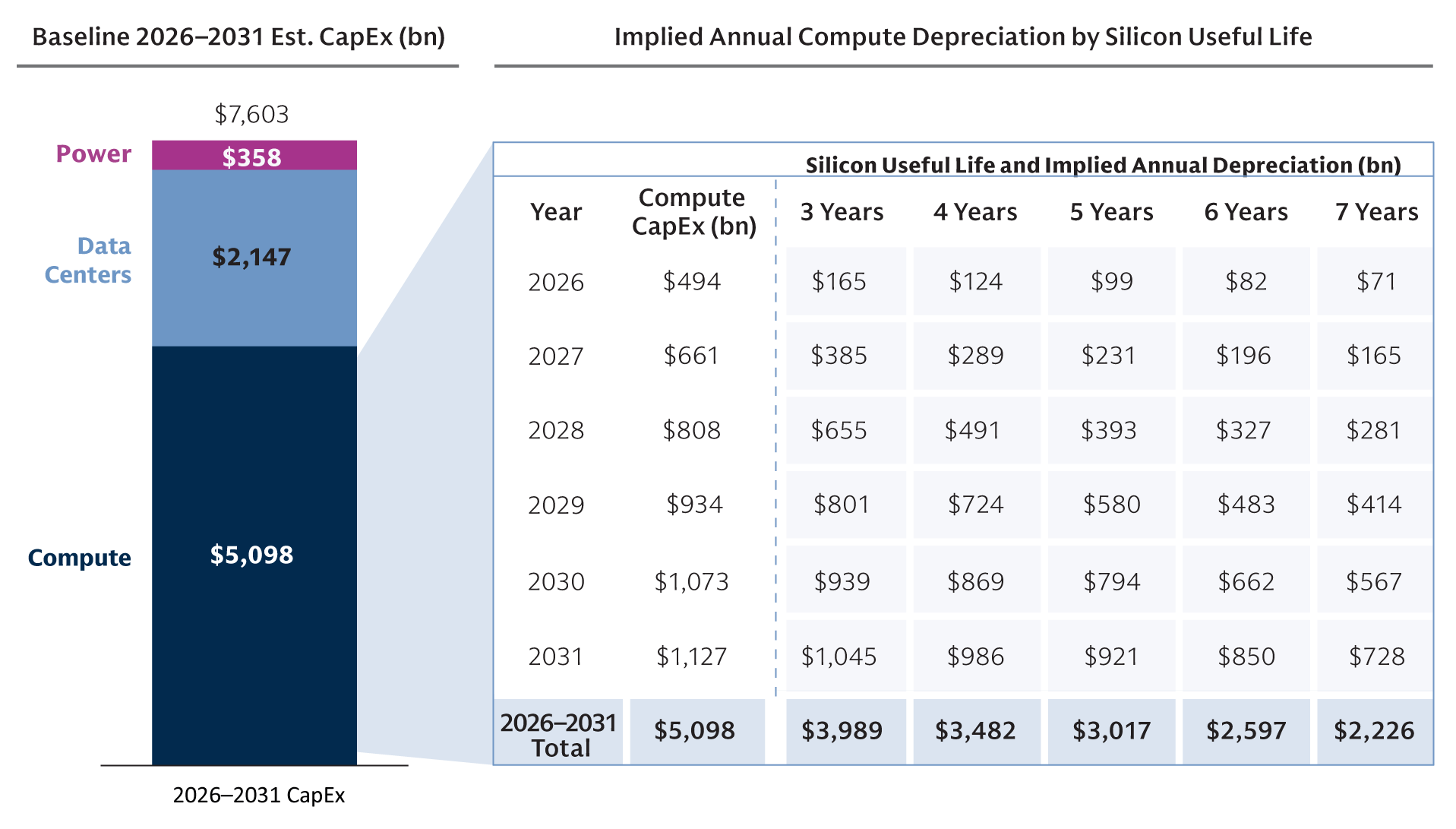
Because silicon accounts for a large share of AI infrastructure CapEx, small changes in assumed useful life have outsize effects on cumulative spend. Extending average economic life from four years to six years materially reduces the number of replacement cycles over a given horizon—while shortening it has the opposite effect. At scale, these differences translate into substantial changes in aggregate capital requirements—and, critically, into the level of annual depreciation borne by the ecosystem—even as spending on buildings and power infrastructure remains largely unchanged.
Sensitizing the useful life of silicon
Impact on annual compute depreciation from altering silicon useful life from 3 years to 7 yearsGoldman Sachs Global Institute, Goldman Sachs Global Investment Research NVIDIA projections (as of March 3, 2026) Note: Forecasts and expectations are based on material assumptions subject to change. Assumes straight-line depreciation and no terminal value for GPUs. Totals may not sum due to rounding.To illustrate: A single accelerator purchased at $50,000 and depreciated over five years carries $10,000 per year in depreciation expense. However, if that chip becomes operationally obsolete or uneconomic to run before the depreciation schedule expires—because a new generation delivers dramatically better performance per dollar—the operator is still carrying the cost of an asset that no longer drives the economic value it once did. Multiply that dynamic across hundreds of thousands of devices, and the risk becomes a threat to the fundamental economics of the AI ecosystem. Accounting statements may reflect orderly depreciation, but operational obsolescence can impose a very different economic reality—and those shifts can arrive abruptly.
But one dynamic that could extend useful lives—and lend support to the prevailing depreciation treatment—is the emergence of a tiered deployment model for AI silicon. Beyond the demand for leading-edge training lies many less performance-sensitive workloads that may be well suited to trailing-edge silicon and benefit from the depreciated cost of such devices—such as certain inference scenarios, edge computing, deployment in emerging markets, and synthetic data generation. Today, the rental price of trailing-edge NVIDIA devices such as A100s and H100s remains high enough to suggest useful lives of five to six-plus years. That could be a consequence of the extreme capacity constraints model providers are operating under today, or it could be a signal about the sustained value of silicon in the AI era—and thus the appropriateness of its prevailing depreciation timelines.
Buildings and power systems are long-lived assets, while AI silicon turns over far more quickly. As a result, assumptions about accelerator replacement cycles can plausibly shift multiyear infrastructure investment totals by hundreds of billions of dollars.
Assumption 2: The Cost and Complexity of Building Next-Generation Data Centers....
....MUCH MORE

