From SemiAnalysis, May 26:
Four-Phase 800VDC Transition, Power Rack Economics, SST, Equipment Content/MW Build, Supplier Implications
We’d like to thank DG Matrix, Novos Power, and Aran Industries for their contributions and insights during the preparation of this deep dive.
Introduction: Welcome to the Power Chain Roller Coaster
Across every major industry conference in the first half of 2026, our research team kept walking past the same scene: a booth ten or fifteen people deep, leaning in to catch every word from another datacenter equipment messiah preaching the gospel of 800VDC. The pitch was the same every time. 800VDC is about to change the electrical infrastructure of the datacenter.
Every architectural shift looked excessive at first. Operators spent decades keeping water and leaks out of the data hall, then GPU thermal density made running coolant right up against the precious silicon unavoidable. Each shift happened anyway, because physics and the economics of compute do not negotiate. 800VDC is next, and the logic is the same. Tokens per watt are what matters.
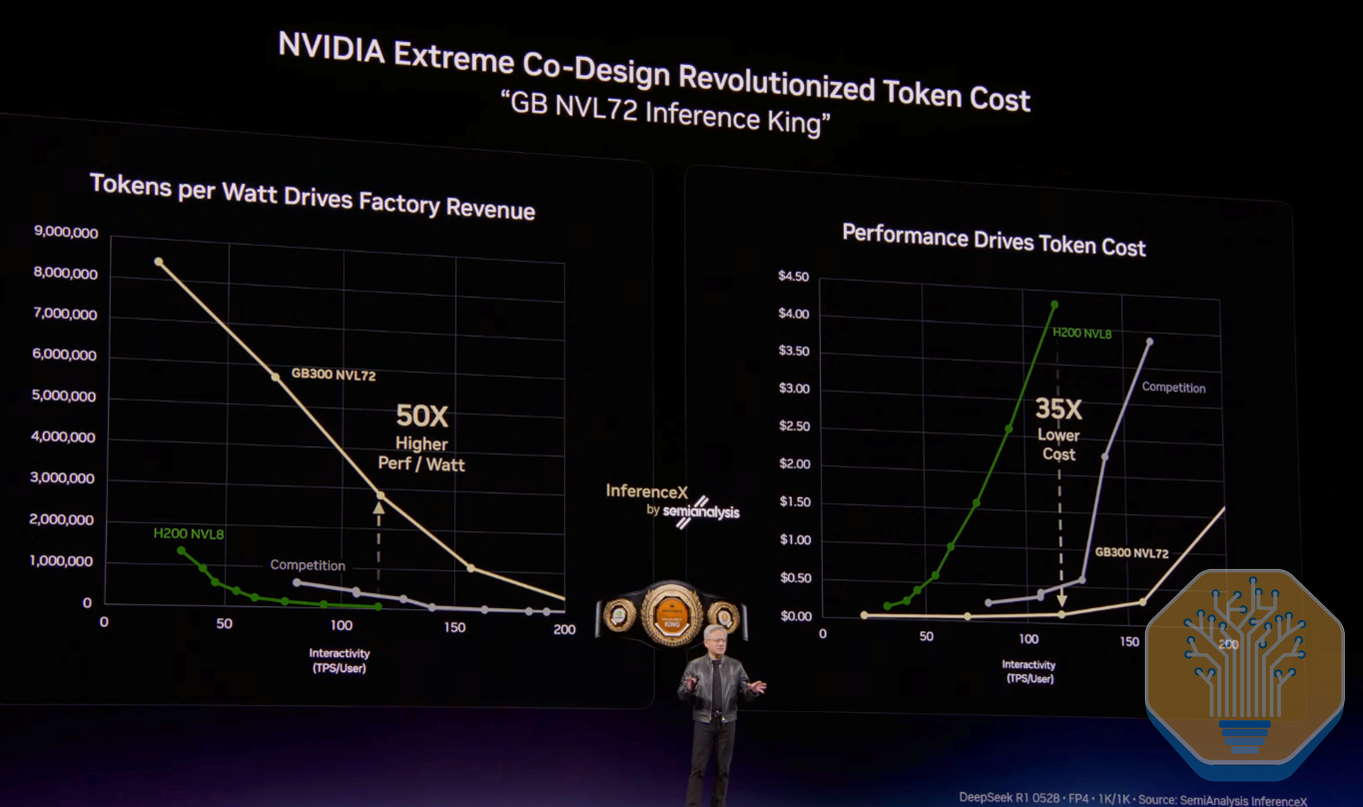
Source: Nvidia, InferenceX
As GPU clusters become increasingly dense, with Kyber Ultra approaching 660kW per rack, the physics start to break down. Resistive losses scale with current squared, and at these power levels copper mass and thermal envelope exceed what fits inside a rack. Moving to 800VDC eliminates conversion stages, reduces resistive losses, and cuts facility-level power consumption by ~5%. At 1GW of IT load, that is over 50MW of continuous savings, tens of millions in annual electricity costs, or new compute capacity unlocked. For all the inference-king proponents out there, 800VDC is a transition forced by physics and motivated by system economics.
We have been tracking this transition through our InferenceX and Industrials Models, which provide a bottom-up view of where efficiency gains materialize and which equipment categories absorb the disruption. The Industrials Model includes a dedicated 800VDC module, building up from individual accelerator architectures to a top-down view of 800VDC penetration, MW adoption, and market sizing for equipment like the power sidecar and Solid-State Transformers (SSTs).
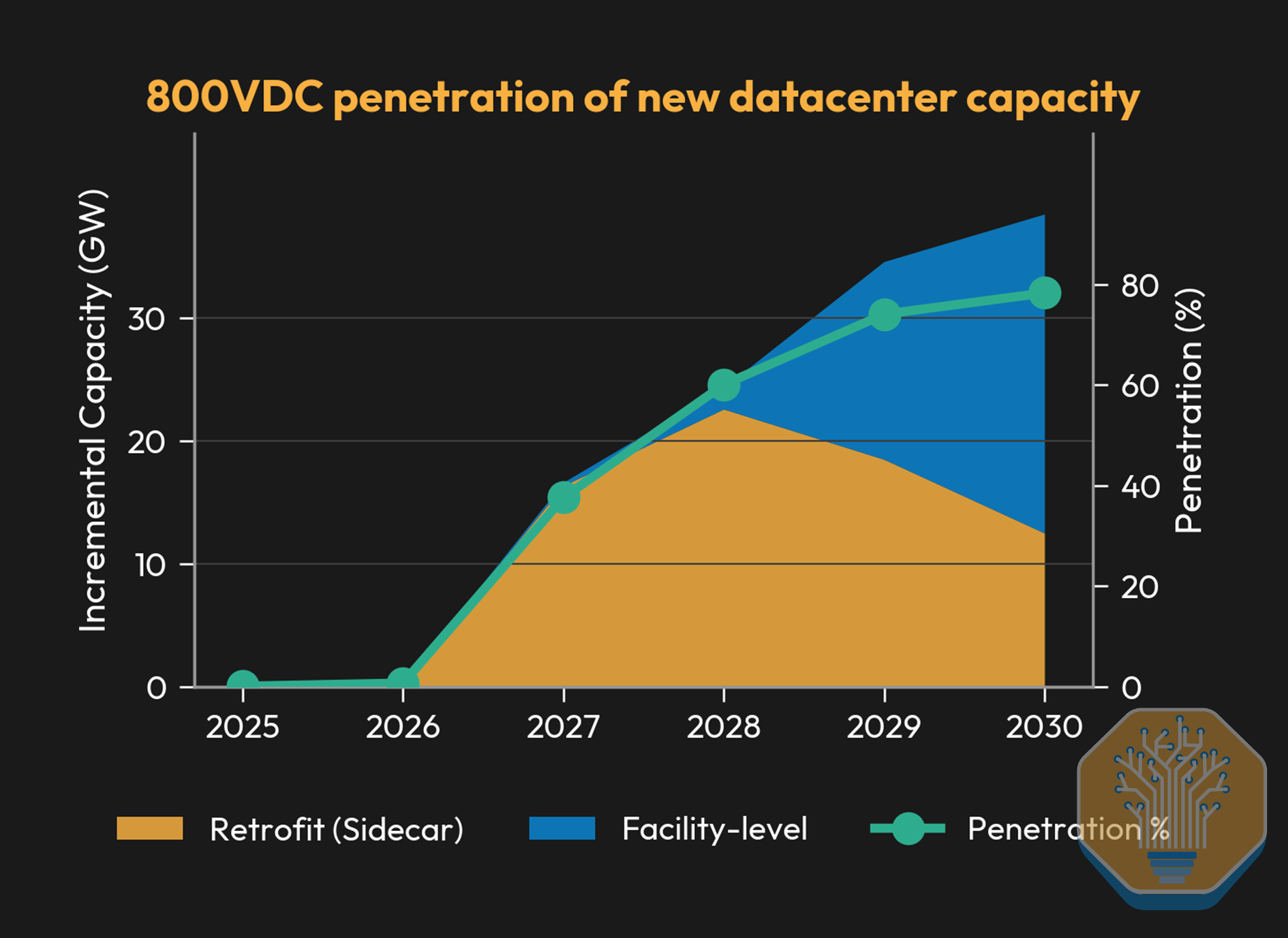
Source: SemiAnalysis Industrials Model
This deep dive traces the transition phase by phase: from the sidecar retrofit, through faciliy-level DC distribution, to the SST endgame. For each phase, we analyze the BoM and map the changes in equipment content/MW, what survives, what gets redesigned, and what gets eliminated.
The 800VDC revolution is set to dramatically change the revenue trajectory of certain suppliers. We’ve been tracking winners and losers for over a year in Industrials Model, which estimates the BoM for 20+ different datacenter designs broken down into 70+ equipment types and lays out the impact for 500+ suppliers. It is built on our industry-leading Datacenter Model which forecasts quarter-by-quarter MWs for 6000+ datacenters and anticipates design changes.
This has enabled us to successfully call out both winners, and companies inaccurately pictured as losers by the market, before anyone else. If you are wondering whether UPS systems have a place in upcoming 800VDC distribution, what is the market opportunity for SSTs, or which suppliers are leading this transition, stick with us.
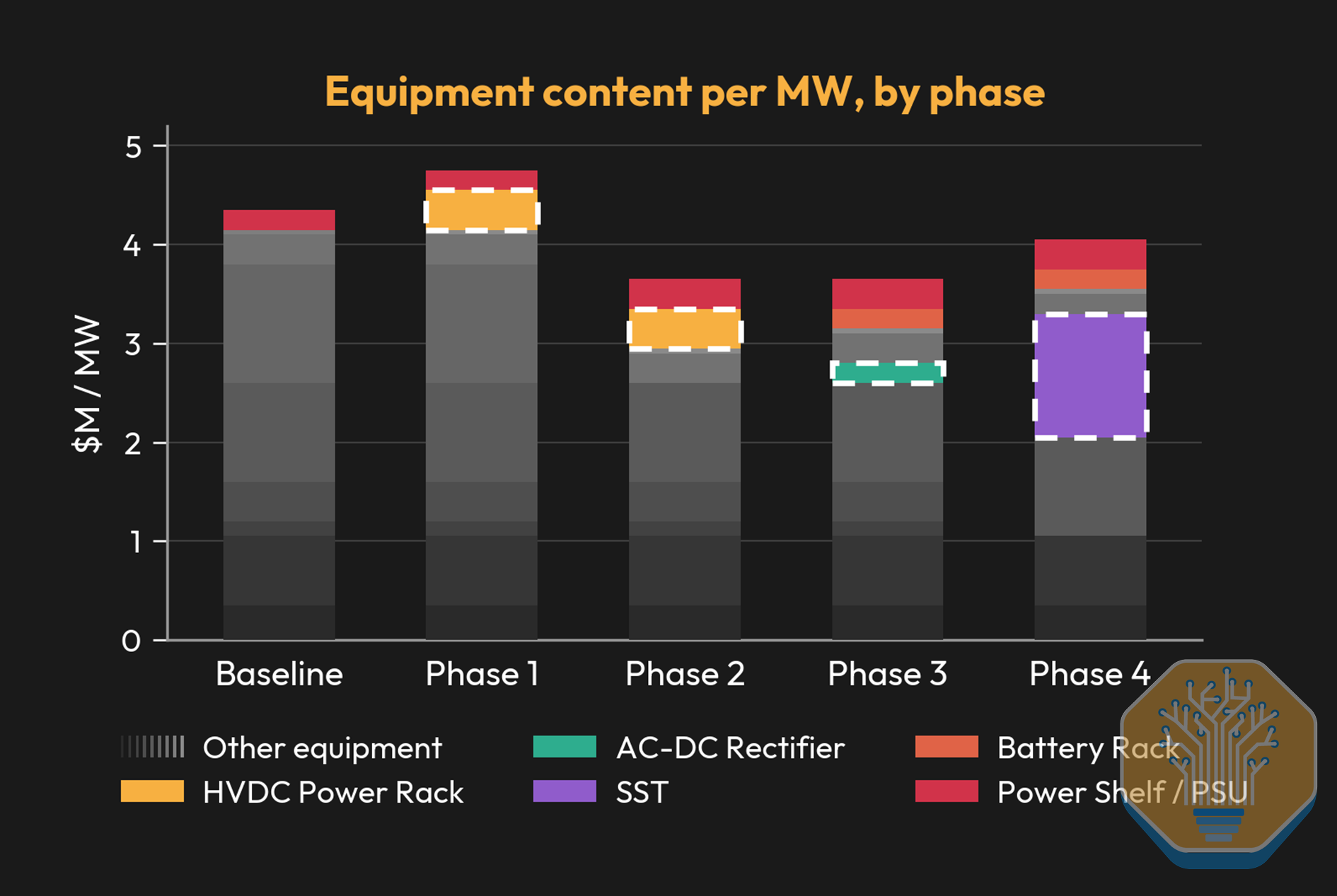
Source: SemiAnalysis Industrials Model
Part 1 of this 800VDC Revolution series covers datacenter layout and equipment implications. Part 2 will focus on power electronics and the semiconductor revolution underneath it.
Understanding The Basics: What is 800VDC and Why It’s Inevitable
At its simplest, 800VDC in this context means distributing power at ~800 volts direct current through the data hall or row and into the rack, then stepping it down near the compute. The number 800 is not arbitrary, but a voltage high enough to materially reduce current (and therefore copper loss and thermal burden) while remaining within the broad regulatory and product-safety classification of “low-voltage DC” in many jurisdictions. For context, EU rules around the Low Voltage Directive scope reference DC equipment ratings up to 1,500 V DC (and AC up to 1,000 V).
Current datacenter electrical architectures generally rely on AC distribution at the facility level. Datacenters today use three-phase AC at 415V or 480V, and the topology relies on conventional UPS architectures before distributing 48-54V DC within the rack.
This works at today’s rack power levels, but starts to fail as rack densities in the next two years approach ~600 kW+, for several reasons:
Copper becomes unmanageable at 48–54 V. A 1 MW rack at 48–54 VDC needs ~200 kg of copper busbars. At 1 GW scale, that’s hundreds of tons of copper — brutal on cost, weight, installation complexity, and routing space.
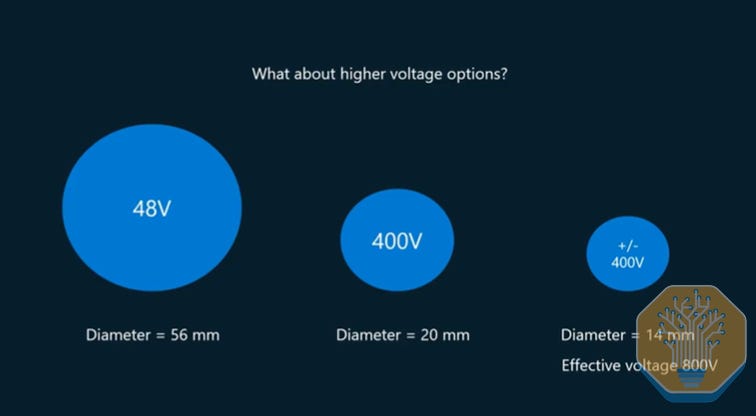
Source: Microsoft
Power shelves crowd out compute. Today’s NVL72 racks already use up to 8 power shelves. At Kyber-class rack power, a 48–54V approach would require ~64U-equivalent of power hardware, effectiviely an entire rack, leaving no volume for compute.
Current becomes the real limiter. Delivering 600 kW at 48–54 V implies ~12,500A. At 800 V, that drops to ~750 A (~16.7× less), enabling dramatically smaller conductors/busbars and far lower thermal stress. If conductor resistance were held constant, I²R losses fall ~278×, so in practice you shrink copper and “buy” size/weight reductions.
Conversion losses compound and hurt reliability. Stacked AC-to-DC and DC-to-DC stages reduce end-to-end efficiency, increase heat, and introduce failure points, raising cooling loads, downtime risk, and maintenance costs.
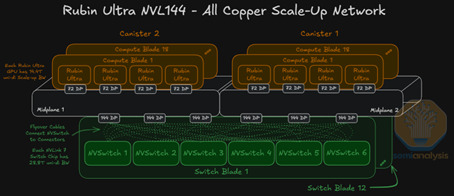
At the end of the day, 800VDC is the physics enabler for 2,300W TDP chips and 600kW racks, and those 600kW racks are the direct consequence of the push for density, because density is what drives cost per token down. Cost per token is dictated by the size of the scale-up world you can build at full NVLink bandwidth: bigger domains mean wider Expert Parallelism (EP) / Tensor Parallelism (TP), MoE routing on NVLink rather than scale-out, and less serialization across decode. As we laid out in our Vera Rubin Deep Dive and GTC 2026 pieces, Nvidia’s design rule is to pack compute tightly enough that copper reaches everything in the rack. Reiner Pope made this point cleanly on our friend Dwarkesh’s podcast a few weeks ago, indicating that a single rack bounds the size of the expert layer you can build, because the moment an all-to-all crosses a rack boundary, it falls onto a scale-out fabric that is roughly eight times slower than NVLink.
Bigger scale-up worlds mean denser racks, denser racks mean 600kW envelopes, and 800VDC is what makes those envelopes possible.
Source: SemiAnalysis AI Networking Model
The Four Chapters of the HVDC Transition
The move to 800VDC is a complex metamorphosis that rewrites the entire electrical architecture, introduces new safety standards, requires new regulatory frameworks, and, most importantly, forces operators to make very different strategic choices about when to walk away from their legacy AC distribution.
Source: SemiAnalysis
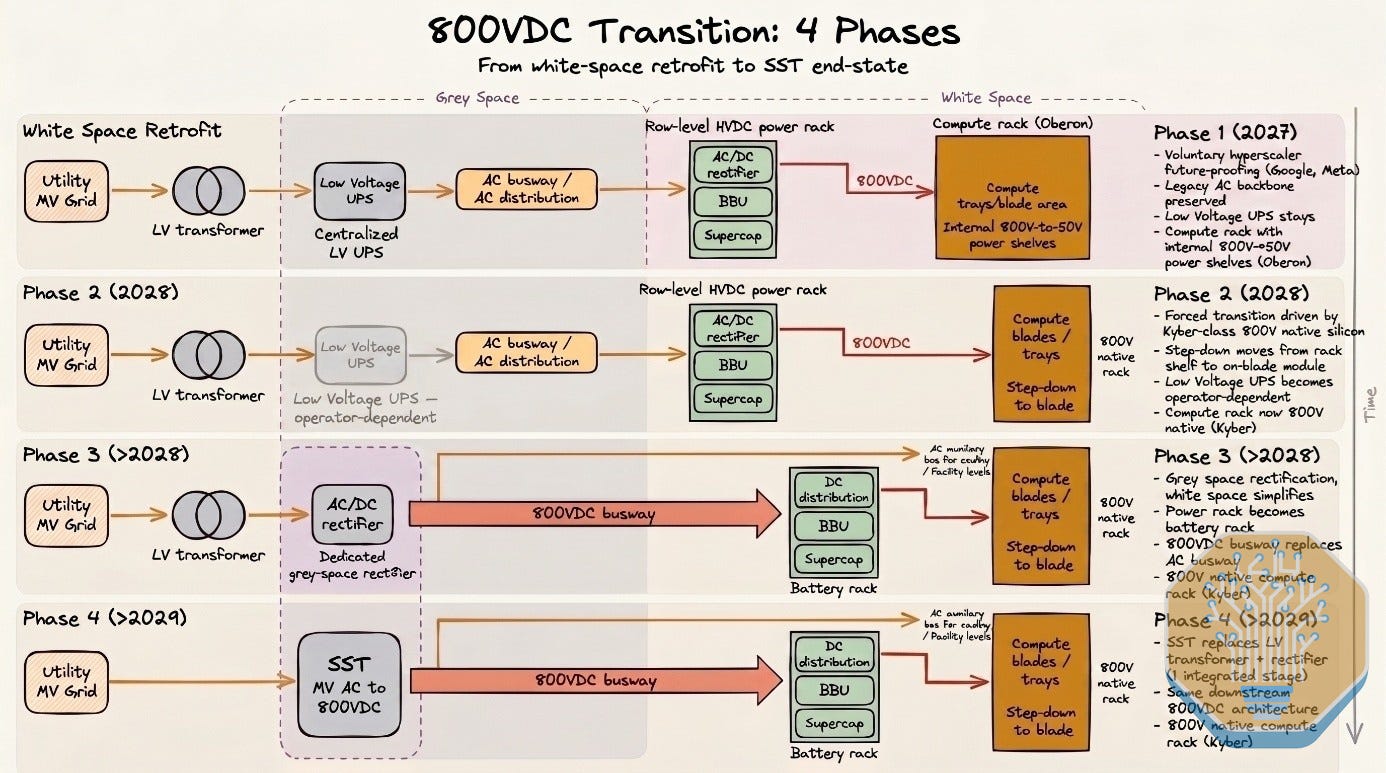
We frame the 800VDC transition as progressing through four distinct phases. Phases 1 and 2, starting in late 2026 / early 2027, retrofit the existing AC distribution into 800VDC at the rack level via the power rack. Phase 1 is the early-mover stage, driven by hyperscalers willing to pay up for future-proofing and efficiency gains. Phase 2 kicks in once 800VDC-native systems begin shipping at volume. Phase 3 rewrites the electrical architecture itself, taking 800VDC distribution facility-wide. Phase 4 is the end state, built around new pieces of equipment that promise to render much of today’s electrical stack obsolete....
....MUCH MORE
Previously:

