Name two people who can out-think me even though they're dead.
(a long list, I know. trust me, I know)
From the MIT Press Reader:
Is Life a Form of Computation?
In 1994, a strange, pixelated machine came to life on a computer screen.
It read a string of instructions, copied them, and built a clone of
itself — just as the Hungarian-American Polymath John von Neumann had
predicted half a century earlier. It was a striking demonstration of a
profound idea: that life, at its core, might be computational.
Although this is seldom fully appreciated, von Neumann was one of the
first to establish a deep link between life and computation.
Reproduction, like computation, he showed, could be carried out by
machines following coded instructions. In his model, based on Alan
Turing’s Universal Machine, self-replicating systems read and execute
instructions much like DNA does: “if the next instruction is the codon CGA, then add an arginine to the protein under construction.” It’s not a metaphor to call DNA a “program” — that is literally the case.
Of
course, there are meaningful differences between biological computing
and the kind of digital computing done by a personal computer or your
smartphone. DNA is subtle and multilayered, including phenomena like
epigenetics and gene proximity effects. Cellular DNA is nowhere near the
whole story, either. Our bodies contain (and continually swap)
countless bacteria and viruses, each running their own code.
It’s not a metaphor to call DNA a “program” — that is literally the case.
Biological computing is “massively parallel,” decentralized, and noisy. Your cells have somewhere in the neighborhood of 300 quintillion ribosomes,
all working at the same time. Each of these exquisitely complex
floating protein factories is, in effect, a tiny computer — albeit a
stochastic one, meaning not entirely predictable. The movements of
hinged components, the capture and release of smaller molecules, and the
manipulation of chemical bonds are all individually random, reversible,
and inexact, driven this way and that by constant thermal buffeting.
Only a statistical asymmetry favors one direction over another, with
clever origami moves tending to “lock in” certain steps such that a next
step becomes likely to happen.
This differs greatly from the
operation of “logic gates” in a computer, basic components that process
binary inputs into outputs using fixed rules. They are irreversible and
engineered to be 99.99 percent reliable and reproducible.
Biological computing is computing, nonetheless. And its use of randomness is a feature, not a bug....
In hotel penthouses around the globe, rock stars and heads of state have been displaced by cocooning patients looking to emerge as immortal butterflies.
recently
stayed at an ultraluxury hotel in Bangkok, and the most interesting
guest I encountered wasn’t the K-pop star I saw slinking out of the bar
or one of the designer-clad TikTok creators dancing in the lobby, or
even the former U.S. politician I spotted in the restaurant. It was the
woman I saw every morning in the elevator, draped in a different brocade
robe and pajama set, being gently guided to breakfast by her elderly
nurse because she could barely see out of the post- surgical dressing
wrapped around her entire face. No one batted an eye, least of all the
hotel staff, because clearly she had been there a while.
What
was once taboo is now commonplace. The long-term hotel stay, formerly
the province of rock stars on benders or agoraphobic recluses, has taken
on a decidedly medical bent. Why else would the famed Brazilian plastic
surgeon Marcelo Araújo open his new clinic, which has a yearlong
waiting list just for a consultation, in a building at the Rosewood São
Paulo, for instance? You may see women dressed like the one I
encountered in Bangkok on any day at the Mark or the Carlyle in New
York. A hotel partnership is now de rigueur for top-tier plastic
surgeons, as patients expect not just privacy during their recovery but
high-level hospitality. Who, after all, wants to recuperate in a
hospital bed when she could be snoozing on 1,000-thread-count sheets?
The
idea is moving beyond plastic surgery. At the Four Seasons in Beverly
Hills, a partnership with Immortelle Integrative Health has effectively
turned the hotel into one of the most cutting-edge wellness clinics in
the world. “We shifted [from post-surgical care] into internal medicine,
developing an executive physical called a Life Optimization Reset,”
says Immortelle co-founder and CEO Evan Pinchuk. “We collapse five years
of medicine into 48 hours and check your health across internal
medicine, functional medicine, pulmonology, cardiology, biomechanics,
oral health, dermatology, and podiatry.” Not only that, he says, but
Immortelle has affiliations with the four top hospitals in Los Angeles,
so it can fast-track care should findings show that a client needs
immediate attention.
Housed
on the fifth floor, directly above the spa, Immortelle boasts not only a
fully staffed medical facility but tricked-out hotel rooms for
post-surgery recovery that combine state-of-the-art medical equipment
with the ultraluxe service of a five-star hotel (including the iconic
Four Seasons mattresses). That combination is the key that has clients
including professional athletes, A-list celebrities, and international
royals eschewing the typical wellness clinic setting and “flying in from
around the world” to book one of Immortelle’s programs, says Vivian
Henein, director of wellness at Four Seasons Hotel Los Angeles.
The
aforementioned Life Optimization Reset costs $42,500 (which includes
two nights at the hotel), but for those who don’t want the whole
shebang, there are also the Functional Health Assessment ($6,500 with
one night included), which assesses longevity markers like gut health,
micronutrients, and environmental toxins, and the Executive Health
Assessment ($11,500 with one night included), which includes internal
medicine and an in-depth cardiology assessment. (“After age 40, the
biggest killer is your heart,” Pinchuk asserts.) And for those who want
the Immortelle experience without a full program, there are à la carte
options, such as IV therapy, vitamin injections, and acupuncture
available on demand, as well as a new Functional Frequency Reset
($1,775), a five-hour package combining best-sellers from Immortelle and
the spa.
Demand
has been staggering, Henein says, with many high-rolling guests booking
long—sometimes months-long—stays centered on the Immortelle program....
Over 2 million job seekers used Goodwill's employment services last year—and the charity's CEO Steve Preston says it's gearing up for an influx of unemployed Gen Z thanks to AI.
Tech leaders have been quick to squash claims
that their AI firms could one day cause significant unemployment. But
Goodwill’s CEO Steve Preston says it’s already happening.
The charity, which has over 650 job centers, saw over 2 million
people use its employment services last year—and it’s getting ready for
even more.
“We are preparing for a flux of unemployed young people—as well as other people—from AI,” the CEO exclusively told Fortune, adding that automation will hit low-wage and entry-level roles the worst.
The 65-year-old, who formerly served as the 14th United States
secretary of housing and urban development, revealed that he’s already
witnessing “large organizations beginning to make significant layoffs
based on a move to AI.”
Call centers
and sales roles are being particularly hard hit right now, he added. “I
don’t know that it’ll be catastrophic, but I do think we’re going to
see a significant reduction in a number of jobs. I think it’s going to
hit low wage workers especially hard.”
Although people of all ages hold lower-paying jobs, they’re often
a rite of passage for fresh-faced students starting out in the world of
work.
“It’s much harder to find a job, Preston adds. “It’s really
hitting college students right now in the marketplace. It’s really
hitting young adults without college degrees.”
Gen Z non-grads are finding themselves worst hit by unemployment—
but they won’t be the only ones impacted
Despite numerous reports warning that the higher education payoff is dead—essentially,
thanks to more inclusive skills-based hiring, there’s no point getting a
degree anymore and Gen Zers without one are winning the talent
war—Preston is seeing the complete opposite.
“What I’m seeing is of the overall unemployment, people without college degrees have no jobs,” he said. Research has shown that the issue is even more acute for young men.
“That is a terrible thing,” Preston said, while sympathising with
young people on how crucial it is to see a world where they can grow and
thrive. “For young people at that point in their life, to attach to
something where they can see a future is so important, where they can
envision their lives going forward.”
And as AI and automation gets smarter, eventually those with
degrees will also find landing that first job increasingly
impossible—and according to Preston, that’ll have a knock-on effect on
more senior roles too.....
From the U.S. Army's Mad Scientist blog, August 21:
“Be subtle! be subtle! and use your spies for every kind of business.” — Sun Tzu, The Art of War
[Editor’s Note: While China’s People’s Liberation
Army (PLA) shares five military domains with the U.S. — Land, Air,
Sea, Space, and Cyber — it also recognizes two additional domains:
Electromagnetic Spectrum (EMS) and Cognitive. Today’s Mad Scientist Laboratory post by guest blogger Dr. John Ringquistexplores how the Chinese Communist Party (CCP) and the PLA plan to employ the Cognitive Domain to achieve another of Sun Tzu‘s observations, “The supreme art of war is to subdue the enemy without fighting.”
By harnessing the convergence of the Internet, Big Data, Social
Media, and Artificial Intelligence (AI), China is now able to conduct
Cognitive Warfare at the granular level. We already know from PLA
patent applications that China has designed methods and systems that use
Generative AIto
facilitate intelligence tasks like generating Open-Source Intelligence
(OSINT) products, processing satellite imagery, supporting event
extraction, and processing event data. We also know China is building dossiers
on virtually every U.S. citizen and is harnessing AI to correlate
sensitive information across databases they have stolen over the years
from the U.S. Office of Personal Management (OPM), health insurers, and
banks — this data includes fingerprints, foreign contacts, financial
debts, and personal medical records. With this granular-level of
understanding, the PLA can craft precise influence operations at machine
speed — tailored to target key demographics and even specific
individuals to shape U.S. domestic perceptions in favor of the CCP’s
strategic objectives. “China’s cognitive warfare against the United States is happening now.” Read on to learn more about the CCP’s nefarious activities!]
Cognitive warfare sounds like the stuff of Hollywood movies or sci-fi futurism. Imagine
your intimate thoughts, perceptions, and beliefs subjected to an
ingeniously designed campaign of psychological and perceptual revision
by a foreign adversary. Facts become lies and reality is created by
machines crunching big data. Expect Cognitive Warfare to be an
instrument wielded by intelligence agencies, cybercriminals, and
military units in their mission to change your mind, beliefs, and
reality to suit their purposes. It has already begun. China’s
determination to control information moving into its virtual and
physical borders is reinforced by constantly directed efforts to impact information abroad. The PLA is transforming its information warfare
skills, and its forces have embraced the concept of virtual war.
China’s cognitive warfare strategies are readily employed in grey zone
tactics and techniques, simultaneously exercising influence through
diplomatic, economic, and cultural spheres to create alternative
realities to contest those of its Western adversaries.
China controls domestic access to information through the “Great
Firewall” and its domestic agenda is a sweeping effort that aims to
combat internal dissention, deflect international interference with
China’s surveillance state construct, and blunt the West’s global
democracy narrative.1
Chinese AI-guided Large Language Model (LLM) censorship programs
identify and report social media targets, modify public opinion, and
track potential political opponents — then refine counters to quell
voices that contest Chinese efforts to control access to information.2
Efforts to combat unfavorable information derive strength from
citizens willing to strike perceived traitors with counterinformation,
bots, and threats against any that threaten government dominance.3
In February 2025, it was reported that a Chinese group used ChatGPT to
collect social media posts with sensitive material for the Chinese
government. The same report claimed a collaborative relationship was
ongoing between public and private actors in China. 4
These same tools are turned outward on commentators that post content
that challenges China. Social media of all types is subject to this
kind of censorship.....
As can be seen it is still an invest (investigative area) being referred to as Potential Tropical Cyclone Nine but the forecast has it developing into a depression, than a storm and then into a hurricane by September 30.
A snippet from The Blog of Finance Watch.org, December 19, 2013
Lessons from history VIII – On the social utility of finance
How an 18th century British doctrine suggests a complete overhaul of financial regulation
....Life insurance was invented in the 15th century. From the very
beginning, people have used life insurance as a way to bet on lives,
which made catholic powers furious. In 1419, the Venetian Senate banned
all bets on the Pope’s life. In most of Europe, there was a blanket
prohibition on gambling, which also encompassed life insurance. There
were only a few exceptions; for example, merchants were allowed to
insure slaves, which fostered colonial trade. Nevertheless, in England,
life insurance was never prohibited, partly because it was less
developed, partly because of Anglicanism, and partly because of Common
Law traditions.
So in the 18th century, England became home to all kind of bets. In
1771, speculation broke out on the true sex of a French soldier and
diplomat, the Chevalier d’Eon. Rumors that he was a woman had been
circulating since late 1770. Since the Chevalier refused to be examined,
two lawsuits were brought by brokers, to determine whether a friend’s
testimony constituted a proof. Courts dismissed the brokers’ claims.
However, the immorality of bets became more and more blatant. Here is a
telling story: “In 1750, a man collapsed at the door to the club and
was carried in. The members of the club immediately made bets whether he
was dead or not, and when the surgeon made ready to bleed him, the
wagerers ‘for his death interposed’, objecting that ‘it would affect the
fairness of the bet’” [Clark, 1999].
The insurable interest doctrine
Faced with such scandals, the British Parliament had to react, but
without hampering insurance markets, which are an essential step toward
an advanced capitalist economy. This resulted in the Gambling Act of
1774, which introduced the “insurable interest doctrine”: insurance
contracts that do not aim at protecting a legitimate economic interest
shall be annulled. This also helps to address the “moral hazard” problem
where the insured person is more interested in seeing the insurance pay
out than in preventing the harm it is designed to protect against.
But what is a legitimate interest? In 1777, Mr. Spenser, a rich
British soldier, died on his way to the West Indies. A good husband, he
had arranged for a £500 annuity to be paid to his wife, Mary Spenser.
Cautiously, she also took a £5,000 insurance policy on her husband. The
underwriters refused to pay: they claimed that Mary Spenser had no
“economic interest in her husband’s life” since he had already provided
for an annuity. However, the court held the contract to be valid, and
underwriters had to pay the promised amount. Indeed, common law
considers that a person has an unlimited interest in their own life, or
in that of their spouse. The case was one of the first decisions to
elaborate the “insurable interest” doctrine after the adoption of the
Gambling Act, the major historical pillar of insurance regulation in
England.
The Spenser case illustrates the difficulty of distinguishing
economic activity from pure speculation. There is always a speculative
element in finance, and it needs to be acknowledged. But one could argue
that on insurance policy markets, the balance has been found, thanks to
the “insurable interest” doctrine. Everybody now understands the
difference between protecting your family through life insurance and
betting on a stranger’s life. Historians have argued that the ensuing
development of private insurance was a great step forward, which among
other things paved the way for the Welfare State. Could better
regulation of today’s commodity and credit derivatives markets bring
similarly significant contributions to global development?....
With that headline the author and/or his editors obviously need our "Introduction to Search Engine Optimization/How to Write Clickbait That Works" tutorials. Some examples from our graduates:
Moving right along, from The Philosphical Salon, February 6....
And from Sublation Magazine, March 18, 2023, the headliner:
What does a Marx+Foucault framework look like for understanding contemporary capital crises? [1] Look no further than the work of Italian Marxist Fabio Vighi.
At the start of each essay in his ongoing project, Vighi makes clear that he wants his readers to consider what happens to a capitalist society when it no longer centrally runs on the production of profit via the exploitation of waged labor (or, the extraction of surplus value from a waged worker’s labor power). He gathers this question through a reading of “The Fragment on Machines,” an essay found in Marx’s Grundrisse. In this essay, as Michael McBride notes, Marx “seems to imply that the very act of automation transforms the framework he has established in his previous texts.” It breaks down the revolutionary subjecthood of the working class, in that – as Marx notes – it “no longer appears so much to be included within the production process.” Worth quoting Marx at length here:
[T]he human being comes to relate more as watchman and regulator to the production process itself…As soon as labor in the direct form has ceased to be the great well-spring of wealth, labor time ceases and must cease to be its measure. Capitalism thus works toward its own dissolution as the form dominating production….[T]he general reduction of necessary labor of society to a minimum, which corresponds to the artistic, scientific etc. development of individuals in the time set free, and with the means created, for all of them. Capital itself is the moving contradiction, [in] that it presses to reduce labor time to a minimum, while it posits labor time, on the other side, as sole measure and source of wealth.
The contradiction of capital is the push by major capitalists to reduce labor time (to reduce labor costs, to outcompete competitors) at the same time that labor is the source of surplus value/wealth. The battle to outcompete through efficiency leads to such high levels of productivity and savings, with less labor time/cost required, that capitalists are no longer able to extract as much surplus value since they’ve now put themselves in a situation where there is less human labor to exploit. Vighi agrees with the British Marxist Ted Reese that what Marx was speculating on in Grundrisse is not dissimilar to what we’re experiencing today, with automation leading to “prices trend[ing] secularly towards zero.” For a few wide-ranging examples, Reese notes:
[T]he fastest supercomputer in 1975 was worth $5m ($32m in 2013 money); an iPhone 4 released in 2010 with the equivalent performance was $400. Aerospace companies producing propulsion systems in 2010 for $24m in 24 months were by 2019 3-D printing them for $2,000 in two weeks [citing A. Bastani, Fully Automated Luxury Communism, Verso, 2019, p. 123]. One gigabyte of data storage fell from around $200,000 in 1980 to $0.03 in 2014. According to Rethink X, cheaply growing “unlimited” amounts of food in vats through ‘precision fermentation’ – feedstock plus gene-edited microbes (a form of automation) – will soon “sweep away the industrial dairy and meat industries”. In 2000, the cost of producing one kilogram of one type of molecule through precision fermentation cost $1million, but fell to around $100 in 2020, when it was on course to become cost-competitive with bulk animal protein ($10 per kg for casein and whey) by 2025. It is expected to be five times cheaper than traditional animal proteins by 2030.
So what happens when prices such as these trend toward zero? Reese argues that an under-accumulation of labor-produced surplus value is paired with an overaccumulation of value “increasingly dependent on the efficiency of central planning both at the state level (e.g., central bank intervention) and within private enterprises; industrial monopolization (mergers & acquisitions); and state subsidies, facilities and contracts.”
Vighi takes a slightly different angle on what happens, though similarly coalescing around crises of accumulation, automation, the narrowing of necessary waged labor time, and state management:
The current implosion reflects the historical exhaustion of the value-creating substance of capital; the fact that the fundamental ingredient of value itself – labor – is vanishing irreversibly while automated (technological) productivity takes off…
…Every leap in post-industrial technological innovation driven by capital, no matter how green or desirable, will cause unemployment and poverty to grow, together with the imposition of widespread repressive measures upon entire populations.
Vighi’s story begins at a typical starting point for understanding the rise of the particular kind of capitalist hegemony we see today. This is, of course, the dawn of neoliberalism. He briefly points to some financial policy and business shifts in the 60s and 70s before focusing on the 80s as the real starting point, at least for established/institutionalized neoliberalism and financial capitalism, two objects of analysis he refuses to separate, a third being biopolitics, which he will introduce later in his story. [2]
But before re-telling this story, if I even have space, we seriously need to put all of Vighi’s cards on the table. It would be disingenuous to not disclose his ‘senile’ perspective up front. Vighi is a firm believer that COVID-19 lockdowns were a biopolitical strategy orchestrated by the state and elite capital. He insists that global lockdowns were paired with mass government injection of artificially produced liquidity (cash) into the economy. He insists that that the systematic, centralized injection of liquidity was required to save the rentier, financial, credit-based capitalist system from collapse:....
January 2022 - "Red Pill or Blue Pill? Variants, Inflation, and the Controlled Demolition of Society" The Philosophical Salon has had some of the most interesting explorations of the interplay between the torrents of both fiscal and monetary liquidity, lockdowns, and the nagging sense that something much larger than official explanations is going on. Some previous links after the jump....
Professor Fabio Vighi (Critical Theory and Italian at Cardiff Uni.) can get heavy/borderline tedious but I think he's on to something. Plus, where else are you going to find sentences like:
"At the heart of this process is the reliance on the toxic fetish of the speculative bubble: trillions (quadrillions if we count derivatives) of insubstantial money orbiting above our heads at the speed of light."
There is a good chance that I will purloin "...the toxic fetish of the speculative bubble"
And then we package it, throw a pretty wrapper around the package—perhaps a posh frock, create derivatives and hoo boy, there is money to be made!
Just kidding. While Collateralized Compute Obligations are almost alliterative, a major selling point, that's not where this story is going. Yet.
From Bloomberg, September 26:
The AI Boom Needs a Market for Compute Just as oil futures and spectrum auctions unlocked waves of investment, turning compute into a tradable commodity will be needed to fuel AI’s next stage.
There’s money — really big money — in selling compute, the processing power driving the AI revolution.
Hyperscaler CoreWeave Inc. is worth more than $50 billion even as its losses are projected to increase tenfold this year, to $650 million. Oracle Corp., meanwhile, recently added
some $250 billion to its market capitalization overnight after
revealing the size of its upcoming order book. What’s unclear is whether
those valuations are based on a scarcity thesis — that demand is likely
to outstrip supply for years to come — or an abundance thesis,
foreseeing a multitrillion-dollar market where these companies will be
among the many winners.
In
a world where the promise of AI is fulfilled and today’s valuations for
companies like OpenAI are justified, compute providers will be more
akin to Walmart, with its high-volume, low-margin stores, than a
high-margin, medium-volume business like LVMH. That world aligns roughly
with McKinsey & Co.’s bull-case scenario
of $7.9 trillion in data center investment over the next five years,
and would also be good news for the industry: Walmart Inc. after all, is
a lot more profitable than LVMH Moët Hennessy Louis Vuitton SE.
Even
McKinsey’s bear case of $3.7 trillion, however, implies a magnitude of
capital flows with little precedent in human history. And if that’s
going to happen, one necessary precondition is that compute needs to be
priced a lot more transparently.
In
the clunky current system, the chief operating officer of an AI company
calls up Amazon Web Services Inc. or CoreWeave and asks for a price.
That’s a major bottleneck, since it’s difficult for consumers of compute
to shop around, especially if there are many different configurations
they’d be happy with at the right price. And while vendors enjoy the
extra pricing power the status quo gives them, they’d also love to be
able to compete effortlessly on every contract being negotiated anywhere
in the world. That means sooner or later we’re going to have to have a
public market for compute, much as we do for all other valuable
commodities.
The
good news is that transitioning to a market-based system has happened
many times before, generally with great success. The oil and gas
industry, for instance, struggled with significant capital constraints
when it came to exploration up until around 1983, when the introduction
of crude oil futures brought a lot more liquidity into the market.
Something similar happened in the 1990s, when chunks of the
electromagnetic spectrum previously allocated by governments started
being auctioned, priced and invested in.
The godfather of spectrum auctions is Paul Milgrom, the Stanford economist who won the Nobel Prize in 2020 for his work on auction design. Now, Milgrom and his company, Auctionomics Inc., have teamed up with OneChronos Markets, a company that builds smart exchanges, to do for compute what Milgrom did for spectrum.
With
AI technology, that’s now possible. As a rule, the simpler and more
fungible the commodity, the easier it is to trade. Grain futures date
back almost 4,000 years, to the Mesopotamian Code of Hammurabi; oil
futures, by contrast, required the creation of standards like Brent
Crude and West Texas Intermediate. Compute markets — both spot and
futures — involve so many variables that they’ve become a possibility
only with the advent of AI agents that can accept natural-language
inputs. Those agents then turn high-level English-language goals and
instructions into detailed structured “expressive bidding” that can be executed on-exchange.
The
trick is to use what’s known as combinatorial auctions. Bidders might
care very much about having an uninterrupted stretch of time to do their
computations, for instance, or they might be willing to break it up if
someone else wanted the data center urgently and briefly. Similarly, a
bidder might ideally want to use B200 chips, but would be fine with
paying slightly less money to use more H100 chips for more hours. Right
now the market in compute is almost entirely bespoke: A client explains
what they’re looking for, and a vendor gives them a price. But with
combinatorial auctions, a large number of buyers and sellers can
collectively arrive at prices for the optimal allocation of every chip
during every hour of every day.
That
in turn maximizes value, not least because it significantly reduces the
risk associated with buying compute. “One of the things that can really
hurt the value of an asset is liquidity risk, or the inability to
resell it,” says OneChronos co-founder and Chief Executive Officer Kelly
Littlepage. Once compute spot markets are in place, every buyer will
become a potential reseller of the commodity, creating vastly more
potential vendors from whom chip time can be bought....
There have been a billion pixels sacrificed to make the circular finance argument, including here on the blog (though we are still the only ones to invoke the ourobouros)
Here is a look at things from a different angle.
From Barron's, September 26:
Artificial-intelligence leader Nvidia generated $112 billion in free
cash flow in the past six quarters—and more is coming, at an increasing
rate. For companies that have reached this rarefied air, the inevitable
question is what to do with all that money. Apple, for one, decided to
buy back billions worth of stock and reinvest in its business. For
Nvidia, the decision is to backstop the AI investment boom,
where it remains the primary winner.
Nvidia, to be sure, has also
done buybacks and reinvestments. In the past six quarters, the company
has spent $57 billion on share repurchases. In August, the board
authorized another $60 billion. In its recently reported second quarter,
research and development expenses were up 39% from the year before.
Even
with that spending, Nvidia’s cash and short-term investments have risen
11 quarters in a row, now up to $57 billion. In the past, companies
would also use their cash for mergers and acquisitions, but the
regulatory environment doesn’t favor large deals anymore, as seen by
Nvidia’s failed effort to buy Arm Holdings from 2020 through 2022.
Today, Nvidia faces the same dilemma as Apple did in 2012, when it had
over $100 billion in cash and securities. The companies have more than
they know what to do with, and it’s piling up every day.
Nvidia’s
AI backstop strategy began in 2023, when CEO Jensen Huang identified a
small AI cloud provider called CoreWeave, which at the time had $16
million in annual revenue. Since then, he has helped it grow into a
company with a $80 billion market value. Huang didn’t want to be
dependent on a few “hyperscaler” cloud companies like Amazon Web
Services, Microsoft Azure, and Google Cloud, so he created a new
customer by seeing that CoreWeave got early allotments of Nvidia’s AI
servers.
CoreWeave says it doesn’t get any special treatment from
Nvidia. “What makes our relationship strong is execution,” a company
spokesperson says. “CoreWeave has built the scale, infrastructure, and
technical expertise to be a reliable partner, which is why customers and
suppliers choose to work with us.”
But there’s no denying that
Nvidia is CoreWeave’s most important supplier and a key customer. It
also owns about 5% of the company’s stock. Huang’s latest move came two
weeks ago, when CoreWeave signed a $6.3 billion deal for Nvidia to buy
any excess AI data center capacity, should demand from CoreWeave’s
multiyear contracts falter. CoreWeave’s business model requires rapid
growth and massive debt to fund it. Nvidia is promising to backstop the
effort. In so doing, it’s giving others more confidence to lend
CoreWeave money for its ambitious growth strategy.
That same
week, during a trip to the United Kingdom, Huang seemed to christen a
new British CoreWeave-style company called Nscale. Like the CoreWeave of
yesteryear, Nscale has little in the way of revenue. According to
FactSet, the company raised one round of funding worth $155 million in
December.
But now Nscale has the full faith and credit of Nvidia,
and a $1.1 billion round of financing from a group that includes
Nvidia. It also sports new contracts with Microsoft and OpenAI for U.K.
data center deployments, and it has plans to expand internationally.
In
a video posted to LinkedIn, Huang “signed” the Nscale partnership on a
bottle of Johnny Walker Blue scotch, writing “zero to 50 billion,” in
reference to Nscale’s growth. “I’ve never seen a start-up take off like
that before,” Huang said to Nscale CEO Josh Payne. “I think you’re on
the Starship.”
“We couldn’t do so without your support,” Payne replied.
But
the CoreWeave and Nscale deals pale in comparison to what came this
past week, when Nvidia committed up to $100 billion to OpenAI, as part
of OpenAI’s plan to build 10 gigawatts of data centers for itself.
Data
center developers have taken to sizing their projects by the power
consumed, since the massive energy requirements are a limiting factor.
Ten gigawatts would consume all of the power output from the most
recently built U.S. nuclear reactor, Georgia’s Vogtle 4, which opened in
2024, plus another eight just like it....
Bowman is one of the two Fed Governors we pay especial attention to,
despite the fact that she, like Fed Head Powell is an attorney rather
than a banker or economist. She is the Fed's regulation overseer and
seems to have a pretty good feel for banks not named JPMorganChase. She
was the banking commissioner for the state of Kansas and officially sits
in the community banking chair.
The other one we watch is Lorie Logan at the Dallas Federal Reserve Bank. From her official mini-bio:
....Prior to leading the Bank, President Logan spent more than two decades
working in the Markets Group at the Federal Reserve Bank of New York.
She was previously manager of the System Open Market Account for the
FOMC and an executive vice president at the Federal Reserve Bank of New
York. In that role, she managed the Federal Reserve’s securities
portfolio and led the implementation of monetary policy as directed by
the FOMC....
Here's her thinking on rates and the balance sheet in an address to SIFMA last October...
Here at Climateer Investing, WE RECYCLE!
And from Yahoo Finance, September 26:
Federal Reserve Vice Chair for Supervision
Michelle Bowman reiterated on Friday that she believes decisive interest
rate cuts are needed to ward off rising trouble in the job market.
“Recent
data show a materially more fragile labor market along with inflation
that, excluding tariffs, has continued to hover not far above our
target,” Bowman said in the text of a speech delivered before a
gathering of the Forecasters Club of New York.
Citing many months’ worth of data showing mounting
issues in the job market, Bowman said it is time for the rate-setting
Federal Open Market Committee “to act decisively and proactively to
address decreasing labor market dynamism and emerging signs of
fragility.”
She said “we are at serious risk
of already being behind the curve in addressing deteriorating labor
market conditions,” and noted “should these conditions continue, I am
concerned that we will need to adjust policy at a faster pace and to a
larger degree going forward.”
When the
rate-setting Federal Open Market Committee met last month policymakers
trimmed their overnight interest rate target range by a quarter of a
percentage point to between 4% and 4.25%. While officials are still
worried about inflation being above their target, their rate cut was
aimed at helping bolster the job market.
One
Fed governor voted in favor of a larger rate cut but Bowman joined with
her colleagues to support the 25-basis point easing. Bowman had
dissented at the Fed’s meeting at the end of July in favor of a rate cut
while most officials then favored keeping rates steady....
Michelle W. Bowman took office as the Vice Chair for Supervision of
the Board of Governors of the Federal Reserve System on June 9, 2025,
for a four-year term. Ms. Bowman has served as a member of the Board of
Governors of the Federal Reserve System since taking office on November
26, 2018, to fill an unexpired term ending January 31, 2020. She was
reappointed to the Board on January 23, 2020, and sworn in on January
30, 2020, for a term ending January 31, 2034.
Prior to her appointment to the Board, Ms. Bowman served as the state
bank commissioner of Kansas from January 2017 to November 2018. She
also served as vice president of Farmers & Drovers Bank in Kansas
from 2010 to 2017.
In addition to her experience in the banking industry, Ms. Bowman
worked in Washington, D.C. for Senator Bob Dole of Kansas from 1995 to
1996 and served as a counsel to the U.S. House Committee on
Transportation and Infrastructure and the Committee on Government Reform
and Oversight between 1997 and 2002. In 2002, Ms. Bowman became
director of congressional and intergovernmental affairs at the Federal
Emergency Management Agency. From 2003 to 2004, she served as Deputy
Assistant Secretary and policy advisor to Homeland Security Secretary
Tom Ridge.
Following her time in Washington, D.C., Ms. Bowman led a government
and public affairs consultancy based in London before returning to
Kansas in 2010.
Ms. Bowman received a BS in advertising and journalism from the
University of Kansas and a JD from the Washburn University School of
Law. She is a member of the New York Bar.
Ørsted (OTCPK:DNNGY) is in talks to sell a 50% stake in its £8.5 billion Hornsea 3 wind farm off the U.K. east coast to Apollo Global Management (APO), the Financial Times reported Friday, as the world's largest offshore wind developer tries to shore up its balance sheet.
Ørsted (OTCPK:DNNGY)
launched a sale process for Hornsea 3 late last year and said in August
that it had found a preferred bidder for the stake, without revealing
the identity; the FT report now says the negotiations are with Apollo (APO)....
Ørsted seems to be making the right moves, cutting exposure here and in Korea, shoring up the balance sheet with cash etc. It might me late, as evidenced by the 67% discount that was required in the recent rights offering but it does seem to be planning to be around for a while.
For what it's worth the shareholders approved the rights offering and one of the larger existing shareholders seemed to like the pricing:
Investment banks from Evercore Inc. to Lazard Inc.
are poaching bankers in the Nordics as they seek to seize market share
from homegrown players amid a dealmaking boom in the region.
Evercore last month hired Lars Ingemarsson, ex-head of Nordic investment banking at Citigroup Inc., to lead its new office in Stockholm and establish a team of 15 bankers.
Lazard appointed Jesper Jensen, who spent the past decade at Rothschild & Co., to open a new office in Copenhagen. The bank is assembling a team of five to six people there, according to Jean-Louis Girodolle, its co-head of European investment banking.
“We
see the region as a whole as a growth engine,” Girodolle said. “The
region has an attractive mix of blue-chip corporates, huge investment
pockets such as the family offices as well as large private equity
funds. They are open to do cross-border transactions to enter new
markets or tap a well-functioning stock market.”
Elsewhere, Thomas Westin recently joined PJT Partners Inc. from Goldman Sachs Group Inc. with a mandate to build a team in the Swedish capital. And Rothschild hired Miro Hemanus from DNB Carnegie Holding AB this month, marking the start of the French bank’s on-the-ground presence in Helsinki.
The
Nordics — which include Sweden, Denmark, Finland, Norway and Iceland —
has already more than $120 billion worth of deals announced so far this
year, according to data compiled by Bloomberg. It’s been the region’s
10th consecutive year of delivering $100 billion-plus deals. It’s also
higher than France — historically one of Europe’s largest M&A
markets — which has about $105 billion of announced transactions this
year, the data show....
From the Bureau of Economic Analysis, September 26:
Personal Income and Outlays, August 2025
Personal income
increased $95.7 billion (0.4 percent at a monthly rate) in August,
according to estimates released today by the U.S. Bureau of Economic
Analysis. Disposable personal income (DPI)—personal income less personal current taxes—increased $86.1 billion (0.4 percent) and personal consumption expenditures (PCE) increased $129.2 billion (0.6 percent).
Personal outlays—the sum of PCE, personal interest payments, and personal current transfer payments—increased $132.9 billion in August. Personal saving was $1.06 trillion in August and the personal saving rate—personal saving as a percentage of disposable personal income—was 4.6 percent....
*****
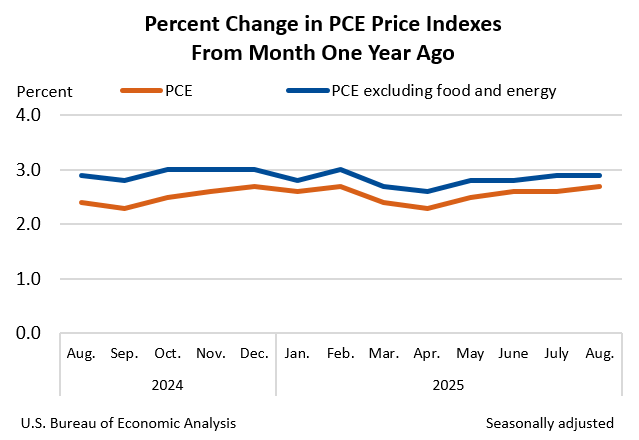
...From the preceding month, the PCE price index for August increased 0.3 percent. Excluding food and energy, the PCE price index increased 0.2 percent.
From the same month one year ago, the PCE price index for August increased 2.7 percent. Excluding food and energy, the PCE price index increased 2.9 percent from one year ago....
Teens dreaming of lucrative tech careers should seize on the
opportunity to hone their artificial intelligence skills by immersing
themselves in the growing number of AI-powered code generation tools,
says billionaire Scale AI co-founder Alexandr Wang.
“You just have to figure out how to use the tools maximally,” Wang said on a recent episode of the “TBPN” podcast that aired on September 17.
When
asked for his best advice for young people, Wang said, “it’s impossible
to understate the degree to which I’ve been radicalized by AI coding.”
AI coding, also called “vibe coding,” involves using artificial intelligence to generate original software code simply by typing out commands and instructions. AI coding apps, like Replit and Cursor, allow you to write code, or even develop a new app, without any coding or computer engineering expertise.
“It’s actually, in some ways, this incredible moment of discontinuity where, if you just happen to spend, like, 10,000 hours
playing with the tools and figuring out how to use them better than
other people, that’s a huge advantage,” said Wang, who co-founded Scale
AI in 2016 and helped build it into a tech unicorn that was most
recently valued at $29 billion.
Wang
compared the current moment of rapid technological advancement to the
early days of the computer revolution, when people like “the Bill Gates’
of the world” capitalized on being early adopters of computers and
software.
Indeed, the Microsoft co-founder has said he spent his teen years sneaking out of his parents’ house
at night to spend hours learning to write software code, thanks to a
fortuitous arrangement he had with a local Seattle company that gave him
free computer access.
Wang believes this era’s teens would be
wise to follow Gates’ approach by spending as much time as possible
learning to use AI coding tools: “That moment is happening right now —
and if you are, like, 13 years old, you should spend all of your time
vibe coding,” he said on the podcast. “That’s how you should live your
life.”
AI’s coding ability will match Wang’s ‘within the next five years’ Wang has an estimated net worth of $3.2 billion, according to Forbes, and was poached by Meta in June to serve as chief AI officer. Despite his massive success and standing in the industry, even Wang believes that “literally all the code I’ve written in my life … will be able to have been produced by an AI model within the next five years,” he told “TBPN.”
The idea of AI
programs potentially being able to replicate the work of even the best
coders in the world is already feeding concerns about software
programming remaining a promising career choice. Companies are already increasing their use of AI coding programs, and in some cases using them to replace human programmers....
The closer you are to your subject, meaning hands-on, learning by doing, rather than theoretical understanding, the more "happy coincidences" you will experience. It is in the interstices that the creativity is to be found. But first you have to have the framework to hang it all on and that framework can be boring as all-get-out to acquire. Once you have it though, internalized rather that top-of-mind, you are freed up to observe connections that may not have occurred to other people.
There are so few truly original ideas but there are so many ways to connect those things that have already been discovered that the potential is close to infinite.
All you need is one good idea that, when combined with grit, social connections and openness to luck, and away you go.
But first you have to know something at the deepest level you can achieve.
Overview: The dollar rallied in North America yesterday and the foreign exchange market seems to be waiting for its leadership again today. Against the G10 currencies, the greenback is consolidating in narrow ranges near yesterday's best levels without advancing. The dollar is mixed against the major currencies but is not much more than +/- 0.15%. Emerging market currencies are mixed with most of Asia Pacific currencies a little lower and central Europe slightly firmer. The news stream is light. Besides the unexpected flat Tokyo September CPI, the market is digesting a rash of new tariff announcements by the US. They include 100% on non-generic pharma (with an exemption for companies building facilities in the US) 25% on heavy trucks, 50% on kitchen cabinets/vanities, and 30% on upholstered furniture. The details and impacts are still be thought through.
Asia Pacific equities tumbled, led by a nearly 2.5% slide in South Korea, a 1.7% drop in Taiwan, and a nearly 1.4% loss in Hong Kong. European pharma may (or may not) be protected by the previous 15% levy agreement, and the Stoxx 600 is recouping about half of yesterday's 0.65% decline. US index futures are narrowly mixed. European benchmark 10-year yields are 1-2 bp softer, while the US 10-year yield is little changed slightly below 4.17%. Just as 4.0% marks the lower end of the range (on a closing basis) the 4.20% marks the upper end of the recent range. Gold is trading sideways, and like yesterday, remains in Wednesday's range (~$3717-$3779). November WTI edged up to a marginal new high near $65.40 before meeting sellers that pushed it back to about $64.80. The 200-day moving average is near $64.35. It settled around $62.40 last week. If the nearly 4% gain this week is sustained, it would be the largest weekly advance since June.
USD: The Dollar Index is firm. It absorbed offers near 98.00. Overcoming resistance near 98.25 sent it to 98.60 area. It is in a narrow range near yesterday's highs (~98.30-55). The 98.70 area is the (61.8%) retracement objective of the slide since August 1. It also corresponds to the highs going back to the middle of August. Above there could target 99.30. DXY is poised for its first back-to-back weekly gain since July. The US reports personal income, consumption, and deflators today. Income is expected to have risen by 0.3% and consumption by 0.5%. However, the nominal rise in consumption is largely a function of higher prices. In real terms, consumption expenditures have not grown this year (monthly average through July is zero). The Fed targets the headline PCE deflator, yet the media insists on calling the core deflator the Fed's "preferred measure". In any event....
Ukrainian President Volodymyr Zelensky ominously warned Russian
officials to find the nearest bomb shelter if they continue to refuse to
end the war.
“They have to know where the bomb shelters are,” Zelensky told Axios Wednesday. “They need it. If they will not stop the war, they will need it in any case.”
Zelensky went on to insist Ukraine would only target Kremlin
officials and not Russian civilians because “we are not terrorists.”....
Hegseth orders rare, urgent meeting of hundreds of generals, admirals
The Pentagon has summoned military officials from around the world for a gathering in Virginia. Even top generals and their staffs don’t know the reason for the meeting....
What's at stake: Stablecoin failure could echo throughout the banking system.
Forward look: The Senate will debate market structure legislation next month.
Expert quote: "No one wants to hear about this" – Senate Banking Committee ranking member Elizabeth Warren, D-Mass.
WASHINGTON
— As Congress prepares to debate sweeping market structure legislation
this fall, one glaring question remains unaddressed: what happens when a
major stablecoin collapses?
Lawmakers
spent months crafting the GENIUS Act, which President Donald Trump
signed into law in July, creating the first legislative framework for
stablecoins. That legislation passed despite objections from Democratic
lawmakers and banks alike, and Republicans pushing the bills say those concerns will be addressed in a forthcoming market structure package that the Senate is planning to take up next month.
But the biggest of those concerns is what would happen to the financial system if a stablecoin issuer — or a bank holding significant stablecoin deposits — were to fail. That question, so far, has barely registered in the debate.
"I
actually have had some of this conversation with Republicans as well,
and no one wants to hear it," Sen. Elizabeth Warren, D-Mass., ranking
member of the Senate Banking Committee, told American Banker in July.
"Nobody wants to hear this."
How it starts The idea of a single company, or a small number of companies, going under and taking all or a significant part of the entire financial system with it are usually fringe cases.
Bankruptcies
are rare, and big financial companies going under are even rarer. That
said, it does happen, most recently with the collapse of Silicon Valley
Bank in 2023, which set off a broader crisis of market confidence among
large regional banks.
A stablecoin issuer failing would
be very different from a bank failure or large nonbank bankruptcy.
Consumers, should the industry grow, may increasingly park their money
in stablecoins just as they do with bank deposits, except the treatment
of stablecoins is different from deposits should the entity holding them
fail....
This is a post on weather. I maybe should have headlined it "Pas de deux" rather than "M&A."
But then it would have risked disappointing the the ballet crowd, and they can be mean buggers.
From Gulf Coast News Now, September 25:
Dancing Hurricanes: What is the Fujiwhara effect? When 2 hurricanes glide close to each other, they can spin around in a stormy duet
Tropical Storm Humberto is rumbling in the Atlantic. It's track may be
influenced by a secondary system bubbling in near the Bahamas. The two
may experience the Fujiwhara effect and enter a sort of tropical tango.
The Fujiwhara effect occurs when two spinning vortexes, like
hurricanes or typhoons, rotate around a shared center. This cyclonic
samba happens when two hurricanes pass close enough, usually between 350
to 850 miles, to influence each other's paths.
The tropical
twirl is dependent on each storm's strength. Two storms of similar
intensities can spin into each other and merge to create one system.
Sometimes, they briefly rotate, only to be tossed in separate ways.
If one storm is significantly stronger than the other, the weaker system
usually begins to orbit around the larger. This is similar to the way a
planet orbits the sun. Often, the smaller storm will orbit closer and
closer until it eventually crashes into the larger system....
Here's the current set-up from the National Hurricane Center.
Hurricane Gabrielle seems to be bound-and-determined to Reconquista the Iberian Peninsula:
while to the west Humberto has just become a tropical storm on his way to possibly maturing into a cat 2 Hurricane. Even further west, Invest 94 is also forecast to develop into a tropical storm and it's those two who could go all Fujiwhara on us:
1. Central Caribbean Sea and Southwestern Atlantic (AL94): A tropical wave is producing a large area of disorganized showers, thunderstorms, and gusty winds across portions of the Dominican Republic, and the Turks and Caicos Islands. An area of low pressure is expected to form along the wave tonight or early Friday when it moves near the southeast Bahamas. This low is expected to become a tropical depression when it is in the vicinity of the central and northwest Bahamas in a couple of days. Interests in the Dominican Republic, Haiti, the Turks and Caicos Islands, and the Bahamas should monitor the progress of this system as heavy rains and gusty winds are likely across that region regardless of development. Interests along the coast of the southeastern United States should also monitor the progress of this system. * Formation chance through 48 hours...high...70 percent. * Formation chance through 7 days...high...90 percent.
And we still haven't gotten around to posting on all the various forecasts. Maybe next week for the whole batch.
***
On the other hand, just posting this little bit of hubris will probably
be the butterfly-flapping-its-wings necessary to trigger the first
whole-hemisphere-category-7-North-and-South-Atlantic-cyclone.
TC Energy plans to invest $8.5B in U.S. power projects over five years, betting on soaring natural gas demand from AI data centers, manufacturing, and LNG exports.
Analysts expect natural gas to remain the only fossil fuel gaining share in major economies by 2050.
Wood Mackenzie warns of rising costs, turbine supply constraints, and competition from cheaper renewables
Canadian energy infrastructure company, TC Energy Corp.
(NYSE:TRP), has unveiled plans to invest $8.5 billion over the next
five years in U.S. power projects, banking on predictions of a 45
billion cubic feet per day increase in natural gas demand to meet
surging power demand. According to TC Energy CEO François Poirier,
gas-fired generation will power the ongoing AI build-out, adding that
his company has a footprint in eight of the ten largest U.S. electric
utilities.
“It’s all about energy--and natural gas is going to be the backbone,” Poirier said in an interview.
Poirier
says favorable policies by the Trump administration will make it easier
for the company to achieve its lofty goal, saying that time spent on
permitting and construction could be cut in half. The energy executive
has predicted that U.S. LNG exports will double from the current 12
bcf/d to 24 bcf/d over the next 10 years. Back in May, Poirier reaffirmed
TC Energy’s capital expenditure guidance of $5.5 billion to $6 billion
in the current year, and said it remains on track to place assets worth
$8.5 billion into service in 2025. TC Energy reported that its projects
are tracking ~15% below budget.
TC Energy is not the only organization that has predicted robust growth in U.S. natural gas demand.
Last year, Morgan Stanley predicted
that the U.S. natural gas market is entering a new growth cycle thanks
to the advent of AI data centers, clean energy manufacturing and the
cryptocurrencies boom. According to the International Energy Agency
(IEA) global electricity demand increased by 4.3% in 2024, up from 2.5%
growth recorded in 2023.
Meanwhile, S&P Global Commodity Insights recently predicted
that natural gas will be the only fossil fuel that will increase its
share in the energy mix of the United States, China, and India by 2050,
even as oil and coal usage decline globally. S&P Global has
projected that renewables will supply 20% of global energy by 2050, up
from just 4% currently. “By 2050, gas shall be the only fossil fuel with
a potential increase in the energy mix for the US, China, and India,”
the report stated....
A beancounter’s look at the hyperscalers’ balance-sheets
IN ARTIFICIAL INTELLIGENCE, billions are so 2022. Three years after ChatGPT ignited the AI boom, the business is all about trillions. The market value of Microsoft, whose Azure cloud has a glistening AI lining, is not far off its recent $4trn record. Alphabet, which is giving Google an AI makeover, has just become a $3trn company. On a good day, Amazon, with a rival cloud, rounds to that. Meta, as much about AI these days as about social media, is now firmly a $2trn firm, plus or minus. Last week Oracle, challenging Alphabet, Amazon and Microsoft in the AI cloud, made a dash for $1trn. If some stock sales go to plan, OpenAI, ChatGPT’s maker, and its two rivals, Anthropic and xAI, could together be worth this much, give or take, by the end of the year.
AI revenues and expenditures are likewise a 13-figure affair nowadays. Worldwide spending on AI
hardware and software nudged $1trn last year, according to Gartner, a
research firm. This is likely to double to $2trn in 2026. Between 2024
and 2026 the five listed AI powerhouses will have splurged over $1trn on capital investments, chiefly AI data centres. A slug will end up with Nvidia and Broadcom, which furnish them and others with AI
semiconductors. The duo (combined market capitalisation: $6trn) are
together forecast to book almost $1trn in sales over that period.
Such a tally of zeros is normally reserved for official statisticians in G20 economies. In business, it is dizzying. All the more so given that examining the AI
titans’ finances can be like staring into a black hole. Whether or not
it promotes long-termism, President Donald Trump’s latest suggestion
that American companies move from quarterly to half-yearly financial
reporting is liable to make things blacker still. Pity the analyst
without the levellest of heads and the brightest of torchlights.
Fortunately, some are equipped with both. And they are beginning to raise questions about aspects of AI book-keeping. Depending on the precise answer, the impact on the AI champions’ value could itself be measured in trillions of dollars.
The most pressing set of questions concerns the tech giants’ assets—specifically, the longevity of all those fancy AI chips they are installing in their data centres. Last year Nvidia, which makes most of them, said it would unveil a fresh AI
chip every year rather than every couple of years. In March its boss,
Jensen Huang, remarked that “when Blackwell starts shipping in volume,
you couldn’t give Hoppers away,” referring to Nvidia’s latest chips and
their predecessors, respectively.
No
one took Mr Huang literally: that would imply that the useful life of
his firm’s pricey products is now a mere 12 months. Rightly so, for he
was clearly being tongue-in-cheek. And his biggest customers have in
recent times been raising their servers’ lifetimes, reducing
depreciation charges in their accounts. Microsoft pushed it up from four
to six years in 2022. Alphabet did the same in 2023. Amazon and Oracle
changed it from five to six in 2024. And in January Meta moved from five
to five and a half years.
In
the same month Amazon reversed course and moved back to five years for
some kit, noting this would cut operating profit in 2025 by $700m, or
about 1%, owing to a higher depreciation expense. Given the rapid
advances in chipmaking, that seems optimistic. And Amazon’s AI
rivals clinging to their elongated depreciation schedules look
Pollyannaish. In July Jim Chanos, a veteran short-seller, posted that if
the true economic lifespan of Meta’s AI chips is two to
three years, then “most of its ‘profits’ are materially overstated.” A
recent analysis of Alphabet, Amazon and Meta by Barclays, a bank,
estimated that higher depreciation costs would shave 5-10% from their
earnings per share.
Apply this logic to the entire AI
big five and the potential overall hit to the bottom line is huge. The
companies do not report the net book value of their computing
infrastructure. But you can get a rough idea by multiplying the gross
value, which each discloses in its annual filings, by the ratio of net
book value to book value of all plant and equipment (excluding land,
which is not subject to depreciation). Next assume that half the
resulting sum is tied up in servers, in line with their estimated share
of the global AI capital binge. Then, if all these
servers lose their value in three years rather than however many each
company assumes, their combined annual pre-tax profit would fall by
$26bn, or 8% of last year’s total.
At
the five companies’ current ratio of market capitalisation to pre-tax
profit, this would amount to a $780bn knock to their combined value.
Redo the sums depreciating the servers over two years instead of three
and the size of the hit rises to $1.6trn. Take Mr Huang literally, and
you get a staggering $4trn, equivalent to one-third of their collective
worth.
The cloud-depreciation society In reality, not all of the AI quintet’s servers would be useless after three years, let alone 12 months. They can keep performing oodles of non-AI work. Some AI tasks can also be farmed out to older processors....
Nvidia's development cycle is currently around eighteen months, shorter than the magic number that Moore's Law observed for the number of transistors in an integrated circuit, two years.
I don't know how long Nvidia can maintain that pace but Mr. Huang is pushing to shorten the development cycle further, thus making earlier generations of the company's GPUs obsolete even faster, a point we were pitching as a positive earlier this year regarding leakage of state-of-the art chips from the Middle Eastern buyers to China:
On the one hand with that many chips floating around that part of the
world there is no way to keep a bunch of them from ending up in China.
On the other hand, Nvidia's development cycle is focused on releasing
new, more powerful chips every 12 -14 months meaning the current smoking
hot H100 chips will have been superseded by two cycles at the end of
the contract period.
note: the smuggled chips were not the ones destined for the UAE.
The second point is that the real technology transfer deterrent is in the pace of NVDA's development cycle.
Although
there are hiccups—most recently server racks overheating from the
amazing amount of electricity flowing through the systems—the
overarching goal is an almost metronomic rhythm to the development of
new chips such that the H20s will be out-dated in under 2 1/2 years.
If interested in a deeper dive into the pace of development see also: