Friday, April 28, 2023

When Amazon Talks About User "Optimization" Of AWS Here's What they Mean (AMZN)

First up from Yahoo Finance:

Amazon stock forfeits gains after company warns on 'optimizations' from AWS customers

Amazon (AMZN) reported first quarter earnings on Thursday that beat expectations and initially sent shares surging, but cautious comments regarding a slowdown in its key Amazon Web Services (AWS) cloud unit saw the stock reverse all of these gains in extended trading.

Amazon CFO Brian Olsavsky told investors on the company's earnings call AWS customers are continuing "optimizations" in their spending and guided to a notable slowdown in growth from the segment, spooking investors.

Amazon shares were down about 2% near 8:00 p.m. ET Thursday evening.

"As expected, customers continue to evaluate ways to optimize their cloud spending in response to these tough economic conditions in the first quarter," Amazon CFO Brian Olsavsky told analysts on the company's earnings call. "We are seeing these optimizations continue into the second quarter with April revenue growth rates about 500 basis points lower than what we saw in Q1."

Revenue in Amazon's AWS unit grew 16% during the first quarter, down from an annual growth rate of 37% seen in the same quarter last year.

Olsavsky sought to cushion the blow of this guidance by telling investors, "we're not trying to optimize for any one quarter or year. We're working to build customer relationships and a business that will outlast all of us."....

And from ServiceStack's blog, September 6, 2022:

In pursuit of the best value US cloud provider 

At ServiceStack, we have been using AWS for hosting for over 10 years. It has served us well, but it suffers from complex pricing and possibility of bill shock due to its fractured pay-as-you-go design.

Thankfully, more and more companies are providing simpler offerings for hosting needs, and AWS themselves launched Lightsail as their answer to market demands for simple hosting options that package everything you need for basic hosting.

These simpler hosting options tend to bundle several things together as one fixed monthly price. A VM with a specific compute and memory allocation, as well as data transfer, and storage.

Looking at different US offerings
Something we wanted to do was to host our live demo applications on a US based host. We were using Hetzner dedicated servers in the past for non-latency sensitive use cases like our build server and Gist.Cafe (our interactive playground for multiple platforms) but we also wanted our demo applications to be snappy for US users.

DigitalOcean provides "Droplets" with this fixed pricing model with a nice and simple interface. Their pricing was quite good and we realized we could run all 20+ of our demo applications on a single droplet for $40/month.

For deployment, we also like to keep things as simple as we can, whilst keeping portability. Since all our projects are public and on GitHub, we use GitHub Actions heavily along with a pattern that deploys our applications using Docker Compose via SSH. Each application runs in its own container behind an NGINX proxy with a side car that handles renewing LetsEncrypt certificates. Below is an example of this pattern with Blazor and Litestream.

A nice side effect of this approach is moving servers is relatively painless. We change the DNS entry for the application to point to our new server, update the GitHub Action Secrets if needed and run our Release workflow.

A minute or so later, the application is back running again. Since their were 20+ of these repositories we took advantage of the GitHub Organization Secrets so we only needed to update values in one place, and running the workflows again can also be done programmatically through the GitHub CLI.

DigitalOcean Price Increase
In June of 2022, we got a notification that prices for droplets would be increasing, and for our droplet it would be going from $40 to $48. While this is a small amount of money, it prompted us to have a wider look into this market.

Something we try to do at ServiceStack is to not only provide a comprehensive .NET Framework for building API first systems, but also seek out great value hosting options we can recommend in this ever change space which we're happy to share, like this blog post, that might be useful to our users and others.

Not everyone builds massively distributed systems, and as hardware performance increases, and platforms like .NET are becoming even more optimized, a setup with just a server or two can manage larger loads and use cases....

....MUCH MORE

"How DARPA wants to rethink the fundamentals of AI to include trust"

From The Register, April 20:

Would you trust your life to the current generation of AIs? Yeah, we wouldn't either

Comment Would you trust your life to an artificial intelligence?

The current state of AI is impressive, but seeing it as bordering on generally intelligent is an overstatement. If you want to get a handle on how well the AI boom is going, just answer this question: Do you trust AI?

Google's Bard and Microsoft's ChatGPT-powered Bing large language models both made boneheaded mistakes during their launch presentations that could have been avoided with a quick web search. LLMs have also been spotted getting the facts wrong and pushing out incorrect citations.

It's one thing when those AIs are just responsible for, say, entertaining Bing or Bard users, DARPA's Matt Turek, deputy director of the Information Innovation Office, tells us. It's another thing altogether when lives are on the line, which is why Turek's agency has launched an initiative called AI Forward to try answering the question of what exactly it means to build an AI system we can trust.

Trust is …?

In an interview with The Register, Turek said he likes to think of building trustworthy AI with a civil engineering metaphor that also involves placing a lot of trussed trust in technology: Building bridges.

"We don't build bridges by trial and error anymore," Turek says. "We understand the foundational physics, the foundational material science, the system engineering to say, I need to be able to span this distance and need to carry this sort of weight," he adds....

....MUCH MORE

Tooze: "The Sudan crisis and the Sahel gold rush"

He's right about the gold but our interest is more focused on the Russian desire for a naval base at Port Sudan and the American desire to thwart the Russians, both of which he does get to. But back to Tooze, Chartbook #209, April 18:

Sudan is a pivotal link in the increasingly fragile and violent geopolitics of both the Sahel and the Red Sea/Horn of Africa regions. The bloody fighting across the country that began on April 15 is the result of a clash between the two most powerful military forces in the country - General Abdel Fattah al-Burhan, president since October 2021, and General Mohamed Hamdan Dagalo, better known as Hemeti (Hemetti, Himedti), Sudan’s vice-president and commander of the powerful paramilitary Rapid Support Forces. The fighting is driven by rivalry between the generals, heading different factions within the security forces in the wake of the ouster of long-time President al-Bashir in April 2019. They represent different power groupings in Sudan and enjoy sponsorship from rival outside forces. Al-Burhan is connected to Sisi in Egypt. Hemeti is thought to be closer to the Emiratis. Both have links to Russia. But the condition of possibility for this clash are the political economy of Sudan to which one of the keys is gold. As the work of a brilliant group of French scholars reveals, the emergence of General Hemeti as a challenger for power in Khartoum, is a reflection of the power-shift brought about within Sudan and the wider region, by a spectacular gold rush.

***

As the International Crisis Group reported in 2019:

In central Sahel (Mali, Burkina Faso and Niger), gold mining has intensified since 2012 due to the discovery of a particularly rich vein that crosses the Sahara from east to west. The first finds were made in Sudan (Jebel Amir) in 2012, followed by others between 2013 and 2016 in Chad (Batha in the centre and Tibesti in the north of the country), in 2014 in Niger (Djado in the north east of the country, Tchibarakaten to the north east of Arlit, and the Aïr region in the centre north), then finally in 2016 in Mali (the northern part of the Kidal region) and Mauritania (Tasiast, in the west). The cross-border movement of experienced miners from the sub-region, notably from Sudan, Mali and Burkina Faso, has fuelled the exploitation of these sites. These recent discoveries come in addition to the gold already mined in Tillabéri (western Niger), Kayes, Sikasso and Koulikoro (southern Mali), and various regions of Burkina Faso, making artisanal gold a hugely important issue in the Sahel.

https://substackcdn.com/image/fetch/f_auto,q_auto:good,fl_progressive:steep/https%3A%2F%2Fsubstack-post-media.s3.amazonaws.com%2Fpublic%2Fimages%2F140ffda6-0687-46fd-95ae-5cf7fcc7fe42_1366x1186.png

Source: Raphaëlle Chevrillon-Guibert, Laurent Gagnol, Géraud Magrin Hérodote 2019

As it has swept from East to West, the gold rush has been rearranging populations, economic, social, political and military relations across the Sahel. It is a moving frontier of artisanal production similar in some ways to the astonishing helter-skelter development of cocoa planting that I analysed in Ghana and Cote D’Ivoire in Chartbook 196.

The activities of Africa’s artisanal miners have attracted media coverage around the world. This tends to concentrate on the primitive conditions in which they work. Dramatic pictures of artisanal mining conjure up comparisons to the “19th century” or some other imagined past. Frequently comments are made about the stark contrast between the smartphones that the rare earths end up in and the primitivism of the conditions in which gold, coltan etc are mined.

The contrast between affluence and poverty is only too real. But the idea that they reflect different eras of history, or different stages of development is an illusion.

The activity of artisanal mining is quite new in most of the places in Africa that have been caught up in the current resource boom. It has certainly never been practice on this scale before. Giant artisanal mine sites in Mali or Darfur are no more more natural or native to Africa than the deforested cocoa regions of CdI. Furthermore, all this activity involving millions of people organized across huge distance, would not be possible without the extensive use of modern technologies at the African sites of production. In 2018 Mali registered 150 cellphone subscriptions per 100 inhabitants and rising. But there is one gizmo of which the Sahel’s gold miners can claim to be the most important users worldwide - the cheap portable metal detectors, which became widely available in the region around 2008-2009....

....MUCH MORE
*Al Jazeera, March 18, 2022
Sudan: Russian influence and Ukraine war stir domestic tensions

First Solar (FSLR) Q1 Earnings Miss Estimates, Sales Rise Y/Y

Just ahead of the bell the stock is changing hands at $186.25, down $14.58 (-7.26%).

From Zacks Equity Research, April 28:

First Solar, Inc. (FSLR - Free Report) reported first-quarter 2023 earnings of 40 cents per share, missing the Zacks Consensus Estimate of earnings of 99 cents by 59.6%. However, the bottom line improved significantly from the prior-year quarter’s loss of 41 cents per share.

Sales Update
First Solar’s first-quarter net sales were $548 million, which missed the Zacks Consensus Estimate of $724 million by 23.7%. However, the top line improved by 49.4% from the year-ago quarter’s $367 million.

Operational Highlights
In the first quarter, the gross profit totaled $112.1 million, which improved massively by 877.5% from $11.5 million in the year-ago quarter.

Total operating expenses increased 32.1% to $94 million due to higher research and development costs, SG&A expenses and production startup costs.

The company reported an operating income of $18 million against an operating loss of $57.8 million in the year-ago quarter.

Financial Performance
First Solar had $906.6 million of cash and cash equivalents as of Mar 31, 2023, down from $1,481.3 million as of Dec 31, 2022.

The long-term debt totaled $320.4 million as of Mar 31, 2023 compared with $184.3 million as of Dec 31, 2022.

2023 Guidance....
....MUCH MORE

"“It’s just mind boggling.” More than 19,000 undersea volcanoes discovered"

Waddya mean "mind boggling"? One extrapolation estimated up to three million* submarine volcanoes. We have a few dozen posts on these things. As noted in 2016:

Six underwater volcanoes found hiding in plain sight

The edifice, named Actea, is one of six volcanoes recently discovered while scientists were mapping the underwater landscape of the Sicilian Channel, a heavily trafficked waterway off the southwest...

 Oh.

And many more. Up north it's not just Iceland that has volcanoes. There are active volcanoes in the Bering Sea.
And off of Antarctica. Damn things are everywhere we look.

From the journal Science, April 19:

New seamount maps could aid in studies of ecology, plate tectonics, and ocean mixing

The U.S. submarine fleet’s biggest adversary lately hasn’t been Red October. In 2005, the nuclear-powered USS San Francisco collided with an underwater volcano, or seamount, at top speed, killing a crew member and injuring most aboard. It happened again in 2021 when the USS Connecticut struck a seamount in the South China Sea, damaging its sonar array.

With only one-quarter of the sea floor mapped with sonar, it is impossible to know how many seamounts exist. But radar satellites that measure ocean height can also find them, by looking for subtle signs of seawater mounding above a hidden seamount, tugged by its gravity. A 2011 census using the method found more than 24,000. High-resolution radar data have now added more than 19,000 new ones. The vast majority—more than 27,000—remain uncharted by sonar. “It’s just mind boggling,” says David Sandwell, a marine geophysicist at the Scripps Institution of Oceanography, who helped lead the work.

Published this month in Earth and Space Science, the new seamount catalog is “a great step forward,” says Larry Mayer, director of the University of New Hampshire’s Center for Coastal and Ocean Mapping. Besides posing navigational hazards, the mountains harbor rare-earth minerals that make them commercial targets for deep-sea miners. Their size and distribution hold clues to plate tectonics and magmatism. They are crucial oases for marine life. And they are pot-stirrers that help control the large-scale ocean flows responsible for sequestering vast amounts of heat and carbon dioxide, says John Lowell, chief hydrographer of the National Geospatial-Intelligence Agency (NGA), which runs the U.S. military’s satellite mapping efforts. “The better we understand the shape of the sea floor, the better we can prepare [for climate change].”

After the USS San Francisco accident, Sandwell and his colleagues secured funding from the Navy and NGA to hunt for seamounts with satellites. They identified thousands, including 700 particularly shallow ones that posed hazards to submarines. But the team knew its first catalog was far from complete. Now, armed with data from high-resolution radar satellites, including the European Space Agency’s CryoSat-2 and SARAL from the Indian and French space agencies, the team can detect seamounts just 1100 meters tall—close to the lower limit of what defines a seamount, Sandwell says....

....MUCH MORE

Ja, ja I got your 3600 foot outcrop and raise you this hitherto unknown specimen:  

Giant underwater volcano found off Indonesia
Further proof that Homo Sapiens really don't know all that much about how the pieces fit together. After the headline story from EarthTimes I'll link to one of the most amazing finds of the last couple years.
From the ET [link rotted, here's the Guardian]:

Jakarta - Scientists have discovered a giant undersea volcano off Indonesia's Sumatra island, the state-run Antara news agency said Friday. The volcano spans 50 kilometres at its base with a height of 4,600 metres, said Yusuf Surachman, a director at the state-run Agency for the Assessment and Application of Technology. Indonesian, American and French scientists found the volcano 330 kilometres off Bengkulu province on Sumatra while they were surveying the sea floor to study changes in its geological structure following major earthquakes in the region. "This volcano is huge and tall. There are no volcanoes of similar height on Indonesian land," he was quoted as saying by Antara. Surachman said the scientists did not know if the volcano was active....

Did you catch that? A volcano 15,000 feet tall and thirty miles across at its base. And, oh, it might be active.....

Or this from 2021:

"Submarine volcanoes release enough energy to power the United States"

Or the supervolcano that was discovered under the Aleutian Islands or...
...damn things are everywhere.
*....Here's a 2007 story from NewScientist:
The true extent to which the ocean bed is dotted with volcanoes has been revealed by researchers who have counted 201,055 underwater cones. This is over 10 times more than have been found before.

The team estimates that in total there could be about 3 million submarine volcanoes, 39,000 of which rise more than 1000 metres over the sea bed....

Human beings aren't near as smart as we think we are, a point I exemplify on a daily basis at Climateer Investing.

Thursday, April 27, 2023

"Tencent Cloud announces Deepfakes-as-a-Service for $145"

From The Register, April 28:

Three minutes of video, 100 sentences of speech, and 24 hours gets you a bot to front your livestreams and answer questions

Tencent Cloud has announced it's offering a digital human production platform – essentially Deepfakes-as-a-Service (DFaaS).

According to Chinese media and confirmed to The Reg by Tencent, the service needs just three minutes of live-action video and 100 spoken sentences – and a $145 fee – to create a high-definition digital human.

Gestating the creation requires just 24 hours. Making people hasn't been that quick since Eden....

....MUCH MORE

China’s Property Pain Deflates ‘Overhyped’ Iron Ore Market" (copper too)

We've been pitching the construction malaise, particularly in reference to copper, for over a year. It's one of those big, big drivers of economic activity to which attention must be paid.

From Bloomberg via ScrapMonster, April 27:

After a bullish start to 2023, iron ore is struggling with the reality that China’s property sector — the steelmaking material’s largest demand driver for two decades — is still far from a robust recovery.

After a bullish start to 2023, iron ore is struggling with the reality that China’s property sector — the steelmaking material’s largest demand driver for two decades — is still far from a robust recovery.

Iron ore dipped below $100 a ton this week for the first time since early December, becoming the biggest victim of a bearish mood across industrial metals. The main culprit is a weaker-than-expected peak construction season, which runs from April through June, highlighting China’s uneven rebound.

President Xi Jinping’s flagship campaign to squeeze debt from the real estate sector has stifled commodities demand, as developers focus on completing existing projects with few new ones in the pipeline. That’s crimped the appetite for iron ore and metals during a period when building sites should be buzzing.

“Developers are very reluctant to start new projects outside of the top-tier cities, and that’s where the bulk of steel demand used to come from,” said Tomas Gutierrez, an analyst at Kallanish Commodities Ltd. Iron ore was “overhyped” as the price rallied late last year into March, he added.

China’s steelmakers are already losing money and cutting output in an ominous sign for global miners. Prices for iron ore to copper — and the fortunes of major producers such as BHP Group and Rio Tinto Group — have been tied to the nation’s property booms and slowdowns since 2000.

Chinese mills monitored by the country’s statistic bureau made a first-quarter loss for the first time in more than a decade, according to data from the National Bureau of Statistics released Thursday.

Still Shrinking
China’s economy grew at the fastest pace in a year during the first quarter, and several banks recently raised growth forecasts, but the rebound has been patchy. The recovery has been led by consumer sectors, with the government so far reluctant to unleash major stimulus.

While real estate has turned a corner in terms of prices and sales this year, fresh investment is still falling. Property starts will decline 12.5% in 2023, according to Hong Kong-based consultancy Real Estate Foresight. Citigroup Inc. is even more pessimistic, with a forecast for a 40% contraction.

“China’s property sector is not completely out of the woods and steel consumption from the sector is unlikely to see a meaningful turnaround this year,” Citi analysts including Max Layton wrote in a note this week.

Iron ore slipped to $99.90 a ton on Wednesday in Singapore before rebounding, and was down 0.7% at $104.40 as of 3 p.m. local time Thursday. Prices are down around 16% in April, heading for the biggest monthly drop since October, after surging above $132 in mid-March.

‘Missed Expectations’
The property sector typically accounts for between a third and half of metals use in China, and the construction malaise has fed into base metals. Copper fell to the lowest level in a month on the London Metal Exchange this week, while aluminum was down for a sixth session on Thursday.

“Chinese copper demand has missed expectations,” Ni Hongyan, the vice president of trading firm Eagle Metal International Pte Ltd. told an industry conference this week in Shandong province. She expects prices to go even lower, under pressure also from US monetary tightening and financial stress....

....MUCH MORE

 As the old-timers used to say: "Pay attention or pay the offer."

This next post was written as copper was on its way to $3.13 in July 2022, down from $5.04 in the February-March '22 run-up:

May 2022
Copper: It Is All About China's Economy 

If China ever begins tearing down the tens of millions of apartments that are sitting empty the amount of supply from copper that will be recycled is mind boggling. Barring that, the huge cutback in residential construction has taken one of the largest demand factors out of the equation and except for the run-up in price we saw immediately after Russia invaded Ukraine, when it appeared China was converting their foreign exchange holdings into just about any kind of tangible stuff that would be storable, grains, metals etc., the trend since the Shanghai lockdowns became widely publicized has been pretty much unidirectional....

A few months later it actually happened:

September 1, 2022
"China tears down tower blocks in effort to boost stalling economy" (plus Keynes and copper)

Up through last week's:

Copper: No Dramatic Impact From China's Re-Opening

And if CRE owners follow Kyle Bass' advice and tear down their buildings we'll have a whole new source of supply. 
Just kidding about "new", around 2/3 of copper is recycled so the copper in those buildings would come onto the market eventually, it's just a question of when.

More important will be the effect of any recession on demand in Europe and the U.S., particularly in construction and less so in electric vehicles. Wind turbine manufacturers, a very large per unit user of Cu have, in the U.S., the $3/4 Trillion in loans and tax credits that wind farm developers will suckle upon....
*****
....Most active (May) futures 4.0345 -0.0425 (-1.04%) . Here's the last few months of prices from the COMEX, you can see the burst of enthusiasm on the announcement of the end of the Covid controls and then, meh:

TradingView Chart

Right now the futures are at $3.9110 up 0.0270 and bouncing back from a multi-month low of $3.8165 achieved earlier today.

There are a few dozen posts both preceding and following that May 2022 post, use the 'search blog' box if interested. Don't pay the offer. Instead, enjoy some whining and moaning from March 13 when a couple banks were in the news:

Copper: Oh Who Knows Any More

Things were proceeding according to plan, the dollar was making a major move higher and then, some rat-bastard bankers who didn't want to pay the, what, eight basis points, to hedge their interest rate exposure waited too long to raise capital while at the same time their customers, the venture capitalists and their portfolio companies, did nothing.

I mentioned a few days ago that these Jedi knights, these masters of the universe could have shored up what they are calling the heart of the Silicon Valley ecosystem, that they could have shored up the bank with three billion or so dollars with maybe another $1 or 2 billion to follow but no, just like their rat-bastard banker the rat-bastard VC's did nothing. 

Meaning:

https://finviz.com/fut_image.ashx?dx_d1_s.png&rev=638143498445881469

the dollar—proxied by the DXY, it excludes China though so not perfect— was making a solid move to the upside from just above 101 in early February, the dollar which is greatly influenced by relative interest rates gets hammered on the flight to quality i.e. treasuries, and by the hope that the Fed will quit fighting inflation.

Meaning the copper market, which is in almost perfect balance at the moment and was thus trading off exogenous factors like oh, the strength or weakness of the dollar, did this:

https://finviz.com/fut_image.ashx?hg_d1_s.png&rev=638143498018967872

Halting the decline that was developing so nicely.

And now we have supply coming back on the market from Panama and soon from Peru and China isn't reopening anywhere near as fast as the rah-rah guys said it would and the Chinese are sending copper out of the country and big supply is being developed for later in the decade and the market won't care because it's all about the dollar and interest rates and bailouts and some skinflint banker who didn't want to pay to hedge.

Here are the headlines at Mining.com, not that anyone cares (at the moment):

Panama gives First Quantum go-ahead to operate port terminal 

China copper exports to jump in rare deliveries to LME depots

....Oyu Tolgoi is expected to become the fourth-largest copper mine in the world by 2030
 
Oh, and February's huge landslide at the world's second largest copper mine has been dealt with: Freeport Indonesia says Grasberg mine operations back to normal after floods
 
Hunter S Thompson nailed it:
"Still humping the American Dream, that vision of the Big Winner somehow emerging from the last minute pre—dawn chaos of a stale Vegas casino. Big strike in Silver City. Beat the dealer and go home rich. Why not? I stopped at the Money Wheel and dropped a dollar on Thomas Jefferson—a $2 bill, the straight Freak ticket, thinking as always that some idle instinct bet might carry the whole thing off. But no. Just another two bucks down the tube. You bastards! No. Calm down. Learn to enjoy losing.... 
 -Fear and Loathing in Las Vegas

Excuse me, I have to take a moment 

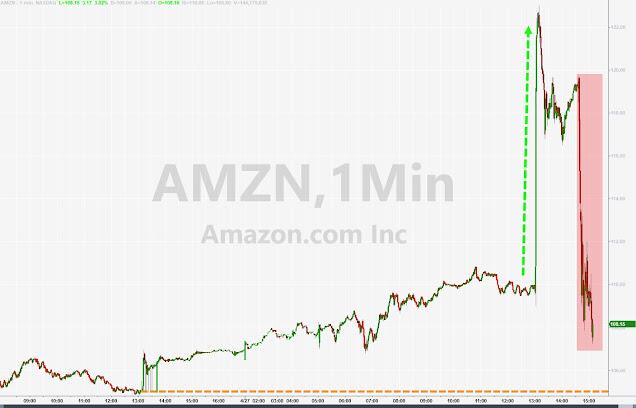
Amazon Reverses Earlier Gains On Cloud Concerns (AMZN)

Huh. I guess we've looked at clouds from both sides now.

From ZeroHedge: 

Amazon Erases 12% Gain, Turns Red After Revealing Sharp Slowdown In April AWS Growth

Update (6:00pm): Everything was going ok, with AMZN stock soaring as much as 12% and then suddenly AMZN stock erased all gains and turned red during the company's analyst earnings call (the media call held an hour earlier went by ok).

There was initially some confusion what sparked the plunge, but it eventually was revealed that during the call, Amazon said that “Customers continue to evaluate ways to optimize their cloud spending in response to these tough economic conditions in Q1 and we are seeing these optimizations continue into Q2 with April revenue growth rates about 500bps lower than what we saw in Q1."

As noted earlier (see below), AWS did a little better than analysts had expected in 1Q, but that might not be worth much if growth continues to drift toward single digits.

The company tried to provide some favorable spin with the CEO saying that he is "pretty optimistic that we have a chance not just to recover to where we were pre-pandemic in terms of operating margin, but I think there is additional upside with some of the opportunities we've identified" but by now it was too little too late, and the stock had erased all of its earlier gains and was on the verge of turning red for the day.

 https://cms.zerohedge.com/s3/files/inline-images/unnamed%20-%202023-04-27T180753.010.jpg?itok=8ovnYYhl

....MORE

After-hours last $107.71, down $2.11 (1.92%)

...From up and down, and still somehow
It's cloud illusions, I recall
I really don't know clouds at all

(apologies to Joni Mitchell) 

Here she is in 2022 in her first concert appearance since her near-fatal brain aneurysm in 2015:

That's Brandi Carlile by her side. Not to be confused with Belinda Carlisle in the earlier musical commentary.

"Sweden launches research rocket, accidentally hits Norway"

From NATO: "Collective defence and Article 5"

And from Reuters, April 26:

A research rocket launched by Sweden Space Corp (SSC) early on Monday from Esrange Space Center in northern Sweden malfunctioned and landed 15 km (9.32 miles) inside neighbouring Norway.

The rocket reached an altitude of 250 kilometers (155.34 miles) where experiments were carried out in zero gravity, the agency said in a statement.

"It landed in the mountains at 1,000 meters altitude, and 10 kilometers from the closest settlement," Philip Ohlsson, head of communications at SSC, told Reuters on Tuesday....

....MUCH MORE

"Latest round of Amazon layoffs begins today, impacting AWS and human resources"

Two from GeekWire. First up the earnings release:

Amazon stock up 11% after beating Q1 estimates with $127.4B in revenue

Amazon shares were up more than 11% in after-hours trading Thursday after the Seattle tech giant topped analyst expectations for both profits and revenue.

The company reported $127.4 billion in first quarter revenue, up 9% year-over-year. Net income was $0.31 per share. Operating income came in at $4.8 billion, up from $3.7 billion in the year-ago quarter.

Analysts were expecting $124.5 billion in revenue, and earnings per share of $0.21. 

The company’s cloud computing business reported revenue of $21.3 billion, up 16% from the year-ago period. Analysts were closely watching AWS results as it is a key profit driver but has faced slowing growth amid the broader tech spending slowdown and other inflationary pressures.

“We like the fundamentals we’re seeing in AWS, and believe there’s much growth ahead,” Amazon CEO Andy Jassy said in a statement.

After growing rapidly during the pandemic, Amazon has been in cost-cutting mode over the past year, trimming its workforce and axing various services and products.....

....MUCH MORE

The enthusiasm has cooled a bit, the stock is changing hands at $117.04, up $7.22 (+6.57%) After hours.

And the headline story:

Amazon began notifying Amazon Web Services and human resources employees impacted by its latest round of layoffs on Wednesday, as the company continues to trim headcount to cut costs.

The layoffs are part of the 9,000-person corporate workforce reduction announced by the company in March. The cuts mostly affect AWS, human resources (which Amazon calls PXT, for People Experience and Technology), Amazon Advertising, and Twitch.

Amazon in January announced a 18,000-person layoff, the largest in the Seattle company’s history. The additional 9,000 layoffs bring the total to 27,000 job cuts, about 8% of Amazon’s corporate workforce, which previously numbered around 350,000 people....

....MUCH MORE

Although most of the layoffs are not in Seattle, the city and King County have already seen 5,000 go unemployed from Microsoft (2743, Redmond and Bellevue) and Amazon (2320, Seattle, Bellevue), and will get hit on both GDP and tax revenue.

Amazon Beats, Raises, Stock Jumps 7% (AMZN)

In early after-hours action the stock is up $8.07 (+7.35%) at $117.89.

Here's a condensed report from ZeroHedge:

....So with all that in mind, here is what Amazon just reported for its just concluded quarter

  • Q1 EPS 31c,up from a 38c loss YoY, and beating the estimate of $0.21
  • Q1 Net sales $127.358 billion, +9.4% y/y, beating the estimate of $124.7 billion
    • Online stores net sales $51.10 billion vs. $51.13 billion y/y, beating estimate $50.57 billion
    • Physical Stores net sales $4.90 billion, +6.6% y/y, beating estimate $4.77 billion
    • Third- Party Seller Services net sales $29.82 billion, +18% y/y, beating estimate $28.7 billion
    • Subscription Services net sales $9.66 billion, +15% y/y, estimate $9.29 billion
    • North America net sales $76.88 billion, +11% y/y, beating estimate $75.54 billion
    • International net sales $29.12 billion, +1.3% y/y, beating estimate $27.65 billion
    • Third-party seller services net sales excluding F/X +20% vs. +9% y/y, beating estimate +13.9%
    • Subscription services net sales excluding F/X +17% vs. +13% y/y, beating estimate +11.8%
    • And the most important one: AWS net sales $21.35 billion, +16% y/y, beating estimate $21.03 billion
      • Amazon Web Services net sales excluding F/X +16% vs. +37% y/y, estimate +13.8%
  • Operating income $4.77 billion, +30% y/y, beating the estimate $3 billion
  • Operating margin 3.7% vs. 3.2% y/y, beating the estimate 2.38%
  • North America operating margin +1.2% vs. -2.3% y/y, beating the estimate +0.34%
  • International operating margin -4.3% vs. -4.5% y/y, beating estimate -8.49%
  • Fulfillment expense $20.91 billion, +3.1% y/y, beating estimate $20.72 billion
  • Seller unit mix 59% vs. 55% y/y, estimate 56.8%

Bottom line here, Amazon beats expectations for Q1 across the board, and most importantly AWS came in well above expectations on both revenue growth and profit margin basis, which is why AMZN stock is seeing a buying frenzy after hours pushing it more than 10% higher.

There is another reason for the surge: the company's Q2 guidance was stellar:

  • Sees net sales $127.0 billion to $133.0 billion, in line with the sellside estimate $130.1 billion;  this represents growth between 5% and 10% compared with Q2 2022 and "anticipates an unfavorable impact of approximately 30 basis points from foreign exchange rates.”
  • Sees operating income $2 to $5.5 billion, estimate $4.74 billion

In short, solid earnings beating expectations across the board, while guidance came generally in line with Wall Street expectations....

....MUCH MORE

And additional commentary by The Go-Go's 

San Francisco Office Building Priced To Sell, Marked Down 80%

From the Wall Street Journal, April 27:

Fire Sale: $300 Million San Francisco Office Tower, Mostly Empty. Open to Offers.
350 California Street was worth $300 million four years ago. It might sell for 80% less now, brokers say, in a market where office vacancy rates have soared.

(formerly) nice 'hood.

HT: 

"Amazon earnings preview: Analysts watching cloud growth, impact of layoffs" (AMZN)

We usually don't do "earnings previews" because a) the reality of the release makes the preview obsolete in a matter of hours to days and b) because the previewers don't usually bring any special insight to the story.

The relationship between GeekWire and Amazon is a bit different.

From Seattle's own, GeekWire, April 27:

In-depth Amazon coverage from the tech giant’s hometown, including e-commerce, AWS, Amazon Prime, Alexa, logistics, devices, and more. [also covering Redmond]

Amazon will report its first quarter earnings on Thursday. Here’s what to watch.

Cloud growth: Amazon Web Services has long been a key profit driver but is facing slowing growth amid the broader tech spending slowdown and other inflationary pressures. AWS revenue grew 20% year-over-year in the fourth quarter, compared to 40% growth in the year-ago period. “It is now widely understood and expected that AWS is likely to show significant deceleration in Q2 in particular,” RBC wrote in a report last month.

Layoffs impact: Amazon in January announced a 18,000-person layoff, the largest in the Seattle company’s history, and in March announced an additional 9,000 layoffs. That brought the total to 27,000 job cuts, about 8% of Amazon’s corporate workforce, which previously numbered around 350,000 people....

....MUCH MORE

Related at GeekWire, April 26:

Amazon’s Halo disappears: Tech giant discontinues health devices and service, promises refunds

Institutional Risk Analyst: The U.S. Banking System Has $5 Trillion Of Festering QE/QT Losses To Get Through

 From The Institutional Risk Analyst (also on blogroll at right), April 26:

Who Killed First Republic Bank?

Q: Who killed First Republic Bank (FRC)? A: Janet Yellen and Jerome Powell. Q: When did bankers and regulators first know they had a problem with QE and the banks? A: The middle of 2022.

Going back more than five years, The Institutional Risk Analyst described the existential market risk created by the Federal Open Market Committee’s massive purchases of securities. The recent movement of the bond market has reduced the visible unrealized losses on securities owned by banks, but the fundamental problem of mispricing of risk remains unresolved. Trillions of dollars worth of low-yielding assets are festering on the books of all US banks.

Ponder the remarkable idiocy of the Financial Stability Oversight Council, which just published a long list of recommendations for identifying risk among nonbank financial firms like Black Rock (BLK). The FSOC document never mentions the impact of quantitative easing or “QE” on financial institutions and markets. Chaired by Treasury Secretary and former Fed Chair Janet Yellen, one of the architects of the “go big” policy behind QE, the FSOC sees risk lurking in every corner but the one that actually matters.

It is clear today that the Fed's decision to start manipulating the bond market early in 2019 was a serious mistake, yet Fed Chairman Jerome Powell and Secretary Yellen are silent. The Treasury and Fed cannot admit fault for fear of bringing the whole house of cards crashing down, especially now that President Joe Biden has announced his reelection campaign.

How big is the risk created by Chair Yellen and her successor, Fed Chairman Powell, as a result of going “big” on QE in 2019 and then full throttle after March 2020? Let’s start with the data from the Securities Industry and Financial Markets Association (SIFMA), which shows that about $25 trillion in fixed income securities were issued in 2020-2021. If we adjust these securities by a conservative 12% haircut vs current pricing for say Fannie Mae 3% coupon MBS, you’re looking at $3 trillion in unrealized losses on COVID era securities.

The same price adjustment on trillions of dollars in whole loans priced during 2020-2021 gets you another couple of trillion in unrealized losses. We express the losses as a discount to par value, but the real problem for banks and other investors is the low levels of income coming from these COVID-era securities. Those Fannie Mae 3s issued in 2020 at 104 are trading at 89 today, but SOFR is just shy of 5% as are three-month T-bills.

Anyway we cut it, the US financial markets need to absorb about $5 trillion in securities losses to get clear of the cost of QE. This process of loss recognition must occur at the same time that banks and leveraged investors are forced to reprice their funding costs. As the process of repricing of liabilities moves forward, more banks will likely fail....

....MUCH MORE

Wednesday, April 26, 2023

"Bernard Arnault, Chairman and CEO of Louis Vuitton is currently the world’s richest man, worth around $239 billion...."

The proprietor of this blog, author of this post, Martin Hutchinson, knows some stuff.

From The Bear's Lair hosted at his True Blue Will Never Stain website, April 24:

The Bear’s Lair: How to Produce Trillionaires

Bernard Arnault, Chairman and CEO of Louis Vuitton is currently the world’s richest man, worth around $239 billion; he is notable in coming neither from the United States nor from the tech sector. His wealth is a product of globalization, which has produced demand for Western fashion brands among a substantial fraction of 8 billion people. Globalization is just one of the forces artificially inflating the wealth of the richest at the expense of the rest of us; I will herein examine the history of extreme wealth and the factors inflating it and forecast the conditions that will produce the world’s first trillionaires.

Contrary to leftist popular myth, the Industrial Revolution did not produce extremes of wealth. Thomas Newcomen, its instigator by inventing the steam engine in 1712, remained a provincial ironmonger throughout his life. Josiah Wedgwood, the potter and inventor of modern marketing, achieved worldwide sales but a net worth at his death of only around £500,000 – around $220 million with an m in today’s money if you convert by the gold value, my preferred way of making that conversion. Sir Richard Arkwright, the first successful textile entrepreneur, got a knighthood for his pains, but his net worth at death in 1792 was around £600,000. Granville Leveson-Gower, 2nd Earl Gower, was a landed magnate who expanded his wealth substantially through successful industrial investment but was still worth only £2 million at his death in 1803 – not quite qualifying as a dollar billionaire in today’s money.

Half a century later, the following generation were richer, but only moderately so. Richard Arkwright, son of Sir Richard, was the richest commoner in Britain when he died in 1843 worth £3.5 million ($1.5 billion in today’s money) – probably only Gower’s grandson the 2nd Duke of Sutherland was richer, through inheritance and removing the inhabitants from the Highlands of Scotland. In the United States, John Jacob Astor, the country’s richest man, died in 1848 worth $20 million – about £4.1 million 1848 pounds or $1.9 billion 2023 dollars.

Then, without significant inflation – if anything, prices declined between 1840 and 1880 – the size of fortunes in the United States but not in Britain or elsewhere took a leap upwards. Cornelius Vanderbilt died in 1877 worth $100 million; his son William Howard Vanderbilt died in 1885, only eight years later, worth $200 million. ($9.5 billion and $19 billion in 2023 values). Then around 1900 the first dollar billionaire appeared: John D. Rockefeller, with Henry Ford following around 1914 (both worth around $95 billion in today’s dollars).

No fortunes of that size appeared outside the United States, showing that the increase in scale of the top U.S. fortunes had either policy or economic causes peculiar to that country....

....MUCH MORE 

"Wetlands store a lot of carbon—but turning that into a business isn’t easy"

From Nautil.us, April 21:

The Challenge of Blue Carbon

A year on from Hurricane Katrina, the small Louisiana town of Luling, about 25 miles west of New Orleans, embarked upon a modest experiment. Instead of discharging treated municipal wastewater through a canal and into a nearby lake, the town would pump its effluent into surrounding bayou swampland.

The change would be a small step in reversing the ecological damage of flood control along the Mississippi River, which for centuries had slowly separated America’s longest river system from its natural floodplain. Although it opened up more land for farming and habitation, flood control set the scene for the levee failures in New Orleans, where more than 1,000 people died in Katrina and its aftermath. Preventing natural seasonal flooding also deprives the Mississippi delta of sediments that renew it, contributing to the loss of 30 percent of its land in the past half-century.

A mangrove swamp might contain 25 times as much carbon as a similar patch of terrestrial forest.

In Luling, sediments that would have flowed directly into the lake would now be trapped in the town’s bayous. Nitrogen, phosphorous, and other chemicals in the cloudy wastewater would enhance the growth of native bald cypress and water tupelo trees. These in turn would soak up floodwaters, prevent erosion, and provide crucial ecosystem services. The trees would be a boon for wildlife: Bald cypresses serve as breeding grounds for amphibians, provide nesting spots for ducks and raptors, and shelter young catfish among their submerged roots.

On top of all those benefits, the revitalized swamp would store lots of carbon—at least in principle. In practice, it wouldn’t be so simple.

So-called “blue carbon” aquatic ecosystems like Luling’s bald cypresses, Australia’s seagrass meadows, and tropical tidal marshes store an estimated 300 billion tons of carbon worldwide—an amount roughly comparable, by some estimates, to the lifetime emissions of all the power plants in the world. A mangrove swamp might contain 25 times as much carbon as a similarly-sized patch of terrestrial forest.

These capacities have made wetlands appealing targets for the fast-growing, near-trillion-dollar carbon accounting industry, which uses carbon offsets and carbon credits to—hopefully—reduce global CO2 emissions. Each offset or credit is supposed to represent an actual ton of CO2 sequestered or prevented from entering the atmosphere. To ensure that happens, the science behind them, and oversight of the projects that generate them, must be rock solid. This is far from certain today, where even the largest schemes have faced accusations of shoddy measurement, weak verification, and outright fraud.

“There’s a lot of bogus carbon projects out there,” says Robert Lane, chief operating officer at Comite Resources, the coastal science consultancy behind the Luling project. “Real carbon projects take an area of land and do something to it so it sequesters more than it would without intervention. And it’s that extra sequestration that you can monetize.” But monetizing Luling’s swamps would prove tricky.

In September 2012, the 600 hectares of Luling’s wastewater wetlands became the first blue carbon project approved by the American Carbon Registry (ACR), a private non-profit greenhouse gas registry. Over the next 40 years, its credits would be sold to pay for ongoing carbon monitoring costs and to compensate the bayou’s owner, a private real estate and development company, “We calculated that the area would sequester 11,617 tons of CO2 each year,” says Lane. “If the price of carbon were $20 a ton, which is a reasonable market price, that would generate $232,340 per year.”....

....MUCH MORE

"Chinese Lithium Finally Ticks Up After Five-Month Slide"

A quick hit from Bloomberg, April 26:

  • Battery material had sunk more than 70% since November’s peak
  • Major producers Ganfeng, Tianqi will report earnings this week

Lithium prices in China halted a five-month slide on signs that demand growth among battery makers may finally gather pace.

Chinese lithium carbonate ticked up 1.2% Wednesday, the first gain this year. Prices had tumbled more than 70% since mid-November as companies across the battery supply chain drew down inventories rather than buying afresh, while an end to Chinese electric-vehicle subsidies curtailed demand.

Data now point to improved EV sales prospects, while lithium stockpiles have been thinning.

“There’s some pickup in buying from traders who think prices have bottomed, which supported lithium this week,” said Jesline Tang, a non-ferrous metals pricing analyst at S&P Global Commodity Insights. “There’s also talk of declining inventories at battery makers, which could drive restocking activity.”

Prices edged up to 167,500 yuan a ton on Wednesday, according to data from Asian Metal Inc.

That may hint at respite for some smaller Chinese producers of the material, which have seen profit margins dented by the price crash. Yet even with this year’s collapse, lithium carbonate remains four times more expensive than in 2020....

....MORE

"Summers Says Inflation Won’t Get Back to 2% Without Downturn"

Much as I dislike the man on a personal level, I have to admit he has been more right on inflation than the RIA's and such who get paid for nominal, not real inflation-adjusted AUM, or the bulk of the fund universe that takes their pay based on nominal returns. 

From Bloomberg, April 26:

The former Treasury secretary said he is ‘not that optimistic’ about the fight against rising prices and that the Federal Reserve lost credibility by acting too slowly.

Former Treasury Secretary Lawrence Summers said taming inflation will likely lead to a “meaningful” economic downturn. Speaking at the Morningstar Investment Conference in Chicago, he said that fiscal stimulus and low interest rates during the pandemic turned the US from a “2% inflation country to 5% inflation country.”

“I think we’re going to have difficulty getting near a 2% inflation target until and unless the economy slows down substantially,” he said. Summers, a Harvard University professor and paid contributor to Bloomberg Television, said earlier this month that the likelihood of a US recession is increasing and that the Federal Reserve is nearing the end of its interest-rate hikes.

The latest inflation reading for March showed the average overall prices rose 5% from a year earlier. Other takeaways from the talk included:....

....MUCH MORE

Having acknowledged Summers' ability to recognize the inflation as it was developing, he is wrong to characterize the Fed as having acted too slowly.

The Fed did exactly what they wanted to do, no ifs, ands or buts about it. They wanted the inflation and they wanted it to entrench itself.  

It wasn't a mistake, it was deliberate.

Pensions&Investments has more on his keynote speech at the Morningstar conference:

Some previous Larry on inflation: 

October 2022, regarding Paul Krugman:  Inflation: Larry Summers Is Troubled

Previously on the Paul & Larry Traveling Good Time Show: 

If interested here is the video hosted at Princeton.

Here is the video for Part I, "Will the Biden Stimulus lead to Inflation? A Conversation with Paul R. Krugman and Lawrence H. Summers", February 12, 2021, no transcript (it was via Zoom) but we do have Bloomberg's "Summers and Krugman Debate Stimulus. Here’s a Blow-by-Blow Account"

And on our overarching view of what's up and what's what:

July 22, 2022
Paul Krugman Says: "I Was Wrong About Inflation"

This was one of eight "I was wrong" pieces that the New York Times had their columnists do this week, and Herr Dokter, Dokter [he's a double doc in the German style] Herr Professor Krugman was given top billing, ahead of Thomas Friedman being wrong about China and Michelle Goldberg being wrong about Al Franken.

[sidebar: how funny would it be if Franken moved back to New York and ran for the Senate against Kirsten Gillibrand?]

I think the Times' not-quite-a-mea culpa project is an effort to regain some credibility using the technique of the serial liar: admit to those things that are blindingly obvious. I've seen it done so often over the years that what I hear is: "How can I lie to you if you won't listen to me?" 

A bit jaded, I know. 

From the New York Times, July 21:

In early 2021 there was an intense debate among economists about the likely consequences of the American Rescue Plan, the $1.9 trillion package enacted by a new Democratic president and a (barely) Democratic Congress. Some warned that the package would be dangerously inflationary; others were fairly relaxed. I was Team Relaxed. As it turned out, of course, that was a very bad call.

But what, exactly, did I get wrong? Both the initial debate and the way things have played out were more complicated than I suspect most people realize.

You see, this wasn’t a debate between opposing economic ideologies. Just about all the prominent players, from Larry Summers to Dean Baker, were Keynesian economists, with more or less center-left political leanings. And we all had similar views, at least in a qualitative sense, about how economic policy works. Everyone in the debate agreed that deficit spending would stimulate demand; everyone agreed that a stronger economy with a lower unemployment rate would, other things equal, have a higher inflation rate.

What we had instead was an argument about magnitudes. The rescue plan was huge in dollar terms, and as Team Inflation warned, if it had a normal-size “multiplier” (the increase in gross domestic product caused by a dollar of additional government spending) it would lead to a highly overheated economy — that is, to a temporary surge in employment and gross domestic product far above their sustainable levels, and hence high inflation.

Those of us on Team Relaxed argued, however, that the structure of the plan would lead to a much smaller surge in G.D.P. than the headline number would suggest. A big piece of the plan was one-time checks to taxpayers, which we argued would be largely saved rather than spent; another big piece was aid to state and local governments, which we thought would be spent only gradually, over several years.

We also argued that if there were a temporary overshoot on G.D.P. and employment it wouldn’t sharply increase inflation, because historical experience suggested that the relationship between employment and inflation was fairly flat — that is, that it would take a lot of overheating to produce a big inflation surge.

So here’s the odd thing: The multiplier on the rescue plan does, in fact, seem to have been relatively low. A lot of consumers saved those checks; state and local government spending rose by less than one percent of G.D.P. Employment is still below its prepandemic level, and real G.D.P., while it has recovered to roughly its prepandemic trend, hasn’t shot above it.

Yet inflation soared anyway. Why?

Much, although not all, of the inflation surge seems to reflect disruptions associated with the pandemic. Fear of infection and changes in the way we live caused big shifts in the mix of spending: People spent less money on services and more on goods, leading to shortages of shipping containers, overstressed port capacity, and so on. These disruptions help explain why inflation rose in many countries, not just in the United States.

But while inflation was confined mainly to a relatively narrow part of the economy at first, consistent with the disruption story, it has gotten broader. And many indicators, like the number of unfilled job openings, seem to show an economy running hotter than numbers like G.D.P. or the unemployment rate suggest. Some combination of factors — early retirements, reduced immigration, lack of child care — seems to have reduced the economy’s productive capacity compared with the previous trend.

Even so, historical experience wouldn’t have led us to expect this much inflation from overheating. So something was wrong with my model of inflation — again, a model shared by many others, including those who were right to worry in early 2021. I know it sounds lame to say that Team Inflation was right for the wrong reasons, but it’s also arguably true.

One possibility is that historical experience was misleading because until recently the economy was almost always running a bit cold — producing less than it could — and inflation didn’t depend much on exactly how cold it was. Maybe in a hot economy the relationship between G.D.P. and inflation gets a lot steeper.

Also, disruptions associated with adjusting to the pandemic and its aftermath may still be playing a large role. And of course both Russia’s invasion of Ukraine and China’s lockdown of major cities have added a whole new level of disruption....

....MORE

A few quick comments:

1) The people pitching the "Inflation isn't a problem" narrative weren't  just making an intellectual argument. They were attacking, vilifying, smearing and slandering anyone who didn't fall in line.

2) Krugman makes only one mention of 'lockdowns', with those being the Chinese variety.
But there were lockdowns in the U.S. 
Hard lockdowns, by the big cities in particular and by counties and by states.
Whether or not the politicians, the vast majority of whom have never run a company, and a stunning number of whom have never worked in the private sector, actually thought you could stop and start businesses like you were flipping a switch or whether they didn't even bother to think at all, was, when combined with the tsunami of money flowing into the economy, was a recipe for the current mess.
 
3) Combined with the graft and corruption of politicians directing trillions to their cronies was the bizarre decision to pay people more than they would make when working. If you wanted to distort a nation's labor market and effect huge changes in public - private relationships you would be hard-pressed to find a more effective transmission mechanism than telling people to stay home and watch "number go up" on their bank balance.
 
There's a lot more detail I could drop on patient yet wary reader but this is starting to sound a bit ranty. Sorry
May 7, 2022
"Inflation Is No Accident"
November 2021
Questions Rabobank Was Asking: "Is Someone Trying To Delay The Global COVID Recovery To Ram Through Even More Stimulus"
April 20, 2021
The Fed, The Treasury, The Congress And You: It's All About Transferring Wealth Upward
No matter what the Federal Reserve spokespeeps say their goal is, the result is always the same.
This is a very real problem and probably means a Fed overshoot is baked in the cake.

And finally, the numbers, as they developed, from Trading Economics (also on blogroll at right):


with commentary, June 29, 2022:

The PCE, the measure the Federal Reserve Board says it watches most closely, what with its under-weighting of shelter costs—half that of the CPI, which itself is distorted lower by using Owner's Equivalent Rent—and all, first crossed the Fed's 2% line in March 2021.

The Fed could have acted on its balance sheet and on interest rates at that time.

Giving them the benefit of the doubt, that they wanted to be sure a rising trend was in place, they could have acted after the April release.

Ditto for a desire to target 2% as an average, meaning running hotter than 2% to bring the trailing average up. By May 2021 with the PCE printing at almost double the Fed's stated target there was no reason to delay tapping on the brakes, beginning the interest rate hiking cycle and announcing the start of Quantitative Tightening - perhaps not going into run-off mode but balancing new purchases of treasury's and Agency MBS's with maturing paper. 

They didn't.

And for some reason the Fed thought it more important to delay action than it was to appear credible; what with the "transitory" talk and all. And the Fed kept delaying, and kept on spouting non-sense for a year after they should have taken action.

Again, for emphasis, the Fed knowingly decided to look like stupid liars rather than honestly explain what they were up to. The question is: Why would they do that?

All I can surmise is that it must be something really, really big to let CPI inflation get to 8.6% [note: May CPI] while talking stupid shit all the way up

Ukraine Says Russia Will Not Launch a Nuclear Attack When Ukrainian Defenders Enter Occupied Crimea.

Cool.

From Ukraine Pravda, April 24:

No nuclear strike will happen after Ukraine enters Crimea – Ukraine's Defence Intelligence Chief

Kyrylo Budanov, Chief of Ukraine’s Defence Intelligence, believes that Russia will not launch a nuclear attack when Ukrainian defenders enter occupied Crimea.

Source: Budanov in an interview with RBC-Ukraine

Details: Asked whether there will be a nuclear strike if the Armed Forces of Ukraine enter Crimea, Budanov answered, "There will not be."

In his opinion, Russian propaganda will present the loss of Crimea as a "forced measure", just like during the liberation of Kherson....

....MUCH MORE

"Bank Stress Hobbles the Dollar, while Dissents Make the 50 bp Hike by Sweden less than Hawkish"

 From Marc to Market:

Overview: The re-emergence of bank stress reverberated through the US markets yesterday, downgrading the perceived chances of a Fed hike next week and sending the US 2-year yield sharply lower. The yield settled 13 bp lower, the largest drop in three weeks. The risk-off sent the US dollar higher against most of the major and emerging market currencies. Follow-through US dollar gains today has been mostly limited to the Australian dollar, where after today's CPI figures has given up any residual chance of a hike next week, and the Swedish krona, where two dissents give a dovish twist to the Riksbank's 50 bp hike. The euro and sterling are leading the G10 currencies today. The euro's strength is helping to lift the eastern and central European currencies higher to lead the emerging market complex.

The US 2-year rate has stabilized today near 3.92%, and the perceived odds of a Fed hike next week is slightly above 80%. Equities were mixed in the Asia Pacific region, but of note China's CSI 300 fell for the sixth consecutive session. Europe's Stoxx 60 is off around 0.7%, for its third consecutive decline. Its bank share index is off 1.1% after falling 2.7% yesterday. Favorable earnings by a regional US bank and Microsoft and Alphabet are encouraging bottom picking after yesterday's sharp US equity losses. The 10-year US Treasury yield is little changed near 3.41%, while European benchmark yields are mostly 2-4 bp lower. Sweden's 10-year yield is off six basis points. Gold has recovered from yesterday's low near $1976 to again straddle the $2000 area. June WTI made a marginal new low for the month yesterday ($76.50) amid demand concerns, reports suggesting there was no sign of Russian output cuts and worries that refiners' demand will slow. Late yesterday's API reportedly estimated that US inventory fell by 6 mln barrels. June WTI is trading with a $77-handle today....

....MUCH MORE