Showing posts sorted by relevance for query jack lifton. Sort by date Show all posts

Sunday, March 9, 2025

"Rare Earths Reality Check: Ukraine Doesn't Have Minable Deposits Experts say proposed deal with U.S. makes no sense"

Astute reader may have noticed we've had no comment on "Ukrainian rare earths". The headline is accurate.

However, Ukraine does have $10 - 12 trillion of other resources: titanium, iron, neon, nickel and lithium (largest minable deposit in Europe.)

Throw in the beryllium, niobium, tantalum, titanium and cobalt, along with uranium and feldspar and it starts adding up.

From IEEE Spectrum, March 7:

When a seemingly routine Oval Office press conference degenerated into a shouting match on 28 February, the world looked on in astonishment. That is, except for actual experts in rare earths and other critical materials, who understood all along that the proposed “deal” that motivated the press conference was nonsensical and could only be viewed as political theater.

The meeting was supposed to announce an agreement under which Ukraine would provide U.S. companies with access to critical minerals deposits in exchange for the tens of billions of dollars in military aid already provided by the U.S. government. According to the Center for Strategic and International Studies, the agreement would have established “a reconstruction investment fund with joint U.S. and Ukraine ownership. Ukraine will contribute 50 percent of all revenues earned from the future monetization of all Ukrainian government-owned natural resource assets into the fund.” Ukraine has substantial reserves or deposits of lithium, graphite, manganese, titanium, gallium, and nickel. However, in describing the proposed deal, president Donald J. Trump and other principals quickly zeroed in on the rare earths, for which the US has for years been spending billions of dollars in an attempt to secure stable supplies.

The Trump administration, like those before it, seems to grasp the importance of these materials. At his confirmation hearing, Secretary of State Marco Rubio said, “If we stay on the road we’re on right now, in less than 10 years, virtually everything that matters to us in life will depend on whether China will allow us to have it or not … They have come to dominate the critical-mineral industry supplies throughout the world.”

The Ukraine rare-earths deal now seems endangered, to put it mildly. But its apparent failure—and the way it failed—is revealing of how the Trump administration is likely to pursue supplies of strategically vital rare earths and other critical materials in the context of trade and international policies that are freezing out not just China but also longtime economic and military allies, while welcoming a longstanding adversary, Russia. China dominates production of numerous critical metals and minerals, but none so completely as the rare earths. More than 95 percent of industrially useful rare-earth metals are produced by China, creating supply-chain and national-security vulnerabilities that the U.S. and other countries have been attempting to ameliorate for more than a decade.

Ukraine Doesn’t Actually Have Minable Rare Earths

To begin with, the contentious 28 February Oval Office meeting can’t be understood without a crucial piece of context: there are no deposits of rare-earth ore in Ukraine known to be minable in an economically viable way. And that would be true even if full-scale warfare were not raging in the country’s east, where a great deal of its mineral resources are concentrated.

Ukraine is believed to have four areas with substantial deposits of rare earth ores, according to Erik Jonsson, senior geologist with the Geological Survey of Sweden. “There are four slightly bigger deposits: Yastrubetske, Novopoltavske, Azovske, and Mazurivske. All but one of them seem to be now within or near the zone that the Russians control, as far as I can tell,” says Jonsson. “And when it comes to resources in those deposits, I mean, we have numbers; yes, that’s nice. But we have no real, detailed, outline of how those numbers were arrived at.” The numbers are believed to come from Soviet surveys dating as far back as the 1960s.

“The rare-earth deposits don’t look that relevant,” Jonsson concludes. “I mean, I wouldn’t go for them.” Two of the deposits are dominated by a mineral called britholite, he notes, which is not desirable because it has not been processed for rare earths, which means that almost nothing exists in the way of process chemistry and equipment.

“If you want critical minerals, Ukraine ain’t the place to look for them,” declares Jack Lifton, executive chairman of the Critical Minerals Institute. “It’s a fantasy. There’s no point to any of this. There’s some other agenda going on here. I can’t believe that anybody in Washington actually believes that it makes sense to get rare earths in Ukraine.”

Even without a war to contend with, it would take at least 15 years to build a mine to begin extracting rare-earth ore on a large scale, Lifton notes. And according to the terms of the draft critical materials deal, private companies would have to invest huge sums, likely a billion dollars or more, to develop rare-earths mines in Ukraine. It’s a possibility that Lifton, an IEEE member and former metals trader, dismisses as absurd. He notes that a multinational mining company, Rio Tinto Group, has spent close to US $3 billion on potential mine sites in Arizona and Alaska and still does not have the necessary licenses and permits from the U.S. Government to begin building a mine in either place.

What is Trump’s rare-earth agenda?....

....MUCH MORE

Over the years we visited Mr. Lifton many, many times. Here's a post that wraps some of those earlier visits. From August 2017 "Electric Vehicles: An Old Pro On Battery Technology and Policy and China":

Back in the glory days of the rare earth fad we would visit the author of the current piece, Jack Lifton:

June 21, 2010
Climateer Line of the Day: Rare Earth Edition 
From Jack Lifton writing at Technology Metals Research: 
Rare earths are nowhere near as important to the China State Council as they are to Western stock promoters, trying their P.T. Barnum Best to get us alarmed over a non-existent direct threat, from a battered industry in a country trying to raise its standard of living and meet stated national economic goals....
-Chinese Production of Rare Earths: The Real Crisis
Our last post linking to Mr. Lifton:
"Afghan Lithium And Other Mineral Nonsense"
Good times.
Here's a 2015 post looking back to those halcyon days:

Rare earth metals: Objects of power and risk
Just the words, "Rare Earth" brings back memories: “My old MG TC. A blond girl, tan from the summer sun, in the Hamptons, beer on the beach, ‘Unchained Melody,’ the little bar in the Village.”

Uh, wait. That was Adam Smith in our 2012 post  "Adam Smith on Oil Shale (Now with Voodoo Beach Bunnies)". Ahem. Never mind.

Our memories are more like trading Molycorp for three triples, short and long, on the blog, in public, from IPO to bankruptcy or if you will "From tombstone to tombstone".

Or commenting on the passing parade: Luxembourg-based Rare Earth Company Hoping to Mine in South Africa by 2014 Does Oversubscribed IPO in Toronto (FRO.tsx), or quoting one of the, if not the, best books on investing and life:
"...Words like 'uranium', 'rare earths', etc. seem to be magic to
 those unsuspecting who are often fleeced..."
Gerald M. Loeb
The Battle for Investment Survival
Simon & Schuster, 1935

And many more.

Sunday, August 6, 2017

Electric Vehicles: An Old Pro On Battery Technology and Policy and China

Back in the glory days of the rare earth fad we would visit the author of the current piece, Jack Lifton:

June 21, 2010
Climateer Line of the Day: Rare Earth Edition 
From Jack Lifton writing at Technology Metals Research: 
Rare earths are nowhere near as important to the China State Council as they are to Western stock promoters, trying their P.T. Barnum Best to get us alarmed over a non-existent direct threat, from a battered industry in a country trying to raise its standard of living and meet stated national economic goals....
-Chinese Production of Rare Earths: The Real Crisis
Our last post linking to Mr. Lifton:
"Afghan Lithium And Other Mineral Nonsense"
Good times.
Here's a 2015 post looking back to those halcyon days:

Rare earth metals: Objects of power and risk
Just the words, "Rare Earth" brings back memories: “My old MG TC. A blond girl, tan from the summer sun, in the Hamptons, beer on the beach, ‘Unchained Melody,’ the little bar in the Village.”

Uh, wait. That was Adam Smith in our 2012 post  "Adam Smith on Oil Shale (Now with Voodoo Beach Bunnies)". Ahem. Never mind.

Our memories are more like trading Molycorp for three triples, short and long, on the blog, in public, from IPO to bankruptcy or if you will "From tombstone to tombstone".

Or commenting on the passing parade: Luxembourg-based Rare Earth Company Hoping to Mine in South Africa by 2014 Does Oversubscribed IPO in Toronto (FRO.tsx), or quoting one of the, if not the, best books on investing and life:
"...Words like 'uranium', 'rare earths', etc. seem to be magic to
 those unsuspecting who are often fleeced..."
Gerald M. Loeb
The Battle for Investment Survival
Simon & Schuster, 1935

Good times, good times.....Where was I? Oh yes:
From Naked Capitalism, August 1:

The Two Capitalisms: Electric Batteries as a Case Study in US Magical Thinking vs. Chinese Vertical Integration
By Jack Lifton, a consultant, author, and lecturer on the market fundamentals of the technology metals
Capitalism with Chinese Characteristics, (CWCC) as the Chinese press officially refers to the use of capitalism by the Chinese Communist Party (CCP) to advance socialism in China, is winning the battle with the neoliberal, “free and efficient,” market that supposedly has led the USA, first and foremost, to “the end of history.” CWCC has transferred enough wealth from the west to the east to ignite self-sustaining growth in China’s GDP.

Our world dominated by two capitalisms; the “free market” variety practiced in one form or another by almost all of the industrialized countries except Russia and a few others with a strong authoritarian bent; and “Capitalism with Chinese Characteristics (their official description) practiced of course by the Peoples’ Republic of China.

Let’s look at how the two capitalisms have fared in creating a secure supply of the raw materials for manufacturing energy storage and production devices for the storage of and production of alternate (to fossil fuel produced) energy. Access to supplies is critical to prevent shortages and to help assure market position.

Notwithstanding the illogical blather about globalization, its purpose outside of China in the last generation has been to enrich a small segment of western society without regard to the welfare of the general populations in those countries. Natural resource imperialism has been the  driver of globalization for centuries. But the countries that were once victims of resource imperialism are in the process of turning the tables via total vertical integration of the production, use, and marketing of consumer goods critically enabled by those natural resources.

Specifically, the overarching purpose of Chinese business is to achieve Chinese independence of global markets for the basic needs of a widespread technological society second to none.
The Chinese focused first on the security of a growing Chinese INDUSTRIAL economy by seeking to attain natural resource total supply chain self-sufficiency. The country is now addressing health and safety.

Chinese politicians pursue national objectives through a reestablished mandarinate, a reproduction in part of their own ancient approach to large scale governance by a meritocratically selected and educated elite. They have dded to that a bit of the ancient Roman cursus honorum, the path that a member of the ruling class must take in order to advance to senior roles in their one party government. No Justin Trudeau’s; Eduard Macron’ or even Donald Trump can take power in their system. It does help to be directly descended from a founder of the Chinese Communist Party or its hierarchy but experience in government, and a specialized education, is an absolute requirement for the top job(s) in today’s China.

By contrast, American politicians; public intellectuals; and opinion makers are committed to magical thinking; they hold that beliefs are more important than mere facts. When they recognize a “crisis,” which they define as “when things aren’t going the way they are supposed to go to keep us personally wealthy and powerful indefinitely” their response is to first “study” the problem (to get it out of the public eye) and then after consultation with each other throw money at “solutions” that have been proposed by properly credentialed “experts’ and others who are the “right sort (their class) of people.” Thus we get neoliberal economics with its conceit that a “free” market will always be both efficient and “ultimately” keep supply and demand in balance through directing capital to where it is needed to do so.

The FACT; it is not a belief or conjecture; but an obvious fact that a consumer society built upon technology is completely dependent upon the production of just a few key materials derived from natural resources. This is well understood by the Chinese mandarinate, and since the goal of the CCP is to build such a society, it has resulted in a national mandate for China to become self-sufficient in these key materials for technology as soon as possible. The Chinese are not natural resource globalists; in fact they are natural resource imperialists for want of a better term.
As Mao Zedong said when the Chinese communist takeover was floundering economically, “Let a thousand flowers bloom,” i.e. try everything

His brilliant successor, Deng Xiaoping, decreed that China must quietly become wealthy and powerful, and for this he allowed the first use of capitalism to advance those goals through selecting the best results of letting a thousand flowers bloom.

Today’s Chinese leaders, less charismatic but dedicated to the same goals, have promulgated a modified capitalism (with Chinese characteristics) to achieve self-sufficiency in production and then supply of goods determined to be critical to the future of Chinese society.

And now they are sorting out the various approached to capitalism and the selected target resources to make CWCC as efficient as possible to achieve the goals that have been so identified.
The mandarins convinced Deng that China’s abundance of rare earths was important, because they foresaw that the miniaturization of electronic and electrical devices, the main use of rare earths properties, conserved and extended commodity natural resources such as iron, steel, aluminum, copper, and fossil fuels, thus advancing China’s goal of self-sufficiency. Within one generation the Chinese rare earth supply chain had become vertically integrated and was a global monopoly; this was mostly achieved because China’s construction of a total downstream (from mining and refining) supply chain allowed it also to become a monopsony in the final assembly of goods dependent for their operations upon the electronic properties of the rare earths. This monopoly/monopsony was the intended goal!

Of particular interest today is that China’s rulers have now determined that they must electrify personal as well as mass transportation on the ground in order to eliminate an unforeseen (by them) problem: massive air pollution in their mega cities caused by the concentrations there of fossil-fueled vehicles (which in the general scheme of things globally produce only two percent of “pollution,” but their concentrations in cities are principal contributors to it in those locales).

China’s “President” mandated first that China’s 90 motor vehicle assemblers and 40 lithium ion battery manufacturers produce 5,000,00 electrified (mainly battery powered) motor vehicles by 2020. Then they extended the “mandate” to foreign automakers manufacturing or selling cars in China, and furthermore, required that only Chinese manufactured batteries may be used in motor vehicles made or sold in China!!

The Chinese domestic battery maker’s very first response was that they did not have the manufacturing capacity nor access to the raw materials necessary. The response of the long term goal directed CCC was to use CWCC to “encourage” Chinese mining, refining, and fabricating industries (dominated by SOES) to develop or purchase the critical natural resources and to expand their capacities to meet the needs of the mandate. The Bank of China was ordered to “facilitate” such investments GLOBALLY-but and this cannot be overemphasized-globalization of sourcing for the PROC means the acquisition globally for use IN CHINA of natural resources! It does not mean acquiring foreign sources of natural resources to produce them as raw materials for global markets, NOT AT ALL!

By contrast, free market capitalism has today been almost totally financialized. Its purpose has become the transfer of money to a few, not the creation of new wealth in the financier’s home country through building factories and creating jobs. In fact, the moneyed elites have become what the Soviets used to call “cosmopolitans,” which were the criminals who put self before cause or country. Although it is easier for a Chinese national to “escape’ than it ever was for a Soviet citizen, it is still a crime in China to make or sequester money that is not for the purpose of advancing China’s path to socialism. Expatriates are shunned if they try to return and the amount of capital that can be exported from China for personal use is strictly limited.

With that introduction, let me now look at the influence on world commodity markets of the Chinese goal of the electrification of motor vehicles for personal use. The issues in the west have been driving range and the selling price of the vehicles.

The nebulous goal in the USA is allegedly to save the planet. In China, it is to immediately reduce pollution in the cities. American free market capitalism wants a relatively short term return on capital. CWCCs wants a self sufficient Chinese economy with return on capital to be measured by including the success of the Chinese standard of living and quality of life.

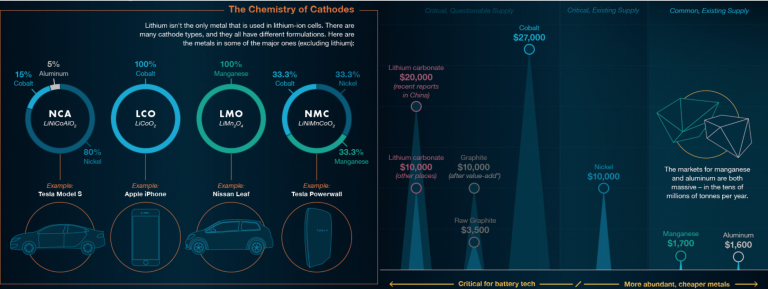
Let’s look at the critical natural resources necessary for producing lithium ion batteries that can give a one to two ton motor vehicle a range of 300 km or more; these would be of the of the NCA, nickel-cobalt-aluminum cathode type such as is used by the Tesla corporation....
https://www.nakedcapitalism.com/wp-content/uploads/2017/08/Screen-Shot-2017-08-01-at-1.40.36-AM-768x289.png
...MUCH MUCH MORE 

Friday, December 18, 2009

Rare Earth Metals on PBS's NewsHour and "Rare Earths strategic supplies more important than price" (AVL.TO; GWG[TSXV]; NEM.TO; RES.V)

I watched this segment a couple days ago and thought "This is about as mainstream as I care for the subject to get".
Here's their piece "Are Rare Earth Minerals Too Costly for Environment?":


Here are some quotes from the transcript:
"But, without rare earth, Copenhagen means nothing. You buy a Prius hybrid car and think you're saving the planet. But each motor contains a kilo of neodymium and each battery more than 10 kilos of lanthanum, rare earth elements from China."

"MARK SMITH, CEO, Molycorp Minerals: If the purpose is to lower our dependence on foreign oil, and all We're doing is asking that we put hybrid cars on the road that need Chinese rare earth materials, aren't we changing, you know, inter-trading one dependence for another?"

"...ZHAO ZENGQI: Although China has the largest reserves, we only have 50 percent of global deposits. We are supplying too much rare earth, and it's not sustainable, so we must restrict export.

LINDSEY HILSUM: The writing on the wall says: Become the leader of the world in rare earth industry.

But China can't produce enough for everyone anymore, and if governments are serious about low-carbon technologies, other countries will have to start producing.

MARK SMITH: I think that, if we don't get a couple of projects up and running very, very quickly, there's going to be very severe shortage of rare earths in the world, and all of these clean-energy technologies that we're legislating and trying to implement through policy changes are not going to be possible...."

And from Mineweb:

With China, which currently controls or produces virtually all global rare earths metals supplies, needing these for its own industries and limiting supplies, Jack Lifton reckons the West needs to consider its own production options, even if pricier to mine and process.
"Price may not be as important as security of supply [for Rare Earth metals]" says Jack Lifton, an independent consultant with more than 45 years of experience in sourcing nonferrous strategic metals. In the U.S., our dependence on rare metals is undermined by the simple fact that we're not producing any. Given that China now controls 95% of these 'technology metals' and the world is projected to eat 200,000 tons of rare earth metals near 2015, we need to jumpstart our own domestic supply chain and, more importantly, build the refineries to process them-rather than sending them to China for refining, which is our only option currently.

The Gold Report: Jack, we hear you're starting on a documentary, "On the Green Road." Tell us a bit about it, and what you mean by "Green Road."

Jack Lifton: I came up with that title because no matter what the attitude of the individual is towards being "green," there really isn't any other path for us now. My proposed documentary "On the Green Road" will follow the path that a rare earth metal takes from the mine to the market, so that the consumer can see the necessary steps required to make the technological devices upon which our quality of life depends. If the Green Road is the path to the future we need to get on it and stay on it right now.

Six hundred million people in the Western world are enjoying a life increasingly dominated by technology that we don't understand. In particular, we don't understand how it is made. What I see in America is a reluctance to admit that the green road starts in the black earth. We have to mine and refine the minerals and metals into forms which can then be fabricated into forms which can then be made into parts which can then be assembled into the technology devices we use to conserve energy. Everything starts at the mine or at the oil or gas well.

In the West, electronic devices using electricity produced by a huge network of generating devices control our transportation, communication, and our environment. We've got a grid that we talk about as if we understand it, but it's an extremely complicated system. We ignore the fact that we produce and distribute oil and its by-products, metals and their compounds and alloys. Nobody pays attention to that. All we do is say we've got to stop doing this and stop doing that. We have to start educating everyone as to how a metal becomes a radio or how a metal becomes a battery, how a battery propels a car.

TGR: I heard you speak recently at the Hard Assets Conference about supply issues in terms of expanding wind and solar technologies. Can you explain some of those supply constraints?

JL: Yes. In the United States, Canada, and Western Europe we are consuming most of the supplies of the technology metals. Now we're facing six billion people in the rest of the world whose standard of living is growing rapidly and we do not have ten times the amount of materials used to create the good life in the West to create the same standard of living for the entire world.

I don't mean to be a doomsayer, but if the Chinese government wants its own people to have the standard of living that people in Los Angeles have today, it's going to mean that China must use all of its own natural resources to improve its standard of living and its quality of life, which will mean that our standard of living will have to decline. Why? Because there are some materials-for example, the rare earths-that China controls 100% of the supply of today. And as China's economy is growing, China is requiring more and more of these materials for its own domestic economy.

Ten years ago China exported 75% of its production of rare earth metals to the rest of the world. Today it exports less than 25%, even though the production in the last 10 years has more than doubled. So that should tell you what's going on here. This is not a conflict. This is economic reality....MUCH MORE
When we started posting on rare earths they were a curiosity for the general public. No more.
Here are some of our posts:
Shortage of Rare Metals for Hybrids Is Overblown
No one said there was a shortage. The question is geopolitical and strategic. It is the same situation with lithium. There isn't a shortage in the foreseeable future. In Li, The potential problem arises from the fact that Evo Morales controls half the world's known reserves of lithium. The calculus of signing agreements with him is closer to that required when dealing with Hugo Chavez than that required when dealing with the Japanese....
Canadian Firms Step Up Search for Rare-Earth Metals (AVL.TO; GWG[TSXV]; NEM.TO; RES.V)
These are EXTREMELY speculative issues that have had big run-ups since the rare earths began* to be spoken of in polite company. Be careful out there....
Wind/Rare Earth Metals: "China Non-Ferrous Barred From Taking Control of Lynas" And: "China Investment Corp to launch own rare earth mining firm"
Wind: Why rare earth metals matter
China tightens grip on rare earths
With a Name Like Inner Mongolia Baotou Steel Rare-Earth Hi-Tech Co., it has to be good ( 600111:Shanghai)
Rare Earth Metals: "California metal mine regains luster" (GS)
Molycorp May Invest $400 Million to Expand Rare-Earths Mine
Wind: "China, Japan on collision course over rare-earth metals"
Wind: China to support three domestic enterprises for rare earth development. And: Baotou Steel Rare-Earth net loss hits $9.83 mln in H1
Rare earths offer unique investment opportunity

And many more.

Thursday, October 16, 2025

"The only five rare earth elements that matter"

I sometimes forget that many of our current readers weren't with us in the last rare earths mania/depression, that they don't share our memories of trading Molycorp (Mountain Pass mine, now resurrected as MP Materials) for three triples, short and long, on the blog, in public, from IPO to bankruptcy or if you will "From tombstone to tombstone".

Or a quaint little quote from a depression-era book that we posted every few months; one of the, if not the, best books on investing and life:

"...Words like 'uranium', 'rare earths', etc. seem to be magic to
 those unsuspecting who are often fleeced..."
Gerald M. Loeb
The Battle for Investment Survival
Simon & Schuster, 1935

So, here's some background. From Mining.com, June 19, 2012:

There is no single rare earth element market. Instead, the rare earth universe is made up of four or five distinct “critical rare earth” markets that should be the focus for investors today. Even with new mine supply and refining capacity coming on-line over the next four years, these elements will remain in short supply, with hefty price tags attached. In this exclusive interview with The Critical Metals Report, Institute for the Analysis of Global Security Senior Fellow Jack Lifton explains how investors can play a crucial role in building a supply chain outside of China. 

The Critical Metals Report: Can you give us an overview of the rare earth element (REE) market today? What are the most important trends you’re following?

Jack Lifton: The REE market today is going through a shakeout. We had a bubble last year—an anomalous speculative blip—that ran REE prices to the sky. It happened just as the junior miners were coming into full bloom. At that time, I would say most of the junior REE exploration companies were overvaluing their projects something fierce. Then the market herd jumped in and ran the prices way up.

Now that the speculative bubble has burst—and I think a lot of it had to do with China repositioning itself—we’re back to earth. I would guess that of the 250–260 listed REE public companies, there’s just one that is in production: Molycorp Inc. (MCP:NYSE). All of the valuations are coming down to earth.

Between 90–95% of the remaining junior miners will be wiped out. Investors should understand there is no single REE market. There is a market for some of the individual REEs—the critical REEs. But for at least half of the REEs, production and usage are tiny and there is no “market” to speak of.

For many REEs, production exceeds demand and will for the foreseeable future. Cerium is a good example of the fact that not all rare earth demand is equivalent. When you produce dysprosium, you are always producing much more cerium than dysprosium. That doesn’t mean that there is a market for cerium. In fact, it is more correct to say that some cerium/lanthanum/neodymium deposits contain recoverable dysprosium. Saying it this way really defines the problem.

I follow four or five critical REEs that each have individual markets. One of them is neodymium, because it’s the most important REE used in permanent magnets. The others are heavy rare earth elements (HREEs), including europium, terbium, dysprosium and yttrium. The latter isn’t really an REE, but it’s associated with them. As the market corrects to reasonable prices, people are coming to understand this....

....MUCH MORE 

Friday, March 12, 2010

Rare Earths: "U.S. Sitting on Mother Lode of Rare Tech-Crucial Minerals "

The company's website greets you with: "U.S. Rare Earths, Inc. (A Private Company)".
Here's a bit of backround on the company:
US Rare Earths, Inc.: A Discussion With Ed Cowle And Jack Lifton
From LiveScience:

China supplies most of the rare earth minerals found in technologies such as hybrid cars, wind turbines, computer hard drives and cell phones, but the U.S. has its own largely untapped reserves that could safeguard future tech innovation.

Those reserves include deposits of both "light" and "heavy" rare earths — families of minerals that help make everything from TV displays to magnets in hybrid electric motors. A company called U.S. Rare Earths holds the only known U.S. deposit of heavy rare earths with a concentration worth mining, according to a recent report by the U.S. Geological Survey (USGS).

Light rare earths include the minerals ranging from lanthanum to gadolinium on the periodic table of elements, while heavy rare earths range from terbium to lutetium.

Averting disaster

If developed, such deposits could help the U.S. avoid a possibly crippling rare earth shortage in the next decade. China has warned that its own industrial demands could compel it to stop exporting rare earths within the next five or 10 years.

"There is already a shortage, because there are companies that already can't get enough material," said Jim Hedrick, a former USGS rare earth specialist who recently retired. "No one's trying to expand their use of rare earths because they know there's not more available."

U.S. Rare Earths practically stumbled upon its first rare earth deposit at Lehmi Pass, on the border between Idaho and Montana, about 15 years ago. The company founders coveted the area's reserves of thorium — an alternative nuclear fuel — and took little interest in the rare earths that were only used, at the time, in lighter flints and tracer bullets for the military.

Their view changed over the years as rare earths became practically irreplaceable in high-tech products used by millions of people today. The company only recently changed its name to U.S. Rare Earths after staking out another deposit at Diamond Creek, Idaho.

"The fact is, the Diamond Creek property is today, the most accessible, undeveloped rare earth resource with significant [heavy rare earths] that there is in North America," said Jack Lifton, an independent consultant who works with U.S. Rare Earths.

Recent USGS figures estimate that the U.S. holds rare earth ore reserves of up to 13 million metric tons. By contrast, the entire world produced just 124,000 metric tons in 2009 — but it would take both time and money for the U.S. to become self-sufficient in producing rare earths.

Deposits near civilization

The Diamond Creek location has the added advantages of being in mining-friendly Idaho and having access to nearby highways and power lines — factors that would make opening a mine much easier.

"We have power, light and roads, so we're not in the middle of the wilderness," said Ed Cowle, CEO of U.S. Rare Earths.

Cowle hopes to attract enough funding over the next six months to do some exploratory drilling at his company's deposits. He also pointed to growing interest from national legislators in prodding the federal government to take action.

"Many times opening a mine takes a certain period of time, but if there's a strategic need for material from government, that time period can be lessened," Cowle told TechNewsDaily. "We're hopeful of that because of the nature of what's in the ground."

An expensive proposition

Another company, Molycorp Minerals, has already begun processing "light" rare earths, such as lanthanum and neodymium, from a stockpile it accumulated at its mine in Mountain Pass, California. But it still has to ship its rare earths to China for final processing, because only China currently has the equipment needed for the job.

"No one [in the U.S.] wants to be first to jump into the market because of the cost of building a separation plant," Hedrick explained. The former USGS specialist said that such a plant requires thousands of stainless steel tanks holding different chemical solutions to separate out all the individual rare earths....MORE

Wednesday, December 1, 2010

More on First Solar's New Tellurium Supplier (ASOE; FSLR; VNP.TO)

The agreement is in addition to the ongoing relationship with 5N Plus (VNP.tsx).
From 10Q Detective via bnet:

How First Solar’s Tellurium Deal Shows the Fragile Economics of Solar Panels
First Solar has signed a five-year purchase agreement with a China-based mining company for an undisclosed amount of refined tellurium (Te). The deal underscores the thin-film module maker’s need to secure visible, longer-term supplies of its core photovoltaic (PV) commodity — but also highlights how uncertainty over supplies of the rare metal could monkeywrench some solar-panel makers.
According to the contract, Apollo Solar Energy (ASOE) will provide an estimated $110 million of 5N (”five-nines,” or 99.999%) ultra-high purity tellurium — feedstock for cadmium telluride (CdTe), the semiconducting compound coating First Solar’s thin-film PV panels.

The global leader in sales of thin-film solar panels, First Solar (FSLR) had to delay panel shipments last quarter due to capacity constraints. Complicating production problems, the utility-scale PV market is anticipated to surge next year, growing five-times faster than the rest of the industry, according to a recent analysis from IMS Research. With a growing backlog — 2.2 GW in North America alone — this new demand supports management’s recent decision to nearly double production from 1.4 GW to more than 2.7 GW come 2012.

Given CdTe thin-film solar modules are less efficient at converting sunlight to electrical energy, First Solar has excelled at offering customers the cheapest manufacturing costs, a 20 to 30 percent discount to traditional crystalline silicon (c-Si) PV makers. In second-quarter 2010, the Arizona-based PV supplier posted a new low for module costs of $0.74 per watt. Robust demand and tight inventories of tellurium upstream, however, could challenge attempts to improve manufacturing efficiencies.
“First Solar’s problem is not simply one of getting tellurium, but in getting the amount it needs annually,” says Jack Lifton, co-founder of Technology Metals Research.
The market price for 5N-grade tellurium has increased almost fifteen-fold in the last decade, recently trading at about $275 per kilogram.

Tellurium is a relatively rare element, with more than 90 percent of global production recovered as a byproduct of copper mining and processing. Despite projections as high as 1,600 tons per annum, the actual global output of tellurium is essentially unknown, as producers rarely publish production numbers. Data published by the U.S. Geological Survey (USGS) puts annual global production at around 200 tons.
In e-mail correspondence, Lifton cautioned:
Tellurium has never been stockpiled — it has simply not been produced for the most part; it has stayed in the copper or been discarded from copper production in the tailings in which it is far too disseminated for recovery.
“Total world production of new copper in 2008 was at an all time high of 16 million metric tons,” said Lifton. “Theoretically that would have produced a maximum of around 50 metric tons of new tellurium, were it all recovered.”...MORE
Previously:
UPDATED: "First Solar News, Rumors: CIGS, Mercury, Tellurium" (FSLR; ASOE; TSL; STP; JASO )
Is First Solar Going to Buy Critical CdTe Supplier 5N Plus? (VNP.TO; FSLR; GE; HON)

From the press release, via semiconductor Today:

Apollo signs 5-year deal to supply Te to solar panel maker
Apollo Solar Energy Inc of Chengdu, Sichuan Province, China says that it has signed a five-year purchase contract with a major global solar panel maker.

Apollo will provide 5N (five-nines) ultra-high-purity tellurium, which is the core material of cadmium telluride (CdTe) thin-film solar photovoltaics (PV), with projected sales of about RMB730m ($110m) over a five-year period.

“We have been cooperating closely for the past five years with this manufacturer, and we believe this purchase contract will be a win–win strategy for both of us in the long run,” says CEO Dr Jingong Pan.
 
Through its subsidiary Sichuan Apollo Solar Science and Technology Co Ltd, Apollo Solar Energy is a vertically integrated firm primarily engaged in mining, refining and producing high-purity tellurium (Te), Te-based compounds and other metals for the thin-film PV industry as well as for segments of the electronic materials market (including radiation detection and infrared detection). Products include ultra-high-purity metals and commercial-purity metals (such as selenium, antimony, bismuth, cadmium and zinc), cadmium telluride (CdTe) thin-film compounds, and copper indium gallium diselenide (CIGS) thin-film compounds.

Friday, September 24, 2010

"Hike In Rare Earth Prices As China Quotas Bite" (How's Cerium Oxide $8000/tonne to $36,000/t in two months grab ya?)

From Technoloy Metals Report:
The price of so-called rare earth metals has ratcheted up in recent weeks. These metals are essential for high-tech goods and green technologies and China is virtually the sole producer.
The price hike was due to two factors, according to Judith Chegwidden, rare earth expert at Roskill Information Services. Primarily, it was the announcement of much tighter export quotas, with China cutting quotas for rare earths in 2010 by 40% from 2009 levels (C & I 2010, 6, 14). Also, there was some recovery in demand. ‘I think it is unlikely that the Chinese will ease export restrictions as they are very clear that they have to conserve resources and implement environmental regulations with greater vigour,’ adds Chegwidden.

However, the most extreme price increases occurred with lower value rare earths like cerium. Prices for cerium oxide had increased from around $8000/t at the end of July 2010 to around $36,000/t in September 2010. For neodymium, the increase was from $37,650/t to $56,750/t over the same period. China did not specify any particular rare earths when it announced the export restrictions, says US analyst Jack Lifton, who thinks the price rises are unjustified. Traders and suppliers do not want to waste their export quota on low value rare earth oxides, so stopped exporting them. ‘I was amazed that somebody then quoted cerium prices at five times the recent price, yet cerium is plentiful,’ says Lifton. ‘This is simply speculative fever.’...MORE

Monday, June 21, 2010

Climateer Line of the Day: Rare Earth Edition

From Jack Lifton writing at Technology Metals Research:
 Rare earths are nowhere near as important to the China State Council as they are to Western stock promoters, trying their P.T. Barnum Best to get us alarmed over a non-existent direct threat, from a battered industry in a country trying to raise its standard of living and meet stated national economic goals....
-Chinese Production of Rare Earths: The Real Crisis
Our last post linking to Mr. Lifton:
"Afghan Lithium And Other Mineral Nonsense"

Monday, May 9, 2011

More than You Ever Wanted to Know About the Rare Earth Mining/Refining Business (MCP; REE; AVL)

Back in January we reposted an Oct. 2010 piece that linked to an excellent piece from MIT: "Repost: Hard Truths About the Rare Earth Element Business (MCP; REE; AVL.TO;; LYSCF: REMX)".
I thought that was the mother of all overviews but this article by Jack Lifton at Technology Metals Research tops it:

In Xanadu Did Goldman Sachs Decree A Rare Earths Surplus For All To See
I guess that there’s no need now to worry about the future supply of the rare-earth metals. Earlier today the Wall Street Journal reported, in an article entitled “Rare Earths Grow Less Rare“, that Goldman Sachs says that although supplies will remain tight in 2011 and 2012 and prices will remain high, we can be assured (by Goldman Sachs analysts) that the rare earth supply shortage situation will end in 2013 as new supplies come on stream from outside of China.
I sincerely wonder if this is even good nonsense.
With the exception of the fluid cracking catalyst manufacturing industry, which uses chemical compounds of the rare earths produced early in the rare-earth refining process, the overwhelming majority of end users of the rare earths use and require high-purity metals and alloys of the rare earths for their products.
The only three companies today producing significant quantities outside of China, of high-purity metals or alloys, or both, are:
  1. Molycorp, via the recently acquired operations in Estonia (from Silmet) and Arizona (from Santoku America);
  2. Great Western Mineral Group, via its wholly owned UK subsidiary, Less Common Metals, Ltd.; and
  3. Japan’s Santoku, based in Kobe, Japan.
The feed stock for all of these operations, other than the Estonian one, comes from China. The high-purity-metals and -alloys capacity of all three combined, is less than 5% of the world’s total demand.

A number of junior-mining ventures have announced that they will be producing “rare earths” in 2011-15. The mining analysts do not seem to know or recognize that the production of rare earths is not a well-defined phrase. Mines produce ore concentrates. Most so-called “metal” mines then chemically extract the metal values, as chemical compounds, from the mechanically produced ore concentrates. Different metal miners then traditionally do their own thing, so to speak, with the chemical solutions containing the extracted metals.
Copper miners, for example, typically refine their ore concentrates to the metallic state. The quality (grade) of the copper metal produced is determined by the extent and capability of the processing undertaken by the miner. Even those miners of copper who produce high-purity copper “cathodes” by electro-refining are not normally the producers of the final use products, such as wire rod, sheet, and plate. These are produced, for example in the case of electrical conducting wire, by a specialized industry (for example, a ‘wire’ industry), which itself sells only fabricated copper forms to manufacturers who make such devices as electric motors and generators and wiring harnesses for motor vehicles. I can’t think of a vertically integrated manufacturer,for example, of electric motors, i.e. one that mines copper, refines and purifies it, fabricates industrial forms, and builds electric motors. If a reader knows of one please let me know....MUCH MORE

Tuesday, May 18, 2010

China to Begin Stockpiling Rare Earths

Last August we posted "Why, Just the Other Day I was Talking About Inner Mongolia Baotou Steel Rare Earth Hi-Tech Co."...*
From The Jack Lifton Report:

I’m in Shanghai at the CLSA China Forum 2010, and I just saw this story, ”Baotou Rare Earth Kicks off Reservation Plan,” on a locally produced web news site in English translation.

It basically states that China’s largest producer of rare earths, which is identified as Baotou Rare Earths, is going to build a stockpile of 300,000 tonnes of rare earth ore concentrates over the next three years.

The story denies that this is a government mandated but does say that Chinese “experts’ are divided among themselves on the value and the meaning of this move. Some think it reflects a government interest in building a strategic stockpile and others say it is to make sure that prices of the rare earths continue to be set by China even if foreign production should occur.

I want to contribute for my readers a third even more plausible explanation. I think that the rare earth mining industry in China is now facing a large environmental cleanup program; the Chinese government has decreed a halt to new mining projects including expansion of existing operations until 2015 or until environmental pollution due to a history of mining for volume without regard to environmental consequences has been “remediated.” This can take years and huge amounts of money. But, in any case, there is already too much dependence on this mining at many stages in the supply chain for components and finished goods, and simply stopping mining during the “clean up” and restructuring, which would be normal at some point, could well be an economic disaster for China.

I think that Baotou is building a large stockpile in anticipation of a supply interruption to be caused by the clean up and restructuring of the mining industry in general and the rare earth mining sector in particular....MORE

Which linked to an earlier post "With a Name Like Inner Mongolia Baotou Steel Rare-Earth Hi-Tech Co., it has to be good ( 600111:Shanghai)".

Monday, June 14, 2010

"Afghan Lithium And Other Mineral Nonsense"

From Jack Lifton:
Set your stop (common sense) watches!
I’ll bet that there is an Afghan Minerals, Inc (or Ltd) or an Afghan Minerals Fund (or ‘Trust’) by the end of the week, if not sooner, listed on an American secondary exchange and surely in Toronto, Vancouver, Sydney, and Frankfurt…
The New York Times has today, June 14, 2010 (Flag Day here in the USA) delivered a pieces of first-class political theater.
We are supposed to believe that one of the most primitive societies in the world – the cash crop of which is opium, and the actual government of which is tribal, fragmented, religiously fundamentalist, and hostile to Western values in general – is going to suddenly realize that the very little value its people get by being at the bottom of both the supply and value chain for narcotics, is going to be now supplanted by the very little value they will get from being at the very bottom of the supply and value chains for minerals needed by every other culture but the Afghan. Even the warlords (read ‘local officials’) would get less from mining companies than they get today from illegal drug distributors, so they’ll sign on, of course.

The New York Times is either acting as the agent of the US Department of State or just as the agent of the absurd.
Afghanistan is not the Saudi Arabia of lithium; it is the Saudi Arabia of ladies’ fashion. Afghans know as much about the one as the Saudis know about the other.
The development of natural resources requires that there is in place:
  1. Logistics, i.e., roads, vehicles, vehicle fueling and repair stations, railroads, railroad fueling, repair, and maintenance services, etc.;
  2. Huge quantities of flowing or pumpable water and systems to clean it, before returning it to any other use or even to the aquifer, and
  3. Enormous quantities of reliable electricity
Mining ventures in remote places usually fail, no matter how good their resource, due to the fact that they cannot afford to have the above necessary and critical resources put in place. In developed countries they can share the resources of logistics, water, and energy already in place, the costs for which are distributed among the population (i.e., government) and local industries of a similar type....MORE

Thursday, October 1, 2026

"Lynas Rare Earths (ASX:LYC) A$968m [$672 million USD] Deal Doubles Down on the Heavy Rare Earths Race"

The acquirer's stock got walloped on the news of the price paid but the HREE focus is where LYC has a strategic advantage over the American standard-bearer MP Materials.

From Stocks Down Under, October 1:

Investment Case Summary

  • Caldeira adds the largest ionic clay rare earth resource outside China and lifts Lynas reserves by 26%.
  • The all-scrip structure preserves Lynas A$1.2 billion cash to fund the US$500m-plus Brazil build.
  • Brazilian regulatory approval under new critical minerals law is the key execution risk before March 2027. 

The deal doubles the resource base. The real question is whether Brazil approvals arrive on time.

Lynas Rare Earths (ASX:LYC) has agreed to acquire Meteoric Resources in an all-scrip scheme valued at A$968 million on a fully diluted basis. The deal hands Lynas the Caldeira Project in Minas Gerais, Brazil, the largest known ionic clay rare earth oxide resource outside China under the JORC Code.

The exchange ratio of 0.0207 Lynas shares per Meteoric share implies A$0.286 per Meteoric share, a 68.4% premium to the last close of A$0.17. Meteoric shareholders will end up owning roughly 5.9% of the combined group on a fully diluted basis.

The strategic logic is clear enough. Caldeira adds an estimated 802kt of NdPr oxides and 41kt of DyTb oxides to Lynas, lifts Measured and Indicated TREO resources by about 79% and Ore Reserves by 26% on a pro forma basis. It also diversifies Lynas from one tier-one orebody to two, pairing the hard rock Mt Weld deposit in Western Australia with a scalable ionic clay asset in a supportive mining jurisdiction.

Why is Lynas paying up for Caldeira now?

Because scale and heavy rare earths are suddenly the whole game. Caldeira contains both light and heavy rare earth elements, with life-of-mine production of around 3,862 tonnes of NdPr and 127 tonnes of DyTb a year under Meteoric’s definitive feasibility study.

DyTb is the strategic prize. Dysprosium and terbium are the heavy rare earths that go into high-performance magnets for EVs, wind turbines and defence electronics, and China still controls almost all commercial supply. A credible non-Chinese source of DyTb is scarce, and Caldeira is one of the few outside China that has moved through a DFS....

....MUCH MORE 

LYC was down 8.6% (-A$1.19) to A$12.64 on Thursday and year-to-date is up a measly 1.8%:


TradingView 

On the Heavy Rare Earth Elements, a couple mentions in the last year (we have dozens on LYC and MP going back to the 2009 - 2011 glory days): 

January 2026 - Rare Earths: "Australia's Lynas reports Q2 revenue surge on higher prices" (LYC.ax)

Our preference among the Western mines due to the heavy rare earth resource/reserves.

October 2025 - Why Did President Zelensky Come Away From His Meeting Without Tomahawk Missiles? Think Rare Earths

There are, of course, a few reasons that President Trump is reluctant to send the missiles to NATO partners for resale to Ukraine, the most commonly uttered example is a determination to not expand and extend the war.

However, there are a couple rare earth angles that are also behind the decision....

***

....One way for China to keep Russia in the fight is to pressure the U.S. generally on the critical minerals.

Another is to focus on the Tomahawks themselves. They cannot be built without the use of dysprosium magnets in the actuators that move the control fins.

Dysprosium is a Heavy Rare Earth Element (HREE) and America's only rare earth mine at Mountain Pass doesn't produce it. Australia's Lynas produces some but unlike the light rare earths, the HREEs are pretty much all found in Chinese geologies.

If interested see last week's reposted article from 2012 "The only five rare earth elements that matter": 

[Jack Lifton writing]....I follow four or five critical REEs that each have individual markets. One of them is neodymium, because it’s the most important REE used in permanent magnets. The others are heavy rare earth elements (HREEs), including europium, terbium, dysprosium and yttrium. The latter isn’t really an REE, but it’s associated with them. As the market corrects to reasonable prices, people are coming to understand this.... 

Neodymium magnets are not as robust as those made from dysprosium and are more likely to fail under thermal and physical stress, leaving you with an unguided missile flying hither and yon.

As things stand right now, China not only has one heck of a monopoly on the majority of the rare earth supply chains, from mine to fabrication but absolutely controls the one for the absurdly critical input into Tomahawk missiles.

Oh, and after lobbing a bunch of the Tomahawks at the Houthis in Yemen, we see this at ZeroHedge October 14: "Military Analyst Warns US Doesn't Have Enough Tomahawks To Send To Ukraine".

All because China found and exploited a point of maximum pressure to implement their geostrategic worldview.

*** 

MP has the backing of the U.S. Government while Australia's richest person, Gina Rinehart owns 8.2% of LYC, formerly worth around a billion U.S.

Fun fact:

Critical Minerals: "Mining tycoon Gina Rinehart buys over $1 billion SpaceX stake" (SPCX)

She also owns 8.4% of MP. 

Monday, August 31, 2009

"As hybrid cars gobble rare metals, shortage looms". And: "California mine digs in for "green" gold rush" (GS)

We got us a meme!
Most of our prior posts on rare earth elements can be found linked in last week's "Wind: "World faces hi-tech crunch as China eyes ban on rare metal exports" Two from Reuters:
The Prius hybrid automobile is popular for its fuel efficiency, but its electric motor and battery guzzle rare earth metals, a little-known class of elements found in a wide range of gadgets and consumer goods.

That makes Toyota's market-leading gasoline-electric hybrid car and other similar vehicles vulnerable to a supply crunch predicted by experts as China, the world's dominant rare earths producer, limits exports while global demand swells.

Worldwide demand for rare earths, covering 15 entries on the periodic table of elements, is expected to exceed supply by some 40,000 tonnes annually in several years unless major new production sources are developed. One promising U.S. source is a rare earths mine slated to reopen in California by 2012.

Among the rare earths that would be most affected in a shortage is neodymium, the key component of an alloy used to make the high-power, lightweight magnets for electric motors of hybrid cars, such as the Prius, Honda Insight and Ford Focus, as well as in generators for wind turbines.

Close cousins terbium and dysprosium are added in smaller amounts to the alloy to preserve neodymium's magnetic properties at high temperatures. Yet another rare earth metal, lanthanum, is a major ingredient for hybrid car batteries.

Production of both hybrids cars and wind turbines is expected to climb sharply amid the clamor for cleaner transportation and energy alternatives that reduce dependence on fossil fuels blamed for global climate change.

Toyota has 70 percent of the U.S. market for vehicles powered by a combination of an internal-combustion engine and electric motor. The Prius is its No. 1 hybrid seller.

Jack Lifton, an independent commodities consultant and strategic metals expert, calls the Prius "the biggest user of rare earths of any object in the world.">>>MORE

Privately held MolyCorp sports Goldman among it's investors. [go figure -ed]

The future of wind farms and hybrid cars may well hinge on what happens to a 55-acre (22.3-hectare) hole in the ground at the edge of California's high desert.

The open-pit mine at Mountain Pass, California, holds the world's richest proven reserve of "rare earth" metals, a family of minerals vital to producing the powerful, lightweight magnets used in the engines of Toyota Motor Corp's Prius and other hybrid vehicles as well as generators in wind turbines.

Seeking to replace China as the leading supplier of these scarce materials, Colorado-based Molycorp Minerals LLC plans to reopen its long-idled quarry to resume extracting and refining thousands of tons of rare earth ore in the next few years.

Last month, Molycorp reached a joint venture deal with Arnold Magnetic Technologies Corp. of Rochester, New York, to make "permanent" magnets from rare metals at Mountain Pass.

Backed by hundreds of millions of dollars from equity investors, including Goldman Sachs, Molycorp aims to avert a looming rare-earths supply crunch that threatens to muffle the green-technology boom.

"The world has been looking for an alternative to these rare-earth permanent magnets for over 20 years, and one has not been found," Molycorp chief executive Mark Smith said. "What Molycorp is proposing as a business strategy is to fill that supply chain and go all the way from mining to magnets."

Success hinges on Molycorp's ability to operate the mine and its processing facilities much more efficiently than in the past.

At the peak of its operations two decades ago, the mine produced 20,000 tonnes of rare earth oxides a year, accounting for the entire U.S. supply and about a third of the world's total. Most of the rest came from China.

CHINA FACTOR

But as Chinese production and exports grew through the 1990s, rare earth prices worldwide plunged, undercutting business for Molycorp, then owned by oil company Unocal....MUCH MORE

Monday, October 20, 2025

Why Did President Zelensky Come Away From His Meeting Without Tomahawk Missiles? Think Rare Earths

There are, of course, a few reasons that President Trump is reluctant to send the missiles to NATO partners for resale to Ukraine, the most commonly uttered example is a determination to not expand and extend the war.

However, there are a couple rare earth angles that are also behind the decision.

On July 2, 2025 China's Foreign Minister Wang Yi held an extended (four hours) meeting with former Estonian Prime Minister Kaja Kallas, now the High Representative of the European Union for Foreign Affairs and Security Policy, as close to a Foreign Minister as the Eurocrats have under their non-federal form of governance.

From the South China Morning Post, July 4: 

Exclusive | China tells EU it does not want to see Russia lose its war in Ukraine: sources
Wang Yi speaks of concern that US could shift whole focus in China’s direction in talks with top EU diplomat Beijing 

Chinese Foreign Minister Wang Yi told the European Union’s top diplomat on Wednesday that Beijing did not want to see a Russian loss in Ukraine because it feared the United States would then shift its whole focus to Beijing, according to several people familiar with the exchange.

The comment, to the EU’s Kaja Kallas, would confirm what many in Brussels believe to be Beijing’s position but jar with China’s public utterances. The foreign ministry regularly says China is “not a party” to the war. Some EU officials involved were surprised by the frankness of Wang’s remarks.

However, Wang is said to have rejected the accusation that China was materially supporting Russia’s war effort, financially or militarily, insisting that if it was doing so, the conflict would have ended long ago.

During a marathon four-hour debate on a wide range of geopolitical and commercial grievances, Wang was said to have given Kallas – the former Estonian prime minister who only late last year took up her role as the bloc’s de facto foreign affairs chief – several “history lessons and lectures”.

Some EU officials felt he was giving her a lesson in realpolitik, part of which focused on Beijing’s belief that Washington would soon turn its full attention eastward, two officials said.

One interpretation of Wang’s statement in Brussels is that while China did not ask for the war, its prolongation may suit Beijing’s strategic needs, so long as the US remains engaged in Ukraine....

....MUCH MORE

Someone leaked to the SCMP. It probably wasn't the Europeans.

One way for China to keep Russia in the fight is to pressure the U.S. generally on the critical minerals.

Another is to focus on the Tomahawks themselves. They cannot be built without the use of dysprosium magnets in the actuators that move the control fins.

Dysprosium is a Heavy Rare Earth Element (HREE) and America's only rare earth mine at Mountain Pass doesn't produce it. Australia's Lynas produces some but unlike the light rare earths, the HREEs are pretty much all found in Chinese geologies.

If interested see last week's reposted article from 2012 "The only five rare earth elements that matter": 

[Jack Lifton writing]....I follow four or five critical REEs that each have individual markets. One of them is neodymium, because it’s the most important REE used in permanent magnets. The others are heavy rare earth elements (HREEs), including europium, terbium, dysprosium and yttrium. The latter isn’t really an REE, but it’s associated with them. As the market corrects to reasonable prices, people are coming to understand this.... 

Neodymium magnets are not as robust as those made from dysprosium and are more likely to fail under thermal and physical stress, leaving you with an unguided missile flying hither and yon.

As things stand right now, China not only has one heck of a monopoly on the majority of the rare earth supply chains, from mine to fabrication but absolutely controls the one for the absurdly critical input into Tomahawk missiles.

Oh, and after lobbing a bunch of the Tomahawks at the Houthis in Yemen, we see this at ZeroHedge October 14: "Military Analyst Warns US Doesn't Have Enough Tomahawks To Send To Ukraine".

All because China found and exploited a point of maximum pressure to implement their geostrategic worldview.

Wednesday, April 6, 2011

"Why Did Molycorp Buy Silmet And Was It Worth The Money?" (MCP; STZYF)

Jack Lifton wants Answers.  The stock is down 3.16% at $63.42.
From Technology Metals Research:
If you understand the title of this article then you are a follower of the events shaping the present and future price of the NYSE-traded shares of Molycorp, the project to revive rare-earth mining and downstream refining and processing, I hope, in California. In a news release on Monday, Molycorp announced that it has purchased the operations of rare-earth processor, AS Silmet, based in Estonia.

There is nothing new to be discovered about Silmet, an Estonian operation established during the Soviet era as a typical central place to process uranium ores and fuels, to separate rare-earth concentrates into their individual elements and to process those separated forms into metals and alloys. Like all Soviet-era attempts at central planning, Silmet suffered from the worst problems of a centralized command economy; its payroll was bloated and its production quotas were set by Moscow bureaucrats determined to produce ever more goods to “achieve” the goals set by politicians for production levels for each successive five-year plan. The market fundamentals of supply and demand were not considered relevant if there was a five-year plan output level to achieve.

One has to wonder by the way, what the relationship was in the (good?) old days, between Silmet and the processing operation in Kyrgyzstan now “owned” by Stans Energy....MORE, including a bunch of sharp questions.

Tuesday, May 10, 2011

Rare Earth: "Industry Players Respond to Goldman's Analysis" (AVL; MCP; REE)

From Rare Metals blog:
Obviously, there has been one story front and center in the world of REEs this week, that of Goldman Sachs’ analysis of the REE markets, and the financial medias rote recitation of said self-described analysis as fact. Judging by my inbox over the weekend, it’s safe to say that Malcolm Southwood and his band of merry MBAs have rankled the geologists that be, to no discernible end. Reactions seem to run the gamut from disbelief to contention to naked outrage.

Just to recap, the Goldman research note largely postulates that the global supply deficit of rare earth elements that has driven up prices more than tenfold since 2009 is likely to peak this year, and swing into a surplus by 2013, as Western companies start up new mines to compete with the Chinese firms that currently dominate the market.

Differing opinions (and there are many, mine included) have posited many shortfalls in Southwood et al’s analysis, ranging from an assumed lack of understanding (in said analysis) of the greatly varying properties and characteristics from one REE to another, to a disregard for the inherent difficulties in production of REEs, to (surprisingly plausible) conspiracy theories about perceived bias towards one particular US-based market leader, or the possibility that Goldman could itself undertake positions based on a ‘corrected’ market post-analysis.

On issues of a technical nature I defer to my esteemed colleague Jack Lifton, whose beautifully written long-form ruminations on this matter can be found here. He makes mention of the fact that there are only three non-Chinese companies producing significant quantities of high-purity metals or alloys (or both): Molycorp, Great Western Mineral Group, and Santoku. However, the high-purity-metals and -alloys capacity of all three combined is equivalent to less than 5% of the world’s total demand. The processes and infrastructure required to actually produce viable rare-earth products are numerous, daunting, and very time-consuming.

Ergo, the feasibility of non-Chinese operations drastically reducing our dependance on Mainland suppliers in the time-period suggested is not high. James Hedrick, President of Hedrick Consultants and former rare-earth commodity specialist for the U.S. Geological Survey, suggested I take another look at the US Department of Energy’s Dec 15, 2010 Critical Materials Strategy study, in which they forecast future demand, noting that they expect the future demand of certain REEs for wind turbines alone would require seven Molycorps.
These concerns escalate when we separate the REEs from a collective group into a packet of distinct products. Mountain Pass and Mt. Weld alone cannot possibly solve the supply v. demand conundrum that currently pertains to HREEs in such a short time. Less than 1% of Mountain Pass’ ore comprises of heavies, and approximately 2% at Mt. Weld. Dudley Kingsnorth, Executive Director of the Industrial Minerals Company of Australia, said, “It is quite clear that Goldman Sachs have oversimplified the Rare Earths Supply/Demand situation, and it is not as though there is a lack of information about the demand and supply for individual rare earths.”...MORE
Previously:
UPDATED: Hoarding Rare Earths is a Sign of China's Weakness (MCP; REE; AVL)
Goldman Sachs: China to Benefit From Rare Earth Prices until Oversupply in 2013 (MCP; REE; AVL)

Tuesday, July 12, 2011

UPDATED--Frontier Rare Earths in Partner Talks for South African Mine and an Interview with the CEO (FRO.tsx)

 UPDATE: "Well this is Timely: Frontier Rare Earth and Korean Government-owned Corp Sign Development Deal (FRO.tsx)"
Original post:
The stock was up 16 cents yesterday and another 9 cents today, currently $2.10 Cdn.
See the "Mom I Was Kidding" post for Investor Risk Tolerance (basically "Wanna cut the cards for a thousand?" No? it's not for you)
We've mentioned this one a few times:
Luxembourg-based Rare Earth Company Hoping to Mine in South Africa by 2014 Does Oversubscribed IPO in Toronto (FRO.tsx)
Alrighty then. 
Rare Earths: Pssst, You Want a Hot Tip in the Market? (FRO.TO; FRO.WT)
On page 254 of Edwin Lefevre's Reminiscences of a Stock Operator (online version) we read:
...At the same time I realise that the best of all tipsters, the most persuasive of all salesmen, is the tape....
Read the book, it's the best tip I've got.
Livermore understood markets.
Mr. Lefevre also wrote a short story called The Tipster, published in 1901.

If, on the other hand, monsieur et madame should be in the market for say, a wild-ass mining speculation, I would like to draw your attention toward:

A Luxembourg based company with
An undeveloped South African rare earth deposit whose stock
Trades on the Toronto stock exchange.

I'm thinking the warrants...
Frontier Rare Earths Ltd.: "Mom I Was Kidding" (FRO.tsx)

The reason for this attention? A comment that Jack Lifton made:
Rare Earth Metals: "Chinese Institutional Investors Look At Rare Metals Overseas" (AVL.TO: LYC.AX; MCP; UCU.V)

...America’s needs for light rare earths will be oversupplied by Molycorp as will Australia’s by Lynas in a massive way. For the heavy rare earths, America’s needs can be meet and exceeded  by Ucore Rare Metals and Rare Element Resources. The needs of China, Japan, Korea and India for heavy rare earths can be met by the Canadian and African operations of Great Western Minerals Group, the Canadian operations of Avalon Rare Metals or Quest Rare Minerals, and the southern African operations of Frontier Rare Earths and Tantalus Rare Earths...
Here's the latest. First up, Reuters:
* Sees economic assessment of Zandkopsdrift project to complete by Q4
* Sees partnership soon (Follows alerts)
(Reuters) - Frontier Rare Earths Ltd said it would complete a preliminary economic assessment of its Zandkopsdrift project in South Africa in the fourth quarter and was in talks with potential partners for the mine.

The Toronto, Ontario-based miner said it expects discussions to lead to a partnership being agreed upon soon.

"The results of this study will confirm that Frontier has the potential to not only be one of the first new large scale producers of rare earths outside China after Molycorp and Lynas , but also become one of the world's most economically viable," it said in a statement....MORE 

And from Highgrade Review:
The completion of an IPO earlier in late 2010 marked the arrival of a new late-stage player on the Canadian listed rare earths scene, Frontier Rare Earths. Frontier began trading on the TSX exchange on November 17th, 2010 after the completion of a $60 million unit financing at $3.40 concurrent with the company’s IPO. The unit offering consisted of 1 share and 1/2 share purchase warrant at $4.60 expiring after 2 years. Since then, the company's shares have been trending down hitting a low of $1.86 earlier this month and are now trading at $1.97.

Frontier's flagship project is the Zandkopsdrift rare earth element deposit in the Northern Cape province of South Africa. The company's NI 43-101 technical report states that Zandkopsdrift is one of the largest known undeveloped rare earth deposits outside China. The independent report, prepared by South African consultants MSA Group in October, 2010, identifies an indicated resource of approximately 23 million tonnes at an average grade of 2.32 percent TREO, representing 532,000 tonnes of contained TREO. In addition, the report identifies an additional inferred resource of approximately 21 million tonnes at an average grade of 1.99 percent TREO, representing 415,000 tonnes of contained TREO. Frontier hopes to supply up to 20,000 tonnes per year of REO and is working on validating the production potential from the ongoing prefeasibility study projected to be completed towards the end of this year. The company is quick to point out that their Zandkopsdrift B Zone, which is contained within the overall Zandkopsdrift resource estimate, is the third highest grade rare earth deposit outside of China after Lynas and Molycorp.

Jacob Securities Analyst Luisa Moreno likes Frontier Rare Earths, she has a price target of $9.83 on the stock. In a report from June 8th, 2011, she states, "Although Molycorp's grade at Mountain Pass deposit is 8.28% compared to Frontier's with 2.16% TREO, Frontier's critical heavy element grades (dysprosium, europium and terbium) are higher, which means that Frontier will be able to produce more of these critical materials (circa 370 tonnes) and generate higher sales for these elements than Molycorp (circa 80 tonnes) despite Molycorp's overall production target being twice that of Frontier."

The Prospecting Right for Zandkopsdrift is held by Sedex Minerals, a South African company that is 74% owned by Frontier while the remaining 26% of Sedex is held by South Africa's Black Economic Empowerment (BEE) through which 21% ownership is extended to Namaqualand Empowerment Trust (NET). NET is a broad-based community trust established for the benefit of historically disadvantaged South Africans principally in the Namaqualand region of the Northern and Western Cape Provinces of South Africa. From the BEE Commission Report in 2002, the post-apartheid program is aimed at redressing the imbalances of the past by seeking to substantially and equitably transfer and confer ownership, management and control of South Africa's financial and economic resources to the majority of the citizens. It seeks to ensure broader and meaningful participation in the economy by black people to achieve sustainable development and prosperity. An interesting approach that has proven to be successful in South Africa.
Although Frontier has a direct 74% interest in Zandkopsdrift, company Chief Executive James Kenny noted that the provisions of  Sedex’s shareholder agreement in fact gives Frontier an effective 95% economic interest in Zandkopsdrift when he connected with Highgrade Editor Kirk Exner.

Frontier recently completed an IPO on the TSX raising $60 million via a unit offering at $3.40 per unit on the strength of your rare earth project in South Africa. Could you talk about the genesis of the project prior to your IPO?
...MORE

Tuesday, September 8, 2009

Shortage of Rare Metals for Hybrids Is Overblown

No one said there was a shortage. The question is geopolitical and strategic. It is the same situation with lithium. There isn't a shortage in the foreseeable future. In Li, The potential problem arises from the fact that Evo Morales controls half the world's known reserves of lithium. The calculus of signing agreements with him is closer to that required when dealing with Hugo Chavez than that required when dealing with the Japanese.
From HybridCars:

Toyota Could Gain Advantage

China is tightening grip on its rare earth metals, which may derail production of hybrid and electric cars, according to The New York Times and Bloomberg. Hybrid cars use rare metals, especially neodymium for magnets in electric motors, and lanthanum in nickel metal hydride batteries.

Prabhakar Patil, CEO of battery-maker Compact Power and former chief engineer of Ford’s hybrid program, sees the rare earth supply concern as “not very high,” when compared to other factors that could limit production of hybrids and electric cars. Patil believes that if supplies or prices for rare earth metals become an issue, car companies will work around a shortage by using induction motors and power electronics. He admits that there will be a penalty in terms of size, cost, and efficiency of motors. “But it is not a show stopper,” Patil told HybridCars.com.

Officials from Toyota, by far the biggest manufacturer of hybrid cars, believe rare earth materials are a concern, but not a major or immediate one. “This is something that we have to address as more manufacturing of electric vehicles and hybrids come on line,” said Jana Hartline Toyota’s environmental communication manager, in an interview with HybridCars.com. “Does that mean next week? No. It becomes a legitimate thing to consider when you talk about production in the order of millions over several years.”

Recent media reports also described the process of mining the rare earth metals as damaging to the environment. Hartline said, “Mining in any way, shape or form is never an environmentally friendly process. That’s the nature of the beast.” She said that Toyota is continually looking for sourcing and manufacturing processes that are less damaging to the environment.

Planning Required

Jack Lifton, an independent Michigan-based strategic metals expert, believes there could be “a gap” in hybrid and electric car production in the future—but only if new North American production of rare earth metals does not come on board as expected, and auto engineers fail to plan for a shift to magnets and motors that require fewer or no rare earth metals....MORE