I didn't see this at the time, we don't do much with Apple except for it's inclusion in the big three U.S. indices: DJIA, S&P 500, and the Nasdaq (also the Naz 100 for more concentrated stuff).
But, pretty good call, see for yourself.
From MarketWatch October 15:
Apple’s earnings could be hit by weak demand in China, Goldman warns Economic woes in China could hamper iPhone demand, says Goldman
Macroeconomic conditions in China could hurt demand for new iPhones, according to Goldman Sachs analyst Rod Hall.
Hall
wrote in a note to clients Sunday that he sees “multiple signs of
rapidly slowing consumer demand in China,” which may affect Apple Inc.’s
results. If weak consumer demand continues and affects the higher end
of the smartphone market, he said, Apple
AAPL, -9.13%
could have trouble beating Wall Street’s earnings expectations.
In
particular, Hall worries that Apple’s December-quarter earnings outlook
might disappoint, as he expects that the company could deliver a
conservative forecast while it looks for a better read on conditions in
the China market. The smartphone maker reports September-quarter results
on Nov. 1 and is expected to provide commentary on the China market
during its earnings call....MORE
ZeroHedge led the Oct. 15 story with:
It's not just auto sales that
are tumbling in China: according to Goldman there are "multiple signs"
of rapidly slowing consumer demand in China across all products.
While this would have a dramatic impact on China's economy, which as we noted recently has
been manipulating official data to represent solid industrial profit
growth even as individual companies have indicted that profits have been
shrinking sharply in recent months......MORE
So, that's a no on the thousand dollar cell phone ma'am? Have you seen the Huawei Honor?
90% of the performance, less than half the price. Let me show you a couple...
Says the smooth talking salesman.
Growth in market share for Huawei was mainly due to a strong performance from its budget Honor brand
...The Canalys report did not specify Apple’s market share, putting the
Cupertino, California-based technology giant into the category of
“smaller vendors” in China....
Soooo, Huawei not going after the $1000 USD market then.
Motley Fool, December 4:
...The global smartphone market has been
maturing for years, with overall unit volumes continuing to plateau.
That's caused endless consternation for Apple (NASDAQ:AAPL) investors, which is largely why the Mac maker has been futilely trying
to get shareholders to better appreciate its growing and highly
profitable services business in recent years. What little growth that is
left is being driven by low-cost handsets from Chinese vendors...
...Instead of Samsung and Apple slicing a big portion of the Q3 2018 sales
figures, research firm Gartner says that Chinese brands like Huawei and
Xiaomi this time helped in driving global smartphone sales. Overall
growth of smartphone sales was only 1.4 percent in the third quarter of
2018, with 389 million units shipped in total. Samsung saw a drop in
sales, while Apple saw a measly sales growth of 0.7 percent in the third
quarter, when compared to the last quarter. Huawei, in particular,
performed significantly well in Q3, due to strong sales of its Honor
devices....
And for 2019? Ireland's Silicon Republic says Huawei may become the world's largest cell phone seller by specifically not going after the high end of the market.
... Huawei sold 200m smartphones worldwide in 2018 and has revealed that a
new device, the P Smart, which is aimed at the mid-market, will be
launched in February...
Maybe just maybe there is a strategy problem in Cupertino.
Instead of spending $5 billion on the new headquarters:
And $4 billion on Beats headphones, and a couple bazillion on stock buy-backs they maybe should have spent a few yuan on figuring out where the market was going.
I vaguely remember reading about it at Markets Live, but the images are jumbled.
Bryce was delayed getting to the Markets Live desk, but unlike a day earlier, not complaining that ML cut into his actual work. He seemed oddly resigned to his task of keeping the Rabble on the Right on a short leash. Cue dream sequence:
BE The time? Yeah, new policy. From now on we won't be releasing specific data on the exact start time of ML.
GBKrona
Hola
LeonardSG
Morning
BE We
believe the metric distracts the ROTR from the underlying trends
affecting the quality of FT Alphaville's daily thing with the typing.
AAAA
à la AAPL ...
Soundbuy
We're well-conditioned already
Viking1
Morning and APPL down 7.3 pre market
Viking1
%
AAAA
if aapl do it, why not ML
JimboRock
Alibaba please
rwl
Good morning "randomville" :)
Viking1
How many points on the Dow?
BE The ROTR should expect the information we are willing to provide, not the information they actually want.
BE Which, TBH, has always been the policy.
irish hedge fund guy
guten morgen, or perhaps abend
irish hedge fund guy
yes apple tired of focus on Iphones lol
BESo ............. let's head straight into the world's biggest single-product toy maker.
BE AAPL:NYSE
Viking1
Oil futures?Trump already allowing India etc to buy oil from the verboten land
BE Didn't think it'd autoticker. Down 6.2% premarket last I checked.
Flaneur Loads of rehashed clickbait about Apples $1trn valuation and 'what its bigger
than...combined'.Crazy valuation for a one trick pony. Its worth 25% at most.
BE Actually, rallied a bit. 5.5% now. And volume of 540k, which isn't bad.
jackdaniel37 Trump China whats the deal
BE The news is two headed.
BE First, guidance for the Christmas quarter's weaker than expected.
rw42 I'm amazed there aren't enough people insulted by the thought of >£1k phones
that they've not killed their market - especially considering the number of people i see
with cracked phone screens!
BE Cautious noises on sales in EM, which weren't entirely unexpected, and cautious noises on margins, which weren't.
LeonardSG
prolly a scheme to ensure inflation
BE Given DRAM prices etc are on their way down.
irish hedge fund guy
and AMZN at $1trn as well. Look at it now..
Viking1 Off course this pre market decline in AAPL ...
not that many years that was equivalent to the entire market cap of the company
BE Second, we have the conference call bombshell of investors no longer getting unit volume data.
Excel Developer
#Midterms: pinch of salt please with any tweets about progress in trade talks.
BE Why?
because Apple's no longer a hardware company of course. It's a bank of
installed customers who can be filleted in multiple ways, not just by
hardware sales.
Anonymous For Today good morning. Has VVO ever been covered here?
I would love a few opinions
tonyb
Newbie question: What does ROTR stand for?
BE And the fact that the decision has been made not to release unit data when unit data is flatlining is entirely coincidental.
Dow Jones futures fell sharply late Wednesday, along with S&P 500 futures and Nasdaq futures, after Apple (AAPL)
warned on fiscal first-quarter revenue and gross margins, raising
doubts about the 2019 stock market rally attempt. Apple stock fell
sharply in late trade. So did Apple iPhone suppliers such as Broadcom (AVGO), Qualcomm (QCOM), Analog Devices (ADI) and Taiwan Semiconductor (TSM). Many other big techs, including Microsoft (MSFT) and the FANG internet giants, retreated.
Dow Jones Futures Today
Dow Jones futures fell 1.4% vs. fair value. S&P 500 futures
retreated 1.3%. Nasdaq 100 futures plunged 2.2%. Remember that overnight
action in Dow futures, Apple stock and elsewhere doesn't necessarily
translate into actual trading in the next regular stock market session.
In Wednesday's stock market, the Dow Jones and S&P 500 index rose 0.1%, while the Nasdaq composite climbed 0.5%.
Apple Warning: Cook Blames China, iPhone Upgrades
Apple now sees revenue
for the fiscal first quarter ended Dec. 29 to be around $84 billion,
far below its already disappointing guidance of $89 billion to $93
billion. At $89 billion, that would be a 5% decline vs. a year earlier.
Apple also cut its gross margin forecast slightly.
Apple CEO Tim Cook, in a statement, blamed "economic deceleration" in
China, currency headwinds and fewer Apple iPhone upgrades than
expected....MUCH MORE
AAPL is a component of all three major U.S. stock indices and overweight in the cap-weighted.
From CNBC: Published 1 Hour Ago
The main ETF tracking the tech-heavy Nasdaq-100 dropped in after hours trading Wednesday.
Dow and S&P 500 futures opened for trading more than 1 percent lower.
Apple
said it sees first quarter revenue of $84 billion vs. a previous
guidance of a range of $89 billion and $93 billion. It blamed weak China
sales for the shortfall and some weakness in upgrade cycle in other
countries.
Apple shares were down 30 percent last quarter as Wall Street analysts warned this kind of announcement could be coming.
It's going to be a tough day for technology stocks on Thursday after Apple warned first quarter sales would be less than it previously expected.
The Invesco QQQ Trust,
which track the tech heavy Nasdaq-100 Index, lost more than 2 percent
in after hours trading on Wednesday. Apple shares cratered by 7 percent.
The S&P 500 ETF Trust, tracking the broader market, lost more than 1 percent in extended trading.
Dow Jones Industrial
Average futures dropped 338 points shortly after the open of trading
Wednesday evening. S&P 500 futures lost 1.3 percent. The yen saw a
giant move higher versus the U.S. dollar (about 2 percent) as investors
sought safety in the Japanese currency.
Apple said it sees first quarter
revenue of $84 billion vs. a previous guidance of a range of $89
billion and $93 billion. Analysts expected revenue of $91.3 billion for
the period, according to the consensus estimate from FactSet. Apple
blamed most of the revenue shortfall for struggling business in China.
But the company also said that upgrades by customers in other countries
were "not as strong as we thought they would be."
"If you look at our
results, our shortfall is over 100 percent from iPhone and it's
primarily in greater China," Apple CEO Tim Cook told CNBC's Josh Lipton
in an interview Wednesday. "It's clear that the economy began to slow
there in the second half and I believe the trade tensions between the
United States and China put additional pressure on their economy."...
John Authers continues the bit he began while employed at the Financial Times.
From Bloomberg, Dec. 30:
Going long U.S. utilities, managed care and short-term U.S. Treasuries
worked, as did shorting euro-zone banks, blockchain and Bitcoin.
Hindsight Capital LLC: End-of-Year Report for 2018.
As this is the last Points of Return of 2018, it is time once again to visit my friends at Hindsight Capital LLC.
For readers who have not read my work from before I arrived at
Bloomberg, I should explain that Hindsight Capital is a very special
hedge fund, able to invest using a strategy that beats all others every
year without fail: hindsight. It only puts on the trades at the
beginning of the year that it knows will, with the benefit of hindsight,
prove to be the best.
Naturally, the rewards for such a fund are potentially infinite, so
there some limits imposed. There is no use of leverage (otherwise,
returns would be infinite), no single stocks and no trading on the basis
of anything that wasn’t knowable at the beginning of the year. For
example, trading on the basis of a forthcoming earthquake is not
allowed. And there is no trading during the year, with the exception of
one opportunity to sell at June 30 — which turned out to be handy in
2018. The fund is allowed to sell short, thus betting that a security
will go down.
As you probably have figured out, Hindsight Capital does not
exist. Nobody in the real world would take the kind of risks that it can
take. But I still enjoy the exercise, which yields some interesting
insights. Here, then, are Hindsight Capital’s trades for 2018.
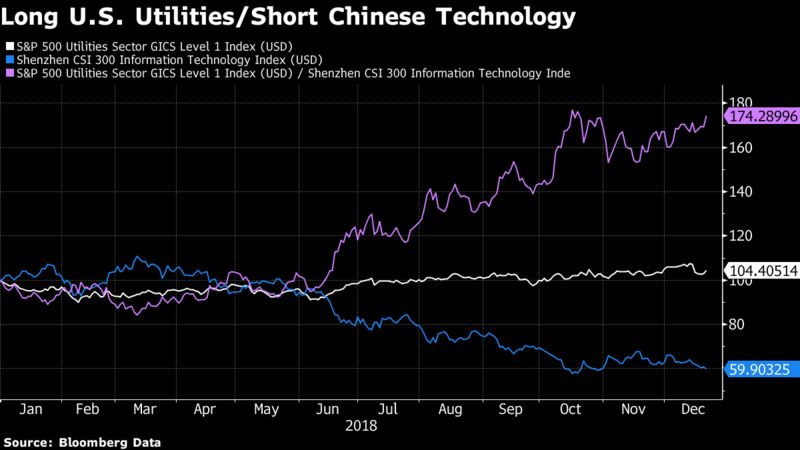
Long U.S. utilities, short Chinese technology.
One
big problem permeated the year: It was almost impossible to make any
serious money on the “long” side. Global stocks sank into a bear market.
Commodity prices fell and bond yields rose in what many proclaimed the
beginning of a secular bear market in fixed-income assets. And the
dollar rose. The trick lying behind a number of Hindsight’s trades was
to get on the right side of “America First” — in other words, to bet
against securities that were pummeled by U.S. trade measures and tighter
money, while investing in the rather smaller number of domestically
focused U.S. names that were immune to international pressures and
benefited from the strong U.S. economy.
Betting
on the inverse of the “Trump trade” yielded money wherever Hindsight
looked. It was evident that President Donald Trump was going to move on
to his trade agenda in his second year in office, and that the agenda
was more about technology and security than about trade perse.
To bet on investors taking cover as a trade war morphed into a tech war
with China, Hindsight shorted the CSI 300 Technology Index (-41 percent
in dollars) and put the money into U.S. utilities (which made a boring
4.4 percent and remains insulated from all trade concerns). Putting the
two trades together netted a return of 74.5 percent.
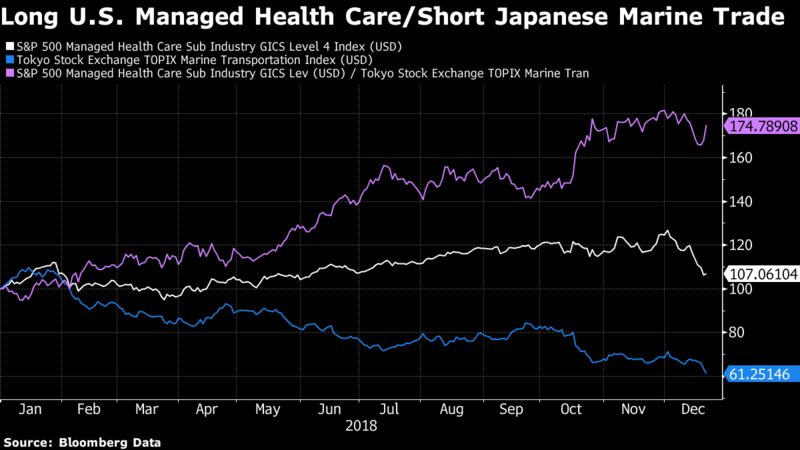
Long U.S. managed care, short Japanese marine trade.
Managed
care stocks benefited from Republicans’ failure to repeal Obamacare in
2017. They’re a safe long-term bet thanks to the aging population, and
their business provided protection against any trade repercussions.
Meanwhile, Hindsight foresaw raw fear over a U.S.-China trade war. And
no sector stands to lose more from a big reduction in trans-Pacific
trade than Japan’s big shipping companies. So, long the S&P 500
Managed Care Index (+7.2 percent) and short the Topix Marine Trade Index
(-39 percent) yielded a 75 percent return.
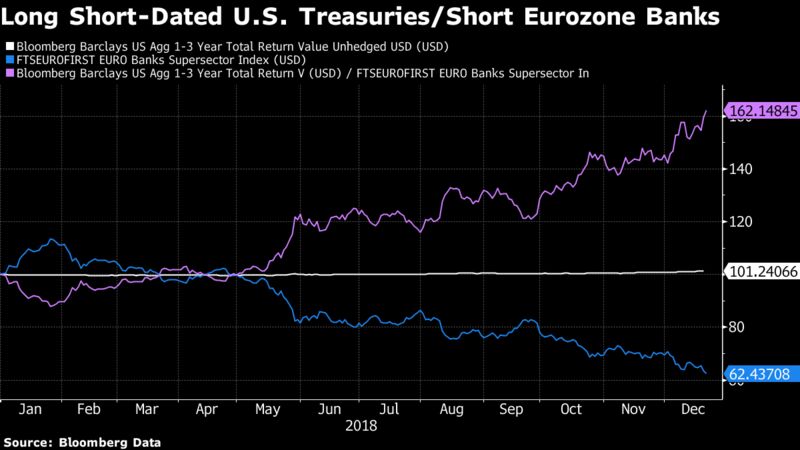
Long short-dated U.S. Treasuries, short euro-zone banks.
Hindsight
foresaw that tighter monetary policy in the U.S., which should be bad
for the price of bonds, would by the year-end spark enough of a flight
to safety that returns on short-dated bonds would be slightly positive.
Meanwhile, no sector was pummeled more by a stronger dollar, the
repatriation of U.S. tech companies’ profits that had been parked
overseas, and reduced dollar liquidity than the euro-zone banks. Many
other financials were pounded during the year, including those in the
U.S. But the banks of the euro zone, already bloated and with Deutsche
Bank in serious trouble, had the most terrible year of all. Long the
Bloomberg Barclays Treasuries Index (+1.25 percent) and short the
FTSE-Eurofirst Eurozone Banks Index (-37.5 percent in dollars) yielded a
62.1 percent return.
Move to Buenos Aires.
Money
illusion is always your friend. Each year, Hindsight moves to the
capital of the country whose currency enjoys the weakest year, as this
will automatically flatter the returns....
This is a bit old but at the time it was published the timing was off.
Now, with property price news from London and Sydney sounding a bit gloomy it might be time.
From 13D Research, June 7, 2018:
A pattern of weakness is
becoming apparent in megacity housing markets around the world. By the
end of May, home prices in Sidney had fallen 4.7% year-over-year. In
Toronto, the average price of a single family home had fallen 13% since
the market’s peak in April of last year. Meanwhile, in February, London
saw its first annual decrease in prices in more than eight years, which
accelerated in March and April. And in the first quarter of this year,
Manhattan saw the median price-per-square foot fall 18% year-over-year.
No doubt, these declines can be
attributed to region-specific supply and policy factors, whether
newly-implemented government restrictions on foreign investment or
Brexit and the U.S. tax reform bill. However, a recent report by the IMF
sounds a troubling alarm: “a simultaneous decline in house prices across the globe could lead financial and macroeconomic instability.”
The IMF’s argument is
intuitive. Accomodative monetary policy following the Global Financial
Crisis drove an unprecedented flood of institutional and individual
investor capital into real estate, with cross-border flows concentrating
in cosmopolitan megacities. This has dramatically divorced megacity
property-appreciation rates from economic fundamentals—primarily the
spending power of residents. Moreover, it has made local housing markets
far more intertwined with global economic conditions. According
to the IMF, 30% of property price movements today can be attributed to
global—not local—factors, up from just 10% two decades ago.
Now, with QE transitioning to
QT, the IMF’s fear is that a reversal of financial conditions could
cause cross-border capital to retreat from housing. Given the synchronicity between global megacities, instability could start anywhere and rapidly spread everywhere.
The weakness seen today may not be a harbinger of a crisis anytime
soon. However, as the lowest interest rates in history begin to
normalize, a basic truth, articulated by Fed Chair Jay Powell last
summer, requires increasing attention: “Housing is often found at the heart of financial crises”.
In Vancouver, home and
condominium prices are up roughly 60% in just the past three years. In
Sydney, house prices jumped over 80% between the end of 2009 and the
peak last September. And in Toronto, Stockholm, Munich, London, and Hong
Kong, housing rose by 50% on average since 2011. As the IMF writes: “In
recent years, the simultaneous growth in house
prices in many countries and cities located in advanced and emerging
market economies parallels the coordinated run-up seen before the
crisis.”The following chart
illustrates both how widespread the megacity property boom has been, and
the dramatic gap between city and nationwide appreciation in most
countries:
Source: The International Monetary Fund
The
escalation of cross-border institutional and individual investment in
real estate has no doubt played an essential role in fueling megacity
property booms. While data on foreign investment in cities is
scarce and incomplete, the pattern is clear. According to the National
Association of Realtors, U.S. home sales to foreigners surged 49% just
between April 2016 and March 2017, reaching a record $153 billion.
According to the Canadian government, foreigners
now own at least 5% of Vancouver’s housing stock, a number that does
not include Canadian immigrants who bought houses with funds from
overseas. And according to a study released late last year by the
Reserve Bank of Australia, foreign buyers accounted for roughly 25% of all property transactions in New South Wales and Victoria in 2015 and 2016, approximately three-and-a-half times greater than just five years earlier.
The role being played by
institutional investors is far easier to track. The IMF charts the
escalation of their participation in global real-estate markets since
the beginning of 2005:
Source: The International Monetary Fund
In its annual housing report
released last September, UBS concluded: “The risk of a real estate
bubble in top global cities has increased significantly in the past five
years.” The role foreign and institutional money has played in escalating home prices beyond the spending power of the local population was at the heart of the Swiss bank’s concern....MORE
Drunk and boarish: swigging pig hogs 18 beers at campsite Campers told to lock up food and drink after feral pig goes on bender in Western Australia and ends up in altercation with cow
A rampage by a feral pig that consumed 18 beers has prompted warnings
for people at campsites to properly secure their food and alcohol.
The pig struck at the DeGrey River rest area, east of the remote Western
Australian town of Port Hedland in the Pilbara, according to the ABC.
The animal was seen stealing three six-packs of beer from campers before
ransacking rubbish bags for food. One camper reported seeing the pig
guzzling the beer before getting involved in an altercation with a cow.
"In the middle of the night these people camping opposite us heard a
noise, so they got their torch out and shone it on the pig and there he
was, scrunching away at their cans," said the visitor, who estimated
that the pig had consumed 18 beers.
"Then he went and raided all the rubbish bags. There were some other
people camped right on the river and they saw him being chased around
their vehicle by a cow."....MORE
PLA’s official newspaper outlines ‘work focus’ in New Year’s Day
editorial, saying ‘at no time should we allow any slack in these areas’
Strengthening training and preparation for war are among the top
priorities for China’s military in 2019, its official newspaper said on
Tuesday.
“Drilling soldiers and war preparations are the
fundamental jobs and work focus of our military, and at no time should
we allow any slack in these areas,” the PLA Daily said in its New Year’s Day editorial.
“We should be well prepared for all directions
of military struggle and comprehensively improve troops’ combat response
in emergencies … to ensure we can meet the challenge and win when there
is a situation.”
Other priorities outlined in the editorial
included thorough planning and implementation to develop the military,
fostering reform and innovation, and party building within the People’s
Liberation Army (PLA).
President Xi Jinping, who also heads the
military, has been pushing the PLA to boost its combat readiness since
he took the top job in late 2012. Observers said stepping up drills
could be about flexing the PLA’s military muscle, but spelling it out at
the start of the year also suggested it was a more important part of
the plan for 2019.
“During the 20 years I spent in the PLA before I
left in 2004, military training to boost combat readiness was always
one of our top tasks,” said Zeng Zhiping, a retired lieutenant colonel
and military analyst based in Nanchang, Jiangxi province....MUCH MORE, including video
My first thought was Mike Hoare and the 1960's mercenaries in the Congo. Not good.
Via ZeroHedge:
Erik Prince, the founder of private security firm Blackwater, plans to
raise as much as $500m to capitalize on the rush into metals required
for batteries used in electric cars, according to the Financial Times.
"For all the talk of our virtual world, the innovation, you can’t build
those vehicles without minerals that come from generally weird,
hard-to-access places," said Prince, and adviser to president Trump and
brother of US education secretary Betsy DeVos
Miners - particularly from China, have been pouring billions into the
metals as the electric vehicle industry expands, which include cobalt,
copper and lithium.
One of the largest investors has been China, with Chinese companies buying stakes in deposits in the Democratic Republic of Congo and in Chile this year. Mr Prince also runs a Hong Kong-listed security and logistics company that is backed by China’s state-owned Citic Group. -Financial Times
Prince says his new fund will focus on unexplored deposits which
could be brought into production and then acquired by larger mining
companies, and will look to offload its investments within four to five
years.
"Chinese companies are not necessarily interested in the very
upstream exploration," said Prince. "They want to buy something in
production which leaves that gap for us."
More than 60 percent for the world's cobalt supply originates from
the DRC, which has attracted major investments from Chinese companies
including Citic, Jinchuan Group and China Molybdenum.
Prince gained notoriety as the founder of Blackwater - the world's
most famous private military contractor which has been targeted with
lawsuits alleging civilian deaths in Iraq, including a 2007 incident in
Nisour Square, Baghdad, where 17 civilians were killed and 20 injured
after Blackwater guards claim their convoy was ambushed. And FBI
investigation concluded that at least 14 of the 17 Iraqis were shot
without cause.
Prince sold the company in 2010, which has changed names and is now known as Academi.
Since
parting ways, Prince has run Frontier Services Group, providing
logistics and security services to companies operating in risky or
unstable countries. For example, they provide anti-piracy support to
Somalia and security to oil firms doing business in South Sudan. The
company has also ventured into natural resources, however, after
discovering a copper and cobalt deposit in the Congo, and investing in a
bauxite mine in Guinea.
A former Navy Seal who now lives in Abu Dhabi, Mr Prince’s strong
Chinese connections have helped with his mining investments. This year
his mine in Guinea secured an agreement to supply China’s state-owned
aluminium producer Chalco with bauxite.
Mr Prince, whose father sold automotive parts in West Michigan, said
carmakers will need huge amounts of minerals to fulfil their visions. -Financial Times
"When I see the R&D budgets of all the major automakers ploughing
huge money into hybrid or electric vehicles, I believe the demand curve
for the unique minerals that make up an electric car and battery
technology will be enormously high over the coming years," said Prince.
Prince has been investigated by special counsel Robert Mueller over a
meeting with Kirill Dmitriev, the head of one of Russia's sovereign
wealth funds, which the Blackwater founder said was a chance encounter
for the two to discuss trade and mineral wealth.
More accurately, "re" new.
From the Honolulu Star-Advertiser:
A boom in the shipments of Hawaii avocados is expected
KAILUA-KONA >> Shipments of Sharwil avocados from Hawaii and
their resulting profits could expand exponentially in coming years,
industry officials said.
Hawaii’s avocado industry opened in earnest in early December with
weekly shipments of about 3,000 pounds of avocados to two Seattle-based
wholesale produce companies, West Hawaii Today reported.
Shipments of that size, which nearly reach the capacity of
the state’s only avocado-packing facility, are expected to continue
through March.
“The potential is unreal,” said Billy Wakefield, a board member of
the Hawaii Avocado Association. “Ultimately, hundreds of acres could be
sent to the mainland very easily.”
The trees on each acre could potentially produce about 5,000 pounds of avocados each year, Wakefield said.
Hawaii avocados were first shipped to Alaska in 1987, and the fruit
started to get sent to the mainland U.S. without restrictions by 1989,
said Mike Scharf, officer in charge for the U.S. Department of
Agriculture in West Hawaii.
The shipments stopped in 1992 over concerns about fruit flies spreading from Hawaii to the continental U.S....MORE
And that boys and girls is how commodities work. Supply/demand.
It was funny when the Iranians were accusing Israel of stealing their clouds. Now it has the potential to get serious.
From Al-Monitor:
Eighteen lawmakers representing constituencies from the
central Iranian province of Esfahan, where water scarcity has reached
an alarming state, have resigned collectively
in a symbolic move against what they believe is an unfair distribution
of water resources. In response, their counterparts from three other
provinces, which share the same water supplies, hit back. They demanded
in a public letter
that the heads of the three branches of the Iranian state — president,
parliament speaker and judiciary chief — as well as the country's
powerful Supreme National Security Council intervene to bridge the
widening divide over who should have more water.
The latest
confrontation has not been without a precedent. Last August,
Iran's interior minister reported at least 20 water-related clashes, some of them deadly, in a period of less than 140 days.
Local tensions over water resources in Iran are not a novelty either.
In recent years, the crisis has not only worsened but has also
witnessed new implications. Provinces that were traditionally
considered water-rich areas — such as west Azerbaijan, east Azerbaijan,
Kohgiluyeh and Boyer-Ahmad, Chahar Mahal and Bakhtiari, Khuzestan,
Mazandaran, Gilan and Golestan — are already battling it out to win the
bigger share, bringing the fight to political levels in the open.
The collective resignation by parliamentarians Dec. 5 was
specifically a protest against the government's decision to take off
Esfahan province water transfer projects from next year's budget bill.
The angry lawmakers are still digging in their heels. The key water
supply of the province is Zayandeh Roud, central Iran's longest river
originating from springs in Chaharmahal and Bakhtiari province.
Distribution of water from Zayandehroud has been the main driving force
behind tensions between the authorities in Esfahan and the neighboring
provinces of Yazd, Chahar Mahal and Kohgiluyeh as well as Khuzestan
further away in the southwest.
While seeking solutions in their public letter against the
resignation by their colleagues from Esfahan, lawmakers from Chahar
Mahal, Kohgiluyeh and Khuzestan implicitly warned that the gesture could
fan the flames of water-related conflicts.
Similar differences are also growing elsewhere between the three
northern water-rich provinces of Gilan, Mazandaran and Golestan on the
one hand, and the central provinces of Semnan and Markazi on the other.
Semnan is the birthplace of President Hassan Rouhani, who only one day
before the Esfahan parliamentarians' resignation promised cheering
crowds there an ambitious water diversion project from the Caspian Sea. The pledge, however, was met with fury from lawmakers representing the three northern provinces on the shore of the Caspian Sea. Rouhani's words angered even his allies in parliament. This case has rallied Rouhani supporters and opponents behind one flag in the opposition against him.
"This treason will not be permitted," one pro-Rouhani member of parliament warned about the project.
Earlier, the water crisis had already pitted parliamentarians from
Sistan and Balouchestan province against Foreign Minister Mohammad Javad
Zarif over Iran's share from the Hirmand River running in from the
Afghan border. An older water-related political conflict in Iran is the
constant and unsettled tension
between lawmakers from west and east Azerbaijan provinces, and
different sitting governments over Lake Urmia's critically falling
levels.
Such a background of political implications of Iran's water crisis
has in recent years triggered public protests, in many cases turning
ugly, with security forces making arrests in their heavy-handed
response. The latest of such unrest rocked Khuzestan province last summer.
To overcome the crisis, the Iranian government has launched at least
10 water transfer megaprojects in the target areas. The projects,
however, remain incomplete and have only complicated the situation by sparking protests in areas from which water is meant to be transferred to drought-hit regions....
Things have been quite active in the Eastern Mediterranean lately,
with Israel, Cyprus and Greece pushing forward for the realization of
the EastMed pipeline, a new gas conduit destined to diversify Europe’s
natural gas sources and find a long-term reliable market outlet for all
the recent Mediterranean gas discoveries. The three sides have reached
an agreement in late November (roughly a year after signing the MoU) to
lay the pipeline, the estimated cost of which hovers around $7 billion
(roughly the same as rival TurkStream’s construction cost). Yet behind
the brave facade, it is still very early to talk about EastMed as a
viable and profitable project as it faces an uphill battle with
traditionally difficult Levantine geopolitics, as well as field geology.
The
EastMed gas pipeline is expected to start some 170 kilometers off the
southern coast of Cyprus and reach Otranto on the Puglian coast of Italy
via the island of Crete and the Greek mainland. Since most of its
subsea section is projected to be laid at depths of 3-3.5 kilometer, in
case it is built it would become the deepest subsea gas pipeline, most
probably the longest, too, with an estimated length of 1900km. The
countries involved proceed from the premise that the pipeline’s
throughput capacity would be 20 BCM per year (706 BCf), although
previous estimates were within the 12-16 BCm per year interval.
According to Yuval Steinitz, the Israeli Energy Minister, the
stakeholders would need a year to iron out all the remaining
administrative issues and 4-5 years to build the pipeline, meaning it
could come onstream not before 2025.
The idea of EastMed was first
flaunted around 2009-2010 as the first more or less substantial gas
discovery in the Eastern Mediterranean, the Tamar gas field in Israel’s
offshore zone, paved the way for speculations about an impending gas
boom. Then came the 535 BCm (18.9 TCf) Leviathan in 2010 and the 850 BCm
(30 TCf) Zohr discovery in offshore Egypt five years later and suddenly
it seemed that an Eastern Mediterranean gas expansion is inevitable.
Yet over the years, the operators of Leviathan have already allocated
part of their total gas volumes to domestic power generating companies
and most notably NEPCO, the Jordanian electric power company (1.6-2BCm
per year). Egypt has been concentrating on meeting domestic needs and
getting rid of LNG imports, moreover once it bounces back to gas
exporter status in 2019, it will only use its own 2 LNG terminals in
Damietta and Idku.
Thus, a pertinent question arises – whose gas would be used to fill the
EastMed pipeline? If the pipeline starts in offshore Cyprus, then it
would be logical to expect that Cyprus’ gas bounty would be somehow
utilized. Yet Cyprus has been lagging behind Egypt and Israel in its
offshore endeavors and so far lacks a clear-cut giant field to base its
supply future on....MUCH MORE
Director of Research, BlueMountain Capital Management
Prior to joining BlueMountain, Michael was Head of Global Financial
Strategies at Credit Suisse and Chief Investment Strategist at Legg
Mason Capital Management. Michael originally joined CS in 1992 as a
packaged food industry analyst and was named Chief U.S. Investment
Strategist in 1999. He is a former president of the Consumer Analyst
Group of New York and was repeatedly named to Institutional Investor's All-America Research Team and The Wall Street Journal All-Star survey in the food industry group....MUCH MORE
This is informative, if unusual, viewing: the causes of recession as explained through interpretive dance.
Economic
historian John Steele Gordon narrates the discussion. It’s a good
explanation, albeit low on details of what caused the last recession,
namely the spread of toxic mortgages and the ensuing crumpling of the
financial system....
I was a bit disappointed when I realized we wouldn't be watching Krugman and Mankiw and Nordhaus and the rest of the troupe but it sort of grows on you.
The most impressive technical feat of James Joyce’s novel Ulysses
is that it manages to record nearly every detail from a day in the life
of the book’s protagonist, Leopold Bloom, and to elevate those events
to the status of literature. Mythology, even. Readers track Bloom’s
journey step by step, as he navigates the labyrinthine streets, pubs,
and offices of Dublin, yet Bloom’s errands bear the symbolic weight of The Odyssey. Ulysses battled his way from island to island, fighting witches and monsters, but Ulysses suggests that modern, urban lives might be just as significant.
Recording stray thoughts, private conversations, newspaper headlines, and even an amorous act in the bedroom, Ulysses
functions as a super-catalog of the mundane. Joyce’s approach—a
persistent surveillance of events in Dublin on the date of June
16—implies that a larger story remains hidden in a plain sight, an
explanation that might finally make sense of the world, lurking in the
data of everyday life. We just need to capture and record that data.
Joyce
allegedly had larger ambitions than merely crafting a novel. According
to his friend, the writer and artist Frank Budgen, Joyce wanted Ulysses
to be so exhaustively detailed that it might operate as a kind of
literary hologram. In his own words, “I want to give a picture of Dublin
so complete that if the city one day suddenly disappeared from the
Earth it could be reconstructed out of my book.”
It is literature as 3-D point cloud: a total model of the metropolis
and an infinite archive of everything that takes place inside of it.
There are other ways to capture a city. In 2009, the U.S. military revealed the use of a new surveillance tool called Gorgon Stare.
It was named after creatures from Greek mythology that could turn
anyone who made eye contact with them to stone. In practice, Gorgon
Stare was a sphere of nine surveillance cameras mounted on an aerial
drone that could stay aloft for hours, recording everything in sight. As
an Air Force major general explained to The Washington Post at
the time, “Gorgon Stare will be looking at a whole city, so there will
be no way for the adversary to know what we’re looking at, and we can see everything.”
If
a car bomb were to detonate in an outdoor market, for example, the
accumulated footage Gorgon Stare had captured from that day could be
rewound to track the vehicle to its point of origin. Perhaps it could
even follow the car backward in time, over several days. This could
reveal not only the vehicle’s driver but also the buildings the car
might have visited in the hours or days leading up to the attack. It is
instant-replay technology applied to an entire metropolis instead of a
football field—a comparison made unnervingly literal by the fact that
the same company that supplied instant replays for the National Football
League began consulting with the Pentagon to bring their technology to the battlefield.
Unsurprisingly,
militarized replay technologies such as Gorgon Stare caught the eye of
domestic U.S. law enforcement who saw it as an unprecedented opportunity
to identify, track, and capture even the pettiest of criminals—or, more
ominously, to follow every attendee of a political rally or public demonstration.
The
larger promise of Gorgon Stare, however, was a narrative one: Its
capacity for total documentation implied that every event in the city
could not just be reconstructed but fully and completely explained.
Indeed, James Joyce and the U.S. military would seem to agree that the
best way to make sense of the modern metropolis is to document even the
most inconsequential details. Urban events as minor as a Dubliner out
for an afternoon stroll—let alone something as catastrophic as a
terrorist attack—can be rewound, studied, and rationally annotated.
Gorgon Stare is Ulysses reimagined as a police operation: a
complete, time-coded, searchable archive of a person’s every act. The
police can go back days, weeks, or months; if they have enough server
space, years. Should they wish, they could produce the most complex,
novelistic explanations imaginable simply because their data pool has
become so rich.
This
sort of persistent surveillance no longer requires drones, however, or
even dedicated cameras; instead, people have willfully embedded these
technologies into their daily lives. The rise of the so-called smart city
is more accurately described as the rise of a loose group of
multisensory tracking technologies. Gorgon Stare, we might say, is the
metropolis now....MORE
CPEC involves road and rail projects, dams and a
pipeline from Gwadar to Xinjiang, but it is very long-term endeavor as a
visit to the country revealed
The glorious view of the Hunza Valley and snow-capped mountains from the top of Baltit Fort. Photo: Asia Times
On top of the graceful Baltit Fort, overlooking the Hunza Valley’s
Shangri-La-style splendor, it’s impossible not to feel dizzy at the
view: an overwhelming collision of millennia of geology and centuries of
history.
We are at the heart of Gilgit-Baltistan, in Pakistan’s Northern
Areas, or – as legend rules, the Roof of the World. This is an area
about 70,000 square kilometers (27,000 square miles) crammed with
spectacular mountain ranges and amidst them, secluded pristine valleys
and the largest glaciers outside of the Polar region.
The location feels like vertigo. To the north, beyond the Batura
Glacier, is the tiny northeast arm of Afghanistan, the legendary Wakhan
corridor. A crest of the Hindu Kush separates Wakhan from the regional
capital Gilgit. Xinjiang starts on Wakhan’s uppermost tip. Via the
upgraded Karakoram highway, it’s only 240 km from Gilgit to the
Khunjerab Pass, 4,934 meters high on the official China-Pakistan border.
What used to be called the Russian Pamir, now in Tajikistan, can be seen
with naked eyes from one of the peaks of the Karakoram. To the east,
past Skardu and an arduous trek that may last almost a month, lies K2,
the second highest peak in the world, among a mighty group north of the
Batura Glacier (also known as Baltoro), which is 63km long.
To the south lies Azad (“Free”) Kashmir and slightly to the southeast
what locals define as Indian-occupied Kashmir. The former King of
Kashmir agreed to be part of India after Partition in 1947 but troops
were airlifted to the northern state and after a year of fighting, India
went to the UN. A temporary ceasefire line was established in 1948 and
runs down from the Karakoram towards the Nanga Parbat – the killer
mountain, dividing Kashmir into two virtually sealed halves.
Massive mountain ranges
Driving across the Karakoram Highway (see part 2 of this report) we
were face to face with three massive mountain ranges running in
different directions. The Karakoram roughly starts where the Hindu Kush
ends and then sweeps eastward – a watershed between Central Asian
drainage and streams flowing into the Indian Ocean.
The ancient Silk Road is seen above the Karakoram Highway. Photo: Asia Times
The Himalayas start in Gilgit and then run southeast through a
cluster of high peaks, including the Nanga Parbat, directly on the
Islamabad-Gilgit air route (flights by turboprop only take off if
weather around the Nanga Parbat allows).
The Karakoram and the Himalayas are like an extension of each other,
while the Hindu Kush starts in southern Afghanistan and ties up with the
Karakoram north of the Hunza Valley. Within a radius of roughly 150 km
from Gilgit and Skardu, there are no less than 90 peaks towering over
8,000m.
Strategically, this is one of the top spots on the planet, a
protagonist of the original Great Game between imperial Britain and
Russia. So it’s more than appropriate that here is exactly where a
protagonist of the New Great Game, the China-Pakistan Economic Corridor
(CPEC), the flagship project of the New Silk Roads, or Belt and Road
Initiative (BRI), actually starts, linking western China’s Xinjiang to
the Northern Areas across the Khunjerab Pass.
Karakoram politics
CPEC is the supreme jewel in the Belt and Road crown, the largest
foreign development or investment program in modern China’s history,
loaded with way more funds than years of US military aid to Islamabad.
And we are indeed in Ancient Silk Road territory. Looking at the
millenary trail parallel to the Karakoram, lovingly restored by the Aga
Khan Development Foundation, it’s easy to picture the great Chinese
traveler Hiuen Tsang traversing these heights in the 7th Century, and
naming them Polo-le. The Tang dynasty called it Great Polu. When Marco
Polo trekked in the 14th Century, he called it Bolor.
Early last month, I was privileged to drive on the upgraded Karakoram
Highway along CPEC all the way from Gilgit to the Khunjerab, and back,
with multiple incursions to valleys such as lush, pine-forested Naltar,
Shimshal (manufacturers of sublime yak wool shawls), Kutwal and receding
glaciers, such as Hopper and Bualtar.
The Karakoram Highway was originally conceived in the 1970s as an
ambitious political-strategic project able to influence the geopolitical
balance in the subcontinent, by expanding Islamabad’s reach into
previously inaccessible frontiers.
Now it’s at the heart of a trade and energy corridor from the
China-Pak border all the way south to Gwadar, the port in Balochistan in
the Arabian Sea a stone’s throw from the Persian Gulf. Gwadar looks
likely to be a crucial springboard to China becoming a naval power –
active from the Indian Ocean to the Persian Gulf and on to the
Mediterranean, while CPEC, slowly but surely, aims to change the social
and economic structure of Pakistan.
Previous Pakistani prime minister Nawaz Sharif, the controversial
“Lion of the Punjab”, was an avid CPEC supporter after he won the 2013
elections. At the time current Prime Minister Imran Khan’s
Tehreek-e-Insaf (PTI) party, winner of elections held in July, had
already polled second nationwide and rose to power in the strategic
Khyber-Pakhtunkhwa province – straddling the area between Islamabad and
the tribal belt.
Sharif, in June 2013, when he was about to enter negotiations with
the Chinese, was lauding what would become CPEC as an infrastructure
scheme that “will change the fate of Pakistan”. So far that has
translated mostly into new hydroelectric dams, coal-fired power
stations, and civil-nuclear power. The China National Nuclear
Corporation is building two 1,100 MW reactors
near Karachi for nearly $10 billion, 65% financed by Chinese loans.
This is the first time that the Chinese nuclear industry has built
something of this scale outside of their country.
More than a dozen CPEC projects involve power generation – Pakistan
is no longer woefully energy-deprived. These projects may not be as sexy
as high-speed rail and pipelines, which could arrive much later; after
all CPEC in its planned entirety runs to 2030.
Of course, monumental business decisions will have to be addressed;
the staggering cost – and state of the art engineering – involved in
building a railway parallel to the Karakoram; and the fact that oil
pumped via a pipeline from Gwadar to Xinjiang might cost five times more
than via the usual sea lanes all the way to Shanghai.
A map shows the route of the China-Pakistan Economic Corridor. Photo: Wikimedia Commons/ Wanishahrukh
What Imran wants
Imran Khan is way more cautious than Sharif, who had a “China cell” inside his office and commanded the Pakistani Army to set up a 10,000-strong security force to protect China’s CPEC investments.
But Khan knows well about the firepower behind CPEC: the Silk Road
Fund, the Asian Infrastructure Investment Bank (AIIB), CITIC, Bank of
China, EXIM, China Development Bank. The Chinese Academy of Social
Sciences (CASS) projects that BRI could mobilize as much as $6 trillion
in the next few years. What Khan wants is to negotiate better terms for
Pakistan....MORE