Tuesday, May 2, 2017

With Prices up 8% in 30 Hours Wheat Markets Await Crop Tour Results, Amid Debate over Cold Damage

The tramp through the wheat fields begins today.
A twofer from Agrimoney:

Wheat markets await crop tour results, amid debate over cold damage

The US is poised for a thaw, after the weekend storms some estimate have cost more than 2.5m tonnes in wheat production – and which is placing extra stress on results of a high-profile crop tour.
Weather service MDA said that in the central US "temperatures will moderate over the course of this week", after weekend storms which brought rains of up to 6 inches to parts of the Corn Belt, and snows reported at 20 inches in parts of the central Plains.
The warm-up will "limit additional damage" to crops hurt by the weekend tempests, which also brought high winds which MDA said "led to some lodging of the wheat crop" – ie, the snapping of wheat stalks.
The improved conditions and snow melt – albeit likely to be accompanied by fresh rains in many areas - will also allow a better assessment of the extent of crop damage, in particular in the Plains hard red winter wheat belt, but with some losses expected in Midwest soft red winter wheat too.
Crop loss estimates
According to MDA, the "cold temperatures, particularly in Kansas, caused damage to about a third of the crop, especially in areas where snow cover was minimal, with about 10% of the crop potentially facing irreversible damage".
In volume terms, Richard Feltes at Chicago broker RJ O'Brien flagged "early estimates of large hard red winter wheat loss" of some 100m bushels, equivalent to 2.7m tonnes, although he added that figures on this scale were "likely to be scaled back in coming weeks"....
...MORE 

A few hours earlier:

Wheat prices up 8% in 2 days, as US woes spark 'explosion'
So just how big will the explosion in wheat futures be?
Many commentators have been cautioning that speculators were dicing with trouble in the wheat market, in building up a record net short position (as of latest data, for a week ago) in Chicago (the world benchmark) at a time when prices were already not far from 10-year lows, and when there were some weather worries around.
One observer, Water Street Solutions, said at the weekend that hedge funds' stance was "starting to feel like hosting a cigar party in the gunpowder room". This a week after cautioning that the extensive net short had left the market like a geyser, waiting to blow.
This before investors appreciated just how dire weekend weather in the US had been when, as Joe Lardy at broker CHS Hedging said, "a major winter storm hammered the western Plains states".
These included Kansas, the top producing state, and centred on hard red winter wheat, as traded in Kansas City.
'Heavy snow and cold temperatures'
"Some areas receive little snow but heavy rains, other areas were buried in over a foot of snow," Mr Lardy said, with high winds an issue too, breaking wheat stalks.
According to Agritel, in "some region of Texas, 30cm (12 inches) of snow have been registered".
MDA talked of snows of up to 15 inches.
While snow is not a problem for wheat in the winter, out of dormancy, the crop becomes far more susceptible to damage from cold. (Besides, much crop which did not receive snow battled with heavy rains and flooding.)
The "heavy snow and cold temperatures put the heading and flowering hard red winter wheat crop at risk", Benson Quinn Commodities said.
"Total damage won't be known until harvest," meaning plenty of scope for speculation and counter speculation ahead of that on the size of crop losses.
'Big crop losses'

As to the extent of the damage on production, Richard Feltes at RJ O'Brien flagged "early estimates of large hard red winter wheat loss" of some 100m bushels, equivalent to 2.7m tonnes, if adding that such ideas were "likely to be scaled back in coming weeks....
...MORE

Recently:
Yesterday 
"Hedge funds lift bearish ag bets near to record - spurring weather rally talk"
Sunday 
"The Last Remaining Cheap Asset"

July futures 457'2  +1'2 Here's the 60 minute chart from the CBOT/CME:

So, How Will You Deal With The Great Vanilla Shortage of '17?

I see other outlets are getting around to this right now but the FT's Emiko Terazono was on it a week ago.
From The Financial Times, April 24, 2017: 

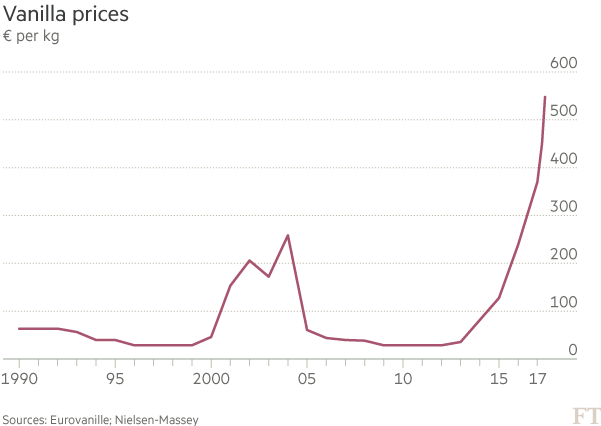
Vanilla price reaches record high after Madagascar cyclone
Price of pods used in ice cream soars as top producer grapples with damage
The price of vanilla has soared to a record high as Madagascar, the world’s top producer of vanilla beans, grapples with damage wrought by a cyclone. Used in ice cream, chocolate and perfume, vanilla pods are trading at an all-time high of $600 a kilogramme, according to Craig Nielsen of US vanilla and flavourings group Nielsen Massey. 
Prices for vanilla, which is not traded on an exchange, had already surged over the past year thanks to speculative hoarding and rising demand as more consumers shun artificial flavourings and ingredients. The price climbed from about $100 a kg in 2015 to $450-$500 at the start of this year. 

“Inventories were already depleted, and now we have the damage caused by the cyclone,” said Mr Nielsen. “It will be a tough time [for the vanilla market] for the next couple of years.”...MUCH MORE
https://www.ft.com/__origami/service/image/v2/images/raw/http%3A%2F%2Fcom.ft.imagepublish.prod-us.s3.amazonaws.com%2F78965bee-28f4-11e7-9ec8-168383da43b7?source=next&fit=scale-down&width=601

Speaking of Emiko-on-the-spot, this crossed within the last hour
Wheat jumps as US snowstorm damages crops  
Amazing what a May snowstorm does to price:


Grantham Mayo Van Otterloo First Quarter Letter

Ha! I see the FT's Izabella Kaminska was also perusing Mr. Grantham's letter. She has additional thoughts at "GMO’s Grantham on what’s driving abnormal profit margins".
Great minds and all that.

Interestingly, we both zeroed in on the political power angle, which of course reminded me of something (what doesn't?), in this case a 2015 post, "While the Cost of Stuff Declines, The Cost of Political Power Skyrockets":
In the comments section of an FT Alphaville piece on Andreessen-Horowitz-backed bitcoin play, 21 Inc. Alphaville's benevolent overlord  pounded home a point Izabella raised in the article:

Paul Murphy FT
I'd missed the screaming irony here.  You don't seem to be able to buy the 21 Bitcoin computer with bitcoin.
And why doesn't M. Andreessen accept bitcoin in payment?
Because it is not the coin of the realm he is actually interested in: The Political.

When the plebs are bought off with their $12,000/yr. guaranteed basic income (plus a smartphone) the things that will cost serious coin will be political access and law-making power.
And we're already on the way....
And that leads us to today's link.
From GMO:
This Time Seems Very, Very Different (Part 2 of Not with a Bang but a Whimper -A Thought Experiment)
Jeremy Grantham
Pages 9-16
Oh, the good old days!
When I started following the market in 1965 I could look back at what we might call the Ben Graham training period of 1935-1965. He noticed financial relationships and came to the conclusion that for patient investors the important ratios always went back to their old trends. He unsurprisingly preferred larger safety margins to smaller ones and, most importantly, more assets per dollar of stock price to fewer because he believed margins would tend to mean revert and make underperforming assets more valuable.You do not have to be an especially frugal Yorkshireman to think, “What’s not to like about that?”

So in my training period I adopted the same biases. And they worked! For the next 10 years, the out-of-favor cheap dogs beat the market as their low margins recovered. And the next 10 years, and the next!

Not exactly shooting fish in a barrel, but close. Similarly, a group of stocks or even
the whole market would shoot up from time to time, but eventually – inconveniently, sometimes a couple of painful years longer than expected – they would come down. Crushed margins would in general recover, and for value managers the world was, for the most part, convenient, and even easy for decades. And then it changed.

Exhibit 1 shows what happened to the average P/E ratio of the S&P 500 after 1996. For a long and painful 20 years – for someone betting on a steady, unchanging world order – the P/E ratio stayed high by 1935-1995 standards. It still oscillated the same as before, but was now around a much higher mean, 65% to 70% higher! This is not a trivial difference to investors, and 20 years is long enough to test the apocryphal but suitable Keynesian quote that the market can stay irrational longer than the investor can stay solvent.

1 In fact, between 1965 and 1995 cheap price to book stocks (best decile) continuously outperformed the market on a rolling 10-year basis with one exception – 1973 (French and Fama).

Along the way there were early signs that things had changed. First was the decline from the greatest bubble in US equity history, the 2000 tech bubble. Compared to the previous high of 21x earnings at the 1929 bubble high, this 2000 market shot up to 35x and when it finally broke, it fell only for a second to touch the old normal price trend. And then it quite quickly doubled. Compare that experience to the classic bubbles breaking in the US in 1929 and 1972 (Exhibit 2) or Japan in 1989.

All three crashed through the existing trend and stayed below for an investment generation, waiting for a new crop of more hopeful investors. The market stayed below trend from 1930 to 1956 and again from 1973 to 1987. And in Japan, the market stayed below trend for... you tell me. It is 28 years and counting! Indeed, a trend is by definition a level below which half the time is spent. Almost all the time spent below trend in the US was following the breaking of the two previous bubbles of 1929 and 1972. After the bursting of the tech bubble, the failure of the market in 2002 to go below trend even for a minute should have whispered that something was different. Although I noted the point at the time, I missed the full significance. Even in 2009, with the whole commercial world wobbling, the market went below trend for only six months. So, we have actually spent all of six months
cumulatively below trend in the last 25 years! The behavior of the S&P 500 in 2002 might have been whispering in my ear, but surely this is now a shout? The market has been acting as if it is oscillating normally enough but around a much higher average P/E.

How about profit margins, the other input into the market level? Exhibit 3 shows the return on sales of the S&P 500 and Exhibit 4 shows the share of GDP held by corporate profits. Compared to the pre- 1997 era, the margins have risen by about 30%. This is a large and sustained change. And remember, it is double counting: above-average profit margins times above-average multiples will give you very much above-average price to book ratios or price to replacement cost. Counterintuitively, if we need to sell at replacement cost (most people’s view of fair value), then above-normal margins must be multiplied by a below-average P/E ratio and vice versa.

To this point, we have looked at two of the three most important inputs in markets and they are very different in the same direction, upwards. A third one – interest rates – is also very different. As is well- known, short rates have never been at such low levels in history as they were last year. Come to think of it, the population growth rate is also very, very different. As is the aging profile of our population. And the degree of income inequality. So too the extent of globalization and indicators of monopoly in the US. Also the extended period of below-trend GDP growth and productivity almost everywhere but particularly in the developed world. And serious climate change issues that may be understated in countries like the US, the UK, and Australia, where the fossil fuel industries are powerful and engage in effective obfuscation, but pre-1997 the topic was not broadly appreciated at all. The price of oil in 1997 was more or less on its 80-year trend in real terms of around $18 a barrel in today’s currency. The trend price today, based on the cost of finding new oil, is about $65 a barrel with today’s price only slightly lower despite an unexpected surge in supply from US tight oil, or fracking. Three and a half times the old price is not an insignificant change when you realize that almost all serious economic declines have been associated with price surges in oil. And, finally, my old bugbear – the modus operandi of the Federal Reserve and its allies is very different in its 22-year persistent effort to work the highs and lows of the rate cycle lower and lower. One might ask here: Is there anything that really matters in investing that is not different? (Actually, I have one, but will save it for another discussion: human behavior.)

We value investors have bored momentum investors for decades by trotting out the axiom that the four most dangerous words are, “This time is different.” 2 For 2017 I would like, however, to add to this warning: Conversely, it can be very dangerous indeed to assume that things are never different.

Corporate profitability is the key difference in higher pricing
Of all these many differences, the most important for understanding the stock market is, in my opinion, the much higher level of corporate profits. With higher margins, of course the market is going to sell at higher prices. 3 So how permanent are these higher margins? I used to call profit margins the most dependably mean-reverting series in finance. And they were through 1997. So why did they stop mean reverting around the old trend? Or alternatively, why did they appear to jump to a much higher trend level of profits? It is unreasonable to expect to return to the old price trends – however measured – as long as profits stay at these higher levels.

So, what will it take to get corporate margins down in the US? Not to a temporary low, but to a level where they fluctuate, more or less permanently, around the earlier, lower average? Here are some of the influences on margins (in thinking about them, consider not only the possibilities for change back to the old conditions, but also the likely speed of such change):

■ Increased globalization has no doubt increased the value of brands, and the US has much more than its fair share of both the old established brands of the Coca-Cola and J&J variety and the new ones like Apple, Amazon, and Facebook. Even much more modest domestic brands – wakeboard distributors would be a suitable example – have allowed for returns on required capital to handsomely improve by moving the capital- intensive production to China and retaining only the brand management in the US. Impeding global trade today would decrease the advantages that have accrued to US corporations, but we can readily agree that any setback would be slow and reluctant, capitalism being what it is, compared to the steady gains of the last 20 years (particularly noticeable after China joined the WTO).

■ Steadily increasing corporate power over the last 40 years has been, I think it’s fair to say, the defining feature of the US government and politics in general. This has probably been a slight but growing negative for GDP growth and job creation, but has been good for corporate profit margins. And not evenly so, but skewed toward the larger and more politically savvy corporations. So that as new regulations proliferated, they tended to protect the large, established companies and hinder new entrants.

Exhibit 5 shows the steady drop of net new entrants into the US business world – they have plummeted since 1970! Increased regulations cost all corporations money, but the very large can better afford to deal with them. Thus regulations, however necessary to the well-being of ordinary people, are in aggregate anti-competitive. They form a protective moat for large, established firms. This produces the irony that the current ripping out of regulations willy-nilly will of course reduce short-term corporate costs and increase profits in the near future (other things being equal), but for the longer run, the corporate establishment’s enthusiasm for less regulation is misguided:

Stripping out regulations is working to fill in its protective moat.
■Corporate power, however, really hinges on other things, especially the ease with which money can influence policy. In this, management was blessed by the Supreme Court, whose majority in the Citizens United decision put the seal of approval on corporate privilege and power over ordinary people. Maybe corporate power will weaken one day if it stimulates a broad pushback from the general public as Schumpeter predicted. But will it be quick enough to drag corporate margins back toward normal in the next 10 or 15 years? I suggest you don’t hold your breath.

■ It is hard to know if the lack of action from the Justice Department is related to the increased political power of corporations, but its increased inertia is clearly evident. There seems to be no reason to expect this to change in a hurry.

■ Previously, margins in what appeared to be very healthy economies were competed down to a remarkably stable return – economists used to be amazed by this stability – driven by waves of capital spending just as industry peak profits appeared. But now in a very different world to that described in Part 1, 4 there is plenty of excess capacity...

...MUCH MORE, including GMO's Ben Inker on what keeps him up at night.

HT: Value Investing World

Monday, May 1, 2017

First the Good News: Recode on Kalanick Edition

From Recode, who seem a bit crabby:
Uber CEO Travis Kalanick is not the first exec to deal with sexual harassment and sexism issues. And he’s not the first to be accused of stealing technology. He’s also not the first to anger customers through cloddish statements. And he’s not the first to face significant doubts about his ability to manage a fast-growing startup.
But.
Okay, big But:
But he is the very first speaker in the 15 years we have been putting on our tech and media events to cancel his interview due to the many embarrassing issues at his company. In this case, because the report from former Attorney General Eric Holder on Uber’s culture and management problems has been delayed until the week of Code at the end of May.....
...MUCH MORE

Prop Bet: Mo Money Monet

Wanna bet this pretty picture goes for more than the quoted range despite the stamped signature?

From Art Market Monitor, April 24:

Sotheby’s $14m Monet Nymphéas Up in May

http://1uyxqn3lzdsa2ytyzj1asxmmmpt.wpengine.netdna-cdn.com/wp-content/uploads/2017/04/Le-Bassin-aux-nympeas.jpg
 Claude Monet Le Bassin aux nymphéas Oil on canvas 38¼ by 51⅛ in. Painted circa 1917-20. Est. $14/18 million
Details on the last of the Imp-Mod lots are coming out as the catalogues emerge and get printed. Sotheby’s has a few lots like this Monet water lilies work that was stamped by his heirs with the painter’s signature....MORE

"RBOB 'In Danger Of Breaking Down' Amid Record Gasoline Contango"

From ZeroHedge:
June 2017 gasoline futures are traded at the biggest discount ever to the July contract this morning...
http://www.zerohedge.com/sites/default/files/images/user3303/imageroot/2017/05/01/20170501_RBOB2.jpg
... As the front-month futures tumbles to its lowest since September...MORE

Front (June)       1.5215     -0.0266
           July         1.5274     -0.0253

          August
   1.5276     -0.0241  

Stocks--I'm a genius! Housing--I'm a genius! Commercial real estate--yes, well, I suppose the evidence is overwhelming...

A nice line from Charles Hugh Smith's take on the old trader's phrase: "Bull market genius".
From his Of Two Minds blog, April 25:

A Rising (Central Bank) Tide Turns Everyone into a Genius
Until the system implodes--you're a genius.
So you've ridden the markets higher--stocks, housing, commercial real estate, bat guano, quatloos, you name it--everything you touch turns to gold. What can we say, bucko, other than you're a genius!

It's a market truism that rising tides lift all boats. But that's not the really important effect; what really matters is rising tides turn everyone into a genius--at least in their own minds.

Those of us who have been seduced by the Sirens' songs of hubris know from bitter experience how easy it is to confuse a rising tide with speculative genius. When everything you touch keeps going higher, the only possible cause is.... your hot hand, of course!

Stocks--I'm a genius! Housing--I'm a genius! Commercial real estate--yes, well, I suppose the evidence is overwhelming--it does seem I'm a genius.

The only thing better than buy and hold is buy the dips and hold--and use margin or whatever leverage you have to buy more before the price goes even higher.

What can we say other than: this is the strategy of geniuses. The proof is in the charts:
The S&P 500: margin to the hilt and buy every dip: genius!

Housing in Sweden, Toronto, Brooklyn, West L.A., San Francisco, Seattle, Portland, Shanghai and every other blazing-hot market: borrow more from the shadow banking system, mortgage your house to the hilt, do whatever you have to do to get the down payment and buy another flat: pure genius! 
http://www.oftwominds.com/photos2017/Sweden-housing3.png
Commercial real estate:...MORE

I'm guessing we'll be coming back to this as well as last week's "The Coming Opportunity From The Shift To Passive Investment Management" and a few others somewhere down the line. 

Neurofinance: The Psychology Behind When To Sell A Bull Market

I'm not quite sure what to make of this but, like the locale in the Saturday piece datelined The Seychelles, nice hood.
From HedgeEye:

This special guest commentary was written by our friend Richard Peterson M.D., MarketPsych. This piece was originally published on April 13th.
“When the music stops, in terms of liquidity, things will be complicated. But as long as the music is playing, you’ve got to get up and dance. We’re still dancing."
-Chuck Price (then CEO of Citigroup) to the Financial Times on July 9, 2007.
How Will We Know When to Stop Dancing?
According to TD Ameritrade's investor movement index (IMX), individual investor stock purchases broke their all time high in February 2017. Despite large gains already, the U.S. stock market's "Trump rally" may continue, fueled by anticipation of lower tax rates, repatriation of overseas corporate cash, and U.S. fiscal stimulus on infrastructure.

But just as easily as we can cite reasons for the rally to continue, we can find evidence that it's a good time to sell. Some experts (including Nobel laureate Robert Shiller) believe U.S. stocks are overvalued. Rising interest rates may slow the economy. A stronger dollar is hurting U.S. companies' profits. Trump creates a unique level of uncertainty.

It can't be both ways. In this environment of both historically high stock prices and high uncertainty, two prevalent behavioral biases exert their influence over investors. Today's newsletter will explore research reported at last week's neurofinance conference at Lake Lucerne, Switzerland. It then examines how the biases called the Disposition effect (Cutting Winners Short) and the Repurchase Effect distort our thinking in market environments such as this one. Finally, we look for guidance on the stock market going forward.

Neurofinance in Practice
Switzerland-based hedge fund manager Peter Pühringer (German language wiki page) is a generous sponsor of neurological research, including neurofinance. In the markets Pühringer has profited - in part - from a keen understanding of the psychological nature of the interest rate cycle, and Pühringer is now one of the wealthiest men in the region (his personal 70% return last year didn't hurt).

He didn't start out wealthy - he was born in East Germany and emigrated to Austria in his early 20s. In his career as an investor, his early successes came from bucking the trend with Saudi real estate development and buying East German real estate in Berlin just after the Wall fell. Last week his firm was one of only two to bid on Ghanian debt during that country's first debt auction.

Pühringer's enthusiasm for market psychology has driven him to become personally engaged with brain research. He renovated the Vitznau Health and Wealth Residence on Lake Lucerne (photo below) which may be the only resort to double as a neurological rehabilitation facility complete with a MRI scanner in the building's basement....

Neurofinance: The Psychology Behind When To Sell A Bull Market - peterson image 1
Pühringer's interest in market psychology and economic cycles is evident in the resort's signature statue, depicted below. And on at least one floor, suites at the hotel are named after influential economists and behavioralists including Robert Shiller....

...I could write many pages about the fascinating implications of the neurofinance research underway. Given it's relevance to how investors feel after a significant bull market, today's newsletter will examine the neuroscience research of USC finance professor Cary Frydman (see extensive citations below).

In a 28-subject study that combined investment decision making with neuroimaging (fMRI), Frydman found that all participants were susceptible to two common biases - the Disposition effect - in which investors sell their winning investments too soon and hold their losers too long - and the Repurchase effect.... 
...MORE

"Hedge funds lift bearish ag bets near to record - spurring weather rally talk"

Right on cue:

Last Chg
Corn 374-2+7-6
Soybeans 968-0+11-6
Wheat 447-6+15-4

From Agrimoney:
Hedge funds extended bearish bets on ags to the second highest on record, including their biggest ever net short in wheat and a larger-than-expected net short in corn – raising the potential for weather setbacks to spur price surges.
Managed money, a proxy for speculators, lifted its net short position in futures and options in the top 13 US-traded agricultural commodities, from corn to hogs, by 68,232 contracts in the week to last Tuesday, analysis of data from the Commodity Futures Trading Commission regulator shows.
The increase took the net short - the extent to which short holdings, which profit when values fall, exceed long bets, which benefit when prices gain – to 231,206 lots, a reading beaten only once in data going back to 2006.
It also represented a 10th successive week in which hedge fund sales in ags exceeded purchases, the second longest such spree on record, behind only an 11-week run which ended in early 2014.
'Shorts larger than expected'
Net selling was evident in all three ag sectors – grains, soft commodities and livestock – although in particular in grains, including the soy complex, in which hedge funds lifted their net short by more than 43,000 lots to an all-time high of 462,912 contracts....MORE

"Venture-Capital Quandary: Too Much Money Chasing Too Few Ideas"

From the Wall Street Journal, April 27:

Expecting a ‘deep winter’ of funding, China’s VC industry instead finds lots of cash sloshing around
After a frenzied 2015 when venture money gushed into apps providing on-demand home services from meal delivery to massages, funding for startups was supposed to enter what industry insiders called “deep winter.”

For some of those darlings, capital did freeze up, forcing them to fold, shrink or merge with competitors. But funding is anything but short. China’s venture-capital industry is suffering a different headache: too much money and too few solid prospects to bet on.

It is “more like a drought of assets than a ‘deep winter’ of funding,” says Fang Zhan, an analyst with investment database pedata.cn, which is run by Zero2IPO Research in Beijing.
Money has rushed into the tech sector because of dwindling investment returns elsewhere and policy decisions by Beijing, which opened the credit taps last year to spur slowing growth—and has steered money toward “innovation” in hopes of creating new economic drivers.

Last year 2,438 new venture-capital and private-equity funds raised 1.37 trillion yuan ($198.8 billion), up from 784.9 billion ($113.9 billion) in 2015, according to research by pedata.cn. Much of that money came from 323 government-led funds created last year, the research found.

Established firms created larger funds last year than previously—raising billions and tens of billions of yuan per fund, rather than the hundreds of millions in years past, says Ms. Zhan of pedata.cn.
So much money is sloshing around that China last year fielded a record herd of “unicorns”—startups valued at $1 billion or more—with 70 new entrants. All told, China’s Ministry of Science and Technology counts 131 unicorns. That is 30 more than the U.S., according to data company CB Insights.

Nobody in the industry wants to use the “B” word—bubble—on the record. Privately, many say that the valuations are crazy.

Look at two of the most chased-after investment targets now: startups that offer the use of bicycles or power banks for charging smartphones, for about 1 yuan (15 cents) an hour.
A leading bike-sharing operator, Ofo, announced Sunday that Ant Financial, the financial-services affiliate of Alibaba Group Holding Ltd. , had placed a strategic investment. Though the amount wasn’t disclosed, the founder of the three-year-old company told CNBC last week that Ofo is worth over $2 billion.

Its biggest competitor, Mobike, was declared a unicorn by its investors early this year.

And those are just two of dozens of operators flooding major cities with bikes—making them so ubiquitous in some places that they’ve become sources of annoyance and targets of vandalism.
To win users, the companies offer subsidies and sometimes free rides, a strategy that requires lots of cash while generating little revenue.

“Don’t ask me how the business model might work,” says one early Mobike investor. “I don’t know any longer.”...MUCH MORE
https://si.wsj.net/public/resources/images/BN-TE202_30Sra_M_20170427043421.jpg?width=700&height=467
Another Beijing pileup, this one damaged Ofo bicycles awaiting repair. Photo: Kevin Frayer/Getty Images 

Relatedly at Bloomberg, also April 27: 

Ex-Google Engineer Builds $1.5 Billion Startup in 21 Months
Ex Googler Colin Huang created Pinduoduo, a fast-growing Shanghai unicorn that lets people shop together online and earn group discounts.... 

Yes, a sort of Facebook/Groupon unicorn meld.

The World According to a Free-Range Short Seller With Nothing to Lose

An oldie but goodie on an interesting guy.
(actually not that oldie)
From Bloomberg, February 9, 2017:

Marc Cohodes, the scourge of Wall Street, is back. And he’s passing along his “dying art” to a new generation of troublemakers.
The roosters start crowing at 4 a.m. on Alder Lane Farm, about an hour north of San Francisco on the edge of Sonoma wine country. While horses stir in their stables and chickens begin to roam the 20-acre property, one of the world’s most fearsome short sellers puts on his usual attire—shorts and flip-flops—and makes his way in the dark to the room behind his garage. Six pinball machines, a gigantic flatscreen, and a pingpong table compete for attention. If not for the Bloomberg terminal in the corner, you might assume this was your typical man cave.

But let’s not dwell on Marc Cohodes’s pastured chickens, or his show-jumping horses, or even his homemade apricot jam that, on special occasions, San Francisco’s Una Pizza Napoletana puts on its pies in lieu of tomato sauce. Some of the most respected people in the investing industry say that, dating back to the 1980s, nobody has had a better nose for sniffing out fraud than the 56-year-old Cohodes. He’s exposed suspect accounting at a number of high-profile companies, including the Belgian speech-­recognition software developer Lernout & Hauspie, which went bankrupt in 2001 after being valued at about $10 billion, and mortgage lender NovaStar Financial, where his efforts earned him a Harvard Business School case study published in 2013.

“I would not want to be his adversary if I was still a criminal today,” says Sam Antar, who was sentenced to six months of house arrest and 1,200 hours of community service for cooking the books at New York consumer-electronics chain Crazy Eddie in one of the largest securities frauds unearthed in the 1980s. “A character like Marc”—the two crossed paths later in his life when both were focused on detecting fraud—“you stay away from.”

And that’s been relatively easy for at least part of the past eight years. In 2008 the hedge fund Cohodes worked at for more than two decades went out of business under controversial circumstances. He maintains that Goldman Sachs, its prime broker, closed it too hastily by making needless margin calls, a claim Goldman disputes. The fallout spurred a bout of what Cohodes likens to post-traumatic stress disorder. “What happened to me would put the average person under,” he says. He retreated to his farm, where he recuperated by spending his days delivering eggs to San Francisco, cheering on the Oakland Raiders, and traveling to see a friend’s rock band, Collective Soul. Besides, the vast majority of stocks were rising because of central bank stimulus, depriving him of ideal opportunities as a short seller.

Now Cohodes is back. His time among the horses and chickens—outside the money management industry—may even have helped him return to the top of his game. Slimmed down and fighting fit, he’s been winning big on a series of short bets against Canadian companies since he made his comeback. Cohodes says he’s been betting against embattled Valeant Pharmaceuticals International since the summer of 2015. Around the same time, he began shorting another debt-laden Canadian drugmaker, Concordia International, which he calls “the poor man’s Valeant.” Both stocks lost most of their value last year.

Cohodes says he’s committed to exposing companies that he believes may be ripping off ordinary, unwary investors—“Joe Six-pack,” as he puts it. “Legitimate companies don’t know who the f--- I am. And they don’t care,” Cohodes says. “The bad guys? They know. And they do care.” And he’ll go to great lengths to chase them down: dumpster-diving to find clues of wrongdoing, lambasting enemies on Twitter (where his rambunctious character is on full display), and hotfooting it across Las Vegas to check whether new business offices reported by NovaStar were real. (They weren’t, according to Cohodes; one was a private home, another a massage parlor.) “I’m a pretty driven guy,” he says.

Indeed, press him on his return to the markets, and Cohodes will reveal another reason that brought him back from the wilderness. Short selling—borrowing stock and selling it, hoping to profit by buying it back later at a lower price—is a “dying art,” he fears. Short-biased funds managed only $5.5 billion in assets as of the end of September, a tiny fraction of the roughly $3 trillion the hedge fund industry oversees, according to Hedge Fund Research. The number of short-biased funds had fallen to 18 at that time, from 50 in 2009. Cohodes wants to make sure the “old-school” craft gets passed along to a new generation of people with—he jokes—that “genetic defect” that makes them want to take on all of Wall Street.

As the bounty hunters of the stock market, short sellers have uncovered some major failings over the years. Think Jim Chanos’s role in highlighting the fraud at Enron, or David Einhorn’s call on Lehman Brothers. But the long list of allegations against short sellers is as old as the markets themselves. They spread false rumors to profit when stocks fall, a practice dubbed “short and distort” that has sometimes gotten them into trouble with regulators. They conspire to torpedo share prices in “bear raids.” They destroy good companies and cause people to lose their jobs. They have many natural enemies, including investors betting shares will rise, analysts issuing buy recommendations, and executives whose whole careers are suddenly called into question when short sellers level charges against them. And they’re not regulated the way Wall Street analysts are, so they aren’t as accountable.

To short a stock and then publicly recommend selling it “absolutely should be illegal,” says Amir Anvarzadeh, head of Japanese equity sales at brokerage BGC Partners in Singapore, stressing he doesn’t know Cohodes and is talking about short selling in general. “It’s morally wrong. It’s called front-running, and it’s wrong.”...MUCH MORE
Previously on Cohodes:

June 2013 
Lest We Forget: The Hedgefunder That Goldman (may or may not have) Crushed and Forced to Become a Chicken Farmer
These are a few of my favorite things:
Goldman and hedgies and farmers and chicken...

Julie Andrews I ain't.

And neither is this guy. From the New York Times March 25, 2012:
July 2016
Meet the (former) Wall Street Short Seller Betting Against Canadian Real Estate

And on Sam Antar:
Convicted Felon and Former CPA (insert family shame joke here) Has a Question for Green Mountain Coffee Roasters (GMCR)

Sam "Crazy Eddie" Antar on Solyndra
Takes one to know one (A Fraud on Fraud)