Sunday, September 27, 2015

The Tree Climbing Goats of Morocco, Layee-o-dl layee-o-dl lay ee-o

We're no goat-fanbois-come-lately.
(words I never thought I'd type)

From 2014's "Goat Towers: An Idea Whose Time Has Come":
Following the 2010 "Men Who Stare at Goats" spike, the general trend of goat awareness has been on a downward trajectory.
Until Q1 2013.

In that year and again in early 2014 Google reported a surge in goat-related news stories:


including our own "Goat Simulator Sets the Internet on Fire".

Being forward-thinking denizens of the interwebs we are already planning our 2015 search-engine-optimization marketing campaign. Here's a sneak preview of the Goats and Architecture series....
And the latest, from Metro UK, 18Sept:

This video of a herd of goats standing in a tree is terrifying
This is definitely how the apocalypse is going to look.
Trust us.
 Goats in a tree
If the rapture doesn’t include goats in trees like in this video then we’ll be very surprised.
The unsettling clip of wild stock just casually hanging out on branches was filmed in Morocco by Michael Chinnici, a photographer at Moroccan photo tours.

The goats were actually eating fruit and leaves from the argan trees and not just creepily watching people....MORE
 Goats in a tree

No sign of the goatherd, Layee-o-dl layee-o-dl o.
Excluding well known goat news hotspot Botswana, Google Trends indicates the interest is currently centered on the Anglosphere which means there is basically a whole world to conquer:


Pssst, Are You In The Market For Sovereign Bearer Bonds? The Real Deal? Good as Gilt(s)?

I'm not talking the Bank of Sierra Leone* here, fine as their instruments may be.
Rather, as Izabella Kaminska tips us, Bank of freakin' England!
From Dizzynomics:

Bearers
I was under the impression that bearer bonds were a thing of the past.

And yet, as I  discovered this week, not only does the BoE issues foreign currency debt to finance its foreign currency reserves (that’s weird right?) it does so in the form of securities that can be held in bearer form. And it’s been doing so since 2006.

It’s not a huge amount of money – about $6 billion, so almost nothing in central bank terms — but it is curious.

For one thing, foreign exchange reserves are usually the result of operations that provide central banks with an FX position on the asset side of the balance sheet. Here you are the central bank picking up foreign exchange as part of your daily operations — which are usually held in the account of a bank within the monetary system (or at least with a subsidiary) of the foreign currency unit you are holding or in some cases directly with the foreign central bank — and you have two choices. You can keep holding the FX in a bank account or you can invest it in a money-like debt security. If you are feeling especially exotic, you might buy some private debt or equity.

Nevertheless, if you choose the second option you go to the market and acquire said securities. You don’t issue them yourself.

And either way the FX has been financed by the issuance of your own sterling liabilities. The FX exchange exposure/effect is something you probably desire, as in the case of the SNB.
But here we have the BoE (not the UK Treasury) issuing dollar securities to raise dollars for FX operations on the liability side, which expose the central bank to FX risk it can’t necessarily control without guaranteed access to Fed swap lines (which of course it does now have) in the event the dollar appreciates.

But to top things off, the notes have a bearer option....MORE
*Psst, here's the most recent Bank of Sierra Leone info:

TREASURY BONDS AUCTION RESULT
RESULT OF THE TREASURY BONDS AUCTION HELD ON FRIDAY 11th SEPTEMBER, 2015
THE INTEREST RATE THAT CLEARED THE MARKET FOR THE TREASURY BONDS ISSUED ON FRIDAY SEPTEMBER 11, 2015 MATURING FRIDAY SEPTEMBER 9, 2016 WAS 5% PER ANNUM.
CUSTOMERS WHO BID AT INTEREST RATE OF 5% AND BELOW SUCCEEDED IN THE AUCTION AT A FLAT RATE OF 5%.

The VW Evidence Was Public Knowledge For A Year and Every Analyst In The World Missed It

Dear plaintiffs bar, I'm giving you this one gratiis.
(that's Latin)

From IEEE Spectrum:

How Engineers at West Virginia University Caught VW Cheating
Volkwagen, which had just become the biggest-selling auto maker in the world, has been nabbed committing perhaps the biggest corporate cybercrime of all time.

Its diesel cars were found to have cheated systematically on emissions tests run by the United States Environmental Protection Agency (EPA) over the past seven years. This dirty trick allowed for a clean getaway for some 482,000 cars under the VW and Audi brand names.

The EPA found out, VW admitted wrongdoing and stopped selling the offending vehicles, and its shares lost more than a fifth of their value in the early hours of the next trading day. That’s the story up to yesterday. Now come the details of how VW’s deception was discovered.

“Some people have mischaracterized what our role was,” says Dan Carder, interim director of West Virginia University’s Center for Alternative Fuels, Engines and Emissions (CAFEE). “Some have used the phrase ‘tipped off the EPA.’ But we were just working under contract.”

The contracting organization, a European non-profit, had wanted to convince European regulators to emulate strict U.S. standards for diesel emissions of nitrous oxides (NOX). So it asked CAFEE engineers to gather data from the field. They rented VW diesels, measured their tailpipe emissions on the road and compared them to measurements on the same cars made in the lab. The discrepancies were huge.

“We presented this in a public forum in San Diego, in the spring of 2014; we said, these are two vehicles; we’re presenting what we can present,” Carder says. “And EPA people were in the audience.” Meanwhile, the sponsoring group, called the International Council on Clean Transportation, published the results online as well.

The information was out there for more than a year. But the auto press missed its significance.
The EPA did not. It started testing with a vengence, going through all the necessary protocols before formally approaching Volkswagen. VW resisted for a while, then it admitted that it had deliberately cheated.

“What’s surprising to me was their total admission,” says Carder. He offered no opinion on who might have been behind the scheme.

Carder did, however, shed light on diesel exhaust. The problem, he says, is one of thermal management.

Catalytic converters break down NOX only when they’re hot, and keeping them hot may sometimes require that you burn more fuel than you need for the performance you want. You might want to run the engine on a lean fuel-air mixture, but you have to run it rich.

“There’s also a trap for NOX that acts like a sponge,” Carder points out. “But if you saturate it with NOX, then you have to go to a rich-burning condition to use the catalyst to reduce the NOX” and thus wring out the sponge....MORE

Naked Capitalism: The Economist on Porn (PORN)

From The Economist:
IT WAS 2012, and Fabian Thylmann’s goal was world domination. The man who had put together Manwin, an emerging online-pornography giant, now controlled most of the top ten porn “tubes”—aggregators that, like YouTube, contain thousands of videos and are wildly popular, because much of their content is free. If he could get hold of the two biggest, XVideos and XHamster, he could put it all behind a pay barrier and build an online porn empire. If competitors emerged, he would buy them, too. What antitrust authority would rein in a monopolist in a business that upstanding people pretend does not exist?

But neither of his targets would sell. The French owner of XVideos is said to have turned down an offer of more than $120m with a scornful “Sorry, I have to go and play Diablo II.” Mr Thylmann later sold out of Manwin (since renamed Mindgeek), after coming under investigation by tax authorities in Germany, his home country.

Still, Mr Thylmann left a lasting legacy—just not the one he had intended. Inadvertently, he helped cement the tubes’ dominance, turning porn into a commodity in the process. The upheaval suffered by other media businesses in recent years has been experienced by the porn industry in fast forward. And it is now signalling the direction of further change, including the fusing of real and online worlds through virtual reality and robotics.

Cheaper thrills
Porn used to be pricey: although it is legal in many countries, sexual taboos, regulation and the difficulties of distribution limited supply. That made for high prices—and outsized profits. Business was best after first videotapes and then DVDs made it cheap to shoot and distribute films to watch at home. In the 1990s dozens of producers, many of them based in California, churned out hundreds of X-rated films each month to buy or rent.

In the internet’s early days, pornographers continued to profit. They realised the potential of e-commerce faster than other businessfolk: an American law requiring them to make customers of phone-sex lines punch in a credit-card number to prove they were not minors meant they were technically well prepared. By the early 2000s there were more than 3,000 porn sites, most of them tiny, subscription-based outfits. Making money was simple: set up a website with some pictures, control access using billing software and see the bank account fill up.

But then porn was hit by the truth, first spotted by Stewart Brand, a technology guru, 30 years ago, that content “wants to be free”. To attract custom, sites started to give away “teasers”. Amateur pictures—and not a few pirated ones—joined the free commercial content. Soon it was all being aggregated by “list sites” and “thumbnail galleries”, essentially collections of links. As the internet got faster, videos replaced pictures. Then came the tubes, which made their thousands of clips searchable. That porn is an industry where raw market forces reign helped them lay siege to the established producers: when anything goes, everything is tried, and quickly copied if it turns out to work.

In America the number of porn studios is now down from over 200 to 20, says Alec Helmy, the founder of XBiz, a trade publication. Performers who used to make $1,500 an hour now get $500—even as increased competition means they are asked to produce more extreme content. Revenues are well below their peak; how far below is hard to say, as most porn producers are private. Just before the tubes took off, plausible estimates put worldwide industry revenues at $40 billion-50 billion. Mr Thylmann thinks they have fallen by at least three-quarters since then.

Mr Thylmann was not the first corporate porn-predator, but he had an edge: originally a programmer with an interest in data science, he had rare insight into what made one site successful and what it would take to drive more traffic to another. Sometimes his data-crunching meant he knew businesses were more valuable than their owners had realised. Among those he scooped up were some of the most successful pay sites. In 2012 he took over Digital Playground, which specialises in (by porn’s standards) big-budget productions, such as a highly successful parody of “Pirates of the Caribbean”. Mindgeek has continued its acquisition spree since he stepped back.

With most porn on the internet now free and easy to find, the number of adult sites, and traffic to them, have exploded. The web boasts an estimated 700m-800m individual porn pages, three-fifths in America. PornHub, Mindgeek’s biggest tube, claims to have had nearly 80 billion video viewings last year, and more than 18 billion visits (see chart). In terms of traffic and bandwidth, Mindgeek is now one of the world’s biggest online operators in any industry. The company says its sites serve more than 100m visitors a day, consuming 1.5 terabits of data per second—enough to download 150 feature films.

Earlier than other parts of the online world, porn discovered that traffic and data are the coin of the digital realm. Tsunami-like traffic became the basis for a new business model. The list sites of the web’s early days sold clicks on their sites to traffic brokers, which redirected visitors to pay sites. If one ended up subscribing, the pay site would give the broker a fixed fee or a share of the revenue. Next-Generation Affiliate Tracking Software, known as NATS, which Mr Thylmann developed in the 1990s, was best at monitoring traffic and ensuring that it was paid for. Mindgeek now uses the data it collects to refine ad placement: TrafficJunky, its online advertising network, delivers highly targeted ads, for instance to mobile devices owned by gay people in San Francisco.

Beyond explicit
The traffic the tubes can direct towards pay sites means that their relationship has evolved from hostility to close, if grudging, co-operation. More and more content producers are signing deals to let their stuff appear on tubes: if a viewer clicks through to the originating site and subscribes, the tube will get a cut, sometimes as much as 50%. Since tubes get so many visitors, the bargain may be worthwhile for pay sites even if only one in 1,000 of them decides to subscribe. But the tubes are by far the bigger winners, getting not only commissions but more videos, which in turn drive up their traffic and ad rates. The model has been likened to a “vampiric ecosystem” in which Mindgeek and the other tube sites feed on pay sites, sucking their profitability.

All this will sound painfully familiar to other media firms. Echoing the aggregation deals struck by the tubes with commercial porn producers, social-media sites are starting not just to link to content, but to host it. Snapchat, a messaging app that lets users send each other photos and videos that vanish after a few seconds, allows news outlets to publish articles on its service in return for a share of advertising revenue. Facebook is doing something similar with its Instant Articles service. Indeed, Facebook, Twitter and their like have essentially evolved into traffic-brokers. Many of the clicks they pass on come from links posted by users. But the number of ads, promoted posts and suchlike is growing....MORE
Previously:

The First Conscious Machines will Probably Be on Wall Street
Or in porn....
...Some sample headlines on porn and tech:
12 Innovations Porn Has Brought to Technology
In the tech world, porn quietly leads the way - CNN.com
How Porn Drives Innovation In Tech - Business Insider 
OPINION: How the porn industry has driven Internet innovation
"MI5 is worried about sex...." (GS)
Sex.com; Match.com and Financing Solar
Taibbi: "Surprise Winner in Thomas Friedman Porn-Title Contest"
"We Must Study Porn to Defeat Al Qaeda" (PORN) 

Saturday, September 26, 2015

Attention Creatives: eBooks and Aggregation Theory

Following up on Sept. 6's "E-Book Sales Tank".
From stratechery:

Disconfirming Ebooks
UPDATE: There is a question as to whether The New York Times properly represented the state of ebooks. I address that and other questions in this Daily Update, the pertinent part of which is available for free.

As I’ve noted repeatedly, I believe the impact of computing and the Internet on the world will ultimately rival the Industrial Revolution in importance. And, by extension, I think said impact has only just begun. For the first several decades of the high tech industry most firms were occupied by competing with each other; it’s only in the last half decade or so that attention has increasingly turned to industries which have at most leveraged computing and the Internet to do what they did previously slightly more efficiently.

For example, you’ve been able to book hotels online for a long time, which meant the Internet was basically a super efficient travel agency. Airbnb, on the other hand, is challenging the fundamental assumptions that underly the existence of hotels in the first place. You can say the same thing about Uber and transportation, Amazon and retail (and infrastructure), and Netflix and TV.

It’s no accident that these companies were my primary examples in Aggregation Theory. I know theory talk bores some of you, but there is a purpose: if there do turn out to be common elements to events that are happening in multiple industries, then perhaps we can build a predictive framework that anticipates what industries will be affected next, and how (or, on the flipside, identify opportunities for new companies and a plan of attack).

In that light, while it is satisfying when the theory is seemingly borne out, what is most interesting — and most useful — is disconfirming evidence: industries that seem to prove the theory wrong. Like, say, book publishing.

Ebook Expectations
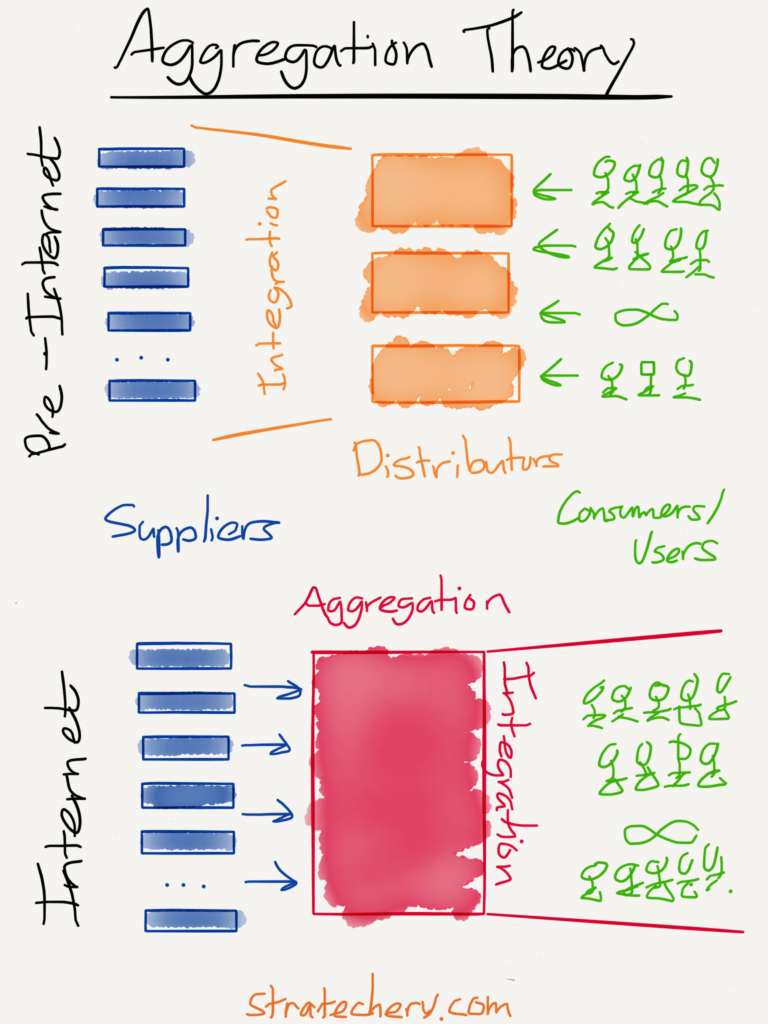
In a nutshell, Aggregation Theory states that:
  • The Internet has made distribution free, neutralizing the advantage that pre-Internet distributors leveraged to integrate with suppliers
  • The Internet has made transaction costs zero, making it viable for a new kind of aggregator to integrate forward with consumers at scale (their advantage will be a superior user experience)
  • Prior supplier/distributor relationships will be modularized, resulting in suppliers selling an increasing portion of their goods/services directly to the new aggregators, effectively resulting in a worldwide two-sided market due to winner-take-all effects (and a significant loss in value for the old distributors)
stratechery Year One - 220
Given this, what we should expect with ebooks is that because the Internet has made book distribution free, publishers should be at a significant disadvantage to an entity (i.e. Amazon) that, thanks to a superior user experience, owns consumer relationships at scale. And, over time, the previously integrated relationship between distributors (publishers) and suppliers (authors) should be broken apart as the latter sell directly through the aggregator (Amazon).
However, that isn’t happening in practice.

Ebook Reality
Yesterday the The New York Times had a fascinating piece about how ebook sales, contra Aggregation Theory, are actually declining even as publishers and book stores are thriving on the back of print:
Five years ago, the book world was seized by collective panic over the uncertain future of print. As readers migrated to new digital devices, ebook sales soared, up 1,260 percent between 2008 and 2010, alarming booksellers that watched consumers use their stores to find titles they would later buy online. Print sales dwindled, bookstores struggled to stay open, and publishers and authors feared that cheaper ebooks would cannibalize their business…
But the digital apocalypse never arrived, or at least not on schedule. While analysts once predicted that ebooks would overtake print by 2015, digital sales have instead slowed sharply. Now, there are signs that some ebook adopters are returning to print, or becoming hybrid readers, who juggle devices and paper. Ebook sales fell by 10 percent in the first five months of this year, according to the Association of American Publishers, which collects data from nearly 1,200 publishers. Digital books accounted last year for around 20 percent of the market, roughly the same as they did a few years ago.
Ebooks’ declining popularity may signal that publishing, while not immune to technological upheaval, will weather the tidal wave of digital technology better than other forms of media, like music and television.
First off, I’m not necessarily surprised that publishers haven’t all gone bankrupt en masse. Much like the music labels publishers have always provided more than distribution, including funding (using a venture capital-like process where one hit pays for a bunch of losers), promotion (discovery is the biggest challenge in a world of abundance, and breaking through is expensive), and expertise (someone needs to do the editing, layout, cover design, etc.). And, as long as there is any print business at all, distribution still matters to a degree given the economics of writing a book: very high fixed costs with minimal marginal costs, which dictates as wide a reach as possible.

Still, none of this explains why ebooks have been stopped in their tracks, and that’s where this discussion gets interesting: not only is it worth thinking about the ebook answer specifically, but also are there broader takeaways that explain what the theory got wrong, and how it can be made better?...MUCH MORE
See also:
"The Artists' Road To Serfdom: The Commoditization Of Creative Content"

The book reader of the future (April, 1935 issue of Everyday Science and Mechanics)


"Oligarchs and Orchestras: Inside Luxembourg’s Secretive Low-Tax ‘Fortress of Art’ Warehouse"

We'll have more on the art/finance nexus tomorrow or Monday, for now a primer.
See also links below for some stuff on the Geneva and Zurich free ports.
From the Wall Street Journal, Sept. 23:

Fraud allegations against Swiss entrepreneur Yves Bouvier have cast a shadow on Luxembourg’s Le Freeport, a high-security, low-tax warehouse for art
SENNINGERBERG, Luxembourg—Last year, David Arendt stood in a reinforced concrete warehouse at Luxembourg’s airport and welcomed wealthy collectors to his “fortress of art,” complete with high security, minimal taxes and discretion. Mr. Arendt warned that it would fill up quickly.

The 237,000-square-foot building, known as Le Freeport, opened its 10-ton doors, joining a global network of impenetrable warehouses where taxes are suspended and art can be stored and sold away from prying eyes.

As the international art market has boomed, so has demand for such discreet storage, particularly for costly art picked up as an investment and never intended for a living room wall. But a year after Luxembourg’s Le Freeport opened at a cost of nearly $60 million, the Monets and Picassos have been slow to arrive.

The reason: the protracted public-relations disaster of Le Freeport’s biggest investor, Swiss entrepreneur Yves Bouvier. Mr. Bouvier was briefly jailed in Monaco earlier this year, after he was accused of selling paintings to Russian billionaire Dmitry Rybolovlev at inflated prices.
On Sept. 14, Mr. Bouvier faced new charges. He was questioned in France by authorities investigating allegations by Catherine Hutin-Blay, the stepdaughter of Pablo Picasso, that works in her collection were pilfered and sold to Mr. Rybolovlev. Mr. Bouvier was freed after posting a €27 million ($30.5 million) bond.

In a statement, Mr. Bouvier denied the allegations in France and said the pieces in question were properly purchased on behalf of his Russian client. Some were meant for the walls of a chalet owned by Mr. Rybolovlev, while others, including the Picasso painting “Espagnole à l’éventail,” were deposited in a freeport in Geneva, he said. In an interview with The Wall Street Journal in Geneva earlier this year, Mr. Bouvier also denied the allegations of defrauding Mr. Rybolovlev.

Mr. Rybolovlev’s attorney said authorities were free to examine works in his collection believed to have been stolen. Mr. Rybolovlev hasn’t been accused of wrongdoing.

The legal issues have amplified the challenges facing Luxembourg’s Le Freeport, which was already contending with a chorus of critics who say the opaque nature of freeports makes them susceptible to illicit activity such as money laundering or harboring stolen goods. Earlier this year, lawmakers in Luxembourg responded to those concerns by bolstering the country’s anti-money-laundering laws to specifically apply to firms operating at Le Freeport—which now have a heightened legal responsibility to know what they are putting into storage and for whom.

Mr. Arendt, Le Freeport’s managing director, said the facility has safeguards to prevent illegal behavior and that he is confident Le Freeport isn’t used for money laundering. He also said the facility can adapt to the legal change—and perhaps even use it as a selling point for “honest art collectors.”

But Mr. Bouvier’s travails have hurt business. “We’re behind on our objectives, as a result of all of this mess,” Mr. Arendt said in an interview in May, as he sat in an empty showroom at Le Freeport. On Wednesday, Mr. Arendt sounded hopeful that the bad publicity had faded. “We’re more or less on track,” he said, though “we’ve had a lot of explaining to do.” Mr. Arendt said Mr. Bouvier has no role in running the freeport.

In the art market, “reputation is pretty much all you have,” said Harco van den Oever, who runs London-based Overstone Art Services.

About 60% of Le Freeport’s storage space has been rented to the firms that deal directly with collectors and store their art at the building, according to Mr. Arendt. The biggest of those firms, FineArt Logistics Natural Le Coultre SA, which accounts for roughly half of that rented space, is Mr. Bouvier’s company, and has so far only filled about 15% of its available square footage.

Freeports are an outgrowth of bonded warehouses, where commodities like grain in transit across borders could be stored, without incurring taxes. There are dozens of such warehouses around the world.

A few, like Le Freeport, are tailored to the needs of high-end art collectors. At Le Freeport in Luxembourg, artwork that remains inside its walls is exempt from value-added tax, which can be as high as 27% in Europe, and from customs duty. Art sales within the building are also tax-free. Art can remain in a freeport for years, through multiple transfers of ownership. Firms offering art-related services like restoration and financing set up shop on the grounds.

The value of the global art market reached a record €51 billion last year, according to a recent report published by the European Fine Art Foundation, the organizer of a major annual European art fair.
Nearly a third of art collectors and professionals surveyed last year by Deloitte Touche Tohmatsu Ltd. said they had used a freeport. Experts speculate that the freeport in Geneva, which traces its roots back to 1854 and is controlled by local authorities, may house the most valuable art collection in the world—although its holdings are generally secret.

Proponents say freeports allow art to be moved around the world without incurring punitive taxes. Critics say the warehouses can invite fraud. “I can’t see any better way for people to launder money than to go through a freeport,” says James Palmer, founder of Mondex Corp., which specializes in recovering art looted from its rightful owners....MORE 
See also, if interested:
"(Sm)art Investing: Rich Move Assets from Banks to Warehouses" ($4 trillion in 'treasure' assets)
"Secretive Swiss vaults may hold missing link in platinum price equation" or Why Didn't the Price Double During the Miners Strike?

and at Alphaville:
Roubini Vs the so-called “art” industry
Art as the sophisticated man’s Bitcoin 
“If it were a museum, some say that it would probably be the best museum in the world” 

Friday's Action: Biotechs Blow Up

As we've noted a couple times in the last two weeks:
Early and late stage bulls must have the financials participating. In the middle speculations and lottery tickets confirm where you're at....
The S&P financial sector ETF, XLF, was up 1.47% on an otherwise weak day.
The iShares Nasdaq Biotechnology ETF, IBB, ended down 4.90%.
The triple-levered Direxion BioBeastie was down 20.53% with the inverse up 20.82%.

From Barron's:

Biotech Bombs, Suffers Worst Weekly Decline Since ’08
A rocky week for the broader stock market has inflicted serious damage to exchange-traded funds that track biotechnology stocks.

The $8 billion iShares Nasdaq Biotechnology ETF (IBB) fell 6.5% recent trading on Friday.
The ETF has fallen each day this week, bringing its total five-day decline to 14% — the biggest weekly drop since Oct. 2008, the height of the financial crisis. Worse: IBB entered “bear market” territory based on closing prices, meaning it’s down more than 20% from its recent high. That last happened during last year’s February-April swoon.

Biotechs including Gilead Sciences (GILD), Amgen (AMGN), Biogen (BIIB) and Regeneron (REGN) have been the market’s growth-stock heroes in recent years. And ETFs that own them, including IBB, have become so popular that they’re basically proxies for overall market momentum.

The First Trust NYSE Arca Biotechnology Index ETF (FBT) was down 6%, while the SPDR S&P Biotech ETF (XBI) slumped 7.9%. Smaller, newer funds including the BioShares Biotechnology Products Fund (BBP) dropped more than 6%.
What’s driving this powerful selling? John McNamara on Deutsche Bank’s equity desk says it’s not clear:
“Biotech and Spec Pharma continue to lead the space lower, with news flow continuing to be relatively muted.”
...MORE

"A report from a future where genetic engineering has sabotaged society."

From Nautil.us:

What If Tinder Showed Your IQ?
The not-so-young parents sat in the office of their socio-genetic consultant, an occupation that emerged in the late 2030s, with at least one practitioner in every affluent fertility clinic. They faced what had become a fairly typical choice: Twelve viable embryos had been created in their latest round of in vitro fertilization. Anxiously, they pored over the scores for the various traits they had received from the clinic. Eight of the 16-cell morulae were fairly easy to eliminate based on the fact they had higher-than-average risks for either cardiovascular problems or schizophrenia, or both. That left four potential babies from which to choose. One was going to be significantly shorter than the parents and his older sibling. Another was a girl, and since this was their second, they wanted a boy to complement their darling Rita, now entering the terrible twos. Besides, this girl had a greater than one-in-four chance of being infertile. Because this was likely to be their last child, due to advancing age, they wanted to maximize the chances they would someday enjoy grandchildren.

That left two male embryos. These embryos scored almost identically on disease risks, height, and body mass index. Where they differed was in the realm of brain development. One scored a predicted IQ of 180 and the other a “mere” 150. A generation earlier, a 150 IQ would have been high enough to assure an economically secure life in a number of occupations. But with the advent of voluntary artificial selection, a score of 150 was only above average. By the mid 2040s, it took a score of 170 or more to insure your little one would grow up to become a knowledge leader.

At the same time, the merger of 23andMe—the largest genetics database in the world—and InterActiveCorp (owner of Tinder and OKCupid), and their subsequent integration with Facebook, meant that not only were embryos being selected for implantation based on their future abilities and deficits, but that people were also screening potential spouses based on genotype. Rather than just screening for non-smokers, why not screen for non-smokers who are genotypically likely to pass that trait onto one’s potential offspring?

But there was a catch. There was always a catch. The science of reprogenetics—self-chosen, self-directed eugenics—had come far over the years, but it still could not escape the reality of evolutionary tradeoffs, such as the increased likelihood of disease when one maximized on a particular trait, ignoring the others. Or the social tradeoffs—the high-risk, high-reward economy for reprogenetic individuals, where a few IQ points could make all the difference between success or failure, or where stretching genetic potential to achieve those cognitive heights might lead to a collapse in non-cognitive skills, such as impulse control or empathy.

Against this backdrop, the embryo predicted to have the higher IQ also had an eight-fold greater chance of being severely myopic to the point of uncorrectable blindness—every parent’s worst nightmare. The fact that the genetic relationship between intelligence and focal length had been known about for decades did not seem to figure in the mania for maximizing IQ.1 Nor the fact that the correlation worked through genes that controlled eye and brain size, leading to some very odd looking, high IQ kids.2 (And, of course, anecdotally, the correlation between glasses and IQ has been the stuff of jokes for as long as ground lenses have existed.)
Parents were lured by slick marketing campaigns that promised educational environments fine-tuned to a child’s particular combination of genotypes.
The early proponents of reprogenetics failed to take into account the basic genetic force of pleiotropy: that the same genes have not one phenotypic effect, but multiple ones. Greater genetic potential for height also meant a higher risk score for cardiovascular disease. Cancer risk and Alzheimer’s probability were inversely proportionate—and not only because if one killed you, you were probably spared the other, but because a good ability to regenerate cells (read: neurons) also meant that one’s cells were more poised to reproduce out of control (read: cancer).3 As generations of poets and painters could have attested, the genome score for creativity was highly correlated with that for major depression.

But nowhere was the correlation among predictive scores more powerful—and perhaps in hindsight none should have been more obvious—than the strong relationship between IQ and Asperger’s risk.4 According to a highly controversial paper from 2038, each additional 10 points over 120 also meant a doubling in the risk of being neurologically atypical. Because the predictive power of genotyping had improved so dramatically, the environmental component to outcomes had withered in a reflexive loop. In the early decades of the 21st century, IQ was, on average, only two-thirds genetic and one-third environmental in origin by young adulthood.5 But measuring the genetic component became a self-fulfilling prophecy. That is, only kids with high IQ genotypes were admitted to the best schools, regardless of their test scores. (It was generally assumed that IQ was measured with much error early in life anyway, so genes were a much better proxy for ultimate, adult cognitive functioning.) This pre-birth tracking meant that environmental inputs—which were of course still necessary—were perfectly predicted by the genetic distribution. This resulted in a heritability of 100 percent for the traits most important to society—namely IQ and (lack of) ADHD, thanks to the need to focus for long periods on intellectually demanding, creative work, as machines were taking care of most other tasks....MUCH MORE
References
1. Cohn, S.J., Cohn, C.M., & Jensen, A.R. Myopia and intelligence: a pleiotropic relationship? Human Genetics 80, 53-58 (1988).
2. Miller, E.M., On the correlation of myopia and intelligence. Genetic, Social, and General Psychology Monographs 118, 361-383 (1992).
3. Driver, J.A., et al. Inverse association between cancer and Alzheimer’s disease: results from the Framingham Heart Study. BMJ 344, e1442 (2012).
4. Hayashi, M., Kato, M., Igarashi, K., & Kashima, H. Superior fluid intelligence in children with Asperger’s disorder. Brain and Cognition 66, 306-310 (2008)....
... 

New York Fed Historical Echoes: "The Woman Who Would Be Bank"

From the Federal Reserve Bank Of New York's Liberty Street Economics blog:
Mary Roebling (1904-94) was the first woman to serve as president of a major U.S.  bank. (She was also the first woman governor of the American Stock Exchange, among numerous other honors.) According to a New York Times obituary, she came into her position through a combination of happenstance and preparation:
LSE_2015_he-woman-roebling-200_art Mrs. Roebling’s own economic power came initially through inheritance, but she increased it vastly once it fell into her hands. She was bequeathed a large block of Trenton Trust stock by her millionaire second husband, Siegfried Roebling, whose family had long been prominent in engineering and cable manufacturing. He was a great-grandson of John A. Roebling, who designed the Brooklyn Bridge, and a grandson of Col. Washington A. Roebling, who completed its construction.

Siegfried Roebling died in 1936, of a heart attack. Mrs. Roebling’s father and father-in-law then urged her to try her hand at running the bank. She had preparation for the job: she had worked for a Philadelphia investment house while taking business courses at night and, the two men told her, she had another important qualification, common sense.

The rest was banking history. She took her husband’s seat on the bank’s board and, on Jan. 21, 1937, was elected president.
LSE_2015_he-woman-roebling-200-b_art Here’s the fun part: she had 200 commemorative mechanical banks made in her image! (See alternate views and moving images of other banks.) That’s right—and the last time we looked, one was selling on eBay for over $1,300 and another on an auction site for over $1,800. Why were these banks made?

According to a 1967 issue of Hobbies Magazine,

...she sets aside certain time to the avocation of collecting mechanical banks and has a deep interest in her collection. Sometime prior to 1963, the 75th anniversary of her bank the Trenton Trust, Mrs. Roebling came up with the idea of creating a mechanical bank to commemorate the occasion. She wanted the bank to have the characteristics of the old cast iron type and be made in the same fashion and material. This required a bit of ingenuity on her part, and to begin with she acquired the services of the well known sculptor, Anthony Greenwood of Philadelphia, Pa. He worked for some six months to develop the original idea and two working models were made. These at a later date completely and mysteriously disappeared. 

It was decided by Mrs. Roebling to make a limited edition of 200 of the banks, each to be numbered. The Grey Iron Casting Company of Mt. Joy, Pa., made the bank from designs by J.E. Brubaker. The Mary Roebling-Trenton Trust mechanical bank was designed to symbolize the free enterprise system upon which our country’s economy thrives—to commemorate 25 years during which Mrs. Roebling has served as President and Chairman of the Board of Trenton Trust—to show the bank’s location, significant in historic times, as well as today, where it is the highest building in Trenton.
According to the descriptive entry for the bank on the artsconnected.org website, here is how this mechanical bank works:

bank building with female figure seated in front in blue dress; lever on back activates woman's arm which “shovels” coins into the side of the building and then a sign saying “Trenton Trust” pops out of the top of the building like toast....
...MORE

Friday, September 25, 2015

Headlines That Comfort When Long

Following up on September 10's "The One Market Sector That Really Matters Right Now (XLF)":
If you had to have only one indicator of where the equity markets are heading, right now this is probably it. For different stages of a bull market there are different indicators that work best.

Early and late stage bulls must have the financials participating. In the middle speculations and lottery tickets confirm where you're at.

Back in the day, you could trust the brokerage stocks to indicate where the broader market was going to be in, say, three months.

That's not so true anymore, the brokers as a group got merged out of existence, but using their devil-spawn, the Citi's and BAML's you have an indicator that ranges from coincident to maybe a two week heads-up.

From FinViz, the one we watch, the S&P Financial Sector ETF, $23.01 up a dime last:


XLF  The Financial Select Sector SPDR Fund daily Stock Chart
And a megabank shall lead them. So if the train and the bus are going to the same place, get on board....
DJIA   16,335
S&P    1952.59
And today's headline?
Dow jumps triple digits as Nike leaps 9%; financials lead
-CNBC
DJIA  16,397
S&P   1948
XLF   $22.84

See also: Once Upon a Time: The Bear Market Fiction.

Russia Increases Natural Gas Deliveries To Europe

So much for the dream of U.S. LNG heading off to, well anywhere. Maybe Chanos is right to short Cheniere.
From the U.S. Energy Information Administration:

Natural Gas Weekly Update  

In the News:
Russian and Norwegian natural gas pipeline exports to Europe increase over the summer amid lower prices
Natural gas pipeline exports to Europe from Russia and Norway, two of its largest suppliers, have steadily increased over the summer as European countries accelerated the refill of storage inventories. European countries have injected a record 1,834 Bcf from April 1 through September 22, amid the lowest natural gas prices since 2009. Combined Russian and Norwegian exports to Europe increased by 8% in the second quarter of 2015 over first quarter levels. This was driven by a 58% increase in exports from Russia over this period, with Russian natural gas pipeline prices at German border averaging $7.35 per Million British Thermal Units (MMBtu), compared to $9.36/MMBtu, on average, in the first three months of this year. Prices declined further to $6.66/MMBtu in August, as oil-linked contractual natural gas prices began to reflect declines in crude oil prices.
Russian natural gas pipeline exports to Europe, 2010-15
The sharp decline in crude oil prices between August 2014 and January 2015 had a significant effect on European natural gas markets, where most natural gas trade is based on long-term contracts linked to crude oil or petroleum product prices, lagged three to nine months. As the North Sea Brent crude oil price declined to $47.76 per barrel in January 2015, a more than 50% decline from August 2014, European buyers began to optimize their oil-indexed contracts by decreasing imports in the winter while drawing heavily on gas in storage in anticipation of lower natural gas prices in the spring and summer 2015.

Going into the winter of 2014-15, Russian exports to Europe were at record low levels, 22% below the five-year (2010-14) average. The exports declined even further to 6.4 billion cubic feet per day (Bcf/d) in January and 5.3 Bcf/d in February, a 36% and 40% decline from the five-year (2010-14) average for these months, according to EIA calculations of data published by the International Energy Agency (IEA).

Since March, Russian exports increased and remained at high levels into the summer. As of July, the most recent monthly data available, Russian exports averaged 11.9 Bcf/d. While Russian exports transiting Ukraine on the Brotherhood pipeline have been decreasing, exports on Nord Stream pipeline into Germany hit record high levels this year, increasing by 55% and 59% in June and July, respectively, compared with the same months last year. The German border price for Russian gas declined by more than 30% in April-August 2015 compared with last year.

Natural gas pipeline exports from Norway increased by 4% in the second quarter of 2015, compared with the same period last year, and averaged 9% higher year-on-year in January-July 2015, according to IEA data. Additional imports from Norway are offsetting declines in imports from the Netherlands. A further government limit on the Netherlands Groningen field production implies a maximum 2015 production of 30 billion cubic meters (Bcm) (1,059 Bcf), a 12.5 Bcm (441 Bcf) reduction from the previous cap announced in 2014.

Storage inventories in Europe have been filling up at a rapid pace over the summer and currently stand at 2,578 Bcf, according to data by Gas Infrastructure Europe. The injections between April 1 and September 22 of 1,834 Bcf have been the highest of the 2010-15 period, surpassing the previous 2013 record of 1,625 Bcf in this period. High export volumes from Russia and Norway are expected to continue in the remaining few weeks of the injection season, supported by lower natural gas prices, both spot and contract, which are expected to be sustained at current levels in the next few months....MORE

Thursday, September 24, 2015

Glencore As the Lehmann of Our Time (or the AIG, maybe the monoline? Northern Rock. yes, Glencore as the Northern Rock)

But I'm never going to be able to repeat headlines like "Northern Rocked, City Shocked" or "Rock Paper Scissored".
Oh well. From ZeroHedge:
One of the more "unmentionable" conspiracy theories surrounding the demise of Lehman Brothers in 2008 is that this "shocking" event was in fact a well-choreographed and carefully scripted "controlled demolition", with the Lehman Bankruptcy - the event that officially unleashed the Great Financial Crisis - getting the express prior permission of both Ben Bernanke and Hank Paulson, a former Goldman employee, whose motive was the elimination of the one firm that was then Goldman's biggest competitor in the FICC space, and whose subsequent bailout of his former employer (Goldman Sachs and all other insolvent banks) would lead to the preservation of trillions in worthless equity courtesy of the biggest taxpayer funded bailout in history, and with billions in excess reserves parked on Goldman's balance sheet smoothing the bank's transition through a historic recession. 
Fast forward to this week when as we reported previously, following a surge in its Credit Default Swaps, the "doomsday" scenario for Glencore is now on the table, because the market suddenly realized that Glencore's most valuable asset, not its mines, or its trading operations, but its investment grade rating, could be stripped away. 
This is what we said, after we noted that GLEN CDS had just hit a multi-year wide of 464bps (precisely as we said it would over a year ago):
We expect this CDS blowout to continue.
What's worse, if the company is downgraded from investment grade to junk, watch as the "commodity Lehman" scenario for Glencore, which much more than a simple copper miner just happens to be one of the world's biggest commodity trading desks, comes full cricle leading to waterfall collateral liquidations and counterparty freeze-outs as suddenly the world is reminded that there is a vast difference between a real and a rehypothecated commodity, and that all collateral rehypothecation chains are only as strong as the weakest counterparty!  
 
Long story short: if and when Glencore loses its Investment Grade rating, it's more or less game over, if not for the company's already mothballed mining operation then certainly for its trading group, where "junking" would lead to numerous collateral shortfalls and margin call waterfalls, reminiscent of the ratings agency downgrade of AIG that culminated with the US bailout of the insurer. 
Therefore we were not surprised earlier today to see Glencore stock crash to a new record low below 100p even as the CDS blow out continued.
We were, however, very surprised by the catalyst, because the company that managed to successfully hammer Glencore, which in our view is nothing short of the commodity "Lehman" (or perhaps AIG) was none other than Goldman, which earlier today released a report which is essentially blueprint for not only how to take away Glencore's precious investment grade rating, but taken a few steps further, how to unleash this cycle's commodity "Lehman event" (once again, Glencore is first and foremost a trading desk which serves as a counterparty with trillions in derivatives notional exposure to virtually every other commodity using and trading entity in the world) and taken to the extreme, how to "force" the Fed to finally unleash the helicopter money should Glencore's failure be the catalyst the pushes the entire world into a deflationary recession, if not outright depression....MUCH MORE

Lessons in Money, Fungibility and P.R.

From Dilbert.com:

Ceo Compensation - Dilbert by Scott Adams

UPDATED--"Yellen: “Will Likely Be Appropriate” to Raise Rates “Sometime Later This Year”"

Update below.
Original post:

From Barron's Income Investing:
U.S. Federal Reserve Chair Janet Yellen said pretty much the same thing Thursday that she said last week after the Federal Open Market Committee voted to leave interest rates unchanged: the committee will probably raise interest rates later this year. 
But she gave a lot more detail Thursday. Here’s the key part of her speech:
Most of my colleagues and I anticipate that it will likely be appropriate to raise the target range for the federal funds rate sometime later this year and to continue boosting short-term rates at a gradual pace thereafter as the labor market improves further and inflation moves back to our 2 percent objective. 
Her 5 p.m. ET speech at the University of Massachusetts is titled, “Inflation Dynamics and Monetary Policy” and is being parsed by strategists almost as closely as the Fed policy statement issued last week. 
There is plenty of hedging in her words, but the bottom line is that the Fed still sees a good chance of liftoff this year, timing the bond market was increasingly questioning as global economic strength wanes....MORE
Update:
Alphaville on the job, note the timestamp (and comment).

"Yellen: surveys of inflation expectations either useful, or not"

"Private companies are overvalued OR public companies are undervalued"

From Mahesh VC:
...The public data is fun to look at so I went ahead and compiled my own index of consumer internet companies across the following categories: Social, Marketplaces, Ecommerce, Digital Media / Gaming, and Travel.  For each, I plotted the 2016 enterprise value / revenue multiple. 
Note: Most of these companies are not valued solely based on a multiple of forward revenue.  This is simply the closest metric used for most private valuation rounds.  Other important metrics take into account growth rates, operating margins and free cash flow characteristics.  I also focused on US companies for the most part.  
Picture2
As you can see, almost no companies achieve higher than a 10x forward revenue multiple save for Facebook.  Even LinkedIn and Twitter only get 5-6x.  Quality marketplaces also tend to get premium multiples with Lending Club and Just-Eat leading the pack around 8x forward revenue.  Most other marketplaces center around the 3-6x range with some stragglers like Angie’s List and Care.com.  Ecommerce companies on the other hand trade completely differently.  Given the lower margins and other challenging business characteristics, ecommerce businesses are worth 0.5x-2.0x forward revenue.  FitBit is doing it’s own thing right now similar to how GoPro behaved post-IPO, though the latter has since come down to more reasonable levels.  The Digital Media / Gaming bucket has a nice variety of various business models and valuations tend to be across the board in the 1.0-6.0x range.  Dominant industry players with monopolistic tendencies seem to get much higher multiples (Google, Activision, EA), and the same is true for travel (Priceline, TripAdvisor)....
...MORE

HT: Abnormal Returns

As Three More New Economy Companies Are Sued For Employee Misclassification, Uber Thinks It Has the Golden Ticket

First up, yesterday's Los Angeles Times:

GrubHub, DoorDash and Caviar face lawsuits over worker misclassification
On--demand food delivery services GrubHub, DoorDash and Caviar were slapped with lawsuits Wednesday alleging that they misclassified their delivery drivers as independent contractors. 
The complaints were filed in San Francisco Superior Court on behalf of the delivery drivers by Boston attorney Shannon Liss-Riordan, who is also representing plaintiffs in similar lawsuits against on-demand transportation companies Uber and Lyft. A federal judge in San Francisco certified the lawsuit against Uber for class action last month. 
The complaints filed against GrubHub and DoorDash are both class actions, while the Caviar complaint is a demand for arbitration on behalf of a San Francisco driver. 
Neither DoorDash nor Caviar immediately responded to requests for comment. A GrubHub spokesperson said the company does not discuss pending litigation. 
According to one of the complaints, GrubHub treated its delivery drivers as employees but failed to provide any of the benefits -- such as expense reimbursements for gas, parking and phone data, meeting minimum wage requirements, and paying drivers for overtime....MORE
Meanwhile Bloomberg doesn't say it but Uber has taken a cue from the securities industry (Shearson v. McMahon, 1987):

Uber’s Plan to Keep Driver Complaints Out of Court
Uber says its drivers should enjoy the freedom that comes with setting their own hours, as long as that freedom ends at the courthouse steps. As its California drivers battle to be treated as employees with benefits—rather than independent contractors—the world’s most valuable startup is arguing they can’t go to trial. According to the contracts most drivers signed, Uber says, disputes have to go through private arbitration. 
The company’s position has taken on greater importance since a Sept. 1 decision by U.S. District Court Judge Edward Chen in San Francisco. Chen granted class-action status to a lawsuit brought by two Uber drivers seeking reclassification as employees. That means thousands more of the company’s 160,000 drivers in California could join the suit. The drivers are seeking reimbursement for expenses and tips, which would open the door to a minimum wage, meal breaks, workers’ compensation, and unionization. On Sept. 15, Uber asked the U.S. Court of Appeals for the Ninth Circuit in San Francisco to take up “the leading case raising urgent questions about the classification of sharing-economy workers” and reverse Chen’s decision. 
In its appeal, Uber continues to argue its drivers aren’t a class because they don’t have set hours or other commitments. It’s also urging the appellate court to overturn Chen’s ruling in a related case last June, which invalidated the arbitration agreements barring drivers from joining class actions. Uber spokeswoman Jessica Santillo declined to comment on arbitration. 
Daily hearing fee for arbitration firm JAMS: $7,000 
The fine print in Uber’s driver contract includes a clause requiring the driver to take disputes to an arbitrator. If the two parties can’t agree on an arbitrator, the mediation service JAMS is supposed to play that part. According to the contract language, Uber and the driver would split the costs of arbitration. JAMS charges a hearing fee of $7,000 per day and a $5,000 retainer fee to start the process. 
JAMS spokeswoman Victoria Walsh says her firm hasn’t handled any cases for Uber. In his June decision, Chen ruled that the arbitration agreements are so unfair they’re unenforceable. On Sept. 21, state Judge Ernest Goldsmith came to the same conclusion in a similar case in San Francisco Superior Court....MORE

My Favorite Things: Eurodollar Futures Curves

I may have been doing this too long.
From Alhambra Investments:

Eurodollar To Fundamental
By most accounts the Asian “dollar” was quiet last night but now the “regular” eurodollar is in full form. That might suggest greater care with these terms as the yen appears to be in that latter mix despite geographically belonging to the former. For purposes of clarification, then, since Japanese banks were among the original sources of the eurodollar buildup (and the second most difficult of the 2007-08 bottlenecks) in my view they belong to the eurodollar whereas Chinese, Hong Kong and those of perhaps newer entrance form the Asian dollar. The fact that one, the seemingly ancient eurodollar, is alive today while the other is not might again suggest fracture though still quite attached.
ABOOK Sept 2015 More Trouble Eurodollar June 18
At the moment, eurodollar futures seem to be most indicative of today’s higher tendency toward liquidation. As noted recently, the eurodollar curve has barely paused lately, especially after the FOMC failed to act for the nth time. The curve has been a shriveling, bearish hump for awhile, but that has seemingly amplified in the past week. The June 2018 eurodollar futures has traded today well above the highest price on August 24.
ABOOK Sept 2015 More Trouble Eurodollar Curve to Sept FOMC
Among the major currency proxies for the “dollar” only the real (nothing new) and yen really stand out. Combined with the eurodollar curve’s trends shown here, and the fact that the Asian dollar is not readily apparent (SHIBOR fixed the same as yesterday, offshore CNH HIBOR was lower O/N and only slightly higher 1W and out), that might suggest more and deeper economic concern rather than raw financial adjustment (though one certainly follows the other). The fact that US stocks and the corporate bubble are aligned with the angry eurodollar seems to further that interpretation....MORE
ABOOK Sept 2015 More Trouble Eurodollar Curve
ABOOK Sept 2015 More Trouble Eurodollar Curve Shriveled Hump

Let the Good Times Roll! Evans-Pritchard Calls The End Of Deflation SuperCycle; Partaaay!

From the Telegraph:

Deflation supercyle is over as world runs out of workers
The demographic 'sweet spot' is vanishing. We are on the cusp of a complete reversal, spelling the end of corporate hegemony
Workers of the world are about to get their revenge. Owners of capital will have to make do with a shrinking slice of the cake. 
The powerful social forces that have flooded the global economy with abundant labour for the past four decades years are reversing suddenly, spelling the end of the deflationary super-cycle and the era of zero interest rates. 
"We are at a sharp inflexion point," says Charles Goodhart, a professor at the London School of Economics and a former top official at the Bank of England.
As cheap labour dries up and savings fall, real interest rates will climb from sub-zero levels back to their historic norm of 2.75pc to 3pc, or even higher. 
The implications are ominous for long-term US Treasuries, Gilts or Bunds. The whole structure of the global bond market is a based on false anthropology.
Prof Goodhart says the coming era of labour scarcity will shift the balance of power from employers to workers, pushing up wages. It will roll back the corrosive inequality that has built up within countries across the globe. 
If he is right, events will soon discredit the sweeping neo-Marxist claims of Thomas Piketty, the best-selling French economist who vaulted to stardom last year. 
Mr Piketty's unlikely bestseller - Capital in the 21st Century - alleged that the return on capital outpaces the growth of the economy over time, leading ineluctably to greater concentrations of wealth in an unfettered market system. "Piketty was wrong," said Prof Goodhart.
What in reality happened is that the twin effects of plummeting birth rates and longer life spans from 1970 onwards led to a demographic "sweet spot", a one-off episode that temporarily distorted labour economics. 
Prof Goodhart and Manoj Pradhan argue in a paper for Morgan Stanley that this was made even sweeter by the collapse of the Soviet Union and China's spectacular entry into the global trading system. 
The working age cohort was 685m in the developed world in 1990. China and eastern Europe added a further 820m, more than doubling the work pool of the globalised market in the blink of an eye. 
"It was the biggest 'positive labour shock' the world has ever seen. It is what led to 25 years of wage stagnation," said Prof Goodhart, speaking at a forum held by Lombard Street Research....MORE
HT: Marginal Revolution

Previously on New Ambrose:
Roubini Dismisses China Scare as False Alarm, Stuns With Optimism

Société Générale's Albert Edwards: We Are Doomed

I swear Albert is looking more deranged in each new picture.
From Business Insider (Aus):

ALBERT EDWARDS WARNS: The next US recession will surprise investors, and a desperate Fed's next move will be unprecedented
Albert Edwards
We have another call for negative interest rates in the US. 
Societe Generale’s Albert Edwards believes that the Federal Reserve should lower its benchmark rate below zero during the next economic downturn. 
Negative rates are a last-resort monetary policy tool that central banks use to crush deflation and encourage consumer spending. 
In a note to clients on Thursday, Edwards wrote (emphasis added), 
“The next US recession will probably arrive a lot sooner than most investors expect and will likely see more desperate monetary experimentation from the Fed. Bob [Janjuah of Nomura] and I thought that this time we would see deeply negative interest rates in the US (and Europe). Sweden has led the way, dipping their toe below the water line with their current -0.35% policy rates but there will be more, much more along these lines. For if -0.35% is possible, why not – 3.5% or less? It goes without saying that deeply negative interest rates would be accompanied by a massively expanded QE4 in the US. The last seven years of exploding central bank balance sheets will seem like Bundesbank monetary austerity compared to what is to come.” 

QE, or quantitative easing, was the name of the Fed’s program involving the purchases of billions of dollars worth of bonds....MORE
Previously:

Société Générale's Albert Edwards Not His Usual Jolly Self

Société Générale's Albert Edwards Is Bearish (and possibly suffering from a mental disorder)
Albert appears to have begun speaking in clichés which is one of the hallmarks of the mental disorder jargonaphasia, more below....
...From the Journal of Neurological Science:
Neologistic jargon aphasia and agraphia in primary progressive aphasia
Société Générale's Albert Edwards On Flirting and Rejection

Music For Albert Edwards. On A Cold Day. In February
And it's raining.
In F flat minor.*


Société Générale's Albert Edwards Descends Into A Nightmare World of Dream Demons and Market Depravity
 

"A Big Bet That China’s Currency Will Devalue Further"

Following up on last week's "IDEAGlobal: China is mulling a 15-20 percent devaluation by 2016".

From the New York Times' DealBook blog:
When Mark L. Hart III, a hedge fund investor based in Texas, makes an investment bet, he does it in the style of his home state: big time. 
Since 2007, his winners have included high-risk, high-return wagers that the United States housing market would collapse and that Greece would go bankrupt. 
But Mr. Hart’s most audacious gamble to date may well be the one he is making on China. He is betting that the mini-devaluation of China’s currency last month was a mere appetizer to a 50 percent currency implosion that he predicts will come when foreign investors pull their money out of China. 
Such an extreme drop in China’s currency, the renminbi, would propel a broader rout in emerging-market currencies — from South Korea to Turkey to Brazil — and result in a sustained global slump as China’s borrowing binge grinds to a halt. 
“Extreme credit growth usually leads to a credit bust,” Mr. Hart said in an interview on Real Vision TV — a new media venture in which sophisticated investors and financial experts offer their insights to fellow practitioners in a Charlie Rose-style format. In the video, which was produced a year ago — well before the recent currency devaluation — Mr. Hart explained how investors pulling their money out of China would lead to a collapse of the renminbi. “It is the story of 1997 and the Asian currency crisis,” he warned. 
A growing number of investors like Mr. Hart have concluded that a dollar that strengthens with the United States economy will have a devastating effect not only on China but on emerging markets in general. Their view is that the trillions of dollars that chased risky investment opportunities in China, Brazil, Turkey and other countries are swiftly exiting and that the pace will pick up when the Federal Reserve eventually raises interest rates. 
The result, they say, will be plunging currencies, corporate defaults and a sustained growth slowdown over the next few years. This week, emerging-market currencies continued their decline, led by Brazil, Turkey, Mexico and South Africa....MORE
For a contrary opinion, September 6:
Roubini Dismisses China Scare as False Alarm, Stuns With Optimism
We seem to have entered a phantasmagorical vortex of shape-shifting market madness. 
Or something....