Showing posts sorted by date for query uber. Sort by relevance Show all posts

Thursday, October 1, 2026

Citadel's Ken Griffin Makes A Big Bet On Miami Tech

 From The Hill, September 30:

Ken Griffin donating $3B to Carnegie Mellon 

Citadel founder and CEO Ken Griffin is donating $3 billion to Carnegie Mellon University, according to an announcement from the institution on Wednesday. 

The donation is the largest individual gift in higher education history and the largest donation ever made by the hedge fund manager. 

“Carnegie Mellon University has made profound contributions to America’s preeminence in science, engineering, technology, and the arts and humanities,” said Griffin. “Since its founding, Carnegie Mellon has fostered remarkable talent, pioneered scientific breakthroughs, and expanded the frontiers of research — shaping global leaders and innovators.” 

One-third of the donation will be invested in Carnegie Mellon’s Pittsburgh campus, and the other $2 billion will go to building a branch campus in Miami.  

The Miami school will be built on 25 acres in the heart of the city with the goal of supporting 3,500 undergraduate, master’s and Ph.D. students. Construction is set to begin next year, with the hope of enrolling its first students in 2028, according to the university. 

“We are deeply grateful to Ken Griffin for his extraordinary vision, partnership and belief in what Carnegie Mellon can achieve,” said Carnegie Mellon President Farnam Jahanian.  

“Throughout our history, CMU has anticipated moments of profound technological change and responded with new ways of thinking and solving problems. Artificial intelligence represents one of the defining intellectual developments of our time, and it demands that we rethink how we educate students, conduct research and partner with others,” he added....

....MUCH MORE 

CMU has sort of a special place on the blog. Well, along with Stanford, CalTech and MIT.

November 2016 - the introduction to "Interview: Manuela Veloso Head of Machine Learning, Carnegie Mellon University":

Our readers probably know Carnegie Mellon more for the  top-ranked financial engineering program (Master of Science in Computational Finance) but artificial intelligence was pretty much invented at CMU by Herbert Simon and Allen Newell. Simon received the Nobel in Economics but it actually could have been for any of four or five subjects, he was quite the polymath.

Newell had to settle for the Turing award (along with Simon) from the Association for Computing Machinery, probably the root'in-tootin high-falootinest tchotchke in the computer biz.
The Association for the Advancement of Artificial Intelligence along with the ACM subsequently named an award in Newell's honor. Ditto for CMU.

The University's machine learning department was the first in the world to offer a doctorate and as far as I know is still the largest.
A department, for one branch of AI.

Carnegie-Mellon used to have a world class robotics Institute but Uber gutted it with a combination of cash and stock options leaving a Dean and a couple robots to rebuild.
One of the robots is said to be in advanced negotiations with the Ube-sters....
Anyhoo....
So You Want To Be A Quant: The Best Schools For Your Financial Engineering Degree
Archaeology: "Previously Unknown Warhol Works Discovered on Floppy Disks from 1985"
You Understand Why Mr. Son and SoftBank Are Circling Uber, Right?
"Uber Is Stealing Scientists, But Only So It Can Lay Off Drivers"
Big Money: Uber Guts Carnegie Mellon Robotics Lab To Hire Autonomous Car Developers
Raising money at a $600 illion zillion fafillion valuation allows you to buy pretty much anything.
The way this is going to pan out is: you won't be able to own the vehicle but its use will be mandated. The car is autonomous but the people aren't....

Saturday, September 26, 2026

Thinking About Berlin's Politics: Return of the City-State, Or: The End of the Nation State May Be Upon Us

Following on With The Victory Of Die Linke (The Left) In Berlin And The Probability Of The City's First Muslim Mayor: "First We Took Manhattan, Then We Took Berlin" earlier today.

The fact that Die Linke not only won the election for the city-state (Stadtstaaten) of Berlin but did so in the face of the rise of AfD really is notable and raises the question: "Whither the Nation-State?"

Some previous looks at this query. First up, the headline post from September 2017:

Because, as mentioned in the introduction to "Trends to Watch: "Can mayors actually rule the world?":

In low-key but very persistent ways technocrats* have been aiming at this target for years and now it seems to be gathering some momentum. Here's a good introduction by Harvard's Diane Davis....
And because there is serious money pushing this idea, it is sometimes challenging to discern whether a piece of writing is reporting or advocacy.
As always, it's your call.
From Aeon:

Return of the city-state
Nation-states came late to history, and there’s plenty of evidence to suggest they won’t make it to the end of the century 

https://upload.wikimedia.org/wikipedia/commons/1/1c/Nuremberg_chronicles_-_Nuremberga.png 
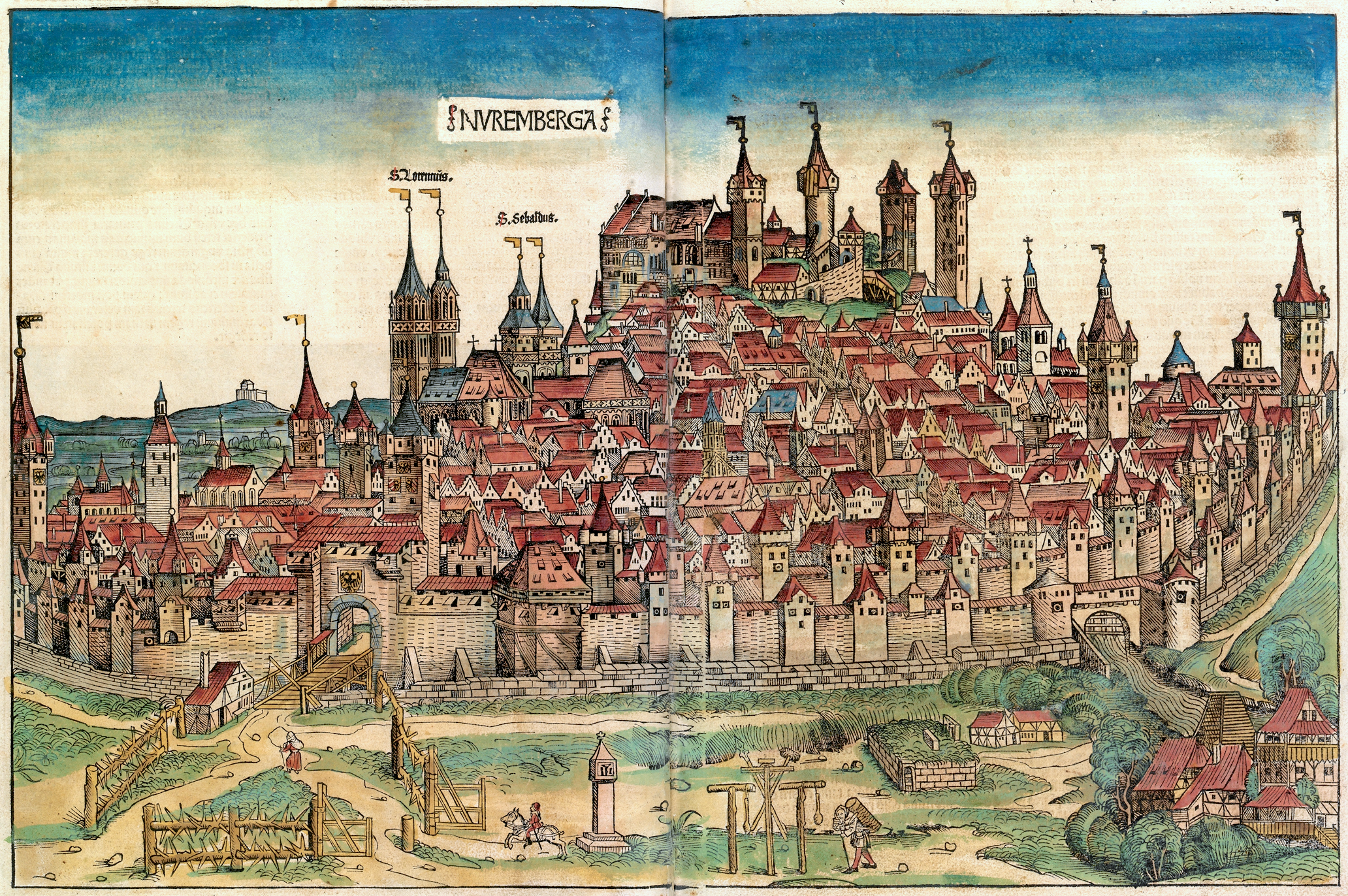
 A woodcut of Nuremberg from the Nuremberg Chronicle 1493
If you’d been born 1,500 years ago in southern Europe, you’d have been convinced that the Roman empire would last forever. It had, after all, been around for 1,000 years. And yet, following a period of economic and military decline, it fell apart. By 476 CE it was gone. To the people living under the mighty empire, these events must have been unthinkable. Just as they must have been for those living through the collapse of the Pharaoh’s rule or Christendom or the Ancien Régime.
We are just as deluded that our model of living in ‘countries’ is inevitable and eternal. Yes, there are dictatorships and democracies, but the whole world is made up of nation-states. This means a blend of ‘nation’ (people with common attributes and characteristics) and ‘state’ (an organised political system with sovereignty over a defined space, with borders agreed by other nation-states). Try to imagine a world without countries – you can’t. Our sense of who we are, our loyalties, our rights and obligations, are bound up in them.

Which is all rather odd, since they’re not really that old. Until the mid-19th century, most of the world was a sprawl of empires, unclaimed land, city-states and principalities, which travellers crossed without checks or passports. As industrialisation made societies more complex, large centralised bureaucracies grew up to manage them. Those governments best able to unify their regions, store records, and coordinate action (especially war) grew more powerful vis-à-vis their neighbours. Revolutions – especially in the United States (1776) and France (1789) – helped to create the idea of a commonly defined ‘national interest’, while improved communications unified language, culture and identity. Imperialistic expansion spread the nation-state model worldwide, and by the middle of the 20th century it was the only game in town. There are now 193 nation-states ruling the world.
But the nation-state with its borders, centralised governments, common people and sovereign authority is increasingly out of step with the world. And as Karl Marx observed, if you change the dominant mode of production that underpins a society, the social and political structure will change too.

The case against the nation-state is hardly new. Twenty years ago, many were prophesising its imminent demise. Globalisation, said the futurists, was chipping away at nation-states’ power to enforce change. Businesses, finance and people could up sticks and leave. The exciting, new internet seemed to herald a borderless, free, identity-less future. And climate change, internet governance and international crime all seemed beyond the nation-state’s abilities. It seemed too small to handle international challenges; and too lumbering to tinker with local problems. Voters were quick to spot all this and stopped bothering to vote, making matters worse. In 1995, two books both titled The End of the Nation State – one by the former French diplomat Jean-Marie Guéhenno, the other by the Japanese organisational theorist Kenichi Ohmae – prophesised that power would head up to multinational bodies such as the European Union or the United Nations, or down to regions and cities.

Reports of its death were greatly exaggerated, and the end-of-the-nation-state theory itself died at the turn of the millennium. But now it’s back, and this time it might be right.

There were only tens of millions of people online in 1995 when the nation-state was last declared dead. In 2015, that number had grown to around 3 billion; by 2020, it will be more than 4 billion. (And more than 20 billion internet-connected devices.) Digital technology doesn’t really like the nation-state. John Perry Barlow’s ‘Declaration of the Independence of Cyberspace’ (1996) sums it up well: the internet is a technology built on libertarian principles. Censorship-free, decentralised and borderless. And now ubiquitous.

This is an enormous pain for the nation-state in all sorts of ways. It’s now possible for the British National Health Service to be targeted by ransomware launched in North Korea, and there are few ways to stop it or bring perpetrators to justice. App technology such as Uber and Deliveroo has helped to produce a sudden surge in the gig economy, which is reckoned to cost the government £3.5 billion a year by 2020-1. There are already millions of people using bitcoin and blockchain technologies, explicitly designed to wrestle control of the money supply from central banks and governments, and their number will continue to grow. It’s also infusing us with new values, ones that are not always national in nature: a growing number of people see themselves as ‘global’ citizens....MUCH MORE

That was followed by a counter-argument in October 2017:

"Why nation-states are good"

...We've been kicking around ideas on how to profit from a devolution of power from larger entities (nation-states) to smaller (city-states) should said devolution occur. So, stealing a way of thinking from Eisenhower, in another context, obvs.:

In preparing for battle I have always found that plans are useless, but planning is indispensable.
 - Dwight D. Eisenhower

And in December 2018:

What Wharton Is Thinking About: "Nation-States Are Failing…Will a New, Feudal Order Replace Them?"

Are nation-states failing?
They are changing, that's for sure. And there are lots of people who would like to shape/reshape the world to whatever image of  how-things-should-be that they happen to prefer.
Who knows how people should organize themselves? Or, be organized? Seriously, who knows. A lot of people act as if they know and push one direction or another but maybe no one knows.

From Knowledge@Wharton....
Finally, in April 2026:
"A Shakeup Is Coming for the Nation-State"
For centuries, holding vast territory has been the basis of state security. Drones and AI are about to make it a vulnerability.  

Some related posts:

February 2017 - Trends to Watch: "Can mayors actually rule the world?"
Local authorities are pushing to fundamentally move away from the longstanding dominance of the nation-state. How can we ensure that this is for the best?....

September 2017 - A Warning On Mayors Ruling The World From A Surprising Source

There is a determined push to decrease the importance of nation-states while elevating the worldwide political power of municipalities and their mayors, a trend I had assumed CityLab backed come hell-or-high-water.
Maybe not.
The writer of this piece, Amy Liu, hangs her hat at Brookings....

October 2017 - Pope Francis Calls For "Rethinking of the figure and the role of the Nation-State..."

November 2017 - "Mayoral Powers in the Age of New Localism"

One of the problems with politics is that the people attracted to power are exactly the ones who should not be allowed anywhere near it.
Go figure.

We've been watching the mission-creep trend in municipal governance for a while now, trying to get in front of it—"Il faut bien que je les suive, puisque je suis leur chef"*—to make a bucko or two but, to date, have only come up with the tautology that these people would rather jet off to Buenos Aires during the Northern Hemisphere winter for the Global Parliament of Mayors** than stay home and fix potholes.
It was ever thus, or at least has been since 1967 when John Lennon noted "4000 holes in Blackburn, Lancashire"

*Ledru-Rollin, 1848—schoolboy French translation: "I must follow them for I am their leader."
**This year the get-together was actually held in Stavanger in late September. Nice 'hood, nice time of year....

April 2019 - "Cities Are Rising in Influence and Power on the Global Stage"

A subject near and dear to our jaded hearts.
It's the manifestation of the age-old thirst for power, to make the world as you want it, and an acknowledgement that fixing potholes is boring....

May 2019 - "Money and trust. Amsterdam moneylenders and the rise of the modern state..."

It has always been about trust.
From the smallest group, immediate family, up through larger and larger populations, clans, tribes etc,  to the nation state, and, some hope, transnational and global agglomerations.
When trust is lost people instinctively pull back to the group or even the individuals they believe they can trust.

The other city-states among Germany's sixteen states are Hamburg and Bremen.

We'll keep an eye on them but for now the action is in what used to be called in the 1920's, red Berlin.  

Friday, August 28, 2026

Deutsche Bank Research: "AI at 70: 14 lessons from a lifetime of boom and bust"

Following on the post immediately below, "Would There Be an AI Revolution If There Were No Nvidia?" (NVDA).

From the Deutsche Bank Research Institute via Beijing's 36Kr-European Central Station, August 18: 

Deutsche Bank sorts out the 70-year development trajectory of AI and sums up 14 historical takeaways. AI is witnessing exponential non-linear growth, and falling costs will spur even greater demand. However, technical routes see frequent iterations, with bottlenecks emerging in hardware and supply chains. While AI has gained rapid popularity among consumers, its commercial application in the enterprise segment is still in the early stage. Current market valuations are nearing historically high levels, and investors need to stay alert to risks brought by technological iteration and supply chain disruptions.

Deutsche Bank's latest research report sorts out the development context of artificial intelligence since its birth in 1956, extracts 14 key insights from historical patterns, and provides a reference for investors to judge the trend of the current AI boom.

This August marks exactly 70 years since the 1956 Dartmouth Summer Research Project on Artificial Intelligence, the birthplace of AI. Adrian Cox, Thematic Strategist at Deutsche Bank Research, points out in the latest report that the 70-year history of AI has been filled with alternating booms and busts, and the current round of investment and valuation frenzy is repeating the paradigm of technological revolutions that have appeared many times in history.

The report argues that "context" is critical to understanding the future direction of AI. From non-linear growth and infrastructure bottlenecks to the expansion and bursting of valuation bubbles, historical signals are clearly identifiable. The report states directly that some people may claim that "this time is different", but the data from the past 70 years provides another frame of reference — for investors betting on the AI track, these insights are directly related to asset allocation logic and risk judgment.

01 Growth is not linear, and is often severely underestimated

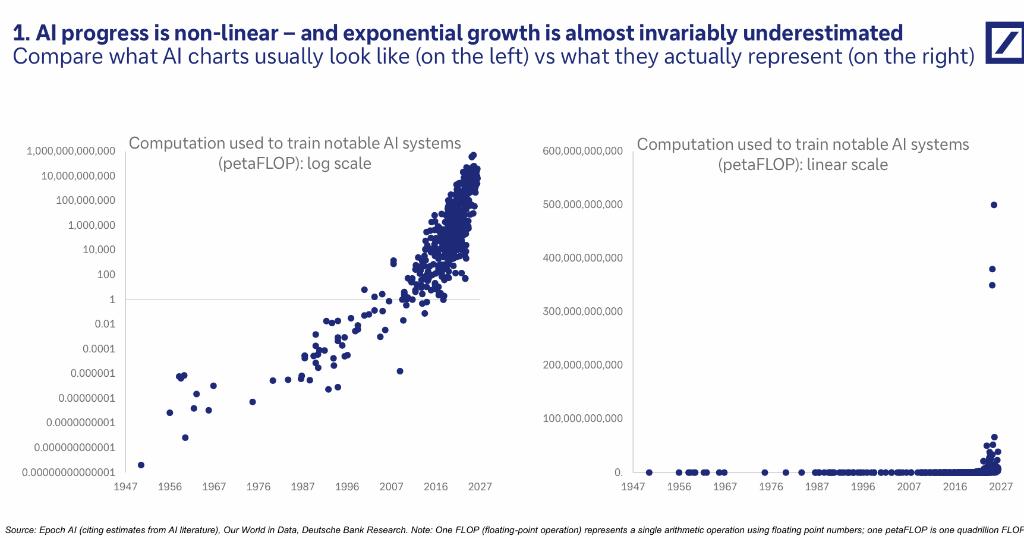
The report highlights the core feature of AI progress at the beginning: non-linearity. Presenting the historical data of training computing power on a logarithmic scale, it can be clearly seen that since 1956, the growth of computing power used to train major AI systems has spanned dozens of orders of magnitude, while the visual presentation of linear charts almost completely obscures this trend. Exponential growth is intuitively very easy to underestimate, which is the first cognitive threshold for understanding the AI wave.

Closely related to this, the progress speed of AI has surpassed Moore's Law. Traditional computing power doubles every 18 to 24 months, but after entering the era of deep learning, the average annual growth rate of computing power has reached about 4 times, far higher than the annual growth rate of about 1.4 times before the deep learning era. The reason lies in the simultaneous improvement of multiple factors such as system scale expansion, memory enhancement, and algorithm optimization, forming a superposition effect.

02 Technical routes continue to iterate, today's leader is not necessarily tomorrow's winner

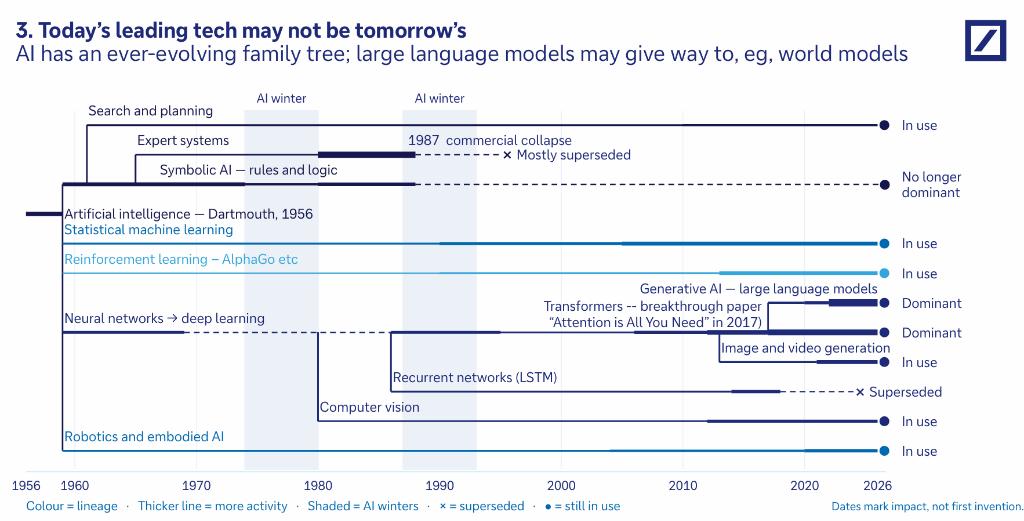
The report presents the 70-year evolution of routes through the AI technology spectrum: from symbolic logic and expert systems to statistical machine learning, deep learning, and then to the currently dominant large language models. Each generation of mainstream technology has gone through a cycle from rise to replacement. Some routes (such as recurrent neural networks) have been surpassed, while others are still evolving in parallel. The report points out that large language models may give way to new paradigms such as "world models" in the future, and the intergenerational replacement of technologies does not depend on the will of current leaders.

Historical changes in market share also confirm this point. Internet Explorer once outperformed Netscape, but was later replaced by Chrome. In the current competitive landscape of generative AI platforms, ChatGPT leads in monthly visits, but Google Gemini, DeepSeek and Claude are all catching up rapidly. Early advantages do not equal long-term moats.

03 R&D accumulation determines the competitive landscape, and the rise of DeepSeek is no accident

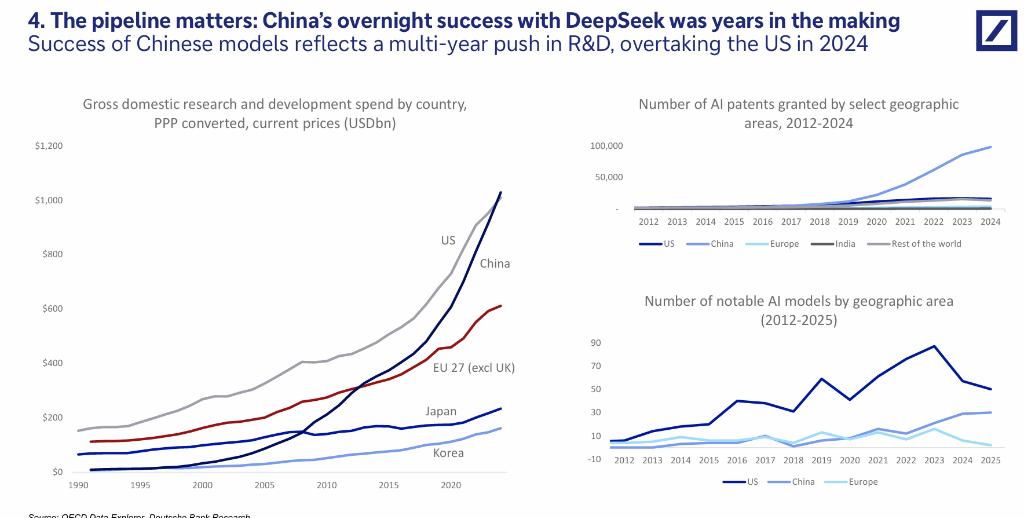
The sudden rise of Chinese AI models, represented by DeepSeek, seems to be "overnight success" on the surface, but it is actually the result of years of R&D investment accumulation. Data shows that China has surpassed the United States in total R&D expenditure in 2024, and its catching-up speed in the number of major AI models is also remarkable. In terms of the number of AI patent grants, China's growth curve is also far ahead of other economies. For investors, this means that changes in the competitive landscape often accumulate at the underlying level for many years before they are visible on the surface.

04 Cost reduction will not compress demand, but will instead expand demand

The report cites the "Jevons Paradox" to illustrate that the sharp drop in the cost of AI use will not lead to a reduction in total expenditure, but will instead stimulate a surge in demand. Since 2006, the cost of GPU computing power has dropped by more than 99%, but according to the forecast of the International Energy Agency (IEA), global data center power consumption will double from 2024 to 2030. Lower marginal cost means more application scenarios and higher total demand....

....MUCH MORE 

Here's the original at DB, 17 page PDF, downloadable.

If interested see also the RAND Corporation's relationship with AI: 

RAND: "Artificial Intelligence and Biotechnology: Risks and Opportunities"

RAND has a very deep history in artificial intelligence. From Jeremy Norman's History of Information:
Newell, Simon & Shaw Develop the First Artificial Intelligence Program

During 1955 and 1956 computer scientist and cognitive psychologist Allen Newell, political scientist, economist and sociologist Herbert A. Simon, and systems programmer John Clifford Shaw, all working at the Rand Corporation in Santa Monica, California, developed the Logic Theorist, the first program deliberately engineered to mimic the problem solving skills of a human being. They decided to write a program that could prove theorems in the propositional calculus like those in Principia Mathematica by Alfred North Whitehead and Bertrand Russell. As Simon later wrote,

"LT was based on the system of Principia mathematica, largely because a copy of that work happened to sit in my bookshelf. There was no intention of making a contribution to symbolic logic, and the system of Principia was sufficiently outmoded by that time as to be inappropriate for that purpose. For us, the important consideration was not the precise task, but its suitability for demonstrating that a computer could discover problem solutions in a complex nonnumerical domain by heuristic search that used humanoid heuristics" (Simon,"Allen Newell: 1927-1992," Annals of the History of Computing 20 [1998] 68).

The collaborators wrote the first version of the program by hand on 3 x 5 inch cards. As Simon recalled....

For a bit more on Mr. Simon here's the introduction to 2016's "Interview: Manuela Veloso Head of Machine Learning, Carnegie Mellon University":

Our readers probably know Carnegie Mellon more for the  top-ranked financial engineering program (Master of Science in Computational Finance) but artificial intelligence was pretty much invented at CMU by Herbert Simon and Allen Newell. Simon received the Nobel in Economics but it actually could have been for any of four or five subjects, he was quite the polymath.

Newell had to settle for the Turing award (along with Simon) from the Association for Computing Machinery, probably the root'in-tootin high-falootinest tchotchke in the computer biz.
The Association for the Advancement of Artificial Intelligence along with the ACM subsequently named an award in Newell's honor. Ditto for CMU.

The University's machine learning department was the first in the world to offer a doctorate and as far as I know is still the largest.
A department, for one branch of AI.

Carnegie-Mellon used to have a world class robotics Institute but Uber gutted it with a combination of cash and stock options leaving a Dean and a couple robots to rebuild.
One of the robots is said to be in advanced negotiations with the Ube-sters.

Tuesday, August 25, 2026

"Anthropic Expected to Tell Investors It Sees Over $30 Trillion in Potential Revenue"

For comparison the IMF is forecasting the world's Gross Domestic Product for 2026 at $126 trillion so ~24% of global GDP or 92.6% of the U.S. GDP forecast for 2026, $32.38 trillion.

Of course those are static measures. Using dynamic scoring Mr. Amodei would tell you AI will triple world GDP so his company's piece of the pie is only around an 8% share. 

An exclusive from the Wall Street Journal, August 25:

The AI startup is likely to top SpaceX’s eye-popping potential revenue estimate

SpaceX’s record-breaking IPO tested the limits of an obscure financial metric. Anthropic’s could push it even further.

The maker of Claude is likely to tell investors its potential revenue opportunities are above $30 trillion, topping SpaceX’s $28.5 trillion estimate, according to people familiar with the matter.

Tech startups or other growing companies going public often estimate their “total addressable markets,” or TAMs, to show investors they have ample room to grow. Such figures estimate the amount of annual revenue a company could theoretically capture if it achieved 100% market-share using inputs ranging from industry data to bankers’ models.

While they have always involved a bit of guesswork, these estimates are especially squishy when it comes to trying to predict how the rapid adoption of artificial intelligence will upend entire industries.

Elon Musk’s rocket maker called its TAM “the largest actionable” market in “human history” when it revealed the figure in a May filing. Most of the figure, $26.5 trillion, was attributed to opportunities in AI.

The number was astronomic compared with those featured in previous IPOs, prompting some skepticism on Wall Street. When Uber went public in 2019, it described its market opportunity as $6 trillion, citing the mileage value of all personal cars and public transportation services globally. WeWork cited a $3 trillion market opportunity in its ultimately abandoned IPO.

New York University’s Aswath Damodaran, a finance known as “the Dean of Valuation” told The Wall Street Journal ahead of SpaceX’s June offering that the TAM the company saw in AI was “reaching the end of what’s plausible and pushing beyond.”

To quantify its TAM, Anthropic is looking at the full scope of work that could be completed with AI models, the people said.

Anthropic more than doubled its revenue to $11.6 billion in the second quarter. To put its more than $30 trillion vision in context, the 191 technology companies in the S&P 1500 brought in $2.4 trillion in revenue last year, according to FactSet....

....MORE 

 Also at the Journal:

Trump Threatens to Rename Lake Ontario as Spat With Canada Escalates

Wednesday, August 19, 2026

"How bookies can outwit smart bettors: A solution to a fundamental problem for market makers..."

A repost from June 2019.
From Chicago Booth Review, June 10:

Sports-betting markets are based entirely on predictions. A bettor has to pick a winning contestant, and a market maker―a bookie―bets on the opponent. The predictions rely on available information about both sides as well as conditions that might affect the outcome. As bookies have to take the other side of every bet, they have to know what they’re doing. But a bookie can be manipulated by a skillful bettor.

Chicago Booth’s John R. Birge, Booth PhD candidate Yifan Feng, Duke’s N. Bora Keskin, and Uber’s Adam Schultz explore the dynamics of how a bookie can keep from being manipulated. Because the sports-betting market shares features with financial markets that rely on spreads―including credit default swaps and options―the implications of the research could apply far beyond the $4.9 billion-a-year Nevada sports-betting industry. The findings may interest sports bettors and hedge-fund managers alike.

The researchers identify a key problem for bookies and financial market makers: they are vulnerable to being bluffed by knowledgeable bettors or bettors with inside information, such as whether a star is able to play. The bets being placed are the bookie’s best source of information—by analyzing betting patterns, a bookie can effectively crowdsource information about the expected outcome of an event. However, a clever bettor might place some phony bets to throw the bookie off. Through the application of a theoretical model, the researchers identify a set of policies, which they call inertial policies, that enable bookies to strike a balance between learning from market participants and bluff proofing their business.

Say you want to place a bet on the Chicago Bulls, a National Basketball Association team. A sports bookie might take the bet on the condition that the Bulls would have to win by, say, six points, or else you lose the bet. If the bookie sets the spread right, you’ll still place the bet, the Bulls can still win, and the bookie can still make money. As the bettor, you can’t be happy with this because a bookie who never gets the spread wrong never loses. This dynamic is also at play in other predictions markets, including options markets, where investors pay a premium for the right to buy or sell stocks or commodities at a certain price, or the CDS market, where investors pay to bet on whether an event such as a corporate bankruptcy will happen.

Birge, Feng, Keskin, and Schultz imagine a bettor who knows more than the bookie, creating an interesting dilemma for both sides. The betting market is a prime source of information for the bookie. If everybody wants to bet on the Bulls, the bookie takes note and factors that into the calculation of the spread. If the bookie notices that particularly smart bettors are bullish on the Bulls, the bookie sets the spread even wider.

If a bettor has perfect knowledge of the statistical distribution of outcomes for the event he’s betting on, and always bets according to this knowledge, he can make no money, the researchers reason, because the bookie will never bet with him on terms that allow him to win.
In the researchers’ model, when a market maker accepts a transaction—whether it’s a sports bet, an options contract, or a CDS contract—she has to estimate the likelihood of being forced to pay out and build in compensation for taking that risk: commission. For the bettor, the payoff can be summarized as betting $1 to win $1 minus the commission. If the bettor loses, he loses only the money he put up. If the bettor wins, the market maker is left with only the commission....MORE

Monday, August 10, 2026

News You Can Use: "Taxi drivers rarely die of Alzheimer’s"

News you can use for a few more years at any rate. 

From The Conversation, August 6:

Taxi drivers rarely die of Alzheimer’s – how complex mental maps and spatial reasoning protect your brain 

Taxi and ambulance drivers are less likely than workers in almost any other job to die of Alzheimer’s disease. That was the surprising result of a 2024 study examining the death certificates of nearly 9 million people in the U.S.

These findings stopped me in my tracks because those two jobs rely on the same thing as my own work: maps.

I have spent more than two decades staring at maps. Not paper maps on a wall, but digital ones with multiple layers: flood boundaries draped over census blocks, car crash hot spots plotted against road geometry, and satellite readings of rainfall stitched across river basins. Much of my work as a civil and environmental engineer is done through GIS – that is, geographic information systems. Engineers like me hold several spatial relationships in their minds at once, reasoning about where things sit relative to one another across scales ranging from a city block to a whole watershed.

I always assumed that spatial reasoning across map layers was purely professional. But that study on taxi and ambulance drivers made me wonder whether all that mental work might be doing something good to the brain.

Taxi driver brains 
Of the 9 million death certificates from January 2020 to December 2022 that researchers examined, taxi and ambulance drivers had the lowest risk of dying from Alzheimer’s disease out of 443 occupations. After adjusting for age, sex, race, ethnicity and education, roughly 1 in 100 taxi and ambulance drivers died of Alzheimer’s, compared with 1 in 60 people overall.

This pattern did not extend to other driving jobs. The researchers concluded that the key to reducing the risk of Alzheimer’s was not driving itself but continuous real-time navigation: the constant work of locating yourself in space, tracking a destination and updating a mental map as conditions change. Drivers whose jobs relied on fixed or predetermined routes, like bus drivers and aircraft pilots, didn’t seem to experience a similar advantage....

....MUCH MORE 

No mention of GPS, curious. 

However! From Bloomberg's CityLab, July 31:

A London Taxi Family Confronts the Driverless Future 

With more than a century of combined experience behind the wheel, the Gouldings now face their greatest challenge yet: Waymo, Wayve and Baidu. 

I wasn’t sure at first whether the taxi driver who arrived for my usual predawn work pickup had also driven me a few days before. The name was different, but Ron looked curiously similar to my driver from last week.

Time and light banter eventually cleared things up. I hadn’t been hallucinating before my caffeine hit — my two recent drivers were identical twins. More interesting still, the twins were the sons of a taxi driver whose own mother kept cabbies fueled with tea, coffee and sandwiches from one of London’s traditional Cabmen’s Shelters. Two other brothers had also followed their father into the trade. Together, they form a remarkable London taxi family.

The black cab business has been good to the Gouldings. It hasn’t made them rich, but it provides a very comfortable living — without a boss to answer to. This proud clan’s heart is David, 70, the family patriarch, who took up the trade 42 years ago to support his young family. With his twin sons Ron and Billy, 44, following in their father’s footsteps — and their younger brothers, David, 40, and Harry, 38, close behind — the Goulding tradition spans more than a century of combined experience behind the wheel.

Like many long-standing traditions, the world in which they operate — London’s taxi trade — keeps confronting new threats. The centuries-old industry has survived wars, the onslaught of Uber, and Covid. Black cabs remain one of London’s defining symbols for many, alongside Buckingham Palace, Sunday roast lunches and Paddington Bear.

But the trade faces perhaps its greatest disruption yet: competition from vehicles with no driver at all. Still in testing mode, autonomous taxis could, pending government approval, offer driverless rides to Londoners by the end of the year. Their arrival could arguably prove a greater shock in the city than elsewhere. London is, after all, home to the world’s most thoroughly trained cabbies, who spend up to four years completing “the Knowledge” — a famously rigorous memorization of the city’s street plan.

The Map in Their Minds

Introduced in 1865, the Knowledge remains one of the world’s toughest professional qualifications. Candidates master the city’s streets through intensive visualization, training so rigorous that studies have shown it can physically reshape the brain. One study even found that London cabbies outperform GPS navigation apps in some respects.

Ron would agree. While he occasionally uses navigation apps to verify obscure addresses, he says GPS often misses taxi-only routes. He recalls winning over one skeptical passenger by ignoring the satnav and taking a faster route using bus lanes which are open to licensed taxis in the UK. The passenger was so impressed that he left a tip and said, “I trust you.”....

....MUCH MORE 

Back in 2015 we were already seeing:

Uber Introduces Its Video Knock-off of "The Knowledge"

A month ago This Is Money was reporting that the number of drivers taking "The Knowledge", the notoriously difficult geographical test required to become a London black-cab driver, had dropped by two thirds as new aspirants hooked up with Uber and GPS rather than the black cabs.

Well now Uber has rolled out a video game version of The Knowledge for its San Francisco drivers, call it "Grand Theft Uber"....

Friday, August 7, 2026

Rentier Regimes: "Capital re-conceptualized as terraforming expropriation of the future."

From New Left Review 159, May–June 2026:

Reviews
Timothy Mitchell, The Alibi of Capital: How We Broke the Earth to Steal the Future on the Promise of a Better Tomorrow
Verso: London and New York 2026
400 pp, 978 1 8367 4227 2

As Joan Robinson once observed, defining ‘capital’ is a painful subject for economists, who commonly ‘set up models in which quantities of “capital” appear, without any indication of what it is supposed to be a quantity of’. Some, however, have offered an answer. For the dominant neoclassical tradition, capital names the assets—tangible or intangible, machine or know-how—that are used to satisfy needs. For an older tradition, adopting the practical language of businesspeople, capital is simply a fund of money put to work by the investor. Yet these static descriptions shed little light on the peculiar dynamism of their object. How is it that this thing, capital, grows through time, generating streams of income for its owners? The responses provided by economists have often confused explanation with apologia. Marx ridiculed the nineteenth-century dogma that profits are a reward for the capitalist’s abstinence in foregoing consumption. A more intuitive account centres the bold actions of the entrepreneur. It is the latter’s innovation—technological or organizational—that secures the superior growth of the capital under their supervision. Thus, ‘without entrepreneurial achievement, no capitalist returns and no capitalist propulsion’, Schumpeter claimed.

In his latest book, The Alibi of Capital, Timothy Mitchell sets out to dismantle this received wisdom. Look at Uber, he suggests in the book’s opening pages. The ride-sharing company had its Initial Public Offering in 2019, achieving a stock market valuation of $82 billion. Did this eye-watering number reflect the frugality of Uber’s owners or the novelty of its technical innovations? No. Uber had been burning through investors’ cash for a decade without ever earning a profit; its app was nothing out of the ordinary; it owned no cars; its foray into self-driving vehicles was a flop. The technologies it did rely on—smartphones, gps, the internet—were developed in part through public funding. 

What Uber’s valuation really represented was the monopoly position that the company was projected to achieve in the years to come. By offering ultra-cheap fares (subsidized by its venture-capitalist backers), manipulating municipal regulations and undermining local public transport systems, the company would drive competitors from the field, after which it could freely prey on drivers and passengers alike. By 2023 the profits had begun to flow, making good on its prior valuation. People and planet are left footing the bill. 

[Climateer here, this is also known as "The Amazon model"]  

Uber’s case is well known, but it hints at a larger phenomenon. ‘Capital is not something saved up from the past’, Mitchell writes, whether machinery, knowledge or finances. Such backward-looking accounts obscure an uglier reality: capital is ‘a capture from the future’. The key is the process of ‘capitalization’, whereby a future income stream—tax revenue, mortgage payments or corporate earnings—is transformed into a present financial asset. When a company goes public, floating its shares on the stock market, it is selling discounted claims on its prospective profits. These profits derive more often than not from ‘an encumbrance imposed on the firm’s future customers and workers and on the communities and ecologies to which they belong’. Instead of competing to offer more and/or better goods and services at lower prices, in Mitchell’s account companies engage in what the father of institutional economics, Thorstein Veblen, called ‘sabotage’: they exclude rivals with the help of political authorities, eschew costly innovations, manufacture scarcity, drive up prices, sell flimsy products and run roughshod over the environment. Present stock market valuations are an index of the capitalized burden inflicted on the future. Competitive innovation, the satisfaction of demand, growth—for Mitchell, these are ‘alibis’ for capital’s true mechanism of time-bending financial predation. But is this all there is to it? Is capitalism’s seeming technological dynamism and expansionary character, noted by its defenders and critics alike, simply a ‘misdirection’?....

....MUCH MORE 

Saturday, July 25, 2026

"Waymo Plans End of Uber Robotaxi Tie-Up, Stepping Up Rivalry"

Waymo is another of the ulti-multi-decacorns. In February they announced the completion of a $16 billion Series D financing round at a $126 billion post-money valuation.

From Bloomberg, July 24:

Alphabet Inc.’s Waymo is exploring options to exit its robotaxi partnership with Uber Technologies Inc., the latest relationship twist between two companies that have functioned as both rivals and partners.

Uber currently offers rides in autonomous Waymo vehicles on its platform exclusively in two US cities — Austin and Atlanta — after ending a more limited partnership in Phoenix last month. An Uber spokesperson said that Waymo has given notice that it plans to launch service through its own app in those cities in January 2028 “alongside their existing deployment with Uber.” This “would end Waymo’s exclusivity in Austin and Atlanta and allow us to launch with other AV providers in those cities, which we will be prepared to do,” the spokesperson added.

The current fleet of Waymo vehicles will remain on Uber’s platform through at least May 2028, the duration of the current contract, Uber said. The Financial Times Waymo explores split with Uber as robotaxi tensions deepen earlier that Waymo was exploring options for exiting the partnership.

“We believe in a vibrant and collaborative AV ecosystem that champions innovation and provides riders with a choice in how they experience this technology,” said a Waymo spokesperson. “This is essential to the industry’s future and to our vision of making the Waymo app and the safety of our technology available to riders everywhere.”

Shares of Uber slid 4.3%, closing Friday at $65.94 in New York, the lowest level in more than a year. Alphabet’s stock was up less than 1%.

The rift is a major setback for Uber, which has been developing partnerships with Waymo and fleet managers, and investing in other robotaxi companies in the hopes that it can one day be the go-to aggregator for driverless and human-operated rides. Waymo, the leading robotaxi provider in the US, also competes with Uber in key rideshare markets such as San Francisco and Los Angeles with its consumer app.

The absence of new developments from Uber and Waymo’s multiyear partnership has helped fuel anxiety about their relationship for months. Since launching the Atlanta service last June, Waymo hasn’t announced new cities where its vehicles will be available on the Uber app. Instead, the Alphabet unit has forged ahead with the standalone Waymo app and has launched in six more cities outside San Francisco and Los Angeles.

With almost every new Waymo announcement without Uber, Uber’s stock has taken a hit on fears that Waymo’s growth will eventually erode the ride-hail company’s business, which reported an annual profit for the first time only in 2023. Even as Uber has announced partnerships with other driverless car companies on planned service in the US, Middle East and Europe, Wall Street has remained unconvinced. The stock has fallen almost 20% so far this year....

....MUCH MORE 

Thursday, July 16, 2026

"Uber reaches deal for $14.8 billion takeover of Delivery Hero" (DHER.DE; UBER)

From the Wall Street Journal via MSN, July 16:

Uber Technologies agreed to acquire Germany’s Delivery Hero in a deal that values the German food-delivery company at $14.8 billion and seeks to strengthen the U.S. tech company’s footprint in international markets.

The San Francisco-based company said Thursday that it entered into a combination agreement with Delivery Hero under which it will offer 41.50 euros a share in cash.

Delivery Hero shares closed at 38.18 euros on Wednesday.

Tuesday, July 14, 2026

And to Our Friends in France

A couple previous Bastille Day posts:

June 14 2020 [commenting on July 14, 2019's disaster]

We'll return to our usual graphic and contemplate whether to memory-hole last year's embarrassment.*

http://jattdisite.com/wp-content/uploads/2015/03/Child-TAke-Flag-On-Bastille-Day.jpg

See you next month!
*July 15, 2019
An Apology To Our French Speaking Friends on the Day After Bastille Day
This is embarrassing.
I mislabeled a painting.
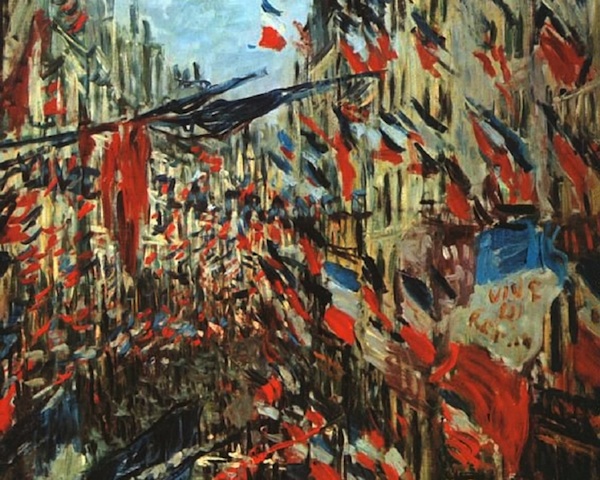
To note yesterday's holiday the blog went with one of Monet's Festival of 30 June 1878 paintings.
The date isn't the problem, I wanted a pic of the tri-color and despite it not representing a Bastille Day scene, thought that with the label folks would understand that we understood.
Ahem.
https://www.theparisreview.org/blog/wp-content/uploads/2013/07/monet_1878large.jpg
Claude Monet, Rue Montorgueil, Paris, Festival of 30 June 1878.

This morning I looked at the painting and wondered why it seemed so dark so I went to the website of the Musée d'Orsay and "ah crap". 
That's the Rue St. Denis, not the Rue Montorgueil and it hangs at the Musée des Beaux-Arts de Rouen. 
It's the fraternal twin of the pic I was going for:

Claude Monet - The Rue Montorgueil in Paris. Celebration of June 30, 1878 - Google Art Project


Which is at the Musée d'Orsay.
Someone should let the The Paris Review know as well.
However, the fact they got it wrong doesn't matter, we are responsible for our little corner of the internet.
The Musée d'Orsay adds insult to injury by starting their description with:
The Rue Montorgueil, like its twin painting The Rue Saint-Denis (Rouen, musée des Beaux-arts), is often thought to depict a 14 July celebration. In fact it was painted on 30 June 1878 for a festival declared that year by the government celebrating "peace and work". This was one of the events organised for the third Universal Exhibition in Paris a few weeks after it opened, and intended to be a symbol of France’s recovery after the defeat of 1870. As well as demonstrating nationalist enthusiasm, the celebrations of 30 June 1878 were also an opportunity to strengthen the position of the Republican regime, still fragile only a few months after the major confrontations of 1876-1877 between its supporters and the conservatives. It was only two years later, in 1880, that 14 July was designated the French National Day.....

Non! We knew it wasn't 14 July, it's that we messed up the darn paintings.
Easier to go with the little girl and her tri-color.
back in a month. 

And July 14, 2025: 

"France to quicken defense-spending boost in bid to be ‘feared’"

Umlauts. Fräncë needs umlauts if they truly intend to inspire dread wherever they turn their Gallic gaze.*

From DefenseNews, Bastille Day, 2025:

https://www.defensenews.com/resizer/v2/G45RJDXVIRGTHAU4CPIN2UXD2M.jpg?auth=eafd835eed2933c7e4a627e2544dd9ad2edc8793b88276c2c87c28511949ff08&width=1024&height=682 

French military vehicles stand in formation for the annual Bastille Day military parade on the 
Champs-Elysees Avenue with the Arc de Triomphe in the background in Paris on July 14, 2025. 

France will accelerate a hike in defense spending to reach €64 billion (US$75 billion) in 2027, three years earlier than planned, President Emmanuel Macron told troops and military brass ahead of Bastille Day celebrations on July 14.

In the face of the greatest threat to freedom since 1945, France needs to step up, the president said in his traditional speech at the Armed Forces Ministry in Paris the evening before the national holiday. Macron said Europe must be ready to face a permanent Russian threat on its borders, from the Caucasus to the Arctic....


...MUCH MORE
*
From January 2014's "After Car Attacked By Paris Taxi Drivers, Uber to Toughen Image With Umlauts ": 

In a move designed to make Uber seem more "bad-assed and scary in a quasi-heavy-metal manner," the Goldman Sachs, Menlo Ventures and Bezos Expeditions-backed company officially changed it's name to Über on  Monday.
"Much like Mötley Crüe and Motörhead, Über is not to be messed with," said founder Gärrëtt Cämp, né Camp...

"Ödërïnt, düm mëtüänt" (Let them hate so long as they fear)  

Friday, July 10, 2026

Amazon Has A Secret ‘Moonraker’ Project (AMZN)

 In association with Hugo Drax Productions.

From Business Insider, July 8:

Amazon documents reveal a costly new Alexa AI project 

Amazon's next Alexa AI upgrade may be able to handle more complex tasks. Getting there is expensive, though.

Internal planning documents reviewed by Business Insider show Amazon is working on a previously unreported Alexa project, codenamed Moonraker, to handle more complex, multistep tasks for users.

Moonraker pushes Alexa into the AI agent race. Alexa+, its AI-powered assistant, already lets users book rides or buy tickets through partners such as Uber and Ticketmaster. Moonraker would take that a step further by completing multiple actions from a single request.

The project also highlights the steep cost of building more capable AI. Internal documents show Moonraker quickly became one of the most expensive parts of Amazon's latest Alexa+ overhaul....

....MUCH MORE 

See what happens when Big Retail, founded by a guy with a side-gig rocket company, gets creative control of the Bond franchise?

No word on whether the ethereal spirit of Roger Moore has been attached to the project. 

All of which brings to mind the outro from a 2023 post, Renewable Fuel: "Wood Pellet Giant Enviva Discloses a Financial Crisis": 

....*Drax is the largest power plant in Britain at just under 4 megawatts capacity and has been converted from coal to biomass-and-coal to biomass base load with natural gas peakers. 

*Don't get me started on Admiral Sir Reginald Aylmer Ranfurly Plunkett-Ernle-Erle-Drax, KCB, DSO, JP, DL and the whole Drax clan, we could be here all night.

Not to mention Moonraker, James Bond and one Hugo Drax:

Nationality American 
Occupation  Criminal mastermind 
Affiliation Independent 
Status Deceased; shot by a poison dart and blasted into space by James Bond

Thursday, June 25, 2026

Pelosi Group Reveals Latest Option Plays On...

The former Speaker of the House is hands down one of the premier traders of our time.

From Benzinga, June 24: 

Benzinga’s Government Trades page tracks Pelosi’s newly disclosed stock transactions — her first trades in five months.

Purchases include:

  • May 29, 2026: 200 call options with a strike price of $50 and expiration date of March 19, 2027 in Intel Corp INTC
  • May 29, 2026: 200 call options with a strike price of $50 and expiration date of March 19, 2027, in Uber Technologies UBER

The Intel trade is listed with a dollar value between $1 million and $5 million. The Uber trade has a dollar value of $500,000 to $1 million.

These mark the first trades disclosed by Pelosi since January 2026.

The option purchases follow a trading strategy often used by Mr. Pelosi that involves buying options dated months into the future and at a strike price already in the money, or below where shares are currently trading.

Intel stock is one of the top gainers in 2026 among large-cap stocks. Its shares are up 237.9% year-to-date as of this writing....

....MUCH MORE 

When the she-wolf of Wall Street awakens after a five-month slumber it is worth remarking upon. 

At MoneyWise, November 9, 2025:

Nancy Pelosi posted up a staggering 16,930% return on her investments, beat the market by 581%: Here are her 5 biggest wins and what you can learn

Conservative commentator Scott Jennings recently joked on X that “President Trump should hire Nancy Pelosi in retirement to manage Americans' stock market portfolios. She beat the S&P 500 by 559%. We could all be retired in 6 months!” (1) The sarcasm aside, Jennings had no idea that the numbers Pelosi leaves behind heading into retirement tell a startling truth.

A New York Post analysis revealed that before first taking office in 1987, Pelosi and her husband reported between $610,000 and $785,000 in stocks in their portfolio — worth $133.7 million today, according to the latest estimates from Quiver Quantitative (2).

That means that Nancy Pelosi made a 16,930% return, blasting past 2,300% for the Dow Jones over the same period of 37 years.

The New York Post reported that they netted a 14.5% average annual return, crushing the S&P 500, NASDAQ and Dow Jones performances over those years, around 7% to 9%.

Over the past decade alone, Pelosi's portfolio has generated an estimated 838% cumulative return, beating the S&P 500's 256% return by 581% at time of writing. In 2024, her portfolio jumped 70.9% compared to the S&P 500's 24.9% gain. Pelosi's personal net worth has skyrocketed to over $278 million according to Quiver Quant data (3).

These aren't actually Nancy Pelosi's trades directly — her husband Paul Pelosi, a venture capitalist, handles investments for the Pelosi family....

....MUCH MORE 

Sunday, June 21, 2026

"The Tight Family Trust That Reigns Over The New York Times"

The writer doesn't much care for dual-class/super-voting shares. He's not alone.

From Richard Pollock's The World in Crisis substack, May 19: 

How a Family Trust Insulates The Times From Public Accountability 

A great deal already has been written about the dishonest Nicholas Kristof New York Times column which alleges Israeli atrocities against Palestinian prisoners.

But behind this latest case of deceitful Times coverage is the fact that from its inception, the ownership of the company has been controlled by a family trust, deliberately designed to be insulated from any public accountability.

The dirty little secret is that the “New York Times Company” has two classes of stock: Class A and Class B.

Class B was created in the 19th century by founder Adolph Ochs-Sulzberger. Class B shares are solely controlled by an iron-clad family trust. This structure was intentionally designed to protect the Ochs-Sulzberger family power as it published the paper as it saw fit, and eliminated any potential interference from its public stockholders, known as Class A.

If you go to AI, it observes, “The Ochs-Sulzberger trust is a powerful family trust that controls the majority of the Class B voting stock of The New York Times Company. Established to maintain independent, family-led stewardship, it effectively prevents hostile takeovers and keeps editorial and corporate control in the hands of the descendants of Adolph S. Ochs.”

AI adds, “It ensures that power and financial stakes are passed down to the succeeding generations of the Ochs-Sulzberger clan.”

Presently, 70% of the Times board is chosen by the family. Thirty percent of the board is decided by stockholders.

The author Susan E. Tifft and Alex S. Jones exposed this primitive form of family control in their scathing,1999 book on the Sulzberger empire titled, The Trust: The Private and Powerful Family Behind the New York Times.

They wrote, “The New York Times is uniquely insulated when it comes to its own newsroom. This structure was intentionally designed by the founding Ochs-Sulzberger family to protect the newsroom from corporate takeovers or activist investors.”

Tifft and Jones were given full access to the Sulzberger family and to the Times archives.

They describe many of the Times’ most fatal reporting errors.

According to Christopher Ogden in a New York Times book review of the Tifft-Jones book, during World War I the paper demurred on unconditional German surrender. “Ochs’ failure to press editorially for an unconditional German surrender…prompted criticism that the paper was treasonous.”

Later, during World War II, the Times continually downplayed the consequences of the Holocaust on the Jews. And when the Times.published a front-page story on the liberation of the Nazi concentration camp of Dachau, it never mentioned the word Jew, according to Tifft-Jones.

Adolph Ochs, the founder, ”toiled to ensure that The Times never earned the moniker ‘too Jewish,’ according to Anna Baldwin in a review of the Tifft-Jones book.

“Ochs assiduously declined to promote Jewish editors,” according to Baldwin.

After Adolph, Arthur Hays Sulzberger led the paper from 1935 to 1961. He was a reform Jew. Sulzberger was an enthusiastic supporter of the American Council for Judaism, founded in June 1942 to oppose Zionism. It was Hays who ignored the Holocaust and the plight of the Jews.

In a 2001 article for the Times, former Executive Editor Max Frankel wrote that Arthur Hays Sulzberger downplayed the Holocaust. The editorial page “was cool to all measures that might have singled [Jews] out for rescue or even special attention.”

Here is the line of descendants:

Arthur Gregg (A.G) Sulzberger is the current Chairman of the New York Times Company. He is the fifth-generation descendant of the Ochs-Sulzberger clan to serve as chairman.

Arthur Ochs Sulzberger, Jr., (known as Punch, Jr.), A.G.’s father, was publisher of the company from 1992 to 2017. He was chairman from 1997 to 2020. He currently is Chairman Emeritus. Punch, Jr. reportedly was raised in his mother’s Episcopalian faith and later stopped practicing religion, according to the Times of Israel.

Punch, Jr.’s grandfather, Arthur Ochs Sulzberger, Sr. (known as “Punch, Sr.) was publisher of the Times from 1963 to 1992. When Punch Sr. stepped aside as chairman, he was “ceding the crown of the multibillion-dollar public company to his son, Arthur Sulzberger Jr., in an exercise of divine right that Arthur of Camelot would have appreciated,” according to Christopher Ogden in his review of the Tifft-Jones book for the New York Times.

Gabriel Sherman, wrote in New York Magazine as the 2015 succession fight emerged among three family members. He then counted six family members in top positions at the Times: “A total of six fifth-generation cousins currently hold positions at the Times.”....

....MUCH MORE 

We've looked at the issue from a few different angles.

In 2011 "Mispricing of Dual-Class Shares: Profit Opportunities, Arbitrage, and Trading". 

In the 20-teens we saw "Zeitgeist: "Zuckerberg’s control over Facebook ‘akin to a dictatorship,’ says California pension fund" (FB)". 

And "Why Uber Won’t Fire Its CEO" 

In 2009 it was "The Berkshire Hathaway Arbitrage (BRK.A: BRK.B)" 

A good overview was "Perpetual Dual-Class Stock: The Case Against Corporate Royalty"
The author is a commissioner on the SEC and a recovering academic.
(enough footnotes to make Matt Levine envious)
Another: "The Untenable Case for Perpetual Dual-Class Stock"
From The Harvard Law School Forum on Corporate Governance and Financial Regulation: 
 
So it goes. 
(no word on Vonnegut's thinking re: super-voting shares) 

And nota bene: if you think you've found an arbitrage rather than a pair trade, check whether "A" is good delivery for "B" and vice-versa, if you prefer your vice-versa.

Our out-the-door flashback from 2017:

Zuckerberg says he has no plans to run for president: report (FB)
Mr. Zuckerberg still has to resolve the shareholder lawsuit on his "Ya got it, ya sell it, ya still got it"*  controlling shareholder plan, now, after discovery, with more Andreessen.

Then he's going on his 50-state "meeting people in small towns-2017 tour".
Then he has to talk with President Obama's campaign wizard David Plouffe about whether David is happy in his brand-new perch at the Chan-Zuckerberg Initiative.

Then he...
Hell who knows, 2020 seems a long way off and right around the corner at the same time....

*I think the "...Got it, sell it, still got it" formulation is the punchline to "Why do Goldman bond salesmen envy hookers" or something, now used as voting control strategy in the Valley, see for example GOOG-GOOGL-GOOGLIEST (class B for Larry and Sergei with 10x votes). 

Monday, May 18, 2026

Recursive Artificial Intelligence: The Coming Acceleration (plus Recursive, the company, raises $650 million)

 From the American Enterprise Institute, March 19:

When I wrote about recursive artificial intelligence last September, I described an innovation still in its early stages, powerful in concept, but not fully realized in practice. Six months on, AI has made meaningful strides toward true recursivity. The acceleration has, well, accelerated.

A quick refresher: recursive AI refers to systems that can improve themselves, testing their own outputs, identifying weaknesses, and generating better versions without waiting for human researchers to do the work. The concern was twofold: The systems would be powerful and so fast that communities, individuals, and workers would have little time to adapt.

Here is what has changed since then.

A brief digression into the history of theoretical mathematics helps illustrate how recursive AI is developing in real time. In 1969, Volker Strassen discovered a faster algorithm for matrix multiplication, the core computational operation underlying modern AI systems. His insight reduced the arithmetic steps required: Seven scalar multiplications instead of eight at each recursive step, a seemingly small gain that compounds across billions of calculations. The practical record set by that work went essentially unchallenged for 56 years.

Google DeepMind’s AlphaEvolve, announced in May 2025, finally surpassed it. Rather than relying on flashes of insight from human researchers, AlphaEvolve uses automated evaluators that generate and test thousands of candidate solutions, selecting the best and iteratively improving them. The result: a new algorithm for multiplying 4×4 complex-valued matrices using 48 scalar multiplications, one fewer than Strassen’s long-standing benchmark of 49. That single-digit improvement had eluded mathematicians for more than half a century.

The mechanism AlphaEvolve uses is a more powerful version of something now available to anyone working with AI-assisted code. I recently started using a similar approach in my own workflow automation, and the only word for it is “magical.” You provide the AI with existing code and instruct it to fix and verify the result. The system iterates until it has a working product. This is AlphaEvolve in miniature.

So what happens when the frontier AI labs start applying these self-guided recursive systems to their own research and engineering work? METR, which monitors progress in advanced AI models, has been tracking the answer. Its original March 2025 study found that the duration of tasks AI agents can complete autonomously has roughly doubled every seven months over the prior 6 years.

More recent data suggests that the pace has accelerated: in 2024 and 2025, the doubling time shortened to approximately four months. By late 2025, the most capable models were reliably completing tasks complex enough to require five hours of skilled professional work. This isn’t a speed question but a measure of the difficulty of challenges AI is able to take on. As a consequence, the time between major improvements in model performance is shrinking....

....MORE 

And May 13 we see, via India's Office Chai:

Recursive Raises $650 Million At $4.65 Billion Valuation To Create Self-Improving AI

Brand-new startups are continuing to raise massive rounds to work on new niches of AI.

Recursive, a stealth-mode AI lab, has emerged from the shadows with one an audacious pitch: build an AI that improves itself — endlessly, and without human intervention. To back that bet, the company has raised $650 million at a $4.65 billion valuation in a round led by GV (Google Ventures) and Greycroft, with participation from AMD Ventures and NVIDIA.

The round is part of a broader surge in mega AI funding that has defined the past two years, as investors pour capital into teams chasing the next frontier of intelligence — beyond scaling laws, beyond human-in-the-loop development.

The Founding Team

Recursive was founded by former team leaders from OpenAI, Google DeepMind, Meta AI, Salesforce AI, and Uber AI. Richard Socher, one of the most-cited researchers in AI history, anchors the founding team. He previously served as Chief Scientist and EVP at Salesforce, where he built and led the company’s entire AI research and product stack. Before Salesforce, he founded MetaMind, which Salesforce acquired. He is widely credited with bringing deep learning into natural language processing and pioneering word vector representations that underpinned today’s large language models.

Tim Rocktäschel, co-founder and research lead, is a professor of AI at University College London and former Director and Principal Scientist at Google DeepMind, where he ran the Open-Endedness research group. His team won the ICML 2024 Best Paper Award for Genie, an interactive world model capable of generating playable environments from a single image.

The co-founders are joined by former OpenAI researchers Jeff Clune, Josh Tobin, and Tim Shi. Clune is a pioneer in evolutionary algorithms and open-ended AI systems; his Darwin Gödel Machine work at Sakana AI demonstrated that AI agents could autonomously rewrite their own code to improve benchmark performance. Tobin built OpenAI’s robotics capabilities and later co-founded Gantry, an ML monitoring startup.

In total, Recursive has over 25 people and is growing fast. The team includes researchers in open-ended algorithms, quality diversity algorithms, AI-generating algorithms, self-improving coding agents, automated red teaming, prompt engineering, world models, vision transformers, and retrieval-augmented generation.

What Makes Recursive Different

Most AI labs today are racing to build bigger, better foundation models — and that race requires armies of human researchers to design experiments, curate data, run evaluations, and decide what to work on next. Recursive’s thesis is that this human bottleneck is the real speed limit on AI progress.

The company’s approach draws a direct parallel to evolution: just as Darwinian processes produced intelligence through an open-ended archive of interestingly different discoveries — building from replicating molecules to sight, language, and science — Recursive wants to replicate this dynamic in software. The system would grow its own archive of innovations, with each discovery enabling the next, in a loop that has no ceiling.

Socher has called this the “third and perhaps final stage of neural networks” — a system that automates evaluation, data selection, training, post-training, and even research direction itself. Where existing labs like OpenAI, Anthropic, and Google DeepMind have explored aspects of automated research, none has organized an entire company around recursive self-improvement as its core commercial thesis....

....MUCH MORE  

If interested see also:

January 28 -  So it Begins: "Silicon Valley Wants to Build A.I. That Can Improve A.I. on Its Own"

The headline at TechCrunch was "AI chip startup Ricursive hits $4B valuation two months after launch" 

Serious money believes these women are on to something. 

May 12 - "AI Is Starting to Build Better AI"

Not there yet but some very smart people think it's close.