Showing posts sorted by date for query rare earth. Sort by relevance Show all posts

Sunday, November 1, 2026

AI: "The Race We’re Actually Running, Part 2: Good Enough at a Fraction of the Price"

Avoiding the question: 

Will the incoming Congress use their antipathy to Elon Musk and the AI build-out to cripple the AI expansion, remove the only sector propping up the economy, plunge the nation, and thus the world unto a depression, neuter any tech advantage America possesses, hand the emerging future to China and force the U.S. to follow the last-ditch German economic plan, betting everything on re-armament before the final war to end all wars?

That question. 

From the High Performance Computing geeks at HPCwire, October 30:

What the AI race is a contest over, and why the cheapest capable model may win

In part 1 of this series, I looked at where the US and China stand after two decades of investment. This installment asks the question the public debate tends to skip: when people say “winning the AI race,” what does winning mean?

There Is No Single Finish Line
The AI race gets described as though there were one finish line: one model, one moment when someone crosses first and the outcome is settled. The United States and China are not running toward the same point. If China is racing toward nine o’clock and the US toward two o’clock, both can run as fast as they possibly can and still not compete for the same prize. The useful question is what each side is trying to get, and what happens to the rest of the world once they get it. 

Five Things Being Contested
Frontier model capability. This is the headline contest: which model scores highest on the hardest benchmarks. The US leads, narrowly. Stanford’s 2026 AI Index put the gap between the leading US and Chinese models on the Arena leaderboard at about 2.7% as of March. In mid-October, the Artificial Analysis Intelligence Index scored the best closed model at 58 and the best openly downloadable model at 46. The pattern is consistent: close on conversation, wider on hard reasoning and long autonomous tasks.

Chip manufacturing. The US holds a wide and, for now, structural lead: advanced chip fabrication sits in a small number of facilities the US and its allies control. Part of that lead is policy. The Institute for Progress estimates that with no H200 exports, the US would hold a 21 to 49 times advantage in AI compute produced in 2026, and that unrestricted exports of Nvidia‘s H200 could cut it to roughly 1.2 to 6.7 times. Commerce approved about 10 Chinese buyers in May, but Reuters reported no deliveries as Beijing steered its companies toward Huawei. That substitution is not one for one. Huawei’s Ascend 910C trails the H200 in computing power and memory bandwidth, and Epoch AI estimates Huawei’s 2026 output at about 880,000 H100-equivalents against about 23 million for Nvidia, under 4%. The tightest constraint is high-bandwidth memory, which China cannot yet make in volume. Huawei is pushing anyway. In September it pulled its Ascend 960DT forward to early 2027, a chip Bernstein estimates will roughly match the H200 with more than twice its interconnect bandwidth, and said a 256,000-card cluster is being deployed. How large the US lead stays depends on Washington’s export decisions and China’s memory production as much as on chip design.

Research volume and open-source distribution. China leads here, and this may be the contest that decides what the rest of the world runs on. Chinese models accounted for about 41% of downloads on Hugging Face over the past year, ahead of US models, and the summer brought a run of Chinese releases: Moonshot‘s Kimi K3, Alibaba‘s Qwen3.8, DeepSeek V4.1-Flash, and models from Z.ai and Xiaomi. In October, Anthropic reported that Z.ai’s open-weight GLM-5.3 came close to its restricted Mythos Preview model on cyber-exploit tests, while NIST’s Center for AI Standards and Innovation put it about four months behind the US frontier. DeepSeek and Huawei have also released open tools for programming Huawei’s chips, aimed at reducing dependence on Nvidia’s CUDA software.

A note on terms. An open-weight model publishes its trained parameters, called weights, so anyone can download it, run it on their own hardware, and modify it. Many people call these open-source models, though the training data and code usually stay private. A closed model, such as those from OpenAI, Anthropic, and Google, can only be used through the company’s own service.

The trade between the two is simple. Closed models are more capable, and open models are much cheaper. DeepSeek’s open-weight V4-Pro costs $0.66 per million input tokens and $1.98 per million output tokens off-peak (a token is about three-quarters of a word), against $5 and $25 for Anthropic’s Claude Opus 4.7 and $5 and $30 for OpenAI’s GPT-5.5. That makes DeepSeek roughly 8 to 15 times cheaper. On SWE-bench Verified, a widely used test of fixing real software bugs, Opus 4.7 solves 87.6% of the problems; DeepSeek reports 80.6%, and an independent US government evaluation measured 74%. Put simply, the open model solves fewer of the hardest problems for about a tenth of the price.

Open models also reach what the best closed models could do only recently. Epoch AI puts the lag at about four months. So a buyer can pay a premium for the top of the range now, or give up some capability on the hardest tasks at a fraction of the cost and expect open models to reach today’s frontier within months. Many will take that trade for customer service, document processing, and routine coding, where the cheaper model already does the job. Open models are not only a Chinese story, either: hosting companies offer OpenAI’s open-weight gpt-oss-120b for well under a dollar per million tokens.

Capital. Stanford’s AI Index puts US AI investment in 2025 at about $286 billion against about $12 billion for China, roughly 23 times. China answers with state capital. Bloomberg reported in June that Beijing has drafted a five-year, roughly $295 billion plan for a national AI data-center grid, funded by state bonds, requiring at least 80%domestic technology and interconnected by 2028. That is about $59 billion a year, less than any one of the largest US cloud companies spends: Oracle, Microsoft, Amazon, Meta, and Alphabet together are expected to spend about $800 billion on capital projects in 2026, according to research by Columbia Business School’s Stijn Van Nieuwerburgh. The Chinese plan’s strength is coordination, bringing state debt, land, power allocation, and domestic chips together under one national grid.

Talent. This trend favors China and compounds over the longest horizon, which makes it the hardest to reverse quickly.

What the Summit Did and Did Not Settle 
The most visible diplomacy of the fall was the Trump-Xi summit in Washington, which ended September 25. According to news reports of the readouts, it extended the trade truce to January 10, 2027, eased tariffs on about $30 billion of non-sensitive goods in each direction, and opened a dialogue on AI risks with a channel for AI-related incidents. Rare-earth talks will continue, and advanced chips did not feature. The leaders are expected to meet again at APEC in November and the G20 in Miami in December. The diplomacy is moving on its own track, and the competition in chips, models, and power is moving faster.

....MUCH MORE 

Thursday, October 1, 2026

"Lynas Rare Earths (ASX:LYC) A$968m [$672 million USD] Deal Doubles Down on the Heavy Rare Earths Race"

The acquirer's stock got walloped on the news of the price paid but the HREE focus is where LYC has a strategic advantage over the American standard-bearer MP Materials.

From Stocks Down Under, October 1:

Investment Case Summary

  • Caldeira adds the largest ionic clay rare earth resource outside China and lifts Lynas reserves by 26%.
  • The all-scrip structure preserves Lynas A$1.2 billion cash to fund the US$500m-plus Brazil build.
  • Brazilian regulatory approval under new critical minerals law is the key execution risk before March 2027. 

The deal doubles the resource base. The real question is whether Brazil approvals arrive on time.

Lynas Rare Earths (ASX:LYC) has agreed to acquire Meteoric Resources in an all-scrip scheme valued at A$968 million on a fully diluted basis. The deal hands Lynas the Caldeira Project in Minas Gerais, Brazil, the largest known ionic clay rare earth oxide resource outside China under the JORC Code.

The exchange ratio of 0.0207 Lynas shares per Meteoric share implies A$0.286 per Meteoric share, a 68.4% premium to the last close of A$0.17. Meteoric shareholders will end up owning roughly 5.9% of the combined group on a fully diluted basis.

The strategic logic is clear enough. Caldeira adds an estimated 802kt of NdPr oxides and 41kt of DyTb oxides to Lynas, lifts Measured and Indicated TREO resources by about 79% and Ore Reserves by 26% on a pro forma basis. It also diversifies Lynas from one tier-one orebody to two, pairing the hard rock Mt Weld deposit in Western Australia with a scalable ionic clay asset in a supportive mining jurisdiction.

Why is Lynas paying up for Caldeira now?

Because scale and heavy rare earths are suddenly the whole game. Caldeira contains both light and heavy rare earth elements, with life-of-mine production of around 3,862 tonnes of NdPr and 127 tonnes of DyTb a year under Meteoric’s definitive feasibility study.

DyTb is the strategic prize. Dysprosium and terbium are the heavy rare earths that go into high-performance magnets for EVs, wind turbines and defence electronics, and China still controls almost all commercial supply. A credible non-Chinese source of DyTb is scarce, and Caldeira is one of the few outside China that has moved through a DFS....

....MUCH MORE 

LYC was down 8.6% (-A$1.19) to A$12.64 on Thursday and year-to-date is up a measly 1.8%:


TradingView 

On the Heavy Rare Earth Elements, a couple mentions in the last year (we have dozens on LYC and MP going back to the 2009 - 2011 glory days): 

January 2026 - Rare Earths: "Australia's Lynas reports Q2 revenue surge on higher prices" (LYC.ax)

Our preference among the Western mines due to the heavy rare earth resource/reserves.

October 2025 - Why Did President Zelensky Come Away From His Meeting Without Tomahawk Missiles? Think Rare Earths

There are, of course, a few reasons that President Trump is reluctant to send the missiles to NATO partners for resale to Ukraine, the most commonly uttered example is a determination to not expand and extend the war.

However, there are a couple rare earth angles that are also behind the decision....

***

....One way for China to keep Russia in the fight is to pressure the U.S. generally on the critical minerals.

Another is to focus on the Tomahawks themselves. They cannot be built without the use of dysprosium magnets in the actuators that move the control fins.

Dysprosium is a Heavy Rare Earth Element (HREE) and America's only rare earth mine at Mountain Pass doesn't produce it. Australia's Lynas produces some but unlike the light rare earths, the HREEs are pretty much all found in Chinese geologies.

If interested see last week's reposted article from 2012 "The only five rare earth elements that matter": 

[Jack Lifton writing]....I follow four or five critical REEs that each have individual markets. One of them is neodymium, because it’s the most important REE used in permanent magnets. The others are heavy rare earth elements (HREEs), including europium, terbium, dysprosium and yttrium. The latter isn’t really an REE, but it’s associated with them. As the market corrects to reasonable prices, people are coming to understand this.... 

Neodymium magnets are not as robust as those made from dysprosium and are more likely to fail under thermal and physical stress, leaving you with an unguided missile flying hither and yon.

As things stand right now, China not only has one heck of a monopoly on the majority of the rare earth supply chains, from mine to fabrication but absolutely controls the one for the absurdly critical input into Tomahawk missiles.

Oh, and after lobbing a bunch of the Tomahawks at the Houthis in Yemen, we see this at ZeroHedge October 14: "Military Analyst Warns US Doesn't Have Enough Tomahawks To Send To Ukraine".

All because China found and exploited a point of maximum pressure to implement their geostrategic worldview.

*** 

MP has the backing of the U.S. Government while Australia's richest person, Gina Rinehart owns 8.2% of LYC, formerly worth around a billion U.S.

Fun fact:

Critical Minerals: "Mining tycoon Gina Rinehart buys over $1 billion SpaceX stake" (SPCX)

She also owns 8.4% of MP. 

Friday, September 18, 2026

Rare Earth: With The News That A China National Champion May End Up With An Indirect Holding In America's MP Materials...(MP)

...A look at who's who in China. First up, from Reuters, Sept. 18:

EXCLUSIVE China Rare Earth Group in talks to buy MP Materials shareholder Shenghe Resources, sources say

And from Rare Earth Mining News, March 27, 2026:

Chinese Rare Earth Companies: Top 10 Producers 2026 

Chinese rare earth companies account for approximately 60% of global rare earth mining output and more than 85% of global separation and processing capacity — a concentration that shapes pricing, supply chains, and industrial policy from Beijing to Brussels. For investors, procurement directors, and policymakers tracking the rare earth supply chain, understanding which companies control what, and how they relate to the Chinese state, is now a baseline requirement.

How We Ranked the Top 10 Chinese Rare Earth Companies

This ranking assesses companies across five criteria: production volume and resource base, position in the value chain (miner, processor, materials manufacturer, or integrated operator), registered capital as a proxy for balance sheet scale, strategic state significance, and measurable global market impact. State-owned enterprises dominate this list — that is a deliberate feature of China’s rare earth industrial policy, formalised most visibly through the creation of China Rare Earth Group in December 2021.

1. China Northern Rare Earth (Group) High-Tech Co., Ltd. (600111.SH)

China Northern Rare Earth is the world’s largest rare earth producer by output volume, built on privileged access to the Bayan Obo deposit in Inner Mongolia — the single largest rare earth reserve on earth. The company receives rare earth concentrates from Baoshan Mining, a subsidiary of Baotou Steel Union, and converts them into separated oxides and downstream functional materials. Its registered capital stands at CN¥3.62 billion.

The product focus is light rare earths, with neodymium and praseodymium oxides — the feedstock for NdFeB permanent magnets — representing the highest-value output. China Northern Rare Earth is not part of the China Rare Earth Group consolidation structure; it operates under the Inner Mongolia government and the Baotou Steel Group umbrella, a deliberate policy decision to keep northern and southern rare earth assets in separate state structures.

For context on the elements this company brings to market, see the neodymium price tracker and praseodymium price tracker.

2. China Rare Earth Group Co., Ltd.

China Rare Earth Group was established in December 2021 by directive from Beijing as the national rare earth champion — a consolidation vehicle designed to bring the fragmented southern Chinese rare earth industry under unified state control. Headquartered in Ganzhou, Jiangxi, with a registered capital of CN¥100 million at the holding company level, it controls China Southern Rare Earth Group, Guangdong Rare Earth Industry Group, and Rising Nonferrous Metals through a layered ownership structure.

The group’s strategic focus is heavy and medium rare earths — dysprosium, terbium, and the other critical elements extracted from Jiangxi and Guangdong ion-adsorption clay deposits. Two of its subsidiaries are publicly listed: 000831.SZ and 600259.SH. China Rare Earth Group is the primary vehicle through which Beijing manages export quota allocations, processing licences, and strategic reserve decisions for heavy rare earths. Its policy significance exceeds its registered capital figure by a substantial margin. See the dysprosium price tracker for current market benchmarks on the elements it primarily controls.

3. Guangdong Rare Earth Industry Group Co., Ltd.

Guangdong Rare Earth Industry Group is a wholly-controlled subsidiary of China Rare Earth Group, transferred from Guangdong Rising Holdings in January 2024 as part of the ongoing southern consolidation. Registered capital of CN¥1 billion. The company operates medium and heavy rare earth assets across Guangdong Province and controls Rising Nonferrous Metals, giving the group a direct stake in ASX-listed operations via that subsidiary’s holdings.

The full value chain is represented: mining, smelting, separation, new materials production, and trading. Guangdong Province sits on significant ion-adsorption clay deposits that yield medium and heavy rare earth profiles distinct from Jiangxi — including higher proportions of europium and samarium alongside dysprosium and terbium. The January 2024 transfer tightened China Rare Earth Group’s grip on southern output, reducing the number of independent provincial operators. See the terbium price tracker for heavy rare earth market benchmarks relevant to this group’s output.

4. Xiamen Tungsten Co., Ltd. (600549.SH)

Xiamen Tungsten is the most technically diversified company on this list, operating across rare earths, tungsten, and battery materials under a registered capital of CN¥1.42 billion. Its rare earth business spans NdFeB magnet production, rare earth smelting and separation, and functional materials. A separately listed battery materials subsidiary (688778.SH on the STAR Market) handles lithium-ion battery cathode materials, making Xiamen Tungsten one of the few Chinese companies with material exposure to both the magnet and battery supply chains simultaneously.

The company has international legal visibility: the 2020 Tan Hongjin trade secrets case in the United States referenced Xiamen Tungsten in court documents in connection with alleged intellectual property theft, though the company itself was not charged. Western procurement teams tracking supply chain compliance risk should note this as a factor in due diligence, not as a finding of wrongdoing. Xiamen Tungsten’s strategic positioning at the intersection of magnets, battery materials, and tungsten gives it an unusual risk and opportunity profile among Chinese rare earth companies.

5. Shenghe Resources Holding Co., Ltd. (600392.SH)

Shenghe Resources is the most internationally embedded Chinese rare earth company — and arguably the most geopolitically significant for Western supply chain watchers. Its 7.7% equity stake in MP Materials (NYSE: MP), combined with a long-term offtake agreement covering Mountain Pass concentrate, gives Shenghe a direct financial interest in the primary US rare earth mining operation. That relationship has been under scrutiny from US regulators, and any renegotiation of the offtake terms would have material implications for both companies.

Beyond Mountain Pass, Shenghe holds a 90% stake in Vietnam Rare Earth Co. and a 9.4% position in Greenland Minerals (ASX: GGG), giving it the broadest geographic footprint of any company on this list. Domestic operations span Sichuan and Jiangxi. Registered capital is CN¥1.75 billion. For rare earth producers and investors tracking the intersection of Chinese capital and Western mining assets, Shenghe is the primary case study.

....MUCH MORE 

'Ol 600111 was a favorite name (before the name change)—along with pre-bankruptcy MP—back in the 2009 - 2011 glory days:

November 2010 - Rare Earth: Inner Mongolia Baotou Steel Rare Earth Hi Tech Co. Ltd. Reports 369% Increase in Q3 Net (600111 Shanghai)

This is the big dog.
And one that the Chinese government says will be on top of the mandated industry consolidation...


"Mining hordes invade Mongolia, the 'Kuwait of Central Asia'" and "Hong Kong a good market for Mongolian IPOs" 
Chinese Rare Earth Stocks Limit Up in Weak Chinese Markets

And man, many more for both 600111 and MP. 

Wednesday, September 2, 2026

Two Really Rare Rare Earths

From IEEE Spectrum, August 26:

China’s Grip on Erbium and Yttrium Could Choke Data-Center Growth
Vital supply chains rest on a couple of really rare rare earths 

There are 17 rare earth elements. While almost all of them have vital industrial uses, you could be forgiven for believing, based on news coverage, that there are only four that matter: neodymium, praseodymium, dysprosium, and terbium.

To be sure, those are the essential ingredients in the powerful permanent-magnet motors that go into electric vehicles, heating and cooling systems, appliances, tools, fighter jets, bombs, and many other systems. But the industrial and national-security importance of rare earth elements goes far beyond magnets. Among the 13 other rare earths are two—erbium and yttirum—whose importance is no less vital, and which are now facing a looming geopolitical deadline this November. Depending on how negotiations play out, the post-deadline framework could erode U.S. national security—or redraw U.S.–China trade relations.

Erbium is used in the amplifiers that boost optical signals in the fiber-optic cables that crisscross the planet. Yttrium is a key component of the thermal barrier coatings that protect turbine blades and other structures from blistering heat in jet engines and in the combustion turbines so in demand to power new data centers.

Yttrium is more broadly used than erbium; besides thermal barrier coatings, it is also used in white LED lights and displays, microwave filters, and solid-state lasers, among other applications. Also, “small quantities of yttrium feed into trillions of multilayer ceramic capacitors that keep our electronics world going, including AI data centers,” notes Thomas Kruemmer, a rare-earths consultant based in Singapore.

Erbium and yttrium, Kruemmer writes in an email, are good examples of how “tiny quantities of rare earths can have an outsized impact by enabling core functionality in their respective applications.” Taken together, all of these rare earths “literally affect almost anything we can switch on and off.”....

....MUCH MORE 

Monday, August 31, 2026

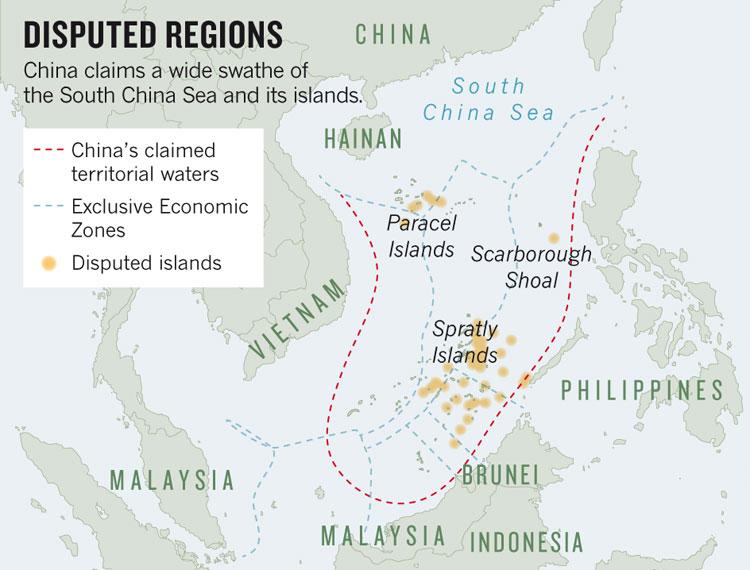
South China Sea: "Vietnam Demands ‘Immediate Cessation’ to Construction Activities in Paracel Islands"

From The Diplomat, August 31:

The request follows reports of extensive Chinese construction activities on Antelope Reef and a nearby islet. 

Vietnam’s government on Friday expressed its opposition to “illegal” reclamation and construction activities in the Paracel Islands, after reports emerged of fresh Chinese construction activities in the contested South China Sea archipelago.

On August 14, the Asia Maritime Transparency Initiative (AMTI) reported that China had completed land reclamation at Antelope Reef in the Paracels, and appeared to be working on new infrastructure on the island.

AMTI, which is run by the Washington-based Center of Strategic and International Studies, said that “the first signs of major infrastructure at the new artificial island have emerged,” including a “likely airstrip.”

Reuters then reported on August 25 that new installations had been sighted on Yagong Reef, an islet close to Antelope Reef, citing photos taken by Vantor, a commercial provider of satellite images. While the purpose of the buildings was not certain, “several structures on Yagong Reef resemble other military radar/early warning facilities ​seen elsewhere in the South China Sea and are likely associated with the ultimate military functions of nearby Antelope Reef,” a Vantor spokesperson told the news agency.

Vietnam claims sovereignty over the Paracel Islands, which it refers to as Hoang Sa, but they have been under Chinese control since 1974, when China seized them following a battle with the then-teetering southern Republic of Vietnam.

When asked about the recent reports at a regular press briefing on Friday, Foreign Ministry Spokesperson Pham Thu Hang told the press that Vietnam “has full historical evidence and legal grounds to affirm its sovereignty over the archipelago, including Hai Sam reef and Ba Ba island, in accordance with international law,” using Hanoi’s preferred names for Antelope Reef and Yagong Reef.

Hang stated that all “foreign activities” in the Paracels, including the two sites in question, ⁠were “completely illegal ​and null and void,” and that Vietnam has lodged a strong diplomatic protest with China over the issue. “Vietnam demands the immediate cessation of such activities and that they not be repeated,” she added.

While Vietnam has no real power in the Paracels, in recent years it has undertaken a significant land reclamation at its features in the Spratly Islands, which lie to the south of the Paracels and are also contested by the Philippines, Malaysia, and Brunei. AMTI reported in May that Vietnam had reclaimed a total of 2,771 acres of land in the Spratlys and was beginning construction of extensive infrastructure on its features there, including harbors, munitions storage depots, and communications structures. AMTI has also previously reported that Vietnam is building an airstrip on Barque Canada Reef, its largest feature in the Spratlys....

....MORE 

As a backgrounder, here's the intro to, and outro from, February 2021's "Vietnam Builds up Defences Against China in Spratly Islands"

Although we've mentioned that China did not achieve their goal of ejecting Vietnam from Cambodia and restoring the génocidaire Kmer Rouge with their attack on Vietnam in 1979, five years earlier the Chinese did defeat the Vietnamese in the Battle of the Paracel Islands which established de facto Chinese control over that group of islands....

***** 

....Both groups of islands are within China's ridiculous "Nine-Dash-Line" claim (here with many more dashes):

https://media.philstar.com/images/the-philippine-star/world/20140911/Nine-dashed-line-South-China-Sea.jpg

—the Philippines Star

If interested see also: 

"Vietnam’s omission from Chinese foreign minister’s Southeast Asia tour tells a story, observers say "

"Report: Chinese Vessel Rams Vietnamese Fishing Boat in S. China Sea"
I'm tellin' ya, China wants their military to get some battle experience before they do anything with Taiwan and Vietnam looks like a target.

Vietnam Rising: "US-China trade war pushing Vietnam’s manufacturing industry to capacity"

A major piece on the country The Diplomat says will be the testing ground for China's military, prior to an invasion of Taiwan. See last month's "China Will Attack Vietnam".

Throw in Vietnam's undeveloped rare earth resource base, tied with Brazil for #2 in the world (combined they match China) and the risk it poses to China's lock on prices and Vietnam has suddenly gotten very interesting.
Oh, and China is still smarting from being unable to achieve their goals during the 1979 invasion of Vietnam....

"Philippines President Duterte Threatened Beijing with Military Action":

When the Chinese stopped laughing they reflected and gave thanks it wasn't Vietnam* making the threat....
***
*...The Vietnam line is in reference to the fact that General Võ Nguyên Giáp, possibly the greatest general of the 20th century, defeated in turn, the French empire, the U.S.A. Cambodia and China in 1954, 1975, 1978 and 1979 respectively.

That last conflict was the result of China's invasion of Vietnam in an attempt to force Vietnam out of Cambodia which Vietnam had invaded in 1978, putting Pol Pot and the Kmer Rouge génocidaires out of business. It didn't work, Vietnam stayed in Cambodia until 1989.
The General died in 2013 age 102.
He outlived all his adversaries.

Friday, July 24, 2026

"China Wields Its Rare-Earths Leverage Over Europe With Export Controls"

From the New York Times, July 24:

Beijing banned shipments of important supplies to 14 companies on the cutting edge of chemicals processing, electric motors and defense. 

Last month, China blacklisted two American companies crucial to U.S. efforts to create a supply chain for making powerful rare earth magnets.

On Friday, Beijing took similar action against even more companies in Europe.

China’s Ministry of Commerce announced that it had banned any further shipment to 14 companies in the European Union of “dual-use” materials or products — items that China describes as potentially having both military and civilian applications. As a result, the companies may struggle to buy many of the critical minerals they need to make products like rare-earth magnets and semiconductors, which are essential for cars, offshore wind turbines, robots, drones and other advanced manufacturing applications.

Over the past 16 months, China has used its dominance over the mining and processing of rare earths as leverage in economic disputes with trading partners.

In a statement on Friday, the Commerce Ministry noted that it had acted one day after the European Union imposed sanctions on 14 companies in mainland China and Hong Kong in connection with Russia’s war effort in Ukraine. The European Union said these companies, along with 24 Russian companies and 10 firms elsewhere, were “entities that are part of or support Russia’s military-industrial complex or enable the circumvention of E.U. sanctions.”

Many of the European companies targeted by China play a crucial role in turning rare-earth metals and other critical minerals, like antimony and tungsten, into alloys and specialty chemicals that manufacturers need.

Also on China’s list was Germany’s largest defense contractor, Rheinmetall, which has been central to Germany’s effort to rearm after Russia’s full-scale invasion of Ukraine in 2022. Military hardware uses a lot of superhard tungsten and some rare earths.

Critical minerals have received growing attention in the West, especially since China imposed export restrictions in late 2024 on four critical but obscure minerals: tungsten, antimony, gallium and germanium. China then put export restrictions in April last year on seven kinds of rare-earth metals that are crucial to a very wide range of manufacturing, and has announced plans to impose restrictions in November on five more kinds of rare-earth metals....

Sunday, July 19, 2026

AI Trained to Find Craters on Mars Just Found 73 Hidden Volcanoes on Earth’s Ocean Floor.

As noted over the years: The damn things are everywhere. 

From ScienceAlert, July 11:

Deep beneath the ocean waves, dangers lurk.

Not from cryptic monsters like the kraken, but from powerful forces reshaping the ocean floor itself.

Most of Earth's volcanic activity takes place underwater. Yet the scars those volcanoes leave behind have remained largely hidden.

Now, through an AI-assisted search of the seafloor, a team led by volcanologist Andrea Verolino of Paris-Saclay University in France has identified 73 previously unknown volcanic calderas hidden beneath Earth's oceans.

Calderas are vast crater-like depressions left when a volcano empties enough of its underground magma chamber for the ground above to collapse in on itself. Some are long extinct, but others mark volcanic systems that could erupt again.

"Our dataset," writes the team in an early-access paper published in Communications, Earth & Environment, "fills a major observational gap and provides a reproducible, upgradeable framework for submarine volcano characterization, underscoring the need to incorporate submarine calderas into future global volcanic assessments."

Most of Earth's volcanic activity takes place beneath the sea, where tectonic plates are constantly pulling apart, colliding, and sliding beneath one another. These restless boundaries allow magma to rise toward the surface, building volcanoes across the ocean floor....

....MUCH MORE, a deep dive, so to speak. 

 Here's January 2023's "More Land For Norway":

No, not by invading Finland, Norway already did that. And the Finns were tallying the upside of annexation: NATO membership, Royal family, oil revenues etc.

The number of submarine volcanoes around the world is still pretty much unknown. One study extrapolated a small census out to three million of the damn things if you count the inactive ones. Links after the jump....

*****

...We put some of our prior links in 2021's "Submarine volcanoes release enough energy to power the United States":

Weird Hum Heard Around the World Was the Birth Of A Submarine Volcano
One of the stories on the Mayotte volcano referred to it as rare. They aren't rare at all.

"Beneath the Ocean, a World of Mountains"
We have no idea how many submarine volcanoes there are.
There was a subsea survey a decade ago that extrapolated out to three million* of the damn things.
We're only now looking at the mud volcanoes in the Arctic.
Lots of stuff to figure out.....

****

....Here's a 2007 story from NewScientist:

The true extent to which the ocean bed is dotted with volcanoes has been revealed by researchers who have counted 201,055 underwater cones. This is over 10 times more than have been found before.

The team estimates that in total there could be about 3 million submarine volcanoes, 39,000 of which rise more than 1000 metres over the sea bed....

Human beings aren't near as smart as we think we are, a point I exemplify on a daily basis at Climateer Investing.

"Ships in Caribbean Told to Avoid Underwater Volcano ‘Kick ’em Jenny’ Over Risk of Eruption"
Avoiding anything named Kick 'em Jenny sounds like a good idea....

Giant underwater volcano found off Indonesia
Further proof that Homo Sapiens really don't know all that much about how the pieces fit together. After the headline story from EarthTimes I'll link to one of the most amazing finds of the last couple years.
From the ET:

Jakarta - Scientists have discovered a giant undersea volcano off Indonesia's Sumatra island, the state-run Antara news agency said Friday. The volcano spans 50 kilometres at its base with a height of 4,600 metres, said Yusuf Surachman, a director at the state-run Agency for the Assessment and Application of Technology. Indonesian, American and French scientists found the volcano 330 kilometres off Bengkulu province on Sumatra while they were surveying the sea floor to study changes in its geological structure following major earthquakes in the region. "This volcano is huge and tall. There are no volcanoes of similar height on Indonesian land," he was quoted as saying by Antara. Surachman said the scientists did not know if the volcano was active....

Did you catch that? A volcano 15,000 feet tall and thirty miles across at its base. And, oh, it might be active.....

In 2016 National Geographic reported:

Six underwater volcanoes found hiding in plain sight
The edifice, named Actea, is one of six volcanoes recently discovered while scientists were mapping the underwater landscape of the Sicilian Channel, a heavily trafficked waterway off the southwest...

 Oh.

And many more. Up north it's not just Iceland that has volcanoes. There are active volcanoes in the Bering Sea. 

And off of Antarctica. Damn things are everywhere we look.

A few months later, April 2023: 

"“It’s just mind boggling.” More than 19,000 undersea volcanoes discovered"

*** 

Ja, ja I got your 3600 foot outcrop and raise you this hitherto unknown specimen...  

And: "Europe's largest underwater volcano at risk of collapse"

 This story is two years old and there is no sign that collapse is going to happen tomorrow but is something our obscure perils group would consider covering. Just another example of all these damn submarine volcanoes.

From Deutsche Welle, May 5, 2019:

The biggest underwater volcano in Europe could erupt at any moment and cause a tsunami, according to new research. For residents of southern Italy, the Marsili is just one more disaster threat to live with.

And....let's just say there's an awful lot we don't know. 

Thursday, July 16, 2026

International Energy Agency: China's Rare Earth Curbs Could Endanger $6.5 Trillion Of Western industry

From Reuters, July 15: 

The full implementation of China's rare earth export restrictions could put $6.5 trillion of downstream production outside the country at risk, the International ​Energy Agency warned on Thursday.
 
China, the world's largest producer of ‌rare earths, expanded export controls in October last year to cover additional materials and introduced new licensing requirements, but later agreed to delay implementation for a year.
 
Rare earths are a group ​of 17 metals used in small quantities, but essential to products ​ranging from cars and aircraft to electronics and weapons systems.
 
If ⁠the controls take full effect, about $6.5 trillion of production across the automotive, ​high-tech, defence and energy sectors could be exposed to supply disruptions, the ​IEA said in its Global Critical Minerals Outlook report.
 
The U.S. and Europe would account for nearly half of the economic impact, the report added. 
"Our latest analysis shows that vast ​amounts of economic value depend on relatively small volumes of critical minerals, ​whose supply chains remain highly concentrated and are therefore vulnerable," IEA Executive Director Fatih Birol ‌said....
....MUCH MORE 
 
And at the IEA, the press release with link to the 373 page PDF:
Supply concentration, export restrictions and declining investment put critical mineral security at risk

Monday, June 22, 2026

Capital Markets: "Sterling Proves Resilient as Starmer says Good Bye"

 From Marc Chandler at Bannockburn Global Forex:

Conflicting news from the Middle East initially lifted oil prices and weighed om risk-taking appetites, but US-Iran negotiations continue and both sides report progress. Oil prices have come back off. The dollar is mostly firmer but so far has held above last week’s lows against the euro and sterling. The yen snapped a five-day slide ahead of the weekend but is softer today, and the greenback is knocking against the recent high (~JPY161.80). The Canadian dollar is extending is slide into the eighth consecutive session. 

Given the light economic diary today, politics are in the spotlight. The UK’s sixth prime minister since Brexit a decade ago has resigned and will oversee the selection process of his successor. Sterling was initially sold but has come back to record near session highs late in the European morning. US-China tensions have taken a turn for the worse. Apparently in response to the US decision this month to add some of China’s largest companies to a list of companies that aid the military, Beijing has sanctioned two US rare earth companies. It maybe mostly symbolic as the two companies reported have reported largely cut off inputs from China....

....MUCH MORE 

Friday, May 15, 2026

Dear Norway, Thanks Again: That Time A Couple Of Old Norwegian Guys Put Down Their Coffee, Sank A Nazi Warship and Saved Western Civilization

Over the years we've posted on military moments that were turning points in history, D-Day, the second day of the battle of Gettysburg, the Black Monday hailstorm in 1360.

Here's one we haven't reposted in a while that definitely qualifies. 

April 9, 2017

Okay, the 'saved Western civilization' part may be a bit much but April 9, 1940 was an important day.

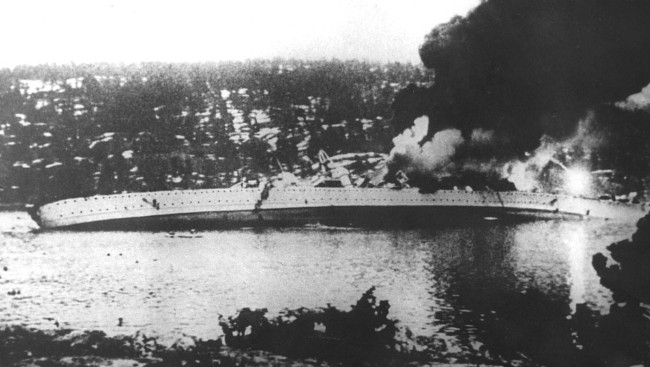
Going back 77 years to the story of how a couple old coots, Birger Eriksen and Andreas Anderssen, hanging out on their little island, decide it's their job to defend the country against a Nazi freakin' armada headed for Oslo, go out and sink a brand new battle cruiser and send the rest of the invaders running, allowing the King and Government enough time to evacuate the capital to Hamar, 125 km north and eventually to set up the Government-in-exile plus kept the national treasury, 50 tons of gold, out of the hands of the Nazis.

As I put it a couple years ago to mark the 75th anniversary:

...sank the most modern ship in the German Navy, saved the Norwegian King and government from being taken captive and pulled Churchill's fat out of the fire-keeping the path open for him to assume the premiership of Britain and thus save Western Civilization.
We like Norway.

The two old guys at Oscarsborg that evening were Colonel Birger Eriksen, commander of the fortress, age 64 and Andreas Anderssen, a 60 year old Kommandørkaptein but retired and living in the town who Eriksen probably enticed to come out to the fort with offers of coffee and brown cheese.

As the German armada approached, Eriksen aware his rookie cadets had started their national service just days earlier and wouldn't be able to reload the old cannons, Moses and Aron, knew he'd only get one chance so he waited and waited for the Nazis to get closer.

At around a mile he disobeys general orders to first fire a warning shot, says "Either I will be decorated or I will be court-martialed, Fire!" and shoots at the heavy cruiser Blücher which had only been completed in September 1939.

No neutrality there.

They missed.

With the artillery now pretty much useless, Eriksen tells Anderssen to fire a couple obsolete land-based torpedoes. Anderssen does, missing the mark with the first, adjusting his aim and:

https://upload.wikimedia.org/wikipedia/commons/d/df/German_cruiser_Bl%C3%BCcher_sinking.jpg
The rest of the flotilla including the pocket-battleship Lützow turned tail and ran back down the fjord, not quite sure what had hit them.
A pretty good English language version of the story is at:
Making do with what you have... [link rotted, here's the Internet Archive cache]

One of these days I'll get around to explaining why Churchill almost wasn't going to become Prime Minister the following month. 

When not saving the world the blue-eyed Arabs (oil business nomenclature) settled for saving Europe:

February 27, 2018
That Time A Dozen Norwegians Stopped the Nazis From Developing the Atom Bomb and Possibly Saved Europe 
 
This isn't the story of Birger and Andreas having to take a break from the brown cheese and herring and, well, we marked that anniversary with "That Time A Couple Of Old Norwegian Guys Put Down Their Coffee, Sank A Nazi Warship and Saved Western Civilization".

Rather, our headline event happened a few years later but first, I know everyone reading can't wait for a History-of-Norwegian-Industry-ca-1900 - 1915-diversion, so here goes. We've posted on Kristian Birkeland more than once, this is part of last year's "Shipping: He May Not Have Received His Nobel Prizes But The World's First Fully Electric Autonomous Container Ship Will Be Called the Birkeland"

...the introduction to the Plasma Universe entry on Birkeland:
Kristian Olaf Bernhard Birkeland (13 December 1867 - 15 June 1917) was a Norwegian scientist who has been called "the first space scientist"[1] and "the father of plasma experiments in the laboratory and space"[2] [3] [4]. He is perhaps most well-known for his scientific work on the aurora using a terrella (a magnetized globe), and as inventor of an electromagnetic cannon, and, a method of electrically producing artificial fertilizer. He also became a full professor of physics at the University of Oslo at the age of 31.

Birkeland also had astrophysical research published on cathode rays,[5] the Zodiacal lights,[6] comets,[7] the Sun and sunspots,[8] the origin of planets and their satellites,[9] the Earth's magnetism.[10]
 
Some of Birkeland's other contributions to science included:[2] • Derived the general expression for the Poynting vector • Gave the first general solution to Maxwell's equations [11] • Pioneered the field of charged-particle beams • Utilized the concept of "longitudinal mass" • Constructed the first foil diodes • Pioneered the field of visible-light photography of electrical discharges • Advocated charged-particle propulsion engines for space travel • Created Norsk Hydro's nitrogen-fertilizer industry (the Birkeland-Eyde method for production of potassium nitrate) • Invented an electromagnetic rail gun capable of firing a 10-kg projectile • Established Birkeland's Firearms company • Anticipated cosmic rays (discovered in 1911) with his calculations involving energies of several billion electron volts • Held patents on the electromagnetic cannon,[12] electric blankets, solid margarine, and hearing aids.

In 1969 when field-align currents had been identified in the Earth's atmosphere, they were named in his honor: Birkeland currents.[13]....
...MUCH MORE

He also co-founded Norsk Hydro and got his picture on the cover of the Rolling Stone Norway's 200 kr banknote:
https://upload.wikimedia.org/wikipedia/en/e/e4/VII-200-forside-200.jpg

The note will become invalid at the end of this year and the old boy will be replaced by a cod and a herring....

It was that Norsk Hydro bit that is important to this tale.
Norsk Hydro made nitrogen fertilizer using giant arcs to fix nitrogen in the air to nitric oxide which could be further manipulated to become nitric acid which can then be used to make explosives or fertilizer or other stuff. The process was very energy inefficient but hey, it was the early 20th century and we're talking Norway. They have a few waterfalls.  Fast forward thirty years and despite the efforts of Birger and Andreas the Nazis have invaded and are intent on grabbing them some heavy water, of which Norsk Hydro has become the go-to source, as a byproduct of the now-modernized (no more Birkeland-Eyde process) fertilizer operation.

And it is here the story of February 28, 1943 really begins. From The Conversation via Scientific American:

Operation Gunnerside: The Norwegian Attack on Heavy Water That Deprived the Nazis of the Atomic Bomb
February 28 marks the 75th anniversary of one of the most dramatic and important military missions of World War II
The following essay is reprinted with permission from The Conversation, an online publication covering the latest research.
The Conversation
After handing them their suicide capsules, Norwegian Royal Army Colonel Leif Tronstad informed his soldiers, “I cannot tell you why this mission is so important, but if you succeed, it will live in Norway’s memory for a hundred years.”

These commandos did know, however, that an earlier attempt at the same mission by British soldiers had been a complete failure. Two gliders transporting the men had both crashed while en route to their target. The survivors were quickly captured by German soldiers, tortured and executed. If similarly captured, these Norwegians could expect the same fate as their British counterparts, hence the suicide pills.

Feb. 28 marks the 75th anniversary of Operation Gunnerside, and though it hasn’t yet been 100 years, the memory of this successful Norwegian mission remains strong both within Norway and beyond. Memorialized in movies, books and TV mini-series, the winter sabotage of the Vemork chemical plant in Telemark County of Nazi-occupied Norway was one of the most dramatic and important military missions of World War II. It put the German nuclear scientists months behind and allowed the United States to overtake the Germans in the quest to produce the first atomic bomb.

While people tend to associate the United States’ atomic bomb efforts with Japan and the war in the Pacific, the Manhattan Project—the American program to produce an atomic bomb—was actually undertaken in reaction to Allied suspicions that the Germans were actively pursuing such a weapon. Yet the fighting in Europe ended before either side had a working atomic bomb. In fact, a rehearsal for Trinity—America’s first atomic bomb test detonation—was conducted on May 7, 1945, the very day that Germany surrendered.

So the U.S. atomic bomb arrived weeks too late for use against Germany. Nevertheless, had the Germans developed their own bomb just a few months earlier, the outcome of the war in Europe might have been completely different. The months of setback caused by the Norwegians’ sabotage of the Vemork chemical plant may very well have prevented a German victory.

Nazi bomb effort relied on heavy water
What Colonel Tronstad, himself a prewar chemistry professor, was able to tell his men was that the Vemork chemical plant made “heavy water,” an important ingredient for the Germans’ weapons research. Beyond that, the Norwegian troops knew nothing of atomic bombs or how the heavy water was used. Even today, when many people have at least a rudimentary understanding of atomic bombs and know that the source of their vast energy is the splitting of atoms, few have any idea what heavy water is or its role in splitting those atoms. Still fewer know why the German nuclear scientists needed it, while the Americans didn’t.

“Heavy water” is just that: water with a molecular weight of 20 rather than the normal 18 atomic mass units, or amu. It’s heavier than normal because each of the two hydrogen atoms in heavy H2O weighs two rather than one amu. (The one oxygen atom in H2O weighs 16 amu.) While the nucleus of a normal hydrogen atom has a single subatomic particle called a proton, the nuclei of the hydrogen atoms in heavy water have both a proton and a neutron—another type of subatomic particle that weighs the same as a proton. Water molecules with heavy hydrogen atoms are extremely rare in nature (less than one in a billion natural water molecules are heavy), so the Germans had to artificially produce all the heavy water that they needed.

In terms of their chemistries, heavy water and normal water behave very similarly, and you wouldn’t detect any differences in your own cooking, drinking or bathing if heavy water were to suddenly start coming out of your tap. But you would notice that ice cubes made from heavy water sink rather than float when you put them in a glass of normal drinking water, because of their increased density.

Those differences are subtle, but there is something heavy water does that normal water can’t. When fast neutrons released by the splitting of atoms (that is, nuclear fission) pass through heavy water, interactions with the heavy water molecules cause those neutrons to slow down, or moderate. This is important because slowly moving neutrons are more efficient at splitting uranium atoms than fast moving neutrons. Since neutrons traveling through heavy water split atoms more efficiently, less uranium should be needed to achieve a critical mass; that’s the minimum amount of uranium required to start a spontaneous chain reaction of atoms splitting in rapid succession. It is this chain reaction, within the critical mass, that releases the explosive energy of the bomb. That’s why the Germans needed the heavy water; their strategy for producing an atomic explosion depended upon it.

The American scientists, in contrast, had chosen a different approach to achieve a critical mass. As I explain in my book, “Strange Glow: The Story of Radiation,” the U.S. atomic bomb effort used enriched uranium—uranium that has an increased concentration of the easily split uranium-235—while the Germans used unenriched uranium. And the Americans chose to slow the neutrons emitted from their enriched uranium with more readily available graphite, rather than heavy water. Each approach had its technological trade-offs, but the U.S. approach did not rely on having to synthesize the extremely scarce heavy water. Its rarity made heavy water the Achilles’ heel of the German nuclear bomb program.

Stealthy approach by the Norwegians 
Rather than repeating the British strategy of sending dozens of men in gliders, flying with heavy weapons and equipment (including bicycles!) to traverse the snow-covered roads, and making a direct assault at the plant’s front gates, the Norwegians would rely on an alternate strategy. They’d parachute a small group of expert skiers into the wilderness that surrounded the plant. The lightly armed skiers would then quickly ski their way to the plant, and use stealth rather than force to gain entry to the heavy water production room in order to destroy it with explosives...MUCH MORE

So again, thanks. 

Sunday, April 26, 2026

U.S. Treasury Secretary Bessent On A.I.: "'a year, maybe 18 months,' before the new technology defines our lives across the board."

That's at the Wall Street Journal, April 24:

The Weekend Interview 

Scott Bessent: Donald Trump’s Economic Engineer
The Treasury secretary looks ahead to the Beijing summit and discusses AI, energy, taxes, bank regulation and more.

Washington
President Trump has a lot of big goals: completing a grand ballroom and a giant arch, putting a covey of his enemies in prison, winning a Nobel Peace Prize. Most of all, he wants the American economy to roar so loudly that no one can deny it’s the greatest financial power in history.

No one has more responsibility for achieving that goal than Scott Kenneth Homer Bessent, star quarterback of Mr. Trump’s economic team in his rookie season in government. According to many of Mr. Bessent’s former Wall Street colleagues, however, his task has been made manifestly harder by Mr. Trump’s tariffs and the Iran war.

The central components of the Treasury secretary’s agenda include restoring growth after the havoc of war, rebalancing global trade, driving down inflation without choking expansion, lifting real wages for the bottom half of earners, and reasserting American dominance in the industries that will determine the next generation of prosperity—chips, artificial intelligence, energy. His portfolio would be daunting even in peacetime. In the aftermath of a regional conflict and amid a trade confrontation with the world, it is a stress test of both policy and temperament.

In several conversations in his office, Mr. Bessent, 63, speaks about all these global challenges the way a trader might talk about a volatile market: with a mixture of confidence and probabilistic hedging. As he learned early from his macroeconomic mentor, George Soros, and has been reminded by Mr. Trump, risk is something not to be feared, but understood and leveraged. “George Soros is willing to take unlimited market risk,” Mr. Bessent says, “but has incredible survival instincts. The president is willing to take unlimited political risk, but knows when to cut.” 

Growth has slowed, but Mr. Bessent insists it will recover. Energy prices will normalize. What he calls the “buffet”—the spread of economic benefits to every household—will still be set out, although delayed from the second quarter of 2026 to the third, perhaps not coincidentally right before the midterm elections that are vitally important to the White House.

China is the most urgent item in Mr. Bessent’s inbox. For all the noise around tariffs, Mr. Bessent’s responsibility is to manage the integrity of the U.S.-China relationship, which will largely define whether the Trump economy is a success. He presents a formulation that sounds simple but contains a dozen tensions: “We have to derisk but not decouple.”

What does that mean? Mr. Bessent sketches a picture that is less rupture than recalibration. Trade continues. American companies still operate in China. The U.S. still sells agriculture, energy, financial services and software. But in three areas—critical minerals, medicines, and semiconductors—America becomes meaningfully independent.

“We’re pretty far along,” he says of rare-earth minerals. “I would say it’s a step function every nine months and probably completely resolved in four years.”

That timeline underscores the central contradiction in Mr. Bessent’s China policy. He insists the coming summit with Xi Jinping is about “stability,” avoiding escalation, keeping the relationship predictable. Yet nearly every concrete move he describes is designed to reduce dependence on the Chinese, thus minimizing Beijing’s leverage.

The recent tariff spiral sharpened the point. As tariffs rose, China deployed nontariff measures, including restrictions on exports of rare-earth magnets. The U.S. responded by applying its own forms of pressure—data controls, technology limitations, student-visa rules. “We have leverage,” Mr. Bessent says, almost casually. “
 
Whether it’s aircraft engines or silicon quartz, the Chinese students, [it] really bothered them.”
 
The deeper view he offers of China is historical, even civilizational. “They believe that they were the Middle Kingdom,” he says, invoking the Qing Dynasty. “I think they want to get back to that equilibrium where the world comes to them.”

This isn’t the language of benign competition but of strategic rivalry and sober mistrust, softened only slightly by the possibility of “peaceful coexistence.” China, he notes, “has never had allies. They have vassal states.”Yet in the same breath, Mr. Bessent argues that the goal of the summit circuit—no fewer than four Trump-Xi meetings this year, including a Xi state visit to the White House in September, the Asia-Pacific Economic Cooperation summit in Beijing in November, and the Group of 20 at Doral, Fla., in December—is to keep relations steady, almost routine. The stakes are “not that high,” Mr. Bessent says, “because everything gets pregamed.” The tension between those two ideas—China as existential competitor and China as manageable counterpart—runs through the entire approach. 
 
But the subtext is clear—Mr. Bessent remains staunchly wary, both culturally and commercially. “We founded the World Bank and the IMF,” he says, “whereas the Chinese just want to be part of it and take it over, and they also formed the Belt and Road and the Asian Infrastructure Bank. But I think the difference is we were in it for more soft-power reasons; they are in it for more hard-power reasons.” 
 
If China is the casino, artificial intelligence is the table stakes. “If we don’t win in AI,” Mr. Bessent says, “then it’s game over.” He speaks with the urgency of someone who believes the timeline has collapsed. It isn’t five years, or even two, but “a year, maybe 18 months,” before the new technology defines our lives across the board.
 
The implications, as he describes them, are both sweeping and oddly mundane. Entire categories of work could be compressed into a fraction of their current cost. Small businesses could operate with a handful of employees and a suite of AI agents. Productivity gains could ripple across the economy in ways that are difficult to predict but impossible to ignore.....
....MUCH MORE 

Wednesday, April 15, 2026

"China weighs curbs on exports of solar manufacturing equipment to US"

 Well that would be good for First Solar wouldn't it?

Thin-film cadmium telluride vs. polysilicon substrate.

Not so good for data centers in space though. 

From Reuters, April 15;

  • China may curb exports to keep solar tech lead, sources say
  • Move could threaten U.S. firms' solar factory plans
  • Industry sees Tesla's solar goals as threat amid downturn

Chinese officials have held initial talks with providers of equipment to make solar panels as they consider limiting exports of the most advanced technology to the United States, said five people with knowledge of the consultations.

Such ​a clampdown would risk investments by U.S. firms and set back a race for space-based computing, as China, estimated to make more than 80% of the world's ‌solar panel components, is also home to the top 10 suppliers of equipment to make solar cells. 

No rule has been finalised, and the talks have not advanced to the stage of canvassing formal feedback from an industry grappling with severe overcapacity after years of aggressive expansion, two of the sources said.

China's commerce ministry and its state council, or cabinet, did not immediately respond to faxed requests for comment from Reuters.

IF ADOPTED, STEP COULD THREATEN U.S. FIRMS' PLANS TO ​EXPAND 

If adopted, such a move could threaten plans by U.S. firms, such as Tesla (TSLA.O), opens new tab, to build new factories or expand existing ones in efforts to boost local production. 

It would ​also widen export controls in another area of technology where China has a lead, building on Beijing's move to control rare earth exports a year ⁠ago in response to U.S. tariffs. 

The step comes at a time when the rivalry between China and the United States has spilled into the race to produce space-based computing powered by solar ​panels, a focus for Tesla CEO Elon Musk.

Other U.S. tech companies such as Google (GOOGL.O) and Amazon (AMZN.O) are investing in ground-based solar and energy storage systems, even as they count on similar orbital data centres ​to satisfy AI's growing demand for power. 

Analysts who track China's solar industry and executives have braced for export controls, in part because concern is growing over efforts by Musk and others to boost solar panel production in the United States, reducing reliance on China.

DOWNTURN COULD SEE INDUSTRY LOSE OUT TO U.S. COMPANIES
Musk seeks to exploit China's solar downturn to acquire equipment and talent, Xu Xiaohua, chairman of Anhui Huasun Energy, told the Caijing business magazine ​this year....

....MUCH MORE 

Friday, March 27, 2026

"Australia rare-earth stocks soar as China clamps down on exports"

Lynas is our preferred rare earth name, despite MP getting most of the attention (and U.S. government money). 

From Nikkei Asia, March 27: 

Market cap triples in year for Lynas, largest rare-earth separator outside China, on Japan, US deals 

Rare-earth stocks in Australia have risen sharply over the past year amid growing demand from sources other than China for the metals, found in everything from mobile phones and cars to modern weapons.

Lynas Rare Earths, the world's largest commercial rare-earth separator outside China, announced this month it had locked in purchase price guarantees with a joint venture co-owned by Japanese trading house Sojitz. It marks the first time a Japanese client has committed to a price floor for a rare-earth deal.

"The implementation of fair market pricing will reduce price volatility for Lynas and enable continued growth and investment in our operations," Lynas CEO Amanda Lacaze said in a press release.

The sides have agreed to a minimum price of $110 per kilogram for neodymium-praseodymium, which is used to make magnets for vehicles, among other applications. Lynas is entering into a similar deal with the U.S. Defense Department.

Lynas' market capitalization reached 20 billion Australian dollars ($14 billion) as of Friday, roughly tripling in value over 12 months. The company has surpassed the $9.4 billion market cap of its largest U.S. rival, MP Materials, and is gaining ground on China Northern Rare Earth Group High-Tech, the biggest Chinese player with a market cap of $24 billion....

....MUCH MORE, an excellent overview. 

China Northern is an old friend formerly known as "Inner Mongolia Baotou Steel Rare-Earth Hi-Tech Co., Ltd." As noted in a 2024 post on Baidu: 

....China has a communist government, they pick winners and losers in business, that's what communists do.

We first became aware of how important this understanding is in the case of the Chinese rare earth companies. Here's a snip from a 2009 post, "Inner Mongolia Baotou Steel Rare-Earth Hi-Tech Co., Ltd. UP 10% Wednesday (600111: Shanghai)", this is a couple years before the twenty-tweens rare earth mania:

....China's moves to tighten control on the mining and export of a class of metal ores called rare earth are aimed at attracting high-tech manufacturing to Inner Mongolia, and not at dominating the market, a senior Chinese official said.

Wednesday's comments by Zhao Shuanglin, vice chairman of Inner Mongolia Autonomous Region, appear aimed at quelling concerns that China is trying to dominate the global market for rare-earth resources, used in some environmentally friendly technologies. Rare-earth metals greatly improve batteries made for hybrid cars....

...China also is taking steps to consolidate its rare-earth industry. Mr. Zhao, who said he runs the region's industrial policy, said Inner Mongolia Baotou Steel Rare Earth Hi-Tech Co. would lead that consolidation. The move is aimed at creating a group of rare-earth miners and processors in the region's western parts. Inner Mongolia Baotou Steel Rare Earth's stock rose 7.6% in Shanghai trading Wednesday.

"Most of the consolidation is complete," Mr. Zhao said. "We want to build Baotou into an international rare earth production base."....

By November 2010 the story was:
"Rare Earth: Inner Mongolia Baotou Steel Rare Earth Hi Tech Co. Ltd. Reports 369% Increase in Q3 Net":
This is the big dog.
And one that the Chinese government says will be on top of the mandated industry consolidation.

IMBSREHTCL was chosen to succeed.

In the case of artificial intelligence it was apparent by 2017 that Baidu, known in the West as a search engine, was the anointed one for machine learning and such.

Some more 2009 posts on "IMBSREHTCL":

Again, years before the mania and "Inner Mongolia Baotou Steel Rare-Earth Hi-Tech Co., Ltd." being on everyone's lips and our chosen tagline coming from one of the best books on investing ever written:

"...Words like 'uranium', 'rare earths', etc. seem to be magic to
 those unsuspecting who are often fleeced..."
Gerald M. Loeb
The Battle for Investment Survival
Simon & Schuster, 1935