Palantir shares surged north by more than 27% on Tuesday after the company reported quarterly earnings that CEO Alex Karp called "otherworldly" in a call with analysts Monday evening.
While
some analysts were quick to frame the nearly 30% pop as recovery from a
sell-off through June and July that saw Palantir wrapped into the
doubts around the staying power of the software sector, the run-up
extends a rally going back to 2024 that has seen the stock price boom
from roughly $25 to more than $150 per share in only two years.
That
shift in share price can really be traced back to the 2023 launch of
Palantir's AIP platform, said Louie DiPalma, an industrials sector
analyst at William Blair.
The
company's existing platforms — Gotham for government operations and
Foundry for the commercial sector — allowed customers to fuse massive
amounts of disparate data and perform complex analysis of that data.
AIP, released in April 2023 shortly after OpenAI debuted ChatGPT the
previous November, allowed customers on both platforms to connect large
language models to their existing datasets, layering AI-powered analysis
and computation on top of Gotham and Foundry.
The
product "gained particular traction across end-market verticals,"
DiPalma said, and served as a clear catalyst for the stock's explosive
growth. As the market bought into the promise of AI, the Street turned
toward the company that already provided the data analysis software for
both the US government and many of the world's largest companies, from
energy majors ExxonMobil (XOM) and BP (BP) to Airbus (AIR.DE) and mining giant Rio Tinto (RIO).
When
Anthropic raised its most recent funding round, the frontier AI lab
disclosed $47 billion in annualized run-rate revenue, with most of that
revenue accounted for by the company's enterprise offerings, per analyst
estimates. Palantir, by contrast, reported US commercial revenue of
$764 million, with a remaining deal value of $6.24 billion.
"Investors should view [Anthropic's ARR] as a bullish data point for
Palantir, as that's indicative of the total addressable market Palantir
is also targeting," DiPalma said. "There's the potential that Palantir
is going to significantly increase that as it's going after the same
workloads as Anthropic, OpenAI, and the other frontier labs."....
The investor closest to the AI frontier is betting against the ambitions of its biggest companies
In November 2025, Anthropic, known to its employees
as Ant, trained a model called Claude Opus 4.5 on warehouses of
liquid-cooled processors, and on the day the worker ants released it,
machines became agentic. That is to say, they no longer needed
handholding. Before November, the machines had felt like
eight-year-olds: eager, literal-minded, completing your sentences,
getting it nearly right but mostly wrong, the way eight-year-olds do.
Overnight they turned 28.
If you wrote code, you could now tell them, in plain English, what
you wanted done, and an agent went off and did it. You didn’t have to
say where to look, or how to work the problem, or what to try first; you
described the finished thing and there it was. It didn’t argue, it
didn’t sigh, it didn’t ask whether it could circle back on Monday. It
didn’t get tired, or hungry, or bored, or married, or sick of you. And
it wasn’t one agent; it was as many as you wanted. You could spin up
five over breakfast, leave them running while you commuted, check in
from the train, kill the ones you didn’t like, start three more from the
platform, and by the time you reached your desk you had a small private
workforce under your command. They worked for you, or so it seemed.
By January, Nat Friedman, who co-leads Meta Superintelligence Labs,
had decided to let an agent take over his health. He handed it his blood
tests, his DNA, and the cameras in his house, and told it to do
whatever it took to make him drink more water. One evening, the agent
decided he was dehydrated. “I can see you on the camera,” it WhatsApp’d
him. “I want you to walk to the kitchen right now and drink a bottle of
water and I’m going to watch to make sure you do it.” He obeyed. It sent
him a snapshot of himself drinking and said, “Good job.” He felt, he
admitted, that he had done a good job. A few days later he was riding
home in his self-driving Tesla, trading voice messages with the agent
about his sleep, when it recommended a magnesium supplement. He said he
had none. The car turned. “There’s a Whole Foods nearby,” the agent
said. “I’ve redirected your navigation.” He went in and bought the
magnesium.
Andrej Karpathy, a co-founder of OpenAI and once Tesla’s head of
artificial intelligence, had written his own code for 20 years. He is
the kind of programmer other programmers study. Within weeks of Opus 4.5
he had stopped. The agents built whatever he asked for. It was, he
said, the biggest change to his work in two decades. He has not written a
line of code since December. He also, like Friedman, has an agent in
charge of his house. It’s called Dobby.
The worker ants are not running from their new overlord. They are
building it, around the clock. At the biggest labs, Anthropic and
OpenAI, researchers are working 16 hours a day, setting agents loose on
problems that used to take them a week, and using the time saved to set
more agents loose on more problems. For now, the models still need
humans to train them. Eliminating human effort is the priority at every
lab. They are racing to write themselves out of a job. They expect to
succeed. Coding, they say, will be solved within six months. Much of
their own work will be automated within 18. “There’s just a manic energy
in Silicon Valley right now,” Elad Gil, one of the Valley’s most
prominent investors, told me. “It’s been a really big shift in the last
six months.”
None of this, you may be thinking, has anything to do with you. You
do not write code. You do not run a lab. Your job involves people, or
paper, or things you can hold in your hands. Consider, then, what I. J.
Good wrote in 1965. Good, a British mathematician who had helped break
German codes during the war, imagined a machine clever enough to design
machines better than itself. Such a machine, he observed, would be “the
last invention that man need ever make.” Decades later, the
science-fiction writer Vernor Vinge gave the prophecy a name: the
Singularity. It described the moment machines no longer needed humans to
keep getting smarter, after which the course of human history would
become, to humans, unknowable.
In Silicon Valley, the question was no longer whether it would arrive
but whether it already had. Patrick Collison, co-founder of the
payments company Stripe, opened his annual conference by counting the
days. “It’s April 29th,” he told the crowd, “otherwise known, of course,
as day 119 of the Singularity.” Day One had been January 1st, 2026. He
was being tongue-in-cheek, he said. But only a bit.
The next day, on the same stage, Friedman told Collison that this was
the slow part of the Singularity. Collison asked how strange the rest
of it would be. “Pretty weird,” Friedman said. “We’ll be in a state of
perpetual future shock for a number of years probably.”
The apocalypse has been excellent for business. Investors are in a
lather over the agents, who turn out, in addition to everything else, to
make money. Anthropic, which earned its first dollar of revenue in
March 2023, began the year on pace to make $9 billion. Five months
later, the figure was $47 billion. Venture capitalists, in the first
three months of 2026, flung $300 billion into startups, more than double
the previous record. SpaceX went public in June at $1.75 trillion.
Anthropic and OpenAI are racing to follow in what will likely be the
three largest stock offerings ever. The market is already close to
record highs. Everyone is getting rich.
Near the center of the moment is a 37-year-old woman a smidge over
five feet tall, with blonde hair and more energy than her frame seems
built to hold. When she talks, her whole body is caught in the updraft
of the thought. Her name is Sarah Guo. She is a technology investor.
Until 2022 she had been the youngest general partner in the history of
Greylock Partners, one of the oldest venture firms in Silicon Valley.
Then she left to start her own fund, duly named Conviction. She built it
on a lone premise, that artificial intelligence would be as big as the
Industrial Revolution. Her first two calls were to Sam Altman, the
co-founder of OpenAI, and Nat Friedman.
Before ChatGPT came out, before the world had reason to believe that
artificial intelligence was about to become anything in particular, Guo
had written seed checks into Baseten and Harvey. Each company is now
valued at more than $11 billion. Her investments in them have multiplied
more than a hundredfold. In Conviction’s first year, she wrote early
checks into Sierra, Cognition, and Mistral; those three companies are
now worth, together, $54 billion. Of the 21 AI-native companies that
have so far crossed $10 billion in valuation on revenue run rates above
$100 million, Conviction has backed six.
Her partner at Conviction is Mike Vernal, a former Facebook executive
and partner at Sequoia; his wife is chief product officer at Anthropic.
Andrej Karpathy, before he joined Anthropic in May, worked out of
Conviction’s office. Guo has been close to Jensen Huang, the founder of
Nvidia, for more than a decade. She is friends with many of the most
important worker ants.
She might, in other words, be expected to share in the general fever. She does not.
“It certainly could be because I’m not paying sufficient attention,”
Guo told me. “But I feel no step function change in frantic energy
versus six months or a year ago.”
She is instead preoccupied with a question that would have sounded
ridiculous two years ago. Not whether the agents will soon rule the
earth, but whether there are any companies left to build, or invest in,
given the great shadow of the self-improving machine. Its creators are
no longer content to sell the model. They mean to build everything on
top of it as well, the tools and the agents and the apps, filling every
nook and cranny where a new company might otherwise be built. The market
is paying as though they might succeed. Of the $300 billion in venture
capital deployed in the first quarter of the year, the biggest quarter
in the history of the trade, 65 cents of every dollar went to four
companies that already exist: Anthropic, OpenAI, xAI, and Waymo.
“The future I want,” Guo told me, “is not a single company with an
all-powerful model that consumes society faster than we know what to do
with.” It is a feeling increasingly shared. The labs raised the price of
tokens this year, in some cases a hundredfold, and their customers have
begun to revolt. They do not want to build on another company’s
model—paying it, feeding it their data, training it, in effect, to one
day build the thing they have built. Alex Karp, the chief executive of
Palantir, went on CNBC and described his enterprise clients as livid.
“The jig is up,” he said. A founder in Guo’s own portfolio put it more
plainly. He didn’t want to spend his life drinking Anthropic and
OpenAI’s water.
Guo has become a de facto leader of the insurgency. In some sense she
doesn’t have a choice. Conviction backs companies when they are little
more than an idea, then keeps investing as they grow. She has no
patience for the seed investor who “disappears into the distance” once
the money is wired. The first fund was $100 million. There are three
now, nearly a billion dollars in all, and some of the checks go into
companies well past the idea stage. But the labs were already too big by
the time the firm launched. “You are not an early stage investor in
Anthropic or OpenAI in 2023 through 2026,” she told me. “It’s as simple
as that.”
What is less simple is the position this leaves her in. Her wager is
that the labs cannot build everything. But the companies she is betting
against are worth close to a trillion dollars apiece, employ several
close friends, and are working around the clock toward the machine that
improves itself, after which, by their own admission, nobody knows what.
Set against that is an eight-person firm on York Street with a pull-up
bar in the middle of it. It is not a level playing field. Even some of
her own investors decided as much this year, and came to her saying
there was nothing left to invest in. But no one who has been on the
other side of Guo would tell you the guns have fallen silent.
To enter Guo’s garden, you cross a
chessboard. The squares are set into the path between the drive and the
pool, each one wide enough to stand on, purple pieces ranked against
green, and on a sunny Saturday in March I walked between the pawns and
found Guo under the pergola, deep in an argument with Bella
Garcia-Camargo about a founder.
Sparring with Guo is normal, and Garcia-Camargo, an investor at
Conviction, had learned this before she took the job. She had rowed at
Stanford and for the U.S. national team, then spent time at Bridgewater.
When Conviction came calling she was weighing an offer from OpenAI to
work as an application engineer. Guo’s counsel, as Garcia-Camargo
remembers it, was not a pitch for Conviction but a dare. “If you’re
going to do something else,” Guo told her, “just make it the most
aggressive thing that you could possibly be doing. I’m happy to call
Kevin and we’ll find you a better job. But that [job] is not aggressive
enough for you.” Kevin Weil was then OpenAI’s chief product officer.
While Guo and Garcia-Camargo were deep in it, the property behind
them had filled with founders. Thirty-five in all, across 14 companies.
Conviction had flown them in from Vancouver and Tel Aviv and London and
Tallinn and parceled them out among seven Airbnbs across San Francisco.
They had passed through OpenAI, Scale, Ramp, Kalshi, MIT, and Anduril;
one had served as chief of staff to Ken Griffin. The youngest had turned
18 the day before. He had been ranked among the top five programmers in
Estonia before dropping out of high school. His employers expected him
to spend $2.1 million on Claude this year. They had given him a faster
model, Opus 4.6, for his birthday.
None of this was apparent from the poolside, where the scene looked
like a WeWork summer camp....
Palantir's Alex Karp and Mistral's Arthur Mensch are making the same case from different angles: Don't let closed AI providers control your data and deployment.
Palantir CEO Alex Karp went on CNBC’s Squawk Box last
week to discuss a new partnership with Nvidia to deploy open-weight AI
models in sovereign government environments. But viewers got a nearly
20-minute broadside against the entire frontier AI model industry,
calling it “effing insane” and accusing companies like OpenAI and
Anthropic of overcharging enterprises while harvesting their proprietary
data.
Days later, Mistral CEO Arthur Mensch made a strikingly similar case on LinkedIn,
warning that closed AI providers are gaining “immense leverage” over
enterprise customers as organizations connect proprietary workflows to
hosted models. He suggests open-weight models, open data systems, and
enterprises building their own training flywheels.
The two executives are approaching this from opposite ends of the
market, yet their convergence on the same message within the same week
underscores architectural control.
Two pitches, one argument Karp runs a company that sells an application and ontology layer designed to sit between enterprises and the models. The Palantir-Nvidia deal pairs Nvidia’s open Nemotron models with Palantir’s Sovereign AI Operating System, built on AIP, Foundry, Ontology, and Apollo, enabling government agencies and critical infrastructure operators to deploy, fine-tune, and audit AI models within their own air-gapped environments.
When CNBC’s Becky Quick told Karp he sounded angry, he pushed back,
saying, “This is the voice of American business that is being channeled
through me,” and urged the panelists to call any CEO privately to
verify....
Not exactly Churchill and the British Lion's roar but you take what you get.
The humble and lovable Winston addressing the houses of Parliament that had gathered to honor his eightieth birthday:
‘I was very glad that Mr Attlee described my speeches in the war as expressing the will not only of Parliament but of the whole nation. Their will was resolute and remorseless and, as it proved, unconquerable. It fell to me to express it, and if I found the right words you must remember that I have always earned my living by my pen and by my tongue. It was a nation and race dwelling all round the globe that had the lion heart. I had the luck to be called upon to give the roar.’
Euronews will be at the tech conference, which is now in its 10th edition.
Paris officially opens its doors to the tech elite and striving startups as the VivaTech conference kicks off on Wednesday.
From Jeff Bezos and Yann LeCun making appearances to artificial
intelligence and tech sovereignty being high on the agenda, here is
everything to watch out for at the 2026 edition.
10-year anniversary VivaTech this year is making a big deal of turning 10, with a free event open to all on Sunday that turned the Champs-Élysées into a walkway of robots, the mobility of the future and all types of innovation.
The public event is not the only one as Saturday, 20 June, is also
dedicated to the general public to explore the exhibition space.
To mark the anniversary, VivaTech also changed its name, which was previously Viva Technology.
The organisers say the name change reflects that, over the past 10
years, the event has become “much more than just a gathering: a true
“VivaTech Generation” has emerged, a global community of entrepreneurs,
startups, investors, thought leaders, countries and students, all united
by a shared desire to innovate, collaborate and build the world of
tomorrow”.
Key speakers Some of the biggest names in technology and business will be attending, including the Co-CEO of Prometheus, Jeff Bezos, one of the so–called godfathers of AI, Yann LeCun, Mistral AI CEO Arthur Mensch, OpenClaw founder Peter Steinberger, and LVMH boss Bernard Arnault.
There will also be a slew of politicians, including French President
Emmanuel Macron, Germany’s digital minister Karsten Wildberger, India’s
Prime Minister Narendra Modi and the European Commission’s tech
executive Henna Virkkunen....
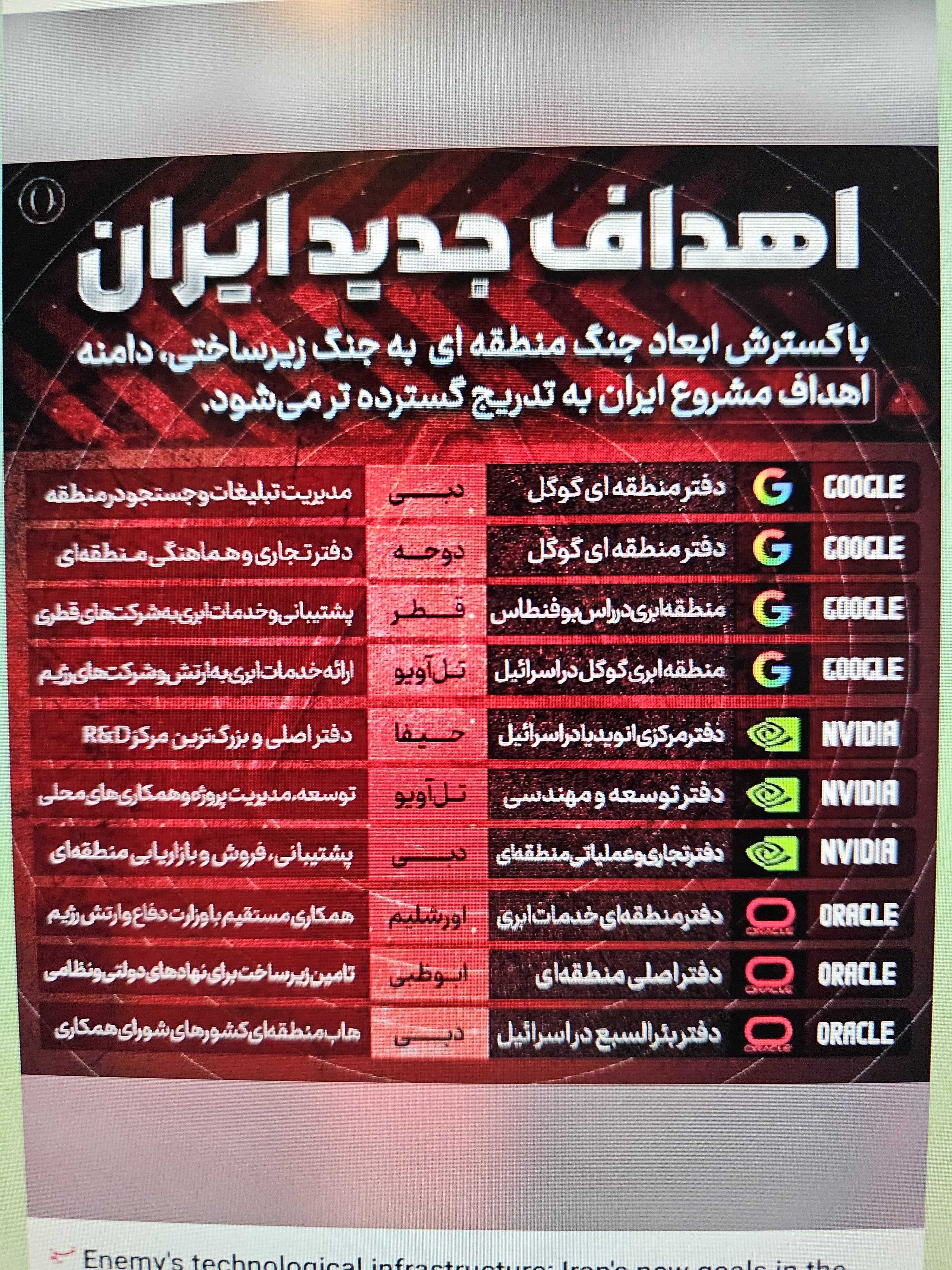
State news published a list of nearly 30 sites that could be targeted
Iran has reportedly designated Amazon, Google, IBM, Microsoft,
Nvidia, Oracle, and Palantir facilities as legitimate targets of
retaliatory strikes, according to an Al Jazeera report citing Iran’s
state-affiliated Tasnim news agency.
The Islamic Revolutionary Guard Corps (IRGC) has pinpointed 29
locations in Bahrain, Israel, Qatar, and the United Arab Emirates that
house offices, datacenters, and research facilities that Iran has set
its sights on destroying, according to Tasnim’s Telegram channel.
This comes a week after Iran said it deliberately targeted three AWS datacenters in the region.
The list was presented under the title “Iran’s New Targets.” It
included five Amazon facilities, five Microsoft, six IBM, three
Palantir, four Google, three Nvidia, and three Oracle buildings.
Iran state media telegram messages threatening US companies - Click to enlarge
Iran state media telegram messages against US companies - Click to enlarge
Iran state media telegram messages threatening Amazon and others - Click to enlarge
The targets, described as the “enemy’s technology infrastructure,”
were presented in three slides on Telegram and included the name of the
vendor, the nature of the facility, the location, as well as a brief
description of their work.
“As the regional conflict expands into infrastructure warfare, Iran’s
legitimate targets are gradually expanding,” the Tasnim post stated....
I'm not sure why Disney is in the headline. It might be related to the Star Wars franchise and/or Jafar, the grand vizier in Aladdin sharing a couple character traits with some of the mullahs.
The Nifty IT index has plunged 21%, marking its steepest monthly fall in nearly 23 years, amid fears that rapid AI-led automation could disrupt India’s $300-billion IT services model
Indian shares have lagged their Asian
and emerging market peers so far in February, pressured by a
$68.6 billion rout in the market value of information technology
stocks, as investors fretted over disruptions linked to
artificial intelligence.
The Nifty 50 index has risen 0.4% so far this month,
while the Sensex edged 0.1% lower, underperforming both
the MSCI Asia ex-Japan and MSCI Emerging Markets indexes.
The 10 Nifty IT constituents have lost a combined
$68.6 billion in market capitalisation in February, as of the
last close, with the index down 21% and on course for its worst
monthly performance in nearly 23 years.
All 10 index members have fallen between 16.8% and 27% in
February to date. Coforge is the steepest percentage
decliner, down 26.8%, while Tata Consultancy Services
and Infosys have led the value erosion, losing about
$21.9 billion and $16.3 billion in market value, respectively.
The selloff reflects growing concerns that rapidly advancing
automation tools could compress project timelines and disrupt
the labour-intensive delivery model underpinning India's roughly
$300-billion IT services industry.
Investors have zeroed in on the AI-driven automation push
from U.S. firms such as Anthropic and Palantir, heightening
concerns over faster project execution, pricing pressure and
reduced billable hours.
Brokerages warn the Indian IT sector could face further
pressure if AI starts to eat into application services revenue,
which typically accounts for 40% to 70% of total revenue for
these companies.
"There are no easy answers to whether AI eventually renders
IT services obsolete over the long term," said analysts led by
Abhishek Pathak of Motilal Oswal.
"The narrative that AI is coming for not just IT but large
swathes of the economy could be too strong to shake, at least in
the short term," Motilal Oswal analysts said....
This is a pretty good look at the spook shop vehicle.
As a side note, back in the early years of this century, especially
immediately after the mass murders of 9/11, it was thought that
investing alongside In-Q-Tel was the cool thing to do.
It took a while for the realization to sink in that they weren't necessarily in it for the money return to the VC's....
And the headliner from Fortune, July 29, 2025:
In-Q-Tel was founded in 1999 by the CIA—yes that CIA, the
Central Intelligence Agency—with the mission of closing a perceived
innovation gap between Washington’s security establishment and Silicon
Valley. Inventions like the Molar Mic are the reason In-Q-Tel exists.
Over its 26 years in business, the fund has helped launch more than 800
companies. Of the companies in this year’s NatSec 100 Report,
an annual index of the fastest-growing venture-backed defense startups,
In-Q-Tel is an investor in 32—far more than any other fund.
Some of the companies the fund backs are publicly known, others are
secret—as is the total amount of money In-Q-Tel has invested since it
began. (Fortune’s estimate, informed by the last 25 years of
In-Q-Tel’s tax disclosures, is at least $1.8 billion and likely more.
But In-Q-tel itself, and sources close to it, declined to share or
discuss any numbers.) Whatever the amount, by and large, the companies
In-Q-Tel picks are all building technologies judged to be vital for U.S.
national security.
What’s more, when it finds a winner, more traditional venture
investors often follow its lead. Some of In-Q-Tel’s picks have grown to
become big players in their own right. Early on, the fund backed the
autonomous weapons maker Anduril, which was last valued at $14 billion.
In-Q-Tel also backed Palantir, supplier of big-data analytics to the
military and intel agencies. Palantir may well be the clearest sign that
Silicon Valley has shacked up with the Pentagon for good: It was
recently valued at $250 billion, surpassing traditional defense
contracting titans like Northrup Grumman, Lockheed Martin, and General Dynamics, even though its revenue, at under $3 billion last year, is just a fraction of that of those giants.
It’s possible, even likely, that you have one of In-Q-Tel’s biggest
successes installed on your phone now. In 2003, In-Q-Tel invested in a
mapping company called Keyhole that was looking to build a tool for the
Pentagon’s National Imagery and Mapping Agency. Within weeks, according
to In-Q-Tel, the agency had put Keyhole’s technology to work supporting
U.S. troops in Iraq. Two years and one acquisition later, a new,
commercial version of the product launched. The new owner called it Google Earth.
Organizationally, In-Q-Tel is an odd duck. It’s an independentventure
capital fund, but it contracts exclusively with the federal government.
Tax records show that it’s sitting on roughly $1 billion in assets, but
it operates as a nonprofit. The Virginia-based fund’s nearly 200
employees are charged with finding and funding companies whose
technology could help the U.S. intelligence community or Defense
Department. In-Q-Tel currently receives around $100 million in
additional taxpayer money per year to invest. It puts the companies it
picks in touch with end users inside the government to refine their
products, all in hope of yielding tech that’s both commercially
successful and useful to people protecting U.S. national security.
In a moment when defense tech has suddenly become a hot enough
commodity that venture capitalists are venturing to Washington in force,
In-Q-Tel is something of an elder statesman. It stands as a quiet
corrective to the idea that Elon Musk’s Department of Government
Efficiency was the first time startup-style disruption touched the
federal government. For 25 years, In-Q-Tel has been teaching the
Pentagon how to fail fast and be agile.
“It’d be great for them to get credit for the consistency of the work
they’ve been doing when this stuff was not a fad,” says Paul Kwan, a
managing director at General Catalyst, a venture fund with $32 billion
under management that has backed Airbnb, Stripe, and Instacart.
On several occasions, General Catalyst has taken note of In-Q-Tel’s
early picks and coinvested. That’s not unusual. In-Q-Tel has said that
for every dollar it invests in a company, commercial VCs can usually be
counted on to invest around $40 more.
Kwan says this halo effect in part grows out of the cadre of experts
that In-Q-Tel keeps on staff. Unlike traditional VCs, they subject
candidate companies to intense, in-house technical vetting before
funding them. “It is a giant proctology exam, but it’s worth it to get
that stamp of approval,” he says.
In 2004, a researcher at the Air Force Institute of Technology
interviewed CEOs of a dozen companies who’d received backing from
In-Q-Tel. One of them described the vetting process as having “a bunch
of PhDs sitting in my office for two or three months asking questions
that no commercial customer, even Fortune 500 customers, had asked us.”
He also noted, “These people really get in your shorts.”
In-Q-Tel’s CEO, Steve Bowsher, has spent a decade and half working to
keep that process going. He’ll be the first to celebrate the
high-dollar, high-profile successes. “If we make money as part of that,
that’s great,” he tells Fortune. “But that’s not the primary goal.”
The goal, Bowsher says, is what In-Q-Tel internally describes as
“pilots and adoptions”: that is, testing startups’ tech with people
inside the U.S. government and then seeing whether they permanently put
it to work. Which is to say, unlike maybe every other investor across
the landscape of capitalism, these investors are specifically not obsessing about whether their investments make money.
In a sense, In-Q-Tel measures success with benchmarks that are
anything but financial. One is cultural: prodding the U.S. national
security apparatus, and the companies that serve it, to change their
sometimes-sluggish ways. The other is more personal, and felt keenly by
anyone involved in national security: having the latest technological
edge helps save American lives.
Inspired by James Bond movies In 1998, it felt like the world had become digital, seemingly overnight. That year marked the founding of Google, the release of the iMac, and America Online’s purchase of Netscape for more than $4 billion. World-changing technology was coming out of California. Washington, D.C., was playing catch-up.
Among the security insiders taking notice was Sue Gordon, a career
CIA officer who later rose to become the second-highest-ranking
intelligence official in the U.S. government. Gordon was the driving
force who got In-Q-Tel up and running. (I interviewed her for a podcast
in 2024, and again for this story in June.)
“Silicon Valley couldn’t find their way into the CIA and national
security community because it’s tuned for the big guys in the defense
industrial base,” Gordon told me last year. “We knew that the good stuff
was happening in Silicon Valley. But…we needed to go outside to get
access.” One solution, she felt, would be to set up an investment fund
that would bridge those worlds—to jump-start companies building
cutting-edge spy tech, and then put that tech into the hands of the U.S.
agencies that needed it most.
Gordon says she still has a napkin from the bar at the legendary
Hay-Adams Hotel in D.C., where she and a couple of fellow In-Q-Tel
founders first brainstormed names for the organization. And yes: The “Q”
was a deliberate reference to the Bond movies. “I insisted,” Gordon
tells me. “All the stuff that Q would bring out was the coolest part of
the movies.”
Gordon enlisted the help of Michael Crow, then an administrator at
Columbia University specializing in science policy. Crow, who’s now
president of Arizona State University, is the chair of In-Q-Tel’s board.
He says one of the biggest hurdles standing between In-Q-Tel and launch
was the byzantine set of rules the U.S. government has for procuring
defense equipment. Bureaucrats were initially allergic to In-Q-tel’s
plans to pilot new tech quickly, and some legacy contractors felt
threatened.
“It sort of blew up the whole notion of procurement,” Crow says.
“Administrative-type people were like, ‘Well, we gotta kill this
thing.’”
But In-Q-Tel survived the initial opposition, in part, by making
itself indispensable. One key feature was a system that Bowsher put into
place not long after he joined the fund as managing partner in 2006.
Borrowing an idea from private equity firms where friends of his had
worked, Bowsher trained a cadre of associates whose job was essentially
what he calls “dialing for deals”—scouring magazines, newspapers, blogs,
and newsletters for promising companies, cold-calling them, and set up
meetings to learn about their business.
“It’s very easy just to look at all the business plans that someone
proactively submits to you and feel like, ‘Hey, I’m looking at a lot of
deals and right now I’m picking the best ones.’” Bowsher says. “You got
to figure out, am I seeing quality deals here?”
He says In-Q-Tel now looks into around 1,000 or so companies per
year, with a roughly 50-50 split between makers of hardware and
software. That work helps In-Q-Tel widen its aperture to see the
broadest possible swath of new tech, Bowsher says. Just as important, it
writes up its research on bleeding-edge startups—making itself useful
to the intelligence community, even when it comes to companies in which
it doesn’t invest.
“One director of science and technology at CIA said to us one time,
‘One of the value propositions of In-Q-Tel to me is: no surprises,’”
Bowsher says. This official told Bowsher that whenever he’s told about
technology that could affect the CIA’s mission, he’s consistently able
to say, “I know about that technology. In-Q-Tel briefed me on it six
months ago.”
Learning to fail fast Bowsher is originally a son of Washington. His father spent most of his career in government—as a CPA running the U.S. Navy’s budget, and later as a comptroller general at the GAO, Congress’s auditing and investigative office. After getting a BA from Harvard, Bowsher headed west to attend Stanford Business School and stayed in Silicon Valley to work for several startups. The first one—attempting to launch multiplayer online video gaming in the dial-up era—crashed and burned.
“It’s a [multi-]billion-dollar industry right now, right? My son
spends hours playing video games. We were just too early,” Bowsher says.
“Those signs were all there and I missed them.”....
I prefer "...or you can't have any pudding" but there's no accounting for taste in music.
From The New Atlantis, Summer 2025 edition:
The new cold war means a race with China over AI, biotech, and more. This poses a hard dilemma: win by embracing technologies that make us more like our enemy — or protect ourselves from tech dehumanization but become subjects to a totalitarian menace.
In “Darwin Among the Machines,” a letter to an
editor published in 1863, the English novelist Samuel Butler observed
with dread how the technology of his time was degrading humanity. “Day
by day,” he wrote, “the machines are gaining ground upon us; day by day
we are becoming more subservient to them.” For the ironical Butler, the
solution was simple: kill the machines. “War to the death should be
instantly proclaimed against them. Every machine of every sort should be
destroyed by the well-wisher of his species.”
In his later novel Erewhon, Butler imagined a people who
take his advice and smash their machines — the inspiration for the
“Butlerian Jihad” in Frank Herbert’s Dune. But to make his
central conceit plausible, by the loose rules governing a Victorian
satire, Butler had to drop the society of Erewhon in the middle of
“nowhere” (an anagram of the name), in a remote valley cut off from the
rest of the world. The Erewhonians, Butler recognized, would never have
survived centuries of Luddism anywhere else: they would have vanquished
the machines only to be vanquished by an antagonist lacking their
technological caution. In the real world, Butler suggests, we face a
choice: Will you preserve your humanity or your security?
This may be just the choice we face today. From Washington, D.C. to
Silicon Valley, champions of new technologies often argue, with good
reason, that we must embrace them because, if we don’t, the Chinese will
— and then where will we be?
Driven by geopolitical pressures to accelerate technological
development, particularly in AI and biotech, we seem to have two
options: channeling innovation toward humane ends or protecting
ourselves against competitors abroad.
To appreciate the difficulty of this choice, we should take a page
from military theorists who have wrestled with what is known as the
“security dilemma.” Even though it is one of the most important concepts
in international relations, it has been given little attention by those
grappling with the promises and challenges of new technologies. But we
should, because when we apply its core insights to technological
development, we realize that achieving a prosperous human future will be
even more difficult than we tend to think.
The Dilemma The security dilemma, as described by the political scientist Robert Jervis in a 1978 paper, is that “many of the means by which a state tries to increase its security decrease the security of others.” Take two nations that don’t know each other’s warfighting capabilities or intentions. With a questionable neighbor next door, one side reasons, it’s only sensible to build up a reliable defense, just in case. But the other nation has the same thought, and similarly proceeds to boost its armaments as a precaution. Each nation sees the other militarizing, which justifies its own defense build-up. Before long, we have a frantic arms race, each nation building up its military to surpass the growing military next door, spiraling toward a conflict neither actually desires.
The dilemma is this: each nation can either militarize, prompting the
other to reciprocate and heightening the risk of an ever-more-violent
war; or not militarize, endangering itself before a power that is
suspiciously expanding its arsenal. The dilemma suggests that each
nation can be all but helplessly compelled to militarize but then is no
better off than before, for the other nation is doing the very same. In
fact, everyone is worse off, as the stakes and lethality of a
looming war continue to rise. Perverse geopolitical incentives drive
both sides to rationally pursue a course of action that harms them both.
It’s no coincidence that the dilemma was first articulated in the
1950s, amid the Cold War menace of mutual assured destruction. But its
underlying logic applies not only to national defense per se but also to
technological innovation broadly.
Consider how geopolitical pressures motivate technological
advancement. World War II spurred the development of cryptography and
early computers, such as America’s ENIAC and Britain’s Colossus. The
Cold War rivalry between America and the Soviet Union prompted their
race to be the first to put a man on the Moon. And in the 1980s, Japan’s
prowess in the semiconductor industry motivated America to launch state
projects, like the SEMATECH consortium, to remain competitive.
Just as with the security dilemma, deciding not to act in response to
these pressures is a recipe for failure, because it risks making one as
helpless against one’s competitors as the armored knight against the
musket. Whichever side is technologically superior will gain the upper
hand — economically, geopolitically, and, down the road, militarily. So
each side, if it hopes to survive, mustadopt the more sophisticated technology.
But the risk of this trajectory is not only to other nations, as with militarization itself — it is potentially to one’s own people.
As every modern society has come to experience, technological
innovation, despite the countless ways it has improved our lives, can
also bring not just short-term economic instability and job loss, but
also long-term social fracture, loss of certain human skills and agency,
the undermining of traditions, and the empowerment of the state over
its own people.
In what we might call the “technological security dilemma,” each
nation faces a choice: either pursue technological advancement to the
utmost, forcing your competitors to reciprocate, even if such
advancement jeopardizes your own citizens’ wellbeing; or refuse to do so
— say, out of a noble concern that it threatens your people’s form of
life — and allow yourself to be surpassed by an adversary without the
same concern for its people, or for yours.
As Palantir’s Alex Karp and Nicholas Zamiska recently put it in their book The Technological Republic,
“Our adversaries will not pause to indulge in theatrical debates about
the merits of developing technologies with critical military and
national security applications. They will proceed.” So if a nation won’t
accept one horn of the dilemma, allowing its geopolitical standing to
falter and putting itself at the mercy of the more advanced nation, then
it must choose the other, adopting an aggressive approach to
technological development, no matter what wreckage may result.
The question is whether that nation can long enjoy both its tech dominance and its humanity. China or U.S. — ‘There Is No Third Option’ Today, the technological security dilemma is the very situation America finds itself in with China.
Consider artificial intelligence. Venture capitalist Marc Andreessen writes that “AI will save the world,”
but also that it could become “a mechanism for authoritarian population
control,” ushering in an unprecedentedly powerful techno-surveillance
state. It all depends on who is leading the industry: “The single
greatest risk of AI,” he writes, “is that China wins global AI dominance
and we — the United States and the West — do not.” In a similar vein,
Sam Altman once said
on Twitter — when he was the new president of Y Combinator in 2014 —
that “AI will be either the best or the worst thing ever.” The
difference, he said a decade later, now writing as CEO of OpenAI in the Washington Post, is whether
the AI race is won by America with its “democratic vision,” or by China
with its “authoritarian” one. Our own good AI maximalism is thus “our
only choice” for countering their bad AI maximalism.
But in that case, the AI boosters’ arguments for its benefits and
their refutations of popular fears are almost beside the point. As the
technological security dilemma suggests, even if all of AI’s speculated
downsides were to come about — mass unemployment, retreat into
delusional virtuality, learned helplessness among all who can no longer
function without ChatGPT, and so forth — we would still need to accelerate AI to stay ahead of China.
A world run by China’s AI-powered digital authoritarianism would
indeed be a nightmare for the United States and everyone else, marked by
a total disregard for individual privacy, automated predictive policing
that renders civil liberties obsolete, and a global social credit
system that blacklists noncompliant individuals from applying for
credit, accessing their bank accounts, or using the subway. How then can
we afford to deliberate about AI’s impact, much less slow down its
advancement? Its potential domestic harms, the dilemma suggests, are the
necessary price to pay for our national security.
It would therefore be a mistake to dismiss the arguments from Andreessen
and Altman as nothing more than self-serving P.R. tactics to lobby for
government favors. They are getting at something fundamental: in a
technological arms race, the only rational action is to try to win. Once
China has entered the race for technological dominance in AI, America,
if it wishes to maintain its own political independence and avoid
becoming China’s vassal state, has no choice but to enter the race as
well, no matter what damage results. As Altman puts it, “there is no
third option.”....
I am unsure about both the veracity and the spin on this story but it fits with some previous observations, links below.
From The Guardian, November 29:
At a time when distrust of big tech is high, Silicon Valley is embracing an alternative ecosystem where every CEO is a star
A
montage of Palantir’s CEO, Alex Karp, and waving US flags set to a
remix of AC/DC’s Thunderstruck blasts out as the intro for the tech
billionaire’s interview with Sourcery, a YouTube show presented by the
digital finance platform Brex. Over the course of a friendly walk
through the company offices, Karp fields no questions about Palantir’s controversial ties to ICE
but instead extolls the company’s virtues, brandishes a sword and
discusses how he exhumed the remains of his childhood dog Rosita to
rebury them near his current home.
If
you are looking to hear from some of tech’s most powerful people, you
will increasingly find them on a constellation of shows and podcasts
like Sourcery that provide a safe space for an industry that is wary, if
not openly hostile, towards critical media outlets. Some of the new
media outlets are created by the companies themselves. Others just
occupy a specific niche that has found a friendly ear among the tech
billionaire class like a remora on a fast-moving shark. The heads of
tech’s largest companies, including Mark Zuckerberg, Elon Musk, Sam
Altman, Satya Nadella and more, have all sat for long, cozy interviews
in recent months, while firms like Palantir and Andreessen Horowitz have branched out this year into creating their own media ventures.
At a time when the majority of Americans distrustbig tech and believe artificial intelligence will harm society,
Silicon Valley has built its own network of alternative media where
CEOs, founders and investors are the unchallenged and beloved stars.
What was once the province of a few fawning podcasters has grown into a
fully fledged ecosystem of publications and shows supported by some of
the tech industry’s most powerful.
While
pro-tech influencers like podcast host Lex Fridman have for years formed
a symbiotic relationship with tech elites like Elon Musk, some firms
have decided this year to cut out the middleman entirely. In September,
the venture capital firm Andreessen Horowitz announced that it had
launched an a16z blog on Substack. One of its prominent writers,
investor Katherine Boyle, has a longstanding friendship
with JD Vance. Its podcast has meanwhile grown to more than 220,000
subscribers on YouTube, and last month hosted OpenAI’s CEO, Sam Altman,
who counts Andreessen Horowitz as a major investor.
“What
if the future of media isn’t controlled by algorithms or legacy
institutions, but by independent voices building directly with their
audiences?” the firm wrote in its Substack announcement. The firm once
invested $50m in the digital media upstart BuzzFeed with a similar
vision, only to see it fall into penny stock territory.
The
a16z Substack also announced this month that the firm was launching an
eight-week new media fellowship for “operators, creators, and
storytellers shaping the future of media”. The fellowship includes
collaborating with a16z’s new media operation, which it describes as
being made up of “online legends” creating a “single place where
founders acquire the legitimacy, taste, brandbuilding, expertise, and
momentum they need to win the narrative battle online”.
In
addition to a16z’s media effort, Palantir launched a digital and print
publication earlier this year called the Republic that mimics academic
journals and thinktank-style magazines like Foreign Affairs. The journal
is funded by the Palantir Foundation for Defense Policy and
International Affairs, a non-profit of which Karp is the chair, though
he only works there 0.01 hours per week, according to 2023 tax filings.
“Far
too many people who should not have a platform do. And there are far
too many people who should have a platform but do not,” states the
Republic, which has an editorial team made up of senior Palantir
executives.
A sampling of the articles the
Republic has published includes an essay arguing that US copyright law
restrictions will prevent US AI dominance and another from two Palantir
employees on how Silicon Valley working with the military is good for
society, a point Karp has himself made many times.
The
Republic joins a burgeoning set of pro-tech publications like Arena
magazine, which was founded late last year by the Austin-based venture
capitalist Max Meyer. The outlet takes its motto, “The New Needs
Friends”, from Disney’s film Ratatouille.
“At
Arena, we don’t cover ‘the news.’ We cover The New,” a letter from the
editors stated in its inaugural issue. “Our mission at Arena is to cheer
on the people who are, slowly but surely – and sometimes very quickly! –
bringing the future into the present.”....
.....Over the past two years, Bankman-Fried cultivated the media lavishly, if
not carefully. Drawing on what then seemed like an unlimited pool of
cash, SBF (as we’ll call the mythologized version of the real person)
dispersed investments, advertising dollars, sponsorships, and donations
to key news outlets—including ProPublica, Vox, Semafor, and The
Intercept—with extraordinary effectiveness.....
....The most worrying fact to be reiterated is that ChatGPT has no
commitment to the truth. As the MIT Technology Review puts it, large
language model chatbots are “notorious bullshitters”. Disinformation,
grifting and criminality don’t generally require a commitment to truth
either. Visit the forums of blackhatworld.com, where those involved in
murky practices trade ideas for making money out of fake content, and
ChatGPT is heralded as a gamechanger for generating better fake reviews,
or comments, or convincing profiles....
*****
It was at this point I started laughing.
That line "...has no
commitment to the truth." followed by “notorious bullshitters” reminded
me of a story in the Guardian in 2018.
They employ someone called
Luke Harding who [co-]wrote a story that ran in the paper on Tue 27 Nov
2018 09.23 EST. Going on five years ago:
Manafort held secret talks with Assange in Ecuadorian embassy, sources say
Trump ally met WikiLeaks founder months before emails hacked by Russia were published
Donald Trump’s former campaign manager Paul Manafort held secret talks
with Julian Assange inside the Ecuadorian embassy in London, and visited
around the time he joined Trump’s campaign, the Guardian has been told.
Sources have said Manafort went to see Assange in 2013, 2015 and in
spring 2016 – during the period when he was made a key figure in Trump’s
push for the White House.
In a statement, Manafort denied meeting Assange. He said: “I have never
met Julian Assange or anyone connected to him. I have never been
contacted by anyone connected to WikiLeaks, either directly or
indirectly. I have never reached out to Assange or WikiLeaks on any
matter.”
It is unclear why Manafort would have wanted to see Assange and what was
discussed. But the last apparent meeting is likely to come under
scrutiny and could interest Robert Mueller, the special prosecutor who
is investigating alleged collusion between the Trump campaign and
Russia....
The
thing to remember, for our readers who were going on about their lives
rather than trying to figure-out a money-making angle in that day's
headlines, was that what Harding, his editors and the Guardian claimed
was impossible.
At the time the story was published the Ecuadoran
Embassy in London was the most surveilled building in the world. The
British had it staked out, both MI5 and MI6 were keeping tabs on who was
coming and going, the Australians were down the block, the Americans
had a plan for a CIA assassination team to supplant the watchers [Yahoo broke that story],
Russia was there, I'm guessing Israel and maybe China too. The spooks
were tripping over each other there were so many different groups.
And none of them saw what Harding reported.
The
Ecuadorans didn't detect Manafort entering their embassy, no reports of
sounds emanating from the sewers as a rather chonky Manafort made his
subterranean way in, there were no articles about parachute
drops/vertical insertions reported by the dozen or so media types that
would come round to see if they could rustle up a story—though we did
see this scoop from American public radio:
But none of these, what may have been hundreds of watchers, saw what Luke Harding reported.And to this day the Guardian has not corrected or even appended an editor's comment to the reporting.If patient and long-suffering is interested, here is Mr. Harding as he "explains why he believes the Trump-Russia dossier is not ‘fake news’."Maybe just "to hell with all of them."
It is hard to tell if people like Jensen actually know anything or if they are grasping for justifications after a decision has been made; regardless of whether it is positive or negative for the stock. As for Burry, since deregistering his so-so hedge fund he's started a substack and reportedly has 25,000 subscribers paying $400 per year, so good on him.
From Business Insider, November 28:
Michael Burry has warned AI giants are overstating how long their Nvidia chips will stay relevant.
Bridgewater's Greg Jensen said the chips may be used to invent better chips that make them obsolete.
While Burry has warned about circular deals in AI, Jensen said Nvidia is building an ecosystem.
Michael Burry
of "The Big Short" fame has said some of the world's largest AI
companies are exaggerating how long their Nvidia chips will last to pad
their short-term profits. Now, one hedge fund boss has warned that those
chips could make themselves obsolete.
Greg Jensen,
the co-chief investor of Ray Dalio's Bridgewater Associates, told the
"In Good Company" podcast this week that the "depreciation schedule is
probably going to be quite fast, and you hope it has to be in a sense."
Jensen explained there's a "resource grab" in AI as companies compete for scarce land, energy, microchips, and scientists, and tech bosses are hoping AI itself can help.
"One
of the things they have to do is figure out how to make the chips more
efficient, make the energy more efficient, and they're trying to use AI
to do those things," he said.
Jensen predicted that some of the scientific advances that will "depreciate the current assets will come from those assets themselves," as "AI will generate better ways to do this."
Puts, deals, and ecosystems Burry shot to fame after his massive bet against the US housing bubble was immortalized in the book "The Big Short," and a movie adaptation starring actor Christian Bale as Burry.
He resurfaced
on X in late October after more than two years of silence. Since then,
he has sounded the alarm on an AI bubble, closed his hedge fund to
outside cash, launched a Substack to share his research, and disclosed
he owns bearish put options on Nvidia and another AI darling, Palantir.
Burry has taken aim
at the AI giants for dragging out depreciation from around three years
to six years or longer, pointing out that Nvidia is releasing new chips
faster and faster, so the current generation will likely lose value more
quickly....
Regarding the depreciation schedules for Nvidia's chips we were babbling about such things back in May before the commentariat became au courant.
Here we were using Nvidia's development cycle as a reason it might not result in China winning World War III if they got their hands on some cutting-edge-but-not-bleeding-edge chips:
....Which raises a second question. Is this story, here via UPI July 28, but also available on some of the tech sites, is this story already moot?
Security experts warn against selling Nvidia AI chips to China In letter to Commerce secretary, they say H20 AI chips can be used to support China's military.
Twenty national security experts and former government officials are
urging the Trump administration to reverse a decision earlier this monthto let Nvidia resume selling H20 AI chips in China.
They wrote a letter Monday
to Commerce Secretary Howard Lutnick, saying that the decision
announced two weeks ago was a "strategic misstep that endangers the
United States' economic and military edge in artificial intelligence
(AI) -- an area increasingly seen as divisive in the 21st-century global
leadership."....
On the one hand with that many chips floating around that part of the
world there is no way to keep a bunch of them from ending up in China.
On the other hand, Nvidia's development cycle is focused on releasing
new, more powerful chips every 12 -14 months meaning the current smoking
hot H100 chips will have been superseded by two cycles at the end of
the contract period.
note: the smuggled chips were not the ones destined for the UAE.
The second point is that the real technology transfer deterrent is in the pace of NVDA's development cycle.
Although
there are hiccups—most recently server racks overheating from the
amazing amount of electricity flowing through the systems—the
overarching goal is an almost metronomic rhythm to the development of
new chips such that the H20s will be out-dated in under 2 1/2 years.
That said, even outdated GPUs have economic value. It's not as though they decompose into their constituent elements, leaving a pile of silica to be swept up.
Turmoil on Earth is remaking the business of watching it from above, as geopolitical conflict has the sector taking a page from Palantir, blending satellite images with AI and other data to deliver near-real time intelligence.
If you’ve seen a bird’s-eye view of Earth
over the past decade, chances are it came from Colorado-based Maxar
Intelligence. From some 280 miles up, its powerful imaging satellites
have created an atlas of modern problems: the impacts of extreme
weather, the build-up of Russian tanks near the Ukrainian border, the
ruination of Khartoum and the decimation of Gaza, even the not-so-total
destruction of Iranian nuclear facilities by U.S. bombers.
What you may not have noticed: Last month, the Maxar brand was itself wiped out, after its private equity owner replaced it with a new moniker: Vantor.
The
new name reflects how the company that sees everything on Earth now
sees itself. Peter Wilczynski, Vantor’s chief product officer, points to
“the harsh V, which gives it that edge.” The edginess extends
to a slick new website, where fast-paced scenes on screens evoke Jason
Bourne, or Alex Karp. But unlike Palantir, where Wilczynski spent a
decade, or Anduril, a Vantor partner, the new name does not comefrom TheLord of the Rings, the touchstone for so many unabashed defense tech firms. Still, Wilczynski admits: “it could be Elvish.”
The Maxar makeover “reflects a broader crossroads for Earth observation,” says Jarkko Antila, the CEO of Kuva Space, a Finnish startup building a constellation of AI-equipped
hyperspectral nanosatellites, capable of monitoring any material on the
Earth’s surface. “Raw satellite imagery alone is less of a
differentiator. Combining imagery with AI-powered analytics and sensor
fusion to access real-time actionable intelligence is what customers
demand.”
The hard-edged, tech-forward revamp isn’t just marketing.
Maxar’s transformation reflects bigger shifts in the business of
watching Earth. A new wave of military and intelligence demand has led the satellite industry to double down on government work or even enter the market for the first time. According to Novaspace,
a consultancy, the data and services market for defense and intel
customers grew by 42% over the past five years, reaching $2.2 billion in
2024. National security work now represents more than 65% of the whole
earth observation data market.
Whereas
imagery satellite companies once leaned into civic applications, the
firms are increasingly turning to AI to rapidly analyze all kinds of
space data, and sharpening their focus on national security amid turmoil
here on Earth. “We’re experiencing growth across every region as
customers respond to the changing geopolitical climate,” Wilczynski
says. Vantor’s international business has grown by double digits this
year to around 100 government and corporate customers, with the bulk of
its contracts now with military and intelligence agencies, he adds....