Showing posts sorted by date for query dell nvidia. Sort by relevance Show all posts

Wednesday, October 21, 2026

"Nvidia reveals plans for an AI factory in a shipping container to build data centers in weeks, not months" (NVDA)

They may be safer than other things people contemplate putting in shipping containers: small nuclear weapons, chemical or biological weapons, really any weapons at all. See Israel's Mossad and Ukraine's Operation Spiderweb.

I say may be because really, who knows?

From Yahoo Finance via MSN, October 21:

Nvidia (NVDA) wants to reduce the time it takes for its customers to start generating revenue from its AI systems.

At its GTC event in Berlin on Wednesday, the company unveiled its DSX POD, a reference design for an AI data center packed into a box about the size of a standard shipping container.

Data center construction can take months, if not years, to get up and running. And because they don't start generating revenue until they begin processing AI tokens, the longer a data center takes to come online, the more expenses pile up.

The DSX POD is meant to serve as a faster, modular solution for companies that need access to data center capabilities sooner rather than later.

"The moment then you have to install these AI factories, and they're gigantic. And putting these AI factories into service takes months. If we could reduce that months, you know, from the moment that the systems are shipped to the moment that it's deployed and being operational, if we could reduce it from months to weeks or even a month, that will be completely game-changing for all of these AI factories," CEO Jensen Huang told Deirdre Bosa.

According to Nvidia, the Vera Rubin-powered DSX PODs will arrive on site, ready to be plugged into the power, cooling, and networking infrastructure, reducing deployment time from six months to 14 days....

....MUCH MORE 

And at the company, October 21:

NVIDIA Introduces DSX POD AI Factories to Accelerate Europe’s Infrastructure Deployment 

Factory-Built With a Global Ecosystem Including Bull, Dell Technologies, HPE, Lenovo, Schneider Electric and Vertiv, the New Reference Design Speeds Infrastructure Deployment From Months to Weeks, Accelerating Time to First Production Tokens....

....MUCH MORE 

Monday, July 27, 2026

"AI Stocks Crash After NVIDIA Plans to Finance $250 Billion OpenAI Buildout Are Reported" (NVDA)

Nvidia is down $10.00 (-4.84%). That's a lot of billions of market capitalization.

From 24/7 Wall Street, July 27: 

NVDA fell 5% and AMD dropped 8% after the WSJ reported NVIDIA may guarantee $250 billion for OpenAI's data-center buildout.

Dell slid 4% on AI-server demand fears while Oracle has fallen 20% over the past month on overlapping data-center exposure.

NVIDIA guides $91 billion in Q2 revenue and AMD's data center revenue grew 57% YoY, keeping the fundamental bull case intact despite today's selloff....

....MUCH MORE

Our post after the WSJ exclusive crossed the tape:

Not Good - "Nvidia in Talks With OpenAI to Guarantee $250 Billion Financing for Data Center"
Not good at all....

Also at 24/7 Wall Street:

SanDisk Sinks 12%, Micron Drops 5%, SK Hynix Falls 8% as China’s CXMT IPO Rattles Memory Stocks

And the earlier:

"China memory chipmaker CXMT skyrockets 470% in Shanghai debut"

Tuesday, June 2, 2026

"3 things businesses need to know from Nvidia’s Computex 2026 keynote" (NVDA)

Well, among other things ARM Holdings stock was up 15.7% yesterday, bringing the one-month gain to 96.32%:


TradingView 

And Marvell was up $14.43 (+7.04%) to $219.43 and another $48.64 (+22.17%) in this morning's pre-market trade after Mr. Huang said MRVL would achieve a trillion-dollar market cap.

Nvidia's CEO says a lot of things.*

From TechFinitive, June 1:

Nvidia CEO Jensen Huang kicked off Computex 2026 with a sonic boom of a bang this morning by claiming that it is going to reinvent the PC in exactly the same way that Apple reinvented the phone.

“Remember, 15, 20 years ago, we used to have an idea called a phone,” said Huang during the two-hour keynote speech. “Today, when you think about your phone, the one thing you don’t do with it is make phone calls. You do just about everything else. So that phone means something very different to you than a phone of the past.

“I am certain that what is going to happen here is that the PC ten years from now, and the PC you think about today… is going to be completely different,” he said. “Here’s my theory. [Just as] many houses have home theatres, lawnmowers, dishwashers, I can totally imagine that someday there’s an AI supercomputer in your house.”

Naturally, an AI supercomputer that will be running on Nvidia silicon. It’s no coincidence that Huang also announced RTX Spark, an AI-focused chip that will run Windows. More of that later in this article.

Huang’s vision is that rather than our current idea of a PC that you sit in front of, clicking and typing, in this future world the PC will be “running all of your agents, it’s running all of your assistants, and it’s doing all kinds of things for you all the time”.

But that’s the future, one that sets the direction of travel for Nvidia and perhaps the entire PC industry. Against that backdrop, here’s a run-through of five immediate announcements that we think businesses, enterprises and large organisations should take note of.

AI supercomputer on every enterprise desk

While Huang’s vision of an AI supercomputer in every house seems a little distant, it has already announced an AI supercomputer for every desk in an enterprise. This echoes Bill Gates’ successful prediction, made in 1993, of a computer in every home.

The enterprise AI supercomputer in question is the Nvidia DGX Station for Windows. Based on the Nvidia GB300 Grace Blackwell Ultra Desktop Superchip (Nvidia is not afraid of superlatives) it can pack up to 748GB of memory and provides up to 20 petaflops of FP4 performance....

....MUCH MORE 

In March 2024 Huang literally shone the spotlight on Michael Dell at the March GTC confab. It took a while for the market to catch on but catch on it did:


5 years—TradingView 

As the old-timers used to say: "Pay attention or pay the offer." 

Monday, June 1, 2026

Nvidia Just Set The Second-Largest Market Cap Gain In History (NVDA)

If my abacus is working correctly today's gain is just under a third-of-a-trillion-dollars, $320 billion.

That is second only to:

Nvidia,  July 31, 2024  - $327 billion.

But exceeds the other contenders:

Nvidia, Feb 22, 2024 - $277 billion

Nvidia  May 23, 2024 - $218 billion

Apple  June 11, 2024 - $215 billion

—Visual Capitalist,  Ranked: Top 10 Single-Day Market Cap Gains

The headline this morning from WCCFTech was: "Taipei's "Computex 2026 Will Be NVIDIA’s Biggest Event Of The Year. Here’s What To Expect" (NVDA)" 

And Sunday:

"Nvidia, Microsoft preparing AI PCs, source says" (NVDA; MSFT; DELL) 

Sunday, May 31, 2026

Taipei's "Computex 2026 Will Be NVIDIA’s Biggest Event Of The Year. Here’s What To Expect" (NVDA)

From WCCFTech May 30:

Although CES 2026 was a massive disappointment for consumers, Computex 2026 looks to inject some much-needed excitement back into the beleaguered tech space.

In what is arguably the biggest consumer hardware launch of the year, Nvidia and ARM have already started teasing their highly anticipated N1X laptop chip, an APU based on the same GB10 chip used in the DGX Spark. Now, as Jensen prepares to take the stage at Computex next week, let's take a look at what Nvidia has planned for the show.

Nvidia's Laptop Chip Finally Launches, Packing 20 CPU Cores With An RTX 5070 Equivalent GPU 

Nvidia, Arm, and Microsoft have taken Twitter by storm recently, with a series of cryptic X posts declaring "A new era of PC", accompanied by coordinates pointing to Taipei Music Center. This obviously refers to the much-anticipated N1X laptop APU, packing 20 ARM cores and 6,144 CUDA cores into a single package, all sharing a unified memory pool over a 256-bit LPPDR5X bus. 

In theory, this should put N1X ahead of AMD's strongest APU, but as we've seen with Qualcomm's laptop chips, real-world gaming performance is still hit-or-miss on ARM-based CPUs, not to mention the significant memory bandwidth deficit with LPDDR5X. Another important note is that although the GPU has the same core count as a desktop RTX 5070, power consumption will be significantly lower, so expectations should be kept in check.

Obviously, the real draw with N1X will be the ability to allocate massive amounts of VRAM to the GPU from the shared memory pool. This will allow users to run intelligent, 100B+ parameter LLMs locally, just as we've seen with Strix Halo in its 128GB config. Nvidia's advantage here will be more robust, day-one support for various AI applications, as despite AMD's massive leaps with ROCm recently, CUDA remains king for crucial consumer use cases such as image and video generation.

In terms of partners for this launch, Dell, Lenovo, and ASUS have each either accidentally leaked confirmation of N1X models or hinted at such. HP hasn't teased (or leaked) anything yet, but they'll likely have models available too. Prices are still up in the air, but given that Strix Halo laptops with 128 GB of RAM retail for close to $3k nowadays, I'd expect a figure north of that for equivalently spec'd N1X laptops.

Vera Rubin, Nvidia's Complete "AI Factory" Platform, Rolls Out....  

....MUCH MORE 

Counterpoint Research also has an overview, May 29:

Computex 2026: Agentic AI & Physical AI Reshaping the Computing Landscape

NVIDIA Remains in Spotlight:

AI is no longer confined to research. From energy and infrastructure to chips, models, and applications, the entire AI industry is rapidly developing. Vera Rubin, the successor to Blackwell, scales from rack-level to cell-level systems and is designed specifically for the era of agent-based AI. NVIDIA also stated that major hyperscale data center operators and system manufacturers are already deploying the platform. NVIDIA is building a complete AI platform, not just selling GPUs. With CUDA-X, MGX, and DSX, NVIDIA is building a complete AI infrastructure platform. NVIDIA also describes AI data centers as "token factories."

Agent-based AI will drive a new wave of computing demand. AI agents are rapidly entering personal computers, enterprise software, and work systems, creating enormous computing demand. This not only presents opportunities for GPUs but also provides new growth opportunities for CPUs in reinforcement learning and AI orchestration. NVIDIA will likely showcase the development of physical AI, including driverless taxis, autonomous vehicles, and humanoid robots.

Taiwan is becoming a key hub for the global AI industry. NVIDIA believes that AI will spawn a completely new industry, just like steam power, electricity, and the internet. Leveraging its semiconductor and supply chain advantages, Taiwan now holds a significant position. (GTC Taipei 2026 Highlights Expectations)

CPU to Become the Backbone of Agentic AI Infrastructure:
Last year, the focus was on core counts, node transitions, and ASICs. This year, we expect the focus to shift toward the CPU, as it is now the backbone of agentic AI infrastructure....
....MUCH MORE 

"Nvidia, Microsoft preparing AI PCs, source says" (NVDA; MSFT; DELL)

Via Tech in Asia, May 31:

Nvidia and Microsoft are expected next week to debut the first Windows PCs that use Nvidia chips as the main processor at Computex in Taipei and Microsoft Build in San Francisco, according to sources.

The lineup is expected to include Microsoft Surface devices, systems from Dell, a US-based computer maker, and other PC companies.

Microsoft is also expected to show Windows software that would let AI agents carry out tasks locally on PCs.

Nvidia was reportedly developing Arm-based central processing units (CPUs) for Windows in 2023.

The expected debut would follow a period in which Qualcomm was the only supplier of Arm-based CPUs for Windows laptops under its arrangement with Microsoft, which Arm chief executive Rene Haas said was set to expire in 2024....

....MUCH MORE 

Tuesday, March 17, 2026

Transcript: Analyst Q&A, Nvidia GTC, March 17, 2026 (NVDA)

From Investing.com, March 17:

On Tuesday, 17 March 2026, NVIDIA (NASDAQ:NVDA) presented at the Conference GTC Financial Analyst Q&A, highlighting its strategic advancements in AI and financial outlook. The company showcased strong growth prospects, driven by innovative AI systems and robust demand for its architectures. However, challenges in maintaining margins and competition were also discussed.

Key Takeaways

  • NVIDIA anticipates over $1 trillion in demand for its Blackwell and Rubin architectures by the end of 2027.
  • The company plans to allocate 50% of its free cash flow to stock repurchases and dividends.
  • NVIDIA is expanding its AI solutions, integrating CPUs and storage to enhance its AI factory platform.
  • The shift towards token-based models is reshaping the IT industry, with NVIDIA positioning itself as a leader in this transition.
  • NVIDIA’s customer base is diversifying beyond hyperscalers to include regional clouds and enterprises.

Financial Results

  • NVIDIA projects strong visibility in demand, with over $1 trillion expected for Blackwell and Rubin architectures through 2027.
  • Excluding other products like Feynman and Groq, the company sees potential for additional business growth.
  • Approximately 50% of free cash flow will be directed towards stock repurchases and dividends, with potential increases based on future growth.

Operational Updates

  • The rise of agentic systems marks a new inflection point in AI, enhancing NVIDIA’s growth trajectory.
  • NVIDIA’s AI coverage has expanded, adding platforms like Anthropic and Meta AI.
  • The company is focusing on optimizing AI inference with architectures like Groq, catering to diverse performance needs.

Future Outlook

  • NVIDIA plans to ship Vera Rubin before Groq, enhancing throughput with NVLink 72 and Vera Rubin Ultra NVLink 144.
  • The company aims to increase throughput and pricing, potentially boosting demand to $1.25 trillion if Groq is fully integrated.
  • Jensen envisions 99% of global compute focusing on inference, positioning NVIDIA at the forefront of AI innovation.

Q&A Highlights

  • Non-public AI companies are reportedly seeing revenue increases of $1 to $2 billion per week.
  • The IT industry, valued at $2 trillion, is expected to grow to $8 trillion, integrating OpenAI and Anthropic models.
  • Jensen emphasized NVIDIA’s value proposition, highlighting the importance of integrated hardware and software solutions.

For a detailed understanding, readers are encouraged to refer to the full transcript below.

Full transcript - Conference GTC Financial Analyst Q&A:

: Good morning, everyone. As we quiet the back room, I have a very important job. As a reminder, the content of this presentation may contain forward-looking statements, and investors are advised to read our reports filed with the SEC for information related to risks and uncertainties facing our business. With that, I will turn it over to Jensen and Colette.

Colette: All right. Good morning, everybody. I hope you enjoyed the presentation yesterday. Went a little bit longer, but I think it was an absolutely great summary for us. We’re gonna take this time to focus on your needs and some of the additional kind of questions you are. We’re gonna start with a couple, maybe the first slide or so, and then we’ll open it up for questions, and I’m gonna turn this over to Jensen with that.

Jensen: As I was saying yesterday, there were three inflection points in recent AI. The first one was generative AI, the second was reasoning, and we’re at the third inflection point now, and each one builds on the others. There’s a lot of technical reasons why each one of them built on the others, but here we are with the third inflection point, which is agentic systems. Agentic systems that are able to operate autonomously, that’s why they call them agentic, because they have agency. You can give them goals, and instead of just answering questions, they can now perform tasks. Tasks could be anything. Of course, one of the most popular applications of agentic systems is write software.

You know, engineers in your company, I’m sure, and engineers in my company for sure are using agentic systems all day long. What used to be a thing for engineers is, you know, when you come to work, they give you a laptop. Now when you come to work, they give you a laptop and tokens. Token budget is now a real thing. Every engineer is gonna have a token budget. You know, the idea that you would hire a $300,000 engineer and they spend no tokens in doing their job, you gotta ask the question, what are they doing?

It is very, very clear now that every engineer will have a lot of tokens that they will have to consume, and those tokens are going to be produced. Now, I just said something a second ago. If you just connected the dots, we used to be, when an engineer comes to work, software programmer, somebody comes to work, give them a laptop. That’s a tool. Today, we give them a laptop and tokens. Those tokens have to be manufactured. A computer used to be just a tool. A computer of the future is a manufacturing equipment. These computers, as you see, they’re no different than ASML manufacturing equipment of the future. They’re producing something that is sold. Just, it’s no different than a dynamo machine a long time ago that produced electricity.

These are manufacturing systems, and the energy efficiency of it, the production efficiency of it matters everything because it drives your revenues, okay? The third inflection point is here. As you know, OpenClaw. Oh, many of these things when they first drop, these open source projects, they seem like toys. You take a step back and just analyze what is OpenClaw on first principles, and I explained that yesterday. OpenClaw on first principles is really a computer, the operating system of an AI computer, a personal AI computer. It has all of the properties of a computing system. It has all the properties of an operating system of this new computer. You know, it manages resources, it schedules, it does IO, and, you know, it networks.

All of the properties of a fundamental computer it has, okay? You could see the red line is actually not the y-axis. The red line is its growth. That’s just the extraordinary thing. Every company in the world will now need to have it. What is your OpenClaw strategy? Every single software company, every single company needs to have an OpenClaw strategy. Just as we all had our Linux strategy, just as we all had to have an internet strategy, just what is your mobile cloud strategy? Now, the question is what’s your OpenClaw strategy? Okay? This is a very big deal. I wanted to answer the questions about what I said here a little bit more.

First of all, a year ago, I said that we had strong visibility of our Blackwell and Rubin shipments of $500 billion through 2026. I was standing in 2025, right? GTC 2025 was around, what was it? Was it March? April?

Colette: October.

Jensen: It was October?

Colette: October.

Jensen: Okay. October. I was standing there. You sure? It was October?

Colette: I’m sure.

Jensen: GTC DC or GTC. I said it twice, though. The first time I said it was GTC here, right?

Colette: I think you’ve been saying it twice.

Jensen: Yeah.

Colette: I don’t think all the way back.

Jensen: I see. Yeah. Okay. Anyways. Anyhow, in 2025, one of those months, I said that we have strong visibility of Blackwell plus Rubin demand, purchase orders and demand, okay? Very firm demand of $500 billion. There were a lot of questions from many of you that, you know, so where are we now? You wanted an update on where we are now, and I thought I’d give you guys an update. Where we’re standing right now and what month are we? Just for the record. March. Here we are in March. The end of 2027, as you know, is many more months away. I just wanna first let you guys know that.

However, because we’re building infrastructure and factories and the lead times for everyone is long, they wanna make sure they give us firm demand or give us purchase orders and firm demand as early as they can to secure their supply. Okay? We have strong confidence and visibility of $1 trillion plus. You know, it’s not a floating point number, you guys. Okay? It is also not 94 digits of accuracy, okay? We’re not counting cents. You can keep your cents. However, we have strong visibility of $1 trillion plus of Blackwell plus Rubin. The reason why it’s only Blackwell plus Rubin and not all of the other things that we sell is because I referenced it from the last year when I was only talking about Blackwell and Rubin. Does that make sense?

Last year we didn’t have Groq. Last year, we weren’t selling standalone CPUs. Last year, we didn’t have many of the things that we have to sell now, and it wouldn’t have made sense for me to include those today and not because we didn’t have those things yesterday. Does that make sense? Somebody nod, then I can continue. Okay? A couple of things. It’s only Blackwell and Rubin. It’s not Feynman. It’s not Rubin you know, Rubin Ultra. It’s not Vera standalone. It’s not Groq. Blackwell plus Rubin, we have high confidence, strong visibility, demand, forecast, purchase orders of $1 trillion+. We close businesses that we ship oftentimes, and we expect to close and ship more business between now and the end of 2027.

We expect to close, book, and ship more business on top of this between now and 2027. The reason for that is because we expect to be coming to work between now and the end of 2027. Now, unlike other businesses, because we build and complete systems of this quality, we can actually win, book, ship new business in the same quarter. Of course, you can’t do that if you have to build an ASIC or you know, obviously. If you don’t see it now, you’re not shipping it by the end of 2027. That’s not true for us. We build inventory. We have a pipeline of supply that.

We have to take care of customers who come out of the blue because they’re desperate for more compute. Does that make sense? When they’re desperate for more compute, and all of a sudden in the last day, they say, "You know, goodness gracious, I could use more," I would like to be able to say, and we are always in a position to say, "We’d be more than happy to help you." We’re also working on new customers, new markets, new regions that we haven’t put in here yet because we still have, well, about 21 months to go. Okay? I want you guys to understand what that $1 trillion is. It’s, by definition, going to keep growing. By definition, because what I compared it against, it will keep growing, and it’ll be larger than that.

A couple of things that I wanted to say, also, that last year was a really good year because 2025 was our year of inference, and I think we helped everybody understand that the price of the computer and the cost of the token, the price of the computer and the cost of the token are only marginally related. The price of the computer and the cost of the token. Remember, people are buying these computers to produce tokens. The effectiveness of the production of those tokens matter greatly. They’re not reselling the computer. If you bought a computer and it’s expensive, if you resold it, and that’s it, then it’s expensive. But you bought a computer, and it’s expensive because the technology’s incredible, but it produces tokens at such incredible rates.

You had simultaneously have purchased the most expensive computer and produced the lowest cost tokens. Does that make sense? This is what we do every day. This is our job. It is the reason why we deliver the value that we deliver. The value discrepancy that we deliver here, the two numbers that I just described, is how we’re able to secure our gross margins. We have to deliver, and we consistently deliver so much more value, which is tokens per second, which is tokens per second per watt. We deliver so much more value every single generation that customers would prefer to buy our next generation product at a higher price than our current generation product at a lower price. They prefer instantaneously to convert. The moment that Vera Rubin comes, it is smarter to install Vera Rubins than to continue to buy Grace Blackwells.

Are you guys following me? Somebody nod. Okay. The value is better even though the price is higher. I’m comparing these two systems because these are the two de facto systems in the world. Until you can beat these two systems, there’s no point buying something else. These two systems are incredibly hard to beat because Moore’s Law doesn’t give you 35x. Moore’s Law alone won’t do it. Building a faster chip won’t do it. You’re gonna have to build a faster lots of chips. 2025 was year in inference, and I think we demonstrated our inference leadership. Training to post-training to now inference. Then some of the other things that we did last year that was really great is we expanded the reach.

We expanded the number of AIs that now support our platform. Last year, 2025, we added Anthropic to our platform, which is net new. We added Meta AI, which is net new. We’re still working with Meta on all of the other stuff. Meta AI is a net new entity, and they have net new computing requirements. We can all acknowledge that last year, open source software, open source models really took off to the point where API inference service providers now see that open models probably represent, approximately represent the second most popular AI model. Meaning the first one, of course, is OpenAI into total number of tokens generated. In aggregate, open models represent number two. As you know, NVIDIA is the best platform for open models in the world. We are the standard for open models everywhere. Number one, OpenAI.

Number two, all the open models. Number three, Anthropic. Number four, xAI. Just take your list, keep working. I think NVIDIA’s coverage of models last year increased substantially, which explains our accelerating growth at a very large number. We are already a very large company, as you know, and we’re now accelerating. Our rate of growth is actually accelerating. Anyways, that’s I think about it. Oh, one last point. We love our hyperscaler partners, and we work very, very closely with them, but it’s important to understand that our relationship with hyperscalers is we’re not just selling to them. We attract customers for them. Having CUDA in their cloud brings all of the CUDA developers, all the AI natives, all the large companies that we work with.

Whenever we accelerate those large or small companies, we bring them, we train them, we have them hosted in the world’s CSPs. We are one of the best sales forces of the world’s CSPs. It is the reason why if you go down to the show floor, they have all of the largest booths. AWS has the largest booth here. Google Cloud has the largest booth here. Azure has the largest booth here. Oracle, giant booth here. CoreWeave, big booth here. Does that make sense? Because we bring customers to them. Why are they here? To sell to my developers. All of our developers only know how to program one thing. They only know how to program CUDA, and they only use CUDA-X libraries.

when we win and when we help those developers integrate NVIDIA, they land on one of our CSP partners. We are one of the CSP’s best sales forces. All right. However, we’re also seeing tremendous customer diversity outside of the CSPs. Regional clouds, industrial, enterprise on-prem, when Dell and Lenovo and HP, they’re all growing so fast and all the ODMs are growing so fast. A lot of that business go towards the right-hand side of that chart, the 40%. Most people see our business in the left 60%. The right 40% without NVIDIA’s full stack, the fact that we can build you the entire AI factory and the fact that all of the world’s open platforms run on top of NVIDIA, you have no hope addressing the 40%.

The net of this chart is this, a big part of that 60% is NVIDIA developers landing in the cloud. 100% of the 40% is impossible without full stack, without end-to-end. Was I successful in communicating that? It’s important to understand our business. We aggregate that whole thing into what is called accelerated computing, and it’s probably a disservice to you. Next year, we’re gonna separate it out a little differently. Well, in the future, we’re gonna separate it out a little differently, and it’s gonna look probably like this chart. You’ll see something like hyperscalers or something like that in 60% of it. Even when you see that, remember, a lot of those customers, we brought to the clouds.

On the right-hand side, that 40% is completely impossible if you just build a chip because they don’t buy chips. They buy platforms. Three messages all in one slide, which probably made your brain blew up, and therefore, I did it again. Was that helpful? You know what I should have done? I should have made three panels or three slides. It would’ve been a seven-hour keynote. But it would’ve been worth it. Okay. That’s it. Thank you. Questions?

: We’re opening it up for questions now.

Ben Reitzes, Melius Research: Hi, it’s Ben Reitzes, Melius Research. Thanks for having us here at this event. It’s amazing access that you guys provide. Congrats to you and the team for that. This is great. Jensen, last night, when we took a picture. By the way, you all can still like that picture. I need to beat last year’s record.

Jensen: What, what picture?

Ben Reitzes, Melius Research: Well, we took a quick picture, and I posted it.

Jensen: Uh-huh.

Ben Reitzes, Melius Research: I’m trying to beat last year’s likes.

Jensen: Oh, okay. All right.

Ben Reitzes, Melius Research: Yeah. Anyway.

Jensen: Was I in some vulnerable position or anything?

Ben Reitzes, Melius Research: Let’s put it this way. The camera added 10 pounds to me, but not to you. I don’t know how that works.

Jensen: Thank you.

Ben Reitzes, Melius Research: You look great. So, I promised I’d ask you an inference question, and this is related, is, you know. This is great. Like, I think a lot of people here get this. I think the main pushback we get is the juice worth the squeeze, and will the hyperscalers have upside to their revenues for API and cloud that justify all the spend, and what is Jensen seeing? Because, you know, I have estimates for the hyperscalers, and I’ve said there’s upside to the revenues. For now, the CapEx is 20% above their cloud/API revenue, and I’m wondering what you’re seeing. You’ve said in the past that there’s this massive upside to these cash flows and from your customers, particularly hyperscalers and those that are serving Anthropic and OpenAI. When do we adjust those higher?

I know this is a tough question for you because you got to guide for five other companies. If we see that upside, I think your stock will behave a lot better because then we’ll realize this build can keep going. When is this inflection? I mean, we’re seeing the inflection, but when is it, you know, what is the upside to their revenues, and how do we feel better about it?

Jensen: I wish those companies were public, and the reason for that is because then you’ll see what I see. No companies in history has ever grown as a startup company, non-public company. As a startup company, increased revenues by $1 billion or $2 billion a week. That’s what they’re experiencing right now. Now, remember, I just said a week. The entire IT software industry is, call it $2 trillion. That $2 trillion industry, I don’t believe is gonna be disrupted. I think it’s going to be transformed.

I believe that $2 trillion IT industry is going to integrate a combination of OpenAI, Anthropic, and open models and connect it with an open source software called OpenClaw that we turned into an enterprise-ready version called NemoClaw, and you have instantly an agent. 1.5 million people downloaded OpenClaw and built themselves an agent. It’s one line of code. Then you tell the agent to finish building itself. Oh, you don’t know this thing? Go learn it. It goes off and learn it, you know. In the future, those agents will be integrated into the IT industry. This IT industry is $2 trillion of software licenses today.

It’s probably going to be, let me just pick a random number, $8 trillion that also resells an enormous amount of tokens. 100% of the world’s IT industry will become resellers of OpenAI and Anthropic. Are you guys following me? No?

Ben Reitzes, Melius Research: Take your estimates up for OpenAI and Anthropic.

Jensen: I believe that Anthropic and OpenAI and of course all of the IT company will also modify and customize their own software, their own models with open models, and that’s what Nemotron’s for, and that’s what Nemo’s for and we’ve created all the tools, and that’s why we’re working with all of them. They’re all going to create agents that integrate these three components. I believe they’re gonna grow incredibly. The time is gonna come, it’s gonna come soon. The reason for that is you could see it in Anthropic’s numbers, you could see it in OpenAI’s numbers. They’re growing an entire IT company in a month. The revenues of these AI companies, their AI will be used by enterprise directly, but it’s also going to be resold through IT companies, integrated into IT companies. Does that make sense?

Ben Reitzes, Melius Research: Yep.

Jensen: Because just think of it, that AI is just software. Their software is gonna be offered directly to enterprises, but it’s also going to be integrated and become domain-specific and specialized, governed, secured, easily provisioned, connected to their system of records, so on and so forth. There’s gonna be a whole, you know, and that agentic system will be rented to customers, but they still would have to consume tokens through factories. If it comes down through OpenAI, that’s terrific. It comes down through Anthropic, that’s terrific. If it comes down through open models, that’s terrific. They all have to have tokens generated. The net-net is IT companies of the past license software. IT companies of the future will rent tokens, will generate tokens. Are you guys following me? Their business models will change. The companies will become bigger. Their gross margins will change.

Gross margin profile will change because they have COGS in their business model now. They offer greater, much, much more value. This is exciting for them. Super exciting for them.

Ben Reitzes, Melius Research: Okay, great. Passing this $8 trillion microphone.

C.J. Muse, Cantor Fitzgerald: Thank you. Good morning. C.J. Muse, Cantor Fitzgerald. Thank you for hosting this event. Really appreciate it.

Jensen: Yes, C.J.

C.J. Muse, Cantor Fitzgerald: Wanted to, I guess, maybe follow up on Ben’s question, and think about the evolution of this chart of 60/40. You know, you talked about NemoClaw, and then you announced yesterday the Vera Rubin DGX AI factory reference design, essentially, providing the blueprint for your non-hyperscale customers to compete with the hyperscalers. I’m curious, you know, as you put it all together, you see, you know, massive spike in token generation, how you’re expecting, you know, pretty much this chart to evolve over time, and how we should be thinking about the different players inside there, as to their relative kinda growth vectors....

....MUCH MORE 

Monday, March 16, 2026

As Nvidia's Developer Confab Kicks Off, Some Hard-Won Insight (NVDA)

Now that the GTC (GPU Technology Conference) has become much ballyhooed in the general media we don't see as much lift for the stock as in days of yore. Going into one of the conferences, either San Jose or Teipei it struck me that unless Mr. Huang can levitate into the auditorium, the media reaction is often "meh."

And so it goes.

Where we have seen some action is in the secondary and tertiary names. When they turned the spotlight (literally) on Michael Dell last year it was, not quite a sign from God but a pretty good tell on the action:


TradingView, 1-year

Up 61% over the twelve months.

And from Investor's Business Daily, March 16: 

AI Stocks: Nvidia GTC News Could Jolt Broadcom, Dell, CoreWeave, Arista, Lumentum  

As volatility in artificial intelligence stocks plays out in 2026, Nvidia's (NVDA) GTC this week could jolt a wide range of companies beyond the chip giant itself. Many of the leading AI stocks last year have turned into laggards. But there are bright spots, such as memory chip makers.

Further, Nvidia's updated AI chip roadmap at GTC will be closely watched by rivals such as Broadcom (AVGO). Its data-center networking strategy could influence suppliers like Arista Networks (ANET), while Nvidia's push into optical interconnects has implications for component makers such as Lumentum Holdings (LITE).

AI computer server makers such as Dell Technologies (DELL) and Hewlett Packard Enterprise (HPE) could react to updates on Nvidia's next-generation GPU systems. Cloud computing partners including CoreWeave (CRWV) and Nebius Group (NBIS) may see volatility tied to demand signals for AI infrastructure.

Nvidia GTC: Huang Keynote 
Nvidia Chief Executive Jensen Huang will deliver a keynote presentation on Monday at 11 a.m. PT. Aside from Nvidia technology, he's expected to highlight developments in the AI ecosystem, including open software models and agentic systems. OpenClaw, an open-source AI agent that can write code and surf the web to complete tasks on behalf of users, could be as big a game-changer as ChatGPT.

While Nvidia is ramping up production of  "Vera Rubin" AI accelerators, this year's GTC is expected to bring news related to Nvidia's $20 billion technology licensing agreement with Groq announced in December. One change in the AI accelerator market is that demand will shift from training AI models to "inferencing," or running AI applications. At GTC, Nvidia is expected to unveil a new AI inferencing chip using Groq's technology.

AI Stocks: Hyperscalers Retreat 
Nvidia stock has retreated 3% in 2026. Further, Nvidia stock has been in a trading range since mid-2025. One view is that investors are focusing on the sustainability of hyperscaler capital spending growth and the longevity of the AI business cycle. In other words, investors are focused on the duration of the AI boom, not the magnitude.

Meanwhile, investors are scrutinizing capital spending hikes by hyperscalers — cloud computing giants that build massive data centers.  Shares in all the hyperscalers have under-performed in 2026 amid worries that they're building too much AI infrastructure, too fast.

Four hyperscalers — Alphabet's (GOOGL) Google, Amazon.com (AMZN), Meta Platforms (META) and Microsoft (MSFT) — are now expected to spend $645 billion in 2026, representing growth of 56% or $230 billion on a dollar basis. Google stock is down 3% this year while Meta has retreated 7%. Amazon stock has pulled back 10%. Microsoft stock is down 18%.

In 2026, investors prefer some data center plays over AI chip suppliers amid intensified semiconductor competition. Among the top-performing AI stocks this year have been Lumentum, Ciena (CIEN), Applied Optoelectronics (AAOI), and Vertiv HoldingsVRT.....

....MUCH MORE 

In pre-market trade the big dog's stock is up $2.92 (+1.62%) to $183.17 making up Friday's $2.91 drop.

Thursday, January 15, 2026

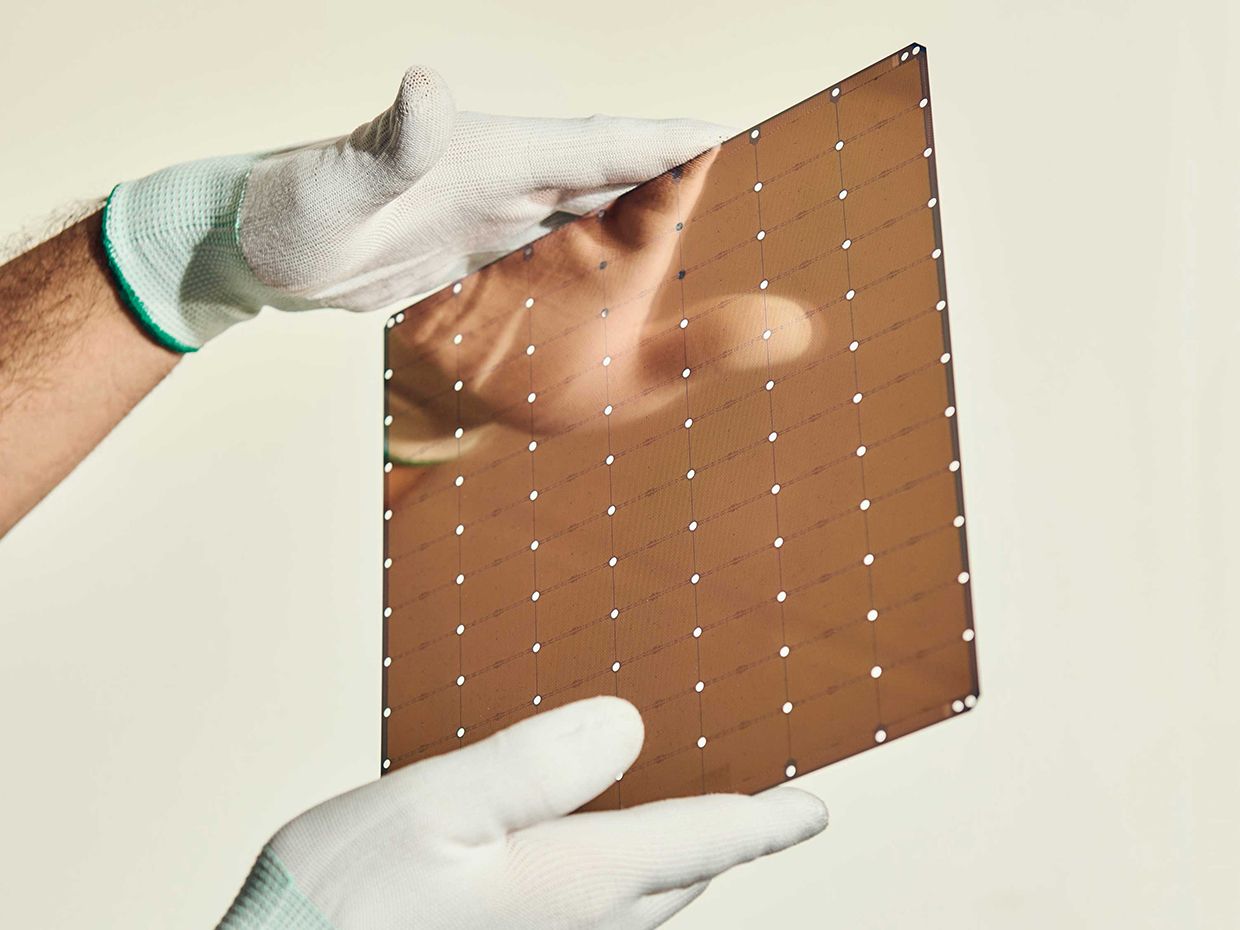
Chips As Big As Your Head: Cerebras Does Deal With OpenAI For $10 Billion+ In Computing Power

That's our usual description of Cerebras. Where Nvidia uses smaller chips with ultrafast connections, Cerebras users the whole silicon wafer and eliminates the need for many of the connections completely.

Here's an August 2019 post: Artificial Intelligence: The World's Largest Chip Is As Big As Your Head and Contains 1.2 Trillion Transistors 

And a picture from 2020's "Cerebras’ Giant Chip Will Smash Deep Learning’s Speed Barrier"
Computers using Cerebras’s chip will train these AI systems in hours instead of weeks

https://spectrum.ieee.org/image/MzUzNTc5Mg.jpeg
The world’s largest chip, the Wafer Scale Engine, is more than 50 times the size of the largest GPU. 

And from the Wall Street Journal, January 14:

OpenAI Forges Multibillion-Dollar Computing Partnership With Cerebras
The ChatGPT-maker is racing to secure more computing power, especially for responding to user queries

OpenAI has struck a multibillion-dollar agreement to buy computing capacity from startup Cerebras Systems, which is backed by Chief Executive Sam Altman, the latest in a string of chip and cloud deals signed by the ChatGPT-maker. 

OpenAI plans to use chips designed by Cerebras to power its popular chatbot, the companies said Wednesday. It has committed to purchase up to 750 megawatts of computing power over three years from Cerebras. The deal is worth more than $10 billion, according to people familiar with the matter.

Cerebras designs artificial-intelligence chips that it says can run AI models and generate responses faster than industry leader Nvidia. OpenAI CEO Altman is a personal investor in Cerebras, and the two companies previously explored a partnership in 2017.
News Corp, owner of The Wall Street Journal, has a content-licensing partnership with OpenAI.

OpenAI is racing to secure access to more data-center capacity as it prepares for its next phase of growth. The company counts more than 900 million weekly users, and executives have said repeatedly that they are facing a severe shortage in computing resources. 

It also is looking for cheaper and more efficient alternatives to chips designed by Nvidia. Last year, OpenAI announced that it was building a custom chip with Broadcom and separately signed an agreement to use Advanced Micro Devices’ new MI450 chip. 

OpenAI and Cerebras began talks about their partnership in the fall and signed a term sheet by Thanksgiving, Cerebras CEO Andrew Feldman said in an interview. 

Feldman showed a series of demonstrations in a video interview with The Wall Street Journal in which chatbots powered by Cerebras’s chips delivered speedier responses to users than those relying on processors made by rivals. He said his chips’ ability to process AI computations more quickly was what led OpenAI to strike a deal. 

“What is driving the market right now,” Feldman said, is “this extraordinary demand for fast compute.”

Sachin Katti, an OpenAI infrastructure executive, said that the company began considering a partnership with Cerebras after its engineers provided feedback that they wanted chips that could run AI applications, specifically for coding, more quickly. 

“The biggest predictor of OpenAI revenue is how much compute is there,” Katti said in an interview. “The last two years, consistently, we have tripled compute every year and the revenue has tripled every year.”

Cerebras is in discussions to raise $1 billion at a valuation of $22 billion, people familiar with the matter said, nearly tripling its valuation. The Information earlier reported on the company’s fundraising talks.

It has raised a total of $1.8 billion in funding, not including the new capital, according to research firm PitchBook, with investors including Benchmark, United Arab Emirates firm G42, Fidelity Management & Research Co. and Atreides Management. 

Chip startups focused on inference, the process of running trained AI models to generate responses, are in demand as AI companies compete to secure cutting-edge technology that can deliver fast, cost-efficient computing power.

Nvidia signed a $20 billion licensing agreement in December with Groq, giving it access to the startup’s chip that is similarly designed to handle such tasks. In September, the chip giant also signed a preliminary agreement with OpenAI to sell up to 10 gigawatts worth of chips, but it hasn’t yet been finalized....

....MUCH MORE 

Previously:

June 2024 - Big Chips: "Cerebras to Collaborate with Dell, and AMD, on AI Model Training"

March 2024 - Chips: "Cerebras Introduces ‘World’s Fastest AI Chip’..." (it's as big as your head) 
All their chips are as big as your head.

July 2023 - Big Deal: "Cerebras Sells $100 Million AI Supercomputer, Plans Eight More" 

And many more. 

Monday, October 13, 2025

Nvidia Releases The DGX Spark Miniature Supercomputer, It Seems Rather Meh (NVDA)

From The Register, October 13:

Nvidia's GB10 workstations arrive with 1 petaFLOPS of compute, 128GB of VRAM, and a $3K+ price tag
Systems from Nvidia, Dell, and others available starting Oct. 15

Nvidia's tiniest Grace-Blackwell workstation is finally making its way to store shelves this week, the better part of a year after the GPU giant first teased the AI mini PC, then called Project Digits, at CES.

Since rebranded as the DGX Spark, the roughly NUC-sized system pairs a Blackwell GPU capable of delivering up to a petaFLOP of sparse FP4 performance with 128 GB of unified system memory and 200 Gbps of high-speed networking.

But with a price starting around $3,000, small doesn't mean cheap. Then again, it's not exactly aimed at mainstream PC buyers. The systems, which will also be available under various brand names from OEM partners, won't even come with Windows. A Copilot+ PC this is not. Instead, it ships with a custom spin of Ubuntu Linux.

Spark is actually intended for AI and robotics developers, data scientists, and machine learning researchers looking for a lower-cost workstation platform that's still capable of running models up to 200 billion parameters in size.

These kinds of workloads are incredibly memory-hungry, which makes running them on consumer graphics processors impractical. High-end workstation cards, like the RTX Pro 6000, can be had with up to 96 GB of speedy GDDR7, but a single card will set you back more than $8,000, and that's before you factor in the rest of the platform cost.

At the time of launch, the DGX Spark is technically Nvidia's highest capacity workstation GPU — at least until its Blackwell Ultra-based DGX Station makes its debut.

Honey, I shrunk the superchip 
Powering the DGX Spark is the GB10 system-on-a-chip, which is essentially a miniaturized version of the Grace-Blackwell Superchips that power its flagship NVL72 rack systems.

As we explored back at Hot Chips, the GB10 is composed of two compute dies connected at 600 GB/s via Nvidia's proprietary NVLink chip-to-chip interconnect tech. And, in case you're wondering, this same technology will eventually be used to mesh Nvidia's GPUs to Intel's future client CPUs as part of a tie-up between the two chip heavyweights.

The GPU tile is capable of delivering up to a petaFLOP of sparse FP4 or around 31 teraFLOPS at single precision (FP32) — putting it on par with an RTX 5070 in terms of raw performance. Yes, the $550 consumer card does offer more than twice the memory bandwidth, but with just 12 GB of GDDR7, you'll be fairly limited in terms of what models and AI workloads you can run....

....MUCH MORE 

And there's the rub.

Granted there is a lot more value for money than a couple earlier Nvidia supercomputers that we got fired up about. Some backlinks from June 2018's "Nvidia debuts cloud server platform to unify AI and HPC (NVDA)":

....Before that they explained how to build your own (remember, this was pre-media-rapture, hence the explanatory tone) supercomputer, relayed in May 2015's:
Nvidia Wants to Be the Brains Of Your Autonomous Car (NVDA)

...Among the fastest processors in the business are the one's originally developed for video games and known as Graphics Processing Units or GPU's. Since Nvidia released their Tesla hardware in 2008 hobbyists (and others) have used GPU's to build personal supercomputers.
Here's Nvidias Build your Own page. [link rotted, here is an Internet Archive capture]
Or have your tech guy build one for you....
NVIDIA really started blurring the lines  with their mini-supercomputer for training AI in 2016:
Technology Review on NVIDIA's Pint-Sized Supercomputer (NVDA)
$129,000

In April 2018 the company had a new offering that stunned reviewers into caveman-speak:
UPDATED—NVIDIA Wants to Be the Brains Behind the Surveillance State (NVDA)
The company just rolled out a $399,000 two-petaflop supercomputer that every little totalitarian and his brother is going to lust after to run their surveillance-city smart-city data slurping dreams.

The coming municipal data centers will end up matching the NSA in total storage capacity and NVIDIA wants to be the one sifting through it all. More on this down the road, for now here's the beast.

From Hot Hardware:
NVIDIA Unveils Beastly 2 Petaflop DGX-2 AI Supercomputer With 32GB Tesla V100 And NVSwitch Tech (Updated)...
Ummm, beast fast.

But of course back then the world was fresh and new. 

Today's press release does have a nice mention of the earlier machines:

NVIDIA DGX Spark Arrives for World’s AI Developers 

October 13, 2025  

News Summary:

  • NVIDIA founder and CEO Jensen Huang delivers DGX Spark to Elon Musk at SpaceX.
  • This week, NVIDIA and its partners are shipping DGX Spark, the world’s smallest AI supercomputer, delivering NVIDIA’s AI stack in a compact desktop form factor.
  • Acer, ASUS, Dell Technologies, GIGABYTE, HPI, Lenovo and MSI debut DGX Spark systems, expanding access to powerful AI computing.
  • Built on the NVIDIA Grace Blackwell architecture, DGX Spark integrates NVIDIA GPUs, CPUs, networking, CUDA libraries and NVIDIA AI software, accelerating agentic and physical AI development.

NVIDIA today announced it will start shipping NVIDIA DGX Spark™, the world’s smallest AI supercomputer.

AI workloads are quickly outgrowing the memory and software capabilities of the PCs, workstations and laptops millions of developers rely on today — forcing teams to shift work to the cloud or local data centers.

As a new class of computer, DGX Spark delivers a petaflop of AI performance and 128GB of unified memory in a compact desktop form factor, giving developers the power to run inference on AI models with up to 200 billion parameters and fine-tune models of up to 70 billion parameters locally. In addition, DGX Spark lets developers create AI agents and run advanced software stacks locally.

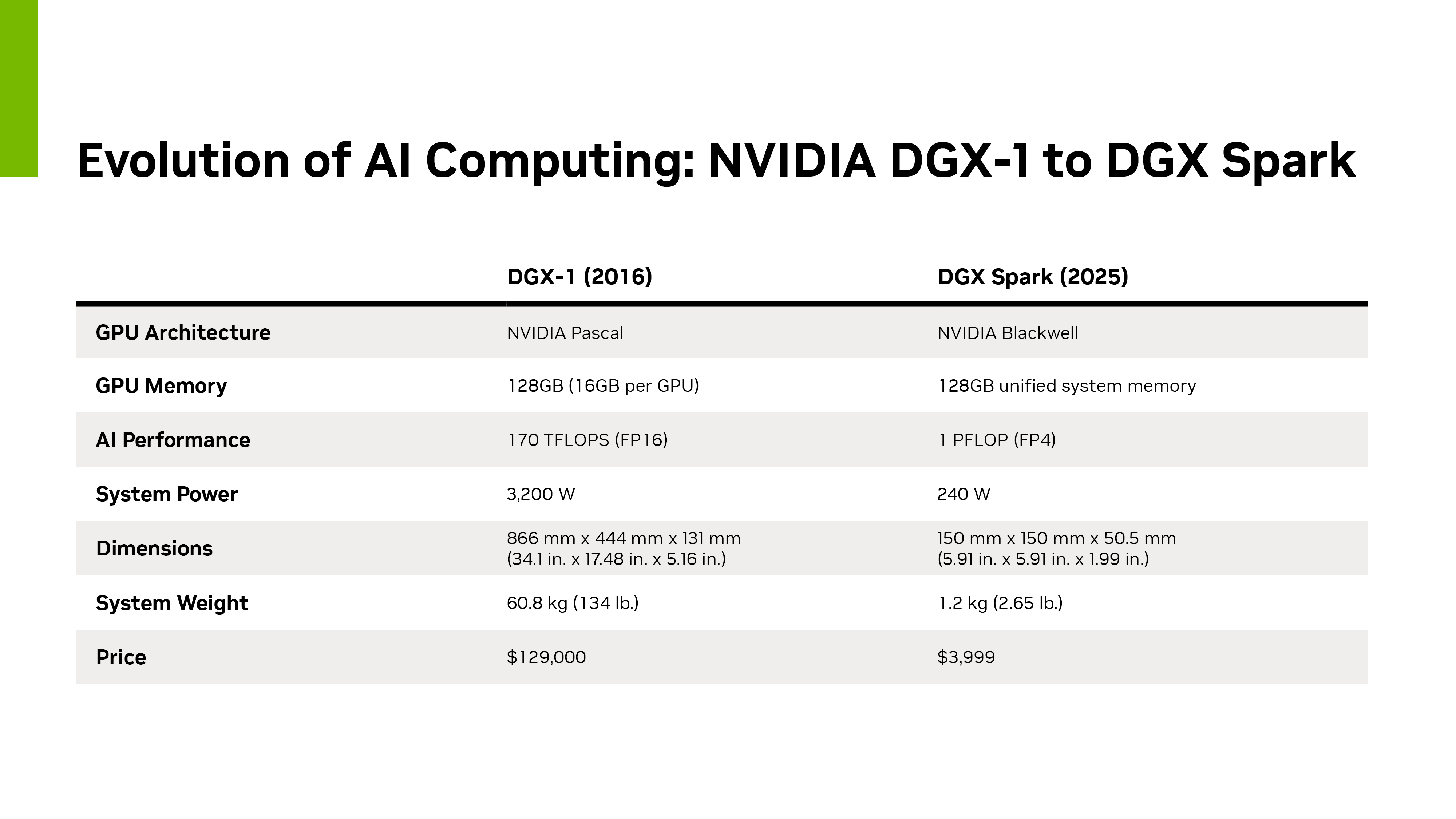
“In 2016, we built DGX-1 to give AI researchers their own supercomputer. I hand-delivered the first system to Elon at a small startup called OpenAI — and from it came ChatGPT, kickstarting the AI revolution,” said Jensen Huang, founder and CEO of NVIDIA. “DGX-1 launched the era of AI supercomputers and unlocked the scaling laws that drive modern AI. With DGX Spark, we return to that mission — placing an AI computer in the hands of every developer to ignite the next wave of breakthroughs.”

Evolution of AI Computing: NVIDIA DGX-1 to DGX Spark

DGX Spark brings together the full NVIDIA AI platform — including GPUs, CPUs, networking, CUDA® libraries and the NVIDIA AI software stack — into a system small enough for a lab or an office, yet powerful enough to accelerate agentic and physical AI development. By combining breakthrough performance with the reach of the NVIDIA ecosystem, DGX Spark transforms the desktop into an AI development platform.

....MUCH MORE

Sunday, August 24, 2025

Hot Chips Symposium 2025 Begins Today, August 24

 First up, from Forbes, August 22:

HotChips Preview: Nvidia Scales AI Beyond The Data Center 

The annual HotChips conference starts this Sunday, Aug. 24, in San Francisco [sic]. Nvidia is scheduled to present six sessions covering topics of interest to AI data center users and operators and will make several key announcements I’ll cover in this article. (Like most AI semiconductor-related companies, Nvidia is a client of Cambrian-AI Research.)

NVLink Fusion is perhaps the most fascinating topic, enabling the entire industry of CPUs and GPUs to create chips to access NVLink, the company’s secret sauce for interconnecting up to 72 accelerators and 36 CPUs in a rack. While I’m working on another article that specifically covers how Qualcomm is using NVLink Fusion to enter the data center with its super-fast Arm-based Oryon CPUs, I’ll focus here on how Nvidia is enabling AI to expand beyond a single data center, and a new 4-bit format that could significantly improve the efficiency of training AI models by as much as four-fold.

Connecting Multiple Data Data Centers for Massive AI 
As older data centers struggle to grow AI due to power constraints, many are seeking a method to break through the walls and distances to connect their network of data centers, delivering on the promise of AI and growing their business. Nvidia has launched a new Ethernet card called Spectrum-XGS to enable these data centers to enter the world of giga-scale AI. This scale is needed for training large AI models but increasingly is also used for agentic AI and reasoning models. Nvidia claims this network can nearly double the performance of multi-site AI workloads....

....MORE 

The big get-together is held at Stanford's Memorial Auditorium, PALO ALTO.

From the conference organizers:

Advance Program

And at Nvidia:

August 21 - Scaling AI Inference Performance and Flexibility with NVIDIA NVLink and NVLink Fusion 

August 22 - Hot Topics at Hot Chips: Inference, Networking, AI Innovation at Every Scale — All Built on NVIDIA 

NVLink, along with the various software offerings including CUDA are major components of Nvidia's moat (and potential targets for anti-trust investigators).

March 20, 2025 - NVIDIA GTC Financial Analyst Q&A March 19, 2024 Video and Transcript 

March 25, 2024 - Reuters "Exclusive: Behind the plot to break Nvidia’s grip on AI by targeting software" (NVDA)

April 22, 2024 - Nvidia's Jensen Huang: “even when the competitors’ chips are free, it’s not cheap enough.” (NVDA)
That's quite a statement. It was made in reference to NVDA's chips and CUDA software combo pack....

September 11, 2024 - "How Nvidia Is Building A Competitive Moat To Fend Off AI Challengers" (NVDA)

One of our early Nvidia posts called out NVLink:

November 6, 2015 - "NVIDIA: “Expensive and Worth It,” Says MKM Partners" (NVDA)  

We don't do much individual stock stuff on the blog but this one is special.
We use it as an example of what Silicon Valley used to be, when high tech meant high technology and not a new app for some (still) mundane task.

Simply put, NVIDIA makes some of the fastest computer chips in the world.
They are used in gaming systems that require graphics that don't  make you (literally) puke. Right now automakers use their chips for graphic displays.

The future: Robocars? May 2015: "Nvidia Wants to Be the Brains Of Your Autonomous Car (NVID)":

Among the fastest processors in the business are the one's originally developed for video games and known as Graphics Processing Units or GPU's. Since Nvidia released their Tesla hardware in 2008 hobbyists (and others) have used GPU's to build personal supercomputers.
Here's Nvidias Build your Own page.
Or have your tech guy build one for you.

In addition Nvidia has very fast connectors they call NVLink.
Using a hybrid combination of IBM Central Processing Units (CPU's) and Nvidia's GPU's, all hooked together with NVIDIA's NVLink, Oak Ridge National Laboratory is building what will be the world's fastest supercomputer when it debuts in 2018.

As your kid plays Grand Theft Auto.... 

And more recently, May 19, 2025:

Nvidia Blog: Highlights Of Jensen Huang's Computex 2025 Keynote Address (NVDA)

And May 29, 2025:

"Energy Dept. Unveils Supercomputer That Merges With A.I." (DELL; NVDA)
I believe this is were we came in....

Thursday, May 29, 2025

"Energy Dept. Unveils Supercomputer That Merges With A.I." (DELL; NVDA)

I believe this is were we came in.

From the New York Times, May 29: 

The new supercomputer shows the increasing desire of government labs to adopt more technologies from commercial artificial intelligence systems.

Scientific computing and artificial intelligence were once separate worlds, using different kinds of calculations on distinctly different hardware. But the two fields are steadily merging, as shown by a massive new machine coming to Berkeley, Calif.

On Thursday, the Department of Energy’s laboratory near the University of California, Berkeley, said it had selected Dell Technologies to deliver its next flagship supercomputer in 2026. The system will use Nvidia chips tailored for A.I. calculations and the simulations common to energy research and other scientific fields.

Lawrence Berkeley National Laboratory expects the new machine — to be named for Jennifer Doudna, a Berkeley biochemist who shared the 2020 Nobel Prize for chemistry — to offer more than a tenfold speed boost over the lab’s most powerful current system. If fully outfitted, the machine could be the Energy Department’s biggest resource for tasks like training A.I. models, said Jonathan Carter, associate laboratory director for computing sciences at the Berkeley center.

The supercomputer stands out for its technology choices, which indicate the growing desire for government labs to adopt more technologies from commercial A.I. systems. Nvidia chips, though widely used by big cloud companies as well as in supercomputers, were passed over by the Energy Department for three previous record-setting machines that were assembled by Hewlett Packard Enterprise. Dell has hardly been a player in the highest end of the supercomputer market, but it has had success in large commercial A.I. installations.

At the March 2024 GTC Jensen Huang literally turned the spotlight on Michael Dell who was in the audience for Huang's keynote speech.

Here's our first NVIDIA post, Sunday May 17, 2015:

Nvidia Wants to Be the Brains Of Your Autonomous Car (NVDA)

We've mentioned, usually in the context of the Top 500* fastest supercomputers, that:
Long time readers know we have a serious interest in screaming fast computers and try to get to the Top500 list a couple times a year. Here is a computer that was at the top of that list, the fastest computer in the world just four years ago. And it's being shut down.
Technology changes pretty fast. 
That was from a 2013 post.
Among the fastest processors in the business are the one's originally developed for video games and known as Graphics Processing Units or GPU's. Since Nvidia released their Tesla hardware in 2008 hobbyists (and others) have used GPU's to build personal supercomputers.
Here's Nvidias Build your Own page.
Or have your tech guy build one for you.

In addition Nvidia has very fast connectors they call NVLink.
Using a hybrid combination of IBM Central Processing Units (CPU's) and Nvidia's GPU's, all hooked together with the NVLink, Oak Ridge National Laboratory is building what will be the world's fastest supercomputer when it debuts in 2018.

As your kid plays Grand Theft Auto.

From IEEE Spectrum, April 9, 2015:

Nvidia Wants to Build the Robocar's Brain...

The stock had closed the previous Friday at $21.30. [multiply today's close, (May 29, 2025) $139.19 x 40 to account for the stock splits et voilà!: $5567.60]

Our first post on AI was December 2013's "Why Is Machine Learning (CS 229) The Most Popular Course At Stanford?"

 And with a few more posts in 2014, including:

it was off to the races. But this week's backward-looking recollections have to end: 

June 11, 2019
Securitise Everything: Debits, Credits, Whatev

I just realized I am in danger of becoming an old woman.

Yesterday FT Alphaville had three posts:

What a debut securitisation tells us about fintech
Is Lufthansa an e-money issuer?
Can air miles points be securitised?  
That grabbed my eye but rather than sticking to the topics at hand my mind wandered to Carl Icahn's time at Trans World Airlines.

Old Carl had bought the storied carrier with unsecured junk bonds and famously proceeded to mortgage everything he could including one "senior secured" issue backed by collateral that included spare light bulbs for the planes. The TWA light bulb bonds.

TWA went broke, I don't know what became of the light bulbs, but combined with reminiscences of the copper trading glory days of 15 years ago I thought, "Uh oh":

https://painting-planet.com/images/8/image379.jpg

That's Vasili Maksimov's "Everything is in the past" (1889), which the Russian State Tretyakov Gallery describes as:
.... "Everything is in the past" , where the artist shows us one of the slowly disappearing "nests of the gentry", tackling the themes of a elegaic country estate life, senility and irreversibility of time.....
Yikes, I am not ready for samovars and knitting needles. "Hello fellow kids, what is new with blockchain?"
Although, come to think of it, maybe some tea would be nice. 
 
If interested here is a story on the Light Bulb Bonds.

Wednesday, May 14, 2025

Some Details On Super Micro Computer's $20 Billion Deal With Saudi Arabia's DataVolt (SMCI; NVDA)

Although the SMCI/Datavolt deal was first on the White House fact sheet included in yesterday GE Vernova post we didn't highlight it because of the issues surrounding the company's financial reporting.

Now it appears that Super Micro is serious about finding a more experienced CFO and should that come to pass we would take another look at what has been described as an "AI pure play" (and Nvidia's little buddy in the GPUs-as-a-Service biz). Until then, life is short enough as it is without screwing around with companies that don't get their financial filed on time.

Here's the shout-out from the White House:

  • Saudi Arabian DataVolt is moving forward with plans to invest $20 billion in AI data centers and energy infrastructure in the United States.

And from wccftech, May 14:

Supermicro (SMCI) Can Feasibly Earn $4 Billion In Annual Revenue And $200 Million In Annual EBIT From Its “Party In The Desert” Deal With The Saudi Hyperscaler DataVolt 

Supermicro (SMCI), a leading GPU-as-a-Service player and a prominent retailer of liquid-cooled AI racks, has managed to clinch one of the larger deals inked during President Trump's investment-focused trip to Saudi Arabia.

To wit, Supermicro has now inked a "multi-year partnership agreement" with DataVolt, a leading Saudi data center company that plans to "pair gigawatt-class renewable and net-zero green hydrogen power with the industry’s most advanced server technology."

While the granular details of this $20 billion agreement have not been made public, the deal will see Supermicro supply high-density GPU platforms and rack-scale liquid cooling systems to DataVolt over a number of years.

As per the numbers crunched by Goldman Sachs, the deal could feasibly entail $5 billion in annual revenue and an annual EBIT of around $200 million:

"Assuming a 5-year deal, 5% margins, and the entirety of the $20B represents IT hardware revenue, this would represent $4 bn of annual revenue and $200 mn of annual EBIT."

Despite the sizable windfall that Supermicro stands to gain from its just-inked agreement with DataVolt, Goldman Sachs has chosen to reiterate its 'Sell' rating for the stock, replete with a $24 share price target. For reference, SMCI shares are currently trading at the $46.86 price level in pre-market trading.

On the flip side, Raymond James analyst Simon Leopold has adopted a much more bullish view of Supermicro in light of its "Party in the desert" deal with DataVolt, reiterating an 'Outperform' rating and a $41 stock price target.

Leopold believes that the deal "expands visibility with multi-year hardware backlog and supports upward estimate revisions" for Supermicro. However, the analyst remains concerned about the "uncertain" build-out timing, currently pegged for 2028....

....MUCH MORE

 Some previous mentions of SMCI:

April 2024 - "Nvidia, AI Stocks Catch A Cold After Super Micro Computer Sneezes"

November 2024 - "Stock Markets Are in Denial Over Inflation. Why Investors Face a Shock Ahead and 5 Other Things to Know Today."
Trump fills out cabinet picks, Cisco raises outlook, Super Micro stock faces delisting, and other news to start your day.

January 2025 - "Short-selling firm Hindenburg Research is closing up shop"

March 2025 -  "Apple Joins AI Data Center Race After Siri Mess" (AAPL; NVDA; DELL; SMCI)

There are many more, going back to 2018 but those are the most recent.

Tuesday, March 25, 2025

"Apple Joins AI Data Center Race After Siri Mess" (AAPL; NVDA; DELL; SMCI)

 From Investor's Business Daily, March 25:

While other Big Tech firms invested heavily in artificial intelligence data centers, Apple (AAPL) stayed on the sidelines, choosing to avoid the capex spending surge. But that appears to have changed with Apple realizing it needed to join the AI data center game.

Loop Capital analyst Ananda Baruah late Monday said Apple is in the process of placing orders for about $1 billion in Nvidia (NVDA) GB300 NVL72 systems. That equates to about 250 servers at $3.7 million to $4 million each, he said in a client note.

Apple is working with server builders Dell Technologies (DELL) and Super Micro Computer (SMCI) on its large server cluster to support generative AI applications, Baruah said.

"AAPL is officially in the large server cluster Gen AI game … and SMCI & DELL are the key server partners," he said. "While we are still gathering fuller context, this appears to have the potential to be a Gen AI LLM (large language model) cluster."

Baruah believes Apple's strategy shift was compelled by troubles in bringing its AI-enabled Siri digital assistant to market....

....MORE

Wednesday, March 19, 2025

Nvidia GTC Financial Analysts Q&A Transcript (NVDA)

Following on the (unembeddable )link to the video.

From Investing.com, March 19 2025:

NVIDIA at GTC Financial Analyst Q&A: AI Infrastructure Expansion

On Wednesday, 19 March 2025, NVIDIA Corporation (NASDAQ: NVDA) held its GTC Financial Analyst Q&A, presenting a strategic shift towards AI infrastructure for cloud, enterprise IT, and robotics. Led by CEO Jensen Huang, the discussion highlighted NVIDIA’s ambitions to modernize enterprise IT and dominate the AI landscape. While the company aims for growth in AI infrastructure, it also faces challenges such as economic downturns and tariffs.

Key Takeaways

  • NVIDIA is focusing on AI infrastructure, partnering with Dell, HPE, and Cisco to transform enterprise IT.
  • The company’s robotics business, valued at $5 billion, is expanding rapidly with key partnerships, including GM.
  • NVIDIA anticipates improved gross margins with the ramp-up of the Grace Blackwell architecture.
  • The company is preparing for potential tariffs by planning onshore manufacturing in Arizona.
  • NVIDIA aims to maintain dominance over custom ASICs with its comprehensive AI platform.

Financial Results

  • Gross margins are expected to improve as the Grace Blackwell architecture scales up over the next three to four years.
  • NVIDIA foresees large AI factory projects, with investments potentially reaching hundreds of billions of dollars.
  • Current data center spending is projected to hit a trillion dollars.

Operational Updates

  • NVIDIA is expanding its focus to include AI infrastructure for cloud, enterprise IT, and robotics, addressing computing, networking, and storage.
  • The emphasis on "AI factories" marks a shift towards single-function data centers dedicated to AI.
  • The company’s robotics business, valued at $5 billion, includes self-driving cars and robotic warehouses.

Future Outlook

  • NVIDIA is preparing for onshore manufacturing, leveraging TSMC’s investment in Arizona to mitigate potential tariff impacts.
  • The company laid out a roadmap of three years, emphasizing its role as an infrastructure provider rather than a consumer products business.
  • Companies investing in AI are expected to increase their focus on AI if a recession occurs.

Q&A Highlights

  • NVIDIA’s GPUs have a longer lifecycle, lasting three to four years longer than competitors, and remain useful for data processing.
  • The company plans to continue using copper for Nvlink as long as possible, with a shift to silicon photonics if necessary.
  • Homogeneous clusters are favored for higher data center performance, as every computer is fungible.

For a detailed understanding, please refer to the full transcript below.

Full transcript - GTC Financial Analyst Q&A:

Jensen: Sorry. It’s late. I was on TV. I’m just kidding. Chuck and I were on TV.

Chuck Robbins, Cisco.

Unidentified speaker: All good. And also on Kramer this morning. So just a few interviews, right?

Jensen: Yes. That was fun.

Unidentified speaker: Okay. Great to see everybody, both yesterday as well as, last night at our cocktail hour. This opportunity to speak with the Jensen and really talk about what this meant to our investor community in terms of our announcement at the GTC. I kindly remind you to look at our disclosure statement, this fine print in front of us, and then I want to make sure there’s one announcement for you all. Toshiya Hara is here with you, but he is with you as our new lead of investor relations.

He started just about yesterday and he’s now been here a good forty eight hours, so please make sure you ask him a ton of questions in terms of there. We’re really pleased to bring him on board, bring him on board here to both California and his many, many years in terms of, semis working at Goldman. Truly, truly excited to have him as part of the team in the whole. With that, I’m gonna turn the mic over to Johnson for some opening remarks.

Jensen: Good morning. Great to see all of you. Let’s see. We announced a whole lot of stuff yesterday, and, let me put it all in perspective. The first is, as you know, everybody’s expecting us to build AI infrastructure for cloud.

That, I think, everybody knows. And, the good news is that the, understanding of r one was completely wrong. That’s the good news. And the reason for that is because reasoning should be a fantastic new breakthrough. Reasoning, includes better answers, which makes AI more useful, solving more problems, which expands the reach of AI, and, of course, from a technology perspective, requires a lot more computation.

And so the computation demand for reasoning AIs is much, much higher than the computation demand of one shot pre trained AI. And so I think everybody now has a better understanding of that. That’s number one. Number two, and so so the first thing is inference, Blackwell incredibly good at it, building out AI clouds, the the investments of all the AI clouds continues to be very, very high. The demand for computing continues to be extremely high.

Okay. So I think that that’s the first part. The the part that I think people are are starting to learn about and and, we announced yesterday, I and and I I I I’ll just take, I could have done a better job explaining it, and so I’m gonna do it again. In order to bring AI to the world’s enterprise, we have to first recognize that AI has reinvented the entire computing stack. And if so, all of the data centers and all the computers in the world’s enterprises are obviously out of date.

And so just as we’ve been remodernizing the world’s AI clouds, all the world’s clouds for AI, it’s sensible we’re gonna have to re rack, if you will, reinstall, modernize, whatever words, the world’s enterprise IT. And doing so is not just about a computer, but you have to reinvent computing, networking, and storage. And so I didn’t give it very much time yesterday because we had so much so much content that that part, which represents about half of the world’s capex, enterprise IT, representing about half of the world’s CapEx. That half needs to be reinvented, and our journey begins now. Our partnership with Dell and HPE and, this morning, the reason why Chuck Robbins and I were on on, on CNBC together, is to talk about this reinvention of enterprise IT.

And Cisco is gonna be a net NVIDIA networking partner. I announced yesterday, basically, the entire world’s storage companies have signed on to be NVIDIA’s storage technology and storage platform partner. And, of course, as you know, computing is an area that we’ve been working on for a long time, including building some new modular systems that are much more enterprise friendly. And so, we announced that yesterday. Spark, DGX Spark, DGX Station, and all of the different Blackwell systems that are becoming from the OEMs.

Okay. So that’s second. So now we’re building AI infrastructure not just for cloud, but we’re building AI infrastructure for the world’s enterprise IT. And the third is robotics. When we talk about robotics, people think robots, and this is a great thing.

It’s fantastic. There’s nothing wrong with that. The world is tens of millions of workers short. We need lots and lots of robots. However, don’t forget the business opportunity is well upstream of the robot.

Before you have a robot, you have to create the AI for the robot. Before you have a chatbot, you have to create the AI for the chatbot. That chatbot is just the last drop last end of it. And so in order for us to enable the world’s robotics industry, upstream is a bunch of AI infrastructure we have to go create to teach the robot how to be a robot. Now teaching a robot how to be a robot is much harder than in fact even chatbots for obvious reasons.

It has to manipulate physical things and it has to understand the world physically. And so we have to invent new technologies for that. The amount of data you have to train with is gigantic. It’s not words, it’s video. It’s not world, it’s not just words and numbers, it’s video and physical interactions, cause and effects physics.

And so so that new adventure we’ve been on for several years, and now it’s starting to grow quite fast. Inside our robotics business includes self driving cars, humanoid robotics, robotic factories, robotic warehouses, lots and lots of robotic things. That business is already many billions of dollars. It’s at least $5,000,000,000 today, the automotive industry, and it’s growing quite fast. Okay?

And yesterday, we also announced a big partnership with, GM, who’s gonna be working with us across all of these different areas. And so we now have three AI infrastructure focuses, if you will, cloud data centers, enterprise IT, and robotic systems. I would say those three buckets, I’ve talked about I talked about those things yesterday. And then foundationally, of course, we spoke about the different parts of the technology, pre training and how that works and how pre training works for reasoning AIs, how pre training works for robotic AI, how in reasoning inference impacts, computing and therefore, directly how it impacts our business. And then answering a very big question that a lot of people seem to have, and I never understood why, which is, how how important is inference to NVIDIA?....

....MUCH MORE, the analysts have questions.

 Also at Investing.com, the transcript of Mr. Huang's March 18 GTC keynote speech:

NVIDIA at GTC 2025: AI and Accelerated Computing Innovations