Forget your standard 19th-century dinner parties, where everyone sat
around sipping sherry and discussing the weather. If you were lucky
enough to snag an invite to Charles Babbage’s Saturday night scientific
soirées, you were in for a wild ride through the brainiest and most
bizarre conversations that Victorian London had to offer. Picture a mad
mix of engineers, poets, inventors, and maybe a magician or two, all
crowding into Babbage’s house on Dorset Street in Westminster, ready to
debate everything from algebra to automata (while probably getting a
little tipsy).
Babbage, our host with the most (complex mechanical
calculations), is rightly remembered as the “father of the computer” —
though no one actually knew what a computer was back then. He was a man
who saw the potential of machines to transform human society long before
anyone else could and his vision for mechanical computation laid the
groundwork for the digital age. The concepts he developed—programmable
machines, stored memory, and automated calculation—are the backbone of
modern computing.
At his infamous Saturday night gatherings which he held in the 1830s
and 40s, Babbage would often present his latest ideas and inventions,
using the soirées as a platform to engage with other great minds like
Michael Faraday, Charles Darwin, Ada Lovelace, and even literary figures
like Charles Dickens and George Eliot. These events weren’t just
social—they were intellectual incubators where ideas that shaped the
modern world were exchanged and debated. soirées were a Victorian
version of TED Talks, minus the PowerPoints, with a heavy dose of
eccentricity. I thought we could highlight just some of the quirky
characters who made Babbage’s gatherings legendary…
Ada Lovelace: The Original Queen of Code
Ada Lovelace, “the first tech visionary”
You
can’t mention Babbage’s soirées without talking about Ada Lovelace. She
wasn’t just any guest — Ada was basically the queen of mathematics. She
not only worked with Babbage on his never-quite-finished Analytical
Engine but also envisioned that it could do more than just crunch
numbers. Lady Lovelace imagined a machine that could compose music, draw
pictures, and maybe even predict the weather (if only it weren’t in
London). Ada’s sharp wit and even sharper mind made her a star of
Babbage’s soirées, where she held her own among the men, probably while
wearing some killer Victorian gowns. She was also the only legitimate
daughter of the famous poet Lord Byron and knew how to flirt with a
scandal or two. Lord Byron, famously mad, bad, and dangerous to know,
was involved in more than a few scandals of his own, including
well-known affairs, rumored incest, and general chaos. Though Ada was
raised by her mother to be the polar opposite of Byron, his
controversial legacy undoubtedly followed her around, particularly in
society circles that loved a bit of gossip.
Lovelace had a bit of a wild streak, and one of the juiciest chapters
in her life involved a rather unhealthy obsession with gambling. After
being introduced to the world of horse racing by her husband, Ada’s
interest soon spiraled into a full-blown addiction. She wasn’t just a
casual gambler, either—she got involved in complex betting schemes,
applying her mathematical genius to the betting systems in an effort to
“beat the odds.” Even beyond the gambling and romantic whispers, Ada
Lovelace was inherently scandalous simply by being a woman operating at
such an intellectual level in the Victorian era. Near the end of her
life, she had a religious transformation and began to repent the conduct
of her life. After confessing something to her husband 3 months before
her death, he abandoned her bedside. It is not known what she told him.
Isambard Kingdom Brunel: The Big Dreamer with a Bigger Hat
Isambard Kingdom Brunel
It’s
no surprise that one of the greatest engineers of the 19th century
would pop up at Babbage’s parties. Isambard Kingdom Brunel, with his
iconic stovepipe hat and larger-than-life personality, was all about
pushing the limits of what was possible — whether it was building
massive bridges or railways that seemed to defy gravity. You can bet
Babbage and Brunel spent hours nerding out over mechanical designs while
everyone else in the room pretended to understand. But Brunel’s
larger-than-life ideas matched Babbage’s own, and the two of them were
probably the loudest voices in any conversation about steam engines or,
you know, the future of human progress....
We caught this on the same day NASA announces Boeing's Starliner spaceship will return empty as Space-X rescues the stranded astronauts. It seems to have been all downhill at the Royal Society since Pepys, Wren and Newton ran the place.
13 Things I Found on the Internet Today (Vol. 715)
5. A Legendary “Junkyard” Collection of Classic Cars Up for Auction
Since
1967, Rudi Klein, a renowned figure in the world of collecting, had
quietly amassed a remarkable collection of automotive treasures in a
modest junkyard in Southern Los Angeles. Known for his discerning eye
and passion for rare and unique automobiles, Klein’s collection has long
been a well-kept secret, with only rumors of its existence swirling
amongst certain collectors’ circles.
Now,
for the first time, RM Sotheby’s will unveil ‘The Junkyard,’ bringing
to market Klein’s extraordinary collection of rare and revered
automobiles, parts, and memorabilia in a series of auctions. A rare
glimpse into the world of a true collector, this event offers bidders
the opportunity to acquire significant models long thought lost or
destroyed, along with a trove of automotive parts and treasures; true
pieces of automotive history, once lost, now found....
Paris may be the City of Light, but it is filled with dark corners. Some
of the best-known ghost stories were inspired by the very real, gory
history of this otherwise romantic setting. Behind – and, indeed,
beneath – the picturesque Haussmanian facades lurk countless tragic
tales, the protagonists of which are still said to stalk the streets…
after all, a city filled with history is a city filled with ghosts.
It may be one of the most iconic landmarks in the world, but even the
Eiffel Tower has a few skeletons in its closet. After courting for a
period of time in the 1920s, a young couple agreed to meet at the top of
the tower – but only one of them would ever leave. The two had arrived
with very different intentions: he was there to propose, she was there
to break up with him. But it was he who spoke first. Down on one knee,
he popped the question and was promptly rejected. The story goes that he
pushed her off the ledge, enraged by her response. An alternative is
that she backed away in disgust and fell to her death. Whichever version
of events you choose to believe, they end the same grisly way. To this
day, tourists claim to hear a nervous giggle followed by an angry voice,
ending with a blood-curdling scream, always in the exact same spot....
From David Goldman (Spengler), Deputy Editor (Business) at Asia Times, February 2:
The Ghost of Richelieu reveals the Red Sea’s secrets ‘The Austrians and Spanish began the 30 Years’ War with twice France’s population and the wealth of a global empire’
The Cardinal’s invitation was scrawled on the crumbling paper of a 1634 edition of La Gazette de France, so I knew at once that it was genuine: “Midnight on the 31st of
January, below the Pont d’Alma” – the Bridge of Souls, above the
entrance to the sewers of Paris, where I first held séance with
Richelieu’s Ghost more than a decade ago.
I dug my waders out of an old trunk and bought a magnum of Chateau
Petrus. With the Bordeaux under one arm and a spittoon under the other,
I picked my way through the sedimentary levels of the Parisian
netherworld, past the 19th-century brickwork to the medieval
stonework and the Roman ruins deep underneath, until I reached the
secret ossuary of the Carthusian monks, its walls lined with stacked
bones topped by grinning skulls.
I poured the Bordeaux into the spittoon. An ectoplasmic blob of
indeterminate shape inserted a gooey proboscis into the brass neck.
Presently it took on the red color of a cardinal’s soutane. There stood
before me the Ghost of Richelieu, humming the tune of “Thank Heaven for
Little Girls.”
“Eminence,” I stammered, “why did you summon me?”
“Oh,” said the scarlet shade. “I wanted some Petrus. Now that you’re here, you may ask one question and then go away.”
I ventured, “What should the United States do about Iran?”
“That,” the Ghost of Richelieu retorted wearily, “is the wrong question.”
“What is the right question, Eminence?”
“You have already used up your question, Spengler. In life, you get
only one. But, as I happen to be dead, I will allow you another. The
right question, Spengler, is: What should the Americans do about the
South China Sea? The United States cannot produce enough weapons to
fight the Russians, let alone the Chinese. Its Ukrainian proxy has run
out of artillery shells, which is as much an embarrassment as it is an
inconvenience when the Russians are firing 6,000 shells a day. But
Ukraine has run out of air defense missiles, so even Russia’s
cheap plywood drones are hitting their targets.”
“Pardon my impertinence,” I said, “but how do you know so much about what is happening in Ukraine?”
“Stupid question! A couple of hundred Ukrainians arrive here every day.”
“But what does that mean for Iran, Eminence?”
“It means that the US military is running out of the weapons to
defend its ships, not to mention commercial vessels, against obsolete
anti-ship missiles and primitive Iranian drones. The
American warships in the Red Sea have managed to defend themselves but
not the freighters they were sent to protect from the weapons of the
Houthis. And before long they will run out of munitions and will have
to sail away, leaving America’s credibility to sink in their wake.”
“Doesn’t China suffer from an interruption of its trade as well?” I ventured.
“China’s trade! Ça alors!” The ghost chortled violently.
“China thinks that it is in a struggle for survival against an
American empire that is determined to suppress its economy and
thereby bring down its political system. It believes that America plans
to begin the dismemberment of China with the independence of Taiwan. It
has built thousands of missiles and hundreds of planes and scores of
submarines to prevent this. By bumbling into the Red Sea, the United
States has given China a gift from heaven. China can observe the
performance of American weapons against the missiles and drones that
Iran manufacturers from Chinese components and gives to the Houthis –
in actual engagements, not Potemkin Village tests staged by the defense
contractors. It won’t send its own ships and give the Americans a
similar opportunity to observe their performance. A legion of Chinese
spies with access to the specifications of all the weapons systems of
the US Navy could not produce intelligence of this quality! A year ago, a
Washington think tank conducted a wargame with China in which the
United States exhausted its supply of anti-ship missiles in a week.”.....
For a dead guy Richelieu seems to have a pretty good grasp of what's what.
And Mr. Goldman? Prior to the current gig he was:
Global head of credit strategy at Credit Suisse
Global Head of Fixed Income Research for Bank of America
Global Head of Fixed Income Research at Cantor Fitzgerald
In
addition to apparently not being able to hold onto a job I think one of
his requirements for moving on was a "Global Head" title. (JK, young
Master. G.)
And me?
When I see the name Petrus, this is what I think of:
Also underground but definitely not an ossuary.
One of the greatest wine collections in the world.
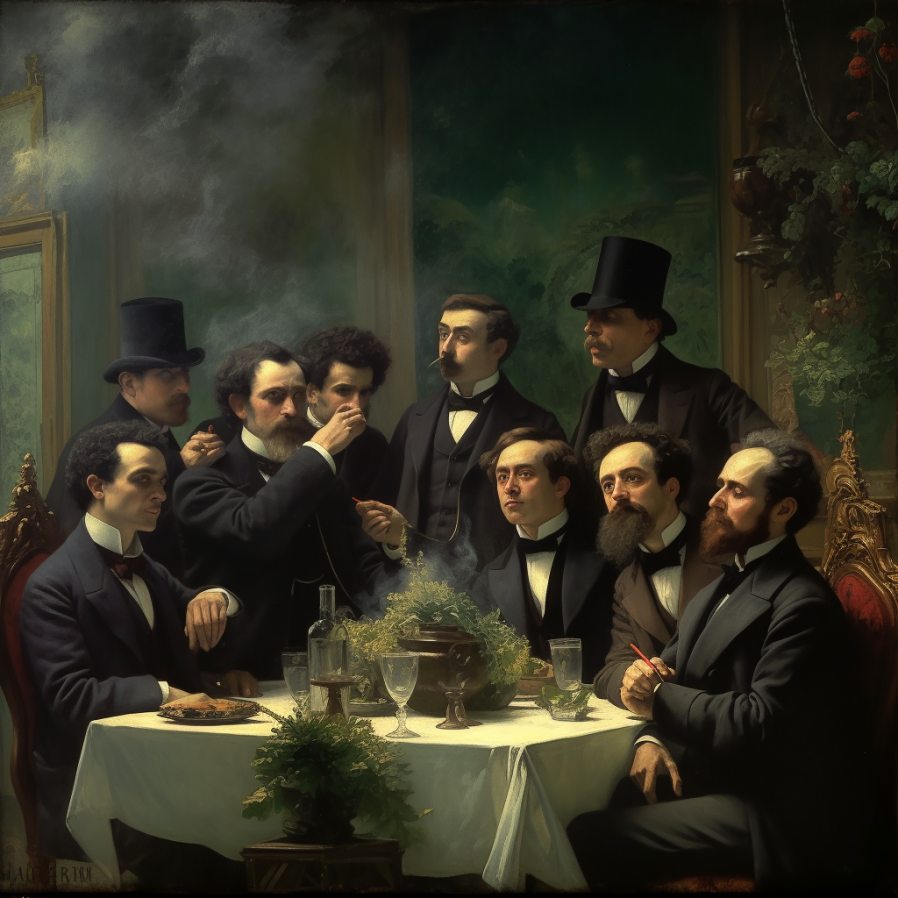
Ah, Belle Epoque Paris: a lost world of artists, writers, dancers,
philosophers and …. potheads? Today, we’re getting acquainted with the
long forgotten Club des Hashischins, “Club of the
Hashish-Eaters”, a 19th century gang of Parisians dedicated to
drug-induced experiences, whose members included a gaggle of the most
prolific intellectual names, including Victor Hugo, Alexandre Dumas,
Charles Baudelaire, and Honoré de Balzac to mention a few. Snacks ready?
Let’s light this one up…
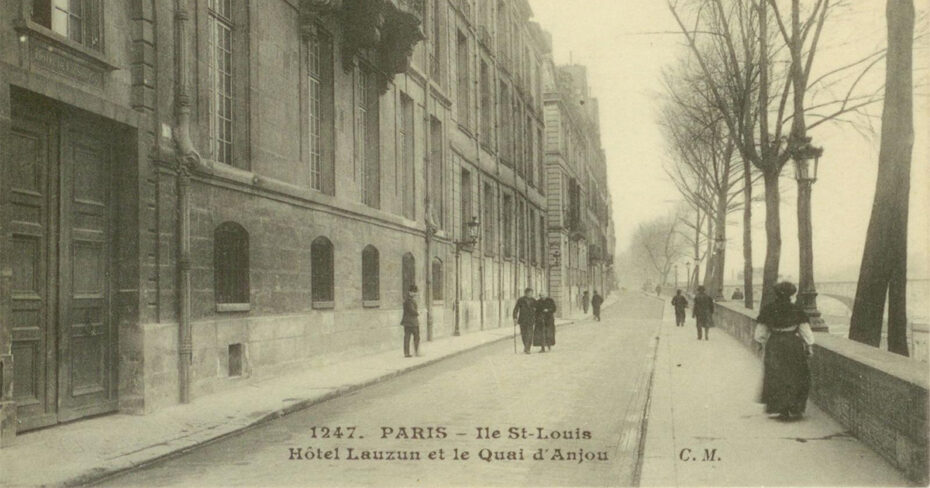
Hôtel de Lauzun
Our collective of creative Parisian ‘hash-heads’ met regularly in the
heart of Paris between 1844 and 1849 on Ile St-Louis at the gothic Hôtel
de Lauzun, the rented townhouse of 19th century painter and musician Fernand Boissard. Charles Baudelaire, who at the time was busy translating the works of Edgar Allan Poe, writer Victor Hugo (best known for his novels Les Misérables and The Hunchback of Notre Dame), novelists Alexandre Dumas (The Three Musketeers and The Count of Monte Cristo)
and painter Eugéne Delacroix, among other famous heavyweights,
regularly dipped in and out of the ‘Club of the Hashish-Eaters’ suitably
dressed in bohemian attire. The glue that cemented this social club
together was of course the drug hashish, a highly potent form of
cannabis made by compressing and processing the flowering buds of the
female cannabis plant. The drug has been consumed for centuries – the
exact date of its first appearance isn’t clear but northern India and
Nepal have a history of thousands of years of producing it....
Kris Jenner works hard, but Barbie’s marketing team works harder.
On Monday, Airbnb listed a real-life Barbie Malibu Dreamhouse
hosted by “Ken.” It’s only available for two one-night stays, but if
you’re lucky enough to score one of them, it won’t cost you a dime:
“Ken’s thing is beach, not math,” according to a press release.
The Dreamhouse rental is yet another viral marketing stunt for the upcoming Barbie movie, which has cemented itself as the cultural event of the summer. A promotional effort that began in the spring with a selfie generator and a beguiling trailer
(what exactly is the plot?) has ballooned to include seemingly infinite
partnerships and even a themed boat cruise in Boston, proving that Kris
Jenner works hard, but Barbie’s marketing team works harder.
In fact, the hype around the movie has inspired a whole new wave of interior design:
It’s
leading more adults to decorate their homes in Barbiecore, “a palette
made up primarily of hot pink, and similarly bold rosy hues like fuchsia
and magenta,” the NYT reported.
According to the Times, searches for “Barbie aesthetic bedroom” on Pinterest jumped 1,135% from May 2022 to May 2023.
The pink fuzz is generating ear-piercing buzz
With every brand under the Malibu sun trying to get in on the Barbie action,
Barbiecore is proving to be more than just a color palette. Mattel, the
company that launched Barbie in 1959, and its 100+ brand collaborators,
are seeing opportunity in seemingly every consumer category:
For gamers…Xbox is making a Barbie-themed console.
For style influencers…Aldo is collaborating with Barbie on pink shoes and accessories....
As Mattel rolls out some additions to the Barbie line-up, three new body types, "tall, curvy and petite" along with seven skin tones, 22 eye colors and 24 hairstyles--collectors are calling their banks to confirm their credit lines-- here's some backstory from Messy Nessy Chic:
Meet Lilli, the High-end German Call Girl who became America’s Iconic Barbie Doll
So it turns out Barbie’s original design was based on a German adult gag-gift escort doll named Lilli. That’s right, she wasn’t
a dentist or a surgeon, an Olympian gymnast, a pet stylist or an
ambassador for world peace. And she certainly wasn’t a toy for little
girls…
Lilli on display at the Barbie Museum in Prague
Unbeknownst to most, Barbie actually started out life in the late 1940s
as a German cartoon character created by artist Reinhard Beuthien for
the Hamburg-based tabloid, Bild-Zeitung. The comic strip
character was known as “Bild Lilli”, a post-war gold-digging buxom broad
who got by in life seducing wealthy male suitors....
...She was famously quick-witted and known to talk back when it came to
male authority. In one cartoon, Lilli is warned by a policeman for
illegally wearing a bikini out on the sidewalk. Lilli responds, “Oh, and
in your opinion, what part should I take off?”....
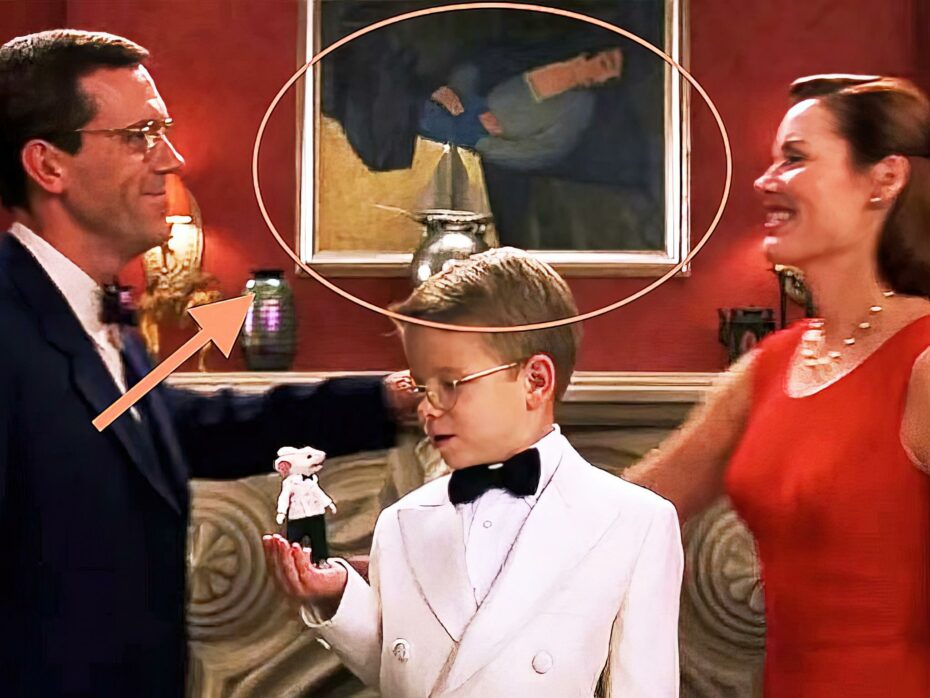
We love a good story about a missing painting missing. This one
starts in Christmas of 2008: a Hungarian art historian is at home with
his young daughter Lola, watching the popular children’s film Stuart Little,
when he notices a painting in the background that shakes him up so
much, he almost drops his daughter from his lap. It appears to be a
missing masterpiece by the Hungarian avant-garde painter Róbert Berény: Sleeping Lady with Black Vase. Unable to believe his own eyes, Gergely Barki, had only ever seen a faded black and white photo of Sleeping Lady with Black Vase
taken in 1928 before it went missing without a paper trail in sight. As
a researcher at the Hungarian National Gallery, Barki knows his Berény,
and is certain that the prop cannot be a print or copy, given the
obscurity of the artwork.
He swiftly embarks on a mission to track it down and ultimately finds
the original painting, which had indeed ended up as a set piece in a
popular Hollywood kids movie nearly a century later. The lost painting
was recovered and made its way home, all thanks to Barki, a researcher
at the Hungarian National Gallery, who also doubles up as a missing art
detective on the mission to track down lost Hungarian masterpieces (more
on that later). Let’s tumble through this strange-but-true art history
mystery that wouldn’t feel out of place in a Wes Anderson film....
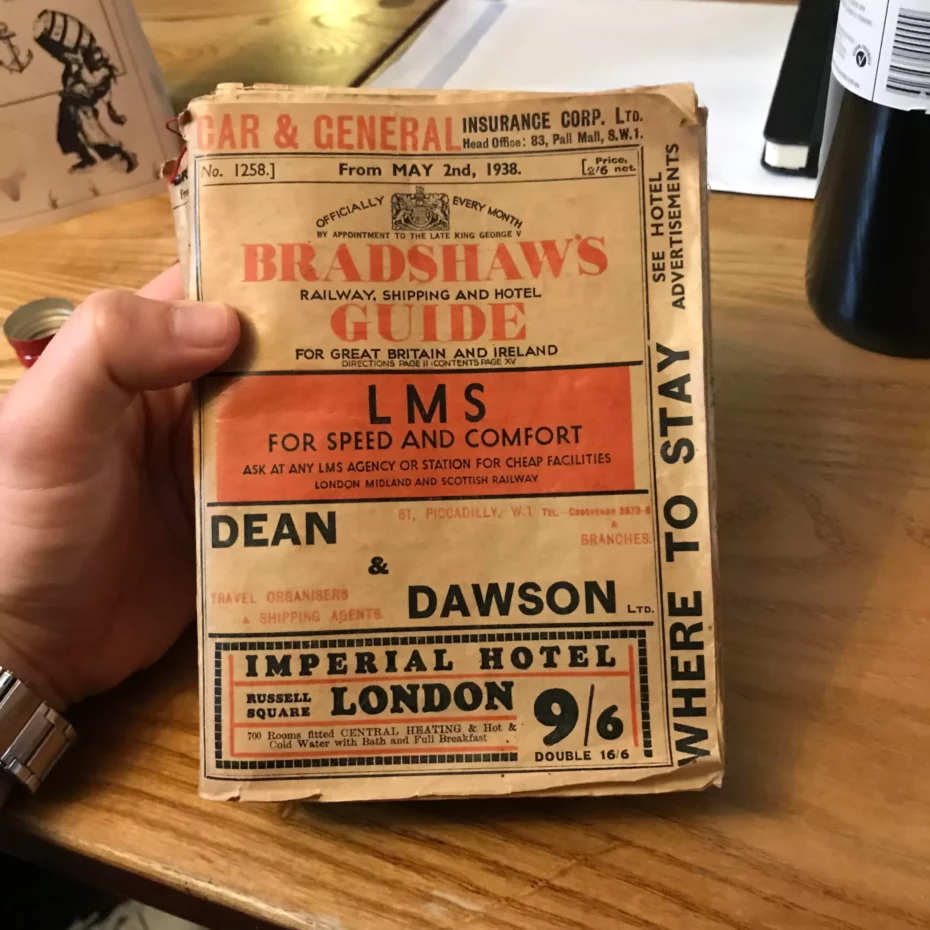
And the headline story, from Messy Nessy Chic, April 28:
Are you looking for a way to travel back in time? Well, we haven’t
cracked the laws of physics yet, but we have the next best thing – a
guidebook from another time. Move over Lonely Planet, Bradshaw’s was one
of the original guides that inspired the British to travel the
Continent for leisure.
Bradshaw’s also carries significant cultural clout. In fact, some of
the most iconic travellers in literature confided in their trusty copy.
Dracula is spotted reading an “English Bradshaw’s Guide” as he prepped
for his journey to England in Bram Stoker’s classic, and literature’s
most iconic traveller, Phileas Fogg also carries a copy with him in
Jules Verne’s Around the World in 80 Days. If it’s good enough for Dracula and Phileas Fogg, it’s good enough for us!....
It's not just in Paris. Prices for French castles and chateaux are
ticking up but still seem remarkably affordable compared to properties
in England.
Of course Scotland is still the place for bargain-minded castle buyers.
From Messy Nessy Chic, April 6:
Let’s Window Shop for French Fairytale Homes Again
I’m in that mood again. Is there ever a bad time to go window
shopping for French fairytale homes? The allure of quitting urban life,
recruiting your best friends to go all in on the adventure and living
out the rest of your days fixing up your French fortress with an endless
supply of wine & cheese. There is certainly no shortage of castles
and historic fixer-uppers in France, and here at MessyNessyChic HQ in
Paris, we like to keep an eye on what’s on the market via a few of our
go-to resources. So I thought I’d share the results of my latest sweep
of listings for sale, a personal curation of properties for all budgets,
from basement bargain castles to the dreamiest of spreads. Let’s go
shopping!....
....MUCH MORE, as usual, she has located some terrific properties.
A twofer. First up, the New York Post, September 13, 2022
King Charles’ outrageous list of daily demands revealed From pampered prince to coddled king.
Although he was just named Britain’s ruling monarch last weekend, Charles III has been living like a king his whole life.
King Charles was reportedly nicknamed the “pampered prince” by his
staff at Clarence House, where he lived with his wife Queen Consort
Camilla from 2003 until he recently took the throne.
Details of the former Prince of Wales’ lavish requests were revealed
in the 2015 Amazon Prime documentary “Serving the Royals: Inside the
Firm.”
“His pajamas are pressed every morning, his shoelaces are pressed flat
with an iron, the bath plug has to be in a certain position, and the
water temperature has to be just tepid,” in a bathtub filled “only half
full,” Burrell said.
The king even “has his valets squeeze one inch of toothpaste onto his toothbrush every morning.”
After getting ready, King Charles’ strict morning routine is continued with his breakfast.
“Prince Charles has a healthier option. He’d have homemade bread, a
bowl of fresh fruit, fresh fruit juices,” said chef Graham Newbould, a
former member of the royal staff.
“Wherever the prince goes in the world, the breakfast box goes with
him. He has six different types of honey, some special mueslis, his
dried fruit and anything that’s a bit special that he is a bit fussy
about.”....
And the reason for the query in the headline, from Messy Nessy Chic, March 17:
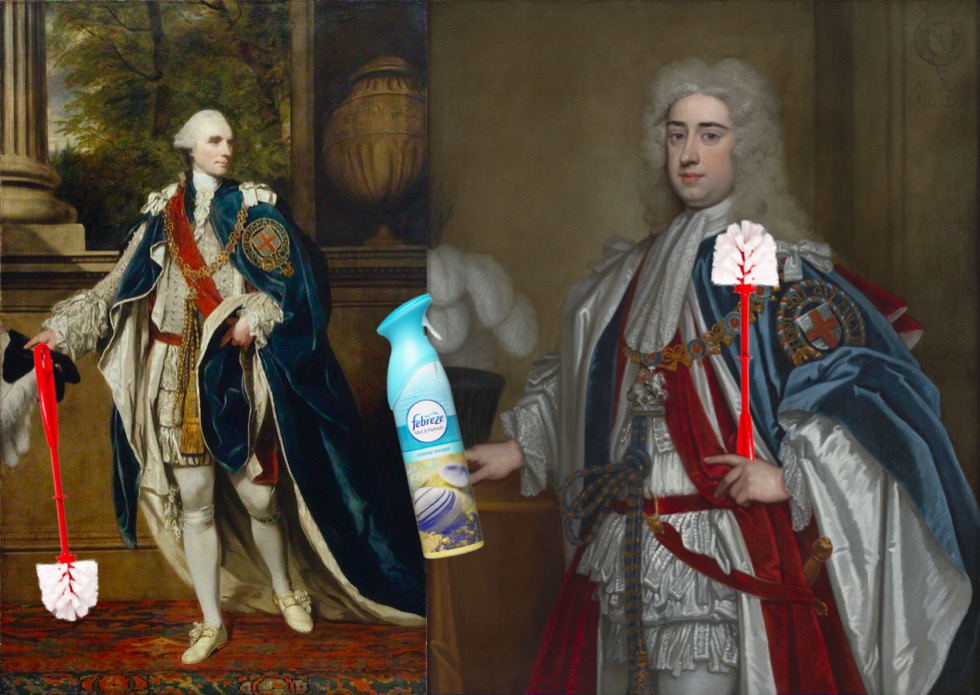
The Toilet Duty Dukes and Duchesses of England
Those precious moments of alone time in the
bathroom are priceless to many of us, and yet strangely enough, it was
one of the few luxuries the King and Queen of England could not
afford. Until as recently as the 20th century, the British monarchy
appointed what was known as the “Groom of the Stool”, a courtier
responsible for assisting them in the performance of “bodily functions
of excretion and ablution”. And this wasn’t the role of any ordinary
household servant. The appointment was offered to Dukes and Duchesses,
Earls and Lords, Count and Viscounts– even future Prime Ministers of
England, who willingly took a job that more or less entailed wiping the
King’s bottom…
Above left: John Stuart, Prime Minister of Britain and Groom of
Stole to George III; Right: Lionel Sackville, 1st Duke of Dorset, Groom
to George I.
Some American companies are such a part of our everyday lives, they’re taken for granted, the likes of Apple, Microsoft and Google for example. But there is another company that although it can be seen everywhere, no-one notices. Even more mysteriously, the company no longer exists. But walk through any American city, or picture its greatest manmade landmarks and the chances are it was made with Bethlehem Steel. For over a century, the star of Bethlehem Steel burned bright, becoming one of the world’s largest producers of steel. Based in a small city in Pennsylvania, the company built the backbone of America; from the Chrysler Building to the Empire State Building, the Hoover Dam, Madison Square Garden, Rockefeller Centre, the Golden Gate Bridge, even the prison island of Alcatraz were just some of the iconic structures made with Bethlehem Steel.
By 1940, a staggering 80% of New York’s famous skyline was built with
Bethlehem Steel. But by the 1990s, the unthinkable happened, and this
titan of American industry went bankrupt. The blast furnaces closed,
taking most of the city of Bethlehem’s fortunes with it. One winter’s
day we went to visit the haunting ruins of the city that built America....
....MUCH MORE, some of the pictures have to be seen to be believed.
....the "War Brides", companies that would profit
from WW I. GM fit into both categories. One of the big movers of the
1914-1918 bull market was Bethlehem Steel whose stock traded through
1913 with a desultory $30-handle and went to $600 in 1915:
These aren't just any provinces. I mean New Brunswick is nice, and huge shout-out to Gander, Newfoundland but the three provinces in the headline are the breadbasket of Canada and a world-class agricultural resource.
The Premiers of Saskatchewan:
The same federal government who alienated our oil and gas industry is now putting global food security at risk by attacking the hard working agriculture producers across western Canada with an arbitrary goal to reduce fertilizer usage.
Manitoba families can't afford even higher grocery costs. Manitoba farmers feed the world. We'll continue to fight for them.@Min_DJohnson & I wrote to @JustinTrudeau & @mclaudebibeau to fight for you against the increased costs their nutrient reduction policy would cause #mbpolipic.twitter.com/nIX3SewuzY
— Heather Stefanson 🇺🇦 (@HStefansonMB) July 29, 2022
That's it for Messy Nessy for this week. I had been feeling as though
I was depriving our readers of that cyber cabinet of curiosities but
it's August in Paris and posting will be light.
We on the other
hand, despite a few hundred posts on the topic, have barely scratched
the surface in our review of nitrogen: Money, Power, Glory, Guano!
What we know as the famous Roman “Colosseum” might have been paid for
with pee, more specifically poor people’s pee. Built under the rule of
Emperor Vespasian of the Flavian dynasty, he is one of the only known
rulers in history to have imposed a urine tax on the sale and
distribution of urine from the city’s public toilets, which in the time
of Ancient Rome, apparently had very good resale value. Let us explain…
Roman Emperors had controversial lifestyles,
but the Emperor that preceded Vespasian – Nero – trumped them all and
bankrupted the empire with reckless spending. The senate declared him a
public enemy, he committed suicide and a civil-war broke out. Rising
from this chaos was Vespasian, a commoner and civil servant known for
his fiscal responsibility and military campaigns. Basically, the
opposite of Nero. His peers nicknamed Vespasian “Mulio,” or
mule-breeder, because he sold mules to get to finance the North African
Province he governed rather than exploiting the local resources.
Now Emperor, Vespasian found the imperial treasury depleted and
needed to generate funds. He did this by raising taxes. Most of his
taxes targeted the rich. He even extorted nobles by promoting them, only
to then imprison them and make them pay fines for their freedom. People
said he used these men as “sponges” – soaking them when they were dry
and squeezing them when wet.
However, his most infamous tax targeted the commoners. Most Romans were
generally “too poor to have a pot to piss in” as the saying goes, and
had to go to local public latrines to relieve themselves. Landlords
would collect and sell the peasants’ pee. Buyers paid the tax. Why would
anyone buy urine, you ask? Tanners, wool producers and launderers
coveted piddle for its high ammonia content and some Romans even
believed it could be used it for whitening their teeth.....
That's it for Messy Nessy for this week. I had been feeling as though I was depriving our readers of that cyber cabinet of curiosities but it's August in Paris and posting will be light.
We on the other hand, despite a few hundred posts on the topic, have barely scratched the surface in our review of nitrogen: Money, Power, Glory, Guano!
If you’re not subscribed to the Messy Nessy Chic newsletter (hint hint),
you may be wondering why we’ve gone a little quiet these past few
weeks. The fact that the MNC HQ is based in Paris may give you a clue.
You see, Parisians close up shop for August to chase the last rays of
summer outside la capitale, turning the city into a veritable
ghost town. Tourists and locals alike are left wondering where on earth
they can find an open boulangerie, where they can shop, dine, and make
merry while tumbleweeds roll down the Champs-Elysées…
We haven't visited Vanessa at Messy Nessy Chic in a while and that is an egregious failing on our part.
She truly has put together an internet version of the old-timey cabinet of curiosities that is unrivaled. Here's the homepage.
And here's the headliner, May 24:
When Nellie Bly got bored of writing about fashion and gardening, she
went undercover as a patient in a mental asylum and faked insanity to
expose the institutional abuse. When she read Jules Verne’s book Around the world in 80 Days,
she attempted the fictional journey herself, and did it in 72 days, 6
hours, and 11 minutes, setting a world record as the first person to do
so. When she married and was expected to become a housewife, she
patented two designs for steel cans and became the boss of a
million-dollar iron manufacturing business instead. This was all before
the age of 40, and before women had the right to vote.
Nelly Bly was a daredevil writer and pioneering investigative ‘stunt’
journalist on a mission. Ahead of her time as she was hell-bent on
promoting social change, she felt compelled to champion the cause of
neglected and exploited women in the rising industrial world of the late
19th century.
She was born Elizabeth Jane Cochran in 1864 at Burrell Township,
Pennsylvania USA, and one of 15 children from an impoverished and
extended family. Her father died when she was six, and although having
been a successful local businessman owning the local mill, this seems to
have had little benefit to Nellie. In 1880, Cochran enrolled at Indiana
Normal School (now Indiana University of Pennsylvania) but after a
year, had had to drop out due to lack of funds.
Her first skirmish within the world of journalism occurred in her
early teens when she wrote a strong and feminist letter to an editor
objecting to an article that had appeared in the “What Girls are Good
For” column of her local Pittsburg paper, The Dispatch. The article claimed that women were ‘only good for giving birth and doing housework’.
*****
The paper’s editor, George Madden, was so bowled over by Nellie’s response that he asked her to write an official reaction article under the pen name ‘Lonely Orphan Girl’. In her first Dispatch article, ‘The Girl Puzzle’, she passionately penned how divorce adversely affected women and appealed for change to the divorce laws of the day. Madden offered her a full-time position using the pen-name Nellie Bly, based on a popular Afro-American song character from 1850. The name stuck....
....MUCH MORE, including illustrations that were new to yours truly.
And although Nellie Bly has not been accorded the place in journo history that Ida Tarbell and the McClure's crowd received, Nellie Bly was every bit the muck-raker that they were.
In 2011 we visited Ida Tarbell in "Ida M. Tarbell: 'John D. Rockefeller: A Character Study'" in part because I wanted a searchable link to the Tarbell collection
at Allegheny college and partly because she described John D.'s
grandfather, Godfrey as "a shiftless tippler, stunted in stature and
mean in spirit".
In February 2016's "Oil Tankers and Interest Rates and Scallywags and Time"
one of the Rockefeller minions, Thomas Lawson, got a mention, not for
his exposé of his copper dealings with Standard Oil honcho Henry
Huttleston Rogers, Frenzied Finance, but because of the ship for which Lawson was namesake.
Staying in 2016, it was Ida's buddy Lincoln Steffens in "Goldman Sachs: Death Of Capitalism Averted, Time For Working Schlubs to Partaay!", again not for the work he was most famous for, in Steffens' case his Shame of the Cities (St. Louis, Minneapolis, Pittsburgh et al) but because of his famously wrong statement about Soviet Russia in a letter dated April 3, 1919: “I have seen the future and it works.”.
It didn't.
So yes, more than wary reader might have anticipated and I've probably forgotten a couple.
Circling back to Ida, here's an online version of History of the Standard Oil Company.
Although there are quite a few critiques you can raise about her book it
was pretty important and was one of the factors that led to the breakup
of Standard Oil in the Supreme Court decision "Standard Oil Co. of New Jersey v. United States" seven years later. So Mr Rockefeller probably considered the book important.
It ranks #5 on NYU's Journalism school's list of the 100 best works of 20th-century American journalism. (via the NYT)
Full disclosure, we never gave the Periodic Table much thought – it
remains in our memory as a clunky patchwork of confusing titled squares
taped to the back of our school chemistry folder that our teachers would
occasionally torture us with for a pop quiz on the elements. Walter
Russell however, a 1920s Renaissance man, did give the Periodic
Table a lot of thought, so much so, that he was inspired to reimagine
it in a dramatically different and artistic form, adding two missing
elements that would later lead to the development of the atom bomb.
This, coming from a guy who never advanced beyond a grade 4 education.
But there was something about Walter. The great Serbian-American
inventor, Nikola Tesla was an admirer, and was so awed by Russell’s
philosophy on cosmology and the nature of the universe that he told him
to lock his findings in a sepulcher for a thousand years, because in his
opinion, mankind was not ready for it. Keeping up with the many lives
of Walter Russell is as dizzying as attempting to understand his
extensive archive of mesmerising New Age diagrams. He was an eccentric
scientific philosopher, renowned sculptor and impressionist painter, an
author, musician, equestrian, an architectural developer – and, perhaps
the cherry on the cake – he is credited with introducing figure skating
to America. So without further ado, it’s time to get better acquainted
with this under-the-radar 20th century visionary....
The movie Sideways, a comedy about a neurotic novelist on a
soul-searching trip through California’s wine country, became a bit of a
sensation among a certain class of Americans in 2005. It took in over $100 million at the box office
and won a whole bunch of awards. It’s best remembered today for an
iconic scene in which Paul Giamatti’s main character goes on a brief
expletive-ridden tirade against Merlot right before a high-stakes dinner
date.
*****
These roughly five or six seconds of dialogue had a profound effect on
popular perceptions of Merlot and, in turn, on the entire California
wine industry. According to a new study published in the Journal of Wine Economics
(no, I did not make that up), in the years following Sideways’ release
the price of Merlot fell and California wineries converted thousands of
acres of Merlot grapes into the varietal preferred by Giamatti’s
character in the film: Pinot Noir....
What a bunch of wine snob poseurs. Merlot is just fine, especially if it's dolled up as Chateau Petrus. Berry Bros. & Rudd is running a special case price, "Buy 6 and save £ 2667.37". ARomanée Conti (pinot noir) will cost you double or triple. BB&R is price on request. Either way, possibly more than the average baboon has in petty cash....
Wild baboons in South Africa are raiding vineyards. Perhaps they watched the move Sideways
or perhaps they just have good taste: Growers report that the baboons
favor pinot noir grapes. Not only that, but they "choose the nicest
bunches" and leave the sour grapes on the ground, according to one
farmer quoted by the Associated Press.
The primates' discernment
is expensive for the growers in South Africa's wine country: Pinot sells
for more than the merlot and cabernet sauvignon that the tasteful
baboons tend to ignore....
Well, compared to the gentleman in this next post I rank somewhere in the vineyard raiding baboon category:
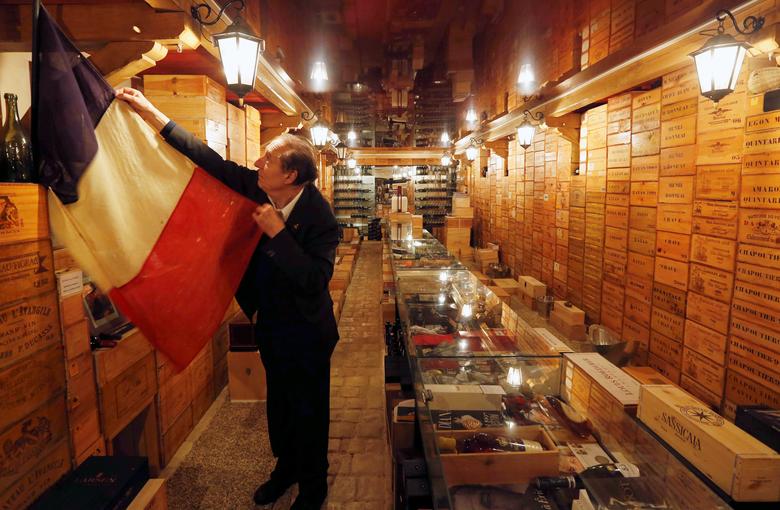
One of the world’s most prestigious wine cellars isn’t where you
think it might be. It isn’t nestled beneath a grand chateau or
presidential palace, but buried in the backyard of an average Joe, a
retiree of humble background who has been collecting the rarest wines,
bottle by bottle for the past 50 years.
US private equity firms that own property in Spain have been evicting residents during the pandemic, the NYT reports.
Tenants and housing activists have declared "war," protesting evictions by squatting in apartments.
They argue that the investment firms have been profiting off the economic strain caused by the pandemic.
Renters who can't afford to pay their landlords are being
evicted, and they're furious about it. They're especially mad that their
landlord is a large investment firm headquartered in Wall Street.
But
what if I told you this was happening thousands of miles away from New
York City, an ocean away even, in Spain? And what if I told you the
Spanish evictees aren't taking it lying down?
Large American
private equity firms have been evicting renters from their apartments in
Spain as the residents have struggled to pay rent during the pandemic.
Renters, however, have been organizing against the landlords, lawyers,
and police officers trying to evict them, refusing to leave their own
homes and squatting in others.
A group called "Guerra a Cerberus"
— War Against Cerberus — has been fighting back against eviction
attempts, The New York Times reported
this week. The organization, made up of both residents and long term
housing activists in Spain, are protesting the firms that they argue
have been profiting off the financial strain of the pandemic, as well as
the court system, which they view as favoring landlords in eviction
cases.
Cerberus — named for the three-headed dog that guards the
underworld in Greek mythology — is a giant investment firm that began
buying cheap properties across Spain after the global financial crisis
started in 2008. Cerberus and other firms, such as Blackstone and Lone
Star, are based in the US, but collectively purchased thousands of
properties across the European country.
Members of War Against
Cerberus have been taking action when police officers and lawyers
representing private equity firms attempt to force residents out of
their homes. As they are physically removed from their apartments,
members of the organization squat in properties owned by the firms in
other parts of the city.
Dozens of households have occupied
buildings owned by private equity firms, War Against Cerberus told the
Times. The pressure the squatters exert on the large firms is
quantifiable: it can take several years in court and millions of dollars
in legal fees to have squatters removed.
War Against Cerberus
often posts their encounters with law enforcement on social media. They
also use platforms such as Twitter to rally support when residents are
evicted from their homes.
"Today the vulture fund Cerberus wants to take out Yousra and her family," the group posted
on Twitter last week. "The neighborhood has woken up with people from
all over, showing an organized and combative movement." A picture posted
with the tweet shows a blockade that the group formed in front of the
apartment they were demonstrating in front of.
"Our lives are worth more than all their properties, so #GuerraACerberus," an organizer shouted during one group meeting in October.
The
housing crisis in Spain worsened during the pandemic — with evictions
rising by 14% in early 2021 compared to the same period in 2020,
according to the government — but has been hitting residents hard since
the financial crisis of 2008. Homeowners went bankrupt, evictions rose,
and thousands of people lost their homes. In the last decade, the number
of renters in Spain grew by more than 40 percent, the Times estimates....
Kind of an artsy-fartsy day, what with the big auctions and perfectly executed risk management and all. just kidding, it was far from perfect, hence yesterday's disappearing act and today's spiffy new risk manager hat.
Via Messy Nessy Chic, 13 Things I Found on the Internet Today (Vol. CCXXXV), May 15:
3. This Airbnb Location
Designed by Ricardo Bofill and built in 1973,La Muralla Roja is an insanely colourful apartment complex which sits out on the rocks of a coastal town in Calpe, Spain.
Good grief, grow up. I am not going back to our every usage of "Gin Lane" to add a "this may offend your sensibilities" tag.
I thought I was going above and beyond the call just to make clear the old saying:
Drunk for a penny
dead drunk for tuppence
clean straw for nothing
-Inscription on the arch of the gin celler
"Gin Royal" in Hogarth's Gin Lane
The motto is inscribed above the arch, bottom left-click to enlarge.
And from one of the founders of The Critic:
Apparently Hogarth reveals "the entrenchment of racist, sexist and xenophobic stereotypes". Rather astonishing for an eighteenth century caricaturist... who would have thought it? pic.twitter.com/Qr9TuqkM3q
At one of the first homeless shelters in London, for two pennies a
night people could sleep resting over a rope (they were forbidden from
lying down). It was called the “two-penny-hangover” and it may likely be
where the term “hungover” originates from.