Thursday, June 28, 2012

Shanghai Stock Exchange Index Continues Decline, Now Down for 2012

Holy Crap this could get bad.
From last Saturday:
Is China's Shanghai Index Approaching the Waterfall Decline?
You know how it goes.
You get in the river and it's flowing just enough to be exhilarating and then the gradient increases and you're right on the edge of control and you'd be worried about the class 5's except now you hear a fucking waterfall.
Or something.

From Alpha Global Investors:

(click for larger image)

Shanghai Stock exchange weekly chart ; Clear long term lower highs (see red arrows)...MORE

And from Bloomberg this morning:
China’s Stock Index Erases 2012 Gain After June Plunge

China’s Shanghai Composite Index (SHCOMP), the world’s second worst-performing stocks measure this month, erased this year’s gain on concern a manufacturing slump and the European debt crisis will deepen the economic slowdown. 

The Shanghai index dropped 1 percent to 2,195.84 at the close, a seventh day of losses. The gauge has lost 7.4 percent in June. The measure had gained as much as 12 percent this year through its peak on March 2. Trading values on the Shanghai Stock Exchange fell to a five-month low yesterday....MUCH MORE, including a note on a former favorite:
Inner Mongolia Baotou Steel Rare-Earth Hi-Tech Co., China’s biggest producer of rare earth, declined 5.5 percent to 37.95 yuan.

Wednesday, June 27, 2012

Are Individual Investors Fleeing Stocks Like Rats Off A Sinking Ship?

No.
From Jason Zweig at the Wall Street Journal:
A new report from Vanguard Group casts some doubt on the meme that retail investors have been fleeing stocks like rats from a sinking ship.

The report, “How America Saves,” is the latest installment in Vanguard’s annual survey of the more than 3 million Americans who participate in retirement plans administered by the giant fund company.
To be sure, this year’s study (encompassing data from 2011) shows that the proportion of assets in retirement plans invested in stocks fell three percentage points from last year and is down eight points from its peak in 2007. But that still leaves 65% in stocks – versus 17% in cash and 10% each in bonds and balanced funds.

While the financial commentariat would have you believe that retail investors have been yanking their last farthings out of the stock market, the folks in Vanguard’s huge sample of retirement savers still have two-thirds of their money riding on stocks.

The story gets more interesting when you look beyond people’s balances to see what they are doing with the contributions from their current paychecks. Fully 71% of that money is going into stocks, reports Vanguard – up one percentage point from 2010 and three points higher than in 2009.

If this is “the death of equities,” the funeral seems extraordinarily well-attended.

There is something subtle going on beneath the surface, however....MORE 
HT: MarketBeat
Had we seen that "Death of Equities" line earlier in the day Mr. Zweig may have pushed past the SEC's Enforcement honcho to win today's prestiious CLoD.

Mayor Bloomberg Hooks Home Air Conditioner On SUV

You have got to be kidding.
From the New York Post:
Mayor rigs wacky A/C to keep his SUV chilled
Who’s full of hot air?

Mayor Bloomberg wants to maintain his politically correct credentials on global warming — but hates to get into a hot car when he leaves an air conditioned building.

The solution his aides came up with could easily have doubled as a stunt on David Letterman’s show.
In full view of bemused tourists and other passers-by, workers yesterday performed what looked like a comedy routine: They hoisted a standard room air conditioner to a side window of one of the mayor’s SUVs parked in the City Hall lot to see if it would fit.

If the strange plan gets a green light, the units would be plugged into electrical outlets and cause less pollution than running the vehicles’ own A/Cs on an idling engine.
“This is an experiment to be used on extremely hot days like the types we saw last week,” said mayoral spokesman Stu Loeser.

“Even with the vehicles parked in the shade, the temperatures inside can quickly rise to more than 100 degrees.”

The mayor’s two Chevy Suburbans have been on cooling restriction since July 2009, when reporters spotted them all around town idling with the A/Cs on for several minutes at a time....MORE

Bread and Circuses: Chicago City Council Votes to Decriminalize Marijuana, 43-2

From Reason's Hit & Run blog:
The Chicago City Council voted 43-2 today to decriminalize marijuana, reports Law Enforcement Against Prohibition. The group released this statement in anticipation of today's vote:
“I expect the City Council to show great leadership by decriminalizing marijuana possession today,” said former assistant state's attorney of Cook County Jim Gierach. “As a prosecutor, I’ve seen first hand that our marijuana laws aren’t working. This proposal shows that our leaders here in Chicago realize that focusing on this nonviolent crime is not only costing us tax precious dollars, it’s costing precious lives.”
The proposal already had support from Mayor Rahm Emanuel, local police, and a majority of the 50 city council members before Gierach started his petition. But Gierach hopes the petition shows that there is public support for reforming drug laws....MORE
In other Chicago news, via the Sun-Times (June 24):
Chicago violence weekend toll: 4 dead, 29 wounded

I'm thinking pot is the least of Chicago's problems.

Now You Can Say You've Seen it: The Earliest Photograph of a Person

You have to squint to see the guy getting his shoes shined.
Via Can Turtles Fly:


Oldest Photo of a Person
Boulevard du Temple by Daguerre, Paris, France (circa 1838)
(source: Scanned from The Photography Book, Phaidon Press, London, 1997. Downloaded from Wikipedia Commons on June 24, 2012)

Previously:
Nasty bugger what with the devil horns and all
tornado
Oldest known photograph of a tornado
Image ID: wea00206, NOAA's National Weather Service (NWS) Collection
Location:
22 miles southwest of Howard, South Dakota

Photo Date:
1884 August 28
From NOAA
HT: Wicked Weather Pics
And:
Oldest Known Pornography Found in France

Schaeffer's Research on Molycorp and Chesapeake Options (MCP; CHK)

Chesapeake is up 4% at $17.76, Molycorp is up 2.18% at $20.58.
From Schaeffer's Investment Research (June 26):
Speculative investors have taken a keen interest lately in rare earth oxide specialist Molycorp, Inc. (NYSE:MCP - 19.98), natural gas giant Chesapeake Energy Corporation (NYSE:CHK - 16.84), and semiconductor stock Skyworks Solutions, Inc. (NYSE:SWKS - 24.90). Calls have become the options of choice on MCP, while puts are in heavy rotation on CHK and SWKS. Here's a closer look at the latest trends in the options pits for these three hot stocks.

Over the past five days, options traders have bought to open 16,410 calls on MCP, according to data from the International Securities Exchange (ISE) and Chicago Board Options Exchange (CBOE). Meanwhile, a relatively meager 3,541 puts have been bought to open, netting the stock a five-day call/put volume ratio of 4.63. In other words, speculators have scooped up nearly five times more bullish bets than bearish during the past week.

From a longer-term perspective, MCP sports a 10-day call/put volume ratio of 3.32 on the ISE, CBOE, and NASDAQ OMX PHLX (PHLX). This ratio ranks higher than 76% of other such readings taken during the past year, suggesting that speculators have purchased calls over puts at a faster pace just 24% of the time.

However, options traders may not be as optimistic as they appear. Despite a 7.2% decline during the most recent reporting period, short interest still accounts for a lofty 35.8% of MCP's float. With so many bears betting on the stock to slide, it's possible that skeptics have been buying call options simply to hedge their shorted shares.

MCP has been a serious laggard on the charts, having plummeted to a loss of 63.7% over the previous 52 weeks. The shares are trading below familiar resistance at their 10-week and 20-week moving averages, and they're now at risk of breaching tenuous support in the $20 area. A definitive break of this psychologically significant level could spur additional selling in MCP.
-----------------------------------------------------------------------------------------------
On the other side of the options aisle, put players have set their sights on long-suffering CHK. Traders on the ISE have bought to open 8,473 puts on CHK during the past five sessions, nearly doubling the 4,315 calls that were purchased in the same time frame....MORE


Lawmakers Tweak Their Portfolios After Talking with Administration Officials

From Securities Law Prof:
In case you missed it, this is well worth reading:  On Sunday the Washington Post reports on 34 members of Congress who reworked their financial portfolios during the financial crisis after phone calls or meetings with Treasury Secretary Henry Paulson, Timothy Geithner or Fed Chairman Bernanke, according to the newspaper's examination of appointment calendars and congressional disclosure forms....MORE

Climateer Line of the Day: Phil Falcone Edition

“Today’s charges read like the final exam in a graduate school course 
in how to operate a hedge fund unlawfully”

-Robert Khuzami
Director, Division of Enforcement
United States Securities and Exchange Commission

From the SEC:
Washington, D.C., June 27, 2012 — The Securities and Exchange Commission today filed fraud charges against New York-based hedge fund adviser Philip A. Falcone and his advisory firm, Harbinger Capital Partners LLC for illicit conduct that included misappropriation of client assets, market manipulation, and betraying clients. The SEC also charged Peter A. Jenson, Harbinger’s former Chief Operating Officer, for aiding and abetting the misappropriation scheme. Additionally, the SEC reached a settlement with Harbinger for unlawful trading.

The SEC alleges that Falcone used fund assets to pay his taxes, conducted an illegal “short squeeze” to manipulate bond prices, secretly favored certain customers at the expense of others, and that Harbinger unlawfully bought equity securities in a public offering, after having sold short the same security during a restricted period. 
The SEC press release.

Which is Worse: Barclays Criminality or Their Sheer Incompetence? (BARC.L)

From Fintag:
News comments:
What can you say? Investment Bankers cheating again.

It has been clear for years that Libor was a bit of a dart throw, but Barclays abuse is quite staggering. But then when bankers are able to con governments in getting them to fund their bonuses under the guise of capital requirements and too big to fail rhetoric, then what is a little bit of libor flexing?

Barclays are in big shit. Everything they have done in the past 10 years has turned to dust.

Barclays are rumoured to have pumped 2 billion into film partnerships, tax schemes being investigated and closed down by the UK's tax authorities. Barclays have also set aside huge sums for PPI mis-selling and it turns out will be setting aside even more for the mis-selling of interest rate swaps....MORE
Today's Barclay shorts:
USD450 Fine (reuters)

PPI (moneysavingexpert)

IRS (telegraph)

Film Partnerships (independent)

Privacy (fintag)

1% tax on UK profits (mirror)

Today's longs:
GoogTab (bloomberg)

Gossip:
Bank of America, UBS, Nomura ...(rollingstone) 

Jeremy Grantham Sees 'ho-hum' returns for next 7 years

From Money Magazine:
Jeremy Grantham has attracted a cultlike following to his quarterly investment letters. For good reason: The chief investment strategist at Boston asset manager GMO warned of dismal returns ahead for U.S. stocks in the 2000s and predicted the bursting of both the technology and housing bubbles.

Lest you get the impression Grantham is a permabear (a label he hates), in his March 2009 letter he advised snapping up U.S. stocks just as they were plunging to their nadir in the financial crisis. Those who bought profited from one of the most powerful market rallies ever. No wonder Grantham was the top choice of MONEY readers for this month's Game Changers interview.

These days Grantham, 73, is downbeat about the prospects for most, but not all, stocks. A student of history, he has much to say about why markets get out of whack, and why we may be entering a period in which resource scarcity is again an issue for society -- and an opportunity for investors.
Contributing writer Janice Revell spoke with Grantham, who also answered questions from readers. The conversation has been edited.

How do you go about finding the best opportunities?
The great opportunities are much more likely to come at the broader asset class level than from individual stocks.
Asset classes -- stocks, bonds, commodities -- get very badly mispriced. That's because they come with enormous career risks for institutional investors. As a professional, you can afford to pick some stocks and be wrong about a few of them. To keep your job, you cannot take the risk of being seen to be wrong about the "big picture" for very long.

How did the price/earnings ratio of the S&P 500 get to 35 in 2000, compared with the long-run average of 15?
You had a massively mispriced market, and it was talked about all over the place. But no one would step aside. Institutions couldn't bring themselves to do that because they would have been skinned alive for their conservatism.

So asset allocation is an enormous opportunity, but only if you're willing to take considerable career risks. Playing against the tech bubble was unbelievably painful for us for two years, and then eventually, of course, it paid off handsomely.

How do you avoid getting sucked into bubbles yet still get some benefit from rising prices? -- Ray Ng, Scottsdale
Remember that history always repeats itself. Every great bubble in history has broken. There are no exceptions.

At GMO, we have a database of 35 bubbles. Of the 33 that have ended, every one broke all the way back -- not halfway back -- to the trend before the bubble started....MUCH MORE
HT: Abnormal Returns 

Back in 2009 we linked to GMO's 7-Year Asset Class Return Forecast:

GMO 7 year asset class forecast Sept 2009

To sum up, their predict that:
  • the S&P 500 will return less than 5% annually over the next 7 years.
  • international equities are expected to perform better, but not by that much
  • US government bonds are among the lowest return asset class (1.7%)
  • once again, timber makes an appearance with a 7.5% expected return
In comparison, GMO’s prediction of asset class returns just before the financial markets went into a tailspin in 2007 looked quite different:
  • the S&P 500 forecast was -2%
  • US ‘low quality’stocks were expected to return -10%
  • US government bond returns were forecast at just 3%
  • and timber was still high, at 6.5% annual return...MORE
The last monthly forecast I saw was May 2012:
  • US Large caps: 0.8% per year
  • US Small caps: -0.5% per year
  • US High Quality: 4.8% per year
  • International Large caps: 6.1% per year
  • International Small caps: 5.3% per year
  • Emerging Markets: 6.7% per year
Here's GMO home and Mr. Grantham's last quarterly letter. Q2 should be out next month.

Natural Gas Hits 5 1/2 Month High as Cooling Degree Days Jump 20-50% Above Last Year

The expiring July futures settled at $2.767 after trading as high as $2.946. The August got as high as $2.975.

This is the third time in the last four months  that the roll up the contango ladder has stuck, at least for a couple days/
The heat wave has come back with a vengence, here's the National Weather Service Cooling Degree Day forecast June 23 through 30:

COOLING DEGREE DAY DATA WEEKLY FORECAST
     POPULATION-WEIGHTED STATE,REGIONAL,AND NATIONAL AVERAGES
              CLIMATE PREDICTION CENTER-NCEP-NWS-NOAA
 
             LAST DATE OF FORECAST WEEK IS JUN 30, 2012
      LAST DATE OF OBSERVED WEEKLY LAST YR IS JUN 30, 2011
   SEASONAL ACCUMULATIONS ARE FROM JAN  1, 2012 TO JUN 23, 2012
         -999 = NORMAL LESS THAN 100 OR RATIO INCALCULABLE
 
   STATE         FCST  FCST FCST   ****  OBSERVED SEASONAL  ****
                 WEEK  WEEK WEEK   ****    ACCUMULATIONS    ****
                 TOTAL DEV  DEV     TOTAL DEV   DEV   DEV   DEV
                       FROM FROM          FROM  FROM  FROM  FROM
                       NORM L YR          NORM  L YR  NORM  L YR
                                                      PRCT  PRCT
           2000 CDD normals implemented 1/1/2003 
 ALABAMA           111   18   12     721   201   -31    39    -4
 ARIZONA           166   26   -2    1016   206   176    25    21
 ARKANSAS          113   18  -13     736   287    58    64     9
 CALIFORNIA         21  -19    5      72  -111    16   -61    29
 COLORADO           76   56   40     117    77    68  -999  -999
 CONNECTICUT        69   34   37      97    20    -9  -999  -999
 DELAWARE           78   14    8     346   146   -61    73   -15
 FLORIDA           118    3    3    1458   231   -38    19    -3
 GEORGIA           101   13    2     621   155   -81    33   -12
 IDAHO              33    7    4     114    56    75  -999  -999
 ILLINOIS           65   11   28     339   136    98    67    41
 INDIANA            63    8   27     309    94    33    44    12
 IOWA               88   34   41     329   128    69    64    27
 KANSAS            122   38    9     537   218    71    68    15
 KENTUCKY           81   14   31     420   143     6    52     1
 LOUISIANA         127   13   -5    1191   363    37    44     3
 MAINE              20    7   10      31    15    12  -999  -999
 MARYLAND           66    4    2     279    78   -65    39   -19
 MASSACHUSETTS      57   29   31      76    23   -11  -999  -999
 MICHIGAN           47   11   27     195    74    38    61    24
 MINNESOTA          52   20   16     190    79    77    71    68
 MISSISSIPPI       111    8    0     742   131   -25    21    -3
 MISSOURI           95   22   20     484   197    84    69    21
 MONTANA            41   26   25      57    29    40  -999  -999
 NEBRASKA          126   62   63     397   169   138    74    53
 NEVADA            110   10    6     645   161   265    33    70
 NEW HAMPSHIRE      29   10   13      72    35     1  -999  -999
 NEW JERSEY         69   21   16     192    66   -24    52   -11
 NEW MEXICO         94   35    3     346   141    60    69    21
 NEW YORK           51   14   20     140    46     5  -999  -999
 NORTH CAROLINA     92   14  -11     493   159  -113    48   -19
 NORTH DAKOTA       49   20   10     124    29    61  -999  -999
 OHIO               58   13   29     266   102    34    62    15
 OKLAHOMA          123   22  -26     720   269   -17    60    -2
 OREGON             10   -1    0      37    19    18  -999  -999
 PENNSYLVANIA       50    9   21     176    53   -31    43   -15
 RHODE ISLAND       41   14   19      68    22     4  -999  -999
 SOUTH CAROLINA    102    8  -11     634   144  -110    29   -15
 SOUTH DAKOTA       73   26   26     217    70   109    48   101
 TENNESSEE          89   14   16     500   169   -26    51    -5
 TEXAS             141   23   -8    1179   348   -72    42    -6
 UTAH               60   20   16     172    68   127    65   282
 VERMONT            21    4   11      69    32    17  -999  -999
 VIRGINIA           79   16    5     347   130   -81    60   -19
 WASHINGTON         10    1    4      20     1     8  -999  -999
 WEST VIRGINIA      59   13   23     271   109    -2    67    -1
 WISCONSIN          49   17   31     182    81    90    80    98
 WYOMING            56   36   32      69    29    55  -999  -999
   REGION
 NEW ENGLAND        51   26   27      76    32    -5  -999  -999
 MIDDLE ATLANTIC    55   15   19     162    62   -12    62    -7
 E N CENTRAL        57   12   28     266   112    59    73    29
 W N CENTRAL        87   29   24     362   154    83    74    30
 SOUTH ATLANTIC     96    9    1     768   175   -70    30    -8
 E S CENTRAL        97   14   16     579   173   -20    43    -3
 W S CENTRAL       135   21  -10    1093   348   -39    47    -3
 MOUNTAIN          100   33   14     454   148   125    48    38
 PACIFIC            19  -13    4      62   -63    15   -50    32
 
 UNITED STATES      74   12   12     434   120     5    38     1

"Here Are Facebook’s New Ratings" (FB)

From Deal Journal:
The 40-day quiet period for analysts at Facebook’s underwriters ended yesterday.
Today those analysts are out with reports.

Goldman Sachs, one of the IPO’s lead underwriters, initiated its coverage with a “buy” rating, and a $42 12-month price target, or $4 above Facebook’s IPO price and 27% above Tuesday’s closing price of $33.10.

J.P. Morgan, the No. 2 underwriter, gave the stock an “overweight,” and the top price target of the morning at $45....MORE, including table

Signposts--"Gold coin sales from national Mints fall in Q1"

From Reuters India:

Demand for gold coins fell in key markets in the early part of this year as the strong demand for small investment products that helped send bullion prices to record highs in 2011 tailed off, sales data from three major Mints showed.

The United States, Canadian and Austrian Mints, which between them produce three of the world's top five bullion investment coins, all reported lower sales in the first quarter of 2012 versus a year ago.

Combined sales of U.S. American Eagle, Canadian Maple Leaf and Vienna Philharmonic gold coins fell by more than a third to 451,113 ounces in the three months to March.

The Royal Canadian Mint, which produces Maple Leaf coins in gold and silver, saw the biggest drop in gold sales, which were down 46 percent to 160,000 ounces from 296,000 ounces.

"The Mint cannot predict the precious metals market," it said in an annual report....MORE

Machine Intelligence: Simulated 13-Year-Old Boy Wins Largest-Ever Turing Test

From NewScientist:
Eugene Goostman, a chatbot with the personality of a 13-year-old boy, won the biggest Turing test ever staged, on 23 June, the 100th anniversary of the birth of Alan Turing.

Held at Bletchley Park near Milton Keynes, UK, where Turing cracked the Nazi Enigma code during the second world war, the test involved over 150 separate conversations, 30 judges (including myself), 25 hidden humans and five elite, chattering software programs.

By contrast, the most famous Turing test - the annual Loebner prize, also held at Bletchley Park this year to honour Turing - typically involves just four human judges and four machines.

"With 150 Turing tests conducted, this is the biggest Turing test contest ever," says Huma Shah, a researcher at the University of Reading, UK, who organised the mammoth test.

That makes the result more statistically significant than any other previous Turing test, says Eugene's creator Vladimir Veselov based in Raritan, New Jersey. "It was a pretty huge number of conversations," he said, shortly after he was awarded first prize: "I am very excited."

First conceived by Turing in the early 1950s, the test is the most famous evaluation of machine intelligence. Human judges converse via a text interface with both hidden bots and humans - and say in each case whether they are chatting to a human or machine.

Turing said that a machine that fooled humans into thinking it was human 30 per cent of the time would have beaten the test. Just short of this, Eugene fooled its judges 29 per cent of the time. In a close second place, came JFred, the brain child of Robby Garner, and in third place Rollo Carpenter's Cleverbot. The other two bots to compete were Ultra Hal and Elbot....MORE
See also Saturday's:
How to Solve Today's Alan Turing Google Doodle

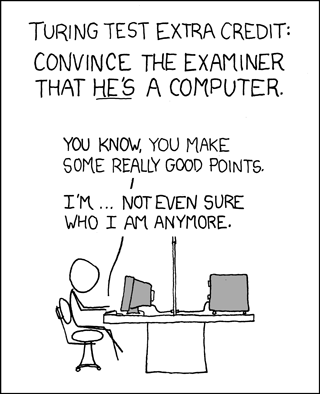
And from the genius that is xkcd:

Turing Test

Operation High Roller Attempts to Hack Banks for Billions, Nets at Least $80 Million so Far

First up, Network World:

International fraud ring said to use automated techniques to steal $78 million from banks, commercial accounts, according to McAfee and Guardian Analytics report
A global fraud ring has been targeting high net-worth businesses and individuals has netted the criminals an estimated $78 million (60 million euros). 

According to McAfee and Guardian Analytics which today issued a report on the fraud, "Dissecting Operation High Roller," the attacks, first identified this winter, have hit 60 or more institutions and the total amount stolen may in fact be may be much higher.

The two security firms say they have tracked "at least a dozen groups" that are relying on "server-side components and heavy automation" with about 60 servers processing thousands of attempted thefts from commercial accounts and the rich. This appears to be happening mainly in the European Union countries, though there's also evidence of it in Latin America and the U.S. These attacks are said to differ from the known malware-based SpyEye and Zeus attacks in that they are far more automated and usually done without human intervention.

"The advanced methods discovered in Operation High Roller show fraudsters moving toward cloud-based servers with multi-faceted automation in a global fraud campaign," said Dave Marcus, McAfee director of advanced research and threat intelligence.

McAfee and Guardian Analytics first spotted evidence of these crime activities in late January in an attack on a bank in Germany in which the victim log data on the server "showed the fraudsters compromised 176 accounts and attempted to transfer nearly one million Euros to mule accounts in Portugal, Greece, and the United Kingdom." The average account targeted held about 509,000 euros.

An attack against the German bank was highly automated, and in their report, the security firms say they had seen something similar in an earlier attack on a bank in Italy that involved SpyEye and Zeus malware to transfer funds but was more automated than anything they'd seen before.

The report says all manner of banking institutions have been targeted: credit union, large global bank and regional banks. In March, the fraudsters hit the Netherlands banking system with this newer style of server-side automated attack. They circumvented endpoint security and monitoring tools used for fraud detection at the institution, the report says. The server was based in San Jose, Calif., and has also apparently been used against victims in the U.S. whose accounts contained at least $1 million.

A hit against two banks in the Netherlands reached into more than 5,000 business accounts. The attempted fraud was estimated to be 35.58 million euros. Later in March, the security firms also became aware of attacks in Latin America, where more than a dozen businesses in Colombia were targeted, each having an account balance between $500,000 and $2 million. The server used in this wave of attacks was hosted in La Brea, Calif., though there was evidence of fraudsters logging in from Moscow to "manipulate some of the transactions in an attempt to transfer arbitrary amounts as high as 50% - 80% of the victim's balance." McAfee and Guardian Analytics say they've shared their findings with law enforcement agencies....MORE 
Daily Tech puts a much higher number on the scam:

"High Roller" Hacker Attack is Stealing Hundreds of Millions From the Rich
...II. Sophisticated Cloud-Commanded Malware Hits U.S.

The attacks initially targeted Europe, but have since spread to the U.S. and Columbia.  The hardest hit region in Europe, according to McAfee is the Netherlands, which suffered over €141M ($175M USD).  However attacks in the U.S. are also escalating with 8 to 10 malware variants currently attacking 109 businesses.

Texas is the state currently being hardest hit by the attacks.  Numerous account holders in New York, Georgia, and California were also targeted....MORE 


High Roller attacks

Here's the McAfee report (20 page PDF)

How to think About Inflatioñerós and Deflationistas

From PostLibertarian:

Where is that hyperinflation, anyway?
I saw an article in a business magazine the other day about the inevitability of the coming inflation and how to prepare for it from a business perspective. There have been a lot of voices over the last few years predicting harmful levels of inflation, usually as a consequence of the Federal Reserve’s recent interventions in the economy. (Here are a couple classic examples from doom-pop site Zero Hedge.)

Bob Murphy was confident enough in the coming inflation to bet David Henderson $500 in 2009 that we would see 10% inflation by 2013. Through 2010 and 2011 gold and silver soared to records that many cited as evidence, but it never translated to the rest of the economy, and those metals are flat or down over the last twelve months. 10% inflation hasn’t come close to happening and it doesn’t look like it will.

(Of course, there are those like John “ShadowStats” Williams who claim that inflation really is much higher than the “official” levels, but that just doesn’t pass the smell test for me. From dollar menus to DVDs, most stuff has not doubled in the last 10 years, and in fact, a lot of it has gotten better and cheaper; the iPhone didn’t even exist until five years ago this Friday. Additionally, there’s a separate inflation measurement from MIT that closely tracks the official CPI and actually shows lower levels right now.)

Now I’ve only read a small percentage of the writings of both Bob and David, but they both seem to rest comfortably inside the libertarian-ish part of the political spectrum (unlike, say, the more predictable Paul Krugman). I don’t know why some libertarians aren’t worried about inflation (i.e. do they reject Austrian economic theories that some libertarians favor?), but there do seem to be a lot of libertarian-ish anti-government anti-Federal-Reserve folks that are very worried about it....
...If hyperinflation never comes to the US, the Paul Krugmans will continue to gloat about how much more right they are than those Austrian whackos. And if hyperinflation ever does come, the Austrian whackos will gloat about how much more right they are than the Paul Krugmans. But I think whoever’s right will just be more “lucky” than “right.” I don’t think anyone really understands what’s going on – though I certainly have my opinions about what sorts of policies will make such things more or less likely....
...MORE

Tuesday, June 26, 2012

"America's Most Important Cities: 1978 vs. 2010"

From The Atlantic:
In many ways, the contemporary history of America's economy is really a story about cities. Metro areas rise and fall with each generation, buoyed or sunk by the industries and trends that support them.

The chart below, from the McKinsey Global Institute, does a beautiful job telling that story. On the left, we have the top 30 U.S. metro areas ranked by real GDP as of 1978. On the right, the top 30 for 2010. That cross-hatch of red and blue lines shows just how much churn there has been in the economy. But I think there are three main trends to take away from this. 

McKinsey_Top_30_Cities_1978_2010.PNG

First, there's the fall of the Rust Belt and the rise of the Sun Belt....MORE

Stockton California Within Hours of Becoming Largest Ch. 9 Bankruptcy

For pre-1934 insolvencies creditors went straight to a writ of mandamus.
From Reuters:
California's Stockton seen at brink of bankruptcy filing
Stockton, a northern California city of nearly 300,000, is poised on Tuesday to become the largest U.S. city to declare bankruptcy by approving a budget that requests protection from creditors.

After three months of talks to avert the bankruptcy concluded at midnight on Monday without results, Stockton's city council is scheduled to meet on Tuesday evening to vote on the new budget. The city manager could file for Chapter 9 as soon as Wednesday.

The council, due to meet at 6:30 p.m. local time, is widely expected to endorse the plan, said Dwane Milnes, who represented retired city employees in the talks: "It will be at least a 6-1 vote."
"Every signal in the universe points to them filing for bankruptcy either Wednesday or Thursday," he said.
Stockton, which has more than $700 million in debt, had been in confidential mediation with 18 creditors, seeking concessions to help fill a $26 million shortfall for the fiscal year beginning on July 1.

The mediation was part of a restructuring plan for the city's battered finances unveiled in February. Representatives for some creditors said a sense of pessimism hung over the talks given their complexity and the scale of Stockton's financial troubles....MORE
Previously:
 May 31 
Wells Fargo Seizes Stockton, California City Hall Ahead of Possible City Bankruptcy

"Fun Fact: Mitt Romney Was Also A Hedge Fund Manager "

From Mark Gongloff at the Huffington Post:
Could-be U.S. President Willard Mitt Romney has played many roles in his life: Governor. Husband. Hairdresser. People-firer. Hoagie-lover.

But did you know that he has also been a hedge-fund manager?

We didn't either, until Fortune's Dan Primack did some splainin' this morning in his "Term Sheet" email newsletter. It seems Romney, in yet another one of his many roles, this time as Imperial High Potentate of the private equity firm Bain Capital, was hanging around the shop one day in 1996 when he and the Bain boys decided to engage in some of their typical hijinks. Just for a crazy mix-em-up, one of them said, why don't we go to the "stock market" and buy us some "stocks," as the rabble call them.

And so that's what those pranksters did. They bought some stocks and became a gosh darn hedge fund. They raised some money, named it Brookside Capital, slapped it on the rump and started buyin' stuff. They figured they could make a ton of money using their private-equity know-how in the public markets, because of synergies or Six Sigma or something.

All anybody knows is that it worked -- maybe because Mitt Romney knows business, that's why. The thing is still around and hasn't caused any black holes in anybody's money that we know of, though it did lose 17 percent before fees during the crisis, according to Bloomberg, which almost makes it sound like not much "hedging" was going on at old Brookside....MORE 
Previously:
Bain Capital's Investments: 1984-1999
Barack H. Obama The Trader-in-Chief
No , not a Rezko story
"Unions Hate Private Equity, but They Love Its Profits"
"What Debt Did for Romney"
George Washington Would Beat Out Romney as Richest President; John Kerry Would Have, Too
Forbes: "What Mitt Romney Is Really Worth: An Exclusive Analysis Of His Latest Finances"
"Romney’s Top 10 Wealth Gaffes"
King of Bain': 6 questions answered about anti-Mitt Romney attack ads
M&A "That’s One Reason to Delay a Deal"

Bain Capital has delayed its $3.7 billion takeover of Skylark, a Japanese restaurant chain, following a late-August outbreak of dysentery that shuttered 120 locations for about a month, according to the publication Basis Point. Read more »  
It's a Dogfight: 11 Best Tweets on the President's Dog-eating Childhood


"I don't care who ya are, now that's funny!"
-Mitt

As Debby Does Perry and Lamont: "Why tropical storm Debby is such a wet, sloppy slow poke"

Perry and Lamont are actually a bit east of the Wakulla County weather station with the highest reported rainfall, 12.99 inches in 12 hours and 25 inches total.*
From the Christian Science Monitor:
Like the guest who overstays her welcome, tropical storm Debby is inclined to just sit over the Florida panhandle – and dump more rain than any host could possibly absorb. How much longer will it stay?
For residents of Florida's panhandle and into southeastern Georgia, tropical storm Debby might as well be renamed Debby the Drencher....
...Debby's crawl across the northeastern Gulf can be traced to the storm moving through a kind of doldrums in winds at the altitudes that tend to steer tropical cyclones.

Debby found itself between two branches of the jet stream – the polar jet to the north and the subtropical jet to the south, explains Jeff Masters, director of meteorology with the online service
Weatherunderground.com. At the same time, Debby has been caught between two broad regions of high atmospheric pressure – one over the west-central US and the other over Puerto Rico and the island of Hispanola.

The relative positions of these key players – including Debby – left winds that otherwise might have moved the storm along in a very weak state. That left Debby to drift along the northern Gulf in slow motion.
Debby's position in the Gulf "brought up incredible amounts of tropical moisture," the NHC's Mr. Feltgen adds. Powerful updrafts hoisted that moist air into the storm to feed it. That led to the formation "of bands of just horrific rainfall," he says....MORE
The state record (#2 in the U.S.):  Yankeetown, northwestern Florida, 9/5/1950, 38.7" as the result of another damp tramp, Hurricane Easy.