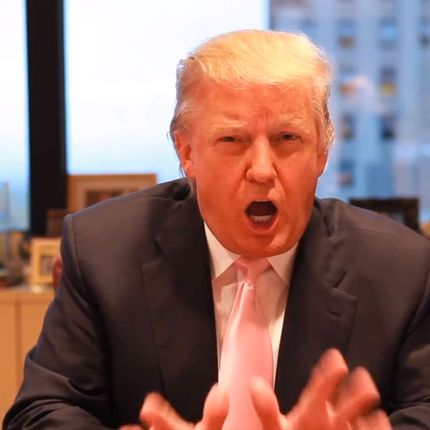
Showing posts sorted by relevance for query trump. Sort by date Show all posts

Thursday, February 2, 2012

CORRECTING--Report: Trump to Endorse Gingrich, Self

Correction: "UPDATING, CORRECTING: "Trump intends to endorse Romney'"
Original post:
From Reuters:
Businessman and reality TV personality Donald Trump will endorse former House Speaker Newt Gingrich in the race for the 2012 Republican presidential nomination, U.S. media reported on Wednesday....MORE
Some of our favorite Trump posts:
It Was The Donald Wot Found bin Ladin
From CNN:
Potential 2012 presidential candidate Donald Trump took a departure from his sideshow topics Wednesday to tout his past remarks on Osama bin Laden, weigh in on the budget negotiations and assess his chances of moving into the White House.
During his second trip to the early presidential contest state of New Hampshire, the famously confident Trump said he appeared on television "a few weeks ago" saying bin Laden was in Pakistan but that "nobody else picked it up."

"You tell them (Pakistan) we're not giving you any money unless you hand over to us Osama bin Laden and everybody looked at me like eh, nobody else picked it up," Trump told a crowd at the Chamber of Commerce Nashua Expo. "That's what I hate about politics. You know when I buy a piece of real estate I own it, OK? When you come up with a good idea in politics, if they like it they take it and they say I have an idea and you know, by that time most people forgot it was Trump's idea so Trump doesn't get any credit. I love to get credit."...
Tipping Point: Now Donald Trump Is an Environmentalist
From the WSJ's Wealth Report:
You know the green movement has reached its peak when Donald Trump proclaims himself an environmentalist.

Mr. Trump is trying to build a golf course on an unspoiled stretch of land in northern Scotland. Reflecting his usual penchant for modesty, Mr. Trump says the course will be the “best in the world,” and far superior to the legendary courses at St. Andrews....
...Mr. Trump attended a hearing on the proposal yesterday to try and save it. (Here’s the BBC article and video of Mr. Trump’s press conference). After a representative of the Scottish Wildlife Trust said Mr. Trump had ignored his own environmental consultants’ advice, Mr. Trump said he didn’t need to read the reports, since he was already an expert.
“I would consider myself an environmentalist in the true sense of the word,” Mr. Trump said, a comment that drew so much laughter from the public gallery that the inquiry chairman had to call for order....MORE 
*Trump on Trump: Testimony Offers Glimpse of How He Values His Empire
Worth Rises, Falls 'With Markets and Attitudes And With Feelings, Even My Own Feeling'
...For example, in a November 2007 Wall Street Journal interview cited by Mr. Ceresney, Mr. Trump said he had sold out units at an eponymous condo-hotel project in Hawaii. “The building is largely owned by me,” he said in the interview. But in the deposition, Mr. Ceresney produced the licensing agreement for the project. Mr. Trump wasn’t a major equity holder in the project, it showed, a fact Mr. Trump didn’t dispute.

“Because this is such a strong licensing agreement that I consider it to be a form of ownership,” Mr. Trump said. “I’d rather have this than own the building,” he said. Moments later he said: “I would say that it could be interpreted to be a form of ownership in the building.” ...
"Reactions Vary to Bin Laden's Death": Trump, Chomsky et Cie.
Republican presidential hopeful Donald Trump: “I'm very happy to hear these reports of Mr. Laden's supposed 'death.' But I don't think the American people are going to be satisfied with rumors, second-hand reports, and some hasty, secret burial at sea. This so-called 'deather' issue won't be put to bed until President Obama does the right thing: What Americans want to see is the long form of Mr. Laden's Hawaiian death certificate. Then they want my team of top-notch, world-class investigators to go over the paperwork and make sure everything is hunky-dory. Pending that, I consider myself guardedly optimistic that Mr. Laden might be dead. But the President has got some serious questions to answer, unless in two years he wants to hear the voters tell him, 'You're fired.'"

Friday, August 8, 2014

"Donald Trump Says Trump Casinos Tarnish the Trump Name"

We are collectors of stories about The Donald, some links below.
From New York Magazine:


Suddenly, Donald Trump is worried about his personal brand. Citing concerns about undermining his sterling reputation as a classy purveyor of high end real estate, The Donald has sued to strip his name from the Trump Plaza and the Trump Taj Mahal in Atlantic City because the two casinos have begun to resemble the man himself: old, discolored, and completely irrelevant.

"I want it off both of them," Trump told the AP. "I've been away from Atlantic City for many years. People think we operate [the company], and we don't. It's not us. It's not me."...MORE


Possibly also of interest:
June 2008
Tipping Point: Now Donald Trump Is an Environmentalist
From the WSJ's Wealth Report:
You know the green movement has reached its peak when Donald Trump proclaims himself an environmentalist.

Mr. Trump is trying to build a golf course on an unspoiled stretch of land in northern Scotland. Reflecting his usual penchant for modesty, Mr. Trump says the course will be the “best in the world,” and far superior to the legendary courses at St. Andrews.... 
...Mr. Trump attended a hearing on the proposal yesterday to try and save it. (Here’s the BBC article and video of Mr. Trump’s press conference). After a representative of the Scottish Wildlife Trust said Mr. Trump had ignored his own environmental consultants’ advice, Mr. Trump said he didn’t need to read the reports, since he was already an expert.
“I would consider myself an environmentalist in the true sense of the word,” Mr. Trump said, a comment that drew so much laughter from the public gallery that the inquiry chairman had to call for order....MORE
November 2007
Stalled Condo Projects Tarnish Trump's Name
...One of my favorite Trump stories comes from The Donald's scramble to meet a junk-bond payment back in the early nineties:

...It definitely represents another advance in the art of the deal. The deal this time revolved around Donald's astonishing success in meeting a bond interest payment at the Trump Castle casino after his father lent him the requisite $3 million.

The loan took a most original form: Fred Trump, age 85, arranged for his lawyer to visit the Castle, march up to a high-stakes blackjack table, and buy some $3 million worth of $5,000 chips. Instead of then playing blackjack, as any normal sentient being might do, the lawyer placed them in a satchel and presumably lugged them back to Fred, who now had his collateral.

Why structure the loan this way? Obvious answer: to protect Dad in case the Castle sashays into Chapter 11. With an ordinary loan, Fred would then be in line with a whole bunch of towel suppliers and other shafted creditors. But the integrity of the casino industry depends on the players' ability to cash in their chips. ''Chips are always redeemable,'' states the mighty Casino Control Commission.
From Fortune
CORRECTING--Report: Trump to Endorse Gingrich, Self
"Donald Trump: Gloria Allred Would Be Impressed By My Penis"
Trump on Trump: Testimony Offers Glimpse of How He Values His Empire
Worth Rises, Falls 'With Markets and Attitudes And With Feelings, Even My Own Feeling'

And many more.

Monday, February 2, 2026

A good-faith attempt to ascertain the truth about Donald Trump’s hair.

Did I write "hair"? I meant "health." 

I was thinking about this post from 2015:

Questions America Is Asking: What Is Donald Trump's Hair Worth?

Mozart's locks are going up for auction at Sotheby's, which makes us wonder which factors make celebrity hair a worthy investment. As a barometer, we asked the experts to appraise Donald Trump's....

Which backlinked to a couple posts from 2012:

 UPDATING, CORRECTING: "Trump intends to endorse Romney"

Correcting, amplifying and updating this morning's "Report: Trump to Endorse Gingrich, Self".
https://blogger.googleusercontent.com/img/b/R29vZ2xl/AVvXsEjq4c_L3iYJVkUXrec6nysjcRvCxPdh4W4LH2ve2NJOdK_qqy_fo0MSdTN5SLlxs9Wu1DnokaxIzg_GgmwzHb-Vvq75XrivQhTgCbWB12IZkhQvuoCDy6C-1_NaYcmtbP1OCKV0IAHfZJw/s1600/Donald-Trump-bad-hair.jpg

The tie, there's something odd about the tie.

Anyhoo, moving forward  

From New York Magazine's Intelligencer, January 26:

A good-faith attempt to ascertain the truth about Donald Trump’s health.

When I arrived at the Oval Office in December to talk to Donald Trump about his health, the president was standing next to a couple of men clutching pieces of paper labeled TALKING POINTS.

“These are two doctors,” Trump told me before I could ask a question. “And by the way, I don’t know them, they’re not my best friends. They’re respected doctors that practice out of Walter Reed. And they happen to be taking care of me for anything — but I don’t need any taking care of because I’m in perfect health. I do purposely every year or less a physical, because I think the American people should know that the president is healthy so you don’t get a guy like the last one, who was the worst thing that ever happened to older people. Because I know people in their 90s that are 100 percent. Gary Player is 90 years old. He shot 70 with me the other day.”

Trump gestured at everyone present — me, the doctors, and press secretary Karoline Leavitt — to follow him into the room.

“Let’s sit for a couple of minutes,” he said. “I hate to waste a lot of time on this, but if you’re going to write a bad story about my health, I’m going to sue the ass off of New York Magazine. There will be a time when you can write that story, maybe in two years, three years, five years — five years, no one is going to care, I guess. Go ahead and sit down.”

Despite the president’s protests, the White House realizes that the time to talk about his health is now. Speculation about his fitness for office is rampant; armchair physicians have given him months and sometimes even days to live. “That right there looks like a leg bag for a urinary catheter,” a physical therapist claimed in an Instagram with 19 million views, pointing to a bulge in Trump’s pants. In recent months, Trump has been caught seeming to fall asleep during public events, making him the butt of recurring jokes on The Onion (“Trump Appears to Doze During Stroke”). His right hand is constantly bruised and often bandaged. In July, his ankles swelled up like the Michelin Man, a symptom, his doctors said, of “chronic venous insufficiency” — a common circulatory condition. In August, when Trump took a break from public appearances for a few days, “Trump Is Dead” began trending on social media. “I got calls from friends that said, ‘Thank God you picked up the phone,’” Trump told me. “‘Because there’s a report that you died.’”

In September, Trump made headlines at a 9/11 memorial event because the right side of his face appeared “droopy”; in October, he went to Walter Reed and received what he said was an MRI, and when asked why, he suspiciously couldn’t recall which part of his body had been imaged; on New Year’s Eve, he was spotted apparently limping into a black-tie party at Mar-a-Lago; in January, his mental fitness was called into question when he demanded control of Greenland because he hadn’t been awarded the Nobel Peace Prize, prompting calls for Congress to invoke the 25th Amendment; and later that month, he showed up in Davos with a new bruise on his left hand.

That Trump couldn’t stop talking about his “perfect health” at rallies and on Truth Social only convinced people something was wrong. That he started making jokes about how he wasn’t on track to get into Heaven only added more fodder for conspiracy theorists. And the fact that his predecessor in the Oval Office began his disastrous decline at around the same age has only made the questions surrounding Trump’s health more palpably urgent.

“I feel the same as I did 40 years ago,” he said, settling in behind the Resolute desk. Warm afternoon light from the window illuminated his famous hair, once dyed golden and now its natural white — his “only concession to age,” one of his senior staffers told me. In person, Trump looks trimmer than he does on television, though he denies he’s ever been on a GLP-1 or, as he calls it, “the fat drug.” (His last physical, this past April, listed him as weighing 224 pounds, but he told me he’s currently “about 235.”) He stands a little hunched and his eyes are puffy, but he looks pretty good for a 79-year-old. His hearing, according to a senior staff member, isn’t what it used to be (the staffer doesn’t think Trump has noticed this about himself, despite regularly leaning in and requesting people speak up). His right hand, warm and soft during our handshake, looked like rhino hide on the back: dry and gray, the notorious bruise spread out like an inkblot test.

The president’s discolored hand has become something of a smoking gun for those on Donald Trump Deathwatch, evidence, perhaps, that he’s getting surreptitious IVs to treat an undisclosed illness. “They’re looking very Queen Elizabeth–esque,” The Bulwark’s Tim Miller has said, referring to photos of her Royal Highness’s bruised hands shortly before she died. It doesn’t help that Trump covers the bruise with a large dollop of makeup and can seem testy when people bring up the subject. Late last year, a Republican operative showed Trump his own hand injury to try to relate. “He wasn’t amused,” the operative told me. When Trump met with the much younger Zohran Mamdani in the Oval Office in November, I watched up close as Trump spent the public portion of the meeting shielding the bruise with his left hand. On occasion he would sneak a peek at the mark as if checking the time.

“This is only from shaking hands,” he said now, rubbing his left thumb over the back of his right hand, a claim he would repeat to other journalists. Trump turned to the doctors, Captain Sean Barbabella, his lead physician, and Colonel James Jones, a physician’s assistant with a Ph.D. in health science.

“Can you just verify that?” he said.

“Absolutely,” said Barbabella, a short man with close-cropped hair and a nervous smile. “I’ve seen the president shaking hands for over an hour.” Trump held up his non-shaking hand. “Look, this one’s perfect,” he said. “People say, ‘What beautiful skin you have.’” (The White House said the bruise that appeared on his left hand in Davos was caused by him hitting it against a table corner. Trump also blamed women’s fingernails and rings for the cuts on his right hand, including one particularly nasty “slice” that came from a botched high five with Attorney General Pam Bondi.)

It would be easy, Trump said, to stop the bruising and end the rumors of his imminent demise. All he would have to do is stop taking so much aspirin, which he claims is necessary to prevent his blood from becoming too thick. “I want thin blood,” he said. “Real thin blood.” In 2016, Trump shocked executives from a major pharmaceutical company when he told them he took 325 milligrams of the company’s aspirin each day. “You shouldn’t be taking that much,” one of the executives said, according to a person familiar with his comments. “Do your doctors know?” Trump said they did and didn’t approve. “But it works for me,” he said. He told me, “I’ve been doing it for 30 years, and I don’t want to change. You know what? You’re in the Oval Office now, right? I don’t want to change a thing.”

Rather than change, Trump tends to force the world to adapt to him. If there was a conspiracy of silence protecting Joe Biden when questions arose about his mental and physical decline, there’s a cacophony around Trump. Numerous members of his inner circle have clamored to tell me tales of the president’s godlike virility. “He can work harder and he has a better memory and he has more stamina and has more energy than a normal mortal,” deputy chief of staff Stephen Miller told me. “The headline of your story should be ‘The Superhuman President.’”

These strenuous assertions came alongside signs that made Trump seem more mortal than ever, from his dismal approval rating to the growing likelihood that Republicans will lose control of at least one chamber of Congress in this fall’s midterms. Already, pundits have started calling him a lame duck, a term typically saved for the third year of a presidency, which might partly explain the vigorous flurry of activity he has undertaken in Nigeria, Venezuela, Minneapolis, Greenland, and beyond. He has gamely entertained discussions about whether Marco Rubio or J. D. Vance will succeed him, which in one sense is an acknowledgment of his mortality. In another sense, the succession represents a way for him to live forever — a conceit, I soon learned, that was perpetuated by the bubble of loyalists and supplicants and advisers that constantly surrounds him and that seemed indicative of the late-empire stage of Trump’s decade-plus-long dominance of American life.

“Real fast,” Trump said, turning to the doctors in the room. “Is my health perfect?”

“Your health is excellent, sir,” Jones said.....

....MUCH MORE 

The bit about Secretary of State (former acting director USAID and acting director National Archives) Rubio trying to get some sleep on Air Force One is pretty funny.

Monday, May 18, 2009

Columbia Journalism Review: "Nice scoop by the Journal." (The Donald)

My favorite (recent) Trump story was via the WSJ's Wealth Report in June last year:

Tipping Point: Now Donald Trump Is an Environmentalist
You know the green movement has reached its peak when Donald Trump proclaims himself an environmentalist.

Mr. Trump is trying to build a golf course on an unspoiled stretch of land in northern Scotland. Reflecting his usual penchant for modesty, Mr. Trump says the course will be the “best in the world,” and far superior to the legendary courses at St. Andrews....

...Mr. Trump attended a hearing on the proposal yesterday to try and save it. (Here’s the BBC article and video of Mr. Trump’s press conference). After a representative of the Scottish Wildlife Trust said Mr. Trump had ignored his own environmental consultants’ advice, Mr. Trump said he didn’t need to read the reports, since he was already an expert.

“I would consider myself an environmentalist in the true sense of the word,” Mr. Trump said,

a comment that drew so much laughter from the public gallery that the inquiry chairman had to call for order....MORE

Here's the CJR on today's Journal story*:

Deposed Trump Looks Very Bad in the Journal

The Wall Street Journal has a hilarious story today using Donald Trump’s lawsuit against The New York Times editor Timothy O’Brien to get a damaging look inside Trumpville.

O’Brien wrote a book four years ago saying Trump was worth just a couple hundred million dollars rather than the billions Trump claims, and the Donald sued for “defamation.”

Trump, surprisingly, is actually pushing the case forward and has been deposed. Surprising because… well, see below. My friend Alex Frangos, a Journal real estate reporter, somehow got a hold of the deposition and—let’s just say this—O’Brien doesn’t have much to worry about.

The deposed Trump is a huckster laid bare: A web of spin, delusions, and outright BS—and he admits it.

For example:

Mr. Trump was asked whether he has ever exaggerated in statements about his properties. “I think everybody does,” he said in the deposition. “Who wouldn’t?”

A follow-up question: Does that mean he inflates the value of his properties in general, nonfinancial public statements? “Not beyond reason,” he said in the testimony.

And:

For example, in a November 2007 Wall Street Journal interview cited by Mr. Ceresney, Mr. Trump said he had sold out units at an eponymous condo-hotel project in Hawaii. “The building is largely owned by me,” he said in the interview. But in the deposition, Mr. Ceresney produced the licensing agreement for the project. Mr. Trump wasn’t a major equity holder in the project, it showed, a fact Mr. Trump didn’t dispute.

“Because this is such a strong licensing agreement that I consider it to be a form of ownership,” Mr. Trump said. “I’d rather have this than own the building,” he said. Moments later he said: “I would say that it could be interpreted to be a form of ownership in the building.”

Uh, no, Donny....MORE

*Trump on Trump: Testimony Offers Glimpse of How He Values His Empire
Worth Rises, Falls 'With Markets and Attitudes And With Feelings, Even My Own Feeling'

Thursday, November 7, 2024

UPDATED—Betting Markets: How Théo, The French Polymarket Whale, Correctly Called the Election And Won $50 Million

Update after the jump.

Original post:

From the Wall Street Journal via MSN, November 6:

How the Trump Whale Correctly Called the Election 

The mystery trader known as the “Trump whale” is set to reap almost $50 million in profit after running the table on a series of bold bets tied to the presidential election.

Not only did he see Donald Trump winning the presidency, he wagered that Trump would win the popular vote—an outcome that many political observers saw as unlikely. “Théo,” as the trader called himself, also bet that Trump would win the Blue Wall swing states of Pennsylvania, Michigan and Wisconsin.

“I am very happy and confident for my bet!” he wrote after Trump’s strong showing in Florida boded well for his long-shot bet on the popular vote.

In messages sent privately to a reporter before Election Day, Théo predicted that Trump would take 49% or 50% of all votes cast in the U.S., beating Harris. He also predicted that Trump would win six of the seven battleground states.

As of Wednesday afternoon, analysts were projecting that Trump would win the popular vote, with nearly 72 million votes to Harris’s 67.1 million, although millions of ballots had yet to be counted in California and other states. Betting markets regarded it as a near-certainty that Trump would win the popular vote.

Trump is also favored to win all seven swing states, betting markets show. The one state where Théo thought Harris might win, Michigan, was called for Trump on Wednesday.

The Journal has confirmed that Théo is the trader behind the Polymarket accounts that were systematically purchasing wagers on a Trump victory. Polymarket has corroborated some parts of his story, saying that the individual behind the bets was a French national with extensive trading experience and a financial-services background.

Théo said he placed the Trump bets using his own money, with an eye toward making a big profit, and he had “absolutely no political agenda.” The Journal was unable to determine whether these statements are true. Nor could the Journal rule out links between Théo and any political organization or Trump allies.

In his emails and a Zoom conversation with a reporter, Théo repeatedly criticized U.S. opinion polls. He was particularly critical of polls conducted by mainstream-media outlets that, in his view, were biased toward Democrats and tended to produce outlier poll results that favored Harris.

“In France this is different!! The pollster credibility is more important: they want to be as close as possible to the actual results. Culture is different on this,” he wrote.

Théo shared a table of numbers he had compiled based on RealClearPolitics polling averages, showing that Trump had overperformed his swing-state polling numbers in 2020. Given the tight polls in swing states in 2024, Théo reasoned that a similar overperformance by Trump would easily push him into the lead.

Polls failed to account for the “shy Trump voter effect,” Théo said. Either Trump backers were reluctant to tell pollsters that they supported the former president, or they didn’t want to participate in polls, Théo wrote.

To solve this problem, Théo argued that pollsters should use what are known as neighbor polls that ask respondents which candidates they expect their neighbors to support. The idea is that people might not want to reveal their own preferences, but will indirectly reveal them when asked to guess who their neighbors plan to vote for.

Théo cited a handful of publicly released polls conducted in September using the neighbor method alongside the traditional method. These polls showed Harris’s support was several percentage points lower when respondents were asked who their neighbors would vote for, compared with the result that came from directly asking which candidate they supported.

To Théo, this was evidence that pollsters were—once again—underestimating Trump’s support. The data helped convince him to put on his long-shot bet that Trump would win the popular vote. At the time that Théo made those wagers, bettors on Polymarket were assessing the chances of a Trump popular-vote victory at less than 40%....

....MUCH MORE

Update: "The Polymarket 'whale' actually made $85 million, far more than originally thought"

Some previous posts on teasing reality out sociology:

November 2021
Politics: I Am Told I Should Read Professor Timur Kuran To Understand Current American Politics

The underlying thesis is that in societies where people don't feel safe expressing themselves they will have, but not exhibit, their political preferences. This can lead to preference cascades ripping through a society, when through subtle signaling or even osmosis individual learn they are not alone and feel freer and freer to express themselves.

May 2022
The Wildly Perverse Effects Of Compelled Beliefs

And as noted in a February 2023 post:

In authoritarian/totalitarian/tyrannical societies when people are attacked for their ideas, to the point that their ability to earn a living is threatened or destroyed they oftentimes keep their thoughts to themselves, while outwardly appearing to acquiesce to the authorities or the mob which is oftentimes created by the authorities.

This dynamic makes for a very dysfunctional society, exemplified by the old Soviet joke, "We pretend to work, They pretend to pay us." This ended up being the way of life from the Balkans to the Baltic, with various degrees of submission. After the East German revolt in 1953 was put down, the GDR was probably the most enthusiastic adopter of the totalitarian society required to force people to do things that are contrary to the human spirit, and thus had less distinction between outward appearance and inner beliefs; while people in Czechoslovakia and Poland probably had the most difficult time accepting the diktats from above and thus had the widest divergence between mouthing the party line and what they were actually thinking. 

In the case of Poland it was so apparent to everyone involved that Stalin once remarked that imposing Communism on Poland was akin to “fitting a saddle onto a cow.”.

A major, major issue to be aware of is that when people begin to realize they are not alone in their thinking, their passive resistance begins to exceed the limits of containment and self-restraint that individuals have practiced, to the point you get Budapest in 1956, Prague 1968 or Tiananmen Square 1989. The rulers, fearing for their lives, much less their hold on power, tend to react violently to what they didn't see coming or, in the case of Gdansk in 1989 they try to cut a deal to hang on.

This rapid reveal of what the populace actually thinks and feels is the preference cascade....

Here's a 2022 post that will suffice as a quick overview:

When Self-Annointed Elites And Other Control Phreaks Care More About Image Than Substance

For the record, Potemkin, like Dracos, got a bad rap from history.

Excerpted from the Ecospohia essay "Potemkin Nation", August 18, 2021:

One of the repeated lessons of history is that when Potemkin politics become standard operating procedure in a nation, no matter how powerful and stable that nation might look, it can come apart with astonishing speed once somebody provides the good hard shove just discussed. The sudden implosion of the Kingdom of France in 1789 and the equally abrupt collapse of the Soviet Union in 1991 are two of the most famous examples, but there have been many others. In every case, what happened was that a government that had stopped solving its nation’s problems, and settled for trying to manage appearances instead, discovered the hard way that governments really do derive their power from the consent of the governed—and that this consent can be withdrawn very suddenly indeed.

When things start to crumble they can crumble fast.

This is exactly the point made by Vaclav Havel in "The Power of the Powerless" and by Timur Kuran in his writings on preference cascades. If interested see:

February 2024
Compelled Beliefs and Preference Cascades

Gathered together in our October 27, 2024 pre-election compendium:

If You Repress People (and their ability to express themselves) You Won't Get The Information You Need
This is true whether you are talking about something as mundane as political polling or as esoteric as the state intelligence organs....

Thursday, June 20, 2024

The Resistance to a New Trump Administration Has Already Started

From the New York Times, June 16/18:

An emerging coalition that views Donald J. Trump’s agenda as a threat to democracy is laying the groundwork to push back if he wins in November, taking extraordinary pre-emptive actions. 

Opponents of Donald J. Trump are drafting potential lawsuits in case he is elected in November and carries out mass deportations, as he has vowed. One group has hired a new auditor to withstand any attempt by a second Trump administration to unleash the Internal Revenue Service against them. Democratic-run state governments are even stockpiling abortion medication.

A sprawling network of Democratic officials, progressive activists, watchdog groups and ex-Republicans has been taking extraordinary steps to prepare for a potential second Trump presidency, drawn together by the fear that Mr. Trump’s return to power would pose a grave threat not just to their agenda but to American democracy itself.

“Trump has made clear that he’ll disregard the law and test the limits of our system,” said Joanna Lydgate, the chief executive of States United Democracy Center, a nonpartisan democracy watchdog organization that works with state officials in both parties. “What we’re staring down is extremely dark.”

While the Supreme Court on Thursday rejected an attempt to nullify federal approval of the abortion pill mifepristone, liberals fear a new Trump administration could rescind the approval or use a 19th-century morality law to criminalize sending it across state lines.

The Democratic governor of Washington State, Jay Inslee, said he had secured a large enough supply of mifepristone pills to preserve access for women in his state through a second Trump administration. The supply is locked away at a state warehouse.

“We have it physically in the state of Washington, which could stop him and his anti-choice forces from prohibiting its distribution,” Mr. Inslee said in an interview. “It has a life span of five or six years. If there was another Trump administration, it’ll get us through.”

There is always discussion in any election year of what might happen if the other side wins the White House. Such talk has been typically limited to Washington chatter and private speculation, as much of the energy has focused on helping one’s party win the election and develop wish-list policy plans.

But the early timing, volume and scale of the planning underway to push back against a potential second Trump administration are without precedent. The loose-knit coalition is determined not to be caught flat-footed, as many were after his unexpected victory in 2016.

If Mr. Trump returns to power, he is openly planning to impose radical changes — many with authoritarian overtones. Those plans include using the Justice Department to take revenge on his adversaries, sending federal troops into Democratic cities, carrying out mass deportations, building huge camps to hold immigrant detainees, making it easier to fire civil servants and replace them with loyalists and expanding and centralizing executive power.

Ian Bassin, the executive director of Protect Democracy, said the planning for how to resist such an agenda should not be seen as an ordinary policy dispute, but as an effort to defend fundamental aspects of American self-government “from an aspiring autocrat.”

“He is no normal candidate, this is no normal election, and these are no normal preparations for merely coming out on the wrong side of a national referendum on policy choices,” Mr. Bassin said.

The leaders of many of the centrist and left-leaning groups involved insist their energies are primarily devoted to preventing Mr. Trump from regaining power in the first place. Many are also wary about discussing their contingency plans publicly, for fear of signaling a lack of confidence in President Biden’s campaign prospects. Their angst is intensified by Mr. Biden’s low approval numbers and by his persistent trailing of Mr. Trump in polls of the states that are likely to decide the election.

Interviews with more than 30 officials and leaders of organizations about their plans revealed a combination of acute exhaustion and acute anxiety. Activist groups that spent the four years of Mr. Trump’s presidency organizing mass protests and pursuing legal challenges, ultimately helping channel that energy into persuading voters to oust him from power in 2020, are now realizing with great dread they may have to resist him all over again.

The group leaders say they learned a lot from 2017 to 2021 about how to run an effective resistance campaign. At the same time, their understanding of what Mr. Trump is capable of expanded after the Capitol riot on Jan. 6, 2021. They believe that the orbit around Mr. Trump has grown more sophisticated and that a second Trump White House would be both more radical and more effective, especially on core issues like immigration.

“What Trump and his acolytes are running on is an authoritarian playbook,” said Patrick Gaspard, the chief executive of the CAP Action Fund, the political arm of the liberal think tank the Center for American Progress. He added, “So now we have to democracy-proof our actual institutions and the values that we share.”

The Biden administration pushed through a flurry of regulations in the spring, meeting a deadline to ensure that those rules could not be summarily overturned next year under a 1996 law if Mr. Trump wins the election and Republicans take total control of Congress. But administration officials have generally been reluctant to engage in contingency planning, insisting they are confident Mr. Biden will win a second term.

Steven Cheung, a Trump campaign spokesman, denounced these efforts as a way to pre-empt Mr. Trump from being able to implement a legitimate policy agenda.

“It’s not surprising Biden and his cronies are working overtime to stymie the will of the American people after they vote to elect President Trump and his America First agenda,” Mr. Cheung said. “Their devious actions are a direct threat to democracy.”

Different groups worried about what a second Trump presidency could mean are also starting to think about how to work together.

Earlier this week, representatives from 50 national and local immigration rights organizations convened at a hotel outside Phoenix for a three-day retreat under the umbrella group Immigrant Movement Visioning Process. On the agenda for two days was “Scenario Planning: Post Election Readiness,” building on a four-hour exercise the group had conducted online in May, according to Kica Matos, president of the National Immigration Law Center.

And next month, the anti-Trump conservative group Principles First and Norman Eisen, who was a lawyer for House Democrats during Mr. Trump’s first impeachment and helped produce an “autocracy threat tracker” focused on Mr. Trump’s plans, are organizing a conference at New York University entitled “Autocracy in America – A Warning and Response.” They are inviting dozens of practitioners and scholars to discuss how to resist leaders with authoritarian leanings around the world, Mr. Eisen said.

Maurice Mitchell, the head of the Working Families Party and a co-anchor of Fight Back Table, a progressive coalition that formed in 2017, said activists opposed to Mr. Trump’s agenda were primarily trying to prevent him from winning. But he said they were also determined to be prepared if he does retake power and to stay out of each other’s lanes.

“A lot of folks are in the mind frame of, What can we learn from the past?” Mr. Mitchell said. “How can we apply those lessons going forward? And how can we think through the various scenarios that might present themselves, and how might we leverage everything that we have?”

A new litigation wave
A common tactic to push back against the first Trump administration was through litigation that tied up his policies in court. Sometimes that work succeeded in blocking actions entirely, and in other cases it delayed those policies from taking effect....

....MUCH MORE, a very extensive piece.

Monday, March 18, 2024

"Trump can’t secure $454 million appeal bond in New York fraud case, his lawyers say"

From CNBC, March 18:

  • Former President Donald Trump has been unable to fully secure a $454 million appeal bond in a New York civil business fraud case, according to a Manhattan Supreme Court filing.
  • Trump, the Trump Organization, and other defendants were found liable in the case, filed by New York Attorney General Letitia James.
  • The Republican, who is set to face President Joe Biden in November’s election, is also challenging defamation case judgments in favor of writer E. Jean Carroll, who accused him of rape. 

Former President Donald Trump has been unable to obtain an appeal bond to secure a $454 million civil judgment against him in a New York business fraud case, his attorneys said in a court filing Monday.

Lawyers for Trump and his co-defendants said it has been “impossible” for them to secure a complete appeal bond, which would effectively require “cash reserves approaching $1 billion,” which neither the former president nor his company has.

Trump’s team has approached, without success, around 30 surety companies through four separate brokers as he seeks an appeal bond, and they have spent “countless hours negotiating with one of the largest insurance companies in the world,” according to the filing with the Appellate Division of Manhattan Supreme Court.

Under New York court rules, Trump must post an appeal bond if he wants to avoid New York Attorney General Letitia James moving to collect on the fraud judgment in the state’s favor.

James has said she will seize Trump’s property if he is unable to pay the entire judgment or obtain an appeal bond.

Trump’s lawyers in their filing said that if the appellate division considers denying a stay of the judgment, it should schedule oral arguments on the issue.

And the attorneys asked that if the division declines to grant the stay, they be allowed to ask the Court of Appeals, the highest state court in New York, to pause the judgment without Trump having to obtain an appeal bond in the full amount.

Manhattan Supreme Court Judge Arthur Engoron in February ordered Trump and his co-defendants to pay a total of $464 million in damages and interest for violating a New York anti-fraud statute.

Engoron ruled in favor of James, who in a lawsuit had accused Trump, his two adult sons, the Trump Organization, and the company’s top executives of falsely inflating Trump’s asset values for years to boost his net worth and get financial perks.

Trump was ordered to pay the lion’s share of the judgment: $454 million. Post-judgment interest on Trump’s share of the damages continues to accrue at a rate of nearly $112,000 a day.

Trump, who has secured the Republican presidential nomination, in a deposition last year claimed to have “substantially in excess of $400 million in cash.”

Despite that, Monday’s nearly 5,000-page court filing by his lawyers detailed his inability to get a bond to secure the full judgment.

The filing includes an affidavit from Gary Giulietti, president of the Northeast division of the Lockton Companies, which he describes as the largest privately held insurance brokerage firm in the world.

Giulietti, who was hired to help the defendants to obtain a bond, in that statement wrote, “Despite scouring the market, we have been unsuccessful in our effort ... for the simple reason that obtaining an appeal bond for $464 million is a practical impossibility under the circumstances presented.”

Only a handful of bond surety companies are approved by the Treasury Department to underwrite a bond that large, and many of those firms will only issue a single bond to a maximum of $100 million, Giulietti wrote.

He also said that none of those companies will accept non-liquid assets — such as real estate — as collateral.

“Simply put, a bond of this size is rarely, if ever, seen,” Giulietti wrote. “In the unusual circumstance that a bond of this size is issued, it is provided to the largest public companies in the world, not to individuals or privately held businesses.”

The Trump Organization is privately held.

Giulietti wrote that it would be unattainable for a private company to obtain a bond to secure the $464 million total judgment unless it had around $1 billion in cash or cash equivalents to offer as collateral, while still being able to satisfy its other business obligations.

“While it is my understanding that the Trump Organization is in a strong liquidity position, it does not have $1 billion in cash or cash equivalents,” he wrote.

Trump’s attorneys also noted in the filing that bond issuers often will demand collateral totaling 120% of the judgment, which equates to over $557 million.

Those issuers are also likely to demand a two-year advance on a 2% annual bond premium, which would require the defendants to pay more than $18 million upfront, the lawyers wrote....

....MORE

Also at CNBC:

"Elon Musk says Trump ‘came by’ while he was eating breakfast, did not ask for money"

Tuesday, August 1, 2023

"Forget Treason. Money Laundering Is Serious."

 With the indictment of former President Trump on charges of conspiracy to overturn the 2020 election I thought of a couple unposted stories in the link-vault.

The first of these stuck with me at the time because I thought the headline (above) was cute. Re-reading it now is interesting to say the least.

From Bloomberg, January 4, 2018:

Steve Bannon's charge against Trump's son isn't the worst thing he's saying about the president's inner circle. 

Trump watchers have been treated to a world-class cage match over the last couple of days between President Donald Trump and one of his political svengalis, Steve Bannon.

Lots of attention has been lavished on Bannon's charge, leveled in a new book by the journalist Michael Wolff, that Trump's son, Donald Jr., engaged in "treasonous" behavior by meeting with a Russian lawyer in Trump Tower during the 2016 presidential campaign. 

There are also requisite antics involving others in the Trump clan and the White House.

All of that is entertaining, as is Trump's furious counterattack. He posits that Bannon has "lost his mind" and on Wednesday night unleashed one of his lawyers to warn his former chief strategist that if he kept yapping about life with the Trumps he’d get taken to court and suffer other miseries. (Wolff apparently has recordings of his Bannon interviews and Trump granted Wolff access to the White House, so legal remedies for the president may be elusive.)

But one of the more substantive issues Bannon has surfaced shouldn't get lost in the cacophony. Bannon, in his interviews with Wolff, has invited us to consider the families of Trump and his son-in-law Jared Kushner as possible targets of a significant federal money-laundering investigation.

Bannon is dismissive of the Trumps and how haphazard and reckless they were during the campaign — in part, no doubt, because they didn't think they'd win. That lens allows Bannon to understand exactly why the Trump campaign has drawn the attention of the Justice Department's special counsel, Robert Mueller, who is investigating possible links to the Kremlin (and who has already indicted Michael Flynn, Trump's former national security adviser, and Paul Manafort, Trump's former campaign manager, on an array of criminal charges).

Bannon also knows, as any street-fighter would, that Mueller's probe is perilous for the president because it is much more than an investigation into Russia's election meddling on Trump's behalf — and Bannon zeroes in candidly and coolly on that fact.

"This is all about money laundering," Wolff quotes Bannon saying. "Their path to [expletive] Trump goes right through Paul Manafort, Don Jr. and Jared Kushner." For good measure he added, "It’s as plain as a hair on your face."

"It goes through Deutsche Bank and all the Kushner stuff," Bannon adds. "The Kushner stuff is greasy. They’re going to go right through that." (He used a nastier word than "stuff," but let's keep things family-friendly around here.)

Bannon then roasts the Trump White House for how ill-prepared it is to take on Mueller's team: "They’re sitting on a beach trying to stop a Category Five."

The Trump family has had longstanding real estate and licensing dealings with questionable business associates, some of them Russian and some of them not, as I and reporters like the late Wayne Barrett have written about for years. The family's recent departure from its ill-fated Trump SoHo hotel project, and its partnership with career criminals like Felix Sater, are reminders of how problematic some of those deals will be in the context of Mueller's investigation.

While Trump allies have recently targeted Mueller's probe as ill-founded, tainted with prosecutorial bias, and the work of a conspiracy orchestrated with Democratic partisans and the "deep state," the reality is that Mueller — a well-regarded, veteran prosecutor — has been running a by-the-books investigation....

....MUCH MORE

Friday, November 8, 2024

"Donald Trump and the Plaza Hotel

From Delancey Place:

Today's selection -- from The Plaza by Julie Satow. 

"In the fog of 1980s excess, Trump had built up his sprawling, debt-laden empire. As the dawn of the 1990s broke, however, the haze cleared, and the economic realities came into view. There was a recession, the real estate mar­ket had collapsed, and Wall Street was reeling from the savings and loan crisis. Trump had overpaid and overborrowed in the expecta­tion that his assets would continue appreciating and he could easily cover his debts. But that didn't happen.

"Trump owed his lenders several billion dollars, nearly $1 bil­lion of which he had personally guaranteed. This meant that his personal assets, and not just his business assets, could be seized by creditors. One day, Trump was strolling down Fifth Avenue with Marla when he passed by a homeless person. 'You see that man?' he asked her. 'Right now he's worth $900 million more than me ... Right now I'm worth minus $900 million.'

"Trump's situation became increasingly dire. In 1991, his Taj Mahal casino in Atlantic City, billed as the 'Eighth Wonder of the World,' was nearly $3 billion in debt and filed for bankruptcy protection. It would be the first of what would eventually amount to six corporate bankruptcies. As he watched his empire and his marriage collapse, Trump retreated to his own apartment in Trump Tower, taking refuge in food, ordering in hamburgers and French fries from the deli downstairs. When a friend commented that he was acting like the reclusive Howard Hughes, he replied, 'Thanks, I admire him.' In the end, Trump would lose his 282-foot yacht; his private jet; his Trump Shuttle airline; his stake in the Grand Hyatt New York; and his Mona Lisa, the Plaza.

"In the first few years that Trump owned the Plaza, the hotel benefited from rising room prices and occupancy rates, as well as a booming banquet business, thanks in part to the Trumps' high­profile celebrity friends. But despite its performance, the underly­ing financials were shaky. Trump had acquired the Plaza at a market peak, using borrowed funds. He had then saddled the hotel with even more loans, leveraging it to buy an airline and fund construc­tion of his Taj Mahal casino. No matter how much the Plaza made, how many weddings, debutante balls, or bar mitzvahs it hosted, it would never be sufficient to service the debt.

"In 1990, the hotel's total accrued debt service was about $41 million, while the hotel's cash was just $21 million -- a major shortfall. In 1991, it was even worse, with a $42 million debt ser­vice and cash of $17.6 million.' At the same time, Ivana was a profligate spender and blew way past her budget on her many hotel improvements. In fact, as a result of her costly renovations, in one year the Plaza spent a staggering $74 million more than it earned. In the summer of 1990, Trump's lenders agreed to let him defer his interest payments and extend the maturity dates on his loans. But by late 1991, it became obvious that no matter what allowances the bank gave him, Trump could never cover his Plaza debts.

"Trump, concerned he would lose the hotel, threw out a possible lifeline. When he had first bought the Plaza, he intended to carve out the building's upper floors into more than a dozen exclusive penthouse apartments, even going so far as to get city approvals for his plan. But not long after Trump closed on the hotel, he grew distracted with his personal life, his Atlantic City casinos, and other Trump-branded ventures. The penthouse plans were put aside.

"Now, he tried reviving them.

"The Plaza's upper floors didn't look like penthouse material.

"They had once been the former maids' quarters and were now a warren of small offices and storage rooms. 'The seventeenth floor was kind of half empty,' Lee Harris Pomeroy, an architect whose offices were there, told me. Pomeroy's conference room, for exam­ple, had bathroom tiles along one wall, a throwback from when it had been the maids' shower. These floors were also often used as gathering spots for the prostitutes who hung around the hotel. 'We had a couple of public bathrooms on my floor, and there were the prostitutes in the community. They would hang out downstairs in the lobby, but they needed to change their clothes or do whatever they do, so they would come up to the top floor,' Pomeroy recalled. To try to dissuade the prostitutes from congregating up there, the hotel removed chairs and other lounge furniture from the hallways so there would be no place for them to sit.

"Trump was hoping that the penthouse concept, his last-ditch effort to save the hotel from bankruptcy, could generate massive profits. (He was right. Trump's penthouse plan would eventually be realized -- years later, without him -- generating $1 billion for the Plaza's then-owners.) Trump hired Pomeroy to execute the designs for his penthouses, and the architect began creating plans. The idea was to convert the seven­teenth and eighteenth floors into fourteen ultraexpensive apartments. The ungainly rooftop, which was covered with water ranks and paint sheds made of corrugated metal and chicken wire, would also be cleaned up and become a part of the design. But there were several problems standing in Trump's way, and one of the most challenging presented itself in the shape of a diminutive old lady.

"Fannie Lowenstein was one of just a handful of the thirty-nine widows of the Plaza who were still alive. Lowenstein had arrived in 1958, as a young divorcee, and she soon met a fellow hotel resident who became her second husband. Not only did Mr. Lowenstein have a seat on the New York Stock Exchange, but even better, he had a rent-controlled Plaza apartment, one of the lucky few whose rent was frozen in the wake of price controls instituted during World War II. When her husband died, Lowenstein continued to live in splendor in their three-room suite. It would have typically rented for more than $1,250 a night, but Lowenstein paid just $800 a month....

....MUCH MORE

Saturday, March 15, 2025

"Reversing Kissinger The former secretary of state’s 1972 opening to China badly weakened the U.S."

The self-proclaimed "expert" class has led the world into some very dark and dangerous places in many, many fields of endeavor.

From Tablet magazine, March 5, 2025:

Reversing Kissinger
The former secretary of state’s 1972 opening to China badly weakened the U.S. By dispensing with that conceit, Trump shows he intends for America to win the great-power competition. 

The undiplomatic words that Donald Trump had for Ukrainian President Volodymyr Zelensky last week left some Washington, D.C., observers wondering how the Europeans saw the situation. After all, they wondered, if that’s how Trump treats a war-torn country fighting for its independence against Russian despot Vladimir Putin, what do Paris, London, and Rome, etc. think about U.S. security commitments?

Other foreign policy analysts recognize that Trump has many audiences outside the United States, including those in Moscow and Beijing. Many of these Trump watchers conjectured that the spectacle at the White House was meant to illustrate that Trump was willing to tilt against Ukraine in order to accommodate Putin. And the reason for that, they say, is to drive a wedge between Russia and China, what Trump sees as America’s No. 1 threat.

The Washington foreign policy establishment is calling what it presumes to be Trump’s Russia policy “reverse Kissinger.” That is, Trump is using the same tactic employed by Richard Nixon’s chief foreign policy aide Henry Kissinger when he encouraged his boss to open relations with the People’s Republic of China (PRC) and thereby “play the China card” against the more powerful Soviet Union. And in February 1972, Nixon went to Beijing, forging the opening with China. Trump, some are arguing, is doing the same, except going the other way.

Indeed, Kissinger himself had prophesied the coming of the “reverse Kissinger,” for as he told Nixon only days before their fateful 1972 trip, a future American president “if he’s as wise as you, will wind up leaning towards the Russians against the Chinese.”

Kissinger reportedly suggested the idea to Trump in 2017 and the president told me for my forthcoming book on China that lots of people agreed it was a bad idea to let Russia and China get close. There were many in the administration who wanted to see if there was a way to work with Moscow to hobble Beijing, but there was no way to get around Russiagate.

"Kissinger’s idea of an international order based on cooperation and comity was an early advertisement 
for what we now call globalism—the very order that the ‘America First’ president opposes and seeks to undo."

The surveillance and propaganda operation managed by Barack Obama’s spy chiefs who alleged that the Trump circle had illicit ties to Russia consumed most of Trump’s first term, and made it impossible for him to engage with Putin on most meaningful issues. Thus, Russiagate was more than a Beltway scandal featuring U.S. spy services that tried to topple the government; it’s a still-unfolding national security disaster of the first order that limited the president’s ability to secure American peace and advance our prosperity.

Insofar as it kept Trump from testing the waters to see if he might split Russia from China, Russiagate was effectively a pro-CCP information operation benefiting a U.S. ruling class—including media, Big Tech, and corporate elites alongside the security services—whose wealth, power, and prestige are fruits of the opening with China. Many of those now disdainful of Trump’s initiative are deeply invested in his failure since weakening China weakens them. Naturally they’re going to say that Trump can’t pull it off—because, for among other reasons, Trump isn’t as smart as America’s most famous statesman. However, a more critical look at the opening shows that Kissinger and his boss bungled it badly.

Trump’s critics are right that there’s nothing now analogous to the fault line underlying the 1972 opening—there’s no obvious breathing space between Moscow and Beijing like the Sino-Soviet split that drove the two communist juggernauts apart starting with the 1953 death of Josef Stalin. But Kissinger fans give him far too much credit for seizing that opportunity, when the plain fact is that he misplayed the gift that fell into his lap....

....MUCH MORE

The damage done by the "Russiagate" perpetrators and their cheerleaders on both legacy and social media is far greater than anything any terrorists have attempted, and could yet fracture the United States.

Wednesday, May 27, 2015

Questions America Is Asking: What Is Donald Trump's Hair Worth?

From Hopes & Fears:

Mozart's locks are going up for auction at Sotheby's, which makes us wonder which factors make celebrity hair a worthy investment. As a barometer, we asked the experts to appraise Donald Trump's.
We had Donald Trump's hair appraised — Business на Hopes&Fears
Breaking news in famous hair! Today we learned that a lock of Mozart’s hair will be going up for auction for an estimated £12,000 ($18,500). Given the $115,000 precedent already set by Elvis, we wondered where this number comes from. What are the relevant factors when it comes to evaluating the price of follicles? Does hair notoriety alone increase value, or should hair represent a significant contribution to culture? What about authenticity, volume, and aesthetic? As a barometer, we asked auction experts and critics to appraise Donald Trump's infamous head ornament.

Tim Luke

BAS, MPPA, Master personal property appraiser for Treasure Quest Group, Inc.
   
Auction estimate:
<$1000
One of the things that we do as auctioneers and appraisers is look for comparables in the marketplace. Elvis Presley holds the record for follicles at auction for $115,000. John Lennon, Justin Bieber… all of these entertainers have been seeing skyrocketing values. Even politicians. I'm sure you saw Lincoln, Washington, JFK, even Neil Armstrong's hair has sold at auction. It comes down to desirability, iconic recognition of the individual and being sure that you can verify that this is the person's hair because the provenance and the background are the most important thing.

Donald Trump is part of the popular culture, but his signatures only bring between $100-$250 at auction. His best-selling books at auction recently went unsold. I would think his hair would do a little better, but looking at those factors, I don't think those follicles are going to be in the running with Elvis or Mozart… I think people would like it, but it's more of a novelty.

I don't think it would bring more than $1000 at auction. It might be different if it were for a charity, though. He's very philanthropic. 
Paddy Johnson
Art critic, Founder and Editor of Art F City
   
Auction estimate:
$0
To establish hair value you must first consider how much of it came from the same place. For example, if it comes from the shower or a brush it's disgusting and worthless, if it's a lock plucked from a full head of hair it's magical and priceless. Next you must determine whether the hair is virginesque. Has it been dyed, straightened or permed before? If so, that knocks down the price considerably.

Now, think about this valuation criteria together, and ask yourself how much of Donald Trump's hair can be collected as a lock and whether any of it is real in the first place. You're probably buying strands of used hair. I'd appraise the value of that at nothing....MUCH MORE
We prefer the 2012 TheDonald:

UPDATING, CORRECTING: "Trump intends to endorse Romney"
Correcting, amplifying and updating this morning's "Report: Trump to Endorse Gingrich, Self".
https://blogger.googleusercontent.com/img/b/R29vZ2xl/AVvXsEjq4c_L3iYJVkUXrec6nysjcRvCxPdh4W4LH2ve2NJOdK_qqy_fo0MSdTN5SLlxs9Wu1DnokaxIzg_GgmwzHb-Vvq75XrivQhTgCbWB12IZkhQvuoCDy6C-1_NaYcmtbP1OCKV0IAHfZJw/s1600/Donald-Trump-bad-hair.jpg

The tie, there's something odd about the tie.

Possibly also of interest:
"Donald Trump Says Trump Casinos Tarnish the Trump Name"
Trump on Trump: Testimony Offers Glimpse of How He Values His Empire
Worth Rises, Falls 'With Markets and Attitudes And With Feelings, Even My Own Feeling'  
Let's Hope the Drapes Match: "Persian rug from 1600s fetches record $33.7M at auction"
"Donald Trump: Gloria Allred Would Be Impressed By My Penis"
Tipping Point: Now Donald Trump Is an Environmentalist
"Reactions Vary to Bin Laden's Death": Trump, Chomsky et Cie.
Republican presidential hopeful Donald Trump: “I'm very happy to hear these reports of Mr. Laden's supposed 'death.' But I don't think the American people are going to be satisfied with rumors, second-hand reports, and some hasty, secret burial at sea. This so-called 'deather' issue won't be put to bed until President Obama does the right thing...

Monday, November 25, 2024

"Donald Trump and Tulsi Gabbard are coming for the spooks"

From The Economist, Nov 24th 2024:

The president-elect’s intelligence picks suggest a radical agenda

OF DONALD TRUMP’s nominees to high office, few are more suspicious of the government they are pegged to join than Tulsi Gabbard. She warns of a “slow-rolling coup” by “the entire permanent Washington machine”, as she describes it in “For Love of Country”, a campaign book published in April. Her list of putschists is long, catholic and spook-heavy: “the Democratic National Committee, propaganda media, Big Tech, the FBI, the CIA, and a whole network of rogue intelligence and law enforcement agents working at the highest levels of our government”. Yet she may soon oversee some of that machinery. 

On November 13th Donald Trump chose Ms Gabbard as his nominee for Director of National Intelligence (DNI), a post that co-ordinates the work of the alphabet soup of 18 spy agencies in the country’s intelligence community. The news raised fears in the agencies and among America’s allies that intelligence will be distorted to suit Mr Trump’s preferences. And it heralds rifts within Mr Trump’s administration between hawks like Mike Waltz and Marco Rubio, nominated as national security adviser and secretary of state respectively, and radicals such as Ms Gabbard, who have argued for a softer line on China, Russia and Iran.

Mr Trump’s intelligence team is still taking shape. On November 12th he picked John Ratcliffe as CIA director. He is a former congressman who briefly served as DNI at the end of Mr Trump’s first term. At the FBI, Christopher Wray, the director, who was appointed by Mr Trump in 2017 to a ten-year term, seems likely to be replaced. In his first term, Mr Trump clashed repeatedly and frequently with the FBI and other agencies. He was angered by their reports that Russia had intervened on his behalf in the 2016 election. In 2020 he fired a string of top intelligence officials including Chris Krebs, the director of the Cybersecurity and Infrastructure Security Agency, who had declared that the 2020 election was not, as Mr Trump insisted, stolen.

That history suggests that Mr Trump and his appointees will seek dramatic reforms, even purges, in the spy agencies and at the FBI. The bureau, the premier federal law-enforcement agency, houses big counterintelligence and counterterrorism sections that collect and analyse intelligence. It is likely to be first in line for Mr Trump’s plans to neuter perceived enemies. Kash Patel, an inexperienced loyalist whom Mr Trump sought and failed to install as deputy CIA director in the dying days of his first administration, has been linked to Mr Wray’s job. “We will go out and find the conspirators, not just in government but in the media,” promised Mr Patel last December. “Whether it’s criminally or civilly…we’re putting you all on notice.”

The bureau might also be checked in other ways. Mr Trump and Ms Gabbard are both opposed to Section 702 of the Foreign Surveillance Intelligence (FISA) Act, which authorises electronic surveillance on American soil. It was renewed this year after a fierce debate in the Senate but will lapse in 2026. “The [FISA] court has proven to be a dependable rubber stamp for government requests,” argues Ms Gabbard (not inaccurately). If Mr Trump quashes it, the FBI will lose a major source of intelligence.

Other clues for Mr Trump’s plans might be found in the writings of those in his political orbit. Last year Project 2025, an initiative by the conservative Heritage Foundation think-tank to prepare for a Trump administration, published “Mandate for Leadership”. Dustin Carmack, a former aide to Mr Ratcliffe, contributed a chapter on intelligence. In May this year the America First Policy Institute published a similar volume, with a chapter on intelligence by Sam Faddis, a retired CIA officer who sought to overturn Mr Trump’s election defeat in 2020. Many of Mr Carmack’s proposed reforms are technocratic, such as efforts to improve intelligence sharing and streamline security clearances across agencies. He also expresses enthusiasm for covert action, in line with the views of traditional Republicans. Other proposals are more contentious....

....MUCH MORE


As noted in the intro to November 3's "60 Years Ago, Congress Warned Us About the Surveillance State. What Happened?":

It's time for another Church Committee. 

And probably the break-up of the CIA and FBI. The agencies have become little more than extortion rackets, gathering their bits and bytes of information not for the greater good of the country but to exert pressure and control on the people who pay their salaries and on the people's elected representatives.

Extortion, blackmail and coercion are what they do.They knew all about the Biden family corruption and used that information, not to warn the country but to feather their own nests and expand their power base. And that's just one example among dozens. It's a nasty business. As Senate [then]-Minority Leader Chuck Schumer, a Washington insider since 1980, said in January 2017:

“Let me tell you: You take on the intelligence community — they have six ways from Sunday at getting back at you.”

Possibly also of interest, August 31's "'The CIA And The Media' By Carl Bernstein"

Friday, May 17, 2019

IBD—"China Trade War: Why China's Xi Wants To Crush Dow Jones — Fast"

From Investor's Business Daily, May 13:
A China trade deal suddenly looks like pie in the sky. The best-case scenario: a cease-fire — before President Donald Trump doubles down again, targeting all Chinese imports with 25% tariffs. That's not exactly a bullish outcome for investors. Even worse, the only path to get there may be through a significantly lower Dow Jones. It's a good bet that's Chinese President Xi Jinping's plan. If so, the stock market is cooperating.

Dow Jones, Stock Market Tumble On China Trade War
On Monday, the Dow Jones slid 617 points, or 2.4%, while the Nasdaq composite sank 3.4%. All but one of 30 Dow Jones components fell on the stock market. Apple (AAPL) led the way lower, falling 5.8%. Boeing (BA) and Caterpillar (CAT) fell nearly 5%.

The sell-off deepened as China hit back against the U.S. Beijing hiked tariffs on $60 billion in American imports to as much as 25%. That followed Trump's move Friday to lift 10% tariffs to 25% on $200 billion in Chinese imports. Wall Street awaited the Trump administration's next list of targets, due out late Monday. Trump has said it would include the remaining $325 billion in Chinese imports. The Apple iPhone, iPad, Apple Watch and laptop computers likely will show up on the list.
Monday's Dow Jones drubbing surely didn't escape Trump's attention. He sounded a bit less married to his plan to unload one more massive round of tariffs in an afternoon press conference. "We have the right to do another $325 billion at 25% in additional tariffs. That is a tremendous amount of money that would come into our country. I have not made that decision yet."

Xi's China Trade Talks Shift
It could take a couple of months before Trump trade officials seek comment, hold hearings and, finally, let loose the next round of China tariffs. But Beijing has made clear in recent days that there's no middle ground for a deal.

Since last Friday, Chinese officials have indicated that caving to Trump's demands would be humiliating. The U.S. insists that China write new laws resolving complaints over theft of intellectual property, forced technology transfers, currency manipulation, access to Chinese markets and state subsidies. Even then, Trump tariffs would remain in force, with some falling away as Beijing clears these benchmarks. China says it would change regulations, but not laws. It won't make concessions unless the U.S. removes tariffs. It also has pushed back on the size of the purchases it would make to narrow the trade gap....MORE
And from ZeroHedge, May 16:

How Low Will The S&P Fall Before Trump Capitulates To China? JPMorgan Has The Answer
Three days after we published our take on the latest Flows and Liquidity report by JPMorgan's quant Nikolaos Panigirtzoglou, whose conclusion was "problematic" as it contradicted the hypothesis previously laid out by JPM's more recognizable (at least to the broader public) face, Marko Kolanovic, with the Greek strategist stating that any assumption that institutions or retail investors are underinvested is wrong, and instead finding that "neither institutional nor retail investors are currently underinvested in equities. In fact we find that the opposite appears to be true...", Kolanovic has responded (just as expected, "always on an uptick"), and not surprisingly, has stuck to his core argument, stating that "overall, positioning remains muted, and absent new geopolitical escalations, equity downside should be limited. This is consistent with our last report, where we pointed out that pullbacks are likely to be less severe compared to those last year."

In other words, one banks, two world class quants, two diametrically opposing conclusions. Good luck humans trying to figure out how to trade this market.

In addition to the now traditional "good quant/bad quant" back and forth between JPM's Croat and Greek quants, Kolanovic also provides a brief discussion on the current "client" climate, writing that the "clients we’ve spoken to are trying to grasp the implications of the political landscape and 2020 elections." What appears to be the source of confusion, is why Trump would risk destabilizing the market and economy just over a year before the 2020 elections, by escalating the trade war with China, a feud that could result in both a sharp market, as well as a recession, both of which would undermine Trump's re-election odds. Here is Kolanovic:
Based on the current polls, it seems most likely that the presidential candidates will be Trump and Joe Biden. It also seems that Trump stands a good chance to get re-elected unless there is an economic deterioration in the US. Despite the  ongoing stimulus in China and a solid US economy, it’s possible we could have a slowdown or a recession if the trade war escalates further, which would likely lower Trump’s chances of winning in 2020 due to the potential selloff in US stocks, direct GDP impact of trade breakdown, increasing consumer price inflation, etc. It should thus come as no surprise that some Democrats would welcome this path. One should keep in mind that academia, businesses, and central banks have written extensively on the counterproductive impact of trade tariffs. This was well summarized by the late president Ronald Reagan and more recently Larry Kudlow. The stock market is indicating that the trade tariff approach is likely detrimental to the value of US businesses and hence the US economy.

With the above in mind, and noting that China has various additional levers to pull to preserve the status quo, such as "control of monetary and fiscal authorities and even the 'National Team' to support the stock market (i.e. the actual “Plunge Protection Team”)", Kolanovic goes back to his argument from early 2018, according to which Trump is ultimately a rational entity, and as a result, "trade war will get resolved and that latest trade escalation is just a short-term hurdle, before favorable terms for the US are reached."

Finally, one day after JPMorgan's other Croatian strategist (and Kolanovic' co-worker), Dubravko Lakos-Bujas, the bank's chief US equity strategist said that if US-China trade talks fully collapse, "the S&P 500’s next 12 months’ per-share earnings will take a ~$9 cumulative hit, sending the S&P down about 11% from Wednesday’s close" to around 2,550, Kolanovic recalculates what may be the most important number for the stock market - the "Trump Put", or the level on the S&P at which Trump will concede a loss to China and capitulate to Xi Jinping.

According to the JPM quant, the US administration has made it apparent that "the tone and sentiment towards the trade war changes with roughly ~100 points on the S&P 500."
As RaboBank's Michael Every recapped most recently yesterday, Kolanovic points out that the market moving higher "generally leads to a hardened stance and more confrontational tone, and the market moving lower generally leads to either verbal or actual progress towards trade resolution", i.e., Trump conceding to Chinese demands.

In this context, Kolanovic introduced the concept of a ‘Trump put’ in 2017, which the strategist writes has "now evolved into a ‘Trump collar’ (i.e. limited upside due to escalation of the trade conflict)."
...MORE