Showing posts sorted by relevance for query riding the south sea bubble. Sort by date Show all posts

Friday, May 26, 2023

On Bubbles

First up, George Soros via Real Investment Advice, June 2016:

Soros – A Rudimentary Theory Of Bubbles

....David’s comments reminded me of George Soros’ take on bubbles.

“First, financial markets, far from accurately reflecting all the available knowledge, always provide a distorted view of reality. The degree of distortion may vary from time to time. Sometimes it’s quite insignificant, at other times, it is quite pronounced. When there is a significant divergence between market prices and the underlying reality, there is a lack of equilibrium conditions.

I have developed a rudimentary theory of bubbles along these lines. Every bubble has two components: an underlying trend that prevails in reality and a misconception relating to that trend. When a positive feedback develops between the trend and the misconception, a boom-bust process is set in motion. The process is liable to be tested by negative feedback along the way, and if it is strong enough to survive these tests, both the trend and the misconception will be reinforced. Eventually, market expectations become so far removed from reality that people are forced to recognize that a misconception is involved. A twilight period ensues during which doubts grow and more and more people lose faith, but the prevailing trend is sustained by inertia. As Chuck Prince, former head of Citigroup, said, ‘As long as the music is playing, you’ve got to get up and dance. We are still dancing.’ Eventually, a tipping point is reached when the trend is reversed; it then becomes self-reinforcing in the opposite direction.

Typically bubbles have an asymmetric shape. The boom is long and slow to start. It accelerates gradually until it flattens out again during the twilight period. The bust is short and steep because it involves the forced liquidation of unsound positions.”

....MUCH MORE

RIA revisited and expanded on Soros and bubbles in January 2020's "Market Bubbles: It’s Not The Price, It’s The Mentality."

Soros used to say something along the lines of "When I see a bubble forming, I rush to buy, adding fuel to the fire." I believe—but cant find the source—that exact quote is from early 2020 but HUGE Caveat, Soros later that year changed his public pronouncements:

“Pivoting to his legendary approach to financial markets, Soros acknowledges that investors are in a bubble fueled by Fed liquidity, which creates a situation that he now avoids. He explained that ‘two simple propositions’ make up the framework that has historically given him an advantage. However, since he shared it in his book, ‘Alchemy of Finance,’ the advantage is gone.” – MarketWatch

So we have two diametrically opposed statements in the same year.

You have my word as a hedge fund manager....

[George Soros]

And more interestingly, and definitely less confusingly, a post originally from 2012 but updated:

For the third time our link to the South Sea Bubble paper has rotted,
Here's the version hosted at MIT before it was published in the American Economic Review.

By PETER TEMIN AND HANS-JOACHIM VOTH


Original post:
Prop Trading the South Sea Bubble: Hoare's Bank 1720
 
I've mentioned the archives at Hoare's bank a few times, firstly, I believe, in "South Sea Bubble Survivor Says Dismantle RBS Along With Lloyds":

*From deep in the link-vault comes a tiny treasure, an analysis of Hoare's trading during the South Sea bubble (15 page PDF):
Riding the South Sea Bubble
By PETER TEMIN AND HANS-JOACHIM VOTH
This paper presents a case study of a well-informed investor in the South Sea bubble. We argue that Hoare’s Bank, a fledgling West End London bank, knew that a bubble was in progress and nonetheless invested in the stock: it was profitable to “ride the bubble.” Using a unique dataset on daily trades, we show that this sophisticated investor was not constrained by such institutional factors as restrictions on short sales or agency problems....MORE 
The bank has opened their records to academics and Temin and Voth have taken full advantage.
Along with the above they published "Banking as an emerging technology: Hoare’s Bank, 1702–1742" in Financial History Review and "Private borrowing during the financialrevolution: Hoare’s Bank and its customers, 1702–24" in Economic History Review.

It's Riding the South Sea Bubble that really stands out though and is the 'tiny treasure'.

Yesterday, as I was putting "The World's First Stock Exchange (and first bear raid, first dividend, first equity derivatives...)" together I wanted to refer to RtSSB and did a quick search of the blog.
The link was broken.

The entire original purpose of this blog was to give me a database of things that caught my interest during the trading day. Hosted on Google's servers. Searchable by the Goog's algos (or anyone else).
And the damn link was broken. So I had to replace it.

And I re-read the whole 15 page paper, starting with:
What allows asset price bubbles to inflate? The recent rise and fall of technology stocks have led many to argue that wide swings in asset prices are largely driven by herd behavior among investors. Robert J. Shiller (2000) emphasized that “irrational exuberance” raised stock prices above their fundamental values in the 1990s. Others, however, have pointed to structural features of the stock market, such as lock-up provisions for IPOs, analysts’ advice, strategic interactions between investors, and the uncertainties surrounding Internet technology, as causes of the recent bubble. We use a historical example to ask which of these explanations is most apt, with the potential to shed light on other important episodes of market overvaluation.

We examine one of the most famous and dramatic episodes in the history of speculation, the South Sea bubble. Data on the daily trading behavior of a goldsmith bank—Hoare’s—allow us to examine competing explanations for how bubbles can inflate.

While many investors, including Isaac Newton, lost substantially in 1720, Hoare’s made a profit of over £28,000, a great deal of money at a time when £200 was a comfortable annual income for a middle-class family (John Carswell, 1993). The behavior of a single knowledgeable investor can tell us much about the nature of bubbles and investors during periods of substantial mispricing. The bank did not profit simply by chance. It “rode the bubble” for an extended period while giving numerous indications that it believed the stock to be overvalued. Short-selling constraints and the difficulties of arbitrage that have been emphasized in recent work on the dot-com mania cannot explain the South Sea bubble. A zero-investment constraint, if it existed, did not bind market participants like Hoare’s. Perverse incentive effects arising from delegated investment management highlighted in recent work on mutual funds and hedge funds were not at work. We infer that the need for coordination in attacking the South Sea bubble was the key to allowing it to inflate to such an extreme extent, in line with recent theoretical work by Dilip Abreu and Markus Brunnermeier (2003).

There is a rich body of earlier research on the emergence of bubbles. The efficient markets hypothesis rules out substantial mispricing (Eugene F. Fama, 1965). The same conclusion emerges from no-trade theorems under asymmetric information, as well as from backward induction in finite horizon models (Manuel Santos and Michael Woodford, 1997; Jean Tirole, 1982). Famous historical episodes like the South Sea bubble, the tulip mania, and the Mississippi speculation are given as examples of markets functioning reasonably well under uncertainty (Peter M. Garber, 2000). Recent theoretical and empirical work, however, suggests that bubbles can inflate even if there are large numbers of highly capitalized, rational investors....
And I thought "sweet".

The two most important parts of the paper "II. Hoare’s Trading Performance" and "III. Causes of Success" are definitely worth a couple minutes. Here's the link. (also replaced in the original post).

Wednesday, February 22, 2012

Prop Trading the South Sea Bubble: Hoare's Bank 1720

I've mentioned the archives at Hoare's bank a few times, firstly, I believe, in "South Sea Bubble Survivor Says Dismantle RBS Along With Lloyds":

*From deep in the link-vault comes a tiny treasure, an analysis of Hoare's trading during the South Sea bubble (15 page PDF):
Riding the South Sea Bubble
By PETER TEMIN AND HANS-JOACHIM VOTH
This paper presents a case study of a well-informed investor in the South Sea bubble. We argue that Hoare’s Bank, a fledgling West End London bank, knew that a bubble was in progress and nonetheless invested in the stock: it was profitable to “ride the bubble.” Using a unique dataset on daily trades, we show that this sophisticated investor was not constrained by such institutional factors as restrictions on short sales or agency problems....MORE 
The bank has opened their records to academics and Temin and Voth have taken full advantage.
Along with the above they published "Banking as an emerging technology: Hoare’s Bank, 1702–1742" in Financial History Review and "Private borrowing during the financialrevolution: Hoare’s Bank and its customers, 1702–24" in Economic History Review.

It's Riding the South Sea Bubble that really stands out though and is the 'tiny treasure'.

Yesterday, as I was putting "The World's First Stock Exchange (and first bear raid, first dividend, first equity derivatives...)" together I wanted to refer to RtSSB and did a quick search of the blog.
The link was broken.

The entire original purpose of this blog was to give me a database of things that caught my interest during the trading day. Hosted on Google's servers. Searchable by the Goog's algos (or anyone else).
And the damn link was broken. So I had to replace it.

And I re-read the whole 15 page paper, starting with:
What allows asset price bubbles to inflate? The recent rise and fall of technology stocks have led many to argue that wide swings in asset prices are largely driven by herd behavior among investors. Robert J. Shiller (2000) emphasized that “irrational exuberance” raised stock prices above their fundamental values in the 1990s. Others, however, have pointed to structural features of the stock market, such as lock-up provisions for IPOs, analysts’ advice, strategic interactions between investors, and the uncertainties surrounding Internet technology, as causes of the recent bubble. We use a historical example to ask which of these explanations is most apt, with the potential to shed light on other important episodes of market overvaluation.

We examine one of the most famous and dramatic episodes in the history of speculation, the South Sea bubble. Data on the daily trading behavior of a goldsmith bank—Hoare’s—allow us to examine competing explanations for how bubbles can inflate.

While many investors, including Isaac Newton, lost substantially in 1720, Hoare’s made a profit of over £28,000, a great deal of money at a time when £200 was a comfortable annual income for a middle-class family (John Carswell, 1993). The behavior of a single knowledgeable investor can tell us much about the nature of bubbles and investors during periods of substantial mispricing. The bank did not profit simply by chance. It “rode the bubble” for an extended period while giving numerous indications that it believed the stock to be overvalued. Short-selling constraints and the difficulties of arbitrage that have been emphasized in recent work on the dot-com mania cannot explain the South Sea bubble. A zero-investment constraint, if it existed, did not bind market participants like Hoare’s. Perverse incentive effects arising from delegated investment management highlighted in recent work on mutual funds and hedge funds were not at work. We infer that the need for coordination in attacking the South Sea bubble was the key to allowing it to inflate to such an extreme extent, in line with recent theoretical work by Dilip Abreu and Markus Brunnermeier (2003).

There is a rich body of earlier research on the emergence of bubbles. The efficient markets hypothesis rules out substantial mispricing (Eugene F. Fama, 1965). The same conclusion emerges from no-trade theorems under asymmetric information, as well as from backward induction in finite horizon models (Manuel Santos and Michael Woodford, 1997; Jean Tirole, 1982). Famous historical episodes like the South Sea bubble, the tulip mania, and the Mississippi speculation are given as examples of markets functioning reasonably well under uncertainty (Peter M. Garber, 2000). Recent theoretical and empirical work, however, suggests that bubbles can inflate even if there are large numbers of highly capitalized, rational investors....
And I thought "sweet".

The two most important parts of the paper "II. Hoare’s Trading Performance" and "III. Causes of Success" are definitely worth a couple minutes. Here's the link. (also replaced in the original post).

Friday, September 15, 2017

Is A Bubble A Bubble If You Can See It's A Bubble?

From time to time the usually perspicacious commentators at FT Alphaville will say something that just ain't so.

This is especially true when Izabella Kaminska is writing about cryptocurrencies—which I sometimes think she does as much to get a rise from the cheap seats as she does to explicate a point or principle of crypto.

Here's an example of an ahistorical comment which is in response to Ms. K's post "Crypto tethers as the new eurodollars":

Having followed much of the FT's extensive coverage on crypto (as well as the Wall Street Journal, Forbes, CNBC etc) and from reading hundreds of comments from readers, it is clear to me that the overwhelming majority of observers wholeheartedly believe that Bitcoin is a bubble.
It's ironic that this defies one of the key characteristics of other financial bubbles in history; the naysayers get shouted down by the majority which, in turn, permits the mania to propagate further.


It's that 'shouted down' bit that jumps out at one. That is not the way financial manias propagate. Naysayers get ignored rather than shouted down.
All this is lead-in to a repost from February 2012 whose linked paper gets into the nature of bubbles and directly addresses the awareness/self-awareness question:

Prop Trading the South Sea Bubble: Hoare's Bank 1720
I've mentioned the archives at Hoare's Bank a few times, firstly, I believe, in "South Sea Bubble Survivor Says Dismantle RBS Along With Lloyds":

...*From deep in the link-vault comes a tiny treasure, an analysis of Hoare's trading during the South Sea bubble (15 page PDF):


Riding the South Sea Bubble
By PETER TEMIN AND HANS-JOACHIM VOTH
This paper presents a case study of a well-informed investor in the South Sea bubble. We argue that Hoare’s Bank, a fledgling West End London bank, knew that a bubble was in progress and nonetheless invested in the stock: it was profitable to “ride the bubble.” Using a unique dataset on daily trades, we show that this sophisticated investor was not constrained by such institutional factors as restrictions on short sales or agency problems....MORE 
The bank has opened their records to academics and Temin and Voth have taken full advantage.
Along with the above they published "Banking as an emerging technology: Hoare’s Bank, 1702–1742" in Financial History Review and "Private borrowing during the financial revolution: Hoare’s Bank and its customers, 1702–24" in Economic History Review.

It's Riding the South Sea Bubble that really stands out though and is the 'tiny treasure'.

Yesterday, as I was putting "The World's First Stock Exchange (and first bear raid, first dividend, first equity derivatives...)" together I wanted to refer to RtSSB and did a quick search of the blog.
The link was broken.

The entire original purpose of this blog was to give me a database of things that caught my interest during the trading day. Hosted on Google's servers. Searchable by the Goog's algos (or anyone else).
And the damn link was broken. So I had to replace it.

And I re-read the whole 15 page paper, starting with:
What allows asset price bubbles to inflate? The recent rise and fall of technology stocks have led many to argue that wide swings in asset prices are largely driven by herd behavior among investors. Robert J. Shiller (2000) emphasized that “irrational exuberance” raised stock prices above their fundamental values in the 1990s. Others, however, have pointed to structural features of the stock market, such as lock-up provisions for IPOs, analysts’ advice, strategic interactions between investors, and the uncertainties surrounding Internet technology, as causes of the recent bubble. We use a historical example to ask which of these explanations is most apt, with the potential to shed light on other important episodes of market overvaluation.

We examine one of the most famous and dramatic episodes in the history of speculation, the South Sea bubble. Data on the daily trading behavior of a goldsmith bank—Hoare’s—allow us to examine competing explanations for how bubbles can inflate.

While many investors, including Isaac Newton, lost substantially in 1720, Hoare’s made a profit of over £28,000, a great deal of money at a time when £200 was a comfortable annual income for a middle-class family (John Carswell, 1993). The behavior of a single knowledgeable investor can tell us much about the nature of bubbles and investors during periods of substantial mispricing. The bank did not profit simply by chance. It “rode the bubble” for an extended period while giving numerous indications that it believed the stock to be overvalued. Short-selling constraints and the difficulties of arbitrage that have been emphasized in recent work on the dot-com mania cannot explain the South Sea bubble. A zero-investment constraint, if it existed, did not bind market participants like Hoare’s. Perverse incentive effects arising from delegated investment management highlighted in recent work on mutual funds and hedge funds were not at work. We infer that the need for coordination in attacking the South Sea bubble was the key to allowing it to inflate to such an extreme extent, in line with recent theoretical work by Dilip Abreu and Markus Brunnermeier (2003).

There is a rich body of earlier research on the emergence of bubbles. The efficient markets hypothesis rules out substantial mispricing (Eugene F. Fama, 1965). The same conclusion emerges from no-trade theorems under asymmetric information, as well as from backward induction in finite horizon models (Manuel Santos and Michael Woodford, 1997; Jean Tirole, 1982). Famous historical episodes like the South Sea bubble, the tulip mania, and the Mississippi speculation are given as examples of markets functioning reasonably well under uncertainty (Peter M. Garber, 2000). Recent theoretical and empirical work, however, suggests that bubbles can inflate even if there are large numbers of highly capitalized, rational investors....
And I thought "sweet".

The two most important parts of the paper "II. Hoare’s Trading Performance" and "III. Causes of Success" are definitely worth a couple minutes. Here's the link. (also replaced in the original post).
Sunday, January 28, 2018

When to Sell in a Bull Market

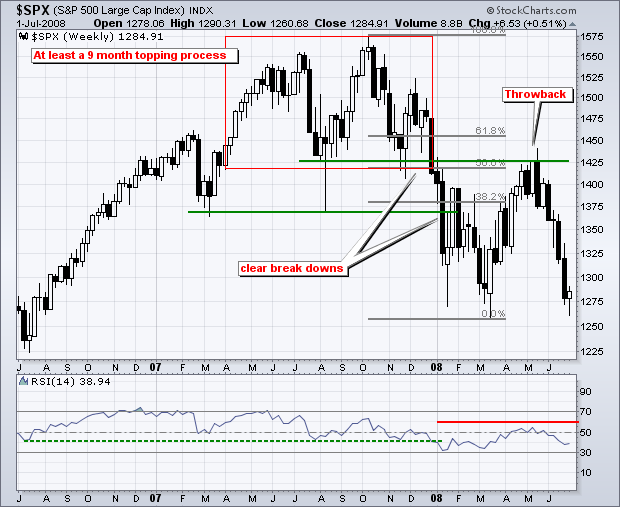
Our off-the-cuff-answer is on the start of the second decline from an all time high, something along these lines from StockCharts back in 2011:

Revisiting the 2007 S&P 500 Reversal 
Although no two market tops are the same, we can get an idea of what a major reversal looks like by examining past reversals. The 2007 top evolved over a 9 month period. There were clear support breaks at 1425 and 1375. RSI broke its bull zone (40 to 80) at the end of December 2007. The ensuing throwback rally retraced 50% and met resistance near broken support.
100714spx2007

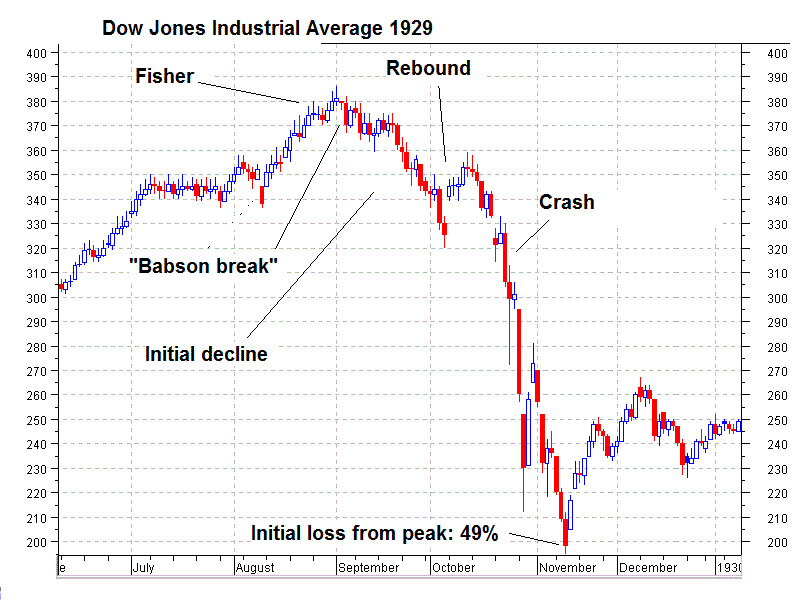
Here's another example via SNBCHF, the Dow Jones Industrial in  1929:
https://snbchf.com/wp-content/uploads/2017/07/1-1929-crash.png

Do note this chart only takes you to the first week of 1930. The DJIA didn't bottom until July 8, 1932.
At 41.22 (close, 40.56 intraday)

The failure to re-take the highs after the first decline (the right shoulder of an H&S patter) is your clue to be wary.
Keep in mind that in broad based indices you have all kinds of churning around going on, some stocks head down while the index is still rising etc.

Possibly more interesting is this account of ubbly-bubbly parabolic goodness, from Feb. 2012:

Prop Trading the South Sea Bubble: Hoare's Bank 1720 

I've mentioned the archives at Hoare's bank a few times, firstly, I believe, in "South Sea Bubble Survivor Says Dismantle RBS Along With Lloyds":

*From deep in the link-vault comes a tiny treasure, an analysis of Hoare's trading during the South Sea bubble (15 page PDF):

Riding the South Sea Bubble
By PETER TEMIN AND HANS-JOACHIM VOTH
This paper presents a case study of a well-informed investor in the South Sea bubble. We argue that Hoare’s Bank, a fledgling West End London bank, knew that a bubble was in progress and nonetheless invested in the stock: it was profitable to “ride the bubble.” Using a unique dataset on daily trades, we show that this sophisticated investor was not constrained by such institutional factors as restrictions on short sales or agency problems....MORE 
The bank has opened their records to academics and Temin and Voth have taken full advantage.
Along with the above they published "Banking as an emerging technology: Hoare’s Bank, 1702–1742" in Financial History Review and "Private borrowing during the financialrevolution: Hoare’s Bank and its customers, 1702–24" in Economic History Review.

It's Riding the South Sea Bubble that really stands out though and is the 'tiny treasure'.

Yesterday, as I was putting "The World's First Stock Exchange (and first bear raid, first dividend, first equity derivatives...)" together I wanted to refer to RtSSB and did a quick search of the blog.
The link was broken.

The entire original purpose of this blog was to give me a database of things that caught my interest during the trading day. Hosted on Google's servers. Searchable by the Goog's algos (or anyone else).
And the damn link was broken. So I had to replace it.

And I re-read the whole 15 page paper, starting with:
What allows asset price bubbles to inflate? The recent rise and fall of technology stocks have led many to argue that wide swings in asset prices are largely driven by herd behavior among investors. Robert J. Shiller (2000) emphasized that “irrational exuberance” raised stock prices above their fundamental values in the 1990s. Others, however, have pointed to structural features of the stock market, such as lock-up provisions for IPOs, analysts’ advice, strategic interactions between investors, and the uncertainties surrounding Internet technology, as causes of the recent bubble. We use a historical example to ask which of these explanations is most apt, with the potential to shed light on other important episodes of market overvaluation.

We examine one of the most famous and dramatic episodes in the history of speculation, the South Sea bubble. Data on the daily trading behavior of a goldsmith bank—Hoare’s—allow us to examine competing explanations for how bubbles can inflate.

While many investors, including Isaac Newton, lost substantially in 1720, Hoare’s made a profit of over £28,000, a great deal of money at a time when £200 was a comfortable annual income for a middle-class family (John Carswell, 1993). The behavior of a single knowledgeable investor can tell us much about the nature of bubbles and investors during periods of substantial mispricing. The bank did not profit simply by chance. It “rode the bubble” for an extended period while giving numerous indications that it believed the stock to be overvalued. Short-selling constraints and the difficulties of arbitrage that have been emphasized in recent work on the dot-com mania cannot explain the South Sea bubble. A zero-investment constraint, if it existed, did not bind market participants like Hoare’s. Perverse incentive effects arising from delegated investment management highlighted in recent work on mutual funds and hedge funds were not at work. We infer that the need for coordination in attacking the South Sea bubble was the key to allowing it to inflate to such an extreme extent, in line with recent theoretical work by Dilip Abreu and Markus Brunnermeier (2003).

There is a rich body of earlier research on the emergence of bubbles. The efficient markets hypothesis rules out substantial mispricing (Eugene F. Fama, 1965). The same conclusion emerges from no-trade theorems under asymmetric information, as well as from backward induction in finite horizon models (Manuel Santos and Michael Woodford, 1997; Jean Tirole, 1982). Famous historical episodes like the South Sea bubble, the tulip mania, and the Mississippi speculation are given as examples of markets functioning reasonably well under uncertainty (Peter M. Garber, 2000). Recent theoretical and empirical work, however, suggests that bubbles can inflate even if there are large numbers of highly capitalized, rational investors....
And I thought "sweet".

The two most important parts of the paper "II. Hoare’s Trading Performance" and "III. Causes of Success" are definitely worth a couple minutes. Here's the link. (also replaced in the original post).
*****
Now that link is dead, the mortality rate for links is probably itself graphable as a parabola.
Here's the copy hosted at MIT, cross your fingers that the famous trade school on the Charles can stay open for a while longer.

Friday, March 15, 2024

When to Sell in a Bull Market

A repost from 2018 that is intended to help avoid getting whipsawed out of a position by the sometimes terrifying moves that come with the territory. The territory being anything riskier than 30-day T-Bills. It is hard enough to find good companies/markets without the added risk of letting uncertainty shake you out.

note: this does not apply to commodities which present their own set of problems starting with the fact their long-term average real return return approaches zero i.e. they're made for tradin' not 'vestin'.

Originally posted January 28, 2018:

Our off-the-cuff-answer is on the start of the second decline from an all time high, something along these lines from StockCharts back in 2011:

Revisiting the 2007 S&P 500 Reversal 

Although no two market tops are the same, we can get an idea of what a major reversal looks like by examining past reversals. The 2007 top evolved over a 9 month period. There were clear support breaks at 1425 and 1375. RSI broke its bull zone (40 to 80) at the end of December 2007. The ensuing throwback rally retraced 50% and met resistance near broken support.
100714spx2007

Here's another example via SNBCHF, the Dow Jones Industrial in  1929:
https://snbchf.com/wp-content/uploads/2017/07/1-1929-crash.png

Do note this chart only takes you to the first week of 1930. The DJIA didn't bottom until July 8, 1932.
At 41.22 (close, 40.56 intraday)

The failure to re-take the highs after the first decline (the right shoulder of an H&S patter) is your clue to be wary.
Keep in mind that in broad based indices you have all kinds of churning around going on, some stocks head down while the index is still rising etc.

Possibly more interesting is this account of ubbly-bubbly parabolic goodness, from Feb. 2012:

Prop Trading the South Sea Bubble: Hoare's Bank 1720 

I've mentioned the archives at Hoare's bank a few times, firstly, I believe, in "South Sea Bubble Survivor Says Dismantle RBS Along With Lloyds":

*From deep in the link-vault comes a tiny treasure, an analysis of Hoare's trading during the South Sea bubble (15 page PDF):

Riding the South Sea Bubble
By PETER TEMIN AND HANS-JOACHIM VOTH
This paper presents a case study of a well-informed investor in the South Sea bubble. We argue that Hoare’s Bank, a fledgling West End London bank, knew that a bubble was in progress and nonetheless invested in the stock: it was profitable to “ride the bubble.” Using a unique dataset on daily trades, we show that this sophisticated investor was not constrained by such institutional factors as restrictions on short sales or agency problems....MORE 
The bank has opened their records to academics and Temin and Voth have taken full advantage.
Along with the above they published "Banking as an emerging technology: Hoare’s Bank, 1702–1742" in Financial History Review and "Private borrowing during the financialrevolution: Hoare’s Bank and its customers, 1702–24" in Economic History Review.

It's Riding the South Sea Bubble that really stands out though and is the 'tiny treasure'.

Yesterday, as I was putting "The World's First Stock Exchange (and first bear raid, first dividend, first equity derivatives...)" together I wanted to refer to RtSSB and did a quick search of the blog.
The link was broken.

The entire original purpose of this blog was to give me a database of things that caught my interest during the trading day. Hosted on Google's servers. Searchable by the Goog's algos (or anyone else).
And the damn link was broken. So I had to replace it.

And I re-read the whole 15 page paper, starting with:
What allows asset price bubbles to inflate? The recent rise and fall of technology stocks have led many to argue that wide swings in asset prices are largely driven by herd behavior among investors. Robert J. Shiller (2000) emphasized that “irrational exuberance” raised stock prices above their fundamental values in the 1990s. Others, however, have pointed to structural features of the stock market, such as lock-up provisions for IPOs, analysts’ advice, strategic interactions between investors, and the uncertainties surrounding Internet technology, as causes of the recent bubble. We use a historical example to ask which of these explanations is most apt, with the potential to shed light on other important episodes of market overvaluation.

We examine one of the most famous and dramatic episodes in the history of speculation, the South Sea bubble. Data on the daily trading behavior of a goldsmith bank—Hoare’s—allow us to examine competing explanations for how bubbles can inflate.

While many investors, including Isaac Newton, lost substantially in 1720, Hoare’s made a profit of over £28,000, a great deal of money at a time when £200 was a comfortable annual income for a middle-class family (John Carswell, 1993). The behavior of a single knowledgeable investor can tell us much about the nature of bubbles and investors during periods of substantial mispricing. The bank did not profit simply by chance. It “rode the bubble” for an extended period while giving numerous indications that it believed the stock to be overvalued. Short-selling constraints and the difficulties of arbitrage that have been emphasized in recent work on the dot-com mania cannot explain the South Sea bubble. A zero-investment constraint, if it existed, did not bind market participants like Hoare’s. Perverse incentive effects arising from delegated investment management highlighted in recent work on mutual funds and hedge funds were not at work. We infer that the need for coordination in attacking the South Sea bubble was the key to allowing it to inflate to such an extreme extent, in line with recent theoretical work by Dilip Abreu and Markus Brunnermeier (2003).

There is a rich body of earlier research on the emergence of bubbles. The efficient markets hypothesis rules out substantial mispricing (Eugene F. Fama, 1965). The same conclusion emerges from no-trade theorems under asymmetric information, as well as from backward induction in finite horizon models (Manuel Santos and Michael Woodford, 1997; Jean Tirole, 1982). Famous historical episodes like the South Sea bubble, the tulip mania, and the Mississippi speculation are given as examples of markets functioning reasonably well under uncertainty (Peter M. Garber, 2000). Recent theoretical and empirical work, however, suggests that bubbles can inflate even if there are large numbers of highly capitalized, rational investors....
And I thought "sweet".

The two most important parts of the paper "II. Hoare’s Trading Performance" and "III. Causes of Success" are definitely worth a couple minutes. Here's the link. (also replaced in the original post).
*****
Now that link is dead, the mortality rate for links is probably itself graphable as a parabola.
Here's the copy hosted at MIT, cross your fingers that the famous trade school on the Charles can stay open for a while longer.

Tuesday, May 22, 2018

"How Politicians Intensify Financial Cycles: 300 Years of Pro-Cyclical Regulation"

Be careful with this piece. I didn't have time to check all the details the writer musters to his argument but am pretty sure there are a couple errors in this bit:
...A Short Narrative of Three Centuries of Regulatory Cycles
Roll back the clock to 1725, when the South Sea Bubble was riding high in England. It was one of the earliest well documented stock market bubbles. Political elites cheered for the stock market mania— until it crashed. The political backlash was substantial, and many members of parliament were thrown in jail. England inherited from the South Sea Bubble backlash the ‘Bubble Act,’ an oppressive law that placed a tremendous hurdle on companies going public. The Act remained in place for a full century. It was then repealed at the peak of the next big bubble, in 1825. The repeal is well documented as being the result of lobbying and influence peddling. The response to the ensuing crash and banking crisis transformed and modernized financial markets in England....
Putting on the academic hat: The bubble had run its course by July 1721 (all time high one year earlier, July 1720), it was not "riding high" in 1725:

https://d577c622-a-62cb3a1a-s-sites.googlegroups.com/site/davesmant/monetary-economics/famous-first-bubbles/south-sea-bubble/ssbprice.jpg?attachauth=ANoY7coDTV1eA_4NzjvyBZiZFvEbbIFB-G9NAJWQeaW3LDXdO6vIaK66PiuBIlkAZMCybB1esVYzNTi4QE0KgY3kkmPIzW8hUzF4kWJQRPZVJKfdG_qdLCgA7c2wPBCAAnQFaqnnWarQhi_aVj0QxLSTggw0SFalPCaJ5_MeiZU7aWEWXEsgtLZ6BW2AH3tWP0RSMC54vlPMeXwZR1chILfgU5_cIdQdV5nrjHc2-yO_C1cVEh_zhqWUICl8wfbqyvvkpi9E2VNUNbGu-qnqLIQWwMqOddXc_6dI4KGQPA_JB2i5IE7o6_I%3D&attredirects=0

Secondly, the Bubble Act was passed during the mania, June 11, 1720, just before the third subscription and the ultimate top-tick in the forward market (because the transfer books were closed there was no spot price).
The Bubble Act forced any new companies to apply for a Royal Charter and was actually enacted as an impediment to new joint-stock companies that might compete for capital the South Sea directors thought should rightfully go to their venture.
The Act did not stop the formation of companies, you just had to be connected enough with the royals or the court denizens to get the official okey-dokey.

The author of this piece is probably confusing the Bubble Act with Barnard's Act, more on that after the jump.

From The University of Chicago's ProMarket blog:
[Note: The post below was first published at VoxEU.org with the title “Regulatory Cycles: Revisiting the Political Economy of Financial Crises.”]

Back in early 2017, while the stock market was breaking records, the new administration in the US made promises to significantly roll back the recently implemented regulations under the Dodd-Frank Act. We have seen the move toward deregulation take shape on various fronts. By most accounts, new regulatory appointees have signaled a shift toward a softer approach to financial regulation.  On the legislative front, after a failed attempt by the House of Representatives to erase core financial regulations under the DFA, the Senate has voted last week on a bill that would offer regulatory relief to small and mid-sized banks.

Over the last two decades, the US has gone through a regulatory cycle. The financial sector was deregulated during the boom spanning the late-1990s to mid-2000s, and then re-regulated following the 2008 crash (e.g. Goldstein 2009). Currently, it appears that the regulatory pendulum is swinging the other way. In a recent paper, I examine the political economy of financial policy during ten of the most infamous financial booms and busts since the 18th century (Dagher 2018). I rely on a wealth of scholarship on each episode to show that procyclical regulations are a recurring feature since the early days of finance and across countries. Financial booms—and risk-taking during these episodes—were often amplified by political regulatory stimuli, credit subsidies, and an increasing light-touch approach to financial supervision. Financial crises led to a massive regulatory backlash, which sometimes suffocated finance. The regulatory response can be best understood in the context of the political ramifications of such crises.

The large literature on the 2008 Global Crisis tends to focus on identifying the regulatory failures that led to the crash. I argue that it is equally important to understand the roots of these regulatory failures, and that politics is usually at the heart of the story.

A Short Narrative of Three Centuries of Regulatory Cycles
Roll back the clock to 1725, when the South Sea Bubble was riding high in England. It was one of the earliest well documented stock market bubbles. Political elites cheered for the stock market mania— until it crashed. The political backlash was substantial, and many members of parliament were thrown in jail. England inherited from the South Sea Bubble backlash the ‘Bubble Act,’ an oppressive law that placed a tremendous hurdle on companies going public. The Act remained in place for a full century. It was then repealed at the peak of the next big bubble, in 1825. The repeal is well documented as being the result of lobbying and influence peddling. The response to the ensuing crash and banking crisis transformed and modernized financial markets in England.

To those familiar with the financial history of the US this might ring a bell or two. The market euphoria in the late 1920s came at the heels of a period of deregulation, inaction by regulatory agencies, and rising subsidies to the housing sector. President Hoover at the time took a dim view of federal regulations and supervision, and appointed regulators that shared this view. The 1929 crash and the ensuing Great Depression led to a major rethinking of the role of government, resulting in an impressive comeback by the Democrats in Congress.  The New Deal reshaped the financial landscape in the US and imposed stricter regulations and supervision. The Glass-Steagall Act of 1933 separated commercial and investment banking in order to protect depositors. The Act remained in effect for much of the remaining 20th century, but was then repealed in 1999 at the height of a stupendous stock market boom. During the 1990s, securities laws were also eased by Congress, but they were then tightened under the Sarbanes-Oxley law a few years later, after the Dot-Com crash – a short-lived regulatory cycle confined to the securities market. But deregulation and a light touch approach in the banking sector continued and intensified in the midst of a tremendous housing boom. The credit boom benefited from government subsidies and sponsorship under both the Clinton and Bush administrations. Two years after its crash in 2008, President Obama signed into law the Dodd-Frank Act, the most significant regulatory overhaul since the New Deal.

Stylized Facts
These regulatory cycles can be observed across time and countries....MUCH MORE
Back to the Bubble, been down this road before. Here's 2009's "Murphy A. (2009) The smartest boys in the alley, early derivatives on the London stock market":
On Thursday I was pulling some links together on the British experience regulating derivatives after the South Sea Bubble of 1720. Lo and behold what pops up this morning but a link via Alphaville to the Economic History blog. Just one quibble, Dr. Murphy states that Barnard's Act* was dated 1737, I'd swear that my memory puts it earlier.
[just how old are you? -ed]
From the Economic History blog:
Murphy, Anne L. (2009) Trading options before Black-Scholes: a study of the market in late seventeenth-century London. Economic History Review, 62/1: 8-30.
The ledger of the financial broker Charles Blunt contains the details of some 1,500 transactions realized between 1692 and 1695, about a third of which regard the then novel trade in equity options (p.9). The technique had arisen in the 1620s in the commodity market and was proving very useful in the decade following the Glorious Revolution, when some 100 joint-stock companies were floated in London (p.10). During the boom of the early 1690s, it is likely that “several thousand derivatives were transacted each year”.
Various strategies
Four out of five options traded were calls (i.e. the right to pursue a share at any time during a given period, usually 6 months) and at-the-money (i.e. for the price of the share at the time of the agreement). “It is likely that they were transacted to take advantage of an anticipated price move associated with a specific future event” (p.12). Most of Charles Bunt’s clients were not professionals, for them using a broker was the only way to find a buyer. However many of these amateurs did in fact engage in option trading....MORE
HT: FT Alphaville

*Barnard's Act, which outlawed the use of options and forwards to purchase stock, was enacted in 1734 and due to sunset in 1737. Instead it was made perpetual and not repealed until 1860.
If interested see also "Prop Trading the South Sea Bubble: Hoare's Bank 1720":

*From deep in the link-vault comes a tiny treasure, an analysis of Hoare's trading during the South Sea bubble (62 page PDF):

Riding the South Sea Bubble
By PETER TEMIN AND HANS-JOACHIM VOTH
This paper presents a case study of a well-informed investor in the South Sea bubble. We argue that Hoare’s Bank, a fledgling West End London bank, knew that a bubble was in progress and nonetheless invested in the stock: it was profitable to “ride the bubble.” Using a unique dataset on daily trades, we show that this sophisticated investor was not constrained by such institutional factors as restrictions on short sales or agency problems....MORE

Saturday, July 1, 2023

"Nvidia’s Next Big Opportunity Is AI-as-a-Service. Here’s Why." (NVDA)

A quick hit from Barron's June 30, 1:01 pm ET:

Raymond James said Nvidia ’s new artificial intelligence cloud offering for corporations could become a large business over time.

Analyst Srini Pajjuri reaffirmed on Thursday his Strong Buy rating for Nvidia stock (ticker: NVDA) and his $450 price target.

Earlier this year, Nvidia unveiled its DGX cloud service, which allows companies to rent AI computing capacity powered by the chip maker’s semiconductors.

Nvidia DGX Cloud’s AI-as-a-Service is a significant long term opportunity, he wrote. The chip maker has AI “models that enterprises can leverage to build customized large language models with proprietary enterprise data.”....

....MORE

So, we are faced with the decision whether-or-not to play a dangerous little game, riding the bubble knowing full well it is a bubble, or retiring to the sidelines.
For now one of our favorite economists with one of our favorite stories.

Here's the version hosted at MIT:
By PETER TEMIN AND HANS-JOACHIM VOTH
This paper presents a case study of a well-informed investor in the South Sea bubble. We argue that Hoare’s Bank, a fledgling West End London bank, knew that a bubble was in progress and nonetheless invested in the stock: it was profitable to “ride the bubble.” Using a unique dataset on daily trades, we show that this sophisticated investor was not constrained by such institutional factors as restrictions on short sales or agency problems...
The two most important parts of the paper "II. Hoare’s Trading Performance" and "III. Causes of Success" are definitely worth a couple minutes.

Also posted in 2012 as "Prop Trading the South Sea Bubble: Hoare's Bank 1720":

What allows asset price bubbles to inflate? The recent rise and fall of technology stocks have led many to argue that wide swings in asset prices are largely driven by herd behavior among investors. Robert J. Shiller (2000) emphasized that “irrational exuberance” raised stock prices above their fundamental values in the 1990s. Others, however, have pointed to structural features of the stock market, such as lock-up provisions for IPOs, analysts’ advice, strategic interactions between investors, and the uncertainties surrounding Internet technology, as causes of the recent bubble. We use a historical example to ask which of these explanations is most apt, with the potential to shed light on other important episodes of market overvaluation.

We examine one of the most famous and dramatic episodes in the history of speculation, the South Sea bubble. Data on the daily trading behavior of a goldsmith bank—Hoare’s—allow us to examine competing explanations for how bubbles can inflate.

While many investors, including Isaac Newton, lost substantially in 1720, Hoare’s made a profit of over £28,000, a great deal of money at a time when £200 was a comfortable annual income for a middle-class family (John Carswell, 1993). The behavior of a single knowledgeable investor can tell us much about the nature of bubbles and investors during periods of substantial mispricing. The bank did not profit simply by chance. It “rode the bubble” for an extended period while giving numerous indications that it believed the stock to be overvalued. Short-selling constraints and the difficulties of arbitrage that have been emphasized in recent work on the dot-com mania cannot explain the South Sea bubble. A zero-investment constraint, if it existed, did not bind market participants like Hoare’s. Perverse incentive effects arising from delegated investment management highlighted in recent work on mutual funds and hedge funds were not at work. We infer that the need for coordination in attacking the South Sea bubble was the key to allowing it to inflate to such an extreme extent, in line with recent theoretical work by Dilip Abreu and Markus Brunnermeier (2003).

There is a rich body of earlier research on the emergence of bubbles. The efficient markets hypothesis rules out substantial mispricing (Eugene F. Fama, 1965). The same conclusion emerges from no-trade theorems under asymmetric information, as well as from backward induction in finite horizon models (Manuel Santos and Michael Woodford, 1997; Jean Tirole, 1982). Famous historical episodes like the South Sea bubble, the tulip mania, and the Mississippi speculation are given as examples of markets functioning reasonably well under uncertainty (Peter M. Garber, 2000). Recent theoretical and empirical work, however, suggests that bubbles can inflate even if there are large numbers of highly capitalized, rational investors....

Wednesday, October 31, 2012

"Share Portfolios and Risk Management in the Early Years of Financial Capitalism: London 1690-1730" (special bonus: "Prop Trading the South Sea Bubble")

The first part is the title of a paper that Jason Zweig commends to our attention.
From the Wall Street Journal's Total Return blog:

Can You Trust Your Stockjobber?
How much has investing behavior evolved since earliest days of trading in the financial markets?
A fascinating new research paper analyzes how individual investors built stock portfolios soon after building portfolios first became possible: from 1690 to 1730.

The researchers, led by the distinguished financial historian Larry Neal of the University of Illinois, painstakingly replicated all the holdings and trades in the Bank of England, the East India Co. and the United East India Co., the Royal African Co., the Hudson’s Bay Co., the Million Bank and the South Sea Co. These were the dominant companies at the birth of the British capital markets three centuries ago. The share registries survive, so the scholars were able to match virtually every investment with the person who held it – encompassing 5,813 investors during the 1690s and 23,723 by the end of the period.

These people included everyone from dukes and other aristocrats to “stockjobbers,” or brokers, along with merchants, apothecaries, glassmakers, drapers and goldsmiths – and up to 27% of them were women.
Three centuries ago, investors:
  • underdiversified, with 86% of them owning shares in only a single stock;
  • chased performance, with rising prices leading to higher trading volume;
  • underperformed the market as a whole, earning lower returns and incurring higher risk.
Women appear to have had more-conservative portfolios than men....MORE
From earlier this year, some deep insight into the activities of a knowledgeable investor in:
Prop Trading the South Sea Bubble: Hoare's Bank 1720
I've mentioned the archives at Hoare's bank a few times, firstly, I believe, in "South Sea Bubble Survivor Says Dismantle RBS Along With Lloyds":

*From deep in the link-vault comes a tiny treasure, an analysis of Hoare's trading during the South Sea bubble (15 page PDF):

Riding the South Sea Bubble
By PETER TEMIN AND HANS-JOACHIM VOTH
This paper presents a case study of a well-informed investor in the South Sea bubble. We argue that Hoare’s Bank, a fledgling West End London bank, knew that a bubble was in progress and nonetheless invested in the stock: it was profitable to “ride the bubble.” Using a unique dataset on daily trades, we show that this sophisticated investor was not constrained by such institutional factors as restrictions on short sales or agency problems....MORE 
The bank has opened their records to academics and Temin and Voth have taken full advantage.
Along with the above they published "Banking as an emerging technology: Hoare’s Bank, 1702–1742" in Financial History Review and "Private borrowing during the financialrevolution: Hoare’s Bank and its customers, 1702–24" in Economic History Review.

It's Riding the South Sea Bubble that really stands out though and is the 'tiny treasure'.

Yesterday, as I was putting "The World's First Stock Exchange (and first bear raid, first dividend, first equity derivatives...)" together I wanted to refer to RtSSB and did a quick search of the blog.
The link was broken.

The entire original purpose of this blog was to give me a database of things that caught my interest during the trading day. Hosted on Google's servers. Searchable by the Goog's algos (or anyone else).
And the damn link was broken. So I had to replace it....MORE

Monday, March 17, 2014

How to Ride Market Manias: Lessons From A Survivor of The South Sea Bubble

A tiny treasure. Via the Hoare's Bank archives and the scholarship of Temin and Voth:

Riding the South Sea Bubble
By PETER TEMIN AND HANS-JOACHIM VOTH
This paper presents a case study of a well-informed investor in the South Sea bubble. We argue that Hoare’s Bank, a fledgling West End London bank, knew that a bubble was in progress and nonetheless invested in the stock: it was profitable to “ride the bubble.” Using a unique dataset on daily trades, we show that this sophisticated investor was not constrained by such institutional factors as restrictions on short sales or agency problems....MORE (30 page PDF)
From our 2012 post "Prop Trading the South Sea Bubble: Hoare's Bank 1720":

...The entire original purpose of this blog was to give me a database of things that caught my interest during the trading day. Hosted on Google's servers. Searchable by the Goog's algos (or anyone else).
And the damn link was broken. So I had to replace it.

And I re-read the whole 15 page paper, starting with:
What allows asset price bubbles to inflate? The recent rise and fall of technology stocks have led many to argue that wide swings in asset prices are largely driven by herd behavior among investors. Robert J. Shiller (2000) emphasized that “irrational exuberance” raised stock prices above their fundamental values in the 1990s. Others, however, have pointed to structural features of the stock market, such as lock-up provisions for IPOs, analysts’ advice, strategic interactions between investors, and the uncertainties surrounding Internet technology, as causes of the recent bubble. We use a historical example to ask which of these explanations is most apt, with the potential to shed light on other important episodes of market overvaluation.

We examine one of the most famous and dramatic episodes in the history of speculation, the South Sea bubble. Data on the daily trading behavior of a goldsmith bank—Hoare’s—allow us to examine competing explanations for how bubbles can inflate.

While many investors, including Isaac Newton, lost substantially in 1720, Hoare’s made a profit of over £28,000, a great deal of money at a time when £200 was a comfortable annual income for a middle-class family (John Carswell, 1993). The behavior of a single knowledgeable investor can tell us much about the nature of bubbles and investors during periods of substantial mispricing. The bank did not profit simply by chance. It “rode the bubble” for an extended period while giving numerous indications that it believed the stock to be overvalued. Short-selling constraints and the difficulties of arbitrage that have been emphasized in recent work on the dot-com mania cannot explain the South Sea bubble. A zero-investment constraint, if it existed, did not bind market participants like Hoare’s. Perverse incentive effects arising from delegated investment management highlighted in recent work on mutual funds and hedge funds were not at work. We infer that the need for coordination in attacking the South Sea bubble was the key to allowing it to inflate to such an extreme extent, in line with recent theoretical work by Dilip Abreu and Markus Brunnermeier (2003).

There is a rich body of earlier research on the emergence of bubbles. The efficient markets hypothesis rules out substantial mispricing (Eugene F. Fama, 1965). The same conclusion emerges from no-trade theorems under asymmetric information, as well as from backward induction in finite horizon models (Manuel Santos and Michael Woodford, 1997; Jean Tirole, 1982). Famous historical episodes like the South Sea bubble, the tulip mania, and the Mississippi speculation are given as examples of markets functioning reasonably well under uncertainty (Peter M. Garber, 2000). Recent theoretical and empirical work, however, suggests that bubbles can inflate even if there are large numbers of highly capitalized, rational investors....
And I thought "sweet".

The two most important parts of the paper "II. Hoare’s Trading Performance" and "III. Causes of Success" are definitely worth a couple minutes. Here's the link.

Friday, January 10, 2020

"The British banking dynasty that’s even older than the Rothschilds"

We've visited the bank's archives a few times and probably more actionable, their trading records during the South Sea Bubble, links after the jump.
From Bloomberg, July 3, 2019:
In the UK there’s old money, really old money and then there’s C Hoare & Co.
The London firm was started in 1672 by Richard Hoare and has tended to the affairs of diarist Samuel Pepys, poet Lord Byron and novelist Jane Austen. That’s almost a hundred years older than the famous Rothschild dynasty, which was founded in the 1760s. After more than three centuries of continuous operation, the family still runs the show, overseeing about £4.4bn ($5.6bn) of deposits and sticking to a traditional way of doing business.

“You go in and you talk,” said Islay Robinson, chief executive officer of Enness, a mortgage broker with dozens of high-net-worth clients who have borrowed from the bank. “They lend their own money and tend to be able to come up with solutions that other banks can’t.”

The last of the 10th generation of partners retired last year, leaving the bank in the hands of six partners from the 11th generation who have continued its evolution. In March, they opened the first outpost outside London: a Cambridge office designed to serve existing clients but also attract entrepreneurs in a region known for bioscience and technology ventures.

Blending old with new has become vital for C Hoare, rival Coutts and smaller competitors such as Raphaels and Weatherbys as they vie to serve wealthy clients. Independent banks are also striving to reconcile their highly tailored services to an industry where the prevailing trends are consolidation and rising regulation.

“It’s a constant tension because part of what makes us completely different to the clearing banks is that we are smaller and more personable and more human and more relatable to customers,” partner Alexander Hoare, 57, said during an interview in a meeting room festooned with cartoons. “We don’t want to be herded and we don’t want to grow. We want to be special.”

C Hoare is certainly different. The firm is an unlimited liability partnership, meaning the personal assets of the partners are fair game for creditors. Since at least 1994, the dividend has been fixed at £50 per share or £6,000 total. That’s for a business with £26mn of profit in the 12 months through March 31, 2019.

The restraint has built a valuable enterprise. The partnership’s latest accounts show a book value of about £370mn, putting the family among the UK’s richest on paper. But the Hoares said they have no interest in selling.

“If people were in it for the liquidity event, it would have been sold a long time ago,” said Rennie Hoare, 33, who became a partner last year.

The original “golden bottle”, which marked the location of the bank before street numbers were invented, is on display in the bank’s museum.
The bank’s oldest surviving cheque, addressed to Richard Hoare from William Hale, dates from July 1676.

His ancestor Richard Hoare first started to trade at the “sign of the golden bottle” in 1672 (it took another century for street numbering to be invented). He rose to dominate the City of London, dabbled in politics and was knighted by Queen Anne.

Succeeding partners furthered this success, so many of whom were named Henry that they accrued epithets like “Henry the Good,” “Henry the Magnificent” and “Fat Harry” to distinguish them. While the family dodged the pitfalls associated with the third generation of ownership, the seventh generation’s speculative investments proved more problematic, with partner Henry Junior putting money into ventures such as a steam-engine enterprise and a company in Canada that was supposed to revolutionise the leather trade with treated hemlock, according to a family history. The collapse of his personal finances forced him to resign in 1874.

“Our seventh generation got way too wealthy and burnt through a fantastic fortune,” Alexander Hoare said. “There are two things that can destroy a family business: the business and the family, and they both have to be kept in order.”....MUCH MORE
I think Bloomberg went with Rothschild's for name recognition. Coutts & Co. would be the competitor in the longevity race but is 20 years younger than Hoare's.
Some previous posts:
South Sea Bubble Survivor Says Dismantle RBS Along With Lloyds
 
The Amazing Archives of England's Oldest Private Bank: Junk Bonds from 1863

If Britain's Oldest Private Bank Could Survive the South Sea Bubble, You Can Get Through This: More of C. Hoare & Co's Amazing Archives

Prop Trading the South Sea Bubble: Hoare's Bank 1720
This paper presents a case study of a well-informed investor in the South Sea bubble. We argue that Hoare’s Bank, a fledgling West End London bank, knew that a bubble was in progress and nonetheless invested in the stock: it was profitable to “ride the bubble.” Using a unique dataset on daily trades, we show that this sophisticated investor was not constrained by such institutional factors as restrictions on short sales or agency problems
For the third time our link to the South Sea Bubble paper has rotted,
Here's the version hosted at MIT:
By PETER TEMIN AND HANS-JOACHIM VOTH

Monday, April 25, 2022

Think You Know Sovereign Debt? "Lending To The Borrower From Hell: Debt and Default in The Age Of Philip II, 1556-1598" (plus a tiny treasure)

Reading a short article by Jeff Deist, President of the Mises Institute, wherein he ponders:

"Given historically low rates of return on Treasury debt—well below real inflation—and given 
the almost unbelievable and irreversible profligacy of the spendthrift US government, why 
would any sentient being continue to loan money to Uncle Sam?"

I was reminded of the headline paper from one of the few, very few, economists who might be enjoyable company for the weekend. A repost from 2013/updated in 2018:

Update: had a rotted link on "Riding the South Sea Bubble". Fixed
Original post-
 
With news of Argentina in 2018—and faint echoes of 1890 (more later today), here's a recollection from 2013:

The closing of Switzerland's oldest private bank got me thinking of England's oldest private bank, C. Hoare & Co which got me thinking of their experience in the 1720's: "Riding the South Sea Bubble"* which got me wondering what the authors of that paper were up to.
Here is Hans-Joachim Voth, ICREA/Universitat Pompeu Fabra [now at University of Zurich]:

Abstract:

Philip II of Spain accumulated debts of over 50% of GDP. He also failed to honor them four times. We ask what allowed the sovereign to borrow much while defaulting often. Earlier work emphasized either banker irrationality or the importance of sanctions, in line with Bulow and Rogoff (1989). Using a unique dataset on 438 lending contracts derived from the archives, we show that neither interpretation is supported by the evidence. What sustained lending was the ability of bankers to cut off Philip II’s access to smoothing services. Lenders contracted with the king in overlapping syndicates, effectively creating a network of bankers. We analyze the incentive structure that supported the cohesion of this bankers’ coalition, and examine how it survived across the biggest defaults in Philip’s reign. In particular, we argue that the effectiveness of lending moratoria was sustained through a ‘cheat-the-cheater’ mechanism, in the spirit of Kletzer and Wright (2000). Since the king needed to smooth his expenditure in the face of major revenue and spending shocks, the ability of bankers to cut him off from funding was sufficient to sustain cross-border lending.
So much for Dictum meum pactum. Here's the paper, 37 page PDF.

See also our 2011 post: "How Venice Rigged the First, and Worst, Global Financial Crash" which lets Edward III off the hook for ruining the Bardi and Peruzzi families.
*From deep in the link-vault comes a tiny treasure, an analysis of Hoare's trading during the South Sea bubble (62 page PDF):
Riding the South Sea Bubble
By PETER TEMIN AND HANS-JOACHIM VOTH
This paper presents a case study of a well-informed investor in the South Sea bubble. We argue that Hoare’s Bank, a fledgling West End London bank, knew that a bubble was in progress and nonetheless invested in the stock: it was profitable to “ride the bubble.” Using a unique dataset on daily trades, we show that this sophisticated investor was not constrained by such institutional factors as restrictions on short sales or agency problems....MORE

Sunday, May 13, 2018

UPDATED—Think You Know Sovereign Debt? "Lending To The Borrower From Hell: Debt and Default in The Age Of Philip II, 1556-1598" (and a tiny treasure)

Update: had a rotted link on "Riding the South Sea Bubble". Fixed
Original post-
 
With news of Argentina in 2018—and faint echoes of 1890 (more later today), here's a recollection from 2013:

The closing of Switzerland's oldest private bank got me thinking of England's oldest private bank, C. Hoare & Co which got me thinking of their experience in the 1720's: "Riding the South Sea Bubble"* which got me wondering what the authors of that paper were up to.
Here is Hans-Joachim Voth, ICREA/Universitat Pompeu Fabra:

Abstract:
Philip II of Spain accumulated debts of over 50% of GDP. He also failed to honor them four times. We ask what allowed the sovereign to borrow much while defaulting often. Earlier work emphasized either banker irrationality or the importance of sanctions, in line with Bulow and Rogoff (1989). Using a unique dataset on 438 lending contracts derived from the archives, we show that neither interpretation is supported by the evidence. What sustained lending was the ability of bankers to cut off Philip II’s access to smoothing services. Lenders contracted with the king in overlapping syndicates, effectively creating a network of bankers. We analyze the incentive structure that supported the cohesion of this bankers’ coalition, and examine how it survived across the biggest defaults in Philip’s reign. In particular, we argue that the effectiveness of lending moratoria was sustained through a ‘cheat-the-cheater’ mechanism, in the spirit of Kletzer and Wright (2000). Since the king needed to smooth his expenditure in the face of major revenue and spending shocks, the ability of bankers to cut him off from funding was sufficient to sustain cross-border lending.
So much for Dictum meum pactum. Here's the paper, 37 page PDF.

See also our 2011 post: "How Venice Rigged the First, and Worst, Global Financial Crash" which lets Edward III off the hook for ruining the Bardi and Peruzzi families.

*From deep in the link-vault comes a tiny treasure, an analysis of Hoare's trading during the South Sea bubble (62 page PDF):
Riding the South Sea Bubble
By PETER TEMIN AND HANS-JOACHIM VOTH
This paper presents a case study of a well-informed investor in the South Sea bubble. We argue that Hoare’s Bank, a fledgling West End London bank, knew that a bubble was in progress and nonetheless invested in the stock: it was profitable to “ride the bubble.” Using a unique dataset on daily trades, we show that this sophisticated investor was not constrained by such institutional factors as restrictions on short sales or agency problems....MORE

Thursday, October 21, 2010

Eat your heart out Albert Edwards: "And now for something extremely bearish…"

The last time I used the "Eat your heart out..." headline was in "Eat your heart out Albert Edwards": Royal Bank of Scotland Calls for 550 S&P (and: "South Sea Bubble Redux").*
Here's FT Alphaville:
… from John Taylor, the chairman of FX Concepts, one of the world’s biggest currency hedge funds.
Some of this stuff would make even Albert Edwards blanch, but given Taylor’s track record, he’s more than qualified to pontificate on the FX market.
Selected highlights from Taylor’s Market Insight Report for October.
After the Phoney War, Things Really Got Nasty
Not too many traders remember ‘the phoney war,’ or the Sitzkrieg, as it happened 71 years ago. After Hitler invaded Poland on the first day of September 1939, Poland’s European allies France and England declared war on Germany, but nothing significant happened on that front until the following May when the German Army rolled through Luxembourg, the Netherlands, and Belgium and into France. Although the horror started in Poland in the fall of 1939, for a few months, the rest of Europe was spared that horror, which eventually lasted through the next five years.
Strangely, this past September (2010), the US equity market rose by about 8.8%, its best return for that month, since that same September (1939). To me the parallels are ominous. What were those people thinking back in 1939? Could a coming world war have that positive an impact on the economy and on markets? They must have been crazy – of course equities gave up their gains and were cratered in May 1940 when Germany invaded the west. But, what are we thinking of now? A war has just begun....MORE
*That post had a nice little vignette:
South Sea Bubble Survivor Says Dismantle RBS Along With Lloyds
From Bloomberg:
Henry Hoare made a 1.6 million- pound ($2.2 million) profit [*] from the South Sea Bubble, a speculative bust that bankrupted thousands of English families in the 1720s. His great-, great-, great-, great-, great-, great-grand- nephew boosted the deposits of his family’s bank by 20 percent in the past year to come through one of the worst financial crises since then, which is why people might want to listen to him.
“Keep it simple, stupid,”[**] Alexander Hoare said in an interview in his drawing room on the first floor of C. Hoare & Co.’s 180-year-old office on London’s Fleet Street. “Get the depositors in, lend to people who can afford to borrow.”
That’s a lesson Royal Bank of Scotland Group Plc should have learned, said Hoare, 46, whose family-owned firm started in 1672 and now has about 10,000 customers....MORE
HT: FT Alphaville who headlined their linkpost "Esoteric headline of the day"

*From deep in the link-vault comes a tiny treasure, an analysis of Hoare's trading during the South Sea bubble (15 page PDF):

Riding the South Sea Bubble
By PETER TEMIN AND HANS-JOACHIM VOTH
This paper presents a case study of a well-informed investor in the South Sea bubble. We argue that Hoare’s Bank, a fledgling West End London bank, knew that a bubble was in progress and nonetheless invested in the stock: it was profitable to “ride the bubble.” Using a unique dataset on daily trades, we show that this sophisticated investor was not constrained by such institutional factors as restrictions on short sales or agency problems....MORE
**As pointed out in Friday's "Markets: Where Do We Go From Here?", we are firm believers in the low I.Q. approach to business.

Sunday, November 30, 2025

Reminder: We believe AI is a bubble and have made the decision to ride the bubble. (bubblelicious since July 1, 2023)

Not one of these bubble-come-lately types, no siree. 

June 18, 2024: Nvidia's Financial Dominance (NVDA) 

For the last year we have been referring to the AI phenomena as a bubble, perhaps not so much in financial terms but rather in terms of the psychology, the speculative frenzy. It's true in Nvidia's case, the stock could be cut in half and still be discounting the future with a 2-3% discount factor i.e. 33 to 50 times free cash flow.

However! Despite this we have been pitching a "Ride the Bubble" approach to the stock for over a year (we have an almost full decade with this one but it was in the last thirteen months that we thought it bubblelicious). Here's a July 1, 2023 post:

....So, we are faced with the decision whether-or-not to play a dangerous little game, riding the bubble knowing full well it is a bubble, or retiring to the sidelines.
For now one of our favorite economists with one of our favorite stories.

Here's the version hosted at MIT: 

By PETER TEMIN AND HANS-JOACHIM VOTH
This paper presents a case study of a well-informed investor in the South Sea bubble. We argue that Hoare’s Bank, a fledgling West End London bank, knew that a bubble was in progress and nonetheless invested in the stock: it was profitable to “ride the bubble.” Using a unique dataset on daily trades, we show that this sophisticated investor was not constrained by such institutional factors as restrictions on short sales or agency problems...

The two most important parts of the paper "II. Hoare’s Trading Performance" and "III. Causes of Success" are definitely worth a couple minutes....

***** 

....We'll have more on the big stories, autonomous vehicles, agentic AI and humanoid robots later today.

Mr. Huang believes they are each trillion dollar+ addressable markets.
*We reiterated the ride the bubble pitch a few more times, despite some trepidation. 
note: stock prices should be divided by 10 to adjust for the most recent stock split.

January 19, 2024 at $594.91 "AI: Lessons From The South Sea Bubble". 

February 6, 2024:

Nvidia Collapses (gives back half yesterday's gains) plus Isaac Newton and Daniel Defoe do a drive by (NVDA)

The stock is down $11.87, so a little less than half yesterday's up-move. $681.45 last after trading as low as $663.00 (down $30.31 and almost the entire Monday $31.72 up-move.) Unfortunately there is a gap on the chart at $660 so it didn't completely fill. Nervous-making....

By-the-bye, that $660 ($66, new style) is the "cut in half" number.

March 6, 2024:

Earlier this morning the stock got to $889.68 and we are still pitching the "ride the bubble" approach—up $220 since the last mention, Feb. 6—but that could change anywhere between today and the end of the NVDA GTC conference (Mar. 21)....

If interested in some of our history with the big dog there are links embedded in January 2024's "Nvidia expands its reach in China’s electric vehicle sector" (NVD 

As reiterated in January 7 2025's:
"Everything (retail) Nvidia Announced at CES 2025"
Reminder: We believe AI is a bubble and have made the decision to ride the bubble.... 

Finally, as Adam Smith put it in his book on the 'sixties bull market, The Money Game:

“Now you know and I know that one day the orchestra will stop playing and the
wind will rattle through the broken window panes, and the anticipation of this
freezes us. All of these kids but one will be broke, and that one will be the multi-
millionaire, the Arthur Rock of the new generation. There is always one, and
maybe we will find him.”

—As seen in February 2024's "JPMorgan's Jamie Dimon On The Business Case For AI: "This Is Not Hype" (JPM)" 

Not being in government, I don't have the authoritarian type of authority so I tend toward Burkeian humble and lovable: 

"All which a man without authority can give--
His unbiased opinion, his honest advice, and his best reasons."

—Edmund Burke (1791)*

—Power Politics For Outsiders, March 2023 (and elsewhere)
*Potential downside: Burke was described by Edward Gibbon (he of The...Decline and Fall...) as:
"The most eloquent and rational madman that I ever knew". 

Wednesday, September 23, 2009

"Eat your heart out Albert Edwards": Royal Bank of Scotland Calls for 550 S&P (and: "South Sea Bubble Redux")

The analyst quoted had some good calls in 2008-09*. From yesterday's FT Alphaville:
Bob’s back

RBS’s chief strategist Bob, ‘The Bear’, Janjuah has returned from his summer travels and he is as bearish as ever.

In fact his latest missive is at times almost apocalyptic:

I do however think that we are VERY MUCH in the tail end of the correction of the Oct 07 to Mar 09 bear move, where S&P lost nearly 60% from peak to trough, and where the correction from the Mar low would, at 1120, represent the 50% retrace. Once what I assume is a bear mrkt correction finishes, over the next month or so, I expect the Bear to return with vengeance and I retain my call for NEW LOWS in equities. That’s 550 S&P!!

Wow. 550 on the S&P. Eat your heart out Albert Edwards. Bob continues:

The crossroads is only weeks away, and visibility is poor, thus it is extremely difficult to make big calls at this time, esp. when the call is against the growing weight of opinion. Something extra-ordinary MAY be happening and, joking aside, even if its not, precise timing is always difficult. But based on everything I know and see I would be using any further risk asset rallies over the next month or so as an oppose to sell risk/raise cash/get short, and to flip out of high beta risk low quality risk, into low beta high quality risk.

And here why Bob is so bearish:
I have yet to see ANY meaningful evidence of self-sustaining private sector demand, which I have said for many months is the key to a sustained/secular economic recovery and asset price recovery. All I see is growth and asset price gains driven by the willing and reckless destruction of government and central bank balance sheets. This is NOT sustainable IMHO. I continue to see a private sector that wants to pay down debt, increase savings, cut costs, take less risk....MORE
*Previous RBS posts:
August 12, 2009 (just before he went on vacation)

Royal Bank of Scotland uber-bear issues fresh alert on global stock markets

...Britain's Uber-bear is growling again. After predicting a torrid "relief rally" over the early summer, Bob Janjuah at Royal Bank of Scotland is advising clients to take profits in global equity and commodity markets and prepare for another storm as winter nears.

"We are now in the middle of a parabolic spike up," he said in his latest confidential note to clients.

"I expect this risk rally to continue into – and maybe through – a large part of August. What happens after that? The next ugly leg of the bear market begins as we get into the July through September 'tipping zone', driven by the failure of the data to validate the V (shaped recovery) that is now fully priced into markets."...

June 16, 2008

Royal Bank of Scotland: Global Stock and Credit Crash Alert

..."A very nasty period is soon to be upon us - be prepared," said Bob Janjuah, the bank's credit strategist.
A report by the bank's research team warns that the S&P 500 index of Wall Street equities is likely to fall by more than 300 points to around 1050 by September as "all the chickens come home to roost" from the excesses of the global boom, with contagion spreading across Europe and emerging markets.

Such a slide on world bourses would amount to one of the worst bear markets over the last century....MORE
More from the Telegraph:

  • I should point out that he expected inflation to be the proximate cause. That is not however why we had this post in the link-vault:

    South Sea Bubble Survivor Says Dismantle RBS Along With Lloyds

    From Bloomberg:

    Henry Hoare made a 1.6 million- pound ($2.2 million) profit [*] from the South Sea Bubble, a speculative bust that bankrupted thousands of English families in the 1720s.

    His great-, great-, great-, great-, great-, great-grand- nephew boosted the deposits of his family’s bank by 20 percent in the past year to come through one of the worst financial crises since then, which is why people might want to listen to him.

    “Keep it simple, stupid,”[**] Alexander Hoare said in an interview in his drawing room on the first floor of C. Hoare & Co.’s 180-year-old office on London’s Fleet Street. “Get the depositors in, lend to people who can afford to borrow.”

    That’s a lesson Royal Bank of Scotland Group Plc should have learned, said Hoare, 46, whose family-owned firm started in 1672 and now has about 10,000 customers....MORE
    HT: FT Alphaville who headlined their linkpost "Esoteric headline of the day"

    *From deep in the link-vault comes a tiny treasure, an analysis of Hoare's trading during the South Sea bubble (15 page PDF):

    Riding the South Sea Bubble
    By PETER TEMIN AND HANS-JOACHIM VOTH

    This paper presents a case study of a well-informed investor in the South Sea bubble. We argue that Hoare’s Bank, a fledgling West End London bank, knew that a bubble was in progress and nonetheless invested in the stock: it was profitable to “ride the bubble.” Using a unique dataset on daily trades, we show that this sophisticated investor was not constrained by such institutional factors as restrictions on short sales or agency problems....MORE
    **As pointed out in Friday's "Markets: Where Do We Go From Here?", we are firm believers in the low I.Q. approach to business.