Showing posts sorted by relevance for query gold. Sort by date Show all posts

Wednesday, May 15, 2013

As Indian Central Bank Restricts Gold Imports Spot Falls to a Three Week Low

From Reuters India:
Gold fell for the fifth straight session on Wednesday, hitting a three-week low as the dollar strengthened to a six-week high versus the euro after weak euro zone data.

While gold has recovered around 7 percent from a two-year trough of $1.321.35 an ounce hit in mid-April, its safe-haven appeal has been battered by record-high U.S. equities and signs of an improving U.S. economy.

Spot gold fell 0.8 percent to $1,414.56 an ounce at 1000 GMT, having touched its lowest since April 23 at $1,408.19 earlier. Bullion was on track to post a daily fall for a fifth consecutive session, its longest run of losses since January 2011. It has fallen more than 14 percent so far in 2013 after gaining for the past 12 years.

U.S. gold futures for June fell 0.8 percent to $1,413.70 an ounce....MORE

The restrictions which were announced Monday could have a big effect, some analysts are talking a 50% reduction in imports.
From The Hindu's Business Line:

To moderate the demand for gold for domestic use, the Reserve Bank of India has decided to restrict the import of gold on consignment basis by banks only to meet the genuine needs of exporters of gold jewellery.
This restriction, which has come into force with immediate effect, has been imposed in the backdrop of rising gold imports exerting pressure on India’s current account deficit. 

The RBI curb also comes on a day when government trade data showed that gold imports jumped by 138 per cent to $7.5 billion in April, highest so far this year, pushing up the trade deficit to $17.7 billion. This is likely to worsen the current account deficit (CAD) this fiscal.

Consignment basis
In the transaction involving import of gold on consignment basis, the ownership of the gold remains with the overseas supplier and the Indian importer acts as the former’s agent. The Indian bank remits the cost of import as and when the sale takes place. 

The CAD, which is a key indicator of a country’s external vulnerability, arises when a country’s total imports of goods, services and transfers’ is greater than exports. 

A widening CAD usually exerts downward pressure on the domestic currency, making imports costly. This is a cause for concern for the Government as costly crude oil imports have inflationary impact. The current account deficit reading came in at an all-time high of 6.7 per cent of GDP in October-December period of 2012-13. 

The restriction on the import of gold on consignment basis by banks comes as the RBI’s Working Group on Gold had recommended aligning gold import regulations with rest of the imports for creating a level-playing field between gold imports and other imports....MORE 
Monday's move should not come as a surprise to anyone watching the world's largest gold market.
From Feb. 19:

Here's the recent action in the futures via FinViz, the low today was $1405.60: 

With gold imports putting pressure on the current account deficit (CAD), the Reserve Bank of India (RBI) today imposed restrictions on import of the yellow metal by banks.
"To moderate the demand for gold for domestic use, it has been decided to restrict the import of gold on consignment basis by banks, only to meet the genuine needs of exporters of gold jewellery," the RBI said in a statement.
As per a data released today by the government, gold and silver imports during April, 2013 jumped by 138 per cent to USD 7.5 billion against USD 3.1 billion in the year-ago period. Due to high gold imports, the country's trade deficit in April widened to USD 17.8 billion year on year.
Higher trade deficit in turn puts pressure on CAD, which has been described as the biggest risk to the Indian economy by the RBI.
The CAD, which is difference between the outflow and inflow of foreign currency, touched a record high of 6.7 per cent in the October-December quarter on the back of rising oil and gold imports.
The RBI's decision to impose restrictions on gold imports follows recommendations of a Working Group on Gold which had suggested aligning gold import regulations with rest of the imports for creating a level playing field between gold imports and other imports.
Nominated banks and agencies were permitted to import gold on loan basis, suppliers credit/buyers credit basis, consignment basis as also on unfixed price basis.
However, bulk of the gold imported is on consignment basis whereby nominated banks do not have to fund these stocks, RBI said.
- See more at: http://www.indianexpress.com/news/reserve-bank-of-india-puts-restrictions-on-gold-imports-by-banks/1115161/#sthash.NY36AwoF.dpuf
With gold imports putting pressure on the current account deficit (CAD), the Reserve Bank of India (RBI) today imposed restrictions on import of the yellow metal by banks.
"To moderate the demand for gold for domestic use, it has been decided to restrict the import of gold on consignment basis by banks, only to meet the genuine needs of exporters of gold jewellery," the RBI said in a statement.
As per a data released today by the government, gold and silver imports during April, 2013 jumped by 138 per cent to USD 7.5 billion against USD 3.1 billion in the year-ago period. Due to high gold imports, the country's trade deficit in April widened to USD 17.8 billion year on year.
Higher trade deficit in turn puts pressure on CAD, which has been described as the biggest risk to the Indian economy by the RBI.
The CAD, which is difference between the outflow and inflow of foreign currency, touched a record high of 6.7 per cent in the October-December quarter on the back of rising oil and gold imports.
The RBI's decision to impose restrictions on gold imports follows recommendations of a Working Group on Gold which had suggested aligning gold import regulations with rest of the imports for creating a level playing field between gold imports and other imports.
Nominated banks and agencies were permitted to import gold on loan basis, suppliers credit/buyers credit basis, consignment basis as also on unfixed price basis.
However, bulk of the gold imported is on consignment basis whereby nominated banks do not have to fund these stocks, RBI said.
- See more at: http://www.indianexpress.com/news/reserve-bank-of-india-puts-restrictions-on-gold-imports-by-banks/1115161/#sthash.NY36AwoF.dpuf

Saturday, September 12, 2015

What On Earth Is India Doing With All That Gold?

We've looked at the Indian love affair with the shiny stuff many times over the years, some links below.
From FT Alphaville:

Aapka gold chahiye
Yes, as you can probably tell this is the news that India’s government wants to get the masses of idle gold lying dormant in vaults and households throughout the country out into the open.
To put that in Zerohedge-ese it’s the The Start Of India’s Gold Confiscation.

Or, to put it more simply… it’s a reasonable (if poorly executed) attempt to cut India’s crazy large (CA hurting) gold import bill by tapping into the estimated 22,000 MT of gold knocking around its temples etc.
For reference, from Citi, “India’s gold imports stood at US$34.3bn or ~900 tons in FY15 and in the not too distant past (i.e. FY12) imports had been as high as US$56bn, or over 1,000 tons.”

In order to get that down by getting domestic gold out and usable it’s setting up two schemes — a sovereign gold bond scheme and a more general gold monetisation scheme. As Citi summarise, “the issuance of sovereign gold bonds is aimed to curb the domestic demand for physical gold among investors, and the gold monetization is aimed at enhancing the domestic supply of physical gold for jewelers etc.”

And here’s Nomura with the broad points on both:
Features of the sovereign gold bond scheme
 Denomination: Sovereign gold bonds (sovereign guarantee) will be issued in rupees and denominated in 5, 10, 50 and 100 grams of gold.
 Interest rate: The interest rate (~3% according to CNBC sources) will be calculated on the value of gold at the time of investment. Officially, interest rates have not yet been announced.
 Redemption: Redemption will be in rupees (cash) only. At the time of redemption, the depositor will have the option to roll over the bond for three or more years, in case gold prices are lower....
...MUCH MORE

From August 2014:
Try Doing This With Your Fiat Currency: "Indian man creates $200,000 shirt made out of gold"
gold-shirt_0
Back in 2013 it was:
"India might buy gold from citizens to ease rupee crisis"
India's Central Bank Reiterates "We won't take Temple or Shrine gold"
Reserve Bank of India Launches Inflation Bonds to Reduce Demand for Gold
Largest (English language) Paper in Largest Gold Market: Time to Sell Gold Not Buy
As Indian Central Bank Restricts Gold Imports Spot Falls to a Three Week Low
"No Gold Rush in India After Latest Plunge"
Ahead of Hindu Holy Day Warnings on Gold Purchases and Discounts on Coins
"Chatter That India Will Ask IMF For Help"
"India and gold (1): jewellers in a desperate spot"
"India and gold (2): gold loans on the up"

"India and gold (4): demand softens this Diwali"
Hmmmm.... "Indian Jewelers Offer BMWs, Discounts to Lure Gold Buyers"
India: "Holy man's dream leads to government hunt for $40b gold treasure"
Somehow related:
Can Hindu Deities Open Brokerage Accounts Allowing them to Trade Securities?

UPDATE: Bombay High Court Rules Hindu Deities MAY NOT Trade Securities
No demat accounts for Hindu gods...
Indian Central Bank Issues Guidelines on Dematerialized Gold in Effort to Reduce Need to Import Physical
And many, many more. Use the 'search blog' box if interested.
Sripuram Golden Temple:


http://media-cdn.tripadvisor.com/media/photo-s/02/3c/e2/2b/golden-temple-2.jpg

Tuesday, September 30, 2008

The Financial Times Sings Praise of Gold. They're wrong.

From FT Alphaville:
Amid the rubble, gold shines
When it comes to talk of market outlooks, one of the few places on the planet you might find some bonhomie and optimism is - believe it or not - in Kyoto, scene of the annual meeting of the London Bullion Market Association (yes, they’re still doing alright for themselves..)

As Javier Blas, the FT’s commodities correspondent, reports from the scene, the mood is definitely bullish, amid a joyously firm belief that gold prices will rise next year as the financial crisis pushes more investors into the precious metal safe haven.

The gold industry forecasts bullion prices at about $958.6 a troy ounce by November next year, according to the annual LBMA poll among delegates. The poll, which has been a reliable indicator in the past, compares with current prices just above $902 (on Tuesday, spot gold drifted lower to $900.90, down 0.3 per cent at 0410 GMT)....MORE

From the FT's Lex column:

Gold

The financial meltdown has gold bugs buzzing with delight. Often slightly eccentric, gold investors have long warned that the end is nigh. Today, however, their fears are being discussed at dinner tables across the world. As markets have tumbled over the past fortnight, the price of gold has rallied by about a fifth to almost $900 per ounce. Over the medium term, however, there are many reasons to limit the number of bars being buried in the garden.

Certainly gold looks like a one-way bet for now. Due to its relative rarity and indestructibility, gold is a perceived safe haven in times of crisis. Inflows are pouring into gold-backed exchange traded funds and the ultimate doom-sayers are hoarding the physical metal. More important, however, gold as a monetary asset is benefiting from a weak dollar and high inflation....MORE

On Thursday we posted: The Great Deleveraging (and what it means)
Deleveraging is Deflationary. Ignore the talk of any immediate Inflationary effect. That comes later. Anyone telling you to buy gold now is a fool, a liar, a knave or a nut. The time for AU will come but it is most assuredly not now.
Gold promptly went up 5%.
Gold is not a hedge against deflation. Over the years goldbugs have come to believe it is, based on the performance of Homestake Mining's stock during the Great Depression. Here's an example from Gold Eagle:

Gold Stocks did well during the Great Crash and aftermath… indeed exceedingly well. Please note that from August through October 1929 Homestake Mining did decline in value, but no where near the percent plunge in the general stock market. And by yearend Homestake was again creeping up in price. For the first few months of 1930 the gold mining industry proxy was relatively flat. However, from mid-year on Homestake began to increase in value as the DOW and DJUA rapidly and relentlessly melted away. During the next five years the Gold Mining Industry's surrogate soared in value - while stock prices were decimated by the Great Depression.

It is relevant to observe that Homestake's price appreciation was not a market anomaly, but was consistent with its growing annual earnings per share and increasing cash dividend payout. Yearly E.P.S and cash Dividend payout data may be seen in the above Homestake chart. While nearly all industries revenues and earnings dwindled, the gold mining industry thrived. Homestake's E.P.S. increased from $4.19 in 1929 to $32.43 in 1935. During the six desolate years of the Great Depression, the gold mining industry's proxy enjoyed an E.P.S. growth rate of 41% COMPOUNDED ANNUALLY. Furthermore, while the banks paid a paltry 1% in "earned" interest on the meager savings of those few hapless souls who still had money, Homestake share holders were indeed enriching themselves. The 1929 cash dividend of $7.00 increased to a cash payout of $56 PER SHARE BY 1935. Consider for a moment the awesome investment significance of it.

Had an investor the foresight and guts to buy a share of Homestake in the throes of the 1929 Crash, he would have gotten it for about $80. During the next six years while stock values worldwide were melting away - and preciously few companies were able to pay even a declining trend of dividends - Homestake soared relentlessly to $495 a share by yearend 1935 - THAT'S NEARLY 520% CAPITAL APPRECIATION (34% compounded yearly increased value). And during the six depression years of international economic suffering, Homestake paid out $128 in cash dividends. In 1935 alone, the gold mining proxy paid a $56 cash dividend per share - which represented 70% of the 1929 Crash Price of the stock!

Many market analysts and financial students erroneously suggest that US president, Franklin Delano Roosevelt's action of increasing gold's value in 1934 from $20.67 to $35 an ounce was the prime reason for Homestake's stellar performance during the Great Depression. NOT SO. Please observe the Homestake chart again. Homestake's stock price was rising strongly much before FDR's decision to stimulate fallen commodity prices by increasing gold's value. Nevertheless, gold's price hike did indeed add more impetus to Homestake's dynamic performance, while world economies continued to struggle in the morass of deflation.

To put the relative market performances of the stock market vis-à-vis gold mining shares into proper perspective, please view the following two charts superimposing the DOW with Homestake and the DJUA with Homestake. There is absolutely no room for mis-intepretation - THE ONLY PLACE TO BE IN DEFLATION WAS IN GOLD STOCKS.

That is rather enthusiastic and more accurate than most analyses, at least he focuses on the equity rather than the metal. But the focus is still wrong.
After the mine closed in 2002 I went out to Lead to answer the question "Is gold an asset you want to own during deflation?" I was quite possibly the last person with access to the company records from the '30's. The skeleton staff that Barrick had in place for the shutdown were literally boxing documents for the archivists as I sat there.

There were three contributors to the move in the stock price:
1) A high-grading mining strategy proposed by a young engineer, Don McLaughlin in the late '20's began bearing fruit in the form of higher recoveries. Mr. McLaughlin went on to the presidency of the company.
2) A flight to safety after the October 1929 stock market crash.
3) The Gold Reserve Act of January 30, 1934 raised the price of gold 69%, from $20.67 to $35.00 (conversely devaluing the dollar by 41%).
3a) Homestake was thus paying salaries and other expenses in devalued dollars.
This combination of more gold produced, higher price per ounce and lowered expenses (in real terms) was what moved the stock, not some inherent magic in gold.

A good explication of gold's valuation is Roy Jastram's study of the purchasing power of gold, "The Golden Constant: The English and American Experience, 1560-1976". The main point is that gold tends to retain purchasing power over long periods of time. A secondary point is at apparent varience with my conclusion. Jastram says that gold's purchasing power increases under deflation.
The apparent contradiction is resolved by the knowledge that during his period of study, gold was money. During deflation, any unit of money increases in purchasing power. No one backs their money with gold, that link is broken.

Friday and yesterday's flight to safety move up has been largely reversed, today, gold is down $29.30. From Kitco
Click to enlarge Click to enlarge
Gold will shine but not until the printing presses have overcome the contraction in credit/money.
In the meantime, if you are of a mind to invest for the Apocalypse, buy some bullion silver coins or Silver Eagles. The lower valuation should make buying a fifty pound sack of flour easier than it would be with an ounce of gold.

Friday, August 30, 2013

"India doubles margins on gold futures trading to curb volatility"

Gold is down for the third day, off $18.00 at $1394.90.
Not to be confused with the moves the Reserve Bank of India and the Indian government have made this year, list below.
From Reuters:
India, the world's biggest buyer of gold, doubled margins on trading in gold futures effective Monday in a bid to tackle volatility after local prices of the metal rose by nearly a fifth this month to hit a record high.

The move is not related to India's numerous other measures to dampen buying of physical gold as the nation grapples with a widening current-account deficit and a tumbling rupee currency. India imports almost all of its gold.

But it is seen denting participation in futures trade and hurting the Multi Commodity Exchange (MCX), the country's biggest commodities trading bourse, which garners significant revenue from precious metals.
The Forward Markets Commission (FMC), which regulates the commodity futures market, hiked initial margin to 5 percent from 4 percent earlier, and also imposed an additional 5 percent margin on gold, silver and crude oil futures contracts from Monday.

"It will have an impact on volumes and participation. Due to high cost or margins, a trader would take only one lot compared to two lots earlier," said Haresh Galipelli, vice-president with Inditrade Derivatives and Commodities....MORE
And from ZeroHedge the list of steps the Gov. and the RBI have taken:

...The full list:
  • Jan 21 - The government raises the gold import duty by 2% to 6%.
  • Jan 22 - The government more than doubles the duty on raw gold to 5%.
  • Jan 30 - Finance Minister P. Chidambaram says there are no plans for additional taxes or curbs on gold imports.
  • Feb 1 - The Reserve Bank of India (RBI) plans to introduce three or four gold-linked products in the next few months.
  • Feb 6 - The RBI says it would consider imposing value and quantity restrictions on gold imports by banks.
  • Feb 14 - The central bank relaxes rules on gold deposit schemes offered by banks by allowing lenders to offer the products with shorter maturities.
  • Feb 20 - The Trade Ministry recommends suspending cheaper gold jewellery imports from Thailand.
  • Feb 28 - India keeps its gold import duty unchanged in its annual national budget, defying industry expectations.
  • Feb 28 - India proposes a transaction tax of 0.01% on nonagricultural futures contracts, including for precious metals.
  • March 1 - The Finance Minister appeals to people not to buy so much gold.
  • March 18 - The Reserve Bank of India says it is examining banks that sell gold coins and wealth management products to identify "systemic issues", with a view to closing any legal loopholes.
  • April 2 - The Finance Ministry suggests it is unlikely to raise the import tax on gold further to avoid smuggling and would instead introduce inflation-indexed instruments.
  • May 3 - The RBI restricts the import of gold on a consignment basis by banks.
  • June 3 - The Finance Minister says India cannot afford high levels of gold imports and may review its import policy.
  • June 5 - India hikes the gold import duty by a third, to 8%.
  • June 21 - Reliance Capital halts gold sales and investments in its gold-backed funds.
  • June 24 - India's biggest jewellers' association asks members to stop selling gold bars and coins, about 35% of their business.
  • July 10 - India's jewellers announce they might continue a voluntary ban on sales of gold coins and bars for six months.
  • July 22 - The RBI moves to tighten gold imports again, making them dependent on export volumes, but offers relief to domestic sellers by lifting restrictions on credit deals.
  • July 31 - India hopes to contain gold imports well below the 845 tonnes that were shipped last year, the Finance Minister says.
  • Aug 13 - India hikes the import duty on gold for a third time in 2013, to 10%. Duties for silver and platinum are also increased to 10%. The customs duty on gold ore bars, ore, and concentrate are increased to 8% from 6%.
  • Aug 14 - India turns the screws on gold buying again, banning imports of coins and medallions and making domestic buyers pay cash.

Thursday, August 22, 2013

Gold and Real Rates: "What Determines the Return on Gold?"

I have become very reluctant to link to most economist's blogs. More and more it seems economists are nothing more than wannabe politicians who don't have the guts to run for office and who, instead, gussy themselves up in a bit of math before finding an echo chamber to preach their politics to.
Life's too short.

However, here's a guest post by a student who seems not to have picked up the playground-squabble tone that so much econ writing exhibits these days.

Plus, for me anyway, it just oozes confirmation bias.
Gold $1372.40, 10 year yield 2.907 up 5.2 bips.

From Not Quite Noahpinion:
What Determines the Return on Gold? 
Gold glitters, but from an investment perspective it does little else. It is backed by neither cash flows (like stocks are) nor a value at maturity (like bonds are). It's just a metal that, historically, has always been highly valued: a value that exists beyond its role in jewelry or in industry.

So what gives? Broadly speaking, when people make a bull case for gold, they tend to talk about two catalysts. First, they argue that because central banks are engaging in expansionary monetary policy, this will lead to massive levels of inflation that will drive gold prices higher. Second, they argue that gold is valuable because it acts like a panic button and serves as insurance against crisis. These in fact, were the primary motivators behind Paulson's famous bet on gold. In this post, I hope to show that the theory underlying (1) is flat out wrong, and that the logic behind (2) does not correspond to the actual challenging facing the world right now.

So let's first talk about inflation. The argument goes that since gold is a precious metal with "intrinsic" value, its price will rapidly appreciate in an environment of rapid inflation. Unlike a fiat currency, gold cannot be "debased" and therefore even if the Fed prints too many dollars, the gold coins will still hold onto their real value. In a world in which wheelbarrows of paper money buy only loaves of bread, gold will still make sure you can still eat. This value across all levels of inflation means that gold prices spike if inflation rises, and thus holding gold can hedge that risk.

Most arguments against this thesis have come down to (correctly) observing that central banks have not caused high levels of inflation. Given high levels of slack in developed economies, central banks are also unlikely to cause high levels of inflation. But this concedes too much. In truth, inflation hardly drives gold prices at all.

When people think of high inflation, they naturally gravitate towards the late 70's, early 80's -- a time of rapid growth in gold prices. But this was a special time for many reasons, not least of which was the United States decision to suspend dollar convertibility. But ever since those inflationary years, although gold has had its ups and downs, its price has actually been relatively uncorrelated with levels of inflation. In fact, if you look at the scatter plot below, you'll notice that the positive relationship between gold and inflation is almost entirely driven by three data points: 1974, 1979, and 1980. Once you drop those three years worth of observations, you go from the upward sloping dotted line to the solid downward sloping one. This suggests that inflation is actually a horrible predictor of where gold is going to go, and that we should look elsewhere for a guide.
So what is this other guide? Real rates. In fact, yearly return on gold is almost entirely determined by a the 10 year treasury yield minus the year over year inflation rate. To see this, consider the following scatter plot. Unlike the gold-inflation relationship, the real interest relationship is not driven by just a few data points. Both the 1970's and 2011 gold price spikes are explained by this relationship. Moreover, the relationship between the variables seems consistent through all levels of the real interest rate. This is evident from the fact that the non-parametric loess fit (the red line) and the linear fit are roughly consistent with each other.

This observation makes the most sense in the context of a Hotelling model -- a note that Paul Krugman has previously made. For a full explanation of the mechanics of the Hotelling model, I suggest you read Krugman's post. But the intuition for the model is that a higher real interest rate lowers demand for gold since the opportunity cost of holding it increases....MORE
HT: Abnormal Returns

Recently:

Aug. 19
As the 10-Year Yield Sets Another Cycle High A Bit of Nervousness on Gold
The yield on the 10 year bond traded at 2.8660% this morning while gold has been inching up. This can't last and my bet is gold buckles before the yield does... 
The Mid-April Reversal of the Treasury-yield/Gold-price Correlation
Inflation and Real Rates or What's a Fed Chairman to Do?
Real Interest Rates and Gold
So Why is Gold Down? Look To the Real Interest Rate
Barron's on Gold and Real Interest Rates

Confirmation bias, know what I'm sayin'? 

Wednesday, May 28, 2014

Is Gold Signaling A Move Higher in TIPS Bonds?

Earlier today the yield on the straight 10-year hit 2.47%, the lowest of 2014.
The fact that gold is declining in the face of lower rates i.e. lower opportunity cost is quite negative for metals fanciers.

The piece below is the inverse analysis of something that FT Alphaville's Izabella Kaminska did back in December 2012, "Capping the gold price" which, were one paying attention, turned out to be remarkably profitable. More links below.
Gold futures $1260.90 and apparently on the way back to the 2013 June-December double bottoms at $1179.

Here is the Treasury's TIPS site, nominal yields are negative out to the January 2022's at 0.078 with accrued principal at 1042. The 5/8ths of 2024 are bid at 103.05 to yield 0.277 with accrued at 1011.

From Advisor Perspectives, Tuesday May 27:
For the last decade, TIPS yields and gold have had a negative 88% correlation.  The logic is simple enough: since gold doesn't generate any income, falling TIPS rates reduce the opportunity cost of holding gold.  We can see this play out in the charts below.  In early 2008, the peak in gold was accompanied by a trough in TIPS yields, and then later in 2008, the trough in gold was accompanied by a rise in TIPS yields. 

On December 10, 2012 TIPS yields bottomed at -.87%, and this began the slide in gold from $1700/oz. to just under $1250/oz. by the end of 2013.  Since the beginning of the year, 10 year TIPS yields have fallen from 75bps to 32bps, yet gold prices are mostly unchanged. 

image

Gold is down about 2% today, falling under $1270/oz for the first time since February.  In the chart below, we transform the time series chart above to a scatterplot that illustrates the relationship without regard to time.  There is not a single data point in the last decade where gold is below $1290/oz. with TIPS rates at or below 35bps. The breakdown in gold could suggest that the trend toward falling TIPS yields may be set to reverse....MORE 

From our June 2013 post "Targeting the Bottom for Gold":

FT Alphaville's Izabella Kaminska has been remarkably restrained.

If you read the comments on some of her gold posts from 2012-2013 you'd come away with the impression she practiced some debauched puppies-in-a-blender Ilse Koch/Cruella deVil cultism.

Of course she did, from time to time, bait the gold-buggery crowd with headlines like "Bricks of gold, bits of code: the worship of things shiny and useless" but overall she was fair, almost clinical in her examination of gold and the lovers thereof.

So having watched the over $500/oz. plummet from last December she must have been tempted to sneak in one little told ya so, but she hasn't.

Me on the other hand, I'm probably not as circumspect....


image

Anyhoo.
In today's installment, "How low can gold go?", she, without snark, says:
...This has now led a whole bunch of people getting excited about an upcoming bottom in gold, as well its prospective speedy revival.

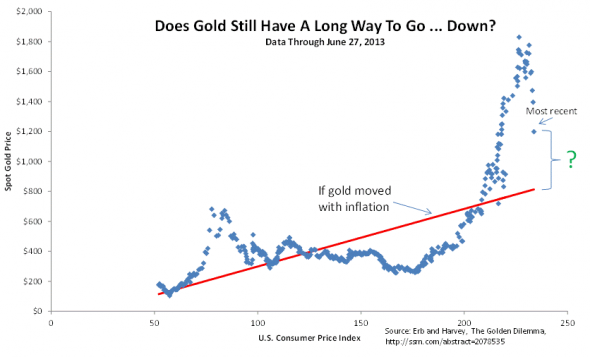
But on the subject of gold bottoms, some bottom talk is more compelling than others. Campbell Harvey, from Duke University, for example, has been arguing for a while that in real terms the gold price has been overvalued for some time.

So, on the basis that gold really is the inflation hedge some people think it is, its value should currently more about the … $800 mark:

But since gold doesn’t really do a good job of moving with inflation, it’s hard to say if common sense valuations will prevail. In fact, Harvey questions the entire correlation between gold and real yields, and suggests its outperformance is mostly the result of a “fear trade”....MORE
The r-squared for gold and real rates is .82 (depending on the timeframe, of course)...MUCH MORE
See also:
Barron's on Gold and Real Interest Rates

Monday, May 18, 2009

Waste outshines gold as prices surge. And: "Gold 2009: The Story So Far"

Gold was heading south, last I saw.
First up, a blurb from FT Alphaville:
It has become the latest – and perhaps most unlikely – sector to nourish the green shoots of economic recovery: the price of recyclable rubbish has doubled since November, outperforming traditional commodities, the FT reported. Prices for plastic and paper have surged from a dramatic crash last year, and in percentage terms have outperformed gold, crude oil and the FTSE 100.
Chart from Kitco:

From Money Morning Australia:

Whether inflation or deflation strikes, a growing number of people are fast buying gold for defence…

IT’S COMMON KNOWLEDGE that gold bullion proved the most reliable wealth-store during the vicious inflation of the late 1970s. Yet almost un-noticed, gold has once again been the best-performing asset bar none this decade, too....

...Gold prices had already trebled and more against the world’s major currencies, gaining an average 14% per annum in Sterling terms since the start of 2000....

We've had a few posts on the fallacy of gold as a hedge against deflation. In "The Financial Times Sings Praise of Gold. They're wrong":

Gold is not a hedge against deflation. Over the years goldbugs have come to believe it is, based on the performance of Homestake Mining's stock during the Great Depression. Here's an example from Gold Eagle:

Gold Stocks did well during the Great Crash and aftermath… indeed exceedingly well. Please note that from August through October 1929 Homestake Mining did decline in value, but no where near the percent plunge in the general stock market. And by yearend Homestake was again creeping up in price. For the first few months of 1930 the gold mining industry proxy was relatively flat. However, from mid-year on Homestake began to increase in value as the DOW and DJUA rapidly and relentlessly melted away. During the next five years the Gold Mining Industry's surrogate soared in value - while stock prices were decimated by the Great Depression.

It is relevant to observe that Homestake's price appreciation was not a market anomaly, but was consistent with its growing annual earnings per share and increasing cash dividend payout. Yearly E.P.S and cash Dividend payout data may be seen in the above Homestake chart. While nearly all industries revenues and earnings dwindled, the gold mining industry thrived. Homestake's E.P.S. increased from $4.19 in 1929 to $32.43 in 1935. During the six desolate years of the Great Depression, the gold mining industry's proxy enjoyed an E.P.S. growth rate of 41% COMPOUNDED ANNUALLY. Furthermore, while the banks paid a paltry 1% in "earned" interest on the meager savings of those few hapless souls who still had money, Homestake share holders were indeed enriching themselves. The 1929 cash dividend of $7.00 increased to a cash payout of $56 PER SHARE BY 1935. Consider for a moment the awesome investment significance of it....

...That is rather enthusiastic and more accurate than most analyses, at least he focuses on the equity rather than the metal. But the focus is still wrong.
After the mine closed in 2002 I went out to Lead to answer the question "Is gold an asset you want to own during deflation?" I was quite possibly the last person with access to the company records from the '30's. The skeleton staff that Barrick had in place for the shutdown were literally boxing documents for the archivists as I sat there.

There were three contributors to the move in the stock price:
1) A high-grading mining strategy proposed by a young engineer, Don McLaughlin in the late '20's began bearing fruit in the form of higher recoveries. Mr. McLaughlin went on to the presidency of the company.
2) A flight to safety after the October 1929 stock market crash.
3) The Gold Reserve Act of January 30, 1934 raised the price of gold 69%, from $20.67 to $35.00 (conversely devaluing the dollar by 41%).
3a) Homestake was thus paying salaries and other expenses in devalued dollars.
This combination of more gold produced, higher price per ounce and lowered expenses (in real terms) was what moved the stock, not some inherent magic in gold.

A good explication of gold's valuation is Roy Jastram's study of the purchasing power of gold, "The Golden Constant: The English and American Experience, 1560-1976". The main point is that gold tends to retain purchasing power over long periods of time. A secondary point is at apparent varience with my conclusion. Jastram says that gold's purchasing power increases under deflation.
The apparent contradiction is resolved by the knowledge that during his period of study, gold was money. During deflation, any unit of money increases in purchasing power. No one backs their money with gold, that link is broken.

Gold will shine but not until the printing presses have overcome the contraction in credit/money.
In the meantime, if you are of a mind to invest for the Apocalypse, buy some bullion silver coins or Silver Eagles. The lower valuation should make buying a fifty pound sack of flour easier than it would be with an ounce of gold.

Tuesday, April 29, 2014

1914: The Gold Standard Is A Dying Regime

We are coming into the hundred year anniversary of that last summer of peace.*
From Global Financial Data (they of the ridiculously long time-series'):

The End of the Gold Standard
It was 100 years ago, in 1914, that the Gold Standard died.  When World War I began, most countries went off the Gold Standard and attempts to return to a Gold Standard since have all failed. Some people have called for a return to the Gold Standard as a way of disciplining governments and ensuring that they do not inflate their way out of their current fiscal problems. If it were only that easy.

                What many people don’t understand is that in the long run, the International Gold Standard was a very brief phenomenon, and the fact that the world moved to a Gold Standard in the late 1800s was a sign of weakness in the role of gold and silver in the economy, not of strength.  The reality was that Europe was on a bimetallic standard, not a Gold Standard, from the Middle Ages until World War I, and gold triumphed in the nineteenth century because bimetallism had failed. This should have been taken as a sign that the gold standard too would inevitably fail, not that it was the result of teleological inevitability.

                The first gold and silver coins were issued by Croesus in Lydia around 600 BC.  Before that, both gold and silver were used as a store of for wealth, for conspicuous consumption, or to value other goods, but no coins existed.  The value of gold relative to silver, the gold/silver ratio, changed over time.  In 2700 BC it was around 9 to 1; under Hammurabi in 1800 BC it was 6 to 1; and by the time Croesus issued the first gold and silver coins, rather than electrum coins, it was 12 to 1.

                The gold/silver ratio remained around 12 to 1 for the next 2500 years, though it could range as low as 9 to 1 or as high as 16 to 1. Athens built its empire on the silver mines of Laurium; Alexander the Great plundered the treasuries of the Persians; and the Romans seized this stolen bullion when they conquered the Mediterranean. Constantine took the gold of the Pagan temples for his needs, and whoever controlled Egypt could rely upon the mines in Nubia as a source of gold. When the Arabs spread Islam through the world, they seized the gold and silver of the lands they conquered. When they gained control over northern Africa, the Arabs also gained power over the gold coming from sub-Saharan Africa.

                Europeans minted a few coins during their Dark Ages, but mainly they relied upon Arab gold coins. It wasn’t until the Europeans sacked Constantinople during the Crusades, taking its gold, and the Venetian cities developed trade surpluses with the Arabs that Europe found a need to mint gold on a regular basis, starting in 1252.

                The chart below shows the gold/silver ratio over the past 750 years. In the thirteenth century, the gold to silver ratio was around 10 to 1. It was the scarcity of gold in the fifteenth century that drove the Portuguese to go south and east to seek gold and silver, and the Spaniards to go west, discovering the Americas instead of reaching China....MORE
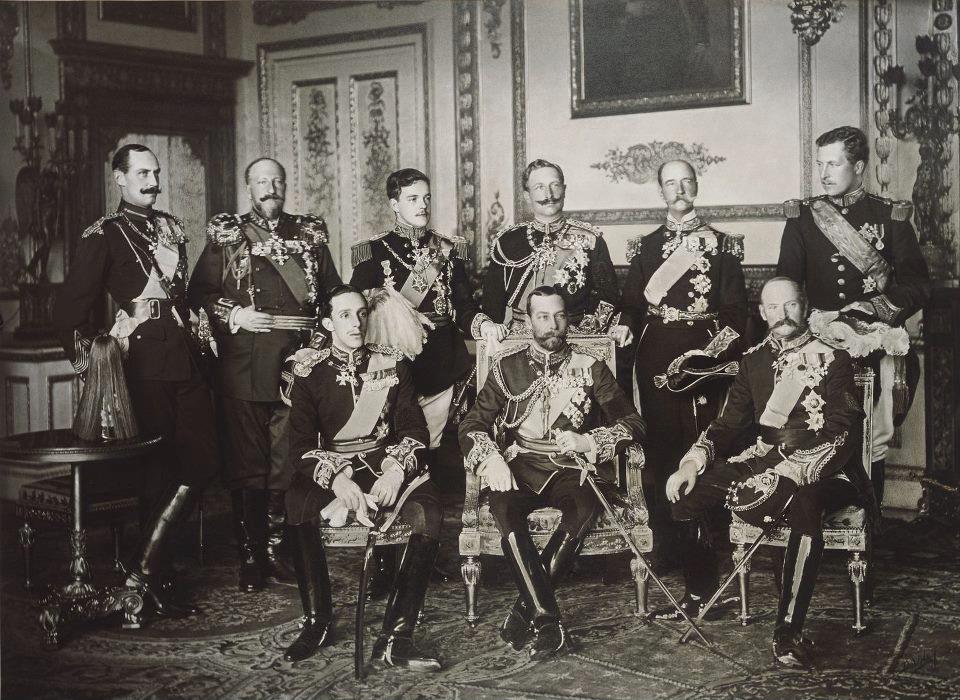
1914 marked the end of the 100 year Pax Britannica, the régime best exemplified  in this very, very rare photograph from a few years earlier:
Nine Kings 1910*
 

*Probably the only time in history the protocol peeps were able to get this many roi boy** types to agree to the order of precedence.
**(pronounced rwa bwas)

May 1910: Nine Kings assembled at Buckingham Palace for the funeral of Edward VII, the Father of George V (centre). From left to right, back row: Haakon VII of Norway, Ferdinand I of Bulgaria, Manuel II of Portugal, Wilhelm II of Germany, George I of Greece and Albert I Of Belgium. Front row: Alphonso XIII of Spain, George V and Frederick VIII of Denmark. The funeral on  20th May was the largest gathering of the European royalty–and its last hurrah, too. Also present at the funeral was Archduke Franz Ferdinand of Austria, whose assassination four years later would spark the WWI–which collapsed many royal dynasties of Europe. Manuel of Portugal would be driven from his throne by revolutionaries within months of this picture. George would be assassinated.  Alphonso, Wilhelm and Ferdinand lost their thrones.-Source

Sharp eyed readers have probably noted the absence of Nicholas II, Emperor and Autocrat of All the Russias.
Very odd considering that he was part o'the fam:


Two bearded men of identical height wear military dress uniforms emblazoned with medals and stand side-by-side
King George V (right) with his
first cousin Tsar Nicholas II, 
Berlin, 1913. Note the close 
physical resemblance between 
the two monarchs.

Nick was also the nephew of the Greek and Danish Kings and of the widowed wife of Edward VII, Queen Consort Alexandra.

Time to post, before I start singing Sister Sledge.

Tuesday, January 7, 2014

Conspiracy! Bullion Banks Force Miners to Hedge, Replenishing Banks' Gold Stocks

From MineWeb:
Bullion banks forcing hedging to replenish their gold stocks?
Could there be hidden agenda behind the latest drive by the bullion banks to insist miners hedge some of their output as a prerequisite for the provision of new finance?  
LONDON (Mineweb) - 
Hedging has come soaring back into the headlines in recent weeks as a result of a number of fairly high profile comments. And, while the global gold hedge book is still massively lower than where it once was, in recent months there has been a growing trend among lenders to ensure that part of the gold output is hedged forward as a prerequisite for raising new finance.

Before the seemingly ever rising gold price of the first decade of the 21st Century put hedging out of favour, and the big miners scrambled to dehedge, this was, in fact, pretty normal practice.  Gold mining was looked upon as a particularly risky business after the big collapse down from $800 in 1980 to under $300 over the subsequent 20 years and the banks were thus keen to protect their investment which they could do by an insistence on hedging output at a specific price as an income guarantee.  But now, some are suggesting there is a hidden agenda behind a new insistence on hedging by the bullion banks. 

It certainly won’t have gone without notice that gold bullion is flowing out of U.S. and European vaults to the east – and to China in particular.  Indeed, despite the massive gold liquidations out of the big ETFs – GLD in particular – and more, available metal in COMEX warehouses is at a very low level as most of it is  being swallowed up by Eastern, Middle Eastern and FSU demand. Add into this the certainty that many central banks have been leasing out much of their gold, which has then been sold on by the bullion banks, and there is a huge supply squeeze developing for physical gold in the West. 

The bullion banks will supposedly have to return the gold they have leased, but are unable to do so because the available bullion supplies are just not there and that which comes on the market is being snapped up by the East.  Indeed this desperation to get their hands on physical metal without bankrupting themselves may be at least a partial reason for the gold price being driven downwards with the kind of strange market activity we have seen in the recent past.  Their inability to return leased gold to the central banks is also the most likely reason why Germany is finding it so difficult to repatriate its gold stored in U.S. and U.K. central bank gold vaults.

Thus, the reports suggest, the bullion banks are now exerting pressure on the basic gold suppliers - the miners - to supply gold directly to them  (through hedging) to try and help replenish their holdings so as to be able to return the gold they have leased.  The suggestion is that should a gold miner require say $300 million in finance to build a new mine, or expand an existing one, it is going to be required to hedge a significant portion of its production in order to get the financing.  But the miners are resisting this – at a gold price of around $1200, most would be mining gold at a loss.  The miners’ main hope is for an increase in the gold price in the future as new operations and expansions come on stream, but if they hedge their output forward at $1200 they would be doing so at, or near,  a lossmaking level – not an attractive proposition, and one which could land them in serious financial difficulties should the gold price take off again and, as we have seen in recent years, costs escalate accordingly.

But there is another side to the new mined gold supply situation that could be even more worrying for the bullion banks in terms of reducing new mined gold supply availability in the West.  We hear that gold miners are being approached to sell their output direct to Chinese refiners at a premium – surely an attractive proposition for a struggling gold miner....MORE
The evil that is Macquarie Bank forced Australian miner Beadell Resources to sell 60% of their production forward.
At $1600/oz.

Another Macquarie-backed miner, B2Gold, sold call options to pay for put options, constructing a collar around part of its production at between $1,721 and $1,000 per ounce.
Pretty fancy. 

Tuesday, November 26, 2013

"Cash Costs A Better Indicator Of Pressure On Gold Mining: Citi" (GDX; GDXJ)

A subject near and dear, links below.
From Value Walk:
Gold mining operations have been under severe pressure for years, and major companies have burnt through $11 billion in the last decade, but that hasn’t stopped mines from increasing production, raising the gold supply by 10% between 2009 and 2012. Normally you would expect cost pressures to force some mines to halt production, but Citi analyst Jon Bergtheil thinks that cash costs may be a better indicator of short-term pressure than all-in costs.

Gold miners failed to cut costs
“Gold miners have failed to cut costs quickly enough to keep up with the fall in the gold price. Indeed, Citi equity analysts calculate that average all-in costs production costs decreased by 6.1% y/y in H1 2013 to $1,666/oz, while average spot gold prices fell at a faster rate of 7.4% to $1,530/oz. during the same period,” writes Bergtheil. “We estimate that practically the entire global gold industry is cash-burning on an ‘all-in’ cost basis.”
gold all in costs

Gold: All-in cost

All-in costs include everything from CAPEX and exploration costs to taxes, but a lot of the time these costs are overhead that mining operations can’t get out from even if they halt operations. This is the comparison that has a lot of people worried about the industry. Looking only at cash costs, a more reasonable picture emerges.

 http://ify.valuewalk.com/wp-content/uploads/2013/11/gold-cash-costs.png

This doesn’t mean that all-in costs aren’t relevant, and they’re still a good indication of the long-term health of the sector, but cash costs seem to be a better indicator of gold production in the short term. This implies that gold’s spot price will have to keep falling before miners start pulling back on supply, and while Bergtheil doesn’t think gold will fall below $1000/oz, he concedes that it is a possibility. Above ground inventory has also been increasing, meaning that even if miners do reduce production there will be a significant delay before the reduction is able to support prices.

Something unexpected could always send investors back to gold as a defensive measure, but with falling prices and a still increasing supply, it looks like gold’s bear market hasn’t completely played itself out just yet, causing Citi to rate the sector as a whole as neutral.
Previously:
Nov. 18 
This is what Izzy was warning against in last week's Alphaville post "The gold producer wild card".
Which brought out the dimwits:
Scipio78 | November 14 1:55pm | Permalink
This post is nonsense. The real "all-in cost" of mining gold is about $1100oz for most producers. On new mines (usually in Africa or Latam with little infrastructure and greedy politicians) it can be about $1500-1600oz. For many gold miners current spot prices are about breakeven, if spot were to go below $1k, they would not hedge .... they would close down!! 
It isn't the all-in cost that matters here, companies will forgo capex, environmental remediation and a half-dozen other components of "all-in".
What matters is cash costs. What do they have to pay the miners? What is this month's electrical bill? etc....
Nov. 12 
Sept. 23 
One thing to keep in mind, there are a few measures of 'cost of production'.
As the Financial Times put it a on Monday in "Gold mine measure ‘to reflect true costs’":
Gold is being mined by some of the world’s biggest producers at costs that are higher than the price of the precious metal, according to a new measure that may become a benchmark of industry efficiency for companies and investors.

Several miners reporting earnings in recent weeks have revealed “all-in sustaining costs” of production of more than $1,200 per troy ounce, the price to which gold dropped this year. Some have shown an AISC of more than $1,400. Gold ended last week at $1,314 per ounce, having fallen more than 5 per cent during the week.
The AISC measure intends to show more clearly the full costs of getting gold out of the ground. Its adoption comes as this year’s sharp fall in the price of the precious metal has put the industry under more pressure than it has known for almost a decade and heightened investors’ interest in miners’ true profitability.
Goldminers, like other miners, have traditionally used “cash cost” – showing the cost of running a mine to produce a given amount of a metal – as a benchmark of their operating efficiency.

However cash cost measures have disregarded other expenses, from general office spending to some of the capital that must be spent to develop a mine, to keep it in production or to rehabilitate a site at the end of its life....MORE 
Although the new measurement is closer to reflecting financial reality and thus more honest in reporting, you can bet that some managements will use the cash cost bogey at least for periods up to a year meaning that there will be more supply coming out than if one used the AISC number.
June 26 
April 18 

Tuesday, February 19, 2013

Indian Central Bank Issues Guidelines on Dematerialized Gold in Effort to Reduce Need to Import Physical

Comments on gold by the Reserve Bank of India's Deputy Governor got certain nodes of the www firing last November:
Dematerialise gold : RBI's Subir Gokarn
 Reserve Bank Deputy Governor Subir Gokarn today said there is a need to "dematerialise" gold like any other financial product to reduce its physical imports, the rise of which has been blamed for the high current account deficit that is feared to touch new record high this year. 
"It (high gold imports) is creating some macroeconomic stresses and so the challenge is to find ways to replicate the financial characteristics of gold without necessarily causing physically importing," Gokarn told the last day of the two-day annual Bancon here....MORE
Gold imports are a major component of India's current account deficit:
..."More expensive gold is being imported in larger quantities which is compounding the troubles," he said.
As gold imports touched a record high last year, pushing up the current account deficit to a historic high of 4.2 percent in the year, the Reserve Bank has unveiled a slew of curbs on gold purchase and financing....
The dematerialization talk was understood by some to mean a full scale assault on all that is good and pure gold bugs.

Last week the RBI issued guidelines on the dematerialization:
DBOD.No.IBD.BC.81/23.67.001/2012-13 February 14, 2013
All Scheduled Commercial Banks authorized to deal in Gold
Dear Sir / Madam
Gold Deposit Scheme
The Central Government, with a view to bringing privately held stock of gold in circulation, reduce the country’s reliance on import of gold and providing its owners with some income apart from freeing them from the problems of storage, movement and security of gold in their possession, had notified Gold Deposit Scheme 1999 on September 14, 1999. Accordingly, Reserve Bank of India vide circular No IBS 912/23.67.001/99-2000 dated October 5, 1999 had formulated guidelines for Gold Deposit Scheme to enable banks authorized to deal in gold to prepare their own Gold Deposit Schemes.
2. The Central Government (Department of Financial Services, Ministry of Finance) has now issued a Notification No.G.S.R.46(E) dated January 24, 2013 (copy enclosed) enabling Mutual Funds/Exchange Traded Funds registered under SEBI (Mutual Fund) Regulations to deposit part of their gold with the banks under the scheme.
3. In view of the above, the guidelines enclosed with our circular dated October 5, 1999 for operation of the Gold Deposit Scheme have been modified as under:
(i) Under para 5, presently the banks may either issue a passbook/statement of account or a certificate/bond to the depositors for deposit of gold, which will be transferable by endorsement and delivery.
In terms of the Government Notification dated January 24, 2013, the Gold Certificate would also mean the final receipt, in dematerialised form or otherwise, issued to a subscriber of the Scheme after the gold tendered by him has been assayed as specified in para (ii) below and accepted as deposit by the bank. The gold deposit certificate shall be transferable by endorsement and delivery, as hitherto. However, in case of certificates issued in dematerialized form, the depository rules for transfer would apply. ...MORE
We last visited Indian Demat accounts in 2010:
Can Hindu Deities Open Brokerage Accounts Allowing them to Trade Securities?

which was followed by:

UPDATE: Bombay High Court Rules Hindu Deities MAY NOT Trade Securities
 No demat accounts for Hindu gods
MUMBAI: Let gods remain in temples and not enter the stock markets, said the Bombay High Court while dismissing a petition seeking orders to authorities to allow Hindu gods to open demat accounts....
....Which is a pity. Last April Foreign Policy's Passport blog had the perfect prime broker for the Deities:

Teenage goddess to pursue banking career


What's a girl to do when she's not a living goddess anymore? Apparently aim for a career in finance...

Monday, September 23, 2013

UPDATED--Gold is Going Much Lower

Update: "JPMorgan Says "Buy Gold", Conspiracy Theorists Dazed, Confused".
Original post:
Comex gold settled at $1,332.50 on Friday, off $36.80 for the session. After the close it traded down to $1325.60.
From Izabella Kaminska at Dizzynomics:

All that glitters…
Gold goes up on non-taper, gold goes down on taper.
Is it really that simple?

Maybe.
Though I suspect that even without tapering it won’t stay supported for long. This is because QE has finally created the conditions necessary to reward equity investing more than they do gold investing.

And without the likes of India buying, there isn’t enough liquidity heading into the market to support new highs. And new highs are necessary if you can’t hedge your gold positions at a positive rate.

The more QE happens, the greater the chance of negative rates on traditional risk free assets. But gold is a useless alternative if it can’t be hedged at a positive rate (i.e in a contango).

Gold backwardation is a market condition that deprives the gold investor from the ability to replicate a positive yielding safe security out of gold.

If you can’t own gold and guarantee a hedge that more than protects your capital as well as your transaction/position costs, you might as well put your money in: 1) the last remaining commodity markets which can simulate a positive yielding security via contango 2) price supported equities which at least do pay a dividend or 3)which are unlikely to fall too much in price because of continue Fed action or emerging market securities.

I feel confident that unless another EM country piles into the market or gold producers stop hedging, gold will be going to go down in dollar terms no matter what.

And gold miners are unlikely to stop hedging now that we’ve reached a point where more supply from them increasingly risks crashing the market....MUCH MORE including a small walk-on part by H.G. Wells.
One thing to keep in mind, there are a few measures of 'cost of production'.
As the Financial Times put it a on Monday in "Gold mine measure ‘to reflect true costs’":
Gold is being mined by some of the world’s biggest producers at costs that are higher than the price of the precious metal, according to a new measure that may become a benchmark of industry efficiency for companies and investors.

Several miners reporting earnings in recent weeks have revealed “all-in sustaining costs” of production of more than $1,200 per troy ounce, the price to which gold dropped this year. Some have shown an AISC of more than $1,400. Gold ended last week at $1,314 per ounce, having fallen more than 5 per cent during the week.

The AISC measure intends to show more clearly the full costs of getting gold out of the ground. Its adoption comes as this year’s sharp fall in the price of the precious metal has put the industry under more pressure than it has known for almost a decade and heightened investors’ interest in miners’ true profitability.

Goldminers, like other miners, have traditionally used “cash cost” – showing the cost of running a mine to produce a given amount of a metal – as a benchmark of their operating efficiency.

However cash cost measures have disregarded other expenses, from general office spending to some of the capital that must be spent to develop a mine, to keep it in production or to rehabilitate a site at the end of its life....MORE 
Although the new measurement is closer to reflecting financial reality and thus more honest in reporting, you can bet that some managements will use the cash cost bogey at least for periods up to a year meaning that there will be more supply coming out than if one used the AISC number.

The world-wide, all-in, sustainable number is just under $1300 per ounce as we saw in April's "Barclays: "If Gold Was "Just A Commodity" What Would Be Its Support Price?" (ABX; G; GLD; NEM)".
The next day we looked at some of the miners whose mineral target is copper or other base metals and who consider gold to be a byproduct; "Goldman Sachs on Australian Gold Miner Cash Costs". Some of these guys figure their cash cost at under $500/oz.

From June's "Gold Miners Have Just Started Outperforming Gold (GDX; GLD)":

I've mentioned that the ultimate bottom of this cycle could very well be the (nominal) top of the last cycle, the $875 print ($2360+ adjusted) in Hong Kong in January 1980. That would be far below the all-in costs of mining and even below just the cash costs alone  for some of the miners:
...Analyzing the all-in sustaining costs (total costs associated with producing gold), 2013 guidance of Barrick Gold, Newmont, Kinross, Goldcorp and Agnico Eagle ranges from $950 to a maximum of $1200 per ounce....

Just yesterday Russia's Polymetal estimated their cash costs at $725-$750....
Polymetal is in an enviable position to hedge forward production but haven't done so yet while Peter Hambro's Petropavlovsk hedged a bunch (technical term) at $1408 this spring.

Here's a deeper dive in June's "Gold Collapses, Approaching Gold Miners Cost Threshold (Infographic)":
...There is a saying in the commodity biz, "High prices are the cure for high prices" because price incentivises production. In the same way low prices can be the cure for low prices as marginal producers become uneconomic and stop producing.
As The Australian defined the terms a couple days ago:
All-in costs are much higher than the cash-cost method currently used by the industry because they add in sustaining capital expenditures, general and administrative costs, mine site exploration and evaluation costs, and environmental rehabilitation costs....
In the current market the South African producers have the highest all-in costs and will have to decide if they want to go into money losing mode. All of the country's miners save the largest have costs above the current price and the largest, AngloGold, is close at $1204/oz.

The Australian article ref'd above estimates that production would fall 10 to 20% at $1200 for any extended period but one survival strategy is to halt every expense that doesn't bring gold to the surface which gives the industry $3-400 breathing room for a while.

For 2012 Gold Fields Mineral Service estimated worldwide cash costs at $740/oz and all-in costs at $1150/oz.

Finally, here's an infographic we posted last month, cash costs for the 50 largest miners worldwide....MORE

Tuesday, July 27, 2010

UPDATED: "GOLD TOP?" (GLD; XAU)

UPDATE below. The futures are now down $24.60.
Original post:

The futures are off a buck at $1,186.00.
From Pragmatic Capitalism:
As most people  know, gold has been in a raging bull market for more than 10 years rallying from about $250 per ounce to more than$1,250 per ounce. Many people are now wondering if the world’s currencies have any value at all and are flocking to gold as the only hard asset that historically has always had value.
Gold coin purchases are at an all time high. There are people walking up and down city streets and in shopping mall, holding signs saying “We Buy Gold.” There are even vending machines where  people can purchase gold bars. Of course, there are the ubiquitous commercials on TV about gold.

Does a contrarian look at all these factors and take the other side? Possibly, but the problem is most of these factors have been present for more than two years and gold has rallied more than $400. Why would gold be any different now?

I believe the psychology of the gold market is in a dangerous place, but manias can go on longer than people think. This happened in the real estate market in 2005 when everyone rushed in. Real estate TV commercials ran nonstop, many were buying second homes as an investment with no down payment, bankers were giving loans to anyone.
It took about three years for it to finally come apart. The gold and real estate markets are not related, but the mass psychology is eerily similar.

Are we finally at that tipping point? I believe we are.
Until two weeks ago, gold had been in a steady uptrend since February.  It was going up because of inflation or deflation; it was going up because Euro weakness or Euro strength or it was going up because of stock market strength or stock market weakness. People on CNBC have even said gold will never go down.
But close inspection of the gold market at this time show many technical difficulties that may bring it down. Below is a candlestick weekly chart of the gold market.

goldTop1 s GOLD TOP?
Source: Barcharts.com

Gold set the all time high of $1,264.80 per ounce during the week of 6/21/10, but that week also formed a candle stick called a “hang man”. This is when a market breaks off the highs but then runs all the way back up to the previous daily or weekly close. The next bar is critical because it must run back down and close under that previous low.  As you can see, this is exactly what happened.

The chart below also shows some import reversal patterns. This is a daily candlestick of gold. On June 21, gold made an all time high but closed below the previous day’s low. This previous day was the all time high. This can bea very bearish sign. Also notice it happened again just five days later....MORE
To my mind an even more important call was Kitco's John Nadler on May 3:
$800 Gold Prediction. No, A Zero Is NOT Missing.

Kitco is in the business of peddling gold and Nadler is their top analyst.
If you do a Google search for John Nadler the suggestions include:
John Nadler idiot
John Nadler is wrong
John Nadler is an idiot
John Nadler stupid
John Nadler wrong
Ya gotta love  the gold-bug crowd, and Nadler. We've had Kitco on the blogroll since we started the blog.
UPDATE, from FT Alphaville:

About that gold sell-off…
Spot gold prices continued their recent sell-off on Tuesday – chart via Kitco:

And in case there was any doubt, last week’s rumours of significant speculative liquidations appear to have been confirmed by CFTC futures data.
The figures out last Friday showed that money managers cut their long gold futures positions by 18 per cent last week.
Barclays Capital offered a little more context on Monday:
Indeed, the weekly drop in exposure was the second-largest weekly drop since February while non-commercial positions as a percentage of open interest has dropped to 32%, its lowest level since December 2008. In contrast, physical gold ETP holdings remained unchanged at 2087.9 tonnes, less than 15 tonnes of the peak reached in mid-July. However, platinum ETP holdings dropped by 11koz from its peak.
As too did Société Générale’s analysts...MORE 

Friday, July 31, 2015

Commodity Investors And the Kübler-Ross Model of Grief (or why gold could go lower than our $875 target)

We've been targeting the 1980 Hong Kong high (it only hit $850 in the U.S.) since FT Alphaville's Izabella Kaminska published a December 2012 post, "Capping the gold price" which begins modestly:
The following chart, we propose, has the potential to inspire a whole new way of looking at the gold and Treasury market...
That was posted five days before gold hit an intermediate term high of $1715, which it hasn't seen since, and probably won't see for some while.

When I got around to reading her piece a month later I reasoned, with the mental acuity of a bright six-year-old, "Saaay, if it can't go up any more..."
Of course in subsequent posts I'd write something to the effect: "Now if you cut out the upside (...Capped) you are left with the semi-variance which means you can design extremely high reward bets...."

Anyhoo, this article is based on the work of Claude Erb who has graced these pages a few times, links below.
Front futures $1097.60, up $9.20.
From Hulbert@MarketWatch:

Opinion: Study predicts gold could plunge to $350 an ounce
Gold bugs, who have just begun to digest bullion’s more than $100 drop over the past month, need to prepare for the possibility of an even bigger decline.

That, at least, is the forecast of Claude Erb, a former commodities manager at fund manager TCW Group, and co-author (with Campbell Harvey, a Duke University finance professor) of a mid-2012 study that forecast a plunging gold price. They deserve to be listened to, therefore, since — unlike many latter-day converts to the bearish thesis — they forecast a long-term gold bear market when it was only just beginning.
You might think that, with gold now trading more than $500 lower than when the study was released, Erb would declare victory and leave well enough alone. But Erb is doing nothing of the sort. Earlier this week, he told me that the gold community now needs to consider the distinct possibility that gold will trade for as low as $350 an ounce.

Erb bases this particularly chilling prospect on two premises. The first is gold’s fair value, which is currently $825 according to the formula proposed in Erb and Harvey’s study. The second is the likelihood that, whenever gold does eventually drop to fair value, it will overshoot and drop to a much lower value. He calculates that, if gold drops below fair value to the same extent it did in the mid-1970s and the late 1990s, bullion would trade around $350 an ounce.

Erb acknowledges that gold’s true believers will find such a prospect outrageous, if not simply incomprehensible. But, he asks, why should gold behave differently than any other asset, each of which fluctuates markedly from the extremes of over and under value?

Erb uses the five well-know stages of grief to characterize where the gold market currently stands. Those stages are denial, anger, bargaining, depression and acceptance, and he argues that the gold-bug community currently is in the “bargaining” stage.

He argues that, in mid-2012, the gold bugs were in the denial phase. His and Harvey’s forecast of gold around $800 an ounce was met with almost total incredulity. Today, in contrast, with gold more than $500 an ounce lower and forecasts of sub-thousand-dollar gold now relatively common, the gold bugs have progressed through the anger phase and are now “bargaining with God.”

Erb imagines them saying the functional equivalent of: “So long as gold stays above $1,000 an ounce, I’ll go to church every Sunday.”...MORE
Previous posts Mr. Erb shows up in:
April 2008 
Classic Paper: Returns from Commodity Futures
November 2010
"The financialisation of commodities"
June 2013
Barron's on Gold and Real Interest Rates
May 2014
AQR's Cliff Asness: "Fact, Fiction and Momentum Investing"

Here's Erb and Harvey: "The Golden Dilemma" and Erb "Betting on 'Dumb Volatility' with 'Smart Beta'", both at SSRN.