Monday, January 5, 2026

"Foxconn's Q4 revenue jumps 22% to record high on AI demand"

From Reuters, January 5:

Taiwan's Foxconn, the world's largest contract electronics maker, reported record fourth-quarter revenue on Monday, driven by strong demand for artificial intelligence products. 
Revenue for Nvidia's biggest server maker and Apple's top iPhone assembler jumped 22.07% from the same quarter last year to T$2.6028 trillion ($82.73 billion), Foxconn said in a statement.
 
The results exceeded the T$2.418 trillion LSEG SmartEstimate, which gives greater weight to forecasts from analysts who are more consistently accurate.
 
Foxconn said revenue for the quarter grew significantly on both a quarter-on-quarter and year-on-year basis, exceeding its expectations and creating a high base of comparison for the first quarter of 2026....
....MUCH MORE 

"UK to Pass Population Tipping Point in 2026, Think Tank Says"

From Bloomberg via Canada's Financial Post, January 4:

The number of people who die in Britain this year is set to exceed those born in the country, the Resolution Foundation said, in what the think tank described as a permanent shift that will increase the UK’s dependency on migration. 

The number of people who die in Britain this year is set to exceed those born in the country, the Resolution Foundation said, in what the think tank described as a permanent shift that will increase the UK’s dependency on migration. 

Britain will see a shortfall in births in 2026, Resolution Foundation projected as part of its annual economic outlook released on Monday. That gap will increase “by an ever-widening margin, forever closing a chapter in the demographics” of Britain that stretches back to at least the start of the 20th century, the research institution said.

While the number of deaths in the UK exceeded births in 2020 at the height of the Covid-19 pandemic and again in 2023, the native population grew slightly in each of the past two years, Resolution Foundation estimated. From 2026 onwards, any population growth “is set to come from international net migration,” the think tank said. 

The report shows the stakes of the debate gripping Britain as Prime Minister Keir Starmer seeks to reverse the rise of Nigel Farage’s anti-immigration Reform UK in opinion polls. Starmer and his home secretary, Shabana Mahmood, have pledged to bring down migration from record highs, at the risk of the Labour Party’s broader commitment to end an extended period of economic stagnation. 

Opposition to immigration — a key driver of Britain’s vote a decade ago to leave the European Union — has risen further in the wake of a surge in both legal immigration and arrivals of asylum-seekers from across the English Channel. Net migration reached a peak of almost one million a year after the then-Conservative government loosened visa rules to offset the shortfall of European workers and accommodate Ukrainians and Hong Kongers fleeing strife at home. 

The UK’s projected shortfall in births mirrors trends elsewhere in Europe and across the developed world, fueling support for policies to encourage women to have more children. The projected population accounts for everyone already in the UK, including families of foreign descent as well as those who have been in the country for generations. 

“This may shift the conversation on migration away from arguments over whether the country is already ‘full’ and onto whether we want to address population decline,” said Greg Thwaites, research director for the Resolution Foundation. Thwaites acknowledged the subject was “likely to remain politically charged.”....

....MUCH MORE 

Oh well, as they say in Old Blighty, "Allahu Akbar!" 

And from the Telegraph, November 27, 2025: 

London’s demographic change is unprecedented in peacetime  
Most of the population has been replaced within a couple of generations 

As a grizzled travel writer, I’ve picked up a few tips over the years. And one of them is this: if you want to understand a country quickly, take an urban food tour. You get to sample delicious scran, you learn how locals eat, drink and socialise and – crucially – as the chat flows, you hear the sort of throwaway facts that make you sit back in surprise.

So it was last night, for me, in Phnom Penh, the increasingly seductive, hedonistic capital of Cambodia. I was eating buffalo beef jerky with a spry fifty-something guy called Vannak, right outside the monastery where the young Pol Pot, the future communist tyrant then known as Saloth Sar, was a trainee monk.

Naturally the conversation strayed to the appalling Khmer Rouge era. Vannak explained how he was nine years old on that burning hot April day in 1975 when the Khmer Rouge entered Phnom Penh and drove everyone out, including his own family of bourgeois business folk.

Then he offered up his startling fact: today, Phnom Penh once again has a population of about 2m, as it did in 1974 before the Khmer Rouge. However, 80 per cent of these people are “newcomers”, with no ancestral, cultural or generational link to the old Phnom Penh. The original population that was kicked out in 1975 has never truly returned.

Setting down my beer, I started taking notes, hoping to find a way to illustrate this astounding change. I wrote the lines “imagine if this happened to London, if most of the population was replaced in two generations, how incredible it might…”

And then I stopped. Because I realised that actually has happened to London. In 1975 the white British population of London was about 85 per cent. Today, fifty years later, it is just 37 per cent, and falling.

Now, of course what has happened to Londoners is utterly different from the Cambodian experience. Voluntarily moving from Bow to Braintree is, to put it mildly, not the same as being marched out of your home at gunpoint. Any moral comparison would be grotesque. But in strictly numerical terms the transformation with war-torn Phnom Penh is, like it or not, analogous. Put it differently: what’s happened to London is almost unprecedented in peacetime.

A glance at history shows this. If you seek out examples of dramatic ethnic change comparable with London 1975-2025, you get these: Constantinople from 1453-1500, when Ottoman conquest reduced the Greek population from 90 per cent to 30 per cent. Alternatively there is medieval Toledo, Spain, when the Reconquista reduced the majority Muslim population to a much smaller minority in the years 1085-1150.

Another example is Thessaloniki between 1870-1928, when convulsions of empire followed by the First World War, married with forced ethnic expulsions, saw the Turks replaced by Greeks. A fourth contender might be one of the Polish cities purged of its ethnic German population in the smoking ruins of Europe, 1945-1950. Somewhere like Wroclaw.

Indeed, finding peacetime equivalents for the disappearance of the Cockneys is seriously difficult. You might argue for New York City in the late 19th century. Buenos Aires is also a possibility, from 1870 to 1914....

....MUCH MORE 

Sunday, January 4, 2026

"The World Happiness Report Is a Sham"

From Yasha Mounk's substack, March 20, 2025 (World Happiness Day):

A case study in elite misinformation. 

Today is World Happiness Day. So, like every year on March 20th, you are likely to see a lot of headlines reporting on the publication of the annual World Happiness Report. “Finland is again ranked the happiest country in the world [while] the US falls to its lowest-ever position,” a headline in the Associated Press ran this morning. Forbes even got philosophical, promising “5 Life Lessons From Finland, Once Again the World’s Happiest Country.”

Published by the United Nations Sustainable Development Solutions Network and the Wellbeing Research Centre at Oxford University, the basic message of the report has remained the same since its launch in 2012. The happiest countries in the world are in Scandinavia; this year, Finland is followed by Denmark, Iceland and Sweden. America, despite being one of the richest large countries in the world, persistently underperforms: this year, the United States only comes in 24th out of the 147 countries covered in the report, placing it behind much poorer countries like Lithuania and Costa Rica.

I have to admit that I have been skeptical about this ranking ever since I first came across it. Because I have family in both Sweden and Denmark, I have spent a good amount of time in Scandinavia. And while Scandinavian countries have a lot of great things going for them, they never struck me as pictures of joy. For much of the year, they are cold and dark. Their cultures are extremely reserved and socially disjointed. When you walk around the—admittedly beautiful—centers of Copenhagen or Stockholm, you rarely see anybody smile. Could these really be the happiest places in the whole wide world?

So, to honor World Happiness Day, I finally decided to follow my hunch, and look into the research on this topic more deeply. What I found was worse than I’d imagined. To put it politely, the World Happiness Report is beset with methodological problems. To put it bluntly, it is a sham.

News reports about the World Happiness Report usually give the impression that it is based on a major research effort. Noting that the report is “compiled annually by a consortium of groups including the United Nations and Gallup,” for example, an article about last year’s iteration in the New York Times warned darkly that “the United States fell out of the Top 20” without a hint of skepticism about the reliability of such a finding.

In light of such confident pronouncements, and the absence of any critical voices in most of these news stories, you might be forgiven for thinking that the report carefully assesses how happy each country in the world is according to a sophisticated methodology, one that likely involves both subjective and objective criteria. But upon closer examination, it turns out that the World Happiness Report is not based on any major research effort; far from measuring how happy people are with some sophisticated mix of indicators, it simply compiles answers to a single question asked to comparatively small samples of people in each country:

“Please imagine a ladder with steps numbered from zero at the bottom to ten at the top. Suppose we say that the top of the ladder represents the best possible life for you and the bottom of the ladder represents the worst possible life for you. If the top step is 10 and the bottom step is 0, on which step of the ladder do you feel you personally stand at the present time?”

The obvious problem with this question, commonly known as the Cantril Ladder, is that it doesn’t really ask about happiness at all. We know from many surveys that people tend to give very different answers to questions about what makes them satisfied with their life and to questions about whether they are feeling good in the moment. Having children, for example, tends to raise parents’ assessment of how meaningful their life is; but notably it does not make them report higher levels of happiness at any particular moment, including when they are spending time with their kids. At most, a ranking based purely on the Cantril Ladder could therefore give us something called a World Self-Reported Life Satisfaction Report—and it’s easy to see why such an honest title wouldn’t entice many journalists to write about it.

The less obvious problem with the Cantril Ladder is that it does not even do a good job of measuring respondents’ satisfaction with their own lives. When one set of researchers asked over a thousand survey respondents in the United Kingdom what they took the question to be getting at, the most commonly mentioned responses included “wealth,” “rich” and “successful.” As August Nilsson and his colleagues painstakingly demonstrate, some of the specific language in the question—such as the metaphor of the ladder and its emphasis on the “top” as well as the “bottom step”—primes respondents to think about social hierarchies. Their conclusion is sobering: “The Cantril Ladder is arguably the most prominent measure of well-being, but the results suggest caution in its interpretation—the Cantril Ladder’s structure appears to influence participants to attend to a more power- and wealth-oriented view of well-being.”....

....MUCH MORE 

Previously:

May 2021 - "The Grim Secret of Nordic Happiness"

I thought everyone knew this. At minimum as regards the Finns. 

As to the Nordics, what with the Janteloven I sometimes think there is a bit of play-acting in the ostentatious humility....

As noted in the outro from 2019's "FinnTech: What To Do With Near-Indestructible Black Plastic": 

I remember asking a Finnish woman why it sounded like people were laughing when they spoke Finnish, were they happy?
"Oh no" she said and then she stopped talking.

Someone, I can't recall who, mentioned that on public transportation Finns sit and stare at their shoes. It is considered very forward to stare at someone else's shoes.
I don't know as much about Finland as I do about Norway but here are some of our posts:

Thousands Of Migrants Flee Finland Hoping For A Better Life In Iraq

"Embracing päntsdrunk, the Finnish way of drinking alone in your underwear"

The Finns used to dance the Tango but maybe not so much anymore. The only Finnish band I could name is an old-school Finnmetal band, Children Of Bodom described as:

"Melodic death metal meets virtuoso guitars: Children Of Bodom took the spirit of eighties
 heavy metal and thrash, and married it to a contemporary death metal framework"

or, as Encyclopaedia Mettalum thumbnails it:

Genre: Melodic Death/Power Metal
Lyrical themes: Death, Hate, Lake Bodom, Anger, Antagonism
Current label: Nuclear Blast

And then there was the time "Norway Invades Finland":

https://web.archive.org/web/20210101210655im_/https://thebarentsobserver.com/sites/default/files/screen_shot_2018-04-11_at_20.10.12.png 

That's really all I've got. They fought the Soviets to a standstill in WWII. The famine that started in 1866 was the last natural great starving in Europe but nowhere near as bad as what Stalin and the communists did in the Holodomor, 150,000 vs 3.5 to 4 million.
And the people sound like they're laughing when they talk, but they aren't.

Somehow related:

These Captcha Things Are Getting More Difficult

Select all squares with Finnish snipers:

https://i0.wp.com/www.powerlineblog.com/ed-assets/2019/04/Screen-Shot-2019-04-12-at-8.32.08-AM.png?w=970&ssl=1

Is that Marshal Mannerheim in the tree on the right? 

On the other hand, August 2022's - "The Dissolution of the Soviet Union and the Culture That Is Finland" has a video of the Russian Red Army Choir doing a nice cover of "Happy Together" in  Helsinki's Senate Square along with Finland's Leningrad Cowboys.

July 2023 - Questions Der Spiegel Is Asking: "What Happens If Russia Attacks Finland's Åland Islands?"

I know, I know this one: a dance-off!

"China’s property woes could last until 2030"

We've been babbling about this for going-on five years, a couple links after the jump.

From The Economist, December 30:

Despite the best efforts of its social-media censors 

Since 2021, as the Chinese property market has descended into crisis, analysts have paid close attention to its woes—a task that is now becoming increasingly difficult. In mid-December Beijing’s housing authority announced that it would stamp out social-media accounts responsible for negative posts; thousands have since been closed or suspended. Estate agents are being pressed to keep ugly intelligence under wraps. In November two of the country’s best private sources of property data stopped providing monthly home-sales figures, reportedly at the command of the government.

The official anxiety comes in response to unrelenting bad news. Vanke, a state-backed property giant, is teetering on the edge of default. New home sales by floor space have fallen by half since their peak in 2021. Fresh residential construction is down by nearly three-quarters; investment, by over a third. Yet it is house prices that are causing the most concern. Larry Hu of Macquarie, an investment bank, calculates that 85% of the gains seen in the decade to 2021 have been wiped out. By comparison, the American housing meltdown of 2007 erased a mere 47% of the increase in home prices between 1996 and 2006.

Through the floor
Investors are keen to understand how much further, and for how much longer, prices will fall, since the crisis has profound implications for China’s financial industry. Lots of collateral held by banks is in some form of real estate, meaning that as prices drop so does the value of their assets. State asset managers and insurance firms are also big investors in property.

Answering such questions is hard both because of recent restrictions on information and because of flaws in existing data. The government’s benchmark is an index of house prices in 70 large cities. Its statisticians use a weighted average to calculate monthly and annual changes in prices. Although the resulting figures show a fearsome fall, they may underestimate the problem. Thousands of smaller cities, where the downturn has been most severe, are excluded. And whereas official figures suggest that Shanghai’s second-hand home prices have fallen modestly each year since 2023, anecdotal reports suggest they have fallen much more steeply, a pattern which may also be true of other big cities.

In the absence of reliable data, investors must rely on expert guesses. A recent report by Enhance International looks at the price-to-rent ratios of existing homes in four large, representative cities—and offers a grim outlook for the next five years. The consultancy’s analysts believe that prices for non-new homes have another 40% to fall, despite having already dropped to their lowest in a decade. Even more worrying, they reckon that China’s property crisis may continue until 2030.

What explains the drawn-out descent? One factor is meddling by local officials. They often limit discounts on new homes to avoid sudden price collapses and minimise social tensions (imagine the frustration of a recent buyer who paid full price only to discover that a flat across the hall has just sold at a 40% discount). But doing so distorts market signals, slowing the sale of China’s 30m unsold homes....

....MUCH MORE  

The Chinese property experience is an example of the truth in the statement: Stimulus does not create demand, it only pulls it from the future to the present. The Chinese government - private developer partnership created the boom in the twenty-teens but it was phony. And it can be dated to Xi Jinping's rise to the top of the Chinese Communist Party in 2012 and the government in 2013.

Previously:

September 2021 - "Hong Kong Stocks Crash, Futures Slide As Markets Finally Freak Out About Evergrande Default Contagion"

October 2021 - Michael Pettis: «China Is Probably the Most Overvalued Property Market in the World. Evergrande is a Symptom of That»

November 2023 - "China’s property loan scheme may or may not work " 

We'll have more on the Chinese government efforts to date next week but the TL;dr is: it's not enough. The property sector is so big that the hole in it is so big that it will take over a trillion dollars just to stabilize, much less return the asset class to a position of driving the economy.

Here's some background from a year ago thatt has stood us in good stead as far as understanding the economy of the Eastern Giant: 

Thursday, December 1, 2022
What If Our Understanding Of China's "Zero Covid" Is 180 Degrees Wrong?

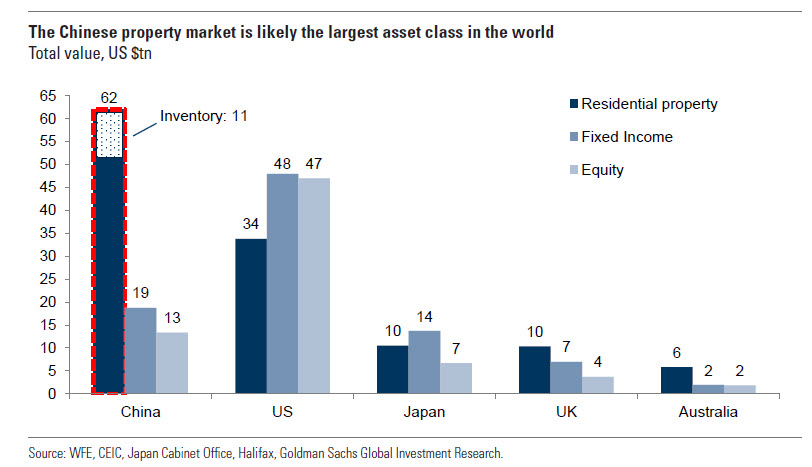
One story that has dropped from the headlines is China's property market, in part because the government has ordered the banks to open the nozzle on the liquidity fire hose. I think the official numbers are up to around $200 billion. But that's not even the amount of China Evergrande Group's debt ($300 billion), much less the rest of the sector, which itself is just a fraction of the total asset class which Goldman last year estimated to be the largest in the world at $62 trillion (but deflating fast)

https://pbs.twimg.com/media/FBNmpi-WYAE3DHs?format=jpg&name=900x900 

What if the required rescue is 10 times the amount officially reported as being injected?

China would run into the same dilemma the U.S. faced when injecting $5 - 6 trillion into the American economy: If the powers-that-be allowed the economy to remain open as the liquidity poured in the resulting inflation would have been 40 -50% and would have hit the population within weeks. In China's case the rioting would have made the current protests look look like a convivial, collegial discussion group.

The lockdowns allowed the U.S. to bleed the inflation into the economy at a reduced rate, CPI is up 14% since January 2021, effectively deflating the Federal debt by a like amount or $4.2 trillion, equal to around 2/3 of the 2020 -2021 spending and liquidity injections.

The Chinese "zero covid" lockdowns make no sense from a public health standpoint and as one of my favorite China experts says, "Chinese are very smart people, there must be something else going on that you roundeyes don't see. And then he laughs when I tell him he is a racist.

On the other hand here is the causality as usually presented, from Time Magazine, December 1:

China’s Zero-COVID Trap

Protesters in China have demanded an end to the country’s draconian zero-COVID policy—a pandemic prevention strategy that President Xi Jinping claims has kept his people safer than less stringent measures taken by other nations—as the suffering it’s wrought is becoming increasingly unbearable.

Experts have said it’s unlikely the government will outright end zero-COVID anytime soon, though it may continue to tweak the policy. But even if Xi wanted to ditch the strategy altogether, as some localities are reportedly starting to do, that could bring about even more misery.

Zero-COVID—defined by city-wide lockdowns, mass testing, and enforced quarantines—was once a paragon of the containment approach toward the coronavirus pandemic. To this day, Johns Hopkins University data shows China to have the lowest COVID-19-related deaths per capita worldwide. The country’s death toll, according to the World Health Organization, is only at 30,205, compared to the more than a million deaths in the United States—though questions have been raised about the accuracy of China’s official data reports.

Over nearly three years, however, the same measures meant to protect China and its people have also exacted a devastating toll. Residents in some areas have found themselves scrambling for food and other resources, and others have blamed zero-COVID for deadly delays in emergency responses. Mental health in the country has plummeted, while the economic fallout, domestically and globally, continues to grow....

....MUCH MORE

If we can believe the 30,205 deaths number, we can probably believe the liquidity injections numbers. 

If not, not.

And the headliner, from Asia Times....

And at least one hundred more posts, it has been, along with the hyper-Pareto distribution of profits in the West, one of our guiding principles of investing in the 2020's.  

Okay Serbia, You're Next: "Russia harshly criticizes US attack on Venezuela, capture of Maduro"

Among the groups most affected by President Maduro's change of address, besides his backers in Venezuela and the U.S., are the governments of Iran, Cuba, China and Russia with the latter being the biggest loser.

From The Hill, January 4: 

Russia is offering stark criticism of the U.S. military attack on Venezuela, which resulted in the capture of Venezuelan President Nicolás Maduro.

In response, Russia called for a full meeting of the United Nations Security Council.

“This morning, the United States carried out an act of armed aggression against Venezuela. This causes deep concern and condemnation,” Russia said in a statement from its Foreign Ministry.

“The pretexts cited to justify such actions are unfounded. Ideologized hostility has prevailed over practical pragmatism and over a willingness to build relations based on trust and predictability,” Russian officials wrote, nearly five years into the nation’s own war in Ukraine.

Russia, a key ally of the Maduro regime, said it was crucial to “prevent further escalation and to focus on finding a way out through dialogue.”

“We proceed from the understanding that all parties who may have claims against one another should seek solutions through dialogue-based approaches. We are ready to support them in this,” the ministry said.

“Latin America must remain a zone of peace, as it declared itself in 2014. Venezuela must be guaranteed the right to determine its own destiny without any destructive, especially military, interference from outside,” it wrote. “We reaffirm our solidarity with the Venezuelan people and our support for the course of its Bolivarian leadership aimed at defending the country’s national interests and sovereignty.”

Russia said its embassy in Caracas, Venezuela’s capital city, was operating normally and that it had no information about Russian citizens having been injured.

Attorney General Pam Bondi says Maduro has been charged with “Narco-Terrorism Conspiracy, Cocaine Importation Conspiracy, Possession of Machine guns and Destructive Devices, and Conspiracy to Possess Machine guns and Destructive Devices against the United States.”

“They will soon face the full wrath of American justice on American soil in American courts,” Bondi added in a post on the social platform X.

Maduro had been in power in Venezuela since 2013. The Venezuelan communications ministry said in a statement that he had signed a declaration of emergency urging “all social and political forces” in the country to “activate mobilization plans and repudiate” the attack from the U.S....

....MUCH MORE 

There is a possible connection between Serbia and Venezuela beyond both being best buddies with the Russians but I won't pull on that string yet, it may turn out to be an hallucination. So for the moment I'll just relay some of the recent stories out of the Balkans:

From Poland's TVP World television, December 29:

Serbia’s student protests escalate political crisis, renew calls for early elections 

Serbia is once again witnessing a surge of civic mobilization, as student-led protests push the country’s long-running political crisis into a new phase.

Demonstrators have begun collecting signatures demanding early parliamentary elections, framing their movement not as a partisan effort but as a struggle over democratic values, accountability and the rule of law. 

Speaking on TVP World’s World Talks, Nataša Vučković, director of the Center for Democracy Foundation and a former Serbian member of parliament, said the protests reflect a “very large discontent with the present government” that extends well beyond traditional opposition politics....

....MUCH MORE 

From Saint Petersburg's Oreanda-News, January 2:

The Russian ambassador called the signs of a color revolution in Serbia 

Signs of a color revolution and an externally supported attempt to change power in Serbia are obvious given the complex composition of the protest movement, Russian Ambassador to Serbia Alexander Botan-Kharchenko said in an interview with RIA Novosti.

"There are internal issues, some of the participants who joined the protests, who are dissatisfied with certain aspects, the conditions of their existence, and so on. There are really people who are very empathetic, sympathetic," the Russian diplomat noted.

He recalled that the starting point of the protests was the tragedy in Novi Sad, the collapse of the canopy at the railway station on November 1, 2024.

"But a lot of this protest movement, its organization, launch and maintenance in an intensive state, and there were also moments when it was possible to speak about a very large scale, is connected with external support. Yes, this is one of the options, let's say so, to promote the color revolution in Serbia, which we also discussed, let me remind you, with the aim of changing the government, changing specific people in power, President (Alexander) Vucic," said the head of the Russian diplomatic mission.

Protests by students and the opposition began in 2024 in Serbia after the collapse of a canopy at the railway station in Novi Sad....

....MUCH MORE 

Finally, I don't think NATO is going to bomb Serbia (and the Chinese embassy) again but you never know. From a January 2024 post:

...The 78 day NATO bombathon of Yugoslavia  that started on March 24, 1999 was a pretty big deal, at least for the people under the rubble. I admit I was a bit distracted by the historic 1995 - 2000 run in the Nasdaq and didn't see pictures like this at the time:

https://libertarianinstitute.org/wp-content/uploads/2019/08/hqdefault.jpg

Electricity: "How AI Labs Are Solving the Power Crisis: The Onsite Gas Deep Dive"

From SemiAnalysis, December 30:

Bring Your Own Generation, Sayonara Electric Grid, Turbines vs. Recips. vs. Fuel Cells, Why Not Build More CCGTs?, Onsite Power TCO 

The Grid is Old and Tired

Nearly two years ago, we were the first to predict a looming power crunch. In our report AI Datacenter Energy Dilemma - Race for AI Datacenter Space, we forecasted AI Power Demand in the US to grow from ~3GW in 2023 to over 28GW by 2026 – a pressure that would overwhelm America’s supply chains. Our prediction proved very accurate.

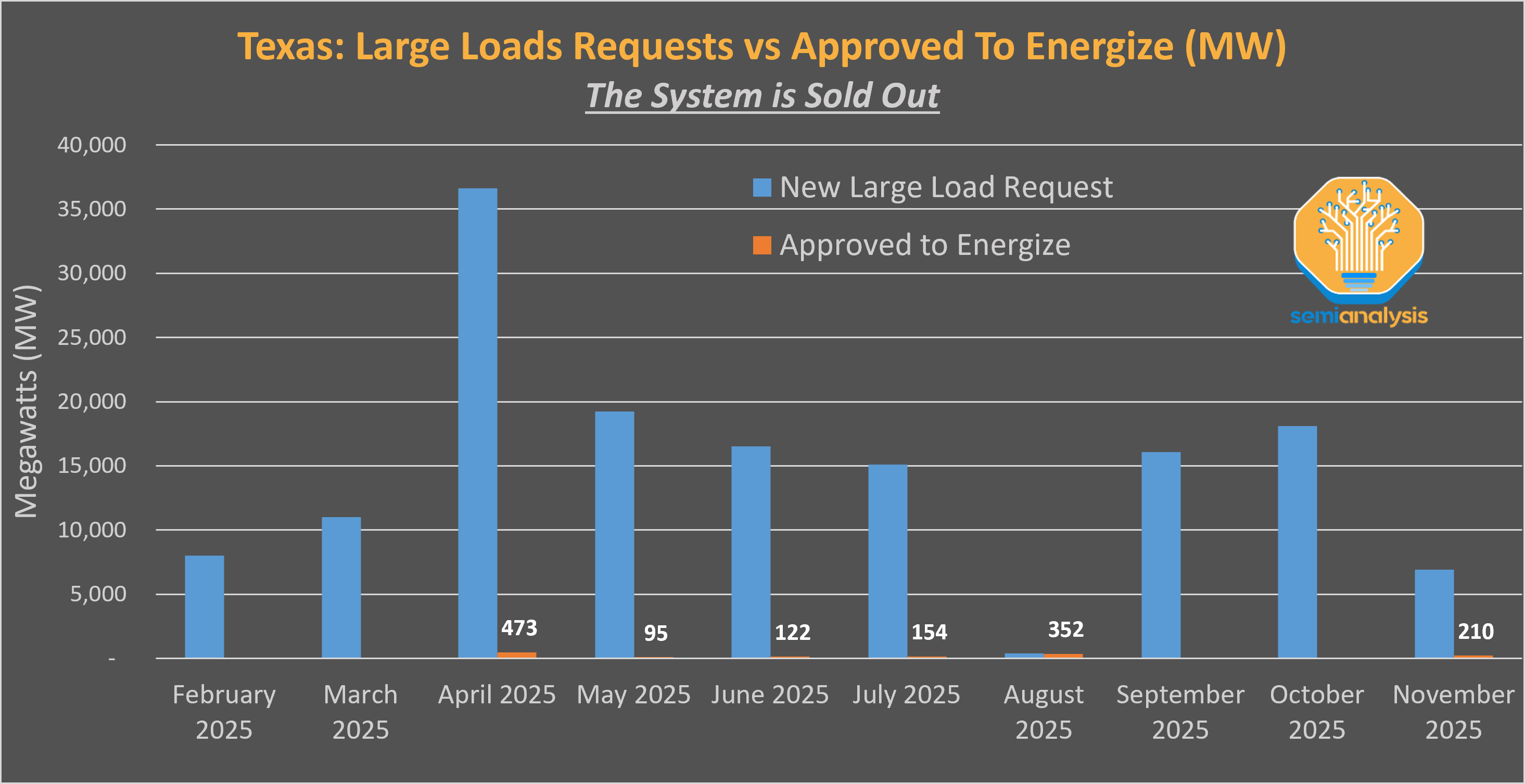
The chart below tells the story: in Texas alone, tens of gigawatts of datacenter load requests pour in each month. Yet in the past 12 months, barely more than a gigawatt has been approved. The grid is sold out.

https://substackcdn.com/image/fetch/$s_!U377!,f_auto,q_auto:good,fl_progressive:steep/https%3A%2F%2Fsubstack-post-media.s3.amazonaws.com%2Fpublic%2Fimages%2Fe566cdd5-3ecc-4023-8fd5-a4c8f47f777d_2930x1507.png 

Source: ERCOT 2024 Large Flexible Load Task Force (LFLTF)

However, AI infrastructure cannot wait for the grid’s multiyear transmission upgrades. An AI cloud can generate revenue of $10-12 billion dollars per gigawatt, annually. Getting a 400 MW datacenter online even six months earlier is worth billions. Economic need dwarfs problems like an overloaded electric grid. The industry is already searching for new solutions.

Eighteen months ago, Elon Musk shocked the datacenter industry by building a 100,000-GPU cluster in four months. Multiple innovations enabled this incredible achievement, but the energy strategy was the most impressive. xAI entirely bypassed the grid and generated power onsite, using truck-mounted gas turbines and engines. As shown below, xAI has already deployed over 500MW of turbines near its datacenters. In a world where AI Labs are racing to be first with a Gigawatt datacenter, speed is the moat.

https://substackcdn.com/image/fetch/$s_!hlM-!,f_auto,q_auto:good,fl_progressive:steep/https%3A%2F%2Fsubstack-post-media.s3.amazonaws.com%2Fpublic%2Fimages%2Fb467823e-102f-47aa-97ec-e1d399f8f77b_1024x555.jpeg  

Source: SemiAnalysis Datacenter Industry Model 

One by one, hyperscalers and AI Labs are following suit and temporarily abandoning the grid to build their own onsite power plant. As we discussed months ago in the Datacenter Model, in October 2025, OpenAI and Oracle placed the largest order ever for onsite gas generation, with a 2.3GW plant in Texas. The market for onsite gas generation is entering an era of triple-digit growth annual growth.

The beneficiaries extend far beyond the usual suspects. Yes, GE Vernova and Siemens Energy have seen their stocks surge. But we’re witnessing an unprecedented wave of new entrants, such as:

To understand growth and market share by supplier, we built a building-by-building tracker of sites deploying onsite gas in our Datacenter Model. The results surprised us: 12 different suppliers have now secured >400 MW of datacenter orders each in the US alone, for onsite gas generation....

....MUCH MORE 

Previously from SemiAnalysis:

October 8, 2024 - Chips and Data Centers: "AI Neocloud Playbook and Anatomy"

February 7 2025 - SemiAnalysis: "DeepSeek Debates: Chinese Leadership On Cost, True Training Cost, Closed Model Margin Impacts"

March 19 - "NVIDIA GTC 2025 – Built For Reasoning, Vera Rubin, Kyber, CPO, Dynamo Inference, Jensen Math, Feynman" (NVDA)

March 29 - "America Is Missing The New Labor Economy – Robotics Part 1"

July 13 - ZuckAI: "Meta Superintelligence – Leadership Compute, Talent, and Data" (META)

September 22 - Elon Musk's "xAI’s Colossus 2 – First Gigawatt Datacenter In The World, Unique RL Methodology, Capital Raise"

November 14 - "Microsoft's AI Strategy Deconstructed - From Energy to Tokens" (MSFT)

December 14 - Chips: "AWS Trainium3 Deep Dive | A Potential Challenger Approaching" (AMZN; NVDA)

"The End of History and The Return to Geopolitics"

I'm not sure why Stanford keeps Francis "the end of history..." Fukuyama around and that goes double for Paul Ehrlich* but it's their money and their reputation and since Stanford has a lot of each I suppose they can afford to squander a bit.

From Modern Diplomacy, July 23, 2025:

Fukuyama’s triumphalist “end of history” now reads as a cautionary tale, as we reach the limits of the democratic-neoliberal order and confront the return of geopolitics in an increasingly unstable, multipolar world. 

In his 1992 book The End of History and the Last Man, Francis Fukuyama put forward one of the most challenging and enduring hypotheses in the International Relations corpus. A puzzle seemingly naïve and optimistic in the face of the unshakable aura of a serious and Realist tradition—already scarred by the three major conflict of the 20th century—yet annoyingly pertinent, as the unexpected fall of the Soviet Union and the ascendancy of the Western liberal democratic order seemed to herald the natural Long Peace after humanity’s most violent moment.

When the end of accumulated chaos after the Cold War brought with it the newfound certainty about the conclusion of enduring human struggle, it also planted the expectation of its return.

For the proponents of Fukuyama’s hypothesis, this counterfactual unipolar moment could be seen as a linear progression, sustained by the triad of democracy, trade, and interdependence. For others, it signaled a reminder of our captivity to history and a prelude to the eventual end of the current world order. However, the return of history does not mean its strict repetition. While optimistic views tend to deny the possibility of the emergence of new threats and strongly believe that international relations are conducive to peace and tranquility, pessimistic views suggest the return to a period similar to that of Europe between the World Wars.

Today’s so-called “return to power politics” does not resemble a German-style rise to systemic confrontation, but rather marks a shift away from the U.S.-led Western status quo. The international system, as constructed after the Second World War, has become almost unrecognizable today, owing to the rise of emerging powers, the historic transfer of relative wealth and economic influence from West to East, increasing globalization, transnational forces, and the narrowing gap in power differentials between states.

The failure of the “end of history” thesis stems from two key assumptions: (1) the necessity of a globally adopted democratic order, and (2) the universal acceptance of liberalism as the foundation for human theodicy:

Failure of the  Democratic Order

For Fukuyama’s hypothesis to hold, democracy and liberalism would have needed to spread universally, to every country. Yet, this convergence has not occurred. Some states, like China, have embraced aspects of economic liberalism without adopting democratic governance, showing that the liberal-democratic pairing is neither natural nor inevitable.

Even where liberal democracy has spread, it has not consistently demonstrated its superiority. In recent decades, some authoritarian regimes have outperformed democracies in areas such as economic development, social cohesion, and crisis management, challenging the assumption that liberal democracy is the most effective or desirable model. This performance gap has become particularly evident in response to social crises. The COVID-19 pandemic, for instance, exposed how certain authoritarian systems could act more decisively and effectively in times of global emergency. As the world grapples with increasing transnational crises—climate change, resource competition, pandemics, cyber threats, migration—resilience and adaptability may matter more than regime type alone.

Failure of the Liberal Ideal

The “end of history” rationale implies the need for a common ground in defining what is good or evil—a kind of universal theodicy. First, in relation to the democratic-liberal system, the hypothesis that “democracies do not go to war with one another” requires that all inter-state relations be dyadic and democratic. Empirical evidence shows that democracies frequently engage in conflict with non-democracies. U.S. interventions in Iraq, Kuwait, and elsewhere serve as clear examples that being democratic does not guarantee pacifism. This suggests that unless every state becomes democratic, the conditions necessary to prevent war remain unfulfilled. Second, the notion of a political theodicy—the belief that liberalism represents a universally accepted moral endpoint—presumes a consensus beyond foundational political disagreements. It assumes a shared framework for determining the lesser evil in decision-making, balancing what is disagreeable with what is disastrous. But political judgment is inherently shaped by context, trade-offs, and power struggles that are deeply specific to each society. Envisioning a politics free of conflict or power is as unrealistic as expecting global unity under one religion or moral code.

Failure of the Western Neo-Liberal Democratic Order

The exportation of democracy and regime change in authoritarian countries has only strengthened nationalist tendencies and fueled resentment toward Western intervention. For example, framed as democracy promotion, the 2003 U.S. invasion of Iraq and the 2011 NATO intervention in Libya, instead of fostering peace, fueled anti-Western sentiment, destabilized regions, and reinforced norms of self-determination and sovereignty. In response, countries like Russia and China have increasingly advocated for non-intervention, emphasizing national sovereignty. Russia’s 2014 annexation of Crimea and the rise of global nationalist movements further demonstrated the backlash against foreign interference.

In parallel, transnational organizations, once key pillars for maintaining peace, have expanded their memberships but gradually lost relevance in interventions and peace settlements as the Global South rises in power, undermining their legitimacy. Many international organizations, along with the states backing them, have seen their credibility and legitimacy eroded. These organizations now often serve symbolic roles in conflict management, lacking a firm commitment to the rule of law and undermining the normative principles they once upheld. In Northern countries, the widening decision-making powers of these institutions over national governments have triggered political and social instability within liberal states (e.g., the European Union). As a result, national identity and sovereignty have once again become dominant political and social values. The growing extremes in political regimes and the lack of political stability have further fractured the international order, with far-right and far-left parties complicating internal stability and hindering international cooperation....

....MUCH MORE 

Related December 30-"US-Indonesia minerals deal points to new global trade era"

December 17 - Great Powers: "What if everyone loses?"


When is science not science? When it's done by Paul -Population Bomb- Ehrlich.

"In ten years all important animal life in the sea will be extinct. Large areas of coastline will have to be evacuated because of the stench of dead fish." Paul Ehrlich, Earth Day 1970
The guy would be an embarrassment a third rate college much less to Stanford of all places.
"I would take even money that England will not exist in the year 2000." (1969)

"Before 1985, mankind will enter a genuine age of scarcity . . . in which the accessible supplies of many key minerals will be facing depletion." (1976)
May 2013 
Last month I tangentially mentioned Paul Ehrlich:
See also: the spectacularly wrong and wrong-headed forecasts made by Paul Ehrlich for which he has been rewarded with an endowed chair at Stanford-definitely a mark against Stanford.
And fully intended to gather some of his wrong-beyond-wrong predictions.
I forgot.
I'll get around to a full post on his doom-mongering but for now here are a couple of his comments on India:

"I don't see how India could possibly feed two hundred million more people by 1980."
-Population Bomb, 1968 

"I have yet to meet anyone familiar with the situation who thinks that India 
will be self-sufficient in food by 1971." 
-Population Bomb, 1968

In the book's 1971 edition, the latter prediction was removed, green revolution and all that.
The World Bank estimates India's population was 511 million in January 1968.
India is feeding 700 million more people than when Ehrlich wrote his 200 mil. line.
Meet M.S. Swaminathan and his students.

There are many, many more examples but for now, you get the point.

"Commodities: 'The Case for Human Ingenuity'":

“When you buy commodities, you’re selling human ingenuity.”
Dylan Grice on why investing in commodities for the long run is a bad idea (SocGen Cross Asset Research, December 2010)

"A Guide for Knaves, Fools, Harlots, Cuckolds, Drunkards, Liars, Thieves, and Braggarts"

 From the New York Times, November 26, 2018:

Manspreading, Renaissance-Style: 2 Experts Weigh In on Etiquette of Centuries Past

https://static01.nyt.com/images/2018/12/02/books/review/02BECKER-COMBO1/02BECKER-COMBO1-superJumbo.jpg?quality=75&auto=webp 

The sign of the cuckold (left) and the “filip,” a gesture likely to cause great offense. 

HOW TO BEHAVE BADLY IN ELIZABETHAN ENGLAND
A Guide for Knaves, Fools, Harlots, Cuckolds, Drunkards, Liars, Thieves, and Braggarts
By Ruth Goodman
314 pp. Liveright Publishing. $28.95.

WHAT WOULD MRS. ASTOR DO?

The Essential Guide to the Manners and Mores of the Gilded Age
By Cecelia Tichi
303 pp. Washington Mews/New York University Press. $24.95.

“Anyone who has ever tried to learn a new language knows that it is the rude words that somehow stick in the memory.”

Oh, how I wish Ruth Goodman could be my French tutor. But settling in for one of her history lessons is better than second best. Especially since her latest book is based on the theory that “bad behavior can be so much more illuminating than the world of the respectable conformist.” And if you don’t believe her, another new etiquette guide, by Cecelia Tichi, has just turned up, offering further proof that sliding around the naughty edges of society can be as informative as it is entertaining.

The historical periods Goodman and Tichi describe in “How to Behave Badly in Elizabethan England” and “What Would Mrs. Astor Do?” are separated by several centuries and a very large ocean, but each turns out to be deeply hierarchical, conspicuously consuming and obsessed with what the neighbors might think. And each has nurtured some apparently timeless human foibles. Although 21st-century Americans aren’t likely to be hauled into court, as some 16th-century Britons were, for deploying a pungent epithet like “a turd in your teeth” or engaging in the criminal offense of “scolding,” Goodman need hardly remind us that “manners, power and insult are intricately linked.”

As its subtitle suggests, Goodman’s book — complete with extensive chapters on rude gestures, disgusting habits and outright violence — is the more intimately in-your-face volume. This will come as no surprise to readers of her previous books, “How to Be a Victorian” and “How to Be a Tudor,” or to fans of her rambunctious BBC historical re-enactments, most notably “Tudor Monastery Farm,” in which she experienced the full-on drudgery and muck of being a medieval peasant. Tichi, who teaches American studies and English at Vanderbilt, adopts a more detached approach to the Old Money-Robber Baron clashes that shaped our country at the turn of the 20th century. But you can sense the delight she takes, after laying out some of the rigid proscriptions that ruled New York society (“A lady will not cross a ballroom unattended”; “A lady never sits in the aisle seat if she is with a gentleman”), in pointing out that even a snob like Caroline Astor (“I have never entertained a foreigner in my life unless he comes to me with a letter of introduction”) had to adjust her standards to accommodate her own daughter’s divorce. 

https://static01.nyt.com/images/2018/12/02/books/review/02BECKER-COMBO2/02BECKER-COMBO2-superJumbo.jpg?quality=75&auto=webp 

The “fig of Spain” (left), which could provoke a fight, and the wagging figure, 
a feminine gesture of reproof.

Although Elizabeth I ruled Britain’s aristocracy as Mrs. Astor aimed to rule her Four Hundred, the realms they inhabited were dominated by men — and men, all the way down the social ladder, were sticklers for maintaining a proper pecking order. Goodman spends many pages attempting to master the techniques for a staggering number of bows and styles of walking that could, if deployed ineptly, result in sniggering at best and ostracism at worst. In some cases, they simply appeared weird: “The high fashion walk of the 1620s gent” — which, she explains, was adapted to accommodate that period’s extremely wide-topped boots — “made him look like he was suffering from the advanced stages of venereal disease.”

Goodman is pleased to identify elbowing as the Renaissance counterpart of manspreading and wonders if our own urban gang culture can illuminate that earlier era’s “urgent need for visible respect.” You might, though, have a moment of doubt when she goes on to describe one of 17th-century London’s notorious menaces, a group of upper-class louts who took their name from a Latin poem by Virgil. Or when she introduces a rampaging band of soldiers from a slightly later period whose depredations included forcing women to do their laundry.

Gilded Age men had fewer sartorial and social restrictions, as long as they maintained a certain facade. Mr. Astor’s yacht was reportedly the scene of wild parties, but his wife, who never set foot on it, merely dismissed inquiries with a blithe “The sea air is so good for him.” Yet even a kingpin could outplay his hand, as evidenced by Tichi’s account of the exploits of the newspaper heir James Gordon Bennett Jr., with whom, she remarks, “nothing quiet was ever associated.”....

....MUCH MORE 

Saturday, January 3, 2026

"Science in 2050: the future breakthroughs that will shape our world — and beyond"

From the journal Nature, December 30, 2025:

Nuclear fusion. People on Mars. Artificial general intelligence. These are just some of the advances that could come by the mid-century mark.  

The Roman sage Marcus Aurelius said we should never let the future disturb us. But then he never had a conversation with the futurologist Nick Bostrom about the state of the world in 2050.
“There’s a good likelihood that by 2050, all scientific research will be done by superintelligent AI rather than human researchers,” Bostrom said in an e-mail. “Some humans might do science as a hobby, but they wouldn’t be making any useful contributions.”
Time to rethink your career options, Nature readers!
To adapt a cliché about computer models, predictions of the future are usually wrong, but some are interesting. And Nature has a long history of seeking stimulation in forecasts, projections and auguries about how research might unfold in the coming decades. Most notably, the journal marked the end of the twentieth century and the onset of the twenty-first with supplements dedicated to scientific soothsaying, and a bold prediction, from then-editor Philip Campbell, that life based on something other than DNA would be discovered by 2100. (It was a statement he called foolish then, but stands by today.)
So, with peer review suspended and Nature’s stated aim of discussing the “interpretation of topical and coming trends” firmly underlined, let’s set the controls of our (stubbornly still undiscovered) time machine for 2050 and take a cautious peek outside. Prepare for technological leaps, solving the puzzle of dark matter and perhaps being able to study enough people to wave goodbye to many diseases.
Hot times
You should probably brace yourself before opening the door. “It will be worse than we had anticipated in terms of climate change,” says Guy Brasseur, a modeller at the Max Planck Institute for Meteorology in Hamburg, Germany.
The world will have barrelled past the crucial threshold of 2 °C of average warming above pre-industrial levels by 2040, he suggests. (To avoid that, given the inertia in the climate system, the International Panel on Climate Change says that global emissions needed to peak in 2025 and then decline sharply; see go.nature.com/4prom5j.) So, by 2050, political debate on the reality of a warming world could have melted with the glaciers.
Arguments might rage instead about whether or not to try to cool the planet, most probably by injecting shiny particles into the upper atmosphere that keep sunlight from hitting the surface. Although this geoengineering technique is unproven and untested at significant scale, severe climate impacts by 2050 could encourage an affected nation or even a company to stage such an atmospheric intervention.
“You could have some countries that are using it unilaterally,” Brasseur says, “just thinking that it will solve their problem without looking at the consequence for others.” The intervention could change rainfall patterns and disrupt other aspects of the weather, perhaps making the situation even worse. “I think it should be forbidden,” Brasseur says.
Geopolitical tensions mean that forecasts of future climate to 2050 must increasingly account for more than atmospheric physics, Brasseur and his colleagues pointed out in a 2025 study1. A decade ago, climate scientists were celebrating global recognition of climate change with the Paris agreement. Today, those in the United States are being forced to delete the term from government reports and websites. Meanwhile, other priorities have taken over.
“If we talk about climate science, people just don’t want to hear about it because they’re much more scared by other issues. They want food, they want peace,” he says. All of that points to the world in 2050 facing the prospect of 3 °C or more of warming by the end of the century.
Here’s another, more optimistic, option. By 2050, removing carbon dioxide from the air could become such a business opportunity that companies find ways to draw down the circulating greenhouse gas and turn a profit in doing so.
“We will make different stuff from carbon dioxide,” says Elina Hiltunen, a futures researcher at the National Defence University in Helsinki. “It could be plastics or fuels or medication. But they are all manufactured from air.”
Future shock
The vast gulf between these two possible scenarios illustrates the dilemma for futurologists and others who try to map progress and pitfalls beyond the next election cycle. How much can the future be projected from current trends? To what extent will it be driven by disruptive events and inventions that seem unlikely or haven’t been conceived yet? And at which point do predictions become, well, just a bit silly?
Futurology — the systematic, interdisciplinary study of future trends — is best placed to imagine a time 10—15 years away, suggests Richard Watson, co-author of The Children’s Book of the Future (2024) and a former futurist in residence at Imperial College London and the University of Cambridge, UK.
“Under five years, you just get the gravitational pull of the present and you end up talking about next Tuesday,” he says. “Over about 20 years, it gets very sci-fi very quickly. I’ve run workshops for banks, and the minute you go to the 2050s you invariably get aliens living on the moon.”
Still, 2050 is a prominent timestamp and a seductive deadline for those who want to set goals and steer investment to reach them. Space agencies, for example, routinely plan that far ahead because it can take a couple of decades for missions to be conceived, approved, designed, built and launched.
The European Space Agency, for one, has already canvassed the research community for ideas for projects for 2050. Submissions include an orbiting antimatter detector, bringing frozen samples of a comet’s icy body back to Earth and landing a robot explorer on the surface of Mercury.
Then there’s Mars. US President Donald Trump restated a goal earlier this year for NASA to send humans to Mars well before 2050, whereas Elon Musk has claimed that his company SpaceX could send an uncrewed starship to the red planet as soon as 2026, as part of a plan to send people there in the 2030s.
Emilia Javorsky, director of the Futures Program at the Future of Life Institute, a think tank in Campbell, California, that analyses transformative technologies, is sceptical about people making that trip, given the risks of space radiation and the long-term impacts of microgravity.
“This is a field that’s driven predominantly by engineers, aerospace engineers, mechanical engineers that greatly underestimate the biological challenges,” she says. “Everyone assumes that we’ll find some material, some way to sort of hack ourselves out of it.”
Rise of the machines
Any vision of the future has to try to account for the continuing ascent of artificial intelligence. But at what pace?
“I could give you a relatively good view of what AI will look like in 2027, 2028. But I don’t know if I can be confident about where we’d be in 2030,” says Alex Ayad, co-founder of the London research and foresight company Outsmart Insight.
The picture beyond then is even fuzzier, but some in the AI field argue that by 2050, a machine-learning system could do science worthy of a Nobel prize....
....MUCH MORE 

As noted in October 2025, introducing the Nobel prize article:

"Will AI ever win its own Nobel? Some predict a prize-worthy science discovery soon"
I don't see why not, especially the Peace or Literature prizes. Throw in the Econ. thingamajig and I'd take even odds over a forty-year time frame.

I mean the darn things are already at the level where they are asking to open margin accounts.... 

And if one is so inclined, we have a few dozen posts on Mr. Bostrom to peruse:

https://climateerinvest.blogspot.com/search?q=Nick+Bostrom

"Interludes of Abundance"

From New Left Review, no. 155, September - October 2025:

Arnaud Orain, Le monde confisqué. Essai sur le capitalisme de la finitude (XVIe–XXIe siècle)
Éditions Flammarion: Paris 2025
368 pp, 978 2 0804 6657 0

It has become a truism among Anglophone commentators that the world is in the grip of ‘geoeconomics’, the pursuit of geopolitical ends by economic means. In September 2024, Mario Draghi’s report on the future of the European Union spoke of the need for Brussels to ‘act as one country with a single geoeconomic strategy’. In January 2025, the outgoing Biden Administration’s national security team recommended that the United States prepare itself for a ‘new era of geoeconomic competition’. In July, an essay by the Financial Times columnist Gillian Tett declared the start of ‘the new age of geoeconomics’. When the strategist Edward Luttwak coined the term in The National Interest at the end of the Cold War, he expected military conflict between states to ebb away; instead of armed confrontation, countries would compete via their multinationals, vying for market share and technological leadership. Great power clashes would give way to a sublimated commercial rivalry.

But geopolitical conflict has not withered way. From Ethiopia to Myanmar, Ukraine to Gaza, Nagorno-Karabakh to Sudan, open war is proliferating to a degree not seen in decades. The current ‘geoeconomic’ turn entails not the diversion of conflict so much as its expansion into domains hitherto protected from it. Kinetic war and economic war are now advancing side by side. Intensified great power competition has stretched and broken the norms of neoliberal economic policy: the pieties of free-market globalism are being displaced by antagonistic inter-state conduct and an upsurge in coercive economic measures such as sanctions, export controls and tariffs. To be sure, capitalism and its drive to maximize private profit are firmly intact. But states and corporations are pursuing their objectives through ever more assertive political methods. What is novel is that such antagonisms are playing out in a world economy that has reached historically high levels of commercial, financial and technological integration.

Many Western officials describe geoeconomics as a new domain of policy. But since no country has added more instruments to the arsenal of economic coercion than the United States, it must be asked if the proliferation of such practices is not changing the broader structure of international exchange. Washington’s sidelining of the neoliberal architecture of global governance, coupled with the growth of Chinese power and Russian territorial revisionism, suggest that ‘geoeconomics’ is not merely a novel dimension of policy, but the vocabulary through which technocrats are registering a deeper and broader change in the dominant political logic of the world economy. Political leaders and think tankers have rushed to embrace Luttwak’s old rubric to describe a new reality in the international system, one whose emergence they are only partially in control of—private capital is also strongly implicated in it.

Yet besides denoting the vague sense of a paradigm shift, ‘geoeconomics’ is an amorphous term, used in widely varying ways. Little intellectual consensus exists in the commentariat or the academy about how to characterize the ongoing transformation to which it gestures. There are several possibilities. One option, popular among economists such as Daron Acemoglu, is to locate the shift at the level of market organization: a move from economic globalism to economic nationalism. Geoeconomics, on this view, is a rejection of wto-style apolitical commerce and a break with the post-1970 trend towards freer trade: its focus on economic security harkens back to the protectionist projects of the fin-de-siècle and interwar periods. Others, often investors and hedge funds, portray the new dispensation as moving away from laissez-faire and towards interventionist economic policy. This casts geoeconomics as a statist revirement that is superseding neoliberalism, an ideology that itself toppled the post-war Keynesian-developmentalist consensus, which in turn arose on the ruins of an older economic liberalism that had come to grief in the dual catastrophes of 1914 and the Great Depression. Finally, political scientists and lawyers tend to render the shift as a change of ethos and personnel: from cooperative civilian understandings of global exchange to antagonistic weaponizations of such interdependence, as in Henry Farrell and Abraham Newman’s Underground Empire or Edward Fishman’s Chokepoints.

It is into this conceptual melee that a new book by the French historian and economist Arnaud Orain intervenes with a new, wider-angle formulation. Le monde confisqué is an intellectual history of geoeconomics that examines the cyclical rise, fall and return across the last five centuries of what Orain calls the ‘capitalism of finitude’. This is both a worldview and a real political-economic formation—a Blochian état d’esprit and a set of concrete practices—distinguished by the dominance of the notion that the amount of resources in the world are finite and insufficient to satisfy the needs of all humans and of every state. Orain argues this mentalité has been dominant in three discrete periods: from the early sixteenth to the late eighteenth centuries, during the six tumultuous decades from the 1880s to 1945, and from 2010 until the present.

Orain, who is director of studies at the École des Hautes Études en Sciences Sociales, was born in 1977 and educated at the École Normale Supérieure in Lyon; he defended his doctoral dissertation at Paris I Panthéon-Sorbonne on the economic thought of the philosopher-abbot Étienne Bonnot de Condillac (1714–80). His first monograph, La politique du merveilleux (2018), translated as The Politics of Utopia (2024), is a revisionist interpretation of the Mississippi Bubble, the financial-commercial experiment that destabilized Regency France from 1717 to 1721, as the Scottish economist John Law unified French colonial monopolies, created a modern central bank, introduced a paper currency and nationalized the public debt. La politique du merveilleux is a critique of the prevailing liberal understanding of the Law episode, in which his infamous Compagnie des Indes was a failed Bank of England that might have been. The book challenged conventional portrayals of Law as an economic dictator who held the fate of the Bourbon monarchy in his hands and whose failure scuppered French desires for a central bank for eight decades afterwards.

Instead, Orain argued that Law was merely the best-known figure in a wider landscape of utopian thinkers seeking to transform society through the liberation of finance and commerce under the auspices of an all-powerful, benevolent state that had socialized whole sections of the economy. The Compagnie des Indes was in fact a giant social ‘enterprise of general enrichment that had become the goal of the nation united in a body of a new and daring nature’. Its ambition was to ward off a corrosive liberalism but also to move beyond royal absolutism by elaborating visions of a ‘new Potosí’ of material plenty and sexual liberation in the New World. Orain drew attention to a large ‘carnivalesque literature of state’ that used the self-fulfilling power of expectations to overthrow the entire mindset of the society of orders that characterized the ancien régime....

....MUCH MORE