Showing posts sorted by date for query top500. Sort by relevance Show all posts

Thursday, June 18, 2026

"Nvidia Takes the Lead in Another AI Market Beyond Chips...." (NVDA)

From TipRanks, June 18:

Story Highlights

  • Nvidia became the top vendor in data center Ethernet switching for the first time.
  • IDC said Nvidia’s switching revenue jumped 193% year-over-year in the first quarter.
  • The gain shows Nvidia is expanding beyond GPUs into a larger share of AI infrastructure spending.

Nvidia is best known for its AI chips, but the company has now taken the lead in another fast-growing corner of the AI market. According to new data from market research firm IDC, Nvidia became the top vendor in data center Ethernet switching by revenue during the first quarter of 2026. The company generated $2.1 billion in switching revenue during the quarter, up 193% from a year ago, giving it a 21.5% share of the data center Ethernet switching market.

The huge win highlights how Nvidia is becoming much more than a chip supplier. As companies build larger AI systems, they need not only powerful GPUs but also high-speed networks that can connect thousands of those chips together....

....MUCH MORE

If there is any money to be made from artificial intelligence Mr. Huang seems bound-and-determined that it go to Nvidia. 

In other news, the move to optical and photonics from wires is real and accelerating.

From Nvidia's blog, June 16:

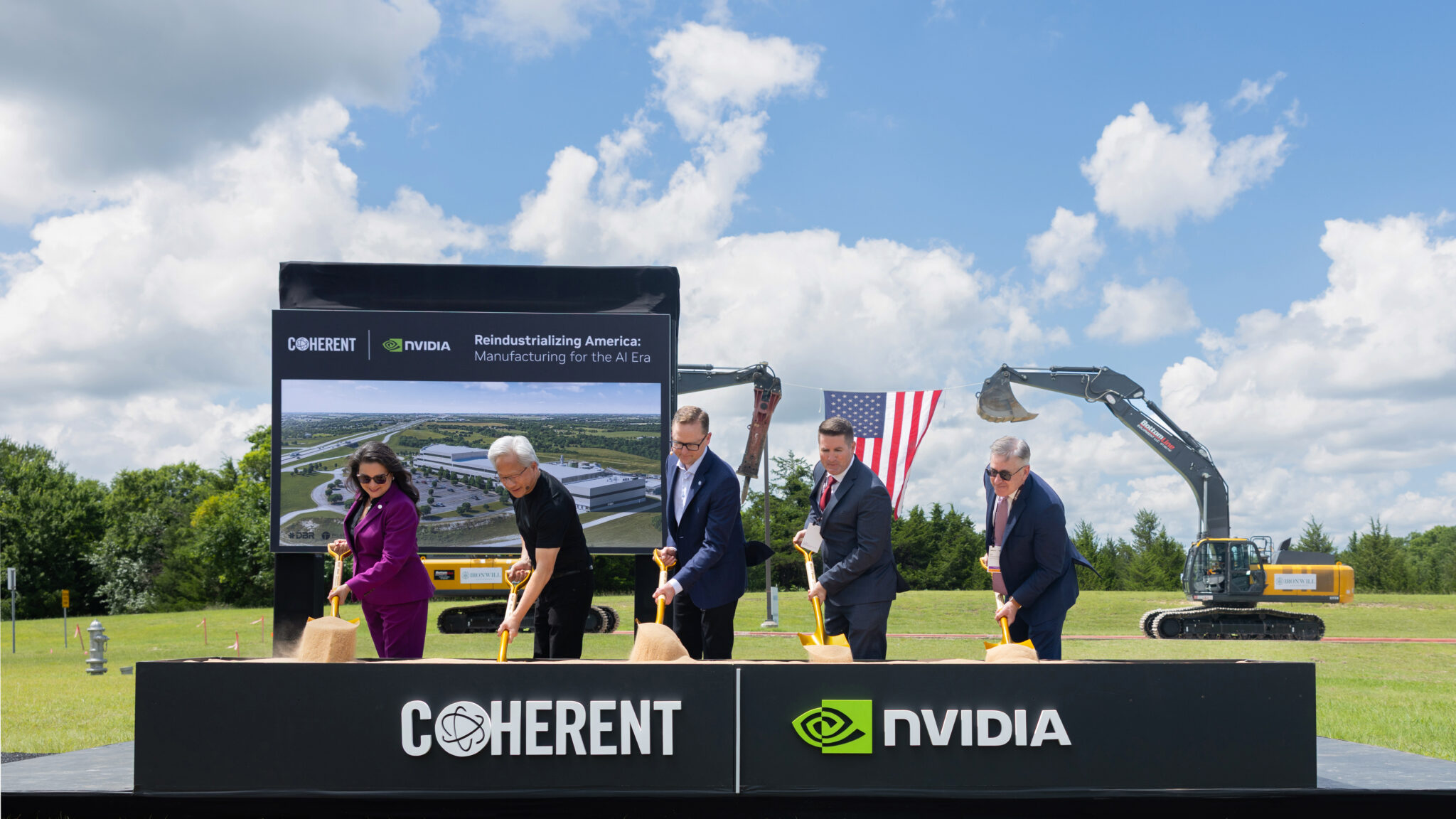
Coherent Breaks Ground on Expanded Texas Facility, Scaling AI’s Optical Backbone 
Coherent’s expansion at its Sherman, Texas, campus scales what it calls the world’s first volume production 6-inch indium phosphide fab, a key supplier across NVIDIA’s AI stack. 

AI runs at the speed of light. More and more, that light is made in Texas.

Coherent broke ground today on an expanded manufacturing building in Sherman, Texas. 

The company makes the lasers, optical components and compound semiconductors that wire AI systems together — and runs what it calls the world’s first 6-inch indium phosphide fab. 

NVIDIA founder and CEO Jensen Huang and Coherent CEO Jim Anderson were on hand for the ceremony, joined by Sherman Mayor Shawn Temann and Adriana Cruz, executive director of Texas Economic Development and Tourism, who delivered remarks.  

The expanded building will scale production of the same InP wafers that carry data between chips, servers and data centers at the speed of light — the optical backbone of modern AI infrastructure.

It’s the kind of milestone that turns a commitment into construction: a concrete step in expanding advanced semiconductor manufacturing in the United States.

“AI is the ultimate general-purpose technology,” Huang said during a conversation with Anderson at the groundbreaking. “Because intelligence is fundamental — the ability to process information, to reason and solve problems — it affects every single industry.”

Public programs like the CHIPS Act, funded at roughly $50 billion, were designed to bring chip manufacturing back to the U.S. 

As part of today’s event, Coherent is announcing a $50 million CHIPS Act grant to help finance the expanded Sherman facility — building on roughly $17 million in earlier support from the Texas CHIPS program and the Sherman Economic Development Corporation.

NVIDIA’s own commitment to produce up to $500 billion of AI infrastructure in the U.S. through industry partnerships with new sites in Arizona and Texas adds private-sector momentum....

....MUCH MORE 

Previously:

March 2 - Connecting it all together: "Nvidia to invest $4 billion in two photonics companies" (NVDA; LITE; COHR)

March 12 - FrenchTech: "Nvidia-backed startup Scintil Photonics starts testing laser chips"

March 31 - Photonics: "Nvidia Invests $2 Billion in Marvell, Announces Partnership" (MRVL; NVDA) 

April 8 - Photonics: "How Nvidia learned to embrace the light in its quest for scale" (NVDA)

And many more going back to NVLink in 2015.

As noted exiting from that March 2 post:

...This network stuff is not new. You may recall that Nvidia purchased networking gear specialist Mellanox for just under $7 billion in 2019, back when a billion was real money. 

"Connecting The Dots On Why Nvidia Is Buying Mellanox" (NVDA)

A year later we saw Mellanox InfiniBand system interconnects in five of the world's top ten fastest supercomputers. (and more than half of the Top500).

In the most recent earnings report, "NVIDIA Q4 2026 Earnings Call Transcript - February 25, 2026 (NVDA)" this was highlighted:

Networking revenue -- $11 billion for the quarter, over 3.5x year over year; full-year Networking exceeded $31 billion, up more than 10x versus fiscal 2021 (year of Mellanox acquisition [sic]). 

n.b. 2020 was the year Mellanox was integrated into NVDA, not 2021. 

Mr. Huang is not fooling around. 

Well maybe fooling around a little bit. He is a master showman/salesman and would not turn down an opportunity to do a photo op for a partner company:
https://blogs.nvidia.com/wp-content/uploads/2026/06/26tx-coherent-factory-DEB30838-DL-edit-1-scaled.jpg 

Monday, March 2, 2026

Connecting it all together: "Nvidia to invest $4 billion in two photonics companies" (NVDA; LITE; COHR)

Mr. Huang has said he wants to connect entire data centers together into one gigantic chip.

To do that you have to get latency between chips and then between servers as close to zero as possible.

From CNBC, March 2:

  • Nvidia is investing a combined $4 billion in Coherent and Lumentum, two photonics companies.
  • Each company will receive $2 billion each from the chip giant as part of the strategic investment.
  • Nvidia is investing a combined $4 billion in two companies developing photonics technologies, as it looks to shore up research pipelines and supply chains to support the major AI infrastructure buildout.

    The U.S. chip giant announced on Monday it’s investing $2 billion in Lumentum and the same amount in Coherent.

    Both companies are developing optics technology — systems which generate or transmit light and are used in functions like sensing and data transfer.

    Lumentum is a U.S.-based company that is developing optical and photonic technologies to power the networks and infrastructure behind AI, cloud computing and next-generation communications.

    Coherent, also based in the U.S., develops photonics technology, which refers to harnessing light (photons) to create components and systems that enable high-performance optical applications.

    “Together with Lumentum, NVIDIA is advancing the world’s most sophisticated silicon photonics to build the next generation of gigawatt-scale AI factories,” Jensen Huang, founder and CEO of Nvidia, said in a statement....

    ....MORE 

    A third player, Applied Optoelectronics (AAOI) is up even more than the two names in the headline.

    This network stuff is not new. You may recall that Nvidia purchased networking gear specialist Mellanox for just under $7 billion in 2019, back when a billion was real money. 

    "Connecting The Dots On Why Nvidia Is Buying Mellanox" (NVDA)

    A year later we saw Mellanox InfiniBand system interconnects in five of the world's top ten fastest supercomputers. (and more than half of the Top500).

    In the most recent earnings report, "NVIDIA Q4 2026 Earnings Call Transcript - February 25, 2026 (NVDA)" this was highlighted:

    Networking revenue -- $11 billion for the quarter, over 3.5x year over year; full-year Networking exceeded $31 billion, up more than 10x versus fiscal 2021 (year of Mellanox acquisition [sic]). 

    n.b. 2020 was the year Mellanox was integrated into NVDA, not 2021. 

    Mr. Huang is not fooling around. 

    Related, June 2024:

    Nvidia's Financial Dominance (NVDA)

    Wednesday, November 26, 2025

    "US launches Genesis Mission, training AI with government datasets to further science"

    From DatacenterDynamics, November 25:

    Will use DOE supercomputers and the cloud 

    The US White House has launched the Genesis Mission, a plan to feed scientific federal government datasets into artificial intelligence models.

    The Department of Energy (DOE)-led project is meant to create and train AI agents and scientific foundation models to speed up scientific progress.

    "We will harness for the benefit of our nation the revolution underway in computing, and build on decades of innovation in semiconductors and high-performance computing," President Donald Trump said in an executive order launching the initiative.

    "The Genesis Mission will dramatically accelerate scientific discovery, strengthen national security, secure energy dominance, enhance workforce productivity, and multiply the return on taxpayer investment into research and development, thereby furthering America’s technological dominance and global strategic leadership."

    The program will use DOE supercomputers, cloud-based AI computing environments, and other Federal computing resources.

    The order calls for the exact compute, storage, and networking resources to be made available within 90 days, including "resources available through industry partners."

    Within 120 days, the DOE Secretary is expected to identify a set of initial data and model assets, including digitization, standardization, metadata, and provenance tracking. They will also develop a plan to ingest datasets from federally funded research, other agencies, academic institutions, and approved private-sector partners.

    Then within 240 days, the Secretary will review capabilities across the DOE national laboratories and other participating Federal research facilities for robotic laboratories and production facilities "with the ability to engage in AI-directed experimentation and manufacturing, including automated and AI-augmented workflows and the related technical and operational standards needed."....

    ....MORE

    The U.S. does have some resources. 

    Way back in June 2018 we were posting "New GPU-Accelerated Supercomputers Change the Balance of Power on the TOP500". 

    Here's the top 10 of the latest Top500 list, the world's three fastest supercomputers are at Department of Energy laboratories as well as numbers 12 and 15.

    Top500 Supercomputers List, November 2025: "El Capitan retains Top500 crown as Jupiter Booster becomes Europe’s first exascale system"

    Wednesday, November 19, 2025

    Top500 Supercomputers List, November 2025: "El Capitan retains Top500 crown as Jupiter Booster becomes Europe’s first exascale system"

    From DatacenterDynamics, November 19:

    AMD and Eviden selected for Alice Recoque exascale supercomputer 

    El Capitan has retained its title as the world’s most powerful supercomputer on the most recent edition of the Top500 list, with the US Department of Energy once again operating all of the top three systems.

    However, while all the supercomputers comprising the top ten retained their positions from six months ago, the fourth-place Jupiter Booster system officially became Europe’s first exascale supercomputer, posting an HPL score of exactly one exaflops – a significant increase from the 793.4 petaflops it achieved in June.

    Housed at Germany's Forschungszentrum Jülich campus, the Jupiter Booster – a partial version of the larger supercomputer being built at the supercomputing facility – is a BullSequana XH3000 featuring Nvidia GH200 Superchips.

    El Capitan also saw an increase in its performance for the 66th edition of the list, posting a four percent gain from six months earlier for a total of 1.809 exaflops. Housed at Lawrence Livermore, the HPE Cray EX255a-based system is comprised of AMD 4th Gen Epyc 24C 1.8GHz CPUs and Instinct MI300A GPUs.

    The system is one of six HPE Cray systems to make the top ten, a list that also includes Frontier, Aurora, HPC6, Alps, and LUMI.

    Achieving 1.353 exaflops, Oak Ridge's second-place Frontier system comprises AMD 3rd Generation Epyc 64C 2GHz CPUs and Instinct MI250X GPUs, while Argonne's Cray EX-based Aurora with the Intel Exascale Compute Blade, Xeon CPU Max 9470 52C 2.4GHz, and Intel Data Center GPU Max, had an HPL score of 1.012 exaflops.

    In fifth place was Microsoft Azure's 561.2 petaflops Eagle, with Intel Xeon Platinum 8480C 48C 2GHz CPUs and Nvidia H100 GPUs, followed by the aptly named HPC6, another AMD-powered system operated by Italian oil giant Eni. The second most powerful supercomputer in Europe, HPC6, achieved 477.9 petaflops.

    Japan’s Arm-based Fugaku supercomputer ranked seventh. Built by Fujitsu for Riken, it achieved 442.01 petaflops.

    Eighth, ninth, and tenth place went to Switzerland's 434.9 petaflops Alps, Finland's 379.7 petaflops Lumi, and Italy's 241.2 petaflops Leonardo, respectively. Both Lumi and Leonardo form part of the European High-Performance Computing Joint Undertaking (EuroHPC JU) initiative.

    Alice Recoque to become third AMD-powered exascale system
    Following the release of the Top500 list, AMD and Eviden announced they would be building the Alice Recoque supercomputer, set to be Europe’s second exascale system....

    https://top500.org/ 

    Monday, October 27, 2025

    "US Department of Energy forms $1 billion supercomputer and AI partnership with AMD"

    From Reuters, October 27: 

    The U.S. has formed a $1 billion partnership with Advanced Micro Devices to construct two supercomputers that will tackle large scientific problems ranging from nuclear power to cancer treatments to national security, Energy Secretary Chris Wright and AMD CEO Lisa Su told Reuters.

    The U.S. is building the two machines to ensure the country has enough supercomputers to run increasingly complex experiments that require harnessing enormous amounts of data-crunching capability. The machines can accelerate the process of making scientific discoveries in areas the U.S. is focused on.
     
    Energy Secretary Wright said the systems would "supercharge" advances in nuclear power and fusion energy, technologies for defense and national security, and the development of drugs. Scientists and companies are trying to replicate fusion, the reaction that fuels the sun, by jamming light atoms in a plasma gas under intense heat and pressure to release massive amounts of energy. "We've made great progress, but plasmas are unstable, and we need to recreate the center of the sun on Earth," Wright told Reuters.
     
    "We're going to get just massively faster progress using the computation from these AI systems that I believe will have practical pathways to harness fusion energy in the next two or three years." Wright said the supercomputers would also help manage the U.S. arsenal of nuclear weapons and accelerate drug discovery by simulating ways to treat cancer down to the molecular level. "My hope is in the next five or eight years, we will turn most cancers, many of which today are ultimate death sentences, into manageable conditions," Wright said.
     
    The plans call for the first computer called Lux to be constructed and come online within the next six months. It will be based around AMD's MI355X artificial intelligence chips, and the design will also include central processors (CPUs) and networking chips made by AMD. The system is co-developed by AMD, Hewlett Packard Enterprise Oracle Cloud Infrastructure and Oak Ridge National Laboratory (ORNL)....
    ....MUCH MORE 
     
    Combined with today's news from QCOM Nvidia's Mr. Huang has some stuff to think about tonight:
     
    Qualcomm stock jumps 11% as company enters AI chip race, taking on Nvidia, AMD 

    Qualcomm (QCOM) shares soared more than 20% Monday before closing the day out up 11% after the company announced it is entering the data center market its new AI200 and AI250 chips and rack-scale server offerings.

    The move puts Qualcomm into direct competition with the likes of Nvidia (NVDA) and AMD (AMD), as the company seeks to stake its claim to a portion of the multibillion-dollar data center market....

    ....MUCH MORE (Yahoo Finance) 

    The U.S. National Laboratories have quite a few spots on the list of the world's fastest supercomputers. From TOP500.org, most recent semi-annual update: June 2025: 

    The 65th edition of the TOP500 showed that the El Capitan system retains the No. 1 position. With El Capitan, Frontier, and Aurora, there are now 3 Exascale systems leading the TOP500. All three are installed at Department of Energy (DOE) laboratories in the United States....

    ***** 

    Rank System Cores Rmax (PFlop/s) Rpeak (PFlop/s) Power (kW)
    1 El Capitan - HPE Cray EX255a, AMD 4th Gen EPYC 24C 1.8GHz, AMD Instinct MI300A, Slingshot-11, TOSS, HPE
    DOE/NNSA/LLNL
    United States
    11,039,616 1,742.00 2,746.38 29,581
    2 Frontier - HPE Cray EX235a, AMD Optimized 3rd Generation EPYC 64C 2GHz, AMD Instinct MI250X, Slingshot-11, HPE Cray OS, HPE
    DOE/SC/Oak Ridge National Laboratory
    United States
    9,066,176 1,353.00 2,055.72 24,607
    3 Aurora - HPE Cray EX - Intel Exascale Compute Blade, Xeon CPU Max 9470 52C 2.4GHz, Intel Data Center GPU Max, Slingshot-11, Intel
    DOE/SC/Argonne National Laboratory
    United States
    9,264,128 1,012.00 1,980.01 38,698
    4 JUPITER Booster - BullSequana XH3000, GH Superchip 72C 3GHz, NVIDIA GH200 Superchip, Quad-Rail NVIDIA InfiniBand NDR200, RedHat Enterprise Linux, EVIDEN
    EuroHPC/FZJ
    Germany
    4,801,344 793.40 930.00 13,088
    5 Eagle - Microsoft NDv5, Xeon Platinum 8480C 48C 2GHz, NVIDIA H100, NVIDIA Infiniband NDR, Microsoft Azure
    Microsoft Azure
    United States
     
    ....MUCH MORE 

    Saturday, June 28, 2025

    "How the UK is testing a radical plan to refreeze the Arctic"

    Let's hope the scientists are all familiar with Ice-9 in Vonnegut's Cat's Cradle.*

    From The Times (London & environs), June 22:

    A government-backed team will soon start running field trials to ask whether thousands of robots could be deployed to thicken and preserve polar sea ice 

    For much of his career, Dr Shaun Fitzgerald of the University of Cambridge worked on trying to cut the amount of carbon we pump into the atmosphere. Five years ago, he shifted his focus. “We’ve been talking about reducing emissions for decades,” he said. “The truth is, they’re still rising.”

    He turned his attention to something more radical. Could we, he wondered, refreeze the Arctic?

    The idea has serious backing. In June the UK’s Advanced Research and Invention Agency (Aria) — a government body created to back “ideas on the edge of what’s possible” — awarded a team led by Fitzgerald £10 million in funding.

    The money will be spent on exploring whether it might be possible to use hundreds of thousands of robots to thicken and prolong the life of a portion of the sea ice that forms each winter across the High Arctic.

    Over coffee in a common room at Cambridge’s Department of Engineering, Fitzgerald explained that the basic physics is relatively straightforward. The ethics and engineering, however, are anything but.

    The idea builds on well established knowhow. “Communities in the Arctic already build ice roads,” he said. “They drill holes, pump seawater on top and let it freeze to thicken the ice.”

    The goal in Fitzgerald’s case is not strength as such, but longevity. The only long-term solution to global warming is to stop emitting carbon. But sea ice plays an important role in regulating the planet’s temperature by reflecting some of the sun’s energy back into space.

    As global temperatures rise, the Arctic’s ice mirror is shrinking, with projections suggesting the region will, within 15 to 20 years, be entirely free of sea ice at the end of each summer. Reinforcing it, even modestly, could have a significant cooling effect, buying time to reach net zero.

    Naturally, new sea ice forms from beneath. For this new ice to grow, heat must escape upwards, through the existing ice, allowing the seawater below to cool and solidify.

    Snow, however, is an excellent insulator. When the ice has a layer of snow on it, the heat that must rise upwards is trapped, slowing the formation of new ice. If you flood the surface with seawater, the snow is washed away. Two things should now happen: the water on the surface will turn to ice and the rate of freezing below the ice should also increase.

    Preliminary experiments last year involved drilling holes through sea ice and pumping water up. This “snow flooding” produced about 25cm of new ice on the surface, and a further 25cm below. “These are encouraging results, not conclusive ones,” Fitzgerald said. “We need much better data.”

    The £10 million from Aria will fund laboratory tests, computer models and field trials. Controlled experiments will be conducted around Cambridge Bay, which lies along the Northwest Passage in the Canadian Arctic, across three winters, starting later this year.

    If all goes well, the areas treated could be extended to up to about 1 sq km per experiment site. “The goal is to gather essential real-world data to rigorously assess if this intervention warrants further consideration,” Aria has said.

    As well as tackling the engineering challenges, which include protecting equipment from temperatures that can drop below -40C, the team will assess environmental side-effects. What microbes are being brought to the surface? Is wildlife being disturbed?

    Another question concerns albedo, or the reflectivity of the Arctic surface. Snow bounces away far more solar energy than bare ice. Ice, in turn, reflects more than open ocean. There is a chance, then, that removing snow and replacing it with ice could make things worse.

    However, Fitzgerald believes that snow flooding could be done in the winter, when the Arctic is plunged into a months-long period of darkness. Since the sun is not shining, there is no solar radiation to bounce away. When the sun returns, a blanket of artificial snow could possibly be created, providing a bright insulating blanket that would slow melting during the summer.

    Another issue is whether the salty seawater pumped to the surface will make the ice melt faster in spring. Salt lowers the freezing point of water, so it might. But when ice crystals form, most of the salt gets pushed out of them. There are early signs that the salty brine that is then formed drops through the ice, creating small channels. These may help meltwater drain away in spring, leaving bright bare ice instead of pools of dark water on the surface....

    ....MUCH MORE 

    Fortunately for the taxpayers a lot of the research and modeling can be done at the University of Bristol on their fancy, newly installed supercomputer:

    Britain's Most Powerful Supercomputer And The Butterfly Effect Of Weather Modeling In the Cloud

    Great name. 
    Isambard Kingdom Brunel may be the greatest engineer of all time and the second greatest Briton of all time, trailing Winston Churchill. (Æthelred II did not make the list)....

    Top500 entry
    *
    And Ice-9? 

    Friday, June 27, 2025

    High Performance Computing: "Europe’s First Exascale Supercomputer Powers Up" (plus the Top500 list of the world's fastest computers)

    This is the big leagues in computing and they are tackling the big questions: complex-chaotic systems and our old nemesis, turbulence.

    From IEEE Spectrum, June 26:

    Debuting at No. 4 on the TOP500, JUPITER could open vast scientific vistas

    If you want to visualize the surface air flowing across every meter of the planet Earth, you need to plot nearly three trillion squares of land and sea and space. To do that you need a mind-bogglingly big calculator.

    Which is why Ioan Hadade, a computational scientist working with vast weather forecasting and climate models, is excited about the machine now online an hour down the road from his lab in Bonn, Germany. Europe’s first exascale supercomputer—called JUPITER, after a much bigger planet than our own—is nearly fully operational. It is currently running scientific programs on its formidable processors.

    JUPITER debuted at No. 4 in the June 2025 global TOP500 list of the world’s most powerful computer systems.

    It is based at the Jülich Supercomputing Center in the German Rhineland between Cologne and Aachen, running on a booster module with 5,900 accelerating compute nodes. Some 24,000-odd Nvidia Grace-Hopper superchips give JUPITER its oomph; the machine also features a universal cluster module with 1,300 nodes using Rhea1 processors, and an InfiniBand NDR network for the high-speed interconnects.

    The semi-annual TOP500 rankings are a way to engage every single element of a machine for performance. Benchmarking proves the functionality of a highly complex operation. “And now, it’s better to have some science done on the machine,” says Thomas Lippert, director of the Jülich Supercomputing Center.

    Computational Science at Scale
    As of mid-June research enterprises were on the JUPITER machine testing scientific calculations. “You need a really large machine to run this,” Hadade says. He’s referring to the Destination Earth digital twin projects he and his colleagues are part of developing at the European Center for Medium-Range Weather Forecasts....

    ....MUCH MORE 

    Here's the press release from Top500:

    News 
    El Capitan Retains Top Spot in 65th TOP500 List as Exascale Era Expands

    The 65th edition of the TOP500 showed that the El Capitan system retains the No. 1 position. With El Capitan, Frontier, and Aurora, there are now 3 Exascale systems leading the TOP500. All three are installed at Department of Energy (DOE) laboratories in the United States.

    The El Capitan system at the Lawrence Livermore National Laboratory, California, remains the No. 1 system on the TOP500. The HPE Cray EX255a system was measured with 1.742 EFlop/s on the HPL benchmark. LLNL now also submitted a measurement for the HPCG benchmark, achieving 17.41 Petaflop/s, which makes the system the new No. 1 on this ranking as well.

    El Capitan has 11,039,616 cores and is based on AMD 4th generation EPYC processors with 24 cores at 1.8 GHz and AMD Instinct MI300A accelerators. It uses the HPE Slingshot interconnect for data transfer and achieves an energy efficiency of 60.3 Gigaflops/watt. El Capitan is the 3rd system exceeding the Exaflop mark on the HPL benchmark.

    The Frontier system at the Oak Ridge National Laboratory, Tennessee, is the No. 2 system on the TOP500. Frontier has been remeasured with an HPL score of 1.353 EFlop/s.  

    Frontier is based on the HPE Cray EX235a architecture and is equipped with AMD 3rd generation EPYC 64C 2GHz processors. The system has 8,699,904 total cores and also relies on HPE Slingshot interconnect for data transfer.  

    The Aurora system at the Argonne Leadership Computing Facility, Illinois, was submitted with 1.012 EFlop/s on the HPL benchmark, which keeps it in the No. 3 spot on the TOP500. 

    Aurora is built by Intel based on the HPE Cray EX - Intel Exascale Compute Blade, which uses Intel Xeon CPU Max Series processors and Intel Data Center GPU Max Series accelerators, which communicate through HPE Slingshot interconnect.

    The JUPITER Booster system at the EuroHPC / Jülich Supercomputing Centre in Germany at No. 4 is the only new system in the TOP 10. 

    JUPITER - JU Pioneer for Innovative and Transformative Exascale Research – was announced as the first EuroHPC exascale supercomputer (see https://jupiter.fz-juelich.de). It is currently being commissioned and has achieved a preliminary HPL value of 793.4 Petaflop/s on a partial system. The system is located at the Forschungszentrum Jülich campus in Germany and is operated by the Jülich Supercomputing Centre. It is based on the Eviden’s BullSequana XH3000 direct liquid-cooled architecture.

    Here is a summary of the system in the Top 10....

    ....MUCH MORE 

    Thursday, May 29, 2025

    "Energy Dept. Unveils Supercomputer That Merges With A.I." (DELL; NVDA)

    I believe this is were we came in.

    From the New York Times, May 29: 

    The new supercomputer shows the increasing desire of government labs to adopt more technologies from commercial artificial intelligence systems.

    Scientific computing and artificial intelligence were once separate worlds, using different kinds of calculations on distinctly different hardware. But the two fields are steadily merging, as shown by a massive new machine coming to Berkeley, Calif.

    On Thursday, the Department of Energy’s laboratory near the University of California, Berkeley, said it had selected Dell Technologies to deliver its next flagship supercomputer in 2026. The system will use Nvidia chips tailored for A.I. calculations and the simulations common to energy research and other scientific fields.

    Lawrence Berkeley National Laboratory expects the new machine — to be named for Jennifer Doudna, a Berkeley biochemist who shared the 2020 Nobel Prize for chemistry — to offer more than a tenfold speed boost over the lab’s most powerful current system. If fully outfitted, the machine could be the Energy Department’s biggest resource for tasks like training A.I. models, said Jonathan Carter, associate laboratory director for computing sciences at the Berkeley center.

    The supercomputer stands out for its technology choices, which indicate the growing desire for government labs to adopt more technologies from commercial A.I. systems. Nvidia chips, though widely used by big cloud companies as well as in supercomputers, were passed over by the Energy Department for three previous record-setting machines that were assembled by Hewlett Packard Enterprise. Dell has hardly been a player in the highest end of the supercomputer market, but it has had success in large commercial A.I. installations.

    At the March 2024 GTC Jensen Huang literally turned the spotlight on Michael Dell who was in the audience for Huang's keynote speech.

    Here's our first NVIDIA post, Sunday May 17, 2015:

    Nvidia Wants to Be the Brains Of Your Autonomous Car (NVDA)

    We've mentioned, usually in the context of the Top 500* fastest supercomputers, that:
    Long time readers know we have a serious interest in screaming fast computers and try to get to the Top500 list a couple times a year. Here is a computer that was at the top of that list, the fastest computer in the world just four years ago. And it's being shut down.
    Technology changes pretty fast. 
    That was from a 2013 post.
    Among the fastest processors in the business are the one's originally developed for video games and known as Graphics Processing Units or GPU's. Since Nvidia released their Tesla hardware in 2008 hobbyists (and others) have used GPU's to build personal supercomputers.
    Here's Nvidias Build your Own page.
    Or have your tech guy build one for you.

    In addition Nvidia has very fast connectors they call NVLink.
    Using a hybrid combination of IBM Central Processing Units (CPU's) and Nvidia's GPU's, all hooked together with the NVLink, Oak Ridge National Laboratory is building what will be the world's fastest supercomputer when it debuts in 2018.

    As your kid plays Grand Theft Auto.

    From IEEE Spectrum, April 9, 2015:

    Nvidia Wants to Build the Robocar's Brain...

    The stock had closed the previous Friday at $21.30. [multiply today's close, (May 29, 2025) $139.19 x 40 to account for the stock splits et voilà!: $5567.60]

    Our first post on AI was December 2013's "Why Is Machine Learning (CS 229) The Most Popular Course At Stanford?"

     And with a few more posts in 2014, including:

    it was off to the races. But this week's backward-looking recollections have to end: 

    June 11, 2019
    Securitise Everything: Debits, Credits, Whatev

    I just realized I am in danger of becoming an old woman.

    Yesterday FT Alphaville had three posts:

    What a debut securitisation tells us about fintech
    Is Lufthansa an e-money issuer?
    Can air miles points be securitised?  
    That grabbed my eye but rather than sticking to the topics at hand my mind wandered to Carl Icahn's time at Trans World Airlines.

    Old Carl had bought the storied carrier with unsecured junk bonds and famously proceeded to mortgage everything he could including one "senior secured" issue backed by collateral that included spare light bulbs for the planes. The TWA light bulb bonds.

    TWA went broke, I don't know what became of the light bulbs, but combined with reminiscences of the copper trading glory days of 15 years ago I thought, "Uh oh":

    https://painting-planet.com/images/8/image379.jpg

    That's Vasili Maksimov's "Everything is in the past" (1889), which the Russian State Tretyakov Gallery describes as:
    .... "Everything is in the past" , where the artist shows us one of the slowly disappearing "nests of the gentry", tackling the themes of a elegaic country estate life, senility and irreversibility of time.....
    Yikes, I am not ready for samovars and knitting needles. "Hello fellow kids, what is new with blockchain?"
    Although, come to think of it, maybe some tea would be nice. 
     
    If interested here is a story on the Light Bulb Bonds.

    Friday, March 14, 2025

    Argonne National Laboratory Opens Aurora Exascale Supercomputer To Scientists Worldwide

    It's quite a 'puter.

    From Australian Manufacturing, March 4:

    Argonne’s Aurora exascale supercomputer begins global scientific research
    The US Department of Energy’s Argonne National Laboratory has released its Aurora exascale supercomputer to researchers worldwide, providing a new tool for scientific discovery.

    Aurora is expected to accelerate progress in various fields, including cosmology, nuclear energy research, drug discovery, and aeronautical engineering, ANL said in a news release. 

    Michael Papka, director of the Argonne Leadership Computing Facility (ALCF), emphasised the system’s capabilities. 

    “We’re ecstatic to officially deploy Aurora for open scientific research,” Papka said. “Early users have given us a glimpse of Aurora’s vast potential. We’re eager to see how the broader scientific community will use the system to transform their research.”

    Aurora is among the first exascale supercomputers, along with Frontier at Oak Ridge National Laboratory and El Capitan at Lawrence Livermore National Laboratory. 

    Exascale computing refers to systems capable of performing at least an exaflop, or a quintillion calculations per second....

    ....MUCH MORE

    Perhaps now we will find a proof for one of the Clay Mathematics Institute's Millennium Prize Problems, The Navier-Stokes Equation. One of the problems, the Poincaré Conjecture was solved by the Russian mathematician Grigoriy Perelman in 2002 - 2003. He turned down the million dollar prize.

    Previously on Aurora:

    March 2023 - "The Computer That Will Change Everything".

    November 2023 - The Computer That Will Change Everything: "New Breed of Supercomputer Aims for the Two Quintillion Mark"

    December 2023 - AI: U.S. Government Jumps Ahead Of Google In Large Language Models

    Our last 'puter link of the day. From TechRadar, November 20:

    The GPT to rule them all: Training for one trillion parameter model backed by Intel and US government has just begun
    LLM playfully dubbed 'ScienceGPT' is being trained from data from the Aurora supercomputer

    Scientists are training a gargantuan one-trillion-parameter generative AI system dubbed 'ScienceGPT' based on scientific data from the newly established Aurora supercomputer.

    May 2024 - Supercomputers: Why Aurora Didn't Take The #1 Position In The Latest Top500 List

    It is a truly remarkable machine but the prime contractor, Intel, wasn't up to the job, delivered it very late and the machine is still being put together.

    November 2024 -  China Has Fallen Out of the Top 10 Fastest Supercomputer Rankings; Europe Now Has Four

    Saturday, November 23, 2024

    China Has Fallen Out of the Top 10 Fastest Supercomputer Rankings; Europe Now Has Four

    From Top500.org, November 2024:

    News
    El Capitan achieves top spot, Frontier and Aurora follow behind

    The 64th edition of the TOP500 reveals that El Capitan has achieved the top spot and is officially the third system to reach exascale computing after Frontier and Aurora. Both systems have since moved down to No. 2 and No. 3 spots, respectively. Additionally, new systems have found their way onto the Top 10.

    The new El Capitan system at the Lawrence Livermore National Laboratory in California, U.S.A., has debuted as the most powerful system on the list with an HPL score of 1.742 EFlop/s. It has 11,039,616 combined CPU and GPU cores and is based on AMD 4th generation EPYC processors with 24 cores at 1.8GHz and AMD Instinct MI300A accelerators. El Capitan relies on a Cray Slingshot 11 network for data transfer and achieves an energy efficiency of 58.89 Gigaflops/watt. This power efficiency rating helped El Capitan achieve No. 18 on the GREEN500 list as well.

    The Frontier system at Oak Ridge National Laboratory in Tennessee, U.S.A, has moved down to the No. 2 spot. It has increased its HPL score from 1.206 Eflop/s on the last list to 1.353 Eflop/s on this list. Frontier has also increased its total core count, from 8,699,904 cores on the last list to 9,066,176 cores on this list. It relies on Cray’s Slingshot 11 network for data transfer.

    The Aurora system at Argonne Leadership Computing Facility in Illinois, U.S.A, has claimed the No. 3 spot on this TOP500 list. The machine kept its HPL benchmark score from the last list, achieving 1.012 Exaflop/s. Aurora is built by Intel based on the HPE Cray EX – Intel Exascale Compute blade which uses Intel Xeon CPU Max Series Processors and Intel Data Center GPU Max Series accelerators that communicate through Cray’s Slingshot-11 network interconnect.

    The Eagle system installed on the Microsoft Azure Cloud in the U.S.A. claimed the No. 4 spot and remains the highest-ranked cloud-based system on the TOP500. It has an HPL score of 561.2 PFlop/s

    The only other new system in the TOP 5 is the HPC6 system at No. 5. This machine is installed at Eni S.p.A center in Ferrera Erbognone, Italy and has the same architecture as the No. 2 system Frontier. The HPC6 system at Eni achieved an HPL benchmark of 477.90 PFlop/s and is now the fastest system in Europe.

    Here is a summary of the system in the Top 10:

    • The El Capitan system at the Lawrence Livermore National Laboratory, California, USA is the new No. 1 system on the TOP500. The HPE Cray EX255a system was measured with 1.742 Exaflop/s on the HPL benchmark. El Capitan has 11,039,616 cores and is based on AMD 4th generation EPYC™ processors with 24 cores at 1.8 GHz and AMD Instinct™ MI300A accelerators. It uses the Cray Slingshot 11 network for data transfer and achieves an energy efficiency of 58.89 Gigaflops/watt.

    • Frontier is now the No. 2 system in the TOP500. This HPE Cray EX system was the first US system with a performance exceeding one Exaflop/s. It is installed at the Oak Ridge National Laboratory (ORNL) in Tennessee, USA, where it is operated for the Department of Energy (DOE). It currently has achieved 1.353 Exaflop/s using 8,699,904 cores. The HPE Cray EX architecture combines 3rd Gen AMD EPYC™ CPUs optimized for HPC and AI, with AMD Instinct™ 250X accelerators, and a Slingshot-11 interconnect.

    • Aurora is currently the No. 3 with a preliminary HPL score of 1.012 Exaflop/s. It is installed at the Argonne Leadership Computing Facility, Illinois, USA, where it is also operated for the Department of Energy (DOE). This new Intel system is based on HPE Cray EX - Intel Exascale Compute Blades. It uses Intel Xeon CPU Max Series processors, Intel Data Center GPU Max Series accelerators, and a Slingshot-11 interconnect.

    • Eagle the No. 4 system is installed by Microsoft in its Azure cloud. This Microsoft NDv5 system is based on Xeon Platinum 8480C processors and NVIDIA H100 accelerators and achieved an HPL score of 561 Petaflop/s.

    • The new No. 5 system is called HPC6 and installed at Eni S.p.A center in Ferrera Erbognone in Italy. It is another HPE Cray EX235a system with 3rd Gen AMD EPYC™ CPUs optimized for HPC and AI, with AMD Instinct™ 250X accelerators, and a Slingshot-11 interconnect. It achieved 477.9 Petaflop/s.

     ....MUCH MORE

    And The List:

    TOP500 List - November 2024

    Monday, October 14, 2024

    Switzerland's Best: Piz Daint has now been replaced by the Alps Supercomputer

    The Piz Daint supercomputer holds a special place in our memories. Besides being the computer the Swiss from time to time loaned to CERN, its speed was later accelerated by the use of Nvidia GPUs. Here's a quick note from April 2016:

    CERN Will Be Using NVIDIA Graphics Processors to Accelerate Their Supercomputer (NVDA)

    Our standard NVDA boilerplate: We don't do much with individual stocks on the blog but this one is special.

    $36.28 last, passing the stock's old all time high from 2007, $36.00. [adjust for 40:1 stock splits, that's 90 cents on the current $139.00 stock. We had started touting it at $25.00/0.625 a year earlier]

    In 2017 Oak Ridge National Laboratory is scheduled to complete their newest supercomputer powered by NVIDIA Graphics Processing Unit chips and retake the title of World's Fastest Computer for the United States.

    In the meantime NVDA is powering AI deep learning and autonomous vehicles and virtual reality and some other stuff.....

    And from Swissinfo, October 3:

    Swiss Alps supercomputer to leverage AI for science

    Switzerland has rebooted its supercomputer network back into the global premier league of data processing. But who gets to use the sixth most powerful supercomputer in the world and what does it hope to achieve? 

    Mapping the universe, sorting health facts from conspiracy theories and more precise climate modelling are just some use cases for Switzerland’s Alps supercomputer. But there are no immediate plans to allow private companies to tap into its resources.

    Switzerland’s previous supercomputer, Piz Daint, has been crunching numbers for scientific research projects since 2013. It has served, among others, the Swiss meteorological service, the federal materials testing institute and the Paul Scherrer Institute of engineering sciences.

    Piz Daint has now been replaced by the Alps Supercomputer, which will have 20 times the computing power of its predecessor when fully operational and the muscle to exploit the potential of artificial intelligence (AI).

    It’s also the world’s sixth most powerful computer, with only the United States, Finland and Japan having more powerful machines. This has restored Switzerland’s supercomputing capabilities compared to other countries, which had been lost when Piz Daint was overtaken by more powerful machines around the world.

    Access limited to science projects
    But this does not mean 20 times more researchers will have access to the powerful computing network, which stretches over three sites in Switzerland and one in Italy. Some 1,800 researchers took advantage of the Piz Daint supercomputer and, so far, 1,000 have signed up to the new Alps network.

    “We cannot serve a million researchers on this system,” Professor Thomas Schulthess, head of the Swiss National Supercomputing Centre (CSCS), told SWI swissinfo.ch. For a start, the CHF100 million ($118 million) supercomputer, with an annual operating budget pf CHF37 million, is funded out of the public purse. “We are a subsidised infrastructure, and subsidies don’t scale. We must be very disciplined in how the infrastructure is used,” said Schulthess....

    ....MUCH MORE

    After the Piz Daint NVDA upgrade it went from 8th fastest to 3rd fastest computer in the world:
    Supercomputers "The 49th TOP500 List was published June 20, 2017 in Frankfurt, Germany."

    Thursday, August 29, 2024

    Nvidia And The Keynesian Beauty Contest (NVDA)

    Following on yesterday's "Nvidia Beats On Top And Bottom Lines, Shares Drop (NVDA)" and "Nvidia Q2 2025 Earnings Call Transcript, August 28, 2024 (NVDA)":

    A repost from August 21 i.e. a week before NVDA released their Q2 numbers:

    "Nvidia is nearing another milestone that would showcase its stunning growth" (NVDA)

    We try to be careful with this type of writing. Speculating about a speculative investment out in public is an exercise fraught with downsides, among which is the Keynesian Beauty Contest aspect of  information on an asset price. You not only have to be right about the underlying story but also on the market's reaction to that story should it come to pass.

    With that caveat, and with an awareness that NVDA has from time to time shown an almost perverse reversal of the price trend going into earnings.... One of the most dramatic was in February 2024 when a short-but-sharp downtrend reversed in dramatic fashion:

    Chart Image

    TradingView

    That gap by the way is the one major gap that has not been filled,* the other big one from the May earnings report was filled in the early August ructions. Over the years - and we are talking every earnings report back to 2015, we've also seen the opposite occur, an up-move into Nvidia earnings reversed when the report didn't hit the whisper numbers.

    So, with that cautionary tale ringing in our ears, here's MarrketWatch, August 21, 2024:

    Several analysts see the company hitting the $30 billion revenue mark when it reports earnings next week. The company crossed the $20 billion threshold two quarters ago.

    Nvidia Corp. keeps moving the bar higher. This time around, that could mean a new revenue milestone.

    Raymond James analyst Srini Pajjuri sees the possibility of Nvidia NVDA topping $30 billion in revenue when the semiconductor company posts earnings next Wednesday afternoon. His projection is above the consensus view, which calls for $28.7 billion.

    A revenue total above the $30 billion mark would highlight just how rapidly Nvidia has been able to grow — and at scale. The company first exceeded $10 billion in quarterly revenue a year ago, and it topped $20 billion in quarterly revenue during the January quarter.

    Analysts see the potential for a $40 billion revenue quarter a year or so from now. The FactSet consensus models $39.6 billion in revenue for next year’s July quarter, and $42.3 billion in revenue for next year’s October quarter.

    Nvidia has beaten consensus revenue expectations each quarter going back at least five years. But even if Nvidia weren’t to hit Pajjuri’s $30 billion-plus revenue mark this quarter, merely meeting the consensus view would be an impressive show of growth as it would mean revenue more than doubled from a year before. Nvidia’s growth is slowing as the company starts to lap periods that also benefitted from explosive demand for artificial-intelligence hardware, but to be able to double revenue at current levels is a rare feat....

    ....MUCH MORE
    *
    To fill that gap will take something that JPM's David Kelly called out in July:

    "JPMorgan’s Kelly Says Only a Bear-Market ‘Shock’ Can Upend Tech"

    $128.04 up $0.79 (0.62%) last.

    *****

    Well, revenues came in at $30.04 billion for the quarter but the judges of the beauty contest were all over the place in their appreciation of what they were seeing.

    Our judgement: If you want to own the future, own this company. That is not a new opinion.

    In late pre-market trade the stock was last at $121.56  down $4.05 (-3.22%).

    *****

    June 18, a walk down Memory Lane:
    "Nvidia overtakes Microsoft as most valuable stock in the world" (NVDA)

    Huh.

    From Yahoo Finance, June 18, 2024: 

    Nvidia (NVDA) overtook Microsoft (MSFT) on Tuesday as the most valuable company in the world just two weeks after it took the No. 2 spot from Apple (AAPL).

    Nvidia's stock price rose about 3.5%, eclipsing $135 per share and giving the chipmaker a market capitalization over $3.33 trillion. With a 0.4% slide on Tuesday, Microsoft's market cap stood at nearly $3.32 trillion.

    Shares of Nvidia are up more than 215% over the last 12 months and more than 3,400% over the last five years. Year to date, Nvidia has gained 175%; Microsoft stock is up just less than 19% in 2024.

    Nvidia first crossed a $1 trillion market cap on June 13, 2023. The stock advanced north of $2 trillion on March 1, and then rapidly crossed the $3 trillion mark for the first time on June 5. The company's advance from a $1 trillion to a $3 trillion market cap was the fastest on record.

    Nvidia's surge has made it a top weighting in the S&P 500 (^GSPC), and the chipmaker has served a pivotal role in the benchmark index hitting record highs in 2024.

    Up until May, the S&P 500 had traded with a near-perfect correlation to Nvidia's price movement, meaning that as Nvidia's stock rose, so did the broader index. As of Monday, Nvidia's stock gains alone had contributed about one-third of the S&P 500's year-to-date rise, according to data from Citi's equity research team.

    Nvidia completed a 10-for-1 split on June 10.

    The company's rise comes amid the generative AI explosion that kicked off when OpenAI debuted its ChatGPT platform in late 2022. Nvidia's chips, modified graphics cards, and CUDA software platform are designed to both train and run AI programs, giving it a strategic advantage that experts say will take rivals AMD (AMD) and Intel (INTC) years to overcome.

    Nvidia is the tech industry's go-to supplier for AI chips and integrated software....

    ....MUCH MORE

    It seems like yesterday we were pitching Nvidia as the brains of your car, but it was actually going-on a decade ago:

    May 2015
    Nvidia Wants to Be the Brains Of Your Autonomous Car (NVDA)

    We've mentioned, usually in the context of the Top 500* fastest supercomputers, that:
    Long time readers know we have a serious interest in screaming fast computers and try to get to the Top500 list a couple times a year. Here is a computer that was at the top of that list, the fastest computer in the world just four years ago. And it's being shut down.
    Technology changes pretty fast. 
    That was from a 2013 post.

    Among the fastest processors in the business are the one's originally developed for video games and known as Graphics Processing Units or GPU's. Since Nvidia released their Tesla hardware in 2008 hobbyists (and others) have used GPU's to build personal supercomputers.
    Here's Nvidias Build your Own page.
    Or have your tech guy build one for you.

    In addition Nvidia has very fast connectors they call NVLink.
    Using a hybrid combination of IBM Central Processing Units (CPU's) and Nvidia's GPU's, all hooked together with the NVLink, Oak Ridge National Laboratory is building what will be the world's fastest supercomputer when it debuts in 2018.

    As your kid plays Grand Theft Auto....

     A bit more troubling was April 2018's "UPDATED—NVIDIA Wants to Be the Brains Behind the Surveillance State (NVDA)"

    In 2015 we started using a boilerplate intro to the company, here's a 2016 version saying "Focus on the AI/Machine Learning":

    NVIDIA: Don't Buy the Stock For The Autonomous Car Stuff (or virtual reality) NVDA; TSLA; IBM

    The stock is up $2.21 (+2.64%) at $85.85. [divide that by 4 to account for the stock split in 2021] {also divide by 10 for the most recent split}
    Yesterday the usually very reliable Investor's Business Daily headlined a story "Nvidia Upgraded On Growth In Car, Cloud, Virtual Reality Fields". As we say in our standard intro to the stock:
    Before we go any further, our NVIDIA boilerplate:  
    We make very few calls on individual names on the blog but this one is special. 
    They are positioned to be the brains in autonomous vehicles, they will drive virtual reality should it ever catch on, the current businesses include gaming graphics, deep learning/artificial intelligence, and supercharging the world's fastest supercomputers including what will be the world's fastest at Oak Ridge next year.
     
    Not just another pretty face.  
    Or food delivery app.

    It worked out.

    NVDA NVIDIA Corporation monthly Stock Chart

     March 22, 2024:

    I Have Heard Of This Nvidia You Speak Of (first call for a $10 trillion market cap) NVDA

    I have heard wondrous tales of immense wealth,

    Of amazing deeds performed as if by magic.

    Yes I have heard*of all of this....but hang on one 'effin minute with the $10 trillion talk. Let's get to $1000 on the stock before we join Coleridge at the hookah. [In Xanadu did Kubla Khan...]

    Tuesday, June 18, 2024

    "Nvidia overtakes Microsoft as most valuable stock in the world" (NVDA)

    Huh.

    From Yahoo Finance, June 18, 2024: 

    Nvidia (NVDA) overtook Microsoft (MSFT) on Tuesday as the most valuable company in the world just two weeks after it took the No. 2 spot from Apple (AAPL).

    Nvidia's stock price rose about 3.5%, eclipsing $135 per share and giving the chipmaker a market capitalization over $3.33 trillion. With a 0.4% slide on Tuesday, Microsoft's market cap stood at nearly $3.32 trillion.

    Shares of Nvidia are up more than 215% over the last 12 months and more than 3,400% over the last five years. Year to date, Nvidia has gained 175%; Microsoft stock is up just less than 19% in 2024.

    Nvidia first crossed a $1 trillion market cap on June 13, 2023. The stock advanced north of $2 trillion on March 1, and then rapidly crossed the $3 trillion mark for the first time on June 5. The company's advance from a $1 trillion to a $3 trillion market cap was the fastest on record.

    Nvidia's surge has made it a top weighting in the S&P 500 (^GSPC), and the chipmaker has served a pivotal role in the benchmark index hitting record highs in 2024.

    Up until May, the S&P 500 had traded with a near-perfect correlation to Nvidia's price movement, meaning that as Nvidia's stock rose, so did the broader index. As of Monday, Nvidia's stock gains alone had contributed about one-third of the S&P 500's year-to-date rise, according to data from Citi's equity research team.

    Nvidia completed a 10-for-1 split on June 10.

    The company's rise comes amid the generative AI explosion that kicked off when OpenAI debuted its ChatGPT platform in late 2022. Nvidia's chips, modified graphics cards, and CUDA software platform are designed to both train and run AI programs, giving it a strategic advantage that experts say will take rivals AMD (AMD) and Intel (INTC) years to overcome.

    Nvidia is the tech industry's go-to supplier for AI chips and integrated software....

    ....MUCH MORE

    It seems like yesterday we were pitching Nvidia as the brains of your car, but it was actually going-on a decade ago:

    May 2015
    Nvidia Wants to Be the Brains Of Your Autonomous Car (NVDA)

    We've mentioned, usually in the context of the Top 500* fastest supercomputers, that:
    Long time readers know we have a serious interest in screaming fast computers and try to get to the Top500 list a couple times a year. Here is a computer that was at the top of that list, the fastest computer in the world just four years ago. And it's being shut down.
    Technology changes pretty fast. 
    That was from a 2013 post.

    Among the fastest processors in the business are the one's originally developed for video games and known as Graphics Processing Units or GPU's. Since Nvidia released their Tesla hardware in 2008 hobbyists (and others) have used GPU's to build personal supercomputers.
    Here's Nvidias Build your Own page.
    Or have your tech guy build one for you.

    In addition Nvidia has very fast connectors they call NVLink.
    Using a hybrid combination of IBM Central Processing Units (CPU's) and Nvidia's GPU's, all hooked together with the NVLink, Oak Ridge National Laboratory is building what will be the world's fastest supercomputer when it debuts in 2018.

    As your kid plays Grand Theft Auto....

     A bit more troubling was April 2018's "UPDATED—NVIDIA Wants to Be the Brains Behind the Surveillance State (NVDA)"

    In 2015 we started using a boilerplate intro to the company, here's a 2016 version saying "Focus on the AI/Machine Learning":

    NVIDIA: Don't Buy the Stock For The Autonomous Car Stuff (or virtual reality) NVDA; TSLA; IBM

    The stock is up $2.21 (+2.64%) at $85.85. [divide that by 4 to account for the stock split in 2021]
    Yesterday the usually very reliable Investor's Business Daily headlined a story "Nvidia Upgraded On Growth In Car, Cloud, Virtual Reality Fields". As we say in our standard intro to the stock:
    Before we go any further, our NVIDIA boilerplate:  
    We make very few calls on individual names on the blog but this one is special. 
    They are positioned to be the brains in autonomous vehicles, they will drive virtual reality should it ever catch on, the current businesses include gaming graphics, deep learning/artificial intelligence, and supercharging the world's fastest supercomputers including what will be the world's fastest at Oak Ridge next year.
     
    Not just another pretty face.  
    Or food delivery app.

    It worked out.

    NVDA NVIDIA Corporation monthly Stock Chart

     March 22, 2024:

    I Have Heard Of This Nvidia You Speak Of (first call for a $10 trillion market cap) NVDA

    I have heard wondrous tales of immense wealth,

    Of amazing deeds performed as if by magic.

    Yes I have heard*of all of this....but hang on one 'effin minute with the $10 trillion talk. Let's get to $1000 on the stock before we join Coleridge at the hookah. [In Xanadu did Kubla Khan...]

    And earlier today: 

    Nvidia's Financial Dominance (NVDA)

    The stock closed the regular session up $4.60 (+3.51%) at $135.58 giving the company a market capitalization of $3.335 Trillion.

    After hours: $135.95 +0.37 (+0.27%)