Three from Modern Diplomacy.
Europe enters the decisive years of its post‑Russian gas transition with a structural constraint that cannot be negotiated away. Political timelines move in short cycles while geological timelines do not. Deep‑basin non‑conventional gas in North Africa requires 5–7 years from licensing to commercial tie‑in and this temporal asymmetry shapes every initiative now underway. The Berlin–Algiers agreement of July 2026 illustrates this reality with clarity. It reallocates Algerian molecules through Italy’s SoutH2 corridor toward Germany, altering destinations but not volumes. Europe receives different gas, not more gas.
Across North Africa the bottlenecks are structural and persistent. Egypt has become a net importer. Zohr’s water‑related shut‑ins and rising domestic deficits force Cairo to rely on Israeli gas and floating regasification units. Algeria remains Europe’s most stable partner, but its exportable surplus is constrained by domestic electricity demand rising at roughly 4% annually. Subsidized power and desalination expansion intensify this pressure. Libya offers geological promise but political fragility. Greenstream’s physical capacity exists but its utilization depends on revenue‑sharing arrangements vulnerable to factional disputes. Morocco enters not as a producer but as a strategic transit actor anchoring a future Atlantic corridor linking West Africa to Europe.
Europe can cover one‑third of its Russian shortfall through North African volumes by 2027. The remainder will be bridged by American and Qatari LNG purchased at higher landed prices than pre‑2022 pipeline contracts. This introduces a structural diversification premium for European industry. Supply security increases and pricing advantage decreases. Diplomatic opacity reinforces this dynamic. By withholding volumes and pricing in the Sonatrach–VNG agreement, Berlin can claim a political win while obscuring the incremental scale of early deliveries.
If Libya’s budget framework holds and Algeria’s domestic demand grows as projected, Europe secures a manageable though costlier supply mix. If political instability disrupts Libyan exports or Algerian winter demand forces Sonatrach to prioritize domestic heating, Europe could face a sharp supply shock precisely as the full Russian gas ban enters into force in late 2027. Conversely an accelerated Trans‑Sahara pipeline, early unconventional output from Chevron and Exxon, or more competitive Libyan licensing terms, could unlock a considerable North African surplus granting Brussels pricing leverage against Gulf and American LNG suppliers.
The Balance of Risks
If Libya’s budget framework holds and Algeria’s domestic demand grows as projected, Europe secures a manageable though costlier supply mix. If political instability disrupts Libyan exports or Algerian winter demand forces Sonatrach to prioritize domestic heating, Europe could face a sharp supply shock precisely as the full Russian gas ban enters into force in late 2027. Conversely an accelerated Trans‑Sahara pipeline, early unconventional output from Chevron and Exxon, or more competitive Libyan licensing terms, could unlock a considerable North African surplus granting Brussels pricing leverage against Gulf and American LNG suppliers.
The Continental and the South-North Atlantic Corridors
The Trans‑Sahara Pipeline represents the most ambitious continental gas artery ever proposed in Africa. It is designed to transport 30 bcm/yr from Nigeria through Niger into Algeria’s export system. Its logic is straightforward. Nigeria holds the continent’s largest proven gas reserves. Algeria possesses the most mature export corridors into Europe. Niger provides the geographic bridge. Feasibility depends on synchronizing technical execution, commercial bankability, and political stability across regions marked by insurgency and coup‑related volatility.
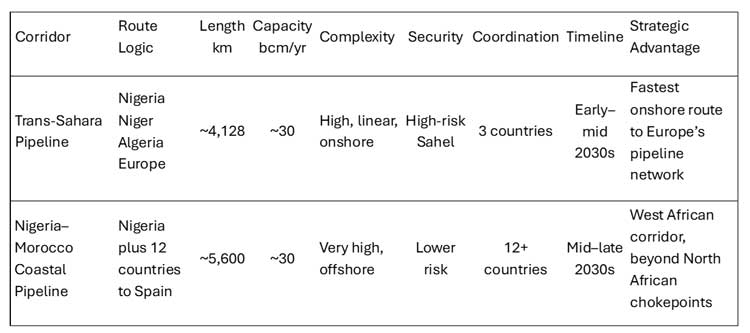
....MUCH MORE
Europe has significantly reduced its dependence on Russian energy since the 2022 energy crisis, but it now faces a different and potentially more damaging challenge: persistently high energy prices that are weakening industrial competitiveness and threatening long term economic growth.
Europe has significantly reduced its dependence on Russian energy since the 2022 energy crisis, but it now faces a different and potentially more damaging challenge: persistently high energy prices that are weakening industrial competitiveness and threatening long term economic growth.
The latest tensions surrounding Iran and the Strait of Hormuz have highlighted that Europe remains vulnerable to disruptions in global fossil fuel markets despite major investments in liquefied natural gas infrastructure, gas storage, and diversified energy imports. While Europe has largely avoided a repeat of the severe energy shock experienced after Russia’s invasion of Ukraine, rising geopolitical risks continue to expose structural weaknesses in the continent’s energy system.
As long as imported fossil fuels continue to determine electricity prices, every geopolitical crisis has the potential to translate into higher production costs for businesses and higher utility bills for households.
Energy Prices Continue to Burden European Industry
Although European natural gas and electricity prices had fallen substantially from their 2022 peaks by the end of 2025, they remained well above prewar levels. Gas prices were roughly 50 percent higher than before the Ukraine conflict, while electricity prices remained about 38 percent above historical averages....
....MUCH MORE
Choosing an Arctic cruise to Svalbard means comparing operators whose actual ice access, passenger capacity, and wildlife programming vary more than their brochures suggest....
....MUCH MORE

