Showing posts sorted by date for query pictet. Sort by relevance Show all posts

Saturday, February 22, 2025

"Scientists discover low-cost way to trap carbon using common rocks"

The key here is the long-term sequestration of the carbon.

And the low cost.

From Stanford Report, February 19:

The new process uses heat to transform common minerals into materials that permanently sequester atmospheric carbon dioxide

Stanford University chemists have developed a practical, low-cost way to permanently remove atmospheric carbon dioxide, the main driver of global warming and climate change. 

The new process uses heat to transform common minerals into materials that spontaneously pull carbon from the atmosphere and permanently sequester it. These reactive materials can be produced in conventional kilns, like those used to make cement. 

“The Earth has an inexhaustible supply of minerals that are capable of removing CO2 from the atmosphere, but they just don’t react fast enough on their own to counteract human greenhouse gas emissions,” said Matthew Kanan, a professor of chemistry in the Stanford School of Humanities and Sciences and senior author of the Feb.19 study in Nature. “Our work solves this problem in a way that we think is uniquely scalable.” 

Enhanced weathering
In nature, common minerals called silicates react with water and atmospheric CO2 to form stable bicarbonate ions and solid carbonate minerals – a process known as weathering. However, this reaction can take hundreds to thousands of years to complete. Since the 1990s, scientists have been searching for ways to make rocks absorb carbon dioxide more rapidly through enhanced weathering techniques.

Kanan and Stanford postdoctoral scholar Yuxuan Chen developed and demonstrated in their lab a new process for converting slow-weathering silicates into much more reactive minerals that capture and store atmospheric carbon quickly. A grant from the Sustainability Accelerator at the Stanford Doerr School of Sustainability is now supporting efforts to move the research into practical applications.

“We envisioned a new chemistry to activate the inert silicate minerals through a simple ion-exchange reaction,” said Chen, lead author of the study, who developed the technique while earning a chemistry PhD in Kanan’s lab. “We didn't expect that it would work as well as it does.”

Many experts say that preventing additional global warming will require both slashing the use of fossil fuels and permanently removing billions of tons of CO2 from the atmosphere. But technologies for carbon removal remain costly, energy-intensive, or both – and unproven at large scale. One of the technologies getting much interest and even early-stage investment lately is direct air capture, which uses panels of large fans to drive ambient air through chemical or other processes to remove CO2. 

“Our process would require less than half the energy used by leading direct air capture technologies, and we think we can be very competitive from a cost point of view,” said Kanan, who is also a senior fellow at the Precourt Institute for Energy in the Stanford Doerr School of Sustainability....

....MUCH MORE

The combination of low cost and pretty-much-permanent sequestration has been a Holy Grail for quite a long time.

Here's a post from November 2007 - "Engineered weathering process could mitigate global warming

And one from September 2024 - "Olivine weathering"

Between those two bookends we've had quite a few posts including:

"We’ve got carbon capture all wrong"

I don't know if I would use the word wrong but that quibble aside this article, especially deeper into it, presents some very interesting opportunities to complement current approaches.

Just as a personal preference, sequestering CO2 as a mineralized solid seems like a possibly more fruitful path than either tying carbon up in plant material—because the plant dies, the carbon gets released, reforms into CO2, that whole carbon cycle thing—or as a gas buried deep under the earth's crust—the potential disaster scenario of a catastrophic leak.

But maybe that's just me....

How Much Life Has Lived On Earth And How Much Carbon Has Cycled Through?
 
"Richard Feynman and the Pleasure Principle"

Oxford Uni.: "The outlook for CO2 removal"

Pictet: "Vaclav Smil on overhyped inventions, category errors and missed opportunities"

Tuesday, December 24, 2024

This Holiday Season Get Her What She Really Wants: A Swiss Banker

Repurposed from "League Table: Switzerland's Hottest Banker? (2019 edition)".

I was not aware this was a feature of FinNews.ch.
I must say, we appear to have some of the same diversity issues that Sweden's SEB suffers from.

From FinNews (en):
Back by popular demand, finews.com presents the third edition Switzerland's most attractive bankers.

Is a list reducing men to their looks even appropriate in this day and age of #metoo and diversity awareness? finews.com underwent some soul-searching and concluded that the male-dominated banking industry in Switzerland itself still celebrates the beauty ideal – intensely so.
Luxury men’s designer Hackett enjoys prime Paradeplatz space and men's salons have shot up around the banking district: to be sure, bankers still preen with appearance, attire, and accessories. These Swiss banker beefcakes combine brains and intellectual brawn with ease on the eye – and the list is as subjective as it is tongue-in-cheek.

Without further ado, the finews.com hotties, in no particular order of hotness:
12. Saman Habibian, Pictet
Saman Habibian 500
One of Julius Baer’s top bankers for the Middle East, the Swiss native was among a raft of defections to Pictet this year. The Swiss native, who is fluent in Persian, began his career at Credit Suisse in Singapore – like new Pictet partner Boris Collardi. Habibian, who spent a total of eight years at Julius Baer, interrupted by a brief stint at Safra Sarasin, is credited with building Julius Baer’s business in Bahrain.
11. Marc Pictet, Pictet
Marc Pictet 500
The 46-year-old represents the eighth generation to govern the bank. Despite his relatively young age, Pictet represents the old-guard – not least because he bears the name of the family bank. The Geneva wealth manager has experienced considerable upheaval in recent months: Collardi has poached dozens of bankers, many from his former shop, Julius Baer; a long-standing employee was caught in an alleged embezzlement scheme; and Pictet is switching senior partners later this year, in what is viewed as a nod to the subtle power shift towards its asset managers. Marc Pictet, responsible for the Genevan firm’s offices in Basel, Frankfurt, Munich, Stuttgart, and Zurich, devotes some of his private time to a local wildlife conservation organization.
10. Ralph Ebert, BIL
ralph ebert 550
Like any good compliance banker, the German lawyer keeps his cards close to his chest. At Credit Suisse, Ebert coordinated the Swiss bank’s response to the FIFA and Petrobras scandals – and bedded down the lessons learned. Ebert just jumped from Indosuez to Banque Internationale de Luxembourg – his third job in as many years. He has spent the bulk of his career in Paris and Geneva, with stints in Zurich.
9. Nicolas Syz, Banque Syz
NicolasSyz 500
The 34-year-old son of Swiss banker Eric Syz had a huge year – as did his older (and equally appealing) brother, Marc Syz. The elder Syz had pegged both Nicolas and Marc for leadership roles in a succession-related revamp last year. Then this year, Nicolas was vaulted to the helm of wealth management at Syz, which his father founded in 1996. The Swiss bank is now a family affair: mother Suzanne Syz, a jewelry designer, joined its board earlier this year amid takeover speculation. Whether Nicolas or Marc – or neither – make the grade to take over from Eric Syz is unclear. Nicolas is playing is cool: «There is no clear road map for succession,» he told a Swiss daily last year....
....MUCH MORE

Wednesday, December 4, 2024

Pictet: "Vaclav Smil on overhyped inventions, category errors and missed opportunities"

 From Pictet North America, December 6, 2023:

Your latest book, Invention and Innovation: A Brief History of Hype and Failure, takes aim at the mainstream media and particularly popular science, technology and environment writers who make sweeping and unfounded claims. What damage do you believe this does?

In a world that runs on extremely truncated attention spans of 140 characters and constant scrolling, reporting like this simply shouts: “no need to worry.” Brilliant technical dei ex machina will always come to our rescue. There’s no need for rational behaviour or thinking about minimised impacts and maximised efficiencies. There’s no need either to promote the ethos of restraint and responsibility. Just consume as much as possible. It will get fixed…

What are some examples of the most “overhyped” inventions we’ve seen in recent years, perhaps specifically in the climate and energy space?

That could be a long list. I’ll limit it to just three prominent items.

Nuclear fusion: in 2022, after some important experimental progress that still left the technique decades from any profitable commercial deployment, we were once again told (quite mistakenly) how close we are to this ultimate energy solution. 

Small modular nuclear reactors: I heard Alvin Weinberg, who was involved in the Manhattan Project as a young man and later became director of the Oak Ridge National Laboratory, talk about them for the first time in 1982. If we had a small commercial reactor for every mention of their imminent arrival during the past four decades, the world would not know what to do with all that power.

CO2 sequestration by exposed mantle rocks (in Oman and elsewhere): in theory such rocks could store hundreds of years of anthropogenic carbon emissions; in practice, though, I wouldn’t add this to your pension portfolio. How could it be done on the requisite scale?

From what you’ve said in the past, you are sceptical about the potential of carbon sequestration. Why is that? And why do you think it has been overhyped as a possible solution?

The appeal is obvious: it’s a classic tailpipe solution. Rather than replace the offending process, we continue business as usual but then capture its undesirable by-products − in this case CO2 released by burning fossil fuels - and bury them out of sight. But mass balances and cost considerations are enormously challenging. To sequester just 10% of all CO2 emitted from fossil fuel combustion, we would have to develop a new global industry that could handle the same mass of CO2 annually as the global mass of crude oil production. And the process would have to work in the opposite direction by spending huge amounts of money and energy to force billons of tons of supercritical CO2 fluid underground rather than bringing highly profitable oil above ground.

One of your arguments seems to be that we’re putting too much emphasis on new inventions that hold the vague promise of overhauling everything. In your opinion, what would be a better course of action for us to take?

Most people don’t seem to realise the extent of the inefficiencies and waste defining our actions, especially as applied to energies embedded in the supply of existential necessities. Here are just three notable examples:

We pump, treat (or desalinate) and dis-tribute drinking water, but frequently lose 30–40% of it through leaky pipes and defective plumbing.

We synthesise and distribute nitrogen fertilisers (at very high energy costs) and then often lose 50–70% of the nitrogen after the fertilisers are applied.

And we extract, process and distribute natural gas to heat homes and then lose a large part of that heat through single-pane windows and poorly insulated walls. I could go on and on.

A rational society would first try to mend its grossly inefficient ways rather than bring in new energy sources to perpetuate the existing inefficiencies.

You’ve written in the past that hydroelectric power deserves to be shown more love by people who are serious about the energy transition. You’ve said something similar about nuclear power. Is there a danger that we ignore these solutions in favour of the latest “shiny” invention?

Hydrogeneration was the original green solution. The first small hydro plant began working in 1882, the same year Edison built his first coal-fired station, and it remained a great favourite for a century. Then attitudes shifted, hydro became an environmental problem and eventually the World Bank stopped financing any new projects in low-income countries with large remaining hydro capacities. This is most unfortunate because the world – both rich and poor − still abounds in opportunities to build lots of small hydro stations whose combined capacities would be a welcome adjunct to intermittent electricity supplies. China, of course, has kept on building on a gargantuan scale as hydro became a critical part of their generation. Why should Africa, with its large hydro potential, be deprived of the same chance?....

....MUCH MORE

Sunday, August 4, 2024

Pictet's Chief Strategist, Luca Paolini In Conversation With The Trade

Mr. Paolini is Chief Strategist  at Pictet Asset Management (Pictet AM), a position he has held since 2012.

From The Trade, August 2:

Fireside Friday with… Pictet Asset Management’s Luca Paolini
The TRADE sits down with Luca Paolini, chief strategist at Pictet Asset Management, to discuss the key themes that impact strategies recommended to investors, how these strategies are executed by traders, and the impact of the current macro landscape.

How are you seeing traders execute the strategies that you are recommending?

The next five years will deliver an economic environment that will alter the dynamics of equity, bond and foreign exchange in several ways. Equities will struggle to repeat their stellar performance of the past few years. In absolute terms, stocks in the MSCI World Index will generate a reasonable return of some 7% per year in local currency terms over the next five years.

But relative to corporate bonds, our calculations show they will deliver an excess of return of just 1% per year versus around 10% over the past five years – and this for roughly two times the risk. This means fixed income will offer a more favourable risk-adjusted return than stocks. Investors should, then, allocate more to fixed income and especially corporate bonds. We think the dispersion of returns across regional and national equity market will fall. Equity investors, therefore, may find it more rewarding to invest along sectoral or thematic lines. The foreign exchange market will be defined by a steady but persistent depreciation of the US dollar. On a trade-weighted basis, we expect a decline of some 2% per year through to 2029. Assets that are negatively correlated to the dollar should account for a larger share of portfolios.

What are the key macro themes that impact the strategies you are recommending to investors?....

....MUCH MORE

Monday, November 20, 2023

"How the U.S. Market Went Sideways for a Wind-Power Giant"

A deep dive from the Wall Street Journal, November 20:

Ørsted’s pullback from East Coast wind farms left the region scrambling 

The poster child for the wind-power revolution was supposed to help build America’s clean-energy future. Its messy pullback from the Northeast is threatening those aspirations.

Denmark’s national oil-and-gas company, now known as Ørsted, bet big on renewables a decade ago. It renounced fossil fuels, renamed itself after a 19th-century physicist and embarked on a debt-fueled expansion, becoming the biggest offshore-wind developer outside China. Surfing investor enthusiasm for all things green, Ørsted surpassed

in market value early in the pandemic.

A hotbed of activity was the U.S., where Ørsted made a play at dominating the nascent wind market. The company lined up high-profile projects off the East Coast championed by Democratic-led states with ambitious climate targets.

Much of that work is at risk of running aground.

The company’s cancellation of two New Jersey wind farms on Halloween drew charges of incompetence from the governor and sparked what could be a $300 million legal spat. In New York, a pricing dispute has threatened to delay Albany’s renewable-energy goals. A New England utility partner is trying to unload stakes in three joint projects. Suppliers across the region are in limbo.

Ørsted might need to cancel more projects, sell parts of existing wind farms, or cut its dividend or issue stock to shore up its balance sheet, analysts and investors say. Any turnaround will come under a new-look C-suite after the chief financial officer and chief operating officer stepped down last week.

Ørsted’s stock has plunged more than 75% from its high in 2021, including a roughly 19% drop this quarter.

Similar upheaval is rippling across an industry that the Biden administration placed at the heart of America’s green-energy ambitions. Inflation drove up prices for turbines, labor and steel. Higher interest rates lifted financing costs. Creating an East Coast network of factories, ports, transmission lines and interconnection facilities—all while companies await a glacial permitting process—proved easier said than done. 

Even in Europe, a capital-intensive industry that thrived when interest rates were low and costs fell year after year is in trouble. “I don’t think we are out of the woods,” said Manuel Losa of Pictet Asset Management, who sold Ørsted shares in 2021.

Ørsted was more vulnerable than most to a surge in inflation and interest rates because stiff competition had already driven down power prices and expected returns from offshore-wind projects, former executives say. Some analysts say higher prices planned for the next round of projects in New York and the U.K. could help the industry rebound and aid states in upgrading aging energy infrastructure....

....MUCH MORE

Wednesday, April 12, 2023

Groundwater Gold Rush In Californ-i-a

A very important story from Bloomberg, April 11:

Banks, pension funds and insurers have been turning California's scarce water into enormous profits, leaving people with less to drink

As storms battered California in March, the state’s inland breadbasket erupted with almond blossoms. It happens every year. The Central Valley—the source of 40% of America’s fruit and nuts—explodes in a riot of pink and white blooms. This year petals fluttered off branches into raging irrigation ditches that only a few months earlier had twisted across the dry dust like coils of snake molt. 

California has a temporary reprieve. At the Woodville Public Utility District, 60 miles southeast of Fresno, Ralph Gutierrez has watched these cycles of flood and drought for decades. Gutierrez, 65, who grew up picking tomatoes and grapes with his parents in the nearby fields, has spent the past 43 years operating water systems for some of the poorest communities in the state. He’s a well whisperer. Brawny, with a tattooed forearm, a silver belt buckle and Western boots, Gutierrez coaxes water from stone aquifers that have been hammered for years by agricultural pollution and overpumping. 

He took over Woodville’s 500 or so household hookups in 2001, when the water table beneath the small farmworker community’s well field was about 100 feet below the surface. The district’s two community wells, powered by electric pumps, produced ample clean groundwater for residential taps. Since then, California has experienced its driest pair of decades in 1,200 years, and the water level has dropped to almost 200 feet. One Woodville well dried up and cracked two years ago. The second was shut down because of nitrate contamination. 

Last year almost 1,500 domestic wells went dry statewide, and the state auditor reported almost a million Californians had no safe drinking water in their homes. Today the people of Woodville drink bottled water. 

This winter’s record storms, a welcome break from drought, lifted Woodville’s water level 18 feet. It will take decades of wet winters to refill the aquifer. For drought is only part of California’s water woes. The other part unspools outside the window of Gutierrez’s white Toyota Tundra, on a drive through Woodville’s outskirts. Each side of the road is covered in dense thickets of almond, pistachio and walnut orchards that have grown to dominate the landscape in the past few decades. The nut trees are known as “permanent crops,” because they need copious, year-round irrigation over the course of their 30-year life span. That’s in contrast to row crops such as tomatoes and lettuce, or silage like corn and hay, which can be fallowed to save water during drought. 

The owners of the unmarked groves are a mystery to Gutierrez. Every few miles, huge U-shaped nozzles stick up, spouts for disgorging water extracted from deeper and deeper underground for California’s nut juggernaut. The prodigious pumping has helped drop the water table in the San Joaquin Valley, California’s food belt between Sacramento and south of Bakersfield. The decline has deprived many shallower wells belonging to small farmers and poor communities such as Woodville of sufficient water supplies. 

“Deeper pockets, deeper wells. That’s what’s basically going on here,” Gutierrez says, growing agitated as the endless rows of trees whiz by. “Whoever is doing this doesn’t give a damn about the small people.” 

The invisible hand, it turns out, belongs to the long arm of investors in New York, Toronto, Zurich and other financial capitals. Some of the world’s largest investment banks, pension funds and insurers, including Manulife Financial Corp.’s John Hancock unit, TIAA and UBS, have been depleting California’s groundwater to grow high-value nuts, leaving less drinking water for the surrounding communities, according to a Bloomberg Green investigation. Wall Street has come to Woodville, wringing it dry. Since 2010, six major investors have quadrupled their farmland under management in California, to almost 120,000 acres in all, equivalent to a third of all the cropland in Connecticut. Despite epochal drought, these companies have fueled the growth of permanent crops, disregarding some of the most basic principles of sustainable investing. 

Much has been made of the water use of local farmers and industrial-scale agribusinesses such as California’s biggest nut farmer, Wonderful Co., but the growing role of institutional investors in the state’s water crisis has gone largely unnoticed. Over the past decade, the financier-farmers have poured millions of dollars into digging deep wells, expensive capital projects that many communities couldn’t dream of matching on their own. In a presentation to investors obtained by Bloomberg Green, one company said it will eventually have to dial back its groundwater pumping yet can still reap handsome returns before that day comes. 

Since the start of 2019, one of every six of the deepest wells in the San Joaquin Valley has been drilled on land owned or managed by outside investors, according to Bloomberg Green’s analysis of state well completion reports through August 2022. Of the landowners that have drilled the greatest number of deep wells since 2019, two of the top three are institutional investors: TIAA and the Public Sector Pension Investment Board of Canada....

....MUCH MORE

That's not very ESG of the teachers and other government employee union pensions, now is it.

Indirectly related:  

We've looked at virtual water a few times: 
January 2013  
One of the few Limits to Growth that actually is a limit rather than some sort of scarcity meme.
However even this should be beatable if some smart people can do the deep dive into the wonder and magic (okay, chemistry and physics) that is H2O.
We'll be hearing about virtual water with increasing frequency, right now there are only 298,000 hits in a Google search....[now up to 459,00]

February 2014 
California Drought: Why Farmers Are 'Exporting Water' to China
March 2016
Shipping U.S. Water To Saudi Arabia
As we've noted elsewhere this is an example of what the hydrology pros call 'virtual water'.
July 2019
"Water is the hidden imbalance in U.S./China trade..."

February 2022
Embedded Water

And another angle:

"Why Wall Street investors’ trading California water futures is nothing to fear – and unlikely to work anyway"
I don't know. Anything that normalizes the commodification of water, that, rather than exalting it as a giver of life (and one of the weirdest compounds in the universe) reduces it to just another thing to trade, brings us closer to the day when pure power politics forces the U.S. to drain the Great Lakes just to keep Phoenix and Las Vegas and Los Angeles going.Or something.

Trying to Make a Buck Off Water Investments

It's So Hard to Find a Decent Bet on Water (investment vehicles)

May 2013
Swiss Private Bank Pictet Making Money in the Water Biz (XYL; DHR)
July 2013
"Can Powdered Water Cure Droughts?"
October 2010
Muni's: "Water Scarcity a Bond Risk, Study Warns"
April 2015
A Look At A Second Water Focused Hedge Fund 

 World Water Day 2019: Hedge Funds and Investing In H2O

Friday, December 16, 2022

This Holiday Season Get Her What She Really Wants: A Swiss Banker

Repurposed from "League Table: Switzerland's Hottest Banker? (2019 edition)".

I was not aware this was a feature of FinNews.ch.
I must say, we appear to have some of the same diversity issues that Sweden's SEB suffers from.

From FinNews (en):
Back by popular demand, finews.com presents the third edition Switzerland's most attractive bankers.

Is a list reducing men to their looks even appropriate in this day and age of #metoo and diversity awareness? finews.com underwent some soul-searching and concluded that the male-dominated banking industry in Switzerland itself still celebrates the beauty ideal – intensely so.
Luxury men’s designer Hackett enjoys prime Paradeplatz space and men's salons have shot up around the banking district: to be sure, bankers still preen with appearance, attire, and accessories. These Swiss banker beefcakes combine brains and intellectual brawn with ease on the eye – and the list is as subjective as it is tongue-in-cheek.

Without further ado, the finews.com hotties, in no particular order of hotness:
12. Saman Habibian, Pictet
Saman Habibian 500
One of Julius Baer’s top bankers for the Middle East, the Swiss native was among a raft of defections to Pictet this year. The Swiss native, who is fluent in Persian, began his career at Credit Suisse in Singapore – like new Pictet partner Boris Collardi. Habibian, who spent a total of eight years at Julius Baer, interrupted by a brief stint at Safra Sarasin, is credited with building Julius Baer’s business in Bahrain.
11. Marc Pictet, Pictet
Marc Pictet 500
The 46-year-old represents the eighth generation to govern the bank. Despite his relatively young age, Pictet represents the old-guard – not least because he bears the name of the family bank. The Geneva wealth manager has experienced considerable upheaval in recent months: Collardi has poached dozens of bankers, many from his former shop, Julius Baer; a long-standing employee was caught in an alleged embezzlement scheme; and Pictet is switching senior partners later this year, in what is viewed as a nod to the subtle power shift towards its asset managers. Marc Pictet, responsible for the Genevan firm’s offices in Basel, Frankfurt, Munich, Stuttgart, and Zurich, devotes some of his private time to a local wildlife conservation organization.
10. Ralph Ebert, BIL
ralph ebert 550
Like any good compliance banker, the German lawyer keeps his cards close to his chest. At Credit Suisse, Ebert coordinated the Swiss bank’s response to the FIFA and Petrobras scandals – and bedded down the lessons learned. Ebert just jumped from Indosuez to Banque Internationale de Luxembourg – his third job in as many years. He has spent the bulk of his career in Paris and Geneva, with stints in Zurich.
9. Nicolas Syz, Banque Syz
NicolasSyz 500
The 34-year-old son of Swiss banker Eric Syz had a huge year – as did his older (and equally appealing) brother, Marc Syz. The elder Syz had pegged both Nicolas and Marc for leadership roles in a succession-related revamp last year. Then this year, Nicolas was vaulted to the helm of wealth management at Syz, which his father founded in 1996. The Swiss bank is now a family affair: mother Suzanne Syz, a jewelry designer, joined its board earlier this year amid takeover speculation. Whether Nicolas or Marc – or neither – make the grade to take over from Eric Syz is unclear. Nicolas is playing is cool: «There is no clear road map for succession,» he told a Swiss daily last year....
....MUCH MORE

Friday, November 25, 2022

Corporate Earnings: Pictet's Steve Donzé Has A Reminder For Us

Mr. Donzé is Deputy Head of Investment & Multi Asset Portfolio Manager at Pictet Asset Management Japan.

Thursday, October 20, 2022

"BlackRock fund bets rich world is likely to face a water crisis"

 Important caveat: Water investing is tough.

From Bloomberg via the Spokane (WA) Spokesman-Review, October 7:

Inside the world’s biggest asset manager, an investment strategy is being fine-tuned based on a bet that the rich world will increasingly face a lack of clean water.

“Historically, we often thought of water as being a developing-country problem, but it goes much deeper than that,” Omar Moufti, product strategist for thematic and sector exchange-traded funds at BlackRock Inc., said in an interview.

Moufti said it’s hard to overstate the long-term risks tied to water scarcity. He also said that “more severe and frequent droughts and floods across the globe have highlighted” how urgent the threat is.

Britain’s Victorian-era water works buckled under the pressure of floods in recent months, leaving the U.K. to deal with sewage spewing into its clean water. In France, over 100 municipalities were without drinking water over the summer, leading the government to ban farmers from irrigating their crops.

In central Europe, drought left the Danube and Rhine rivers almost unnavigable, while the Po in Italy dried up. In the U.S., regional restrictions were enforced on the amount of water municipalities could pump, as water levels in key reservoirs dropped to record lows. And in states such as Mississippi, locals lost access to clean water altogether.

Scientists predict that extreme weather events behind such disruptions will become more frequent and intense.

“We need to mitigate those risks,” Moufti said.

The BlackRock fund that Moufti helped design – the iShares Global Water ETF (ticker DH20@LN) – invests in everything from water utilities and pump manufacturers to companies that improve water efficiency. The top five holdings in the $2 billion exchange-traded fund include American Water Works, Xylem, Essential Utilities, Ferguson and Geberit. Moufti said the fund reflects the growing concerns about water scarcity in the world’s richest economies – and it’s a danger that may not be fully priced into the market.

It’s about “investing in water equipment like pumps, or improving piping to reduce water losses or enhancing waste water treatment,” Moufti said.

So far this year, the BlackRock ETF has dropped 28%, slightly less than the S&P Global Water Net Total Return Index. The fund advanced at an annual rate of 8.3% over the past 10 years....

....MUCH MORE

From a 2015 post:
A Look At A Second Water Focused Hedge Fund
Before we get to the story about Water Asset Management at I'll repeat the introduction to our 2014 post on Summit Global Management "A Look at the World's First Water-focused Hedge Fund":
Since the first Earth Day in April 1970 and more importantly since the establishment of the EPA in December of that year, folks have been trying to make money out of water in the U.S..
Put simply, the returns have not been market-beating.

Because so much of the opportunity was my-little-crony stuff, at the whim of politicians, there was no consistency of growth at a time when other portfolio investments offered very competitive comparisons.
The alternative was to own the cash flow, private equity style, but unless one felt a passion for grit chambers and sludge pans it was pretty pedestrian, utility type ROI.

In fact the most reliable water investment in the U.S. has probably been York Water Company of York PA.
They've been paying dividends for 199 consecutive years and just announced their 575th divi.
The announcement carries the boilerplate "This release contains forward-looking statements"....

If interested see also:

Previously in H2OhOh:
Aug. 2012
It's So Hard to Find a Decent Bet on Water (investment vehicles)

Update below.
Original post:
Water has confounded smarter people than me.

Enron's adventure in H2O is a cautionary tale, they bought Wessex Water in England, bought water concessions in Argentina and had a long term contract in Cancun.
Enron partially spun out the water sub, Azurix at $19.00. Within 18 months it was trading at $3.50 where Enron tendered for the 34% of the company that the public owned.

Not a very sweet deal for anyone involved. Water is tough business.
And, of course, Enron being Enron, they bid 100% more than any one else in the business to get the Argentina deal to have some big pre-IPO news. 
From FT Alphaville:
In search of liquid water (investment vehicles)
This guest post was submitted by Jason Abbruzzese of FT.com.
A little more than a year ago, Citi chief economist Willem Buiter said water was on its way to becoming “the single most important physical-commodity based asset class, dwarfing oil, copper, agricultural commodities and precious metals”.
While we’re not quite there yet...MORE
May 2013
Swiss Private Bank Pictet Making Money in the Water Biz (XYL; DHR)
July 2013
"Can Powdered Water Cure Droughts?"
October 2010
Muni's: "Water Scarcity a Bond Risk, Study Warns

Sunday, May 16, 2021

"Inside the Secretive Swiss Bank for the World’s Richest People"

We used to think of Sarasin as being of the same quality, though 35 years younger and earlier to ESG, but since Safra took control they seem to be just another Swiss Bank.

From Bloomberg via Yahoo Finance:

In the mythology of private banking, Banque Pictet & Cie SA stands apart. Over the course of more than two centuries, the Swiss institution has discreetly tended to the assets of the very rich, led by a small crop of partners who form the most exclusive men-only club anywhere outside the Vatican.

In its entire history, only 43 individuals — all men, all white — have risen to the rank of Pictet managing partner, creating a bond more enduring than your typical marriage. From their Geneva perch, they oversee more than 600 billion francs ($662 billion) in assets under management and a level of profitability far beyond larger, publicly-listed peers, often rewarding each of them with more than 20 million francs a year.

But in recent years, an unsettling new trend crept into Pictet, cracking the façade of corporate cohesion: key employees began leaving. Over the course of 2019, a dozen long-tenured relationship managers at the wealth unit departed. Within days in September of that year, four leading bankers from the team looking after Russian clients handed in their resignations. Bankers for Scandinavia and Israel followed, putting billions in assets under management at stake.

At the heart of the exodus lies a culture clash. Longtime employees were bristling at the brash style of the flood of recent hires brought on to manage the money of the ultra rich, particularly the explosive growth of new wealth in Asia that has set off an aggressive race for assets and talent with bigger rivals like UBS Group AG and HSBC Holdings Plc.

Yet for others, change wasn’t happening fast enough; some newcomers who had signed up to the promise of the rejuvenated Pictet were departing again in frustration.

Interviews with a dozen people familiar with Pictet’s private-wealth arm reveal a business at a crossroads, confronted with the reality that, in order to stay ahead, Switzerland’s preeminent private bank must adapt. That means embracing more risk and changing the client relationship — away from the concierge-like approach that endured for generations toward a more transactional model.

That can be tough for employees accustomed to the principle of caution and secrecy that guided Pictet through the centuries. But change has also brought opportunity to rethink old habits and expand the bank on the global stage.

The people asked not to be identified discussing the bank’s inner workings. Pictet declined to comment for this story.

While overall attrition at Pictet Wealth Management stands at an all-time low of 2.8%, the evacuation of longtime talent has reverberated through the corridors of the five-story modernist headquarters. The departures startled the partners, who viewed the outflow as an assault on an institution priding itself in flat fluctuation. So late in 2019, they gathered in a spartan conference room for what the partners call their salon meeting to learn more about what was behind the defections.

Sitting in tiered formation at the large conference table, much in the same way they congregate several times a week to discuss the order of business, the men heard of tensions, a dispute over restraint and renewal rippling through the bank’s private wealth subsidiary.

“Pictet is in between two worlds,” says Pedro Araujo, a senior researcher at the University of Fribourg, who has studied Switzerland’s elite families. “They are in the old world of Geneva private bankers, and the new world of globalized finance, where they want to be present internationally, they want to grow, they want to present themselves as modern, but not too much. Two worlds that are on a collision course.”

For all its tradition, Pictet has become more attuned to change in recent years. The company transformed its legal status after the end of banking secrecy in 2014, disclosing more performance metrics as a result. One of its partners, Rémy Best, had already made his mark revamping the asset-management unit. Next, he turned his attention to the wealth division, long the beating heart of Pictet.

It turned out that the operation required fresh blood. And the bank found it in Boris Collardi, who performed one of the most audacious maneuvers in Swiss banking in 2018 when he abruptly left as CEO of Zurich private-banking nemesis Julius Baer and decamped to the shores of Lake Geneva to join Pictet.

On the face of it, Collardi is everything that the typical Pictet stakeholder is not. More bonvivant than ascetic financier, Collardi, 46, stands apart as the first outside partner in decades. He also brought serious star power and a dose of bonhomie to the Pictet franchise that values uniformity over individualism, down to the subdued color palette of the partners’ perfectly tailored suits.

Collardi, by contrast, is known to greet close colleagues with a hug or a peck on the cheek; in meetings, he is the first to take off his suit jacket and jokingly complains about having to wear a tie. His ascent to the Pictet partnership not only made him one of the youngest people in recent history to hold that title, it also tipped the scale for the first time to a majority of members in the group who aren’t descendants of the founding families.

In Collardi, the partners identified a peer who could pick up from Best, a longtime acquaintance who had introduced the new hire to the other partners. And Collardi was already well versed in Asia, where Pictet was keen to tap into an affluent class of newly minted billionaires preparing to pass on their wealth to the next generation.

But Collardi also had to adjust to the new reality of no longer being the undisputed leader. Instead, he is now one voice among seven, where every decision is made in unison. The weekly meetings are presided over by senior partner Renaud de Planta, who declined to comment for this story.

Given that the average tenure of an active partner is 20 years, collegial harmony is the glue that holds together the senior team. That hasn’t stopped Collardi from moving swiftly in his new role. Within a year, more than 100 of his loyalists had followed him to Pictet, including close to the complete teams for the Middle East and Latin America.

Collardi also accelerated an overhaul of the investment and trading platforms, replacing some of the longest-serving portfolio managers with investment advisers half their age.

By the end of 2020, Pictet's wealth bankers had swelled to 1,098 from 740 just five years earlier, an expansion not dissimilar to absorbing a full-blown acquisition.

The changes echo the overhaul that Collardi enacted at Julius Baer. Over the course of a decade, he turbo-charged the storied private bank, sending it on a breakneck expansion from Sao Paulo to Singapore, doubling assets under management as a result. But despite his meteoric rise, Collardi remained, by his own account at the time of the move, “only an employee.” Pictet, by contrast, offered a once-in-a-lifetime opportunity to become an entrepreneur with extra financial legroom but without the daily grind of running a publicly-listed company.

Making Pictet partner brings a stake in a steady business whose owners share in more than 500 million francs in annual profit. Up until a few years ago, the firm was so old-fashioned that managing partners were expected to be addressed as Notre Sieur, a formal French title for sire.

The challenge facing the partners is that in order to grow, they need to aggressively target Asia, the epicenter of wealth creation. But that requires the embrace of new — and potentially riskier — investment assets, chief among them structured products, which use derivatives to track the performance of an underlying asset....

....MUCH MORE

Thursday, February 11, 2021

This Valentine's Day Get Her What She Really Wants: A Swiss Banker

Reposting without change.

League Table: Switzerland's Hottest Banker? (2019 edition)
I was not aware this was a feature of FinNews.ch.
I must say, we appear to have some of the same diversity issues that Sweden's SEB suffers from.

From FinNews (en):
Back by popular demand, finews.com presents the third edition Switzerland's most attractive bankers.

Is a list reducing men to their looks even appropriate in this day and age of #metoo and diversity awareness? finews.com underwent some soul-searching and concluded that the male-dominated banking industry in Switzerland itself still celebrates the beauty ideal – intensely so.
Luxury men’s designer Hackett enjoys prime Paradeplatz space and men's salons have shot up around the banking district: to be sure, bankers still preen with appearance, attire, and accessories. These Swiss banker beefcakes combine brains and intellectual brawn with ease on the eye – and the list is as subjective as it is tongue-in-cheek.

Without further ado, the finews.com hotties, in no particular order of hotness:
12. Saman Habibian, Pictet
Saman Habibian 500
One of Julius Baer’s top bankers for the Middle East, the Swiss native was among a raft of defections to Pictet this year. The Swiss native, who is fluent in Persian, began his career at Credit Suisse in Singapore – like new Pictet partner Boris Collardi. Habibian, who spent a total of eight years at Julius Baer, interrupted by a brief stint at Safra Sarasin, is credited with building Julius Baer’s business in Bahrain.
11. Marc Pictet, Pictet
Marc Pictet 500
The 46-year-old represents the eighth generation to govern the bank. Despite his relatively young age, Pictet represents the old-guard – not least because he bears the name of the family bank. The Geneva wealth manager has experienced considerable upheaval in recent months: Collardi has poached dozens of bankers, many from his former shop, Julius Baer; a long-standing employee was caught in an alleged embezzlement scheme; and Pictet is switching senior partners later this year, in what is viewed as a nod to the subtle power shift towards its asset managers. Marc Pictet, responsible for the Genevan firm’s offices in Basel, Frankfurt, Munich, Stuttgart, and Zurich, devotes some of his private time to a local wildlife conservation organization.
10. Ralph Ebert, BIL
ralph ebert 550
Like any good compliance banker, the German lawyer keeps his cards close to his chest. At Credit Suisse, Ebert coordinated the Swiss bank’s response to the FIFA and Petrobras scandals – and bedded down the lessons learned. Ebert just jumped from Indosuez to Banque Internationale de Luxembourg – his third job in as many years. He has spent the bulk of his career in Paris and Geneva, with stints in Zurich.
9. Nicolas Syz, Banque Syz
NicolasSyz 500
The 34-year-old son of Swiss banker Eric Syz had a huge year – as did his older (and equally appealing) brother, Marc Syz. The elder Syz had pegged both Nicolas and Marc for leadership roles in a succession-related revamp last year. Then this year, Nicolas was vaulted to the helm of wealth management at Syz, which his father founded in 1996. The Swiss bank is now a family affair: mother Suzanne Syz, a jewelry designer, joined its board earlier this year amid takeover speculation. Whether Nicolas or Marc – or neither – make the grade to take over from Eric Syz is unclear. Nicolas is playing is cool: «There is no clear road map for succession,» he told a Swiss daily last year....
....MUCH MORE

Tuesday, June 2, 2020

Pictet's Twist On ESG: Investing in Family Controlled Public Companies

Pictet are one of the class acts of the private bank biz.
We used to say the same about Sarasin before Safra bought them but don't really follow the numbers anymore.

At minimum Pictet's idea seems like a smart screen for getting everyone's interests aligned.
I haven't seen the performance figures to comment further though.

May 2020:
Family businesses: Insights on an attractive investment prospect
Pictet-Family – Fund manager interview

Pictet Asset Management has developed a new investment strategy that invests in listed family businesses, companies that count founding families as major shareholders.
The portfolio is a repositioning of the Pictet-Small Cap Europe fund and is managed by Cyril Benier and Alain Caffort.
In this Q&A, they discuss the strategy’s guiding philosophy.

What exactly is a family business?
How you define a family business is a matter of interpretation. Sometimes it’s obvious, say when founders hold very large stakes in their own names. But the boundaries can sometimes be blurred. We take a systematic and rigorous approach to our definition. Family businesses that make up our investment universe are public companies in which an individual or family holds a minimum of 30 per cent of voting rights. The family can be by blood or marriage, the stake can be held through a foundation or some other vehicle. Such information is rarely freely available; unearthing it often requires painstaking research.

Why 30 per cent?
Research shows that active participation in the general assemblies of publicly listed companies averages around 60 per cent of share ownership. At 30 per cent, a shareholder (or group of closely tied shareholders) effectively has the casting vote and, thus, control.

Why focus on family businesses?
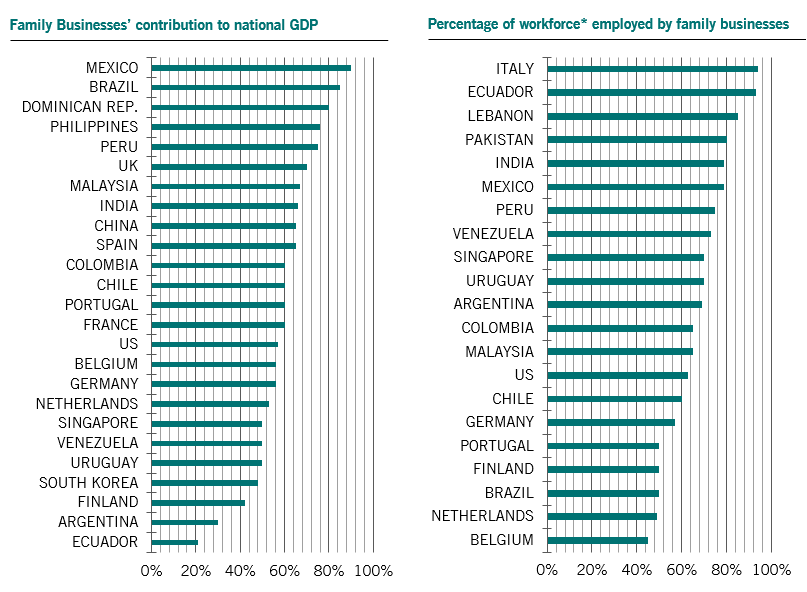
Family businesses are the lifeblood of our society and the backbone of the global economy. They contribute between 50 per cent and 70 per cent of countries’ gross domestic product and employ the majority of their workforces. 
GBPEmployment.png
Source: Tharawat Magazine, Economic Impact of Family Businesses – A Compilation of Facts, 06/01/2016 
– over 40 sources used including IMD and KPMG *Data representative of private employers only 
There’s a large body of research showing family businesses tend to outperform their peers – financially and in terms of shareholder returns.
Of course, as anyone with experience of families and family disputes knows, this type of ownership can also lead to a number of problems – which is why it is also crucial to take an active approach to investing in these companies. And that’s where we can make a difference – ensuring we avoid the pitfalls in this otherwise attractive investment landscape. Please read our related article on the universe for more about why it makes sense to invest in family businesses with an active approach.

This suggests corporate governance is a big focus for you, is that right?
Environmental, social and governance (ESG) factors are all important sources of investment performance. But when it comes to investing in family businesses, governance is key. That’s because governance is intrinsic to a company’s overall values and culture....
....MUCH MORE

Thursday, March 5, 2020

Having Got the ECB to Buy LVMH Bonds To Finance Tiffany Purchase, Europe’s Richest Man Eyeing London’s Ritz Hotel

Life is easier when the central bank buys your bonds.
 First, from ZeroHedge, February 16: 
When France's richest man, LVMH boss Bernard Arnault, shocked the market last November with his $16 billion purchase of jewelry icon Tiffany, he knew he would have to issue about $10 billion in bonds to fund the deal. He also knew it wouldn't be a problem, for one reason: the ECB would be there to make sure the deal got done. But not even Arnault, who expected the yield from the bond issuance to be "between 0% and 1%" anticipated that the deal would get done in a way that the bond market would end up paying him.

Yes, thanks to the lasting legacy of one Mario Draghi, the richest man in France is now even richer because he had to issue debt.

What happened? As the financial world was closely following every fabricated data point out of Beijing in China's fight with the coronavirus epidemic, LVMH quietly raised €7.5 billion ($8.3 billion) and GBP1.55 billion ($2 billion), over a range of maturities from two to 11 years, to help finance its $16 billion purchase of Tiffany.

Here's the kicker: as Reuters reported last week, not only was the €9.3BN bond deal more than 50% upsized from the initial price talk of €6BN just earlier that day, but two of the five euro tranches were placed at negative yields, meaning investors would pay the A-rated LVMH to borrow money. Even the longest maturity, an 11-year euro tranche, had a yield of just 0.43%....MORE
And from Bloomberg:
Bernard Arnault is among a pack of potential bidders vying for London’s Ritz Hotel, according to the Times of London.

Europe’s richest man, chairman of LVMH Moet Hennessy Louis Vuitton SE, is among about 13 interested parties that have been allowed to undertake due diligence, the newspaper said. The five-star hotel is being sold by the Barclay brothers and could fetch as much as 800 million pounds ($1 billion).

Luxury brands have stepped up investments in high-end hotels in recent years, seeking to diversify their interests and deepen ties to the world’s wealthiest consumers. LVMH spent $2.6 billion last year to buy Belmond, which owns or has stakes in more than 30 properties around the world.

Representatives for LVMH and the Barclay brothers declined to comment.....MORE
Some previous visits to Cloud Cuckoo Land:
....Related, the FT's David Keohane starring in:
Frontrun the Bank of England for Fun and Profit

Possibly also of interest:
"Which corporate bonds has the ECB been buying?"
Climateer Line of the Day: In With The In Crowd Edition
Frontrunning the ECB: "Investors in corporate bond ‘land grab’ ahead of ECB buying"--UPDATED
"The ECB’s momentous step into corporate asset purchases"
Deutsche Bank On the European Central Bank: We Are Governed By Idiots
Pictet: "The Pricing And Valuation Of Bonds No Longer Reflects Fundamentals" - Why This Matters  

Friday, February 14, 2020

This Valentine's Day Get Her What She Really Wants: A Swiss Banker

Reposting without change.

League Table: Switzerland's Hottest Banker? (2019 edition)
I was not aware this was a feature of FinNews.ch.
I must say, we appear to have some of the same diversity issues that Sweden's SEB suffers from.

From FinNews (en):
Back by popular demand, finews.com presents the third edition Switzerland's most attractive bankers.
Is a list reducing men to their looks even appropriate in this day and age of #metoo and diversity awareness? finews.com underwent some soul-searching and concluded that the male-dominated banking industry in Switzerland itself still celebrates the beauty ideal – intensely so.
Luxury men’s designer Hackett enjoys prime Paradeplatz space and men's salons have shot up around the banking district: to be sure, bankers still preen with appearance, attire, and accessories. These Swiss banker beefcakes combine brains and intellectual brawn with ease on the eye – and the list is as subjective as it is tongue-in-cheek.

Without further ado, the finews.com hotties, in no particular order of hotness:
12. Saman Habibian, Pictet
Saman Habibian 500
One of Julius Baer’s top bankers for the Middle East, the Swiss native was among a raft of defections to Pictet this year. The Swiss native, who is fluent in Persian, began his career at Credit Suisse in Singapore – like new Pictet partner Boris Collardi. Habibian, who spent a total of eight years at Julius Baer, interrupted by a brief stint at Safra Sarasin, is credited with building Julius Baer’s business in Bahrain.
11. Marc Pictet, Pictet
Marc Pictet 500
The 46-year-old represents the eighth generation to govern the bank. Despite his relatively young age, Pictet represents the old-guard – not least because he bears the name of the family bank. The Geneva wealth manager has experienced considerable upheaval in recent months: Collardi has poached dozens of bankers, many from his former shop, Julius Baer; a long-standing employee was caught in an alleged embezzlement scheme; and Pictet is switching senior partners later this year, in what is viewed as a nod to the subtle power shift towards its asset managers. Marc Pictet, responsible for the Genevan firm’s offices in Basel, Frankfurt, Munich, Stuttgart, and Zurich, devotes some of his private time to a local wildlife conservation organization.
10. Ralph Ebert, BIL
ralph ebert 550
Like any good compliance banker, the German lawyer keeps his cards close to his chest. At Credit Suisse, Ebert coordinated the Swiss bank’s response to the FIFA and Petrobras scandals – and bedded down the lessons learned. Ebert just jumped from Indosuez to Banque Internationale de Luxembourg – his third job in as many years. He has spent the bulk of his career in Paris and Geneva, with stints in Zurich.
9. Nicolas Syz, Banque Syz
NicolasSyz 500
The 34-year-old son of Swiss banker Eric Syz had a huge year – as did his older (and equally appealing) brother, Marc Syz. The elder Syz had pegged both Nicolas and Marc for leadership roles in a succession-related revamp last year. Then this year, Nicolas was vaulted to the helm of wealth management at Syz, which his father founded in 1996. The Swiss bank is now a family affair: mother Suzanne Syz, a jewelry designer, joined its board earlier this year amid takeover speculation. Whether Nicolas or Marc – or neither – make the grade to take over from Eric Syz is unclear. Nicolas is playing is cool: «There is no clear road map for succession,» he told a Swiss daily last year....
....MUCH MORE

Friday, February 7, 2020

League Table: Switzerland's Hottest Banker? (2019 edition)

I was not aware this was a feature of FinNews.ch.
I must say, we appear to have some of the same diversity issues that Sweden's SEB suffers from.

From FinNews (en):
Back by popular demand, finews.com presents the third edition Switzerland's most attractive bankers.
Is a list reducing men to their looks even appropriate in this day and age of #metoo and diversity awareness? finews.com underwent some soul-searching and concluded that the male-dominated banking industry in Switzerland itself still celebrates the beauty ideal – intensely so.
Luxury men’s designer Hackett enjoys prime Paradeplatz space and men's salons have shot up around the banking district: to be sure, bankers still preen with appearance, attire, and accessories. These Swiss banker beefcakes combine brains and intellectual brawn with ease on the eye – and the list is as subjective as it is tongue-in-cheek.

Without further ado, the finews.com hotties, in no particular order of hotness:
12. Saman Habibian, Pictet
Saman Habibian 500
One of Julius Baer’s top bankers for the Middle East, the Swiss native was among a raft of defections to Pictet this year. The Swiss native, who is fluent in Persian, began his career at Credit Suisse in Singapore – like new Pictet partner Boris Collardi. Habibian, who spent a total of eight years at Julius Baer, interrupted by a brief stint at Safra Sarasin, is credited with building Julius Baer’s business in Bahrain.
11. Marc Pictet, Pictet
Marc Pictet 500
The 46-year-old represents the eighth generation to govern the bank. Despite his relatively young age, Pictet represents the old-guard – not least because he bears the name of the family bank. The Geneva wealth manager has experienced considerable upheaval in recent months: Collardi has poached dozens of bankers, many from his former shop, Julius Baer; a long-standing employee was caught in an alleged embezzlement scheme; and Pictet is switching senior partners later this year, in what is viewed as a nod to the subtle power shift towards its asset managers. Marc Pictet, responsible for the Genevan firm’s offices in Basel, Frankfurt, Munich, Stuttgart, and Zurich, devotes some of his private time to a local wildlife conservation organization.
10. Ralph Ebert, BIL
ralph ebert 550
Like any good compliance banker, the German lawyer keeps his cards close to his chest. At Credit Suisse, Ebert coordinated the Swiss bank’s response to the FIFA and Petrobras scandals – and bedded down the lessons learned. Ebert just jumped from Indosuez to Banque Internationale de Luxembourg – his third job in as many years. He has spent the bulk of his career in Paris and Geneva, with stints in Zurich.
9. Nicolas Syz, Banque Syz
NicolasSyz 500
The 34-year-old son of Swiss banker Eric Syz had a huge year – as did his older (and equally appealing) brother, Marc Syz. The elder Syz had pegged both Nicolas and Marc for leadership roles in a succession-related revamp last year. Then this year, Nicolas was vaulted to the helm of wealth management at Syz, which his father founded in 1996. The Swiss bank is now a family affair: mother Suzanne Syz, a jewelry designer, joined its board earlier this year amid takeover speculation. Whether Nicolas or Marc – or neither – make the grade to take over from Eric Syz is unclear. Nicolas is playing is cool: «There is no clear road map for succession,» he told a Swiss daily last year.
8. David Schmid, Leonteq
David Schmid 500
The 37-year-old has quietly advanced to one of the structured product boutique’s most valuable players. Long a close associate of co-founder Jan Schoch, Schmid was part of Leonteq’s go-go years – and survived its fall to earth. He spent two years during Leonteq’s most tumultuous period in Singapore, building up the company’s Asia business. He returned in 2017, just in time to join top management as investment solutions head. His importance to the newly-chastened firm is underscored by his 2.7 million Swiss franc ($2 million) payday last year – more than CEO Lukas Ruflin (a major shareholder, Ruflin also earns dividends) took home.
7. Yves Robert-Charrue, Julius Baer
Yves Robert Charrue 515
The 46-year-old has not had a great year: he was passed over when Philipp Rickenbacher shocked the Swiss banking guild by winning the top Julius Baer job last week. The father of two and married to a lawyer, Robert-Charrue has had the somewhat thankless job of running Europe for the last three years. The region accounts for roughly one-quarter of the wealth manager’s assets, but is not exactly a growth market for the bank. The biggest projects launched by Robert-Charrue, a musician who plays guitar and piano, are Germany and the U.K, where he has the go-ahead to pour money into hiring sprees. The payoff is as yet uncertain....
....MORE

And where, you ask, is the Sarasin contingent?
Apparently after the acquisition by Safra they canned all the male models. 

Tuesday, February 4, 2020

Pictet's Chief Economist Is Pointing Out Some Positives

There was a flurry of recession talk over the last few days, the same "Oh, we're all going to DIE" voices we heard last August when the yield curve also inverted.
Here with a different perspective is Patrick Zweifel:

And one that he retweeted: