Showing posts sorted by date for query forecasting. Sort by relevance Show all posts

Friday, June 12, 2026

Silicon Dreams: That One Day, Should All Humanity Die In A Plague, That AI Will Be Able To Harness The Energy And Extract The Physical Resources To Go On Forever

That's not my dream but I, and everyone else, would be gone so who cares what I dream?
(literally, there would be no one left to care.)
 
From Asterisk Magazine, Issue 14, April 2026: 
 
How Long Until AI Doesn’t Need Humans?

Ajeya Cotra Timothy B. Lee

She thinks it’s nearly imminent. He doesn’t.

How long until AI systems can sustain their own existence — such that, if every human died, they could keep growing their own population? 

METR’s Ajeya Cotra and Understanding AI’s Timothy B. Lee discuss the path toward this “self-sufficient AI.” She thinks it’s nearly imminent; he believes it might never happen. The two talk through the skills and shortcomings of today’s humanoid robots, profit incentives, tacit knowledge and how these affect the timeline, non-robot paths to self-sufficiency, and the benchmarks to watch for in the next few years. 

This interview has been edited for length and clarity.

Clara Collier: This conversation is happening because you two got into a debate on Twitter about when you expect us to have fully autonomous AI systems. Ajeya, this is your concept. Do you want to talk about what you mean by that?

Ajeya Cotra: I wrote a blog post about self-sufficient AI, which is AI systems integrated with physical infrastructure — factories, mines, fabs, robots to operate all of those — such that they don’t need any cognitive or physical inputs from human labor to keep growing their own population. 

If all humans died of the plague one day, the AI systems would be able to maintain themselves, repair things that might be breaking down in their physical environment, and keep up the power plants that run them. They’d also have to expand themselves, which would require eventually consuming more physical resources — going out and mining the quartz and turning it into silicon sheets and then etching those into chips and so on.

This is an interesting forecasting point in my mind because, one, it’s relatively concrete and easy to imagine, and two, because a number of people are concerned about the possibility that AI systems might literally drive humanity extinct because they’re pursuing goals at odds with humanity’s goals. Self-sufficiency seems like a requirement for carrying out full extinction of humanity on the part of the AIs. 

I do want to flag that I think this would be  a pretty late milestone, and you could degrade this milestone in interesting ways and forecast weaker endpoints as well. For example, how many physical humans are needed to sustain a certain population of AIs? To what extent do they need to have specialized expertise versus “the AI can just direct them around because the AI has all the knowledge”? I ultimately think one or more of those weaker milestones will be more directly relevant for policymaking, but you can generate them starting from the concept of self-sufficient AI.

Clara: So when do you think we’re going to have this self-sufficient AI?

Ajeya: More likely than not within 10 years. And it very well could happen sooner.

Clara: Tim?

Timothy B. Lee: I think that timeline is pretty unlikely. Hard to put a number on it, but 20 years is the earliest it sounds plausible to me. I’d say less than 10% chance that it happens within 20 years. I’d say there’s a 10 or 20% chance it’s never, and my median would be 50 years. 

It’s hard to reason about what will happen in the future, but I have a strong intuition based on writing about robotics, particularly self-driving cars and sidewalk robots, that these things always take longer than you think they will. Practical barriers mean stuff in the physical world takes a lot longer than software stuff. It’s capital-intensive. There’s just a lot of stuff you have to do.

Let me give you a specific example. Six years ago, I went out to George Mason University and looked at Starship, which has these sidewalk delivery robots. The robot is simple — it’s a box on wheels, drives four miles an hour, and delivers lunch to people. I wrote an article saying it seems like we’re on the verge of these things being everywhere because they seem to work great and seem useful. Six years later, that company is far bigger than before, but they’re not everywhere

I couldn’t tell you exactly why they haven’t grown faster. I don’t think there were any major technological breakthroughs needed, at least on the hardware side. This was something that worked totally fine. I think it’s some combination of engineering work to make the robots more reliable and easy to repair and some amount of human labor needed to maintain them, and the margins aren’t that high, so it actually wasn’t that profitable a business.

And I think you could tell a similar story about self-driving cars, which is more of a software progress story. Waymo basically now has working self-driving technology, and it’s still going to take them years to just scale that up from the scale they’re at now to where most taxis are driverless. It takes time to build factories, it takes time to get regulatory approval, and so on....

....MUCH MORE 

Thursday, June 11, 2026

More From John Zito: "AI Is 'Hyper-Deflationary,' Making Risk Hard To Price, Says Apollo's Co-President"

Following on the post immediately below, "Apollo’s Zito Says Too Much AI Spending Is for ‘Low IQ’ Tasks" this time from Benzinga, June 10:

The latest inflation data offered fresh evidence that price pressures remain contained, even as investors continue to wrestle with concerns over interest rates, fiscal deficits and an increasingly fragmented geopolitical landscape.

Yet for some of Wall Street’s largest alternative asset managers, those macro debates are beginning to take a back seat.

Apollo Global Management co-President John Zito said the usual checklist of inflation, deficits, interest rates and political fragmentation matters far less than a single emerging force: artificial intelligence.

"I spend very little time thinking about most of the things you just brought up," Zito said, when asked about the macro environment during the Morgan Stanley Financial Services Conference on June 10.

"I think the only thing that matters is whether what's going on with Anthropic in the labs is real or not. It's so dwarfing with what's going on in the world."

How Will AI Transform Market Dynamics?
Traditional macro signals, such as the latest inflation reading and central bank policy trajectory, still shape financing conditions. But Zito argued they are increasingly secondary to technological disruption that is moving at a scale and speed that is difficult to price.

"If AI is real, it's so hyper deflationary to so many things over the long term that it's really hard to take risk," he said, adding that forecasting the next 12 to 24 months has become "as hard an environment to probability weight what the world looks like. It’s just a really difficult environment."

The implication is not just volatility, but uncertainty about the structure of future earnings itself....

....MUCH MORE 

Some smart people are using an 18-month timeframe* for the coming changes.

Fasten your seat belt. 
* Recently:

April 26 - U.S. Treasury Secretary Bessent On A.I.: "'a year, maybe 18 months,' before the new technology defines our lives across the board."

May 8 - AI: "Are we just 18 months away from everything changing?"

June 5 - Anthropic Warns Fully Recursive AI Is Coming Faster Than Expected, Humans May Lose Control

Monday, June 8, 2026

"Coming El Niño will be the strongest ever recorded, new forecast predicts"

From LiveScience, June 5:

A June update by the European Centre for Medium-Range Weather Forecasts suggests that the coming weather event will be the strongest ever measured. 

This year's brewing El Niño will likely become the strongest ever recorded, a new forecast warns.

New predictions by the European Centre for Medium-Range Weather Forecasts (ECMWF) suggest sea surface temperatures in a key region of the central equatorial Pacific Ocean will climb 5.4 degrees Fahrenheit (3 degrees Celsius) above average by December of this year, with some scenarios showing they could go above 7.2 F (4 C).

The ECMWF has one of the better computer models for forecasting hurricanes. We'll see how it does with ENSO.

For comparison here is the prediction plume of statistical and dynamic computer models from IRI/Columbia last month:

El Niño: Columbia/IRI ENSO Forecast May 2026 Quick Look

The three sources we rely on for ENSO news are Australia's Bureau of Meteorology, Japan's "Japan Agency for Marine-Earth Science and Technology" (JAMSTEC) and Columbia/IRI.

JAMSTEC defined the modoki flavor of El Niño which arises in the central rather than the eastern Pacific with the Japanese word meaning "similar but different", handy for dropping casually into conversation at the Thursday afternoon salon. 

First, a note on terminology for normal people who don't obsess about this stuff:

  • ENSO = the El Niño/Southern Oscillation
  • ENSO Neutral = the ocean surface temperature anomaly in the ENSO 3.4 region is between +0.5°C and -0.5°C.
  • El Niño/La Niña conditions exist when the anomaly is greater than (Niño) or less than (Niña) the half-degree cut-off for neutral.
  • A full blown El Niño/La Niña is declared when the conditions persist for three overlapping three-month periods i.e. five consecutive months.

From Columbia University/International Research Institute for Climate and Society, May 19:

Published: May 19, 2026

A monthly summary of the status of El Niño, La Niña, and the Southern Oscillation, or ENSO, based on the NINO3.4 index (120-170W, 5S-5N)

As of mid-May 2026, the equatorial Pacific is rapidly transitioning into El Niño conditions. While monthly SST anomalies remain near the borderline El Niño threshold, weekly values have surged well above it, with the last three weekly pentads firmly reaching +0.9 °C in the Niño3.4 region. This sharp warming strongly indicates that the currently near neutral seasonal averages will rise substantially in the coming months, marking a clear shift from ENSO neutral to El Niño conditions. The latest CCSR/IRI ENSO plume forecast further supports this evolution, assigning a 98% probability to El Niño during May–July 2026 compared to only 2% for continued neutrality. El Niño conditions are then likely to persist through the remainder of 2026, with forecast probabilities consistently maintained within a remarkably high and narrow 97–98% range....

....MUCH MORE 

One of the many charts and graphs, the plume of predictions, both statistical and dynamical:

https://ensoforecast.iri.columbia.edu/cgi-bin/sst_table_img?month=4&year=2026 

Though the two averages (thick lines) are quite high, the outliers, above 2.5°C anomaly and even a few forecasting a +3.0°C anomaly are among the highest in years.

Finally, although all three sites are excellent, and NOAA in the U.S. is the go-to for many who are attempting the dark arts of layering one complex/chaotic system, financial markets, on top of another complex/chaotic system ENSO/weather, it is only with JAMSTEC that you also get the:

Institute for Extra-cutting-edge Science and Technology Avant-garde Research of Life (X-star)


Finally as noted introducing an earlier post:
May 14, 2026 
Drought:Intensifying, Spreading Across The U.S.

This is the first time this year we've posted the Drought Monitor map.

There seems to be an El Niño developing off the coast of South America which would mitigate some of the dryness in the southern and central U.S. Meaning that as all around you are losing their heads shouting "drought, drought" there would be wetter weather just over the horizon which would ruin any long futures one had on corn, beans or wheat.

However! If the arrival of the moisture is delayed much past July 1 it could be just awful for the farmers. So this is a heads-up but not actionable. Yet.

Layering one complex/chaotic system, financial derivatives, on top of another complex/chaotic system, weather can get interesting in ways even the best supercomputers haven't quite figured out.

From the University of Nebraska-Lincoln, May 14 (data through May 12):

This Week's Drought Summary...

Tuesday, June 2, 2026

RAND: "Aligning Forecasting Methods to Support Intelligence Community Analytic Tradecraft"

From the RAND Corporation, May 11:

Forecasting is hard. Accurate forecasting is harder still. But why forecasting? In support of policymakers dealing with uncertainty, intelligence analysts perform three principal functions: They form judgments, prepare forecasts, and generate insights. A key aim of this paper is to show how better alignment between forecasting methods and structured analytic techniques (SATs) will enhance analysts’ judgments about the future—thereby improving the decision-support advantage that policymakers expect from intelligence.

This paper was developed for U.S. government analysts, intelligence practitioners, and national security managers interested in learning how forecasting methods can leverage traditional analytic approaches and enhance tradecraft across the Intelligence Community (IC). The authors examine how forecasting approaches to probabilistic reasoning, uncertainty quantification, and structured question design complement the analytic principles established in IC Directives. Rather than introducing a new analytic paradigm in this paper, the authors emphasize interoperability: how forecasting can be integrated within existing IC analytical frameworks, such as scenario planning, Red team analysis, and other SATs. That is, the authors frame forecasting as a supporting discipline that can be integrated to complement and enhance, not replace, established tradecraft. It is thus positioned as an additive capability that enhances analytic rigor, strengthens the expression of uncertainty, and complements existing IC methodologies, such as scenario planning and related SATs with forecasting applicability....

....MUCH MORE (download page for the 28 page PDF) 

Monday, May 25, 2026

El Niño: Columbia/IRI ENSO Forecast May 2026 Quick Look

The three sources we rely on for ENSO news are Australia's Bureau of Meteorology, Japan's "Japan Agency for Marine-Earth Science and Technology" (JAMSTEC) and Columbia/IRI.

JAMSTEC defined the modoki flavor of El Niño which arises in the central rather than the eastern Pacific with the Japanese word meaning "similar but different", handy for dropping casually into conversation at the Thursday afternoon salon. 

First, a note on terminology for normal people who don't obsess about this stuff:

  • ENSO = the El Niño/Southern Oscillation
  • ENSO Neutral = the ocean surface temperature anomaly in the ENSO 3.4 region is between +0.5°C and -0.5°C.
  • El Niño/La Niña conditions exist when the anomaly is greater than (Niño) or less than (Niña) the half-degree cut-off for neutral.
  • A full blown El Niño/La Niña is declared when the conditions persist for three overlapping three-month periods i.e. five consecutive months.

From Columbia University/International Research Institute for Climate and Society, May 19:

Published: May 19, 2026

A monthly summary of the status of El Niño, La Niña, and the Southern Oscillation, or ENSO, based on the NINO3.4 index (120-170W, 5S-5N)

As of mid-May 2026, the equatorial Pacific is rapidly transitioning into El Niño conditions. While monthly SST anomalies remain near the borderline El Niño threshold, weekly values have surged well above it, with the last three weekly pentads firmly reaching +0.9 °C in the Niño3.4 region. This sharp warming strongly indicates that the currently near neutral seasonal averages will rise substantially in the coming months, marking a clear shift from ENSO neutral to El Niño conditions. The latest CCSR/IRI ENSO plume forecast further supports this evolution, assigning a 98% probability to El Niño during May–July 2026 compared to only 2% for continued neutrality. El Niño conditions are then likely to persist through the remainder of 2026, with forecast probabilities consistently maintained within a remarkably high and narrow 97–98% range....

....MUCH MORE 

One of the many charts and graphs, the plume of predictions, both statistical and dynamical:

https://ensoforecast.iri.columbia.edu/cgi-bin/sst_table_img?month=4&year=2026 

Though the two averages (thick lines) are quite high, the outliers, above 2.5°C anomaly and even a few forecasting a +3.0°C anomaly are among the highest in years.

Finally, although all three sites are excellent, and NOAA in the U.S. is the go-to for many who are attempting the dark arts of layering one complex/chaotic system, financial markets, on top of another complex/chaotic system ENSO/weather, it is only with JAMSTEC that you also get the:

Institute for Extra-cutting-edge Science and Technology Avant-garde Research of Life (X-star)

Tuesday, May 19, 2026

"My Life in Finance By Eugene Fama, PhD, Nobel laureate, Director, and Consultant"

I've mentioned Professor Fama quite a few times, usually in proximity to his co-conspirator Kenneth French who is now at Dartmouth's Tuck School of Business. From their work on asset pricing to their observations at Dimensional Fund Advisors' Fama - French Forum.

To February 2020:

Feb. 25
Regarding the Efficient Market Hypothesis....  
On days like today you might find Eugene Fama in some Chicago watering hole with his designated driver, Kenneth French. As we noted in another context ["Is semi-variance a more useful measure of downside risk than standard deviation?"]:

...If yous see them together at some Chicago dive bar, Fama is the one with the Nobel around his neck, French the one saying "For Chrissakes Gene."

to most recently, May 14's Investing In Companies - Factors: "What Is Quality?"

Here's Eugene Fama via Dimensional Fund Advisors, March 10, 2010:

Foreword

I was invited by the editors to contribute a professional autobiography for the Annual Review of Financial Economics. I focus on what I think is my best stuff. Readers interested in the rest can download my vita from the website of the University of Chicago, Booth School of Business. I only briefly discuss ideas and their origins, to give the flavor of context and motivation. I do not attempt to review the contributions of others, which is likely to raise feathers. Mea culpa in advance.

Finance is the most successful branch of economics in terms of theory and empirical work, the interplay between the two, and the penetration of financial research into other areas of economics and real-world applications. I have been doing research in finance almost since its start, when Markowitz (1952, 1959) and Modigliani and Miller (1958) set the field on the path to become a serious scientific discipline. It has been fun to see it all, to contribute, and to be a friend and colleague to the giants who created the field.

Origins

My grandparents emigrated to the U.S. from Sicily in the early 1900s, so I am a third generation Italian-American. I was the first in the lineage to go to university.

My passion in high school was sports. I played basketball (poorly), ran track (second in the state meet in the high jump — not bad for a 5’8” kid), played football (class B state champions), and baseball (state semi-finals two years). I claim to be the inventor of the split end position in football, an innovation prompted by the beatings I took trying to block much bigger defensive tackles. I am in my high school’s (Malden Catholic) athletic hall of fame.

I went on to Tufts University in 1956, intending to become a high school teacher and sports coach. At the end of my second year, I married my high school sweetheart, Sallyann Dimeco, now my wife of more than 50 years. We have four adult children and ten delightful grandchildren. Sally’s family contributions dwarf mine.

At Tufts I started in romance languages but after two years became bored with rehashing Voltaire and took an economics course. I was enthralled by the subject matter and by the prospect of escaping lifetime starvation on the wages of a high school teacher. In my last two years at Tufts, I went heavy on economics. The professors, as teachers, were as inspiring as the research stars I later profited from at the University of Chicago.

My professors at Tufts encouraged me to go to graduate school. I leaned toward a business school Ph.D. My Tufts professors (mostly Harvard economics Ph.D.s) pushed Chicago as the business school with a bent toward serious economics. I was accepted at other schools, but April 1960 came along and I didn’t hear from Chicago. I called and the dean of students, Jeff Metcalf, answered. (The school was much smaller then.) They had no record of my application. But Jeff and I hit it off, and he asked about my grades. He said Chicago had a scholarship reserved for a qualified Tufts graduate. He asked if I wanted it. I accepted and, except for two great years teaching in Belgium, I have been at the University of Chicago since 1960. I wonder what path my professional life would have taken if Jeff didn’t answer the phone that day. Serendipity!

During my last year at Tufts, I worked for Harry Ernst, an economics professor who also ran a stock market forecasting service. Part of my job was to invent schemes to forecast the market. The schemes always worked on the data used to design them. But Harry was a good statistician, and he insisted on out-of-sample tests. My schemes invariably failed those tests. I didn’t fully appreciate the lesson in this at the time, but it came to me later.....

Friday, May 8, 2026

"Are Prediction Markets Good for Anything?"

From Asterisk Magazine, Issue 14:

We all know they’re casinos. It’s time to look at the data behind the froth.

In 2007, Nobel laureates Kenneth Arrow, Daniel Kahneman, and other notable scholars published a statement arguing that prediction markets could “substantially improve public and private decision-making.” The theoretical foundations were deep. 

Friedrich Hayek had argued in 1945 that markets aggregate dispersed, local, and tacit knowledge through the price system better than any central planner. In 2000, George Mason University economist Robin Hanson proposed a system he called futarchy, in which markets would be used to evaluate whether policies deliver on promises. Seventeen years later, Philip Tetlock, Barbara Mellers, and Peter Scoblic were championing forecasting tournaments as a way to generate useful policy knowledge for the intelligence community and to depolarize political debates. 

Institutions including Google, Microsoft, the CIA, the wider U.S. intelligence community, and British government intelligence analysts have all experimented with internal prediction markets. Some of these trials were more successful than others, but all were small. And we know, from both theory and practice, that more bettors make markets more accurate. Hal Varian, Google’s chief economist, likes to call prediction markets “information markets,” and the bettors the “suppliers” of the information. 

For decades, prediction market optimists — and I count myself among them — have argued that once we build better markets and increase the supply of bettors, accuracy will improve, and we’ll all be able to benefit from a new level of societal foresight.

Now, in 2026, public prediction markets like Polymarket and Kalshi transact billions of dollars in volume each month. The vast majority of these bets are not on questions that might produce useful information. Roughly 90% of Kalshi’s trading volume (dollars exchanging hands between bettors) is from sports betting, making Kalshi effectively a sports gambling website with a small prediction market attached. I find that over 80% of the trading volume on Polymarket is concentrated on sports, cryptocurrency prices, or election betting.1

Much ink has been spilled on the negatives — such as gambling addiction and insider trading — of the growing popularity of these markets. But what of their promise? Are they producing valuable information and making humanity wiser?

Caravaggio Cardsharps
Caravaggio, The Cardsharps, 1594.


Demand, demand, demand 
To understand how useful this supply of forecasts is, and whether the forecasts really are delivering on the vision of the progenitors of prediction markets, we need to think about another factor: demand. 

It is entirely conceivable that prediction markets are only being used by bettors themselves. But if individuals, firms, media, and policymakers want (or need) the predictions we see on these markets, this evidence of demand can be used as a proxy for their usefulness. Vitalik Buterin, creator of the cryptocurrency Ethereum, summarized in Info Finance this dual nature of prediction markets: “If you are a bettor, then you can deposit to Polymarket, and for you it's a betting site. If you are not a bettor, then you can read the charts, and for you it's a news site.” 

I’ve thought hard about how to sell prediction markets to consumers. In 2020, I created Google’s current internal prediction market. Since then, I’ve served as the CTO of Metaculus, a non-market-based crowd-forecasting website, and now run FutureSearch, a startup that provides AI forecasters and researchers. In my work, I’ve found that the benefits of prediction markets fall into five different categories. 

First, markets can provide risk monitoring. I learned about COVID-19 in February 2020 from Metaculus, causing me to cancel a planned trip that would have left me stranded. 

Second, they can help with interpreting news, showing whether, and how much, a current event might affect larger outcomes. For example, the closure of the Strait of Hormuz during the 2026 Iran war led to an increase (from ~25% to ~35%) in the forecasted chance of a 2026 US recession due to the spike in oil prices.

Third, they can inform planning around policy outcomes, such as whether TikTok will be banned in the US.2

Fourth, they could create accountability for claims made by political or business leaders. For example, in June 2025, when President Trump said he was contemplating a strike on Iran’s nuclear program, many Middle East experts dismissed the prospect, according to an article from the Council on Foreign Relations. Yet, per CFR, prediction markets gave a 58% chance of strikes that week, and we later learned that seven B-2 stealth bombers were then on-route.

Fifth, they could produce novel information, allowing traders to discover or track things others don’t, such as when major AI milestones will be reached.3

Now let’s see whether the billions wagered on markets each month are supplying these five forms of useful information....

....MUCH MORE 

Wednesday, April 29, 2026

Earnings: Amazon Beats, Stock Retreats (AMZN)

From Investor's Business Daily, April 29:

Amazon Beats Expectations, Reports Strong Cloud Growth. But Stock Slides 

Amazon (AMZN) stock slipped late Wednesday after the tech giant reported first-quarter results that exceeded expectations, helped by strong cloud growth. The company's guidance for the current quarter was mixed.

Amazon said that it earned $2.78 per share for the March-ended quarter, up 74% from a year earlier. Helped by pre-tax gains from Amazon's Anthropic investment, the EPS beat the $1.63 per share that analysts polled by FactSet were forecasting. Sales increased 17% to $181.5 billion, compared to analyst estimates of $177.3 billion.

Amazon Web Services revenue increased 28% to $37.6 billion, compared to analyst expectations for 26.2% growth from the cloud business. Revenue grew 23.6% in the fourth-quarter and 20.2% in the third-quarter.

Investors have been closely watching AWS growth out of fear that Amazon is losing its market-leading cloud position to AI-driven gains by Microsoft (MSFT) and Google-parent Alphabet (GOOGL)....

....MUCH MORE 

The stock is down $5.29 (-2.01%)  

Among the other hyperscalers reporting today:

META is down $44.60 (-6.67%)

MSFT is down $10.07 (-2.37)

Google is up $19.60 (+5.64%)

Conference calls ongoing.

Monday, April 20, 2026

"M7.5 quake jolts northeastern Japan, tsunami warning issued"

In a lot of places a 7.5 magnitude quake would be considered more that a "jolt."

From Tokyo's Mainichi, April 20:

TOKYO (Kyodo) -- A powerful quake with a preliminary magnitude of 7.5 struck northeastern and northern Japan on Monday, with a tsunami warning issued, the country's weather agency said.

The 4:53 p.m. quake registered upper 5 on the Japanese seismic intensity scale of 7 and occurred at a depth of 10 kilometers, according to the Japan Meteorological Agency. The tremors were also felt in parts of Tokyo.

The agency issued tsunami warnings for the Pacific coasts of Hokkaido, Aomori and Iwate prefectures, forecasting tsunami waves of up to 3 meters.

An 80-centimeter tsunami was observed at Kuji port in Iwate Prefecture, the agency said....

....MORE 

 Here's the Japan Meteorological Agency tsunami warning page

And the US Geological Survey (also on blogroll at right)

https://earthquake.usgs.gov/earthquakes/map/?extent=23.64239,-239.58984&extent=53.85115,-166.46484 

It looks like there have already been a couple M5.0+ aftershocks. 

Friday, March 27, 2026

Betting On The Weather, On Catastrophes, On Natural and Unnatural Phenomena

This is pretty much dead-center on our wheelhouse.

From Aeon Magazine, March 27:

Catastrophe markets
Americans love to gamble. But placing bets on wildfires, floods and storms comes with serious moral and social costs 

Will a Category 5 hurricane make landfall in the US before 2027? Will there be a megaquake by 30 June? Will 2026 be the hottest year ever? You can bet on these and dozens of other disasters in the online prediction markets Kalshi and Polymarket, where users trade ‘yes’ and ‘no’ shares in the outcome of future events in politics, sports, popular culture, business, and weather. Interspersed with trending categories like ‘Ukraine’, ‘Trump’ and ‘Crypto’ are event markets in ‘Hurricanes’, ‘Natural disasters’ and ‘Climate change’.

In January 2025, emergency management officials and insurance companies began estimating losses in the Los Angeles wildfires that ultimately included 440 deaths, of which 31 were direct deaths, and between $76 billion and $131 billion in property and capital losses. Online bettors had been wagering on this event and tallied their winnings or losses in catastrophe markets. By mid-January, Polymarket bets on the wildfires’ spread, duration and political fallout totalled more than $1.2 million. A Polymarket user posted a comment: ‘Volume so high in this market it cause another fire.’

After the 1906 San Francisco earthquake and fire, The New York Times published an article entitled ‘Catastrophe Markets’ that discussed the short-lived impact of the disaster on stock prices. Today’s online catastrophe markets are markets literally in disaster. People bet on whether disasters will happen and how bad they will be. These catastrophe markets raise some questions, including what, besides money, is at stake? What kind of thinking about risk in society do they promote and preclude?

One aspect of the history of catastrophe markets is very old. Weather gambling was described by one newspaper in 1931 as ‘one of the oldest, most fascinating and uncertain gambles in the world’. In 1886, betting on how long it would rain was ‘in vogue’, and, by the 1930s, office weather pools were commonplace. Weather gambling has taken on different and increasingly organised forms from the 19th to the 21st centuries, from informal wagers to gambling rings and lotteries to gamified forecasting apps like Weather Champs.

Rain betting, the oldest and most common form of weather gambling, was often tied to local community traditions. It flourished in Calcutta and Bombay in the 1880s and ’90s. Crowds gathered to gamble on whether a rain gauge would overflow, confident that cheating was impossible because there was no ambiguity in a downpour. As one newspaper remarked: ‘When it rains in India it rains; there is no half-way business about it.’ This assumption that the natural world defied market manipulation was echoed by accounts imagining rain betting as a model for speculation in the US because of its distance from volatility in railroad stocks and market swings in general.

Capitalism turned the uncertainty of the weather into a calculable risk and source of profit

So-called ‘pools on the weather’ in the early to mid-20th century signalled the growth and bureaucratisation of weather gambling, made possible in the US by government weather data. With the rise of government forecasting in Europe and the US, meteorological data became a steady stream in what the philosopher of science Ian Hacking called the 19th-century ‘avalanche of printed numbers’ produced by European state bureaucracies, and it led to the systemisation and scaling up of weather gambling in the 20th century. As a Texas newspaper observed in 1915: ‘Gambling on the weather has become an institution throughout a great part of the United States.’ Large syndicates in cities in the US and Canada were well organised, lucrative, and illegal. In 1950, St Louis police raided what newspapers called a ‘weather-betting racket’ that pulled in a reported $2.6 million annually. Some lotteries were pure chance, while others involved forecasting skill and judgment. Some cities had pools on the temperature at a specific hour the next day or on other combinations of weather data.  
Gamblers attempted to bribe US weather officials to falsify temperature figures and tampered with government weather reports en route to newspaper offices. In St Louis, extra security measures were implemented to prevent this manipulation, and the national weather service stressed its commitment to keeping weather data, a public good in the US, accessible to the public.

Weather data also enabled the financialisation of catastrophe, another precursor of catastrophe markets. In his speech on ‘New England Weather’ (1919), Mark Twain catalogued weather varieties, including ‘weather to sell; to deposit; weather to invest.’ Twain’s satirical assetisation of the weather was prescient. Speculative financial instruments designed to manage weather-related risk – rain insurance, flood insurance, weather derivatives, and catastrophe bonds – emerged during the 20th century. Through insurance and reinsurance, capitalism turned the uncertainty of the weather into a calculable risk and source of profit. This process of taming weather-related risk hinged on the assumption that the stochastic nature of rain, hurricanes and other natural hazards could be rationally managed, like an asset, with market logic. But insurance agents, energy traders and hedge fund managers were only ever partially successful. The uncertainties of bad weather and natural hazards always persisted....

....MUCH MORE 

I will note that, at least as far as fires go, the concept of insurable interest, i.e. who can bet on the event, should be structured to prevent the arsonist from participating in the payoff, perhaps by public execution. 

If interested see:

"Early abuses in life insurance markets"

On moral hazard:

Pro forma, I'm Miss America 
Warren Buffett: Avoid States With Large Unfunded Pension Liabilities

And the conceptually related:

Perversity and Credit Default Swaps

And many, many more. 

Saturday, March 14, 2026

Türkiye: "Scientists Warn: Earthquakes Are Migrating Toward Istanbul Along the Marmara Fault"

This is bad but isn't The Big Risk. 

From SciTechDaily, March 12:

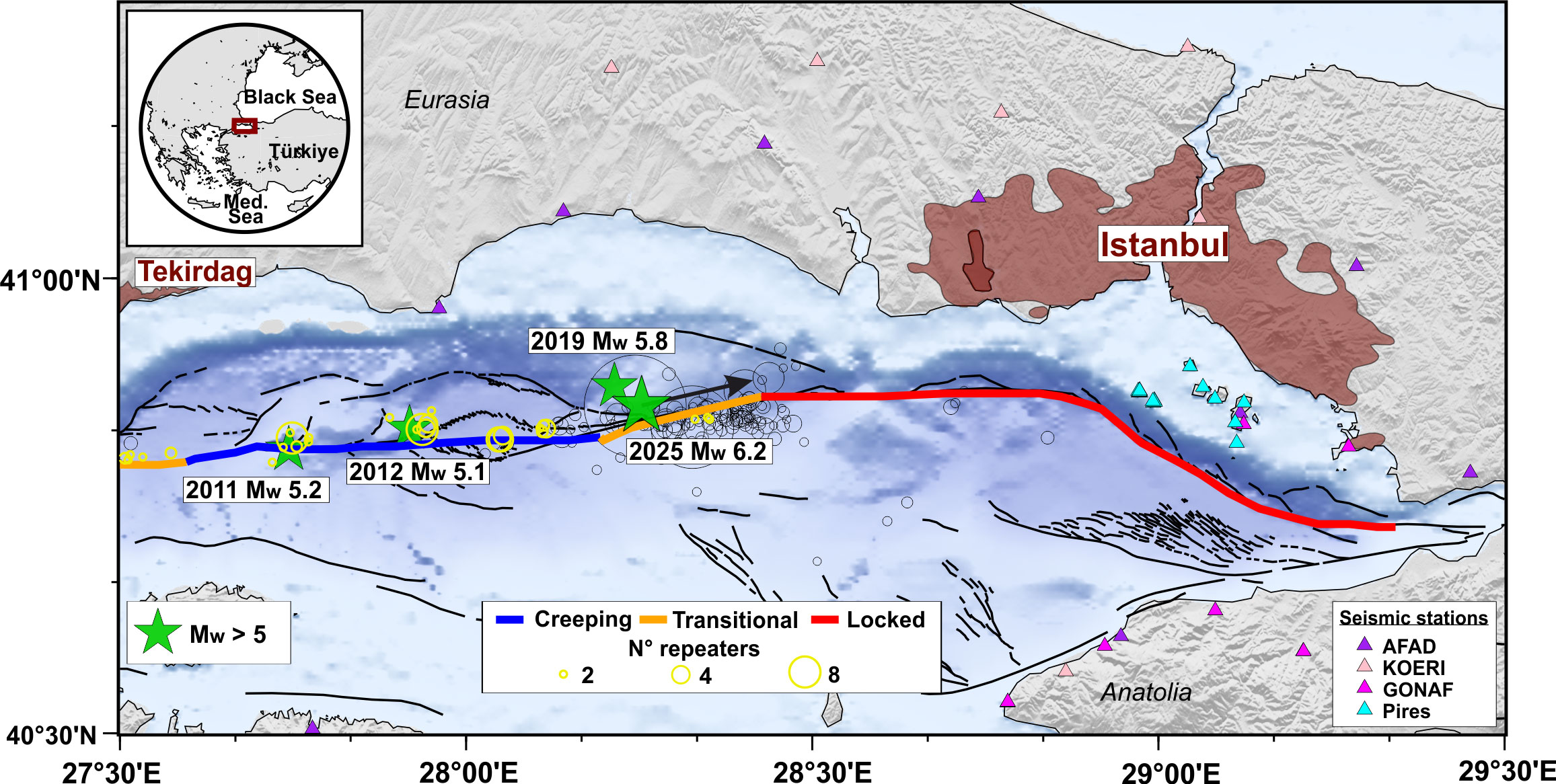
Researchers analyzing two decades of seismic data have uncovered a striking eastward migration of earthquakes along the Main Marmara Fault.

In April 2025, the Main Marmara Fault beneath the Sea of Marmara in northwestern Türkiye experienced its strongest earthquake in more than sixty years. Researchers have now examined the event in detail using nearly two decades of seismic observations.

Their findings, published in Science, come from a team led by Prof. Dr. Patricia Martínez-Garzón of the GFZ Helmholtz Centre for Geosciences in Potsdam, Germany. By studying rupture behavior and aftershock activity across multiple time scales, the scientists identified a sequence of earthquakes greater than magnitude 5 that has steadily progressed eastward along the fault during roughly the past fifteen years. These earthquakes have affected both slowly moving creeping sections and tightly stuck locked sections of the fault.

The results help clarify how stress has been building across the region. Because the remaining locked portion of the fault near Istanbul could produce an even stronger earthquake, potentially threatening the megacity of about 18 million people, the researchers emphasize the need for continuous real time monitoring in the area.

Historical earthquake cycles along the Main Marmara Fault

The Main Marmara Fault (MMF) is considered the most hazardous fault zone in the broader European region. It is the only section of the plate boundary along the North Anatolian Fault Zone between the Eurasian and Anatolian plates that has not produced a large earthquake greater than magnitude 7 since 1766.

Historical records that extend back more than two thousand years show that major earthquakes in the region occur on average every 250 years. Based on this pattern, scientists believe the Main Marmara Fault is already late in its seismic cycle and may be approaching another major rupture.

Diagram of Marmara Fault Earthquake Sequence 

Analyzed earthquake sequence along the Marmara fault in the Sea of Marmara off the megacity of Istanbul: Green stars mark moderate earthquakes with a magnitude of M>5, circles of various sizes mark the aftershocks. The chronological sequence shows the eastward movement. The different sections of the fault are marked in color: blue is the creeping segment, orange is the transition zone and red is the currently locked segment where a major earthquake could occur. Credit: Patricia Martínez-Garzón 

Earlier research by GFZ scientists showed that the Main Marmara Fault is divided into several distinct segments. In the western portion, known as the creeping section, as much as about half of the tectonic energy is released gradually through slow fault movement that does not produce noticeable earthquakes. This process has been identified through the study of small earthquakes that repeatedly occur in the same locations, known as repeaters. Moving eastward along the fault, creeping activity decreases in what researchers call a transitional section....

....MUCH MORE 

The big risk is further north, the NAF.

July 30, 2017
An Istanbul Earthquake: Since 1939 The Magnitude 7+ Quakes Are Moving Progressively Closer To Istanbul
This is just a heads-up, we are not following in Joe Granville's footsteps* and getting into the earthquake predicting business.

In July 20's "Risk:Today's 6.7-Magnitude Turkish Earthquake Was Not The 'Big One'" we noted:
"The epicenter is just offshore southwestern Turkey while  the 'big one' is expected in Istanbul's backyard...." and mentioned the North Anatolian Fault (NAF):

https://upload.wikimedia.org/wikipedia/commons/f/f8/Anatolian_Plate.png

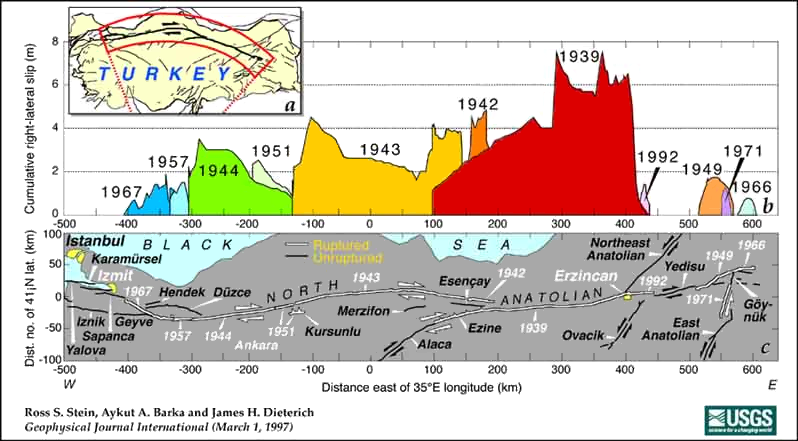
Here's the problem. The strong earthquakes along the NAF, pictured inside the red crescent in the small map below, have been steadily moving west toward Istanbul, population 14.6 million:

https://upload.wikimedia.org/wikipedia/commons/8/89/Slip-dist.png
Source: From the USGS via Wikipedia:

The 1939 earthquake was a 7.8 magnitude and killed 32,000.
The 1942 quake, epicenter 200 km further west was a  magnitude 7.0 and killed ~3000.
The 1943 and 1944 earthquakes were both measured at 7.2 and killed 2800 and 3900 respectively.
The 1957 quake, a 7.1, killed 52 people and the 1967 quake also a 7.1 killed 86.

As can be seen in the top panel both of the latter earthquakes resulted in much less lateral slippage of the land compared to the earlier quakes, meaning the stresses were still building.

Finally the 1999 Izmet earthquake—not shown on this 1997 representation—was another 150 km closer to Istanbul. It measured 7.6 and killed over 17,000 people. The lateral slippage was 5.7 meters.

So don't be surprised if one morning in the next 5 to 10 years you wake up and there is some very bad news coming out of Istanbul.

*Our octa- and nona- genarian readers may recall Joe Granville.
From a 2008 post:
NYT, published: January 11, 1981
Joseph Granville doesn't use the word ''forecasting.'' He prefers to say that he applies to the stock market a ''theory'' that he declines to reveal but whose results he communicates to clients in a weekly investment newsletter.
Last week, as his latest bullish issue was still in the mails, Mr. Granville's theory suddenly turned bearish and advised selling. That advice, transmitted to about 3,000 clients in emergency telephone calls, triggered a selloff that drove the Dow Jones industrial average down 23.80 points and resulted in a new one-day volume record on the New York Stock Exchange. The next day, Mr. Granville predicted an earthquake of Richter magnitude 8.3 would hit Los Angeles in May.
From the New York Times:

NOTES ON PEOPLE; As a Seismologist, He's a Good Stock Analyst
By ALBIN KREBS AND ROBERT MCG. THOMAS (NYT); Metropolitan Desk
April 11, 1981, Saturday
Late City Final Edition, Section 1, Page 16, Column 3, 224 words

When Joseph Granville, the Wall Street analyst, told the 3,000 subscribers to his Granville Market Letter to ''sell everything,'' they had enough faith in him to trigger the Dow Jones industrial Average into tumbling 23.8 points Jan. 8. It was the heaviest trading day in the history of the ...
Always remember that earthquakes can be tricky for equity analysts.

Tuesday, February 24, 2026

Chips: "Samsung, SK Hynix Drive Korea Benchmark’s Breakthrough Past 6000"

From Bloomberg, February 24:

  • South Korea’s equity benchmark, the Kospi Index, has advanced to a record, powered by surging global memory demand and the country’s biggest chipmakers.
  • Korea’s stock market capitalization has moved past France’s, with the benchmark now up for 2026, and corporate governance reforms have helped fuel the rally.
  • Analysts remain broadly bullish, citing the ongoing memory crunch and sustained AI demand, with some forecasting the Kospi gauge to reach as high as 8,000 in the first half of the year.

South Korea’s equity benchmark has crossed a new milestone just a month after surpassing the once-unthinkable 5,000 mark, as surging global memory demand powers the country’s biggest chipmakers.

The Kospi Index advanced as much as 2.6% to a record 6,123 Wednesday, with Samsung Electronics Co. and SK Hynix Inc. each gaining more than 2%. With the benchmark now up 45% for 2026, Korea’s stock market capitalization has also moved past

France’s, following last month’s overtaking of Germany’s.

Long overlooked by foreign funds despite being undervalued, Korean stocks have now emerged as clear winners in the global market. The so-called “AI scare trade” has proven a boon for the country, where software stocks play only a minor role and hardware manufacturers continue to drive the market higher. Corporate governance reforms have helped fuel the rally, with parliament 

to pass a bill later Wednesday requiring companies to cancel treasury shares.

The latest gain is part of a global tech rally following Meta Platforms Inc.’s deal to buy chips and computers from Advanced Micro Devices Inc. to power AI models

“With the Kospi now at 6,000, upside from here is likely to be more incremental, and sustainability will depend on earnings delivery and a meaningful broadening beyond a handful of semiconductor heavyweights,” said Jung In Yun, chief executive officer at Fibonacci Asset Management Global. “Absent that, some consolidation or rotation across sectors wouldn’t be surprising.”....

....MUCH MORE 

Wednesday, February 18, 2026

"OpenAI, SpaceX and other IPOs could break the S&P 500, Jeremy Grantham says"

Ummm, yes.*

From Mark Hulbert at MarketWatch, February 17:

How an overheated IPO market this year could derail U.S. stocks 

     IPO excitement would be a challenge for the stock market.

Jeremy Grantham has a new and provocative argument for why the U.S. stock market will produce mediocre returns this year.

Grantham is the co-founder of GMO, the Boston-based investment firm. He has been bearish on the U.S. stock market for more than a decade and, so far at least, he’s been wrong.

Yet Grantham commands a wide following on Wall Street. Though early in forecasting both the bursting of the internet bubble and the bear market during the global financial crisis, Grantham had the last laugh. Most stock-market analysts would disagree with Grantham’s current bearishness, but worry that they dismiss his arguments at their peril. 

Grantham’s latest bearish case is that U.S. stocks could be sabotaged this year by an overheated IPO market. In a recent 2026 outlook event at GMO, Grantham said:

“My prediction is that 2026 is going to see a level of IPO excitement that we haven’t seen in a while. My guess is that at least two of the private giants (OpenAI, Anthropic, SpaceX) will go public, and this is likely to put pressure on the U.S. market later in the year. … Post-IPOs, initially, maybe the market rises, but longer term, as more stockholders are able to monetize, that will create a challenge for the U.S. market.”

How much of a challenge for the stock market would such IPO “excitement” cause? GMO calculates that, historically, a 1% increase in the stock market’s total market capitalization because of IPOs corresponds to a 7.5% decrease in the market’s subsequent 12-month return.

Since the U.S. stock market’s total market cap is currently around $50 trillion, a 1% increase would require an IPO from a company with a value of at least $500 billion. The AI companies Grantham mentions would come close to that threshold or exceed it, given their recent valuations in the private market....

....MUCH MORE
*
Subjects near and dear: supply, demand, liquidity etc. 

October 2008 - IPOs Produce Smallest Gains Since 1995 as Offerings Increase

Supply and demand. The one effect I can guarantee is the sopping up of billions of dollars and yuan* that would otherwise go into currently trading issues. IPO exits are not only a sign of a top but actually help bring them on by removing some liquidity....

December 2018 - "Nasdaq, 'Tech,' & IPOs are in for Gut-Wrencher"

The Fed's interest rate moves are not that big a deal.
I know that runs counter to a lot of commentary but the upticks are not a problem. Yet.
The bigger headwind facing the market is the Fed's balance sheet unwind sucking up liquidity.
And next year's planned mega-IPOs threatening to do the same....

September 2025 - "US IPO Activity On Track For Best Quarter Since Q1 2022"

This is what we were referring to introducing August 6's "Blackstone prepares portfolio companies for IPOs":

One of the reasons markets trend higher is a lack of new shares coming on to the market.

Over the last few months the IPO window has been opening and the offerings absorb buying power that would otherwise go into issues already trading.

See also: supply/demand.

The Wall Street marketeers are nothing if not opportunistic.

And depending on how much stuff they are primping, packaging, and pushing, this is why stock offerings tend to mark the short/intermediate-term tops in markets.

Just something to be aware of, not a hard and fast rule.

Regarding Mr. Grantham, though he is historically early—keeping in mind that if you are too early, you're not early, you're wrong, I think he is right about the market direction later this year, if not the exact trigger we will point back to.

Anyhoo, we've been keeping track of the G-man's prognostications for a very long time. Here's the outro from a December 2022 post:

....Grantham's problem, shared by moi, is that just because one sees an anomaly, there really isn't any reason to think the market will act on it in the time frame that you think it might.

Way back in 2010 we were posting "Grantham’s ‘Horrifically Early’ Calls Challenge GMO".

Fast forward to June 2020 and Mr. G. was going short, which we dutifully noted. Followed by November 2020's: "Grantham's Short Call Cost His Hedge Fund Over $2 Billion".

One example of where Mr. Grantham isn't just early but wrong is seen in 2012's: 

Vaclav Smil Takes on Jeremy Grantham Over Peak Fertilizer

We posted the whole of Mr. Grantham's Nov. 15 Nature piece for fear it would go behind Nature's paywall.
To date it hasn't. Also to date I haven't come through on my assurance in Nov. 24ths "Jeremy Grantham "On the Road to Zero Growth" as His Co-head of Asset Allocation Does the Full Monty". I promise I'll get to it.

We have almost as many posts on Professor Smil as we do on Mr. Grantham. This is the first time they've been together. I feel very uncomfortable being on the opposite side of Mr. G on just about anything but in this case Smil is right.

From The American:
Jeremy Grantham, Starving for Facts....

Finally, as one commenter at Cowen's Marginal Revolution put it: 

Jeremy Grantham sells ideas for a living. He is and always will be primarily a salesman, and he is very good at his job. A salesman wants to persuade you by engaging you in any way possible, but in particular by engaging your emotions. He is not interested in a deep understanding of all sides of an issue; he only needs to know enough to engage you. A deeper understanding would in fact be harmful to his needs, as his certainty is part of the appeal; a deeper knowledge would lead to doubts and uncertainties that might un-nerve the buyer.

Mr. Grantham avoids a deeper understanding of the ideas he is peddling almost instinctively; he is not so much argumentative as dismissive; he does not concede that there is any doubt at all to dispute. He doesn't truly care about the long term; he is selling medium-term fear to short-term clients. He only needs (or wants) to know enough to complete the sale. Personally, I'm not buying, but I can see why he is successful as a salesman. As a font of wisdom, not so much. The interview was interesting only in so far as it made clear how people are profiting from promoting apocalyptic climate fear.

And from October 2019:

How Good (or bad) Are GMO and Jeremy Grantham's Market Calls?

Tuesday, February 10, 2026

Construction: Dodge Momentum Index Falls In January, Data Centers Remain Strong

First up, from SteelMarketUpdate, February 6:

Dodge: Nonres slips in January, data centers remain a bright spot 

The Dodge Momentum Index (DMI) fell 6.2% in January to 272.7, retreating from December’s downwardly revised reading of 291.0, according to the latest data released by Dodge Construction Network.

The decline signaled a moderation in nonresidential planning activity after a strong finish in 2025. Commercial planning also declined, down 7.2% to a reading of 358.2 for the month, while institutional planning eased 4.4% to 198.6 vs. December.

“Planning momentum cooled in January across most commercial and institutional sectors,” said Sarah Martin, associate director of forecasting at Dodge Construction Network.

And while data center projects remain a driver, Martin added that “after elevated activity in late 2025, most nonresidential sectors are now easing into a more sustainable growth pattern.”....

....MUCH MORE 

And at Dodge Construction Network, February 6:

Dodge Momentum Index Declines 6% in January 

Nonresidential Planning Levels OffData Centers Continue to Support Strong Levels

The Dodge Momentum Index (DMI), issued by Dodge Construction Network, declined 6.3% in January to 272.7 (2000=100) from the downwardly revised December reading of 291.0. Over the month, commercial planning fell 7.2% and institutional planning momentum slowed by 4.4%.  

“Planning momentum cooled in January across most commercial and institutional sectors,” said Sarah Martin, Associate Director of Forecasting at Dodge Construction Network. “Data center projects continue to lead the way, but after elevated activity in late 2025, most nonresidential sectors are now easing into a more sustainable growth pattern.” 

On the commercial side, planning momentum slowed across all commercial sectors apart from retail stores. Within institutional planning, education, healthcare and public building planning slowed in January – while recreational and religious building projects continued to expand.  

Year-over-year, the DMI was up 29% when compared to January 2025. The commercial segment was up 26% (+17% when data centers are removed) and the institutional segment was up 34% over the same period.  

A total of 35 projects valued at $100 million or more entered planning throughout January. The largest commercial projects included the $500 million IEP Data Center (Project Hummingbird) in Monongahela Township, Pennsylvania, the $400 million Mountain Road Technology Park Data Center in Glen Allen, Virginia, and the $350 million Bitfarm Data Center in Nesquehoning, Pennsylvania. The largest institutional projects to enter planning were the $250 million USACE Barracks in Fort Hood, Texas, the $175 million UEPH Barracks at Joint Base Myer-Henderson in Arlington, Virginia, and the $148 million Eurofins Lancaster Biopharmaceutical Laboratory and Office Building in Lancaster, Pennsylvania....

....MUCH MORE 

Thursday, January 29, 2026

"Tesla (TSLA) Q4 2025 Earnings Call Transcript" January 28, 2025

Speaking of humanoids...

From Motley Fool Transcripts, January 28: 

Call participants
  • Chief Executive Officer — Elon Musk
  • Chief Financial Officer — Vaibhav Taneja
  • Vice President, Vehicle Engineering — Lars Moravy
  • Director, Autopilot Software — Ashok Elluswamy
  • Head of Investor Relations — Travis Axelrod
Takeaways
  • Automotive margins excluding credits -- Improved sequentially from 15.4% to 17.9%, supported by positive regional mix effects despite 16% lower deliveries.
  • Total gross margin -- Exceeded 20.1%, the highest in over two years, achieved despite lower fixed cost absorption and tariff impacts.
  • Energy revenue -- Reached nearly $12.8 billion, increasing 26.6% year over year, with high deployments across MegaPack and Powerwall in all regions.
  • Energy gross profit -- Achieved a new quarterly record, attributed to strong global demand and high deployments.
  • FSD paid customers -- Climbed to nearly 1.1 million worldwide, with about 70% representing upfront purchases.
  • FSD model shift -- Transitioned fully to a subscription-based sales model, with short-term negative margin impact expected for automotive.
  • Free cash flow -- Ended the quarter at $1.4 billion.
  • CapEx for next year -- Forecasted to exceed $20 billion, with spending targeted at six factories, AI compute infrastructure, and fleet expansion.
  • Bitcoin holdings impact -- Net income negatively affected by a 23% quarter-over-quarter drop in the value of Bitcoin holdings.
  • Operating expenses -- Increased sequentially by $500 million, mainly due to higher stock-based compensation and charges linked to operation Maestro under the 2025 CA performance award.
  • Services and other margin -- Declined from 10.5% to 8.8%, primarily from increased employee-related costs tied to service center ramp-up for the expanding fleet.
  • Backlog -- Ended the year with a larger backlog than in recent years, attributed to record deliveries in smaller international markets and increased demand in APAC and EMEA.
  • Model S and X production -- CEO Musk said, "We expect to wind down S and X production next quarter and basically stop production of Model S and X next quarter."
  • Optimus production plan -- Plans include converting Fremont's S and X line into an Optimus robot factory with an annual capacity goal of one million units.
  • Robotaxi fleet -- CEO Musk stated, "We are well over 500 [robotaxi] vehicles at this point between the Bay Area and Austin," noting a monthly doubling pace.
  • CyberCab production start -- CEO Musk said, "We expect to start production in April," indicating an S-curve ramp expectation and long-term production surpassing other vehicle models.
  • AI compute investment -- Major investment planned in AI chips, compute infrastructure, and future in-house semiconductor manufacturing (TerraFab), not included in current CapEx guidance.
  • Battery supply constraint -- Described as the biggest global constraint, with ongoing solutions such as integrating 4,680 cells in nonstructural packs.
  • Energy backlog and outlook -- Strong, globally diversified backlog with increased deployment expected from the launch of MegaPack 3 and Mega Block, though margin compression is anticipated from competition, policy uncertainty, and tariffs.
Risks
  • Energy margins face compression from increased low-cost competition, policy uncertainty, and tariffs according to management outlook.
  • Automotive margins may see short-term pressure from the transition to a subscription-based FSD sales model.
  • Net income negatively impacted by a 23% depreciation of Bitcoin holdings and unfavorable foreign exchange from intercompany borrowings.
  • Long-term supply risk cited by CEO Musk: "if we don't do the Tesla TerraFab, we're going to be limited by supplier output of chips," referencing potential chip and memory shortages.
Summary

Tesla (TSLA +0.31%) delivered sequential improvement in automotive margins, record gross margins, and strong revenue growth in energy, while preparing for a transformative shift with higher future capital expenditures and the wind-down of legacy vehicle production. Management outlined aggressive expansion plans focusing on autonomous vehicle and robotics, massive investments in AI compute and factories, and a pivot to a subscription model for FSD, all supported by a robust backlog but tempered by margin and supply chain pressures articulated for the year ahead.

  • CEO Musk announced the end of Model S and X production next quarter, reallocating Fremont capacity for Optimus robot manufacturing.
  • The CyberCab, a fully autonomous vehicle with no steering wheel or pedals, is scheduled for production start in April and is expected to become the highest-volume model longer-term.
  • FSD adoption reached nearly 1.1 million paid customers, with a full transition to a subscription model expected to impact short-term automotive margins.
  • Record quarterly and annual energy results were reported, with management forecasting continued growth but flagging risk of margin compression.
  • AI chip and compute investments are set to increase further, and management signaled plans for domestic semiconductor manufacturing to address long-term supply risks.
  • Robotaxi deployment exceeded 500 vehicles in service and is reportedly doubling monthly, with substantial infrastructure and service network investment to support growth.
Industry glossary
  • FSD (Full Self-Driving): Tesla's advanced driver-assistance system offering full driverless vehicle operation, marketed as a software feature on its vehicles.
  • Optimus: Tesla's humanoid robot platform, developed for general-purpose automation tasks, with manufacturing now prioritized at scale.
  • CyberCab: Tesla's dedicated fully autonomous two-passenger vehicle designed for transportation as a service, without driver controls.
  • TerraFab: Proposed large-scale Tesla semiconductor fabrication facility integrating AI logic, memory, and packaging for internal needs.
  • 4,680 cells: Tesla's proprietary high-energy-density battery cells, integrated into vehicle packs to address production constraints.
  • MegaPack: Tesla's commercial-scale battery storage product for utilities and large energy users, contributing to energy segment growth.
  • Powerwall: Tesla's home energy storage solution supporting its residential and small business energy business.
  • Operation Maestro: Internal designation for a performance-based stock compensation program referenced in fiscal Q4 2025 financials.

Full Conference Call Transcript....

....MUCH MORE 

In early pre-market action the stock is up $12.84 (+2.98%) at $ 443.30. 

Wednesday, January 14, 2026

"Fed up with independence"

From EuroIntelligence, January 12:

We are amazed at the capacity some people have for outrage about Donald Trump. If you accept, as we have, that he is dismantling the world of multilateralism and of independent technocracy, none of this should really come as a surprise. Not all of the mud he throws out will stick. But some of it will. This is a battle on which he will prevail. We are exiting the world, in which central banks were run by economists. Once it’s gone, our prediction is that it won’t come back.

We should remember why societies accepted central bank independence in the first place. Until the 1990s, central bank independence was the exception. Monetary policy is part of economic policy. Like any economic policy, it has distributional consequences. It is not a natural state of affairs for monetary policy to be independent. The reason why societies adopted central bank independence since the 1990s was a high degree of consensus that the primary goal of monetary policy should be to preserve price stability – after the experience of the 1970s and 1980s. Since monetary policy acts over the medium-term, a central bank that did not have to worry about electoral cycles would be in a position to deliver a more consistent policy.

Trump himself is evidence of the fact that the consensus is over. It’s not just central bank. During the age of financial globalisation, the governance of economic affairs was delegated to independent national and international institutions. Economics was progressively taken out of the democratic process. Fiscal policy has become subject to rules and rule by fiscal councils like Britain’s OBR. Some countries accepted private-sector kangaroo courts to adjudicate in trade and investments disputes.

Central bank independence was the epitome of a world run by experts. The Fed and the regional reserve banks employ some 700-800 PhD level economists. If you take the ECB and the national central banks together, you will probably also arrive at a number of approximately several hundreds as well. Careers are at stake. Add to this the PhD economists employed by banks and the financial media to engage in the dark art of central bank watching.

The FT carried an article recently according to which the economics profession is facing a recession. To us this looks more like a structural slump, rather than a cyclical downturn. Employment opportunities are becoming scarcer. And younger people are more likely to study economics. We would expect macroeconomic models, whose forecasting recording has been generally appalling, to be replaced with modern-era machine learning models....

....MUCH MORE 

Monday, January 12, 2026

Construction Leading Indicator Continues Higher

 From Dodge, January 8:

Dodge Momentum Index Grows 7% in December 

Economic Risks Persist, but Key Sectors Signal Positive 2027 Outlook 

BOSTON, MA – January 8, 2026  The Dodge Momentum Index (DMI), issued by Dodge Construction Network grew 7.0% in December to 296.8 (2000=100) from the upwardly revised November reading of 277.4. Over the month, commercial planning improved 3.5% and institutional planning increased by 14.9%. In 2025, the DMI was up 37% from the average reading in 2024. The commercial portion was up 35% and the institutional portion was up 43% over the same period. 

“Nonresidential construction starts (excluding manufacturing and transportation) are projected to accelerate in 2027 alongside sustained planning momentum in data center, healthcare and recreational building construction throughout 2025,” stated Sarah Martin, Associate Director of Forecasting at Dodge Construction Network. “Inflationary pressures will further support nominal activity levels, even as economic risks remain elevated. Notably, projects moved through the planning process marginally quicker in 25-Q4 (16 months vs. 18 months in 25-Q3), offering a modest boost to our near-term outlook.” 

On the commercial side, planning momentum accelerated most strongly for warehouses, office buildings and data centers. Within institutional planning, education and recreational building activity showed the strongest growth, while planning for public buildings pulled back after elevated activity in mid-2025. Year-over-year, the DMI was up 50% when compared to December 2024. The commercial segment was up 45% (+30% when data centers are removed) and the institutional segment was up 60% over the same period.   

A total of 34 projects valued at $100 million or more entered planning throughout December. The largest commercial projects included four phases of the Google Data Center Campus in Summit, Oklahoma – each valued at $500 million dollars. Additionally, Phases 2 and 3 of the Central Park Data Information Processing Center in Loxahatchee, Florida entered planning – valued at $473 million and $431 million respectively. The largest institutional projects to enter planning were the $450 million Atrium Health Hospital in Fort Mill, South Carolina, the $295 million St. Joseph Hospital Tower (Phase 2 Expansion) in Stockton, California, and the $182 million SunRay Casino and Park in Clovis, New Mexico....

https://www.construction.com/wp-content/uploads/2026/01/dec25-dmi-graph.png 

....MUCH MORE, including video 

Wednesday, December 24, 2025

Mohamed A. El-Erian: "Beware of Central Economic Forecasts for 2026"

Also, the Ides of March, but that is still a ways away.

From Project Syndicate via FA=Magazine, December 18:

Forecasting a central scenario for the U.S. economy in 2026 appears to be a straightforward exercise. But the probability that this baseline forecast would materialize probably does not exceed 50%: the “normal” bell distribution has been replaced by one with unusually “fat tails”: the probability of more extreme outcomes, both virtuous and vicious, is significant and equally possible. The U.S. economy is not so much on a single trajectory as it is locked in a tense tug-of-war between three distinct futures: a “Goldilocks-lite” central baseline, a productivity-fueled upside scenario, and a volatile downside scenario.

The central scenario envisions a relatively strong economy, which continues to defy predictions of a cyclical downturn and gradually builds secular strength, owing primarily to robust AI-related investment. By next year, the United States will be moving on from the currently dominant infrastructure phase of the AI revolution—the frenetic build-out of data centers and hardware—and will include more integration. Capital expenditure will remain historically high, driven by the dual imperative of working “on” and “with” AI. 

Complementing this corporate dynamism is a still-resilient consumer base, supported by accommodative fiscal and monetary policies. The American household has proven to be a durable growth engine, albeit a weakening one. With the fiscal taps open, and the Federal Reserve poised to reduce interest rates, it may well remain so, despite elevated prices that hit lower-income households particularly hard. But sticky inflation will remain a reality. While price increases might not be severe enough to de-anchor expectations, they will likely remain above the Fed’s target, precluding a return all the way to the ultra-low interest rates of the 2010s.

This scenario also includes the crystallization of an unsettling phenomenon: the decoupling of employment from GDP. Historically, robust economic growth has been inextricably linked to strong job creation. But this relationship appears to be under pressure, meaning that growth in 2026 may be accompanied by a relatively stagnant labor market. Such jobless growth would exacerbate the K-shaped nature of the economy’s performance. As such, affordability will remain a social and political flashpoint, keeping inequality at the forefront of the national discourse.

This is a central scenario that includes a lot of “dispersion,” and not just domestically. Internationally, the U.S. significantly outperforms other major economies. Hampered by structural rigidities, the eurozone and the United Kingdom remain trapped in a low-growth, low-investment equilibrium. With China’s efforts to upgrade its growth model progressing slowly, the U.S. will serve by far as the global economy’s primary engine—a concentration that creates its own set of risks.

As for the “fat tail” scenarios, their probabilities are roughly equal, offering reasons for both hope and anxiety. On the right-hand side, one finds a tantalizing vision of an economy that doesn’t merely grow but accelerates, while also expanding future capacity. In this scenario, faster-than-anticipated AI adoption, combined with robotics, is translated into tangible, economy-wide productivity gains, enabling the U.S. to pull further ahead of other major economies.

If this “productivity promise” materializes rapidly enough, the U.S. could experience a non-inflationary boom. Because the supply side expands rapidly enough to meet rising demand, inflation remains in check. This is a Goldilocks scenario on steroids: a technology-driven expansion that expands corporate margins and increases tax revenues, potentially alleviating fiscal pressures and enabling the Fed to cut rates more aggressively....

....MUCH MORE