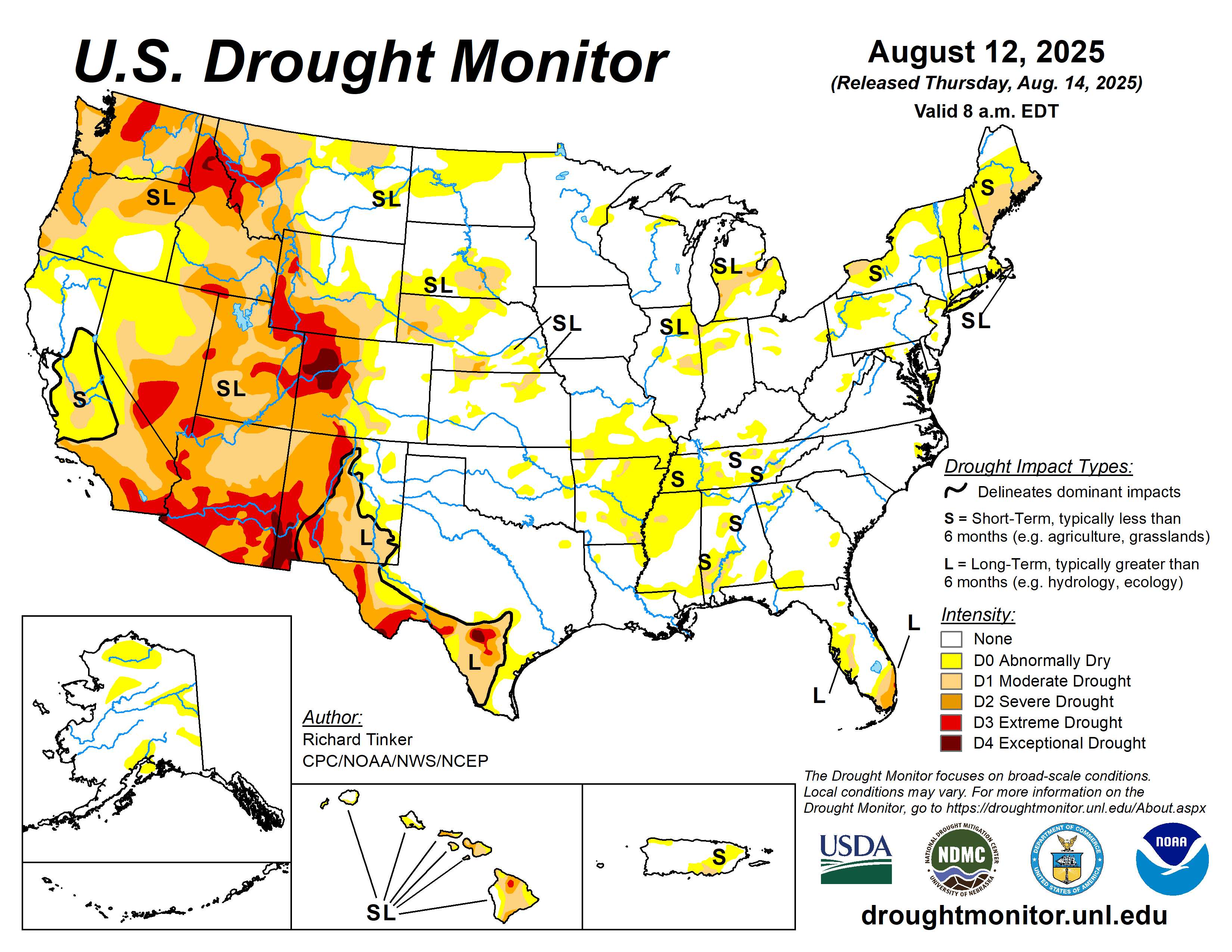
This is the first time this year we've posted the Drought Monitor map.
There seems to be an El Niño developing off the coast of South America which would mitigate some of the dryness in the southern and central U.S. Meaning that as all around you are losing their heads shouting "drought, drought" there would be wetter weather just over the horizon which would ruin any long futures one had on corn, beans or wheat.
However! If the arrival of the moisture is delayed much past July 1 it could be just awful for the farmers. So this is a heads-up but not actionable. Yet.
Layering one complex/chaotic system, financial derivatives, on top of another complex/chaotic system, weather can get interesting in ways even the best supercomputers haven't quite figured out.
From the University of Nebraska-Lincoln, May 14 (data through May 12):
This Week's Drought Summary
This week was defined by a significant precipitation divide, highlighted by a major deluge across parts of the South and Gulf Coast. Persistent storm systems funneled heavy moisture into Louisiana, Mississippi, and Alabama, where total rainfall reached 4 to 6 inches—and in some coastal pockets even higher—representing departures of 3 to 5 inches above seasonal norms. While an active frontal corridor brought a secondary band of moderate rain (1 to 3 inches) from Texas through the Ohio Valley and into the Northeast, the Western U.S. remained exceptionally dry, with most areas west of the Rockies receiving less than 0.1 inch of rain. This lack of moisture, paired with blustery winds, triggered extreme fire danger across the Upper Missouri Valley, though the period concluded with a pattern shift as a significant Pacific low-pressure system finally moved onshore to deliver moisture to the Northwest.
Temperature patterns showed an equally sharp geographical split, with unseasonable warmth gripping the West and parts of the South while a late-spring chill lingered over the North. In the Southwest and South Texas, summer-like heat took a firm hold as Rio Grande Village, Texas, hit a national high of 105°F and Death Valley consistently reached the triple digits; overall, the Western U.S. averaged 5 to 15°F above normal. Conversely, a significant cool-down settled over the Northern Plains and Upper Midwest, where the Dakotas and Minnesota experienced temperatures 5 to 15°F below seasonal averages. This thermal contrast was further sharpened by winter-like conditions in high-elevation regions of the West, where stations in Utah recorded lows as cold as 10°F, even as record-challenging warmth began to expand across the Pacific Northwest and the Southern Border states.
Northeast
The Northeast region experienced a pronounced late-spring chill coupled with a sharp geographical divide in precipitation. Average temperatures ranged from 39°F–48°F in northern portions of the region to 60°F–66°F in parts of Maryland and Delaware. Temperatures were below normal across nearly the entire region, with the most significant cold anomalies concentrated in New York and Pennsylvania; in these areas, departures reached 6°F to over 10°F below average. Precipitation patterns were equally divergent, featuring a surplus in the north and west but deficits in the south. Heavy moisture was concentrated in Western New York, Northwestern Pennsylvania, and much of Maine, where precipitation amounts ranged from 0.45 to 1.8 inches above normal. Moderate (D1) to severe (D2) drought, along with abnormal dryness (D0) were improved in Maine. Conversely, rainfall totals were below-normal across southern portions of the region, with precipitation deficits generally falling between 0.45 and 1.35 inches below normal. Severe (D2) drought was expanded in northern Massachusetts, Delaware, and southern portions of Pennsylvania, New Jersey and West Virginia, while moderate (D1) drought was expanded in Massachusetts, Rhode Island, Connecticut and southern Pennsylvania this week.
Southeast
Much of the Southeast experienced below-normal temperatures this week, where temperatures were 5°F to 10°F below normal. Florida, Georgia, and parts of Alabama and South Carolina were the exception, where averages were in the 80s—up to 10 degrees above normal. Exceptional precipitation totals (1.5 to 3.0 inches) were recorded across much of Alabama, and portions of Georgia and the Florida Panhandle. Localized accumulations in these areas reached 4 to over 7 inches, representing significant departures of 3 to 6 inches above normal. Weekly rainfall totals of 1.5 to 3.0 inches extended from southern Appalachian region to south-central North Carolina. Exceptional (D4) drought was removed from south-central North Carolina and northeast Georgia, and improved in the Florida Panhandle. Extreme (D3) drought improved across parts of northern Florida, Alabama, Georgia, and the Carolinas. Rainfall totals were below normal from northern portions of North Carolina, Virginia, and much of the Florida Peninsula, observing deficits of 0.5 to 1.5 inches. Extreme (D3) drought was expanded in central and southern portions of Virginia and slightly into a northern pocket of North Carolina, while moderate (D1) drought to extreme (D3) drought were expanded in southeast Florida.
South
The Southern region experienced a stark contrast in both precipitation and temperature during the week, defined by torrential Gulf Coast rains and a significant late-spring chill across the interior. Precipitation was most intense across the central Gulf Coast, particularly in Louisiana and southern Mississippi, where weekly totals reached 7 to over 9 inches. These amounts represent exceptional departures of 6 to 7.5 inches above normal. Moderate (D1) to Exceptional (D4) drought was reduced in southern and eastern portions of Texas, and in parts of Louisiana, Mississippi, and southern Tennessee. Abnormal dryness (D0) was improved in parts of Texas and southern Louisiana. Conversely, drier conditions prevailed in West Texas, Oklahoma, and much of the Tennessee Valley, where precipitation was generally 1.5 to 3 inches below average. Exceptional (D4) was introduced in southwest Oklahoma and from the Texas Panhandle into northwest Oklahoma, and expanded in parts of Arkansas and northern Mississippi. Extreme (D3) expanded in northern portions of Texas and western Oklahoma. Heat persisted in southern Texas, where average temperatures reached the 80s and 90s, representing departures of up to 5°F above normal. However, a powerful cold anomaly gripped the northern, eastern, and central portions of the region. In these areas, temperatures were broadly 5 to 10°F below normal for the week.
Midwest
The Midwest region experienced a widespread late-spring chill and a stark contrast in moisture levels between the north and south. Temperatures were broadly below average across the entire region, with the vast majority of the Midwest observing departures of 5 to 10°F below normal. Average temperatures ranged from a cool 30–40°F along the northern border of Minnesota and Wisconsin to the more seasonable 60–70°F in the southern reaches of Missouri and Kentucky. Precipitation was notably sparse across the northern half of the region, including Minnesota, Wisconsin, Iowa, and Michigan, where totals remained under 0.1 inches, resulting in departures of 0.5 to 1.5 inches below normal. In contrast, the southern tier—particularly across parts of Kentucky, southern Missouri, and the Ohio Valley—saw more active weather with precipitation totals ranging from 1.5 to over 3 inches, leading to surpluses of 0.5 to 1.5 inches and resulting in the reduction of severe (D2) and extreme (D3) drought in western parts of Kentucky. However, moderate (D1) to extreme (D3) drought was expanded in portions of central and eastern Kentucky, where rainfall amounts were below normal. Abnormal dryness (D0) was also expanded in parts of Minnesota, western Iowa, southern Missouri, and in pockets of Indiana and Ohio....
High Plains
....MUCH MORE