Property & Casualty insurers could see earnings fall by an average of 26% after Hurricane Sandy, Morgan Stanley analyst Gregory Locraft wrote today.
Insured losses are expected to be at least $5 billion, with some estimates rising as high as $15 billion, Locraft notes, relying on data from multiple catastrophe modeling firms. These kinds of major events, however, tend to see losses rise over time.
Morgan Stanley is “[l]owering fourth quarter P&C carrier EPS an average 26% with primary players bearing the brunt of losses. Our 4Q EPS assumes $7-10b in Sandy losses (1.4-2x Hurricane Irene) and is allocated based on (1) Irene experience and (2) market share in affected states. We note there is little cushion left for future 4Q cat losses with 2 months remaining.”
Among the companies that could take a big earnings hit are ACE (ACE), AIG (AIG), Allstate (ALL), Chubb (CB), and Travelers (TRV). Of those, Locraft slashed his estimates for Chubb, Travelers, and AllState by more than 40% each....MORE
Wednesday, October 31, 2012
Property & Casualty Insurer Earnings Could Take 26% Hit from Sandy: Morgan Stanley (ALL; CB; TRV)
From Barron's Stocks to Watch Today column:


UBS to Exit Trading in Major Commodities
From BusinessWeek:
UBS Said to Plan Closing Oil, Base Metals, Agriculture Trading
Climateer Line of the Day: Bailing on Commodities Edition
The Death of Commodities
"CalPERS fails to make money in commodities: John Kemp"
And from 11 mnths ago:
"Phase Shift" - JP Morgan Downgrades All Commodities To "Sell"
UBS Said to Plan Closing Oil, Base Metals, Agriculture Trading
Related:UBS AG (UBSN) plans to close its oil, base metals and agriculture trading desks as Switzerland’s biggest lender shrinks its investment bank, according to a person with direct knowledge of the decision.The bank plans to keep its index-investor products and precious-metals trading, said the person, who asked not to be identified because the details are private. UBS declined to comment...MORE
Climateer Line of the Day: Bailing on Commodities Edition
The Death of Commodities
"CalPERS fails to make money in commodities: John Kemp"
And from 11 mnths ago:
"Phase Shift" - JP Morgan Downgrades All Commodities To "Sell"
"Sandy spending hopes drive rally for recovery companies" (Generac up 20%) GNRC; HD
GNRC $33.90 + 19.9%.
From Reuters:
Just a Reminder: Reverse All Hurricane Trades As Soon as Possible
Stocks that May Benefit from a Hurricane Sandy Landfall (GNRC; BGG; CB)
Okay, So the World's Going to Hell in a Handbasket: Do You Own the Largest Backup Generator Maker? (GNRC)
From Reuters:
Hurricane Sandy has caused tens of billions of dollars in damage up and down the U.S. East Coast, but the recovery and reconstruction spending that will follow could pump an almost equal amount right back into the economy, driving a rally for some stocks as markets reopened on Wednesday.
Companies like environmental cleanup specialist Clean Harbors (CLH.N), building supply chains Home Depot (HD.N) and Lowe's (LOW.N), building products makers Owens Corning (OC.N) and Beacon Roofing (BECN.O) and generator manufacturer Generac Holdings (GNRC.N) surged in early trading, on the assumption that the recovery from Sandy will take years and boost sales.
Lumber futures also soared, hitting daily limits and shutting trading, on assumptions about demand.
Economists and insurers call the phenomenon "demand surge," or the increased cost to repair or replace damaged property after a disaster, when people are competing for a limited supply of resources in a way that pushes prices up.Previously:
University of Maryland professor Peter Morici estimated this week that reconstruction spending might equal 80 percent of the total economic losses caused by Sandy....MORE
Just a Reminder: Reverse All Hurricane Trades As Soon as Possible
Stocks that May Benefit from a Hurricane Sandy Landfall (GNRC; BGG; CB)
Okay, So the World's Going to Hell in a Handbasket: Do You Own the Largest Backup Generator Maker? (GNRC)
Infographic: "The Insanely Great History of Apple" (AAPL)
Every product back to the Apple I.
From Pop Chart Lab:

HT: CubicleBot
From Pop Chart Lab:

(click to enlarge, rollover to zoom)
HT: CubicleBot
The New York Federal Reserve Bank on the Underwriter's Greenshoe in the Facebook IPO (FB; DealBreaker)
From the New York Fed's Liberty Street blog:
How Hard Did Morgan Stanley Try To Lose Money On The Facebook IPO?
Stocks are usually offered in initial public offerings (IPOs) at a discount, leading to large first-day IPO returns. When there is a risk of a negative initial return, underwriters are known to actively support the aftermarket price of a stock through buying activities. In this post, we look at the trading book for Facebook stock on May 18, 2012, the day of its highly anticipated IPO. Using what we call a “large integer–price bid” identification assumption to indirectly infer which investors are bidding, we find evidence of significant trading by underwriters seeking to stabilize the stock’s price. This evidence suggests that underwriters incurred significant costs as a result of these activities.HT to DealBreaker who writes:
In an IPO, a company sells its shares to the public on a securities exchange for the first time. IPOs are generally conducted with the assistance of one or more investment banks acting as underwriters. The underwriters play three roles in the IPO process: They provide the company with procedural and financial advice, they buy the issue from the company, and they resell it to the public. A major task of the underwriters is setting the IPO price. The finance literature finds that IPOs are generally underpriced in the short run and overpriced in the long run. To date, there is no consensus on the drivers of these patterns (Ritter and Welch 2002).
The underwriters in an IPO try to get the price of its shares “right” by gauging demand in roadshows and conducting their own analysis. In addition, however, the issuing firm may offer underwriters a way of reducing initial market price volatility that is known as the over-allotment or “greenshoe” option. Under this option, which is sanctioned by the Securities and Exchange Commission, the underwriters sell to the public a certain number of extra shares, usually 15 percent of the issuance, in addition to the original offering that they purchased from the issuing firm. If demand for the stock is unexpectedly high, the extra shares reduce upward price pressure and are issued to the underwriters retroactively at the IPO price. However, if demand for the stock is unexpectedly low, the underwriters buy back the extra shares in the marketplace, thus helping to stabilize the price. In economic terms, the “greenshoe” option lends some elasticity to the supply of shares so that the price impact of demand fluctuations is dampened. As explained by Aggarwal (2000) and Lewellen (2006), this over-allotment option is the main mechanism used by underwriters to stabilize the price. In the case of Facebook, the underwriters were given the right to sell slightly more than 63 million additional shares, 15 percent of the issuance of about 421 million shares.
Writing about the Facebook IPO in a post on the blog Dealbreaker, Matt Levine found evidence of stabilizing trades by dealers in the fact that about 43 million Facebook shares were exchanged exactly at the IPO price of $38 on the IPO day. Is there any additional support for this interpretation or evidence of other such trades during the day?...MORE
How Hard Did Morgan Stanley Try To Lose Money On The Facebook IPO?
Let’s disclose some conflicts of interest. I want to be all “go read this post from the NY Fed’s Liberty Street blog about the Facebook IPO greenshoe, it’s good, you’ll like it,” but I have this nagging sense that I’m mostly saying that because the New York Fed cited Dealbreaker, and what are the odds of that, so I want you to see it with your own eyes. But the post is fun, if you like this sort of thing, so, now you’ve got the recommendation and the disclosure, make your own call.1
Anyway the Fed researchers look at the Facebook IPO and the underwriters’ price stabilizing activity on its first trading day, Friday May 18. And they note, as I did, that there was a whole lot of buying at the IPO price of $38, which was probably largely due to the underwriters and which kept the stock above $38 going into the weekend before it cratered Monday morning. But they also note that there was a whole lot of buying at $40, which kept the stock above $40 for … 15 minutes....MUCH MORE
Chartology: Deere vs. Caterpillar (CAT; DE)
DE $85.29 -.21%, CAT $84.59 +.41%.
From Dragonfly Capital:
From Dragonfly Capital:
Many eyes are focusing on the price action in Deere, $DE. After it broke above 83.75, resistance since February, the stock looks ready to keep traveling higher. Currently attempting to move higher out of a bull flag it has resistance at 87 and 88 before free air to move higher and the Measured Move would take it to 90. With support from a bullish and rising Relative Strength Index (RSI) and a
Deere, $DE
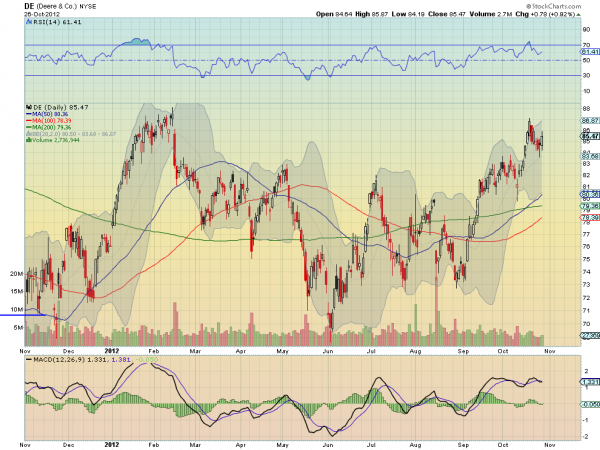
Moving Average Convergence Divergence indicator (MACD) that is crossing to positive it is truly a great trade set up. But if you move a little earth, digging below the surface, there might be a better play in beaten up Caterpillar, $CAT. The ratio chart below of Caterpillar to Deere carries a lot of information. There are two trendlines that help define the bullish and bearish picture over the last 3 years...MORE
Interview: "Elon Musk’s Mission to Mars" (TSLA)
From Wired Science:
When a man tells you about the time he planned to put a vegetable garden on Mars, you worry about his mental state. But if that same man has since launched multiple rockets that are actually capable of reaching Mars—sending them into orbit, Bond-style, from a tiny island in the Pacific—you need to find another diagnosis. That’s the thing about extreme entrepreneurialism: There’s a fine line between madness and genius, and you need a little bit of both to really change the world.
All entrepreneurs have an aptitude for risk, but more important than that is their capacity for self-delusion. Indeed, psychological investigations have found that entrepreneurs aren’t more risk-tolerant than non-entrepreneurs. They just have an extraordinary ability to believe in their own visions, so much so that they think what they’re embarking on isn’t really that risky. They’re wrong, of course, but without the ability to be so wrong—to willfully ignore all those naysayers and all that evidence to the contrary—no one would possess the necessary audacity to start something radically new.
I have never met an entrepreneur who fits this model more than Elon Musk. All of the entrepreneurs I admire most—Musk, Jeff Bezos, Reed Hastings, Jack Dorsey, Sergey Brin and Larry Page, Bill Gates, Steve Jobs, and a few others—have sought not just to build great companies but to take on problems that really matter. Yet even in this class of universe-denters, Musk stands out. After cofounding a series of Internet companies, including PayPal, the South African transplant could simply have retired to enjoy his riches. Instead he decided to disrupt the most difficult-to-master industries in the world. At 41 he is reinventing the car with Tesla, which is building all-electric vehicles in a Detroit-scale factory. (Wired profiled this venture in issue 18.10.) He is transforming energy with SolarCity, a startup that leases solar-power systems to homeowners.
And he is leading the private space race with SpaceX, which is poised to replace the space shuttle and usher us into an interplanetary age. Since Musk founded the company in 2002, it has developed a series of next-generation rockets that can deliver payloads to space for a fraction of the price of legacy rockets. In 2010 SpaceX became the first private company to launch a spacecraft into orbit and bring it back; in 2012 it sent a craft to berth successfully with the International Space Station.
It’s no wonder the character of Tony Stark in Iron Man, played by Robert Downey Jr., was modeled on Musk: This is superhero-grade stuff. I sat down with him at Tesla’s Fremont, California, factory to discuss how cheaper and (eventually) reusable rockets might someday put humans on Mars.
Chris Anderson: You’re not a rocket scientist by training. You’re not a space engineer.
Elon Musk: That’s true. My background educationally is physics and economics, and I grew up in sort of an engineering environment—my father is an electromechanical engineer. And so there were lots of engineery things around me. When I asked for an explanation, I got the true explanation of how things work. I also did things like make model rockets, and in South Africa there were no premade rockets: I had to go to the chemist and get the ingredients for rocket fuel, mix it, put it in a pipe.
Anderson: But then you became an Internet entrepreneur.
Musk: I never had a job where I made anything physical. I cofounded two Internet software companies, Zip2 and PayPal. So it took me a few years to kind of learn rocket science, if you will.
Anderson: How were you drawn to space as your next venture?
Musk: In 2002, once it became clear that PayPal was going to get sold, I was having a conversation with a friend of mine, the entrepreneur Adeo Ressi, who was actually my college housemate. I’d been staying at his home for the weekend, and we were coming back on a rainy day, stuck in traffic on the Long Island Expressway. He was asking me what I would do after PayPal. And I said, well, I’d always been really interested in space, but I didn’t think there was anything I could do as an individual. But, I went on, it seemed clear that we would send people to Mars. Suddenly I began to wonder why it hadn’t happened already. Later I went to the NASA website so I could see the schedule of when we’re supposed to go. [Laughs.]...MORE
"Share Portfolios and Risk Management in the Early Years of Financial Capitalism: London 1690-1730" (special bonus: "Prop Trading the South Sea Bubble")
The first part is the title of a paper that Jason Zweig commends to our attention.
From the Wall Street Journal's Total Return blog:
Can You Trust Your Stockjobber?
Prop Trading the South Sea Bubble: Hoare's Bank 1720
From the Wall Street Journal's Total Return blog:
Can You Trust Your Stockjobber?
How much has investing behavior evolved since earliest days of trading in the financial markets?From earlier this year, some deep insight into the activities of a knowledgeable investor in:
A fascinating new research paper analyzes how individual investors built stock portfolios soon after building portfolios first became possible: from 1690 to 1730.
The researchers, led by the distinguished financial historian Larry Neal of the University of Illinois, painstakingly replicated all the holdings and trades in the Bank of England, the East India Co. and the United East India Co., the Royal African Co., the Hudson’s Bay Co., the Million Bank and the South Sea Co. These were the dominant companies at the birth of the British capital markets three centuries ago. The share registries survive, so the scholars were able to match virtually every investment with the person who held it – encompassing 5,813 investors during the 1690s and 23,723 by the end of the period.
These people included everyone from dukes and other aristocrats to “stockjobbers,” or brokers, along with merchants, apothecaries, glassmakers, drapers and goldsmiths – and up to 27% of them were women.
Three centuries ago, investors:
Women appear to have had more-conservative portfolios than men....MORE
- underdiversified, with 86% of them owning shares in only a single stock;
- chased performance, with rising prices leading to higher trading volume;
- underperformed the market as a whole, earning lower returns and incurring higher risk.
Prop Trading the South Sea Bubble: Hoare's Bank 1720
I've mentioned the archives at Hoare's bank a few times, firstly, I believe, in "South Sea Bubble Survivor Says Dismantle RBS Along With Lloyds":
*From deep in the link-vault comes a tiny treasure, an analysis of Hoare's trading during the South Sea bubble (15 page PDF):
Riding the South Sea Bubble
By PETER TEMIN AND HANS-JOACHIM VOTHThis paper presents a case study of a well-informed investor in the South Sea bubble. We argue that Hoare’s Bank, a fledgling West End London bank, knew that a bubble was in progress and nonetheless invested in the stock: it was profitable to “ride the bubble.” Using a unique dataset on daily trades, we show that this sophisticated investor was not constrained by such institutional factors as restrictions on short sales or agency problems....MOREThe bank has opened their records to academics and Temin and Voth have taken full advantage.
Along with the above they published "Banking as an emerging technology: Hoare’s Bank, 1702–1742" in Financial History Review and "Private borrowing during the financialrevolution: Hoare’s Bank and its customers, 1702–24" in Economic History Review.
It's Riding the South Sea Bubble that really stands out though and is the 'tiny treasure'.
Yesterday, as I was putting "The World's First Stock Exchange (and first bear raid, first dividend, first equity derivatives...)" together I wanted to refer to RtSSB and did a quick search of the blog.
The link was broken.
The entire original purpose of this blog was to give me a database of things that caught my interest during the trading day. Hosted on Google's servers. Searchable by the Goog's algos (or anyone else).
And the damn link was broken. So I had to replace it....MORE
Hurricane Sandy May Shave 6/10% From GDP, Cost Estimates Rise to $50 Billion
Following up on our Monday post "That Which is Seen and That Which is Not Seen: Bastiat on Hurricane Sandy".
From the Wall Street Journal:
No, Hurricane Sandy Won’t Help the Economy
-Paging M. Bastiat: "So Much for Hurricanes as Stimulus, Part Deux"
From the Wall Street Journal:
Sandy is delivering a blow to the U.S. economy that will reverberate for weeks, disrupting commerce in the nation's most-populous region, destroying billions of dollars' worth of property and likely boosting gasoline prices.![[image]](http://si.wsj.net/public/resources/images/EI-BW883_ECONOM_G_20121030174333.jpg) Natalie Keyssar for The Wall Street JournalA statue of Mother Mary stood among hurricane wreckage in Queens, New York, Tuesday.
Natalie Keyssar for The Wall Street JournalA statue of Mother Mary stood among hurricane wreckage in Queens, New York, Tuesday.
Along the East Coast, some restaurants, car dealers and other retailers are likely to see sales slip. Many workers aren't being paid for lost hours. Shipments of goods through eastern seaports and airports are being delayed.
That would drain billions of dollars from the economy at a time when it already is growing sluggishly. Much of this economic activity will be delayed or shifted, such as when the money not spent in a coffee shop this week is spent on a movie next week.And other commerce will pick up as utility workers earn overtime pay, construction crews start rebuilding and homeowners buy materials to repair damage. Many grocers and home-improvement stores rang up higher sales as people prepared for the storm.
Still, the short-term damage likely will cause the economy to grow more slowly in the final three months of the year than it did over the summer, when the economy grew at a tepid 2% annual pace, forecasters said.
Consultancy IHS Global Insight estimated Tuesday that the storm could shave 0.6 percentage point off the annualized pace of growth in the nation's gross domestic product in the fourth quarter. This doesn't capture the complete impact because GDP measures the value of the economy's output of goods and services, but not the wealth destroyed....MOREU.S. News and World Report has a smaller number for the national GDP hit:
...IHS estimates that the costs associated with Sandy could total somewhere between 1 percent and 1.7 percent of gross regional product for the dozen or so states affected, which would translate to about 0.3 percent of national GDP. That might not sound like much, but it comes at a time when the overall economy is growing at a scant 2 percent, a growth rate that could slow even further as Washington grapples with the "fiscal cliff" approaching at the end of the year....Finally, Caroline Baum writes at Bloomberg:
No, Hurricane Sandy Won’t Help the Economy
Before the nonsense gets too far out of hand, let's review very briefly why natural disasters aren't a net plus for an economy.She is more charitable than I was after Irene last year:
Don't laugh. Every time some region of the world suffers the ravages of nature, economists pump out silly reports outlining the benefits. They all read pretty much the same...MORE
...Of course, Strobl and others could publish 50 papers with similar conclusions and it wouldn't stop some doofus from proclaiming that the aftermath of some hurricane or other disaster will be greater prosperity.
-Paging M. Bastiat: "So Much for Hurricanes as Stimulus, Part Deux"
"DARPA Wants Robotics to Rise to the Challenge of Disasters"
From PC Magazine:
The DARPA Robotics Challenge kicks into high gear today as the organization announces the top teams that will be competing to create robots that can prevent the compounding of human peril in manmade and natural disasters.
Spurred by the Fukushima Daiichi nuclear disaster in which the "Fukushima 50" ventured into a nightmare scenario to prevent a nuclear meltdown, DARPA is seeking robotic substitutes so that one individual's life is not weighed against dozens or more of others'.
Dr. Gill Pratt, the program manager for the challenge, noted that the program's focus on humanitarian assistance in disaster response is aligned with one of the 10 primary missions of the U.S. Department of Defense that was laid out by the White House and the Secretary of Defense in January 2012. But Pratt called attention to another reason why DARPA chose the subject of this challenge: "[W]e believe that this is very inspirational for participants because it's a universally understood and appreciated mission."
The participating teams are divided into two tracks: Track A teams will create the robots themselves as well as the software while Track B teams will be provided with the Boston Dynamics-designed Atlas robot, the descendant of Pet-Proto, and create software for it. Both teams will receive DARPA funding for their projects and they have until approximately December 2013 to complete them.
DARPA has chosen seven Track A teams from Carnegie Mellon University, Drexel University, Raytheon, SCHAFT, Virginia Tech, the NASA Johnson Space Center, and the NASA Jet Propulsion Laboratory. The 11 Track B teams are from Lockheed Martin's Advanced Technology Laboratories, RE2, the University of Kansas, Carnegie Mellon University, the Massachusetts Institute of Technology, TRAC Labs, University of Washington, the Florida Institute for Human and Machine Cognition, Ben-Gurion University, the NASA Jet Propulsion Laboratory, and TORC Robotics....MORE
Tuesday, October 30, 2012
Michael Lewis on Catastrophe Bonds and Hurricane Bets: "In Nature's Casino"
A subject near and dear to our flinty hearts.
From the New York Times Magazine:
HT: to an unrepentant quant, World Beta's Mebane Faber:
Nothing against his source, AIR Worldwide but use the figures in the latter, they came from Professor Pielke Jr. who literally wrote the book on such things.
From the New York Times Magazine:
It was Aug. 24, 2005, and New Orleans was still charming. Tropical Depression 12 was spinning from the Bahamas toward Florida, but the chances of an American city’s being destroyed by nature were remote, even for one below sea level. An entire industry of weather bookies — scientists who calculate the likelihood of various natural disasters — had in effect set the odds: a storm that destroys $70 billion of insured property should strike the United States only once every 100 years. New Orleanians had made an art form of ignoring threats far more likely than this; indeed, their carelessness was a big reason they were supposedly more charming than other Americans. And it was true: New Orleanians found pleasure even in oblivion. But in their blindness to certain threats, they could not have been more typically American. From Miami to San Francisco, the nation’s priciest real estate now faced beaches and straddled fault lines; its most vibrant cities occupied its most hazardous land. If, after World War II, you had set out to redistribute wealth to maximize the sums that might be lost to nature, you couldn’t have done much better than Americans had done. And virtually no one — not even the weather bookies — fully understood the true odds.
But there was an exception: an American so improbably prepared for the havoc Tropical Depression 12 was about to wreak that he might as well have planned it. His name was John Seo, he was 39 years old and he ran a hedge fund in Westport, Conn., whose chief purpose was to persuade investors to think about catastrophe in the same peculiar way that he did. He had invested nearly a billion dollars of other people’s money in buying what are known as “cat bonds.” The buyer of a catastrophe bond is effectively selling catastrophe insurance. He puts down his money and will lose it all if some specified bad thing happens within a predetermined number of years: a big hurricane hitting Miami, say, or some insurance company losing more than $1 billion on any single natural disaster. In exchange, the cat-bond seller — an insurance company looking to insure itself against extreme losses — pays the buyer a high rate of interest.
Whatever image pops to mind when you hear the phrase “hedge fund manager,” Seo (pronounced so) undermines it. On one hand, he’s the embodiment of what Wall Street has become: quantitative. But he’s quirky. Less interested in money and more interested in ideas than a Wall Street person is meant to be. He inherited not money but math. At the age of 14, in 1950, his mother fled North Korea on foot, walked through live combat, reached the United States and proceeded to become, reportedly, the first Korean woman ever to earn a Ph.D. in mathematics. His father, a South Korean, also came to the United States for his Ph.D. in math and became a professor of economic theory. Two of his three brothers received Ph.D.’s — one in biology, the other in electrical engineering. John took a physics degree from M.I.T. and applied to Harvard to study for his Ph.D. As a boy, he says, he conceived the idea that he would be a biophysicist, even though he didn’t really know what that meant, because, as he puts it, “I wanted to solve a big problem about life.” He earned his doctorate in biophysics from Harvard in three years, a department record.
His parents had raised him to think, but his thoughts were interrupted once he left Harvard. His wife was pregnant with their second child, and the health plan at Brandeis University, where he had accepted a job, declared her pregnancy a pre-existing condition. He had no money, his parents had no money, and so to cover the costs of childbirth, he accepted a temp job with a Chicago trading firm called O’Connor and Associates. O’Connor had turned a small army of M.I.T. scientists into options traders and made them rich. Seo didn’t want to be rich; he just wanted health insurance. To get it, he agreed to spend eight weeks helping O’Connor price esoteric financial options. When he was done, O’Connor offered him 40 grand and asked him to stay, at a starting salary of $250,000, 27 times his post-doc teaching salary. “Biophysics was starved for resources,” Seo says. “Finance was hurling resources at problems. It was almost as if I was taking it as a price signal. It was society’s way of saying, Please, will you start solving problems over here?”This piece was originally published on August 26, 2007 i.e. three weeks after the "Quant Quake" (NYFed 77 page PDF) and over a year ahead of that glorious September of '08.
His parents, he suspected, would be appalled. They had sacrificed a lot for his academic career. In the late 1980s, if you walked into the Daylight Donuts shop in Dallas, you would have found a sweet-natured Korean woman in her early 50s cheerfully serving up honey-glazed crullers: John’s mom. She had abandoned math for motherhood, and then motherhood for doughnuts, after her most promising son insisted on attending M.I.T. instead of S.M.U., where his tuition would have been free. She needed money, and she got it by buying this doughnut shop and changing the recipe so the glaze didn’t turn soggy. (Revenues tripled.) Whatever frustration she may have felt, she hid, as she did most of her emotions. But when John told her that he was leaving the university for Wall Street, she wept. His father, a hard man to annoy, said, “The devil has come to you as a prostitute and has asked you to lie down with her.”
A willingness to upset one’s mother is usually a promising first step to a conventional Wall Street career. But Seo soon turned Wall Street into his own private science lab, and his continued interest in deep questions mollified even his father. “Before he got into it, I strongly objected,” Tae Kun Seo says. “But now I think he’s not just grabbing money.” He has watched his son quit one firm to go to work for another, but never for a simple promotion; instead, John has moved to learn something new. Still, everywhere he goes, he has been drawn to a similar thorny problem: the right price to charge to insure against potential losses from extremely unlikely financial events. “Tail risk,” as it is known to quantitative traders, for where it falls in a bell-shaped probability curve. Tail risk, broadly speaking, is whatever financial cataclysm is believed by markets to have a 1 percent chance or less of happening. In the foreign-exchange market, the tail event might be the dollar falling by one-third in a year; in the bond market, it might be interest rates moving 3 percent in six months; in the stock market, it might be a 30 percent crash. “If there’s been a theme to John’s life,” says his brother Nelson, “it’s pricing tail.”
(Page 2 of 10)
And if there has been a theme of modern Wall Street, it’s that young men with Ph.D.’s who approach money as science can cause more trouble than a hurricane. John Seo is oddly sympathetic to the complaint. He thinks that much of the academic literature about finance is nonsense, for instance. “These academics couldn’t understand the fact that they couldn’t beat the markets,” he says. “So they just said it was efficient. And, ‘Oh, by the way, here’s a ton of math you don’t understand.’ ” He notes that smart risk-takers with no gift for theory often end up with smart solutions to taking extreme financial risk — answers that often violate the academic theories. (“The markets are usually way ahead of the math.”) He prides himself on his ability to square book smarts with horse sense. As one of his former bosses puts it, “John was known as the man who could price anything, and his pricing felt right to people who didn’t understand his math.”
In the mid-1990s, when Wall Street first noticed money to be made covering the financial risks associated with hurricanes and earthquakes, it was inevitable that someone would call John Seo to ask him if he could figure out how to make sense of it. Until then, he had specialized in financial, not natural, disasters. But there was a connection between financial catastrophe and natural catastrophe. Both were extreme, both were improbable and both needed to be insured against. The firm that called him was Lehman Brothers, whose offer enticed Seo to quit his job and spend his first year at Lehman learning all he could about the old-fashioned insurance industry.
Right away, he could see the problem with natural catastrophe. An insurance company could function only if it was able to control its exposure to loss. Geico sells auto insurance to more than seven million Americans. No individual car accident can be foreseen, obviously, but the total number of accidents over a large population is amazingly predictable. The company knows from past experience what percentage of the drivers it insures will file claims and how much those claims will cost. The logic of catastrophe is very different: either no one is affected or vast numbers of people are. After an earthquake flattens Tokyo, a Japanese earthquake insurer is in deep trouble: millions of customers file claims. If there were a great number of rich cities scattered across the planet that might plausibly be destroyed by an earthquake, the insurer could spread its exposure to the losses by selling earthquake insurance to all of them. The losses it suffered in Tokyo would be offset by the gains it made from the cities not destroyed by an earthquake. But the financial risk from earthquakes — and hurricanes — is highly concentrated in a few places.
There were insurance problems that were beyond the insurance industry’s means. Yet insurers continued to cover them, sometimes unenthusiastically, sometimes recklessly. Why didn’t insurance companies see this? Seo wondered, and then found the answer: They hadn’t listened closely enough to Karen Clark.
Thirteen years before what would become Tropical Storm Katrina churned toward Florida — on Monday, Aug. 24, 1992 — Karen Clark walked from her Boston office to a nearby Au Bon Pain. Several hours earlier, Hurricane Andrew had struck Florida, and she knew immediately that the event could define her career. Back in 1985, while working for an insurance company, Clark wrote a paper with the unpromising title “A Formal Approach to Catastrophe Risk Assessment in Management.” In it, she made the simple point that insurance companies had no idea how much money they might lose in a single storm. For decades Americans had been lurching toward catastrophe. The 1970s and ’80s were unusually free of major storms. At the same time, Americans were cramming themselves and their wealth onto the beach. The insurance industry had been oblivious to the trends and continued to price catastrophic risk just as it always had, by the seat of its pants. The big insurance companies ran up and down the Gulf Coast selling as many policies as they could. No one — not even the supposed experts at Lloyd’s of London — had any idea of the scope of new development and the exposure that the insurance industry now had.....MUCH MORE
HT: to an unrepentant quant, World Beta's Mebane Faber:
Cat BondsYou'll note that his list of natural catastrophes shows lower estimated normalized losses than those in our earlier post "What was the Most Expensive Hurricane Ever to Hit the United States?".
Nothing against his source, AIR Worldwide but use the figures in the latter, they came from Professor Pielke Jr. who literally wrote the book on such things.
"Iranian State TV Uses Still From ‘Day After Tomorrow’ In Story About Sandy"
From Gawker:
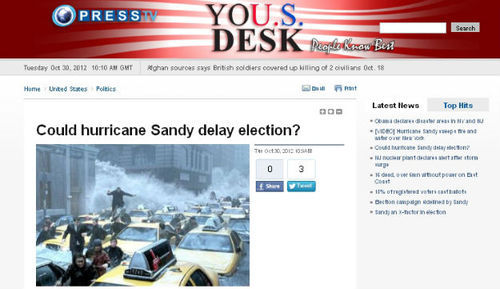
This is not like the Iranian leadership we've come to know and love..
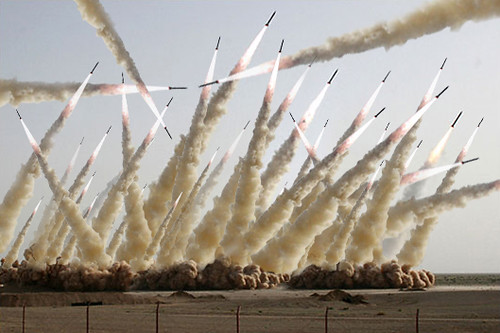
Back in 2008 we posted "Oil: Iran has Photoshop, not afraid to use it". The government, in order to shake the war-monger stick by showing off their new rocketry published this picture:

One problem.
The rocket 3rd from the left is an obvious fake and as soon as this was brought to their attention the Ayatollahs acknowledged the fact and published the pictures of the actual missile test::
Twitter was not the only source of fake photos of Sandy hitting New York City. The state-owned Iranian news agency Press TV used a still from Jake Gyllenhaal vehicle The Day After to accompany an article about Sandy’s affect on the presidential elections today. They wish....MORE
(Gawker links but doesn't attribute the story to Foreign Policy's Passport blog)
This is not like the Iranian leadership we've come to know and love..
Back in 2008 we posted "Oil: Iran has Photoshop, not afraid to use it". The government, in order to shake the war-monger stick by showing off their new rocketry published this picture:
One problem.
The rocket 3rd from the left is an obvious fake and as soon as this was brought to their attention the Ayatollahs acknowledged the fact and published the pictures of the actual missile test::
Don't fear the reaper.
Credit: Cowicide
Climateer Tweet of the Day
More correctly, last night:
Co-proprietor of When in Finance.
(eternal gratitude to one of the denizens of Alphaville for the WIF link)
SKIRT @talktoskirt
Guys, 911 is for life/death emergencies only. Other calls, use 311. General complaining and/or phone sex: tweet me.#sandy
(eternal gratitude to one of the denizens of Alphaville for the WIF link)
What was the Most Expensive Hurricane Ever to Hit the United States?
If you said Katrina you have been taken in by the media hype and short term fixation.
I will quit babbling about the Great Miami Hurricane, at least for a while.
Some methodology from the Pielke et al paper "Normalized Hurricane Damage in the United States:
1900–2005" that we linked to on Saturday:
From Roger Pielke Jr's blog:
I will quit babbling about the Great Miami Hurricane, at least for a while.
Some methodology from the Pielke et al paper "Normalized Hurricane Damage in the United States:
1900–2005" that we linked to on Saturday:
This paper normalizes mainland U.S. hurricane damage from 1900–2005 to 2005 values using two methodologies. A normalization provides an estimate of the damage that would occur if storms from the past made landfall under another year’s societal conditions. Our methods use changes in inflation and wealth at the national level and changes in population and housing units at the coastal county level. Across both normalization methods, there is no remaining trend of increasing absolute damage in the data set, which follows the lack of trends in landfall frequency or intensity observed over the twentieth century.
The 1970s and 1980s were notable because of the extremely low amounts of damage compared to other decades. The decade 1996–2005 has the second most damage among the past 11 decades, with only the decade 1926–1935 surpassing its costs....MORE
From Roger Pielke Jr's blog:
...Here is a table showing the top 20 hurricane losses 1900 to 2011, normalized to 2012 dollars. In other words, the figures show an estimate of what the losses would be were historical storms to occur in 2012. The numbers come from ICAT based on an extension of Pielke et al. 2008.
STORM NAME LANDFALL DATE DAMAGE RANK DAMAGE ($ 2012) Great Miami Sep 18,1926 1 180,220,000,000 Galveston Sep 08,1900 2 105,570,000,000 Galveston Aug 17,1915 3 84,910,000,000 Katrina Aug 29,2005 4 84,620,000,000 Andrew Aug 24,1992 5 64,410,000,000 Storm 11 in 1944 Oct 19,1944 6 53,940,000,000 Donna Sep 10,1960 7 49,810,000,000 New England Sep 21,1938 8 46,840,000,000 Lake Okeechobee Sep 16,1928 9 44,890,000,000 Wilma Oct 24,2005 10 25,960,000,000 Hazel Oct 18,1954 11 24,260,000,000 Diane Aug 19,1955 12 24,110,000,000 Camille Aug 17,1969 13 23,040,000,000 Charley Aug 13,2004 14 20,380,000,000 Ike Sep 13,2008 15 20,370,000,000 Hugo Sep 21,1989 16 20,020,000,000 Carol Aug 31,1954 17 19,290,000,000 Agnes Jun 22,1972 18 19,010,000,000 Ivan Sep 16,2004 19 18,590,000,000 Storm 2 in 1949 Aug 26,1949 20 18,510,000,000
While it will be some time until we have apples to apples estimates from Sandy, the current estimates of $20 billion would place Sandy at #17 all time out of 242 loss-producng storms 1900 to present (in the top 10%). If the damage gets to $30 billion it would crack the top 10 and (top 5%). Right now it seems unlikely that Sandy will climb any higher on the table. (Note that inland flood damage is not included in the tabulations above.)...MORE
"The 2011 Report That Predicted New York's Subway Flooding Disaster"
From The Atlantic Cities:
DUE TO SEA LEVEL RISE." (58 page PDF)
Last fall, as part of a massive report on climate change in New York, a research team led by Klaus Jacob of Columbia University drafted a case study that estimated the effects of a 100-year storm on the city's transportation infrastructure. Considering MTA Chairman Joseph Lhota’s comments today that Hurricane Sandy's impact on the subway was "worse than the worst case scenario," it seems pretty safe to put Sandy in the 100-year category. In that case, assuming the rest of the report holds true, the subway system could be looking at a recovery time of several weeks, with residual effects lasting for months and years.Those Atlantic links are broken, here's "RISK INCREASE TO INFRASTRUCTURE
The researchers modeled a potential 100-year storm that consisted of either a category 1 or 2 hurricane hitting nearby, or a severe nor’easter that coincided with high tide. (As we know now, Sandy was a hybrid of all three events.) The models predicted complete flooding of several tunnels after such an event, including all the tunnels in the East River:
Based on their models, Jacob and colleagues wrote that a 100-year storm could leave roughly 1 billion gallons of water to be pumped from the city’s network of subway tunnels. (To give you an idea of scale, that’s equal to the average daily consumption of drinking water in the city.) If all 14 tunnels flooded, it would take about five days to pump each one clear, according to the report. However that’s the best-case scenario; a week per tunnel is more likely....MORE

DUE TO SEA LEVEL RISE." (58 page PDF)
"Consumers, farmers squeezed as grain giants tighten grip" (ADM; BG)
From Reuters via Pakistan's Dawn (Urdu edition):

—Reuters (File Photo)
LONDON: A global race for grain trading power is putting more of the world’s vital cereals in the hands of fewer companies, with a string of recent acquisitions raising fears that consumers will pay even more for their food, while farmers are squeezed.
Archer Daniels Midland last week bid for Australia’s last independent grain handler GrainCorp, the latest in a series of moves by grain trading heavyweights to grab a larger slice of a booming market as developing economies seek food security.
The four “ABCD” firms, ADM, Bunge, Cargill and Louis Dreyfus, dominate global grain trading along with top global commodities trader Glencore and Japan’s Marubeni, both of which have made major acquisitions in the last few months.
With food price volatility increasingly coming to the fore, most recently in the wake of drought in the US and other key producing regions, concern is growing among importers about extra upward pressure on prices.
“The increasing concentration of power in the global grain market is not healthy. This will lead to grain prices being controlled by top trading companies,” said Rusman Heriawan, deputy agriculture minister of Indonesia, Asia’s top wheat importer.
The United Nations sounded alarm bells on market volatility this summer as corn alone surged around 40 per cent in less than a month. Soybeans hit record highs, while wheat also shot up dramatically, reviving memories of the 2007/08 food crisis.
“So-called grain majors account for about 75 per cent of the global grain market. If they keep on merging with other grain companies, there is the possibility of a monopolistic situation,” said Han Sukho of the grains division at the Korea Rural Economic Institute.
“This will make things difficult for importing countries like South Korea. We might have to pay more than what things actually cost,” the assistant director of the state-run think-tank added.
South Korea is a major importer of both wheat and maize.
OPERATIONAL EFFICIENCY
After a doubling in quarterly profits helped by the impact of drought on the grain trade, Bunge Chairman and Chief Executive Officer Alberto Weisser said on Thursday that he expected industry consolidation to continue.
“I do believe that we will have more consolidation because the market has shown that it is necessary to have large companies” with geographically diverse assets and strong balance sheets “to operate and serve the market in these volatile times,” he said. “We are part of it.”...MORE
Greece Coalition Splinters, Austerity Vote Delayed, PM Warns of 'Chaos'...
Throw in a little Yeats* and you have the perfect 'Greece' headline.
From Mish's Global Economic Trend analysis:
From Mish's Global Economic Trend analysis:
In Greece, Prime Minister Antonis Samaras coalition has split. The result is yet another delay in an austerity vote required for the next tranche of loans to Greece, and the PM warns of 'chaos'.*Something like this light hearted little bit:
Greece's conservative Prime Minister Antonis Samaras is at odds with the Democratic Left party, a coalition partner, which is threatening to vote against the new austerity measures unless labor reforms included in them are scrapped.Another Puppet Show or Is This For Real?
Samaras formed a coalition with the traditional rival Socialists and the Democratic Left after general elections in June. In a statement, the prime minister said he had "exhausted all the available time" to try and reach a consensus.
"The problem is not whether we (introduce) this measure or that measure. On the contrary: It is what we would do if no agreement is reached and the country is led into chaos."
Unemployment in Greece has topped 25 percent, with rapidly worsening poverty that has prompted the Democratic Left to harden its position.
"There are certain issues for us that are fundamental — like labor issues," Theodoros Margaritis, a senior member of the Democratic Left party, told private Skai television. "The dilemma is with Mr. Samaras. Does he want a left-wing party in his government or not? Does he want our consent on certain issues or does he want to proceed alone? If he wants, he may proceed alone."
Cracks in Greece's coalition government are likely to be tested late Tuesday when lawmakers are set to vote on a privatization bill. The new law would give the government broader powers to privatize public utilities, but is facing growing dissent from deputies in the Socialist party and Democratic Left.
Is the inevitable about to happen or is this simply another puppet show for the masses?...MORE
Turning and turning in the widening gyre
The falcon cannot hear the falconer;
Things fall apart; the centre cannot hold;
Mere anarchy is loosed upon the world,
The blood-dimmed tide is loosed, and everywhere
The ceremony of innocence is drowned;
The best lack all conviction, while the worst
Are full of passionate intensity....
-W.B. Yeats, The Second Coming, 1919
Short the French: Brewers battle 150% Tax Increase
Just another milepost ( borne kilométrique?) in our Short the French series.
From CNBC:
EU beer brewers refuse to swallow French suds tax
From CNBC:
Proposals by the French government to increase the tax levy on alcohol by 150 percent have met with fierce criticism, with one brewer telling CNBC firms are joining forces to fight the plans.Fraternité in the service of Liberté, or in the words of Fox news:
Research firm Bernstein Research has estimated that the beer excise duty, which could take effect from the start of next year, would rise by around 150 percent sending the retail price of beer up by 15 percent.
Danish brewer Carlsberg is just one company set to be affected and its French subsidiary Brasseries Kronenbourg told CNBC how firms are together in their cause.
“All the brewers in France are united, under the French Brewer Association's banner, in fighting the French government’s proposal to increase excise duty,” a spokesperson said....MORE
EU beer brewers refuse to swallow French suds tax
"As The Hurricane Damage Tally Begins, Here Is Who Pays"
From ZeroHedge:

The Most Exposed P&C Insurers

and Hurricane Irene Re-Insurer Losses...MORE
While it is too early to estimate the ultimate losses wreaked by Hurricane Sandy in the last 24 hours, we thought it useful to start gauging relative exposures and which companies are the most exposed. As it stands, Hurricane Katrina remains #1 of all US Catastrophes as the most-costly at $46.6bn (2011-equivalents) with 9/11 second at $38.5bn; with the worst MTA disaster in its history and the relative wealth in the areas affected, one can't help but feel like Sandy could be up there. The P&C insurance industry will bear the brunt of personal and corporate losses (as well as federal relief we pre-suppose) and is better capitalized than in the past but as JPM notes, initial estimates of losses tend to be revised upwards. The most exposed insurer is State Farm with an 11.4% share of all potential liability lines in the states impacted, followed by Allstate and Travelers. We finally note that when the P&C industry experiences losses of this magnitude, it typically leads to increased pricing for an extended period of time (as they rebuild capital bases).
The Top 10 Most Costly Catastrophes

The Most Exposed P&C Insurers

and Hurricane Irene Re-Insurer Losses...MORE
Romney Biden in 2012: 4 Possible Freak Election Outcomes
From Politico:
Could the 2012 campaign end in a tie? Is it possible for Mitt Romney to end up as president — with Joe Biden as his vice president? Could the presidential election end up decided by the U.S. Supreme Court, again?
The short answer is: probably not. To call those outcomes improbable would be a huge understatement. The strong likelihood is that one candidate will win both the Electoral College and the popular vote on Nov. 6 and bring our long 2012 slog to an end.
Monday, October 29, 2012
New York Facing Some Major Damage
From 911 Operator:
911 OPERATOR ...MORE@911BUFF
#BROOKLYN PARTIAL BUILDING COLLAPSE AT 13 AND 38 STREET.@HatzolahNYC AND@FDNY ON SCENE.#SANDY#911BUFFSEA GATE- AS PER@HatzolahNYC 20 PEOPLE TRAPPED BY WATER THAT IS UP 6 STORIES.@FDNY AND@NationalGuard TRYING TO ASSIST.#SANDY#911BUFF
 911 OPERATOR
 911 OPERATOR
Subscribe to:
Comments (Atom)