Thursday, September 17, 2026

"A tale of two Chinas – the old and new economic divide, and what it means for investors"

The author is is Chief Investment Officer Asia at Lombard Odier.

A mental framework upon which to hang the data and details. 

From Lombard Odier, July 21:

Article first published in The Business Times on 11 July here

China’s economy is split between world-leading innovation and structural weakness, making selectivity more important than ever for investors.

It was the best of times; it was the worst of times.

Charles Dickens, writing of revolutionary France, could scarcely have imagined how neatly his words would one day describe the Middle Kingdom.

China today presents a striking duality: pockets of technological excellence and global leadership, alongside a broader landscape of economic stress, weak domestic demand, and slowing momentum.

For investors, the question is not whether this duality exists – manifestly it does – but whether this duality exists — manifestly it does — but whether it is possible to navigate both “Chinas” at once: capturing exposure to genuine opportunity while avoiding the structural traps that sit alongside.

In Lombard Odier’s view, sharply accelerating high-tech and clean-tech exports should continue to anchor China’s growth outlook in 2026 despite domestic fragilities

New vs. old 
“New China” – dynamic sectors such as electric vehicles, renewables, high-tech manufacturing, and advanced digital industries – continues to show extraordinary strength and global ambition. In 2025, the country produced around 16 million electric vehicles (EVs), substantially outpacing Europe’s approximately 3.2 million and the United States’ one million units.

Similar dominance is visible in solar and battery production, where China accounts for most of global output and exports. The “new three” industries continued to post robust export growth into 2026, with notable records set in the early months.

Industrial output rose 4.5 per cent year-on-year in May 2026, accelerating from April and underscoring manufacturing resilience, particularly in coastal innovation hubs like Shenzhen and Shanghai.

Equity markets reflect this divide. New energy, technology, and innovation-related sectors have posted gains of 25 per cent year to date, while the broader Shanghai Composite, which includes more old-economy exposure, has delivered only modest returns, up roughly 2 per cent year to date.

In Lombard Odier’s view, sharply accelerating high-tech and clean-tech exports should continue to anchor China’s growth outlook in 2026 despite domestic fragilities.

In contrast, “Old China” – think smokestack industries, property, and legacy sectors – faces ongoing pressure, especially in inland and rural regions where development lags the coastal mega-cities.

The property market remains the clearest expression of that weakness. This matters because property and related construction activity once accounted for 20 to 30 per cent of the economy....

....MUCH MORE 

"King Charles Meets With A.I. Executives About Safety Risks"

From the New York Times, September 17:

The gathering in Scotland brought together industry leaders amid a growing debate about the safety risks of unchecked artificial intelligence. 

King Charles III of Britain met with executives from leading artificial intelligence companies in Scotland on Thursday, amid a growing global debate about safety risks created by the technology and whether the pace of development should be slowed down.

Executives from Nvidia, Google DeepMind, OpenAI, Anthropic and other companies were present, along with government officials and other experts, according to Buckingham Palace.

The king has no legal authority and the event will not produce new public policy. But the meeting was the first international gathering of major A.I. companies since Anthropic’s chief executive, Dario Amodei, and other industry leaders called for a coordinated slow down in A.I. development over fears that further advancement could lead to a global catastrophe. President Trump and others have said regulation is unnecessary.

“The decisions taken at this formative time will shape the world inherited by future generations,” the king will say in a speech to open the meeting, according to prepared remarks shared by the palace. “The task before you is not merely to advance technology, but to ensure that it remains firmly in the service of humanity, community and the natural world.”

Attending the meeting in Ayrshire, in southwest Scotland, were Jensen Huang, the chief executive of Nvidia; Demis Hassabis, the chair of Google DeepMind; Sarah Friar, OpenAI’s chief financial officer; and Mariano-Florentino CuĂ©llar, Anthropic’s global public affairs officer. Paolo Benanti, an adviser to Pope Leo XIV on A.I., and the heads of the British intelligence agencies MI6 and GCHQ were among other government officials and experts on hand....

....MUCH MORE 

"The Automation Paradox: America’s Hidden Bottleneck to Reindustrialization"

From American Affairs Journal, September 10, 2026: 

As an engineer, I ran maintenance for a Fortune 500 pulp and paper company. I was based at a plant in Tennessee and covered nine other facilities across the Southeast and Florida. For anyone unfamiliar with heavy industry, these plants are filled with massive, capital-intensive equipment: three-story machines stretching the length of a football field, motors running constantly, and forklifts moving across the floor to keep the plant fed with raw material. It is an environment built to run continuously. A single hour of unplanned downtime can destroy hundreds of thousands, sometimes millions, of dollars in lost production, depending on the line.

When critical systems failed, and the laws of entropy ensure they always fail, it was never a software engineer or a sleek, cloud-connected dashboard that saved the day. The facility relied entirely on technicians like “Craig,” a millwright with thirty years of accumulated tribal knowledge: the hyper-specific, undocumented expertise and nuanced understanding of legacy equipment that resides in the minds of veteran workers rather than in manuals or databases.

Craig was the kind of technician who could diagnose a failing bearing simply by the pitch of its squeal or the specific frequency of a vibration traveling through a steel walkway. He knew which parts had been replaced, which modifications had never made it into the drawings, and which repair in the manual no longer applied to the machine in front of him. Manuals capture only so much, and they capture it in two dimensions. A maintenance technician works in three, using sight, sound, touch, and years of trial and error. Maintenance is also time-sensitive. Craig could often diagnose a problem faster than a newer technician could locate the relevant drawing. The documentation existed, but during a breakdown it was frequently incomplete, outdated, or too slow to use. That way of working has a consequence. Because the knowledge lived in Craig’s head, recording it was never the priority. The plant did not feel an urgent need to document why a certain oil had been discontinued, when a control program had last been changed, or why a replacement belt differed from the one in the parts list. Craig already knew.

The difficulty of the equipment only compounds this problem. Much of America’s industrial base is brownfield infrastructure. The frames of some paper machines are a century old. Many machines have been modified so often that the original manual no longer describes what is on the floor. Like the ship of Theseus, the machine may retain its name even though nearly every important component has changed. But Craig is retiring. And nobody is taking his place. The disappearance of people like Craig is not just a “skills gap”; it is the central structural flaw in America’s current reindustrialization strategy.

Today, while I am removed from the immediate reality of that specific plant floor as an early-stage entrepreneur, I still speak regularly with factory managers and maintenance directors across the country. Beneath the macroeconomic optimism of the current manufacturing boom, I hear the same refrain in every conversation: “It is impossible to find quality guys nowadays.”

Simultaneously, Silicon Valley and Washington, D.C. find themselves unusually aligned on a singular narrative: America must reindustrialize. We must bring manufacturing home, secure critical supply chains, and rebuild the physical base of national power on American soil.1 The new consensus holds that this will require vast public subsidies and private capital expenditures, along with a new generation of “software-defined” factories.

The assumed solution to local labor shortages is straightforward: if we do not have enough frontline operators, then we should automate the production line. They are solving the obvious problem. Pushing more automation onto the floor can get the plant up and running without requiring a massive army of baseline operators to actively feed the machinery. Yet both the technocratic and venture narratives assume that automating production lines will solve our labor problem, as though the factory’s bottleneck were simply the number of hands on the assembly line rather than the number of people who can keep the machines alive.

Maintaining an industrial facility is an intensely labor-heavy endeavor. It requires highly skilled maintenance technicians—millwrights, industrial machinery mechanics, PLC programmers, electricians—who are in even shorter supply than the general blue-collar workforce because their roles demand technical schooling, apprenticeships, and years of hands-on experience.2

What policymakers and tech founders are missing is that their proposed solution is engineering a serious structural flaw into the reindustrialization roadmap. They are creating what we might call the Automation Paradox: the more you automate production to reduce your dependence on frontline labor, the more highly complex machinery you introduce into the physical environment. That machinery contains many more motors, proximity sensors, bearings, planetary gears, and pneumatic belts. In turn, one must maintain all these discrete components to keep the line running. Consequently, the automated factory requires highly skilled, specialized maintenance technicians, and the shortage of these specific mechanics is far more severe, and far more threatening, than the shortage of baseline assembly workers.

Automation so far has happened almost entirely on the production side of the factory, and there is a reason for that. Production work repeats itself and it is structured, which is what machines are good at. Maintenance is neither. It stayed manual while everything around it was automated. Production capacity can be expanded with capital; maintenance capacity still depends on how many experienced technicians live within driving distance of a plant and how many years they have spent learning the trade. The better we get at automating production, the more work lands on the one part of the plant that has no way to absorb it.

The Demographic Cliff and the Loss of Tribal Knowledge....

....MUCH MORE 

New York State Assemblymember launches $30 million effort to unify Dems on AI

From Politico, September 14:

Alex Bores launches $30 million effort to unify Dems on AI
"Who Decides" was launched by the New York state lawmaker who became one of the AI industry's chief targets when he ran for Congress on a platform focused on regulating the technology. 

A state lawmaker who gained national attention for his opposition to unchecked AI during a failed campaign for Congress this year is launching a $30 million effort to unite Democrats around regulating the technology, according to the organization’s new website.

New York Assemblymember Alex Bores is unveiling the organization — called “Who Decides” — on Tuesday to “build the winning Democratic answer to AI,” according to a website that was publicly available Monday night.

“Who Decides’ goal is that by 2028, Democratic candidates from the top of the ticket on down run with a common AI safety agenda,” reads an announcement on the site dated Tuesday. “That means addressing the harms people already see and the broader danger that increasingly powerful and out-of-control systems could destabilize our economy, our democracy, and our safety.”

It was not immediately clear whether Who Decides would be organized as a federal super PAC, 501(c)(4) nonprofit or other type of group. The website has a “donate” link that redirects to a webpage hosted by “Give Butter,” an organization focused on helping nonprofits fundraise. The announcement said the group would reject “corporate money or contributions from senior executives at frontier AI companies.”

Bores did not immediately respond to questions about the organization Monday night, including whether Bores, a sitting state lawmaker, personally fundraised for the group while holding public office. He is launching the organization with his former chief of staff, Anna Myers, the website says.....

....MUCH MORE 

Capital Markets: "US Rates Steady after Yesterday's Surge and the Greenback Consolidates"

From Marc Chandler at Bannockburn Global Forex: 

The initial reaction to the Federal Reserve rate hike was to take US rates and the dollar higher, even though the hike was well anticipated.  In addition to the dots, which showed 16 officials see another hike as likely being appropriate this year compared with six in June, Chair Warsh’s characterization of the hike as “removing a dose of accommodation” was understood as a hawkish assessment, i.e., policy is still accommodative. However, the market still seems more hawkish than the Fed and has three more hikes discounted over the next 12 months. Still, US rates are a little softer today and the dollar is consolidating.  A few weeks away from the presidential election, Brazil’s central bank cut the Selic rate by 25 bp to 13.75%, but there is little precedent for the US to change policy so close to its election, which seems to rule out another hike next month, though the Fed funds futures have slightly more than a 50% chance of it.  

As expected, the Bank of England held steady (6-3 vote), but indicated a rate hike is coming. The swaps market expects a move at the next meeting in November and the possibly (~2/3 chance) of another hike before year-end. Attention shifts to tomorrow’s Bank of Japan meeting, where a hike is widely anticipated, and the door kept open to another move in Q4....

....MUCH MORE  

"Salesforce’s Marc Benioff to AI industry: Regulate yourselves or get sued"

And on the criminal side of things, as The Atlantic pointed out: Destroying Humanity is Already Against the Law.

Now that the Anthropic/OpenAI duopoly/cartel is so hyper-aware of their positions, if even one person dies because of something the Amodei-Altman boys did or didn't do, I'd lean toward capital punishment of someone from their C-suite execs. It would concentrate their minds on their responsibilities.

From Fortune magazine, September 16:

SAN FRANCISCO, Calif. — Marc Benioff strode down Mission Street Tuesday afternoon toward Salesforce Tower, where he was set to host a private dinner as part of a whirlwind of events during the company’s annual Dreamforce conference. Some pedestrians stopped to take photos of the 6-foot-5 CEO, surprised he had taken to the streets. One person congratulated him on his keynote address earlier in the day; several bodyguards surrounded Benioff as he walked. 

Along the way, Benioff, still wearing the pinstripe suit and burgundy tie from the keynote, waved off concerns that AI could wipe out humanity, a topic that has been front-of-mind in Silicon Valley circles during the past week after Anthropic researcher Jacob Coxon quit over such worries. But Benioff, in a walking interview with Fortune, also said companies should be held accountable for risks they create, and he compared current AI issues to early mistakes made in social media.

“We know we have to hold companies responsible for their products and their technology before people are hurt,” Benioff said, while citing the Hawaiian concept of personal responsibility — kuleana — as essential for corporate ethics (Benioff has baked Hawaiian norms deeply into the San Francisco company’s culture.)....

....MUCH MORE 

Most recently from Fortune:

"Exclusive: Sam Altman addresses AI doomsday fears in new interview" (no IPO in 2026)

Wednesday, September 16, 2026

Antitrust Wunderkind Lina Khan On AI Titans

One of the things that Amodei - Altman want, in addition to new laws that they will "help" write is an exemption from antitrust law which they weren't able to influence back in Teddy Roosevelt's day (more accurately 1890 - 1914).

For readers not familiar with Ms. Khan, here is a post from eight years ago:

Antitrust: "How to Fight Amazon (Before You Turn 29)" AMZN

The New York Times has a  profile of our story's protagonist, Lina Khan, that reads as though they plan on running her for President in 2024, at which time she will have attained the legal minimum age to serve.
I feel old.
For something less gushy, here's a piece from a month ago, with a complimentary link to her Yale Law Journal article after the jump....

And from July 4, 2023 by which time she had become Chair of the Federal Trade Commission: Deals: So Bill Gates, Barack Obama, China and Jeff Bezos Walk Into A Bar ("Lina Khan Fires a Crooked CEO")

And the headline story from her X account:

Continues:

.... — a point @FTC emphasized repeatedly during my tenure.

1. There is an extensive set of laws that govern dangerous and defective products. For example, releasing unvetted AI models or agents can violate consumer protection laws. Shipping flawed AI tools without implementing adequate measures to detect and stop rogue or defective AI agents can be an “unfair or deceptive” act or practice under the FTC Act (and analogous state laws). And some state AGs are already exploring holding AI firms and their CEOs criminally liable when their models participate in criminal activity.

2. Existing laws also prohibit “unfair methods of competition.” This covers instances where AI firms appropriate the competitively sensitive information of their customers, including through tracking their use of various tools. It can also cover instances where firms pursue dangerous behavior, aware that doing so may compel rivals to do the same.

As the Supreme Court has noted: “A method of competition which casts upon one's competitors the burden of the loss of business unless they will descend to a practice which they are under a powerful moral compulsion not to adopt, even though it is not criminal, was thought to involve the kind of unfairness at which the [unfair methods of competition] statute was aimed."

3. The highly concentrated and interconnected structure of these markets could be creating major risks and conflicts of interest. We had started investigating these partnerships and cross-investments across the stack (and released a preliminarily overview of some findings: ftc.gov/news-events/ne…). 

Both federal and state enforcers should be scrutinizing these opaque relationships and inter-dependencies. We are already seeing how these relationships could undermine accountability. For example, OpenAI could face liability given the Hugging Face incident, but Hugging Face being bought up by Nvidia means that we’re unlikely to see it file a lawsuit over this — given Nvidia’s strong incentive to see OpenAI continue full speed ahead.

4. As AI tools dramatically change the landscape of cybersecurity risks and hacks, all businesses should be doubling down on having core security protections in place. Firms that fail to invest in adequate data security measures or fix known vulnerabilities can also be breaking the law. A recent analysis showed that around 1/3 of Fortune 100 companies do not even have a way to notify them about security issues. During my @FTC tenure, we sued firms for poor data security practices and held CEOs liable when they were personally responsible.

this.weekinsecurity.com/dozens-of-amer…

ftc.gov/news-events/ne…

5. As policymakers consider new legal regimes, we should be looking to lessons from prior efforts to govern major sectors, such as banking and other networks, platforms, and utilities. Tools like structural separations, nondiscrimination, and supervision could be key, and there’s a rich history of what works and what doesn’t. But we can and must pursue any new efforts alongside enforcing existing laws. 

Hyperlinks in original. 

Why is European money financing the American AI boom?

Because capital goes where it is wanted?

From EuroNews, September 16:

Eurozone households have hundreds of billions of euros invested in US technology. Analysts say Europe has the money and promising companies, but too few become accessible investments for ordinary savers.

European savings are increasingly exposed to—and helping finance—the expansion of artificial intelligence in the United States. 

Eurozone households hold around €440 billion in US technology companies, including Nvidia and Alphabet, according to European Central Bank President Christine Lagarde.

Speaking in Vienna on Monday, Lagarde warned that European savings risk paying for the US AI boom without Europe receiving a comparable share of the economic benefits.

“The companies are being built elsewhere,” she said. “Last year the United States produced 59 notable AI models, and China produced 35. France and the United Kingdom produced one each.”....

....MUCH MORE 

Tuesday, September 15, 2026

"Nvidia’s Huang diverges with CEOs of Anthropic, OpenAI on AI safety at Dreamforce"

Two from CNBC. September 15:

  • Anthropic CEO Dario Amodei and Nvidia CEO Jensen Huang shared differing views on AI safety during the keynote of Salesforce’s Dreamforce conference.
  • Both executives appeared alongside Salesforce CEO Marc Benioff in San Francisco.
  • Their comments, followed later by an interview with OpenAI’s Sam Altman, landed days after Amodei published an essay urging the AI industry to slow the pace of model development. 

Anthropic CEO Dario Amodei and OpenAI CEO Sam Altman presented views on artificial intelligence safety that differed from Nvidia CEO Jensen Huang in conversations at Salesforce’s Dreamforce conference, days after the debate burst into the mainstream.

Amodei took the stage first with Salesforce CEO Marc Benioff, during his annual keynote, an appearance that followed an essay Amodei published over the weekend urging the industry to slow the pace of model development.

“I think that’s the way to lead the industry forward, to set an example, to say that everyone can always be better,” Amodei told Benioff on Tuesday, in front of about 12,000 people at San Francisco’s Moscone Center.

Industry executives including OpenAI CEO Sam Altman, SpaceX CEO Elon Musk and Google DeepMind Chair Demis Hassabis, quickly voiced support for Amodei’s proposal, which came after industry researchers last week raised the alarm on AI’s potential to cause catastrophic harm. Amodei suggested a three-step plan to temper how quickly model capabilities improve without “sacrificing commercial advantage or the United States’ lead in AI.”

Huang, who appeared with Benioff shortly after Amodei, has a different perspective. The CEO of the world’s most valuable company said market forces already exist, and that the industry doesn’t need new laws or regulations. Huang added that speed and safety are not mutually exclusive, though companies should pace themselves until they are sure they are releasing something that the market will appreciate.

“It’s a false choice,” Huang told Benioff. “You could definitely have both at the same time.”

Huang said it’s up to the model developers to act responsibly with their products.

“Run as fast as you can,” he said. “But if you feel at any given point in time the company’s out of control or the product’s not going to be safe, take a pause and make sure you get it right.”....

....MUCH MORE 

And:

Meta CEO Mark Zuckerberg sides with Nvidia’s Huang on AI safety and slowdown debate 

Immediately below:

Who Would Have Picked Mark Zuckerberg As The Voice Of Reason Vs. The Anthropic/OpenAI Cartel? (META)

I don't really care for Zuckerberg or his approach to business but if this communiquĂ© is an indication of where he's at right now, I could be persuaded to change my opinion.

From Mr. Z's twitter account: 

He continues: 

 ....the ability to take its own actions to ensure that happens.

The reality is:

- People won't want to use agents that are misaligned with them and that don't do what they ask, so labs have a strong natural incentive to make their models more aligned.

There is a lot of debate about slowing progress on capabilities until alignment catches up. My view is that trust and alignment are quickly becoming the most important capabilities that will differentiate agents and models. Any lab that doesn't focus on alignment will fall behind.

- Labs face significant liability if their models cause harm, so they have a strong incentive to prevent this as well.

Meta delayed shipping Muse for several months to focus on safety and security. We didn't call for everyone else to do this before we would. We just did it as part of our day-to-day work because it was clearly the right thing for people and for us. I'm proud of the security foundations we've built.

- Engaging independent evaluators and advisors is industry best practice. MSL already does this today in several areas because it helps produce better work. Other labs can just do this too. In general, it would be helpful for there to be a larger and more diverse ecosystem of evaluators.

- Committing the significant majority of compute towards serving people rather than racing towards recursive self-improvement is one of the best ways to ensure we develop this technology safely. Meta has made this commitment and other labs can do this as well.

I believe the key to building a positive future for everyone is maintaining the right balance of power. This is within our power to do.

"Nvidia CEO to attend Trump dinner for Xi, source says"

From Reuters, September 15:

Nvidia CEO Jensen Huang is set to ​attend U.S. President Donald Trump's state dinner for ‌Chinese President Xi Jinping, a source familiar with the matter said on Tuesday.

Trump is scheduled to meet with Xi on September ​24 in Washington.
 
Huang's attendance at the dinner comes ​amid growing public alarm about the potential danger posed ⁠by AI. Nvidia supplies chips to AI developers, ​positioning the company as a key player in global discussions ​about the technology.
 
The U.S. and China are the two major forces driving development of advanced AI tools and the technology's global adoption.
 
State ​dinners are among the highest diplomatic honors a U.S. ​president can bestow on a foreign leader and are typically reserved ‌for ⁠heads of allied nations....
....MORE 
 
I'm not hearing or seeing a "growing public alarm." I see media reports and hear influence/propaganda campaigns but not "growing public alarm.
It's possible I just don't know the right people. 

Rabobank: "Everybody Involved In The "AI Extinction" Conversation Is Talking Their Own Book" (plus oil)

Via ZeroHedge, September 15:

By Benjamin Picton, senior market strategist at Rabobank

Coalition of the Exceedingly Reluctant

US 10-year bond yields topped 5% on Monday, and again on Tuesday, as crude oil prices continued to move higher and overnight index swaps implied a higher chance of a Fed rate hike on Wednesday. The OIS market now has 24.9bps priced in for Wednesday’s FOMC meeting – suggesting that traders view a Fed hike this week as a near certainty.

US and European equities were broadly lower on Monday as markets digested the implications of tech CEOs banding together to plead for regulation to slow the pace of development of frontier AI models. While Darion Amodei, Elon Musk and Sam Altman were saying “please sir, can I have a bit less” we saw dissent from Mark Zuckerberg and Jensen Huang with the former saying that AI development needed to be speeded up and the latter telling President Trump that “we’re not going to let that happen” in reference to an AI slowdown.

There is a sense here that everybody involved in this conversation is talking their own book. As noted here yesterday, CEOs of frontier model developers are being criticized for seeking regulatory moats to protect their own margins. Meta already enjoys a huge moat from network effects and distribution incumbency and would likely see a benefit to operating margins from lower inference costs. NVIDIA wants to keep the hyper scaling arms race going so it can keep on selling chips.

Trump, meanwhile, views AI as a national security issue where the US cannot afford to take its foot off the gas pedal. This sentiment was recently echoed by Australia’s putative Prime-Minister-in-waiting, Andrew Hastie, who said that failure to develop indigenous frontier AI models will leave Australia as a supplicant, rather than a sovereign state. ECB President Lagarde said much the same thing as she warned against relying on US models: “There is nothing inherently bad about importing rather than producing new technologies... But there are reasons why artificial intelligence is ‘special’”.

So, to refashion Trump’s earlier warning that “if you don’t have steel, you don’t have a country”: “if you don’t have domestic AI capabilities, you don’t have a country”.

While the new economy of AI preoccupied markets for most of yesterday, the much-neglected old economy continued to serve up inconvenient reminders of the importance of real production to 21st century life. Entirely predictable attacks on the Saudi East-West pipeline, reports that damage to the pipeline could take months to repair, and the sense that even if it is repaired it could easily be attacked again ensured that oil markets remained bid. Reports from Iran’s Fars news agency that an oil tanker exploded after colliding with a mine in Omani waters did the same. The spread between dated brent and the front future has blown out to the highest levels since mid April, suggesting further tightness in physical markets as refiners scramble to secure feedstock.

That dynamic won’t be helped by news that the US is approaching the end of its program to release supply from its Strategic Petroleum Reserve. Reserves are sitting at their lowest levels since the 1980s when it was first being filled and there has been an ongoing conversation within oil circles that stock levels may be approaching minimum levels beyond which the structural integrity of the salt caverns where it is stored are threatened. The rundown in US stocks and soaring gasoline prices has invigorated speculation that the administration could seek to impose export bans on certain oil products ahead of the midterm elections in November – a prospect that Secretary of the Interior Doug Burgum hosed down by saying that it wouldn’t help to lower prices.

A meeting was supposed to be held between officials from Iran, Iraq and the GCC nations yesterday in Oman to finalize an agreement to restore traffic to the Strait of Hormuz. That was postponed as parties reportedly failed to reach agreement, which is no surprise considering that the US will not allow Iranian oil through its blockade and Iran will not allow anyone else’s oil through the strait while the blockade remains in place. For now, Iran appears content to up the ante against the US and its allies ahead of the midterm elections by restricting flows through the Red Sea and, especially, through the Bab el-Mandeb. Will Uncle Sam say “uncle!”?....

....MUCH MORE

"Bank lending in China ekes out small increase amid stalled consumption"

If the loans are on offer and there is no take-up, the options available to the Central Bank to goose the economy start to get ugly. Ergo, we'll keep an eye on the fiscal side of things.

From the South China Morning Post, September 15:

Loans reverse record contraction a month earlier but fall far short of expectations as property slump drags and deposits rise 

New lending by China’s banks returned to growth in August after a record contraction the previous month, but the scale remained subdued as sluggish consumption and investment continued to weigh on credit demand.

New bank loans totalled 60 billion yuan (US$8.94 billion) in August, reversing a record contraction of 340 billion yuan in July, according to data released by the People’s Bank of China on Monday.

The figure, however, fell well short of the 380 billion yuan consensus forecast among economists surveyed by Wind. For the first eight months of the year, banks extended 10.44 trillion yuan in new loans, down 22 per cent from 13.46 trillion yuan in the same period last year.

The credit figures were followed by economic data on Tuesday that pointed to deepening weakness in domestic demand. Retail sales grew just 0.4 per cent year on year in August, while fixed-asset investment fell 7.2 per cent in the first eight months, according to the National Bureau of Statistics.

Corporate medium- and long-term loans increased by about 320 billion yuan last month, compared with an increase of 470 billion yuan a year earlier, calculations based on central bank data showed.

Household credit demand remained restrained, with shrinking short-term borrowing pointing to weak appetite for consumer and business loans, while the property slump and early mortgage repayments continued to weigh on longer-term lending, according to a report by Southwest Securities on Monday.

“Loan growth is likely to remain weak, although the year-on-year decline may gradually narrow as faster fiscal disbursement and special treasury bond funding help banks increase longer-term lending for infrastructure and equipment upgrades,” the brokerage said.

Weak home sales would continue to constrain mortgage demand, the report added.

“Credit expansion in the fourth quarter may depend more heavily on policy funding, while a recovery in underlying financing demand will take time,” it said....

....MORE 

Related September 9:

"Burnout Nation: Why Neijuan (Involution) Feels Pervasive in China"
There was a time when China's credit impulse was the most important number on the monthly data calendar. Now, not so much....

"CATL Signs Egyptian Battery Deal Two Weeks After Xi’s Visit to Cairo" (3750:HK)

The writer has done his homework, a lot of information for the word count. 

From EV, September 14:

Contemporary Amperex Technology Co. (CATL) has agreed to help build a battery plant in Egypt with a local manufacturer, in a contract signed on Sunday in front of Prime Minister Mostafa Madbouly, less than two weeks after President Xi Jinping’s state visit to the country.

CATL, headquartered in the Chinese city of Ningde and founded by Robin Zheng, is the world’s largest battery manufacturer.

The plant in Egypt is described by the country’s cabinet as an industrial base for battery systems, which is pack assembly rather than cell production.

EnterpriseAM reports that the cells themselves will be supplied by CATL from China, with Egypt handling assembly, battery management integration, thermal management and final system integration.

That is the only account to set out the split, and neither the cabinet statement nor CATL has confirmed it.

The first phase is to produce 1 gigawatt-hour a year for heavy commercial vehicles, at an investment of more than 2 billion Egyptian pounds, about $39 million.

A second phase would raise capacity to 5GWh and add passenger-car batteries and storage systems for solar and wind projects. The project targets 40% local content and both domestic and export markets.

No construction or completion date has been given, and the site has not been named.

Who Signed 
Maged Wahib, chairman of BME, and Luo Haining, CATL’s Director of International Investment, signed the contract. Industry Minister Khaled Hashem attended, with BME’s project manager Amin Karim Ghabbour and board member Lotfy Tadros.

BME was established by MCV, an Egyptian commercial vehicle maker, and Auto D for Industry, Trade and Supplies.

MCV was already a CATL customer, using its batteries in the C127 electric bus, and runs a $62 million Volvo electric bus line at New Salheya with capacity for 1,200 vehicles a year for export to Europe....

....MUCH MORE

If I had to bet, I'd bet the plant won't be too far from the Suez Canal, making a nice bookend with the Chinese base in Djiouti at the approaches to the Bab el-Mandeb/Red Sea, just to keep an eye on things.

The stock was down 6% in Hong Kong, not on this news but probably because Beijing is blessing an industry roll-up with CATL to be the survivor. Or because of President Trump slamming the Ford - CATL tieup. Who knows? Stocks go up, stocks go down but CATL is the class of the field.

513.00 Hong Kong Dollars, down 36.00 (–6.56%) last I saw.

One last note: CATL is also going after a couple business that Elon Musk has pursued, truck batteries and stationary storage batteries. 

Note to self: Do Not Bet On The Houthis

From Agence France-Presse: 

The Saudi's fell down on the job when they allowed the Houthis to break the cordon and get to the Red Sea. However....

The Saudis have money. A lot of money and if they want to drop a million-dollar bomb on the head of each of 10,000 Houthis they can afford the $10 billion out of cash on hand.

Additionally the U.S. has shipped 200 advisors to Saudi to coordinate the intelligence and satellite recon. to assist in picking off individual Houthis should the Saudis so desire.

Granted the 200 advisors are not the Argyll & Sutherland Highlanders but then there probably won't be the need for a bayonet charge. 

As noted (intro and outro) from March 2024's "Palantir Cuts Deal To Clear Landmines In Ukraine": 

So no HALO Trust?

*****

I was thinking of the HALO Trust because of Lt Col Colin Campbell Mitchell and I was thinking of the Lieutenant Colonel because of the failure of the Western militaries to convince the Houthis to stop firing missiles at passing ships.

In Aden Yemen he led what has been referred to as the "Last Battle of the British Empire" in July 1967.

He and his 700 -strong 1st Battalion, Argyll & Sutherland Highlanders did a bayonet charge at 500-700 of the local militia and police who had perfidiously killed a bunch of Brits a couple weeks earlier.

As they charged the bagpipes began making their Godawful noise, in this case the regimental charge Mony Musk. Here's a recording from the year after the charge:

Commanding Officer Lt Col C.C. Mitchell
Drum Major WO ll J Malloch
Pipe Major Sgt. K. Robson
1968


As the crazy Scotsmen are running straight at the Yemenis, 30 seconds into the charge the pipes go double-time. In December's "Maersk Ship Hit by Missile in the Red Sea"  I mentioned:

It might be time for a reprise of "Mad Mitch" in Yemen with cold steel and pipes skirling
with a short explanation after the jump:

...Back to Mad Mitch, after he was basically chased out of the British Army for exceeding his orders, he went on to found, along with his wife and another Scotsman, the HALO Trust, clearing landmines from the world's conflict areas and keeping kids bipedal. 

His regiment's march, Mony Musk, sounds like it would be quite terrifying to those being approached by a bunch of loony Scots, never mind the bayonets.
And then it goes up-tempo, Yikes! I'd be thinking, time to run.

It was in all the papers and contemporaneous reports on the "mad hillmen" were referring to the Scots, not the Houthis or other Yemenis. But as a result hardly a shot was fired, the Yemenis laid down their weapons and Britain pulled out of Aden, their only Arab colony, on the schedule they had announced in 1963 and the rest is history.

HALO Trust has cleared tens of thousand of acres of a million or two landmines in conflict zones all around the world, and kept a few thousand - or more - kids walking on two legs. 

Or walking at all.

And that's why I thought of the HALO Trust.

Brent $107.81, WTI 103.52. Don't bet on the Houthis.

(stop at $105 WTI) 

Monday, September 14, 2026

"Pentagon shifts away from Anthropic models as Nvidia, Palantir, and Booz Allen raise AI concerns"

Interesting timing, eh what? 

From CryptoBriefing, September 14: 

The Department of Defense has moved nearly 90% of classified AI workloads off Anthropic's closed-source models, accelerating a pivot toward open-weight alternatives built by Nvidia and Palantir  

The US defense establishment is breaking up with Anthropic, and the split is anything but amicable. The Department of Defense designated the AI company a national security supply-chain risk in early 2026, citing Anthropic’s refusal to grant unrestricted access to its models for all lawful government use cases. By mid-September 2026, the DOD had migrated roughly 90% of its classified AI workloads off Anthropic’s closed-source systems, with full completion targeted by the end of the month.

The fallout extends well beyond one government agency and one AI lab. Nvidia, Palantir, and Booz Allen Hamilton are all actively restricting or replacing Anthropic model use in their defense-oriented operations, collectively redrawing the map of who gets to build AI for the world’s largest military.

Why the Pentagon walked away

The core dispute boils down to control. Government agencies want AI models they can inspect, audit, and deploy without restrictions on lawful applications. Anthropic’s usage policies, which prohibit certain categories like mass surveillance and autonomous lethal systems, created friction with defense customers who view those guardrails as an unacceptable dependency on a private company’s ethical framework.

The supply-chain risk designation formalized what had been simmering for months: a fundamental misalignment between Anthropic’s safety-first positioning and the Pentagon’s demand for sovereign, unrestricted access to the tools it deploys in sensitive environments.

Booz Allen’s alarming discovery....

....MUCH MORE 

Meanwhile, In Britain....

This is one way to be rid of the extraneous vowel in oesophagus.*

If one is interested in extraneous vowels we have on offer "The Plague That Broke English (And Why the Founding Fathers Didn’t Sound British)" with the outro:

Okay, but why does the word Queue have four silent vowels? 

Realpolitik: "We're After Power and We Mean It"

Combining a couple posts from the lockdown days as a follow-up to the post immediately below, (House Speaker-in-Waiting) "Jeffries Says Democrats to Meet Tuesday on AI Action: ABC News":

I've never read anything that Ayn Rand wrote.

At the age when many young people are either assigned or discover The Fountainhead or Atlas Shrugged I was trying to absorb a fire hose of other information and didn't have time. Then later, upon learning that former Fed head Alan Greenspan was an acolyte of Rand's, and applying that earlier fire hose of information, I didn't have an interest.

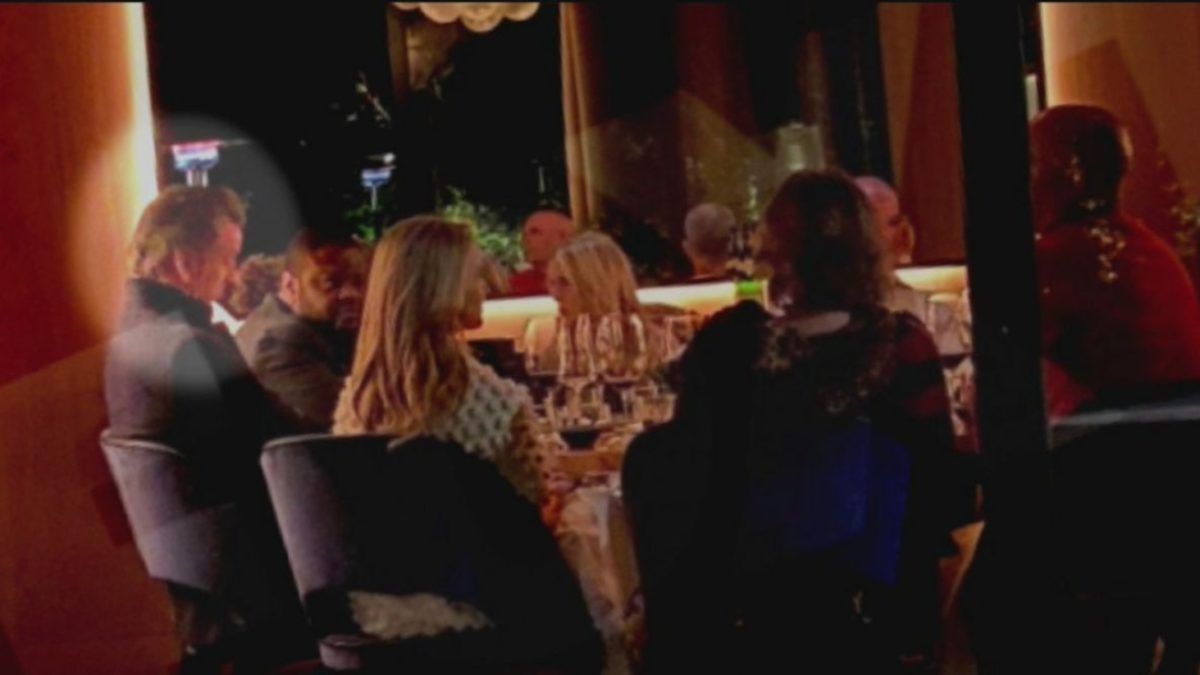
But I have studied power and was reminded of a Rand quote when Governor Newsom was photographed at a political strategist's birthday dinner, surrounded by donors and lobbyists with nary a mask or social distance to be seen:

https://d2eehagpk5cl65.cloudfront.net/img/c1200x675-w1200-q80/uploads/2020/11/Gavin-Newsom-French-Laundry-Fox-11-1200x675.jpg
"To Newsom's right was Dustin Corcoran, CEO of the California Medical Association (CMA). 
To the governor's left was CMA lobbyist Janus Norman." 
Reason Mag

The facile explanation is that this is just hypocrisy. But the Rand quote from Atlas Shrugged could just as well apply. The characters are Floyd Ferris, PhD and Hank Rearden (businessguy/industrialist):

“Did you really think that we want those laws to be observed? said Dr. Ferris. We want them to be broken. You better get it straight that it’s not a bunch of boy scouts you’re up against then you’ll know that this is not the age for beautiful gestures. We’re after power and we mean it. 

You fellows were pikers, but we know the real trick, and you’d better get wise to it. There is no way to rule innocent men. The only power any government has is the power to crack down on criminals. Well, when there aren’t enough criminals, one makes them. One declares so many things to be a crime that it becomes impossible for men to live without breaking laws. Who wants a nation of law abiding citizens? What’s there in that for anyone? But just pass the kind of laws that can neither be observed nor enforced nor objectively interpreted and you create a nation of lawbreakers and then you cash in on the guilt. Now that’s the system, Mr. Rearden, That’s the game, and once you understand it, you’ll be much easier to deal with.” 

CliffNotes describes: "Dr. Floyd Ferris The day-to-day head of the State Science Institute, Dr. Floyd Ferris is a murderous bureaucrat with an unquenchable lust for political power...." 

Once everyone is a criminal and law enforcement is arbitrary then it is just a hop, skip and a jump to Kafkatrapping, the term being based on Kafka's story The Trial, where any attempt by the accused to defend himself was taken as agreement with the premise and proof of guilt.

On the other hand: "I Was Shitting You People - A Message From Ayn Rand" so who actually knows? 

Which brings us to anarcho-tyranny:

 “A concept where the state is more interested in controlling citizens so that they don’t oppose managerial class, rather than tending to real criminals. Laws are argued to be enforced selectively depending on what is beneficial to the ruling elite.”

One of the more astute bits of political analysis you are likely to read today.

From Chronicles Magazine, July 1994:

Anarcho-Tyranny, U.S.A.
By Samuel Francis

On the morning of September 22, 1993, a law-abiding citizen named B.W. Sanders was driving his car down the street in Raleigh, North Carolina, when all of a sudden he found himself flagged down by a policeman and presented with a ticket for $25, Mr. Sanders, it turned out. had not been wearing his seat belt, and under a new state law, that crime carries the penalty he received. But in this case it was not just a traffic cop who flagged down Mr. Sanders. It was a force of some six dozen police officers as well as the governor of North Carolina himself, James B. Hunt. The governor was searching for a photo-op with which to advertise both the new seat belt law and his own personal devotion to law and order. Not only the 70 or more police officers but also an innumerable supply of newspaper reporters and TV newsmen were on the scene to record the governor's triumph over the forces of lawlessness, and the next day Mr. Sanders' wicked ways were recorded in the public press for his family, his employers, his neighbors, and indeed posterity to gander at. To make doubly certain that criminals like Mr. Sanders got the message loud and clear, Governor Hunt held a news conference near the state capital and harangued a crowd of some 150 police officers and state troopers, who were able to take time off from the apprehension of public enemies like Mr. Sanders to attend the governor's words. "I took an oath to protect the people of North Carolina," intoned the Tar Heel State's answer to Dirty Harry, "and this is one way we must do it. . . . Folks, we're serious. We mean it. We're going to do this." And indeed, serious he is. As part of the war on the unbuckled seat belt crisis, the Raleigh News and Observer reported, "Law officers in all 100 counties [of the state] will intensify their efforts to find and cite motorists not using their seat belts. Agencies will compete against each other, winning cash for turning in the best performance."

Governor Hunt's grandstanding might be harmless enough were it not for certain other facts about certain other crimes in North Carolina that also sometimes make the news. Only a week before the apprehension and public humiliation of Mr. Sanders, the same newspaper reported on the state's prison crisis. It seems that North Carolina has another new law in addition to the one on seat belts. This other law, passed by the General Assembly, imposes a cap on how many inmates can be incarcerated in the state prison, and the crisis is that, under this cap, most of the inmates now eligible for parole were imprisoned for violent and assaultive crimes. Most of the less dangerous criminals have already been turned loose, and now the prison system must release public enemies even more dangerous than drivers who do not buckle their seat belts. Since last June, no less than 14 parolees (including one of the men now charged with the murder of Michael Jordan's father) have been arrested and charged with murder, and another parolee, a veteran of the state's death row, murdered his girlfriend and then committed suicide, thereby unfairly depriving Governor Hunt of vet another photo-op. Last August alone, North Carolina paroled 3,700 prison inmates. One might think that if the governor of the state and the 150 police officers and state troopers who took time out of their public jobs to listen to him slap himself on the back for busting poor Mr. Sanders were really interested in upholding their oaths of office, they might turn their attention to the results of releasing hardened and violent criminals who have already been caught, sentenced, and imprisoned.

But the saga of the Napoleon of Crime in the homely person of B.W. Sanders is not an isolated incident. It is a representative tale that illustrates what I take to be an entirely new form of government, one that as far as I can tell is unique in human history and unknown to political theory, ancient or modern. Probably no other society has failed as dismally as the United States in the late 20th century to meet the basic test of any civilization: to enforce simple order and protect the lives and property of its members. History knows of many societies that have succumbed to anarchy when the central government proved unable to control warlords, rebels, and marauding invaders. But anarchy is not quite the problem here.

In the United States today, the government performs many of its functions more or less effectively. The mail is delivered (sometimes); the population, or at least part of it, is counted (sort of); and taxes are collected (you bet). You can accuse the federal leviathan of many things—corruption, incompetence, waste, bureaucratic strangulation—but mere anarchy, the lack of effective government, is not one of them. Yet at the same time, the state does not perform effectively or justly its basic duty of enforcing order and punishing criminals, and in this respect its failures do bring the country or important parts of it close to a state of anarchy. But that semblance of anarchy is coupled with many of the characteristics of tyranny, under which innocent and law-abiding citizens are punished by the state or suffer gross violations of their rights and liberty at the hands of the state. The result is what seems to be the first society in history in which elements of both anarchy and tyranny pertain at the same time and seem to be closely connected with each other and to constitute more or less opposite sides of the same coin.

This condition, which in some of my columns I have called "anarcho-tyranny," is essentially a kind of Hegelian synthesis of what appear to be dialectical opposites, the combination of oppressive government power against the innocent and the law-abiding and, simultaneously, a grotesque paralysis of the ability or the will to use that power to carry out basic public duties such as protection of public safety. And it is characteristic of anarcho-tyranny that it not only fails to punish criminals and enforce legitimate order but also criminalizes the innocent, that at the same time the governor of North Carolina grotesquely fails to uphold his famous oath to protect the citizens of his state by keeping convicted felons in prison, he has no problem finding the time to organize a massive waste of his time and the taxpayers' money to hound and humiliate a perfectly innocent citizen for the infraction of a trivial traffic law.

In fact, we criminalize the innocent all the time in the United States today—through asset seizure laws that confiscate your property even before you're convicted of possessing illegal drugs; through mandatory brainwashing programs designed to reconstruct your mind with "sensitivity training," "human relations," and rehabilitation if you display politically incorrect ideas on certain occasions; through prosecuting people like Bernhard Goetz who use guns to defend themselves; and through gun control laws in general. Under anarcho-tyranny, gun control laws do not usually target criminals who use guns to commit their crimes. The usual suspects are noncriminals who own, carry, or use guns against criminals—like the Korean store owners in Los Angeles or like Mr. Goetz, who spent several months in jail after picking off the three hoodlums who were making ready to liberate him from life and limb.

Indeed, the government response to crime is by far the best illustration of anarcho-tyranny. On the one hand, police forces are better equipped, better trained, and more expensive than ever before in history. Police routinely use computers, have access to nationwide information banks, and carry weapons and communication gadgets that most tyrants of the past would drool over. Yet the police seem utterly baffled by the murder rate. None of their high-tech whiz-bang helps much to catch serious criminals after they have struck, to stop them before they strike, or to keep them off the streets after they are caught. But while the police cannot do much about murderers, rapists, and robbers, they are geniuses at nabbing less serious lawbreakers. They can crack down on tax-dodgers and speeders, jaywalkers and pornography patrons, seat belt nonbucklers and epithet-emitters, gun owners and graffiti-scratchers.

Obviously, such desperate characters are not the reason decent people are scared to walk the streets at night, and no matter how many of them you put in the pokey, civilization and the order it is based on will not survive unless you control the streets. Under anarcho-tyranny, the goal is to avoid performing such basic functions as stopping real crime and to think up purely fictitious functions that will raise revenue, enhance the power of the police or bureaucrats, and foster the illusion that the state is doing its job. The victims of these new functions and laws are precisely otherwise law-abiding and innocent citizens. It's easier and more profitable to enforce the law against the marginal lawbreaker than against those habitually committed to spreading mayhem.....

....MUCH MORE

...This condition, which in some of my columns I have called "anarcho-tyranny," is essentially a kind of Hegelian synthesis of what appear to be dialectical opposites, the combination of oppressive government power against the innocent and the law-abiding and, simultaneously, a grotesque paralysis of the ability or the will to use that power to carry out basic public duties such as protection of public safety....

(House Speaker-in-Waiting) "Jeffries Says Democrats to Meet Tuesday on AI Action: ABC News"

Mr. Jeffries is currently House Minority Leader. He would be elevated to the speakership should his party take control of the House of Representatives after the November mid-term election.
When I saw that President Obama had seen the political opportunity* in Jacob Coxon's resignation tweet from Anthropic, I thought of a 2022 post that was introduced by another Chicago community organizer and one of his acolytes:
 
"The despair is there; 
now it's up to us to go in and rub raw the sores of discontent, 
galvanize them for radical social change.” 

If interested see also:

THERE IS ONLY THE FIGHT
An Analysis of the Alinsky Model
Hillary D. Rodham
Wellesley College
2 May 1969

And now (Sept. 13) we see at Bloomberg the headline story:

House Democratic Leader Hakeem Jeffries says Democrats plan a caucus on Tuesday morning on action on artificial intelligence, according to a transcript of his interview with ABC’s This Week.

*September 13 - "Obama Urges Democrats to Move A.I. Oversight to the Center of Their Agenda"

Capital Markets: "US Dollar Jumps on Fed Expectations"

From Marc Chandler at Bannockburn Global Forex:

The combination of heightened expectations for the Federal Reserve to lift rates late this week coupled with the high oil prices have helped lift the US dollar broadly today. Yet, the PBOC set the dollar's reference rate at a new 3 1/2-year low today.  Among the G10 currencies, the Swedish krona has been the hardest hit. It is off around 0.8% as the weekend election is too close to call and the late vote and ballots from overseas means the results may not be known for a couple more days.  Meanwhile, President Trump says the war with Iran may end around the midterm elections.  He also says that a trade deal with Canada may be struck “fairly soon”.  

Often the market participants seem to be fascinated with trilemmas. We suggest one has unfolded.  There cannot be the continued war in the Middle East, a cap on 10-year yields, and floor under the yen at the same time.  Saudi oil production has plunged, and at the same time, China has reportedly re-entered the market and ostensibly is rebuilding inventories.  The Trump administration calls on Ukraine to stop attacking Russian refinery capacity, which has been a factor driving up diesel prices, critical for long-haul trucking, freight trains, and farm equipment....

....MUCH MORE