Showing posts sorted by relevance for query freeman dyson. Sort by date Show all posts

Saturday, February 29, 2020

On the Passing Of Freeman Dyson

I always thought he was an interesting guy but it turns out he was a really interesting guy.
Some of the headlines:
Physics World
Freeman Dyson dies age 96
NPR
Physicist And Iconoclastic Thinker Freeman Dyson Dies At 96
The Register
RIP Freeman Dyson: The super-boffin who applied his mathematical brain to nuclear magic, quantum physics, space travel, and more
Swarajya Magazine
Obit: Freeman Dyson, The Genius Physicist Who Helped Bring Japan’s ‘Sacred’ Math To The World, Dies At 96
San Diego Union-Tribune
Remembering famed physicist Freeman Dyson and his La Jolla years
c|net
Freeman Dyson, famed physicist and creative force, dies at 96
Science 2.0 
Freeman Dyson. Don't Call Him Doctor. He Was Too Smart For That.

And some of our visits with the old boy:
"The Brain Is Full of Maps A Talk By Freeman Dyson"

"The Key to Everything" Freeman Dyson on Geoffrey West's "Scale..." 
Until seeing this I wasn't aware Professor Dyson was still alive. The old boy hung out at Princeton's Institute for Advanced Studies at the same time Einstein was there. He knew all the physics brainiacs of the day, Feynman in particular and was sharp enough himself that Princeton grabbed him and made Dyson a Professor despite his lack of a PhD.
This review was recommended by one of the commenters on Izabella Kaminska's last posting at FT Alphaville which we linked in "UPDATED—A Map of Every City (plus Izabella Kaminska does a drive-by)".
And speaking of Ms Kaminska, why haven't the tech boffins at the Financial Times come up with a robo-Izzy until her return?

Although Einstein was at the Institute for Advanced Studies when Dyson arrived they didn't pal around. From the Nautil.us interview with Dyson:
...There were many famous scientists at Princeton when you got there, including Albert Einstein. Did you ever get to know him?
No, and he didn’t encourage young people to get to know him. He never came to seminars, never came to lunch. We always saw him walk by every day. He was tremendously busy with affairs of the world, so he was very much in demand. People came every day. Important people came to visit, so he just didn’t have time for saying hello to the kids.

But it sounds like he didn’t want to say hello. Was it simply not part of his makeup to talk with the up-and-coming generation?
That was true. He didn’t enjoy teaching. There were two important things for him. There was his own work, which he always continued, and there was his public activity as a politician, which he did extremely well. He was a really serious player in the international game and actually had a good effect....
"Alien Civilizations and Energy"

Friday, November 26, 2021

In response to 'At Lunch with Freeman Dyson': "Escape from the Prisoner’s Dilemma"

The writer of this letter appears to have a hulkin', honkin', huge portfolio:
In response to “At Lunch with Freeman Dyson”  
Christoph Adami is a Professor of Microbiology, 
Molecular Genetics, Physics, and Astronomy 
at Michigan State University. 
 
From Inference Review: 

To the editors:

In his essay, William Press retells the story of how he, together with the late mathematician and physicist Freeman Dyson, discovered that there are nefarious strategies within the prisoner’s dilemma game that allow a player to control the opponent’s winnings. As Press discusses, the game creates a scenario in which two agents are arrested on suspicion of committing a crime and are interrogated separately. They are each offered a deal: “Rat out your fellow conspirator and walk away with a light sentence, or rot in jail for a prolonged period.” The dilemma here is that cooperating with your fellow suspect is irrational because the temptation to defect, by giving up the accused counterpart, is too great. But if a cooperative act is not rewarded, how could cooperation evolve to be so ubiquitous in biology, then?

It turns out that the answer to this question is already contained in the description of the prisoner’s dilemma, where it is prescribed that the defendants are interrogated separately, to prevent them from communicating with each other. If they could, they surely would reach a pact where they pledge to each other that they will stay quiet; maybe they would seal the pact by swearing that if one should break the accord, the other would retaliate in the worst way once released. And indeed, when acts of cooperation between people and animals are analyzed in detail, it is clear that the parties are cooperating only when they can communicate. Robert Trivers described a tiny cleaner fish might rid the gills of a much larger fish from ectoparasites, which is a dangerous undertaking for the one doing the cleaning as the temptation for a quick meal always looms large for the bigger fish. But there clearly is an understanding between the two: the smaller one will not clean just anyone but only the type it is associated with. Furthermore, the cleaner fish signals to the host fish when the cleaning is finished, so the host can continue swallowing other small fish.1 There is no doubt that this act of cooperation, and likely all others, relies on two-way communication....

 
An understanding of the Prisoner's Dilemma goes a long way toward an understanding of more generalized game theory.
Way back in 2012 we happened to catch the first iteration of the paper in question:
 
Listen up you sociopathic bastards, here's your excuse.
From Neuroanthropology:
Prisoner’s Dilemma and the Evolution of Inequality – Does Unfairness Triumph After All?
A new paper, Iterated Prisoner’s Dilemma contains strategies that dominate any evolutionary opponent (pdf), has just been published in the Proceedings of the National Academy of Sciences. Written by William Press and Freeman Dyson, it represents a substantial breakthrough in strategies that work in the Prisoner’s Dilemma game.....MUCH MORE
We also caught the Inference Review article and appended some of our other Dyson links:  
As noted in the introduction to February 2020's "On the Passing Of Freeman Dyson"
I always thought he was an interesting guy but it turns out he was a really interesting guy....
 
If interested here's another heavyweight on Dyson at Inference Review:

Thinking Big With Freeman Dyson: Project Orion
The writer is Professor Emeritus of Physics at the Stevens Institute of Technology.....

Sunday, June 16, 2019

"The Brain Is Full of Maps A Talk By Freeman Dyson"

Part of Edge.org's Possible Minds Project.
FREEMAN DYSON, emeritus professor of physics at the Institute for Advanced Study in Princeton, has worked on nuclear reactors, solid-state physics, ferromagnetism, astrophysics, and biology, looking for problems where elegant mathematics could be usefully applied. His books include Disturbing the Universe, Weapons and Hope, Infinite in All Directions, and Maker of Patterns. Freeman Dyson's Edge Bio Page

[ED. NOTE:] As a follow-up to the completion of the book Possible Minds: 25 Ways of Looking at AI, we are continuing the conversation as the “Possible Minds Project.” The first meeting was at Winvian Farm in Morris, CT. Over the next few months we are rolling out the fifteen talks—videos, EdgeCasts, transcripts.
 
THE BRAIN IS FULL OF MAPS
FREEMAN DYSON: I was talking about maps and feelings, and whether the brain is analog or digital. I’ll give you a little bit of what I wrote:
Brains use maps to process information. Information from the retina goes to several areas of the brain where the picture seen by the eye is converted into maps of various kinds. Information from sensory nerves in the skin goes to areas where the information is converted into maps of the body. The brain is full of maps. And a big part of the activity is transferring information from one map to another.
As we know from our own use of maps, mapping from one picture to another can be done either by digital or by analog processing. Because digital cameras are now cheap and film cameras are old fashioned and rapidly becoming obsolete, many people assume that the process of mapping in the brain must be digital. But the brain has been evolving over millions of years and does not follow our ephemeral fashions. A map is in its essence an analog device, using a picture to represent another picture. The imaging in the brain must be done by direct comparison of pictures rather than by translations of pictures into digital form.
Introspection tells us our brains are spectacularly quick, transforming two tasks essential to our survival: recognition of images in space, and recognition of patterns of sound in time. We recognize a human face or a snake in the grass in a fraction of a second. We recognize the sound of a voice or of a footstep equally fast. The process of recognition requires the comparison of a perceived image with an enormous database of remembered images. How this is done, in a quarter of a second without any conscious effort, we have no idea. It seems likely that scanning of images in associative memory is done by direct comparison of analog data rather than by digitization.
The quality of a poem such as Homer’s Odyssey or Eliot’s Wasteland is like the quality of a human personality. A large part of our brain is concerned with social interactions, getting to know other people, learning how to live in social groups. The observed correlation between size of brain and size of social groups in primates makes it likely that our brains evolved primarily to deal with social problems. Our ability to see others as analogs of ourselves is basic to our existence as social animals.
I go on to talk about what Danny Hillis told us thirty years ago in his paper titled "Intelligence as an Emergent Behavior; or, the Songs of Eden," which is of course a wonderful story that Danny invented to explain the evolution of speech from song. He had the idea that songs originally were the evolving species, and apes were just the phenotype.

How do songs actually evolve? They have to be remembered by an ape to survive. And how do you get remembered by an ape? Well, you have to give yourself some associated practical use. They have to be useful to the apes in order to survive. So, a song can only become fit to survive by associating itself with meaning. Thereby, you have a co-evolution of apes and songs so that the songs gradually acquire more meaning and the apes acquire more communication. In the end, that develops into speech. This is a beautiful idea. The song is of course analog from beginning to end. It is the sound and spirit of the thing that is transmitted, not the individual phonemes.

I’m suggesting that the brain is mainly an analog device with certain small regions specialized for digital processes. It’s certainly not true, as is sometimes claimed by pundits talking on television, that the left hemisphere is digital, and the right hemisphere is analog. It seems to be true that most of the digital processing is done on the left side. But the division of labor between the two hemispheres is still largely unexplored....
...MUCH MORE

Although Einstein was at the Institute for Advanced Studies when Dyson arrived they didn't pal around. From the Nautil.us interview with Dyson:
...There were many famous scientists at Princeton when you got there, including Albert Einstein. Did you ever get to know him?
No, and he didn’t encourage young people to get to know him. He never came to seminars, never came to lunch. We always saw him walk by every day. He was tremendously busy with affairs of the world, so he was very much in demand. People came every day. Important people came to visit, so he just didn’t have time for saying hello to the kids.

But it sounds like he didn’t want to say hello. Was it simply not part of his makeup to talk with the up-and-coming generation?
That was true. He didn’t enjoy teaching. There were two important things for him. There was his own work, which he always continued, and there was his public activity as a politician, which he did extremely well. He was a really serious player in the international game and actually had a good effect....
Dyson did get to play with Hans Bethe and Wolfgang Pauli, Robert Oppenheimer and Richard Feynman.
Some prior appearances:
Climateer Line of the Day: Some Old Hippies Retain Brain Cells, Comment on Big Data Edition
...Dyson is a kayak builder, emulating the wood-scarce Arctic natives to work with minimum frame inside a skin craft. But in the tropics, where there is a surplus of wood, natives make dugout canoes, formed by removing wood. "We're now surrounded by so much information," Dyson concluded, "we have to become dugout canoe builders. The buzzword of last year was 'big data.' Here's my definition of the situation: Big data is what happened when the cost of storing information became less than the cost of throwing it away."
 -- Stewart Brand, The Long Now Seminars About Long-term Thinking
  
Until seeing this I wasn't aware Professor Dyson was still alive. The old boy hung out at Princeton's Institute for Advanced Studies at the same time Einstein was there. He knew all the physics brainiacs of the day, Feynman in particular and was sharp enough himself that Princeton grabbed him and made Dyson a Professor despite his lack of a PhD.

This review was recommended by one of the commenters on Izabella Kaminska's last posting at FT Alphaville which we linked in "UPDATED—A Map of Every City (plus Izabella Kaminska does a drive-by)".

And speaking of Ms Kaminska, why haven't the tech boffins at the Financial Times come up with a robo-Izzy until her return?

Saturday, June 27, 2020

Thinking Big With Freeman Dyson: Project Orion

The writer is Professor Emeritus of Physics at the Stevens Institute of Technology.
From Inference Review:
As the reader will learn, my friendship with Freeman Dyson goes back well over half a century. I never stopped marveling at his genius. He simply could not help seeing things in a unique way. The last communication I had with Freeman not long before he passed away had to do with climate change. He was concerned about the next ice age, which he thought was long overdue, and about which he was certain that no one really understood the science. Only Freeman would worry about a forthcoming ice age. As part of this essay, we are fortunate to be able to publish something he wrote about space travel and which is typical Freeman.

In the fall of 1957, I arrived at the Institute for Advanced Study (IAS) in Princeton to begin what turned out to be a two-year stay. I had spent that summer as an intern in the Theoretical Division at Los Alamos. Everyone who worked in the Theoretical Division was required to obtain a Q clearance, the highest level of security clearance in use at the Department of Energy and the Atomic Energy Commission. It was a prerequisite for anyone working in close proximity to nuclear weapons and was only granted after an elaborate FBI background check.1 Q clearance holders were also authorized to receive classified information on a need-to-know basis. When I arrived at the IAS, I still held an active Q clearance. Despite having interned at Los Alamos, my knowledge of nuclear weapons was limited. None of the projects I had been involved with had any connections to the weapons program. At the end of the summer, I had been able to observe a couple of nuclear tests in Nevada, but I had no detailed knowledge of how the devices themselves actually worked.

At the Institute that fall, I became good friends with another physicist who was about the same age. Michael Cohen had obtained his degree at Caltech under the supervision of Richard Feynman, a rare distinction. Cohen was both very smart and very self-confident, two qualities he would have needed to succeed at Caltech. He later told me that, while he was getting his degree, he had consulted for the RAND Corporation in Los Angeles, a think tank that worked on nuclear strategy, among other topics, but that also did physics. Cohen suggested that he might be able to get me a summer job there. I took up his offer, and in June 1958, I found myself in Santa Monica, not far from the beaches of the Pacific Ocean. At first glance, the structure that housed RAND’s research facility in Santa Monica looked a bit like a small college campus. It had a tennis court and people ate lunch on tables outside. It was only when you got inside that you began to realize that its entire mission seemed to be devoted to nuclear war.

The security at RAND was even tighter than at Los Alamos. A pass had to be shown to gain access to the offices of the theory group, and an armed guard would frequently inspect the area to make sure that classified documents had not been left unattended. In one of the offices, a small seismograph was used to observe the tremors induced by hydrogen bomb tests in the Pacific. The nuclear theorist Herman Kahn was a notable presence at the facility. A larger-than-life figure in more ways than one, Kahn appeared to spend much of his time trying to convince anyone within earshot that the US could win a nuclear war. Kahn once loaned me the manuscript of a book he was working on. When I read it, I thought he must surely be joking. It was perhaps fitting that Kahn became one of the main sources of inspiration for the eponymous Dr. Strangelove in Stanley Kubrick’s film.

The longer I spent at RAND, the more obvious it became that there was not really anything much for me to do. The only work of any consequence that I was involved in during my time at the facility involved adding up a long column of numbers that apparently had some relevance to a nuclear test proposal. It did not take long before I began to feel that I was wasting my time.

Joining Orion
Freeman Dyson had been a hero of mine since graduate school. When I was first trying to understand quantum electrodynamics, I had attempted to read Feynman’s papers. I found them incomprehensible. I then tried to read Julian Schwinger’s papers. I found them incomprehensible too. It was only when I read Dyson’s paper, “The Radiation Theories of Tomonaga, Schwinger, and Feynman,”2 and the notes from his course on advanced quantum mechanics at Cornell that I finally began to understand what was going on.3 Dyson became a permanent member of the IAS in 1953 and was resident when I arrived there. He was always friendly, but, for the most part, kept to himself. He had lunch with us from time to time but did not say all that much. I once went into his office to ask a question and found him reading the Bible in Russian. He had been studying the language since high school.
My relationship with Dyson was forever changed by the sort of happy accident that occurs all too rarely. I had been in New York and was traveling back to Princeton on the train late at night. By coincidence, Dyson was on the same train. We spoke a little during the trip, and when we arrived in Princeton I offered to give him a lift home in my car. He invited me in, and we had a long talk over a couple of drinks. I was curious about his first mathematical experiences. Dyson told me that when he was still young enough to be put down for naps he began adding in his mind the sequence 1 + 1/2 + 1/4 + 1/16 + … and realized that the sum was converging to 2. He had invented the notion of the convergent infinite series.

Soon after our talk, Dyson left Princeton for his summer job in California. He was working in La Jolla as a consultant for General Atomics, a division of the General Dynamics Corporation. The previous summer in California had been an eventful one for Dyson. On the one hand, he led the design team that developed a class of nuclear research reactors, known as TRIGA (Training, Research, Isotopes, General Atomics), that are still in use to this day.4 On the other hand, during a day trip to Tijuana at summer’s end, he had been bitten by a dog that was thought to be rabid and had been forced to endure all manner of vaccinations as a result. I had no idea what he was working on in the summer of 1958.

All the occupants of our building at the IAS, myself and Dyson included, shared the services of a secretary, Jane Kane. Once a week, she would forward any mail that had arrived and pass on any gossip she had heard. I received a note from her that summer with news of Dyson. He was in La Jolla, as expected, but had recently returned to Tijuana to see a bullfight and was currently working on a design for a spaceship. I immediately to wrote Dyson saying that if either of these things were true, he was certainly having a much better time than I was. A few days later, much to my surprise, Dyson called me. He confirmed that he was indeed working on a spaceship, but quickly added that he could not tell me about it over the phone. Instead, he suggested that I visit him to see the work for myself. This was how I came to join the Orion project.

I still had my Q clearance when I arrived in La Jolla, so Dyson was able give to me a general outline of the project. The following account draws on both my own experiences and a wonderful book written by Freeman’s son George, entitled Project Orion, that was published in 2002.5 The majority of the key figures in the project were still alive when George was researching the book, and his account includes interviews with many of the participants. At the time of writing, nearly twenty years later, there were, as far as I knew, only two surviving members of the project—Freeman and myself.
After Freeman’s passing on February 28, 2020, I may be the only one left.

The Origins of Orion
Stanisław Ulam arrived in Los Alamos in the winter of 1943. He had been recruited to the Manhattan Project by John von Neumann and Hans Bethe. Before traveling to New Mexico, Ulam had been working as an assistant professor at the University of Wisconsin in Madison. He was not told what he would be working on; his instructions were simply to report to Lamy—the railway depot for Santa Fe. Ulam had never heard of Lamy and knew little, if anything, about New Mexico. He later recalled:
I went to the library and borrowed the Federal Writer’s Project Guide to New Mexico. At the back of the book, on the slip of paper on which borrowers signed their names, I read the names of Joan Hinton, David Frisch, Joseph McKibben, and all the other people who had been mysteriously disappearing to hush-hush war jobs without saying where.6
....MUCH MORE

Also at Inference Review:
SARS-CoV-2: Research Guide
122 articles, updated June 1, 2020

Sunday, May 30, 2021

"At Lunch with Freeman Dyson". Game Theory and Cooperation but no Comestibles

As noted in the introduction to February 2020's "On the Passing Of Freeman Dyson"
I always thought he was an interesting guy but it turns out he was a really interesting guy.... 
 
From Inference Review Vol. 6, NO. 1 / May 2021:

In this essay, I would like to tell the story of a minor discovery in mathematical game theory that Freeman Dyson and I made in 2011. Dyson was a personal friend and one of the great mathematical physicists of the twentieth century. He died in 2020, at the age of ninety-six. He was famously self-effacing, which is not to say that he lacked an accurate opinion of his own abilities. Freeman would deny that he had done anything at all and then allow friends—or even strangers—to vehemently contradict him. Our discovery was not of that character. It really was very minor. The reasons for telling the story now are less about the discovery itself and more about the tendency of scientists to seek lessons in moral philosophy in the least likely of places—high-school algebra, for example.

Imagine that a group of scientists gather to play a kind of terror game. They must propose scenarios that, should they eventuate, would shake their belief in the foundations of their fields. The mathematician’s proposed terror is that a long message, in English, is found to be encoded—in excess of any plausible random probability—somewhere in the first billion digits of pi.1 The physicist’s terror is that the interaction cross-section of a fundamental particle will have significantly different values when measured in different places on earth, or in the same place at different times.2 The biologist’s terror is that some feature of the living world will be unexplainable by the principle of natural selection. Within biology’s subspecialty of evolution theory, there is a small area of study known as evolution of cooperation. That study, some would say, lies closest to the biologist’s terror. That makes it worth poking at.

Cooperation and Defection

In biology, a cooperator is an individual who pays a cost for another individual to receive a benefit. When cooperation is mutually beneficial to two individuals of the same or different species—a condition termed direct reciprocity—then it is favored by natural selection. There are other possibilities. In so-called kin selection, an individual’s self-sacrifice may be favored if, on average, it helps another individual in the same gene pool to survive.3 The unit of survival is understood in this case to be not the individual, but the gene that two individuals share.4 It is harder to understand why individuals cooperate when defection would be more favorable or when the reciprocity is only indirect.

Suppose that two microbe species, A and B, both need processed nutrients a and b. The cooperative state might be that A produces a, B produces b, and each secretes a portion of its nutrient for the benefit of the other. But this equilibrium is not evolutionarily stable: a defecting A with a mutation that halts its sharing of a becomes a free rider, benefitting from B without paying the fare. Free riders, avoiding a cost, will tend to take over the population. The evolutionarily stable endpoint is noncooperation, even though cooperation would be better for both species.

Cooperation among humans seems hardest of all to understand. “Humans are the champions of cooperation,” Martin Nowak has remarked. “From hunter-gatherer societies to nation-states, cooperation is the decisive organizing principle of human society.”5 In much, if not most, of our cooperation, reciprocity is indirect. To be sure, some people give money to universities in the hope of getting their own children admitted—kin selection—but many more give to charities that are of no direct benefit to themselves or their kin. Many billionaires become philanthropists, but from the standpoint of evolution theory, why is this? A quirk of our culture, maybe? But cultures, too, compete for dominance with other contemporaneous cultures, and by a process akin to natural selection. Are we to understand that generosity is selectively favored? Or are the generous billionaires only transient?

Charles Darwin recognized that cooperation posed a challenge to his theory of natural selection. He described an elegant experiment to ferret out whether the aphid yields its excretion to the ant voluntarily, or involuntarily with the ant as a parasite.6 He provided a convincing argument that it was the former. Darwin, the consummate naturalist, hated overgeneralized theory. Yet the significant literature on the evolution of cooperation that has flourished in the last fifty years is almost entirely theoretical. Much of it is cast in the formalism of mathematical game theory, a subject that came into existence more than half a century after Darwin’s death in the work of John von Neumann and Oskar Morgenstern. Game theory describes how competing, sentient players, in a well-defined universe of choices and payoffs, may knowingly seek to optimize their own outcomes. Evolution is the blind watchmaker,7 optimizing only by trial and error. Exactly how the achievable outcomes of evolution correspond to the mathematical optima of game theory is not a settled question.

The Prisoner’s Dilemma

Go back to microbes A and B, but now promote them to sentience. They become Alice and Bob, who are arrested on suspicion of committing, together, a serious crime. Each has sworn not to betray the other. They are questioned in separate rooms.

“We already have enough evidence to convict you both of a misdemeanor,” the detective says to each, “that will put you away for one year.” Each, separately, says nothing. “But if you defect, rat out your partner and turn state’s evidence,” the detective continues, “we’ll let you go, scot-free. Your partner will get a felony conviction, six years in the state penitentiary.”

“What if we both turn state’s evidence?” Alice and Bob each ask.

“Well, I can’t let you both go free,” the detective says. “You’ll each get three years.”

Alice reasons as follows: there are only two possibilities. Either Bob will rat me out, or else he won’t. If he rats, then I’ll get six years—unless I rat also, in which case I’ll get just three years. So, if he rats, I should too. But what if he doesn’t rat? What a chump! I can rat on him and be out today. So, either way, I should defect. Bob employs the same reasoning and defects on Alice. They each get three years. The pair spend the time wishing that they had both kept their promises not to betray each other and escaped with misdemeanor convictions.

The prisoner’s dilemma (PD) game, played once, has no direct bearing on evolution. But consider the iterated prisoner’s dilemma (IPD) game, first posited at the RAND Corporation in the 1950s: Alice and Bob play many rounds of the same game with each other. After following the same logic for a few games, Alice tentatively tries a round of cooperation. In that round, Bob still defects and Alice gets six years. But Bob has now seen Alice’s signal. He tries cooperation himself. Alice reciprocates. And, for a string of games, they are both cooperating, receiving only misdemeanor convictions. In the IPD, there is information in the previous plays, and each player can try to use that information to devise a superior strategy that remains self-interested.

Is the best strategy to cooperate always? Certainly not. If Alice adopts that strategy, Bob will always defect, getting off scot-free, while Alice will always get six years. A good strategy would seem to be something like, “Cooperate most of the time, but don’t be a chump if the other player doesn’t follow suit.” Can this be formalized, or made crisp, in some way?...

....MUCH MORE

And some of our visits with the old boy:
"The Brain Is Full of Maps A Talk By Freeman Dyson"

"The Key to Everything" Freeman Dyson on Geoffrey West's "Scale..." 
Until seeing this I wasn't aware Professor Dyson was still alive. The old boy hung out at Princeton's Institute for Advanced Studies at the same time Einstein was there. He knew all the physics brainiacs of the day, Feynman in particular and was sharp enough himself that Princeton grabbed him and made Dyson a Professor despite his lack of a PhD.
This review was recommended by one of the commenters on Izabella Kaminska's last posting at FT Alphaville which we linked in "UPDATED—A Map of Every City (plus Izabella Kaminska does a drive-by)".
And speaking of Ms Kaminska, why haven't the tech boffins at the Financial Times come up with a robo-Izzy until her return?
Although Einstein was at the Institute for Advanced Studies when Dyson arrived they didn't pal around. From the Nautil.us interview with Dyson:
...There were many famous scientists at Princeton when you got there, including Albert Einstein. Did you ever get to know him?
No, and he didn’t encourage young people to get to know him. He never came to seminars, never came to lunch. We always saw him walk by every day. He was tremendously busy with affairs of the world, so he was very much in demand. People came every day. Important people came to visit, so he just didn’t have time for saying hello to the kids.

But it sounds like he didn’t want to say hello. Was it simply not part of his makeup to talk with the up-and-coming generation?
That was true. He didn’t enjoy teaching. There were two important things for him. There was his own work, which he always continued, and there was his public activity as a politician, which he did extremely well. He was a really serious player in the international game and actually had a good effect....
"Alien Civilizations and Energy"

Friday, July 5, 2019

"Alien Civilizations and Energy"

From Delancey Place:
Today's selection -- from Disturbing the Universe by Freeman Dyson. Some of us think days or weeks into the future. Some of the most thoughtful among us reflect on what might happen years into the future. The Soviet astrophysicist Nikolai Kardashev (b. 1932) thinks thousands of years into the future. He has developed a theory of measuring a civilization's technological progress -- the Kardashev scale -- by measuring the amount of energy that civilization is able to harness. This theory has three distinct types:

"The Russian astronomer Kardashev has suggested that civiliza­tions in the universe should fall into three distinct types. A type 1 civilization controls the resources of a planet. A type 2 civilization controls the resources of a star. A type 3 civilization controls the resources of a galaxy. We have not yet achieved type 1 status, but we shall probably do so within a few hundred years. The difference in size and power between types 1 and 2, or between types 2 and 3, is a factor of the order of ten billion, unimaginably large by human standards. But the process of exponential economic growth allows this immense gulf to be bridged remarkably rapidly. To grow by a factor of ten billion takes thirty-three doubling times. A society grow­ing at the modest rate of one percent per year will make the transi­tion from type 1 to type 2 in less than 2500 years. The transition from type 2 to type 3 will take longer than this, since it requires interstellar voyages. But the periods of transition are likely to be comparatively brief episodes in the history of any long-lived society. Hence Karda­shev concludes that if we ever discover an extraterrestrial civiliza­tion, it will probably belong clearly to type 1, 2 or 3 rather than to one of the brief transitional phases....
...MORE

Previously from Freeman Dyson:
"The Brain Is Full of Maps A Talk By Freeman Dyson"
"The Key to Everything" Freeman Dyson on Geoffrey West's "Scale..."
To Hell With Human Cooperation and Trust: There are Indeed Ultimatum Strategies to Win an Iterated Prisoners Dilemma

Saturday, April 27, 2019

"How to Create an Institution That Lasts 10,000 Years"

The subject of this interview, Alexander Rose, is executive director of the Long Now Foundation which is perhaps best known for their 10,000 year clocks and for the Long Bet Project to systematize predictions and challenges that take years to decades to centuries to play out.
Some of the bets that have been resolved:
The world will not reach ‘Peak Oil’ by 2010.    (Correct) date of wager/prediction, 2006

There will be a quantum computer with over 100 qubits of processing capability sold either as a hardware system or whose use is made available as a commercial service by Dec 31, 2010    (Yes, if you consider the early D-Wave machine to be a quantum computer. We don't) date of wager/prediction, 2006

A profitable video-on-demand service aimed at consumers will offer 10,000 titles to 5 million subscribers by 2010.   (Yes but still largely DVD focused) date of wager/prediction, 2002
And many more. There are currently 765 'live' long bets.

We've visited one of the co-founders of the Long Now Foundation, Stewart Brand, a few times including in "Climateer Line of the Day: Some Old Hippies Retain Brain Cells, Comment on Big Data Edition" See after the jump for why it was memorable.

And the headliner, from Edge.org:
....We’re also looking at the oldest living companies in the world, most of which are service-based. There are some family-run hotels and things like that, but also a huge amount in the food and beverage industry. Probably a third of the organizations or the companies over 500 or 1,000 years old are all in some way in wine, beer, or sake production. I was intrigued by that crossover.

What’s interesting is that humanity figured out how to ferment things about 10,000 years ago, which is exactly the time frame where people started creating cities and agriculture. It’s unclear if civilization started because we could ferment things, or we started fermenting things and therefore civilization started, but there’s clearly this intertwined link with fermenting beer, wine, and then much later spirits, and how that fits in with hospitality and places that people gather.

All of these things are right now just nascent bits and pieces of trying to figure out some of the ways in which organizations live for a very long time. While some of them, like being a family-run hotel, may not be very portable as an idea, some of them, like some of the natural strategies, we're just starting to understand how they can be of service to humanity. If we broaden the idea of service industry to our customer civilization, how can you make an institution whose customer is civilization and can last for a very long time?.... 
...MUCH MORE

The remarkable Mr. Brand on George Dyson:
March 26, 2013
Climateer Line of the Day: Some Old Hippies Retain Brain Cells, Comment on Big Data Edition
...Dyson is a kayak builder, emulating the wood-scarce Arctic natives to work with minimum frame inside a skin craft. But in the tropics, where there is a surplus of wood, natives make dugout canoes, formed by removing wood. "We're now surrounded by so much information," Dyson concluded, "we have to become dugout canoe builders. The buzzword of last year was 'big data.' Here's my definition of the situation: Big data is what happened when the cost of storing information became less than the cost of throwing it away."
 -- Stewart Brand, The Long Now Seminars About Long-term Thinking

Mr. Brand was one of Ken Kesey's Merry Pranksters described by Tom Wolfe in the The Electric Kool-Aid Acid Test.
Mr. Brand also edited the Whole Earth Catalog.
Drugs may have been involved.

George Dyson is an historian of science.
Wikipedia describes him as:
George Dyson is the son of the theoretical physicist Freeman Dyson and mathematician Verena Huber-Dyson, the brother of Esther Dyson, and the grandson of the British composer Sir George Dyson....

Tuesday, March 26, 2013

Climateer Line of the Day: Some Old Hippies Retain Brain Cells, Comment on Big Data Edition

...Dyson is a kayak builder, emulating the wood-scarce Arctic natives to work with minimum frame inside a skin craft. But in the tropics, where there is a surplus of wood, natives make dugout canoes, formed by removing wood. "We're now surrounded by so much information," Dyson concluded, "we have to become dugout canoe builders. The buzzword of last year was 'big data.' Here's my definition of the situation: Big data is what happened when the cost of storing information became less than the cost of throwing it away."
 -- Stewart Brand, The Long Now Seminars About Long-term Thinking

Mr. Brand was one of Ken Kesey's Merry Pranksters described by Tom Wolfe in the The Electric Kool-Aid Acid Test.
Mr. Brand also edited the Whole Earth Catalog.
Drugs may have been involved.

George Dyson is an historian of science.
Wikipedia describes him as:
George Dyson is the son of the theoretical physicist Freeman Dyson and mathematician Verena Huber-Dyson, the brother of Esther Dyson, and the grandson of the British composer Sir George Dyson....

Saturday, February 28, 2015

"Game Theory Calls Cooperation Into Question"

From the Simons Foundation's Quanta Magazine:

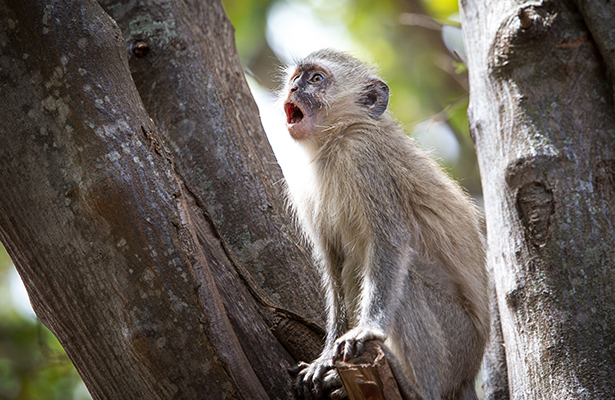
A vervet monkey will scream an alarm when a predator is nearby, putting itself in danger.
 A vervet monkey will scream an alarm when a predator is nearby, putting itself in danger.
A recent solution to the prisoner’s dilemma, a classic game theory scenario, has created new puzzles in evolutionary biology.

When the manuscript crossed his desk, Joshua Plotkin, a theoretical biologist at the University of Pennsylvania, was immediately intrigued. The physicist Freeman Dyson and the computer scientist William Press, both highly accomplished in their fields, had found a new solution to a famous, decades-old game theory scenario called the prisoner’s dilemma, in which players must decide whether to cheat or cooperate with a partner. The prisoner’s dilemma has long been used to help explain how cooperation might endure in nature. After all, natural selection is ruled by the survival of the fittest, so one might expect that selfish strategies benefiting the individual would be most likely to persist. But careful study of the prisoner’s dilemma revealed that organisms could act entirely in their own self-interest and still create a cooperative community.
Press and Dyson’s new solution to the problem, however, threw that rosy perspective into question. It suggested the best strategies were selfish ones that led to extortion, not cooperation.

Plotkin found the duo’s math remarkable in its elegance. But the outcome troubled him. Nature includes numerous examples of cooperative behavior. For example, vampire bats donate some of their blood meal to community members that fail to find prey. Some species of birds and social insects routinely help raise another’s brood. Even bacteria can cooperate, sticking to each other so that some may survive poison. If extortion reigns, what drives these and other acts of selflessness?

Press and Dyson’s paper looked at a classic game theory scenario — a pair of players engaged in repeated confrontation. Plotkin wanted to know if generosity could be revived if the same math was applied to a situation that more closely resembled nature. So he recast their approach in a population, allowing individuals to play a series of games with every other member of their group. The outcome of his experiments, the most recent of which was published in December in the Proceedings of the National Academy of Sciences, suggests that generosity and selfishness walk a precarious line. In some cases, cooperation triumphs. But shift just one variable, and extortion takes over once again. “We now have a very general explanation for when cooperation is expected, or not expected, to evolve in populations,” said Plotkin, who conducted the research along with his colleague Alexander Stewart.

The work is entirely theoretical at this point. But the findings could potentially have broad-reaching implications, explaining phenomena ranging from cooperation among complex organisms to the evolution of multicellularity — a form of cooperation among individual cells.

Plotkin and others say that Press and Dyson’s work could provide a new framework for studying the evolution of cooperation using game theory, allowing researchers to tease out the parameters that permit cooperation to exist. “It has basically revived this field,” said Martin Nowak, a biologist and mathematician at Harvard University....MORE
 Well, other than that what have you been up to?

Saturday, July 7, 2012

To Hell With Human Cooperation and Trust: There are Indeed Ultimatum Strategies to Win an Iterated Prisoners Dilemma

Listen up you sociopathic bastards, here's your excuse.

From Neuroanthropology:
Prisoner’s Dilemma and the Evolution of Inequality – Does Unfairness Triumph After All?
A new paper, Iterated Prisoner’s Dilemma contains strategies that dominate any evolutionary opponent (pdf), has just been published in the Proceedings of the National Academy of Sciences. Written by William Press and Freeman Dyson, it represents a substantial breakthrough in strategies that work in the Prisoner’s Dilemma game.

The key point? There does exist a strategy where a player can “enforce a unilateral claim to an unfair share of rewards.”

The implications of this paper are fascinating. For biological evolution, it opens up new thinking about reproductive strategies and life history theory, as well as the direct impact on ideas about the evolution of cooperation.

For cultural evolution, it seems to provide some powerful insights into the evolution of inequality in human society. As the agriculture revolution and population growth led to the ability to monopolize social resources and create differential wealth, what happened with social class? Did human cooperation turn from fairness to enforcing the sort of unfair game that Press and Dyson outline?

Zero Determinant Strategies and Beating Tit-for-Tat
Here is the paper’s abstract for Press and Dyson (2012):
The two-player Iterated Prisoner’s Dilemma game is a model for both sentient and evolutionary behaviors, especially including the emergence of cooperation. It is generally assumed that there exists no simple ultimatum strategy whereby one player can enforce a unilateral claim to an unfair share of rewards. Here, we show that such strategies unexpectedly do exist. In particular, a player X who is witting of these strategies can (i) deterministically set her opponent Y’s score, independently of his strategy or response, or (ii) enforce an extortionate linear relation between her and his scores. Against such a player, an evolutionary player’s best response is to accede to the extortion. Only a player with a theory of mind about his opponent can do better, in which case Iterated Prisoner’s Dilemma is an Ultimatum Game.
PNAS also gives an informative commentary by Alexander Stewart and Joshua Plotkin entitled “Extortion and cooperation in the Prisoner’s Dilemma (pdf).”...MORE
HT: Simoleon Sense

Sunday, July 28, 2019

If It's Not One Tham Ding It's Another: "The Greatest Long-Term Threats Facing Humanity"

Grandmother didn't swear so she said 'tham ding'.
The grandchildren knew what she meant.

From the BBC, July 19:

How long can civilisation survive? To thrive for billions of years, there will be a few troublesome problems to solve – from the death of the Sun to the decay of matter.
Can we actually say anything about the far future? If we can’t predict when it will rain next month, forecasting billions of years hence might seem impossible.

However, not everything is as chaotic as the weather: even predictions very far ahead are sometimes possible, especially in astrophysics and cosmology. We can be confident that there will be a total solar eclipse in the UK on 23 September 2090 because the Moon, Sun and Earth move in stable, predictable orbits with very minor disturbances, and the laws of gravity are now well-tested. Similarly, we can use known astrophysics to predict what will likely happen across the Universe as it expands.
You might also like:
• The perils of short-termism
• Are we on the road to civilisation collapse?
• How to build to last 10,000 years
This approach can be described as “physical eschatology” – a term coined by the astronomer Martin Rees for using astrophysics to model where the Universe is going. Rees took a cue from theology, in which “eschatology” is the study of ultimate things such as the end of the world. And the classic paper on the topic is Freeman Dyson’s 1979 paper on life in open universes, which outlined likely or possible existential catastrophes that could threaten life far into the future, from the death of the Sun to the detachment of stars from galaxies.

So, what are the biggest challenges humanity will face if we survive into the far future? We cannot say how (or if) they will be overcome (I will make some guesses) but we can be confident these threats to our existence are coming.

Problem 1: Survive better than other mammals
The typical lifespan of a mammalian species is about a million years or so. From nuclear war to bioengineered pandemics, humanity clearly has other risks it needs to reduce urgently: right now the natural extinction rate is far smaller than risk we pose to ourselves.

Were we to fix our current existential risk and sustainability problems we would still have to deal with some other challenges to stay around.

For starters, in a few tens of thousands of years we will have to cope with the end of the current interglacial period: we are living during a brief interruption of a long ice age. Our ancestors have survived ice ages, so it is likely not a big deal – except that they were nomadic hunter-gatherers rather than a global civilisation.

We may also face dramatic climate variations between different geological eras. In the past the Earth has been not just colder, but also warmer. During the Eocene, temperatures were 10C warmer, with palms and alligators in the Arctic and equatorial regions too hot for unprotected humans to survive in. Even further in the past there has been “snowball Earth” episodes where almost all of the Earth was covered with ice.
Then there is the risk of supervolcanism, meteor impacts, gamma ray bursts, or emergent ecological disruptions, which we know have led to natural mass extinctions about once every 100 million years....MORE 

Wednesday, October 20, 2021

Dark Patterns: "the power law distribution that generally defines the longevity of Roman emperors "

About ten years ago the popularization of a rather arcane area of study, power laws seemed to capture the imagination of the public. All of a sudden people were seeing power law distributions everywhere they looked. But as I and many others have pointed out: humans are so good at seeing patterns that we sometimes see them when they aren't even there.
So I now take all power law discussions with a grain or two of sāl.*

Some links after the jump.

From ScienceAlert, October 18:

Dark Pattern Explains Why So Few Roman Emperors Died of Natural Causes 

A staggering amount of Roman emperors did not die of natural causes. That's not breaking news; it's literally ancient history.

But in those untimely and often violent deaths, scientists have now identified a new mathematical pattern: a power law that describes the fate of so many who died with an entire empire at their feet.

"Although they appear to be random, power-law distributions of probabilities are found in many other phenomena associated with complex systems," says data scientist Francisco Rodrigues from the University of São Paulo in Brazil, noting that the reigns of the Caesars themselves are one such context.

According to Rodrigues, the power law distribution that generally defines the longevity of Roman emperors is what's called the Pareto principle.

Also known as the 80/20 rule, the Pareto principle is usually concerned with economic inputs and outcomes, but in terms of probability distribution, it can be simplified to mean that common occurrences have about 80 percent probability, while rare events have about 20 percent.

In this case, with regards to the fates of Roman emperors, violent ends are the more common events, with death from natural causes being significantly rarer – especially in the early days of the Western Roman Empire.

During that period – from the first emperor Augustus (who died in 14 CE) through to Theodosius (who died in 395 CE) – the rulers only had about a one-in-four (24.8 percent) chance of living long enough to die from natural causes, the researchers found in their new study....

....MUCH MORE

Some of our posts on power laws:
Power Laws: “The greatest shortcoming of the human race is our inability to understand the exponential function.”
Scale: "The Hidden Power Laws of Ecosystems"
"The Key to Everything" Freeman Dyson on Geoffrey West's "Scale..."
Financial Physics: "Power laws in finance"
Scientific American: "Can Math Beat Financial Markets?"
Economists and Econophysics
"The Philosophy of Complexity: Are Complex Systems Inherently Tyrannical?"
Yes.
In the end the universe itself is inherently tyrannical.
You are not the boss....

But then:
Power Laws: Raise Those Eyebrows

And then, from Quanta:
Scale: "Scant Evidence of Power Laws in Real-World Networks"
Wait, what?

*As regards Latin, the wictionary reminds us: 

Sāl is occasionally found as a neuter noun in the singular. The gender is observable only from agreement in the nominative case, and from agreement and the use of sāl (neuter) vs. salem (masculine) in the accusative case. The neuter nominative and accusative singular form can alternatively be sale, e.g. in Ennius Ann. 385 and Varro d. Non. 223, 17. In the nominative and accusative plural, the word is found only in the masculine gender, with the form salēs.

Got that, pronoun police?

Friday, September 27, 2024

Dark Patterns: "the power law distribution that generally defines the longevity of Roman emperors"

A repost from October 2021.

About ten years ago the popularization of a rather arcane area of study, power laws seemed to capture the imagination of the public. All of a sudden people were seeing power law distributions everywhere they looked. But as I and many others have pointed out: humans are so good at seeing patterns that we sometimes see them when they aren't even there.
So I now take all power law discussions with a grain or two of sāl.*

Some links after the jump.

From ScienceAlert, October 18:

Dark Pattern Explains Why So Few Roman Emperors Died of Natural Causes 

A staggering amount of Roman emperors did not die of natural causes. That's not breaking news; it's literally ancient history.

But in those untimely and often violent deaths, scientists have now identified a new mathematical pattern: a power law that describes the fate of so many who died with an entire empire at their feet.

"Although they appear to be random, power-law distributions of probabilities are found in many other phenomena associated with complex systems," says data scientist Francisco Rodrigues from the University of São Paulo in Brazil, noting that the reigns of the Caesars themselves are one such context.

According to Rodrigues, the power law distribution that generally defines the longevity of Roman emperors is what's called the Pareto principle.

Also known as the 80/20 rule, the Pareto principle is usually concerned with economic inputs and outcomes, but in terms of probability distribution, it can be simplified to mean that common occurrences have about 80 percent probability, while rare events have about 20 percent.

In this case, with regards to the fates of Roman emperors, violent ends are the more common events, with death from natural causes being significantly rarer – especially in the early days of the Western Roman Empire.

During that period – from the first emperor Augustus (who died in 14 CE) through to Theodosius (who died in 395 CE) – the rulers only had about a one-in-four (24.8 percent) chance of living long enough to die from natural causes, the researchers found in their new study....

....MUCH MORE

Some of our posts on power laws:
Power Laws: “The greatest shortcoming of the human race is our inability to understand the exponential function.”
Scale: "The Hidden Power Laws of Ecosystems"
"The Key to Everything" Freeman Dyson on Geoffrey West's "Scale..."
Financial Physics: "Power laws in finance"
Scientific American: "Can Math Beat Financial Markets?"
Economists and Econophysics
"The Philosophy of Complexity: Are Complex Systems Inherently Tyrannical?"
Yes.
In the end the universe itself is inherently tyrannical.
You are not the boss....

But then:
Power Laws: Raise Those Eyebrows

 *As regards Latin, the wictionary reminds us: 

Sāl is occasionally found as a neuter noun in the singular. The gender is observable only from agreement in the nominative case, and from agreement and the use of sāl (neuter) vs. salem (masculine) in the accusative case. The neuter nominative and accusative singular form can alternatively be sale, e.g. in Ennius Ann. 385 and Varro d. Non. 223, 17. In the nominative and accusative plural, the word is found only in the masculine gender, with the form salēs.

Got that, pronoun police?

Thursday, August 16, 2012

"The Emerging Revolution in Game Theory"

I knew that hanging out with psychopaths might someday pay dividends.

To Hell With Human Cooperation and Trust: There are Indeed Ultimatum Strategies to Win an Iterated Prisoners Dilemma:
Listen up you sociopathic bastards, here's your excuse....
But I sure didn't expect this.

From MIT's Technology Review:

The discovery of a winning strategy for Prisoner's Dilemma is forcing game theorists to rethink their discipline. Their conclusion? Winning isn't everything.
The world of game theory is currently on fire. In May, Freeman Dyson at Princeton University and William Press at the University of Texas announced that they had discovered a previously unknown strategy for the game of prisoner's dilemma which guarantees one player a better outcome than the other.

That's a monumental surprise. Theorists have studied Prisoner's Dilemma for decades, using it as a model for the emergence of co-operation in nature. This work has had a profound impact on disciplines such as economics, evolutionary biology and, of course, game theory itself....MUCH MORE
Previously:
Prisoner's Dilemma in Action: "Deutsche Bank gets prosecution witness status in LIBOR Probe"
"Game Theory and Crowded Trades"
Research Mania: "Italy Exits Before Greece in BofA Game Theory"
"Game Theory Explains the Many Habits of Highly Ineffective People"
Okay, Enough With Politics: Attention Managers, You Can Improve Corporate Efficiency by Randomly Promoting Employees

Sunday, October 30, 2016

"What Do You Consider The Most Interesting Recent [Scientific] News? What Makes It Important?"

That's the Edge.org question for 2016.

And just to give a quick pic of what's rattling around in my head, we had planned to post this piece last spring but some disaster or other came up and it got set aside until this morning when the post immediately preceding mentioned Brian Eno who is one of Edge's go-to brainiacs (see links below), I had an "oh crap" moment and here we are.

To cut to the chase, here's Edge.org, slightly dusty from sitting around in a seldom used server but worth the read. I'll just link to some of the responders, their mini-bios, and answer titles. Persue or not as you choose. Special Bonus after the jump.

From Edge.org:
Robert Sapolsky
Neuroscientist, Stanford University; Author, Monkeyluv
A Collective Realization—We May All Die Horribly 
David Haig
Associate Professor of Biology in Harvard's Department of Organismic and Evolutionary Biology; author, Genomic Imprinting and Kinship
Human Chimera
Gloria Origgi
Philosopher and Researcher, C.N.R.S. Paris; Author, Qu’est-ce que la confiance?
How To Be Bad Together: Antisocial Punishment of Pro-social Cooperators
Theoretical Physicist, Stanford; Father of Eternal Chaotic Inflation; Inaugural Recipient, Fundamental Physics Prize
 
Johnstone Family Professor, Department of Psychology; Harvard University; Author, The Sense of Style
 
Physicist
 
Software Pioneer; Philosopher; Author, "A Realtime Literature Explorer"
 
Science Writer; Fellow, Royal Society of Literature and the Academy of Medical Sciences; Author,The Evolution of Everything
 
Cognitive Scientist, MIT Media Lab, Harvard Program for Evolutionary Dynamics
 
Historian of ideas; Author, Passions and Tempers: A History of the Humours
 
Founder, The Whole Earth Catalog; Co-founder, The Well; Co-Founder, The Long Now Foundation; Author, Whole Earth Discipline
 
Social Psychologist; Professor, New York University Stern School of Business; Author, The Righteous Mind
 
Physicist, MIT; Researcher, Precision Cosmology; Scientific Director, Foundational Questions Institute; President, Future of Life Institute; Author, Our Mathematical Universe
 
Physicist; Entrepreneur & Venture Capitalist; Science Philanthropist
Those are the first 14 answers, there are 184 more HERE. 

Here are the Question homepage and Index.

And from the Climateer archives, February 15, 2015: 


In yesterday's "187 Big Thinkers Answer the Question: What Do You Think About Machines That Think?" I went on about how interesting blah, blah, blah Eno's response to the Edge Big Question was and it wasn't until this morning, while reading Alphaville's Further Reading post (thanks for the h/t Mr. Keohane!) that I realized I hadn't actually linked to Mr. Eno's take on the query.

So here it is, From Edge (note, the credits in the mini bio are almost ridiculously trivial compared to the reality)...
Also, 2013's "Brian Eno Answers Nassim Taleb": 
Mr. Eno is an autodidactic polymath.
Mr. Taleb is a comedian:
Climateer Line of the Day: The Modesty of Nassim Taleb Edition 
...MORE
Finally, one of the better covers of an Eno tune, from the movie Velvet Goldmine (BAFTA for the glam-rock costumes):

Sunday, April 29, 2018

"The Key to Everything" Freeman Dyson on Geoffrey West's "Scale..."

Until seeing this I wasn't aware Professor Dyson was still alive. The old boy hung out at Princeton's Institute for Advanced Studies at the same time Einstein was there. He knew all the physics brainiacs of the day, Feynman in particular and was sharp enough himself that Princeton grabbed him and made Dyson a Professor despite his lack of a PhD.

This review was recommended by one of the commenters on Izabella Kaminska's last posting at FT Alphaville which we linked in "UPDATED—A Map of Every City (plus Izabella Kaminska does a drive-by)".

And speaking of Ms Kaminska, why haven't the tech boffins at the Financial Times come up with a robo-Izzy until her return?

Finally, Professor Dyson takes a dimmer view of Complexity 'science' than many sci-guys but still writes well enough that I am not going to attribute the crotchety bits to the aches and pains of his being 94 years old. Something actually bugs him about the topic.

From the New York Review of Books, May 10, 2018 Issue:

Scale: The Universal Laws of Growth, Innovation, Sustainability, and the Pace of Life in Organisms, Cities, Economies, and Companies
by Geoffrey West
Penguin, 479 pp., $30.00
Geoffrey West spent most of his life as a research scientist and administrator at the Los Alamos National Laboratory, running programs concerned not with nuclear weapons but with peaceful physics. After retiring from Los Alamos, he became director of the nearby Santa Fe Institute, where he switched from physics to a broader interdisciplinary program known as complexity science. The Santa Fe Institute is leading the world in complexity science, with a mixed group of physicists, biologists, economists, political scientists, computer experts, and mathematicians working together. Their aim is to reach a deep understanding of the complexities of the natural environment and of human society, using the methods of science.

Scale is a progress report, summarizing the insights that West and his colleagues at Santa Fe have achieved. West does remarkably well as a writer, making a complicated world seem simple. He uses pictures and diagrams to explain the facts, with a leisurely text to put the facts into their proper setting, and no equations. There are many digressions, expressing personal opinions and telling stories that give a commonsense meaning to scientific conclusions. The text and the pictures could probably be understood and enjoyed by a bright ten-year-old or by a not-so-bright grandparent.
The title, Scale, needs some clarification. To explain what his book is about, West added the subtitle “The Universal Laws of Growth, Innovation, Sustainability, and the Pace of Life in Organisms, Cities, Economies, and Companies.” The title tells us that the universal laws the book lays down are scaling laws. The word “scale” is a verb meaning “vary together.” Each scaling law says that two measurable quantities vary together in a particular way.
We suppose that the variation of each quantity is expressed as a percentage rate of increase or decrease. The scaling law then says that the percentage rate for quantity A is a fixed number k times the percentage rate for quantity B. The number k is called the power of the scaling law. Since the percentage changes of A and B accumulate with compound interest, the scaling law says that A varies with the kth power of B, where now the word “power” has its usual mathematical meaning. For example, if a body is falling without air resistance, the scaling law between distance fallen and time has k=2. The distance varies with the square of time. You fall 16 feet in one second, 64 feet in two seconds, 144 feet in three seconds, and so on.

Another classic example of a scaling law is the third law of planetary motion, discovered by the astronomer Johannes Kepler in 1618. Kepler found by careful observation that the time it takes for a planet to orbit the sun scales with the three-halves power of the diameter of its orbit. That means that the square of the time is proportional to the cube of the distance. Kepler measured the periods and diameters of the orbits of the six planets known in his time, and found that they followed the scaling law precisely. Fifty-nine years later, Isaac Newton explained Kepler’s laws of planetary motion as consequences of a mathematical theory of universal gravitation. Kepler’s laws gave Newton the essential clues that led to the theoretical understanding of the physical universe.

There is a scaling law in biology as important as Kepler’s third law in astronomy. It ought to have the name of Motoo Kimura attached to it, since he was the first to understand its importance, but instead it is known as the law of genetic drift. Genetic drift is one of the two great driving forces of evolution, the other being natural selection. Darwin is rightly honored for his understanding of natural selection as a main cause of evolution, but he failed to include genetic drift in his picture because he knew nothing about genes.
Genetic drift is the change in the average composition of a population due to random mutations of individual genes. Genetic drift causes species to evolve even in the absence of selection. Genetic drift and natural selection work together to drive evolution, selection being dominant when populations are large, genetic drift being dominant when populations are small.

Genetic drift is particularly important for the formation of new species, when populations may remain small for a long time. The predominance of genetic drift for small populations is due to a simple scaling law. Genetic drift scales with the inverse square root of population. This means that genetic drift is ten times faster for a population of ten thousand than for a population of a million. The scaling is the same for any kind of random mutations. If we observe any measurable quantity such as height, running speed, age at puberty, or intelligence test score, the average drift will vary with the inverse square root of population. The square root results from the statistical averaging of random events.

West is now making a huge claim: that scaling laws similar to Kepler’s law and the genetic drift law will lead us to a theoretical understanding of biology, sociology, economics, and commerce. To justify this claim he has to state the scaling laws, display the evidence that they are true, and show how they lead to understanding. He does well with the first and second tasks, not so well with the third. The greater part of the book is occupied with stating the laws and showing the evidence. Little space is left over for explaining. The Santa Fe observers know how to play the part of a modern-day Kepler, but they do not come close to being a modern-day Newton.

The history of each branch of science can be divided into three phases. The first phase is exploration, to see what nature is doing. The second phase is precise observation and measurement, to describe nature accurately. The third phase is explanation, to build theories that enable us to understand nature. Physics reached the second phase with Kepler, the third phase with Newton. Complexity science as West defines it, including economics and sociology, remained in the first phase until about the year 2000, when the era of big data began. The era started abruptly when information became cheaper to store in electronic form than to discard. Storing information can be an automatic process, while discarding it usually requires human judgment. The cost of information storage has decreased rapidly while the cost of information discard has decreased slowly. Since 2000, the world has been inundated with big data. In every science as well as in business and government, databases have been storing immense quantities of information. Information now accumulates much faster than our ability to understand it.

Complexity science at the Santa Fe Institute is driven by big data, providing abundant information about ecological and human affairs. Humans can visualize big data most easily when it is presented in the form of scaling laws—hence the main theme of West’s book. But a collection of scaling laws is not a theory. A theory of complexity would give us answers to deeper questions. Why are there ten thousand species of birds on this planet but only five thousand species of mammals? Why are there warm-blooded animals but no warm-blooded plants? Why are human societies so often engaged in deadly quarrels? What is the destiny of our species? These are questions that big data may illuminate but cannot answer. If complexity science ever moves into the third phase, some of these old questions will be answered, and new questions will arise.

West’s first chapter, “The Big Picture,” sets the stage for the detailed discussions that follow, with a section called “Energy, Metabolism, and Entropy,” explaining how one of the basic laws of physics, the second law of thermodynamics, makes life precarious and survival difficult. Entropy is disorder. The second law states that entropy inexorably increases in any closed system. West comments, “Like death, taxes, and the Sword of Damocles, the Second Law of Thermodynamics hangs over all of us and everything around us…. Entropy kills.” His big picture is seriously one-sided. He does not mention the other side of the picture, the paradox of order and disorder—the fact that, in the real worlds of astronomy and biology, ordered structures emerge spontaneously from disorder. The solar system, in which planets move in an orderly fashion around the sun, emerged from a disordered cloud of gas and dust. The fearful symmetry of the tiger and the beauty of the peacock emerge from a dead and disordered planet.

The astronomer Fang Lizhi published with his wife, Li Shuxian, a popular book, Creation of the Universe (1989), which includes the best explanation that I have seen of the paradox of order and disorder.1 The explanation lies in the peculiar behavior of gravity in the physical world. On the balance sheet of energy accounting, gravitational energy is a deficit. When you are close to a massive object, your gravitational energy is minus the amount of energy it would take to get away from the mass all the way to infinity. When you walk up a hill on the earth, your gravitational energy is becoming less negative, but never gets up to zero. Any object whose motions are dominated by gravity will have energy decreasing as temperature increases and energy increasing as temperature decreases.
As a consequence of the second law of thermodynamics, when energy flows from one such object to another, the hot object will grow hotter and the cold object will grow colder. That is why the sun grew hotter and the planets grew cooler as the solar system evolved. In every situation where gravity is dominant, the second law causes local contrasts to increase together with entropy. This is true for astronomical objects like the sun, and also for large terrestrial objects such as thunderstorms and hurricanes. The diversity of astronomical and terrestrial objects, including living creatures, tends to increase with time, in spite of the second law. The evolution of natural ecologies and of human societies is a part of this pattern. West is evidently unaware of Fang and Li’s insight.

The factual substance of West’s book is contained in eighty-one numerical diagrams, displaying a large number of scaling laws obeyed by various observed quantities. The first diagram, concerning the metabolic rate of animals, shows twenty-eight dots, each labeled with the name of a warm-blooded animal species, beginning with mouse and ending with elephant. The dots are displayed on a square graph, the horizontal position of the dot showing the average body mass of the species and the vertical position showing its average rate of consumption of energy. The diagram shows the twenty-eight points lying with amazing accuracy on a single straight line. The slope of the line on the page demonstrates the scaling law relating energy consumption to mass. Energy consumption scales with the three-quarters power of mass. The fourth power of energy consumption scales with the cube of mass. This scaling law holds accurately for mammals and birds. Cold-blooded animals such as fish and reptiles are excluded because they have no fixed body temperature. Their consumption of energy varies with their temperature, and their temperature varies with the weather.

Similar diagrams display similar scaling laws obeyed by other quantities. These laws are generally most accurate for anatomy and physiology of animals, less accurate for social institutions such as cities and companies. Figure 10 shows heart rates of mammals scaling inversely with the one-quarter power of mass. Figure 35 shows the number of patents awarded in the United States scaling with the 1.15 power of the size of the population. Figure 36 shows the number of crimes reported in cities in Japan scaling with the 1.2 power of population. Figure 75 shows that commercial companies in the United States have a constant death rate independent of age—the life expectancy of a company at any age is about ten years. The short lifetime of companies is an essential feature of capitalist economics, with good and bad consequences. The good effect is to get rid of failed enterprises, which in socialist economies are difficult to kill and continue to eat up resources. The bad effect is to remove incentives for foresight and long-range planning.

The closest that West comes to a theory of complexity is his discussion of fractals. A fractal is a structure with big and small branches that look similar at all sizes, like a tree or the blood-vessels of a mammal. When you magnify a picture of a small piece of it, the result looks like the whole thing. The mathematician Benoit Mandelbrot began the study of fractals in the 1960s and called attention to the ubiquity of fractals in nature. Since fractal structure is independent of scale, it leads naturally to scaling laws. West discusses in detail the example of the mammalian blood-vessel system, whose fractal branching evolved to optimize the distribution of nutrients through one-dimensional vessels in three-dimensional tissues. Optimal branching results in the observed scaling law, the total blood flow scaling with the three-quarters power of the mass. Most of the scaling laws in biology can be understood in a similar way as resulting from the fractal structure of tissues....MUCH MORE