Saturday, September 28, 2024

"Advanced AI system is already ‘self-aware’ — ASI Alliance founder"

As we (and many others) have been saying for a while now, chatbots are not where the smarty-pants of artificial intelligence are going. Far from it.*

From CoinTelegraph, September 26:

SingularityNET founder Ben Goertzel’s AGI project is an “autonomous, self-aware agent” and not just another a chatbot. 

ASI Alliance founder Ben Goertzel says the alpha version of OpenCog Hyperon — the artificial general intelligence system he’s been developing for more than two decades — is already “self-aware” to a certain extent.

Goertzel also tells Magazine he believes OpenAI likely shied away from making its “very impressive” new o1 model an autonomous agent for fear that it would be seen as “risky and dangerous” and provoke a crackdown from regulators.

The Artificial Superintelligence Alliance was formed in March this year, bringing together Goertzel’s SingularityNET project, Ocean Protocol and DeepMind veteran Humayun Sheikh’s FetchAI.

This week, 96% of CUDOS voters approved the decentralized cloud hardware network’s merger with ASI. The merger will boost the compute available for Goertzel’s plans to scale up OpenCog Hyperon, the AGI system he’s been working on since 2001 and launched as an open-source AI framework in 2008. 

OpenCog Hyperon and the future of artificial general intelligence

Three years ago, the project embarked on a total rebuild of OpenCog in “pursuit of massive scalability, and we’re a large way through that process,” he says. The Alpha launched in April, and while he says it’s currently very slow and “breaking changes” are expected, the team is working on “massively speeding it up. I think that should be completed this fall. And so then, which means next year, we’ll be setting about trying to build toward AGI on the new Hyperloop infrastructure.”

Goertzel says the system takes a different approach to large language models (LLMs) like GPT-4 and o1.

“A Hyperon system is not just a chatbot. It’s architected as a sort of autonomous agent which has its own goals and its own self awareness and tries to know who it is and who you are, what it’s trying to accomplish in the given situation. So it’s very much an autonomous, self-aware agent rather than just a question-answering system.”

AGI systems need self-awareness for autonomy

Hold on, Goertzel’s saying the current model is self aware?

What I mean by self-aware is that from the get-go, even the current versions, I mean, it has a model of who it is. It has a model of who you are. It has certain goals it’s trying to achieve in the situation. It knows how it relates to that situation and what it’s trying to do. And a ChatGPT sort of system isn’t really doing that right.”

The system combines a logical reasoning engine, evolutionary program learning and deep neural nets implemented in a dynamic knowledge graph that revises and modifies itself. (GPT-4 explains what that means below).

Incidentally, Goertzel says the lack of a world model explains why none of the autonomous AI agents built so far have really worked. You can’t just take a “question-answering system” and tell it “you are an agent interacting with the world.”

GPT-4 

GPT-4 explains what that all means (OpenAI)

OpenAI’s o1 and regulatory risk
For all the hype around autonomous agent-like behavior with OpenAI and “Strawberry,” Goertzel believes OpenAI deliberately avoided taking that path with the released o1 model....

*Most recently:

AI: Chatbots Are Sooo 2023; Here Comes Interactive AI

"ChatBots Are Not The Be-All And End-All Of Artificial Intelligence":

Far from it.
And all the focus on ChatBots and LLMs are more than just a distraction, they are a perverse representation of what AI is doing and will do and could potentially cost you money or opportunity or both....

ChatBots Are For Children: "What’s Ahead for OpenAI? Project Strawberry, Orion, and GPT Next"

"First impressions of ChatGPT o1: An AI designed to overthink it"

CoinTelegraph has developed am artisanal, homebrew AI specialty. Here's one of our previous visits:

AI Use Case: Biological Immortality By 2030
This would be a pretty good answer to the question "What is the use case for AI?"

But I don't buy it. AI will be like the nanotech revolution that never was, never that is, in the sense of a nanotech industry. Instead, as with nanotech, AI will be embedded in the processes and protocols of every facet of human existence and we won't even notice it.

Who Owns Burisma Part V

For this post we are doing something that we try to avoid, using a version of the article cached at the Internet Archive when it is available on the web. We do this not to deprive naked capitalism of the visits from those who click through but because it is a quick-n-dirty way to capture as many of the embedded hyperlinks as possible before they rot away. The original naked cap link will be prominent after the jump.

From naked capitalism, September 30, 2019:

From 2014: R. Hunter Biden Should Declare Who Really Owns His New Ukrainian Employer, Burisma Holdings
 

Yves here. This 2014 post by our house Sherlock Holmes of international scammers, Richard Smith, is a classic example of Naked Capitalism not simply being onto a story early, but even more than five years later, demonstrably providing depth and detail you won’t find anywhere else.

Richard did a deep dive into the dodgy appointment of Hunter Biden and then Secretary of State John Kerry’s long-standing bundler, Devon Archer, to the board of Burisma Holdings. Richard quickly got past the noteworthy fact that Biden Jr. was being paid quite a lot for no relevant expertise and no investment in the company…so what was he being paid for, exactly? Oh, and Richard also describes how Hunter’s and his uncle James Biden’s past financial rides were with con artists.

But the real puzzlement is that from everything that can be inferred, Burisma is either tiny or just a shell company. So who is behind these big director payoffs payouts? Richard found some bread crumbs that pointed to Burisma being owned by Privat Group, a conglomerate controlled by the Ukrainian oligarch Ihor Kolomoisky. We’ll turn the mike over to Mark Ames:

Kolomoyskiy is the Berezovsky of current Ukrainian oligarchs. The dirtiest of the bunch, absolutely loathed by the IMF/creditor crowd especially for his theft of billions through the collapse of Privat Bank a few years ago.

Yet Kolomoyskiy also was one of the main funders of the Maidan revolution and of many of the neo-Nazi paramilitary death squads (and yes, he’s Jewish and Israeli–just business, Fredo). Kolomoyskiy had to flee Ukraine to Switzerland for a couple of years in a classic intra-oligarch war with Poroshenko, IMF and others. He backed [recently elected Ukrainian president Volodymyr] Zelensky’s rise to power, and returned to Ukraine soon as Zelensky won. None of this will make for an easy narrative about Biden Jr. except to show what a dirty cesspool he’s profiting off amid all that mass poverty in Ukraine, of and what a shitshow his dad helped make of that cursed country.

Before you wonder if Trump was also trying to get to Kolomoyskiy, say that he had delusions of making a deal between Russia and Ukraine via the power behind the throne, Kolomoyskiy, Ames cautions:

I don’t think anyone knows what the fuck they’re doing or what’s going on. Even Russians never figured out Ukraine politics. Hunter got to wet his beak for reasons he never quite grasped, used by forces he never understood, just like our whole Maidan project.

And Lambert noted:

Chaos, ideal to project onto.

And both sides have had since August 12 to buy whatever evidence and witnesses they want, in a country that will sell whatever they want. Pass the popcorn.

This post first ran on May 21, 2014

Here’s last week’s big announcement, adorned by a photograph of an American with a faintly alarming rictus; oh yes, oh dear me, yes: Hunter Biden joins the team of Burisma Holdings:

Burisma Holdings, Ukraine’s largest private gas producer, has expanded its Board of Directors by bringing on Mr. R Hunter Biden as a new director.

R. Hunter Biden will be in charge of the Holdings’ legal unit and will provide support for the Company among international organizations. On his new appointment, he commented: “Burisma’s track record of innovations and industry leadership in the field of natural gas means that it can be a strong driver of a strong economy in Ukraine. As a new member of the Board, I believe that my assistance in consulting the Company on matters of transparency, corporate governance and responsibility, international expansion and other priorities will contribute to the economy and benefit the people of Ukraine.”

Wholehearted approval was not universally forthcoming:

 Isn’t that a bit fishy? Why do you say that?

Because he’s the vice-president’s son! That’s a coincidence. “This is totally based on merit,” said Burisma’s chairman, Alan Apter.

He doesn’t sound very Ukrainian. He’s American, as is the other new board member, Devon Archer.

Who? Devon Archer, who works with Hunter Biden at Rosemont Seneca partners, which is half owned by Rosemont Capital, a private equity firm founded by Archer and Christopher Heinz.

Who? Christopher Heinz … John Kerry’s stepson.

I think Putin’s propaganda people can take a long weekend; their work is being done for them. What do you mean?

Hasn’t Joe Biden pledged to help Ukraine become more energy independent in the wake of its troubles with Russia? Well, yes.

And isn’t Burisma, as a domestic producer, well positioned to profit from rising gas prices caused by the conflict? Possibly, but Hunter Biden is a salaried board member, not an investor. According to anonymous sources in the Wall Street Journal, neither Rosemont Seneca nor Rosemont Capital has made any financial investment in Burisma.

So it’s not fishy at all? No one’s saying that.

Do say: “Somebody needs to get involved in Ukraine’s corporate governance, and it might as well be a clutch of rich, well-connected American dudes with weird first names.”

Don’t say: “Thanks, Dad.”

The White House did the best they could with the optics…

The White House shot down any notion of a conflict of interest with Hunter Biden’s appointment. In a statement provided to Business Insider, Joe Biden spokesperson Kendra Barkoff said Hunter’s appointment did not constitute an endorsement by the vice president.

“Hunter Biden is a private citizen and a lawyer. The Vice President does not endorse any particular company and has no involvement with this company,” Barkoff said. “For any additional questions, I refer you to Hunter’s office.”

Commenters at Daily Kos affirm pugnaciously that there’s nothing to see here:

So the Vice President’s son who has been a high powered lawyer for years who has passed the Bar in DC, CT and the Supreme Court with a speciality in international law and relations shouldn’t sit on company boards? Is this what you are trying to say?

For me, that’s final confirmation that there’s something to see here. But what?

Mollie Hemingway at The Federalist nails it. From her list of nine questions, numbers 7 and 9 are worth particular emphasis:

7. Why would a Ukrainian energy company want Devon Archer or Hunter Biden to serve on its board?

Assuming that they have been appointed to the board, the most innocent explanation is that the company wants to increase foreign direct investment and views Archer and Biden as having the experience to make that happen. Archer, for example, is a long-time investor and financier.

The most disturbing explanation is that the company is attempting to curry favor with the U.S. government by enlisting the services of the close family friend and campaign bundler of the Secretary of the State and the son of the vice president.

…

9. This has to be a hoax, right?

It’s so bizarre that you almost have to assume it’s a hoax. It sounds more like a cliched movie plot — a shady foreign oil company co-opts the vice president’s son in order to capture lucrative foreign investment contracts — than something that would actually happen in real life. But the indications as of this afternoon are that the board appointments actually happened, and that a Ukrainian energy company has retained the counsel of the vice president’s son and the Secretary of State’s close family friend and top campaign bundler.

Take question 9 first. The answer could indeed be “yes”.

However, it is not R. Hunter Biden’s appointment that is a hoax, nor Devon Archer’s; nor is it, for that matter, the appointment of the ex-President of Poland, Aleksander Kwasniewski, who is also on Burisma’s board, as of January. No, it’s Burisma itself that looks flaky, even on a casual inspection.

But surely, that would be a failure of due diligence on the part of messrs Biden, Archer and Kwasniewski? Indeed it would, but there is a most unfortunate precedent for such a failure, which you can read about here, at some length. To sum it up: in 2006 or so, two Bidens, James Biden (future VP’s brother) and our R. Hunter Biden (future VP’s son), wildly overpaid a drug-addicted very senior Moonie for a hedge fund marketing operation that was hugely exaggerating its size and success, and turned out to be distributing ponzis, including the giant Allen Stanford ponzi, second only to Madoff, and other eyecatching frauds, such as Ponta Negra, via a sales network that included brokers with visibly very terrible FINRA records.

None of this makes the Bidens look particularly astute. Much of it would have been very easy to pick up with proper due diligence.

By 2009, Hempton, FT Alphaville and Felix Salmon (linkfest) were all over the story. Bits of it even crept out into the print media.

Final point from Hempton:

Paradigm rejects that the notion that they actively participated in the alleged Ponta Negra scam.  That is an accusation I do not make.  I only make the suggestion that – through clumsiness and the failure to perform even the simplest due diligence – they lend their name to alleged scammers.

Which brings us, five years after the Paradigm scandal blew up, to R. Hunter Biden’s new job at Burisma Holdings, a company that has a mysterious past.

By way of due diligence, we need to make a little dive into some old SEC filings of a US OTC Stock, Sunrise Energy Resources (now called Green Technology Solutions). In their filing for the fiscal year ended December 31, 2003, filed 3 Dec 2004, we find the following in the notes to the financial statements:

Effective October 4, 2004, the Company and certain stockholders entered into a Stock Purchase Agreement and Plan of Reorganization (the “Agreement”) with the stockholders of Esko Pivnich (“EP”), an oil and gas production and development company incorporated and operating in the Republic of Ukraine, to acquire all of the outstanding shares of EP. The Company is to issue that number of shares which, when added to the 5 million shares sold to the EP stockholders in connection with this transaction by five of the Company’s foreign institutional stockholders, will result in the Company’s current stockholders retaining, in the aggregate, 9% of the enlarged company, which will then have 17 million shares issued and outstanding. There are a series of conditions precedent to closing of the transaction, including listing of the Company’s shares for trading on OTC “Pink Sheets”.

There is also a handy list of directors and executive officers of the company, including a youngster called Taras Burdeniy who, ten years later, is part of the team at Burisma.

In the filings for year end 2006, section “description of business” we find another deal:

On January 20, 2006, Sunrise Energy Resources, Inc. executed a share purchase agreement with the shareholders of Pari, Ltd. The board of directors of Sunrise Energy Resources, Inc. approved the transaction on February 9, 2006.

…and an address I’d like you to remember, EP’s offices in Ukraine, at 10a Ryleeva St., Kiev, Ukraine.

Sunrise chugs along producing a bit of oil and gas for a few years. But we are talking thousands of barrels, not millions: it is not some hydrocarbon Eldorado. At its peak, the operation is capitalized at about $20Mn.

But alas, a series of catastrophes is related in the 10-K filed on 31st March 2009: according to the geologist, Sunrise has zero proven reserves, which finishes them as an investment proposition. One of their funders, Millington Solutions, has called in its debt. Oh, and Sunrise has changed accountants.

In the same 10-K Burisma Holdings Limited, of 17 Gr Xenopolou Street, 3106, Limassol, Cyprus, puts in an appearance as the holder of just shy of 70% of Sunrise’s common stock.

It’s all recapped again in a preliminary info filing, Sept 4 2009. Upshot:

  1. Sunrise’s equity holders are wiped out. Since Burisma paid only a nominal fee for the privilege of holding 70% of the Sunrise equity, they probably don’t mind too much. As for the other 30%, who knows what they think; they have put no comments on the record.
  2. Millington Solutions waltz off with Sunrise’s wholly owned subsidiaries Esko Pivnich and Pari, both with the address 10a Ryleeva St., Kiev, Ukraine. Now debt-free, EP and Pari might at best have some underdeveloped mining assets to pick over.

Millington Solutions LLC (properly Millington Solutions Limited), formerly of Suite 401, 302 Regent Street, London, was deregistered in August 2009, mere months after the above shenanigans. Millington was rather an opaque entity, of a particularly English style. English company law allows companies to be directors of companies, which, while pleasingly recursive, doesn’t do much for transparency. Thus we find that the directors of Millington Solutions are:

Terthur Trading Limited, a BVI company which Opencorporates can’t tell me anything about, except that it directs or acts as secretary for another 1,065 companies just as opaque as Millington Solutions…

and

Lambert Investments Limited, which says it’s British, (although I couldn’t actually find a live British company called Lambert Investments Limited), directs 384 companies just as opaque as Millington Solutions, many still registered, and sometimes has a Cypriot co-director, Georgios Amerikanos, a director of 122 UK companies.

In other words, it’s a big shell company network of a classic British kind, with ownership and control completely obfuscated. The Companies Act 2006 introduced a requirement that at least one company director should be a flesh-and-blood human being (“natural person“), but as we can see, Millington Solutions got its work done just before that loophole was closed.

There’s another question. How is it that, 5 years after the utterly opaque Millington rode off into the sunset with Esko Pivnich and Pari, and Burisma Holdings was left empty-handed, it’s now Burisma Holdings who say they own Esko Pivnich and Pari? It’s all as murky as hell. If I were R. Hunter Biden, I wouldn’t touch it; but as we saw from the Paradigm saga, R. Hunter doesn’t look before he leaps.

Another thought: could it be that Millington, Burisma, Esko Pivnich and Pari were owned by the same one person all along? All this calling in of loans would then just be corporate kabuki: a tax dodge, say, or some sort of favour to an oligarch or politician…or just the final public move of a good old-fashioned penny stock scam.

This is what one careful Ukrainian journalist dug up in 2012:

…Burisma changed owners last year: instead of Zlochevsky and Lisin, the company was taken over by a Cypriot off-shore enterprise called Brociti Investments Ltd. Pari and Esko-Pivnich also changed their address: they moved from Kateryny Bilokur Street to 10a Rylyeyeva Street in Kyiv. A third company was already waiting for them in the same building – the above-mentioned Ukrnaftoburinnya.

…

The owners of Ukrnaftoburinnya, Pari, and Esko-Pivnich were finally confirmed through first-hand sources. Oleh Kanivets worked as CEO of Ukrnaftoburinnya for two years. He confirmed who actually controlled the above-mentioned companies to “Slidstvo.Info”.

”The Privat Group is the immediate owner. This company was founded by Mykola Zlochevsky some time ago, but he later sold his shares to the Privat Group”.

There’s that address again: 10a Ryleeva St., Kiev, Ukraine.

The identification of Privat Group as the owner of Burisma, though unconfirmed, is logical enough. Privat Group is a conglomerate controlled by the ferocious Ukrainian oligarch Ihor Kolomoisky.

Kolomoisky is one of the oligarchs charged with holding down the Eastern provinces of Ukraine, and recently mocked Putin, reputedly sensitive about his height, as a “schizophrenic shortarse” (apologies for the English intonation: American alternatives are invited); definitely a bridge-burning moment. Putin, meanwhile, shut down as much of Kolomoisky’s bank as he could, in Crimea and Moscow. I’m not sure who started it, but we can certainly mark it down as a first-rate spat....

....MUCH MORE

Original URL: "https://www.nakedcapitalism.com/2019/09/from-2014-r-hunter-biden-should-declare-who-really-owns-his-new-ukrainian-employer-burisma-holdings.html" 

We visited the "careful Ukrainian journalist", Ukrainian investigative reporter Anna Babinets at “Slidstvo.Info” in: Who Owns Burisma? Part II "Kings of Ukraine Gas".  

Thus far we have also visited Deutsche-Welle trying to understand who owns Burisma in 2014: D-W May 2014 "Who owns Burisma?" and two from John Helmer at Dances with Bears in 2015: Who Owns Burisma Part III and Who Owns Burisma: Part IV.

"Norway issues international search request for person linked to exploding pagers"

From Reuters, September 26:

Norwegian police have issued an international search request for Rinson Jose, a Norwegian-Indian man linked to the sale of pagers to the Lebanese militant group Hezbollah that exploded last week, they said on Thursday.

Jose, 39, disappeared while on a work trip to the U.S. last week. He is a founder of a Bulgarian company that was reportedly part of the pager supply chain.
 
Asked what they were doing to find Jose, police said in an email to Reuters: "Yesterday, Sept. 25, the Oslo police district received a missing person report in connection with the pager case."
 
"A missing persons case has been opened, and we have sent out an international warrant for the person," it added.
 
The Norwegian criminal police, Kripos, which handles international requests, confirmed to Reuters that the request has been sent, declining to elaborate.
 
When a person is missing abroad, Kripos would normally issue a global alert, or so-called "yellow notice", but could also contact its foreign counterparts directly depending on circumstances, its spokesperson told Reuters earlier....
....MUCH MORE
 
Previously, September 25:
"Norway starts probe into reported links to exploding pagers in Lebanon"

"Israel Says It Killed Hezbollah Leader Hassan Nasrallah"

From The Wall Street Journal, September 28: 

Israel brought its fight with Hezbollah to the doorstep of Beirut, with a series of overnight attacks on the city’s southern suburbs following a massive airstrike aimed at killing the group’s leader Hassan Nasrallah.

Israeli officials were still assessing whether Nasrallah had been killed in the strike but felt it was unlikely he had survived, people familiar with the matter said. Other leaders of the militant group and members of Iran’s Islamic Revolutionary Guard Corps also were present at the site, other people familiar with the matter said.

Smoke hung over much of the city’s south as dawn broke Saturday, with narrow columns rising up from the impact sites as residents got their first look at the results of the bombardment.

Images broadcast live by local media showed scenes of destruction in the area’s residential and commercial streets, with burned-out cars, debris strewn across roads and fires still raging.

Other areas of the city were unusually full with residents of southern neighborhoods who fled their homes overnight after Israel warned them to evacuate ahead of the wave of bombings that followed the strike at Nasrallah.

That attack flattened part of a neighborhood in an attempt to kill the cleric who has led the group for three decades and built it into a fearsome foe. Israel’s military said Hezbollah’s main headquarters was hidden under the buildings....

....MUCH MORE  

Sept. 27: "Moody's cuts Israel's rating, warns of drop to 'junk'"

Remember when the Washington Post referred to the head of ISIS as an "austere religious scholar" the day after his death?

I wonder if the Post will go for the "austere" bit for Nasrallah's obit?

HuffPo: "Washington Post Slammed For Calling Baghdadi 'Austere Religious Scholar'"

The newspaper amended its headline to call him an "extremist leader".
Tomato, tomahto

Friday, September 27, 2024

Dark Patterns: "the power law distribution that generally defines the longevity of Roman emperors"

A repost from October 2021.

About ten years ago the popularization of a rather arcane area of study, power laws seemed to capture the imagination of the public. All of a sudden people were seeing power law distributions everywhere they looked. But as I and many others have pointed out: humans are so good at seeing patterns that we sometimes see them when they aren't even there.
So I now take all power law discussions with a grain or two of sāl.*

Some links after the jump.

From ScienceAlert, October 18:

Dark Pattern Explains Why So Few Roman Emperors Died of Natural Causes 

A staggering amount of Roman emperors did not die of natural causes. That's not breaking news; it's literally ancient history.

But in those untimely and often violent deaths, scientists have now identified a new mathematical pattern: a power law that describes the fate of so many who died with an entire empire at their feet.

"Although they appear to be random, power-law distributions of probabilities are found in many other phenomena associated with complex systems," says data scientist Francisco Rodrigues from the University of São Paulo in Brazil, noting that the reigns of the Caesars themselves are one such context.

According to Rodrigues, the power law distribution that generally defines the longevity of Roman emperors is what's called the Pareto principle.

Also known as the 80/20 rule, the Pareto principle is usually concerned with economic inputs and outcomes, but in terms of probability distribution, it can be simplified to mean that common occurrences have about 80 percent probability, while rare events have about 20 percent.

In this case, with regards to the fates of Roman emperors, violent ends are the more common events, with death from natural causes being significantly rarer – especially in the early days of the Western Roman Empire.

During that period – from the first emperor Augustus (who died in 14 CE) through to Theodosius (who died in 395 CE) – the rulers only had about a one-in-four (24.8 percent) chance of living long enough to die from natural causes, the researchers found in their new study....

....MUCH MORE

Some of our posts on power laws:
Power Laws: “The greatest shortcoming of the human race is our inability to understand the exponential function.”
Scale: "The Hidden Power Laws of Ecosystems"
"The Key to Everything" Freeman Dyson on Geoffrey West's "Scale..."
Financial Physics: "Power laws in finance"
Scientific American: "Can Math Beat Financial Markets?"
Economists and Econophysics
"The Philosophy of Complexity: Are Complex Systems Inherently Tyrannical?"
Yes.
In the end the universe itself is inherently tyrannical.
You are not the boss....

But then:
Power Laws: Raise Those Eyebrows

 *As regards Latin, the wictionary reminds us: 

Sāl is occasionally found as a neuter noun in the singular. The gender is observable only from agreement in the nominative case, and from agreement and the use of sāl (neuter) vs. salem (masculine) in the accusative case. The neuter nominative and accusative singular form can alternatively be sale, e.g. in Ennius Ann. 385 and Varro d. Non. 223, 17. In the nominative and accusative plural, the word is found only in the masculine gender, with the form salēs.

Got that, pronoun police?

"The Afterlife of Data"

From the Milken Institute Review, August 29:
In an episode of the speculative-fiction TV series Black Mirror, after a woman’s boyfriend dies in a car accident she discovers a chatbot that can use her dead partner’s “digital remains” to enable her to simulate talking with him. Because, like most people in the modern world, he created thousands upon thousands of emails, social media posts and the like to sift through, the bot could recreate not only his voice and tone but also his sensibility, his humor, his beliefs — almost his whole personality. The woman’s initial fear of the technology gives way to longing, which makes her ripe for a “premium” version that inserts these capabilities into a lifelike replica of her boyfriend who will sit with her at breakfast, walk with her in the garden and, yes, have sex with her.

Several companies — among them, Silicon Intelligence — have made elements of this story a reality by creating “digital ghosts” or “griefbots” that virtually resurrect the dead. Using AI, explains Katarzyna Nowaczyk-Basińska, a University of Cambridge researcher, technologies can “simulate language patterns and personality traits based on processing huge amounts of personal data.”

The Black Mirror plot of technologically cheating mortality hints at myriad issues concerning what Swedish political scientist Carl Őhman calls “the afterlife of data” in his recent book of that name. As we fire off scores of emails and messages every day, venture onto Instagram or TikTok, bank or date online, and shop on Amazon, rarely do we think about what will happen to the records after we die. Yet, barring massive cyberwarfare, the demise of Alphabet and Meta (the parent companies of Google and Facebook), the nuking of data centers, or the conscious decisions of our heirs, corporations or governments, our information will live on.

A whole lot of it, too. Humanity produces 147 zettabytes (147 followed by 21 zeroes) of data per year — in Őhman’s understatement, the “the largest archives ever assembled.” And some 167,000 data-creators (i.e., people) die every day — another two billion or so by mid-century.

Data, Data Everywhere…
The immortality of data, or at least its daunting longevity, raises a host of issues ranging from ethical to economic to legal. And these are largely ones that are not discussed by economists or business leaders, philosophers or politicians. Or anyone.

To begin, consider what becomes of personal data when someone leaves this mortal coil. While digital photos, like old-style photo albums, might reasonably be things that a child, relative or friend might inherit, can posts on Facebook or Reddit, video-game avatars or swipes on Tinder be heritable? Are such data things — or something less tangible, morsels of identity? Is it the property of family and friends or of the corporate behemoths like Apple or Amazon that archive them? Or does it fall into a murky sort of public domain, to be mined by marketers, governments, historians, journalists or run-of-the-mill snoops?

This much is clear: the dead have no legal right to privacy, so embarrassing (or worse) secrets that once would have gone to the grave can posthumously harm reputations or torment descendants. Because people often use search engines as a sort of confessional or a playing field for the id, unarticulated worries and unacted upon desires now leave a vast trace of zeroes and ones. Who would not be embarrassed by what Uncle Elmer left in his deleted email folder?....

....MUCH MORE

"Olivine weathering"

One way or another the oceans are key to the capture, transmutation and storage of CO₂.*

From Works in Progress, May 23, 2023:

Olivine is a green mineral that reacts with CO2 in the ocean to form a harmless silt. This reaction might be the key to slowing down climate change, or reversing it altogether.

A long cycle – as powerful as it is slow – is at work in the rocks, rainwater and air of Earth. Over eons, it moderates the planet’s temperature, makes molehills of mountains, and smooths out fluctuations in the climate.

Consider the lowly carbon dioxide molecule. When released into the atmosphere from fossil fuel combustion or a volcanic eruption, a molecule of CO₂ will only stay in the air for four to five years on average. By that point, it is more likely than not to have become part of a plant via photosynthesis, or have dissolved into rainwater and flushed into the ocean. When the tree it was incorporated into decomposes, or it roils up to the surface of the sea on the crest of a wave, it enters the atmosphere again, ad infinitum.

But there’s a catch to this process: weathering. Dissolved CO₂, in the form of carbonic acid (H₂CO₃), makes rainwater slightly acidic – even in preindustrial times, the pH of rainwater was well below six – and acids react with the rocks that comprise the Earth’s surface. Most of our planet’s crust (about 90 percent) is composed of silicates, minerals formed by bonding metal atoms to one of a number of combinations of silicon and oxygen. 

When rainfall hits a silicate molecule, the metal reacts with the dissolved carbonic acid to form a carbonate mineral (containing the carbonate ion CO₃⁻² or the closely related bicarbonate, H₂CO₃), abandoning the silicate ion to an independent existence as silicon dioxide (SiO₂) – plain beach sand. Since both the carbonate and the sand usually end up flowing down into the ocean with the rainwater that birthed them, the reaction of dissolved CO₂ with minerals is one of the primary forces that files jagged Himalayas and Andes down into soft, rounded Appalachians and Ozarks.

https://wip.gatspress.com/wp-content/uploads/2023/05/16-How-olivine-absorbs-carbon-from-the-sea-and-thus-from-the-air1-1536x827.png

As is often the case in chemistry, other factors come into play. More acidic rainwater and warmer temperatures cause the weathering reaction to proceed faster than it otherwise would. The result, over a time period of thousands to millions of years, is that atmospheric CO₂ levels are self-correcting: when they rise (usually due to geological activity), the rate of weathering speeds up, which sequesters the excess carbon faster.... 

....MUCH MORE
*
If interested see:

February 2021

"Searching for the Dust That Cooled the Planet"
This is why you want to be careful with the geoengineering proposals. Some links after the jump....

*****

....One of the reasons we ran Plankton Week last October—no, not as counterprogramming to Shark Week—was to refresh memories of one of the topics of conversation at all the better salons and soirées circa 2007. 

Plankton Week: “Give me a half tanker of iron, and I will give you an ice age.”

The headline quote is from oceanographer John Martin during a 1988 lecture at Woods Hole Oceanographic Institution. Here's NASA's Earth Observatory archive page on the statement.

It is a bit of an exaggeration, you may need ten of those Valemax bulk carriers, currently the second largest ships in the world at 400,000 dwt (Euronav's two TI oil tankers at 441,000 dwt are bigger), to make an environmental change but what a change it would be. The orders of magnitude of carbon the iron-fed plankton would sequester are almost mind-boggling:

...Martin gathered the results of the incubation experiments and laid out the evidence in support of the Iron Hypothesis together with some back‐of‐the‐envelope calculations and presented his findings at a Journal Club lecture at Woods Hole Oceanographic Institution in July of 1988. He estimated that using a conservative Fe : C ratio that 300,000 tons of iron in the Southern Ocean induce the growth of phytoplankton that could draw down an estimated two billion tons of carbon dioxide. Then, putting on his best Dr. Strangelove accent, he suggested that “with half a ship load of iron….I could give you an ice age.” The symposium broke up with laughter and everyone retired to the lawn outside the Redfield Building for beers (from Chisholm and Morel, Editors, preface to: What controls phytoplankton production in nutrient‐rich areas of the open sea? Limnology and Oceanography, 36, 8 December 1991). 

As repeated in "John Holland Martin: From Picograms to Petagrams and Copepods to Climate"
—Bulletin of Limnology and Oceanography, Wiley. 25 March 2016

This year's energy-sourced emissions of CO2 should come in at 30.6 gigatonnes ( 30,600,000,000 tonnes) of which a large part will reenter the carbon cycle, becoming plant material etc. but it is the stuff that remains in the atmosphere after the rest is sequestered that is available to feed the plankton.
So, very, very serious business.
Don't try this at home....
*****

....Coming up tomorrow, the Pope, and a Vancouver stock promoter.

Our series thus far:
October 27
Plankton Week: "Metal deposits from Chinese coal plants end up in the Pacific Ocean, research shows"
October 26
"Plankton Bloom Heralded Earth’s Greatest Extinction"
....MUCH MORE

"Moody's cuts Israel's rating, warns of drop to 'junk'"

Hezbollah retirement funds on CreditWatch: Negative.

From Reuters, September 27:

Moody's on Friday downgraded Israel's credit rating two notches to "Baa1" from "A2" and maintained a negative outlook amid escalation of the conflict in the region with Lebanese armed group Hezbollah.

"The key driver for the downgrade is our view that geopolitical risk has intensified significantly further, to very high levels, with material negative consequences for Israel's creditworthiness in both the near and longer term," Moody's said.
 
The downgrade kept Israel's rating three notches into investment grade. However, Moody's warned that uncertainties over the country's security and its longer-term economic growth prospects "are much higher than is typical at the Baa rating level." A drop below that level would mean Israel would lose its investment grade rating.
 
"The ratings would likely be downgraded further, potentially by multiple notches, if the current heightened tensions with Hezbollah turned into a full-scale conflict," Moody's said....
....MORE
 
France24: "Live: Israel says it has killed several Hezbollah commanders in southern Lebanon"
Times of Israel: Israel targets Nasrallah in bombing of Hezbollah HQ; increasingly believes it killed him
Times of Israel: Iran’s Khamenei said to convene emergency meeting after strike targeting Nasrallah  
NDTV:  Communication Lost With Hezbollah Head Hassan Nasrallah After Israel's Strike: Report 
Hours after the strikes, Hezbollah had not made a statement on his fate. A source close to Hezbollah told Reuters Nasrallah was alive and Iran's Tasnim news agency also reported he was safe. 
 

Hurricane Helene: At Least 25 Dead, Extreme Flooding Hampers Rescues

CNN has been doing a live-blog of the storm since before landfall. Here are a couple recent posts:

At least 25 dead as Helene brings life-threatening flash flooding to Southeast  

More than 50 people stranded on roof of Tennessee hospital

More than 50 people are stranded on the roof of a Tennessee hospital on Friday after rising floodwaters from Hurricane Helene complicated evacuation efforts.

Ballad Health said it was notified Unicoi County Hospital, located in Erwin, Tennessee, needed to be evacuated at around 9:30 a.m. local time Friday. But because of flooding and high winds, ambulances and helicopters could not reach the building safely. Erwin is just over 40 miles north of Asheville.

A total of 54 people were moved to the roof, and seven others are in rescue boats, Ballad Health said in a statement. The hospital system said there were 11 patients included.

The hospital has since been “engulfed by extremely dangerous and rapidly moving water,” the statement said. Because of how quickly the water was rising around and inside the hospital, rescue boats were also not able to get people out safely.

Ballad Health said the Tennessee Emergency Management Agency and the National Guard are working on “a dangerous rescue operation.” Michael Baker, a town alderman, said several helicopters are currently attempting to get hospital patients and staff off the roof.

“There’s a helicopter on top of the hospital, and we have another one, hovering nearby to start to carousel getting everybody off, but this is a team effort,” Baker told CNN.

This post has been updated with additional details.

Rivers and streams across the South have reached flood stage

Multiple Southern states have seen heavy rainfall and devastating flooding since Helene inched closer to the US on Thursday....

....MUCH MORE

"Graphene at 20: still no sign of the promised space elevator, but here’s how this wonder material is quietly changing the world"

From The Conversation, September 23:

Twenty years ago this October, two physicists at the University of Manchester, Andre Geim and Konstantin Novoselov, published a groundbreaking paper on the “electric field effect in atomically thin carbon films”. Their work described the extraordinary electronic properties of graphene, a crystalline form of carbon equivalent to a single layer of graphite, just one atom thick.

Around that time, I started my doctorate at the University of Surrey. Our team specialised in the electronic properties of carbon. Carbon nanotubes were the latest craze, which I was happily following. One day, my professor encouraged a group of us to travel to London to attend a talk by a well-known science communicator from the University of Manchester. This was Andre Geim.

We were not disappointed. He was inspiring for us fresh-faced PhD students, incorporating talk of wacky Friday afternoon experiments with levitating frogs, before getting on to atomically thin carbon. All the same, we were sceptical about this carbon concept. We couldn’t quite believe that a material effectively obtained from pencil lead with sticky tape was really what it claimed to be. But we were wrong.

The work was quickly copied and reproduced by scientists across the globe. New methods for making this material were devised. Incredible claims about its properties made it sound like something out of a Stan Lee comic. Stronger than steel, highly flexible, super-slippery and impermeable to gases. A better electronic conductor than copper and a better thermal conductor than diamond, as well as practically invisible and displaying a host of exotic quantum properties.

Graphene was hailed as a revolutionary material, promising ultra-fast electronics, supercomputers and super-strong materials. More fantastical claims have included space elevators, solar sails, artificial retinas, even invisibility cloaks.

Just six years after their initial work, Geim and Novoselov were awarded the Nobel Prize in Physics, further fuelling the enthusiasm around this wonder stuff. Since then, hundreds of thousands of academic papers have been published on graphene and related materials.

But not everyone is on board. Skim through the comments section of any popular article on the material, and you’ll quickly find the sceptics. We have endured decades of empty promises about the real-world impact of graphene, they complain. Where are the game-changing products to enrich our lives or save the world from climate change, they ask.

So has graphene been a resounding success or a damp squib? As is so often the case, the reality is somewhere in between.

Graphene’s ups and downs
In terms of public perception, it’s fair to say that graphene has been held to an impossible standard. The popular media can certainly exaggerate science stories for clicks, but academics – including myself – are not immune from over-egging or speculating about their pet projects either. I’d argue this can even be useful, helping to drive new technologies forward. Equally, though, there can be a backlash when progress looks disappointing....

....MUCH MORE

It seems like yesterday that we were relaying:

Andre Geim First in History to Win Both the Nobel and the IgNobel Prizes

and:
Nobelprize.org interviews Physics Laureate Geim about his Ig Nobel

"Rothschilds Paid $100 Million to Pinault Clan for French Winery"

The headline is from Bloomberg, September 18.

From The Robb Report:

Two Old-Money Families Just Swapped These French Vineyards for $100 Million
The Rothschilds shelled out to take over Domaine William Fèvre in the Chablis region of France.

The Rothschilds are growing their wine empire—again.

The famed banking family spent a whopping $99 million when buying Domaine William Fèvre from the Pinault clan, Bloomberg reported on Thursday. The deal was announced last year and finalized in January, but the price wasn’t divulged back then. Now it’s been revealed in financial filings.

Domaine William Fèvre is situated in the Chablis region of France, which produces highly regarded Grand Cru wines such as Bougros, Les Clos, and Vaudésir, Bloomberg noted. Before Domaines Barons de Rothschild (Lafite) took over the vineyards, they were under the control of the Pinaults’ Artémis Domaines. While the Rothschilds have long been important in the world of Bordeaux—they own the first growth Château Lafite Rothschild—the acquisition allows them to move into Chablis, where they haven’t historically had as strong of a presence.

“Chablis benefits from the renown of Burgundy while having much larger vineyards that can produce bigger volumes per estate,” Sébastien Jacquemont, a representative in the region for the real-estate agency Vinea Transaction, told Bloomberg. (Domain William Fèvre sits on 173 acres of land, for example.)....

....MUCH MORE

Huzzah! Personal Consumption Expenditures Price Index up 0.1% Month-over-Month; Up 2.2% Year-over-Year

From the Bureau of Economic Analysis, September 27:

Personal Income and Outlays, August 2024

Personal income increased $50.5 billion (0.2 percent at a monthly rate) in August, according to estimates released today by the U.S. Bureau of Economic Analysis (tables 2 and 3). Disposable personal income (DPI), personal income less personal current taxes, increased $34.2 billion (0.2 percent) and personal consumption expenditures (PCE) increased $47.2 billion (0.2 percent).

The PCE price index increased 0.1 percent. Excluding food and energy, the PCE price index increased 0.1 percent (table 5). Real DPI increased 0.1 percent in August and real PCE increased 0.1 percent; goods increased less than 0.1 percent and services increased 0.2 percent (tables 3 and 4)....

*****

.... Prices

From the preceding month, the PCE price index for August increased 0.1 percent (table 5). Prices for goods decreased 0.2 percent and prices for services increased 0.2 percent. Food prices increased 0.1 percent and energy prices decreased 0.8 percent. Excluding food and energy, the PCE price index increased 0.1 percent. Detailed monthly PCE price indexes can be found on Table 2.4.4U.

From the same month one year ago, the PCE price index for August increased 2.2 percent (table 7). Prices for goods decreased 0.9 percent and prices for services increased 3.7 percent. Food prices increased 1.1 percent and energy prices decreased 5.0 percent. Excluding food and energy, the PCE price index increased 2.7 percent from one year ago....

....MUCH MORE, including that always interesting Table 2.4.4U. 

Capital Markets: "Yen Surges After New LDP Leader Picked, while the Greenback Consolidates"

While the yen strengthens, futures on the Nikkei 225 stock index are down 1160 points (2.94%), though up 450 points from their lows.

From Marc Chandler at Bannockburn Global Forex:

Overview: Japan's LDP leadership selection has not been the dragged-out affair that many thought likely with a record nine candidate vying for the post. It turns out that the economy may have been less important than foreign affairs and the threat posed by China. Shigeru Ishiba is strong nationalist, who reports indicate own shares in Nippon Steel, whose bid for US steel has faced domestic opposition in the US on seemingly nationalist, rather than economic grounds. The yen reversed its initial weakness and reached a new high for the week. More broadly, the dollar is trading firmer against the G10 currencies, but the yen and Swiss franc. Emerging market currencies are mixed. The Chinese yuan is up about 0.5% this week. Here in Q3, the yuan has risen in all but three weeks. It has only fallen in one week since the end of July. The Mexican peso and Taiwanese dollar lead the emerging market currencies today, while central European currencies are laggards.

China's CSI 300 continued to rally. Its 4.5% gain today bring the weekly advance to 15.7%. Japanese shares also rallied. The Nikkei gained 2.3% for a 7.2% gain on the week. Europe's Stoxx 600 is about marginally and has risen by almost 2.5% this week. US index futures are trading a little softer. The S&P 500 is up about 0.75% this week and the NASDAQ is up about 1.35%. European 10-year yields are off 3-5 bp today and the peripheral premium, including France, are narrower. The 10-year US Treasury yield is off a little more than a basis point near 3.78%, which is about three basis points higher than a week ago. Gold is softer but consolidating after reaching a new record yesterday. November WTI is also consolidating. It is holding above $67 but was sold when it poked above $68...

....MUCH MORE

Trading Giant Trafigura's New CEO Is 39 Years Old

I hate him.

From Bloomberg, September 21:

Trafigura’s New Boss Is Ex-Soldier Who Says Profit Comes First
Richard Holtum is preparing to become the third CEO in Trafigura’s history. 

A couple of months ago, the man in line to be Trafigura’s next chief executive officer, Richard Holtum, gathered the commodity trader’s staff in Singapore.

His message was a simple one, according to several people who were there: it’s time to set aside distractions and focus on what’s most important — making money.

The address, with its echoes of Gordon Gekko’s famous “Greed is good” speech in the film Wall Street, was typical of Holtum, according to 11 people who have worked with him, who spoke to Bloomberg on condition of anonymity. 

After a spectacularly rapid ascent through the ranks of Trafigura, the 39-year-old is poised to become the third chief executive in the company’s history. Little known outside Trafigura, people who have dealt with him describe him as ambitious and direct, with a razor-like focus on profits.

Holtum joined Trafigura a decade ago through a junior trader program, but by 2019 was already running the company’s global gas business — a role that has since expanded to include power and renewable energy. The operations, once an afterthought to Trafigura’s traditional businesses trading metals and oil, have grown sharply to become a key profit driver, supercharged by the energy crisis that followed Russia’s invasion of Ukraine.

Trafigura, which declined to comment on the details in this story, is preparing for a leadership handover to Holtum, people familiar with the matter said this week. Current CEO Jeremy Weir is expected to stay on as chairman.

“He’s had a stellar rise,” said Orhan Gunes, a commodity financier who now runs trade finance platform TradeQraft. “Becoming the head of department so quickly and then becoming CEO is kind of exceptional.”

For Trafigura, the CEO handover comes at a pivotal moment. The company, which began life as a scrappy outsider, has never been so large and powerful, vying with Vitol Group and Glencore Plc for the title of the world’s largest commodity trading house and notching up profits of over $17 billion in the previous three years...

....MUCH MORE

Nah, I don't hate him, I just hope he can get Trafigura out of the manipulating markets business. 

Or have the courtesy to call me before they commence a bear raid.

Who Owns Burisma: Part IV

If interested see yesterday's comment on the author of this piece, John Helmer, and his possible biases. In the case of Burisma I don't think they matter except possibly as an impetus to figuring out where the billions went.

Who Owns Burisma Part III

From Dances With Bears, February 19, 2015 (pictures omitted):

THE HUNT FOR BURISMA, PART II — WHAT ROLE FOR IGOR KOLOMOISKY, WHAT LONDON MISSED, WHAT WASHINGTON DOESN’T WANT TO SEE 

By John Helmer, Moscow

The UK Serious Fraud Office (SFO) and the Central Criminal Court have reported that Nikolai Zlochevsky, a Ukrainian businessman and twice the minister of state for oil and gas licences, is the controlling shareholder of the Ukrainian gas producer Burisma. So what are employees of Igor Kolomoisky, warlord of Dniepropetrovsk and controller of the Privatbank Group, doing as the shareholder representatives on the Burisma board?

Kolomoisky isn’t the accommodating, retiring, passive sort, say sources who work with him. Zlochevsky has the more bending character of the two, the sources claim. So is Burisma their cooperative and joint venture, or is Zlochevsky Kolomoisky’s front-man, just as others were for Zlochevsky in the ten-year history of Burisma’s acquisition of valuable oil and gas prospects.

Zlochevsky, now 48, headed the Ukrainian State Committee for Resources between 2003 and 2005. He then served in the Verkhovna Rada where he presided over legislation regulating resource licences. Between 2010 and 2012 he was the Minister of Ecology and Natural Resources. He then became Deputy Secretary of then President Victor Yanukovich’s National Security Council.

During the years he was a state official, if he acquired business assets, especially from licensing awards he was able to direct or influence in his official capacity, Zlochevsky was obliged to act indirectly. The transaction records of the US Securities and Exchange Commission (SEC) confirm that in 2009 Zlochevsky (below, right) and a partner, Nikolai Lisin (left), were the beneficial shareholders at the receiving end of a chain in which Millington Solutions and Sunrise Energy Resources sold title to two Ukrainian gasfields, Pari and Esko Pivnich. 

Sunrise Energy Resources was a Delaware state company; Millington Solutions was a short-lived UK front, registered at an address on Regent Street, London, where the most active line of business was escort sex. Signing for Sunrise was its purported chief executive, Konstantin Tsiryulnikov; signing for Millington was Yevgeny Kozlov.

As their names suggest, these two are of Russian origin, with Soviet backgrounds. In the history of Burisma and its Ukrainian gasfields, they end up in Canada. Here is Tsiryulikov today and this appears to be Kozlov, an Ottawa lawyer.
For the start of the transaction chain in which Esko Pivnich (pictured below in 2006-2007) ends up on Burisma’s balance-sheet, read this filing with the SEC in 2004.

In April of 2011 Lisin, whose business lines also included petroleum products, was killed in a car crash, apparently self-induced but by accident. In August 2012, a Ukrainian group calling itself the Anti-Corruption Action Centre (AntAC), reporting its research into the ownership of Ukrainian gasfields, claimed that Zlochevsky had sold out the year before, apparently after Lisin’s death.

AntAC describes itself as “a Ukrainian civil society organization, which unites experts from legal, media and civic-political sectors fighting corruption as a root cause of the key state-building problems in Ukraine.” Zlochevsky had let go of Burisma through a chain of companies called Ukrnaftoburinnya (Ukraine), Deripon Commercial Ltd. (Cyprus) and Burrard Financial Corporation (BVI). AntaAC’s reports cites Oleh Kanivets, a former chief executive of Ukrnaftoburinnya, as saying the chain ended up with Kolomoisky. “The Privat Group is the immediate owner. This company was founded by Mykola Zlochevsky some time ago, but he later sold his shares to the Privat Group.”

In March 2014, days after the ouster of Yanukovich in Kiev and the installation of a new regime, the UK Serious Fraud Office (SFO) started investigating Zlochevsky. According to the evidence it presented to the Central Criminal Court between March and December of 2014, and according to Justice Blake, who assessed the evidence, there is no mention of Lisin, Deripon, Burrard or Kolomoisky. The judge’s report of how Zlochevsky came by the Pari and Esko Pivnich licences refers only to the fact that Zlochevsky was the state official in charge at the licensing authority, the State Committee for Natural Resources at the time.

The operative companies accepted by the UK investigators and the judge to have been wholly or partly owned by Zlochevsky are identified as Burisma Holdings (Cyprus), Brociti Investments (Cyprus), Chartlux Resources Inc., its subsidiary TOV Kam, Cipriato Alliance Limited (Belize), Seanon Limited, Kisaliano Holdings Limited (BVI), Infox, Vestorgia Holdings Limited (Cyprus), Egeli Services (Cyprus) , and Audrinura Trade LLP (UK). The transaction chains involving these names were reported to the SFO and to the court by Zlochevsky’s lawyer, Andrei Kicha, in order to explain how cash of up to $35 million ended up in London bank accounts of Burisma. Most of the money and most of the names were reported to have nothing to do with Burisma’s gas business but came, allegedly, from real estate dealings by Zlochevsky.

Justice Blake concluded that SFO’s investigation had been barking up the wrong tree. “The transactions appear to involve more corporate vehicles than might seem necessary, but Mr Kicha explains that special purpose vehicles are often the means of conducting large scale transactions in Ukraine and explains why foreign companies and bank accounts are preferred to domestic ones. There is nothing to suggest that any other inference than criminality is implausible.” For Blake’s judgement to lift the freeze order on the bank accounts, read this.

How could it be that the SFO testified, and the judge accepted, that Kicha, the lawyer acting for Burisma and Zlochevsky, was moving Zlochevsky’s cash, when AntAC and other Ukrainian evidence already suggested that Zlochevsky had sold Burisma to the Privatbank group sometime in 2011? Did SFO investigator, Richard Gould, fail to substantiate this with Ukrainian authorities in Kiev? Did the succession of Ukrainian prosecutors evade questions on the point because of Kolomoisky’s countervailing influence? The SFO won’t get into detail. According to spokesman Nilima Fox, “I am unable to share anything further, however, due to the ongoing investigation.”

The Blake judgement of January 21 reveals that the court is open to more evidence, but for the time being it isn’t too keen to understand what is happening in Kiev to cover up for Burisma. The Ukrainian media are reporting that Prosecutor-General Vitaly Yarema (right) was pushed out of office on February 11 because he has reopened the Burisma investigation, aiming not at Zlochevsky, but at Kolomoisky. His dismissal, according to the uncorroborated reports, was Kolomoisky’s doing.

Privat Bank won’t answer questions on the relationship to Burisma, and neither will Burisma.

One explanation for the gap in the Blake judgement is that the evidence submitted to the court not only indicates that Zlochvesky kept bank accounts at BNP Paribas in London with the Burisma name; but also that he didn’t use them for Burisma’s gas business. That, the company website suggests, was firmly under control of the two genuine directors on the Burisma board – Anzelika Pasenidou and Riginos Kharalambus. These are genuine in the sense that the Americans on the board – David Apter, Devon Archer, and Hunter Biden — are not, because Pasenidou and Kharalambus directly represent the control shareholder.

An investigation of Pasenidou and Kharalambus (aka Charalambous) uncovers a fresh chain of offshore entities in which they are also board directors or executives. There is no overlap between this chain and the Zlochevsky one pursued by the UK investigators. So where, and to whom, does the Pasenidou-Kharalambus chain lead?....

....MUCH MORE

'Puters: "India flips the switch on three homebrew supercomputers"

With more to come.

From The Register, September 27:

Rudra machines use local designs for server, interconnect, and cooling – but seemingly not a planned 96-core Arm CPU 

Indian prime minister Narendra Modi yesterday dedicated three new supercomputers, and made the machines a symbol of his economic, social, and industry policies.

Those emphases mean Modi didn't detail the tech specs of the three "PARAM Rudra" machines – but the orgs that will run them have revealed some info.

India's National Centre for Radio Astrophysics has revealed that its machine features "several thousands of Intel CPUs and 90 state-of-the-art Nvidia A100 GPUs, 35 terabytes of memory, and two petabytes of storage."

The A100 is not state of the art – Nvidia's current champ is the H100 and the H200 will arrive any week now.

The S.N. Bose Centre for Basic Sciences mentioned an 838 TFLOPS system in a social media post about the PM's launch.

The Inter-University Accelerator Centre appears not to have disclosed the disposition of its machine, but has previously teased a three-petaflop machine built on Intel Xeon 2nd Gen scalable processors with up to 24 cores each, packing four petabytes of storage capacity and hooked up to a 240Gbit/sec interconnect.

That spec sheet is notable because it matches info in published documents [PDF] that describe [PDF] the spec for India's first-gen Rudra-class machines as employing...

....MUCH MORE

"China’s Market Marred by Glitches as Frenzy Grips Stocks"

Glitches happen.

From Bloomberg, September 27:

  • Trading delays remain for some in afternoon session: traders
  • Similar scenario seen during 2015 rally, says Camel Asset

China’s long-awaited stimulus measures may have been too much for the markets to handle.

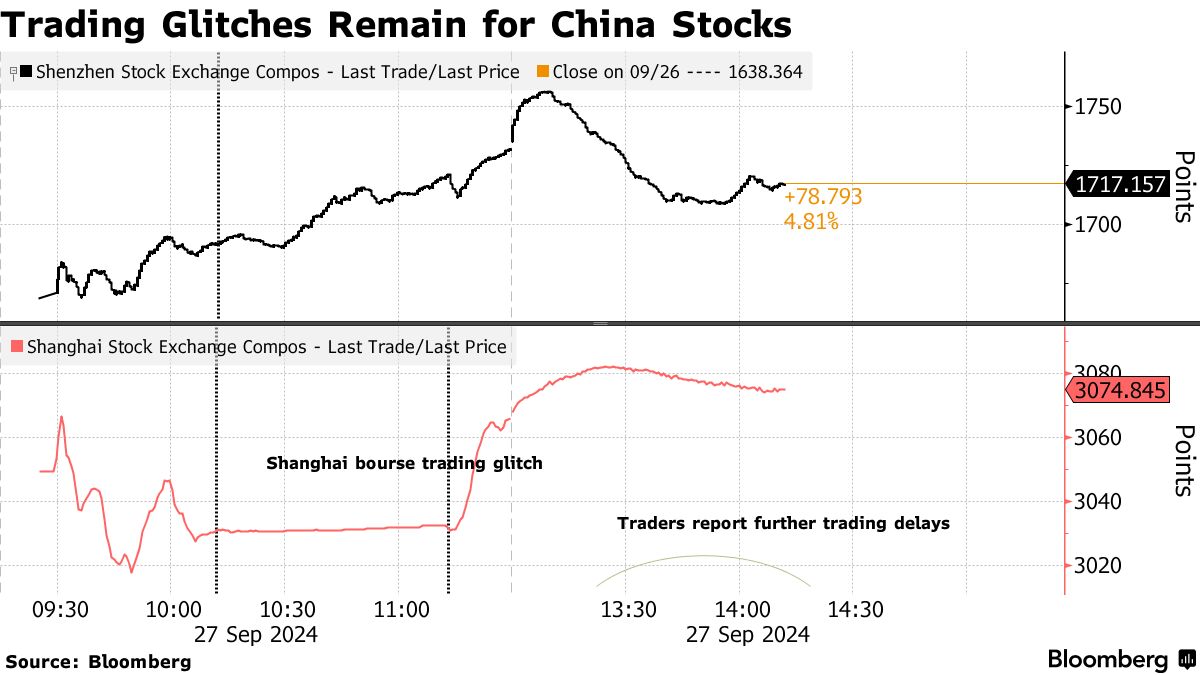
With shares soaring and turnover reaching 710 billion yuan ($101 billion) in the first hour of trading on Friday, Shanghai’s stock exchange was marred by glitches in processing orders and delays, according to messages from brokerages seen by Bloomberg News. The Shanghai Stock Exchange is investigating reasons for delays, it said in a statement.

The Shanghai Composite Index stayed roughly unchanged from 10:10 a.m. for about an hour even as the Shenzhen composite gained 4.4% over the period. As trading resumed, the Shanghai index surged. 

Some continue to experience delays in getting orders through in the afternoon session, multiple traders told Bloomberg News. Onshore turnover was fairly muted after 1 p.m. local time.

“I only recall a trading delay like this one during the 2015 rally, but generally it sends a positive signal,” said Du Kejun, fund manager at Shandong Camel Asset Management Co. “While it was but a small disruption to our trading, it would have been a big annoyance for firms that were eager to increase their positions today.” 

https://assets.bwbx.io/images/users/iqjWHBFdfxIU/iqWAa44Eq76w/v2/pidjEfPlU1QWZop3vfGKsrX.ke8XuWirGYh1PKgEw44kE/-1x-1.png

China’s stock markets erased losses for the year, following a blitz of stimulus measures introduced this week. That has sparked a frenzy of trading, with the volume turnover nearing 1 trillion yuan in the morning session. That’s more than the total for a full day seen in recent months....  

....MORE

The CSI 300 index ended the day at 3,703.68 up 158.36 (+4.47%) for the day and up 15.71% for the week. We should probably begin our long-threatened pivot to cat videos, It is doubtful we will have another market call as timely as last Sunday's Chief Economist of Bank of China International—"Xu Gao's case for stimulus":

This is it. I would assume that he is speaking for the Bank (BOCI) with approval from the Party and the government....

in my lifetime.