Tuesday, February 27, 2024

Goodbye Guys: "The Y Chromosome Is Vanishing. A New Sex Gene May Be The Future of Men"

From ScienceAlert, February 23:

The sex of human and other mammal babies is decided by a male-determining gene on the Y chromosome. But the human Y chromosome is degenerating and may disappear in a few million years, leading to our extinction unless we evolve a new sex gene.

The good news is two branches of rodents have already lost their Y chromosome and have lived to tell the tale.

A recent paper in Proceedings of the National Academy of Science shows how the spiny rat has evolved a new male-determining gene.

How the Y chromosome determines human sex
In humans, as in other mammals, females have two X chromosomes and males have a single X and a puny little chromosome called Y. The names have nothing to do with their shape; the X stood for 'unknown'.

The X contains about 900 genes that do all sorts of jobs unrelated to sex. But the Y contains few genes (about 55) and a lot of non-coding DNA – simple repetitive DNA that doesn't seem to do anything.

But the Y chromosome packs a punch because it contains an all-important gene that kick-starts male development in the embryo....

....MUCH MORE

 The spiny rat story is not as encouraging as the writer seems to think.

Nigeria's Population May Pass China's This Century: "Nigeria’s ‘hardship’ economy in four charts"

Depending on who is doing the forecasting, with Nigeria's population continuing to boom and China's population shrinking fast (How Serious Is China's Demographic Doom? Almost Beyond Comprehension), there is the very real possibility that Nigeria will be the second most populous nation on earth. And their economy is nowhere near ready to deliver what economies are supposed to deliver.

If interested see also: "Follow-Up: Three Estimates Of Nigeria's Population and Rank In 75 Years"

First up, from Semafor, February 26:

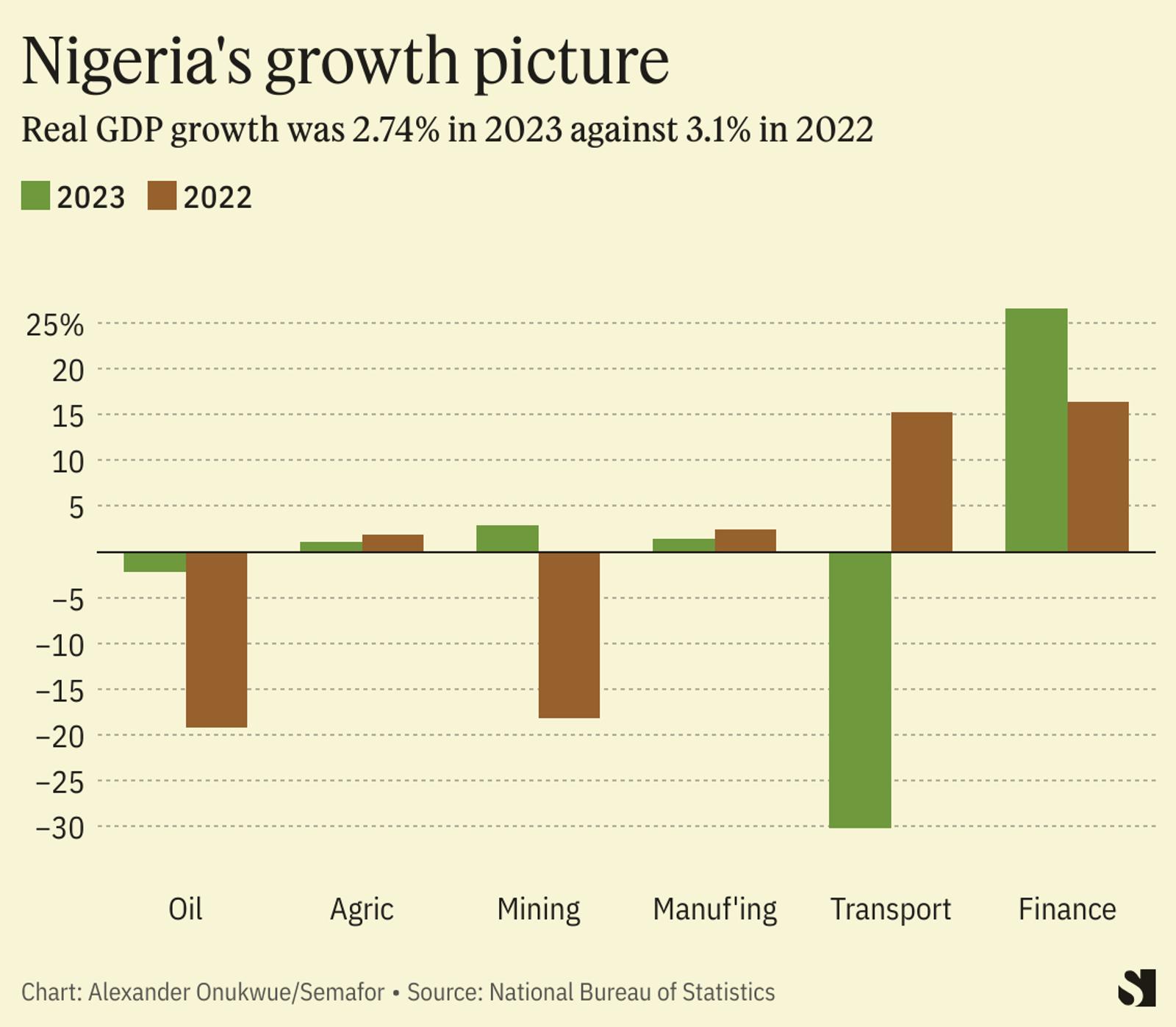
Nigeria’s ‘hardship’ economy in four charts

The News
Nigeria’s economy grew at 2.7% last year, the lowest rate since the country’s recession in 2020, according to the state-run National Bureau of Statistics (NBS).

The performance came on the back of reduced growth across nearly all sectors of Africa’s largest economy from agriculture and trade to manufacturing and construction. The finance sector was a notable exception. Activity in the oil and mining sectors rebounded after shrinking in 2022.

https://img.semafor.com/966baa1b503ff4655f8c5186a2ac40ba30a1793a-1134x990.jpg?w=1600&q=75&auto=format

A change of government last May heralded new policy directions for Nigeria. A years-long petrol subsidy program was ended while a fixed peg for the naira currency against the dollar was scrapped. The period since has been marked by rising prices and a continuously depreciating naira, fueling widespread hardship.

Two main labor unions for government employees plan to hold protests this week. They say the government is yet to implement cost-of-living adjustments agreed to last October as prices rose in response to the subsidy removal.

Know More
Analysts welcomed the Nigerian oil sector’s recovery, marked by a 12% growth in the last three months of the year. But the reduction of the overall economy in dollar terms from $471 billion to $356 billion in 2023 is “bad news” for President Bola Tinubu’s ambitions of a trillion-dollar economy, said Wilson Erumebor, an economist at the Nigeria Economic Summit Group think tank.

Here are three other charts that show the state of Nigeria’s economy in 2023....

....MUCH MORE

Because of the stagflation Nigeria is experiencing capital flight.

Financial Times, February 22:

Nigeria blocks access to crypto exchanges in effort to curb currency slide
Local consumers given only restricted access to markets like Binance and Coinbase

It's a pretty big deal. And speaking of big deals, Nigeria is just the most dramatic example. November 25, 2022:
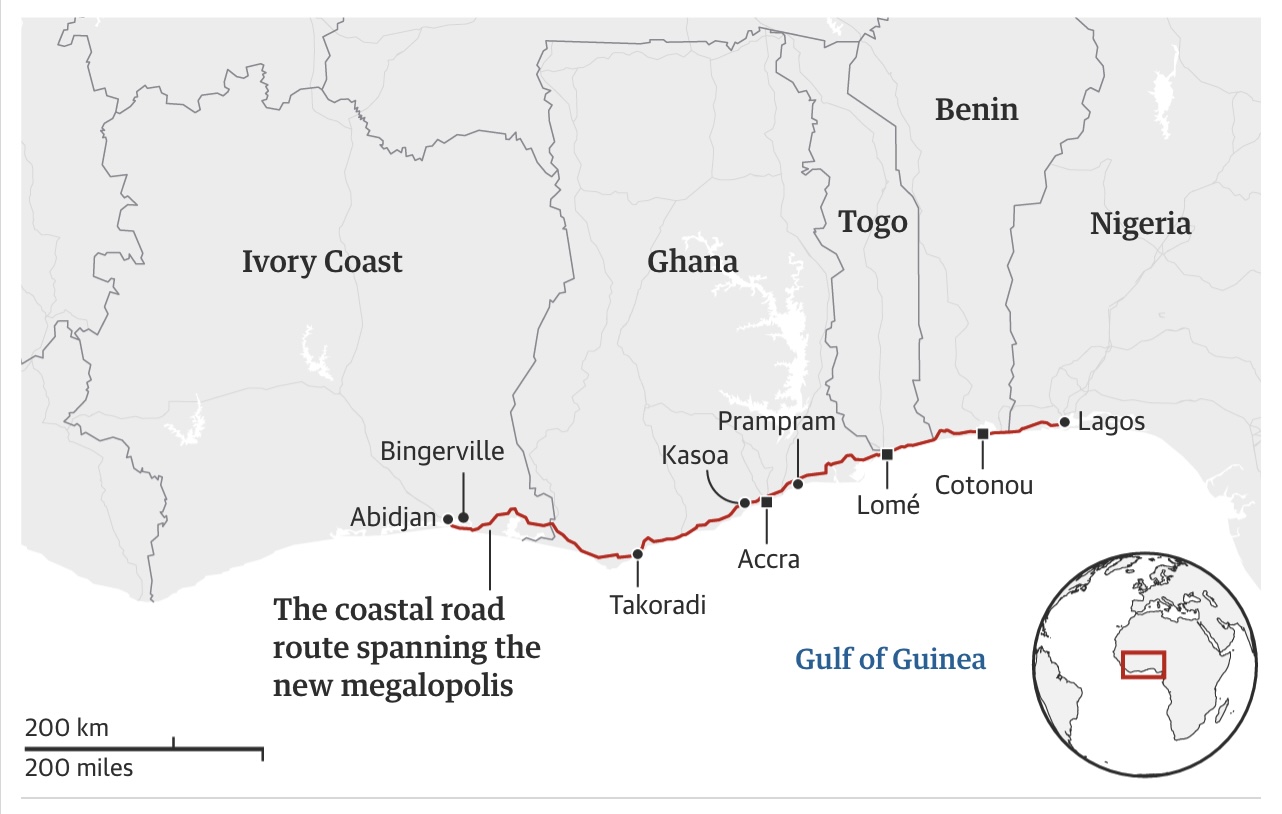
"Megalopolis: how coastal west Africa will shape the coming century"
As the old-timers used to say, "Pay attention or pay the offer."

https://pbs.twimg.com/media/FiDP9oUVUAEv8WJ.jpg:large

....MUCH MORE

Sanofi Is Looking For A "Computational Scientist - Digital R&D Large Molecule Research Team"

This stuff is happening right now. The melding of supercomputers and health sciences gives us the digital biology we've been babbling about. 

From Sanofi:

date posted 02/21/2024
contract type Full time
job id R2713383
location Cambridge, Massachusetts

Reference No. R2713383

Position Title:Computational Scientist – (Machine Learning) Digital R&D Large Molecule Research Team 

Department:Data Strategy Program Management

Location: Cambridge, MA

About Sanofi:

We are an innovative global healthcare company, driven by one purpose: chasing the miracles of science to improve people’s lives. Our team, across some 100 countries, is dedicated to transforming the practice of medicine by working to turn the impossible into the possible. We provide potentially life-changing treatment options and life-saving vaccine protection to millions of people globally, while putting sustainability and social responsibility at the center of our ambitions.

Sanofi has recently embarked on a vast and ambitious digital transformation program. A cornerstone of this roadmap is the acceleration of its data transformation and of the adoption of artificial intelligence (AI) and machine learning (ML) solutions to accelerate R&D, manufacturing and commercial performance, and bring better drugs and vaccines to patients faster, to improve health and save lives.

In alignment to our digital transformation, we have launched a new major strategic initiative in 2023: the Biologics x AI Transformation. This is positioned to be a unique data-driven team, with expertise in AI platforms, data engineering, ML operations, data science, computational biology, strategy, and beyond. We are working as one to identify, design, and scale state-of-the-art AI capabilities targeted to truly transform how we research biologics.

Who You Are:

You are a dynamic Computational Scientist who will work with other scientists to apply cutting-edge computation, Machine Learning/Deep Learning approaches to revolutionize our large molecule computational tools by contributing to accelerating and improving the process of design and engineering of novel biologics drug candidates.

Job Highlights: 

  • Apply and develop artificial intelligence and machine learning (AI/ML) approaches (e.g. classification, clustering, machine learning, deep learning) on pharma research data sets (e.g. activity, function, ADME properties, physico-chemical properties, etc.)

  • Building models from internal and external data sources, algorithms, simulations, and performance evaluation by writing code and using state-of-the art machine learning technologies.

  • Close interactions with other Computational scientists, data engineers, software engineers, UX designers, as well as research scientists in core scientific platforms focusing on protein therapeutics, in an international context (US, Europe, China)

  • Update and report relevant results to interdisciplinary project teams and stakeholders

Key Functional Requirements & Qualifications:

  • Advanced degree (e.g. M.Sc., PhD) in a field related to AI/ML or Data Analytics such as: Computer Science, Mathematics, Statistics, Physics, Biophysics, Computational Biology or Engineering Sciences.

  • Ideally 1+ years of industry experience, new grads will also be considered. Should have a track record of applying ML/Deep Learning (DL) approaches to solve molecule-related problems. 

  • Familiarity with protein structure or sequence featurization/embeddings.

  • Familiarity with advanced statistics, ML/DL techniques including various network architectures (CNNs, GANs, RNNs, Auto-Encoders, Transformers, PLM etc.), regularization, embeddings, loss-functions, optimization strategies, or reinforcement learning techniques.

  • Proficiency in Python and deep learning libraries such as PyTorch, TensorFlow, Keras, Scikit-learn, Numpy, Matpilotlib.

  • Familiarity with data visualization and dimensionality reduction algorithms

  • Ability to develop, benchmark and apply predictive algorithms to generate hypotheses

  • Comfortable working in cloud and high-performance computational environments (e.g. AWS)

  • Excellent written and verbal communication, strong tropism for teamwork

  • Strong understanding of pharma R&D process is a plus.

Capital Markets: "Weak US Durable Goods may Herald Pullback in Capex"

From Marc to Market:

Overview: Most of the G10 currencies are trading quietly in narrow ranges today. After a slightly firmer than expected national CPI reading, which still moderated, and a pullback in US yields, the Japanese yen is the strongest of the major currencies. The dollar has pulled back from almost JPY151 to nearly JPY150. The New Zealand dollar is the weakest, off about 0.2% ahead of tomorrow's central bank meeting. After selling $127 bln of coupons yesterday, the US Treasury comes back with $42 bln seven-year note sales and $80 bln in a 42-day cash-management bill. A sharp drop in Boeing orders will make for a poor durable goods orders report, but more generally, capex looks set to slow after a sharp expansion in Q2 23 and Q3 23, perhaps ahead of the November election. Meanwhile, congressional leaders go to the White House today to see if a partial government shutdown at the end of the week can be averted and aid to Ukraine secured.

After profit-taking was seen yesterday, most large Asia Pacific equity markets advanced today, including a 1.2% rally in China's CSI 300 and a nearly 1.5% rally in mainland shares that trade in Hong Kong. Taiwan and South Korean markets were exceptions and recorded modest losses. Europe's Stoxx 600 has steadied after losing about 0.35% yesterday, its biggest loss in nearly two weeks. US index futures are steady to slightly firmer. European 10-year yields are mostly two basis points lower. Ten-year Gilt yields are around three basis points lower after the BRC reported the smallest increase in shop prices (2.5% year-over-year) in two years. Gold is firm, but the yellow metal remains within last Friday's range (~$2016-$2041). April WTI recovered yesterday from a six-day low near $75.85 to $7800 and is trading quietly today with a $77-handle....

....MUCH MORE

Monday, February 26, 2024

"Underwater cables in Red Sea damaged months after Houthis threatened to do just that"

From The Register, February 27: 

Yemeni rebels thought to lack the ability to damage submarine cables, but here we are

Undersea data cables in the Red Sea have reportedly been damaged, months after Yemeni Houthi rebels threatened to do so.

At least 15 submarine cables pass through the Bab al-Mandab Strait at the southern end of the Red Sea, a body of water just 26km wide at some points. Yemen is the Strait’s northern shore.

The first reports of damage to submarine cables off the coast of Yemen began emerged on Monday morning, with Israeli news outlet Globes claiming that four cables (EIG, AAE-1, Seacom and TGN-EA) had experienced damage. Seacom has reportedly confirmed damage to a cable it operates on a stretch between Kenya and Egypt.

"The location of the cable break is significant due to its geopolitical sensitivity and ongoing tensions, making it a challenging environment for maintenance and repair operations," Seacom said. "The team is currently working towards restoration timelines and will communicate these plans with our clients."

Globes attributed the outages to the Iran-backed Houthis, and claimed the damage was "significant, but not critical," because several other undersea cables serve the region. Seacom has already reassured customers it has re-routed traffic onto other cables.

While the world has a decent supply of cable repair ships, they are booked up well in advance so finding one ready to work is not always possible. Nor are cable repairs easy: it takes time to find and retrieve a damaged segment and reconnect it.

These repairs could be complicated by regional tensions. The Houthis have attacked civilian ships and military assets in the Red Sea since the recent invasion of Gaza by the Israel Defense Forces after terrorist attacks by Hamas....

....MUCH MORE

BIS Still Pushing Tokenization, This Time In The Metaverse

 From the Bank for International Settlements, February 2024:

BIS Papers
No 144
The economic implications of
services in the metaverse

Abstract
How could an immersive computer-generated environment (“the metaverse”) impact services in the digital economy? Investment in virtual worlds has grown rapidly. Yet the technology still falls short of achieving fully immersive experiences. And despite hyperbolic predictions, various indicators show interest has fallen in the last two years. While some use cases show promise (eg gaming, education, healthcare), others seem distinctly gimmicky (eg virtual bank branches, land speculation). If the metaverse does succeed, it could mean: (i) a blurring of lines between the tradable and non-tradable sectors, (ii) greater cross-border economic integration and (iii) new demands on payment services. In principle, retail fast payment systems, retail central bank digital currencies or tokenised deposits could be designed to support services in the metaverse. To prevent virtual environments and money from becoming fragmented and dominated by powerful private firms, public policy would need to support efficient, interoperable payments and provide clear standards on data privacy, digital ownership and consumer protection.

In the 31 page PDF there are 75 instances of the word "payment." There are 57 uses of the root word "token" and/or tokens and/or tokenization. They are very serious about this stuff.

Here's #12 on page 5:

Payments and tokenisation allow for the exchange of value and thus a virtual economy in the metaverse; identity solutions serve as authentication and validation mechanisms; and security, governance and privacy protocols provide the legal frameworks and regulatory structure that allow the metaverse to exist (CB Insights (2022)).

And beginning on page 14:

4. Payments in the metaverse
For metaverse applications to be commercially viable and to promote economic
activity, payments are a crucial foundation. Existing metaverse applications already handle a wide variety of payment methods to purchase items directly or to transact in native utility or governance tokens (Graph 8.A). According to a survey of 10,000 metaverse users, commissioned by PayPal and fielded by Logica Research (Lau (2023)), users do not uniquely choose one payment method but pay in a wide variety of ways. The most commonly used means of payment in the existing metaverse is – perhaps predictably, given the study’s sponsor – PayPal (over 80% of respondents). This is followed closely by debit cards (78%). Other traditional forms of payment are all commonly used according to the survey – credit cards (66%), direct bank transfers
(50%) and prepaid cards (46%). These payment services can be used to buy metaverse tokens, or digital representations of value, in Roblox, Minecraft and Second Life. Those tokens, in turn, can be traded for tokenised goods and services (eg virtual objects and clothes for avatars, services provided by other users). As virtual worlds grow, consumers may want to use their typical payment method out of convenience, which makes it important for these platforms to accept them. The survey’s definition of the metaverse is broad and includes some videogames, but if we focus exclusively on blockchain-based metaverse applications, the top method of payment would be stablecoins and other cryptocurrencies. This includes Bitcoin and Ethereum, and utility and governance tokens in these platforms. The Sandbox’s native token, SAND, can be
traded on exchanges like Gemini, Crypto.com and Binance. Similarly, MANA, the token native to Decentraland, can be purchased on Coinbase, Kraken and others. Responses to the same survey indicate that a very high percentage of users of the metaverse consider it important to be able to use cryptocurrencies (89%) and stablecoins (84%) for purchases in the metaverse (PayPal (2023)). More than half of metaverse users expect their use of cryptocurrencies to increase in the next five years. Cryptocurrency is also the preferred choice to receive payment for work done in the metaverse (76% of respondents), followed closely by fiat currency (69%) Graph 8.B).

More generally, the structure of payment systems in the metaverse depends on
whether the model for the metaverse is centralised or decentralised....

....MUCH MORE

If interested see also:

The Bank For International Settlements Tokenization/Cyber Projects For 2024   

"BIS, World Bank, Swiss National Bank to Tokenize Promissory Notes" 

"Tokenized, Inc: BlackRock's Plan To Own The Fractionalized World"  

I think they're trying to tell us something.

The 5 Most Active PE Investors In Life Sciences: #1, ARCHIMED Lyon, France

Lyon?

From PitchBook, December 3, 2023:

The life sciences industry has drawn considerable interest from private equity, which injects billions of dollars into this rapidly growing segment.

PE investments in life sciences peaked in 2021, when investors closed 695 PE transactions totaling $127.5 billion, according to PitchBook data. The space includes biotech and medical device companies as well as providers of related tools and services.

Among the main drivers of this demand are the spectacular returns that PE investors can potentially score through life sciences deals if they bet on the right horse. The median IRR for such deals signed in the past 10 years is about 25%, and the top-quartile performers generated a return of at least 50%, according to a report by Bain & Company.

Despite the slow M&A environment this year, dealmakers still sealed a handful of multibillion dollar transactions, including a more than $7 billion take-private of biopharma contract research organization Syneos Health and a roughly $6 billion acquisition of veterinary drugmaker Dechra Pharmaceuticals.

These mega-transactions, some of them the largest life sciences deals of the past few years, serve as evidence of investors’ ongoing appetite in this segment.

The industry is expected to see a steady supply, or even an uptick in deal flow, in the coming year, as interest rates will likely stabilize and investors are looking to deploy capital, said Carol Loepere, a partner at Reed Smith.

Particularly in the specialty pharma and medical device sectors, both PE-backed companies and strategic buyers have shown a growing appetite for new acquisitions to enhance their technology or expand the services and products they offer, Loepere said.

Here are the five most active PE investors in life sciences by deal count since 2018. They are ranked by the number of buyouts (excluding add-ons) and growth investments.

ARCHIMED

Lyon, France

ArchiMed is a PE healthcare specialist with offices across North America, Europe and the Asia-Pacific region. The investment manager this year wrapped its fifth multi-asset fund, MED Platform II, on €3.5 billion. The total includes a smaller sidecar fund for coinvestments. In November, ArchiMed acquired and merged two contract research organizations, Symbio & Dow Group and Proinnovera, in an all-equity deal. Earlier this year, it took private Instem, a UK-based life sciences software company.

PE Investments
24
Select Portfolio Companies
Symbio Proinnovera, Instem
....MUCH MORE (2 U.S., 1 China, 1 Sweden)

"Singapore-based startup Mesh Bio raises $3.5 M to make digital twin technologies available at scale"

From BioSpectrumAsia, January 31:

New investment comes three months after Mesh Bio secured historic regulatory approval 

Mesh Bio, a Singapore-based health deep tech startup transforming chronic disease management through predictive analytics, has raised $3.5 million in Series A financing led by East Ventures, a pioneering and leading sector-agnostic venture capital firm focusing on Southeast Asia. This round of investment also saw participation of Elev8, Seed Capitals, and other existing shareholders.

The funding will allow Mesh Bio to offer its digital twin technologies to healthcare providers and scale the deployment of these solutions across Hong Kong and Southeast Asia, mainly Indonesia and the Philippines....

....MUCH MORE

This stuff is happening now. And even though long-time readers have probably internalized the quotes on models, don't let them stop you from thinking about how useful a digital model twin could be.

And for newer readers here's a post from 2012 (there are earlier uses but this was the first that popped up):

Modelling vs. Science

A subject near and dear to our jaded hearts, some links below.
If an experiment is not reproducible it is not science.
If an hypothesis is not falsifiable it is not science.

Finally, our two guiding principles regarding models:

"The map is not the territory"
-Alfred Korzybski
"A Non-Aristotelian System and its Necessity for Rigour in Mathematics and Physics" 
presented before the American Mathematical Society December 28, 1931
......................................................................................................................................................

"All models are wrong, but some are useful"
-George E.P. Box
Section heading, page 2 of Box's paper, "Robustness in the Strategy of Scientific Model Building"
(May 1979)

From Pannell Discussions:

Mick Keogh, from the Australian Farm Institute, recently argued that “much greater caution is required when considering policy responses for issues where the main science available is based on modelled outcomes”. I broadly agree with that conclusion, although there were some points in the article that didn’t gel with me.....

"CRE vet who advised on $8 billion of deals says 30% of office buildings are ‘basically worth nothing’ and ‘just have to be torn down’"

And let nature begin to heal.
Or install tennis courts.*

From Fortune, February 25:

The demolition phase is coming.

As remote work keeps employees out of the office and vacancy rates sit at all-time highs, commercial property owners are desperately trying to avoid default: by upgrading their spaces to attract new tenants, converting their space into apartments or simply offloading their assets. One longtime industry professional doesn’t think that will be enough.

As the market evolves, says Fred Cordova, of Santa Monica-based Corion Enterprises, there won’t be room for everyone—and about a third of office buildings are endangered species.

“There will be a bifurcation…The product in a good location with a good, safe environment will recover. And then you’ve got another group that will somehow hang in there and get reset in pricing,” said Cordova, who is CEO of the real estate consultancy. “And then you have the others that are basically worth nothing—the D class. Those just have to be torn down. That’s probably at least 30% of all offices in the country.”

Residential conversion is the much touted solution. And optimists have suggested that federal aid in the form of subsidies to assist with converting offices to apartments could offer some aid to developers suffering from the precipitous drop in demand for office space—but it likely won’t be enough to stop a significant chunk of the commercial market from collapsing, both figuratively and literally....
*****
... Converting offices into apartments can be prohibitively expensive. Zoning codes mandating natural light and fresh air make it tricky to adapt large, open-concept office floor plans into apartments that are up to code. Many buildings put up during the construction boom of the 1950s and 60s simply aren’t capable of being converted into housing. And skyrocketing construction costs are squeezing margins for would-be developers, meaning that simply tearing an office building down and replacing it with brand-new apartments is actually often the cheaper option, said Cordova. 

“[We used to be involved with] conversions that cost $75 to $150 a foot. Now, the market rate is $350. For high-end luxury, it’s $450. The economic model is very challenging for conversion,” said Cordova. “The way to do it is for governments to provide subsidies for conversion…the government needs to provide about a 20% cost subsidy.”

Those efforts are already underway: the Biden administration earmarked $35 billion in below-market-rate loans to help developers with these types of conversions last fall....

....MUCH MORE 
*Also at Fortune, ten days ago
 
Almost a year ago we saw:
 April 19, 2023
 Kyle Bass Has Some Advice For Commercial Real Estate Owners: Tear The Buildings Down
The ghost of JM Keynes isn't just smiling, he's laughing his (ethereal) backside off

From Bloomberg via Crain's Chicago Business, April 13:

The investor who won big in the 2008 housing crash has advice for office landlords: Tear 'em down.

Kyle Bass has some advice for real estate investors: Tear it down.
The founder of Dallas-based Hayman Capital Management says office buildings in cities need to be demolished because demand isn’t returning and it’s impractical to turn most towers into apartments.

“It’s one asset class that just has to get redone, and redone meaning demolished,” said Bass.
The Dallas-based investor shot to fame more than a decade ago betting against subprime mortgages before the US housing collapse. He’s since pushed a series of contrarian investments that have occasionally burned investors such as predicting the collapse of Japanese government debt and Hong Kong’s dollar....
Here's an interesting point:
....“You have to jackhammer rebar and concrete. You have to re-plumb everything,” Bass, 53, said in an interview. “And when you finish it, it just doesn’t feel right. You wouldn’t want to live there,” he said, citing for instance the lack of light....
....MUCH MORE  

That was followed in May 2023 by:
"Warren Buffett on pain in commercial real estate amid tightening credit: ‘Too bad’"

Ahead Of Tomorrow's Earnings Report First Solar Releases Study On The Company's Economic Impact (FSLR)

Some background on why the company may feel compelled to point out the entire value chain effects of their being in business:

First up August 25, 2023:
"First Solar, The Poster Child For Solar Subsidies Has Had An Awful Month (FSLR)":
As the Wall Street Journal noted on July 31:
The U.S. Clean-Energy Company That Hit the Subsidies Jackpot
Of all the beneficiaries of the U.S.’s green-energy push, few have hit the jackpot like First Solar. The Arizona-based solar-panel manufacturer expects to receive as much as $710 million this year—nearly 90% of forecast operating profit—from subsidies the U.S. government rolled out a year ago to encourage domestic renewables production. One analyst estimates the incentives could be worth more than $10 billion for the company over the next decade...

And December 27, 2023:
Jackpot: "First Solar to sell up to $700 million in IRA tax credits to Fiserv" (FSLR)

The study via BusinessWire, February 26:

First Solar Releases Study Analyzing Economic Impact of American Manufacturing and Supply Chain Investments

  • First Solar forecast to support over 30,000 direct, indirect, and induced jobs representing approximately $2.8 bn in labor income in 2026.
  • Study reveals that every First Solar job in 2026 is expected to support 7.3 jobs across the nation.
  • Solar manufacturer expected to add $5 bn in value and over $10 bn in output to 2026 US economy.

First Solar released what is believed to be the first comprehensive economic analysis of a vertically integrated solar manufacturer’s value chain in the United States. 

“We know that our investments, catalyzed by the Inflation Reduction Act, are enabling jobs and bringing prosperity to communities in places such as Lawrence County, Alabama, Iberia Parish, Louisiana, and Crawford County, Pennsylvania, and this report helps quantify the extent of our contribution to the US economy in real terms.”

TEMPE, Ariz.--()--First Solar, Inc. (Nasdaq: FSLR) released what is believed to be the first comprehensive economic analysis of a vertically integrated solar manufacturer’s value chain in the United States. The study, commissioned by First Solar and conducted by the Kathleen Babineaux Blanco Public Policy Center at the University of Louisiana at Lafayette, used IMPLAN economic software to analyze First Solar’s actual and forecasted US spending in 2023 and 2026 when the company expects to have 14 gigawatts (GW) of annual nameplate capacity across Alabama, Louisiana, and Ohio.  

The study found that in 2023:

  • First Solar supported an estimated 16,245 direct, indirect, and induced jobs across the country, representing $1.59 billion in annual labor income. With 2,700 employees and almost $490 million in direct labor income, every non-construction First Solar job supported six direct, indirect, and induced jobs across the US economy, and every dollar directly spent on wages created $3.3 in labor income.
  • The fully vertically integrated solar manufacturer, which exited 2023 with over 6 GW of annual nameplate capacity, added $2.75 billion in value and $5.32 billion in output to the US economy during the year, including direct, indirect, and induced effects.
  • The company’s construction activity in Alabama, Louisiana, and Ohio supported an estimated 5,765 direct, indirect, and induced jobs, representing over $600 million in labor income. Its construction activity is estimated to have added over $900 million in economic value and almost $2 billion in economic output in 2023.

Analyzing First Solar’s forecasted US spending in 2026, the study projects that.... 

....MORE

Finally from Zacks, February 26:

What's in the Cards for First Solar (FSLR) in Q4 Earnings?

...The Zacks Consensus Estimate for FSLR’s fourth-quarter revenues is pegged at $1.31 billion, indicating growth of 30.8% from the year-ago reported figure....
*****
...The Zacks Consensus Estimate for First Solar’s fourth-quarter earnings is pegged at $3.19 per share, implying a massive improvement from the prior-year reported loss of 7 cents per share....

....MUCH MORE

As for our opinion? We have the Go-Go's "We got the beat" cued up.  

The stock is up 71 cents at $143.60.

Taking Nvidia's Jensen Huang Seriously: Paris-Based "Bioptimus primed with $35m to unravel disease biology using AI"

Two pitches that Nvidia's CEO will be making at next month's NVDA lovefest (Nvidia GTC Conference, March 17 - 21, 300,000 attendees in-person and online) are 1) sovereign AI, every country, even every city needs its own supercomputer powered by Nvidia chips and its own Large Language Model trained on those supercomputers and 2) digital biology - everything from rapid drug discovery to individually tailored gene therapy.*

And from Longevity.Tecnology, February 20:

French startup founded by former Google DeepMind talent aims to build first ‘universal AI foundation model’ for biology.

Paris-based AI startup Bioptimus has emerged from stealth, securing seed funding of $35 million to advance its mission to generate computational representations that capture the full diversity of biology.

The company aims to develop the first “universal AI foundation model” for biology, leveraging high volumes of diverse, multimodal, and multiscale data to provide a comprehensive understanding of biology – from molecules and cells to tissues and entire organisms. Should it be successful in its mission, a better understanding of biology could also help shed light on the mysteries of the aging process, which is still poorly understood.

Led by Professor Jean-Philippe Vert, Bioptimus has assembled a team of scientists, including experts from Google DeepMind and French TechBio company Owkin. The company will benefit from its close ties with Owkin, which boasts advanced data generation capabilities and federated global access to multimodal patient data from leading academic hospitals worldwide, coupled with a secure computing environment.

Vert, who is also Chief R&D Officer of Owkin and former Research Lead at Google Brain, said that AI was set to have a “profound impact” in biology....

WEF's Klaus Schwab At The World Governments Summit: "Use technology to create humanocracy"

From Gulf News, February 12:

Use technology to create humanocracy, Klaus Schwab tells leaders at World Governments Summit in Dubai
Prepare for “intelligent age” merging physical, biological, digital dimensions: WEF chief

Dubai: Professor Klaus Schwab, founder and executive chairman of the World Economic Forum, on Monday urged leaders attending the World Governments Summit (WGS) 2024 in Dubai to harness technology to create what he termed a ‘humanocracy’ and prepare for an ‘intelligent age’ merging our physical, biological, digital dimensions.

Delivering the keynote address on “Civilisations of Tomorrow: Built to Fail or Rise,” Schwab reflected on the impact of technological advancements and emphasised the need for a transition into an era where humanity flourishes alongside technological progress.

Schwab outlined key aspects of this envisioned intelligent age, including personalised education systems, predictive healthcare, and a redefined economy driven by creative entrepreneurship and digital platforms. Emphasising the role of technology in enhancing human wellbeing, he envisioned workspaces that prioritise creativity and interpersonal connections, enabled by automation and AI.

Schwab called upon government leaders to proactively embrace this technological evolution and engage their populations in the process.

“We have to be prepared for a world where we see a fusion of our physical, our digital, and our biological dimensions,” he said during a conversation with Mohammad Abdullah Al Gergawi, UAE Minister of Cabinet Affairs and chairman of the WGS, following his speech....

....MUCH MORE

And from the Union of News Agencies of the Organization of Islamic Cooperation (UNA-OIC), 12Feb2024:

Klaus Schwab: The world will be different in 10 years and we need ethical frameworks that ensure better use of artificial intelligence 

Dubai (UNA/WAM) - In a session with Mohammed bin Abdullah Al Gergawi, Minister of Cabinet Affairs and Chairman of the World Government Summit, entitled “Building the civilizations of tomorrow... Are they resilient?”, Professor Klaus Schwab, founder and president of the World Economic Forum, said: World leaders must involve the population in the process of transition towards what he described as the “smart age,” stressing the need to make our world more sustainable, humane and equal.

During the session held on the first day of the World Government Summit 2024, Schwab spoke about 3 goals that governments should work to achieve in relation to the rapid technological transformation that the world is witnessing, the first of which is the necessity of using technology to make our world more sustainable, resilient, humane and equal.

As for the second goal of governments, Schwab identified the need to involve the population in the targeted change process, because people fear, as he said, the rapid changes that they must adapt to in their daily lives.

Regarding the third goal, he stressed that we need the necessary ethical frameworks to ensure better use of artificial intelligence. Schwab said: “If we look at leadership in the new era, the political leader must combine being aware of the reality of what is happening and what can happen, and He understands the interactions between technology and everyday life, and above all he has to be a human being.”

– Focus on the individual.

When asked about the possibility of the world soon reaching a sustainable economic model, Schwab answered: “We have to go back and review the economic policies that we are pursuing. We should focus on the individual. We are currently focusing a lot on preserving what we have, but we must also take into account the cost of what we do.”

Regarding what can be done so that future generations can be more influential and present in this “new era,” Schwab said: “The infrastructure should be affordable, and all systems should be usable, and thus we allow everyone to access services in a responsible manner, and at a cost.” “Reasonable.”

In his answer to the question, “How can rapid technological progress shape the future of societies?”, Schwab pointed out that “the pace of change in the future will be slower, and the world will be different from what we know now during the next 10 years.”

- Ready for the future.

In his speech, Schwab touched on the integration of big data, quantum computing and artificial intelligence, adding: “We must be ready for a world in which we combine all of this together to achieve the greatest possible benefit to serve humanity.”

Professor Klaus Schwab noted that “we are witnessing a future driven by the technology of the Fourth Industrial Revolution, and we see the dawn of a new era for human civilization, and this vision will unleash societies, where the Internet of Things, three-dimensional (3D) printing, quantum computing, and artificial intelligence.”

– Bridging the digital gap.

He pointed out that technology in the era of new artificial intelligence will not be just a tool or an extension of humanity's capabilities, but rather a partner in shaping the world.

He said: “In the (new era), priority will be given to human well-being through robots and artificial intelligence, and at the core of this transformation there is a commitment to ensuring that the benefits of technological development will be provided equally to bridge the digital gap within societies,” stressing that the human being is the core of this vision for the new era.

He pointed out that the “smart age” will contribute to developing the field of health care and improving remote health monitoring technology, so that it can help those who need it in the farthest parts of the world.

He added: “You, as government leaders, are the ones who shape the future. “So we want to move into a human-technological world to use all our technological capabilities.”

He concluded his speech by saying, “This new simulation is close to us and is not something that will happen with the next generation. The speed of this transformation is very great and we must prepare with all our might to deal with this new era.”....

....MORE

"Was Toyota’s bet on hybrid cars right all along? "

Total team coverage including former Alphavillain, the FT's man in Japan, David Keohane.

An extensive piece from the Financial Times, February 25:

Japanese automaker’s stance on limited appetite for fully electric vehicles is being reassessed 

After spending the past decade as the car industry’s loudest champions of hybrid vehicles, Toyota executives could be forgiven for feeling some measure of vindication.

The Japanese carmaker’s dogged determination to pour billions into hybrid vehicles that combine batteries with the traditional internal combustion engine drew criticism from investors and environmentalists alike.

Consumers would balk at buying more expensive fully electric cars, Toyota repeatedly warned. Now, as a combination of stubbornly high prices and concern over inadequate charging infrastructure chills enthusiasm for battery electric vehicles (BEVs) in markets from Europe to the US, what was once regarded as heresy from Toyota is being reassessed.

Adam Jonas, an analyst at Morgan Stanley who confidently predicted that aggressive government regulation and a consumer preference for fully electric models would quickly extinguish the hybrid market, this month admitted: “I owe Toyota an apology.”

While demand for BEVs has risen over the past three years, according to data compiled by Jato Dynamics, their share of the new car market shrank in the UK and sales growth slowed in the US and Europe.

The shift in the market has already strengthened Toyota’s bottom line: sales of hybrids at the world’s largest carmaker climbed by almost 1mn to 3.4mn last year, helping the company raise its forecast for operating profit to a record ¥4.9tn ($33bn) for the year to March. 

Hybrids come in several varieties. Plug-in hybrids, or PHEVs, can run for dozens of miles on electric power alone and be charged at home, though their large battery means they are generally expensive. Full hybrids combine a smaller battery and a traditional engine that run together, making them cheaper both to buy and run.

The majority of the industry still believes that developing profitable BEVs is the most important long-term goal for carmakers, but the mini-renaissance of hybrids is forcing some to change their plans. In a US hybrid market mainly dominated by Toyota, Honda and the South Korean duo of Kia and Hyundai, domestic manufacturers are racing to catch up.

Last month General Motors, which had largely phased out plug-in hybrids from its range, said it would reintroduce the technology as it acknowledged that customers were taking longer than expected to embrace fully electric models.

Ford, which bet on hybrids as an interim technology, predicts its sales of such models will surge 40 per cent this year, double last year’s pace. It sold more than 52,000 Maverick pick-up trucks in 2023, making it the fifth best-selling hybrid in the US after models from Toyota and Honda....

....MUCH MORE + 276 comments.

"Reddit’s Biggest Risk Is Its Reliance on Unpredictable Users"

From Bloomberg, February 22:

The company’s IPO prospectus makes clear how dependent it is on unpaid labor and the whims of its community. 

Reddit’s prospectus for its initial public offering finally dropped on Thursday, complete with the customary list of “risk factors” that the company thinks could give it headaches in the years ahead as a public company. At 40,000 words, it’s longer than Facebook’s and Twitter’s risk factor statements combined at the time of their listings.

As with IPOs past, many of them are boilerplate. An earthquake would be bad for Reddit’s business, for instance, particularly if it happens to occur within shaking distance of the company’s San Francisco headquarters. Also, the company faces many external threats common among several companes, such as losing the traffic it gets from Google, a collapse in the online advertising economy or the threat of World War III. All standard stuff.

Where Reddit differs among its tech peers — and where the company needs to go into great detail — is in its striking dependence on its user base to keep things operational. More so than any other online business I can remember, Reddit must keep its users satisfied on several important and delicate fronts.

First, it acknowledges that efforts to expand its limited (and already unpopular) advertising formats could send users packing. The majority of the company’s 73 million daily active users are there just to browse. Pulling up stakes and browsing elsewhere, if the ads become too annoying, is trivial when compared with the gargantuan effort required to leave Facebook, X or other platforms. Even if they don’t leave, Reddit users lean toward the tech savvy and won’t hesitate to employ ad blockers in large numbers (if they don’t already). For the past two years, the filing stated, 98% of Reddit’s revenue is made up of advertising income. And of that, 26% came from just 10 ad clients in 2023. Investors will be watching this closely and expect more diversity sooner rather than later.

Then, there’s the small matter of all the unpaid labor it relies on to keep things even remotely civil. There were 60,000 active daily moderators using the platform in December 2023, the filing stated, though it didn’t offer any historical comparisons — investors may want fuller disclosures around that figure to determine whether the number of active moderators is declining. That worked out to just more than 1,200 users for each moderator.

The going rate for a content moderator around the world varies greatly, but for the sake of expedience, let’s say it might average around $50,000 a year. That’s $3 billion worth of free labor. Reddit has only 2,013 full-time employees of its own and thus is relying on these passionate volunteers to stop its website from descending into chaos and keep advertisers from rushing to the exits.

As the site grows, the job of moderator becomes more burdensome for the volunteer and riskier for the company. “Mods,” as they are known, may disagree with the company on what constitutes offensive or inappropriate behavior, and as efforts to monitize grow, this will be a flashpoint. The site, it’s worth stating, is chock-full with pornography, some of which might be considered, by some, as pushing the boundaries of the morally acceptable. Even those users who don’t consume that content will reflexively resent any efforts to sanitize one of the edgier corners of the internet.

Fallout could be swift and effective, the filing warns. “Moderators can also band together and, for various reasons, decide to shut down the normal operation of their communities” and “reduce the amount of monetizable content generated by Redditors.” This could all happen in a flash, though the company said that a recent coordinated protest — in which several popular subreddits shut themselves down — did not have a material effect on the business....

....MUCH MORE

Couldn't have put it better myself, although I tried:

February 18
Ahead Of IPO Reddit Has A New AI Training Deal To Sell User Generated Content
Sounds like Arianna Huffington and the unpaid contributors at the Huffington Post.

February 22
"Reddit is going public and inviting power users to invest" (plus semi-variance vs. standard deviation as a risk measurement)
Following on the dirty hedge post immediately below, this is more akin to a "Texas-hedge" by Reddit management. Unlike a hedge which (theoretically) reduces exposure, a Texas hedge increases exposure to risk. There are many explanations of the origin of the term but the one time I saw it put into action was when a trader was long an equity option position and bought the underlying to goose the option into the money for what reason I know not. That same guy used to mark the close on positions that were close to getting him a margin call, a different form of increasing your risk and illegal in most jurisdictions, further increasing your risk.

The reason the Reddit management's game-plan increases their risk is if the stock goes south after the IPO they will not only have a loss but also have a bunch of their power-users angry with them. Power-users who have a platform they can use to vent/cathart or boycott as they may see fit....

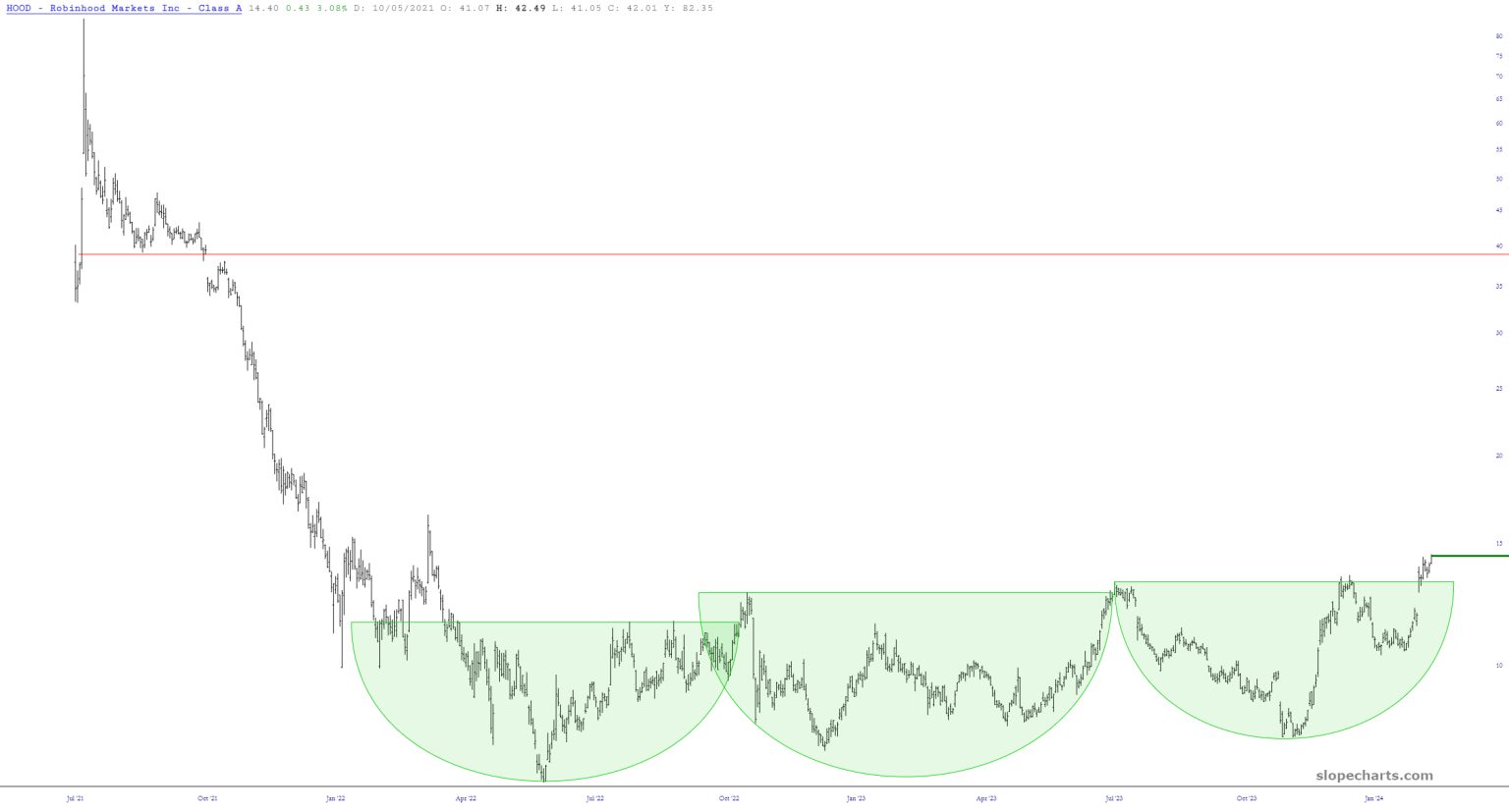
Interview With Robinhood CEO Vlad Tenev (as the stock appears to be basing) HOOD

First up, from Semafor, February 24:

On The Record
Semafor Business’ signature interview series, On The Record, brings you conversations with the people running, shaping, and changing our economy. Read our earlier conversations with Mattel CEO Ynon Kreiz on Hollywood’s golden age of IP, Washington Post CEO Will Lewis on the media doom cycle, and Delta CEO Ed Bastian on the 2020 airlines bailout.

Three years ago, an army of bored, stimulus-rich day traders upended the stock market. They may have rallied on Reddit and Twitter, but they traded on Robinhood, which became the face of the meme-stock craze and was nearly brought down by it when it ran out of cash to cover its customers’ trading.

That moment is over. SPACs are dead. Memelords couldn’t save Bed Bath & Beyond. The index fund that tracked meme stocks, built to “capture a zeitgeist,” shut down in November. What froth remains has been funneled into AI stocks, which at least carry the promise of profits.

Robinhood is still here, trying to thrive beyond the moment that launched it. Trading volumes on its app have fallen by half since early 2021; stocks and cryptocurrencies don’t hold the same appeal when Treasury bonds pay 5%. The company’s shares are down more than 70% from their peak.

Regulators are taking aim at the gamified investing that Robinhood pioneered, which has brought newcomers to the markets — a good thing in a country where the vast majority of wealth-creating assets are owned by already wealthy people, but one that encouraged, through smartphone confetti, engagement beyond what is perhaps wise.

I talked with Vlad Tenev, the company’s 37-year-old CEO, about the way forward. In the sunlit penthouse of Robinhood’s surprisingly anonymous Manhattan headquarters, he sipped bottled green tea and described a Robinhood that looks more like the legacy firms it set out a decade ago to unseat. (Credit cards are coming; check back in on mortgages in a few years.) It must also keep the loyalty of its most active customers, while fending off competitors that are courting Gen Z investors.

This interview was condensed and edited for clarity.

We’re three years out from the meme-stock craze. What did you learn?
The importance of clear communication. I wish I’d been more patient. I was very keen to get out there and start talking right away, and I was dealing with lots of issues internally, trying to make sure everything was stable, and I just wasn’t really sleeping. So I was not as compelling as I could have been in explaining exactly what happened....

....MUCH MORE

And from Slope of Hope, also February 24:

Maybe Robinhood (HOOD) is finally ready to rock higher.

https://slopeofhope.com/wp-content/uploads/2024/02/slopechart_HOOD-1536x827.jpg

Slope latest posts.

Sunday, February 25, 2024

Evolution, Devolution, Gonna Be A Revolution: What Did Britain Use For Lighting Before Candles?

Electricity.

From The Telegraph, February 25:

The UK is much closer to blackouts than anyone dares to admit
It won’t take an enemy power to overwhelm the National Grid  

Of all the problems with electric cars, perhaps the least expected was the revelation that some home charging points provide a potential point of weakness for malign foreign powers to interfere with our National Grid. Last week, the Office for Product Safety and Standards ordered the company Wallbox to stop selling its Copper SB chargers because hackers could potentially access the chargers and incapacitate the grid by such means as suddenly turning on thousands of chargers full-pelt at the same time.

But do we really need a foreign power to crash our electricity grid when we are quite capable of inflicting it on ourselves? We are heading for a big electricity crunch as it is. Whoever wins the general election, the next government will be committed to decarbonising the National Grid – by 2035 in the case of the Conservatives and by 2030 in the case of Labour. That means either closing all the gas power stations or fitting them with carbon capture and storage technology – which does not yet exist on scale in Britain and whose costs are likely to be massive. At the same time every single one of our existing nuclear power stations is currently due to reach the end of its life by 2035. If Hinkley C is delayed much beyond its latest estimated completion, we could end up with no nuclear at all.

That could leave us trying to power the country pretty much with intermittent wind and solar energy alone – and this at a time when politicians want millions more of us to be driving electric cars and heating our homes with heat pumps, thus substantially increasing demand. How will we keep the lights on? One struggles to find satisfactory explanation from the National Grid ESO, which is trusted with this task....

....MUCH MORE

I may get to repurpose the old joke one more time:

California's grid is so unreliable that the joke for the last few years has been:

https://freakytrigger.s3.eu-west-1.amazonaws.com/wordpress/wp-content/uploads/2018/06/27143243/titanic-painting.jpg

 "At least when the Titanic went down the lights were on."

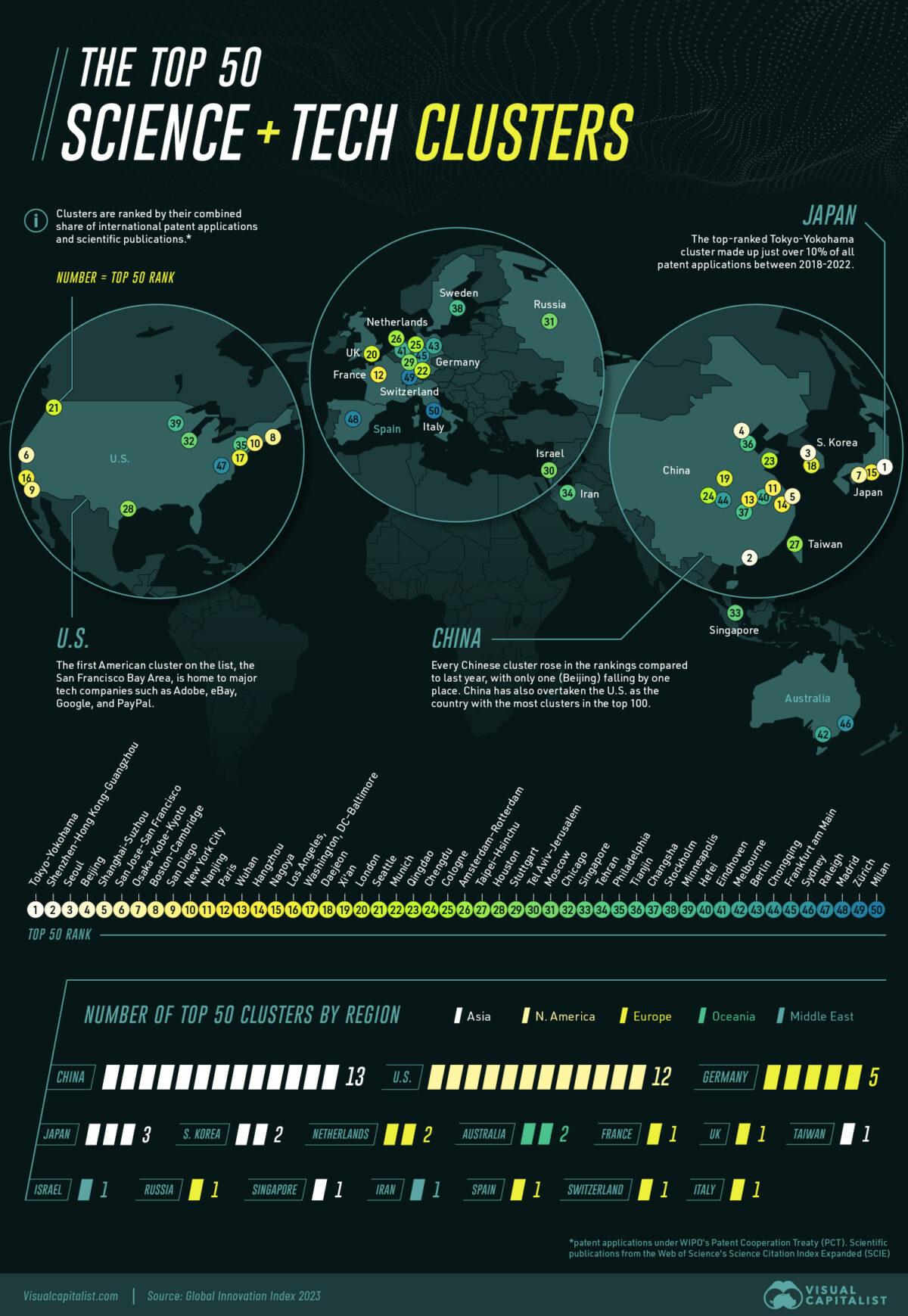
"Mapped: The World’s Top 50 Science and Technology Hubs"

 From Visual Capitalist, February 16:

https://posts.voronoiapp.com/_next/image?url=https%3A%2F%2Fvrnimagesbucket120214-staging.s3.ca-central-1.amazonaws.com%2Fpublic%2Fimages%2Fb29ecfe7-9cdd-40bb-ab90-130791fb25bb.jpeg&w=1920&q=75

(click to enlarge)

....MUCH MORE (click through for discussion)

"Stellantis CEO says there’s still life in Waymo deal for self-driving delivery vans" (STLA; GOOG)

Stellantis has done a lot of the things meeded to (maybe) be one of the auto makers that are still around in fifteen years but this may not be one of them.

From TechCrunch, February 24:

Stellantis, the automaker that owns 14 brands including Chrysler, Jeep and Ram, and autonomous vehicle technology company Waymo are not only still working together, the companies are deepening the partnership, CEO Carlos Tavares told TechCrunch in a recent interview.

This “deepened” partnership will focus on commercial self-driving Ram delivery vans, a target that was first announced in 2020 and promptly faded from public view. Discussions on this “improved” deal have focused, in part, on a crux around driverless delivery: how does the package get from the vehicle to the customer?

“When you reach the destination, how do you take the parcel out of the van?” Tavares said in a wide-ranging interview. “This has been a point of discussion that doesn’t seem easy to solve and we are now upgrading our collaboration deal with them to take that into consideration.”

“At the same time, we understand their needs and there are a lot of things that we can do for them in terms of engineering,” he said, adding it is too soon to share details. “But I would say that the partnership with Waymo is getting deeper. And I think, more exciting.”

Tavares played coy on the important what, where and when details. But he did add that he expected to be able to share more “possibly by summer.”

A Waymo spokesperson confirmed that the company continues to look at ways to deepen its relationship with Stellantis, but didn’t share any other details or if progress had been made.

Tavares’ comments suggest the company has more than a passing interest in reviving a deal that appeared destined to fizzle out as so many other autonomous vehicle-OEM partnerships have in the past two years....

....MUCH MORE 

Some of those right moves:

July 2022
"Stellantis warns of car market collapse if EVs don't get cheaper"
All is proceeding according to plan. You will own nothing and be happy.
In other words: "Hop on the bus, Gus," "Make a new plan, Stan...."(apologies to Paul Simon)

Feb. 2023
Peugeot, Jeep, Dodge, Maserati-Maker Stellantis Earning Big Money (STLA)
Also Fiat, Alfa Romeo, Chrysler and a bunch of other marques.
They appear to be generating serious efficiencies from the 2021 merger. and additionally, sold 288,000 electric vehicles for the full year.

May 2023
"Automaker Stellantis announces inauguration of lithium battery gigafactory in France" (STLA)
Stellantis seems to "get it."
"Go big or go home," aren't just words, it's the reality that automakers are going to have to face if they want to be among the ten or so survivors in the electric vehicle business.

August 2023
"Stellantis unveils low-priced electric vehicles to rival Tesla" (STLA; TSLA)
Continuing our look at Tesla's competition. Stellantis is making the moves that must be made to be one of the 10 or 12 survivors of the EV wars.

Of all those, Stellantis' July 2022 warning about pricing was deep insight for a legacy manufacturer, a realization Tesla and the Chinese had already come to but something GM and Ford seemed to be unaware of.

"For Captured Carbon, Scientists Plot a Sub-Ocean Tomb"

This approach addresses one of the big risks of just willy-nilly burying CO₂: that the gas will somehow escape and a) re-enter the carbon cycle via the atmosphere or b) create a Lake Nyos (Cameroon, 1986) scenario which released naturally trapped CO₂ and killed over 1700 people and thousands of head of livestock. Solidifying the CO₂ as part of the entombment has had its  attractions since the Al Gore days:

I too have heard the siren song of carbon capture and storage.
There are two ways to use carbon once it is captured (still theoretical because of price but the cost is dropping, see below), either sequester it and remove it from the carbon cycle or reuse it in a closed loop hydrocarbon fuel infrastructure.
From 2007: "Can baking soda curb global warming?":

I have a fascination with calcium carbonate. But, being flexible, I am willing to consider the bicarbonate of various metals.
Some scientists have proposed compressing carbon dioxide and sticking it in underground caves as a way to cut down on greenhouse gases. Joe David Jones wants to make baking soda out of it.
Jones, the founder and CEO of Skyonic, has come up with an industrial process called SkyMine that captures 90 percent of the carbon dioxide coming out of smoke stacks and mixes it with sodium hydroxide to make sodium bicarbonate, or baking soda. The energy required for the reaction to turn the chemicals into baking soda comes from the waste heat from the factory.
"It is cleaner than food-grade (baking soda)," he said.
The system also removes 97 percent of the heavy metals, as well as most of the sulfur and nitrogen compounds, Jones said.
And a few months earlier:
... Right now I'm looking at calcium carbonate. Literally. Got a hunk of limestone. CaCO3. That's sequestered carbon, right?. Hmmm.
Make a green pitch, wrap it in recycled fiberboard; et voila! Return of the Pet Rock, eco-version! And seashells, same stuff, calcite. There's the hook! Mom, you're going to Miami Beach.

And many, many more. Use the 'search blog' box if interested.

The cost of the carbon capture stage is still exorbitant but who knows what advances are ahead?

From UnDark, February 19:

It’s a contentious idea, but advocates say storing CO2 under the seafloor could help address climate change—if it works.

In 2010, as the Deepwater Horizon rig sank and millions of gallons of oil gushed into the Gulf of Mexico, Kate Moran’s phone rang in Washington, D.C. At the time, she was assistant director in President Barack Obama’s Office of Science and Technology Policy, and government officials recognized that she brought years of ocean drilling experience. Within a matter of days, and guided by her understanding of deep ocean geochemistry, the government rapidly deployed resources and experts to manage the crisis, overseeing controlled burns, remote undersea vehicles, even air and sea traffic control systems. “It was remarkable,” Moran said recently of the mobilization. “Unbelievably remarkable.”

That memory looms large as Moran leads a project to mitigate the environmental impacts of fossil fuels on a much larger scale. Now president and CEO of the research institute Ocean Networks Canada, she is also the principal investigator for Solid Carbon, a project overseen by the institute that aims to permanently remove greenhouse gases from the atmosphere by entombing carbon under the seafloor.

“You can do big things in the ocean — the oil industry does,” Moran said, expressing dismay that governments have not marshaled resources like they did for Deepwater Horizon. “So why not look at a system where you could have essentially an independent system offshore that actually removes CO2 from the atmosphere and puts it away forever?”

In addition to transitioning away from fossil fuels, climate science experts are increasingly convinced that greenhouse gases will need to be removed from the atmosphere to avoid cascading impacts of climate change. A new global climate deal from the United Nations climate conference, COP28, doesn’t require countries to completely phase out fossil fuel use, but rather relies on investments in renewable energy and carbon removal techniques to mitigate the impacts of greenhouse gases. National climate plans, too, increasingly depend on carbon removal.

But it’s a gamble: Removing enough carbon dioxide on a large scale hasn’t been fully tested. And the slower the transition away from fossil fuels, the more carbon removal will be needed to reach goals and avoid catastrophes.

“My students always say, ‘But don’t we have to try?’ And the answer is absolutely,” said David Goldberg, a professor at Columbia University’s Climate School who designed the Solid Carbon plan with Moran.

Effective carbon removal is essentially a two-step process: first, remove the carbon dioxide from the air, and then somehow keep it from returning for at least several decades and ideally much longer. Forests and other plant life remove and store carbon dioxide naturally, but it risks returning through decomposition or fires. Solid Carbon would use machinery that filters out carbon dioxide both from sources of emissions, as well as directly from the air. The next step is finding a way to permanently store the trapped carbon dioxide.

Researchers at Solid Carbon are turning to basalt, a volcanic rock that easily reacts with acids like carbon dioxide, to turn the greenhouse gas into a carbonate rock under the seabed. Storing carbon in geologic formations like this is expected to be the most long-lasting method among options to keep carbon dioxide out of the atmosphere. Under the Cascadia Basin off the coast of Vancouver Island lies the most extensively studied ocean basalt. What’s more, it’s colossal: large enough in theory to store carbon from all global annual emissions many times over.

Solid Carbon offers a glimpse into the enormous scale that would be required to impact emissions. In one version of its plan, dozens of floating rigs on the Pacific Ocean would be coupled with many more wind turbines to funnel compressed, carbon dioxide nearly 2 miles under the sea. But that would only remove less than 1 percent of what climate scientists predict will be needed by 2050. If carbon removal techniques are to make any dent in emissions, they will need to scale up multiple magnitudes....

....MUCH MORE

I know Professor Moran is all over the earthquake risk but for readers who are unfamiliar with the area here's a little map of the Cascadia Subduction Zone from Kids Fun Science:

https://www.kids-fun-science.com/images/rf3-cascadia-subduction-zone-usgs.jpg

And more fun via Climateer Investing:
When The Megaquake Hits, The Living Will Envy The Dead
Okay, a bit of hyperbole in the headline but let's go with 10,000 dead, 30,000 injured and 2,000,000 people displaced and dependent on handouts.

We've had three posts on the Cascadia Subduction Zone, a couple links below.
There have been a few cat bonds issued over the years that cover Cascadia, they seem to be underpriced for the risk.*

"Fed-Favored Inflation Gauge Seen Rising Most in a Year" (PCE-core)

From Bloomberg, February 24/25:

  • Report may highlight uneven path to taming price pressures
  • Inflation also due in euro zone and Japan; G-20 officials meet 

Underlying US inflation probably rose in January by the most in a year, as tracked by the Federal Reserve’s preferred metric, highlighting the long and bumpy path to taming price pressures.

The core personal consumption expenditures price index, which excludes food and energy costs, is seen rising 0.4% from a month earlier. That would mark the second straight monthly acceleration in a gauge that’s largely been receding over the past two years.

And when annualizing the data on a three- or six-month basis, both would rebound above 2% after dipping below the Fed’s target in December.

Fed officials have stressed they’re in no rush to lower borrowing costs and will only do so once they’re confident that inflation is retreating on a sustained basis....

....MUCH MORE

The January number to be reported this week would be double the 0.2% December figure reported last month. 

For comparison, the Cleveland Fed Inflation Nowcast has PCE-core coming in at a slightly lower 0.32% Unfortunately the Nowcast has been running too cool and has underestimated the last two CPI reports. So we shall see.