Apple's CEO is friendly with the Chinese leadership. And while not wanting to impute motives regarding the headline story, the way MacDailyNews characterizes the relationship in general is:
Anti-government protests flared in several Chinese cities and on
college campuses over the weekend. But the country’s most widespread
show of public dissent in decades will have to manage without a crucial
communication tool, because Apple restricted its use in China earlier
this month.
AirDrop, the file-sharing feature on iPhones and other Apple devices, has helped protestors
in many authoritarian countries evade censorship. That’s because
AirDrop relies on direct connections between phones, forming a local
network of devices that don’t need the internet to communicate. People
can opt into receiving AirDrops from anyone else with an iPhone nearby.
That changed on Nov. 9, when Apple released a new version of its
mobile operating system, iOS 16.1.1, to customers worldwide. Rather than
listing new features, as it often does, the company simply said, “This update includes bug fixes and security updates and is recommended for all users.”
Hidden in the update was a change that only applies to iPhones sold in mainland China:....
Try listing every problem the Western world has at the moment. Along
with Covid, you might include slow growth, climate change, poor health,
financial instability, economic inequality, and falling fertility. These
longer-term trends contribute to a sense of malaise that many of us
feel about our societies. They may seem loosely related, but there is
one big thing that makes them all worse. That thing is a shortage of
housing: too few homes being built where people want to live. And if we
fix those shortages, we will help to solve many of the other, seemingly
unrelated problems that we face as well.
The obvious effects of expensive housing Where you live affects nearly everything about your life – where you work, how you spend time off, who your friends and neighbours are, how many kids you can have and when, and even how often you get sick. Most people’s most valuable asset is, by far, their own home. And housing is so important for the overall economy because it determines the location and supply of the most important ‘resource’ of all: people.
There’s a growing consensus that housing is too expensive in most Western countries. In many places, the prices of new homes far exceed
the cost of building more of them. Higher incomes in cities draw people
to those places, who use some of their increased wages to bid up rents
and house prices there. Easier credit and falling interest rates, which
reflect a lower cost of borrowing and lower returns from other
investments, have helped people bid up the price of housing as well.
For most goods, including very expensive and durable goods like ships
and airplanes, higher incomes and falling interest rates would cause
supply to increase, instead of keeping the price permanently high. But
for housing in and around many in-demand cities, supply has not been
able to keep up with demand.
This is true across the developed world: Dublin, Singapore, Auckland,
Paris, Vancouver, Rome, Hong Kong, Barcelona, Moscow, Cape Town, Zurich
and many other cities have wildly expensive housing compared to the
cost of building more of it. Costs are especially high in places whose
economies are built on intangible capital,
like software or financial services. In these kinds of industries,
there are especially large benefits to people being near one another,
because it makes them both more productive and more innovative. This is
why the San Francisco Bay Area – probably the most productive place in
the Western world – is also one of the most in-demand places to live.
And that demand, plus restrictions on building more houses, is why it is
one of the most expensive places to live as well.
This housing affordability problem has become much worse over the
past four decades – coinciding with, and partly driven by, the growth of
the intangible economy — the move towards production based on software
and intellectual property, instead of machinery and other physical
capital. In the 1960s, it was commonplace that a middle class
single-earner American or British family would be able to afford a
comfortable home.
When more people want to live in an area, we either build more homes
to accommodate them or squeeze them in to the existing housing stock,
with those people bidding up the price of living there. We can see all
of these mechanisms in play in the Western world’s most in-demand
cities. In London, for example, empty homes now make up only a few
percent of the total, as it becomes more and more costly to leave
something empty.
The most dramatic evidence of housing scarcity can be seen in price
rises over the past forty years. Average New York City metropolitan area
house prices are up 706% since 1980 (or 376% more than US consumer prices, and 326% more than US wages). For San Francisco the rise is 932%. London house prices are up over 2,100% in that period (or around 1,500% more than wages). Prices in Sydney, Australia, have risen by 1,450% (compared to hourly wage increases of 480%). In Ireland, prices have risen by about 800% in that period,
driven by rises in Dublin in particular. Rents show similar, but less
extreme, trends, because they are not directly affected by interest
rates.
These prices range from about twice to four times the cost of
building new homes of equivalent specification. This wedge, between
build costs and house prices, is a rough proxy for how much extra cost
is being driven by restrictions on new building.
By contrast, almost every other household product has become better and less expensive since then. Compared to 1975, the number of hours a median American worker would have to work
to buy a television fell from 60 hours in 1975 to 7 hours in 2013; to
buy a fridge-freezer, it fell from 65 hours in 1975 to 20 hours in 2013;
to buy a manual exercise treadmill, from 18 hours in 1975 to 6 hours in
2013; and to buy a washer-dryer, from 67 to 30 hours. Even cars are three times ‘cheaper’ in terms of hours worked
on an average hourly wage now than they were in 1964. And none of these
estimates accounts for how much better most of these products are now
than they were in 1975.
*****
So while other durable goods have become cheaper over time, housing
has become more expensive. Even though incomes have risen, both parents
in a family now typically have to work to afford a decent family house
in a major city, and people have had to move farther and farther outside
city centres to find somewhere they can afford to live, spending more
time and money on commuting to and from work.
So the obvious effect of expensive housing is that people
often spend a lot of their money on renting or buying their home,
leaving them with less money to spend on other things, especially if
they live in and around the Western world’s most wealthy cities. And the
problem is getting worse.....
We've looked at the importance of housing as a cornerstone of
intergenerational wealth a few times, and not just for piles like this:
That's
the courtyard of Arundel Castle, it's been in the fam (Fitzalans;
Howards; Fitzalan-Howards) since the mid-1200's (with a few reversions
to the Crown). More after the jump.....
How
Europe will eat Halal — Why you don’t have to smoke in the smoking
section — Your food choices on the fall of the Saudi king –How to
prevent a friend from working too hard –Omar Sharif ‘s conversion — How
to make a market collapse
The best example I know that gives insights into the functioning of a
complex system is with the following situation. It suffices for an
intransigent minority –a certain type of intransigent minorities –to
reach a minutely small level, say three or four percent of the total
population, for the entire population to have to submit to their
preferences. Further, an optical illusion comes with the dominance of
the minority: a naive observer would be under the impression that the
choices and preferences are those of the majority. If it seems absurd,
it is because our scientific intuitions aren’t calibrated for that
(fughedabout scientific and academic intuitions and snap judgments; they
don’t work and your standard intellectualization fails with complex
systems, though not your grandmothers’ wisdom).
The
main idea behind complex systems is that the ensemble behaves in way
not predicted by the components. The interactions matter more than the
nature of the units. Studying individual ants will never
(one can safely say never for most such situations), never give us an
idea on how the ant colony operates. For that, one needs to understand
an ant colony as an ant colony, no less, no more, not a collection of
ants. This is called an “emergent” property of the whole, by which parts and whole
differ because what matters is the interactions between such parts. And
interactions can obey very simple rules. The rule we discuss in this
chapter is the minority rule.
The
minority rule will show us how it all it takes is a small number of
intolerant virtuous people with skin in the game, in the form of
courage, for society to function properly.
This
example of complexity hit me, ironically, as I was attending the New
England Complex Systems institute summer barbecue. As the hosts were
setting up the table and unpacking the drinks, a friend who was
observant and only ate Kosher dropped by to say hello. I offered him a
glass of that type of yellow sugared water with citric acid people
sometimes call lemonade, almost certain that he would reject it owing to
his dietary laws. He didn’t. He drank the liquid called lemonade, and
another Kosher person commented: “liquids around here are Kosher”. We
looked at the carton container. There was a fine print: a tiny symbol, a
U inside a circle, indicating that it was Kosher.
The symbol will be detected by those who need to know and look for the
minuscule print. As to others, like myself, I had been speaking prose
all these years without knowing, drinking Kosher liquids without knowing
they were Kosher liquids.
Figure 1 The lemonade container with the circled U indicating it is (literally) Kosher.
Criminals With Peanut Allergies
A
strange idea hit me. The Kosher population represents less than three
tenth of a percent of the residents of the United States. Yet, it
appears that almost all drinks are Kosher. Why? Simply because going
full Kosher allows the producer, grocer, restaurant, to not have to
distinguish between Kosher and nonkosher for liquids, with special
markers, separate aisles, separate inventories, different stocking
sub-facilities. And the simple rule that changes the total is as
follows:
A Kosher (or halal) eater will never eat nonkosher (or nonhalal) food , but a nonkosher eater isn’t banned from eating kosher.
Or, rephrased in another domain:
A disabled person will not use the regular bathroom but a nondisabled person will use the bathroom for disabled people.
Granted,
sometimes, in practice, we hesitate to use the bathroom with the
disabled sign on it owing to some confusion –mistaking the rule for the
one for parking cars, under the belief that the bathroom is reserved for
exclusive use by the handicapped.
Someone
with a peanut allergy will not eat products that touch peanuts but a
person without such allergy can eat items without peanut traces in them.
Which
explains why it is so hard to find peanuts on airplanes and why schools
are peanut-free (which, in a way, increases the number of persons with
peanut allergies as reduced exposure is one of the causes behind such
allergies).
Let us apply the rule to domains where it can get entertaining:
An honest person will never commit criminal acts but a criminal will readily engage in legal acts.
Let us call such minority an intransigent group, and the majority a flexible one. And the rule is an asymmetry in choices.
I
once pulled a prank on a friend. Years ago when Big Tobacco were hiding
and repressing the evidence of harm from secondary smoking, New York
had smoking and nonsmoking sections in restaurants (even airplanes had,
absurdly, a smoking section). I once went to lunch with a friend
visiting from Europe: the restaurant only had availability in the
smoking sections. I convinced the friend that we needed to buy
cigarettes as we had to smoke in the smoking section. He complied.
Two
more things. First, the geography of the terrain, that is, the spatial
structure, matters a bit; it makes a big difference whether the
intransigents are in their own district or are mixed with the rest of
the population. If the people following the minority rule lived in
Ghettos, with their separate small economy, then the minority rule would
not apply. But, when a population has an even spatial distribution, say
the ratio of such a minority in a neighborhood is the same as that in
the village, that in the village is the same as in the county, that in
the county is the same as that in state, and that in the sate is the
same as nationwide, then the (flexible) majority will have to submit to
the minority rule. Second, the cost structure matters quite a bit. It
happens in our first example that making lemonade compliant with Kosher
laws doesn’t change the price by much, not enough to justify
inventories. But if the manufacturing of Kosher lemonade cost
substantially more, then the rule will be weakened in some nonlinear
proportion to the difference in costs. If it cost ten times as much to
make Kosher food, then the minority rule will not apply, except perhaps
in some very rich neighborhoods......
Say what you will about the Mafia,” a Greenwich Village neighbour of
mine once told me, as we were chatting on a late summer evening, “but
when they were around, you could leave your wallet on the front seat of
your unlocked car and it would be there the next morning. People knew
not to mess with this neighbourhood.”
My neighbour is an eighty-year-old lesbian who moved to the city in
the late 1950s, found her tribe in the Greenwich Village coffeehouses
and dark-panelled bars, and never left. She has shown me photographs of
herself as an idealistic young woman, dressed in a simple tweed skirt
and sweater and sporting a short no-nonsense haircut, off to work for
Democratic Mayor Robert F. Wagner, the Good Government leader of New
York from 1954 to 1965.
And then a few pages on in her photo album, the tweeds are replaced
by bell-bottoms and Day-Glo colours and she’s a downtown hippie marching
for peace and gay rights. A few more pages: in outdoorsy clothes at a
nuclear weapons protest in Washington Square Park. A few more:
testifying at City Hall against the rampant gentrification of downtown
Manhattan in a 1990s business suit.
Times change, of course. The current crime wave is turning old
liberals into cranky conservatives, which is what crime waves always do.
These days my neighbour is mostly nostalgic about the Pax Mafiosa
that ruled Greenwich Village until the late 1970s. And sometimes, after a
glass or two of wine, she’s even willing to set aside her progressive
politics and say nice things about Rudy Giuliani, who presided over a
steep drop in crime during his mayoral administration.
Mostly though, she sits on the front stoop of the townhouse she
purchased in the 1960s and complains about all of the rich people moving
into the neighbourhood.
Whenever I walk by with a coffee from the local coffee shop—which happens daily—the conversation is always the same.
“Whadya pay for that coffee?” she always asks.
“Five bucks,” I always say.
She shakes her head in disbelief. “Five bucks for coffee! Crazy. Wish I had your money.”
And then I smile and walk home and trudge up three flights to the
apartment that I rent which is right next door to the townhouse she
owns, which she purchased in 1966 for US$40,000 and is now worth around
US$14 million. But whatever you do, do not mention this to her or
suggest, ironically, that hey I guess gentrification isn’t so bad because, believe me, you will be in for a lecture.
But New Yorkers are always a little weird about money. The daffy and appealing heroine of Truman Capote’s Breakfast at Tiffany’s,
Holly Golightly, is a boy-crazy, socially ambitious pauper who refuses
to accept that she is broke. My neighbour, in almost every way Holly
Golightly’s opposite, refuses to accept that she is rich.
A famous and successful chef once told me that he has never—not
once!—ridden in an Uber. Too expensive, he said. And why, when the
subway is only a few bucks? And then he added that his daughter and
son-in-law confided to him that they haven’t taken the subway in twenty
years. They think they’re rich, he said. (To which I did not respond:
they will be, though, won’t they?)....
According to a new report, recently ousted Disney CEO Bob Chapek is
alleged to have engaged in a series of deceptive accounting practices in
order to hide just how much money the company has truly lost in service
of developing their signature streaming service.
As per a collective decision by the House of Mouse’s board of directors following his poor showing during the company’s disastrous Q4 earnings call, Chapek was removed as the Disney’s CEO on November 20th, having served in the position for only two years.
In his place, much to everyone’s surprise, the board chose to reinstate former CEO Bob Iger.
“The board has concluded that as Disney embarks on an increasingly
complex period of industry transformation, Bob Iger is uniquely situated
to lead the company through this pivotal period,” explained the board’s
chairman, Susan Arnold, in a statement
provided to the media. “We thank Bob Chapek for his service to Disney
over his long career, including navigating the company through the
unprecedented challenges of the pandemic.”
Though word on the exact reasons for the board’s loss of confidence
in Chapek have not been publicly detailed, many have speculated that it
was related to his abysmal handling of the Florida Parental Rights in Education Act debacle.
Between turning Disney into a full-on political entity,
constantly flip-flopping on which side of the debate he truly
supported, and basing his moves on the ever evolving whims of Twitter’s
trending topic tab, Chapek’s ineffective and indecisive leadership
during this period has since drawn widespread criticism and mockery from
across the political spectrum.
But it seems that Chapek’s wild ride in Florida was not the sole
reason for his removal, as the former CEO is also said to have been
actively deceiving its investors.
During the company’s Investor Day 2020 presentation, Chapek assured those in attendance that the company expected “Disney+ to achieve profitability in fiscal 2024.”
However, as per insiders who supposedly spoke to The Wall Street Journal,
this is a near impossible goal to achieve due to the fact that the
company has, in reality, “lost more than $8.5 billion since Disney+
launched and has posted bigger operating losses in each of the post four
quarters.”....
...In FX’s “Little Demon,” an animated comedy featuring the voices of Danny
DeVito and Aubrey Plaza, it has been 13 years since being impregnated
by Satan, and a reluctant mother, Laura, and her Antichrist daughter,
Chrissy, attempt to live an ordinary life in Delaware. However, the two
are constantly thwarted by monstrous forces, including Satan, who yearns
for custody of his daughter’s soul....
The first thing that has to be understood is that the Chinese government/Communist Party claims universal jurisdiction for its laws, i.e. believes all Chinese citizens and corporations, anywhere in the world, are bound by Chinese law:
Article 7:All organizations and citizens shall
support, assist, and cooperate with national intelligence efforts in
accordance with law, and shall protect national intelligence work
secrets they are aware of.
The State protects individuals and organizations that support, assist, and cooperate with national intelligence efforts.
All means all, including foreign companies operating in China.
Ditto articles 14:
Article 14: National intelligence work institutions
lawfully carrying out intelligence efforts may request that relevant
organs, organizations, and citizens provide necessary support,
assistance, and cooperation.
And 16:
Article 16: When national intelligence work
institutions staff lawfully perform their tasks in accordance with
relevant national provisions, with approvals and upon the presentation
of relevant identification, they may enter relevant restricted areas and
venues; may learn from and question relevant institutions,
organizations, and individuals; and may read or collect relevant files,
materials or items.
And The Cybersecurity Law
and the Foreign NGO Law (2016) and the Counter-espionage Law (2014) are
all worded vaguely enough that the laws can mean whatever the Party and
the authorities want them to mean.
And the headline story from Elliott Management-backed (Paul Singer) Washington Free Beacon, November 26:
Top China hawks aren't sold on Canadian company Lithium Americas' move to distance itself from top Chinese investor
A Canadian company hopes to use Biden
administration loans to open the largest lithium mine in North America.
But first, it must convince government officials and prospective
partners that it's adequately decoupled from its top shareholder: a
Chinese enterprise led by known Chinese Communist Party members.
Lithium Americas—whose largest
shareholder is Chinese mineral giant Ganfeng Lithium—earlier this month
announced its intention to split the company into two separate entities,
a move that comes as it works to obtain a Biden administration loan to fund "the majority" of its lithium mining project in northern Nevada. The company told the WashingtonFree Beacon
it expects the separation to ease "geopolitical" concerns from
government officials and investors over its relationship with
Beijing-tied Ganfeng, given that the split would decouple Lithium
Americas' Nevada mine from its more controversial mining projects in
South America, which Ganfeng holds direct ownership stakes in. But
leading China hawks in the Republican Party are not satisfied with the
separation, prompting them to sound the alarm over Lithium Americas'
potential to receive federal funding.
That dissatisfaction stems from the
fact that under the proposed split, shareholders will receive stakes in
both Lithium Americas' North American and South American entities
proportional to their current holdings. Because Ganfeng is the only
entity that owns more than 10 percent of Lithium Americas' shares, it
will remain the largest shareholder of both companies following the
split, a Lithium Americas official confirmed to the Free Beacon.
As a result, Ganfeng will still have a sizable financial interest in
Lithium Americas' mine unless it decides to divest—financial interest
that has former secretary of state Mike Pompeo calling the split a "half
measure" that is "nowhere near enough to guarantee that the CCP will
not have any amount of control over a key source of America's lithium
supply."....
“An effective way to write the history of the last thirty years of the twentieth century,” economist Albert Hirschman wrote
in 1985, “may well be to focus on the distinctive reactions of various
countries to the identical issue of worldwide inflation.” Writing just
as the global “great inflation” of the 1970s was abating, Hirschman
couldn’t have foreseen how right he was. As Claudia Sahm recently wrote
in the New York Times,
fear of the great inflation of the 1970s still dominates the thinking
of the Federal Reserve, even as its recent messages indicate changing
winds. (In recent comments,
Larry Summers’s warning that two-thousand-dollar checks would cause the
economy to run too “hot” and generate inflation betrayed an almost
generational blindness on the topic.)
Economists lack a good understanding of what causes
inflation. In introductory macroeconomics curricula, the mantra of
Milton Friedman remains central: “inflation is always a monetary
phenomenon.” By this, Friedman meant that excessive price growth happens
when a state loosens the supply of money, thus over-expanding the
monetary base. But recentresearch has brought
this popular doctrine into question. While expanding the money supply
seems to be a necessary condition for uncontrolled inflation to occur,
it is not sufficient: increases of the monetary base have occurred
without any inflationary episodes, and inflationary episodes have
happened with only very small increases in the monetary base.
Contra Friedman, Hirschman suggested that uncontrolled
inflation is primarily a political phenomenon that occurs when groups
compete over resources. The rapid increase of the price level is a
signal that the state can no longer control this competition. What
exactly happened in the waning decades of the twentieth century, and why
do the ghosts of inflation still haunt our economic and political
reality?
Hyman Minsky’s writings on the collapse of the so-called
golden age of capitalism offer some insight by forcing us to engage with
how distributive struggles have driven the inflationary and
deflationary cycles of the past fifty years. In doing so, we can
construct an account of the political economy underpinning the
“deflationary coalition” that rules the common sense of our economic
policymakers and the policy they write—and the path to a new one.
Hyman Minsky’s moment Minsky became posthumously famous as a prophet of the inherent instability of financial markets. The term “Minsky moment”—the point where a bubble caused by the accumulation of private debt bursts—was coined by PIMCO’s Paul McCauley in the context of the 1998 Russian financial crisis and has become ubiquitous in the financial media. But Minsky’s Financial Instability Hypothesis (FIH), the idea that capitalism has a tendency toward financial crisis, was part of a more elaborate theory of advanced capitalist economies. Minsky believed that as a financial system, capitalism was best defined by the fact that all economic units, including individuals and households, must survive by making cash inflows and matching commitments. This is what he called a “survival constraint”: everyone from industrial firms to individual workers must have cash on hand to pay their debts or else find credit to roll their liabilities over to some future date when they will have cash flows. The ways that societies arrange for the extension and management of these cash flows and credit is a function of their institutions. For Minsky, changes in capitalist distribution and price dynamics can be understood by studying the evolution of these regimes in historical time.
In his first book-length work, John Maynard Keynes,
Minsky analyzed what he called “big government” capitalism. His goal
was two-fold. First, he sought to re-interpret Keynes by distinguishing
the so-called hydraulic Keynesianism of the postwar era from the
author’s actual written work. He argued that postwar governments which
boosted inflation through private profits contradicted Keynes’ original
system. Keynes believed that the state should facilitate long term
economic development by directly planning economic activity, including
the distribution of investment over the long run. Postwar American
policymakers, however, created a policy that protected private sector
profits during downturns. The United States government did not create
the structures which could sustain the production of a baseline basket
of goods and services from market instability during upswings. Instead,
it pumped up aggregate demand via employment in the military-industrial
complex and its attendant investment goods.
The second goal of the book was to warn about the
inflationary tendencies of this approach. Government was forcing
“overinvestment” in capital intensive industries like auto manufacturing
and aerospace. While this created good jobs, it also meant that workers
would have more money to spend on things made by less capital
intensive, nondurable consumer goods industries. Wage inequality between
these two sectors caused increasing industrial conflict. In the United States and Western Europe,
a pattern emerged in which managers made wage concessions to the most
highly productive workers to keep at bay demands for greater union
participation in company decisions, thereby further increasing the
demand for consumer goods.
Because returns to capital intensive goods were high, the
investment capital needed to expand capacity in consumer goods was
scarce. With rapidly increasing demand, the price of these goods began
to rise, leading to a wage-price spiral. In industries with no
anticipated profits, capitalists had no incentive to expand capacity.
Consequently, output remained stable while prices rose. In the labor
market, some workers held on to their jobs while others were relegated
to chronic underemployment.
Minsky’s account differs significantly from those we see in
most textbooks....
Neoliberal Twee Cass Sunstein’s latest TED Talk of a book offers the kind of technocratic whimsy that left and right can agree to hate
If you open a copy of the Encyclopedia of Political Ideology and look up “technocratic neoliberalism,” the dominant policy paradigm
since the end of the Cold War in the contemporary West, you will find a
picture of Cass Sunstein—or at least you would, if such an encyclopedia
existed. Following a successful career as a legal scholar at Chicago,
Columbia, and Harvard, and as a public intellectual who in his early
years wrote thought-provoking books on subjects including the cost of
government and Franklin Roosevelt’s Second Bill of Rights, Sunstein
broke out of the highbrow ghetto in 2008 to reach a much larger audience
with a book he coauthored with University of Chicago economist Richard
Thaler, Nudge: Improving Decisions About Health, Wealth, and Happiness.
Nudge was not Sunstein’s first venture into the genre of midwit nonfiction. That was Infotopia: How Many Minds Produce Knowledge in 2006. Perhaps it is coincidence, but Infotopia came out only a year after the publication of Freakonomics: A Rogue Economist Explores the Hidden Side of Everything, co-authored by Steven Levitt and the journalist Stephen J. Dubner. Freakonomics became a global bestseller, spawning a blog, a podcast, and sequels including SuperFreakonomics: Global Cooling, Patriotic Prostitutes, and Why Suicide Bombers Should Buy Life Insurance (2009), Think Like a Freak: The Authors of Freakonomics Offer to Retrain Your Brain (2014), and When to Rob a Bank: ...And 131 More Warped Suggestions and Well-Intended Rants (2015).
Levitt
teaches economics at the University of Chicago, where Sunstein taught
law for 27 years before joining the faculty of Harvard Law School. I do
not know whether the sudden superstardom of Levitt, his younger Chicago
colleague, inspired Sunstein to try his hand at the middlebrow genre of
pop nonfiction. There were certainly other exemplars of buckraking in
this vein to be followed, including Malcolm Gladwell, whose pop
psychology bestsellers included Blink: The Power of Thinking Without Thinking (2005) and The Tipping Point: How Little Things Can Make a Big Difference (2006), and Spencer Johnson, author or co-author of Who Moved My Cheese? An Amazing Way to Deal with Change in Your Work and Your Life (1998) and TheOne-Minute Manager (1982).
Books
of this ilk are written according to a formula as rigid as that of a
cozy mystery or a Tolkien-clone fantasy trilogy. The author, sometimes
an academic, poses as a defector who shares new research insights with
general readers, who are thrilled to be let in on the scholarly
establishment’s supposed secrets. Thus Steven Levitt, a conventional
economics professor, becomes “a rogue economist,” and Simon and
Schuster’s promotional material describes Cass Sunstein’s 2014 book, Conspiracy Theories and Other Dangerous Ideas,
as “The most controversial essays from the bestselling author once
called the most dangerous man in America—collected for the first time.”
The
format of pop nonfiction is rigidly defined. Books are usually brief,
little more than pamphlets, with small pages and big print. They have
catchy one- or-two word titles, which are sometimes slangy or trendy
neologisms: Freakonomics, Infotopia, Blink.
The author juggles anecdotes and dogmatic assertions and invokes this
study and that, while dazzling readers with confident erudition and
leaping rapidly from topic to topic before readers have time to question
what they are told.
Most
of these books purport to use one or another recent academic theory as a
Rosetta stone that reveals and explains otherwise hidden patterns in
the world. This would be difficult to do in the case of Triassic-era
botany or quantum physics, so most of the pop nonfiction bestsellers
deal with everyday life, office work, or politics, allowing readers to
think of examples from their own lives. As in other kinds of genre
nonfiction and genre fiction, readers who liked the first book often
shell out money for sequel after sequel, so they can experience the same
pleasure in the same predictable way, over and over again....
Andrew Gelman is Professor of statistics and political science at Columbia Uni., the guy who tells the other social scientists how to get their numbers right so they can at least give the appearance of being a science. He has a very tart tongue which, combined with a high level intellect is fun to watch taking on sacred cows and shibboleths. As long as you aren't the target of said intellect and/or sharp tongue. Here he is looking at Cass Sunstein as Sunstein's new book rolls out....
Why you won’t get another COVID shot this year, despite rising cases
One of the nation’s top advisers on vaccination says it is unlikely
young people under 30 will be approved for fourth doses, as Australia
turns its attention to antiviral access to tackle yet another Omicron
wave.
Former ATAGI co-chair and current member Professor Allen
Cheng said the increased risk of myocarditis and the lack of notable
benefit from additional boosters meant it was likely the recommended
vaccine schedule for younger people would remain as is. Some are
approaching a year since their booster shot....
Ghana's government is working on a new policy to buy oil products with gold rather than U.S. dollar reserves, Vice-President Mahamudu Bawumia said on Facebook on Thursday.
The move is meant to tackle dwindling foreign currency reserves coupled with demand for dollars by oil importers, which is weakening the local cedi and increasing living costs.
Ghana's Gross International Reserves stood at around $6.6 billion at the end of September 2022, equating to less than three months of imports cover. That is down from around $9.7 billion at the end of last year, according to the government.
If implemented as planned for the first quarter of 2023, the new policy "will fundamentally change our balance of payments and significantly reduce the persistent depreciation of our currency," Bawumia said.....
Gold Miners Ordered to Sell 20% of Refined Bullion to Ghana
Ghana will buy gold from companies in domestic currency
Cedi dropped 57% this year, making it world’s worst performer
Ghana, Africa’s second-largest gold producer, ordered large mining companies to sell 20% of the metal they refine to the nation’s central bank, as the government embarks on a plan to barter bullion for fuel.
The directive will be effective Jan. 1, Minister for Lands and Natural Resources Samuel Jinapor said in a notice posted on Vice President Mahamudu Bawumia’s Facebook page. The government also ordered small-scale miners to sell their gold to the state-owned Precious Minerals Marketing Co. Bawumia said on Thursday the government was planning to use bullion to buy fuel.
From bartering gold to a plan to ask international bondholders to accept losses on the principal, Ghana’s government is scrambling to find ways to stem a slide in the cedi and make way for a bailout by the International Monetary Fund. The West African nation has been buying gold from mining companies since last year. The latest move ramps up the purchases....
As the old-timers used to say, "Pay attention or pay the offer."
From The Guardian:
Thu 27 Oct 2022 01.00 EDTLast modified on Wed 16 Nov 2022 05.13 EST
By the end of the century, Africa will be home to 40% of the world’s
population – and nowhere is this breakneck-pace development happening
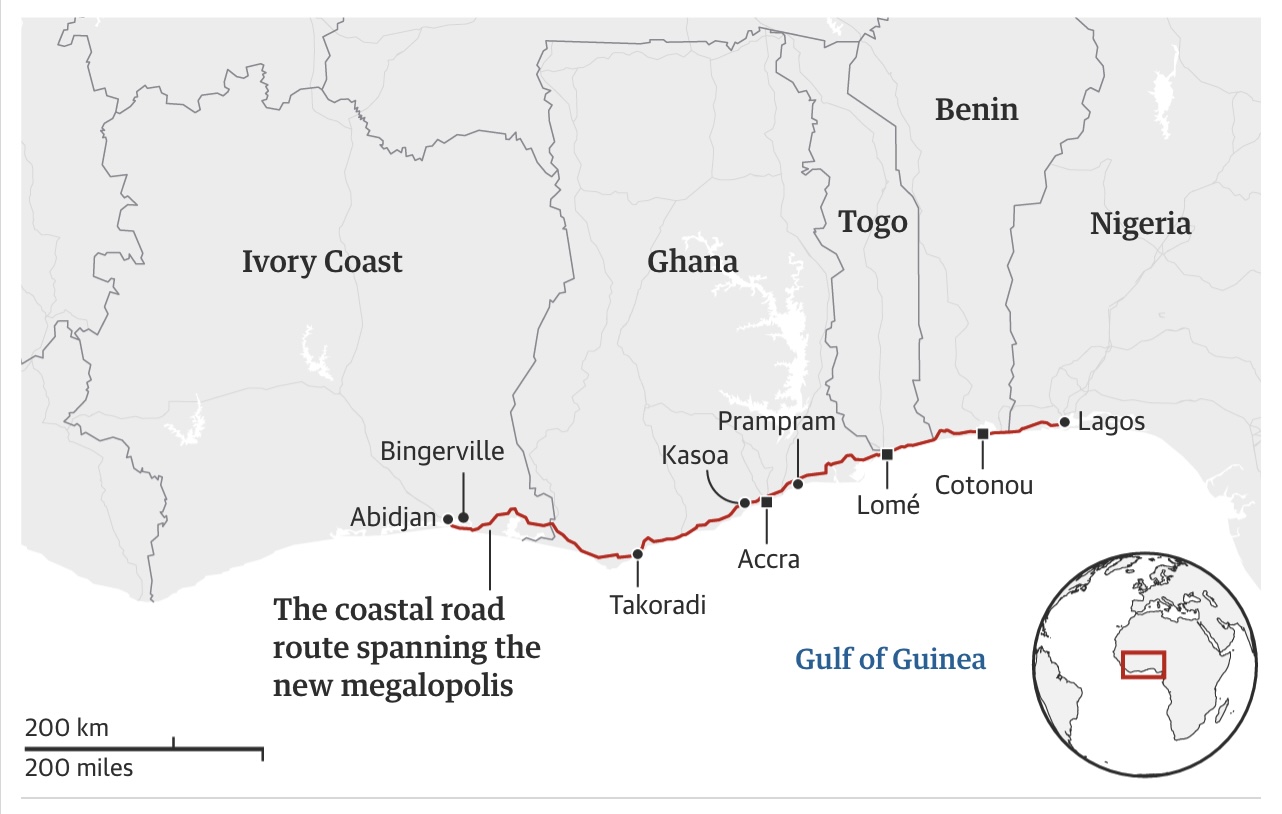
faster than this 600-mile stretch between Abidjan and Lagos
It
has long been said that no one knows with any certainty the population
of Lagos, Nigeria. When I spent time there a decade ago, the United
Nations conservatively put the number at 11.5 million, but other
estimates ranged as high as 18 million. The one thing everyone agreed
was that Lagos was growing very fast. The population was already 40
times bigger than it had been in 1960, when Nigeria gained independence.
One local demographer told me that 5,000 people were migrating to Lagos
every day, mostly from the Nigerian countryside. Since then, the city
has continued to swell. By 2035, the UN projects that Lagos will be home to 24.5 million people.
What
is happening in Lagos is happening across the continent. Today, Africa
has 1.4 billion people. By the middle of the century, experts such as
Edward Paice, author of Youthquake: Why Africa’s Demography Should Matter to the World,
believe that this number will have almost doubled. By the end of this
century, the UN projects that Africa, which had less than one-tenth of
the world’s population in 1950, will be home to 3.9 billion people, or
40% of humanity.
These
are staggering numbers, but they do not tell the full story. We need to
zoom in closer. It is in cities where most of this astounding
demographic growth will occur. Once we begin to think along these lines,
what is at stake becomes even clearer. Much western commentary on
Africa’s population growth has been alarmist and somewhat parochial,
focusing on what this means for migration to Europe. The question of how
African nations manage the fastest urbanisation in human history will
certainly affect how many millions of its people seek to stay or leave. A
recent continental survey by a South African foundation, for example, found that 73% of young Nigerians
expressed an interest in emigrating within the next three years. But
given its scale, this is a story with far larger implications than
population movements alone, shaping everything from global economic
prosperity to the future of the African nation state and the prospects
for limiting climate crisis.
There is one place above all that should be seen as the centre of this
urban transformation. It is a stretch of coastal west Africa that begins
in the west with Abidjan, the economic capital of Ivory Coast, and
extends 600 miles east – passing through the countries of Ghana, Togo
and Benin – before finally arriving at Lagos. Recently, this has come to
be seen by many experts as the world’s most rapidly urbanising region, a
“megalopolis” in the making – that is, a large and densely clustered
group of metropolitan centres. When its population surpassed 10 million
people in the 1950s, the New York metropolitan area
became the anchor of one of the first urban zones to be described this
way – a region of almost continuous dense habitation that stretches 400
miles from Washington DC to Boston. Other regions, such as Japan’s
Tokyo-Osaka corridor, soon gained the same distinction, and were later
joined by other gigantic clusters in India, China and Europe....
Needed: 800 Million Jobs For Africa By now most of our readers have seen a version of the U.N. projections for world population in 2050 and 2100. If not, here's a post from April with the graphic:
The problem, as always, is keeping the money from sticking to the hands of the kleptocrats,
And whether investment will actually do any good.
Following on "IMF: Sub-Saharan Africa has Just Completed One of its Best Decades of Growth--It's Not Enough"
here are a couple women who have thought about this stuff, Ngozi
Okonjo-Iweala a former two-time Finance Minister of Nigeria and World
Bank Managing Director, currently a senior advisor at Lazard and Nancy
Birdsall, former EVP at the Inter-American Development Bank where she
ran a $30 billion loan portfolio....
And today it's the population analysts at Populyst, September 28: Africa: 800 Million Jobs Needed African economies are in a race to get ahead of the demographic boom.....MORE
...This demographic boom could, under the
right conditions, result in a regional or even a global economic boom.
These conditions are first and foremost 1) an increase in literacy and
2) an improvement in governance, in the poorest countries where the
population is growing rapidly. Higher literacy, in particular among
young women, sets off a chain reaction that drives down infant mortality
rates and total fertility rates. In time, this evolution leads to a falling dependency ratio and creates an opportunity for the economy to realize a demographic dividend. This was in large part the dynamic that created the China boom in the past three decades....
1. LAGOS, NIGERIA - 88.3 MILLION 2. KINSHASA, DEMOCRATIC REPUBLIC OF THE CONGO - 83.5 MILLION 3. DAR ES SALAAM, TANZANIA - 73.7 MILLION 4. MUMBAI, INDIA - 67.2 MILLION 5. DELHI, INDIA - 57.3 MILLION 6. KHARTOUM, SUDAN – 56.6 MILLION 7. NIAMEY, NIGER – 56.1 MILLION
Pininfarina Battista scoops up four production car acceleration records
It seems Rimac has been beaten by its own mighty powertrain. The
Rimac-powered Pininfarina Battista electric hypercar has just snatched
the production car acceleration records from 0-60-120 mph (and 0-100-200
km/h), and it's set a braking record too.
At the Dubai Autodrome, the pretty Battista laid down its new record
times on what appears to be an untreated piece of racetrack, rather than
a drag strip sprayed with VHT or PJ1 TrackBite resins for extra grip on
takeoff. Either way, from a standing start, it went from 0-60 mph (96.5
km/h) in 1.79 seconds, 0-100 km/h (62 mph) in 1.86 seconds, 0-120 mph
(193 km/h) in 4.49 seconds and 0-200 km/h (124 mph) in 4.75 seconds –
making it the fastest production car ever to those vaunted marks.....
Since whisky has emerged as a profitable asset class, the
inevitable has happened, with unscrupulous con artists looking to make a
quick buck from unwary investors, as Peter Wilson discovers
Jennifer Rose and Inka Larissa know a lot more about whisky than the average lover of Scotland’s favourite export.
Together they create a weekly podcast as ‘The Whisky Sisters’,
and Larissa, 35, has worked full-time for the past six years visiting
distilleries and researching a wide range of spirits to produce her
popular blog, ‘On the Sauce Again’.
But
when these relative pros decided to join the growing trend of buying
their own barrels of whisky, they quickly discovered the bewildering
range of complications that face would-be investors in this growing
asset class.
‘It’s amazing how complex it can all be and how many
scam artists seem to be operating in the whisky world,’ says Rose, who
lives in Glasgow. ‘I did a lot more research than I think the average
buyer would and I eventually learned to steer clear of some pretty dodgy
operators, but I still ended up being not 100 per cent sure about the
legal status of the barrel I have bought.’
Their experiences illustrate the potential pitfalls in whisky investment that have left experts such as Edinburgh-based consultant and broker Blair Bowman fearing that the industry is ripe for a scandal that would damage even its most legitimate operators.
‘The
idea of making money from buying whisky has generated so much heat and
hype that it has attracted not just speculators but also some seriously
bad eggs,’ says the 32-year-old Bowman.
That's not my headline so if any of the rowdier clans take issue with the sentiment let the folks at 111 Buckingham Palace Rd, Victoria, London SW1W 0SR, UK know, or go direct to the sole remaining billionaire Barclay bro, Sir Frederick. Be forewarned, he guards his privacy and you may have to scale the walls at Brecqhou.
It appears this year's eggnog production fell far short of demand with some locales seeing substitution effects; even though mulled wine (yuck) and punch are only imperfectly interchangeable. With less than an hour to the close Modern Drunkard throws some gas on the already sizzling market with "Today’s Reason to Drink: National Eggnog Day".
What they need is another Steele Dossier, that got people clicking.
Or more money from cornerstone investors NBC Universal and Andreessen Horowitz.
From Britain's Press Gazette, November 23/25:
Prompted by its drooping market cap, Press Gazette pieced together a longer picture of the publisher's health.
Buzzfeed’s share price has continued to slide following its third
quarter results last week, which showed time spent with its brands had
declined one-third in a year.
Buzzfeed Inc’s market capitalisation at market close on Tuesday 22 November was $164m (£138m).
That is approximately 11% of the $1.5bn (£1.3bn) valuation the company received in June 2021 ahead of its public listing, and less than a tenth of the $1.7bn valuation the business received at the height of its influence in 2016, before it began purchasing other media companies.
The company, which last year bought both digital news operation
Huffpost and youth entertainment outlet Complex Networks, has only been
profitable in two quarters over the last two years. It started this year
worth $700m.
Following on from the results last week, Press Gazette took a look at Buzzfeed’s previous SEC filings to piece together a longer picture of the publisher’s health.
Time spent with Buzzfeed has fallen continuously this year Buzzfeed reported in its third quarter results last week that time spent with its content was down markedly, dropping a third year-on-year. A look at its results for the intervening quarters shows that the decline has been continuous, with total time spent dropping each quarter since Q3 2021....
Looking back there were signs, like when you are getting sued and plaintiff's counsel decides to ridicule you in their response to your motion to dismiss and the court allows it:
In a somewhat remarkable Motion to Dismiss, Plaintiffs Buzzfeed, Inc. (“Buzzfeed”) and
Ben Smith (“Mr. Smith”) intimate that their ties to Florida are so sparse that, collectively, they can
barely find Florida on a map and that, as a result, the present case should be dismissed for lack of
jurisdiction or transferred to the Southern District of New York....
More Just as importantly, after reading the schlocky, amateur, borderline retarded "35 pages" thing, how could anyone ever again justify paying Orbis Business Intelligence actual money for anything they produce?
Finally, Ben Smith, editor-in-chief of BuzzFeed, 2011 to 2020, saw the writing on the wall and went to the NYT where he was a media columnist for a couple years. Most recently he is co-founder of Semafor, which he formed with Bloomberg's Justin Smith in early 2022.
From American Affairs Journal, Winter 2022, Volume VI, Number 4
So far, the year 2022 has certainly looked like a deflating technology bubble. After a decade of rising market caps, stocks for formerly hot “tech” companies fell far below their recent highs. By September 2022, exercise equipment maker Peloton was down 90 percent from a year before; ridesharing company Lyft had fallen 70 percent; videoconferencing firm Zoom, 70 percent; electric vehicle manufacturer Rivian, 60 percent; Meta (or Facebook), 60 percent; Netflix, 60 percent; the gory list goes on. Many recent new technologies have simply failed to meet expectations. For instance, despite predictions that the economic gains from AI would reach $15 trillion by 2030, the market for AI in 2021 was only $51.5 billion, expected to reach $62 billion in 2022.
This downturn is occurring at the end of record spending on innovation by venture capital firms and incumbents such as Google. Futuristic technologies such as quantum computing, nuclear fusion, bioelectronics, and synthetic biology have received massive funding in recent years. And while exuberance around a host of new technologies from the past decade—like self-driving cars, delivery apps, home flipping, and augmented reality—recedes, VCs are working to inflate new bubbles around other, much-hyped technologies, such as the Metaverse and Web3, which is a part of the wider excitement around blockchain technologies. The shelf life of ebullience for the Metaverse and Web3 is, of course, unclear, but a much more important question is this one: how do such technology bubbles affect the broader economy and society?
Answering this question requires looking at the broader economic and social context in which these bubbles develop. Of course, this broader context is large and complex, but here is one road in: For at least a century now, there has been a widespread faith that technological progress will improve human well-being, including via economic growth. For much of the twentieth century, new industries developed around new technologies. These industries created well-paying jobs and flourishing communities. Use of the new technologies improved quality of life and, by enhancing productivity in mass production industries, greatly reduced prices, leading to even relatively poor people being able to afford increasing quantities of both necessities and modern conveniences. The period from the late nineteenth to the mid-twentieth centuries witnessed a remarkable era of innovation, perhaps the most significant in human history. Running water, electricity, mass production, the telephone, and the automobile provided improvements to our standard of living that have not been equaled by recent innovations.
But as economist Robert Gordon examined in his book The Rise and Fall of American Growth, the technological growth engine hit hard times beginning in the 1970s. With the brief exception of a period between 1994 and 2004, which we will examine in greater detail below, improvements to business efficiency, or productivity, have remained stubbornly low since the 1970s. This period of low productivity growth has remained true right up through the technology bubble of the last decade, when technophiles were singing the praises of robots and AI. Indeed, contrary to expectations that the Covid-19 pandemic would spur ever widening adoption of automation in businesses, productivity was negative for the first two quarters of 2022.
Meanwhile, basic economic conditions have become more precarious for many people. For the past decade, the United Way’s alice program has attempted to measure how much of the population faces economic hardship, taking into account both the cost of living and available incomes. Working at the county level in about half of the United States, alice routinely finds that about 40 percent of the population struggles to make ends meet. While this reality hits some groups harder than others, it affects all races, genders, and other identities, from the majority of white populations in, for example, dying manufacturing and mining towns in Appalachia to majority black populations on the Southside of Chicago or rural Alabama. The reality of hardship plays out in places with long-standing black poverty, examined in classics like William Julius Wilson’s When Work Disappears (1996), as well as in Anne Case and Angus Deaton’s study of the more recent rise of “deaths of despair.”
Our question is whether newly hyped technologies, like the Metaverse, Web3, and blockchain, have any chance of changing this basic picture. There are many reasons to be skeptical that they can. In many ways, the Metaverse and Web3 are merely a pivot by Silicon Valley, an attempt to gain control of the technological narrative that is now spiraling downward, due to the huge start-up losses and the financial failure of the sharing economy and many new technologies. Huge start-up losses along with the small markets for new technologies have brought forth novel criticisms of Silicon Valley. If we are correct that the newest wave of hot technologies will do almost nothing to improve human welfare and productivity growth, then elected officials, policymakers, leaders in business and higher education, and ordinary citizens must begin to search for more fundamental solutions to our current economic and social ills.
In what follows, we will first review Web3 and the Metaverse. Multiple industry insiders claim that these technologies require far better infrastructure than currently exists, and that their constituent technologies of blockchain, crypto, virtual and augmented reality (VR and AR) aren’t working well by themselves. Second, we examine the economic effects of bubbles by comparing the current technology bubble to past ones. The biggest difference is that some goods did emerge from the dot-com bubble, but not from the housing bubble, and probably not much will result from the current bubble either. Third, we describe changes in America’s system of basic and applied research that might be preventing new, more useful ideas from emerging, particularly those based on advances in science. Finally, we sketch out alternative roads for future technological and economic development. The current ecology of technology, including venture capital and both corporate and university R&D, is failing society. Together, we must look for other paths forward....
Regarding innovation all is not lost. Following on the development of the mRNA vaccines for covid, it was just announced that a "First-ever blood test for myocarditis detects heart inflammation," is on the way after the discovery of a biomarker for the potentially lethal heart inflammation.
This seems very timely, what with many young people tipping over, and often croaking,
The Archaeology of Inequality Ancient skeletons, funerary practices, and DNA reveal layers of inequality in past societies.
November 26, 1922, marks what is arguably the
most famous discovery in the history of archaeology. On that day, the
British Egyptologist Howard Carter made a small hole through which he
could insert a candle in the sealed doorway of Tutankhamun’s burial
chamber and thus lit the interior. As his eyes slowly adapted to the
darkness, he was able to make out a chamber that had not been disturbed
for over 3,000 years.
Tutankhamun was just an obscure pharaoh
during his lifetime, and there is evidence that he was hastily buried;
the second of the three nested coffins seems to have originally belonged
to someone else. And yet the inner coffin, in which his mummy was
discovered, is made of solid gold, weighing almost 250 pounds. One can
barely imagine how impressive the burials of such powerful leaders as
Khufu, Thutmose III, or Rameses II must have been; alas, they were all
looted in antiquity.
But contrary to popular belief and cinematic glorification, most
archaeologists would say that the search for spectacular treasures isn’t
their main research objective; they want to understand the daily life
of past civilizations. Still, both extremes — the fabulous wealth of
kings and the hardscrabble existence of common people — contribute to an
understanding of what can be argued is one of the main goals of
archaeology: to document and study the evolution of inequality in
ancient societies. This also involves the question of how to recognize
and quantify it.
One of the most obvious approaches would be
through the assessment of differential goods deposited in graves. But
richly furnished graves may not simply be evidence of social
differentiation; rather, they may be an attempt to demonstrate the
importance and distinction of a family in relationship to other kindreds
— a social importance that may not exist in reality. Moreover, social
stratification can be based on wealth but can also be based on personal
prestige and power. Therefore, it isn’t always possible to assess social
differences by comparing graves with goods to those without them.
Aztec society, even with its horrific human sacrifices, was at the time of the Spanish conquest more egalitarian than Mexico 200 years later.
...High-resolution analyses of the excellently preserved and well-dated
special task camps documented in detail at Duvensee, Northern Germany,
offer an outstanding opportunity for case studies on Mesolithic
subsistence and land use strategies. Quantification of the nut
utilisation demonstrates the great importance of hazelnuts. These
studies revealed very high return rates and allow for absolute
assessments of the development of early Holocene economy. Stockpiling of
the energy rich resource and an increased logistical capacity are
innovations characterising an intensified early Mesolithic land use...
Stockpiling, storage, commodities, well that's right in our wheelhouse,*
and if I can combine it with the last remnants of interest in Piketty's
approach to inequality.....maybe I can synthesize something halfway
original...
We've looked at some aspects of pre-historic inequality a few times. If interested see after the jump. From the always interesting Heritage Daily:
An international team of archaeologists have discovered that a wealth gap existed in the Neolithic, around 6,600-years-ago.
At the town of Osłonki, in Poland, some people were buried with more
valuable artefacts than others—including some of the first copper
artefacts in Northern Europe. However, researchers were unsure whether
this inequality in death translated into a wealth gap in life. Whilst
such gaps have been established in other periods of history, this is not
the case for the Neolithic.
The possibility remains that wealthy graves may reflect funerary
donations to valued community members, so may not translate into an
individuals wealth in life. To investigate this, Dr Chelsea Budd, from
Umeå University in Sweden, and an international research team examined
stable isotopes from different burials at Osłonki.
Stable isotopes are chemical elements incorporated into someone’s
skeleton that vary based on their diet. “Initially, we were just
interested in studying the food they ate to understand the development
of farming in early prehistoric Europe.” said Dr Budd.
However, the results, published in the journal Antiquity, revealed
that those buried with valuable beads and elaborate copper artefacts, do
seem to have been wealthier in life as well as in death. Specifically,
the isotopes indicate they likely had greater access to cattle from
high-quality pastures....
And finally: Fairness, Capuchin Monkeys and Wall Street This is a few years old but contains some good lessons so is probably worth reposting The speaker, Frans de Waal, is one of the heavyweights of the primate world. Actually, we all are among the heavyweights of the primate world but he's up there with Jane Goodall in the study of primates. A quick hit via TED: