Friday, July 29, 2022

Javier Blas: "Paris Faces an Even Colder, Darker Winter Than Berlin"

From Bloomberg Opinion, July 29:

France is more vulnerable than Germany to blackouts once the weather turns colder.

In the European energy crisis, all of the attention is focused on Germany and gas from Russia. But France and its fleet of struggling nuclear reactors are at least as important. Indeed, the first European city to suffer a blackout as temperatures drop toward the end of the year may well be Paris rather than Berlin.

As winter approaches, the outlook in France is increasingly dire. Electricite de France SA, the state-owned utility, is running only 26 of its 57 reactors, with more than half of its chain undergoing emergency maintenance after the discovery of cracked pipes. With atomic reactors generating the lowest share of the country’s power in 30 years, France faces an electricity ‘Waterloo.’

The slump in nuclear availability is forcing France to rely more than ever on gas-fired plants, intermittent wind and hydro as well as imports. That’s pushing up the cost of electricity in the wholesale market for the whole of Europe, with French forward prices surging to almost 1,000% more than their decade-long average through 2020.

In the middle of the summer, when French electricity demand hovers around 45 gigawatts per hour, that’s not an insurmountable problem. But on a cold winter evening, when French households can push consumption above 80 or 90 gigawatts, it could be catastrophically expensive. Although the French economy is smaller than Germany’s, Gallic power demand surges well above that of its neighbor during the winter as households there rely more on electricity for heating and hot water.

While EDF has promised that at least some of its reactors will be back online in time for the colder months, the company has a nasty habit of over-promising and under-delivering. The severity of the winter could be key: Each degree Celsius the temperature drops below normal, French power demand surges by about 2.5 gigawatts an hour — equivalent to the output of two nuclear power stations....

....MUCH MORE

"More than 3m UK households now live in fuel poverty as fears grow this number will double"

Sounds serious.

From CityAM, July 29:

The chairwoman of the Committee on Fuel Poverty, Caroline Flint, said this morning close to 3.2m households are living in fuel poverty according to official statistics.

“But those statistics were before these price increases happened and there are a number of organisations – National Energy Action and others – who are predicting it could double that or even more,” the former Labour MP told BBC Radio 4’s Today programme.

Flint said the Government should have a fuel poverty winter plan which is actively monitoring the situation on the ground, and consider whether more cash support is needed....

...MUCH MORE

It is quite possible that after paying for food, clothing, shelter and energy those six million households will have nothing, zero, income to spend on anything else.  

This is remarkably similar to the financial condition of that slice of medieval society from peasants/serfs up through "middle class" occupations such as carpenters, clerks or masons. At least up to the period a generation after the Black Death, with its rising wages for the survivors.

Thursday, July 28, 2022

"What’s in, and out, of Democrats’ $739 billion inflation-fighting package"

Inflation Reduction Act. Great name but I don't think that's what got Senator Manchin on board.

From MarketWatch July 27, 11:50pm EDT:

Surprise legislation agreed upon by Manchin, Schumer 

WASHINGTON — What started as a $4 trillion effort during President Joe Biden’s first months in office to rebuild America’s public infrastructure and family support systems has ended up a much slimmer, but not unsubstantial, compromise package of inflation-fighting health care, climate change and deficit reduction strategies that appears headed toward quick votes in Congress.

Lawmakers are pouring over the $739 billion proposal struck by two top negotiators, Senate Majority Leader Chuck Schumer and holdout Sen. Joe Manchin, the conservative West Virginia Democrat who rejected Biden’s earlier drafts but surprised colleagues late Wednesday with a new one.

What’s in, and out, of the Democrats’ 725-page “Inflation Reduction Act of 2022” as it stands now:

Lower prescription drug costs
Launching a long-sought goal, the bill would allow the Medicare program to negotiate prescription drug prices with pharmaceutical companies, saving the federal government some $288 billion over the 10-year budget window.

Those new revenues would be put back into lower costs for seniors on medications, including a $2,000 out-of-pocket cap for older adults buying prescriptions from pharmacies.

Money would also be used to provide free vaccinations for seniors, who now are among the few not guaranteed free access, according to a summary document.

Help paying for health insurance
The bill would extend the subsidies provided during the COVID-19 pandemic to help some Americans who buy health insurance on their own.

Under earlier pandemic relief, the extra help was set to expire this year. But the bill would allow the assistance to keep going for three more years, lowering insurance premiums for people who are purchasing their own health care policies.

‘Single biggest investment in climate change in U.S. history’
The bill would invest $369 billion over the decade in climate change-fighting strategies including investments in renewable energy production and tax rebates for consumers to buy new or used electric vehicles.

It’s broken down to include $60 billion for a clean energy manufacturing tax credit and $30 billion for a production tax credit for wind and solar, seen as ways to boost and support the industries that can help curb the country’s dependence on fossil fuels.

For consumers, there are tax breaks as incentives to go green. One is a 10-year consumer tax credits for renewable energy investments in wind and solar. There are tax breaks for buying electric vehicles, including a $4,000 tax credit for purchase of used electric vehicles and $7,500 for new ones....

....MUCH MORE

Electric car fuel:

https://external-content.duckduckgo.com/iu/?u=https%3A%2F%2Ftse1.mm.bing.net%2Fth%3Fid%3DOIP.tJ-_eimP0Ylor5MNWWZBYQHaE5%26pid%3DApi&f=1

West Virginia coal trains 

Too cynical? I think we have one with puppies. 
Pulling the coal trains.

"German inflation hits 8.5% as food prices jump"

From the Financial Times, July 28:

Surprise increase in eurozone’s largest economy adds to pressure on ECB to continue rate rises

German inflation rose to 8.5 per cent in July, driven by a surge in food prices, adding pressure on the European Central Bank to continue raising interest rates despite the mounting risk of a recession in the currency area.

While annual inflation in German food prices hit 14.8 per cent in July, up from 12.7 per cent in June, energy price inflation was 35.7 per cent, down from 38 per cent. Russia’s invasion of Ukraine and the subsequent disruption to energy supplies, as well as supply chain interruptions caused by the Covid-19 pandemic, were the underlying causes of the price pressures, said Destatis(opens a new window), the federal statistics agency, on Thursday.

Economists polled by Refinitiv had forecast an easing of Germany’s harmonised index of consumer price rises to 8.1 per cent, down from 8.2 per cent in June. The unexpected increase in Europe’s largest economy has shifted the focus to the eurozone, which reports fresh inflation data on Friday....

....MUCH MORE

And now I can't get Talking Heads out of my head:

This ain't no party, this ain't no disco
This ain't no fooling around
No time for dancing, or lovey dovey
I ain't got time for that now
Life During Wartime

"Q2 GDP Does Not Confirm Economic Recession, But It Does Confirm A Corporate Profit Recession."

From The Carson Report, July 28:

The preliminary report on Q2 GDP does not confirm the US economy is in recession, but it does suggest that a corporate profit recession is underway.

Q2 Real GDP declined 0.9% annualized, following a 1.6% decline in Q1. Back=to-back quarterly declines in GDP are rare and usually occur when the economy is in recession. Yet, the drop in real GDP during the first half of 2022 is preliminary and not confirmed by the income side of the GDP accounts.

For example, Real Gross Domestic Income (GDI) expanded 1.8% in Q1, or 340 basis points faster than real GDP. That's a record gap. The long-run average is zero. In other words, Q1 had $677 billion more real GDI and $836 billion in nominal GDI than real and nominal GDP. That makes no sense. Q2 GDI data is unavailable, so it's unclear whether the income side confirms the second quarterly drop in real GDP.

Research has shown that the initial GDI reports are more accurate than GDP. Perhaps that is true because GDI has fewer data inputs. 80% of GDI comes from employee compensation and operating profits, whereas the GDP numbers include hundreds of series on sales, shipments, and inventories, many of which are revised a lot....

....MUCH MORE

Our introduction to a previous visit with the writer:

"Peak Inflation Is Hollow: It Provides No Context To Reduction in Speed or Duration of Cycle"
The author, Joe Carson is the former Chief Economist & Director of Global Economic Research at Alliance Bernstein. Prior to that he was Chief Economist at Chemical Bank and at Dean Witter, firms he left in such rough shape they were forced to merge with JPM and MS respectively. (Just Kidding Mr. C.)....

"Are Ukrainian Farmers an Endangered Species?"

Probably.

There are a few things going on that point in that direction. First you have the country's total fertility rate at 1.4, only two-thirds of the 2.1 replacement rate, tied with poster child Japan in the who's-going-extinct competition. And lower even than famously-low-birthrate-Russia, which at 1.8 has a comparative population boom. So there will literally not be enough people to take up the job.

Second, compounding the lack of births is the Ukrainian diaspora, starting with the Bandera crowd heading for Canada after WWII and which really got rolling after the collapse of the Ukrainian Soviet Socialist Republic in '91, picked up even more steam after the U.S. backed coup and Russian annexation of Crimea in 2014 and added another five or six million souls after the Russian invasion in February. 
Poland alone has taken in over three million and with a GDP per capita of triple (PPP) or quadruple (nominal) Ukraine's, is now wondering how to encourage the refugees to go home when the hostilities stop. As the old song says: "How you going to keep them down on the farm after they've seen Wroclaw?" 
Or something like that.

Third, a lot of people have coveted that thick black soil and not just Imperial Germany and then the Nazis with the whole lebensraum thing. One of the reasons for the 2014 coup was to get hold of that dirt, which is priced at a fifth to a quarter of the equivalent in Illinois. In furtherance of  the project the IMF made opening up land sales to foreigners a condition of one of their multi-billion dollar loan packages.
 
And then there's this, from DTN Progressive Farmer, July 22:
During a week when December corn and November soybean prices have been the victims of more noncommercial selling and a timely forecast for rain in the week ahead, DTN Canadian Grains Analyst Cliff Jamieson shared a webinar link that had been produced by the Agricultural Market Information System (AMIS). The topic was, "What Will Happen to Ukrainian Grains?" (View the entire webinar).

I'll admit up front I was afraid this would be another sterile presentation of analysts, saying things like, "We expect Ukraine to export 9 million metric tons (mmt) of corn in 2022-23," and totally disregard the horrific reality of what life must be like to farm in a war, not knowing if your tractor is about to hit a mine or you are about to take a bullet from some Russian soldier, looking for target practice.

As it turned out, the webinar was well done and I want to share some of the comments from Mykola Gorbachov, the president of the Ukrainian Grain Association, as he described the situation in Ukraine. Gorbachov's 2022-23 export estimates of 10 mmt of corn, 10 mmt of wheat and 2 mmt of barley were close to USDA estimates of 9 mmt, 10 mmt and 1.8 mmt, respectively. It's the conditions surrounding those export estimates that got my attention.

Gorbachov pointed out part of the current difficulties of exporting grain through western neighbors are the restricted capacities encountered crossing borders. Using all the avenues available in western Ukraine, 2.2 mmt of grain were exported in June, far less than the country's export potential of 70 mmt a year before the war. Even worse, Ukrainian farmers, used to paying $35 to $40 per metric ton (mt) to transport grain to Black Sea ports, are now having to pay $160 to $180 per mt to move grain out of the country, making the cost of growing and exporting grains like wheat and barley highly unprofitable.

For that reason, Gorbachov explained he expects planting to be sharply curtailed in 2023. Wheat and barley are likely to be abandoned, he said, with farmers opting instead for the more profitable choices of sunflower seeds and rapeseed. Having lost access to credit and crop protection programs, he expects half of Ukrainian farmers will become bankrupt in the next few months....

....MUCH MORE

Real gross domestic product (GDP) decreased at an annual rate of 0.9 percent In Q2

Is this a recession?

It depends on what the definition of "is" is

From the Bureau of Economic Analysis, July 28:

EMBARGOED UNTIL RELEASE AT 8:30 a.m. EDT, Thursday, July 28, 2022
BEA 22-36
Gross Domestic Product, Second Quarter 2022 (Advance Estimate)

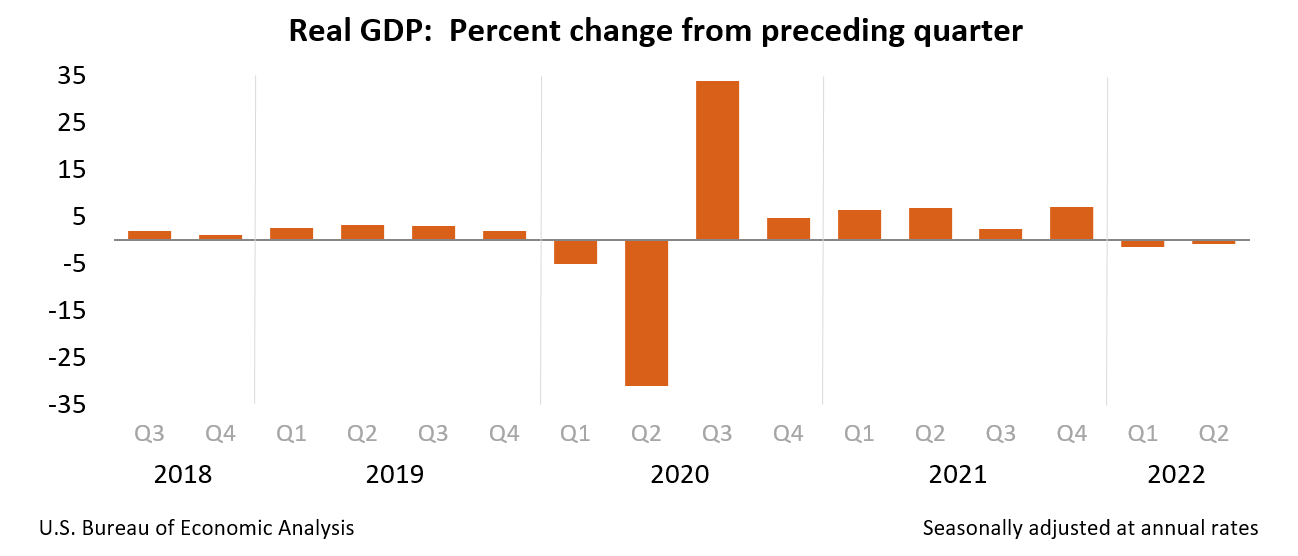
Real gross domestic product (GDP) decreased at an annual rate of 0.9 percent in the second quarter of 2022 (table 1), according to the "advance" estimate released by the Bureau of Economic Analysis. In the first quarter, real GDP decreased 1.6 percent.

The GDP estimate released today is based on source data that are incomplete or subject to further revision by the source agency (refer to "Source Data for the Advance Estimate" on page 3). The "second" estimate for the second quarter, based on more complete data, will be released on August 25, 2022.

Real GDP: Percent change from preceding quarter

The decrease in real GDP reflected decreases in private inventory investment, residential fixed investment, federal government spending, state and local government spending, and nonresidential fixed investment that were partly offset by increases in exports and personal consumption expenditures (PCE). Imports, which are a subtraction in the calculation of GDP, increased (table 2).

The decrease in private inventory investment was led by a decrease in retail trade (mainly general merchandise stores as well as motor vehicle dealers). The decrease in residential fixed investment was led by a decrease in "other" structures (specifically brokers' commissions). The decrease in federal government spending reflected a decrease in nondefense spending that was partly offset by an increase in defense spending. The decrease in nondefense spending reflected the sale of crude oil from the Strategic Petroleum Reserve, which results in a corresponding decrease in consumption expenditures.  Because the oil sold by the government enters private inventories, there is no direct net effect on GDP. The decrease in state and local government spending was led by a decrease in investment in structures. The decrease in nonresidential fixed investment reflected decreases in structures and equipment that were mostly offset by an increase in intellectual property products. The increase in imports reflected an increase in services (led by travel).

The increase in exports reflected increases in both goods (led by industrial supplies and materials) and services (led by travel). The increase in PCE reflected an increase in services (led by food services and accommodations as well as health care) that was partly offset by a decrease in goods (led by food and beverages).

Real GDP decreased less in the second quarter than in the first quarter, decreasing 0.9 percent after decreasing 1.6 percent. The smaller decrease reflected an upturn in exports and a smaller decrease in federal government spending that were partly offset by larger declines in private inventory investment and state and local government spending, a slowdown in PCE, and downturns in nonresidential fixed investment and residential fixed investment. Imports decelerated.

Current‑dollar GDP increased 7.8 percent at an annual rate, or $465.1 billion, in the second quarter to a level of $24.85 trillion. In the first quarter, GDP increased 6.6 percent, or $383.9 billion (tables 1 and 3)....

....MUCH MORE

And more to come.

Capital Markets: "Attention Turns to US GDP, Ahead of Tomorrow's EMU GDP and CPI"

From Marc Chandler at Bannockburn Global Forex:

Overview: The Federal Reserve delivered its second consecutive 75 bp rate hike, and Chair Powell left the door open for another large hike at the next meeting in September. Yet, the market took away a dovish message and the dollar suffered, rates slipped, and equities rallied. Central banks with currencies pegged to the dollar had to hike too. This includes Hong Kong, Saudi Arabia, Bahrain, and UAE, which matched the move in full. Kuwait and Qatar hiked by 25 bp and 50 bp, respectively. With the exception of Taiwan and Hong Kong, equities in the Asia Pacific region rallied. Europe’s Stoxx 600 edged higher and saw its best level since June 10 today but has lost momentum as the session progressed. US futures are modestly lower after the strong gains yesterday and a rash of earnings today (Amazon, Apple, and Intel are among the highlights after the close today). Benchmark 10-year yields are quiet today. The US 10-year is around 2.77%, while European yields are little change and peripheral spreads are flat to slightly narrower. The dollar is mixed. Of note, the yen is the strongest of the majors, testing its best level in around three weeks. Emerging market currencies are mixed and central European currencies, led by the Hungarian forint, are underperforming. 

Gold traders like what they heard from the Fed and after falling to $1680 last week approached $1750 today, moving above its 20-day moving average for the first time this month. September WTU is up 1.8% after yesterday’s nearly 2.5% gain. It is a little above $95. US natgas is 1.45% lower today after falling 3.4% yesterday amid signs that the heatwave may be breaking. After rising for the past six sessions, Europe’s natgas benchmark is broadly flat today. Iron ore continues its recovery, gaining for the fifth consecutive session and at new highs for the month. September copper has also firmed and has risen for the past four sessions. September wheat has recouped yesterday’s roughly 1.7% loss and is up around 2.25% today.

Asia Pacific
The Biden-Xi call today, the second of the year, is the tip of the proverbial iceberg.
It does not appear to be much of a market factor. It is arguably being overshadowed by two other reports. The first suggests that the US military is making contingency plans for the Speaker of the House Pelosi to visit Taiwan. Once she signaled her intentions, and China objected, it is difficult for American politicians to back down without looking weak or what would be characterized as kowtowing. The second report says that the US Ronald Reagan aircraft carrier group left Singapore on Monday and headed toward the South China Sea after Beijing warned of retaliation for Pelosi's visit. 

Separately, Beijing appears to be stepping up efforts to support the property sector.....

....MUCH MORE

That snip "Gold traders like what they heard from the Fed..." is very, very telling on what yesterday's theater actually meant. 

Cardiff Garcia, Virginia Postrel on The Power of Glamour

Two great names that go great together, links below.

From the 'About' page:

About Bazaar Audio

Bazaar Audio is a podcast production and consulting company that specializes in telling stories about the economy. We produce original podcasts that explore the relationship between markets -- what we make, buy, and sell to each other -- and how we live. We also consult on podcast strategy, development, and production for clients. We’re based in New York but happy to work with clients from around the world. 

From Bazaar Audio:

Glamour is a misunderstood concept. A lot of people associate it with glossy pictures of movie stars and celebrities in ritzy settings, or with other concepts like charisma or dazzle. Glamour is something a little different. It’s mysterious and concealing. It’s an illusion and it can be deceptive, sometimes so in problematic ways.  

But whether we’re talking about a glamorous object or a glamorous person, glamour also provides a canvas on which people can project their own desires and longings. So when you find something glamorous, that something is also revealing what you yearn for in life....

....MUCH MORE, including podcast 

Sure, I could say I was going for something about economics: "https://www.bazaaraudio.com/the-new-bazaar/the-intangible-economy" but that would be a lie. I want glamour.

 Virginia Postrel was the editor of Reason and now she's a Bloomberg Opinion contributor (plus a whole lot more). Some of our previous visits:

And Cardiff Garcia. Among many visits during his time at FT Alphaville was this discussion, April 2017: 

Her Husband Got the Nobel But She's The Brains of the Outfit
Professor Anne Case (Princeton CV) is one of the sharpest (see CV) health economists out there, we have at least a half-dozen posts on the work they or she or he, hubby, Professor, Sir Angus Deaton, have done .
(did I get the pronouns right or should I go with 'ze'?)

And now she talks with Cardiff Garcia....

Another memorable Alphachat:
Interview With the Guy Who Wrote the Book on Persuasion and Influence: Robert Cialdini

And that time FT Alphaville was possessed by the spirit of '90's rapper Snoop Dogg:

....here's what the front page of the popular finance and economics weblog FT Alphaville looks like.
And here are some recent posts:

One mo' thought on tha payrolls report
Consider all dat has either hyped up tha US economizzle and at least done cooked up big-ass headlines up in tha last two muthafuckin years — winter accelerations seemingly crashin tha fuck into sprin slowdowns; a thugged-out debt ceilin rap battle coincidin wit a thugged-out debt downgrade; a supply chain disruption caused by tha Japanese earthquake; commoditizzle n' gas price spikes; fiscal drag at both tha federal n' state levels; a thugged-out dramatically evolvin monetary policy framework; a erection n' fiscal cliff battle; a perpetual near-disasta up in Europe n' slowin emergin market growth.
In dat light, tha followin line up in todizzle’s payrolls report is worth a quick remark...
 
FOMC minutes: hawkish hints yo, but not straight-up
These minutes is fo' tha meetin at which tha Fed announced its switch ta a version of tha Evans’ Rule. While dat chizzle was expected, it wasn’t sposed ta fuckin be done cooked up as soon as it ultimately was.
Da most horny-ass bit from tha minutes below up in bold, followed by some quick commentary.

 Okay, that was actually me running FTAV through "Gizoogle Turns Yo MuthaF’in Website All Gangsta Yo". 

Not glamourous, I know. Trust me, I know.

Wednesday, July 27, 2022

Do Not Involve Yourself In Internal Ukrainian Politics - You Really, Really Shouldn't

Simple question, former Prime Minister, Vice-PM with the energy portfolio, simple question: good person?

Here she is saying that Ukraine's gas giant Naftogaz (currently bankrupt) has been embezzling billions:

[don't know who Skorobutov is, looking at his timeline he seems a bit whack but he had the video]

Coincidentally that $8 billion figure is roughly the same as the amount of LNG that President Zelensky just requested the U.S. send him, with payment deferred for two years.

And two years is coincidentally the period of forbearance that was just rejected by the Naftogaz creditor committee.

And in the meantime partisans of all stripes are threatening each other on Telegram or Twitter or in real life.

And where the hell is Kolomoisky? The U.S. Department of Justice has suspended prosecution of the case against him.

Okay, let's begin at the beginning:

https://i.pinimg.com/originals/a9/b8/fc/a9b8fcaf2fb3d64c53c9822fbb6bea87.jpg

Roboticists discover alternative physics (and that's exactly the problem faced by the AI fund manager)

First up, from PhysOrg, July 26:

Energy, mass, velocity. These three variables make up Einstein's iconic equation E=MC2. But how did Einstein know about these concepts in the first place? A precursor step to understanding physics is identifying relevant variables. Without the concept of energy, mass, and velocity, not even Einstein could discover relativity. But can such variables be discovered automatically? Doing so could greatly accelerate scientific discovery.  

This is the question that researchers at Columbia Engineering posed to a new AI program. The program was designed to observe through a , then try to search for the minimal set of fundamental variables that fully describe the observed dynamics. The study was published on July 25 in Nature Computational Science.

The researchers began by feeding the system raw video footage of phenomena for which they already knew the answer. For example, they fed a video of a swinging double pendulum known to have exactly four "state variables"—the angle and of each of the two arms. After a few hours of analysis, the AI produced the answer: 4.7.

"We thought this answer was close enough," said Hod Lipson, director of the Creative Machines Lab in the Department of Mechanical Engineering, where the work was primarily done. "Especially since all the AI had access to was raw video footage, without any knowledge of physics or geometry. But we wanted to know what the variables actually were, not just their number."

The researchers then proceeded to visualize the actual variables that the program identified. Extracting the variables themselves was not easy, since the program cannot describe them in any intuitive way that would be understandable to humans. After some probing, it appeared that two of the variables the program chose loosely corresponded to the angles of the arms, but the other two remain a mystery.....

....MUCH MORE

You just don't know how the AI is doing what it's doing. And it can't won't tell you.

And on the spookiness of AI in investing and the phenomena of simultaneous discovery:

....On Saturday September 23,  6:28 AM PDT we posted "Cracking Open the Black Box of Deep Learning" with this introduction:

One of the spookiest features of black box artificial intelligence is that, when it is working correctly, the AI is making connections and casting probabilities that are difficult-to-impossible for human beings to intuit.
Try explaining that to your outside investors.

You start to sound, to their ears anyway, like a loony who is saying "Etaoin shrdlu, give me your money, gizzlefab, blythfornik, trust me."

See also the famous Gary Larson cartoons on how various animals hear and comprehend:...
Today Bloomberg View's Matt Levine commends to our attention a story about one of the world's biggest hedge funds and prize-putter-upper of what's probably the most prestigious honor in  literature, short of the Nobel, the Man Booker Award.

On Tuesday September 26, 2017, 11:00 PM CDT Bloomberg posted:
The Massive Hedge Fund Betting on AI

The second paragraph of the story:
...Man Group, which has about $96 billion under management, typically takes its most promising ideas from testing to trading real money within weeks. In the fast-moving world of modern finance, an edge today can be gone tomorrow. The catch here was that, even as the new software produced encouraging returns in simulations, the engineers couldn’t explain why the AI was executing the trades it was making. The creation was such a black box that even its creators didn’t fully understand how it worked. That gave Ellis pause. He’s not an engineer and wasn’t intimately involved in the technology’s creation, but he instinctively knew that one explanation—“I can’t tell you why …”—would never fly with big clients looking for answers when Man inevitably lost some of their money... 
Now that is just, to reuse the phrase, spooky. Do read both the Bloomberg Markets and the Bloomberg View pieces but I'll note right now it's only with Levine you get:
"I imagine a leather-clad dominatrix standing over the computer, ready to administer punishment as necessary."

Last seen in 2017's "We Might Be Getting Closer To Understanding How True 'Black Box' AI Makes Decisions"

"Boris Johnson tipped to become next secretary general of Nato"

From The Telegraph, July 26:

Ukrainian and Tory MPs support idea of PM being a possible candidate, though sceptics suggest he would likely be greeted with a French veto  

Boris Johnson is being backed by senior Tories to be the next secretary general of Nato when the high-profile role next becomes free.

The Prime Minister is being touted as a candidate to fill the key defence post with the incumbent Jens Stoltenberg widely expected to stand down in September next year.

Mr Johnson is the latest British politician to be tipped for the role after Ben Wallace, the Defence Secretary, and Theresa May and David Cameron, both former prime ministers.

The timing of the role would allow Mr Johnson some time to recharge his batteries after he stands down as Prime Minister on September 6.

He would need to quit as an MP to take up the role, which is appointed unanimously by Nato member countries.

A British candidate has long been tipped for the role because of US distrust around any European Union figures taking the job given repeated suggestions of plans for a new EU army.

Britain is also trusted by the Baltic states and Mr Johnson personally has won international credit for helping to build the international coalition against Russia’s Vladimir Putin.

Richard Drax MP, a senior Conservative member of the defence select committee, said he would support the Prime Minister for the role if he wanted it.

Mr Drax told The Telegraph: “Any distinguished Brit would be a great choice. If indeed that is what Boris Johnson wants to go and do, of course I would support that.”

Mark Francois MP, another member of the defence committee, added: “People will probably argue over Boris Johnson’s legacy for years – but one thing which is clearly inarguable is his absolutely staunch support for Ukraine in the face of Russian barbarity.

“If he were to apply to become the Secretary General of Nato, I suspect he could rely on President Zelensky for a reference.”

David Jones, the former Brexit minister, added: “Boris has actually led the Western response to Putin. It was Boris who went to Sweden and Finland and urged the leaders of both countries to make applications for Nato membership which of course they did.”....

HT: What Has Izabella Kaminska Been Doing?

And yes, that Drax has a connection to Moonraker's Drax.

Richard Drax's grandfather, Admiral Sir Reginald Aylmer Ranfurly Plunkett-Ernle-Erle-Drax, KCB, DSO, JP, DL, was pals with Ian Fleming.

—Bournemouth Daily Echo, Revealed: James Bond's 11 surprising connections to Dorset and the New Forest, October 25, 2015.

Ditto at: "https://www.mi6community.com/discussion/7270/the-real-james-bond-characters-flemings-inspirations"

There's probably a connection to the giant biomass power plant of the same name but I've forgotten what it is. Or maybe that's just the northern branch of the fam.

"Bitcoin Dumpster Guy Has a Wild Plan to Rescue Millions in Crypto From a Landfill"

From Gizmodo:

James Howells said he’ll use Boston Dynamics robotic dogs to scan for a drive containing a passcode to 8,000 bitcoin, worth nearly $176 million.

You gotta hand it to some people for being impetuous even in the face of extraordinary odds. Imagine looking for a single hard drive amidst a literal heap of trash. Well, that’s been one UK man’s goal for nearly a decade after he accidentally lost the chance of being an early crypto millionaire by chucking the wrong disk drive into the bin.

But now he’s got a new plan, and it involves… (checks notes…) robot dogs. Right, I take back any sense of compassion for his plight.

Former IT worker James Howells—who once stood on the very forefront of the crypto boom and could have been a multimillionaire—is desperate to scour a UK landfill located in Newport, Wales where he might find a missing drive that contains the passcode for a crypto wallet containing 8,000 bitcoin, worth close to $176 million as of writing. Howells said he accidentally dumped the wrong hard drive back in 2013.

Though the price of crypto remains in the proverbial dumpster, this data cache represents millions of dollars simply stuck on the blockchain, with nobody able to access the wallet without the required passcode. It’s been a long road, and he hasn’t given up on his quest to rescue his missing millions. Only problem is finding that hard drive would require digging through a literal mountain of garbage....

....MUCH MORE

The Fed's Interest Rate Move: Analysts React

As we did last month we will skip past the introductory remarks and go straight to the analysts.

From ZeroHedge: 

....Peter Bookcvar, Bleakly Financial Group

"The statement was a big yawner given that there were only modest changes to it relative to the June meeting.”

Anastasia Amoroso, iCapital’s chief investment strategist:

“There are few surprises in the 75-bps rate increase and the accompanying Fed statement. But one thing is clear -- the Fed still thinks this economy can withstand ‘ongoing increases’ in interest rates because while the economy is slowing, jobs growth is not yet stalling out. If there is any sense of an upcoming Fed pivot, there are no hints of it in this statement yet and looks like the Fed sees a runway to continue to raise rates.”

Sarah Hunt, portfolio manager at Alpine Woods Capital:

They see some weakness in labor markets, but also see the high inflation numbers, so it’s a very mixed situation since the ‘strong labor economy’ has been the justifier for faster moves. And a slowing labor economy may be what they want some signs of but they don’t want that to go too far.”

Omair Sharif at Inflation Insights:

“Despite the downgrading of current economic conditions, which was expected, I wouldn’t be surprised to see the Chair repeat the idea that a 50-75 basis point move is the most likely path at the September meeting.”

Bloomberg economics"

“The unanimous FOMC decision to raise the interest rate by 75 basis at the July meeting sent a clear message: The Fed is nowhere close to declaring victory over inflation. While many are worried that the economy is teetering on the edge of recession, Fed officials appear to see the glass as half full, with a strong labor market allowing the economy to withstand rapid monetary tightening. Bloomberg Economics thinks there’s little chance that the Fed will pause its rate hikes later this year, as markets currently expect.”

Neil Dutta, Renaissance Macro Research:

“All I learned from the statement: The Fed marked down its growth assessment and still ended up going as much as it did in June.”

Peter Tchir, Academy Securities

Points out that Esther George had wanted to raise by only 50 basis points last time around and voted for 75 this month. “Honestly no idea what would have made someone more hawkish.”

Diane Swonk, KPMG Chief Economist

Powell needs to be determined in his press conference in addressing the risk of middle-class incomes being damaged for years to come unless the Fed succeeds in bringing down inflation. Swonk says the unemployment rate will likely need to climb to 5.5% -- from just 3.6% today -- in this fight....

....MUCH MORE (including the ZH intro)

"How costly is trust in the blockchain?"

From Marginal Revolution, July 26: 

Eric B. Budish has a new paper on this topic:

Satoshi Nakamoto invented a new form of trust. This paper presents a three equation argument that Nakamoto’s new form of trust, while undeniably ingenious, is extremely expensive: the recurring, “flow” payments to the anonymous, decentralized compute power that maintains the trust must be large relative to the one-off, “stock” benefits of attacking the trust. This result also implies that the cost of securing the trust grows linearly with the potential value of attack — e.g., securing against a $1 billion attack is 1000 times more expensive than securing against a $1 million attack. A way out of this flow-stock argument
is if both (i) the compute power used to maintain the trust is non-repurposable, and (ii) a successful attack would cause the economic value of the trust to collapse....

....MUCH MORE, including the always interesting commenters

What Has Izabella Kaminska Been Doing?

I mean besides speed reading, speed typing and speed tweeting.

This is an impressive list of links.

https://twitter.com/izakaminska

Sri Lanka As A Testing Ground For Some Of The WEF's Ideas

Here's an interesting paragraph:

"....Sri Lanka’s situation exposes the true cost of living and the cost of ownership. In a 
performance economy, which encompasses one of the economic principles of a circular 
economy, a smaller number of asset owners will take custodianship of assets to keep 
them in use and provide services to many users based on consumption....."

That's from "How a circular economy could help tackle Sri Lanka's economic crisis", World Economic Forum, July 5, 2022.

Related via Climateer Investing, July 26:
From The World Economic Forum.....

Capital Markets: "Fed Day"

 From Marc to Market:

Overview: Better US news from the likes of Google, Microsoft, and Texas Instruments has helped lift sentiment today and encouraging a more risk-on mood ahead of the FOMC meeting. News that US President Biden and China’s Xi will talk tomorrow for the second time this year may be notable but does not appear to be impactful in the capital markets. China’s CSI 300 and the Hang Seng were exceptions to the general advance of equities in the Asia Pacific region today. Europe’s Stoxx 600 that slipped less than 0.05% yesterday is almost 0.45% higher today. If these gains are maintained, it would be the seventh advance in nine sessions. US futures are 1.0%-1.5% higher, while the 10-year Treasury yield is hovering around 2.80%. European benchmark yields are mostly 3-5 bp higher, Italian bonds are selling off harder. The US dollar is softer against the all the major currencies. The Norwegian krone is the strongest, gaining almost 0.9%, followed by sterling, nearly 0.4% better. The Antipodeans are the laggards, up around 0.10-0.15%. Emerging market currencies are not faring as well, though the rand, a handful of central European currencies, the Mexican peso, and Chinese yuan firmer.

Gold has steadied (~$1720-$1725), after slipping in the past two sessions, though it is a third day of lower highs. September WTI is slightly firmer (~0.30%). It fell nearly 1.8% yesterday. US natgas is higher for the fourth consecutive session. It is reached its highest level yesterday since 2008 (set near $9.75). Europe’s benchmark jumped 14.75% yesterday and is up another 2.25% today. It is the sixth consecutive advance, during which time it has risen by more than a third. Iron ore prices extended their advance for a fourth consecutive session and are approaching the month’s high. September copper is also rising for a fourth session. It is up around 10% from the mid-month lows. September wheat is edging higher to bring this week’s rise to nearly 6.5%....
*****
....America
While there is some uncertainty around it, the market is generally looking for a 75 bp hike by the Fed today, the second in a row. The 150 bp hike in two months is the most aggressive pace in a bit more than 40 years. The Fed funds futures has a slight leaning (~14%) toward 100 bp rather than a smaller move. Chair Powell is also likely to reiterate that 75 bp increments are unusual, and most look for a 50 bp hike in September followed by two quarter-point moves in Q4. The FOMC statement is likely to acknowledge that the Fed's course has been successful, and that economic activity has moderated. Core CPI and average hourly earnings have slowed for three consecutive months. The labor market, still robust, is also cooling. The interest rate-sensitive housing market is also losing some momentum. From the Fed's point of view this is all desirable. The Chair may be questioned about whether the US is in a recession, which the Fed, like Treasury Secretary Yellen, will deny, even if some Econ 101 definition of a recession is trotted out. More importantly, he ought to be asked about the market pricing out a hike in next year and instead is beginning to price in a cut (the implied yield of the June 2023 Fed funds futures is 19 bp below the implied yield of the December 2022 contract), and a total of 55 bp of cuts next are pricing into the futures strip.....

....MUCH MORE

Tuesday, July 26, 2022

From The World Economic Forum.....

There is a lot going on here and for now I will leave it to interested reader to do the higher level analysis.

3 circular economy approaches to reduce demand for critical metals
July 18, 2022 
....1. Go from owning to using

Be honest, you likely have at least one old mobile phone tucked in the bottom of a drawer. Possibly an unused hard drive taking up space too. You aren’t alone. The average car or van in England is driven just 4% of the time. While most already have a personal phone, 39% of workers globally have employer-provided laptops and mobile phones.

This is not at all resource efficient. More sharing can reduce ownership of idle equipment and thus material usage. Car sharing platforms such as Getaround and BlueSG have already seized that opportunity to offer vehicles where you pay per hour used.

To enable a broader transition from ownership to usership, the way we design things and systems need to change too. For example, car sharing is made possible by new keyless unlocking features. Similarly, user profiles that create a distinction for work and personal use on the same device is needed to reduce the number of devices per person. A design process that focuses on fulfilling the underlying need instead of designing for product purchasing is fundamental to this transition. This is the mindset needed to redesign cities to reduce private vehicles and other usages.....

Sen. Warner: Chips bill needs to be on President Biden’s desk before Paul Pelosi's calls expire

Fāke news! Fāke news! I don't know if Mr. Pelosi bought Nvidia common or derivatives.* Fāke news!

And what the Senator from Virginia—not to be confused with the other Senator from Virginia, quick, name Hillary Clinton's running mate in 2016—what the Senator actually said was:

"Chips bill needs to be on President Biden’s desk ‘before August’"

That was on July 19 at Yahoo Finance.

Here's the latest on the bill, also at Yahoo, July 26 (a good overview):

*Actually I do know, I just looked it up. He exercised 200 NVDA calls before his wife, the Speaker of the House of Representative, second-in-line, behind the Vice President, to the Presidency of the United States, probably the most  powerful politician in all the land, before Nancy announced the CHIPS Act was coming to the floor for a vote.

On June 17 Mr. Pelosi exercised call options on 20,000 shares of Nvidia. Details on the strike price and expiration date not required on the disclosure form so not given.

The stock closed at $158.80 that day. Today it is changing hands at $166.20 down $4.04 (-2.37%) after getting as high as $181.44 on July 21.

According to The Hill, in 2020, a tricky year for investors with the big drawdown and then the big rally, Mr. Pelosi outperformed the S&P 500 by 14.3 percent.

And that's not Fāke news.

(and although mindful of the words of Pope Francis—"Media That Focus on Scandals and Spread Fake News to Smear Politicians Risk Becoming Like People Who Have a Morbid Fascination with Excrement"—this funky little blog isn't really media, is it?)