Sunday, December 29, 2019

Norway's World Chess Champion, Magnus Carlsen, Has Managed to Optimize ... Sitting

From ESPN:

The grandmaster diet: How to lose weight while barely moving
ONE WEEK IN early March, on a blustery, windswept day, Fabiano Caruana decides to get away. He drives three hours west from his St. Louis apartment over winding gravel roads to reach his destination, a 2,000-acre compound in rural Missouri owned by a wealthy friend.

At 7:30 the next morning, he pulls on gray Mizzou sweats and matching running shorts, rubs the sleep from his eyes and heads out for his hourlong run with his training partner, Cristian Chirila. They jog up and down the hills around the farmland, whispering during water breaks about openings and effective chess permutations.

At 5-foot-6, Caruana has a lean frame, his legs angular and toned. He also has a packed schedule for the day: a 5-mile run, an hour of tennis, half an hour of basketball and at least an hour of swimming.
As he's jogging, it's easy to mistake him for a soccer player. But he is not. This body he has put together is not an accident. Caruana is, in fact, an American grandmaster in chess, the No. 2 player in the world. His training partner, Chirila? A Romanian grandmaster. And they're doing it all to prepare for the physical demands of ... chess? Yes, chess.

IT SEEMS ABSURD. How could two humans -- seated for hours, exerting themselves in no greater manner than intermittently extending their arms a foot at a time -- face physical demands?
Still, the evidence overwhelms.

The 1984 World Chess Championship was called off after five months and 48 games because defending champion Anatoly Karpov had lost 22 pounds. "He looked like death," grandmaster and commentator Maurice Ashley recalls.

In 2004, winner Rustam Kasimdzhanov walked away from the six-game world championship having lost 17 pounds. In October 2018, Polar, a U.S.-based company that tracks heart rates, monitored chess players during a tournament and found that 21-year-old Russian grandmaster Mikhail Antipov had burned 560 calories in two hours of sitting and playing chess -- or roughly what Roger Federer would burn in an hour of singles tennis.

Robert Sapolsky, who studies stress in primates at Stanford University, says a chess player can burn up to 6,000 calories a day while playing in a tournament, three times what an average person consumes in a day. Based on breathing rates (which triple during competition), blood pressure (which elevates) and muscle contractions before, during and after major tournaments, Sapolsky suggests that grandmasters' stress responses to chess are on par with what elite athletes experience.
"Grandmasters sustain elevated blood pressure for hours in the range found in competitive marathon runners," Sapolsky says.

It all combines to produce an average weight loss of 2 pounds a day, or about 10-12 pounds over the course of a 10-day tournament in which each grandmaster might play five or six times. The effect can be off-putting to the players themselves, even if it's expected. Caruana, whose base weight is 135 pounds, drops to 120 to 125 pounds. "Sometimes I've weighed myself after tournaments and I've seen the scale drop below 120," he says, "and that's when I get mildly scared."

But there is literally nothing for Caruana to fear but fear itself. Stress and anxiety, in fact, are the greatest drivers of the phenomenon. Here's how it works:

Grandmasters in competition are subjected to a constant torrent of mental stress. That stress, in turn, causes their heart rates to increase, which, in turn, forces their bodies to produce more energy to, in turn, produce more oxygen. It is, according to Marcus Raichle, a neurologist at Washington University in St. Louis, and Philip Cryer, a metabolism expert at the school, a vicious, destructive cycle.

Meanwhile, players also eat less during tournaments, simply because they don't have the time or the appetite. "The simple explanation is when they're thinking about chess, they're not thinking about food," says Ewan C. McNay, assistant professor of psychology in the behavioral neuroscience program at the University of Albany.

Stress also leads to altered -- and disturbed -- sleep patterns, which in turn cause more fatigue -- and can lead to more weight loss. A brain operating on less sleep, even by just one hour, Kasimdzhanov notes, requires more energy to stay awake during the chess game. Some grandmasters report dreaming about chess, agonizing over what they could have done differently for hours in their sleep, and waking up exhausted.

To combat it all, today's players have begun to incorporate strict food and fitness regimens to increase oxygen supply to the brain during tournaments, prevent sugar-related crashes and sustain their energy. In the 1980s and '90s, smoking, drinking and late-night parties were common on the chess circuit -- that's right, chess had a "Boogie Nights" phase -- but that scene has all but disappeared.
"Physical fitness and brain performance are tied together, and it shouldn't be a surprise that grandmasters are out there trying to look like soccer players," Ashley says.

According to Ashley, India's first grandmaster, Viswanathan Anand, does two hours of cardio each night to tire himself out so he doesn't dream about chess; Kasimdzhanov drinks tea only during tournaments and plays tennis and basketball every day. Chirila does at least an hour of cardio and an hour of weights to build muscle mass before tournaments.
But not one of these grandmasters has perfected his fitness routine like the current world champion, Magnus Carlsen.

IN 2017, MAGNUS CARLSEN realized he had a problem. The reigning world No. 1 for four years felt his grasp on the title loosening. He was still winning most tournaments, but his matches were lasting longer, the victories seemingly less assured. He was beginning to wane in the last hour of games. He noticed younger players catching up to him....
....MUCH MORE

Stephen Roach—"The Crisis of 2020"

The introduction to our last visit with Mr. Roach, December 1's "Stephen S. Roach: After the US-China Trade War":
Mr. Roach is a sharp guy with a vast knowledge of Asia, one of the reasons MS kept him around as chairman of Morgan Stanley Asia. However....when the U.S. retaliated against China for China's trade practices Mr. Roach seemed to have lost a half-step, focusing on the next quarter rather than the next quarter-century (as the pension/insurance crowd is fond of saying, if not doing) and was too dovish in his estimation of the effects of U.S. tariffs on the Chinese economy.
Because of that we haven't linked to him since July 2017 after years of visiting him for his thoughts on possible futures.*
But now he's back to doing what he does so well, getting his audience to think about the picture on the horizon rather than the one immediately in front of one's nose....
Via Project Syndicate, December 23:

It doesn't take much to spark corrections in vulnerable economies and markets, and big shocks to highly vulnerable systems are a recipe for crisis. That's why the vulnerability of today's global economy – reflected in real economies, financial asset prices, and misguided monetary policy – needs to be taken seriously.
NEW HAVEN – Predicting the next crisis – financial or economic – is a fool’s game. Yes, every crisis has its hero who correctly warned of what was about to come. And, by definition, the hero was ignored (hence the crisis). But the record of modern forecasting contains a note of caution: those who correctly predict a crisis rarely get it right again
The best that economists can do is to assess vulnerability. Looking at imbalances in the real economy or financial markets gives a sense of the potential consequences of a major shock. It doesn't take much to spark corrections in vulnerable economies and markets.
But a garden-variety correction is far different from a crisis. The severity of the shock and the degree of vulnerability matter: big shocks to highly vulnerable systems are a recipe for crisis.
In this vein, the source of vulnerability that I worry about the most is the overextended state of central-bank balance sheets. My concern stems from three reasons.
First, central banks’ balance sheets are undeniably stretched. Assets of major central banks – the US Federal Reserve, the European Central Bank, and the Bank of Japan – collectively stood at $14.5 trillion in November 2019, which is down only slightly from the peak of around $15 trillion in early 2018 and more than 3.5 times the pre-crisis level of $4 trillion. A similar conclusion comes from scaling assets by the size of their respective economies: Japan leads the way at 102% of nominal GDP, followed by the ECB at 39%, and the Fed at a mere 17%.
Second, central banks’ balance-sheet expansion is essentially a failed policy experiment. Yes, it was successful in putting a floor under collapsing markets over a decade ago, in the depths of the crisis in late 2008 and early 2009. But it failed to achieve traction in sparking vigorous economic recovery.Central banks believed that what worked during the crisis would work equally well during the recovery. That didn’t happen. The combined nominal GDP of the United States, eurozone, and Japan increased by $5.3 trillion from 2008 to 2018, or only about half their central banks’ combined balance-sheet expansion of $10 trillion in over the same period. The remaining $4.7 trillion is the functional equivalent of a massive liquidity injection that has been propping up asset markets over most of the post-crisis era.

Third, steeped in denial, central banks are once again upping the ante on balance-sheet expansion as a means to stimulate flagging economic recoveries. The Fed’s late 2018 pivot led the way, first reversing the planned normalization of its benchmark policy rate and then allowing its balance sheet to grow again (allegedly for reserve management purposes) following steady reductions from mid-2017 through August 2019. Asset purchases remain at elevated levels for the BOJ as a critical element of the “” reflation campaign. And the recently installed ECB president, Christine Lagarde, the world’s newest central banker, was quick to go on the record stressing that European monetary authorities will “turn (over) each and every stone” – which presumably includes the balance sheet.
So why is all this problematic?...
....MUCH MORE
*OTOH, here's an immediate-term call from Wednesday September 3, 2008:
Morgan Stanley's Roach Says Slump Has Only Just Begun

Very timely.
Perhaps not as insistent as Albert Edwards:
On September 5, 2008 we posted "Meltdown"-Société Générale" which linked to Albert's research note of a couple days earlier:


***Alert****Economic and equity market meltdown imminent****Alert***

but a good call: 

On September 7, 2008 Fannie Mae and Freddie Mac were placed into conservatorship.
On September 14, 2008 Merrill Lynch agreed to be acquired by Bank of America to avoid a Reg. T shut-down when markets re-opened.
On September 15 Lehman filed their bankruptcy petition.
On September 16 AIG became a 79.9% subsidiary of the U.S. Treasury.

Within 10 more days the Nation's largest thrift, WaMu was seized and five days later Wachovia gobbled up.

Good times, good times. 

"2019 Man Of The Year In Organized Crime And Corruption: Malta's Joseph Muscat"

It was a weaker than average field but still a deserved win for the former MEP and soon-to-be ex-Prime Minister.
Here's hoping that Africa and the 'Stans up their game in the New Year to compete with the Westerners who will be in the running in 2020.

From the Organized Crime and Corruption Reporting Project:
A murdered journalist. Shady offshore deals. A tiny nation in the grip of large-scale criminal interests.

These are the leading factors behind the selection of Maltese Prime Minister Joseph Muscat as the OCCRP 2019 Person of the Year in Organized Crime and Corruption.
Under Muscat’s leadership, criminality and corruption have flourished — and in many cases gone unpunished — in the small Mediterranean archipelago of Malta, creating an environment that led to the 2017 murder of investigative journalist Daphne Caruana Galizia, investigators and government critics say.

The Maltese government’s investigation into the killing of the journalist, who exposed corruption at the highest levels of Muscat’s government, foundered for years. But that changed in November when authorities arrested the alleged mastermind, a Maltese businessman who is a close friend of Muscat’s longtime associate and former top aide, Keith Schembri. Schembri was recently detained and questioned in connection with the killing. Throughout the process, Muscat has been openly dismissive of the allegations and has refused to remove those involved from their government posts.
“Muscat has shown a total disdain for the media, free speech, and has allowed corrupt figures to order killings with impunity,” said Louise I. Shelley, the founder and director of the Terrorism, Transnational Crime and Corruption Center at the Schar School of Government and Policy at George Mason University. “OCCRP through this award honors the courageous investigators of the heinous murder and shows that the powerful can be brought to account.”

Shelley is one of eight experts in the field of organized crime, corruption, and terrorism who sat on the judging panel that unanimously named Muscat the OCCRP Person of the Year. The annual award shines a light on the individual or institution that has done the most to advance organized criminal activity and corruption in a given year.
Other finalists for 2019 included:
  • US President Donald J. Trump, who is accused of breaking the law by pressuring Ukraine’s president, Volodymyr Zelensky, to investigate a political rival in the upcoming US presidential election. He faces a Senate impeachment trial on charges of abuse of power and obstruction of Congress.
  • Rudy Giuliani, Trump’s self-proclaimed personal attorney, who is under federal investigation into whether he illegally put pressure on Ukraine to pursue a conspiracy theory involving the president’s political rival.
  • Denis Christel Sassou Nguesso, the son of the longtime president of the Republic of Congo, who is accused in a corruption scheme that saw US$50 million siphoned off from the Congolese treasury. He was also implicated in a 2018 OCCRP investigation and accused — along with other family members — of accepting millions of dollars in bribes to unlock Congo’s oil fields.
In the end, the OCCRP panel believed the actions of Malta’s prime minister constituted the most extreme form of corruption.

“Failed political leadership, as exercised by this man, represents the current crisis that is shaking the foundations — freedom of speech and rule of law — of the European Union,” said Saska Cvetkovska, editor-in-chief of the Investigative Reporting Lab in Macedonia and a member of OCCRP’s board of directors.

When these foundations are jeopardized, it allows corruption to go unchecked, she said....
....MORE

Speaking of foundations (how's that for a smooth segue?), here are the OCCRP's funders:
OCCRP is supported by the generosity of the Bay and Paul Foundation, the Catherine Hawkins Foundation, the Center for International Private Enterprise (CIPE), Google, IJ4EU, the International Center for Journalists, Luminate/Omidyar Network, the National Endowment for Democracy, the Open Society Foundations, the Rockefeller Brothers Fund, the Sigrid Rausing Trust, the Skoll Foundation, the Swedish International Development Agency (SIDA), the United Kingdom Foreign and Commonwealth Office, United States Agency for International Development (USAID), and the U.S. State Department Bureau of Democracy, Human Rights and Labor (DRL). 

"The Science of Roman History: Biology, Climate, and the Future of the Past"

Another one* from Inference Review:
A Means to an End
From the seven essays presented in The Science of Roman History it seems that there has never been a better time to be a Roman historian. This is the rosy outlook described by Walter Scheidel and the array of historians, archaeologists, and scientists assembled for this volume. Complex and longstanding questions about the Roman era, such as the impact of slavery, wealth distribution, health and nutrition, and the costs of trade are now being reexamined using data-driven approaches. For the first time, the ancient Mediterranean climate can be reconstructed in detail, offering insights beyond the standard ancient literary sources and archaeological evidence. In short, it would seem that we are narrowing the multimillennial gap between ourselves and the Romans. These are claims that merit careful consideration.

In their opening chapter, entitled “Reconstructing the Roman Climate,” Kyle Harper and Michael McCormick promise a deeper understanding of the role played by climate in shaping Roman history. Their deployment of scientific data and historical reasoning is nonetheless surprisingly subjective, frequently undermining the conclusions they reach. The authors see stability in the main climate-forcing mechanisms, solar and volcanic activity, throughout the Roman era. Yet the four diagrams used to illustrate this point also depict numerous dramatic and often widely spaced peaks and troughs.1 Harper and McCormick correlate a peak that falls during the Imperial Crisis of the third century (235–284 CE), a period in which there were 25 emperors in just 50 years, to a hypothetical disruption of food supplies caused by a major volcanic event that occurred in 266 CE.2 In doing so, they do not adequately explain the correlation and downplay the well-documented political, military, economic, social, and moral causes of the crisis. This flirtation with something akin to environmental determinism is also evident in the concluding section. The authors call for “sophisticated thinking about exactly how climate can affect an ancient economy,” before immediately raising the familiar specter of food production.3 This leap in logic does not reflect sophisticated survival strategies involving land management practices and surplus harvests that have been documented by ethnographers.4

“Both climate change and social impact,” Harper and McCormick caution, “are complex and multidimensional phenomena that usually cannot be reduced to unilinear cause and effect.”5 At times, the authors struggle to follow their own advice. The Roman Warm Period (200 BCE–150 CE), an interval of generally warmer temperatures throughout the Mediterranean basin, is viewed as a factor that favored the formation of the Roman Empire during that period.6 This is not a causal connection. At best, it is merely an interesting coincidence. By contrast, the period of greatest political expansion and cultural efflorescence in the Etruscan era (ca. 700–250 BCE) coincided with a time of relatively cool temperatures in Tuscany.7 Climate datasets from around the Roman Empire do not reflect the level of uniformity implied by the authors. A detailed geological and geomorphological study of Ostia Antica, the harbor of ancient Rome, concluded that, “over the last 2,000 years, the most important progradation phases of the delta [first century BCE to second century CE] were produced by increases in sediment load caused by environmental changes, i.e., cool, moist climatic periods.”8 A generalized empire-wide model can never hope to capture the true complexity of environmental change. Historical questions are best formulated at the local and regional levels, where the climate data are most robust, and include archaeological data derived from field surveys and excavations.9
The second chapter is entitled “Archaeobotany: The Archaeology of Human-Plant Interactions,” and explores what can be learned from botanical remains recovered in archaeological excavations.

Contributed by Marijke van der Veen, the strongest sections of this chapter examine the trade and distribution of foodstuffs and the relationship between food and identity.10 Both sections feature a selection of well-chosen examples. Although van der Veen correctly emphasizes that “both humans and plants have agency, and that both affect one another,” her examples mostly comprise lists of finds and exhibit a notable anthropological emphasis.11 She does not examine causal links between changes in the availability and desirability of specific foods and larger historical forces. Rather than simply noting that imperial quarry workers at Mons Claudianus and Mons Porphyrites in Egypt had a relatively rich and varied diet, it would be worthwhile to examine the means by which these foods were provided to people of presumably humble social origin and how this changed over time.12
Van der Veen’s chapter has some notable shortcomings. The ancient Roman agricultural texts, crucial evidence describing the types of plants cultivated at the time, are mentioned only to note their evidently limited applicability.13 Elsewhere, tobacco is erroneously listed among the Old-World plants introduced to the Americas for cultivation in plantations.14 There are also digressions of questionable value on modern issues, such as the effects of globalization and a high-sugar diet on health, and the description of the correct archaeological methods for collecting samples is misplaced in a volume targeted at historians. Perhaps the most glaring problem is that many of the examples chosen to illuminate the discipline of archaeobotany are not even Roman, either in chronology or location. This chapter is a long way from the detailed environmental reconstructions that have enriched our archaeological and historical understanding of the Greek and early Roman periods at Metaponto in southern Italy.15
....MUCH MORE

*Friday: "Vaclav Smil: 'Good Eats'"

Saturday, December 28, 2019

"UN backs Russia on internet convention, alarming rights advocates"

From Agence-France Presse via Yahoo News:
United Nations (United States) (AFP) - The United Nations on Friday approved a Russian-led bid that aims to create a new convention on cybercrime, alarming rights groups and Western powers that fear a bid to restrict online freedom.

The General Assembly approved the resolution sponsored by Russia and backed by China, which would set up a committee of international experts in 2020.

The panel will work to set up "a comprehensive international convention on countering the use of information and communications technologies for criminal purposes," the resolution said.
The United States, European powers and rights groups fear that the language is code for legitimizing crackdowns on expression, with numerous countries defining criticism of the government as "criminal."
China heavily restricts internet searches to avoid topics sensitive to its communist leadership, as well as news sites with critical coverage.

A number of countries have increasingly tried to turn off the internet, with India cutting off access in Kashmir in August after it stripped autonomy to the Muslim-majority region and Iran taking much of the country offline as it cracked down on protests in November.

"It is precisely our fear that (a new convention) would allow the codification at an international and global level of these types of controls that's driving our opposition and our concerns about this resolution," a US official said....
....MORE

Still not as bad as the time the U.N. put Mugabe's Zimbabwe on the Commission on Sustainable Development.

"The Hittites Lived in Interesting Times"

You never know when the flight attendant is going to get on the speaker and ask "Does anyone onboard know anything about the Hittites?"
And should that time come, you will be ready.

From the art mavens at Apollo Magazine, May 2019:
In around 1200 BC, the Near East was dominated by a group of interconnected complex states – scholars refer to them as the ‘Great Powers’ Club’. Over the course of about 400 years, from 1500 to 1100 BC, this club variously included Egypt, Hatti (the land of the Hittites of Anatolia), Babylonia, Assyria, and Mitanni. In each state, kings and nobles led lavish lifestyles in their palaces and sent expensive gifts to one another; this created a far-flung international trade in luxury goods, feeding the palace economies. A shared identity developed among the palace elites too; they knew each other’s fashions, literature, and even spoke Akkadian as their lingua franca. But there was an unexpected side effect: each state became interconnected, the stability of one dependent on the others.

Then came the Bronze Age collapse. After 1200 BC, a combination of environmental disasters, from ‘earthquake storms’ to droughts, led to famine and mass migrations. Over decades, the inter-palace trade in luxury goods dried up, economies crashed, and elites were cut off from one another. Cities fell amid the chaos, some due to invasions, others perhaps due to popular uprisings. These events redrew the eastern Mediterranean and Near Eastern world’s political map: the territories controlled by Babylon and Assyria shrunk to their cores; Egypt lost its empire and crumbled into political disunity; Greece entered a dark age; meanwhile, the Hittite empire, stretching from western Anatolia into Syria, completely collapsed, leaving a void. The world of interconnected palace systems ceased to exist.

An exhibition opening this month at the Louvre, ‘Forgotten Kingdoms: From the Hittite Empire to the Arameans’ (2 May–12 August), will explore these dramatic events from the point of view of the Hittites; it will take visitors through the rise of their empire in Syria and Anatolia, their conflicts and eventual treaty with ancient Egypt, and the world-altering collapse at the end of the Bronze Age, which left a power vacuum in south-eastern Anatolia and Syria. But more intriguingly, it will take visitors through what happened next: the emergence and short-lived independence of the Neo-Hittite and Aramean kingdoms. Though they may not be as well-known as the ancient Egyptians, Assyrians, or Persians, and are not often the subject of major exhibitions, it fell to these kingdoms to make their way in a shattered world. Some would say they lived in interesting times. Others might call it a dark age.
When the Hittite empire collapsed, territory once under Hittite control returned to local populations. Left to their own devices, small kingdoms formed, some established by members of the fallen Hittite regime. Initially, these kingdoms may have been loosely controlled by the Great King of Carchemish in Syria – a regional capital in the days of empire – who was a tangential member of the Hittite royal family. Ultimately though, each kingdom became independent, forming alliances only when necessary. It is these 15 kingdoms in south-eastern Anatolia and northern Syria – those that attempted to continue Hittite traditions – that are today known as Neo-Hittite; these primarily spoke the Indo-European language Luwian and carved Luwian hieroglyphs on their monuments.

Many people today are aware of the Hittites because of references to them in the Bible; however, the connection between the biblical Hittites and the groups identified by archaeologists is not straightforward. Scholars have divided the biblical Hittites into two categories: a small tribe living in southern Palestine before the arrival of the Israelites, unconnected to the Hittite kingdom of Anatolia; and the people of the Iron Age kingdoms in Syria and south-eastern Anatolia that we today call Neo-Hittite. Interestingly, the great Hittite civilisation that existed in Anatolia and Syria in the Late Bronze Age – rediscovered only in the 19th century – is not mentioned in the Bible at all.

While the Neo-Hittite kingdoms were emerging, a previously nomadic tribal people decided to settle down and found their own kingdoms across Syria and in northern Mesopotamia: these were the Arameans, speakers of the Semitic language Aramaic. First evidenced in an Assyrian inscription of the 12th century BC, the Arameans’ tribal origin is reflected in the names of the states they established: each began with the word Bit meaning ‘House of’, connecting each with a particular family line. The Arameans established their kingdoms in key locations along trade routes (though some cities they controlled had already existed for many centuries, including Damascus).

One of the curious aspects of this phase in Near Eastern history is the interplay between innovation and tradition. Before the collapse, the Near East relied on scribes trained in Akkadian cuneiform for international correspondence; it was key to diplomatic and trade relations. To learn such a complex writing system, however, each scribe had to undergo years of training and memorise hundreds of symbols. Few had access to this life-changing opportunity, and even fewer after the collapse, when centres of scribal training – usually palace-sponsored – either closed or became reduced in number. Although the Neo-Hittite states of Syria continued to use Luwian hieroglyphs on their monuments, it is in this period that we find the beginnings of a world-altering development: the spread of alphabetic writing.

The Arameans didn’t invent alphabetic script – this honour goes to the Phoenicians of the Lebanese coast – but they did popularise it. Adopting the Phoenician alphabet in around 1100 BC, within a few centuries, the Arameans had transformed it into their own flowing cursive script: Aramaic. And afterwards, due to the success of Aramean cities in the trade network, their language and its script spread widely. Any smart trader learned Aramaic as a second language, and its script was much quicker to pick up than the Assyrians’ cuneiform.

Over time, Aramaic inscriptions came to be used for all sorts of purposes, from royal inscriptions to religious and funerary texts. Aramaic words on some funerary stele, for example, claim that no silver or copper was placed in the grave – an attempt to deter grave robbers. Such an inscription can be seen in ‘Forgotten Kingdoms’ on a stele from Neirab in Syria, dated to the 7th century BC....
....MUCH MORE

Huh, shades of San Francisco, 21st century AD:

http://sfcitizen.com/blog/wp-content/uploads/2008/11/photo_111508_001-copy.jpg

Related:
"Lessons From The Last Time Civilization Collapsed"
The Big Disruption: Iron Supplants Bronze
This Year, Why Not Visit Sodom?
World's Oldest Weather Report Found in Egypt: It Was Raining, People Were Crabby

"Here’s how China became the world’s No. 2 economy and how it plans on being No. 1"

From CNBC:
China is on the cusp of keeping a big promise — a vow to double its GDP and income in a decade and take the country to the forefront of the global economic power structure.
The nation now faces the challenge of keeping the momentum going in the face of mounting challenges.

The ascension began in the late 1970s with a move to more open markets. It continued through aggressive central planning, utilizing the advantages of cheap labor, a devalued currency and a robust factory system to spread its products around the world.
All of that changed the economy from slumbering rural decay to a prospering diverse superpower. The country now seems on a inexorable path to No. 1.

China has climbed to No. 2 in the world, with a GDP of $13.1 trillion that, while still trailing the U.S., keeps getting closer. Forecasters expect that growth just north of 6% in 2020 will get to the stated goal of doubling the economy from 2011-20.
https://image.cnbcfm.com/api/v1/image/106307448-157685651503020191220_gdp_by_country_final.png?v=1576856599&w=740&h=416

On the other hand, China also is a country that appears to be taking the worst of the trade war with the U.S. and faces myriad other challenges to keep up to torrid pace of growth.
The future awaits, then, however complicated.

“Going forward, China is going to continue to be very competitive,” said Michael Yoshikami, founder of Destination Wealth Management. “China is still going to be a global player. But it’s a matter of managing expectations relative to what you think is going to happen.”...MORE
Two quick points:

1) The author doesn't discuss how the U.S. and the rest of the West, through deliberate policy created this deformed giant.

In every other place where communism has been applied it has failed economically but in the case of China the western elites thought (so they say, who knows their true motives) that China would liberalize and became more like Switzerland as it became rich. So the policymakers and capitalists allowed and encouraged China to develop this bizarre economy with almost no domestic economy and the most lopsided maercantilist export economy the world has ever seen.

Yes, Deng's reforms and the pragmatism of  "It doesn't matter whether a cat is black or white, as long as it catches mice " set the stage but the West facilitated, either through looking the other way or active measures, the last forty years of entrenching the Communists in power.

And rather than China becoming more like Switzerland, with participatory democracy and respect for human rights and all, the West appears to be importing the worst ideas of totalitarian control, with the surveillance economy and the techno-state hybrid and unelected, and thus unaccountable, bureaucrats who truly believe they know best (and of course that they should be in charge).

I once was asked by someone when the next election in China was going to be held and I actually had to explain that they don't have elections in China. He seemed flabbergasted at a fact that I thought was common knowledge.

That inflection point after 2000 in the graph above is the west allowing China accession to the World Trade Organization without requiring adherence to the rules and principles of that august body. Presidents Bush and Obama, along with the rest of the Western elites have some 'splainin; to do. 

2) The confluence of China's aging population, with its demographer's (and western retiree's) lament of "I got old before I got rich", and China's rising militarism; seriously have you ever really studied their claims within their "Nine-dash line" map:

https://blogger.googleusercontent.com/img/b/R29vZ2xl/AVvXsEhDmbtSLm3wZUYvfipWodcmF2d2iaR29uREHz3HMaKdgwE7blFOVxTrDvpcmywV7V4wQmFmBi5npiUxaGXvP9z6NoJkQ5l3pDlrOh87AUzLqiB5jX3LhbKwgxiPN1-oJ7TZazZGrC1AWpfr/s1600/Chinas-9-dash-line.jpg
Everything from Hainan island down to Borneo island and from the Philippines to Vietnam is China's, that confluence is going to be an explosive mix. And I don't know who is going to play the role of Prince Kanenaga, last seen in January's Sovereignty: "All under Heaven, China’s challenge to the Westphalian system":

....I've mentioned the story a couple times, in 2014's Oil and China's Territorial Ambitions: "The World Is the World's World"
The part of the headline in quotation marks is not to be found in the story, rather it is from a 1382 letter sent by Japan’s Prince Kanenaga to the Hongwu Emperor of China, founder of the Ming Dynasty, explicitly denying the legitimacy of Chinese dominance:
Heaven and earth are vast, they are not monopolized by one ruler. 
The universe is great and wide, and the various countries are created each to have a share in its rule. 
Now the world is the world's world; it does not belong to a single person.
For some reason I've never been able to get that quote out of my head but I promise that is as esoteric as I'll ever get....
And again in last month's "Thinking About President Xi and Prince Kanenaga"
...Here is a better, more scholarly reference via Oxford Journals' Chinese Journal of International Politics, Summer 2012:
...The threat of military force was evident in Ming China’s effort to bring Japan into the tribute system. Japan’s Prince Kanenaga imprisoned and executed a number of the Chinese envoys that Emperor Hongwu had sent in 1369 to demand tribute, apparently angered at the condescending tone of the diplomatic letter denoting Chinese superiority. When the Ming court threatened invasion, the Japanese reminded it of the Mongols’ failed attempts in 1281 to conquer Japan. A letter Kanenaga sent in 1382 explicitly denied the legitimacy of Chinese dominance: ‘Now the world is the world’s world; it does not belong to a single ruler … . I hear that China has troops able to fight a war, but my small country also has plans of defence … . How could we kneel to and acknowledge Chinese overlordship!’88  ...
Jus' sayin' Mr. President Xi, jus' sayin'.
Sometimes people just need to be be gently guided away from idiocy.
See also:
SCMP: "Xi Jinping’s China is ignoring the role the US, and others, played in its rise to economic glory"
The writer of this piece, Chi Wang, is a former head of the Chinese section of the US Library of Congress and is president of the US-China Policy Foundation

In 1980 China's GDP per capita was $312.
In 2017 China's GDP per capita was $8,836 with purchasing power parity being $17,015.
The world has never seen anything like it.

"Millennials May Have to Get Used to More Expensive Stuff"

From Bloomberg, December 19:

There’s a school of thought that says the dominant business model for tech startups isn’t B2B (business-to-business) or D2C (direct-to-consumer). It’s really V2C: venture-capital-to-consumer.
In other words, piles of venture capital are being directed into the pockets of consumers — often tech-savvy millennials — in the form of discounted services provided by startups prioritizing growth over profit. The fact that your ride-hailing app, co-working space or food-delivery service is so cheap isn’t necessarily because anyone has found a wondrous new business model that reduces costs. It’s because the firms are heavily subsidized by investors.

When the venture cash dries up, however, that model often becomes untenable. Nowhere is that truer than in the transportation industry, as automotive giants Daimler AG and BMW AG are now recognizing.

The German carmakers announced on Wednesday that they plan to withdraw their car-sharing service, Share Now, from North America and three European cities. Tough competition — not least from VC-backed firms with less short-term pressure to be profitable — and low adoption rates stymied the group’s ambitions.

Almost five years ago, the automotive industry was stricken with a panic as three emerging technologies threatened to challenge established car companies: self-driving technology, electric vehicles and “shared mobility” (ride-hailing, car-sharing and so on).

As venture capital flooded into each, automakers responded by spreading their own bets, acquiring or investing in scores of relevant startups. Steadily, Daimler built up compelling counterpoints to Uber Technologies Inc. in Europe, for instance, including the Free Now app in Berlin and Kapten in Paris. Both challengers were included in the joint venture Daimler entered into with BMW in February....
....MORE 

"Is It Too Late to Stop Amazon?" (AMZN)

https://images.techhive.com/images/article/2013/12/ceovillain_primary-100154870-large.jpg
"No Mr. Bond, I expect you to buy"

From Gizmodo, December 18:
The brain-splitting moment happened about a week ago. A video (watermarked with the logo of a camera from Ring, an Amazon company) showing a man delivering an Amazon package, finding a box of snacks on a porch, then dancing went viral. My mind failed to find joy in the moment.

Think of the moving parts. There’s a hungry and dehydrated Amazon employee—or, more likely, an Amazon contractor—finding a slight reprieve from his grueling job only to see that moment turned into some weird viral ad. There’s a Ring security camera, made by Amazon, watching what this Amazon employee or anyone else in the neighborhood is doing and potentially sharing that video feed with the local police department. There’s the knowledge that Amazon and Ring have used police partnerships to bait potential package thieves in what could be described as a marketing campaign for a privately run state-sponsored surveillance effort. 

Ten years ago, this situation would have sounded perverse to me. Although Amazon was a much smaller company back then, you might argue that 2010 was a powder keg moment for Amazon. Sales were up 40 percent year-over-year. The company launched Amazon Studios. Amazon’s stock price was about to skyrocket. In fact, if you’d invested in Amazon a decade ago, you’d be looking at a total return of 1,232 percent in December 2019.

Those milestones might only look extraordinary in retrospect, however, knowing that Amazon has become much more than a successful business. The rest of Amazon’s decade was one big hit, one big acquisition, one big record after another. As the next decade arrives, it’s obvious that Amazon founder and chief Jeff Bezos has built some sort of grotesque post-capitalistic empire that makes Standard Oil look like a local firewood stand. Not only does Amazon dictate the future of retail in the United States and around the world; its sprawling cloud computing business all but ensures that, on any given day, you can’t use the internet without putting a penny in Bezos’s bank account.

What’s one to do when staring into the depths of dystopia? In this particular instance, maybe stop buying shit on Amazon. (There’s nothing like a good old fashioned boycott to take on our 21st-century tycoons.) But pushing back against the empire Bezos built is not as simple as no longer shopping at this everything store. I’m afraid it might already be too late to stop Amazon.

Think about your life at the end of the last decade. Think about how you bought stuff and survived. Chances are, when you bought stuff on Amazon, you paid for shipping and waited and ultimately wondered if maybe going to the store would have been more convenient. Chances are you couldn’t imagine that Amazon would have microphones installed in scores of millions of homes in the near future or that Amazon Prime would be a ticket to cheaper groceries at Whole Foods. Chances are you didn’t worry about Amazon building a privately owned surveillance state....
....MORE

Friday, December 27, 2019

Vaclav Smil: "Good Eats"

We usually introduce the good Professor with some version of "Meet The Guy Who Taught Bill Gates About Energy" or "Vaclav Smil: Planet of the Cows": 
Our readers may know Mr. Smil as a big deal in the Thinking-about-Energy biz. Here he is thinking about bovines....

From Inference Review:
Twenty-first-century affluent societies have a schizophrenic approach to food, a combination of neglect and preoccupation. Neglect is well documented. Google’s Ngram Viewer, quantifying the appearance of specific words in English-language books published between 1800 and 2008, shows the following relative maximum frequencies for topics of public interest: peaks of up to 0.02% for both “population” and “energy,” only half as much for “environment” and “economy” (0.01%), a mere 0.004% for “agriculture,” and 0.001% for “nutrition.”1 While discussion of the environment peaked around the year 2000, concerns about energy and population peaked some 40 years ago. Those about agriculture have gone downhill ever since the 1960s.

An outright irrational perspective justifying this neglect comes from the economists, who point out that agriculture is now a marginal sector that contributes little to gross domestic product in modern societies. For example, in 2016, farm production accounted for 0.7% of the United States’ GDP.2 My suggestion: just let them live off the output of the most important sector, which now accounts for more than 20% of GDP, the category labeled by the Bureau of Economic Analysis as “finance, insurance, real estate, rental, and leasing.” Bon appétit!

Food output in affluent societies, which are already producing vastly more food than they can consume, keeps on rising. Advertising for food shows no signs of decline. And preoccupation with the consequences arising from a surfeit of food—ubiquitous dieting and obesity—or from consuming specific nutrients—fats, sugars, vitamins—is reaching new highs. These highs are in no small part aided by the many unscrupulous endorsements of outrageous diets, which range from pseudo-Paleolithic carnivory to uncompromising veganism, by one-time Hollywood actresses and Oz-like publicity-hungry physicians.

Of course, our society’s collective lack of concern about food production is a perfect testimony to the enormous achievements that have resulted from more than a century of agricultural advances. Land and labor have been made more productive through innovations in plant breeding, including improved cultivars and genetically modified crops, and through agronomic, technical, and managerial advances ranging from the introduction of crop rotations to the use of field machinery, synthetic nitrogenous fertilizers, and other agrochemicals. In 1800, a New England farmer, with his two oxen, wooden plow, brush harrows, sickles, and flails, had to invest more than seven minutes of labor to produce a kilogram of wheat that would make two small loaves of whole wheat bread.3 By the year 2000, better cultivars, fertilizers, pesticides, and mechanization reduced that time to less than six seconds. During the second half of the twentieth century, average growth of US agricultural productivity had surpassed that of manufacturing productivity.4

Such advances were replicated in the cultivation of other crops and in the production of meat, eggs, and dairy products. The unprecedented availability of high-quality foods resulted in a nutritional transition, in which many positive outcomes were joined by a few worrisome consequences. No outcomes have been more welcome than the elimination of famine, the drastic reduction of undernutrition, and the declining share of disposable income spent on food. Unfortunately, agriculture’s great productivity has been accompanied by increased food waste—typically one-third or even two-fifths of all produced food—as well as by excessive eating, unhealthy diets, and rising obesity. Some foods and nutrients have been rightly implicated in these shifts, but the best evidence shows that others have been undeservedly maligned.

Ending Famines and Reducing Undernutrition
Lists of modern advances are dominated by technical inventions. In a poll of a representative sample of Western intellectuals, ending famines would likely not be mentioned among the first half-dozen most important accomplishments in the modern world. Such a list would almost certainly include computers, mobile phones, and the internet.

In all of Europe except Russia, threats of recurrent famine were eliminated during the early stages of agricultural transition.5 The Irish famine of 1845–49 was the last event that could be attributed in a large degree to failed harvests.6 Russia’s last peacetime famine was in 1891–92. The major famines in the USSR, between 1921 and 1923 along the Volga, in the Ukrainian Holodomor between 1932 and 1933, and in the summer of 1947, were not due to any inherent inability to produce enough food, but were the result of violent conflicts and destructive policy decisions, including Joseph Stalin’s deliberate attempt to starve the Ukrainian population into submission.7 The months of severe malnutrition and famine in western provinces of the Netherlands, Hongerwinter between October 1944 and May 1945, were caused by the Nazi blockade of food shipments.8.
....MUCH MORE

"The Fallibility of Memory"

From Delancey Place, December 24:
Today's selection -- from The Body by Bill Bryson. The fallibility of memory and perception:
"Your brain is also extraordinarily good at finding patterns and determining order in chaos, as these two well-known illusions show:
"In the first illustration, most people see only random smudges until it is pointed out to them that the picture contains a dalmatian dog; then suddenly for nearly everyone the brain fills in the missing edges and makes sense of the whole composition. The illusion dates from the 1960s, but no one seems to have kept a record of who first created it.
"The second illustration does have a known history. It is called a Kanizsa triangle, after the Italian psychologist Gaetano Kanizsa, who created it in 1955. There is of course no actual triangle in the picture, except for the one your brain puts there.

"Your brain does all these things for you because it is designed to help you in every way it can. Yet paradoxically it is also strikingly unreliable. Some years ago, a psychologist at the University of Cali­fornia at Irvine, Elizabeth Loftus, discovered that it is possible through suggestion to implant entirely false memories in people's heads -- to convince them that they were traumatically lost in a department store or shopping mall when they were small or that they were hugged by Bugs Bunny at Disneyland -- even though these things never hap­pened. (Bugs Bunny is not a Disney character and has never been at Disneyland.) She could show many people pictures of themselves as a child in which the image had been manipulated to make them look as if they were in a hot-air balloon, and often the subjects would suddenly remember the experience and excitedly describe it, even though in each case it was known that it had never happened.
https://delanceyplace.com/cmsAdmin/uploads/5c8f91f1a.gif

....MORE

The story does not have a Kanizsa Triangle so here's an example from The Illusions Index:

https://www.illusionsindex.org/images/illusions/kanizsa/35_kanizsa_main.png
Description:
A symmetrical figure consisting of 3 discs each missing a triangular section, and 3 pairs of lines.

Instructions
What shapes do you experience in the figure? What shapes are there in the figure?

Effect
The figure is often experienced as a solid triangle pointing upwards that is lighter than the background, which occludes an inverted triangle pointing downwards, and a set of black discs which are also occluded by the solid bright white triangle that points upwards. Surprisingly, none of these shapes are actually present in the figure....

....MUCH MORE

The journalist who exposed the Jeffrey Epsteins of Victorian London

So, completely unlike ABC News and Vanity Fair then.
They both had stories but sat on them, leaving the girls to their fate, because running the stories would be awkward for Friends of Jeff.
From The Conversation:
Wealthy men soliciting underage girls for sex. Girls lured to expensive homes by promises of good-paying jobs. Captains of commerce and heads of state reveling in debauchery. Officials looking the other way.

A newspaper exposé written by British journalist W.T. Stead, “The Maiden Tribute of Modern Babylon” sounds just like the sordid sex ring of Jeffrey Epstein, who died of an apparent suicide in prison on Aug. 10.

The difference is that Stead’s account appeared over a century ago, in London’s Pall Mall Gazette in the summer of 1885.
In the four-part series, investigative journalist W.T. Stead graphically detailed the ways that wealthy Victorian men procured young girls for sex. Ironically, Stead was the only one who ended up in jail.

Lured by the promise of a better life
On July 6, 1885, the first article in Stead’s exposé was published. Stead revealed how thousands of girls, most of whom were between 13 and 15 years old, were bought for sex by prominent London men, including a “well-known member of Parliament,” a cabinet minister, a doctor and a clergyman who obtained a 12-year old virgin for £20.

As soon as it hit London’s newsstands, the story went viral. Stead already had a reputation as a fearless editor who advocated “Government by Journalism” and didn’t shy from sensationalism. The Gazette’s reporting was front-page news in the U.S., with The New York Times covering the scandal and the reaction by English authorities.

Instead of working to swiftly shut down the illicit sex trade and identify those involved, London’s city solicitor ordered police to seize copies of the Gazette and to arrest vendors for selling copies of the paper. Despite – or because of – the attempted censorship, copies sold well above their cover price. Thousands waited outside newspaper offices for their chance to buy each new installment.
Those who could get their hands on a copy learned about how women recruited young girls, and how the authorities who knew about it failed to intervene.

Stead interviewed women who explained how they enticed girls to enter the homes of wealthy men with promises of meals, money and jobs. Looking out for “pretty girls who are poor,” brothel keepers and professional procurers recruited orphans, shop girls, servants and nursemaids to “visit” gentlemen.

“The police knew all about them long ago,” Stead added, noting that officers were discouraged from pursuing leads, while prosecutors intimidated potential witnesses....
....MORE

Speaking of which, don't get me started on the U.S. Attorney in New York who wasn't bound by any deal that had been cut in Florida yet allowed the activities in the townhouse of horrors on East 71st St. to continue for years. 

"Everything Is Connected: What the Dollar Means For Emerging Market Gross Returns"

Since the denizens of da ville seem to have flown da coop we'll reach back into their archives for a post that might make you a buck or two.

From FT Alphaville, November 6:
The fool’s gold of emerging market valuations
*****
...It is true that the CAPE ratio has certainly been a reliable tool for forecasting real equity returns in both the US and EM, but, as Joachim Klement of Fidante Partners observed in 2012: “[I]t is clear that emerging market stocks can only outperform developed market stocks if their respective currencies continue to appreciate versus the US Dollar or other developed market currencies.”

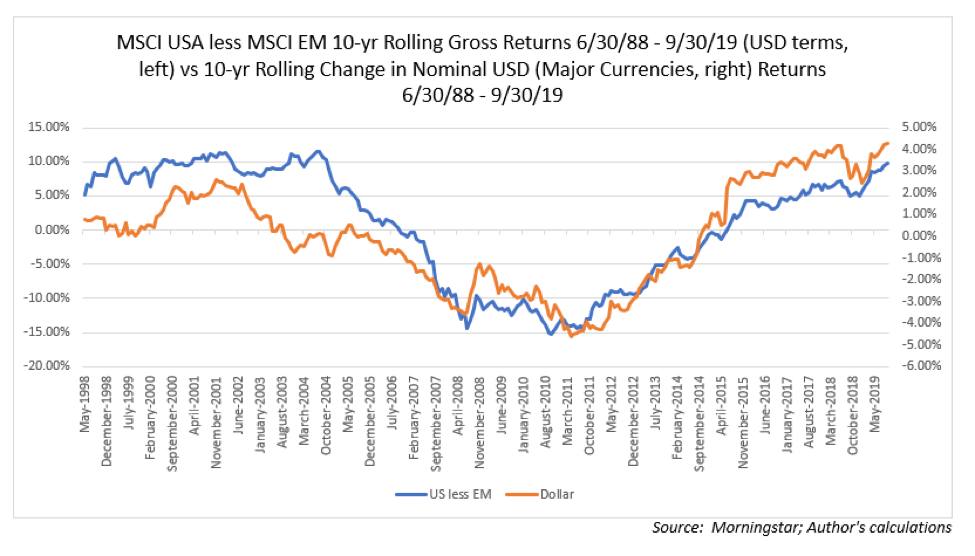
For a US investor, this is a critical point; over the decades since MSCI’s EM index began in June of 1988, excess returns for EM relative to the US have coincided with significant dollar weakness:
As you can see from the chart, the great EM bull market (relative to US stocks) of the 2000s coincided with a substantial bear market in the dollar, and its end coincided with the resurgence of the greenback circa late 2011.

Mr. Friedman does acknowledge the dependence of excess EM equity performance on USD weakness, but suggests EM currencies are currently positioned favourably to the dollar, which GMO believes is due for a period of weakness on a relative basis.

I’m no expert in currency valuation, so I am agnostic on this point, but it seems a rather tall order to have one’s equity bets so reliant on something as fickle as the currency market....
....MUCH MORE (we only snipped the bit that confirmed our priors)

And why bring this up now?
The dollar has been weakening since the September - October double top:

And the EMXC (iShares MSCI Emerging Markets ex China ETF) which has been under-performing both the S&P 500 and the EEM (emerging, including China ETF) is poised to go above a line on a chart:
EMXC iShares MSCI Emerging Markets ex China ETF daily Stock Chart
$51.37 last, +0.21
Merry Christmas.

See also:
World Econ: "Was October The Turning Point?"

Congo investigates possible money laundering in $222 million loan linked to Israeli billionaire Dan Gertler

From Reuters:
Congo prosecutors probe Israeli billionaire's loan to state mining company
Congolese prosecutors are investigating a 200-million-euro ($222 million) line of credit issued to state mining company Gecamines by a company owned by Israeli billionaire Dan Gertler, who is under U.S. sanctions, Gecamines said on Monday.

Two sources at Democratic Republic of Congo’s prosecutor’s office and two at the presidency, speaking on condition of anonymity, told Reuters the investigation was focused on possible money laundering and fraud related to a loan issued in October 2017 by Gertler’s Fleurette Mumi, which has since been renamed Ventora Development.

In a statement, Gecamines interim director-general Jacques Kamenga confirmed that a company official was questioned by prosecutors last week, without naming the person. Kamenga denied any wrongdoing and said Gecamines provided investigators with all requested documents.
Gertler’s spokesperson referred Reuters to a statement by Ventora Development, which said it issued the loan and was simply trying to recover money it was owed by Gecamines....MORE
Another of the shady characters on the African extractive industries scene.

See also "Mining Kingpin Beny Steinmetz Loses Effort To Overturn $2bn (£1.6bn) Arbitration Judgement" for Beny and the Och-Ziff crowd.
We're probably due for an update from ERC or ENRC pretty soon, just to round out the action.
Maybe check in on Frank Giustra for more of that Kazakh flavor.

HT to and headline from: Financial Crime and Corruption Education

Natural Gas: EIA Weekly Storage Report

A big draw, 161 Bcf vs expectations of 150 to 153 Bcf but there is a lot of gas around.
Soon to be front futures (Feb.) 2.199  -0.086 with the January's  down 0.133 at $2.161.
From the Energy Information Administration:
for week ending December 20, 2019   |   Released: December 27, 2019 at 10:30 a.m. 
...Summary
Working gas in storage was 3,250 Bcf as of Friday, December 20, 2019, according to EIA estimates. This represents a net decrease of 161 Bcf from the previous week. Stocks were 518 Bcf higher than last year at this time and 69 Bcf below the five-year average of 3,319 Bcf. At 3,250 Bcf, total working gas is within the five-year historical range....MORE
From the CME, the last few days price action:

https://www.tradingview.com/x/0XFJE6kv/

Natural gas can kill you and I don't mean asphyxiation or explosions. Try trading that in real time.
Which is why we sometimes have to resort to Fibonacci retracements and other such esoterica:

https://blogger.googleusercontent.com/img/b/R29vZ2xl/AVvXsEhJTLuP8pBw2tR6SAnx1RTN1Mqa9gEO6K9TKvsaf0xFkJzQAFdwYnvws_LyZIbgxFwhfs5Pw5KEBgJGtpULppmai97RPjOJry3_oqbcKofccolQd_lO5hYzcUhHVwx8IDG0Zi3KyW0X4lAM/s1600/homer.jpg
Oops, wrong example.
Lets try this:
http://www.lockhaven.edu/~dsimanek/pseudo/fibonacci-water.jpg

As we observe, the Fibs are natural and can be seen everywhere. So obviously, uhhh, higher?
Lower?
Higher.

Questions America Wants Answered: "Are Oreos Part of a Mindful Diet?"

From the Wall Street Journal via Hormel Foods, July 23:

Are Oreos Part of a Mindful Diet? Snack Makers Promote Chewing Thoughtfully
Consumers are thinking more about healthy eating, and snack makers are trying to convince people their treats can be part of that  
Earlier this month, about two dozen employees from Mondelez International ’s headquarters sat facing a wall emblazoned with the company’s snack brands including Oreo cookies, Triscuit crackers, Swedish Fish candy, Cadbury chocolate and Nilla wafers. They gathered to learn how to eat these foods in a new way.

“Close your eyes and chew slowly,” said Claire Mark, a local meditation instructor who led the class. “Try to bring in a deeper level of awareness to the muscles that it takes to chew, to the physical experience of having food in your mouth, to recognize how it feels to swallow.” After a pause, the group repeated the process for each of the remaining bites needed to eat two crackers.

Mindful snacking, or the practice of slowly and deliberately eating food, is being promoted by companies who want to convince increasingly health-conscious consumers that indulging in cookies, crackers and candy is OK to do sometimes…MORE
Thanks to a tipster on this story we somehow missed.

And Speaking of Fusion, China Is Close To Turning On Their "Artificial Sun"

It was in the outro from the post immediately below, "Tesla Patents A Battery Technology (TSLA)".

The headline story from Xinhua, November 26:
China's "artificial sun" device set to be commissioned in 2020
 
And from Nuclear Engineering International, November 29:

China completes new tokamak
China has completed the construction of the HL-2M tokamak fusion reactor at a research centre in Chengdu, the capital city of southwest China’s Sichuan province.

The tokamak will become operational in 2020, Xinhua reported on 27 November, noting that installation work has gone smoothly since the delivery of the coil system in June. The new apparatus, with a more advanced structure and control mode, is expected to generate plasmas hotter than 200 million degrees Celsius, said Duan Xuru, head of the Southwestern Institute of Physics (SWIP) under the China National Nuclear Corporation (CNNC). China has already spent close to a billion dollars on the project. The facility will provide key technical support for China's participation in the International Thermonuclear Experimental Reactor (Iter) project, as well as the self-designing and building of fusion reactors, he noted.  China is a member of Iter, under construction in France, along with the European Union, the US, India, Japan, South Korea and Russia.

HL-2M, built by SWIP is an upgrade of China’s previous model, the HL-2A – one of three major domestic tokamaks now in operation in China...
....MORE

Tesla Patents A Battery Technology (TSLA)

Always keeping in mind how freaking hard it is to scale new battery tech from the lab bench to commercial applications, this goal of extending the life of the battery as opposed to extending range or reducing charging times attacks two very expensive consequences of using batteries in vehicles:

1) The cost of replacing the battery is borderline cost-prohibitive, despite the rest of the car being in fine shape.
2) As more and more batteries reach the end of their useful lives the question arises: what to do with all this toxic waste? It's a serious problem that is coming very quickly.

From Electrek, a slightly more enthusiastic headline than ours, Dec. 26:
Tesla patents new chemistry for better, longer-lasting and cheaper batteries
and the story:
Tesla has made a lot of battery moves this year and it is closing the year by filing a patent on a new
Earlier this year, we reported on Tesla’s battery research partner, Jeff Dahn and his team at Dalhousie University, unveiling the impressive results of tests on a new battery cell that could last over 1 million miles in an electric vehicle.

The new battery tested is a Li-Ion battery cell with a next-generation “single crystal” NMC cathode and a new advanced electrolyte.

Since then, Tesla has been filing US and international patents on the new battery chemistry.
The automaker, through its ‘Tesla Motors Canada’ subsidiary, filed a new international patent called ‘Dioxazolones and nitrile sulfites as electrolyte additives for lithium-ion batteries’.
They wrote in the patent application:
“This disclosure covers novel battery systems with fewer operative, electrolyte additives that may be used in different energy storage applications, for example, in vehicle and grid-storage. More specifically, this disclosure includes additive electrolyte systems that enhance performance and lifetime of lithium-ion batteries, while reducing costs from other systems that rely on more or other additives.”
Tesla wrote in the conclusion of the patent application for the new battery chemistry:...
....MORE

Regarding the difficulty of scaling battery "breakthroughs", there was a time in the early twenty-teens that we just stopped posting on new tech, or manufacturing approaches because despite the oohs and aahs it was a waste of time as far as making money was concerned.

Seriously.
Battery tech is the Holy Grail of venture investing and to date no one has cracked the code.
That's one of the reasons the we are entertaining the ideas of the hydrogen/ammonia crowd for certain applications despite its having been, like nuclear fusion, "ten years away for the last fifty years."
For what it's worth, Mr. Musk rejects the hydrogen approach out-of-hand.

"Quantum Computers on Path to Extinguish Current Encryption Techniques"

From the uberwonks at EE Times, December 26:

In the coming years, large-scale quantum computers will make most current cryptography techniques insecure. To avoid this, two major global directions are being pursued.

In the digital age, each one of us carries out activities daily that would be impossible without cryptographic techniques. The security of our information, however, risks being thrown into crisis by the advent of future quantum computers, equipped with vast computing resources, potentially able to overcome current cryptographic techniques. A new generation of devices under development by companies such as Microsoft, Google, and IBM will multiply the computing capabilities of computers and will probably make obsolete the encryption systems currently in use, based on the transmission of radio waves.

Quantum cryptography is a method of transmitting secret information that offers the guarantee of maximum security. Unlike conventional cryptography based on calculation hypotheses, quantum cryptography has a significant advantage: Its security is based on the laws of physics proving to be unconditionally safe with quantum cryptographic techniques. Quantum mechanics aims to describe the heart of matter, where natural phenomena occur on a subatomic scale. Current systems of quantum cryptography rely on encoding a computer bit in a property of a single photon, which is the fundamental constituent of light and electromagnetic radiation.

The collaboration agreement between imec and the National University of Singapore (NUS) aims to jointly develop scalable, robust, and efficient quantum technologies for the distribution of secure keys for the internet of the future. In the coming years, large-scale quantum computers will make most of the current cryptography techniques insecure. To avoid this, two major global directions have been pursued: a post-quantum cryptography approach and another hardware-based approach called quantum cryptography.

Post-quantum cryptography is essentially about updating existing algorithms and cryptographic standards. It still maintains a security profile that is still based on unproven hypotheses. It consists of the definition and the study of cryptographic systems capable of guaranteeing high levels of security even against attackers equipped with quantum computers. The first challenge in this area consists of identifying mathematical problems that are difficult to solve for an attacker who is not significantly affected by the existence of quantum computers.

Quantum cryptography, on the other hand, offers a much stronger security guarantee. With this approach, two essential constitutive elements are quantum key distribution (QKD) and quantum random number generation (QRNG). Now, however, the methods and processes that enable these quantum technologies are limiting and expensive. As a result, these bottlenecks have made quantum cryptography unattractive for widespread diffusion. Imec and NUS aim to solve some of these bottlenecks (Figure 1).
Figure 1: Block diagram of quantum cryptography
“Our approach consists of developing and integrating all QKD key components in a single silicon-photonics–based chip, which ensures a cost-effective solution,” said Joris Van Campenhout, R&D Program director at imec. Dr. Charles Lim, assistant professor at NUS, said, “The development of chip-based prototypes will allow us to turn today’s QKD technologies into an efficient communication networking solution.”

The quantum distribution of keys makes it possible to transmit a secret key from one user to another, reaching the condition of perfect secrecy from a mathematical point of view and therefore making any interception attempts useless.....
....MORE

Thursday, December 26, 2019

Fairness, Capuchin Monkeys and Wall Street

This is a few years old but contains some good lessons so is probably worth reposting

The speaker, Frans de Waal, is one of the heavyweights of the primate world. Actually, we all are among the heavyweights of the primate world but he's up there with Jane Goodall in the study of primates.
A quick hit via TED:


And in other lessons from primates smaller than ourselves: