Showing posts sorted by date for query feed-in tariffs. Sort by relevance Show all posts

Sunday, September 27, 2026

"The US-China tectonic plates have shifted"

Both countries have financial problems that feed into social problems. As a totalitarian autocracy China may have the advantage. (the ghost of ca. 2009 Tom Friedman stirs) 

From Semafor, September 26:

Before this week, the last time a US president greeted a foreign leader at Joint Base Andrews was when John F. Kennedy welcomed British Prime Minister Harold Macmillan in 1962.

But that’s not the reason the image of US President Donald Trump waiting at the foot of the stairs of an Air China Boeing-747 to personally greet Chinese leader Xi Jinping is historic. Macmillan led a close American ally; Xi leads America’s paramount adversary. In rolling out the red carpet, Trump underscored how rapidly the balance of power in the relationship has shifted.

The turning point came last year, when China made the ultimate power move, threatening to choke off rare earths — and turn US factories dark — after Trump ramped up tariffs on Chinese goods to more than 140%.

Trump backed down, and at the time, Rush Doshi, a Georgetown University professor and former Biden administration official, wrote that China had proved itself to be a “true peer” of the US, unafraid to push back. Doshi’s take on the arrival ceremony, which also included a 21-gun salute and a flyover by B-1B bombers — far exceeding courtesies extended to Trump in Beijing in May — has been that China believes “they’ve basically tamed the United States.”....

....MUCH MORE 

If interested here is Friedman's 2009 op-ed via the Wayback machine. The NYT website has gone through so many iterations that the correct URL is actually a bit difficult to find, even at the Internet Archive (many of the links are re-directs into the void). 

Friday, September 4, 2026

"FAO Food Price Index rises in August amid broad-based increases, led by sugar"

From the Food and Agriculture Organization of the United Nations, September 4: 

» The FAO Food Price Index* (FFPI) averaged 133.3 points in August 2026, up 2.5 points (1.9 percent) from its revised July level. All commodity groups recorded higher price indices than in the previous month, albeit with marked differences in the magnitude of the increases. Compared to last year, the FFPI stood 3.3 points (2.5 percent) higher but remained 26.9 points (16.8 percent) below its peak reached in March 2022. 

https://www.fao.org/media/images/worldfoodsituationlibraries/default-album/home_graph_1_sep26.jpg?sfvrsn=4dcedd86_538 

» The FAO Cereal Price Index averaged 116.3 points in August, up 2.5 points (2.2 percent) from July and marking its highest level since May 2024. International cereal prices increased across all major grains in August, supported by robust demand, weather-related concerns over crop prospects in key producing regions, and continued uncertainty surrounding Black Sea export flows. World wheat prices rose by 2.6 percent month-on-month, standing 15.0 percent above their year-earlier level, amid persistent disruptions to Black Sea export logistics, lower production prospects in parts of Europe following hot and dry weather, and a weaker United States dollar, which enhanced the competitiveness of dollar-denominated export supplies. International maize prices increased by 2.5 percent from July, underpinned by mounting concerns over yield prospects in parts of the Corn Belt of the United States of America and deteriorating production prospects in the European Union due to prolonged heat and dryness, with additional support from strong demand from the ethanol and feed sectors and disruptions to Ukrainian export flows. Concerns over input supplies following the closure of the Strait of Hormuz provided additional support to maize prices. World sorghum and barley prices also increased in August, up by 3.9 percent and 2.6 percent, respectively, broadly reflecting firmer conditions across feed grain markets. Meanwhile, the FAO All Rice Price Index increased by 0.5 percent in August 2026, as a combination of currency movements, sustained purchases by Asian and African countries, and prospects of tighter supplies underpinned Indica quotations.

» The FAO Vegetable Oil Price Index averaged 196.9 points in August, up 1.1 points (0.6 percent) from July, marking its third consecutive monthly increase and reaching its highest level since June 2022. The rise reflected higher world palm and soy oil prices, which more than offset lower quotations for sunflower and rapeseed oils. International palm oil prices continued to increase, driven by robust global import demand and concerns over the potential impact of El Niño-related weather conditions on production prospects in Southeast Asia. Soyoil prices of South American origin remained firm, supported by strong export demand, while quotations in the United States of America declined moderately amid uncertainty surrounding biofuel policies and their implications for domestic feedstock demand. Meanwhile, international sunflower and rapeseed oil prices dropped slightly, reflecting subdued import demand and expectations of ample supplies of both oils in the 2026/27 season. 

» The FAO Meat Price Index averaged 127.9 points in August, up 1.2 points (1.0 percent) from its revised July value and close to its level a year ago. The increase reflected higher poultry, pig and ovine meat prices, which were partly offset by lower bovine meat quotations. International poultry meat prices rose, reflecting a rebound in Brazilian export prices amid strong global import demand. Pig meat quotations also surged, principally driven by higher prices in the European Union, where high temperatures continued to slow animal growth, limiting the availability of slaughter-ready pigs. The increase was partly offset by lower Brazilian prices amid ample supplies. Ovine meat prices increased on firmer quotations in New Zealand, underpinned by persistently limited export supplies and strong global import demand. By contrast, international bovine meat prices declined. With Brazil’s allocation under China’s beef safeguard import quota nearing full utilization, exports slowed further amid prospects of higher tariffs on additional shipments, while Australia had already reached quota thresholds in China and the Republic of Korea. This intensified competition for alternative destinations, exerting downward pressure on export prices in both countries.

» The FAO Dairy Price Index averaged 119.2 points in August, up 2.7 points (2.3 percent) from July, marking its first increase in four months, while it remained 21.7 percent below its level a year earlier. The increase was driven by higher milk powder and cheese prices, while butter quotations were broadly stable. Skim milk powder (SMP) and whole milk powder (WMP) prices rose by 3.0 percent and 2.4 percent, respectively, as firmer quotations in the European Union more than offset seasonal declines in Oceania. In the European Union, tightening milk supplies, compounded by hot and dry weather in several major producing regions, supported prices, while sustained import demand added upward pressure, particularly for SMP. In Oceania, by contrast, increasing seasonal milk production weighed on milk powder markets. Cheese prices increased by 2.7 percent during the month, extending the recovery that began in July. Higher quotations in the European Union, underpinned by limited milk availability, more than offset further price declines in Oceania, where expanding export supplies and continued market competition from the United States of America weighed on prices. Butter prices remained broadly unchanged from July, as firmer European quotations, reflecting tighter milkfat availability, were offset by lower prices in Oceania amid increasing seasonal supplies.

» The FAO Sugar Price Index averaged 106.4 points in August, up11.3 points (11.9 percent) from July and reaching its highest level since June 2025....

....MUCH MORE 

Wednesday, February 11, 2026

"CNBC’s The China Connection newsletter: Inside China’s push to feed 1.4 billion people without U.S. crops"

If the demographers are right, in fifty years the population will be down to 800 million so no worries.

From CNBC, February 11: 

  • Investment in agriculture has boosted local availability of fresh produce.
  • China has long wanted to reduce its reliance on other countries for agricultural products.
  • Companies from e-commerce players to seed developers have benefited.

This report is from this week’s CNBC’s The China Connection newsletter, which brings you insights and analysis on what’s driving the world’s second-largest economy. You can subscribe here.

The big story
Over the last few years in China, it’s gotten easier to buy food straight from the farm.

Whether it’s boxes of apples or bags of vacuum-sealed corn-on-the-cob, online orders placed through popular e-commerce apps take just a couple of days to arrive in Beijing.

China’s food safety standards are still a work in progress. But what I’ve noticed is that even if the apples from a nearby supermarket taste artificial — the ones I can order from the countryside taste like the ones I ate in the U.S. And I can’t say it’s just as easy to get apples shipped from a New York orchard.

The economics behind this consumer experience boil down to a few key differences at the heart of the U.S.-China trade story.

Over the past decade of trade tensions, the U.S. has repeatedly asked China to buy more American agricultural products. But many American farmers have lost sales under the Trump administration’s tariffs.

As the largest U.S. agricultural export by value, soybeans get the headlines. But even there, the White House has struggled to define the deadline for new Chinese purchases of U.S. soybeans. China did buy a record amount last year — mostly from Brazil. But Beijing’s end goal is food security — reducing reliance on other countries.

That’s where corn comes in.

Chinese researchers are developing corn with higher protein that could replace significant amounts of soybean imports. Most of those soybeans are used in animal feed that supports domestic meat production. Here, China has a clear goal to boost self-sufficiency. By 2030, China aims to cut the amount of soymeal in animal feed to just 10%.

Notably, Beijing this month called for increasing the quality of domestic soybeans, rather than simply planting more, as it had urged last year. That indicates the land is being saved for something else.

Tech-driven agriculture
To tackle the challenges of limited farmland and a large rural population, Beijing has sought to use technology and targeted policies to achieve its food security goals.

China has about three-fourths the arable land of the U.S., according to Goldman Sachs, despite having a population four times as large, which means policymakers have had to double down on increasing yield per acre. Around 34% of China’s population lives in rural areas, compared with roughly 20% in the U.S.

While corn fields and tractors dominate much of rural America’s plains, on a similar drive through China’s countryside, I’d see more mountains — and far more people still working the land by hand. The difference for urban consumers in China is that those farms are more connected to the internet and high-speed trains.

Beijing’s efforts to reduce poverty and ensure social stability in rural areas have driven infrastructure development across the country. E-commerce companies such as JD.com and Pinduoduo have expanded into new markets in the countryside. Companies like DJI have also built a business around agricultural drones. Last year, as I was taking a high-speed train from Beijing to Shanghai, I saw a drone working in a field.

Tech company Qicaihong has gone further, expanding from China’s Silicon Valley, Shenzhen, to a very rural part of Yunnan province to standardize local corn production for bigger markets.

The local subsidiary, Shijing Agriculture Technology, uses sensors and software — including AI from DeepSeek — to optimize regional production. Rather than having to find their own sales channels, participating farmers working off tiny plots on mountain steppes can sell their corn to the company at a set price for unified processing, before the corn is sold online and to major distributors.

A similar story plays out in the northeastern Heilongjiang province, where farmers can process their corn at a centralized plant and sell it nationwide and abroad under the brand “Laojieji.”

That’s just one aspect of local agricultural development. China is investing heavily in agricultural research and development, and its public sector spending was roughly double that of the U.S. in 2019 and 2021.

By 2022, China started commercializing its first generation of biotech seeds that improved corn yield by 10%, said Trina Chen, co-head of China equity research at Goldman Sachs.

That allowed the country to import just 2.65 million metric tons of corn in 2025, down from peak levels of nearly 30 million metric tons in 2022 and 2023, according to official data accessed via Wind Information.

Investor interest
More money is poised to enter China’s agricultural sector....

....MUCH MORE 

Saturday, October 4, 2025

"Cocoa Price Selloff Accelerates as Global Supply Prospects Improve"

First off, putting on my academic hat, a quasi-periodic reminder. As Dylan Grice, then at Société Générale pointed out, commodities' expected long-term real rate of return is not appealing. Here's our introduction to 2010's Société Générale's Dylan Grice-"Commodities: ‘Their Expected Long-Run Real Return is 0%’" (please ignore the supercilious "Well duh", I was in my haughty Valley Girl phase, better now):....

From Barchart, the headline story, October 3: 

December ICE NY cocoa (CCZ25) on Friday closed down -291 (-4.49%), and December ICE London cocoa #7 (CAZ25) closed down -225 (-4.99%).

Cocoa prices extended their plunge this week on Friday, with NY cocoa posting a 19-month low in its nearest futures and London cocoa reaching a 20-month low.  Cocoa prices are selling off as this week's actions by the governments of the Ivory Coast and Ghana to boost the amount they pay farmers for their cocoa beans may encourage sales and boost cocoa supplies.

The outlook for abundant global cocoa supplies is hammering cocoa prices.  Cocoa deliveries in Ghana, the world's second-largest cocoa producer, have surged and are weighing on prices.  Cocoa arrivals to ports in Ghana in the four weeks ending September 4 reached 50,440 MT compared to about 11,000 MT delivered in the same period in 2024.

Cocoa prices have also been under pressure over the past seven weeks amid fears that high cocoa prices and tariffs could dampen chocolate demand.  Chocolate maker Lindt & Sprüngli AG lowered its margin guidance for the year in July due to a larger-than-expected decline in first-half chocolate sales.  Additionally, chocolate maker Barry Callebaut AG reduced its sales volume guidance for a second time in three months in July, citing persistently high cocoa prices.  The company projects a decline in full-year sales volume and reported a -9.5% drop in its sales volume for the March-May period, the biggest quarterly decline in a decade.  

Mondelez recently said that the latest cocoa pod count in West Africa is 7% above the five-year average and "materially higher" than last year's crop.  The harvest of the Ivory Coast's main crop is expected to begin next month, and farmers are optimistic about the quality of the crop.....

....MUCH MORE 

Finally, On the Trail of Cocoa: The Dark Goddess, April 3, 2021:

Readers who have been with us for a while have seen us quote one of the more evocative sentences you are likely to find on markets:

“…For, after all, I had been into cocoa a bit myself. That was back when The Great Winfield had discovered cocoa trading. Occasionally in those more leisured days I would sit with him lazily watching stocks move, like two sheriffs in a rowboat watching catfish in the Tennessee River….”
—'Adam Smith', Supermoney

Here's part of the chapter it comes from.

Via the Twitter feed of Anne-Elisabeth Moutet:

So: the funniest pages ever written on commodities investing, by the great "Adam Smith", in 1968: "The Cocoa Game", from "The Money Game". 1/2

*****


***** 

*****

There's more, all great, but that should help to sate the cravings until the chocolate Easter bunnies arrive.

If interested here are the two tweets that Anne-Elisabeth posted:

1/2   https://twitter.com/moutet/status/962695914833022977

2/2   https://twitter.com/moutet/status/962696246023553025

Possibly also of interest:

Only The Dead Have Seen The End Of Candyflation 

Living La Vida Cocoa: Warren Buffett, Berkshire Hathaway and the Chocolate Wars (BRK.A; BRK.B; CBY; KFT; HSY)  

Thursday, September 11, 2025

Grain Prices Approaching Five-Year Lows

From The Economist, September 11: 

How grain has gone from famine to feast
Prices are close to a five-year low 

THREE YEARS ago, calamity loomed. Russia’s war in Ukraine pitted two big grain exporters against each other. Breadbaskets elsewhere faced brutal droughts. Wheat prices hit records; maize and soyabeans also surged. Then, within weeks, they fell, and have carried on sliding since. They are now close to five-year lows.

It is not obvious what prompted traders to go from panicked to placid. As the war in Ukraine continues to rage, the country’s farmers are hurting. Its wheat exports, once the world’s fifth largest, are set to shrink by 25-30% this season. Elsewhere, climate change is damaging output and American tariffs are disrupting trade. Indicators that usually worry investors, such as wheat stocks, have been flashing red for years. Why, then, are markets so calm?

Part of the answer is that global production has been strong. Owing to benign weather, Russia, the world’s largest wheat exporter, has enjoyed a run of excellent crops. Australia, the second largest, has also posted two whopping recent harvests. Even Europe has outperformed.

There are similar bounties elsewhere. America is due to produce record volumes of maize this season. Brazil, with which it competes to be the top maize exporter, may also hit new highs. That is pushing down the price of other crops used as animal feed, including wheat and soyabeans.

At the same time, demand for grain is weak. In a bid to support its farms, China has slashed imports of maize from 23m tonnes in 2023-24 to 4m tonnes this season. Other importers, notably in the Middle East, have also sought to assist domestic farming and food processing.

The underlying dynamics of the market have changed, too. Importers have grown more comfortable relying on lower stocks. The rise of big grain suppliers, such as Russia, makes them confident that they can count on global trade, says Charles Hart of Rabobank, a Dutch lender. Such confidence is bolstered by memories of the swift resolution of the grain crunch in 2022, when things looked truly perilous.

Admittedly, trade wars are complicating the picture. China, which by August last year had booked 13m tonnes of American soyabeans for autumn shipments, has yet to reserve any for this crop year. The weaker dollar, a product of President Donald Trump’s erratic economic policies, has made American maize cheaper for other importers, meaning it is flying off the shelves. All this is distorting regional prices, but not denting overall trade volumes....

....MORE 

There's a long trade setting up here. We thought it might start in summer/fall 2025 but the weather played nice. Maybe next year.  

Friday, September 5, 2025

"FAO Food Price Index virtually unchanged in August"

From the Food and Agriculture Organization of the United Nations, September 5: 

» The FAO Food Price Index* (FFPI) averaged 130.1 points in August 2025, virtually unchanged from the revised July level of 130.0 points. Declines in the cereal and dairy price indices were offset by increases in the indices for meat, sugar and vegetable oils. Overall, the FFPI was 8.4 points (6.9 percent) higher than in August 2024 but remained 30.1 points (18.8 percent) below its peak reached in March 2022.

» The FAO Cereal Price Index averaged 105.6 points in August, down 0.8 points (0.8 percent) from July and 4.5 points (4.1 percent) from August 2024. International wheat prices declined month-on-month, reflecting ample global supplies and subdued import demand, especially from major buyers in Asia and North Africa. Larger harvests in the European Union and the Russian Federation further weighed on prices. By contrast, world maize prices rose for the third consecutive month, mostly underpinned by concerns over the impact of heatwaves on yields in the European Union and the increased demand for feed use and ethanol production especially in the United States of America. Among the other coarse grains, world prices of sorghum decreased while those of barley increased. Meanwhile, the FAO All Rice Price Index fell by 2.0 percent in August 2025, driven by lower Indica prices amid continued fierce competition among exporters.

» The FAO Vegetable Oil Price Index averaged 169.1 points in August, up 2.3 points (1.4 percent) month-on-month, reaching its highest level since July 2022. The increase was driven by higher quotations for palm, sunflower and rapeseed oils, more than offsetting a slight decline in soyoil values. International palm oil prices rose for the third consecutive month in August, largely underpinned by robust global import demand and news of Indonesia’s intention to further raise its biodiesel blending mandate in 2026. Global sunflower and rapeseed oil prices increased on tightening supplies in the Black Sea region and in Europe, respectively. By contrast, world soyoil prices edged lower, mainly reflecting prospects of ample global soybean supplies in the 2025/26 season.

» The FAO Meat Price Index averaged 128.0 points in August, up 0.7 points (0.6 percent) from July and 5.9 points (4.9 percent) from a year ago, marking a new all-time high. The rise was driven by continuing higher bovine and ovine meat prices, which outweighed largely stable pig meat quotations and lower poultry meat prices. International bovine meat prices reached a new record high, underpinned by strong demand from the United States of America, which boosted Australian quotations, and firm import demand from China, which kept Brazilian export prices firm despite reduced sales to the United States of America following the imposition of additional tariffs. Ovine meat prices rose for the fifth consecutive month, reflecting tight export supplies in Oceania, with higher volumes directed to more lucrative markets, notably the United Kingdom of Great Britain and Northern Ireland and the United States of America. World pig meat prices remained broadly steady amid balanced global demand and supply conditions. By contrast, poultry meat quotations declined, pressured by ample exportable supplies from Brazil. Although Brazil declared its commercial poultry farms free of high pathogenicity avian influenza in mid-June, import restrictions maintained by some major trading partners continued to affect demand.

» The FAO Dairy Price Index averaged 152.6 points in August 2025, down 1.3 percent from July, marking the second consecutive monthly decline while remaining 16.2 percent above its level a year-earlier. The decrease reflected lower international prices for butter, cheese, and whole milk powder (WMP), outweighing higher skim milk powder (SMP) quotations. Butter prices declined by 2.5 percent in August, as robust production in New Zealand—despite the country’s seasonal output lull—and steady supplies from the European Union boosted global availability, while import demand, especially from Asia, remained subdued. Cheese prices declined by 1.8 percent, reversing increases since April, with softer demand from key Asian markets and seasonally low export activity weighing on Oceania markets, while in the European Union, weaker domestic demand during the holiday period and increased export competition added pressure on cheese prices. WMP prices edged down by 0.3 percent, reflecting muted demand from key importing countries. By contrast, SMP prices rose by 1.8 percent, driven by limited exportable surpluses in New Zealand and steady demand from Southeast Asia....

https://www.fao.org/images/worldfoodsituationlibraries/default-album/home_graph_2_sep25.jpg?sfvrsn=d0e1a022_413 

....MUCH MORE 

Monday, September 1, 2025

"The geo-economics of Russia’s bad harvest"

Worth paying attention to, though I'm not sure either the characterization or the purported causation is correct. 

From the International Institute for Strategic Studies, August 14:

Russia’s harvest for 2025 is shaping up to be the worst in over 17 years. This is likely to expose weaknesses in Russia’s wartime economy and its status as a global power. 

Russia’s ability to export grain and fertiliser has remained one of its few sources of economic strength and international leverage since its invasion of Ukraine. Unlike hydrocarbons, these exports have been spared Western sanctions, providing the Kremlin with critical revenue and soft power reach. But an increasingly erratic climate is now threatening this advantage. Russia’s bad 2025 harvest is more than a weather event: it reveals the structural fragility of Russia’s war economy and the growing risks to a system built on fiscal buffers and fossil fuels. 

Strength in decline

During the Cold War, the Soviet Union could not feed itself. It depended on grain imports, primarily from the United States. This gave Washington a lever of geopolitical influence during the era of detente by offering access to food on the condition of restraint in foreign policy. 

A Soviet weakness became a Russian strength. The post-Soviet transition to private land ownership and heavy state investment transformed Russia into an agricultural powerhouse. This gave it the confidence to ban Western food imports in 2014 in retaliation against sanctions imposed after Russia annexed Crimea and parts of Donbas. By 2016, Russia had become the world’s largest exporter of wheat and a leading exporter of fertiliser. These exports brought not just foreign currency, but influence – especially among buyers in Africa and the Middle East. 

Following Russia’s full-scale invasion of Ukraine in 2022, Western sanctions have sought to isolate the Russian economy. These have largely exempted agricultural exports to protect global food security, particularly in developing countries. For the Kremlin, this omission has become a secure stream of foreign earnings and influence that have helped stabilise the economy and support the war effort. But nature, indifferent to political constraints, may now be doing what Western policymakers have declined to do. 

The 2025 harvest is shaping up to be Russia’s worst in years. July saw the country’s lowest grain exports for that month since 2008. This is a result of intensifying climate volatility. Unseasonable spring frosts damaged over 240,000 hectares of crops, with 100,000 hectares lost outright. These were followed by record summer heat, with temperatures above 40°C in key southern regions. Drought conditions this summer have been devastating, with nearly 500,000 hectares destroyed. The authorities in Rostov oblast, a major grain-producing region, declared a state of emergency. Fields once golden with wheat were left parched and cracked. Wheat production forecasts were revised downward from 90 million tonnes to 82m–84m tonnes. Total grain output, which peaked at 158m tonnes in 2022, is now expected to fall to around 130m tonnes. 

This comes as pressure mounts on Russia’s once primary source of foreign earnings: hydrocarbon exports. In July, the European Union and the United Kingdom lowered their price cap on Russian crude from US$60 to US$47 per barrel and escalated sanctions on Russia’s shadow fleet of oil tankers. US President Donald Trump’s second administration has imposed tariffs on some buyers of Russian oil – most notably India. Crude oil and refined petroleum products now account for less than half of Russia’s export revenues, placing growing importance on alternative sources, including agricultural exports.

Climate change and consequences 
As I explore in The Earth Transformed, one of the defining challenges for modern states is how they manage and adapt to environmental stress: even modest shocks can have significant implications. Russia, vast and climatically diverse, is particularly exposed – as shown by events in 1916, when food shortages and price rises triggered uprisings, first in tsarist Central Asia and then in Petrograd.

Yet Russian President Vladimir Putin has long dismissed climate change, even suggesting that global warming might benefit Russia by rendering its northern lands arable. This wager appears increasingly short-sighted. While Western economies are investing heavily in adaptation and mitigation, Russia remains wedded to a carbon-intensive model of growth. As one of the world’s largest petrostates by area, it has effectively staked its future on the delay, or failure, of a post-carbon transition....

....MUCH MORE   

Possibly also of interest, September 2021 - That Time The CIA Completely Missed A Soviet Crop Failure And Allowed The Sovs To Buy American Wheat On The Cheap

Over the years I've mentioned some of the major failings of the U.S. intelligence community, from the failure to foresee the rapidity of the collapse of the communist governments in Eastern Europe to the round-up, torture, and murder of virtually all the human assets the CIA was running in China.

And the Chinese hack of the U.S. Office of Personnel Management starting in 2013, exposing the personal information of 20 million current and former employees, including those with highest level security clearances. That was actually a joint CIA/FBI failure. As was the Soviet development of the H-bomb.

And....well, it is a very long list.

Here's one more instance. the memory of which was triggered by wheat trading decisively over $8.00 this morning (821-2  +18-2)....

***** 

....Not only did the Americans supply the wheat the Soviets desperately needed but they paid the grain companies a $300 million subsidy and extended $750 million in credit for the purchases.

And because the Kremlin was able to keep the magnitude of the disaster from becoming common knowledge they were able to make the purchases in a market that did not have access to all the relevant information needed to establish a clearing price.

Next up, the St. Louis Fed paper referenced above....

Sunday, July 20, 2025

Electricity: "Pump Prices Aren’t the Problem for Americans. Plug Prices Are"

From Bloomberg Opinion, July 17: 

Power costs rose twice as fast as overall inflation in June and are consuming an increasing share of disposable personal income.

President Donald Trump, like many Americans, has something of an obsession with gasoline prices. He might be better off focusing on another cost with which Americans are regularly confronted: electricity bills.

The electricity component of the Consumer Price Index was up 5.8% in June, year over year. This was the third month in a row where electricity came in above the broad inflation rate and marked an acceleration in that trend, rising to more than double the CPI’s 2.7%. Meanwhile, although Trump has a habit of citing fantasy sub-$2 gasoline prices, that inflation component just registered its 13th straight month of year-over-year declines. Looking at energy costs as a share of disposable personal income, gasoline took 1.59% compared with 1.15% for electricity in May (the latest month of available data), the narrowest spread in more than four years. Rather than pump prices, plug prices look more ominous....

***

.... In part, this reflects an unusually warm June keeping air conditioners cranked up, plus higher fuel costs. Natural gas-fired generation tends to set the wholesale electricity price, and both gas futures and power plant fuel costs have bounced back from very low levels a year ago.

But the big driver of the utility costs that feed into bills is spending on the grid, which tends to be stickier, too. This is all the more salient given Trump’s recent visit to Pennsylvania to tout multibillion-dollar investments in datacenters there. Winning the race for artificial intelligence is a core element of the administration’s focus on “energy dominance.” US power demand is expected to rise quickly after lying flat for most of the past two decades, with datacenters playing a leading role.

Building the necessary generating capacity, and associated grid infrastructure, is expensive. Grids are quasi-socialist, spreading charges more or less evenly across customers with sometimes very different costs of service. Understandably, your average householder is wary of subsidizing the gigawatt-sized ambitions of the likes of Mark Zuckerberg. Moreover, the AI hype phase we are currently in recalls the early 2000s internet bubble, with its highly inaccurate associated energy projections. (Guess who gets stuck with stranded costs for grid capacity that’s built and not used.) Andy DeVries, an analyst at CreditSights, notes that projections of power demand in 2030 have stopped growing since the DeepSeek shock in late January reminded everyone about the role of efficiency.

In response, a number of state regulators and utilities have proposed special tariffs for datacenter operators to ensure their deep pockets absorb the costs of hooking up large loads to the grid, including any stranded costs. Hyperscalers are also signing long-term contracts to underwrite new power plants and making preliminary moves to encourage new nuclear power development.

Yet these efforts won’t be sufficient to tamp down costs entirely. The datacenter shock is hitting a grid that was already under strain, in part because of the sort of extreme weather events that climate change will exacerbate, regardless of Republican ambivalence on the topic. Hugh Wynne, an analyst at Sector and Sovereign Research LLC, points out that the North American Electric Reliability Corporation assesses six out of the 13 US regions it tracks as facing reliability risks linked to potential gas outages in severe winter weather. These include large grids like the main one in Texas, which failed for that reason in 2021, the Midcontinent Independent System Operator network covering much of the Midwest, and the huge PJM grid, which includes Pennsylvania.

The structural requirement for grid renewal burst into the open in PJM last summer, when a capacity auction — designed to incentivize power plants to remain open or get built — returned an 833% price increase. These charges, insurance against blackouts essentially, get spread across bills. The latest auction concluded the same day Trump was talking gigawatts in Pennsylvania, with results due next week....

....MORE

HT:


By the same writer at Bloomberg Opinion: 

A $12 Billion Window Into AI’s Race for Power: Liam Denning 

Wednesday, May 21, 2025

"Big techs’ AI empire"

Have I mentioned advantage flywheels and super-Pareto/hyper-Pareto distribution of profits?
Why yes, yes I have.*

From VoxEU. May 16:

Authors
Leonardo Gambacorta
Head of Emerging Markets Bank For International Settlements
Vatsala Shreeti
Economist Bank For International Settlements

Advances in AI are transforming the economy. Behind this wave of visible innovation lies a less visible but significant trend: the role of large technology firms – commonly referred to as ‘big techs’ – across the AI supply chain. This column analyses the AI supply chain and the market structure of every input layer, highlighting the economic forces shaping the provision of AI and the role of big techs in each input market. The authors illuminate challenges that big techs pose to consumer choice, innovation, operational resilience, cyber security, and financial stability.

Advances in artificial intelligence (AI) are poised to transform the economy and society. From chatbots and image generators to financial forecasting tools, AI applications are becoming ubiquitous, promising to revolutionise the way we live and work. In particular, generative AI (GenAI) is being adopted at a much faster pace than other transformative technologies (Bick et al. 2024). Recent evidence already points to AI’s wide-ranging impact on labour markets and productivity, local economies, women’s employment, capital markets, public finances, and the broader financial sector (Gambacorta et al. 2024, Aldasoro et al. 2024, Albanesi et al. 2025, Andreadis et al. 2025, Frey and Llanos-Parades 2025, Kelly et al. 2025).

Behind this wave of innovation lies a less visible but significant trend: the growing role of large technology firms – commonly referred to as ‘big techs’ – across the AI supply chain. Big techs have been consistently investing in AI: in 2023, they accounted for 33% of the total capital raised by AI firms and nearly 67% of the capital raised by generative AI firms (Financial Times 2023). While big techs have undoubtedly accelerated the development of AI, their expanding influence over how AI is provided raises critical questions about competition, innovation, operational resilience, and financial stability.

In a recent paper (Gambacorta and Shreeti 2025), we explain the AI supply chain and the market structure of each of its input layers. We highlight the economic forces shaping the provision of AI today, and the role of big tech in each input market. We also outline the potential impact of the current market structure on economic outcomes and highlight challenges for regulation.

Big techs in the AI supply chain

The AI supply chain comprises five key layers: hardware, cloud computing, training data, foundation models, and user-facing AI applications (see Figure 1). Each of these layers is essential to powering the AI systems we use today, and big techs are active in all of them.

Consider cloud computing, the backbone of AI development. AI models require immense computational resources for training and deployment, and cloud platforms provide the infrastructure to make this possible. Globally, the cloud market is dominated by three big techs: Amazon Web Services (AWS), Microsoft Azure, and Google Cloud Platform.

Figure 1 The AI supply chain

Figure 1 The AI supply chain

Source: Gambacorta and Shreeti (2025).

Together, the three big tech firms control nearly 75% of the infrastructure-as-a-service market, the segment most relevant for AI. Their dominance is rooted in both the economic forces shaping the cloud computing market and their strategic actions. High fixed costs, economies of scale, and network effects make it difficult for smaller players to compete in this market. Moreover, cloud providers also charge egress fees to transfer data out of their platforms. The egress fees charged by big techs not only exceed the incremental cost of transferring data but also exceed the fees charged by smaller competitors (Biglaiser et al. 2024). Big techs also provide vertically integrated service ecosystems on their platforms, often at a discount.

But big techs’ influence extends far beyond cloud computing. Training data is the lifeblood of AI, and big tech firms have access to some of the richest pools of user-generated data in the world. Meta has Instagram, Facebook, and WhatsApp; Google has Gmail, Maps, Play Store, and Google Search; Microsoft has Bing; LinkedIn and Microsoft 365 (Hagiu and Wright 2025). To use these data for AI training, big techs have been quietly updating their terms of use and privacy policies. In addition to exploiting their existing data reserves, big tech companies are actively acquiring or partnering with data-rich firms. As the stock of high-quality public data dwindles, such proprietary data sources will become even more valuable. The increasing returns to every additional unit of data can further entrench their influence over the AI supply chain.

The foundation model layer of the AI supply chain – home to large pre-trained models like OpenAI’s GPT-4 or Google’s Gemini – is another area where Big Techs are increasingly active. Foundation models are expensive to develop, with training costs often exceeding $100 million (The Economist 2023). These high fixed costs can create significant barriers to entry, favouring firms with deep pockets and access to computational resources. 1 Unsurprisingly, big tech firms are not only developing their own foundation models but are also integrating them into their consumer-facing products. Microsoft offers its AI-powered Copilot across its suite of applications, while Google embeds its Gemini model into search results. At the same time, they are producing AI hardware (chips) and even securing their own supply of nuclear fuel to power data centres (CNBC 2024). Such vertical integration allows Big Techs to capture value at multiple points in the supply chain.

Figure 2 Big techs in the AI supply chain

Figure 2 Big techs in the AI supply chain

Source: Gambacorta and Shreeti (2025).

This vertical integration can create a self-reinforcing ‘cloud-model-data loop’ (see Figure 2). By controlling cloud computing resources, big tech firms can produce better AI models. These models, in turn, generate more data, which can be fed back into their systems to improve subsequent iterations. The loop is further strengthened if there are substantial network effects associated with AI applications provided by big techs. As more users adopt a particular AI model or platform, its value increases, attracting even more users. The strength of this loop will depend on the quality of big techs’ proprietary data, the extent of network effects arising from AI use, and the returns to scale of each additional unit of data in the AI training process.

Implications for economic and social outcomes....

*That phrase "self-reinforcing 'cloud-model-data-loop'" points the way but it is actually just part of what we've come to refer to as "how to think about business and investing." Here is a jumble of previous posts that when taken together make up a framework to hang incoming data, information, knowledge and hopefully, wisdom, upon. (Our old pal, the DIKW pyramid.)
 
A very handy conceptual framework first posted after the start of the U.S. lockdowns, April 2020. Schools were closed so it seemed natural to link to a superb mini-MBA module.  
Eat your heat out HBR.

 From FutureBlind:

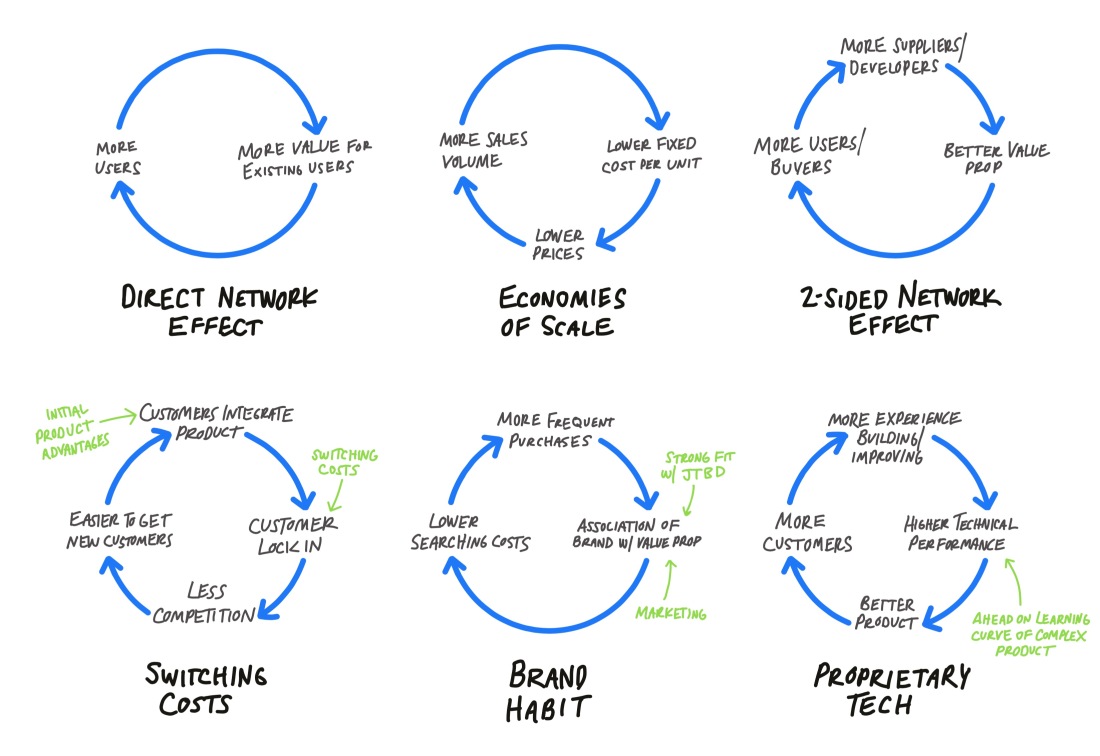
Competitive advantage can be represented visually as 1 or more feedback loops. These create the advantage “flywheel” that maintain and grow a moat over time. Think of a big, heavy wheel that takes some effort to get started but then coasts off its own momentum.
Before continuing, check out Eric Jorgenson’s primer on the flywheel mental model here.

Flywheel archetypes
Here are 6 simple examples of common advantages represented as flywheels (or “causal loops” in systems terminology). These loops are generalized — they’ll be expressed uniquely in every company that has them.
A few examples of how each advantage flywheel can vary:
archetypes.jpg
  • In the Economies of Scale flywheel above, the primary driver of more volume is low prices. This fits for most consumer businesses, but lower prices aren’t always the outcome of lower unit costs. If prices are maintained or increase, scale will yield higher margins → more resources to spend on growth → more sales volume.
  • The Brand Habit flywheel exhibits the typical loop for habit-reinforcing association of a brand with a specific quality or job-to-be-done. Think “thirst quenching happiness” for Coca-Cola and “low prices” for Wal-Mart. Another example of brand advantage is more of a social proof effect: Product has success → the cool kids want it → improved perception of product → …
As Eric discussed in his flywheel post, each wheel needs a push to get started. Written in green on a few of the archetypes above are initial advantages to get the wheels moving. Whether it’s a better user experience, a technical breakthrough, or a bootstrapped network based off of an existing network (college campuses for FB) or a useful utility (Instagram).

Real world examples
The above archetypes can be combined to create more comprehensive flywheels modeling the driving “engines” of each company’s moat:
examples
The most successful moats have multiple flywheels that feed off of each other’s momentum. Google’s technical advantages enable stronger brand allegiance and vice versa. Coca-Cola’s marketing-driven brand feeds off of it’s distributor/bottler based network effects. Facebook’s brands have at least 3 reinforcing network effects: direct (social network), 2-sided aggregator (advertising and developers), and brand-driven social proof....

....MUCH MORE

As artificial intelligence comes more and more to the fore, the advantages accruing to those companies that can afford to make use of their data and custom train the machines will act as advantage flywheels that shift the distribution of profits from the normal Pareto: 80% of the loot goes to the top 20% of businesses to perhaps as much as 95% of all the profits going to the top 5% of businesses.

I didn't really mean the "eat your heart out HBR" line.

Here's the Harvard Business Review on this very point:
HBR—From Pareto To Hyper-Pareto: "AI Is Going to Change the 80/20 Rule"
 
April 15, 2025
The Big Get Bigger: "The trade war uncovers new economies of scale"

From Yahoo Finance, April 15:

It pays to be big.

That's one early takeaway from the tariff drama. Investors momentarily poured back into Big Tech after the administration initiated a temporary levy exemption that covers consumer electronics, networking equipment, GPUs, and servers.

It's essentially another way of saying that Big Tech will probably be OK, as investors also look to the sector as a defensive play. Meanwhile, other sectors and companies still stare down a massive tariff upheaval.

It's a feature of American politics to want to avoid the appearance of picking winners and losers in the market. That phrase is often used as a rhetorical cudgel to attack opponents as bad for the economy.

But one person's favoritism is another's industrial policy.

If the market is consumed by the repercussions of tariffs, exemptions to those taxes can mean everything. The potential special carve-outs for tech, however, initially sparked a rally on Monday, fizzled, then rebounded. Part of this confused response from investors was the White House seemingly sending mixed signals.

After the exclusions from reciprocal tariffs were first unveiled, the president said in a social media post "there was no Tariff 'exception' announced." He later told reporters that his goal was encouraging production to move to the US but added that the administration has to show flexibility.

The tech titans hoping to receive assistance from the White House are showing flexibility too, or rather a willingness to support the president's agenda of bolstering domestic manufacturing and investment.

Nvidia (NVDA) on Monday said it will produce up to $500 billion of AI infrastructure in the US within the next four years. That announcement follows other Big Tech commitments from Apple (AAPL), Microsoft (MSFT), and Meta (META) to spend in the US....

....MUCH MORE

This is a corollary of the basic framework for understanding businesses and investing that we've been pitching for the last six or seven years.

If interested see:

Why Do the Biggest Companies Keep Getting Bigger? It’s How They Spend on Tech" 
...Much more important than the direct monetization of big data is the strategic advantage it can bestow over time.
In a winner-take-all economy, as in a horse race, small differences in superiority are rewarded all out of proportion to the actual advantage. A top thoroughbred may only be a couple fifths of a second faster than the field but those two lengths over the course of a season can mean triple the earnings for #1 vs. #2.
In commerce the results can be even more dramatic because rather than the 60%/20%/10% purse structure of the racetrack the winning vendor will often get 100% of a customer's business.....

Competitive Advantage and Feedback Loops

Flywheel Effect: Why Positive Feedback Loops are a Meta-Competitive Advantage

"Analyzing the deepening divide in learning capabilities between a few corporate giants and the rest of the world." (plus advantage flywheels)

"America's Biggest Firms' Moat Is Becoming Impregnable" (TSLA; NVDA; GOOG)
The announcement at the end of August that Tesla was going live with their supercomputer — Elon Got Himself A Supercomputer: "Tesla's $300 Million AI Cluster Is Going Live Today" (TSLA)—reminded me of this piece at ZeroHedge, last month. We'll be back with more on Morgan Stanley's Tesla note later today but for now the TL;dr is "To the victor go the spoils" or "The rich get richer" or "Those who can afford a supercomputer will get closer to discovering the profitability (if any) of AI than those who can't afford a supercomputer."
In Nvidia's World, If You (and your company) Don't Have Money You Will Not Be Able To Compete (NVDA)

The advantage flywheels keep spinning and reinforcing each other to the point that the Pareto distribution of profits - 20% of companies reap 80% of the profits - is becoming Super-Pareto where 5% of the companies reap 95% of the profits and is approaching Hyper-Pareto at maybe 2% of companies reaping 98% of profits.

It all comes down to having the resources to keep up. 

I watched Mr. Huang give the keynote and it's all a bit much to digest before firing out comments that would make any sense at all so here are some of today's headlines to give a taste of what the intro paragraph is based on.

These are Nvidia's press releases via GlobeNewswire....

"Elon Musk says any company that isn’t spending $10 billion on AI this year like Tesla won’t be able to compete" (TSLA)

This.

This is such an important concept to grasp. It's the advantage flywheels, the rich get richer, winner-take-all reality of business in 2024....

  "Jensen Huang’s extraordinary interview" (NVDA)

And many more, we are playing for keeps.

The Hyper-Pareto Distribution Of Profits Is Happening Right Now (plus an anniversary)
It's not some cutesy management* fad or pop insight like "Business secrets of Genghis Khan."

To the rich go the profits and internalizing that fact makes the rest of this portfolio construction/fund management/investing stuff easier to conceptualize and execute.

And AI is accelerating the already extant dynamic....

Just to reiterate, every incremental advantage that a company can afford does not affect income production in isolation. They accrete in sometimes unforeseeable combinations.

That's it, business, companies and investing in the 21st century. Learn it, love it, live it.

Or not, your call.

Sunday, March 2, 2025

"China May Target US Crops in Tariff Response, Global Times Says:

Global Times is the outward-facing propaganda organ of the government/party.

From Bloomberg, March 2: 

China is considering retaliatory measures on US agriculture and food products in response to tariffs from the Trump administration that are scheduled to take effect on Tuesday, according to the Global Times.

Beijing’s response will likely include tariffs and non-tariff measures, Communist Party-backed Global Times reported, citing a person they didn’t identify. China’s soymeal prices surged 1.5% on concerns that escalating trade tensions could disrupt US shipments of soybeans and tighten the market further.

President Donald Trump has pledged to double the levy on China to 20%, while also hitting Canada and Mexico with tariffs on March 4. The Asian nation is the world’s biggest importer of soybeans, which is typically crushed into cooking oil and animal feed, particularly the country’s large pig herd....

....MORE

If they do target agricultural products they had better hope for good weather in Brazil.

Saturday, April 29, 2023

Untangling the Supply Webs

Not chains, webs.
Following on This Morning's "The Great Re-Shoring Charade".
From The Milken Review, April 21:
 
Breaking Up Is Hard to Do
The Biden administration is on a campaign to fundamentally alter the supply chains that feed America’s vast appetite for foreign-made goods. This effort is driven in part by the public’s demand for protection against the sorts of shortages that made everything from butter to SUVs scarce during the Covid-19 pandemic. Real enthusiasm for reordering supply chains, however, is stoked by perceived military and economic threats to the U.S. from a more assertive China.

On her first visit to India last November, Treasury Secretary Yellen called for “like-minded countries” to work together to reduce the world’s dependence on “risky countries,” taking clear aim at China. Such statements play well on Capitol Hill, where members of Congress outcompete each other to show who is most disgusted by China. But they pose problems for many of America’s trade partners who do not share America’s desires to decouple.

Tangled Webs
The Biden administration inherited Trumpera policies intended to force China to clean up its predatory treatment of American intellectual property — patents, trade secrets and the like. The tariffs, which remain on two thirds of U.S. imports from China, were justified by the Trump administration not only by claims that American companies were forced to share technology as a condition of doing business there, but also as a means of reducing U.S. dependence on China for natural resources and some industrial products, and as payback for past unfair trade practices.

America’s list of China’s economic threats is long, but concern that it will dominate future “chokepoints” — supply nodes that can be used to restrict access to critical materials — drives current policy. And recent Chinese actions have only reinforced fears of economic coercion. Over the past few years, China has used its economic leverage to retaliate against perceived slights from more than a dozen countries, slapping on tariffs and negating long-standing trade relations. Last October, the Biden administration deployed chokepoints of its own to forestall Chinese hightech development, banning exports of advanced semiconductors and the equipment needed to make them.

Although it features prominently in the press, America’s “tech war” with China is only part of the wider effort to reshape U.S.-Sino trade relations. The White House is determined to reduce future dependence on China through “reshoring” and “friend-shoring” of the activities that supply American markets. The goal of moving supply chains away from China now guides U.S. trade and investment policies, its economic relationships with allies, and its refusal to restore the World Trade Organization’s authority to act as an effective arbiter of trade disputes.

America’s efforts to restructure global supply chains reflect a fundamental rethinking of how the global trading system should work. No longer willing to abide by WTO treaty norms, especially non-discrimination against other members, the U.S. is leading the formation of exclusive trade and investment networks.

As the world’s most innovative economy and its largest importer — American merchandise imports exceeded $3 trillion in 2022 — the United States has many levers to move global supply chains. A review of these tools shows, however, that while some can be used effectively at least in the near term, none comes without substantial economic costs. There are also profound consequences of this campaign for U.S. global leadership.

America’s efforts to restructure global supply chains reflect a fundamental rethinking of how the global trading system should work. No longer willing to abide by WTO treaty norms, especially non-discrimination against other members, the U.S. is leading the formation of exclusive trade and investment networks. Other countries also seek to reduce dependence on China and are eager to capture market share it loses. But they still resist U.S. efforts to force them to decouple from China.

The Usefulness of Trump’s Trade-War Tariffs
The Biden administration has left untouched the Trump-era tariffs levied in 2018 and 2019. This failure to reform Trump’s tariff policies, which represented an about-face from decades of U.S. commitment to rules-based open global trade, surprised many who followed the Biden campaign’s cogent criticism of the former president’s approach. However, since rearranging supply chains and making them less vulnerable to geopolitical tides is a priority for the Biden White House, retaining the Section 301 tariffs gives the administration broad discretion in responding to perceived injuries and provides a ready-made tool for altering U.S. trade patterns. Tariffs on China, which still average 19 percent, have helped to reduce its share of U.S. goods imports from 22 percent at the start of the trade war to only 17 percent by the end of 2022.

This reduction in China’s share of the U.S. market has caused considerable economic harm to U.S. interests — costs that now seem to have been forgotten in the rush to remake U.S.-China economic relations. To date, U.S. Customs has collected $167 billion in duties on imports from China subject to Section 301 tariffs, which amounts to a hefty tax on U.S. businesses and consumers, as shown by several detailed studies of U.S. import prices. This sum, it’s worth noting, dwarfs revenue collected under Trump-era scattershot trade actions that also hit targets ranging from Canada to Turkey to the EU as well as China. And, incredibly, Americans continue to pay these import taxes while 2022 U.S. imports from China will exceed the value purchased in 2018, when the trade war began.

Because the largest share of U.S. imports from China are “intermediate goods” — goods, like engine parts, used to make other goods — these tariffs make U.S. businesses that rely on inputs from China less competitive against their foreign rivals at home and abroad. An analysis by Kyle Handley (Michigan), Fariha Kamal (U.S. Census) and Ryan Monarch (Federal Reserve), using detailed information on the activities of American manufacturers, found that Trump-era tariffs lowered export growth for those exposed to them, with an effect equivalent to a 2 percent to 4 percent tariff levied on their foreign sales. And there’s no reason to believe these tariffs are currently less damaging.

While hurting U.S. exports, tariffs do not often result in “reshoring” — that is, returning production (and jobs) to the United States. A recent study by the Peterson Institute for International Economics found that trade subject to the Trump tariffs was diverted away from China toward Mexico and other parts of East Asia, not to Detroit or Seattle or Dallas.

Mr. Biden has made the notion of “democracies versus autocracies” an organizing principle of his foreign policy. Unfortunately, in a world with low barriers to trade, blocking an autocracy from participation in one’s supply chains does not imply that democratically governed economies will take its place. Indeed, one of the ironies of the U.S.-China trade war is the bonus it has provided to Vietnam, an economy guided by the country’s communist party. Vietnam’s share of exports to the U.S. increased markedly after the levy of tariffs on Chinese goods including footwear and apparel. Adding to the irony, the shift was less than what it appears: these Vietnamese- labeled goods undoubtedly contain Chinese content, and some are made in Chinese- owned factories....

....MUCH MORE

That was one of the points made in the earlier posts, that as American imports from Vietnam rose, so to did Vietnam's imports from China.

Very much like Europe buying Russian oil but routing it through India and paying a middleman's markup to do so..

Friday, November 26, 2021

Journalism: Where Are The Muckrakers? The Rise and Fall of McClure's Magazine

It seems as though there is more muck than ever, in government, big business, media etc. and very few people who are actually digging in and getting the stories.

As noted back in 2016: 

Over the years, simply because the blog is composed of things that caught my eye rather than some grand plan, we've from time to time mentioned some of the early 20th century journalists who got appended the term muck-rakers but when I did a quick search of the blog I was surprised how many we'd named, although usually just in passing.

Some links below.
And from Allegheny College, a swell repository of all things Ida Tarbell:

“The Explosions of Our Fine Idealistic Undertakings” 
By Greg Gross, Allegheny College class of 1983

Table of Contents:

Preface

This thesis analyzes the staff breakup of McClure’s Magazine and demonstrates its historical significance by placing it in the context of the progressive era. The McClure’s schism occurred in late March and early April, 1906, and triggered the gradual decline of one of the era’s most popular mass-circulation periodicals. To present this study in a logical manner, I have divided this thesis into three segments, which can best be visualized by imagining three concentric spheres. The “outer sphere,” Chapter I, analyzes the rise of the progressive mentality, which had a strong influence on American culture at the dawn of the twentieth century, from approximately 1900-1912. I introduce the reader to the outer layer of my area of study, presenting an analysis of the origins of progressivism and its Protestant-oriented, middle-class character.

Chapter II, the “middle sphere,” chronicles the rise of McClure’s Magazine to national prominence as the forerunner of the muckraking movement. I introduce the central figures responsible for the expose journalism that “arraigned,” on a nationwide scale, the lawlessness and immorality of the American people, while analyzing the staff’s ideological ties to progressivism.

In Chapter III, the core of this thesis, I explore the ideological tensions that wrenched apart the McClure’s staff. Samuel Sidney McClure, the majority stockholder and chief editor of the magazine which bore his name, committed the “sin” of adultery, which affronted the moral standards of the progressive mentality. His staff reacted by sternly disapproving of his actions. Their disdain caused McClure to suffer from feelings of guilt, which aggravated his already unstable mental condition. In the face of his colleagues’ disapproval, he sought to regain their esteem by establishing a business empire which would serve society. McClure undertook to establish a new magazine,McClure’s Universal Journal, and subsidiary enterprises, including a bank, life insurance company and correspondence school, all geared to serve the “common man.” McClure’s “grandiose scheme” backfired, however, and only succeeded in convincing his staff that he was attempting to found a trust-like business conglomerate.

Convinced of their editor’s mental instability, and affronted by love affairs and unrealistic schemes they considered economically dangerous and morally untenable, the McClure’s staff left the magazine. Ida Tarbell, one of the “insurgents,” aptly summarized the breakup as “the explosions of our fine idealistic undertakings.” (1) I ultimately seek to demonstrate the relationship between these exploded ideals and the movement which nurtured them.

My thesis is intentionally limited to an analysis of how the McClure’s staff members perceived themselves and their mission; this paper is not, nor was it intended to be, a comprehensive history of muckraking or progressivism. Wherever possible, I have used the primary resource materials of the Ida M. Tarbell Collection at Pelletier Library, Allegheny College. The Tarbell Papers proved invaluable in assessing the tensions which led to the breakup of a prominent progressive magazine and the staff that created it.

PREFACE ENDNOTES:
“IMT Collection” designates Ida M. Tarbell Collection.
(1) Ida Tarbell to Ray Stannard Baker, October 17, 1939, IMT Collection, Correspondence between Ida Tarbell and Ray Stannard Baker file, Allegheny College Library, Meadville, Pennsylvania.

Copyright 1997 by Greg Gross. All rights reserved. This work may not be used for any reasons other than noncommercial research and scholarship. For any other use, please email jwestenf@allegheny.edu

Chapter I

“The Rise of Progressive Mentality”


Query: who made the world, Charles?
Charles: God made the world in 4004 B.C.;
but in 1901 it was reorganized by James J. Hill,
J. Pierpont Morgan, and John D. Rockefeller.

—Life (1)
The forty years between the end of Reconstruction and the finish of World War I were a period of significant transformation in the United States. The American way of life, which many would have formerly believed inalterable, yielded to the cultural change prompted by westward settlement. With the rise of industrialism, the populace began to move from the farm to the city. This migration fostered a concurrent shift in political and economic power from agrarian to urban America. The United States, in short, was undergoing a redefinition of its basic goals and values, and such a change — the growing pains of a nation — inevitably ignited discontent. Populism was the first significant expression of protest in this period and formulated much of the progressive ideology which later followed. 
The farmers who composed the populist movement were angered because they witnessed the economic power they once held slipping out of their hands and into the grip of prosperous city dwellers. In the face of crop failures, declining prices, and diminished sources of credit, the farmers demanded reforms that would place them in parity with the burgeoning economic power of industry. They demanded the unlimited circulation of silver currency, direct election of United States senators, and revenue tariffs only. Above all, the populists called for governmental ownership of the railroads, for they realized that control of this mode of transportation was essential to their well-being. The westward expansion of the railroad enabled the ways of the industrial East to invade and disrupt the division of labor in the rural United States:
The farmer suddenly discovered that he was implicated, to an extent undreamed of in the days of true isolation, with banks, with railroads, and with the manufacturers who went into politics in the interest of controlling prices through discriminatory tariffs and favorable monopolies. (2)

The farmer, in the midst of the transportation revolution, felt betrayed. When the tracks were first laid, he envisioned the railroad as the path to prosperity. The train would propel his goods to a larger market and feed the ever-increasing post-war populace, thereby causing crop prices to skyrocket. Under the limitations imposed by federal tariff barriers, however, the market for the increasing amount of agricultural products sharply narrowed, and food prices subsequently declined. Yet the industries of the East “had only to compete in a local market behind high tariff walls,” (3) and the agrarian man bought his clothing, farm implements, and other manufactured necessities at steadily rising prices while his own financial resources continued to shrink....

....MUCH MUCH MORE

That of course was the impetus of the line in John F. Kennedy's stump speech during the 1960 Presidential campaign. I think this was first given in Nebraska but it might have been in Iowa ahead of the caucuses:

"The farmer is the only man in our economy who buys everything at retail, 
sells everything at wholesale, and pays the freight both ways." 
 
Not bad for a Harvard Man, son of a stockbroker. (he had good advisors)
And some of our muckraker posts:
In 2011 we visited Ida Tarbell in "Ida M. Tarbell: 'John D. Rockefeller: A Character Study'" in part because I wanted a searchable link to the Tarbell collection at Allegheny college and partly because she described John D.'s grandfather, Godfrey as "a shiftless tippler, stunted in stature and mean in spirit".

In February 2016's "Oil Tankers and Interest Rates and Scallywags and Time" one of the Rockefeller minions, Thomas Lawson, got a mention, not for his exposé of his copper dealings with Standard Oil honcho Henry Huttleston Rogers, Frenzied Finance, but because of the ship for which Lawson was namesake.

Staying in 2016, it was Ida's buddy Lincoln Steffens in "Goldman Sachs: Death Of Capitalism Averted, Time For Working Schlubs to Partaay!", again not for the work he was most famous for, in Steffens' case his Shame of the Cities (St. Louis, Minneapolis, Pittsburgh et al) but because of his famously wrong statement about Soviet Russia in a letter dated April 3, 1919: “I have seen the future and it works.”.
It didn't.

In 2015 there was Jacob Riis because I was reminded of one of the photographs from "How the Other Half Lives: Studies among the Tenements of New York":
Jacob Riis Lives! "San Francisco Housing Bubble Goes Subterranean: $500/Month To Live In A Crawlspace"
 
And along the way Theodore Dreiser got a major link (possibly one of the best business novels ever) in "Switzerland Begins Two-Year Trial of Driverless Buses (plus money, art, glory and sex)"

So yes, more than wary reader might have anticipated and I've probably forgotten a couple.
Circling back to Ida, here's an online version of History of the Standard Oil Company.

Although there are quite a few critiques you can raise about her book it was pretty important and was one of the factors that led to the breakup of Standard Oil in the Supreme Court decision "Standard Oil Co. of New Jersey v. United States" seven years later. So Mr Rockefeller probably considered the book important.

It ranks #5 on NYU's Journalism school's list of the 100 best works of 20th-century American journalism. (via the NYT)