Showing posts sorted by date for query dopamine. Sort by relevance Show all posts

Saturday, May 30, 2026

"Ozempic may be reshaping the brain, scientists say"

From the Washington Post, May 28:

GLP-1 drugs may be rewiring circuits involved not only in appetite but in emotion, desire and beyond. 

Ozempic was supposed to be a gut story. Then Allison Shapiro looked at the brain scans.

An assistant professor at the University of Colorado Anschutz, she was part of a team studying 13 teens and young women with a hormonal disorder affecting the ovaries who were put on GLP-1 drugs. As part of testing to catalogue the effect of the medication on their bodies, Shapiro took snapshots of their brains before and after.

She was astonished to find extensive changes.

Within only a few months, the brain connections in the salience network, which helps target attention, had multiplied.

“We didn’t expect to see this effect, and we really don’t know what it means,” Shapiro said.

Ozempic and other GLP-1 drugs were initially understood as a metabolism breakthrough: medicines that act like hormones to control hunger, blood sugar and weight. But as researchers probe deeper into how the drugs work, early evidence suggests that GLP-1s may also be reshaping parts of the brain.

Tens of millions of people are now taking the medications worldwide, turning what began as an obesity and diabetes treatment into what could be modern medicine’s largest unplanned neuroscience experiments.

Scientists are studying GLP-1 drugs — medications that mimic the hormones involved in appetite, blood sugar and digestion — for how they affect not only eating behavior, but also addiction, cognition, neurodegeneration and even motivation and pleasure. The category includes older diabetes drugs that researchers have studied for decades; newer medications such as Ozempic and Wegovy, which contain semaglutide; and Mounjaro and Zepbound, which contain tirzepatide — a newer compound that targets both GLP-1 and a second metabolic hormone known as GIP, a distinction some scientists believe may matter neurologically.

The emerging research on GLP-1s is part of a larger scientific shift away from treating brain and physical health as separate domains. Increasingly, researchers see them as tightly intertwined.

Exercise is associated with sharper cognition, stronger memory and better executive function across a person’s lifespan, probably because it enhances neural activation and plasticity — the brain’s capacity to adapt and reorganize itself. Diet exerts its own influence; eating balanced, nutrient-dense foods has been linked to greater gray matter volume and improved mental well-being.

But not all of the reported mental effects of GLP-1 drugs have been positive. On social media and at doctor’s offices, some users have reported a type of brain fog and others something broader and harder to define: a strange emotional flattening. People describe less pleasure, less motivation, diminished interest in hobbies and even reduced sexual desire.

Those accounts are beginning to raise deeper questions about what, exactly, these drugs are changing. If GLP-1s alter the brain systems involved in reward, craving and motivation, researchers wonder, where is the line between quieting a person’s destructive impulses and reshaping personality itself?

The mystery of the mechanism
The hormones and receptors targeted by GLP-1 drugs form a vast communication network that stretches far beyond the stomach. Naturally activated after eating, the system helps regulate hunger, blood sugar and digestion — but its receptors are also scattered throughout the body, including in the heart and deep within the brain.

Scientists are still in the early stages of investigating how GLP-1 drugs affect neural networks. Because the medications are relatively large molecules, researchers remain uncertain how much of them can cross the blood-brain barrier, a protective membrane that shields the brain from the bloodstream.

That uncertainty has raised a larger question: Are the drugs acting directly on the brain, or are they reshaping the nervous system more indirectly by reducing inflammation, improving metabolism and easing stress on the body?

Researchers suspect that both may be true. Some studies suggest the drugs help reduce inflammation that can damage neurons over time, while other research indicates the medications may help brain cells survive and function more effectively.

More on GLP-1s

One leading theory is that GLP-1 drugs may reduce inflammation in the brain. Researchers think the medications could quiet overactive immune cells that, when repeatedly triggered, may contribute to damage and cognitive degeneration over time. Other scientists suspect the drugs may act more directly on brain cells themselves, helping them function more efficiently and resist stress. These two effects may be happening simultaneously.

Researchers are also investigating whether this process originates in the gut rather than the brain. Naturally occurring GLP-1 hormones communicate with the brain through the vagus nerve, the long signaling pathway connecting the digestive system and brain stem that guides sensations of hunger and fullness. Scientists suspect those same gut-brain circuits may also influence mood, craving and cognition.

Rewiring addiction and desire
Long before Oprah Winfrey and social media influencers helped popularize GLP-1 drugs, physician-scientist Lorenzo Leggio was studying them as a possible addiction treatment.

After seeing a 2013 study in Sweden showing that rodents given a GLP-1-like medication consumed less alcohol, Leggio — the clinical director and deputy scientific director at the National Institutes of Health’s National Institute on Drug Abuse — replicated the findings and has been investigating ever since.

Leggio and his team have built a mock bar where participants are exposed to alcohol-related cues — smells, sights and other triggers associated with craving — while their physiological and behavioral responses are measured in real time. Participants also move through virtual-reality environments, including a cafeteria simulation in which they are asked to choose foods, allowing scientists to study how desire and decision-making may shift under the drugs’ influence.

Researchers have long known that addiction is associated with hyperactivity in brain circuits connected to reward, craving and reinforcement. Scientists suspect GLP-1 drugs may dampen the brain’s dopamine-driven reward systems that determine what feels pleasurable and worth repeating — which could lessen these urges. They are also investigating whether the drugs affect the amygdala, which helps regulate fear, stress and emotional processing.

Eli Lilly, which manufactures tirzepatide under the brand names Mounjaro and Zepbound, has launched a large clinical trial expected to conclude by the end of this year or early next year examining whether the drug could help treat alcohol-use disorder.

Several major studies examining GLP-1 drugs on nicotine dependence, opioid- and cocaine-use disorders, gambling addiction and binge eating are also underway.

“It’s very exciting times, but we don’t fully understand how it works,” Leggio said.

Many patients have described a quieting of “food noise” — the constant mental pull toward eating that many had lived with for years. But the same mechanisms that curb destructive cravings could also suppress healthy desires, a shift some on the medication have reported.

“If you think about it from a survival standpoint, some of the foundational behavior such as eating and sex could be impacted,” Leggio said. Still, he noted, the Food and Drug Administration has repeatedly reviewed available safety data and has not concluded that this is a widespread problem....

....MUCH MORE 

 So we're running a giant, unplanned, neuroscience project.

Let's hope it all works out. 

Friday, April 17, 2026

"If AI Makes Every Moat Temporary, What Will Happen To The Value Of Everything" ("The Collapse of Terminal Value")

Entropy. Stasis. Death.

But tonight, we dance!

From Forbes, March 16: 

Earlier today Chamath Palihapitiya, the founder of Social Capital and co-host of the All-In Podcast, published a lengthy thought experiment on X (formerly Twitter) that has since drawn nearly 800,000 views and more than 3,200 likes. The post, titled "The Collapse of Terminal Value," discusses how we might value markets in a post AI era. It poses a unsettling question: what if artificial intelligence erodes competitive advantages and moats so quickly that markets can no longer rationally assign value to what companies might earn in year ten or beyond?

The answer, Palihapitiya suggests, could require a fundamental re-pricing of equity markets at a scale that would make the 2008 financial crisis look modest.

The Argument From First Principles

Palihapitiya grounds his thesis in the basic mechanics of equity valuation. Modern capital markets assign value to companies not only on the basis of what they earn today, but on discounted projections of what they will earn in the future. This "terminal value," the sum of all projected cash flows beyond a forecast period, accounts for a substantial portion of any company's stock price. For high-growth technology companies, that figure is especially large.

In his post, Palihapitiya writes that the S&P 500 currently trades at roughly 22 times earnings, with top technology companies at 30 to 60 times. For most of these businesses, he estimates that 60 to 80 percent of their equity value is embedded in terminal value rather than near-term cash generation. That figure is consistent with broader analysis of large-cap technology valuations. Goldman Sachs Research has noted that the S&P 500's price-to-earnings multiple ranked at the 93rd historical percentile in late 2024, a level that embeds substantial assumptions about future earnings growth.

He asks investors a direct question: what annual probability of AI disruption would you honestly assign to the most important holding in your portfolio? He suggests that any number below 10 percent is difficult to defend given what the industry itself says about the pace of change.

Historical Precedents for Duration Discounting

Palihapitiya’s framework is not new. He draws on four industries where markets previously applied steep duration discounts to businesses generating real cash flows, and where those discounts proved to be correct.

The newspaper industry between 2005 and 2015 is his first example. As digital advertising destroyed the print revenue model, companies that had traded at 12 to 15 times EBITDA compressed to 2 to 4 times. Tribune Company and the Philadelphia Inquirer, among others, eventually filed for bankruptcy. Cash flows were real in year one; they were gone before year seven. Retail experienced a comparable repricing between 2016 and 2020 as Amazon dismantled the economics of brick-and-mortar stores. Department stores and specialty retailers compressed to 3 to 6 times free cash flow even while generating significant cash. The market was pricing duration risk, not current earnings.

Energy companies between 2019 and 2021 saw a similar valuation decline. Major oil producers with decades of proven reserves traded at 4 to 6 times free cash flow as markets priced in the possibility that falling demand for fossil fuels would strand those assets before they could be fully monetized.

The most extreme case, Palihapitiya argues, was the taxi market. Medallion Financial, which provided loans against New York City taxi medallions, watched its collateral collapse from over one million dollars per medallion to under one hundred thousand. These assets were cash-flowing assets with decades of operating history yet the market repriced them to near zero once it became apparent that Uber had made the endpoint of their cash flows visible, even if Uber had not yet finished the job.

The Scale of a Generalized Repricing

What makes Palihapitiya's thesis novel is the proposition that this kind of duration discounting, historically applied one sector at a time, could now be applied across the economy simultaneously. The aggregate market capitalization of the S&P 500 currently sits at approximately $58 trillion. Corporate free cash flow from index constituents runs at roughly $2.8 trillion annually. At a 5 times free cash flow multiple, the midpoint of Palihapitiya's disruption range, the index would be worth approximately $14 trillion. That represents a 75 percent drawdown from current levels. First Trust Advisors' analysis has already flagged that the "Buffett Indicator," which compares total market capitalization to GDP, reached an all-time high of 167 percent of GDP in late 2024, a level Buffett himself originally cited as a warning sign before the dot-com crash.

Palihapitiya is careful to frame this as a thought experiment rather than a forecast. He describes the equilibrium as likely self-defeating. If markets repriced to 2 to 7 times free cash flow, the capital expenditure that drives AI disruption would dry up. AI development would slow. Moats would begin to look durable again. The fear would fade and the cycle would reverse. His more considered conclusion is not a permanent regime change but an oscillating transition: shorter innovation cycles, higher volatility, periodic crises of confidence in long-duration equity valuations, and a structural rise in the equity risk premium.

The Venture Capital Question...

....MUCH MORE 

There is no way I would ever invest in one of his deals but he raises a good point about knowing how your discounted-cash-flow model works.

If interested see:

May 2025 -  We've Entered The Predation Phase Of The A.I. Boom: Chamath Palihapitiya Edition

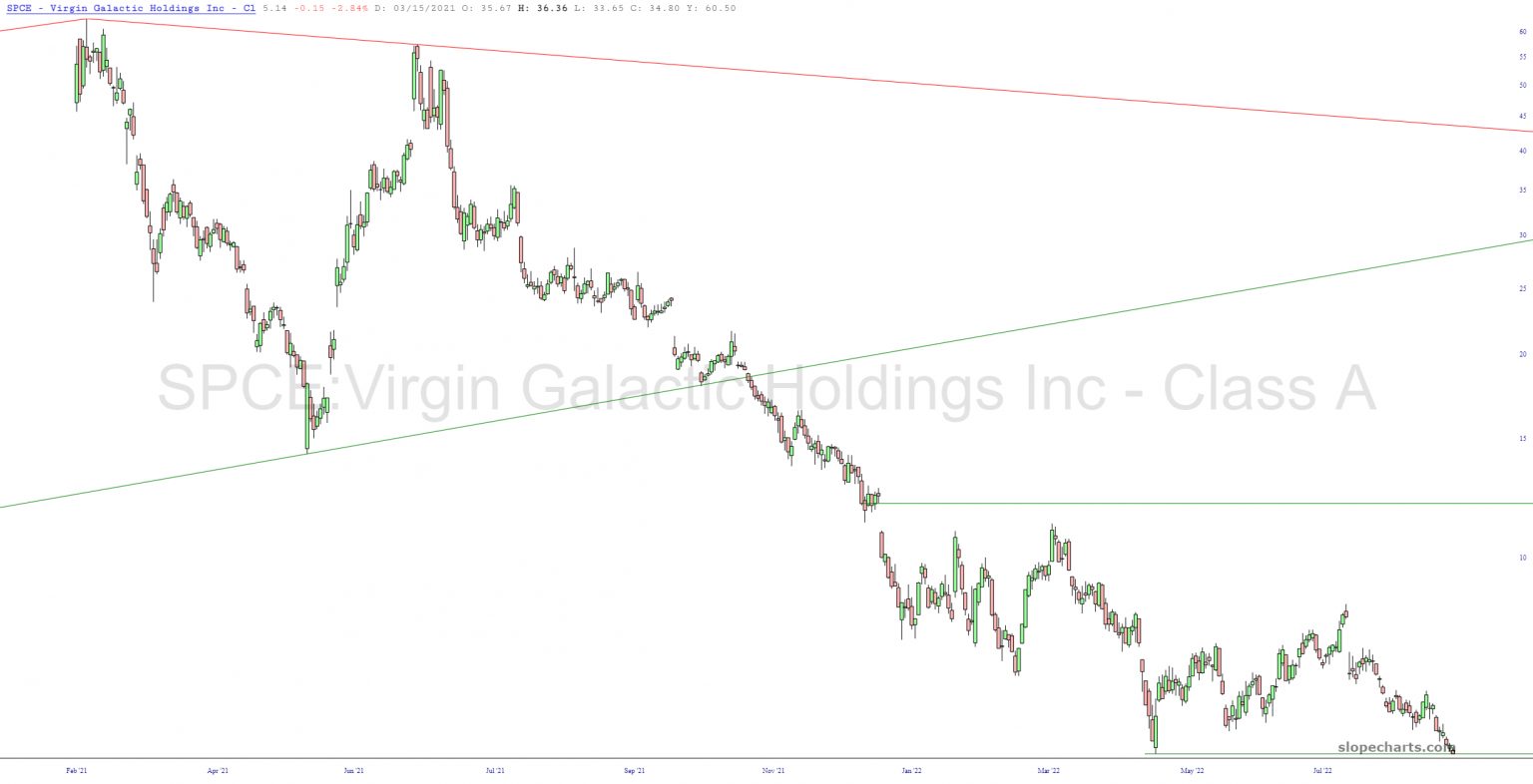
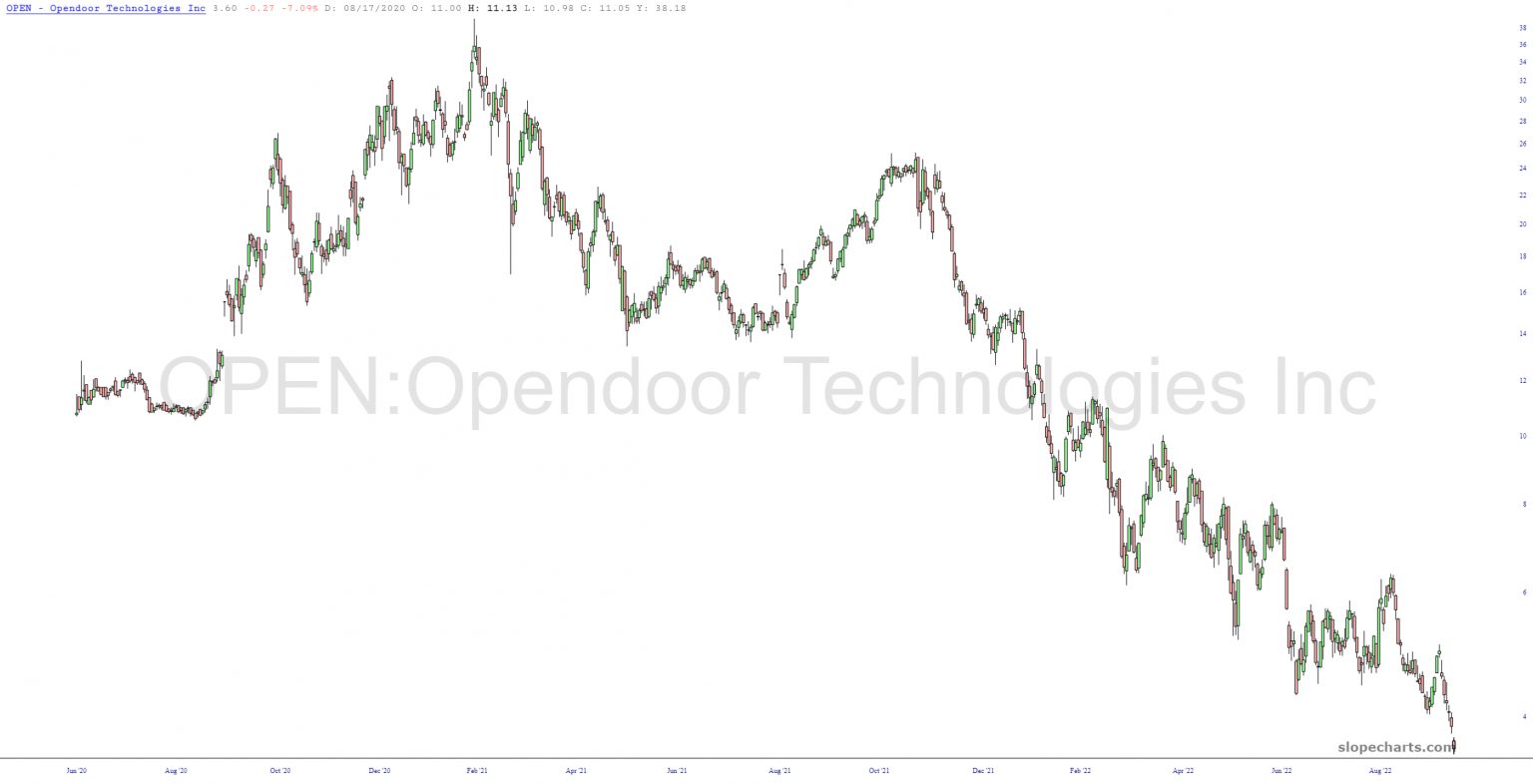
From September 2022's "A Look At Chamath Palihapitiya's SPAC's":
Anyone in the media who gave this guy any oxygen, at all, is an idiot.
(after typing that I thought, "maybe one should check the archive before, rather than after, using the word 'Idiot').*

Virgin Galactic
https://slopeofhope.com/wp-content/uploads/2022/09/slopechart_SPCE-1536x786.jpg
Open Door
https://slopeofhope.com/wp-content/uploads/2022/09/slopechart_OPEN-1536x786.jpg
 
 
*And our mentions of Mr. Palihapitiya? There were three or four, here's another one on the SPACs
 
May 11, 2021
I'm A SPAC Cowboy....
Bet you weren't ready for that.

Because shorting stocks based on valuation (vs fraud) in a bull market is so dangerous, we don't talk about it all that much. There have been a few, the Great Kinder Morgan short of '14* being a wonderful memory, along with a few tactical i.e. quick shorts of Tesla over the years (in direct violation of the decade-long "Don't short TSLA" admonition), but as a general rule, on the blog we only short frauds in a bull. In a bear, "Short 'em all" as one of my mentors used to say.

The fact we don't put every last thought that pops into our collective heads out in public actually benefits our readers as a couple of things that hurt results in 2020 never made it to the blog.

But I don't like blind pools.

And I especially don't like SPAC's with PIPES

And with that confessional we'll turn the narrative over to the professional....

In November 2020's "Arianna Huffington Buys Dopamine Labs" we reused a 2017 quote of his:
 "The short-term, dopamine-driven feedback loops we've created are destroying how society works.  No civil discourse, no cooperation; misinformation, mistruth. And it's not an American problem — this is not about Russians ads. This is a global problem."
—Former Facebook Vice President for Addicting Users, Chamath Palihapitiya

Sunday, November 16, 2025

The “intoxication thesis”: The evolutionary benefits of getting drunk

From BigThink, October 15:

Getting drunk might be bad for you but good for us.  

In this week’s Mini Philosophy interview, philosopher Edward Slingerland argues that behaviors often dismissed as evolutionary “mistakes” — like masturbation, overeating, and drinking — actually serve deeper adaptive purposes. His “intoxication thesis” suggests that alcohol consumption fosters trust, creativity, and social cohesion, making it an essential part of human evolution. What looks like nature’s errors may, in fact, be evolution’s hidden strategies for survival, bonding, and innovation.  

“The classic example of a hijack is masturbation,” Edward Slingerland tells me. We’re talking about all the evolutionary quirks that humans tend to exploit — the cases where we’re “built” for one purpose, but decide to put that structure to other uses. And masturbation is a classic example.

In this week’s Mini Philosophy interview, I spoke with Slingerland about his book Drunk, in which he outlines his “intoxication thesis.” Slingerland argues it’s quite common to think that getting drunk is an evolutionary mistake. Some early Homo sapiens drank too much fermented fruit juice and discovered it was pretty fun. So they told their mates and, altogether, they clinked their frothy ciders and sang bawdy songs about hunting and gathering. But the human brain and body were not built to get drunk. Alcohol is effectively a poison. Our bodies don’t like it — or so the argument goes.

The intoxication thesis says this is all wrong. For Slingerland, drinking alcohol and getting drunk are important to human well-being and complex societies. It might not be what evolution “intended,” but it’s certainly given us a reproductive and interspecies advantage.

So, how is getting drunk different from other “evolutionary mistakes”? And what possible benefits might getting drunk give us? Today, we find out.

The classic example
The reason that masturbation is the “classic example” of an evolutionary mistake is that there’s a very obvious and simple answer as to why an orgasm feels great — it is nature’s reward for doing what our genes really “want” us to do: copy themselves into the next generation. This is what evolutionary biologists call the “adaptive target” of the orgasm. Have sex, reproduce, copy your genes, and you’ll get this surge of dopamine, oxytocin, and lovely, lovely endorphins.

“But humans and other animals have figured out you can get that reward in lots of wildly non-reproductive ways,” Slingerland tells me. “And once we figured that out, we did that all the time. So here’s the classic ‘mistake,’ right: There’s no relationship between an orgasm and reproduction. Evolution doesn’t want us to masturbate, but it doesn’t care because it’s a relatively non-costly behavior. Contrary to what you may have learned in school, it won’t make you go blind. It’s basically low-cost enough that evolution can kind of let it go.”

In other words, from an evolutionary point of view, the cost of masturbation and hijacking the pleasure surge of an orgasm is worth it, so long as humans do, at least a few times, still have an orgasm during reproductive sex.

The Twinkie problem
The other kind of evolutionary mistake is what Slingerland calls the “Twinkie problem,” which is when the body’s reward system was once connected to a certain evolutionarily beneficial behavior, but our environment has now changed so much that the reward system is actually detrimental to our well-being. This is how Slingerland describes it:

“We’re evolutionarily designed to enjoy fat and sugar. We’ll consume it in large quantities whenever we can get it. And that’s great because for almost all of our evolutionary history, and actually for a disturbing number of people still today, getting enough sugar and fat is a problem. And so, you should try to gorge on it whenever you get it. But it becomes a problem when you live in a modern industrialized society and you’re relatively wealthy. You can gorge on Twinkies and potato chips and ice cream.

So, this type of mistake is costly because it causes obesity, diabetes, and all these problems, but it’s very recent, evolutionarily, and it’s geographically still constrained. Again, there are places in the world where you still have trouble getting enough food.”

In other words, while the Twinkie problem is a problem for a growing portion of society, it’s not enough of a problem to fade away — not least because the time scale’s too short for any kind of adaptation. Maybe, in the future, diabetes and obesity will kill off those who really enjoy fat and sugar, and so change the reward system. But that’d be in the far distant future.

The benefits of alcohol....

....MUCH MORE 

The memory that this article was in the link-vault was triggered by the statement introducing the post immediately below, "Worst acquisition ever." Until Bayer bought Monsanto the worst-ever business combination (wealth-destruction-wise) was generally agreed to be AOL-Time Warner.

And then the Germans said "Hold my bier." 

Monday, November 3, 2025

"Venture Capital Firms Bet Big on Gambling. Now They’re Banking on the Addictions."

From Barron's, July 10, 2025: 

U.S. VC firms have invested $2 billion in gambling businesses in recent years. At least six of the firms are simultaneously betting on problem gambling treatments. 

Alumni Ventures got in early on the sports betting trend. In 2017, the New Hampshire–based venture-capital firm was part of an initial round of investment that raised $2 million for Sleeper, a fantasy sports and betting app. Four years later, Sleeper was valued at $400 million. This past August, Alumni made a new bet—this time on gambling addiction treatment, investing $1.5 million in Kindbridge Behavioral Health.

Alumni isn’t the only one getting in on the pair trade. Bettor Capital, a VC firm devoted entirely to gambling, invested in Kindbridge in March. In all, Barron’s identified six VC firms simultaneously invested in gambling and gambling treatment. Most didn’t respond to requests for comment.

The investment thesis is straightforward: As more people gamble, more will eventually develop a gambling problem and seek help. Venture-capital firms see the market for treatment growing in lockstep with the market for gambling.

Tracy Barba, director of the Lucas Institute for Venture Ethics at Santa Clara University, says the paired investments are a clear “conflict of interest” without historical precedent.

“Nobody’s telling them they can’t do this,” Barba says. “When there’s no regulation, no rules, and there’s no consequences or accountability, the only thing that is going to be driving their decision-making is internal revenue return.”

Boston-based Will Ventures has a stake in both Birches Health, a telehealth gambling treatment firm with an “empathetic online care model,” and a stake in BetHog, a crypto casino and sportsbook that calls itself “nakedly degen,” short for degenerate.

All told, U.S. VC firms have invested $2 billion in gambling businesses since a U.S. Supreme Court ruling opened the door to nationwide sports betting in 2018, according to PitchBook. As a business, treating problem gambling is still in its early stages, with VCs generally participating in so-called seed round funding for treatment firms.

As the gambling industry has realigned itself toward a younger audience that prefers virtual betting, treatment is becoming more tech-forward, too: Casinos and in-person therapy are out; smartphone bets and app-based recovery are in....

....MUCH MORE 

If one is interested in all things dopaminergic including signaling pathways and reward deficiency syndrome these prior posts may be of interes:

UK Announces New Crackdown On Predatory Addictive Gambling Games
This stuff is just evil.  Deliberately using a human being's neurophysiology against them to extract every last penny that can be had, and destroy lives as they do it is nasty.... 

Previously on the dopamine channel:  

Engineering Addiction Into Your Product: Lessons From the Professionals

The pros in this case being the gaming gurus at Gamasutra, November 13, 2017:

Compulsion Loops & Dopamine in Games and Gamification....
L.A. Startup Dopamine Labs Manipulates Your Neurotransmitters to Hook You On Apps (and maybe unhook you)

The obsessive checking behavior some users exhibit is virtually indistinguishable from obsessive-compulsive disorder while the anxiety occasioned by withdrawal sure looks miserable.

We have quite a few posts on dopamine cascades and D4 receptors:

Want to Make Big Money? Engineer A Little Addiction Into Your Product

New York Fed On "Anxiety, Overconfidence, and Excessive Risk Taking" (pathological gambling and self-manipulation with booze and blow)

Ethanol: "Why Coffee, Cigarettes and Booze Can Be Good For You"

Your Brain and Financial Bubbles

"Your genes affect your betting behavior"

See also "Pleasure Dissociative Orgasmic Disorder" 

Engineer a Little Addiction Into Your Product - Redux

My work here is done.
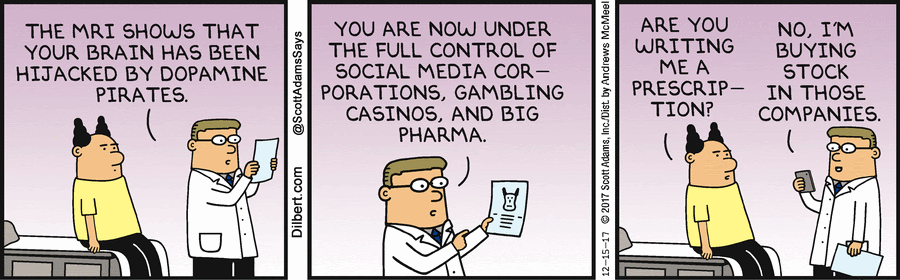
From Dilbert.com:


December 15
Doctor And Dopamine - Dilbert by Scott Adams

December 21
Dopamine - Dilbert by Scott Adams

There are three more in the series, very topical.

Previously in non-Dilbert commentary:
Dec. 11 
Climateer Line of the Day: Neurotransmitters and Facebook Edition
Dec 3 
"The Neurochemistry of Smartphone Addiction"
Sept. 25
Dopamine Labs: "Meet the tech company that wants to make you even more addicted to your phone"
Sept 24
"If You Want To Be Happy, Listen Up. Now! alternative title: The FT's Izabella Kaminska Is...".

And dozens and dozens more including  the namesake 2015 post "Want to Make Big Money? Engineer A Little Addiction Into Your Product"

Finally, from the journal Cell:

Decoding Dopamine Signaling 

https://www.cell.com/cms/attachment/4d2bf50c-3f05-4b9c-a142-0b075955574a/gr1_lrg.jpg 

Sunday, August 31, 2025

"How Surveillance Became a Love Language"

I think it was "Every Breath You Take" in 1983.

Or maybe not, "I'll be watching you" sounds more like stalking than love, come to think of it.

From The Drift Magazine, Issue 14  | December 11, 2024:  

A full-page ad in a November 1990 issue of Fortune magazine features two dozen men in dark suits turned away from the viewer. Standing in neat rows, most blend together in a uniform mass. But three are singled out, with red targets pinned to their backs. The text below the shadowy tableau reads: “Wouldn’t it be great if new customers were this easy to spot? Now they can be.” Bullseye.

The spread was for Lotus MarketPlace, a collaboration between Lotus Development Corporation, a spreadsheet-software tech giant then valued at over one billion dollars, and Equifax, one of the country’s largest consumer credit agencies. Lotus MarketPlace contained detailed profiles of 120 million Americans, including their names, addresses, phone numbers, marital statuses, estimated household incomes, and purchase histories, all filed into lifestyle categories such as “cautious young couples” and “inner-city singles.” For $695 (about $1,600 today), a company could purchase eleven CD-ROM discs of consumer data covering half the U.S. population.

In a Wall Street Journal piece that ran just after the Fortune ad appeared, a Georgetown professor was quoted describing the product as “a big step toward people completely losing control of how, and by whom, personal information is used.” A staff attorney with the American Civil Liberties Union said that Lotus was “stretching for the broadest interpretation of the law and looking for ways to get around its intent.” The article ricocheted through nascent cyberspace, finding its way onto message boards and email lists where angry netizens encouraged one another to call Lotus to insist that their names be removed. This online backlash quickly grew into a coordinated attack, with phone calls and letters overwhelming Lotus’s headquarters.

Nine months after the product was announced, Lotus’s president publicly acknowledged the “volume and tenor of the concerns raised” as well as the insurmountable expense of removing the over thirty thousand people who demanded to be taken out of the database. Lotus MarketPlace was canceled before it even launched. Today, this triumph of privacy advocates reads like a false dawn. In the decades since, we have indeed, as the Georgetown professor warned, completely lost “control of how, and by whom, personal information is used.” 

And we know how it happened. After the dot-com bubble burst in 2002, Google realized that it was sitting on a monetizable surplus: the data produced by people’s engagement with its search engine could be wielded to customize ads. And then it discovered that the more precisely those ads were targeted, the more lucrative they became. Google’s data was richer and vaster than Lotus’s — a combination of search histories, IP addresses, and metadata that could paint a picture of what a specific person in a specific place at a specific time wanted to do, know, or buy. Google’s approach was stealthier, too. The company updated its terms of service to note, without explicitly mentioning advertising, that it was stockpiling this information “to improve the quality of our service and to better understand how people interact with us.” Facebook and data brokers like Acxiom quickly followed suit, refining ad-targeting algorithms and accumulating massive data sets of consumer profiles. By the late 2000s, smartphones provided new sources of data, harvesting information all day long, not just when people were at their computers. There were no more full-page ads in popular magazines. Just terms of service in miniscule fonts, manipulative interfaces, and other tricks of the magician.

The result is that we are now locked in innumerable contracts through which we surrender our personal information for convenience or pleasure — for better search results, faster delivery, more helpful recommendations, thimblefuls of dopamine. We feel conflicted about these agreements, but also powerless to amend or terminate them. Even the “techlash” of the late 2010s — when scandals like Cambridge Analytica and high-octane critiques like Shoshana Zuboff’s The Age of Surveillance Capitalism ended the era of unquestioned techno-optimism — did little to free us from these arrangements. According to a 2023 Pew Research Center survey, 73 percent of Americans feel that “they have very little to no control over the data collected about them by companies.” And yet, we still turn over our information voluntarily for trifles — FaceApp, which demands full access to cameras and camera rolls in exchange for filters that add or subtract twenty years or twenty pounds, has been downloaded by over 350 million people across the globe. We are burnt out, fatigued, addicted. We talk casually about our Big Tech overlords, more or less accepting our debased roles in their fiefdoms.

But there is something more insidious happening, too. Technology companies have so thoroughly conditioned us to believe we are powerless when it comes to digital privacy that our attitudes toward privacy more broadly have also been warped. Just as in the era of the PATRIOT Act the national security state insisted that it was virtuous, even patriotic, to give in to the intelligence machine, tech culture now ascribes its own virtues to the forfeiture of privacy: realness and connection. Where we once guarded our control over personal information, we now give up control not just freely but even tenderly, monitoring and being monitored by loved ones through social media platforms like BeReal and location-sharing apps. It’s a strange form of Stockholm syndrome for the surveillance age — we love, and love with, the tools of our captors. Resigned to the Big Tech companies recording our every move, we’ve invited friends, family, and partners to join them in watching us. We’ve begun to celebrate surveillance as a form of intimacy.

Find My Friends, an app that allows people to track their consenting contacts’ whereabouts in real-time, was introduced in 2011 with the launch of the iPhone 4S. In the app, you can set up alerts for when someone enters or leaves a specified location. Or, you can simply treat Find My as a live map, and watch your targets strut around the neighborhood, the city, or the globe. In 2019, Apple merged Find My Friends with Find My iPhone, which geolocates Apple ID-linked devices. Now, the streamlined Find My app (represented by a green target with a blue bullseye) takes care of both, as if friends are also expensive possessions to track in case they get lost or stolen. And location-tracking is not limited to Find My: Google Maps offers the same, and Snapchat, for example, has a similar feature called Snap Map, which the company claims is accessed by over 350 million users per month.

What might have seemed, not too long ago, like a dangerous act of exposure has rapidly become a security blanket and a source of recreation. Location-sharing apps allow parents to track their adolescent children, and adult children to keep tabs on their senescent parents. Marketed as “family safety” solutions, location-tracking apps like Life360 offer more than just real-time location data. They also maintain a database of your family’s movements, storing up to thirty days of precise location history for every member of your “circle.” There are even smartwatches and other GPS devices designed for kids who don’t yet have phones; the Wizard Watch, for example, says it “gives guardians the confidence to allow their loved one to explore the world outside, without the stress and fear of wondering where they are or if they are safe.” In these duty-bound dynamics, there may be a clear sense in which the person tracking is responsible for the well-being of the person who’s being tracked — one party gives up privacy in exchange for care.

In friendships and intimate partnerships there may be good safety rationales to turn on location sharing, but there’s nothing in the implicit relationship contract to suggest that one person can monitor the other’s whereabouts. Still, it can be entertaining to track the people in our lives. As one 22-year-old Find My user who habitually retrieves ten friends’ locations told Vox, the app “is so, so common among basically everyone I know, just for safety reasons but also for fun.” A 2023 TikTok featuring a screen recording of the Find My interface overlaid with a GIF of Pedro Pascal eating a sandwich and the words “Me checking find my friends to make sure all my sims are where they’re supposed to be” garnered nearly ten million views, one million likes, and countless videos riffing on the format. This kind of location-sharing turns friendship into a video game. And if it’s all a game, there’s no reason to object.

Those who celebrate the fun side of location-sharing apps don’t talk about them in terms of control; they talk about convenience. Apps like Find My save people who are always down to hang from the effort of texting, and enable spontaneous coordination in a globalized, expeditious present in which friends are literally hard to find, stochastically whizzing across and between cities. But what’s really disturbing — and representative of how this technology is changing relationships — is how people talk about mutual location-sharing like it’s a badge of intimacy, the implication being that truly close friends deserve to know everything about each other, including minute-by-minute coordinates. The same Vox article describes the phenomenon as “the next step in digital intimacy after following someone on Instagram.” And some say that it makes their friendships deeper. In The Paris Review, Sophie Haigney (a Drift contributor) cheekily declares Find My to be her “favorite app” and recounts using it “constantly and impractically” to check on her loved ones. “I guess it makes me feel close to them in a stupid technology way,” she explains. In a poetic apologia for the app published in the New York Times, the novelist Kathleen Alcott muses, “Find My Friends rewards a groundwork of trust that’s already laid, magnifying what we know to be true about the people we love through the changes in place that express it.”

In his landmark work from the middle of the last century, sociologist Erving Goffman theorized that in any social interaction, individuals are like actors who tailor their performances to their audiences and their contexts. Building on Goffman’s ideas, media scholars like danah boyd have used the term “context collapse” to describe how social media demands a unified presentation of the self to distinct audiences simultaneously. Unlike face-to-face interactions — in which we present ourselves differently to family, friends, or colleagues — social media forces us to speak to all of them at once. It also introduces another audience member: the algorithm. Whenever we communicate online, we communicate to a collapsed version of our social worlds via a medium that is structured to maximize engagement — by prioritizing the extreme, or the enviable, or the seemingly successful. And so we find ourselves further and further from anything that resembles our complete “self,” presenting ourselves as — per a popular meme — professional on LinkedIn, wholesome on Facebook, slutty on Tinder, and stylish on Instagram. Location-sharing apps, on the other hand, can offer the illusion of remaining whole. They entice in part because they seem to counter the distortionary, performative aspects of social media. They allow us to exercise our desire to rein in our audience and banish the always-lurking algorithm, sharing a truly unfiltered stream of information with the small group we’ve pulled in close. “In a world where we use social media to broadcast highly curated versions of ourselves,” Alcott writes, Find My furnishes an “antithesis.”....

....MUCH MORE 

Speaking of "Every breath you take", in October 2022 we tucked this into the link-vault:

Sting’s startling fortune: Singer earns over £50,000 a month from just one song

Which seems like quite a bit of money for one 42-year old song.

Apparently The Police thought so as well because on August 27, 2025 we saw:

Sting sued by former Police bandmates for millions over lost ‘Every Breath You Take’ royalties

Friday, September 13, 2024

"The Boom in Zero-Day Options Is Coming for Tesla and Nvidia"

Well, I guess my work here is done. I'll check in if there are any breakthroughs in dopaminergic signaling or cascades but for now it looks like beach-time for yours truly.

From the Wall Street Journal, September 9:

Brokers and exchanges discuss expanding #0dte to options on individual stocks

A popular, fast-paced trade has boosted the options market to record volumes in recent years. Now, Wall Street is looking to push it even further.

Zero-day-to-expiry options let investors bet on whether a particular stock-market index will rise or fall by the end of the day. They have drawn an enthusiastic following among amateur investors, even as skeptics call them a form of gambling. They are sometimes known by the hashtag #0dte.

So far, the #0dte boom has been limited to options tied to indexes such as the S&P 500 or Nasdaq-100. The next frontier could be options on stocks such as Tesla or Nvidia.

Currently, options tied to individual stocks expire weekly, on Fridays. To bring #0dte to single-stock options, exchanges would need to add new expirations for Monday through Thursday.

Michael McCaskill, a 48-year-old day trader and volleyball-programs coordinator in Louisville, Ky., trades short-dated options in hopes of hitting the jackpot. He’s intrigued by the prospect of more-frequent expirations on single-stock options.

“The percentage gains are incredible,” said McCaskill, who has previously made profitable bets on GameStop, Netflix and PayPal. “It’s the short-dated options that give you that, whether it’s weekly or daily.”

Financial-industry executives hope that rolling out daily expirations on single-stock options can unleash a trading bonanza. But it would also pose new risks for investors, particularly for options that expire on days when a company reports earnings after 4 p.m. ET. With daily expirations, many more options would expire the same day as large, after-hours price moves. Few companies report earnings on Fridays.

During the past year, brokers, exchanges and electronic-trading firms—including heavyweights such as Charles Schwab and Citadel Securities—have discussed the pros and cons of bringing the #0dte model to options on individual stocks, people familiar with the matter said.

In closed-door industry meetings, retail brokerages such as Robinhood Markets, Schwab, Tastytrade and Morgan Stanley’s E*Trade have advocated for a cautious approach, concerned they could face a customer backlash if investors’ options trades blow up, the people said.

Other firms—including Susquehanna International Group, a huge options-market maker, and Nasdaq—have actively promoted bringing daily expirations to single-stock options, the people said. Both market makers and exchanges stand to benefit from the volumes that could come from further growth in the #0dte phenomenon.

The earliest that #0dte might come to options on individual stocks is late 2025, the people said. Some proponents of the move have suggested a limited launch, covering options on just a small number of stocks initially, to give investors time to adapt....

....MUCH MORE

If interested see also June's "How gamification took over the world" or a couple hundred others, 'search blog' box upper left, keyword: dopamine.

The Dalmatian Coast is nice, quiet with the crowds thinning out, ditto for Amalfi later in the year.

Tuesday, August 20, 2024

"Keep an eye on the tumbling US dollar"

From Sherwood news (div. of Robinhood Financial, get it?), August 20:

The dollar has slumped against the yen, and is reaching a critical inflection point versus other major currencies as well.

The eagle’s wings have been clipped.

The US dollar is sinking like a stone, with the Bloomberg Dollar Spot Index down 1% over the past three sessions and more than 3% off its late June 2024 peak.

Of course, the biggest factor behind the ferocity of the USD decline in August was the unwind of the yen carry trade, which propelled the Japanese currency sharply higher.

Analysts at Bespoke Investment Group note that, through Monday, “2.0 percentage points of [the Bloomberg Spot Index’s] total drop has come from the yen, which has gained almost 10 percentage points against the dollar during its recent short squeeze.”

“All other currencies have accounted for only slightly more than 1% of the drop,” they add. “This USD decline is far less about broad dollar weakness than the yen story,”

https://cdn.robinhood.com/static_content/mwphzyq69oso/en-US/assets/files/5xMNxZFPSz0F75dI8CmbQs_1_Screenshot%202024-08-20%20at%208.56.25%E2%80%AFAM.png

Bespoke Investment Group

But scan across the foreign exchange universe, and we’re reaching the point where this could transform from “yen strength” to “broad dollar weakness” – or this nascent trend could peter out....

....MUCH MORE

Also at Sherwood:

Unpacking the bizarre economic study that says hot people aren’t big gamers  

As I've said over the years, I'm not much into gaming...
(dopamine and GPUs on the other hand...)

Tuesday, June 18, 2024

"How gamification took over the world"

From MIT's Technology Review, June 13:

Gamification was always just behaviorism dressed up in pixels and point systems. Why did we fall for it?

It’s a thought that occurs to every video-game player at some point: What if the weird, hyper-focused state I enter when playing in virtual worlds could somehow be applied to the real one? 

Often pondered during especially challenging or tedious tasks in meatspace (writing essays, say, or doing your taxes), it’s an eminently reasonable question to ask. Life, after all, is hard. And while video games are too, there’s something almost magical about the way they can promote sustained bouts of superhuman concentration and resolve.

For some, this phenomenon leads to an interest in flow states and immersion. For others, it’s simply a reason to play more games. For a handful of consultants, startup gurus, and game designers in the late 2000s, it became the key to unlocking our true human potential.

In her 2010 TED Talk, “Gaming Can Make a Better World,” the game designer Jane McGonigal called this engaged state “blissful productivity.” “There’s a reason why the average World of Warcraft gamer plays for 22 hours a week,” she said. “It’s because we know when we’re playing a game that we’re actually happier working hard than we are relaxing or hanging out. We know that we are optimized as human beings to do hard and meaningful work. And gamers are willing to work hard all the time.”

McGonigal’s basic pitch was this: By making the real world more like a video game, we could harness the blissful productivity of millions of people and direct it at some of humanity’s thorniest problems—things like poverty, obesity, and climate change. The exact details of how to accomplish this were a bit vague (play more games?), but her objective was clear: “My goal for the next decade is to try to make it as easy to save the world in real life as it is to save the world in online games.”

While the word “gamification” never came up during her talk, by that time anyone following the big-ideas circuit (TED, South by Southwest, DICE, etc.) or using the new Foursquare app would have been familiar with the basic idea. Broadly defined as the application of game design elements and principles to non-game activities—think points, levels, missions, badges, leaderboards, reinforcement loops, and so on—gamification was already being hawked as a revolutionary new tool for transforming education, work, health and fitness, and countless other parts of life. 

Instead of liberating us, gamification 
turned out to be just another tool for 
coercion, distraction, and control.

Adding “world-saving” to the list of potential benefits was perhaps inevitable, given the prevalence of that theme in video-game storylines. But it also spoke to gamification’s foundational premise: the idea that reality is somehow broken. According to McGonigal and other gamification boosters, the real world is insufficiently engaging and motivating, and too often it fails to make us happy. Gamification promises to remedy this design flawby engineering a new reality, one that transforms the dull, difficult, and depressing parts of life into something fun and inspiring. Studying for exams, doing household chores, flossing, exercising, learning a new language—there was no limit to the tasks that could be turned into games, making everything IRL better.

Today, we live in an undeniably gamified world. We stand up and move around to close colorful rings and earn achievement badges on our smartwatches; we meditate and sleep to recharge our body batteries; we plant virtual trees to be more productive; we chase “likes” and “karma” on social media sites and try to swipe our way toward social connection. And yet for all the crude gamelike elements that have been grafted onto our lives, the more hopeful and collaborative world that gamification promised more than a decade ago seems as far away as ever. Instead of liberating us from drudgery and maximizing our potential, gamification turned out to be just another tool for coercion, distraction, and control.

Con game
This was not an unforeseeable outcome. From the start, a small but vocal group of journalists and game designers warned against the fairy-tale thinking and facile view of video games that they saw in the concept of gamification. Adrian Hon, author of You’ve Been Played, a recent book that chronicles its dangers, was one of them.

“As someone who was building so-called ‘serious games’ at the time the concept was taking off, I knew that a lot of the claims being made around the possibility of games to transform people’s behaviors and change the world were completely overblown,” he says. 

Hon isn’t some knee-jerk polemicist. A trained neuroscientist who switched to a career in game design and development, he’s the co-creator of Zombies, Run!—one of the most popular gamified fitness apps in the world. While he still believes games can benefit and enrich aspects of our nongaming lives, Hon says a one-size-fits-all approach is bound to fail. For this reason, he’s firmly against both the superficial layering of generic points, leaderboards, and missions atop everyday activities and the more coercive forms of gamification that have invaded the workplace....

....MUCH MORE

If interested see also:

"The Gamification of Banking"

Gamification: It's Definitely Not Fun and Games
 
From Dilbert.com:

Doctor And Dopamine - Dilbert by Scott Adams

Dopamine - Dilbert by Scott Adams

Saturday, April 13, 2024

The Gamification Of Everything

From UnHerd, April 13:

How games are used to control you 
You don't have to play by other people's rules 

For years, some of the world’s sharpest minds have been quietly turning your life into a series of games. Not merely to amuse you, but because they realised that the easiest way to make you do what they want is to make it fun. To escape their control, you must understand the creeping phenomenon of gamification, and how it makes you act against your own interests.

This is a story that encompasses a couple who replaced their real baby with a fake one, a statistician who cost the US the Vietnam War, and the biggest FBI investigation of the 20th century. But it begins with a mild-mannered psychologist who studied pigeons at Harvard in the Thirties. B.F. Skinner believed environment determines behaviour, and a person could therefore be controlled simply by controlling their environment. He began testing this theory, known as behaviourism, on pigeons. For his experiments, he developed the “Skinner box”, a birdcage with a food dispenser controlled by a button.

Skinner’s goal was to make the pigeons peck the button as many times as possible. From his experiments, he made three discoveries. First, the pigeons pecked most when doing so yielded immediate, rather than delayed, rewards. Second, the pigeons pecked most when it rewarded them randomly, rather than every time. Skinner’s third discovery occurred when he noticed the pigeons continued to peck the button long after the food dispenser was empty, provided they could hear it click. He realised the pigeons had become conditioned to associate the click with the food, and now valued the click as a reward in itself.

This led him to propose two kinds of reward: primary and conditioned reinforcers. A primary reinforcer is something we’re born to desire. A conditioned reinforcer is something we learn to desire, due to its association with a primary reinforcer. Skinner found that conditioned reinforcers were generally more effective in shaping behaviour, because while our biological need for the primary reinforcer is easily satiable, our abstract desire for the conditioned reinforcer isn’t. The pigeons would stop seeking food once their bellies were full, but they’d take far longer to get tired of hearing the food dispenser click.

Skinner’s three key insights — immediate rewards work better than delayed, unpredictable rewards work better than fixed, and conditioned rewards work better than primary — were found to also apply to humans, and in the 20th century would be used by businesses to shape consumer behaviour. From frequent-flyer loyalty points to mystery toys in McDonald’s Happy Meals, purchases were turned into games, spurring consumers to purchase more.

Some people soon began to consider whether games could be used to make people do other things. In the Seventies, the American management consultant Charles Coonradt wondered why people work harder at games they pay to play than at work they’re paid to do. Like Skinner, Coonradt saw that a defining feature of compelling games was immediate rewards. Most of the feedback loops in employment — from salary payments to annual performance appraisals — were torturously long. So Coonradt proposed shortening them by introducing daily targets, points systems, and leaderboards. These conditioned reinforcers would transform work from a series of monthly slogs into daily status games, in which employees competed to fulfil the company’s goals.

In the 21st century, advances in technology made it easy to add game mechanics to almost any activity, and a new term — “gamification” — became a buzzword in Silicon Valley. By 2008, business consultants were giving presentations about leveraging fun to shape behaviour, while futurists gave TED Talks speculating on the social implications of a gamified world. Underpinning every speech was a single, momentous question: if gamification could make people buy more stuff and work more hours, what else could it be used to make people do?

The tone was generally utopian, because back then gamification seemed to be mostly a force for good. In 2007, for instance, the online word quiz FreeRice gamified famine relief: for every correct answer, 10 grains of rice were given to the UN World Food Programme. Within six months it had already given away over 20 billion grains of rice. Meanwhile, the software-as-a-service company, Opower, had gamified going green. It turned eco-friendliness into a contest, showing each person how much energy they were using compared with their neighbours, and displaying a leaderboard of the top 10 least wasteful. The app has since saved over $3 billion worth of energy. And then there was Foldit, a game developed by University of Washington biochemists who’d struggled for 15 years to discern the structure of an Aids virus protein. They reasoned that, if they turned the search into a game, someone might do what they couldn’t. It took gamers just 10 days.

Even established corporations saw gamification’s potential. In 2008, Volkswagen debuted a campaign called “The Fun Theory”, based on the idea that “fun is the easiest way to change people’s behaviour for the better”. Piano stairs were installed at a Stockholm rail station to encourage people to use them instead of the escalator, leading to a 66% increase in stair use. Volkswagen also tried to gamify gamification itself, creating a contest for good game ideas. The winning idea was a “speedcam lottery”, where people who kept to the speed limit would be entered into a prize draw, funded by speeding fines.

It all seemed so simple: if we could only create the right games, we could make humanity fitter, greener, kinder, smarter. We could repopulate forests and even cure cancers simply by making it fun.

Unfortunately, that didn’t happen. Instead, gamification took a less wholesome route....

....MUCH MORE

If interested see also:

"The Gamification of Banking"

Friday, March 29, 2024

Orangutans Can Be Such Jerks

Otters, almost as mean as weasels.

Despite this, still our second favorite primates.

Friday, January 19, 2024

Pure Evil: "Robinhood agrees to pay $7.5M fine, change 'gamification' practices"

This is pure evil, using the speculator's neurochemistry, the dopamine reward pathways, to extract even more money from them.

From The San Francisco Business Times, January 18:

Robinhood Financial LLC, the California-based online brokerage, has agreed to pay a $7.5 million fine, overhaul its digital engagement practices and take steps to increase cybersecurity in order to settle a 2020 case brought by Massachusetts securities regulators.

Secretary of the Commonwealth William's Galvin's office argued that the Robinhood app used "gamification" techniques to entice users to make stock market trades, including many users with little to no experience trading. Galvin said the company exposed Massachusetts residents to "unnecessary trading risks" without developing the necessary infrastructure to protect them.

Robinhood filed a consent order with Galvin's Securities Division settling the case Thursday.

His office pointed to the company's use of push notifications, confetti animation, digital scratch tickets and other game-like features to draw users in. Robinhood stopped using many of these techniques after complaints arose. However, as part of Thursday's settlement, "Robinhood will cease any future use of celebratory imagery tied to the frequency of trading, push notifications highlighting specific lists, and features that mimic games of chance" for Massachusetts customers....

....MUCH MORE

Previously:

Want to Make Big Money? Engineer A Little Addiction Into Your Product

"The Gamification of Banking"

Gamification: It's Definitely Not Fun and Games

Engineering Addiction Into Your Product: Lessons From the Professionals
The pros in this case being the gaming gurus at Gamasutra, November 13, 2017:
Compulsion Loops & Dopamine in Games and Gamification....

New York Fed On "Anxiety, Overconfidence, and Excessive Risk Taking" (pathological gambling and self-manipulation with booze and blow)  

Engineer a Little Addiction Into Your Product - Redux

My work here is done.
From Dilbert.com:
December 15
Doctor And Dopamine - Dilbert by Scott Adams

December 21
Dopamine - Dilbert by Scott Adams

There are three more in the series, very topical. 


Saturday, December 9, 2023

"Mysterious Link Between Owning Cats And Schizophrenia Is Real, Study Says"

I thought everyone knew that. (no, not talking sexist anecdotal "rise of the crazy cat ladies", see after the jump)

From ScienceAlert, December 8:

A new review suggests that having a cat as a pet could potentially double a person's risk of schizophrenia-related disorders.

Australian researchers conducted an analysis of 17 studies published during the last 44 years, from 11 countries including the US and the UK.

"We found an association between broadly defined cat ownership and increased odds of developing schizophrenia-related disorders," writes psychiatrist John McGrath and fellow researchers, all from the Queensland Centre for Mental Health Research.

This idea that cat ownership could be linked to schizophrenia risk was proposed in a 1995 study, with exposure to a parasite called Toxoplasma gondii suggested as a cause. But the research so far has put forth mixed conclusions.

Studies have found that being around cats during childhood might make a person more likely to develop schizophrenia; however, not all studies have found an association.

Some also link cat exposure to higher scores on scales that measure traits related to schizophrenia – which affects a person's thoughts, feelings, and behaviors – and psychotic-like experiences, but again, other studies don't show this connection.....

*****

....The study has been published in Schizophrenia Bulletin. 

....MUCH MORE

I wonder if I could get a discount for a lifetime subscription?

Previously:

2012: "Could Tiny Organisms Carried by House Cats be Creeping into our Brains, Causing Everything from Car Wrecks to Schizophrenia? "

2014  The Ig Nobel Prizes, 2014

....PUBLIC HEALTH PRIZE [CZECH REPUBLIC, JAPAN, USA, INDIA]: Jaroslav Flegr, Jan Havlíček and Jitka Hanušova-Lindova, and to David Hanauer, Naren Ramakrishnan, Lisa Seyfried, for investigating whether it is mentally hazardous for a human being to own a cat.

REFERENCE: "Changes in personality profile of young women with latent toxoplasmosis," Jaroslav Flegr and Jan Havlicek, Folia Parasitologica, vol. 46, 1999, pp. 22-28. 

REFERENCE: "Decreased level of psychobiological factor novelty seeking and lower intelligence in men latently infected with the protozoan parasite Toxoplasma gondii Dopamine, a missing link between schizophrenia and toxoplasmosis?" Jaroslav Flegr, Marek Preiss, Jiřı́ Klose, Jan Havlı́ček, Martina Vitáková, and Petr Kodym, Biological Psychology, vol. 63, 2003, pp. 253–268. 

REFERENCE: "Describing the Relationship between Cat Bites and Human Depression Using Data from an Electronic Health Record," David Hanauer, Naren Ramakrishnan, Lisa Seyfried, PLoS ONE, vol. 8, no. 8, 2013, e70585. WHO ATTENDED THE CEREMONY: Jaroslav Flegr, David Hanauer, Naren Ramakrishnan